Magazine Section
pp. 65-69 · Read in the full issue


San Jorge's Ghosts And Things
That Go Bump In The Night
By John Grover
The Spanish Explorer Alvaro de Mendana discovered the Solomons in 1568, 200 years before Captain Cook, and reported a population of about 5,000 people on San Jorge, an island of roughly 60 square miles, rounded in profile. When the British Protector ate was declared in 1893 the entire population had gone and the island was tabu. The mystery has never been explained.
Ernie Palmer’s father established a coconut plantation there alongside the narrow Ortega Channel, but no Islanders would stay the night on the island with him, always preferring to leave before dark in their canoes, to cross the channel to Isabel. Palmer found minerals, so the islanders tell, but one evening went for a walk, broke his leg, and had been eaten by ants before he was found.
And so San Jorge was still deserted and tabu when Roy Hudson, Owen Jones and I arrived there in 1949, accompanied by the Commissioner for Lands, Peter Hindle. The government had asked us to look at this strange island, so different to all others in the protectorate.
The Islanders warned us not to sleep there, quoting the end of Palmer. They believed that this would happen to us, too. Medical Practitioner Bogesi, a well-spoken erudite Islander who had spent some time in Australia, told us of the singing and the night lights that could be seen across on San Jorge. We slept on our small ship
Nancy.
Next day we set out through the swamps, cutting our way, led by Con stable Sakabose—and eventually we returned to Honiara, plucking as we went the pigeons we had shot. It was some years before I experienced the unusual happenings on that strange island.
Far from it bringing bad luck, the reverse seemed true as far as I was concerned. In Honiara the Resident Commissioner Mr Germond invited me to consider the post of Senior Geolo gist and initiate a Geological Survey.
A newspaper story of seven Japanese soldiers believed to be still hiding on San Jorge Island reminded the author of some un usual happenings there. He won ders now whether a Japanese soldier might not have accounted for at least one of those ex periences.
Declining the invitation then, I pro mised to consider it when I returned to Australia Several weeks later, in August 1949, I wired advising my interest but inability to begin before April 1950, which drew perhaps the most unusual Colonial Service appointment of the post war years: His Excellency the High Commissioner for the Western Pacific has appointed you Senior Geologist to the British Solomon Islands Protectorate subject to you obtaining a first class honours degree and commencing duties in April, 1950.
Then in my final year at the University of Sydney, this trip to San Jorge had led to my association with the Solomon Islands for the next two decades to explore and map them in an effort to assess their mineral potential.
However, San Jorge did not allow me off scot-free—it was responsible for my first red-faced encounter with the Press. On our return to Sydney, Roy Hudson had suggested that we should be kind to the reporters and give them a fair and factual state ment concerning our gold-sampling expedition. He, Owen Jones and I composed it; duly signed, it was handed over to a man from a Sydney paper.
We had described how we had gone to Gold Ridge, resampled the gold bearing country, and had then been asked to look at the strange Island of San Jorge where the Spaniards had reported 5,000 people.
Next day in the Melbourne Sun with a map of San Jorge and Santa Isabel, headlines: “5,000 NATIVES DIS
Appear From The Solomon
ISLANDS” as though it had hap pened last Wednesday. In need of advice I telephoned my old friend R. W. Robson and asked what I should do.
He told me the facts of life. There was nothing that could be done. And so the San Jorge story reverberated around the world. Someone said that a question had been asked in the United Nations as to what the awful British had been doing, but I don’t know whether this is true. In any event the report came back to Sydney several weeks later in a small para graph from an overseas agency.
I sailed for the Solomons in the old SS Morinda, arriving in April 1950 and beginning what appeared to be a monumental task of exploration that would take about 70 years. I had not then reckoned with electronics and the explosion of knowledge that would come from its use in collecting data; nor had I thought of using warships and aircraft.
In November 1950 additional sup port arrived in the person of Profes sor Charles E. Marshall of the Uni versity of Sydney in response to my proposal for a collaborative venture.
We went to San Jorge as part of our reconnaissance and noted the “gibber desert” kind of terrain, and a foot path on the ridge crest probably worn by the population that the Spaniards saw 400 years before. Inside small pyramids of piled stones along side the path the Professor observed that the ground level was about 15 inches higher than outside, suggest ing that those stones had been there a long time. John Proud joined us and we camped ashore on the west coast of San Jorge.
Each evening four large crocodiles would line up offshore watching us.
As darkness fell they would close in.
With our Guadalcanal bushmen bearers (who did not know of the
island's reputation, or did not care) we would stand on the beach in the gathering darkness, watching the beasts approach, throwing stones without effect, and then all together retire into our camp as the beasts came ashore on both sides of us.
We were not attacked, but were told later that this was par for San Jorge and that we could only expect them to gang up on us if we shot one. In our years on San Jorge we never did and the crocs obeyed the rules very well. We were only at tacked by sharks who knew no rules.
I escaped one by the skin of my heels much to everyone’s mirth; Dick Stanton, examining a cliff base up to his waist in the sea, fought off one with his geological hammer.
After Professor Marshall’s recon naissance, Dr Stanton undertook the exploration of Santa Isabel and San Jorge, beginning a remarkable as sociation with the Solomons that was to last for 15 years. On his first of many expeditions we noted the pre sence of nickel as well as chrysotile asbestos which had been John Proud’s main interest.
Subsequently I lunched in London with Frank Howard-White (author of “Nickel”) and my return to the Solomons was the signal for two representatives of the International Nickel Company to join me on San Jorge—to begin hand-drilling the laterites. Thus began the work car ried on by my Department of Geo logical Surveys when the company withdrew. It came back again on the basis of our assay results.
By 1969, 42 million tons of nickel oxides had been outlined, of grade 1.00 per cent or better, half this quantity going 1.3 per cent or better.
Only recently INCO withdrew, having so much more easily accessible nickel sulphides available elsewhere for min ing. If only Kambalda’s nickle sul phides had not been found, San Jorge might have been the scene of mining operations similar to those of New Caledonia. The men from INCO and Geology were to have strange ex periences, only some of which I can mention here.
In 1958 we had managed to obtain the Royal Navy’s collaboration in the shape of HMS Cook towing a new fangled “fish” behind it which mapped the magnetic intensity of the region.
From this work in the Solomons and subsequent discussions during my leave in London came the eventual decisions to equip HM Hydrographic Survey Ships in the future with such proton magnetometers and gravity meters.
We were to be most grateful in the years that followed, for the ex cellent geophysical survey work under-
taken aboard ships of the Hydrographic Department of the Royal Navy. The San Jorge story concerned Fred Gray, geophysicist and electronics wizard from the Royal School of Mines who had equipped and come with HMS Cook, using funds we had arranged. We asked him to bring his shore magnetometer to make a survey of the nickel and asbestos-rich rocks, to see if we could recognise any relevant ’ signatures indicating asbestos mineral,sat.on.
We all camped alongside a small stream at Bungasele, 600 feet up on San Jorges latente plateau overlooking the wide sweep of calm, islandstudded Thousand Ships Bay across
to rugged, jungle-covered, saw-toothed
volcanic Sami Isabel on the other side. What a contrast in land form!
For San Jorge was 1.300 feet high and rounded in profile with vast areas too poisonous with nickel to grow forest and covered with bracken.
Other older nickel areas grew forests of ebony, so hard that Australian iron bark was soft by comparison.
At Bungasele Camp we peeled back the bracken, rotting vegetation and moss carpet, rolling it into the tall slender trees that nearly surrounded us. Three tent flys for sleeping, one for mess tent, several lean-to bush leaf shelters comprised the camp—all of them close to the trees, for the area was not large.
We all experienced strange feelings that first night. I had a vivid dream of pigs in large numbers trotting past, their hooves thundering on the laterite, one came into my tent
and was standing at the foot of my stretcher outside my mosquito net. It didn’t worry me; but I shone my powerful torch to chase it away. Noth ing moved. I got out to check, walked into the forest and saw nothing so got back into my blankets, At t he same time I thought I heard a voice saying quite clearly “This was a village time before”. I looked w j t b interest toward the enormously tall pa i m with its solitary white trunk gleaming in the moonlight and thought what a convenient, well-watered site it was? as j dozed off to sleep , , , ... T . , Unbeknown to me at that time John »as sitting up in his bed thmk in 8 th,s P ,ace grange John H U was pacing up and down in the middle °, f the ? am P ln B th ‘ s P> ace „. f stran * e - 1 can ‘ slee P - and John , wa ?. a ma " wh .° usual ‘ y out !' k „ e a seeping without dreami g.
Suddenly the night silence was shat tered h . y a scream of terror endmg ,n a B ur 8 le - Grabbing my machete and torch I leapt out of my blankets and con verged with the others on the shelter occupied by John Teaitale, the Senior Geological Assistant, to find him rol ling on the ground entangled in his green mosquito net, perspiring pro fusely. Disengaging himself he stood up in the midst of us and said “I’m sorry, sir, but I had a dream that pigs came into the camp and one boar attacked and was goring me”, I remember his words well, for he and I had the same dream—but I never told him this, as we did not want
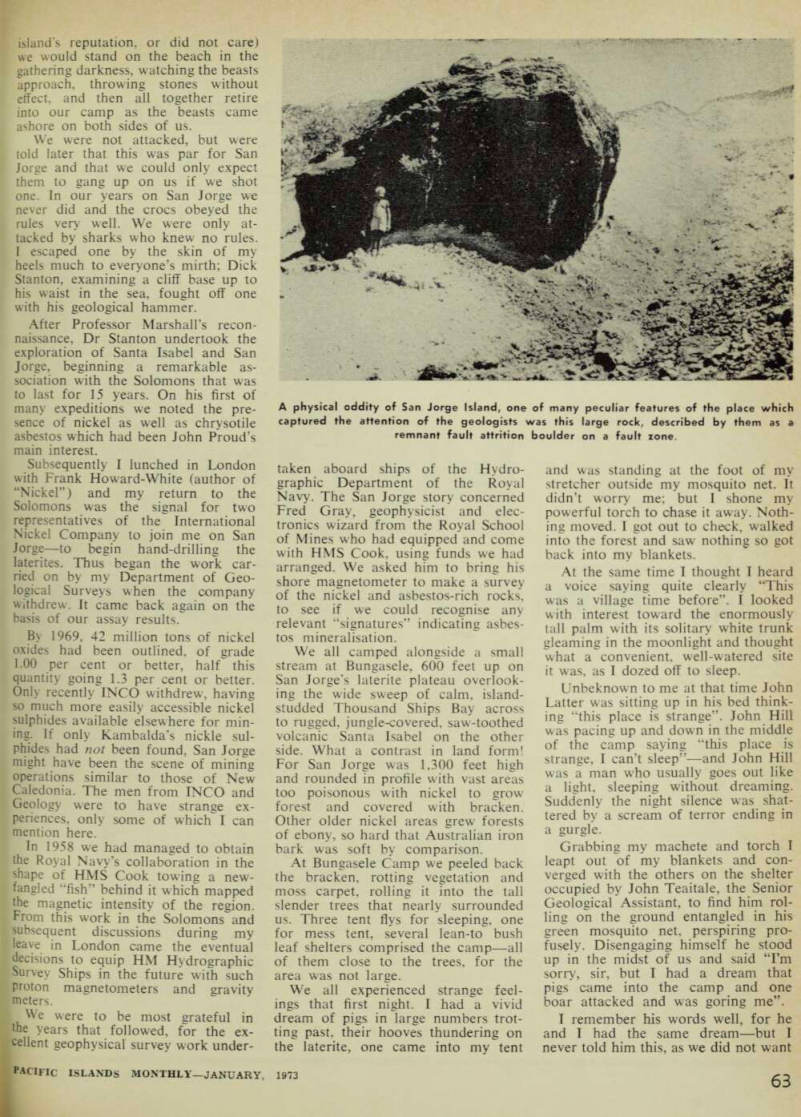
A physical oddity of San Jorge Island, one of many peculiar features of the place which captured the attention of the geologists was this large rock, described by them as a remnant fault attrition boulder on a fault zone.
Apparition In The Moonlight
to cause concern about the strangeness of the place, as we had work to do.
Next night I had a strange en counter with a black snake, one of the only deadly variety, and the next night with a large centipede nearly a foot long. Stranger by far was the ex perience of John Hill.
I should explain that through our camp site went that ancient track that crossed the island, coming up from the Astrolabe Bay, passing into the tall trees. John’s tent was astride this trail. His bed was on it and along it. Anyone wanting to use the trail would have to detour past the tent pegs and walk past John’s bed.
He awoke at something after mid night to the apparition of a man stand ing at the end of the tent, looking down at him from a few feet away.
The moonlight was shining on his face. John, his hand on torch, ready, watched him through his mosquito net without moving, studying his features, carefully pinching himself to be sure that he was not dreaming.
He was sure that he was wide awake.
Eventually feeling that he could hardly stay there all night watching like this, he lifted up the net and got out. Nobody was there. He came and mentioned it to us explaining that it was unusual for him to dream. He described the man; “He was not an old man, he was only about forty”.
I had reason later to remember John’s words.
Thereafter the trees began to fall all night long, about three every two hours, without apparent reason -—7 O-odd feet high, crashing around the camp. We began to get jumpy.
Next night, I had retired at 9 p.m. but wakened at 11.30 p.m. when John Latter passed by with his bright pressure lamp on his way to bed. For no reason, and quite unable to control my words, it seemed, I called out John, come here a minute with that lamp! There is a big tree leaning over one of the tents!”. This was also news to me for I had not seen it and could not explain why I should have talked thus. . Sure enough we found one lean ing about 30 degrees to the vertical resting against another tree in line with the centre of one of the tents.
John Hill said to me “It’s all right it won’t hit the tent”. I looked and reckoned it would if it fell. Chuchu was called up with his axe, everyone got out of his way, and the support ing tree was felled.
The big one crashed into the fork ot yet another tree on the far side of mat tent, being held about six inches
above and across its ridge-pole.
“That’s 0.K.” said everyone. But I can remember, as though a debate were in progress, voices saying “It is all right let them stay” and another “No, get them out!”.
Eventually I ordered everyone out from that tent, into the others. At 3 a.m. down thundered the heavy rain on our taut canvases. A couple of minutes later there was an unholy crash as the supporting tree split and the tall one flattened that empty tent!
The next night John Hill awoke about midnight and in spite of saying to himself “this is bloody impossible” he could see this apparition again— the same man—this time with a male volent expression on his face, frowning at John from where he stood on the ancient trail on the outside of the tent.
John could see him through the canvas, in spite of pinching himself and telling himself that it was ridi culous. There he was. They watched each other. Eventually John had to do something. He lifted his net and got out. Nobody was there. But the trees continued to fall—about three every two hours during the night.
We were all relieved when the time came to leave the strange island and returned to Honiara. But it was not the end of the story.
I met Rev. Father de Theye in Chinatown and broached the subject: “Father, did not the Catholic Mis sion have a bishop murdered on San Jorge in 1845?”. “No, Mr Grover, Bishop Epalle and Father . . . were murdered on Santa Isabel, but were buried at Astrolabe Bay on San Jorge because the island was tabu. We had their remains removed in 1902 for decent burial at Rua Sura when the mission was re-established.” I asked him “What kind of a man was Bishop Epalle?” He replied “Well, he was not an old man, he was only about forty” ... the exact words John Hill had used! I then ascertained that there was a photograph of him in the Mis sion Library, The pressure of our duties caused us to forget these events until several months later, the day before John Hill was due to leave the Solomons.
I remembered that we had not looked at the photograph of Bishop Epalle.
I phoned Father Moore and arranged for a loan of the book from the Mis sion library and had it brought up.
We opened at the page and John Hill looked at it. “Yes,” he said “That could have been the man.” The 113year-old graves of Bishop Epalle and his martyred colleague had been at
the foot of that trail that passe through John Hill’s tent.
Exploration on San Jorge continue for another ten years. INCO took ov< from the Department in 1963—the did a sterling job of assessment. W dropped out. Eventually I went t Fiji, and to Australia. In mid-197 I was at Kalgoorlie in Western Aus ralia and met Bro Palmer, an en ployee of INCO, grandson of Palme who had died on San Jorge. We ha not met for about a dozen years. H told me the story of Bill Heseltin on San Jorge.
Bill was in charge of operations, solid citizen, ex-paratrooper/coir mando type, casual and fearless. Br told the story how one evening wit darkness falling, Bill was alone an headed back to Bungasele camp fol lowing the ancient trail, a roll of map under his arm. A sixth sense warne him that he was being follows silently by something close behind he increased his pace and dared no turn around.
The tall trees were close at ham in the gathering darkness and so wa the follower. Bill broke into a trot He dropped his maps but did no pause, running through the trees t( the camp, arriving with evident re lief. He even discussed it with hi: colleagues. What was it?
And so in far away Kalgoorlie the last account of strange things oi San Jorge was told. But these thing are not only recent or post-war. The} were happening long before that. Foi once, while the island was being ex plored, a bottle was found on th< peak of the highest hill and in it wa: a piece of paper with words to th( effect that Father . . . Tinoni o\ the Melanesian Mission did on thh day , . . 1922 hold a service on thii hill to lay to rest the spirits that haunt this island.”
What happened to the population that disappeared? What are the night singing noises and the ghostly lights seen by the islanders? Why did so many feel that the place was strange?
Why did two men dream the same dream? Why did the tall trees keep falling for days on end? Was it the spirit of the Right Reverend Bishop Epalle murdered in 1845 or was it a Japanese soldier?
Exploring the Solomons was never dull and we geologists learned a great deal from the Melanesian people. We learned to accept things as they hap pened without bothering ourselves by trying to fit these happenings into pre-conceived European pigeon-holes that might satisfy our urban-bred friends. Many things happened that defied explanation but added to the richness of our lives in those quiet and lovely islands.