Pacific Islands Monthly
News Magazine Of The South Pacific
January, 1973
Australia, Nz, Geic, Bsip 50C
PNG, FIJI, COOKS. TONGA, W. SAMOA, N. HEBRIDES 45c
Nauru, Norfolk, Niue 45C
American Samoa 70C Hawaii, Micronesia $L.Oo
NEW CALEDONIA 65 CFP FRENCH POLYNESIA 100 CFP
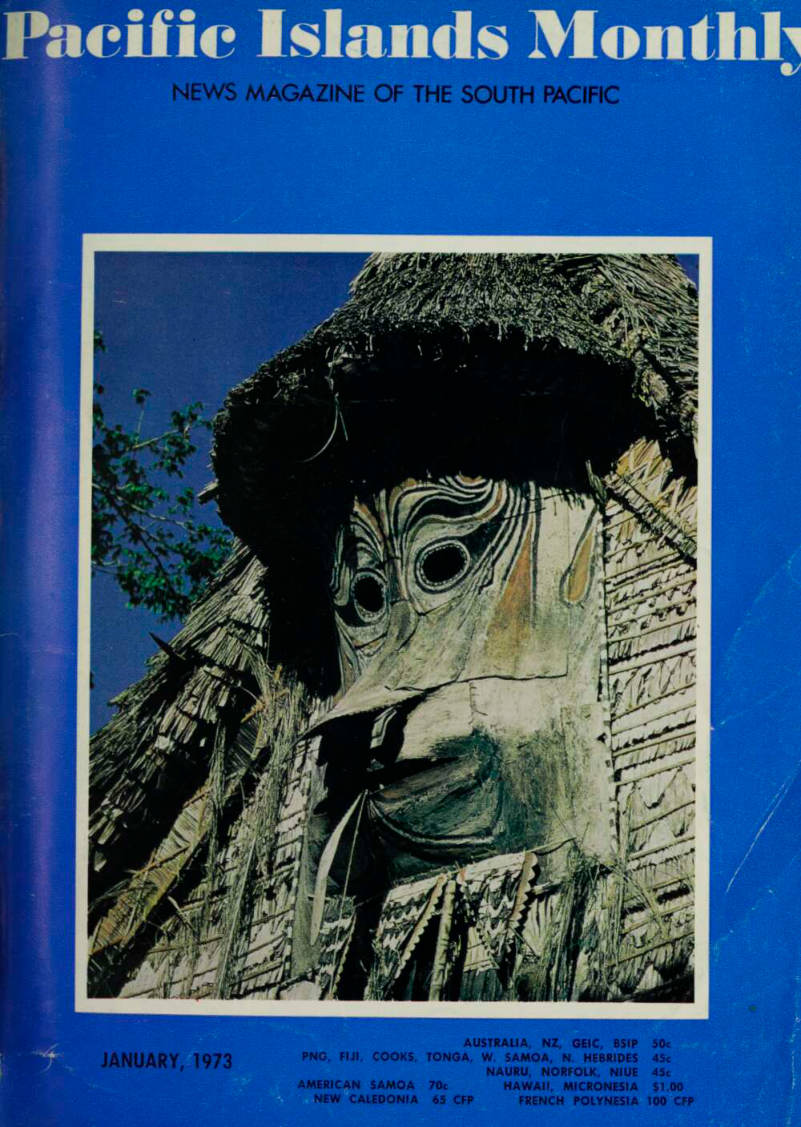
Our Cover
In the Angoram area oj New Guinea’s Sepik River there is a council-built house oj New Guinean art ej acts.
The house is itself an artefact —certainly this detail from it, anyway. A benign face, only a little toffee-nosed.
Advertisements & other items, p. 2 (1 item)
m
s a trade mark of Dolby Laboratories ■ i
i mm
CD % 3f \ % ' . •A K ' % * \ V m F ♦ \ K - ■; - -
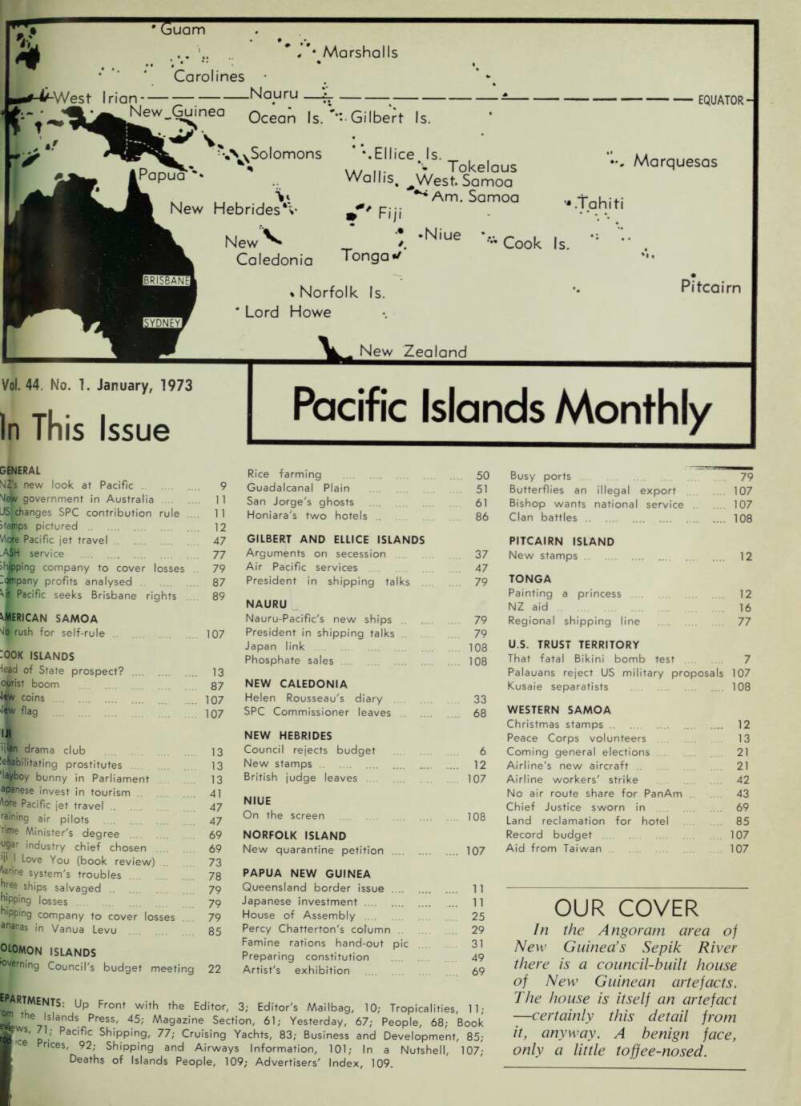
In This Issue
General
M2's new look at Pacific 9 government in Australia 11 JS changes SPC contribution rule ... 11 pictured 12 \AA Pacific jet travel 47 .ASH service 77 jlAping company to cover losses 79 profits analysed 87 \l Pacific seeks Brisbane rights ... 89
Vmerican Samoa
'Jf rush for self-rule .. 107
:00K Islands
l«d of State prospect? 13 SBbt boom 87 Jew coins 107
% flag 107
Iji
•ilb drama club 13 tejbilitating prostitutes 13 *layboy bunny in Parliament 13 apanese invest in tourism 41 tare Pacific jet travel 47 raining air pilots 47 rime Minister's degree 69 ugar industry chief chosen 69 £ L °ve You (book review) 73 tarine system's troubles 78 hree ships salvaged 79 Upping losses 79 hipping company to cover losses 79 ananas in Vanua Levu 85
Olomon Islands
Governing Council's budget meeting 22
Rice farming 50 Guadalcanal Plain 51 San Jorge's ghosts 61 Honiara's two hotels 86
Gilbert And Ellice Islands
Arguments on secession 37 Air Pacific services 47 President in shipping talks 79
Nauru
Nauru-Pacific's new ships 79 President in shipping talks 79 Japan link 108 Phosphate sales 108
New Caledonia
Helen Rousseau's diary 33 SPC Commissioner leaves 68
New Hebrides
Council rejects budget 6 New stamps 12 British judge leaves 107
Niue
On the screen 108
Norfolk Island
New quarantine petition 107
Papua New Guinea
Queensland border issue 11 Japanese investment 11 House of Assembly 25 Percy Chatterton's column 29 Famine rations hand-out pic 31 Preparing constitution 49 Artist's exhibition 69
Busy ports 79 Butterflies an illegal export ... 107 Bishop wants national service 107 Clan battles 108
Pitcairn Island
New stamps 12
Tonga
Painting a princess 12 NZ aid 16 Regional shipping line 77
U S. Trust Territory
That fatal Bikini bomb test 7 Palauans reject US military proposals 107 Kusaie separatists 108
Western Samoa
Christmas stamps 12 Peace Corps volunteers 13 Coming general elections 21 Airline's new aircraft 21 Airline workers' strike 42 No air route share for PanAm 43 Chief Justice sworn in 69 Land reclamation for hotel 85 Record budget 107 Aid from Taiwan 107
E 0 P m AR I MENTS: Up Fr ° nt with the Editor ' 3; Editor ' s Mailbag, 10; Tropicalities, 11; e stands Press, 45; Magazine Section, 61; Yesterday, 67; People, 68; Book I S/ p .' Pac ‘^ c Shipping, 77; Cruising Yachts, 83; Business and Development, 85; Ce rices, 92; Shipping and Airways Information, 101; In a Nutshell, 107; Deaths of Islands People, 109; Advertisers' Index, 109.
Advertisements & other items, p. 4 (1 item)
Qrnott's/ Biscuits
WSS?
as a: si -- Wte 1 WSft*! an Mr* ■is£ m m m m mm
Give your family
these all-time favourites
from Arnott’s
Everybody likes them! Nourishing Milk Arrowroot.. . tasty Nice .. . delicious Coconut Bar ... the egg-and-butter goodness of Scotch Finger . .. they’re all-time family favourites from the great big Arnott’s range. Taste them!
The triple-wrapped packs keep the biscuits fresh.
Qrnott's/ Biscuits
There is no Substitute for Quality
Pacific Islands
Monthly
• FOUNDED BY R. W. ROBSON IN 1930
Published Monthly By
Pacific Publications (Aust.) Pty. Ltd.,
29 Alberta St., Sydney, N.S.W., 2000.
Postal Address; G.P.O. BOX 3408, SYDNEY,
N.S.W., 2001.
Telegraphic Address: PACPUB, Sydney.
Telephones: 61-9197, 61-7101, 61-4369.
msulting Directors: R. W. Robson, Judy Tudor.
Chief Executives: Manager; Selwyn Hughes.
Publisher: Stuart Inder.
Director of Advertising: W. A. Gasnier.
Pacific Islands Monthly
Editor: Stuart Inder.
Assistant Editor; John Carter.
Advertising Manager: W. A. Gasnier.
Circulation Manager: Barry Badger.
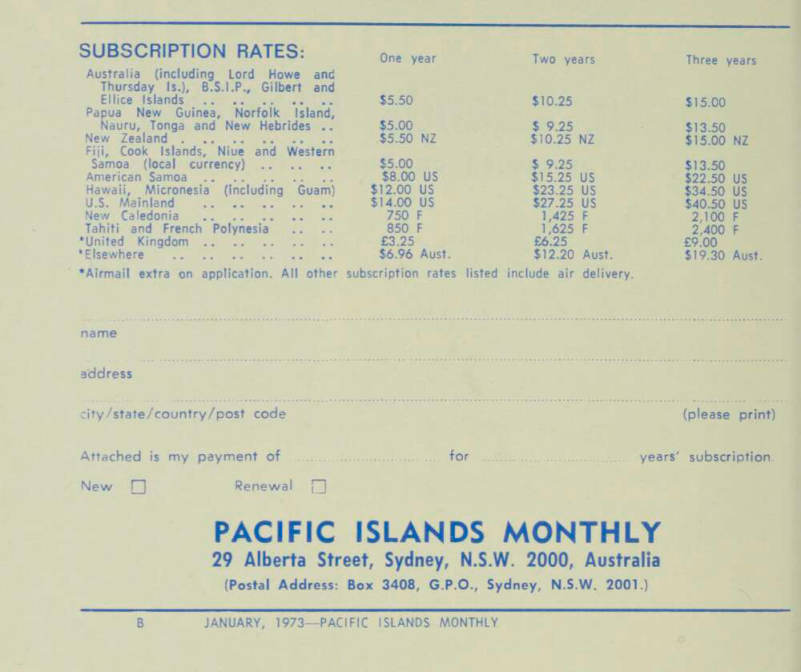
Subscription Rates;
"Pacific Islands Monthly” is air-freighted to all subscribers and agents in the Pacific Islands,copies to other areas go by surface mail.
Australia (including Lord Howe and Thursday Is.), 8.5.1. P., Gilbert and Ellice Is.: $5.50 Aust.; Papua New Guinea, Norfolk Island, Nauru Tonga and New Hebrides: $5.00 Aust.; New Zealand: $5.50 NZ; Fiji, Cook Islands, Niue and Western Samoa: $5.00 (local currency); American Samoa: $B.OO US; U.S. Mainland: 514.00 US; Hawaii, Micronesia (including juam) $12.00 US; New Caledonia: 750 French acme francs; Tahiti and French Polynesia: 350 French Pacific francs,- United Kingdom and elsewhere; £3.25. representatives lilHi„ P f lf OA Pub ' icati c ons (Fiji) Ltd., Fiji Times iuuding, 20 Gordon Street, Suva. Tel.: 25601- [''l T l n ?« °ff' ce v Cnr. Vitogo Pde, and Namoli \ve, LAUTOKA. Telex: 1144. Tel.: 60-422.
Sin N ®m G c Uinea: LAE ' p -°- Box 227; iABAUL, Mr. Steve Simpson, P.O. Box 433 (c/- Rabaul Photographic. Tel.: 2677.) r n ench ,A ol / nesia: Distribution—Hachette Paci ique, 10 Ave Bruat, Papeete. lew Zealand: Pacific Publications, C.P.O. Box npHHinn UC r- and u 379 ‘ 494 - Representative; John bedding, Civic House, 291 Queen St., Auckland, Tel.: 379-494.
" ite d Kmgdom: I. B. Graham, Park House, 1 Park Street, Croydon, CR9 3NP Tel • 01-6884177.
ZT\u\ZZ aP I? (A 9® nci ®s) Ltd., Cromwell ? wood Place, London, W.C.I. Tel.: '■242-0661. Cables: WESNEWS, London, DS4 h P on n: r A p d n ert .i sin9 T: Un l v ? rsal Media Corpora - otf ln' n '. a C - P -°- Box 46, Tokyo. Tel.: 666-3036. *!° ‘ Advertising—Wilke & Co. Ltd 37 owns Road, Clayton, Vic., 3168 'Tel • 544-8222. 3T?t lan p d ;ni A c dV T ertisin9 ~; Bea . le Media Services, Pauls Jeri-cice, Fortitude Valley, Qld. 4006, Tel.; 52-5827. c6Sh and 99?' S h Main,and on,y: Mrs - w - A.
Cb «th, 225 Queen Street, 178, Honolulu, in j . 96813. change of address notices. Form 3579 Bolifatinn * the ., ab °ve address.) ratsc j^ ai se cond class postage ra tes pending at Honolulu, Hawaii.
p Copyright ©, 1972,
acme Publications (Aust.) Pty. Ltd.
January, 1973 Vo 44; No -|
Up Front
with the Editor
1973 What a new year it should be!
This is the year in which Papua New Guinea will formalise self government and attack such sacred cows as land tenure, commercial in vestment, the public service and probably international boundaries.
This is the year in which the Gilbert and Ellice Islanders will decide whether to hang together or hang separately—whether the two peoples will tread different con stitutional paths. This is the year in which the New Hebrideans will give hurry-up to the outmoded British- French condominium system. And the year in which the British Solomon Islanders will find themselves a new system of government. And in which the Dominion of Fiji gets a Fijian Governor-General.
This is the year in which the Micro nesians and the Americans have to come to terms, or otherwise, on the status of Micronesia; and Micronesia itself has to come to terms with the Marianas people over the details of their breakaway proposals.
This is the year in which Western Samoa gets a new parliament; in which the Republic of Nauru takes stock of itself after five years of independence; in which the French will be under real pressure from new Australian and New Zealand Labour governments if they decide to go ahead with their atmospheric nuclear tests.
Australian and New Zealand at titudes to all Island problems will differ in 1973 from those of 1972; the two new governments assure that.
Both are Pacific-orientated, and Prime Ministers Norman Kirk of NZ and Gough Whitlam of Australia actually know where the Islands are (although Gough’s geography is not as good as Norman’s).
There will presumably be changes in immigration procedures affecting Islanders entering both countries, particularly of Islanders entering
Australia from New Zealand. New Zealand has been unhappy about Aus tralia’s attitude to these in the past.
Australia’s new policy is not firm, but Mr Whitlam has said that people who are relatives or close friends of people already living in Australia will get priority to migrate. Whichever way it’s done, if it is made easier for Islanders to live or work in Australia in 1973 then it gets my support.
The political pace in the South Pacific has been developing swiftly in recent years—l’ve said it often enough—but 1973 will show us the hottest pace yet.
CHANGES for PIM in 1973, too.
After 42 years PIM has changed ownership. But the faces are still the same, PIM was founded in Sydney in 1930 by R. W. Robson, who built up Pacific Publications—a company which over the years acquired the Sydney and Melbourne Publishing Co in Sydney and the Fiji Times and Herald Ltd, in Suva. Between them they publish various technical and Pacific journals, books and news papers in Sydney and Suva. It’s been a private organisation, and operated very personally. To R. W. Robson, Judy Tudor, L. G. Usher (in Suva), Selwyn Hughes and myself, Pacific Islands affairs are our heartbeat.
They remain so, although in December the Melbourne-based com pany of Wilke and Co Ltd acquired all the shares in Pacific Publications as result of a contract made in 1970.
The company was acquired as a very much going concern, and the people remain. R. W. Robson now becomes senior director and consultant. Who of us could expect to be as active at 87?
There are some new names. Charles McMillan, chairman of the Wilke group, and Ken Cathie, group man aging director, are both fascinated by the Pacific.
The changes to PIM in 1973 had already been planned, and you’ll notice them as we go along.
Stuart Inder
Advertisements & other items, pp. 5-7 (3 items)
3
ACIFIC ISLANDS MONTHLY—JANUARY, 1973
Gboo
oood/year
G 8
CROSS PLY TYRE
G 8 offers you improved wetskid protection smoother handling and quieter softer ride. Three choices: G 8 Custom G 8 Super Cushion G 8 ■r I Y ( hi Jot* 1 I 1 1 m : % M . m
GOOD-YEAR
GBOO
RADIAL PLY TYRE
You get extra tyre toughness, longer tread life and more fuel economy from Goodyear GBOO, Custom GBOO Rib or GBOO Grand Prix.
t
8-Speed
Power
Blender
-the
appliance
you can use
every meal.
j With powerful, Solid-state motor. Solid-state means added 1 versatility for exactly the blending action you need —to stir, puree, cream, whip, grate, mix, chop or liquefy.
Stainless steel cutters operate at high speed for fast food preparation.
Switch from speed to speed without turning off.
Acif Ic Islands Monthly— January, 1973
Pacific Islands Monthly
New Hebrideans Turn An Economic
Crisis Into A Political One
After gnashing its gums fruitlessly for years the New Hebrides Advisory Council last month found some teeth —perhaps a better word would be dentures, since the biting mechanism was somewhat artificial.
After five days of seemingly inter minable discussion of the condomin ium estimates for 1973, the council told the French and British Resident Commissioners that the Budget was not acceptable and that they rejected it entirely. The move had obviously been pre-considered by Council mem bers who were unanimous in their verdict.
More than a little taken aback the two Resident Commissioners, who are accustomed to having the game played their way and did not like seeing the ball removed from their possession, asked the Council to put on paper the changes it would like to see made in the estimates and then suspended the 24th session until February. They hope the re-examina tion and re-drafting of the year’s estimates can be done by then.
There was more to this demonstra tion of disaffection than disapproval of the estimates (though that was certainly strong enough). It was the culmination of years of increasing frustration to Council members, not so much because their role is only advisory, but because the advice they give has not been listened to.
Two years ago they moved that a financial sub-committee should be appointed from among their members so that they could play a more active part in the preparation of estimates: this was not done and, despite the lip service that the Joint Administration has paid to ‘not governing in the face of opposition’ from Adco, there is no doubt that it prefers to do things its own way. An example of this was the Joint Administration’s proposal last year that, beginning in 1972, duty on imported goods and materials (by far the largest source of revenue to the territory) would be levied on the CIF (landed) value, not on the FOB (port of origin) value.
No matter how beneficial this
might be to the Condominium’s finances, the members of Advisory Council feared the inflationary effect, fears which have since proved justi fied, and voted almost unanimously against the proposal. The effect of this rejection? Nil. The Joint Adminis tration cruised majestically ahead with its plans, firm in its belief in its own infallibility.
Even so, it took a hefty straw to break the back of the long-suffering camel.
In the earliest stages of the Decem ber Session, members made it very clear that they didn’t think much of the idea of boosting the Condomin ium Budget from $4.4 million to $6.1 million when, as the Resident Com missioners themselves made clear in their opening speech, the territory is in economic difficulties due to low copra prices (and New Hebrides prices are the lowest of the low) and the continuing effects of the disas trous cyclones earlier in the year.
“The 1973 Budget has been pared to the bone” said the two administra tors, but Council members questioned whether 43 new civil service posts
and an overall increase in expei of 26 per cent could be called j there was a bit of fat left on where. So for five weary, consch days they sat and made sugg as to how cuts could be acl and listened to government t explaining why the various ini were absolutely essential.
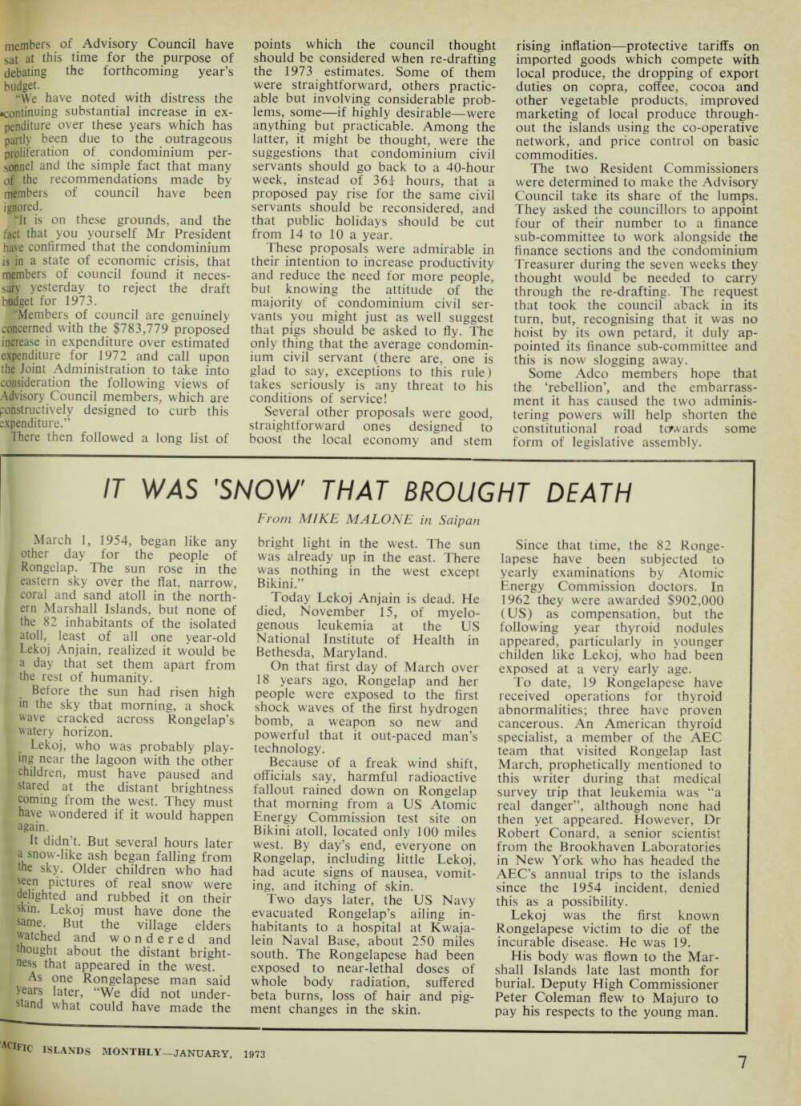
At the end of the five dai effects of their suggestions c estimates were as one membe “precisely nil”. Not for the fin the council’s ‘advice’ had politely and studiously ignore; this time it was ready. Instt going on to vote on the various of the estimates, as is the usu: cedure, the members asked the dent Commissioners for an recess so that they could talk themselves and when the sessi sumed, Mr Bob Paul, api spokesman as the longest-:member, read the following d tion.
“The members of this • reject in its entirety the condon budget. The administration hi acceded to our requests in thi particularly with regard to the: lishment of a finance committe does not feel obliged to accede: way to the budget proposals.”
Somewhat shaken, the R 1 Commissioners sat in silence while and absorbed the implir of the statement. The estimatl taken four months to prepai, council couldn’t mean it! But When the French Resident O! sioner, M Langlois, asked for ; of hands, not a single one was against the statement and mr made it perfectly clear that the no intention of changing their So, adopting a positive app the British Resident Commifi Mr Allan, proposed that mr should put all their suggestio changes in the estimates on pafl present them the following daj When the Council met atJ next morning, Mr Paul was ags appointed spokesman. He saidfc “Mr President, for many\
Advisory Council spokesman, Mr Bob Paul.
members of Advisory Council have sat at this time for the purpose of debating the forthcoming year’s budget.
“We have noted with distress the continuing substantial increase in ex penditure over these years which has partly been due to the outrageous proliferation of condominium per sonnel and the simple fact that many of the recommendations made by members of council have been ignored.
“It is on these grounds, and the fact that you yourself Mr President have confirmed that the condominium is in a state of economic crisis, that members of council found it neces sary yesterday to reject the draft budget for 1973.
“Members of council are genuinely concerned with the $783,779 proposed increase in expenditure over estimated expenditure for 1972 and call upon the Joint Administration to take into consideration the following views of Advisory Council members, which are constructively designed to curb this expenditure.”
There then followed a long list of
points which the council thought should be considered when re-drafting the 1973 estimates. Some of them were straightforward, others practicable but involving considerable problems, some—if highly desirable—were anything but practicable. Among the latter, it might be thought, were the suggestions that condominium civil servants should go back to a 40-hour week, instead of 36i hours, that a proposed pay rise for the same civil servants should be reconsidered, and that public holidays should be cut from 14 to 10 a year, These proposals were admirable in their intention to increase productivity and reduce the need for more people, but knowing the attitude of the majority of condominium civil servants you might just as well suggest that pigs should be asked to fly. The only thing that the average condominium civil servant (there are, one is glad to say, exceptions to this rule) takes seriously is any threat to his conditions of service!
Several other proposals were good, straightforward ones designed to boost the local economy and stem
rising inflation—protective tariffs on imported goods which compete with local produce, the dropping of export duties on copra, coffee, cocoa and other vegetable products, improved marketing of local produce through out the islands using the co-operative network, and price control on basic commodities.
The two Resident Commissioners were determined to make the Advisory Council take its share of the lumps, They asked the councillors to appoint four of their number to a finance sub-committee to work alongside the finance sections and the condominium Treasurer during the seven weeks they thought would be needed to carry through the re-drafting. The request that took the council aback in its turn, but, recognising that it was no hoist by its own petard, it duly ap pointed its finance sub-committee and this is now slogging away, Some Adco members hope that the ‘rebellion’, and the embarrass ment it has caused the two adminis tering powers will help shorten the constitutional road towards some form of legislative assembly.
It Was 'Snow' That Brought Death
From MIKE MALONE in Saipan
March 1, 1954, began like any other day for the people of Rongelap. The sun rose in the eastern sky over the flat, narrow, coral and sand atoll in the north ern Marshall Islands, but none of the 82 inhabitants of the isolated atoll, least of all one year-old Lekoj Anjain, realized it would be a day that set them apart from the rest of humanity.
Before the sun had risen high in the sky that morning, a shock wave cracked across Rongelap’s watery horizon.
Lekoj, who was probably play ing near the lagoon with the other children, must have paused and stared at the distant brightness coming from the west. They must have wondered if it would happen again.
It didn’t. But several hours later a snow-like ash began falling from the sky. Older children who had seen pictures of real snow were delighted and rubbed it on their skin. Lekoj must have done the same. But the village elders watched and wondered and thought about the distant bright ness that appeared in the west.
As one Rongelapese man said years later, “We did not under stand what could have made the
bright light in the west. The sun was already up in the east. There was nothing in the west except Bikini.”
Today Lekoj Anjain is dead. He died, November 15, of myelogenous leukemia at the US National Institute of Health in Bethesda, Maryland.
On that first day of March over 18 years ago, Rongelap and her people were exposed to the first shock waves of the first hydrogen bomb, a weapon so new and powerful that it out-paced man’s technology.
Because of a freak wind shift, officials say, harmful radioactive fallout rained down on Rongelap that morning from a US Atomic Energy Commission test site on Bikini atoll, located only 100 miles west. By day’s end, everyone on Rongelap, including little Lekoj, had acute signs of nausea, vomiting ’ and itchin § of skin.
Two days later, the US Navy evacuated Rongelap’s ailing inhabitants to a hospital at Kwajalein Naval Base, about 250 miles south. The Rongelapese had been exposed to near-lethal doses of whole bod y radiation, suffered beta burns, loss of hair and pigment changes in the skin.
Since that time, the 82 Ronge lapese have been subjected to yearly examinations by Atomic Energy Commission doctors. In 1962 they were awarded $902,000 (US) as compensation, but the following year thyroid nodules appeared, particularly in younger childen like Lekoj, who had been exposed at a very early age.
To date, 19 Rongelapese have received operations for thyroid abnormalities; three have proven cancerous. An American thyroid specialist, a member of the AEC team that visited Rongelap last March, prophetically mentioned to this writer during that medical survey trip that leukemia was “a real danger”, although none had then yet appeared. However, Dr Robert Conard, a senior scientist from the Brookhaven Laboratories in New York who has headed the AEC’s annual trips to the islands since the 1954 incident, denied this as a possibility.
Lekoj was the first known Rongelapese victim to die of the incurable disease. He was 19.
His body was flown to the Mar shall Islands late last month for burial. Deputy High Commissioner Peter Coleman flew to Majuro to pay his respects to the young man.
Advertisements & other items, p. 9 (1 item)
7
ACIp IC ISLANDS MONTHLY—JANUARY. 1973
hurricane
After the hurricane was over
Alleged scandals over the dis tion of rations, a complaint Rotuma that building materials equipment had been returned to and gaoling of a village tura. koro (head man) for selling rations, were unpleasant featur the aftermath of Hurricane Be Fiji.
Two government officials, Atafoa Varea, the Commis: Central, and Mr Isoa M* District Officer, Nadi, claim Nausori politician was inter: with relief operations. The mai advising people to demand ra irrespective of whether they eligible. Mr Varea said polit from both major parties were 11 people, as a political gimmic claim rations.
The Hurricane Relief Comr at the same time, announced relief supplies were intendec people who had lost subsistence crops on which they depended had no other sources of livelihc The government was concern the attitude of some people to relief supplies. They appeared gard them as a gift to which were entitled. However, aid wa plied as an interim measure tc people who would otherwise hungry.
The turaga-ni-koro gaoled, "V Vodivodi, sold a carton of rations to a Nausori shopkeepe: said he sold the rations to get i to pay for the cleaning of the 1 cemetery. The magistrate des the offence as “despicable” am Vodivodi to gaol for three mom New Zealand, which contn generously in cash, relief sir and physical assistance throug army, also sent 1,000 dozen e; relief supplies. Two Auckland Egg Distributors Ltd and P«' man’s Co-op Ltd, paid the c; packing materials and transpi Suva.
Some Rotumans complainec timber, paint and a concrete were sent back to Suva whet: could have been put to good t the island. The materials hao shipped to Rotuma to repair g ment buildings.
The Hurricane Relief Com gave free roofing iron to help < or rebuild some bure-type s*
Advertisements & other items, p. 10 (1 item)
Usd Economcnl Power?
CONTACT Braybon
FDR OBLIGATION FREE QUOTATION
Braybon Bros, manufacture a complete range of Lister engine-powered diesel sets to suit your particular requirements as fully automatic; remote; electric; or manual start.
Represented in all States, P.N.G. and N.Z.
Braybon Bros
V PTY. LTD.,
2 ROTHWELL AVENUE, CONCORD WEST 2138.
Tel.: 73-3246.
COUPON
NOW
Please send me details of your Lister engine-powered alternating sets.
NAME
ADDRESS
New Zealand Prepares For A
New Look At South Pacific
From KATHLEEN HANCOCK in Wellington
The dust of New Zealand’s land slide election is settling down; Well ington's “House on the Hill” is sort ing out Labour names on office doors; and hints, but only hints, of the new government’s Pacific policies are be ginning to filter through.
Ministers most closely involved in Pacific affairs are, of course, Prime Minister Norman Kirk himself, wear ing his Foreign Affairs hat, and Mr P. A. Amos, who will look after both Island Affairs and Education in the new government. The new Prime Minister is moving cautiously into an area of power new to him and to most of his ministers. There wasn’t much said about the Pacific in the election campaign and Mr Kirk hasn’t yet shown himself willing to commit himself on matters affecting New Zealand’s relationship with her Pacific neighbours.
However, it’s a safe bet that one thing will come up quite soon Norman Kirk’s idea of a Pacific Council, first put forward by him in 1968. At the next meeting of the South Pacific Forum the NZ Prime Minister is very likely to sound out Pacific leaders on this subject. His concept of a Pacific Council is un likely to supersede either the South Pacific Commission or the South Pacific Forum, but would more closely resemble a meeting of Pacific parliamentarians.
Pacific trade will certainly occupy i place on the new government’s igenda, though EEC problems will end to overshadow trade matters closer to home. Pacific trade will also oe overshadowed by the mushroom cloud cast over French-NZ relation ihips by French nuclear testing in the Pacific. With French Polynesia and Caledonia ranking second and ■ourth as Pacific consumers of NZ exports, this is a touchy area. Already, a result of last year’s trade union boycott of French shipping, New -ealand’s export figures in these two erntories have slumped badly, with >r«rs going instead to Canada, Aus the US and metropolitan "ranee.
Since the election there has been
JHJf modification (unkindly called
oack-pedalling” in some quarters) of Labour Party’s proposal to send New Zealand frigate into the danger rea prior to the next spate of nuclear .sung by France. It was suggested
at first that the frigate should carry at least one cabinet minister, but Prime Minister Kirk seems to have had second thoughts about this ven ture. “I will investigate all other means first,” he said recently. “If it gets to the stage where we have to take this action, we will ask other nations if they will join us.”
This is more in line with the senti ments of another Pacific leader, con siderably closer to the test area. The King of Tonga said, “I should be concerned indeed if he (Mr Kirk) personally decided to enter the test area, or expose the life of another colleague to the danger of fallout.”
He said that in view of the hardening of the French attitude he felt “that the dramatic move made by Mr Kirk might not achieve the deterrent many people expect.”
The new Labour government has the question of Pacific immigration under close study and the Minister, Mr Fraser Colman, will meet the president of the Auckland-based Samoan Progressive Association Mr M. S. Fonoti, at an early date to dis cuss future developments. Mr Fonoti has been in the news lately with statements that New Zealand’s immi gration policy is “unrealistic” and that Samoans and Tongans are over staying their work permits as a result of this. He wants the legislation re viewed and he also wants NZ’s
Labour government strongly to urge a change in Australia’s immigration attitudes towards Pacific Islanders.
The matter of rates of pay for ships crews working the NZ coast will also come up for examination soon. Low rates of pay for Pacific Islander crews have been a thorn in the side of the NZ unions for some time and it’s expected that the Minis ter for Labour, Mr Watt, the Minister for Island Affairs, Mr Amos, and the union leaders concerned, will be looking at this one in the near future.
The splitting of the former Ministry of Maori and Island Affairs into two separate portfolios caused comment when Cabinet was named. But the Labour Party has never particularly liked the lumping together of these two ministries. It has always con sidered there were more differences between them than things in common.
Maoris also have their own seats in the House and their problems are not those of Cook Islanders or Samoans.
New Zealand’s relationship with other Pacific territories is close, but, with the exception of Cook Islanders, their citizens are not NZ citizens. So popular Maori MP Matt Rata has been appointed Minister for Maori Affairs and Mr P. A. Amos has been given Island Affairs, as well as Edu cation.
The new Minister for Island Affairs is generally considered one of the new government’s happier choices. As a former teacher at both primary and secondary levels, he has always taken a keen interest in the welfare of Island communities. His wife has also been closely involved with Pacific Islanders as a guidance counsellor at Auckland’s Hillary College at Otara, one of the largest concentrations of Polynesians in the country. She was also a pioneer in the introduction of the well-known Tate Readers into Auckland schools with a large Pacific Islander roll. Mr Amos reckons his new job is “a very happy marriage of interests”.
It’s still early days for the new government. The next few months will no doubt clear away the fog of uncertainty that as yet clouds certain issues, such as a possible pull-out from Malaysia and the future of SEATO. New Zealand’s Cabinet will be looking closely at Pacific affairs. And the stability of the Pacific will rank high as a priority.
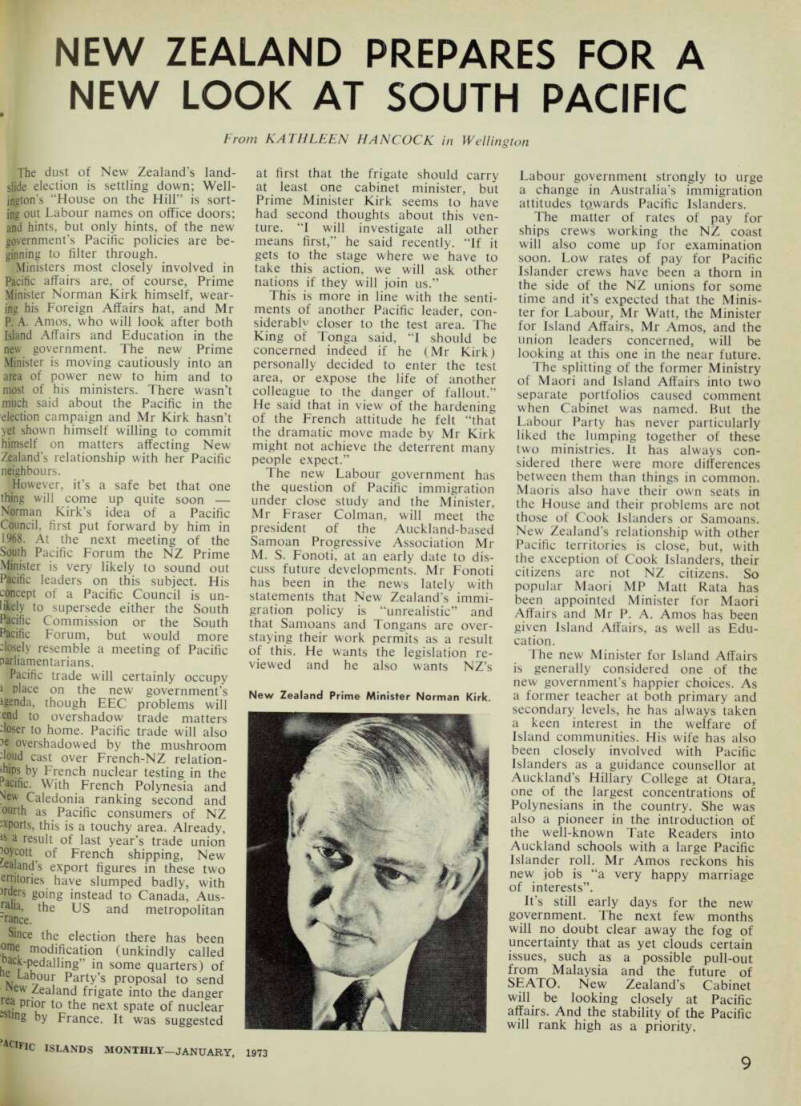
New Zealand Prime Minister Norman Kirk.
Advertisements & other items, p. 11 (1 item)
9
>a CIFIC ISLANDS MONTHLY—JANUARY, 1973
The Editor's Mailbag
Olaf Rumen's Denial
Robert D. West of Chillicothe, Ohio, perpetrates an unjustified lie when he claims, in a letter (PIM, December, p 49) I refuted statements made by the King of Tonga. At the time I wrote the book Minerva Reef, Salote Tupou 111 was Queen of Tonga. I understand that the annexa tion of the reefs to Tonga accomp lished by Captain Tevita in 1966 was not refuted.
Certainly I support the excellent arguments of His Majesty King Taufa ‘ahau Tupou IV in extending his sovereignty over these reefs and I have nothing but contempt for the unprincipled American adventurers —and I understand their conspirators of other nations—for whom Robert D. West is spokesman.
Olaf Ruhen
Sydney.
Dr Davis's Criticism
Our attention has been drawn to a letter under the heading “Doctor Davis’s Criticism”, published in the Editor’s Mailbag (PIM, Nov, p 47).
The correspondent states “Economic development has been encouraged, yet with falling prices of copra, re fusals by New Zealand to take man darins (although NZ originally en couraged the growing of such) etc, can only lead to the thought that there has been no encouragement”.
The statement that New Zealand has refused to take mandarins is en tirely incorrect. It is a fact that some 20 years ago our company suggested that more mandarins could be grown in the Cook Islands and as a result many thousands of dollars have been added to the economy. However, there is a definite limit to the quan tity that can be absorbed by New Zealand at what are regarded by the Island people as payable prices.
Production proceeded on the assumption that New Zealand had an unlimited market and in 1960 it be came necessary to advise the authori ties that the maximum quantity that could be absorbed at present prices would be 5,000 cases per month.
Apparently this information was not acted on and the development of mandarin production proceeded well beyond market requirements.
As a result of the very large quantities of fruit available, much beyond the suggested 5,000 boxes, an arrangement was made of graduated
prices up to 10,000 boxes per ship and the price negotiated would be on any market in the world a very good one for the growers concerned.
When quantities were raised beyond 10,000 boxes we had to advise that large consignments of this quantity would have to be sold on the open market and that we could not guaran tee a price. At no stage however, have we refused to accept consign ments.
The last 20 years have also seen the establishment of mandarin grow ing in various parts of New Zealand and it is true to say that the man darins grown in New Zealand have better colour and better flavour than the Cook Islands fruit, resulting in the public neglecting the Cook Island fruit in favour of New Zealand fruit.
With rising freights it is necessary to ensure high quality produce so that these freights may be absorbed and there is still a market in New Zealand for good quality fruit. The market is wide open, but naturally if the fruit is going to be consigned to New Zealand in extremely large quantities, quantities never at any time suggested by our company, then it is necessary to sell this fruit at market value on the same conditions as fruit is sold in all parts of the world.
C. R. Walker.
Managing Director.
Fruit Distributors Ltd, Wellington, New Zealand.
West Irian
I am a Jamaican living in England.
I have read PIM regularly about two years.
I always thought your magazine provided valuable information about the Pacific islands, until I realised that you never say anything about the situation in West New Guinea. Surely West New Guinea is a Pacific territory like the eastern half of the island, or West Samoa.
A. Fraser.
London, 5.W.5. • West Irian these days is an integral piovince of Indonesia, and if it ever had Pacific Islands status, it has lost it as far as we are con cerned. We do refer to West Irian developments insofar as they concern its neighbour, Papua New Guinea — as for instance our frequent reports on border crossing, and PNG attitudes to it. Thus, for us, West Irian is rather
in the category of Hawaii, a sti America whose domestic doesn’t find its way into PIM but whose attitudes do when touch on the Pacific Islands.
Only The Sword . . .
“Only The Sword He Si
UP IN”. “Yesterday” column, September, recalled this headline an advertisement for a tropica service uniform which was v urgently.
The advertiser could have none other than Hon. Cedric H then Director of Agriculture, Fi wife, Nell, having preceded hi leave to Britain, he was living porarily at the Fiji Club in Suv the residential section was demc by the hurricane of 1952. M< Mr Harvey’s personal belor including his white tropical un plumed helmet, gloves, etc., were the ceremonial unifon members of Legco in those had gone with the wind. S forays into the wreckage of th buildings produced little more the sword and a sock!
Mr Harvey is now living in ment near Truro, Cornwall, wit! to devote to his hobbies c painting and wine making.
(Mrs) Tui Gar[?]
Auckland, NZ.
A Grave Error
I was interested to rea« obituary of the late Dr W.
Kenzie (PIM, Sept., p. 131). 1 was in the New Hebrides in this year I was able to visit I and to see the headstones ow grave of the Rev J. W. MacK children and over his wife Am grave.
There is an unusual error inscription on her headstone reads: Amanda Bruce, wife Rev J. W. MacKenzie died 30' 1898 after 21 years of Christan on Efate.
I wonder how many visitor noticed the spelling of CHRIS?
A. F. Macgilli[?]
London, N2O.
Japanese Wanted
We’d like some help on infon for a history of the Aus 6th Division Cavalry Unit, interested in hearing from an who knows about a Japanese i possibly the last remnant of the: Army, who was located in the: celli mountains of New Guii 1956.
G. A. Robi[?]
9a North Rutledge St, Coolangatta, Qld 4225.
Tropicalities
Too close
for comfort
Australia’s new Labour Prime Minister Gough Whitlam, elected in December, is sympathetic to New Guinean opinion in the Papua- Queensland border dispute. And since the Prime Minister is also the Minister for Foreign Affairs (as is Mew Zealand’s new Prime Minister, Mr Kirk) one may expect that New 3uinea will get a favourable ear in Canberra.
PIM last discussed the dispute in letail back in June, when it hadn’t n fact developed into a dispute. r hings have been moving swiftly in ecent weeks.
Briefly, the Australian border with apua New Guinea runs in one place within 200 yards of the Papuan oast, and traditional Papuan fishing rounds are within Australian waters.
Tie strip also contains three islands, aibai, Dauan and Boigu, with a opulation of about 1,000 islanders, ho are Australian citizens, enjoying xial service benefits from Queens md.
After independence, can New ruinea have three islands and their 20ple smack up against its shoreline Lit belonging to somebody else? ew Guinea government feeling is iat it can’t—that Australia should xiraw the border to give the islands ► New Guinea, with or without the Jople.
Queensland’s Premier, Mr Bjelke etersen, doesn’t like the sound of ns and wants to dig his heels in. e may in fact have the legal right 1 do so.
Nobody yet knows how far he is spared to go, how far Mr Whitlam prepared to go, or how far the ipua New Guinea Government is e Pared to go. But clearly it is a r ? point among many New umean ministers, and it’s unlikely at an independent New Guinea )ul( * tolerate the present situation. [ Bjelke-Petersen, we predict, is
mmg a losing battle.
Papua New Guinea’s coalition moment has problems besides
those of the Queensland border. One of them is a decision on its attitude to a takeover in December by a Japanese firm of Commonwealth New Guinea Timbers.
CNGT is 65 per cent owned by Territory Development Ltd, all of whose shares are held by Placer De velopment Ltd. Placer is selling its shareholding to New Guinea registered New Guinea Sobu Pty Ltd —owned by a wealthy Japanese family group—subject to govern mental agreement.
The point of the story is that the other 35 per cent shareholding in CNGT is held by the Investment Corporation of PNG on behalf of the PNG government, which is thus likely to find itself suddenly with a majority Japanese business partner.
The deal between Placer and the Japanese also includes Territory Fisheries Pty Ltd, all of which is owned by Territory Development Ltd.
PNG Chief Minister Michael Somare had hoped to get his state ment on PNG investment guidelines out by January 1, but its been de layed. Meanwhile Mr Somare says that “several rounds of discussions might be necessary” over the Sobu deal.
Chairman of the PNG Investment Corporation, Mr E. S. Owens, is not perturbed. He says that although he is sorry to lose the old association, the new arrangement would offer benefits to the corporation. “It gives us access to the Japanese markets,” he says, adding that the Japanese ob viously saw tremendous opportunities in PNG in the long term. He under stood that the price paid by the Japanese was in excess of the price paid by the corporation, which he sees as another example of the confi dence the Japanese have in PNG.
US Tilts out
SPC ceiling
After 25 years of attempting to impose its own fiscal check on the South Pacific Commission’s budget, the United States Government has removed the legislative ceiling on American contributions to the SPC.
The amendment, which limits the
United States only to its assessed 20 per cent of the budget, has been signed into law. Now, there are no longer any artificial restrictions im posed by the US Congress on the American contribution as was the case at the conference at Apia this year when the United States delegation was tied to a miserly offer of an eight per cent increase.
Until the new legislation, the SPCs formula for contributions meant that, at times, when the American ceiling was about to be reached or breached, contributions from all the participating governments would be limited to the American peg. While this situation rarely developed openly, it did restrain the other governments behind the scenes. This was very evident when Fiji Prime Minister Ratu Sir Kamisese Mara before leaving Suva
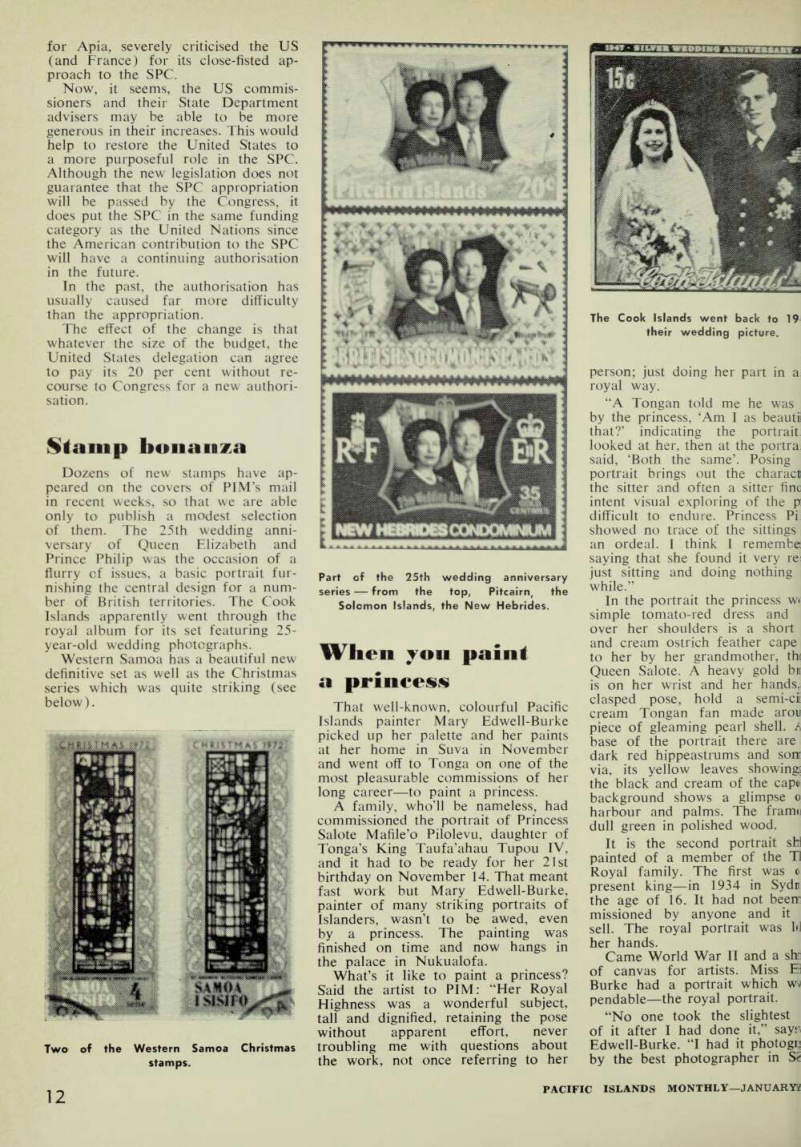
Beautiful new asset to the Fiji modelling scene is Fiji-born Frances Sue, who has been living in Canada. She returned home recently with her husband, Dr Richard Sue, of Suva,
for Apia, severely criticised the US (and France) for its close-fisted ap proach to the SPC.
Now, it seems, the US commis sioners and their State Department advisers may be able to be more generous in their increases. This would help to restore the United States to a more purposeful role in the SPC.
Although the new legislation does not guarantee that the SPC appropriation will be passed by the Congress, it does put the SPC in the same funding category as the United Nations since the American contribution to the SPC will have a continuing authorisation in the future.
In the past, the authorisation has usually caused far more difficulty than the appropriation.
The effect of the change is that whatever the size of the budget, the United States delegation can agree to pay its 20 per cent without re course to Congress for a new authori sation.
Stamp hona idza
Dozens of new stamps have ap peared on the covers of PI M's mail in recent weeks, so that we are able only to publish a modest selection of them. The 25th wedding anni versary of Queen Elizabeth and Prince Philip was the occasion of a flurry of issues, a basic portrait fur nishing the central design for a num ber of British territories. The Cook Islands apparently went through the royal album for its set featuring 25year-old wedding photographs.
Western Samoa has a beautiful new definitive set as well as the Christmas series which was quite striking (see below).
When you paint
a princess
That well-known, colourful Pacific Islands painter Mary Edwell-Burke picked up her palette and her paints at her home in Suva in November and went off to Tonga on one of the most pleasurable commissions of her long career—to paint a princess.
A family, who’ll be nameless, had commissioned the portrait of Princess Salote Mafile’o Pilolevu, daughter of Tonga’s King Taufa’ahau Tupou IV, and it had to be ready for her 21st birthday on November 14. That meant fast work but Mary Edwell-Burke, painter of many striking portraits of Islanders, wasn’t to be awed, even by a princess. The painting was finished on time and now hangs in the palace in Nukualofa.
What’s it like to paint a princess?
Said the artist to PIM: “Her Royal Highness was a wonderful subject, tall and dignified, retaining the pose without apparent effort, never troubling me with questions about the work, not once referring to her
person; just doing her part in a royal way.
“A Tongan told me he was by the princess, ‘Am I as beautii that?’ indicating the portrait, looked at her, then at the portra. said, ‘Both the same’. Posing portrait brings out the charact) the sitter and often a sitter fine intent visual exploring of the p difficult to endure. Princess Pi showed no trace of the sittings an ordeal. I think I remembe saying that she found it very re; just sitting and doing nothing while.”
In the portrait the princess w» simple tomato-red dress and over her shoulders is a short and cream ostrich feather cape to her by her grandmother, thi Queen Salote. A heavy gold bn is on her wrist and her hands, clasped pose, hold a semi-cii cream Tongan fan made arou piece of gleaming pearl shell. A base of the portrait there are dark red hippeastrums and sonr via, its yellow leaves showing the black and cream of the cape background shows a glimpse o harbour and palms. The frannj dull green in polished wood.
It is the second portrait sH painted of a member of the T 1 Royal family. The first was e present king—in 1934 in Sydn the age of 16. It had not been: missioned by anyone and it sell. The royal portrait was Id her hands.
Came World War II and a sh~ of canvas for artists. Miss B Burke had a portrait which wv pendable—the royal portrait.
“No one took the slightest of it after I had done it,” says\ Edwell-Burke. “I had it photogp by the best photographer in Sc
Two of the Western Samoa Christmas stamps.
Part of the 25th wedding anniversary series from the top, Pitcairn, the Solomon Islands, the New Hebrides.
The Cook Islands went back to 19 their wedding picture.
Monty Luke, but still no one took any notice. It was just as though it didn't exist.”
So, she painted another portrait over that of young Prince Tupouto’a- Tungi, one of a “Spanish-type of girl” ‘ in Sydney who often sat for her. She sold it.
Where it is, she doesn’t know, but someone has a painting of a girl.
Underneath is another painting of a prince who is now a king. In the background is the Tongan Royal coat of arms and in the foreground a table and on it a tray of tropical fruit.
Fiji’s own
strolling players
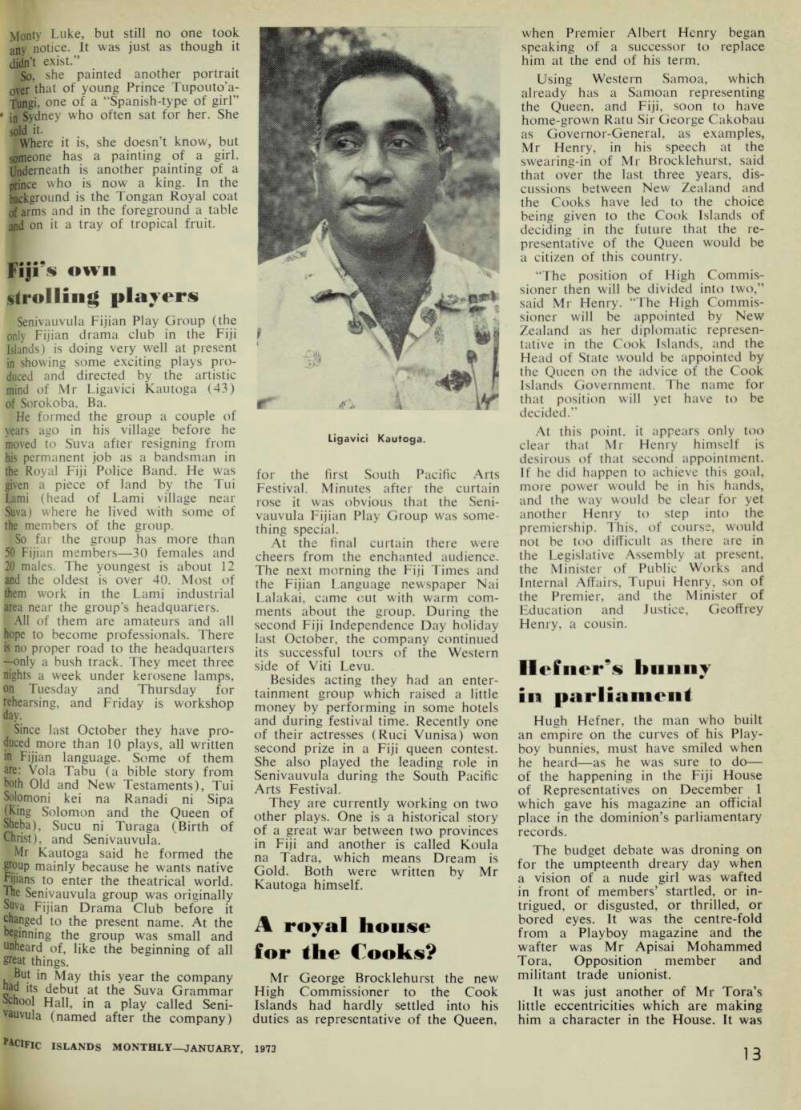
Senivauvula Fijian Play Group (the only Fijian drama club in the Fiji Islands) is doing very well at present in showing some exciting plays pro duced and directed by the artistic mind of Mr Ligavici Kautoga (43) of Sorokoba, Ba.
He formed the group a couple of years ago in his village before he moved to Suva after resigning from his permanent job as a bandsman in the Royal Fiji Police Band. He was given a piece of land by the Tui lami (head of Lami village near Suva) where he lived with some of the members of the group.
So far the group has more than 50 Fijian members—3o females and 20 males. The youngest is about 12 and the oldest is over 40. Most of them work in the Lami industrial area near the group’s headquarters.
All of them are amateurs and all hope to become professionals. There is no proper road to the headquarters a bush track. They meet three nights a week under kerosene lamps, on Tuesday and Thursday for rehearsing, and Friday is workshop day.
Since last October they have pro duced more than 10 plays, all written in Fijian language. Some of them are: Vola Tabu (a bible story from both Old and New Testaments), Tui Solomoni kei na Ranadi ni Sipa (King Solomon and the Queen of Sheba), Sucu ni Turaga (Birth of Christ), and Senivauvula.
Mr Kautoga said he formed the group mainly because he wants native Fijians to enter the theatrical world.
The Senivauvula group was originally Suva Fijian Drama Club before it changed to the present name. At the beginning the group was small and unheard of, like the beginning of all great things.
But in May this year the company had its debut at the Suva Grammar School Hall, in a play called Seni vauvula (named after the company)
for the first South Pacific Arts Festival. Minutes after the curtain rose it was obvious that the Seni vauvula Fijian Play Group was some thing special.
At the final curtain there were cheers from the enchanted audience.
The next morning the Fiji Times and the Fijian Language newspaper Nai Lalakai, came out with warm com ments about the group. During the second Fiji Independence Day holiday last October, the company continued its successful tours of the Western side of Viti Levu.
Besides acting they had an enter tainment group which raised a little money by performing in some hotels and during festival time. Recently one of their actresses (Ruci Vunisa) won second prize in a Fiji queen contest.
She also played the leading role in Senivauvula during the South Pacific Arts Festival.
They are currently working on two other plays. One is a historical story of a great war between two provinces in Fiji and another is called Koula na Tadra, which means Dream is Gold. Both were written by Mr Kautoga himself.
A royal house
for the Cooks?
Mr George Brocklehurst the new High Commissioner to the Cook Islands had hardly settled into his duties as representative of the Queen,
when Premier Albert Henry began speaking of a successor to replace him at the end of his term.
Using Western Samoa, which already has a Samoan representing the Queen, and Fiji, soon to have home-grown Ratu Sir George Cakobau as Governor-General, as examples, Mr Henry, in his speech at the swearing-in of Mr Brocklehurst, said that over the last three years, dis cussions between New Zealand and the Cooks have led to the choice being given to the Cook Islands of deciding in the future that the re presentative of the Queen would be a citizen of this country.
“The position of High Commis sioner then will be divided into two,” said Mr Henry. “The High Commis sioner will be appointed by New Zealand as her diplomatic represen tative in the Cook Islands, and the Head of State would be appointed by the Queen on the advice of the Cook Islands Government. The name for that position will yet have to be decided.”
At this point, it appears only too clear that Mr Henry himself is desirous of that second appointment.
If he did happen to achieve this goal, more power would be in his hands, and the way would be clear for yet another Henry to step into the premiership. This, of course, would not be too difficult as there are in the Legislative Assembly at present, the Minister of Public Works and Internal Affairs, Tupui Henry, son of the Premier, and the Minister of Education and Justice, Geoffrey Henry, a cousin.
Hefner’s bunny
in parliament
Hugh Hefner, the man who built an empire on the curves of his Play boy bunnies, must have smiled when he heard —as he was sure to do— of the happening in the Fiji House of Representatives on December 1 which gave his magazine an official place in the dominion’s parliamentary records.
The budget debate was droning on for the umpteenth dreary day when a vision of a nude girl was wafted in front of members’ startled, or in trigued, or disgusted, or thrilled, or bored eyes. It was the centre-fold from a Playboy magazine and the wafter was Mr Apisai Mohammed Tora, Opposition member and militant trade unionist.
It was just another of Mr Tora’s little eccentricities which are making him a character in the House. It was
Ligavici Kautoga.
his way of protesting against a government member’s attack on the importation of the permissiveness of the outside world. Earlier, Mr Kishor Govind had criticised the wear ing of hotpants and miniskirts, the ex ' hibition and sale of pornographic literature and the showing of indecent films.
Waving the tasty bit over his head, Mr Tora declared: “I see no reason why sexy films demonstrating the art of love and sexual intercourse should not be shown on our screens to adults.” Then he brought the Kama Sutra into the act and, when challenged to show under which head of the budget proposals he was speak s' said, “The Perfumed Garden” (which, surely, wasn’t in the Agri culture Ministry accounts.) ■Deputy Speaker Ratu David Toganivalu warned him he was verg ing on indecency. That might have brought on a recurrence of an in cident which earned Mr Tora head lines a week before. He had called the Minister of Finance, Mr Charles Stinson, a liar and had refused to apologise. Ratu David suspended him and ordered him to leave the House.
His leaving was tardy, so he was helped out by the sergeant-at-arms, apoliceman, and two other policemen. ■Because Mr Tora tabled his Play boy picture, which he called “one of the most beautiful things I have seen,” it will have gone into the official words. Somewhat ambiguously, The Fiji Times headlined the incident “NFP man tables a nude in the House.”
Volunteers 9 place
in Samoa
An Apia correspondent reports: lAre United States Peace Corps wlunteers really needed in Western Slmoa? Opinion is divided. Some say yes, others say no, that the volunteers either do not have a sufficiently high standard of education, or that they help to displace Samoans from many jobs.
The critics do not deny that Peace volunteers are very often graduates and highly qualified by standards, but they contend that these are not up to British sydards and hence do not meet local requirements.
Others are worried that government encouragement of Peace Corps activities will lead to displacement of qualified Samoans from government Pjitions. They say the government taftrying to save money by requesting taore volunteers and that in the long ran Samoans will suffer because they
will not be offered jobs, as tea for example.
The criticism that the Peace volunteers are not highly qualif not based on truth. Many o volunteers are highly qualified in special fields and include PhDs rest are BAs and MAs from v; universities in the US and degrees are certainly not rubbis Most often they are assign teachers to the Departmen Education and they certainly se< be doing a good job as teache maths, science, etc., in seco schools. The Education Depar is requesting a further 30 ( teacher volunteers for 1973.
However, the complaint volunteers may displace Samoa a legitimate one, and one tha government must look into. Cer there is room for volunteers in ern Samoa, especially now h Department of Education reports a shortage of secondary s teachers. But, at the same volunteers must not displace Sar from jobs.
Volunteers will be needed long time as specialised skills a short supply in Samoa.
A new handout
Forty Hereford yearling hi five Hereford bulls and the Zealand High Commissioner- Western Samoa and Tonga, Ni W. Thorp, arrived at Nukualofa) in December. They didn’t all together but there was a conne Mr Thorp had come to talk NZ aid to the kingdom, and the were part of that aid.
Selected Tongan farmers w 1 trained under the aid scheme i basic skills of pasture and beef management.
Mr Thorp, who talked with Prime Minister Tuita and othei eminent leaders, told them New Zealand’s first-ever aid gramme for Tonga would be about $750,000 between now/ March, 1975.
NZ was showing her inter* Tonga because the kingdom was.
Zealand’s closest neighbour anr establishment of diplomatic relt between the two countries was other important factor, as well natural increase of New Zeas global aid under UNDP requires About a third of the total ail be used to establish a livestooi dustry focused mainly on cattle ing. Telecommunications and a:i tation are other probable areas o
Advertisements & other items, pp. 13-22 (2 items)
11
CIFIC ISLANDS MONTHLY—JANUARY, 1973
we run a
ess
o 0 We are New Zealand's biggest exporters of industrial and automotive parts. We already serve the Pacific because New Zealand is an integral part of the Pacific so we're in your backyard. And that cuts transport times and costs. Keep things simple. Any automotive part you want we've got.
Right next door.
Motor Specialties Industries Ltd.
Group Export Division Box 22059, Otahuhu, Auckland, IM.Z.
Distributed by
S 3 MOTOR SPECIALTIES LTD
HEAD OFFICE. 80-90 ANZAC AVENUE, AUCKLAND, 1. i>i
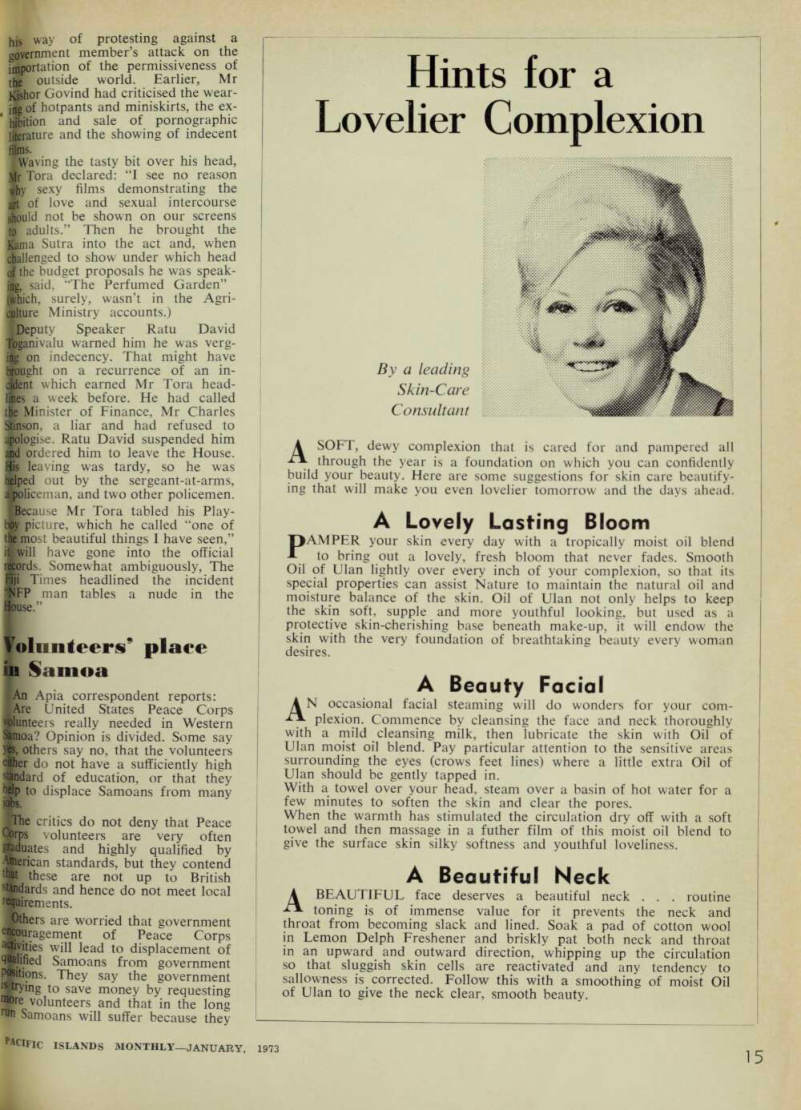
Hints for a
Lovelier Complexion
By a leading
Skin-Care Consultant A SOFT, dewy complexion that is cared for and pampered all through the year is a foundation on which you can confidently build your beauty. Here are some suggestions for skin care beautifying that will make you even lovelier tomorrow and the days ahead.
A Lovely Lasting Bloom
OAMPER your skin every day with a tropically moist oil blend \ to bring out a lovely, fresh bloom that never fades. Smooth Oil of Ulan lightly over every inch of your complexion, so that its special properties can assist Nature to maintain the natural oil and moisture balance of the skin. Oil of Ulan not only helps to keep the skin soft, supple and more youthful looking, but used as a protective skin-cherishing base beneath make-up, it will endow the skin with the very foundation of breathtaking beauty every woman desires.
A Beauty Facial
A N occasional facial steaming will do wonders for your complexion. Commence by cleansing the face and neck thoroughly with a mild cleansing milk, then lubricate the skin with Oil of Ulan moist oil blend. Pay particular attention to the sensitive areas surrounding the eyes (crows feet lines) where a little extra Oil of Ulan should be gently tapped in.
With a towel over your head, steam over a basin of hot water for a few minutes to soften the skin and clear the pores.
When the warmth has stimulated the circulation dry off with a soft towel and then massage in a futher film of this moist oil blend to give the surface skin silky softness and youthful loveliness.
A Beautiful Neck
A BEAUTIFUL face deserves a beautiful neck . . , routine C* toning is of immense value for it prevents the neck and throat from becoming slack and lined. Soak a pad of cotton wool in Lemon Delph Freshener and briskly pat both neck and throat in an upward and outward direction, whipping up the circulation so that sluggish skin cells are reactivated and any tendency to sallowness is corrected. Follow this with a smoothing of moist Oil of Ulan to give the neck clear, smooth beauty. : ' x
Powerful Pea-Beii Insecticide
is Guaranteed to
kill aj[ insect pests...
new ... yet it is compfetejy safe to spray
near food, children and pets.
Intensive scientific research into the most powerful insect killing substance known led to the development of safe, powerful Pea-Beu aerosol insecticide Pea-Beu is guaranteed to contain a high concentration of the world’s most powerful insect killing substance, yet it is absolutely safe to spray anywhere in the home, even near food, places where food is stored or in the presence of young children and household pets. Powerful, safe Pea-Beu aerosol insecticide quickly kills flies, mosquitoes, cockroaches, ants and all insect pests that carry infection and cause annoyance and irritation in your home, removing the dangers of disease.
Pea-Beu aerosol insecticide kills all insect pests Pea-Beu is the only household insecticide that will kill all insect pests including flies, mosquitoes, cockroaches, fleas, ants, moths and silverfish. Take immediate steps to eradicate all disease-carrying insect pests in your home by regular spraying with safe, powerful Pea-Beu aerosol insecticide.
Protect your family’s health Pea-Beu aerosol insecticide contains the strongest, most effective insect killing substance known, yet it is guaranteed safe to use anywhere throughout the home because Pea-Beu does not contain any of the poisonous chlorinated hydrocarbons, such as DDT, BHC, Lindane or Chlordane, all of which can irritate and cause damage to delicate nasal tissues and the lungs. The active ingredient in Pea-Beu aerosol insecticide is recognised as the strongest and safest insect killing substance, lethal to insects, but safe to humans and pets. ❖ % * Remember, the health of your family depends on your choice of insecticide. Powerful, safe Pea-Beu is guaranteed to kill all disease-carrying insect pests before they have a chance to bring illness into your home and Pea-Beu is safe to use in the presence of your children, near food, or even in the children’s nursery. ;|i *
Powerful Pea-Beu Guaranteed safe...
Guaranteed strong... Guaranteed to kill all insects.
mm T 7 n next you are in London , you are cordially invited to visit The House ofDunhill.
T he Dunhill King Size Filter Cigarette, created and perfected by our blenders to be the best
Virginia cigarette
I in the world.
dunhi
;10-OON PARIS NEWVORK
The most distinguished tobacco house in the worl
NPIU
The
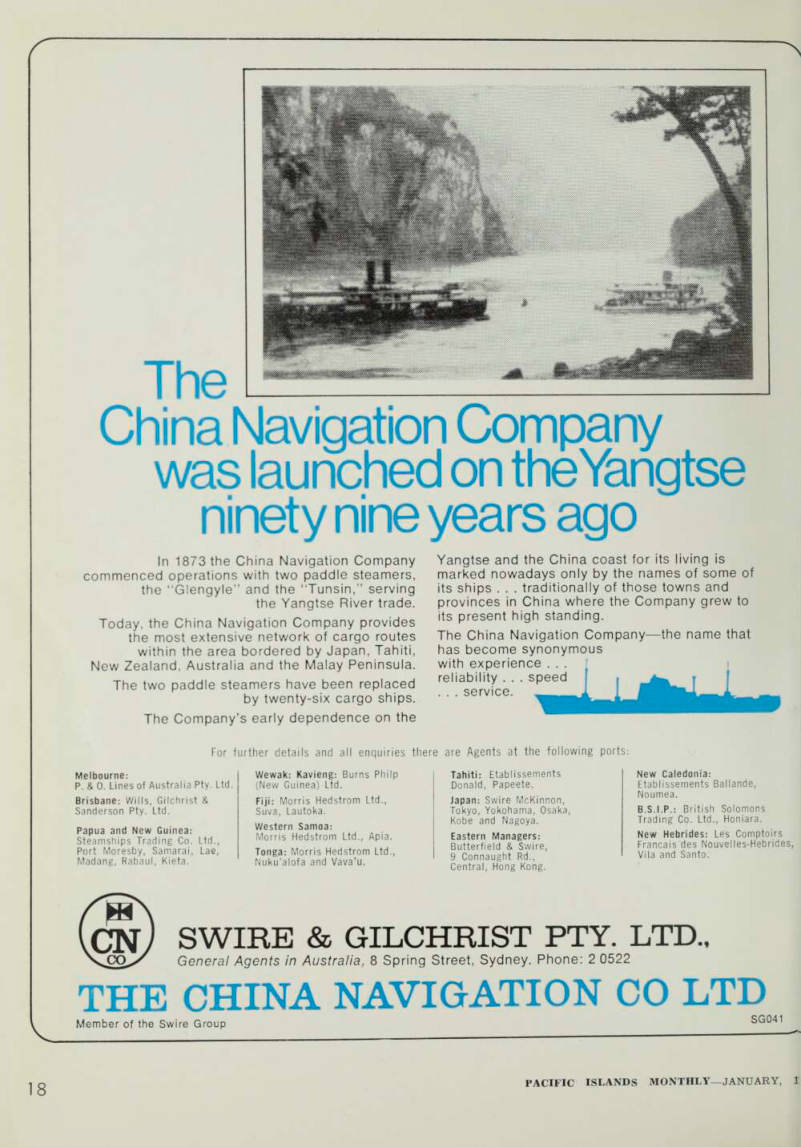
China Navigation Company
was launched on theYangtse
ninety nine years ago
In 1873 the China Navigation Company commenced operations with two paddle steamers, the “Glengyle” and the “Tunsin,” serving the Yangtse River trade.
Today, the China Navigation Company provides
the most extensive network of cargo routes within the area bordered by Japan, Tahiti, New Zealand, Australia and the Malay Peninsula.
The two paddle steamers have been replaced
by twenty-six cargo ships.
The Company’s early dependence on the
Yangtse and the China coast for its living is marked nowadays only by the names of some of its ships . . . traditionally of those towns and provinces in China where the Company grew to
its present high standing.
The China Navigation Company—the name that has become synonymous
with experience . . .
reliability . . . speed
. . . service.
For further details and all enquiries there are Agents Melbourne: P. & 0. Lines of Australia Pty. Ltd.
Brisbane: Wills, Gilchrist & Sanderson Pty. Ltd.
Papua and New Guinea: Steamships Trading Co. Ltd., Port Moresby, Samarai, Lae, Madang, Rabaul, Kieta.
Wewak: Kavieng: Burns Philp (New Guinea) Ltd.
Fiji: Morris Hedstrom Ltd., Suva, Lautoka.
Western Samoa: Morris Hedstrom Ltd., Apia.
Tonga: Morris Hedstrom Ltd., Nukualofa and Vava’u. at the following ports: Tahiti: Etablissements Donald, Papeete.
Japan: Swire McKinnon, Tokyo, Yokohama, Osaka, Kobe and Nagoya.
Eastern Managers: Butterfield & Swire, 9 Connaught Rd., Central, Hong Kong.
New Caledonia: Etablissements Ballande, Noumea. 8.5.1. P.: British Solomons Trading' Co. Ltd., Honiara.
New Hebrides: Les Comptoirs Francais des Nouvelles-Hebrides Vila and Santo.' (CN ) SWIRE & GILCHRIST PTY. LTD.. xJXLX General Agents in Australia, 8 Spring Street, Sydney. Phone: 2 0522
THE CHINA NAVIGATION CO LTD
Member of the Swire Group ®G(
mmm ■ " ■ :■ ■ ■ 1 ■ A onr o 2 n <n
§)QIFooo jr J
V " 3 » is m %
TWw.s.»
WCE OF AUS
25 KG NfT
r <* * i hi rr ■' -4 ra§iii V
the most important ingredient
BREAD FLOURS:
CAKE FLOURS:
BISCUIT FLOURS:
SPECIALITY FLOURS:
• MAINTOP —high protein bread flour • ANCHOR —bakers flour • 50/50 MEAL—brown bread • MEDIUM — anc j pastry • SPONGE —sponge cakes • SPECIAL CAKE—madeira and cup cakes • STRONG —cracker biscuits • MEDIUM —Shortbreads • SOFT —sweet biscuits • RYE flour • RYE mea l • KIBBLED RYE • SHARPS r oti and chapati flour • 100% STONE GROUND
WHOLEMEAL
GILLESPIE BROS. PTY. LTD.
.. head OFFICE: BRISBANE OFFICE:
52 UNION ST., PYRMONT, SYDNEY, N.S.W. CABLE ADDRESS: ALBION, BRISBANE, QUEENSLAND. (G.P.O. BOX 2518, SYDNEY, 2001.) "GILLESPIE", (P.O. BOX 8, ALBION, BRISBANE, 4010.) PHONE: 660-4933. SYDNEY AND BRISBANE. PHONE: 6-1121.
I ■ (V !
CP
MEAT LOAF
Combine 1 lb. minced steak, IV2 cups soft breadcrumbs. 1 finely chopped onion, Vz cup NESTLE'S IDEAL MILK, 1 tsp. salt and Va tsp. pepper. Place 1/3 of the meat onto a greased tray, Pat out into a rectangle. Place 3 hard cooked eggs along the centre. Mould remaining meat mixture around, form a loaf shape. Bake in a moderate oven for IVa hours. Decorate with olives. Serves 4 6.
CHOCOLATE SOUFFLES
Tie collars around 2 small souffle dishes so that mixture comes above lip of dishes. Melt 1 pkt. NESTLE'S CHOC- BITS over hot (not boiling) water. Dissolve 1 tbsp. gelatine in Va cup hot water. Add to melted chocolate. Beat in 1/3 cup sugar. Beat 1 cup well chilled NESTLE'S IDEAL MILK until doubled. Fold through cooled chocolate mixture. Pour into dishes. Chill. Remove collars. Decorate. Serves 2.
JELLY TOPPED CHIFFON PIE
Combine 12 crushed chocolate flavoured biscuits, 3 oz. melted butter. Press over base of 8" spring form tin or a foil lined 8" tin. Chill. Dissolve 1 pkt. strawberry jelly in cup hot water. Partially set. Beat 2 x 4 oz. pkts. cream cheese with V 2 cup sugar. Gradually beat in jelly, finely grated rind of 1 lemon. Beat IV2 cups well chilled NESTLE'S IDEAL MILK until doubled. Gently fold jelly and Vz cup chopped maraschino cherries (optional) through whipped IDEAL. Pour over crust. Refrigerate. Dissolve 1 pkt. strawberry jelly in 3 /a cup hot water. Chill. Chop jelly. Place over pie. Refrigerate. Serves 6 8.
ALL SPOON MEASUREMENTS ARE LEVEL UNLESS OTHERWISE STATED. 8 FL. OZ MEASURING CUP USED.
Cooking with Ideal
Milk that’s what. Great
new cooking ideas.
And new creaminess
and richness in
everything you cook.
That’s because Ideal
is milk and cream
rolled into one.
Isn’t it time you
discovered the
“Ideal thing”?
niilk&creib.,
,oUediitf o °%
NESTLf
Ideal
u CREAM
yiii
MIL
Western Samoa Can Expect Many
New Faces In Parliament
From FELISE VA’A in Apia
Western Samoa’s general elections are expected to be held on February 24. Campaigning by politicians and would-be politicians has begun to intensify. Campaigning usually starts off in a secret manner and then, as election time gets nearer, it becomes more open until opponents are prac tically hurling challenges, sometimes insults, at each other face to face.
Some of the campaigns have long been out in the open. Presents were being handed out to the matai voters and golden promises and concessions have been made. “Elect me and you will get this and this” has been said.
The voters, themselves are in a quandary. Since there are so many candidates, who should be elected?
Without doubt some candidates will be elected who are not necessarily the best available, if “best” means well educated, honest and forthright.
It is very hard to make predictions in Western Samoa. There are no Gallup Polls and the basis for state ments is usually hearsay. However, sometimes it is possible to make a general prediction based on what has been said and observed.
One can predict that there will be a lot of new members; many of the present members are expected to lose their seats, possibly up to 50 per cent.
This has always happened in the past —and there is good reason to believe that this trend will continue in the future.
If it does, the chances of the present government being returned to power are slim. If many of the present members lose their seats, the controlling element in the power base of the present government will have been removed. Shorn of established supporters, the government could very well be defeated, and a new one come into power next year.
The present government can still campaign hard after the elections to be returned to power—but, then, the chances are equal for the other can didates too. And it would probably be found that the new members would desire a change in government --that would mean an opportunity tor some of them to become cabinet ministers. So a big swing towards Mata afa or Tupuola can be expected it these premises hold true.
By early December it looked as if me political campaigning was getting better, judging from recent events in
parliament. It was not just that the politicians were fighting hard to be re-elected. Many were campaigning hard to gain cabinet positions in the next government. It would not be at all surprising if the three top con tenders, Mataafa, Tamasese and Tupuola already have their shadow cabinets.
One of the leading contenders for the post of Minister of Finance is Mr Sam Saili, one of the two mem bers elected on the European roll, now called the Individual Voters’
Roll. Saili was educated mainly in New Zealand where he qualified as a professional accountant. Returning to Samoa, he worked for the Treasury Department and then started his own accounting and auditing firm in part nership with his brother and sister.
Then last year, after at least one unsuccessful attempt, he was elected to parliament to fill the vacancy left by Mr G. F, D. Betham, now South Pacific Commission secretary-general.
Saili is one of the most outspoken critics of the financial policies of the present government. He has strongly denounced government action this year to increase duties on most of the imported foodstuffs and materials.
He said the government was trying to solve a complicated problem in a manner which was patently too easy, that other measures should have been found to gain more government revenue rather than having the public
bear the unnecessary burden of in creased taxation.
Perhaps indirectly, as a result of public outcry against the increased import duties, the Minister of Finance, Tofa Siaosi, recently an nounced in parliament that primage duty on fish, flour, meat, rice, salt and sugar would be removed by December 1.
But in parliament, this belated government measure was condemned by Saili as a brazen campaign move.
He told the minister that if the minister was going to drop duty on certain items, he should drop duty on all the rest.
Tofa found Saili’s sarcasm a bit too much, and his reply was full of emotion. He called Saili’s allegations irresponsible and said, “The primage duty was introduced as a temporary measure only to be abolished when the economy picks up”.
In other respects, Tofua defended some of his important actions, loans for example, clearly a move to main tain the trust of his colleagues in parliament.
The Chamber of Commerce has opposed government importation and distribution of alcoholic liquor. The chamber felt this could be better handled by commerce. Also, club owners had opposed the midnight closing of beer clubs. There was no necessity for this, they argued.
Further, the government has been criticised for not only poor relations with the public, but also for a poor and hostile attitude towards the press.
Admittedly, the government has also had some achievements but many of these, like the telecommuni cations project have not yet borne fruit—and some are continuations of old projects under the Mata’afa gov ernment.
If the present government, how ever, is returned it would be on the basis of its general economic de velopment efforts, past and promised.
The fish cannery proposal should have been brought in much earlier during the government’s term, how ever, for it now seems as if it is a price for the government’s return to power.
There is a real possibility of a change in government after these elections.
Polynesian’s Pili
Polynesian’s new HS74B, named Pili, arrived in Apia in November and was com mencing service December 16. Polynesian Airlines now has two modem HS74Bs. The remaining DC3 was scheduled for return to National Air ways Corporation, Christ
church, early in January.
During December Polynesian commenced charter flights to Rarotonga and twice weekly flights to Nadi.
Not Much Money But Lots
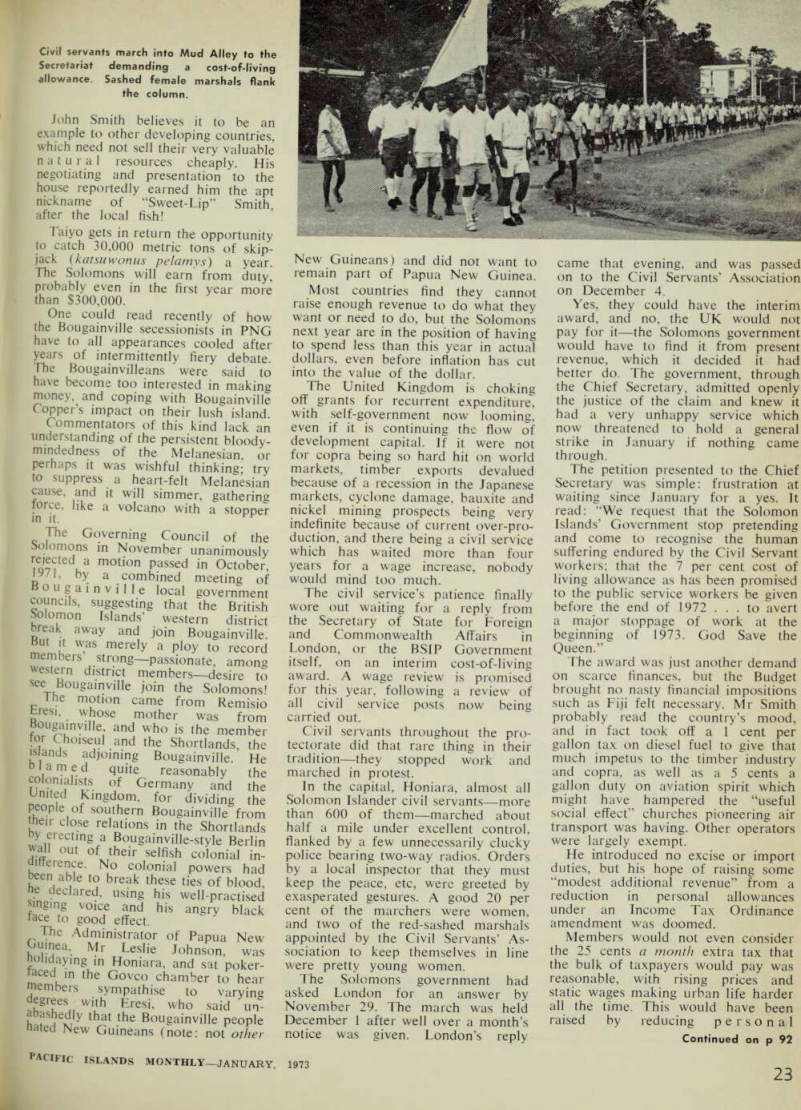

Of Fun In The Solomons
From a Honiara correspondent
The longest sitting in the history of the Solomon Islands legislature (3 weeks, 1 day), dealt with a budget which revealed the awful facts about the Solomons’ financial state (if they were not obvious already), and several associated events —all of them vital to the future of the protectorate.
An obvious highlight was the walk out by the 12 so-called “back benchers” of the Governing Council on Tuesday, Nov 21, the first time Govco has been forced to suspend proceedings for such a reason.
The sudden rising and dispersal of the members through four doors, bags, papers and all, at 3 pm caught the chairman. High Commissioner Sir Michael Gass, and the house leader.
Chief Secretary Mr Tom Russell, by surprise, and somewhat flat-footed as to procedure.
There had been unilateral decision by Internal Affairs Committee chair man, Mr Mariano Kelesi, to allow broadcasting hours on the Solomon Islands Broadcasting Service to be reduced (no lunchtime programmes, evenings cut by an hour or so) without referring to his committee of five.
Seeing Govco was sitting, and all committee members were present, it can only be assumed Mr Kelesi was flexing his muscles in preparation for the new constitution under which he could be a minister if he were to survive the April-May, 1973, general elections. But it was asking for trouble when one of his committee men is the respected and honourable Dr Clement Ofai and the young semi-reformed firebrand, Solomon Mamaloni, is roused.
These two suddenly brought tension to the house. Dr Ofai with quiet anger said there was no use having a committee if the chairman made decisions on his own. Mr Kelesi, tried to bluster his way out in reply with a series of largely incoherent statements about the situation.
When he sat down, another of his four committee members, Alfred Maeke, reiterated more angrily Dr Ofai’s question, and was followed by Mamaloni who spoke with quiet menace briefly about failings of the broadcasting service and the lone decision by Kelesi, then stated, “If we backbenchers are to mean nothing to the government of this country then let us walk out”.
Sir Michael Gass was chairing the Committee of Supply debate on the Budget. After searching Standing Orders, he concluded that the remain ing members —five chairmen of com mittees and two ex-officio—and him self had to sit out 15 minutes of somewhat embarrassing inactivity, then resume the Governing Council itself, find it without a quorum and adjourn until the next day.
The importance of this little drama lay in what had been said the week before by David Kausimae, chairman of the Natural Resources Committee and of the present members probably the most likely choice for the first Chief Minister (in 1974?).
Speaking on the report of the Select Committee on Constitutional Develop ment which recommended a West minster system, he was convinced that only a political party could form a government with staying power.
He picked one or two holes in the report, perceiving that a recom mended Advisory Committee of all backbench members of the new Legislative Assembly could unite easily to defeat their numerically smaller executive of Chief Minister and Council of Ministers—unless there was a party to discipline back benchers.
If nothing else would have revived
the Solomons United National (SUN) Party, this opening seems to have inspired its founder, David Kausimae, to really work for its transformation from steering committee stage to active party.
At least among sophisticates and among those who see meal tickets in commercial fishing, Kausimae has gained considerable prestige by stick ing to his belief in the joint fishing venture with Japan’s Taiyo Fishery Company, in the face of almost total opposition from members and Solomon Islanders at large. To follow this with a party election campaign based on unity for the Solomons to demonstrate his leadership qualities may well swing his own rural, con servative and reputedly still resentful Are Are, Malaita, electorate behind him. Kausimae, the devil who allowed foreigners to fish the Solomons’ deej blue sea, may yet be seen more widely as his country’s financial saviour (with the behind-the-scenes leadership of his chief apostle Financial Secretary, John Smith).
The Solomons Government has ap parently done very nicely out o; its agreement with Taiyo to forn the joint commercial fishing company Solomon Taiyo Limited. Taiyo put; up all the money after paying royaltie: to carry out a survey (admitted!] they also exported $4Jm worth o skipjack while surveying); Taiyo give the Solomons immediately a 25 pe cent share in return for exclusivi foreign fishing rights to skipjack ant other tuna-like fish for the next U years; Taiyo must sell a further 2per cent share to the government a any time the government wants h Taiyo must localise, beginning will 10 per cent of catcher vessels nex year and going to 90 per cent b< 1982, and beginning with 30 per cer Solomon Islanders at sea (86 per cer on shore) next year, and going to 60 per cent at sea (90 per cent o. shore) by 1977; Taiyo must mamtaii shore freezers and cold storage am other on-shore processing, establis; a cannery, provide all expertise am management personnel, pay 10 pe cent export duty on all skipjack ex ported (with a three per cent con cession the first two years, and on per cent the third year) based o f.o.b. value, and pay tax on eventu; dividends as well as 15 per cent ta on interest on overseas borrowings.
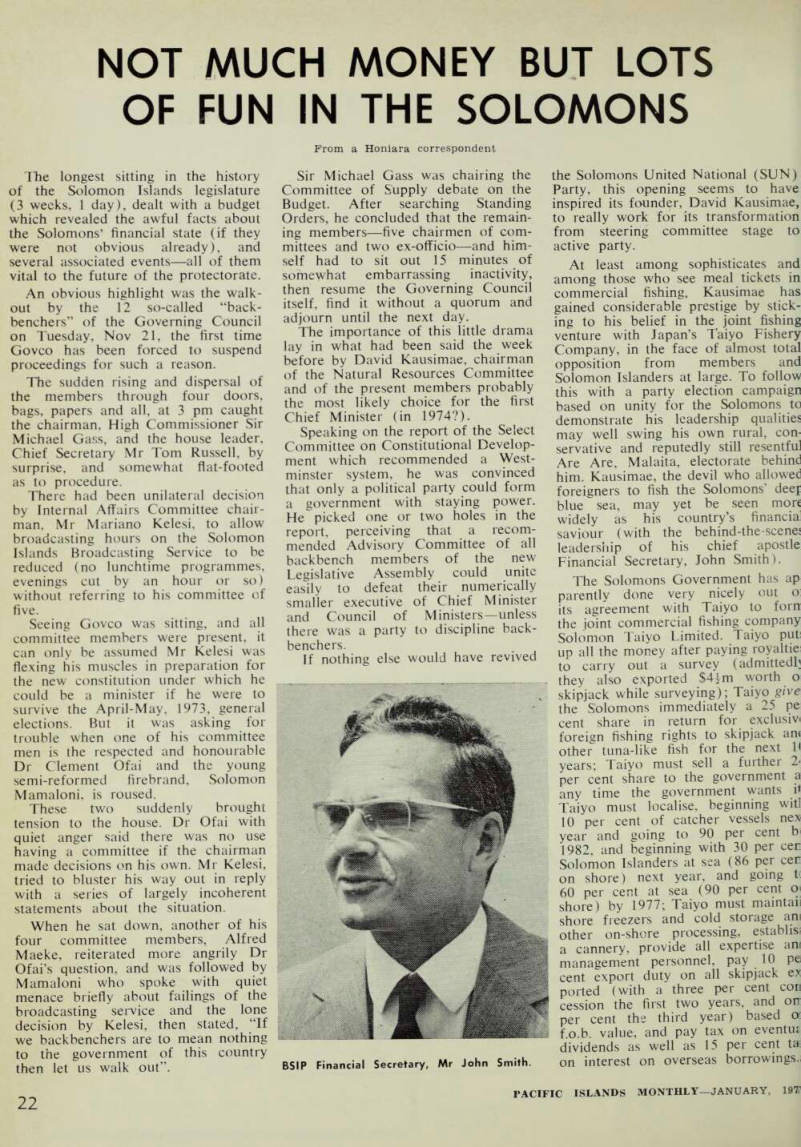
BSIP Financial Secretary, Mr John Smith.
John Smith believes it to be an example to other developing countries, which need not sell their very valuable natural resources cheaply. His negotiating and presentation to the house reportedly earned him the apt nickname of “Sweet-Lip” Smith after the local fish!
Taiyo gets in return the opportunity to catch 30,000 metric tons of skip jack (katsuwonus pelamys ) a year.
The Solomons will earn from duty, probably even in the first year more than $300,000.
One could read recently of how the Bougainville secessionists in PNG have to all appearances cooled after years of intermittently fiery debate.
The Bougainvilleans were said to have become too interested in making money, and coping with Bougainville Copper’s impact on their lush island.
Commentators of this kind lack an understanding of the persistent bloody mindedness of the Melanesian, or perhaps it was wishful thinking* try to suppress a heart-felt Melanesian cause, and it will simmer, gathering force, like a volcano with a stopper in it.
The Governing Council of the Solomons in November unanimously rejected a motion passed in October, i/ 71 ’ b y a combined meeting of Bougainville local government councils, suggesting that the British Solomon Islands' western district break away and join Bougainville.
But it was merely a ploy to record members strong—passionate, among western district members—desire to see Bougamville join the Solomons' the motion came from Remisio Lresi, whose mother was from Bougainville, and who is the member tor Choiseul and the Shortlands the islands adjoining Bougainville. He blamed quite reasonably the colomahsts of Germany and the United Kingdom, for dividing the people of southern Bougainville from their close relations in the Shortlands by erecting a Bougainville-style Berlin wall out of their selfish colonial in i erence. No colonial powers had been able to break these ties of blood, he declared, using his well-practised singing voice and his angry black face to good effect.
The Administrator of Papua New 9 J!" ea , Mr Leslie Johnson, was holidaying in Honiara, and sat poker faced m the Govco chamber to hear members sympathise to varying degrees wiff, Eresi, who said un bashedly that the Bougainville people hated New Guineans (note: not other
New Guineans) and did not want to remain part of Papua New Guinea.
Most countries find they cannot raise enough revenue to do what they want or need to do, but the Solomons next year are in the position of having to spend less than this year in actual dollars, even before inflation has cut into the value of the dollar.
The United Kingdom is choking off grants for recurrent expenditure, with self-government now looming, even if it is continuing the flow of development capital. If it were not for copra being so hard hit on world markets, timber exports devalued because of a recession in the Japanese markets, cyclone damage, bauxite and nickel mining prospects being very indefinite because of current over-pro duction, and there being a civil service which has waited more than four years for a wage increase, nobody would mind too much.
The civil service’s patience finally wore out waiting for a reply from the Secretary of State for Foreign and Commonwealth Affairs in London, or the BSIP Government itself, on an interim cost-of-living award. A wage review is promised for this year, following a review of all civil service posts now being carried out.
Civil servants throughout the pro tectorate did that rare thing in their tradition—they stopped work and marched in protest.
In the capital, Honiara, almost all Solomon Islander civil servants—more than 600 of them—marched about half a mile under excellent control, flanked by a few unnecessarily ducky police bearing two-way radios. Orders by a local inspector that they must keep the peace, etc, were greeted by exasperated gestures. A good 20 per cent of the marchers were women, and two of the red-sashed marshals appointed by the Civil Servants’ As sociation to keep themselves in line were pretty young women.
The Solomons government had asked London for an answer by November 29. The march was held December 1 after well over a month’s notice was given. London’s reply
came that evening, and was passed on to the Civil Servants’ Association on December 4.
Yes, they could have the interim award, and no, the UK would not pay for it—the Solomons government would have to find it from present revenue, which it decided it had better do. The government, through the Chief Secretary, admitted openly the justice of the claim and knew it had a very unhappy service which now threatened to hold a general strike in January if nothing came through.
The petition presented to the Chief Secretary was simple: frustration at waiting since January for a yes. It read: “We request that the Solomon Islands’ Government stop pretending and come to recognise the human suffering endured by the Civil Servant workers; that the 7 per cent cost of living allowance as has been promised to the public service workers be given before the end of 1972 ... to avert a major stoppage of work at the beginning of 1973. God Save the Queen.”
The award was just another demand on scarce finances, but the Budget brought no nasty financial impositions such as Fiji felt necessary. Mr Smith probably read the country’s mood, and in fact took off a 1 cent per gallon tax on diesel fuel to give that much impetus to the timber industry and copra, as well as a 5 cents a gallon duty on aviation spirit which might have hampered the “useful social effect” churches pioneering air transport was having. Other operators were largely exempt.
He introduced no excise or import duties, but his hope of raising some “modest additional revenue” from a reduction in personal allowances under an Income Tax Ordinance amendment was doomed.
Members would not even consider the 25 cents a month extra tax that the bulk of taxpayers would pay was reasonable, with rising prices and static wages making urban life harder all the time. This would have been raised by reducing personal
Continued on p 92
Civil servants march into Mud Alley to the Secretariat demanding a cost-of-living allowance. Sashed female marshals flank the column.
allowances claimed as tax deducts from $4BO to $420. It would b introduced tax to between 2,000 3.000 more people on top of 3.000 taxpayers, and it was “breaking in” of more of the po lation Mr Smith was after as nr as the small amount of revenue.
He did, however, get approval taxing dividends paid from Solomons to foreign shareholcb and for taxing interest repayment! overseas lenders (as in Taiyo’s • mentioned earlier).
The amount to be spent this J by the Solomons is $12,856,783 some $600,000 less than budgij for last year, which ended T a deficit of about $1,900,000. deficit is being met by a grant-inn from the United Kingdom whicl: also providing $4,625,980 in deves ment aid and research funds for • Sixth Development Plan’s prop which continue.
Mr Smith proposes a Solomons • rency, fully backed by reserves?
Australian dollars, be introducedt January 1, 1976. A report made year by an economist from the Um Nations Development Advisory T<l found more in favour of a local rency than against.
Advertisements & other items, p. 26 (1 item)
Mechanic In A Can
THE BIG FLAVOURS COME TO THE
SOUTH PACIFIC
pißiAnm
: §inger<M
y i The red hibiscus symbol proudly marks the introduction of some of New Zealand's most popular soft drinks by Island Bottlers of Fiji Ltd., from their new modern factory.
In Apia in Western Samoa the same flavourful range is produced by the Apia Bottling Company and people everywhere are asking for these famous names-
LEMON and PAEROA, TARTAN DRY GINGER
ALE and the colourful fruity range of JU'CY
SOFT DRINKS.
They're yours to enjoy . . . time after time.
Manufactured under franchise to Innes Tartan Ltd., Auckland, New Zealand by-
n ISLAND BOTTLERS OF FIJI LTD.
W APIA BOTTLING COMPANY LTD.
□ STARTS WET MOTORS □ STOPS SQUEAKS □ PREVENTS □ PROTECTS ALL METALS □ PREVENTS WET IGNITION □ LUBRICATES □ PROTECTS ALL ELECTRICAL SYSTEMS
□ FIGHTS SALT SPRAY CORROSION
□ PENETRATES AND LOOSENS TIGHT NUTS
□ PROTECTS RIFLES AND SPORTING EQUIPMENT
□ PREVENTS BATTERY CORROSION
MECHANIC IN A CAN
WD4O is available in handy aerosol cans or gallon and half gallon cans with applicator.
Other chemicals manufactured by Ardrox include degreasers, decarbonisers, detergents, paint removers, rust and scale removers, corrosion removers, safety solvents, marine cleaning solvents, industrial cleaning materials, general cleaning products and steam cleaning additives ... all developed and approved for aircraft, marine, electrical and general engineering industries.
Send for more information.
ARDROX AUSTRALIA PTY. LIMITED hawker s^eleycompany HEAD OFFICE: BIRNIE AVENUE, LIDCOMBE, N.S.W., AUSTRALIA. TEL: 649 0111 Port Moresby: ANG House. Singapore: 193 b Goldhill Centre, Thompson Rd., Singapore 11
The gentlemanly touch
in PNG'S politics
From Percy Chatterton, In
Port Moresby
Last month I suggested that the kind of opposition most likely to commend itself to Paguineans would be an urbane one. This view was confirmed during the November meeting of the House of Assembly when the Opposition moved to cen sure the Minister of Agriculture, Stock and Fisheries, lambakey Okuk, for what it alleged had been his unseemly behaviour in a Port Moresby restaurant.
No one seemed to have his heart in the exercise, and after 40 minutes of desultory debate the government applied the gag. The Opposition did not call a division; the closure was agreed to and the motion defeated on the voices. Evidently this kind of political in-fighting just doesn’t go down in Papua New Guinea.
The result of the Kairuku-Hiri by election could be another straw blown by the same breeze. Ron Slaughter, well-known Kairuku busi nessman, won the seat in the general election, but by such a small margin that his Papuan runner-up was able to challenge the result on the plea that the contents of several ballot boxes lost in a river-crossing mishap could have affected the result.
The Court of Disputed Returns
ordered a new election, which Mr Slaughter has now won with a lead of more than 1,000 votes over the same runner-up he so narrowly de feated last March. 1 think that the most likely explanation of this land slide victory is that the voters were embarrassed by the course of events and felt that they must do the right thing by Mr Slaughter so that he should not suffer loss of face.
Papuans are very polite people.
The meeting was a brief one—lo sitting days spread over 2± weeks.
But in that time some very important business was dealt with.
First, there was Father John Momis’ motion, setting out, in a 13-point policy statement, guidelines for future mineral exploitation in Papua New Guinea. The most con troversial clause in the motion, that concerning re-negotiation of agree ments, was first withdrawn by Fr Momis and then put back in a modi fied form by Mines Minister Paul Lapun. In its final form the motion was passed on the voices, with not more than a handful of dissentients.
The effect of the motion on the eco nomic development of the country remains to be seen.
The Bougainville Agreement is not directly or immediately affected by the Momis motion. But Chief Minister Somare has made it clear that while future mining agreements will be honoured, his government does not regard the colonially-negotiated Bougainville Agreement as sacro sanct.
Opposition Leader Matthias Toli man, in what is possibly his party’s first constructive contribution to gov ernment since it found itself in oppo sition, has suggested that the govern ment should retain the services of overseas consultants tj study and advise on the agreement.
After the Momis declaration, the most important act of this meeting of the House has undoubtedly been the passage of a bill providing for the setting up of village courts, authorised to deal with certain minor offences and disputes. The fact is that village “courts” have been operating outside the official legal system during the greater part of the colonial period.
This move to regularise and control them and to bring them within the official system is long overdue.
An amendment to the Local Gov ernment Ordinance has removed the requirement that council rules (ie by laws) must be passed by a three quarter majority to be valid. This will save some councils, among them the Port Moresby City Council, from the frustration of having revenue-raising plans blocked by a small but deter mined minority.
The Gazelle Peninsula Bill, the gov ernment's attempt to bring peace to Tolailand, has been deferred till next year in the face of determined opposi tion from those members who regard the measure as a sell-out of the law abiding to the lawless.
It is certainly an odd piece of legislation, designed as it is to give official recognition to the unofficial “councils” set up by opposing fac tions, and to give them certain powers, including the power to levy taxes, but only over their registered members. It is difficult to see how such an arrangement could work satisfactorily except as a very tem porary measure.
On the self-government front the transferral of a further substantial block of powers from Canberra to Port Moresby has been approved by the House, though not without some protest from the go-slow brigade.
Finally yet another attempt, the third, to repeal the notorious Gaming (Playing Cards) Ordinance, which makes playing cards an illegal im port, has failed. It was defeated on a division, in a little more than half filled House, by 34 votes to 24.
Nevertheless, a recent court ruling
Mr Ron Slaughter, MHA indeed.
Fr John Momis, MHA.
Major Share Wanted In Mining
has largely drawn the ordinance’s
teeth.
A magistrate has ruled that to be in possession of playing cards is not in itself an offence, and that a prose
cution can therefore only succeed if
it can be proved that the cards in
question were imported subsequently
to the coming into force of the Ordinance in 1965.
On November 29 the House ad
journed to “a date to be fixed” rumoured to be February 23.
The Resolution
There were 13 clauses in Fr Momis’s motion in which he called for major participation by Papua New Guineans in any mining ventures in the territory.
The motion reads: That this House, re cognising the vital role which mining will play in the economy of Papua New Guinea; that control of the economy is essential to national self-determination and real political independence; that in many developing countries the effect of major mining ventures has been more detrimental than beneficial to these countries: and that it is in the best interests of both Papua New Guinea and potential investors that government policy regarding foreign investment be as clear and explicit as possible, calls on the government to formulate and adopt certain investment principles relating to mining ventures, such principles to provide for the following matters: (a l The equity of Papua New Guineans in any major mining venture should be as great as possible and normally should constitute a major holding; •bi Such equity should normally be held by the government or a government
instrumentality;
<c) The terms of any mining venture should provide—(ii for the maximum employment of Papua New Guineans; (ii) that the venture should, as far as possible, be labour-intensive rather than capital-intensive; (iff) for employee participation in decision making, and; (ivl for the develop ment of secondary and tertiary industries in connection with the mining venture, including the maxi mum feasible processing of ore prior to export. (di Any corporation engaged in a mining venture should be obligated to train or arrange for the training of Papua New Guineans to take over managerial and technical positions in accordance with a definite time table established for each venture; (ei In the setting-up and conduct of any mining venture maximum use should be made of goods and services produced from resources within Papua New Guinea and provided by Papua New Guineans; (fi Any ancillary economic activity generated within Papua New Guinea by a mining venture should be con ducted as far as possible by Papua New Guineans; igi The terms of any mining venture should aim to preserve racial harmony in the area of operations and to maintain and repair the physical environment;
(hi In negotiating the terms of any mining venture, the Government would seek to obtain the maximum collateral advantages in terms of trade and assistance for develop ment; (i) An agreement setting up a mining venture should include formulae agreed to by the parties which provide for changing circumstances, such as price fluctuations, variations in profitability and development of new techniques; (j) To the maximum possible extent, government purchases of equity in mining ventures should be paid for out of future earnings of the mine, instead of large initial cash outlays and commercial loans;
(k) Any agreement for a mining venture should provide at least as much revenue for the Papua New Guinea Government—as is provided on the average by similar ventures in other developing countries; (l) Mining agreements should provide that disputes between mining com panies and the government will be settled in accordance with Papua New Guinea’s legal procedures, and not by resort to outside arbitrators; (m) The offering of tax holidays and other Investment incentives should be balanced against the nation’s need for revenue and equitable treatment of all industry, both foreign-owned and Papua New Guinean, and recommends that the government recruit a specialist team to engage in the negotiation and supervision of mining ventures.
Advertisements & other items, pp. 28-30 (2 items)
31 Macquarie Place, Sydney, N.S.W. 2000
Established 1890 offering merchants in the Pacific, buying service giving prompt, careful and expert attention to all requirements.
For that service with a difference, cable "Success", Sydney. <r* Representing Manufacturers of: Tilley Lamps, Success Footwear, Del Monte Products, Murray Valley Drinks, etc., Lingman Italian Gas Ranges, Success Petrol Washing Machines, E. W. Pipe Fittings, Sharp Calculators, Success Canned Fish, and other leading Brands.
S.^ HIGHEST PRICES OBTAINABLE ON THE WORLD MARKETS
FOR YOUR
SHELL - COCOA - COFFEE - COPRA - ETC.
31 Macquarie Place, Sydney, N.S.W. 2000
G.P.O. BOX 5315, SYDNEY, 2001.
CABLES: "TAITCO", SYDNEY.
Seatrans House, Gore St., Auckland, N.Z.
P.O. BOX 2044, AUCKLAND, N.Z.
CABLES: "TAITCO", AUCKLAND.
N
UICTA
TURNS
GRASS
INTO
LAWN!
A MODEL AVAILABLE TO SUIT ALL
CONDITIONS AND EVERY PURPOSE
SUVA MOTORS LTD.
SUVA, LAUTOKA.
CARPENTERS
PORT MORESBY.
NEW GUINEA CO. LTD.
RABAUL, MADANG,
LAE, MOUNT HAGEN,
MINJ, GOROKO.
happen'
Good things
at home
Tilux Wall Panelling is making beautiful, washable, durable, colourful and non-combustible walls in bathrooms, kitchens and laundries.
Pretty up your home from a whole range of contemporary patterns and decorator colours.
Get some good things happening Available Bowmans, Burns Philp & Coral Industries k (Solomon Islands)
and at
work
Hardiflex Building Board is working beautifully as the new, modern, smooth wall panelling for glamorous interiors and hard-wearing exteriors.
Use it natural or as the perfect base for decorating ... wherever you can use a wall that doesn’t weather, burn or buckle even in fire.
Versilux internal ceiling and wall lining is helping reduce fire danger in schools and other places where safe, attractive, durable, paintable and easily installable linings are required.
[^Hardies
BUILDING PRODUCTS
28237 JH44.87
Footnotes
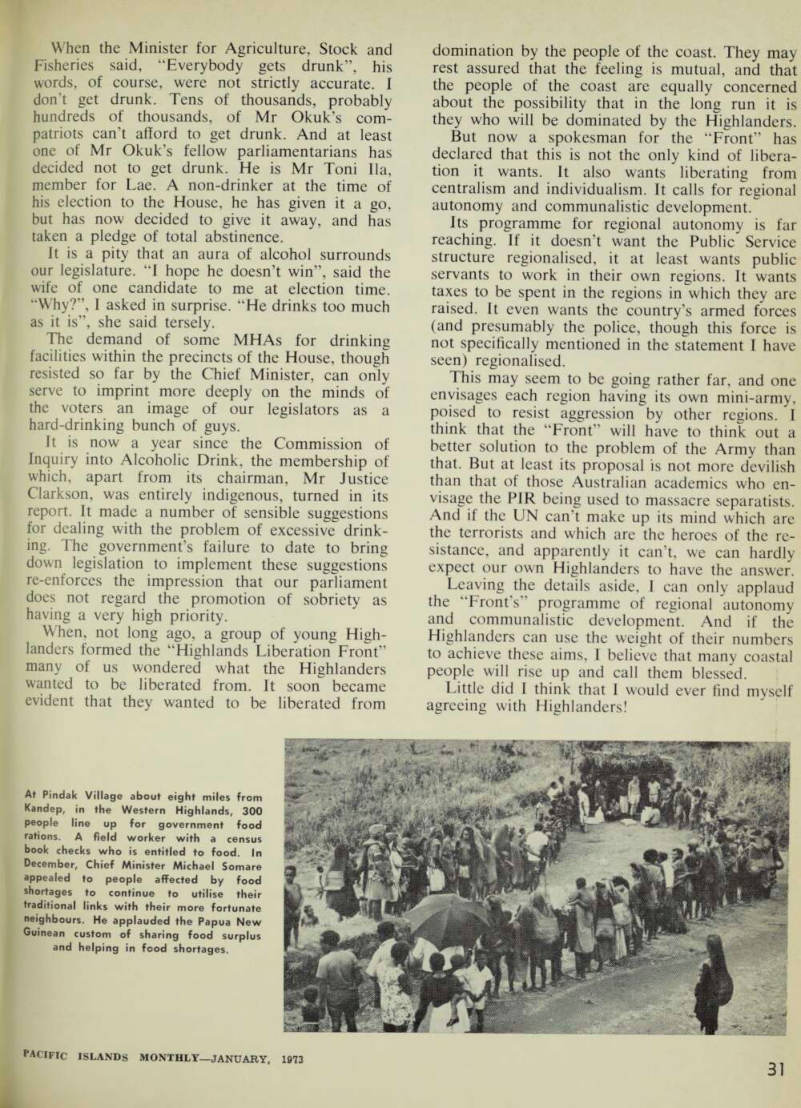
IN November, 1872, the first LMS missionaries 1 arrived in what is now the Papua Region of Papua New Guinea, declaring, it is said, “We have come in peace”.
In November, 1972, the Minister for Agri culture, Stock and Fisheries in PNG’s National Coalition Government, excusing himself in a radio interview for an alleged lapse from minis terial dignity, declared, “Everybody gets drunk”.
In the century which has passed between these two declarations, Papuans and New Guineans have been busily engaged in abandoning the worst of their own bad habits and adopting the worst of ours.
Those first missionaries, however, were not white men from the west but brown men from the east —Melanesians from the Loyalty Islands and Polynesians from the Cook Islands.
In the November and December issues of PIM, Marjorie Crocombe has given us a fascinating
picture of the celebrated Ruatoka, whose portrait appears on a recent PNG stamp, and his Cook Islands colleagues. One suspects that her study has been a labour of love as well as a painstaking piece of research. It is much to be hoped that someone will give us an equally sympathetic study of the Loyalty Islands pioneers in the Torres Strait islands and western Papua.
There is one point, however, at
which Marjorie Crocombe’s interpreters have not served her well. The people of Manumanu are reported to have said of Ruatoka and his col leagues, “They are gods who have come down from Tauru, the spirit world”.
Back-translating into Motu, it is a fairly safe guess that what they actually said was, Idia na dirava, Tauru amo vada e diho.
But Tauru was not “up there”; it was “out there” over the western horizon. In fact, pri marily, the word simply meant the horizon; its secondary meaning was the abode of the spirits of the dead which lay beyond that horizon.
It is true that diho can mean “down”. But it can also mean motion from seaward to landward, and clearly that is the meaning here.
With Percy Chatterton
in Port Moresby
The Worst Of
Then For The
Worst Of Now
Finally dirava, in 1872, meant “the spirits of the dead” (as distinct from lauma, the spirits of the living)—and nothing else. It was W. G.
Lawes, the first white missionary to British New Guinea, who, arriving two years later in 1874, adopted the word Dirava to mean the God of the Christians and their Hebrew forerunners, and dirava to denote the pagan gods who intrude from time to time into the Bible story.
This piece of linguistic hijacking was so suc
cessful that later generations of Motu have tended to keep Dirava for “God”, and to use Lauma to denote the spirits of the dead as well as those of the living—a usage which their ancestors would probably have regarded with horror.
If, therefore, the people of Manumanu did indeed use the phrase I have suggested they used, what they meant by it was, “They are the spirits of the dead,
who have come across the ocean from Tauru, their home beyond the horizon”.
In the same way, the phrase translated “the people of God”, an expression completely ana chronistic for 1872, was probably mase taudia diravadia, that is, “the spirits of dead people”.
Come to think of it, what is more natural than that the people of Manumanu should come to this conclusion. Here were brown skinned people not unlike themselves in appearance who had appeared from the direction of Tauru, and who spoke a strange language which was nevertheless interlarded with occasional Motu words, showing that these dirava had not completely forgotten their mother tongue during their sojourn in Tauru. Who else could they be? (over)
When the Minister for Agriculture, Stock and Fisheries said, “Everybody gets drunk”, his words, of course, were not strictly accurate. I don’t get drunk. Tens of thousands, probably hundreds of thousands, of Mr Okuk’s com patriots can’t afford to get drunk. And at least one of Mr Okuk’s fellow parliamentarians has decided not to get drunk. He is Mr Toni Ila, member for Lae. A non-drinker at the time of his election to the House, he has given it a go, but has now decided to give it away, and has taken a pledge of total abstinence.
It is a pity that an aura of alcohol surrounds our legislature. “I hope he doesn’t win”, said the wife of one candidate to me at election time.
“Why?”, I asked in surprise. “He drinks too much as it is”, she said tersely.
The demand of some MHAs for drinking facilities within the precincts of the House, though resisted so far by the Chief Minister, can only serve to imprint more deeply on the minds of the voters an image of our legislators as a hard-drinking bunch of guys.
It is now a year since the Commission of Inquiry into Alcoholic Drink, the membership of which, apart from its chairman, Mr Justice Clarkson, was entirely indigenous, turned in its report. It made a number of sensible suggestions for dealing with the problem of excessive drink ing. The government’s failure to date to bring down legislation to implement these suggestions re-enforces the impression that our parliament does not regard the promotion of sobriety as having a very high priority.
When, not long ago, a group of young High landers formed the “Highlands Liberation Front” many of us wondered what the Highlanders wanted to be liberated from. It soon became evident that they wanted to be liberated from
domination by the people of the coast. They may rest assured that the feeling is mutual, and that the people of the coast are equally concerned about the possibility that in the long run it is they who will be dominated by the Highlanders.
But now a spokesman for the “Front” has declared that this is not the only kind of libera tion it wants. It also wants liberating from centralism and individualism. It calls for regional autonomy and communalistic development.
Its programme for regional autonomy is far reaching. If it doesn’t want the Public Service structure regionalised, it at least wants public servants to work in their own regions. It wants taxes to be spent in the regions in which they are raised. It even wants the country’s armed forces (and presumably the police, though this force is not specifically mentioned in the statement I have seen) regionalised.
This may seem to be going rather far, and one envisages each region having its own mini-army, poised to resist aggression by other regions. I think that the “Front” will have to think out a better solution to the problem of the Army than that. But at least its proposal is not more devilish than that of those Australian academics who en visage the PIR being used to massacre separatists.
And if the UN can’t make up its mind which are the terrorists and which are the heroes of the re sistance, and apparently it can’t, we can hardly expect our own Highlanders to have the answer.
Leaving the details aside, I can only applaud the “Front’s” programme of regional autonomy and communalistic development. And if the Highlanders can use the weight of their numbers to achieve these aims, I believe that many coastal people will rise up and call them blessed.
Little did I think that I would ever find myself
agreeing with Highlanders!
At Pindak Village about eight miles from Kandep, in the Western Highlands, 300 people line up for government food rations. A field worker with a census book checks who is entitled to food. In December, Chief Minister Michael Somare appealed to people affected by food shortages to continue to utilise their traditional links with their more fortunate neighbours. He applauded the Papua New Guinean custom of sharing food surplus and helping in food shortages.
Advertisements & other items, pp. 32-34 (1 item)
S. E. Tatham
1 52
SOME OF THE FIRMS
WE REPRESENT ARE:
S. E. TATHAM
& CO. PTY. LTD.
ASKEW HOUSE, 364 LONSDALE ST.,
MELBOURNE, 3001, AUSTRALIA.
G.P.O. BOX 8—
CABLES "SET",
TELEPHONE: 601125
BUYERS FOR THE
PACIFIC ISLANDS
Frappier (French Brandy) Huvet (French Brandy) Indika (Belgium Dairy Produce) Durobor S.A. (Belgium Glassware) Miroiterie Gen. de Belgiqe S.A. (Louvre glass and mirrors) City Engineers (U.K. Bicycles) F.H.I. Japan (Subaru Cars) Sunshine Biscuits Sunrise (Confectionery) Flamenco (Instant Coffee & Tea) Quaker Products (Oats, Jets) Merchants (Canned Soft Drinks, Cordials) Hancocks (Spaghetti, Cereals) Melbourne Canning (Jams) Water Wheel (Flour, Sharps, Wheat) A. P. & D. (Twisties, Twirlies) Edward Zorn (Margarine, Cooking Fats) Allens (Confectionery) Red Tulip (Fine Chocolates) Robert Timms (New Guinea Gold Instant Coffees and Teas) Highness (Canned Vegetables, Fruit Juices) S.P.C. (Abalone) Lunchtime (Honey) Wing Lee (See You Sauce) Hardings (Sauces) Magnet (Mattresses) Essteel (Cookware) Warner-Drayton (Fans) Mitchell's (Abrasives) Regent (Swiss watches) Austramax (Pressure Lanterns) Preservene (Soap Products) Lawn Chair; Tubco (Garden Furniture) Sunrise Lustertone (S.S. Sinks, Plumbers Supplies) Electronic Industries (Electrical Household Appliances) Jex (Steelwool) Arnbro (Folding Beds) Elmaco (Plastics —Electrical Fittings) B.X. (Plastics) Franklite (Light Fittings) JJ. Cash (Embroidered Labels) Disston (Saws) Supa-Swift (Motor Mowers, Tractors) 81 \ %
DIRECT ENQUIRIES WELCOMED
FIJI: S. E. TATHAM (FIJI) LTD.,
LAUTOKA P.O. BOX 366,
SUVA G.P.0., BOX 671.
PAPUA NEW GUINEA: S. E. TATHAM (P.N.G.) PTY. LTD.,
MALEKULA ST., LAE. P.O. BOX 1562.
YOUR GUARANTEE
SINCE 1924
i
FOR SERVICE
T. 2
o
dl * COME TO ALLIED IRONFOUNDERS
WHEN IT COMES TO
COOKING
DEFY
iy
“WELCOME DOVER”
SOLID FUEL STOVES
“WELCOME DOVER” are very low priced stoves. Finished in special black lead paint with chrome trimmings and features... * 5-plate cooking top * Optional 13.5 litre hot water tank
CHOOSE FROM 3 SIZES
Also Portable Cooking Boilers, Rayburn Cooker and Hot Water Heater, Commercial Cooking Equipment.
DUO ENTERPRISES
Papua & New Guinea P.O. Box 494, Port Moresby
FOR
GAS, ELECTRIC,
SOLID FUEL AND
OIL COOKERS
MAIL THIS COUPON FOR FREE LITERATURE
TICK IF REQUIRED □ RAYBURN 620 □ COOKING BOILERS □ DOVER STOVES □ COMMERCIAL COOKING EQUIPMENT.
DUO ENTERPRISES Papua & New Guinea P.O. Box 494, Port Moresby, T.P.N.G.
NAME
ADDRESS
I AFI29
diary
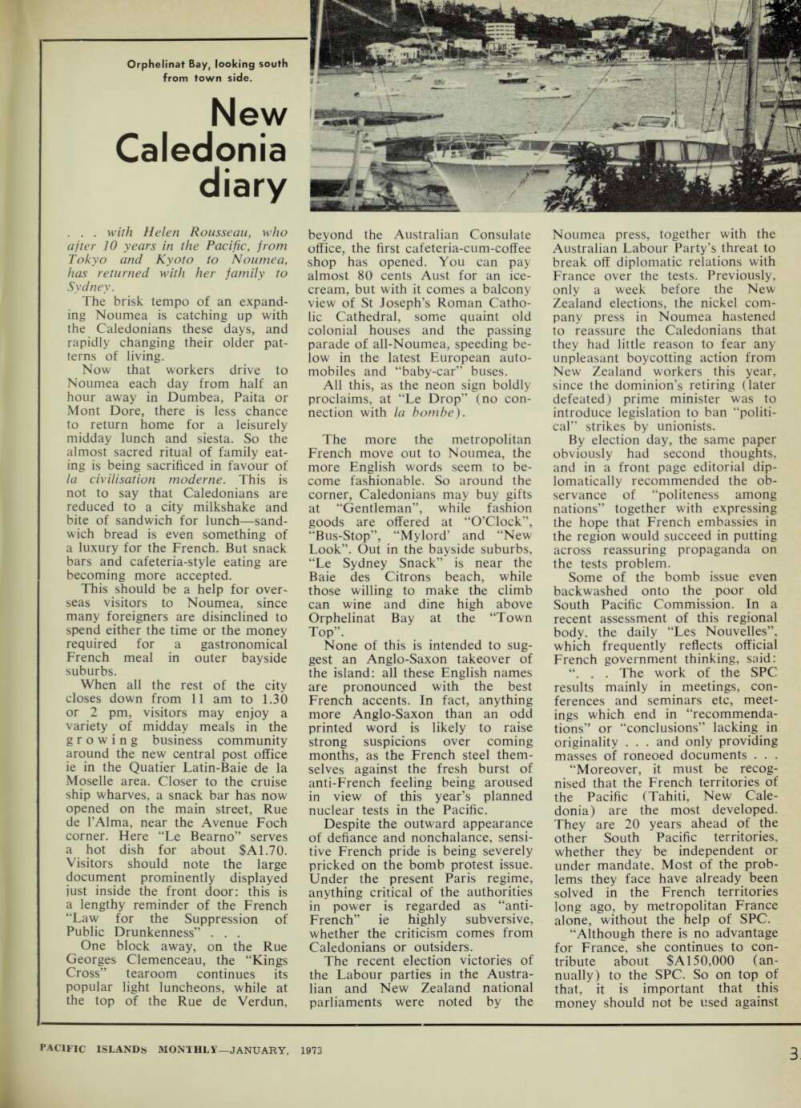

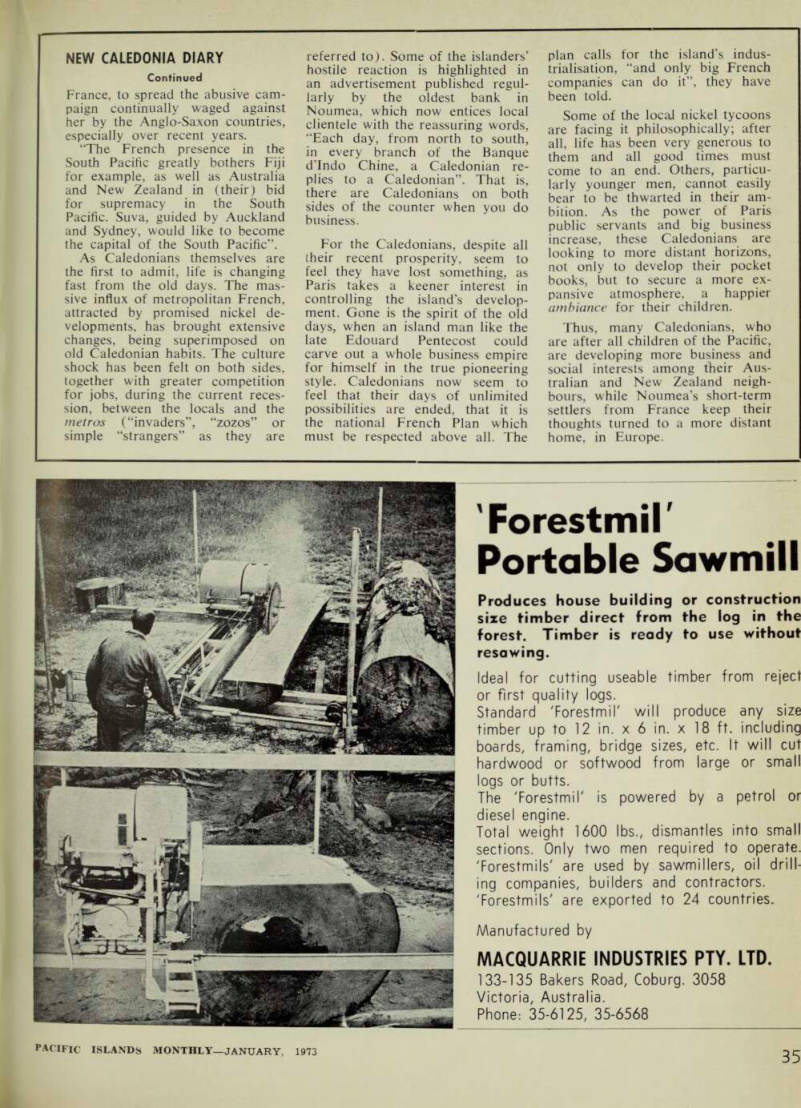
New Caledonia diary
. , . with Helen Rousseau, who after 10 years in the Pacific, from Tokyo and Kyoto to Noumea, has returned with her family to Sydney.
The brisk tempo of an expand ing Noumea is catching up with the Caledonians these days, and rapidly changing their older pat terns of living.
Now that workers drive to Noumea each day from half an hour away in Dumbea, Paita or Mont Dore, there is less chance to return home for a leisurely midday lunch and siesta. So the almost sacred ritual of family eat ing is being sacrificed in favour of la civilisation moderne. This is not to say that Caledonians are reduced to a city milkshake and bite of sandwich for lunch—sand wich bread is even something of a luxury for the French. But snack bars and cafeteria-style eating are becoming more accepted.
This should be a help for over seas visitors to Noumea, since many foreigners are disinclined to spend either the time or the money required for a gastronomical French meal in outer bayside suburbs.
When all the rest of the city closes down from 11 am to 1.30 or 2 pm, visitors may enjoy a variety of midday meals in the growing business community around the new central post office ie in the Quatier Latin-Baie de la Moselle area. Closer to the cruise ship wharves, a snack bar has now opened on the main street, Rue de I’Alma, near the Avenue Foch corner. Here “Le Bearno” serves a hot dish for about 5A1.70.
Visitors should note the large document prominently displayed just inside the front door: this is a lengthy reminder of the French “Law for the Suppression of Public Drunkenness” . . .
One block away, on the Rue Georges Clemenceau, the “Kings Cross” tearoom continues its popular light luncheons, while at the top of the Rue de Verdun,
beyond the Australian Consulate office, the first cafeteria-cum-coffee shop has opened. You can pay almost 80 cents Aust for an ice cream, but with it comes a balcony view of St Joseph’s Roman Catho lic Cathedral, some quaint old colonial houses and the passing parade of all-Noumea, speeding be low in the latest European auto mobiles and “baby-car” buses.
All this, as the neon sign boldly proclaims, at “Le Drop” (no con nection with la bombe).
The more the metropolitan French move out to Noumea, the more English words seem to be come fashionable. So around the corner, Caledonians may buy gifts at “Gentleman”, while fashion goods are offered at “O’Clock”, "Bus-Stop”, “Mylord’ and “New Look”. Out in the bayside suburbs, “Le Sydney Snack” is near the Baie des Citrons beach, while those willing to make the climb can wine and dine high above Orphelinat Bay at the “Town Top”.
None of this is intended to sug gest an Anglo-Saxon takeover of the island; all these English names are pronounced with the best French accents. In fact, anything more Anglo-Saxon than an odd printed word is likely to raise strong suspicions over coming months, as the French steel them selves against the fresh burst of anti-French feeling being aroused in view of this year’s planned nuclear tests in the Pacific.
Despite the outward appearance of defiance and nonchalance, sensi tive French pride is being severely pricked on the bomb protest issue.
Under the present Paris regime, anything critical of the authorities in power is regarded as “anti- French” ie highly subversive, whether the criticism comes from Caledonians or outsiders.
The recent election victories of the Labour parties in the Austra lian and New Zealand national parliaments were noted by the
Noumea press, together with the Australian Labour Party’s threat to break off diplomatic relations with France over the tests. Previously, only a week before the New Zealand elections, the nickel com pany press in Noumea hastened to reassure the Caledonians that they had little reason to fear any unpleasant boycotting action from New Zealand workers this year, since the dominion’s retiring (later defeated) prime minister was to introduce legislation to ban “politi cal” strikes by unionists.
By election day, the same paper obviously had second thoughts, and in a front page editorial dip lomatically recommended the ob servance of “politeness among nations” together with expressing the hope that French embassies in the region would succeed in putting across reassuring propaganda on the tests problem.
Some of the bomb issue even backwashed onto the poor old South Pacific Commission. In a recent assessment of this regional body, the daily “Les Nouvelles”, which frequently reflects official French government thinking, said: . . The work of the SPC results mainly in meetings, con ferences and seminars etc, meet ings which end in “recommenda tions” or “conclusions” lacking in originality . . . and only providing masses of roneoed documents . . .
“Moreover, it must be recog nised that the French territories of the Pacific (Tahiti, New Cale donia) are the most developed.
They are 20 years ahead of the other South Pacific territories, whether they be independent or under mandate. Most of the prob lems they face have already been solved in the French territories long ago, by metropolitan France alone, without the help of SPC.
“Although there is no advantage for France, she continues to con tribute about 5A150,000 (an nually) to the SPC. So on top of that, it is important that this money should not be used against
Orphelinat Bay, looking south from town side.
France, to spread the abusive cam- Smith Pacific- oreatlv bothers Fiii bourn Pacmc greatly bothers riji for example, as well as Australia and New Zealand in (their) bid fnr snnremarv in the Sm.th tor supremacy in the ioutn Pacific. Suva, guided by Auckland and Sydney, would like to become the capital of the South Pacific”.
As Caledonians themselves are the first to admit, life is changing fast from the old days. The massive influx of metropolitan French, attracted by promised nickel developments, has brought extensive changes, being superimposed on old Caledonian habits. The culture shock has been felt on both sides, together with greater competition for jobs, during the current recession, between the locals and the metros (“invaders”, “zozos” or simple “strangers” as they are
referred to). Some of the islanders’ hostile reaction is highlighted in an advertisement published regul larly by the oldest bank in Noumea, which now entices local clientele with the reassuring words, “Each day, from north to south, in every branch of the Banque d’lndo Chine, a Caledonian re plies to a Caledonian”. That is, there are Caledonians on both sides of the counter when you do business.
For the Caledonians, despite all their recent prosperity, seem to feel they have lost something, as Paris takes a keener interest in
controlling the island’s develop
ment. Gone is the spirit of the old days, when an island man like the late Edouard Pentecost could carve out a whole business empire for himself in the true pioneering style. Caledonians now seem to feel that their days of unlimited possibilities are ended, that it is the national French Plan which must be respected above all. The
plan calls for the island’s indus trialisation, “and only big French companies can do it”, they have been told.
Some of the local nickel tycoons are facing it philosophically; after all, life has been very generous to them and all good times must come to an end. Others, particu larly younger men, cannot easily bear to be thwarted in their am bition. As the power of Paris public servants and big business increase, these Caledonians are looking to more distant horizons, not only to develop their pocket books, but to secure a more ex pansive atmosphere, a happier ambiance for their children.
Thus, many Caledonians, who are after all children of the Pacific, are developing more business and social interests among their Aus tralian and New Zealand neigh bours, while Noumea’s short-term settlers from France keep their thoughts turned to a more distant home, in Europe.
Advertisements & other items, pp. 36-40 (2 items)
at its best...
r Z22z: 22Z
For
RUM
at its best...
say
OVERPROOF AND UNDERPROOF
In 5 oz, and 13 oz. flasks and 26 oz. and 40 oz. bottles.
BLENDED AND BOTTLED BY JOHN WALKER & SONS LIMITED.
■ZZZ2. 'ZZZZZ22. -2Z2ZZ -Z2Z2ZEZ23ZZZ2ZZ22.
V.
Z2ZSZZ
tropic or temperate climate —Fibreglass Refrigerated
units by George & Ashton exceed all requirements Box 296, Suva, Fiji.
Phone 26-249. The Fiji Meats unit illustrated is the second supplied to this Company or corrosion. No joints to harbour vermin, so cleaning is easy. Used for any type of vehicle or as static storage units. Any size units can be supplied assembled or in prefabricated sections for easy shipping and erection on site. Approved by N.Z. Depts of Health and I|l
Agriculture. . / 111
GEORGE &
ASHTON
George and Ashton moulded fibreglass refrigerated units are unaffected by rust, rot, fatigue, weathering or corrosion. No joints to harbour vermin, so
■ I I S3K w 7 - : it*. M
Forestmil'
Portable Sawmill
Produces house building or construction size timber direct from the log in the forest. Timber is ready to use without resawing.
Ideal for cutting useable timber from reject or first quality logs.
Standard 'Forestmil' will produce any size timber up to 12 in. x 6 in. x 18 ft. including boards, framing, bridge sizes, etc. It will cut hardwood or softwood from large or small logs or butts.
The 'Forestmil' is powered by a petrol or diesel engine.
Total weight 1600 lbs., dismantles into small sections. Only two men required to operate.
'Forestmils' are used by sawmillers, oil drilling companies, builders and contractors.
'Forestmils' are exported to 24 countries.
Manufactured by
MACQUARRIE INDUSTRIES PTY. LTD.
133-135 Bakers Road, Coburg. 3058 Victoria, Australia.
Phone: 35-6125, 35-6568
Quadruple your listening pleasure
kith SANSUI 4-channel stereo
QS 100 QS-500
QSP-10
SansuL
REGULAR MATRIX
4-CHANNEL STEREO
ith Sansui’s QSP-10 Compact 4-Channel nsolidator QS-100 4-Channel Rear Amplifier, QS-500 4-Channel Rear Amplifier, you can joy the incomparable richness and “presence” 4-channel stereo at minimum cost. The secret s in a 4-channel synthesizer decoder that igically transforms 2-channel sources, such as :ords, tapes, and FM broadcasts, into sathtaking “live sound field” concert-hall ilism. QSP-10 combines this with a 20-watt treo power amplifier and a set of highrformance 15-watt speaker systems. Hook it with your present hi-fi system and—presto— u’ve got a complete, compact 4-channel stereo stem that will quadruple your listening asure. QS-100 combines the 4-channel synthesizer decoder with a 50-watt power amplifier, while the QS-500 combines it with a 120-watt power amplifier. In either case all you need in addition to your present system is a second set of speaker systems.
If you’re building a new system from scratch, Sansui recommends its 210 A solid-state SW MW tuner with stereo amplifier. It provides sensitive reception in both MW and SW bands, 36 watts of music power, and a wide 30 to 25,000 Hz power bandwidth, while limiting distortion to less than 1%. 210 A i products are available through: EE RADIO LTD. Teerad House 13, Midstone Street, Grey Lynn, Auckland 2, New Zealand. Tel; 763064 I PRABHU BROTHERS LTD. P.O. Box 183, Nadi, Fiji Islands 0183 / SERVONNAT Rue des Polius, Tahitiens Pateete, Tahiti. Tel; 03-29 / OCEANIA INDENT AGENCY P.O. Box 5518, Boroko, Port Moresby, Papua & New Guinea. 6406/ MICHEL MERCIER Angle Des Rues Alma-Sebastopol B.P. 1123 Noumea, Nouveue-Caledonia. Tel: 59-11 et 40-78 / SANSUI ELECTRIC CO., LTD. 14-1, 2-chome,
Pacific Islands Monthly
keeps you informed on Pacific happenings
The Pacific is PIM!
For more than 40 years PIM has been reporting on events in the Pacific. Social and political changes, economic development, historical background, regular columnists and commentators, personalities and travel.
YOU’LL READ:—
Letters from readers • A big magazine section • Shipping, airways' schedules • Business and development news • Produce prices • Regular big picture section • Plus all the latest Pacific news Extracts from the Islands Press • Fascinating historical articles Tropicalities Shipping and cruising yachts News of sport and views Become a part of PlM’s Pacific and subscribe now.
Rates and subscription form overleaf.
name address dty/state/country/post code (please print) Attached is my payment of for years' subscription.
New Q Renewal £]
PACIFIC ISLANDS MONTHLY
29 Alberta Street, Sydney, N.S.W. 2000, Australia (Postal Address: Box 3408, G.P.0., Sydney, N.S.W. 2001.)
B JANUARY, 1973—PACIFIC ISLANDS MONTHLY
"Freedom-Whatever The Cost"
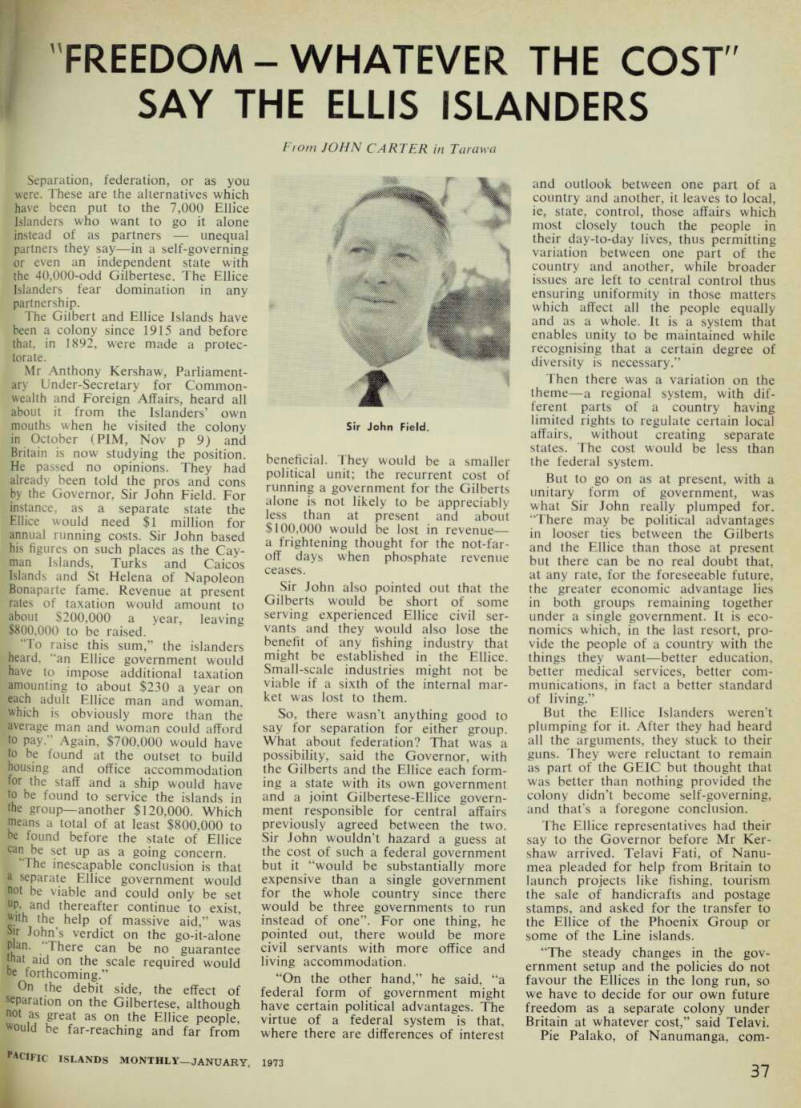


Say The Ellis Islanders
From JOHN CARTER in Tarawa
Separation, federation, or as you were. These are the alternatives which have been put to the 7,000 Ellice Islanders who want to go it alone instead of as partners — unequal partners they say—in a self-governing or even an independent state with the 40,000-odd Gilbertese. The Ellice Islanders fear domination in any partnership.
The Gilbert and Ellice Islands have been a colony since 1915 and before that, in 1892, were made a protec torate.
Mr Anthony Kershaw, Parliament ary Under-Secretary for Common wealth and Foreign Affairs, heard all about it from the Islanders’ own mouths when he visited the colony in October (PIM, Nov p 9) and Britain is now studying the position.
He passed no opinions. They had already been told the pros and cons by the Governor, Sir John Field. For instance, as a separate state the Ellice would need $1 million for annual running costs. Sir John based his figures on such places as the Cay man Islands, Turks and Caicos Islands and St Helena of Napoleon Bonaparte fame. Revenue at present rates of taxation would amount to about $200,000 a year, leaving $800,000 to be raised.
“To raise this sum,” the islanders heard, “an Ellice government would have to impose additional taxation amounting to about $230 a year on each adult Ellice man and woman, which is obviously more than the average man and woman could afford to pay.” Again, $700,000 would have to be found at the outset to build housing and office accommodation for the staff and a ship would have to be found to service the islands in the group—another $120,000. Which means a total of at least $800,000 to be found before the state of Ellice can be set up as a going concern.
“The inescapable conclusion is that a separate Ellice government would not be viable and could only be set up, and thereafter continue to exist, with the help of massive aid,” was “ r John’s verdict on the go-it-alone n} an ’ . can t>e no guarantee mat aid on the scale required would
he forthcoming.”
On the debit side, the effect of separation on the Gilbertese, although not as great as on the Ellice people, would be far-reaching and far from
beneficial. They would be a smaller political unit; the recurrent cost of running a government for the Gilberts alone is not likely to be appreciably less than at present and about $lOO,OOO would be lost in revenue— a frightening thought for the not-far off days when phosphate revenue ceases.
Sir John also pointed out that the Gilberts would be short of some serving experienced Ellice civil ser vants and they would also lose the benefit of any fishing industry that might be established in the Ellice.
Small-scale industries might not be viable if a sixth of the internal mar ket was lost to them.
So, there wasn’t anything good to say for separation for either group.
What about federation? That was a possibility, said the Governor, with the Gilberts and the Ellice each form ing a state with its own government and a joint Gilbertese-Ellice govern ment responsible for central affairs previously agreed between the two.
Sir John wouldn’t hazard a guess at the cost of such a federal government but it “would be substantially more expensive than a single government for the whole country since there would be three governments to run instead of one”. For one thing, he pointed out, there would be more civil servants with more office and living accommodation.
“On the other hand,” he said, “a federal form of government might have certain political advantages. The virtue of a federal system is that, where there are differences of interest
and outlook between one part of a country and another, it leaves to local, ie, state, control, those affairs which most closely touch the people in their day-to-day lives, thus permitting variation between one part of the country and another, while broader issues are left to central control thus ensuring uniformity in those matters which affect all the people equally and as a whole. It is a system that enables unity to be maintained while recognising that a certain degree of diversity is necessary.”
Then there was a variation on the theme—a regional system, with dif ferent parts of a country having limited rights to regulate certain local affairs, without creating separate states. The cost would be less than the federal system.
But to go on as at present, with a unitary form of government, was what Sir John really plumped for.
"There may be political advantages in looser ties between the Gilberts and the Ellice than those at present but there can be no real doubt that, at any rate, for the foreseeable future, the greater economic advantage lies in both groups remaining together under a single government. It is eco nomics which, in the last resort, pro vide the people of a country with the things they want—better education, better medical services, better com munications, in fact a better standard of living.”
But the Ellice Islanders weren't plumping for it. After they had heard all the arguments, they stuck to their guns. They were reluctant to remain as part of the GEIC but thought that was better than nothing provided the colony didn’t become self-governing, and that’s a foregone conclusion.
The Ellice representatives had their say to the Governor before Mr Ker shaw arrived. Telavi Fati, of Nanu mea pleaded for help from Britain to launch projects like fishing, tourism the sale of handicrafts and postage stamps, and asked for the transfer to the Ellice of the Phoenix Group or some of the Line islands.
“The steady changes in the gov ernment setup and the policies do not favour the Ellices in the long run, so we have to decide for our own future freedom as a separate colony under Britain at whatever cost,” said Telavi.
Pie Palako, of Nanumanga, com-
Sir John Field.
A Plate Of Food For Each
plained that the Ellice people never got a chance to work as labourers in the Phoenix or Line Islands and the argument used by Benjamin Kofe, the member for Funafuti, was that they were a separate people, “much different in many ways from the Gil bertese.” He was also not satisfied with the system of sharing out the colony’s representation in the Legis lative Council and the Executive Council and jobs in the civil service, although all these are apportioned according to population—seven Gil bertese to one Ellice Islander. Benja min thought that the job should go to the most reliable man and the best student. He obviously thought one Ellice islander was worth seven Gilbertese.
Language was seen as the obstacle to union by Maheli Naniseni, also of Nanumea. The Ellice language was rarely used, he said, even in schools, churches and on the radio and, if that continued their language would be lost for ever.
Another representative, Tapu, put their case to the Governor this way; “When a father gives a plate of food to his two sons, we do know that the two won’t eat peacefully, for one son would like to have more than the other. From that we can see the difference in behaviour. What must the father do? Each should have a plate of food so that each of them will be pleased and happy,”
At the close of the October meet ing with Mr Kershaw, Telavi Fati summed up the feelings of the Ellice people with a lengthy statement in which he stressed the threat which continued union with the Gilbertese posed for the existence of the Ellice language and culture. Despite their wish to maintain their relationship with Polynesian stock everywhere, they would never forget their much closer ties with the Gilberts. How ever, in the long run they wished for freedom and happiness in accordance with their own customs and culture.
Where do the Gilbertese stand in all this? Reuben Uatioa, Leader of Government Business and, almost certainly, the country’s first Prime Minister, summed up the Gilbertese position to me as, “We would like to continue with the Ellice but under Ibis present system and constitution.
They don’t want to change, so it is either both under the existing type of unitary state, or separation.”
Both sides have bent over back wards to prevent any ill-feeling arising. The actual negotiations, the speeches in the Legislative Council when the Ellice members introduced
a motion calling for separation, and the meeting with Mr Kershaw have received no publicity at all in the colony’s weekly newspaper, the Atoll Pioneer or on the radio.
Both Mr Uatioa and Mr Sione Kleis, one of the Ellice leaders, told me that they had avoided publicity to keep it out of the public arena.
Open discussion in the street or bars could create arguments and bad feel ing and, so far, all that had been
avoided. There is no ill feeling at all between the two peoples and both sides, if separation came, wanted to retain their close ties, The motion which was put to the Legislative Council called for separa tion of the two territories by 1974.
It was pointed out that Britain was responsible for the fusion of the two territories into one when it created the protectorate in 1892. Therefore, it was Britain’s problem and not one for the Legislative Council, so the motion was withdrawn. The decision now rests with Britain.
Advertisements & other items, pp. 42-44 (1 item)
good, deep ploughing
NEW CALEDONIA
Pacific Motors, S.A.,
B.P. 41, NOUMEA
BRITISH SOLOMON ISLANDS
TAHITI
Ets, Donald,
P.O. Box 131, PAPEETE
NEW HEBRIDES
CONDOMINIUM
Pentecost Pacific S.A., Santo and Port Vila
These MF distributors can
show you the MF6S is
acres ahead for a real Job of
good, deep ploughing
The MF6S Disc Plough is equally suitable for deep or shallow ploughing in hard or light soils. There’s plenty of clearance beneath the beam and between the discs for handling heavy surface trash without clogging. 26" or 28" plain discs or 28" notched discs available. Once-a-season lubrication is all the disc bearings ever need. You’ll find the MF6S an easy plough to set and adjust. Take your choice of 2, 3 or 4 disc sizes. Match the MF6S Disc Plough with the MFI6S Tractor and you have an unbeatable combination.
The exclusive Ferguson System gives precise implement control and automatic weight transfer.
What’s more there’s plenty of lugging power available from the MFI6S, a choice of 8 or 12 forward speeds with Multi-Power changing on the move and multiple disc, oil-immersed brakes for positive stopping power.
Don't let your
family down
You've worked hard to give them a home, schooling and security. Don't let that hard-won security erode away because you continued to overlook making out a Will. With a properly planned Will, you can be certain in the knowledge that your property will eventually pass to the people you specify, and also that your Estate will be as large as possible after probate and duties. In this regard, we invite you to take advantage of the advisory service we provide, entirely free of obligation. Our specialists in Estate Planning will be delighted to help you plan your Will most efficiently, or to discuss it fully with your solicitor or accountant.
T HAT
r he
BURNS PHILP TRUSTEE
COMPANY LIMITED
IXECUTOR © ADMINISTRATOR • TRUSTEE • ATTORNEY • AGENT Fiji Office: Mr. A, W. Cooper, Resident Manager, Rodwell Road, Suva. Telephone: 311 777.
Head Office; 51 Pitt Street, Sydney 2000.
Telephone: 241 1021. Telegrams: "BURNSTRUST," Sydney.
Branches and/or Registered Offices; Parramatta (N.S.W.), Canberra, Melbourne, Brisbane, Adelaide, Fremantle (W.A.), Port Moresby (Papua).
BP 45
m m I nr
Tyres
Famous throughout the World for Troublefree Service - High Mileage Outstanding Quality - Superior Comfort - Maximum Safety Proved under all climatic conditions on every kind of road in more than a hundred countries Continental Ciummi WerKe Akliengesellschaft Hannover Largest and Leading Tyre Manufacturers in the Federal Republic of Germany One of the World'* Oldest, but Most Modern Tyre Factor!
Sole Distributors :
BRECKWOLDT & CO. (N.G.) PTY. LTD.
P.O. Box 178,
WEWAK.
BRECKWOLDT & CO.
P.O. Box 47, APIA,
BRECKWOLDT & CO. (5.1.) LTD.
P.O. Box 140, HONIARA.
BRECKWOLDT S.A.R.L.
B.P. 65, NOUMEA.
AVAILABLE FROM :
JAMES SANDY PTY. LTD
637 GARDENERS ROAD, MASCOT
N.S.W., 2020, AUSTRALIA.
• GLASS MERCHANTS
• ALUMINIUM STOREFRONTS
• ALUMINIUM WINDOWS AND DOORS
• SHOWER SCREENS
• MIRRORS
SANDYS
EXTRUDED ALUMINIUM
ADJUSTABLE LOUVRES
FITTED WITH ALUMINIUM OR GLASS BLADES
FOR SUN AND VENTILATION CONTROL
a z
SANDYS EXTRUDED ALUMINIUM GLAZING BAR FOR
ECONOMICAL SIDEWALL GLAZING
is a billion dollar reality
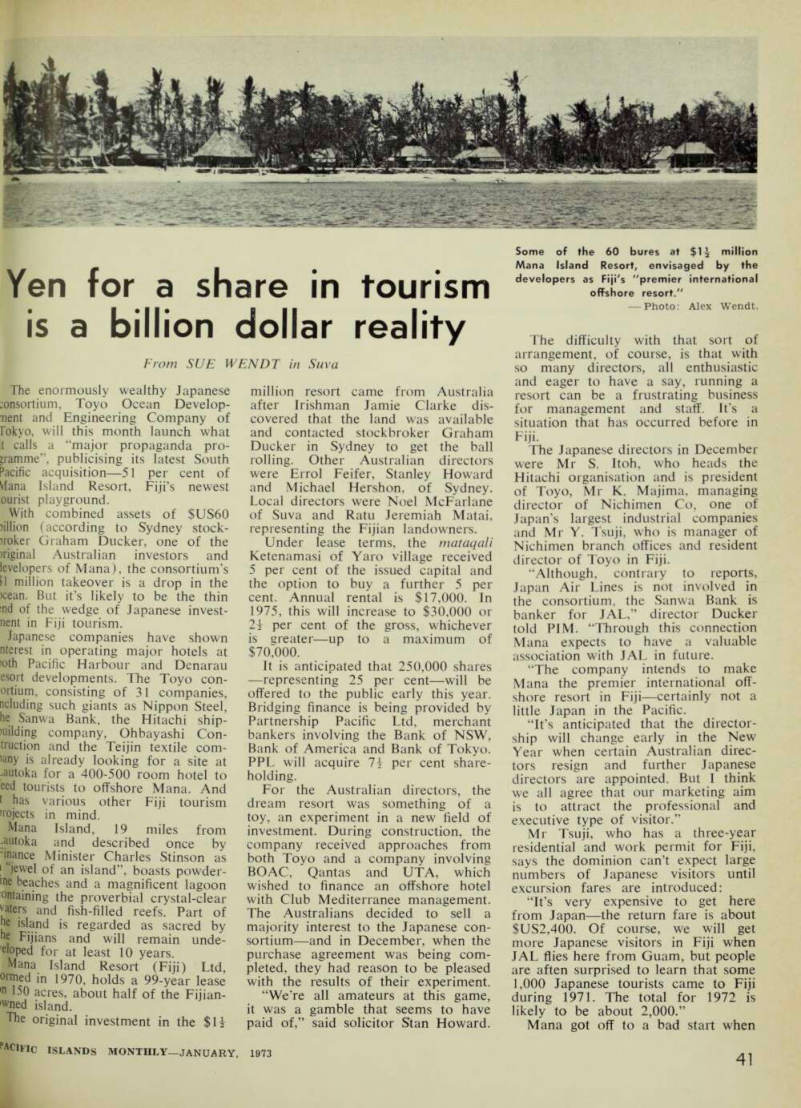
Yen for a share in tourism is a billion dollar reality
From SUE WENDT in Suva
The enormously wealthy Japanese consortium, Toyo Ocean Develop ment and Engineering Company of fokyo, will this month launch what it calls a “major propaganda pro gramme”, publicising its latest South Pacific acquisition—sl per cent of Mana Island Resort, Fiji’s newest ourist playground.
With combined assets of SUS6O )illion (according to Sydney stock >roker Graham Ducker, one of the mginal Australian investors and levelopers of Mana), the consortium’s |1 million takeover is a drop in the )cean. But it’s likely to be the thin ;nd of the wedge of Japanese invest nent in Fiji tourism.
Japanese companies have shown nterest in operating major hotels at »oth Pacific Harbour and Denarau esort developments. The Toyo con ortium, consisting of 31 companies, ticluding such giants as Nippon Steel, he Sanwa Bank, the Hitachi ship milding company, Ohbayashi Con traction and the Teijin textile com >any is already looking for a site at for a 400-500 room hotel to eed tourists to offshore Mana. And t has various other Fiji tourism •rejects in mind.
Mana Island, 19 miles from ; autoka and described once by finance Minister Charles Stinson as ! "jewel of an island”, boasts powder lne beaches and a magnificent lagoon ontaining the proverbial crystal-clear vaters and fish-filled reefs. Part of he island is regarded as sacred by he Fijians and will remain unde 'eloped for at least 10 years.
Mana Island Resort (Fiji) Ltd, °rmed in 1970, holds a 99-year lease in 150 acres, about half of the Fijian 'Wned island.
The original investment in the $H
million resort came from Australia after Irishman Jamie Clarke dis covered that the land was available and contacted stockbroker Graham Ducker in Sydney to get the ball rolling. Other Australian directors were Errol Feifer, Stanley Howard and Michael Hershon, of Sydney.
Local directors were Noel McFarlane of Suva and Ratu Jeremiah Matai, representing the Fijian landowners.
Under lease terms, the mataqali Ketenamasi of Yaro village received 5 per cent of the issued capital and the option to buy a further 5 per cent. Annual rental is $17,000. In 1975, this will increase to $30,000 or 1\ per cent of the gross, whichever is greater—up to a maximum of $70,000.
It is anticipated that 250,000 shares —representing 25 per cent—will be offered to the public early this year.
Bridging finance is being provided by Partnership Pacific Ltd, merchant bankers involving the Bank of NSW, Bank of America and Bank of Tokyo.
PPL will acquire per cent share holding.
For the Australian directors, the dream resort was something of a toy, an experiment in a new field of investment. During construction, the company received approaches from both Toyo and a company involving BOAC, Qantas and UTA, which wished to finance an offshore hotel with Club Mediterranee management.
The Australians decided to sell a majority interest to the Japanese con sortium—and in December, when the purchase agreement was being com pleted, they had reason to be pleased with the results of their experiment.
“We’re all amateurs at this game, it was a gamble that seems to have paid of,” said solicitor Stan Howard.
The difficulty with that sort of arrangement, of course, is that with so many directors, all enthusiastic and eager to have a say, running a resort can be a frustrating business for management and staff. It's a situation that has occurred before in Fiji.
The Japanese directors in December were Mr S. Itoh, who heads the Hitachi organisation and is president of Toyo, Mr K. Majima, managing director of Nichimen Co, one of Japan’s largest industrial companies and Mr Y. Tsuji, who is manager of Nichimen branch offices and resident director of Toyo in Fiji.
“Although, contrary to reports, Japan Air Lines is not involved in the consortium, the Sanwa Bank is banker for JAL,” director Ducker told PIM. “Through this connection Mana expects to have a valuable association with JAL in future.
“The company intends to make Mana the premier international off shore resort in Fiji—certainly not a little Japan in the Pacific.
“It’s anticipated that the director ship will change early in the New Year when certain Australian direc tors resign and further Japanese directors are appointed. But 1 think we all agree that our marketing aim is to attract the professional and executive type of visitor,”
Mr Tsuji, who has a three-year residential and work permit for Fiji, says the dominion can’t expect large numbers of Japanese visitors until excursion fares are introduced: “It’s very expensive to get here from Japan—the return fare is about $U52,400. Of course, we will get more Japanese visitors in Fiji when JAL flies here from Guam, but people are aften surprised to learn that some 1,000 Japanese tourists came to Fiji during 1971. The total for 1972 is likely to be about 2,000.”
Mana got off to a bad start when
Some of the 60 bures at $1½ million Mana Island Resort, envisaged by the developers as Fiji's "premier international offshore resort." - Photo: Alex Wendt.
Hurricane Bebe roared through Fiji two weeks after it opened in October, playing havoc with the landscaped garden and eroding the beach. But the 60 cottage units were undamaged and by December, new planting was underway.
It is planned to start stage 2 of the development in April or May, adding a further 60 units. The resort already includes facilities for day trippers, who are transported to the island in the 87 ft diesel-powered cruiser South Sea Mana. The vessel also carries fresh water to the island, which has a storage capacity of 108,000 gallons, all of it transported from Lautoka.
Samoan airline workers'

walkout ends in the air
From FELISE VA’A in Apia
Strikes are uncommon in Western Samoa. But they have happened in the past, often with disastrous results.
This was mainly because such unions were informal ones not registered ac cording to law, were unorganised and ill led. Such strikes were often restricted to ordinary labourers who felt they were underpaid and exploited in other ways. They did not trouble
management much for the str could easily be replaced, a moment’s notice in fact, throuj plentiful labour supply.
When white collar emplc strike, this is something else; impact on management is more a So when about sixty blue and > collar employees of Polynesian lines went on strike recently management found it could no place the strikers at a mon notice.
The strike was sparked ofl union opposition to three apf ments to middle manage positions made by Polynesian, union, Samoan Employees Ass tion Inc of Polynesian Airlines tended that two of the posil cargo and hostess supervisors, not advertised in a public m: at all. Furthermore, the appoi were brought in from outside, union felt that there were ah capable and experienced people i company who could have taken the positions. The third post, bo( supervisor, was given to a Polyn employee from another section, union again felt there were ca] and experienced people in the I ing section who could do the i The general manager of Polyn« Mr Marsden R. Stanton, said the management’s point of viev people already in the organis were not qualified enough.
He said: “It is the responsii of management to ensure that best available people are empli particularly in supervisory posii In the long term interests of company promotions cannot al be made from within a section as is normal practice overseas also in the commercial field he Samoa, positions are not aj advertised.”
The union also complained o:< crimination against Samoan empli by New Zealand supervisors, one union member. “When a Saj employee breaks a regulation, fired. When a palagi (Furor breaks one, it is overlooked.”' union alleged that grievance; Samoan employees, submitted supervisors were often not dealt! and many were not passed o higher management. The union' this state of affairs was as oc Polynesian’s 10-year history.
Fed up with these problems?
union’s central committee opted to strike. On November 10, Mr George Tuitama, president of the union, sent a letter which was delivered on the same day, to Mr Stanton, outlining the union’s opposition to the appoint ments and notifying Mr Stanton that the union would go on strike at noon November 13. And strike that day it did.
The effect was immediate. At least one flight had to be cancelled that afternoon owing to lack of air hostesses, the majority of whom joined in the strike. The remaining staff of Polynesian, some 25 per cent of the total staff, were redistributed to fill the more important gaps.
Fortunately for Polynesian, both commerce and government provided assistance, so that though the paper work was slowed down, flights functioned normally afterwards. The strike did not achieve a total stop page of work, but the union did nanage to make its grievances public.
Mr Stanton also had a grievance, de said: “The one and only com nunication from the association was he ultimatum to stop work; and this vithout any prior attempt to discuss he alleged grievances either by the issociation or by those whom the issociation claims to be better suited o the positions. Such an action is ntolerable and unacceptable to the ompany.”
During the first week of the strike, he parties were not able to reach any greement. Though some of the hikers, pressed by lack of finance, ad gone back to work, the union /as determined to fight through to he end.
Mr Tuitama announced that the nion had applied to a government 'onciliation Committee to settle the ispute—a meeting with the Acting Commissioner of Labour, Mr George epuleai. had failed to achieve any oncrete results. Mr Fepuleai merely m the contending parties to try to sach an agreement between them es- This they failed to do. The nion was demanding. The manage ient was haughty.
Meanwhile things at Polynesian Pparently went back to normal, ositiors vacated by the strikers were advertised in the Samoa Times. ext week the story disappeared from 16 Pages of the Samoa Times. Union oWer in Western Samoa is not yet P to the level of industrial nations. • Polynesian Airlines has an ounced that it would operate be- Fiji and the Cook Islands *»er charter to Air New Zealand. . 18 expected that two round trips 111 be made each week.
Advertisements & other items, p. 46 (1 item)
"Service"
ITMjL
'V \ -0 i-2 H O ovt-3 >o ws*s V * o
76 Years' Experience
Selling
"SERVICE"
to the Pacific Islands
NELSON & ROBERTSON
PTY. LIMITED
(Established 1895 )
PLANTATION HOUSE, 197 CLARENCE STREET, SYDNEY
CABLES: "IVAN", SYDNEY, BRISBANE. TELEX: AA22381, SYDNEY.
ISLAND MERCHANTS
SHIPPING AGENTS
TRAVEL AGENTS
INSURANCE AGENTS
REAL ESTATE AGENTS
Branch Office: Nelson & Robertson Pty. Ltd., 303 Adelaide St., Brisbane, Old.
New Guinea Representatives: Rabaul Trading Co. Pty. Ltd., Rabaul Lae Madang Kieta.
So The Americans Aren't Bullies!
Western Samoa’s Minister of Civil Aviation, Tupuola Efi, returned from Washington DC with what were apparently “the laurels of victory’’. For, the minister announced, the American civil aviation authorities have agreed to delay Pan Am’s entry to the Apia/Tafuna air route by at least 12 months, after which the civil aviation authorities of both countries will reconsider the impact of PanAm competition on Polynesian.
I was under the impression that the United States were bullies but it was certainly not the case in this instance,’’ Tupuola happily remarked.
In Washington, the minister told officials of the State Department, the Civil Aeronautics Board and the Federal Aviation Agency that there was insufficient traffic to support services by two airlines, and that Pan Am’s involvement at this stage would have a deleterious effect on Polynesian.
Tupuola had felt it necessary to go to Washington to present Polynesian’s case before the American civil aviation officials, especially as there was a very likely danger that the Americans might withdraw Polynesian’s landing rights in American Samoa.
Advertisements & other items, pp. 47-50 (5 items)
43
ACl nc ISLANDS MONTHLY—JANUARY, 1973
Mackenzies Menthoids
KEEP SLIM , TRIM
and HEALTHY . . .
take FORD PILLS
Ford Pills and the Ford Pill diet chart help you to lose that extra weight.
Ford Pills are a mild laxative containing the gentlest of ingredients to rid your body of excess fluids and toxins.
AVAILABLE FROM CHEMISTS AND
STORES EVERYWHERE.
BRITISH MEDICAL LABORATORIES,
BML 115-125 Turrella Street, Turrella, N.S.W. 2205, Australia.
KEEP IN GOOD SHAPE
WITH . . .
MACKENZIES MENTHOIDS
Mackenzies Menthoids stop
muscular and rheumatic pain.
Take Menthoids as directed.
Available from Chemists and Stores everywhere.
CONTENTS 144
RHEUMATISM
tears and piih LAXATIVE • aUßten o*? p|L 120 mm* m i ii ■■ ■ xn, w— . .
A 1 A w
BML
A product of BRITISH MEDICAL LABORATORIES
(A wholly Australian owned company) DISTRIBUTORS ARE BURNS PHILP, W. R. CARPENTER, D. J. FOWLER, PETER JACKETT & CO., C. SULLIVAN EXPORT.
CabOt’S WOOD STAINS
• RANCH HOUSE HUES 2-coat flat finish stain for exterior windows, weatherboards, gables. • OLD VIRGINIA TINT 2-coat flat finish paint for any exterior masonry, wood, steel, asbestos cement.
Matches ranch house hues, colours. • DECK STAIN 1-coat flat finish stain for any wooden floor, seats, handrails, furniture. • STAIN WAX 1-coat hand-rubbed finish stain for any interior woodwork. • DANISH OIL 2-coat clear hand-rubbed finish for any interior woodwork and floors. • BRUSHABLE HAMMERTONE 2-coat brushable hammertone finish for any surface inside or out.
CflßOi
MtUSBCMs
H
Windsor pn
I runJ Ln_n
Parquet py
MOSAIC FLOORING
Real Timber Beauty and Warmth with Individuality • 5 Distinctive designs • Lifetime durability • Different coloured timbers • New designs • Insulation of real timber • Easy cleaning m re ■ %
ALUMINOUS CEM ENT
CIMENT FONDU RAPID SETTING CEMENT
Rapid setting, early strength cement. At 12 hours can carry most traffic, at 24 hours in 1-2-4 mix has a compressive strength of above 7,000 P.S.I. Withstands temperatures up to 1,300°C and resists acids and alkalis. o y Lightning Free Technical service available for all products.
GEORGE WILLS & CO. LTD.
49 Clarence Street, SYDNEY, N.S.W. 2000, Australia Tel:. 29 6061 Please send me information on: □ Cabot’s Wood Stains □ Windsor Parquet □ Ciment Fondu Name Address P/M 12275
From the
Islands Press
From The Fiji Times: Girls who wore hotpants and miniskirts were asking to be molested, Mr Kishor Govind (Alliance, North-Central national) said in the Bouse of Representatives yesterday. Hot-blooded poung men could not be blamed for failing to resist the temptation of such clothing, he said.
Be complained that a flood of imported tomographic books and films were corrupting he youth of Fiji. : rom the News Bulletin of American Samoa: American Samoan voters showed their interest in heir government by turning out for the general dection in numbers which probably rival those egistered anywhere in the US. Of the 6,302 egistered voters 5,718 cast ballots. That represents participation of 90 per cent which is much higher ban shown in most US voting areas.
I with-it advertisement by a well-known bank in he Fiji Photonews: )on’t dream it baby! Do it. All you need is he bread baby. TTie mazuma. The loot. And ou know where it’s at? In the bank. No luff. Where else? But don’t blast, baby. Ask he Man. Cooler still, check in the coupon with he chick at the counter. Could be they talk
our language. Like, Money!!!
rom a report in Otahiti of a visit to Sydney and Melbourne of 157 Tahitian members of a Papeete thletic booster club: lefore leaving each member of the tour was given rough “pareu” material to make himself either a ■tor a dress. They were also given a 10-point list ■ instructions for proper decorum by the tour leaders, tome of the regulations decreed ‘‘Don’t fight in the treet. There will be no jealously shown over women, ■n’t feel the waitress’s leg when in a restaurant.” rom the New Hebrides Group News: |®ineapple weighing 42 lb was harvested recently at B>erungwele village on Aoba. Mr Obed Natu, who grew ■ pineapple says it's the first time he has come across J di a big one in his garden. He says the pineapple •easured 18 inches in length and 24 inches round. Another iisual plant was a manioc dug up at Liro on Paema ■ Tuesday. Mr Walter from Liro says the manioc was ° re than four feet long and 37 inches around its body, w people made two big lap-lap out of it.
Extract from the budget debate in the Western Samoa Parliament reported in the Samoa Times: Seiuli (Taulafo) called on the government to do something about the "foreigners" who are using marriage to Samoan women as a method of entry to set up business in the country. "We have seen the effect of outside control of a country's economy in other countries. We don't want that to happen here even if we have to expel foreign firms from our country," Seiuli said. These people may be making a contribution to the country's development but not at the price of "defeat for the true Samoans," he said.
From the New Hebrides Group News (radio): Most garden crops have dried up and livestock are being affected by the long dry spell at Vao, Espingel Bay and Tenmaru. ... The people in the area have expressed their concern at this unusual dry spell which has been affecting them for several months now. And if rain doesn’t come soon, the people of Vao have decided to bring it down their own way.
Mr Ligo says, at a meeting he attended yesterday, the people collected $6O to pay a professional custom rain-maker. If all goes well, it’s hoped he’ll persuade rain to fall on Vao in a few weeks’ time.
From the Cook Islands News: Word was received by the Manutea on Saturday morning that a lot of improvements have been carried out on the waterfront of Mauke as a result of the work being carried out on the harbour. . . . There was all round damage to nearby buildings and govern ment offices where stones from the blasting have gone through the roof, walls and also broke windows.
Considerable damage was also done to the radio building from the vibration and debris of the blasting.
Some private homes, which are of considerable distance from the harbour, also suffered damage, mainly broken windows.
From the Papua New Guinea Post-Courier: It's true —convicted killers do make the best guides in Biami country. Tour organiser Mr Rick Furlong said today that last week’s British tourists had been taken aback when they found that six of their carriers in the Nomad area had “done time” for murder. “It was the only solution ” Mr Furlong said. “In that part of the country, there are no schools. The only men able to work as interpreters in Pidgin or Motu are those who have been to prison.”
Extract from a speech by the GEIC's Leader of Government Business, Mr Reuben Uatioa, complaining during the debate on the new Develop ment Plan of a possible postponement of parts of the plan because of a shortage of funds from Britain, reported in Atoll Pioneer: What is the use of them trying to tell us progress on this, progress on that; one of these days we will be very happy to see you take over the responsibility in your hands, and have independence. How could we have independence if they are closing their hands and not giving any further aid to us. They might as well say: Gilbert Islands stay where you are because you are a damned poor country. We are not going to give you any more. Stay poor. That is all. Finish.
45
*CIFIC ISLANDS MONTHLY—JANUARY, 1973
Su Lli Vans
MELBOURNE SYDNEY BRISBANE
C. SULLIVAN (EXPORT) PTY. LTD.,
4TH FLOOR. KEMBLA BUILDING.
60 MARGARET STREET, SYDNEY
(G.P.O. BOX 3373).
AUCKLAND CABLES AND TELEGRAMS: “CHASULL”. LONDON
OFFERS A COMPREHENSIVE AND EFFICIENT
BUYING SERVICE TO THE PACIFIC ISLANDS
OFFICES AT:
PORT MORESBY • LAE • RABAUL • KIETA • MOUNT HAGEN • BULUMA • SUVA • LAUTOKA • NOUMEA • HONIARA • PORT VILA
"SULLIVANS for SERVICE
Save hundreds of dollars
on Australians most efficient
WALK IN, ALUMINIUM
COOLROOMS AND
FREEZE ROOMS
Hundreds already installed! The most economical supplementary coolrooms for bottles and food, providing the largest storage capacity of any comparable coolrooms of the same exterior dimensions. Five sizes —from 90-360 cu. ft. capacity; 16 models offering normal temp., two temp., deep freeze, or for pastry and ice storage applications. White vinyl interior, embossed rustproof aluminium exterior. • SUPPLIED IN EASY-TO-ERECT, DO-IT-YOURSELF KIT FORM • PETROL AND PETROL-ELECTRIC MODELS ARE AVAILABLE FOR AREAS WHERE POWER IS LIMITED OR NON-EXISTENT 363 Available from: AUSTRALIAN NEW CALEDONIA EXPORTS (SILVER & BARDA), George St., Sydney, 2000 and Branches.
BRECKWOLDT & CO., 276 Pitt St., Sydney, 2000 and Branches.
PETER FISHER TRADING PTY. LTD., 321 Pitt St., Sydney, 2000.
HAGEMEYER (A'SIA), 59 Anzac Pde., Kensington, 2033 and Branches.
MILLERS LIMITED, Thompson St., Suva, Fiji.
Manufactured by:
NELSON & ROBERTSON PTY. LTD., 197 Clarence St., Sydney, 20 RABAUL TRADING CO. PTY. LTD., P.O. Box 219, Rabaul and Bra ROY GALLIMORE & ASSOCIATES, P.O. Box 179, Vila, New HeU S.E. TATHAM & CO. PTY. LTD., 364 Lonsdale St., Melbourne, and Branches.
C. SULLIVAN (EXPORT) PTY. LTD., 60 Margaret St., Sydney, 200( Branches.
W. S. TAIT & CO. PTY. LTD., 31 Macquarie Place, Sydney, 200 K Branches.
WARBURTON FRANKI
199 Parramatta Road., Cnr. Skarratt Street, Auburn, N.S.W. 2144, Australia. Phone: 648-1711.
Powered by Kelvii Five-year warrai
compressor. Early
livery.
jet travel
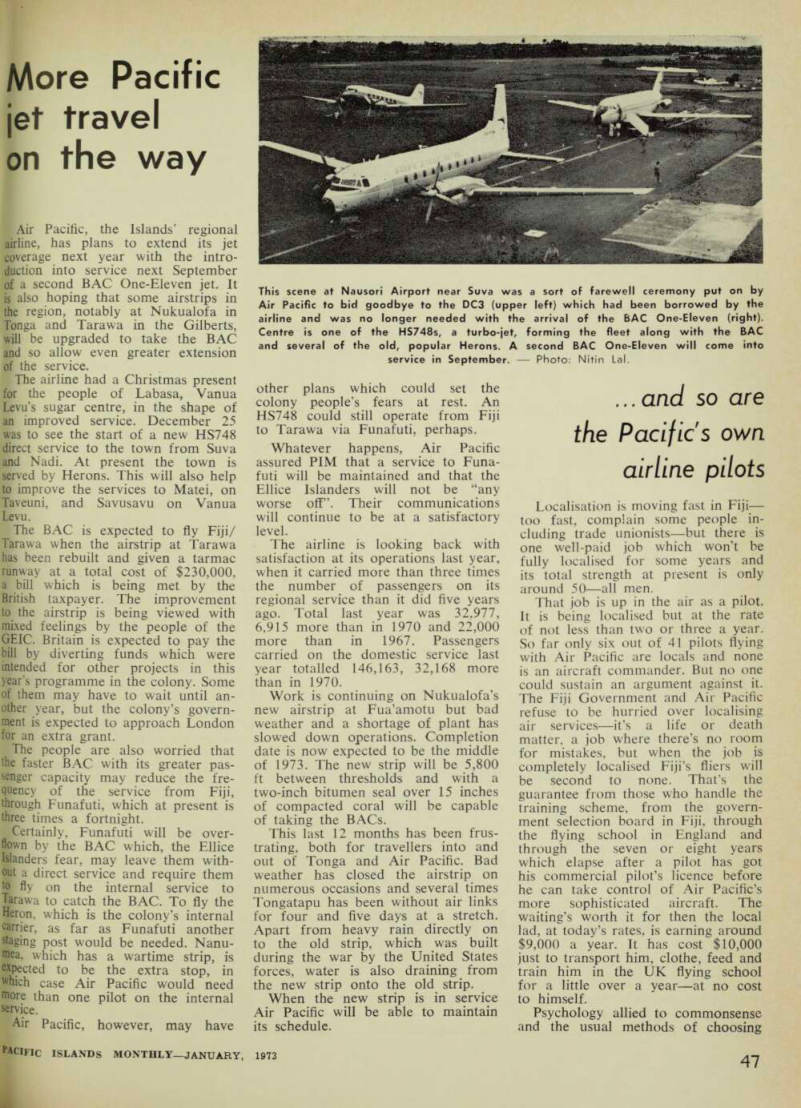

More Pacific jet travel on the way
Air Pacific, the Islands’ regional airline, has plans to extend its jet coverage next year with the intro duction into service next September of a second BAC One-Eleven jet. It is also hoping that some airstrips in the region, notably at Nukualofa in Tonga and Tarawa in the Gilberts, will be upgraded to take the BAC and so allow even greater extension of the service.
The airline had a Christmas present for the people of Labasa, Vanua Levu’s sugar centre, in the shape of an improved service. December 25 was to see the start of a new HS74B direct service to the town from Suva and Nadi. At present the town is served by Herons. This will also help to improve the services to Matei, on Taveuni, and Savusavu on Vanua Levu.
The BAC is expected to fly Fiji/ Tarawa when the airstrip at Tarawa has been rebuilt and given a tarmac runway at a total cost of $230,000, a bill which is being met by the British taxpayer. The improvement to the airstrip is being viewed with mixed feelings by the people of the GEIC. Britain is expected to pay the bill by diverting funds which were intended for other projects in this year’s programme in the colony. Some of them may have to wait until an other year, but the colony’s govern ment is expected to approach London for an extra grant.
The people are also worried that the faster BAC with its greater pas senger capacity may reduce the fre quency of the service from Fiji, through Funafuti, which at present is three times a fortnight. .Certainly, Funafuti will be over flown by the BAC which, the Ellice Islanders fear, may leave them with out a direct service and require them to fly on the internal service to Tarawa to catch the BAC. To fly the Heron, which is the colony’s internal carrier, as far as Funafuti another staging post would be needed. Nanu mea, which has a wartime strip, is ttpected to be the extra stop, in which case Air Pacific would need more than one pilot on the internal service.
Air Pacific, however, may have
other plans which could set the colony people’s fears at rest. An HS74B could still operate from Fiji to Tarawa via Funafuti, perhaps.
Whatever happens, Air Pacific assured PIM that a service to Funa futi will be maintained and that the Ellice Islanders will not be “any worse off”. Their communications will continue to be at a satisfactory level.
The airline is looking back with satisfaction at its operations last year, when it carried more than three times the number of passengers on its regional service than it did five years ago. Total last year was 32,977, 6,915 more than in 1970 and 22,000 more than in 1967. Passengers carried on the domestic service last year totalled 146,163, 32,168 more than in 1970.
Work is continuing on Nukualofa’s new airstrip at Fua’amotu but bad weather and a shortage of plant has slowed down operations. Completion date is now expected to be the middle of 1973. The new strip will be 5,800 ft between thresholds and with a two-inch bitumen seal over 15 inches of compacted coral will be capable of taking the BACs.
This last 12 months has been frus trating, both for travellers into and out of Tonga and Air Pacific. Bad weather has closed the airstrip on numerous occasions and several times Tongatapu has been without air links for four and five days at a stretch.
Apart from heavy rain directly on to the old strip, which was built during the war by the United States forces, water is also draining from the new strip onto the old strip.
When the new strip is in service Air Pacific will be able to maintain its schedule.
...and so are the Pacific's own airline pilots
Localisation is moving fast in Fiji too fast, complain some people in cluding trade unionists—but there is one well-paid job which won’t be fully localised for some years and its total strength at present is only around 50 —all men.
That job is up in the air as a pilot.
It is being localised but at the rate of not less than two or three a year.
So far only six out of 41 pilots flying with Air Pacific are locals and none is an aircraft commander. But no one could sustain an argument against it.
The Fiji Government and Air Pacific refuse to be hurried over localising air services—it’s a life or death matter, a job where there’s no room for mistakes, but when the job is completely localised Fiji’s fliers will be second to none. That’s the guarantee from those who handle the training scheme, from the govern ment selection board in Fiji, through the flying school in England and through the seven or eight years which elapse after a pilot has got his commercial pilot’s licence before he can take control of Air Pacific’s more sophisticated aircraft. The waiting’s worth it for then the local lad, at today’s rates, is earning around $9,000 a year. It has cost $lO,OOO just to transport him, clothe, feed and train him in the UK flying school for a little over a year—at no cost to himself.
Psychology allied to commonsense and the usual methods of choosing
This scene at Nausori Airport near Suva was a sort of farewell ceremony put on by Air Pacific to bid goodbye to the DC3 (upper left) which had been borrowed by the airline and was no longer needed with the arrival of the BAC One-Eleven (right).
Centre is one of the HS748s, a turbo-jet, forming the fleet along with the BAC and several of the old, popular Herons. A second BAC One-Eleven will come into service in September. - Photo: Nitin Lal.
Not For Money
people on an academic yardstick are used by Fiji’s selection board to pick out the two or three lads who, each year, are sent to the flying school, usually the one at Kidlington near Oxford. Maybe a dozen or more young men are chosen from those who respond to the advertisement inviting applications from would-be fliers. The applicant who hasn’t got his university entrance certificate hasn’t much chance of going to the school. If he’s bright and measures up to academic standards, then the psychological side comes into the picture.
If he’s applied for the job with a big salary in mind, he’s out before he’s even in.
Says Controller of Transport and Civil Aviation Jim Verran, a war time pilot and flying instructor, “We can spot the one who’s only after the money right away. It’s surprising how some of the lads who come for interview before the selection board indicate from the word ‘go’ that they are wasting their time and ours. All that has attracted them is the money.
“The likely candidate we can also spot. Not only has he the educational background—and he must have maths and physics among other things to be able to understand everything said in the classroom—but he must
want to fly; must be interesteo aircraft and flying.
“If he’s already in an aero then, all other things being e« he’s in. He wouldn’t be in the if he wasn’t interested in flying.’
After adaptability tests, which 1 another weeding-out process, the b goes to the flying school, does intensive course which takes a over a year and returns to Fiji an with about 250 hours flying perience, a commercial pilot’s lice an R/T licence and has also o pleted a course on Rolls Royce; turbine engines.
Then he’s only beginning. AI are other courses in Fiji—additi navigational training, convei training on the HS74B, as he’s on small planes up to then, an technical course on the 748 folic by an airworthiness examination the type, which really proves worth. After the conversion cc on the 748, usually after 15 hi flying, he puts the first officer’s up and joins the flight crew, at with a training captain and tr after about 100 hours, goes on tc normal first officer pilot’s roster.
Every six months, the young p in common with every other o mercial pilot, has another hurdll clear—a searching medical checH For several years he flies as a officer and, as Captain Neil Gai.
Air Pacific’s operation manager, “He has four or five years first oft training under his belt before hi likely to take command of an HJ so that, altogether, he has somefl like 2,000 to 3,000 hours flyings perience before that day comese A wartime bomber pilot usv qualified after 250 hours. “They their crews were expendable,”
Captain Ganley. “Passengers af expendable and the Fiji Governi certainly encourages us to mail proper standards and there are pressures on us to localise service beyond a lad’s capabill These lads are just as capabhJ every way as any in the world., have very high standards and t lads have to keep up to tf standards. We haven’t had a far yet!”
Fiji’s flying students have eas high praise at the flying school J everyone has done better average in classroom work, says Verran.
At present there are five Fiji j at the Oxford flying school. W they return home with a comma licence they will be paid $3,32* year—but that is only a six wj job. Then, as a first officer in thea his salary jumps to $4,311 with a scale of $5,691.
Advertisements & other items, p. 52 (1 item)
Peter Fisher Trading
PTY. LTD.
321 PITT STREET, SYDNEY, 2000, AUSTRALIA
TELEPHONE; 26-1109 CABLES; "FISHERION", SYDNEY
EXPORTERS TO THE PACIFIC
ISLANDS
Some of the firms and products we represent: BRYANT & MAY matches MAURI BROS, yeast PMU food products TOOHEYS beer FRENCH KNIT car seat covers REPCO automotive parts CRAVEN confectionery BROWNBUILT office furniture ADVANCE containers HARDIE'S building products SEBEL furniture BEARD beds and mattresses HUNTER DOUGLAS furniture KLINKII plywood STERLING bakery machinery CHILTONIAN biscuits ATLAS plastic ware POLARIS stainless steel ware RENA tinned vegetables WALKER frozen meat BOND'S underwear ANDY spotlights COUNTRY CLUB shirts WILLOW metal ware FILLETTA tinned fish PAULCALL tools ASTRA razor blades WENGER quality knives GLYNGORE tinned fish VAN DER LAAN tinned meat CORDEX twine and ropes DEROPA gift paper WARBURTON FRANKI coolrooms DURABUILT prefabricated houses THREE X (XXX) tinned hake WHITE ABBEY Scotch whisky PETROMAX pressure lamps BATA shoes THREE STAR corned beef SPC tinned fruit LUCKY STAR tinned pilchards and sardines LIFESAVERS confectionery
AND MANY MORE
Supplying butchers’ knives, cooks’ knives, sheath knives and pocket knives from Switzerland, Sweden, Norway, Finland and other countries.
Machettes and bush knives from Portugal, Spain and other countries.
be prepared

Must a constitution be prepared constitutionally?
I From a Port Moresby correspondent An innovation of the third House of Assembly in Papua New Guinea has been the appointment of com mittees which do not conform to any of the patterns laid down in 'Standing Orders. One such is the very important committee set up to prepare a draft constitution.
T This situation has arisen from the fact that since its establishment in 1964 the House has had to choose between appointing a select com mittee composed exclusively of mem bers of the House, or asking the Administrator to appoint a commis sion of inquiry, a request which can be, and has been, rejected. Even if it is acceded to, the House has no right to a say in the selection of the commission’s members.
In 1967, former MHA John Stuntz brought down a private member’s bill designed to give the House power to set up its own commissions of inquiry, but the official members op posed this move and secured its defeat. There seems to be a good case for reviving Mr Stuntz’s pro posal or for amending Standing Orders to provide for a new type of committee.
In the meantime the appointment of a constitution-drafting committee itself unconstitutionally constituted has a somewhat Gilbertian flavour; and a conscientious auditor might well challenge the expenditure of public money (and this committee is likely to need to spend a lot of money) on a committee set up neither under Standing Orders nor under any existing ordinance.
Members of the committee are: Mr Michael Somare, chairman, Fr John Momis, deputy chairman, and Messrs John Kaputin, John Kaupa, Matiabe Yuwi, Paul Langro, Paulus Arek, MacKenzie Dauga, Pikah Kasau, Sinake Giregire, Stanis Tollman, Tei Abal, Toni Ila, Angmai Bilas and Dr John Guise.
The three permanent consultants to the committee are Professor J. W.
Davidson, Dr D. J. Stone and Mr E. P. Wolfers.
I Among the various people who will help on aspects of the Con stitution are Professors Y. P. Ghai, of the International Legal Centre, [United Nations, and A. Mazrui, of Makerere University, Uganda. Mr John Ley, counsel to the House of Assembly, is the committee’s legal officer.
Advertisements & other items, p. 53 (1 item)
For all classes
o£
Personal
Industrial
Commercial
Insurance
Our advice is at
Your service
ARVE Y TRI N I
Insurance Brokers Insurances at Lloyd's and Companies Hunter Street, Port Moresby. Tel. 2241-2 Agents: steamships trading company limited, Port Moresby, Samarai, Popondetta, Goroka, SSS* Mount Hagen, Rabaul, Madang and Kieta, wX*X Bougainville •SSi# R. allen, Buioio.
MACDONALD HAMILTON
trading pty. limited, Lae. d. j. gubbay & company (n.h.) pty. ltd., Honiara.
HT.4169R
From Battlefield To Ricefield
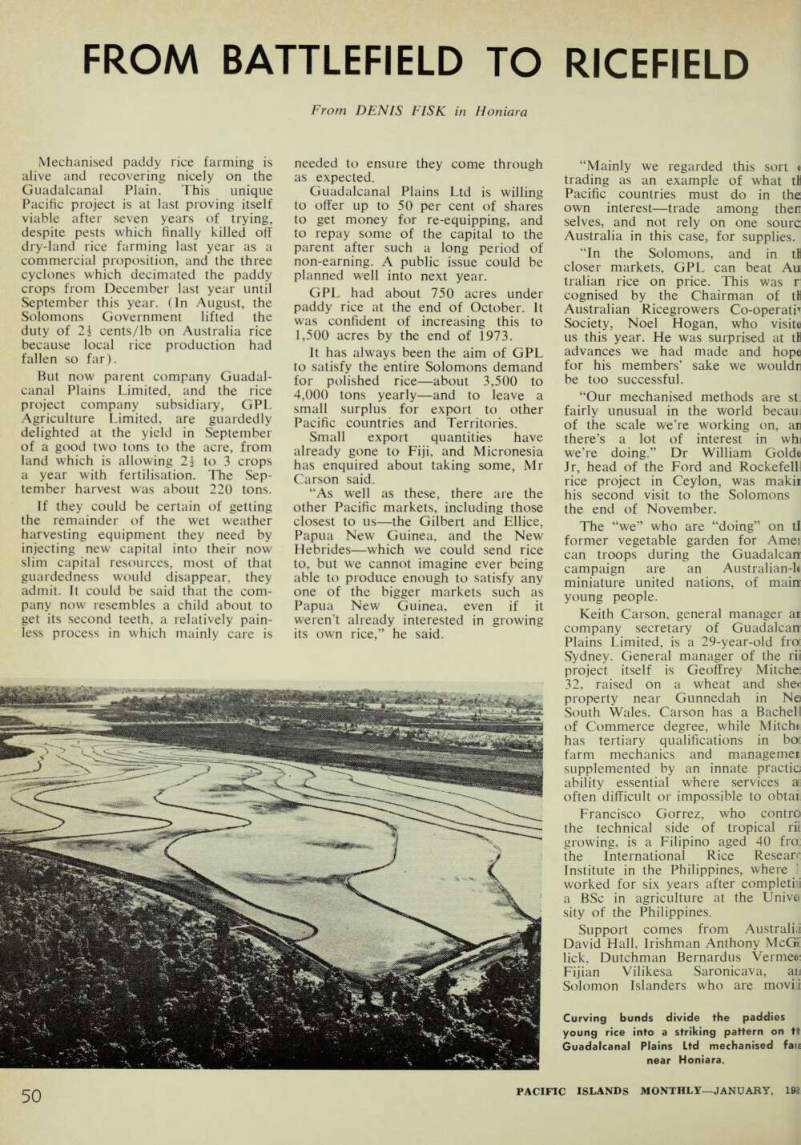
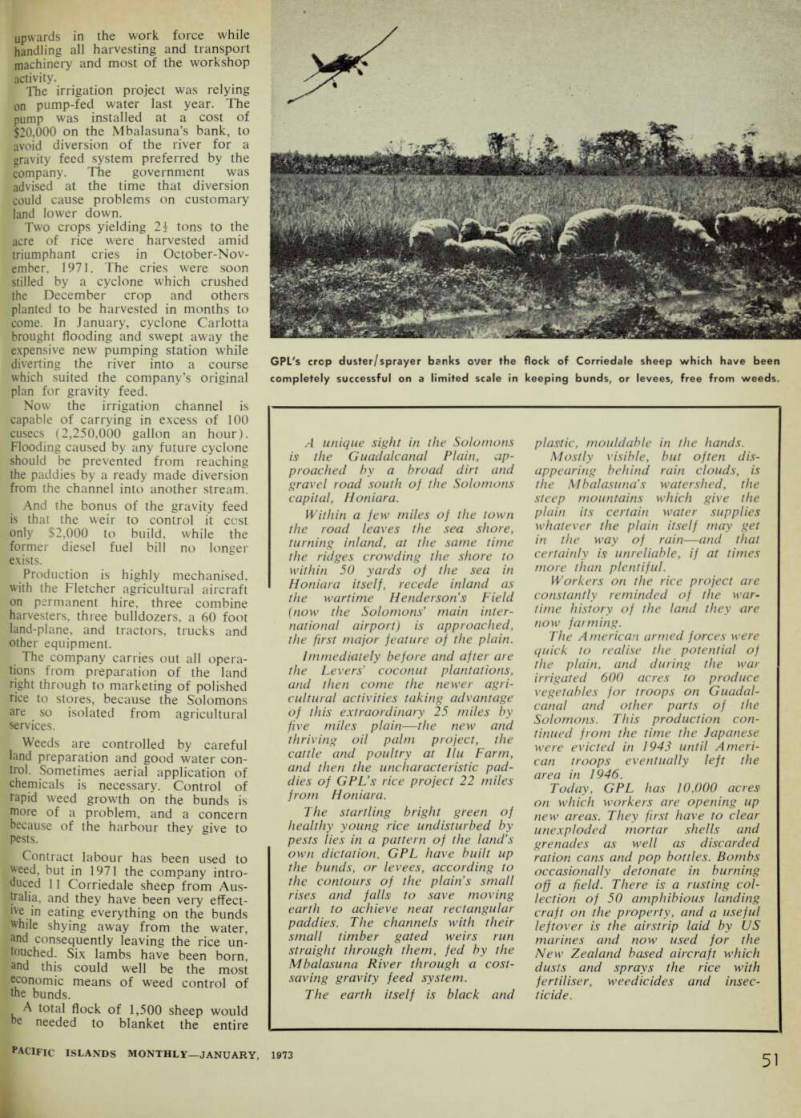
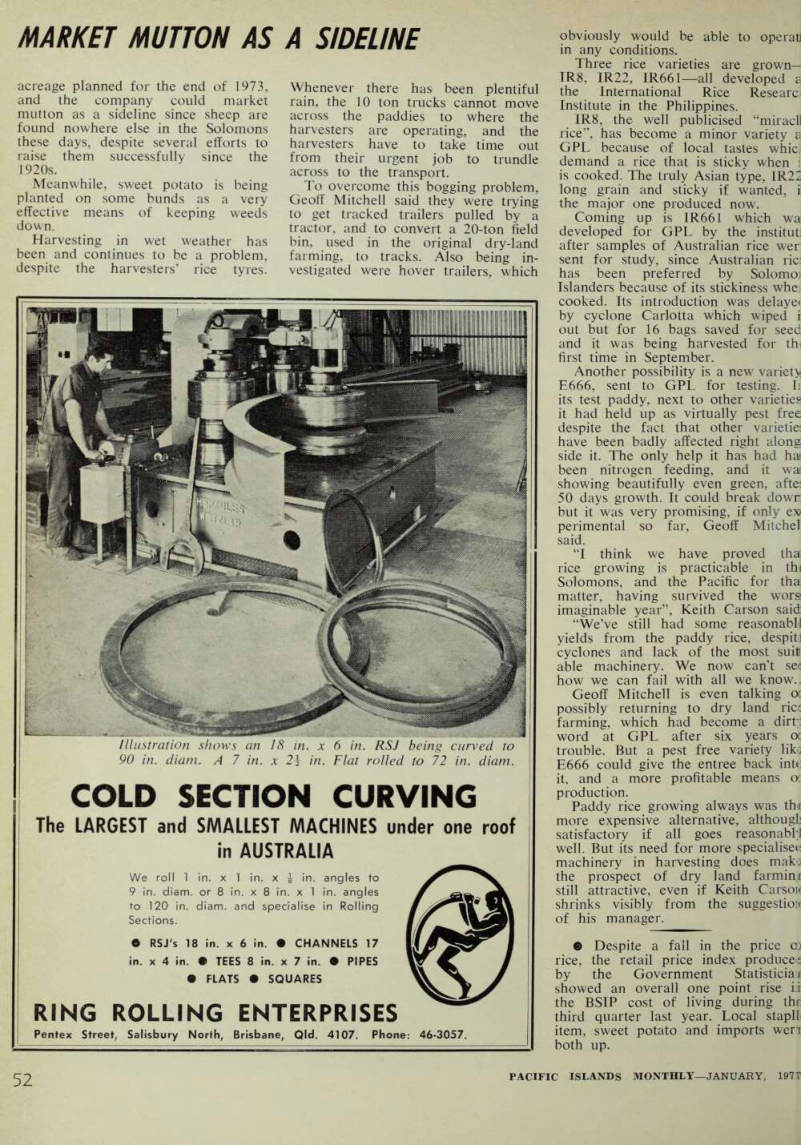
From DENIS FISK in Honiara
Mechanised paddy rice farming is alive and recovering nicely on the Guadalcanal Plain. This unique Pacific project is at last proving itself viable after seven years of trying, despite pests which finally killed off dry-land rice farming last year as a commercial proposition, and the three cyclones which decimated the paddy crops from December last year until September this year. (In August, the Solomons Government lifted the duty of 2i cents/lb on Australia rice because local rice production had fallen so far).
But now parent company Guadal canal Plains Limited, and the rice project company subsidiary, GPL Agriculture Limited, are guardedly delighted at the yield in September of a good two tons to the acre, from land which is allowing 2\ to 3 crops a year with fertilisation. The Sep tember harvest was about 220 tons.
If they could be certain of getting the remainder of the wet weather harvesting equipment they need by injecting new capital into their now slim capital resources, most of that guardedness would disappear, they admit. It could be said that the com pany now resembles a child about to get its second teeth, a relatively pain less process in which mainly care is
needed to ensure they come through as expected.
Guadalcanal Plains Ltd is willing to offer up to 50 per cent of shares to get money for re-equipping, and to repay some of the capital to the parent after such a long period of non-earning. A public issue could be planned well into next year.
GPL had about 750 acres under paddy rice at the end of October. It was confident of increasing this to 1,500 acres by the end of 1973.
It has always been the aim of GPL to satisfy the entire Solomons demand for polished rice—about 3,500 to 4,000 tons yearly—and to leave a small surplus for export to other Pacific countries and Territories.
Small export quantities have already gone to Fiji, and Micronesia has enquired about taking some, Mr Carson said.
“As well as these, there are the other Pacific markets, including those closest to us—the Gilbert and Ellice, Papua New Guinea, and the New Hebrides—which we could send rice to, but we cannot imagine ever being able to produce enough to satisfy any one of the bigger markets such as Papua New Guinea, even if it weren’t already interested in growing its own rice,” he said.
“Mainly we regarded this sort o trading as an example of what tB Pacific countries must do in the own interest—trade among then selves, and not rely on one sourc Australia in this case, for supplies.
“In the Solomons, and in tB closer markets, GPL can beat Am tralian rice on price. This was r cognised by the Chairman of tB Australian Ricegrowers Co-operatr Society, Noel Hogan, who visite us this year. He was surprised at tB advances we had made and hope for his members’ sake we wouldr be too successful.
“Our mechanised methods are st; fairly unusual in the world becam of the scale we’re working on, an there’s a lot of interest in whi we’re doing.” Dr William Golde Jr, head of the Ford and RockefellJ rice project in Ceylon, was makii his second visit to the Solomons the end of November.
The “we” who are “doing” on tl former vegetable garden for Amei can troops during the Guadalcanr campaign are an Australian-!* miniature united nations, of mainr young people.
Keith Carson, general manager ai company secretary of Guadalcanr Plains Limited, is a 29-year-old fra Sydney. General manager of the rii project itself is Geoffrey Mitcha 32, raised on a wheat and shei: property near Gunnedah in Ne South Wales. Carson has a BachelJ of Commerce degree, while Mitchtj has tertiary qualifications in boc farm mechanics and managemei supplemented by an innate practia ability essential where services as often difficult or impossible to obtai; Francisco Gorrez, who contro the technical side of tropical rii growing, is a Filipino aged 40 fra the International Rice Researr Institute in the Philippines, where 1 worked for six years after complete a BSc in agriculture at the Unive sity of the Philippines.
Support comes from Australia David Hall, Irishman Anthony McGI lick, Dutchman Bernardus Vermee; Fijian Vilikesa Saronicava, an Solomon Islanders who are movii
Curving bunds divide the paddies young rice into a striking pattern on to Guadalcanal Plains Ltd mechanised fa[?] near Honiara.
upwards in the work force while handling all harvesting and transport machinery and most of the workshop activity.
The irrigation project was relying on pump-fed water last year. The pump was installed at a cost of $20,000 on the Mbalasuna’s bank, to avoid diversion of the river for a gravity feed system preferred by the company. The government was advised at the time that diversion could cause problems on customary land lower down.
Two crops yielding 2J tons to the acre of rice were harvested amid triumphant cries in October-Nov ember, 1971. The cries were soon stilled by a cyclone which crushed the December crop and others planted to be harvested in months to come. In January, cyclone Carlotta brought flooding and swept away the expensive new pumping station while diverting the river into a course which suited the company’s original plan for gravity feed.
Now the irrigation channel is capable of carrying in excess of 100 cusecs (2,250,000 gallon an hour).
Flooding caused by any future cyclone should be prevented from reaching the paddies by a ready made diversion from the channel into another stream.
And the bonus of the gravity feed is that the weir to control it cost only $2,000 to build, while the former diesel fuel bill no longer exists.
Production is highly mechanised, with the Fletcher agricultural aircraft on permanent hire, three combine harvesters, three bulldozers, a 60 foot land-plane, and tractors, trucks and other equipment.
The company carries out all opera tions from preparation of the land right through to marketing of polished rice to stores, because the Solomons are so isolated from agricultural services.
Weeds are controlled by careful land preparation and good water con trol. Sometimes aerial application of chemicals is necessary. Control of rapid weed growth on the bunds is more of a problem, and a concern because of the harbour they give to pests.
Contract labour has been used to weed, but in 1971 the company intro duced 11 Corriedale sheep from Aus tralia, and they have been very effect ive in eating everything on the bunds while shying away from the water, and consequently leaving the rice un touched. Six lambs have been born, and this could well be the most economic means of weed control of the bunds.
A total flock of 1,500 sheep would he needed to blanket the entire
A unique sight in the Solomons is the Guadalcanal Plain, approached by a broad dirt and gravel road south of the Solomons capital, Honiara.
Within a few miles of the town the road leaves the sea shore, turning inland, at the same time the ridges crowding the shore to within 50 yards of the sea in Honiara itself, recede inland as the wartime Hendersons Field (now the Solomons’ main international airport) is approached, the first major feature of the plain.
Immediately before and after are the Levers' coconut plantations, and then come the newer agricultural activities taking advantage of this extraordinary 25 miles by five miles plain-, he new and thriving oil palm project, the cattle and poultry atl Farm, and then the uncharacteristic paddies of GPL’s rice project 22 miles r . ’
The startling bright green of healthy young rice undisturbed by pests lies in a pattern of the land’s own dictation. GPL have built up the bunds, or levees, according to the contours of the plain’s small rises and falls to save moving earth to achieve neat rectangular paddies. The channels with their small timber gated weirs run straight through them, fed by the Mbalasuna River through a costsaving gravity feed system.
The earth itself is black and
plastic, mouldable in the hands, Mostly visible, but often dis appearing behind rain clouds, is the Mbalasuna’s watershed, the steep mountains which give the plain its certain water supplies whatever the plain itself may get in the way of rain—and that certainly is unreliable, if at times more than plentiful.
Workers on the rice project are constantly reminded of the war time history of the land they are now farming.
The American armed forces were ?«'<* !° realis f of ,he durm * . war 600 acres to produce vegetables for troops on c “'! al T °.'! ier P° r,s r °< " ,e Solomons. This product,on con lu were can • rot jojr: f
are £ K 1 , moon
Today, GPL has 10,000 acres on which workers are opening up new areas They first have to c i ear unex ploded mortar shells and grena des as well as discarded ration ccm s and pop bottles. Bombs occasionally detonate in burning o ff a fi etd There is a rus ting col iection of 50 amphibious landing cra f t on the property, and a useful leftover is the airstrip laid by US marines and now used for the New Zealand based aircraft which dusts and sprays the rice with fertiliser, weedicides and insec ticide.
GPL's crop duster/sprayer banks over the flock of Corriedale sheep which have been completely successful on a limited scale in keeping bunds, or levees, free from weeds.
Market Mutton As A Sideline
acreage planned for the end of 1973, and the company could market mutton as a sideline since sheep are found nowhere else in the Solomons these days, despite several efforts to raise them successfully since the 19205.
Meanwhile, sweet potato is being planted on some bunds as a very effective means of keeping weeds down.
Harvesting in wet weather has been and continues to be a problem, despite the harvesters’ rice tyres.
Whenever there has been plentiful rain, the 10 ton trucks cannot move across the paddies to where the harvesters are operating, and the harvesters have to take time out from their urgent job to trundle across to the transport.
To overcome this bogging problem, Geoff Mitchell said they were trying to get tracked trailers pulled by a tractor, and to convert a 20-ton field bin, used in the original dry-land farming, to tracks. Also being in vestigated were hover trailers, which
obviously would be able to operaU in any conditions.
Three rice varieties are grown— IRS, 1R22, IR66l—all developed a the International Rice Researc Institute in the Philippines.
IRS, the well publicised “miracll rice”, has become a minor variety a GPL because of local tastes whici demand a rice that is sticky when i is cooked. The truly Asian type, 1R22 long grain and sticky if wanted, i the major one produced now.
Coming up is 1R661 which wa developed for GPL by the institut] after samples of Australian rice wer: sent for study, since Australian ric: has been preferred by Solomoi Islanders because of its stickiness whe: cooked. Its introduction was delays by cyclone Carlotta which wiped i out but for 16 bags saved for seed and it was being harvested for thi first time in September.
Another possibility is a new variety E 666, sent to GPL for testing. Ii its test paddy, next to other varieties it had held up as virtually pest free despite the fact that other varietie: have been badly affected right along side it. The only help it has had hat been nitrogen feeding, and it wat showing beautifully even green, afte: 50 days growth. It could break down but it was very promising, if only ex perimental so far, Geoff Mitchel said.
“I think we have proved tha rice growing is practicable in thi Solomons, and the Pacific for tha matter, having survived the wors imaginable year”, Keith Carson said “We’ve still had some reasonable] yields from the paddy rice, despitJ cyclones and lack of the most suit able machinery. We now can’t se< how we can fail with all we know..
Geoff Mitchell is even talking oc possibly returning to dry land rice farming, which had become a dirt;; word at GPL after six years oc trouble. But a pest free variety like E 666 could give the entree back intc it, and a more profitable means a production.
Paddy rice growing always was thi more expensive alternative, although satisfactory if all goes reasonably well. But its need for more specialises machinery in harvesting does maka the prospect of dry land farminr still attractive, even if Keith Carson shrinks visibly from the suggestion of his manager. © Despite a fail in the price cn rice, the retail price index producer by the Government Statistician showed an overall one point rise i;i the BSIP cost of living during the third quarter last year. Local stapll item, sweet potato and imports wen both up.
Advertisements & other items, pp. 56-64 (1 item)
Cold Section Curving
Illustration shows an 18 in. x 6 in. RSJ being curved to 90 in. diam. A 7 in. x in. Flat rolled to 72 in. diam.
The LARGEST and SMALLEST MACHINES under one roof
in AUSTRALIA
RING
We roll 1 in. x 1 in. x i in. angles to 9 in. diam. or 8 in. x 8 in. x 1 in. angles to 120 in. diam. and specialise in Rolling Sections. • RSJ's 18 in. x 6 in. • CHANNELS 17 in. x 4 in. • TEES 8 in. x 7 in. • PIPES
• FLATS • SQUARES
ROLLING ENTERPRISES
& Pentex Street, Salisbury North, Brisbane, Qld. 4107. Phone: 46-3057.
“The trouble with these masked balls is that you never know who anybody is.”
“That’s true,” I agreed.
“Who on earth is that, do you think?”
“Let's see. Six feet tall, red hair... it must be Rudolf,” she said.
"It could be Simon,” I suggested, offering her a Benson and Hedges.
"Of course it’s not! Simon's not nearly that tall! The trouble with you. Peter, is that you don’t notice things.”
“I’m not Peter," I said.
I'm Rudolf.” v’ - Benson & Hedges. When only the best will do. 016.P.293.8.9.72
d Am MM m m ■■■;' i" ■ . - M «mum I BmHi ii H B . m •- •>.■ ■ ■ ...
RT 296 R
Radio/Cassette Recorder ••• ••• ••• ••• •** ••• ••• ••• *«• •••
RP-212S
MW/SW
2-band Radio
KT-215C
Cassette Recorder
EL-55C
Electric Fan Go ahead, dive into portable sound with undreamed of fidelity. These Toshiba sensations bring your favorite sounds wherever you are.
Don't take chances with a good time, take Toshiba every time.
Check these outstanding features; KT-215C Cassette Recorder: Built-in microphone, 1C head, automatic shut-off, push-button operation, tape counter, AC/DC.
RP-212S MW/SW 2-band Radio: Shortwave and medium wave reception, pulls-in distant stations, extra large speaker built-in and exterior antennas.
RT-296R Radio/Cassette Recorder: Remarkable tonal richness, medium wave and three shortwave bands, simultaneous recording while listening, tuning meter, automatic level control, tape counter, automatic shut-off, dynamic mike, light weight, AC/DC.
On hot summer days and nights, cool off with one of Toshiba's superior and silent electric fans. A full line of fans with many unusual features is available at your Toshiba dealer's.
EL-55C 12-inch Desk Fan: Removable blade, 4 push-button controls, cord box.
tfoSuba
...In Touch with Tomorrow
* w n u ■ s Bat Dpvirp d Company Limited. a-Cola Company.
BAC/2382/72
Douh
TOYOTA
rnsm i . • r ‘ -v' * New TOYOTA Celica
Your Pleasure
*r \ ■■ Buy two Toyotas. The Toyota Corolla on top.
The Toyota Celica below. You get a big double combination. That a single car can't give you. For more or less the same price. You get twice the beauty, power and economy. The Corolla really skips along. With famous Toyota good mileage. The Celica skips and skimps about the same. And you have a choice of five youthful, sporty models. But in both cars you get: Fresh air flow-through ventilation. Thick fully reclining front bucket seats.
Safety padded interior. Unit construction.
Plus two Toyotas. / / New TOYOTA Corolla
TOYOTA
PAPUA NEW GUINEA; ELA MOTORS LIMITED Scratchley Rd . Badili. Papua U.S. TRUST TERRITORY MICROL CORPORATION, PO Box 267, Saipan FIJI ISLANDS: AUTOMOTIVE SUPPLIES CO . LTD . G.P O. Box 355, Suva AMERICAN SAMOA: BURNS PHILP (SOUTH SEA) CO LTD Pago Pago WESTERN SAMOA BURNS PHILP (SOUTH SEA) LTD , PO Box 188, Apia GUAM RICKY’s AUTO CO , PO Box 1458, Agana NEW HEBRIDES; NEW HEBRIDES MOTORS LTD., PO Box 18, Vila SOLOMON ISLANDS: ZEPHYR SERVICE STATION PTY LTD,, PO Box 174, Honiara NEW CALEDONIA: SOCIETE D'IMPORTATION AUTOMOBILE DU PACIFIC, BP 438, Noumea TAHITI: ETABLISSEMENTS E.A MARTIN & FILS, B P 61 Papeete COOK ISLANDS: COOK ISLANDS TRADING CORPORATION LTD , P 0 Box 92, Rarotonga
K ,v
WLK
- ■M •> , ■ ** '.
Serving the country
yesterday today and
tomorrow
That is the proud claim of Ansett Airlines of Papua New Guinea.
We are the only airline in Papua New Guinea with 38 years’ flying experience behind us. With more than 200 flights every week to no less than 40 ports throughout the length and breadth of the country.
With pilots who have notched up over 18,000 hours’ flying time.
For these reasons —and for many others —we feel we have the right to claim that we know Papua New Guinea best. After all, it is our home.
K
ETT
Gr-
ansett AIRLINES OF
in conjunction with ANSETT AIRLINES OF AUSTRALIA Serving the country-yesterday today & tomorrow
PAPUA NEW GUINEA
KENWOOD
Brings you creative sound!
3090 uit KL m s. 0 1 1 1 KP 2022 1 KA-4004 Enravished with concert hall sounds of delicate tones, subtle notes and nuances from a powerful system that blends with decor.
Full background score or critical solo, reproduced with highest effect,
creates pleasing background.
Consider the following Kenwood suggestions: KA-4004; 95-watt (IHF 4 ohms) Stereo Amplifier incorporates Direct Coupling Circuitry; KP-2022: Belt-drive Stereo Turntable with auto-return/auto-cut mechanism and 4-pole synchronous motor; KL-3090: Bass Reflex Type 35-watt 2-way 2-speaker system designed for most sensitive sound reproduction. the sou/hi approach to quality
® KENWOOD
For minute information, write to: P-SECTION, TRIO ELECTRONICS, INC. 6-17, S-ohome, Aobadai, Meguro-ku, Tokyo. Japa,
The Suzuki Full Line
“Brings You 4 for Fun.
RV9G
On the Suzuki RV9O you are set to go, go, go!
Anywhere. On and off-road riding, burning up the dunes or just romping in the wilds. Convenient for short shopping trips, rugged enough for agricultural and construction site duty. It’s built to keep rolling, even when the going is roughest.
Like a bike with more muscle? How about one which features the world’s first water-cooled 2-stroke engine? That’s the Suzuki GT7SO. Power to I spare at 67 hp. Advanced safety/comfort features guarantee many carefree rides. A truly hot performer with watercooled efficiency, economy. Spirited 4-wheel drive mobility puts the Suzuki LJ2O in a class by itself. Here is a gutsy lightweight praised world-wide for adaptability. Remote fishing or hunting trips, hauling, towing, or just providing reliable transportation to get you where other vehicles can’t go, the LJ2O comes through. Your leisure enjoyment does not have to end at the water’s edge.
Let the Suzuki DT4OO take over. Smooth 25 hp, plus rust-free construction. A full range of outboard motors is available. Suzuki’s full-line leisure products in- corporate the same advanced technology that has made our motorcycles world-famous. Outstand ng performance is standard on Suzuki equipment. 1.
LJ7O
Tr DT 400 JUAM ISLAND CYCLERY • PONAPE LEO ETSCHEIT • YAP YAP COOPERATIVE ASSOCIATION • TARAWA GILBERT & ELLICE ISLANDS DEVELOPMENT AU- THORITY • NAURU CAPELLE & PARTNER • FIJI MOTIBHAI & CO., LTD. • TONGA MORRIS HEDSTROM LTD. • NIUE BURNS PHILP (SOUTH SEA) COMPANY. LTD. • WESTERN SAMOA TRANS PACIFIC DEVELOPMENT CO., LTD. • NEW GUINEA & >APUA TUTT BRYANT PACIFIC LTD. • BRITISH SOLOMON CHAN WING MOTORS TD • NEW HEBRIDES HENRI LEROUX. • NEW CALEDONIA SUPERCAL • TAHITI [TS. EMILE A. MARTIN & FILLS • NORFOLK MARTIN’S AGENCIES LTD. $
SUZUKI
SUZUKI MOTOR CO,LTD:
P.O. Box 116, Hamamatsu 430, Japan
Magazine Section

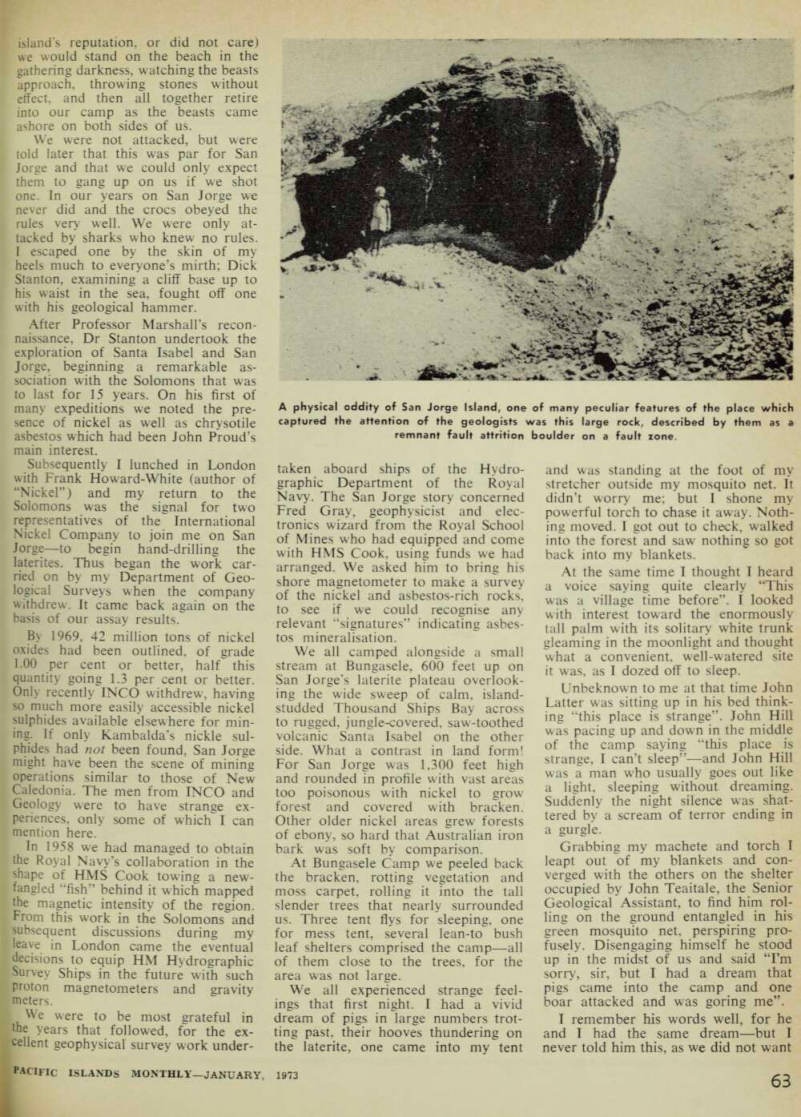

San Jorge's Ghosts And Things
That Go Bump In The Night
By John Grover
The Spanish Explorer Alvaro de Mendana discovered the Solomons in 1568, 200 years before Captain Cook, and reported a population of about 5,000 people on San Jorge, an island of roughly 60 square miles, rounded in profile. When the British Protector ate was declared in 1893 the entire population had gone and the island was tabu. The mystery has never been explained.
Ernie Palmer’s father established a coconut plantation there alongside the narrow Ortega Channel, but no Islanders would stay the night on the island with him, always preferring to leave before dark in their canoes, to cross the channel to Isabel. Palmer found minerals, so the islanders tell, but one evening went for a walk, broke his leg, and had been eaten by ants before he was found.
And so San Jorge was still deserted and tabu when Roy Hudson, Owen Jones and I arrived there in 1949, accompanied by the Commissioner for Lands, Peter Hindle. The government had asked us to look at this strange island, so different to all others in the protectorate.
The Islanders warned us not to sleep there, quoting the end of Palmer. They believed that this would happen to us, too. Medical Practitioner Bogesi, a well-spoken erudite Islander who had spent some time in Australia, told us of the singing and the night lights that could be seen across on San Jorge. We slept on our small ship
Nancy.
Next day we set out through the swamps, cutting our way, led by Con stable Sakabose—and eventually we returned to Honiara, plucking as we went the pigeons we had shot. It was some years before I experienced the unusual happenings on that strange island.
Far from it bringing bad luck, the reverse seemed true as far as I was concerned. In Honiara the Resident Commissioner Mr Germond invited me to consider the post of Senior Geolo gist and initiate a Geological Survey.
A newspaper story of seven Japanese soldiers believed to be still hiding on San Jorge Island reminded the author of some un usual happenings there. He won ders now whether a Japanese soldier might not have accounted for at least one of those ex periences.
Declining the invitation then, I pro mised to consider it when I returned to Australia Several weeks later, in August 1949, I wired advising my interest but inability to begin before April 1950, which drew perhaps the most unusual Colonial Service appointment of the post war years: His Excellency the High Commissioner for the Western Pacific has appointed you Senior Geologist to the British Solomon Islands Protectorate subject to you obtaining a first class honours degree and commencing duties in April, 1950.
Then in my final year at the University of Sydney, this trip to San Jorge had led to my association with the Solomon Islands for the next two decades to explore and map them in an effort to assess their mineral potential.
However, San Jorge did not allow me off scot-free—it was responsible for my first red-faced encounter with the Press. On our return to Sydney, Roy Hudson had suggested that we should be kind to the reporters and give them a fair and factual state ment concerning our gold-sampling expedition. He, Owen Jones and I composed it; duly signed, it was handed over to a man from a Sydney paper.
We had described how we had gone to Gold Ridge, resampled the gold bearing country, and had then been asked to look at the strange Island of San Jorge where the Spaniards had reported 5,000 people.
Next day in the Melbourne Sun with a map of San Jorge and Santa Isabel, headlines: “5,000 NATIVES DIS
Appear From The Solomon
ISLANDS” as though it had hap pened last Wednesday. In need of advice I telephoned my old friend R. W. Robson and asked what I should do.
He told me the facts of life. There was nothing that could be done. And so the San Jorge story reverberated around the world. Someone said that a question had been asked in the United Nations as to what the awful British had been doing, but I don’t know whether this is true. In any event the report came back to Sydney several weeks later in a small para graph from an overseas agency.
I sailed for the Solomons in the old SS Morinda, arriving in April 1950 and beginning what appeared to be a monumental task of exploration that would take about 70 years. I had not then reckoned with electronics and the explosion of knowledge that would come from its use in collecting data; nor had I thought of using warships and aircraft.
In November 1950 additional sup port arrived in the person of Profes sor Charles E. Marshall of the Uni versity of Sydney in response to my proposal for a collaborative venture.
We went to San Jorge as part of our reconnaissance and noted the “gibber desert” kind of terrain, and a foot path on the ridge crest probably worn by the population that the Spaniards saw 400 years before. Inside small pyramids of piled stones along side the path the Professor observed that the ground level was about 15 inches higher than outside, suggest ing that those stones had been there a long time. John Proud joined us and we camped ashore on the west coast of San Jorge.
Each evening four large crocodiles would line up offshore watching us.
As darkness fell they would close in.
With our Guadalcanal bushmen bearers (who did not know of the
island's reputation, or did not care) we would stand on the beach in the gathering darkness, watching the beasts approach, throwing stones without effect, and then all together retire into our camp as the beasts came ashore on both sides of us.
We were not attacked, but were told later that this was par for San Jorge and that we could only expect them to gang up on us if we shot one. In our years on San Jorge we never did and the crocs obeyed the rules very well. We were only at tacked by sharks who knew no rules.
I escaped one by the skin of my heels much to everyone’s mirth; Dick Stanton, examining a cliff base up to his waist in the sea, fought off one with his geological hammer.
After Professor Marshall’s recon naissance, Dr Stanton undertook the exploration of Santa Isabel and San Jorge, beginning a remarkable as sociation with the Solomons that was to last for 15 years. On his first of many expeditions we noted the pre sence of nickel as well as chrysotile asbestos which had been John Proud’s main interest.
Subsequently I lunched in London with Frank Howard-White (author of “Nickel”) and my return to the Solomons was the signal for two representatives of the International Nickel Company to join me on San Jorge—to begin hand-drilling the laterites. Thus began the work car ried on by my Department of Geo logical Surveys when the company withdrew. It came back again on the basis of our assay results.
By 1969, 42 million tons of nickel oxides had been outlined, of grade 1.00 per cent or better, half this quantity going 1.3 per cent or better.
Only recently INCO withdrew, having so much more easily accessible nickel sulphides available elsewhere for min ing. If only Kambalda’s nickle sul phides had not been found, San Jorge might have been the scene of mining operations similar to those of New Caledonia. The men from INCO and Geology were to have strange ex periences, only some of which I can mention here.
In 1958 we had managed to obtain the Royal Navy’s collaboration in the shape of HMS Cook towing a new fangled “fish” behind it which mapped the magnetic intensity of the region.
From this work in the Solomons and subsequent discussions during my leave in London came the eventual decisions to equip HM Hydrographic Survey Ships in the future with such proton magnetometers and gravity meters.
We were to be most grateful in the years that followed, for the ex cellent geophysical survey work under-
taken aboard ships of the Hydrographic Department of the Royal Navy. The San Jorge story concerned Fred Gray, geophysicist and electronics wizard from the Royal School of Mines who had equipped and come with HMS Cook, using funds we had arranged. We asked him to bring his shore magnetometer to make a survey of the nickel and asbestos-rich rocks, to see if we could recognise any relevant ’ signatures indicating asbestos mineral,sat.on.
We all camped alongside a small stream at Bungasele, 600 feet up on San Jorges latente plateau overlooking the wide sweep of calm, islandstudded Thousand Ships Bay across
to rugged, jungle-covered, saw-toothed
volcanic Sami Isabel on the other side. What a contrast in land form!
For San Jorge was 1.300 feet high and rounded in profile with vast areas too poisonous with nickel to grow forest and covered with bracken.
Other older nickel areas grew forests of ebony, so hard that Australian iron bark was soft by comparison.
At Bungasele Camp we peeled back the bracken, rotting vegetation and moss carpet, rolling it into the tall slender trees that nearly surrounded us. Three tent flys for sleeping, one for mess tent, several lean-to bush leaf shelters comprised the camp—all of them close to the trees, for the area was not large.
We all experienced strange feelings that first night. I had a vivid dream of pigs in large numbers trotting past, their hooves thundering on the laterite, one came into my tent
and was standing at the foot of my stretcher outside my mosquito net. It didn’t worry me; but I shone my powerful torch to chase it away. Noth ing moved. I got out to check, walked into the forest and saw nothing so got back into my blankets, At t he same time I thought I heard a voice saying quite clearly “This was a village time before”. I looked w j t b interest toward the enormously tall pa i m with its solitary white trunk gleaming in the moonlight and thought what a convenient, well-watered site it was? as j dozed off to sleep , , , ... T . , Unbeknown to me at that time John »as sitting up in his bed thmk in 8 th,s P ,ace grange John H U was pacing up and down in the middle °, f the ? am P ln B th ‘ s P> ace „. f stran * e - 1 can ‘ slee P - and John , wa ?. a ma " wh .° usual ‘ y out !' k „ e a seeping without dreami g.
Suddenly the night silence was shat tered h . y a scream of terror endmg ,n a B ur 8 le - Grabbing my machete and torch I leapt out of my blankets and con verged with the others on the shelter occupied by John Teaitale, the Senior Geological Assistant, to find him rol ling on the ground entangled in his green mosquito net, perspiring pro fusely. Disengaging himself he stood up in the midst of us and said “I’m sorry, sir, but I had a dream that pigs came into the camp and one boar attacked and was goring me”, I remember his words well, for he and I had the same dream—but I never told him this, as we did not want
A physical oddity of San Jorge Island, one of many peculiar features of the place which captured the attention of the geologists was this large rock, described by them as a remnant fault attrition boulder on a fault zone.
Apparition In The Moonlight
to cause concern about the strangeness of the place, as we had work to do.
Next night I had a strange en counter with a black snake, one of the only deadly variety, and the next night with a large centipede nearly a foot long. Stranger by far was the ex perience of John Hill.
I should explain that through our camp site went that ancient track that crossed the island, coming up from the Astrolabe Bay, passing into the tall trees. John’s tent was astride this trail. His bed was on it and along it. Anyone wanting to use the trail would have to detour past the tent pegs and walk past John’s bed.
He awoke at something after mid night to the apparition of a man stand ing at the end of the tent, looking down at him from a few feet away.
The moonlight was shining on his face. John, his hand on torch, ready, watched him through his mosquito net without moving, studying his features, carefully pinching himself to be sure that he was not dreaming.
He was sure that he was wide awake.
Eventually feeling that he could hardly stay there all night watching like this, he lifted up the net and got out. Nobody was there. He came and mentioned it to us explaining that it was unusual for him to dream. He described the man; “He was not an old man, he was only about forty”.
I had reason later to remember John’s words.
Thereafter the trees began to fall all night long, about three every two hours, without apparent reason -—7 O-odd feet high, crashing around the camp. We began to get jumpy.
Next night, I had retired at 9 p.m. but wakened at 11.30 p.m. when John Latter passed by with his bright pressure lamp on his way to bed. For no reason, and quite unable to control my words, it seemed, I called out John, come here a minute with that lamp! There is a big tree leaning over one of the tents!”. This was also news to me for I had not seen it and could not explain why I should have talked thus. . Sure enough we found one lean ing about 30 degrees to the vertical resting against another tree in line with the centre of one of the tents.
John Hill said to me “It’s all right it won’t hit the tent”. I looked and reckoned it would if it fell. Chuchu was called up with his axe, everyone got out of his way, and the support ing tree was felled.
The big one crashed into the fork ot yet another tree on the far side of mat tent, being held about six inches
above and across its ridge-pole.
“That’s 0.K.” said everyone. But I can remember, as though a debate were in progress, voices saying “It is all right let them stay” and another “No, get them out!”.
Eventually I ordered everyone out from that tent, into the others. At 3 a.m. down thundered the heavy rain on our taut canvases. A couple of minutes later there was an unholy crash as the supporting tree split and the tall one flattened that empty tent!
The next night John Hill awoke about midnight and in spite of saying to himself “this is bloody impossible” he could see this apparition again— the same man—this time with a male volent expression on his face, frowning at John from where he stood on the ancient trail on the outside of the tent.
John could see him through the canvas, in spite of pinching himself and telling himself that it was ridi culous. There he was. They watched each other. Eventually John had to do something. He lifted his net and got out. Nobody was there. But the trees continued to fall—about three every two hours during the night.
We were all relieved when the time came to leave the strange island and returned to Honiara. But it was not the end of the story.
I met Rev. Father de Theye in Chinatown and broached the subject: “Father, did not the Catholic Mis sion have a bishop murdered on San Jorge in 1845?”. “No, Mr Grover, Bishop Epalle and Father . . . were murdered on Santa Isabel, but were buried at Astrolabe Bay on San Jorge because the island was tabu. We had their remains removed in 1902 for decent burial at Rua Sura when the mission was re-established.” I asked him “What kind of a man was Bishop Epalle?” He replied “Well, he was not an old man, he was only about forty” ... the exact words John Hill had used! I then ascertained that there was a photograph of him in the Mis sion Library, The pressure of our duties caused us to forget these events until several months later, the day before John Hill was due to leave the Solomons.
I remembered that we had not looked at the photograph of Bishop Epalle.
I phoned Father Moore and arranged for a loan of the book from the Mis sion library and had it brought up.
We opened at the page and John Hill looked at it. “Yes,” he said “That could have been the man.” The 113year-old graves of Bishop Epalle and his martyred colleague had been at
the foot of that trail that passe through John Hill’s tent.
Exploration on San Jorge continue for another ten years. INCO took ov< from the Department in 1963—the did a sterling job of assessment. W dropped out. Eventually I went t Fiji, and to Australia. In mid-197 I was at Kalgoorlie in Western Aus ralia and met Bro Palmer, an en ployee of INCO, grandson of Palme who had died on San Jorge. We ha not met for about a dozen years. H told me the story of Bill Heseltin on San Jorge.
Bill was in charge of operations, solid citizen, ex-paratrooper/coir mando type, casual and fearless. Br told the story how one evening wit darkness falling, Bill was alone an headed back to Bungasele camp fol lowing the ancient trail, a roll of map under his arm. A sixth sense warne him that he was being follows silently by something close behind he increased his pace and dared no turn around.
The tall trees were close at ham in the gathering darkness and so wa the follower. Bill broke into a trot He dropped his maps but did no pause, running through the trees t( the camp, arriving with evident re lief. He even discussed it with hi: colleagues. What was it?
And so in far away Kalgoorlie the last account of strange things oi San Jorge was told. But these thing are not only recent or post-war. The} were happening long before that. Foi once, while the island was being ex plored, a bottle was found on th< peak of the highest hill and in it wa: a piece of paper with words to th( effect that Father . . . Tinoni o\ the Melanesian Mission did on thh day , . . 1922 hold a service on thii hill to lay to rest the spirits that haunt this island.”
What happened to the population that disappeared? What are the night singing noises and the ghostly lights seen by the islanders? Why did so many feel that the place was strange?
Why did two men dream the same dream? Why did the tall trees keep falling for days on end? Was it the spirit of the Right Reverend Bishop Epalle murdered in 1845 or was it a Japanese soldier?
Exploring the Solomons was never dull and we geologists learned a great deal from the Melanesian people. We learned to accept things as they hap pened without bothering ourselves by trying to fit these happenings into pre-conceived European pigeon-holes that might satisfy our urban-bred friends. Many things happened that defied explanation but added to the richness of our lives in those quiet and lovely islands.
Advertisements & other items, pp. 66-70 (1 item)
drink beer,
Not all Australians
ride surfboards
and throw boomerangs
■a ■ * \ m.
'i.Jh Va * Vs***
Qantas can show you
how the other half lives.
It takes one Australian to show you another. Trust Qantas to take you out and show you the far out, the way out and the Outback. It’s their country. JE Come and see how the other half lives. ttaiSCL. «Cf/VT L 81.1571
You'll fed that love was bom here What light best shows the beauty of the Taj Mahal? The rose of dawn? The soft pearlwhite of a great moon, with the whole shimmer of slender marble afloat on its own image?
In each slight shift of the day's light, the Taj assumes a different look and feel. But always it is an expression of love. Pure love, Shah Jahan felt it for the wife he lost 300 years ago. And twenty thousand workmen laboured twenty-two years to express his feelings. 28494 You'll feel it, too. In India.
Not just as you pause before the Taj Mahal, but in other Indian places, at other monuments from other ages and cultures.
Perhaps India is the last place in the world to offer you so much of it. The cost is low.
And this is the year. Any travel agent can show you the way.
Visit us in this year of pageants. (25th anniversary of the world's largest democracy.) For further details see your travel agent, or contact us at the Government of India Tourist Office, 55 Elizabeth Street, Sydney 2000.
india
is for you this year
1T45.46
TUMID SKID & SCUBR DIUIDG EQUIPmEDT
The TABATA line offers the importer a complete range of RUBBER SKIN & SCUBA DIVING EQUIPMENT and ACCESSORIES for both the professional and amateur. Years of specialized manufacturing experience has established our line’s
REPUTATION FOR QUALITY, ATTRACTIVE and PRACTICAL
DESIGNS and VERY COMPETITIVE PRICES. We also offer a varied line of rubber sundries for golfing, skiing and other popular sports.
NEW ZEALAND Agents: Allan G. Mitchell (N.Z.I Ltd.
NORFOLK ISLAND Agents: Norfolk Island Sporting Centre Ltd.
For full particulars on our lines, write to:
OTabata
Yajima Bldg., 2-2 Yoshi-cho, Nihonbashi.
Tokyo Cable: EASTABAT Tokyo TELEX. 252-281
EASTABATA TOK Tel: (663) 8651-5
OSAKA; 48 Uchiawazi-cho, 2-chome, Higashi-ku.
CO.,LTD.
Ask for FOUREX the dear sparkling amber beer...
available in BOTTLES, CANS and STUBBIES
xxxx The Popular
‘lts Quality Never Varies’
Wholesale Distributors:
C. SULLIVAN
(NEW GUINEA) PTY. LTD.,
Port Moresby, Lae, Mt. Hagen, Rabaul, Kieta, Lautoka and Suva, Fiji.
AGENCIES:
R. Bensley—AAadang. Ping Shee & Co. —Wewak. E. V. Lawson Pty. Ltd.— Honiara, British Solomon Islands. (Wi
[Ajutwnii
Brewed from the finest Ingredients by Castlemaine Perkins Limited, Brisbane, Queensland, Australia.
Continually growing
in popularity
HELLABY’S CANNED MEATS
‘CROWN’
‘PACIFIC’
‘ARROW’
u iS
HELLABY
% A A \
Yesterday
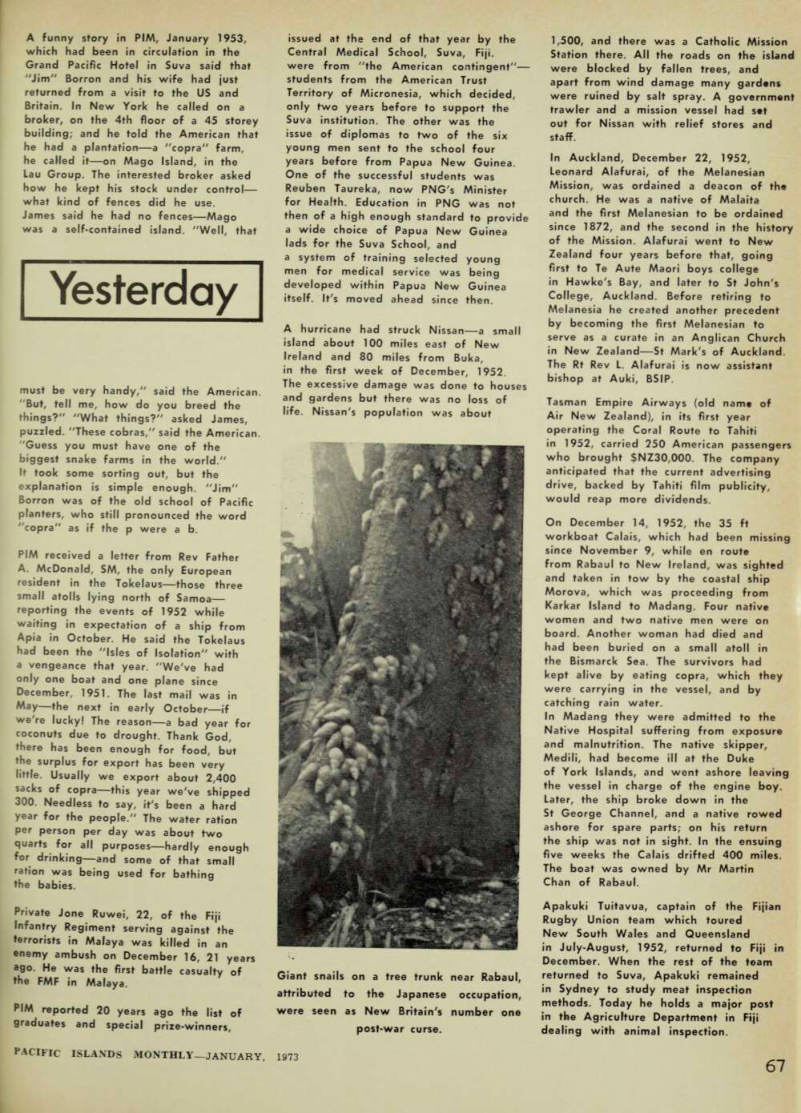
A funny story in PIM, January 1953, which had been in circulation in the Grand Pacific Hotel in Suva said that "Jim" Borron and his wife had just returned from a visit to the US and Britain. In New York he called on a broker, on the 4th floor of a 45 storey building; and he told the American that he had a plantation—a "copra" farm, he called it—on Mago Island, in the Lau Group. The interested broker asked how he kept his stock under control— what kind of fences did he use.
James said he had no fences—Mago was a self-contained island. "Well, that
must be very handy," said the American.
"But, tell me, how do you breed the things?" "What things?" asked James, puzzled. "These cobras," said the American.
"Guess you must have one of the biggest snake farms in the world."
It took some sorting out, but the explanation is simple enough. "Jim"
Borron was of the old school of Pacific planters, who still pronounced the word "copra" as if the p were a b.
PIM received a letter from Rev Father A. McDonald, SM, the only European resident in the Tokelaus—those three small atolls lying north of Samoa — reporting the events of 1952 while waiting in expectation of a ship from Apia in October. He said the Tokelaus had been the "Isles of Isolation" with a vengeance that year. "We've had only one boat and one plane since December, 1951. The last mail was in May—the next in early October—if we're lucky! The reason—a bad year for coconuts due to drought. Thank God, there has been enough for food, but the surplus for export has been very little. Usually we export about 2,400 sacks of copra—this year we've shipped 300. Needless to say, it's been a hard year for the people." The water ration per person per day was about two quarts for all purposes—hardly enough for drinking— and some of that small ration was being used for bathing the babies.
Private Jone Ruwei, 22, of the Fiji Infantry Regiment serving against the terrorists in Malaya was killed in an enemy ambush on December 16, 21 years ago. He was the first battle casualty of the FMF in Malaya.
PIM reported 20 years ago the list of graduates and special prize-winners,
issued at the end of that year by the Central Medical School, Suva, Fiji, were from "the American contingent"— students from the American Trust Territory of Micronesia, which decided, only two years before to support the Suva institution. The other was the issue of diplomas to two of the six young men sent to the school four years before from Papua New Guinea.
One of the successful students was Reuben Taureka, now PNG's Minister for Health. Education in PNG was not then of a high enough standard to provide a wide choice of Papua New Guinea lads for the Suva School, and a system of training selected young men for medical service was being developed within Papua New Guinea itself. It's moved ahead since then.
A hurricane had struck Nissan—a small island about 100 miles east of New Ireland and 80 miles from Buka, in the first week of December, 1952.
The excessive damage was done to houses and gardens but there was no loss of life. Nissan's population was about
1,500, and there was a Catholic Mission Station there. All the roads on the island were blocked by fallen trees, and apart from wind damage many gardens were ruined by salt spray. A government trawler and a mission vessel had set out for Nissan with relief stores and staff.
In Auckland, December 22, 1952, Leonard Alafurai, of the Melanesian Mission, was ordained a deacon of the church. He was a native of Malaita and the first Melanesian to be ordained since 1872, and the second in the history of the Mission. Alafurai went to New Zealand four years before that, going first to Te Aute Maori boys college in Hawke's Bay, and later to St John's College, Auckland. Before retiring to Melanesia he created another precedent by becoming the first Melanesian to serve as a curate in an Anglican Church in New Zealand—St Mark's of Auckland.
The Rt Rev L. Alafurai is now assistant bishop at Auki, BSIP.
Tasman Empire Airways (old name of Air New Zealand), in its first year operating the Coral Route to Tahiti in 1952, carried 250 American passengers who brought SNZ3O,OOO. The company anticipated that the current advertising drive, backed by Tahiti film publicity, would reap more dividends.
On December 14, 1952, the 35 ft workboat Calais, which had been missing since November 9, while en route from Rabaul to New Ireland, was sighted and taken in tow by the coastal ship Morova, which was proceeding from Karkar Island to Madang. Four native women and two native men were on board. Another woman had died and had been buried on a small atoll in the Bismarck Sea. The survivors had kept alive by eating copra, which they were carrying in the vessel, and by catching rain water.
In Madang they were admitted to the Native Hospital suffering from exposure and malnutrition. The native skipper, Medili, had become ill at the Duke of York Islands, and went ashore leaving the vessel in charge of the engine boy.
Later, the ship broke down in the St George Channel, and a native rowed ashore for spare parts; on his return the ship was not in sight. In the ensuing five weeks the Calais drifted 400 miles.
The boat was owned by Mr Martin Chan of Rabaul.
Apakuki Tuitavua, captain of the Fijian Rugby Union team which toured New South Wales and Queensland in July-August, 1952, returned to Fiji in December. When the rest of the team returned to Suva, Apakuki remained in Sydney to study meat inspection methods. Today he holds a major post in the Agriculture Department in Fiji dealing with animal inspection.
Giant snails on a tree trunk near Rabaul, attributed to the Japanese occupation, were seen as New Britain's number one post-war curse.
People
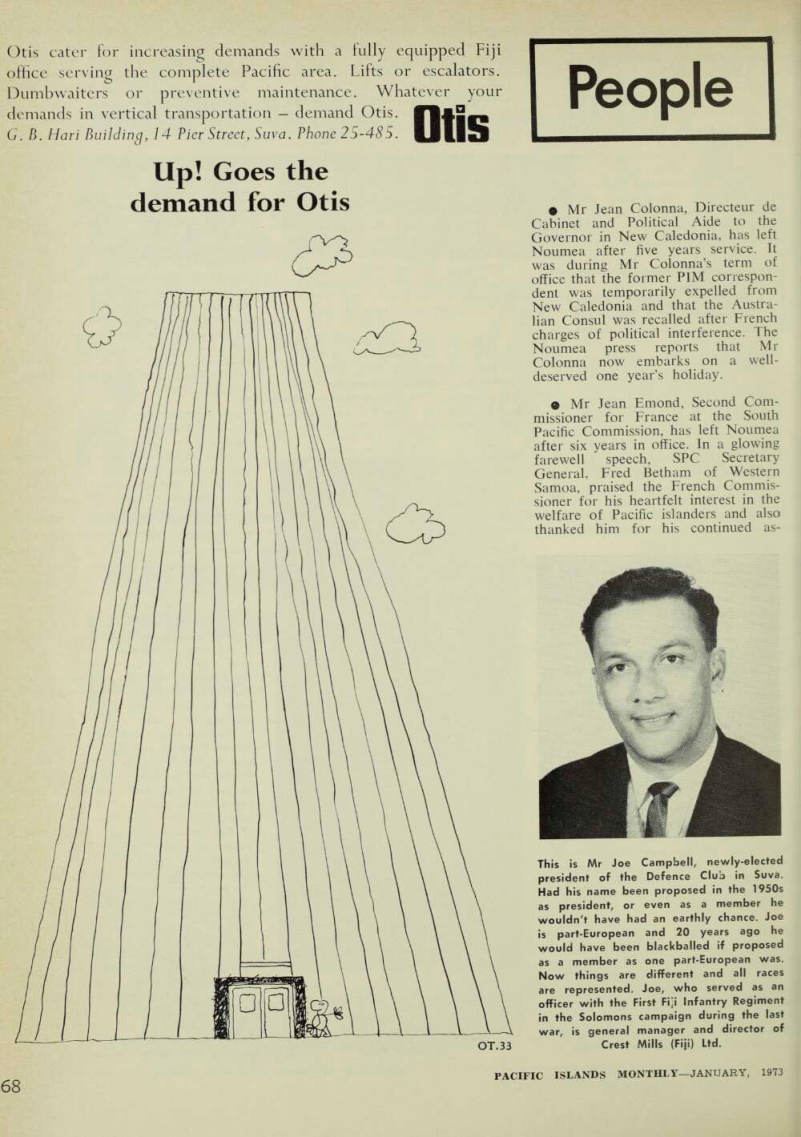
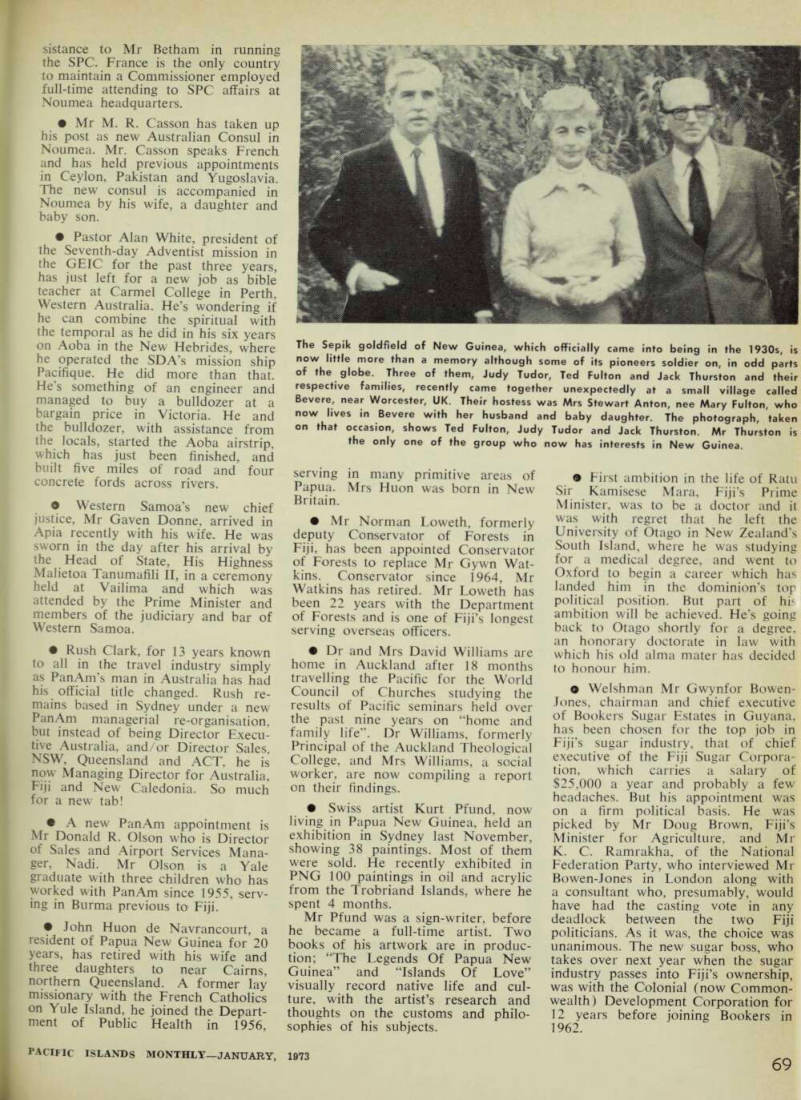
• Mr Jean Colonna, Directeur de Cabinet and Political Aide to the Governor in New Caledonia, has left Noumea after five years service. It was during Mr Colonna’s term of office that the former PIM correspon dent was temporarily expelled from New Caledonia and that the Austra lian Consul was recalled after French charges of political interference. The Noumea press reports that Mr Colonna now embarks on a well deserved one year’s holiday. q Mr Jean Emond, Second Com missioner for France at the South Pacific Commission, has left Noumea after six years in office. In a glowing farewell speech, SPC Secretary General, Fred Betham of Western Samoa, praised the French Commis sioner for his heartfelt interest in the welfare of Pacific islanders and also thanked him for his continued as-
This is Mr Joe Campbell, newly-elected president of the Defence Club in Suva.
Had his name been proposed in the 1950s as president, or even as a member he wouldn't have had an earthly chance. Joe is part-European and 20 years ago he would have been blackballed if proposed as a member as one part-European was.
Now things are different and all races are represented. Joe, who served as an officer with the First Fiji Infantry Regiment in the Solomons campaign during the last war, is general manager and director of Crest Mills (Fiji) Ltd.
sistance to Mr Betham in running the SPC. France is the only country to maintain a Commissioner employed full-time attending to SPC affairs at Noumea headquarters. • Mr M. R. Casson has taken up his post as new Australian Consul in Noumea. Mr. Casson speaks French and has held previous appointments in Ceylon, Pakistan and Yugoslavia.
The new consul is accompanied in Noumea by his wife, a daughter and baby son. • Pastor Alan White, president of the Seventh-day Adventist mission in the GEIC for the past three years, has just left for a new job as bible teacher at Carmel College in Perth, Western Australia. He’s wondering if he can combine the spiritual with the temporal as he did in his six years on Aoba in the New Hebrides, where he operated the SDA’s mission ship Pacifique, He did more than that.
He’s something of an engineer and managed to buy a bulldozer at a bargain price in Victoria. He and the bulldozer, with assistance from the locals, started the Aoba airstrip, which has just been finished, and built five miles of road and four concrete fords across rivers.
O Western Samoa’s new chief justice, Mr Gaven Donne, arrived in Apia recently with his wife. He was sworn in the day after his arrival by the Head of State, His Highness Malietoa Tanumafili 11, in a ceremony held at Vailima and which was attended by the Prime Minister and members of the judiciary and bar of Western Samoa. • Rush Clark, for 13 years known to all in the travel industry simply as Pan Am’s man in Australia has had his official title changed. Rush re mains based in Sydney under a new PanAm managerial re-organisation, but instead of being Director Execu tive Australia, and/or Director Sales, NSW, Queensland and ACT, he is now Managing Director for Australia, Fiji and New Caledonia. So much for a new tab! • A new PanAm appointment is Mr Donald R. Olson who is Director of Sales and Airport Services Mana ger, Nadi. Mr Olson is a Yale graduate with three children who has worked with PanAm since 1955, serv ing in Burma previous to Fiji. • John Huon de Navrancourt, a resident of Papua New Guinea for 20 years, has retired with his wife and three daughters to near Cairns, northern Queensland. A former lay missionary with the French Catholics on Yule Island, he joined the Depart ment of Public Health in 1956,
serving in many primitive areas of Papua. Mrs Huon was born in New Britain - • Mr Norman Loweth, formerly deputy Conservator of Forests in Fiji, has been appointed Conservator of Forests to replace Mr Gywn Watkins. Conservator since 1964, Mr Watkins has retired. Mr Loweth has been 22 years with the Department of Forests and is one of Fiji’s longest serving overseas officers. ... • Dr and Mrs David Williams are home in Auckland after 18 months travelling the Pacific for the World Council of Churches studying the results of Pacific seminars held over the past nine years on “home and family life’’. Dr Williams, formerly Principal of the Auckland Theological College, and Mrs Williams, a social worker, are now compiling a report on their findings. • Swiss artist Kurt Pfund, now living in Papua New Guinea, held an exhibition in Sydney last November, showing 38 paintings. Most of them were sold. He recently exhibited in PNG 100 paintings in oil and acrylic from the Trobriand Islands, where he spent 4 months.
Mr Pfund was a sign-writer, before he became a full-time artist. Two books of his artwork are in production; “The Legends Of Papua New Guinea” and “Islands Of Love” visually record native life and culture, with the artist’s research and thoughts on the customs and philosophies of his subjects.
a First ambition in the life of Ratu Sir Kamisese Mara, Fiji’s Prime Minister, was to be a doctor and it with re B ret that he left the University of Otago in New Zealand’s South I§ land, where he was studying for a medical degree, and went to Oxford to begin a career which has landed him in the dominion’s top P°litical position. But part of hb ambition will be achieved. He’s going back to Otago shortly for a degree, an honorary doctorate in law with which his old alma mater has decided to honour him w 0 0 Welshman Mr Gwynfor Bowen- Jones ’ cha,rman and chief executive ? f Bookers Sugar Estates in Guyana, bas ., been cho . s en for the top job in F, h s su § ar r '" du^y , that of chief executive of the Fiji Sugar Corpora blcb carra f s a salary of 525,000 a year and probably a few headaches. But his appointment was on a firm political basis. He was picked by Mr Doug Brown, Fiji’s Minister for Agriculture, and Mr K. C. Ramrakha, of the National Federation Party, who interviewed Mr Bowen-Jones in London along with a consultant who, presumably, would have had the casting vote in any deadlock between the two Fiji politicians. As it was, the choice was unanimous. The new sugar boss, who takes over next year when the sugar industry passes into Fiji’s ownership, was with the Colonial (now Common wealth) Development Corporation for 12 years before joining Bookers in 1962.
The Sepik goldfield of New Guinea, which officially came into being in the 19305, is now little more than a memory although some of its pioneers soldier on, in odd parts of the globe. Three of them, Judy Tudor, Ted Fulton and Jack Thurston and their respective families, recently came together unexpectedly at a small village called Bevere, near Worcester, UK. Their hostess was Mrs Stewart Anton, nee Mary Fulton, who now lives in Bevere with her husband and baby daughter. The photograph, taken on that occasion, shows Ted Fulton, Judy Tudor and Jack Thurston. Mr Thurston is the only one of the group who now has interests in New Guinea.
Advertisements & other items, pp. 72-74 (2 items)
Otis
cater for increasing demands with a fully equipped Fiji office serving the complete Pacific area. Lifts or escalators.
Dumbwaiters or preventive maintenance. Whatever your demands in vertical transportation - demand Otis.
G. B. Hari Building, 14 Pier Street, Suva. Phone 25-485.
Up! Goes the
demand for Otis
Otis
□ □ 0T.33
Burns Philp
THROUGHOUT THE PACIFIC
FUI,SAMOA,TONGA,NIUE IS.NORFOIK Is.
U/\
[SOUTH SEAT CO. LTD.
REGISTERED OFFICE: SUVA,
TELEPHONE NO: 22661 fi
TELEX NO: FJ1127
Code Address; "BURNSOUTH'
SHIPPING AGENCIES
The New Zealand Shipping Co. Ltd.
Shaw Savill & Albion Co. Ltd.
Blue Star Port Line (Management) Ltd.
Bank Line Ltd.
General Steamship Corporation Ltd.
Compagnie des Messageries Maritimes Royal Interocean Lines Daiwa Navigation Company Ltd.
Sitmar Line Flotta Lauro (Lauro Lines) Australasia Pty. Ltd.
Tonga Shipping Agency Karlander Kangaroo Line
EXCLUSIVE
DISTRIBUTORSHIPS
INCLUDE
Akai Taperecorders Sunbeam Appliances Dunlop Products Hitachi Electronics Holden Motor Vehicles Rolex Watches Revlon Cosmetics Pentax Cameras Massey-Ferguson Tractors Olympic Tyres Penfold Wines Heuga Carpet Tiles Guerlain Parfums
AGENTS FOR
Queensland Insurance Co. Ltd.
Shell Company (P. 1.) Ltd.
Bureau Veritas
ASSOCIATED COMPANIES
Burns Philp (New Hebrides) Ltd.
Burns Philp Trustee Co. Ltd.
Automotive Supplies Co. Ltd.
Corrie & Co. Ltd.
Wrought Iron and Steel Construction Co. Ltd.
Bish Ltd.
SPECIALISED SERVICES
Expert advice on Shipping,- Forwarding; Customs formalities; Insurance
COMPLETE TRAVEL
SERVICE
accredited agents for the
INTERNATIONAL AIR
TRANSPORT ASSOCIATION
OVERSEAS AGENTS: SYDNEY • LONDON • SAN FRANCISCO If
Book Reviews

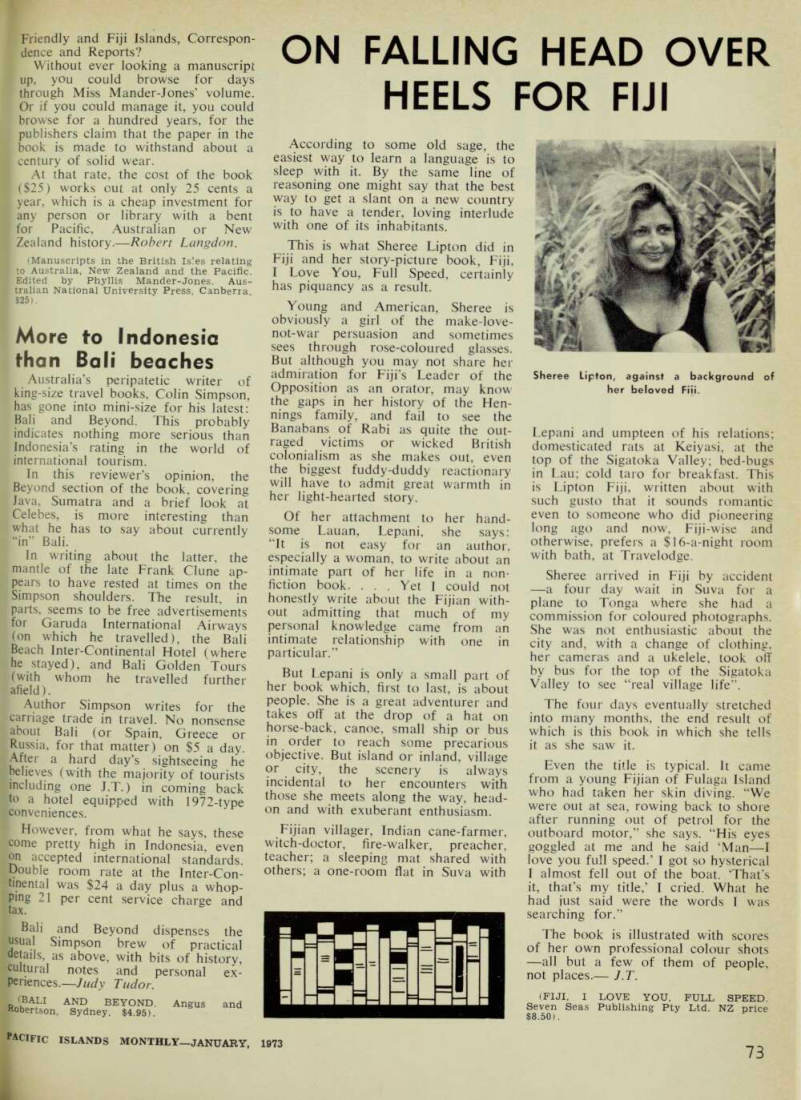
Pacific History Made Easy -
At Only 25C A Year
Historians, journalists, students and such like embarking on books, articles or theses on any aspect of Pacific history are perennially confronted with the same problem: how to find what material exists on their chosen subject?
In the case of printed material, the problem has been largely solved in recent years by the appearance of detailed bibliographies on many of the Island territories, as well as by the bibliographies of current publications that appear annually in the Journal of Pacific History and the Bulletin de la Societe des Oceanistes.
But what about manuscript material? How do you discover the whereabouts of, say, the journals and correspondence of the early London Missionary Society missionaries in Samoa? How do you find out whether any papers of, say. Sir Arthur Gordon of Fiji or Sir Hubert Murray of Papua, have found their way into a public repository some where?
In the case of documents deposited in libraries in Australia, the thing to do is to consult the somewhat mis named Guide to Manuscripts Relating to Australia, or the Catalogue of Manuscripts of Australia and the Pacific, in the Mitchell Library, Sydney.
But until a few weeks ago there was no simple way of finding out what was where in Great Britain.
In fact, Great Britain was the despair of any would-be Pacific historian.
Now, however, there is a magnifi cent guidebook of 697 closely printed pages entitled Manuscripts in the British Isles Relating to Australia, New Zealand and the Pacific. It is the result of eight years of Herculean labour bv Miss Phyllis Mander-Jones, a former Mitchell Librarian, and several assistants, sponsored by the National Library of Australia and the Australian National Univeristy.
Miss Mander-Jones’ volume lists and briefly describes every manuscript or collection of manuscripts on the area it covers in every conceivable
repository from Land’s End to John o’ Groats, and from Ulster to County Cork, for the definition of ‘British Isles’ in her title includes the Republic of Ireland.
The repositories alone make a formidable list. They include such obvious places as the British Museum, the India Office Library, the Methodist Missionary Society and the Public Records Office, as well as many totally unexpected ones such as the Dorset Military Museum, Dorchester; David Salomon’s House, Tunbridge Wells, Kent; and the Manx Museum, Douglas, Isle of Man.
In London alone, the Australasian and Oceanic contents of no less than 98 repositories are listed and described, and in each case there is also a brief description of the repository itself.
Miss Mander-Jones’ volume is an essential tool for anyone planning detailed research on any of the subjects it embraces. It is also a fascinating book just to browse in.
Who would have guessed, for
example, that the British and Foreign Bible Society would still have the manuscript by King Pomarc II of Tahiti of his translation into Tahitian (c. 1820) of St John’s Gospels and part of the Acts of the Apostles?
How else could you readily find out that the British Museum has a letter, written in 1880 by John Hill, of Rabi Island, Fiji, in which he reported the death of his Sydney partner and announced that he would probably have to sell his share in that island?
What, you may wonder, would you be likely to find in the journal (in the National Maritime Museum, Greenwich) of Admiral Sir Phipps Hornby, commander of Britain’s Pacific Squadron in 1847-49, which, according to the guide, mainly con cerns South America, but also con tains entries relating to Hawaii, Samoa and Tahiti?
And what untold secrets might there not be in a baldly-described Public Records Office item such as: Adm. 172/3, 1845-57, Navigators’,
Friendly and Fiji Islands, Correspon dence and Reports?
Without ever looking a manuscript up, you could browse for days through Miss Mander-Jones’ volume.
Or if you could manage it, you could £ browse for a hundred years, for the publishers claim that the paper in the B book is made to withstand about a I century of solid wear.
At that rate, the cost of the book I ($25) works out at only 25 cents a I year, which is a cheap investment for 8 any person or library with a bent 8 for Pacific, Australian or New 8 Zealand history. —Robert Langdon. (Manuscripts in the British Is’.es relating ■ to Australia, New Zealand and the Pacific.
Edited by Phyllis Mander-Jones. Aus ■ tralian National University Press, Canberra.
I $251.
More to Indonesia
than Bali beaches
Australia’s peripatetic writer of king-size travel books, Colin Simpson, has gone into mini-size for his latest; Bali and Beyond. This probably indicates nothing more serious than Indonesia’s rating in the world of international tourism.
In this reviewer’s opinion, the Beyond section of the book, covering Java, Sumatra and a brief look at Celebes, is more interesting than what he has to say about currently J “in” Bali.
In writing about the latter, the mantle of the late Frank Clune ap pears to have rested at times on the Simpson shoulders. The result, in parts, seems to be free advertisements for Garuda International Airways (on which he travelled), the Bali Beach Inter-Continental Hotel (where he stayed), and Bali Golden Tours (with whom he travelled further afield).
Author Simpson writes for the carriage trade in travel. No nonsense about Bali (or Spain, Greece or Russia, for that matter) on $5 a day.
After a hard day’s sightseeing he believes (with the majority of tourists including one J.T.) in coming back to a hotel equipped with 1972-type conveniences.
However, from what he says, these come pretty high in Indonesia, even on accepted international standards.
Double room rate at the Inter-Con tinental was $24 a day plus a whop ping 21 per cent service charge and tax.
Bali and Beyond dispenses the usual Simpson brew of practical details, as above, with bits of history, cultural notes and personal ex
periences.—Judy Tudor.
AND . BEYOND. Angus and «obertson, Sydney. $4.95).
Those Sparks Are Still Flying
Back in December, 1962, PIM published a story (p. 38) entitled 'Sparks Fly Over Those Old Polynesian Voyages'. It recorded the publication, in the Journal of the Polynesian Society, of a symposium on what was then a virtually heretical theory put forward by the New Zealand scholar Andrew Sharp.
This was that the islands of the Pacific (particularly Polynesia) had not been settled by bold navigators who deliberately set out to discover homelands new, but, rather, that they were mainly settled by hapless canoeloads of people who were blown from one island to another.
The JPS symposium created so much interest that the Polynesian Society re published it in book form in 1963 under the title Polynesian Navigation.
That volume has long been out of print. But the sparks are still flying over Andrew Sharp's theory—David Lewis' book. We, the Navigators (reviewed in PIM, Sept., p. 77) being a recent example of its scintillating aftermath.
In the circumstances, the Polynesian Society has done Pacific scholars a service by bringing out a new edition of Polynesian Navigation. It is exactly the same as the previous edition except for a new foreword by the editor. Jack Golson, and a select bibliography of writings on Polynesian navigation that have appeared in the interval. The contributors to the symposium were G. S. Parson son, Captains G. H. Heyen and Charles Bechtol, and G. M. Dening. (POLYNESIAN NAVIGATION. Published for the Polynesian Society by A. H. and A. W. Reed, Wellington and Sydney. $3.95).
Advertisements & other items, p. 76 (1 item)
Clix
GUx
Crackers
taste as «
thevre
buttered'.
SEALED
INNER
PACKS
mk tersm Brockhoff Clix are crisp, 9 °'de? at'heart S Eat them • en f«i thev are. straight IUStl USt a +hP nack. Dabble • r °rtins nibble with drinks StSWK savoury spreads. r
BROCKHOff
CLIX
CRACKERS
8 OZ NET
There’s value, variety and quality in
BROCKHOFF BISCUITS
7769/8 x 65
On Falling Head Over
Heels For Fiji
According to some old sage, the easiest way to learn a language is to sleep with it. By the same line of reasoning one might say that the best way to get a slant on a new country is to have a tender, loving interlude with one of its inhabitants.
This is what Sheree Lipton did in Fiji and her story-picture book, Fiji, I Love You, Full Speed, certainly has piquancy as a result.
Young and American, Sheree is obviously a girl of the make-love not-war persuasion and sometimes sees through rose-coloured glasses.
But although you may not share her admiration for Fiji’s Leader of the Opposition as an orator, may know the gaps in her history of the Hen nings family, and fail to see the Banabans of Rabi as quite the out raged victims or wicked British colonialism as she makes out, even the biggest fuddy-duddy reactionary will have to admit great warmth in her light-hearted story.
Of her attachment to her hand some Lauan, Lepani, she says; “It is not easy for an author, especially a woman, to write about an intimate part of her life in a non fiction book. ... Yet I could not honestly write about the Fijian with out admitting that much of my personal knowledge came from an intimate relationship with one in particular.”
But Lepani is only a small part of her book which, first to last, is about people. She is a great adventurer and takes off at the drop of a hat on horse-back, canoe, small ship or bus in order to reach some precarious objective. But island or inland, village or city, the scenery is always incidental to her encounters with those she meets along the way, head on and with exuberant enthusiasm.
Fijian villager, Indian cane-farmer, witch-doctor, fire-walker, preacher, teacher; a sleeping mat shared with others; a one-room flat in Suva with
Lepani and umpteen of his relations; domesticated rats at Keiyasi, at the top of the Sigatoka Valley; bed-bugs in Lau; cold taro for breakfast. This is Lipton Fiji, written about with such gusto that it sounds romantic even to someone who did pioneering long ago and now, Fiji-wise and otherwise, prefers a $l6-a-night room with bath, at Travelodge.
Sheree arrived in Fiji by accident —a four day wait in Suva for a plane to Tonga where she had a commission for coloured photographs.
She was not enthusiastic about the city and, with a change of clothing, her cameras and a ukelele, took off by bus for the top of the Sigatoka Valley to see “real village life".
The four days eventually stretched into many months, the end result of which is this book in which she tells it as she saw it.
Even the title is typical. It came from a young Fijian of Fulaga Island who had taken her skin diving. “We were out at sea, rowing back to shore after running out of petrol for the outboard motor,” she says. “His eyes goggled at me and he said ‘Man—l love you full speed.’ I got so hysterical 1 almost fell out of the boat. ‘That’s it, that’s my title,’ I cried. What he had just said were the words I was searching for.”
The book is illustrated with scores of her own professional colour shots —all but a few of them of people, not places.— J.T.
(Fiji, I Love You, Pull Speed.
Seven Seas Publishing Pty Ltd. NZ price $8.50).
Sheree Lipton, against a background of her beloved Fiji.
Advertisements & other items, pp. 78-81 (1 item)
Millers
MARINE AND GENERAL ENGINEERS
4 ■ ft i m
THE "WAKAYA"
A standard 50 ft tug built for Marine Pacific Ltd to be used for berthing operations and inter-island barge towing. The propulsion unit in this tug is a 12V71M 340 H.P. G.M.
Detroit diesel, nozzle propeller, with a bollard pull of 6 tons.
Work in hand is Mission ship for Gilbert and Elll Islands, 86 ft. x ft. x 7 ft. 9 in. TT ship is powered twin 180 H.P. T 6 H
LIMITED
SHIP BUILDERS TO THE PACIFIC
SAftf
A % m mm i ■
THE MISSION SHIP
vin diesels, 2 x 20 K.V.A. alternators and is capable of a top speed of 10 knots.
It has accommodation for 12 crew and 10 passengers and has a cargo capacity of 70 tons. Also under construction is a 72 ft. fibreglassed wood hull tourist launch, two 40 ft. and two 30 ft. steel work boats and six 250 ton capacity barges.
MUr.L,MRS
P.O. BOX 296, SUVA, FIJI. PHONE: 23031.
i I K
24 BHP
38BHP
VEDETTE PETROL
CAPTAIN DIESEL.
COMMANDER
DIESEL 55 BHP
COMMODORE
DIESEL 70 BHP
SEALORD
5-7 DIESEL. . 100 BHP
i \ m 1# o mm Newage BMC marine engines are economical, rugged, reliable and virtually unbreakable. But if something should go wrong, it’s good to know you can get any part quickly from Lars Halvorsen.
Lars Halvorsen are sole East Coast distributors for Newage BMC, and to them, after sales service is a big thing. When you buy Newage BMC you don’t buy worries in the unlikely event of a breakdown all you need do Is make one phone call for spare parts, to Lars Halvorsen. Dealer enquiries invited
SONS PTY. LTD.
Waterview Street, Ryde 80 0251
Telegrams: “Halvorsens”, Sydney
Builders of Halvorsen Boats
LH/1871/7I
Looking for a door that
WON’T WARP or
TWIST?
V
PLACAROL
DOORS
Made by Commonwealth New Guinea Timbers Ltd, Bulolo, New Guinea Available from plywood suppliers in the Territory & Pacific area
"HANDBOOK OF FIJI" sells in Australia and P.N.G. for $3.50 Aust. plus 45c posted; Pacific Islands and overseas countries $3.50 Aust., plus 70c posted; U.S.A., $4.80 U.S., posted.
Please send copy(ies) "Handbook of Fiji" to name address
city/state/country/post code
for which payment of is enclosed.
Pacific Publications (Aust.) Pty. Ltd., 29 Alberta Street, Sydney, N.S.W, 2000. (Postal address Box 3408, G.P.0., Sydney, N.S.W. 2001) When ordering ask for our Pacific book catalogue
JANUARY, 1973—PACIFIC ISLANDS MONTHLY
Pacific Shipping
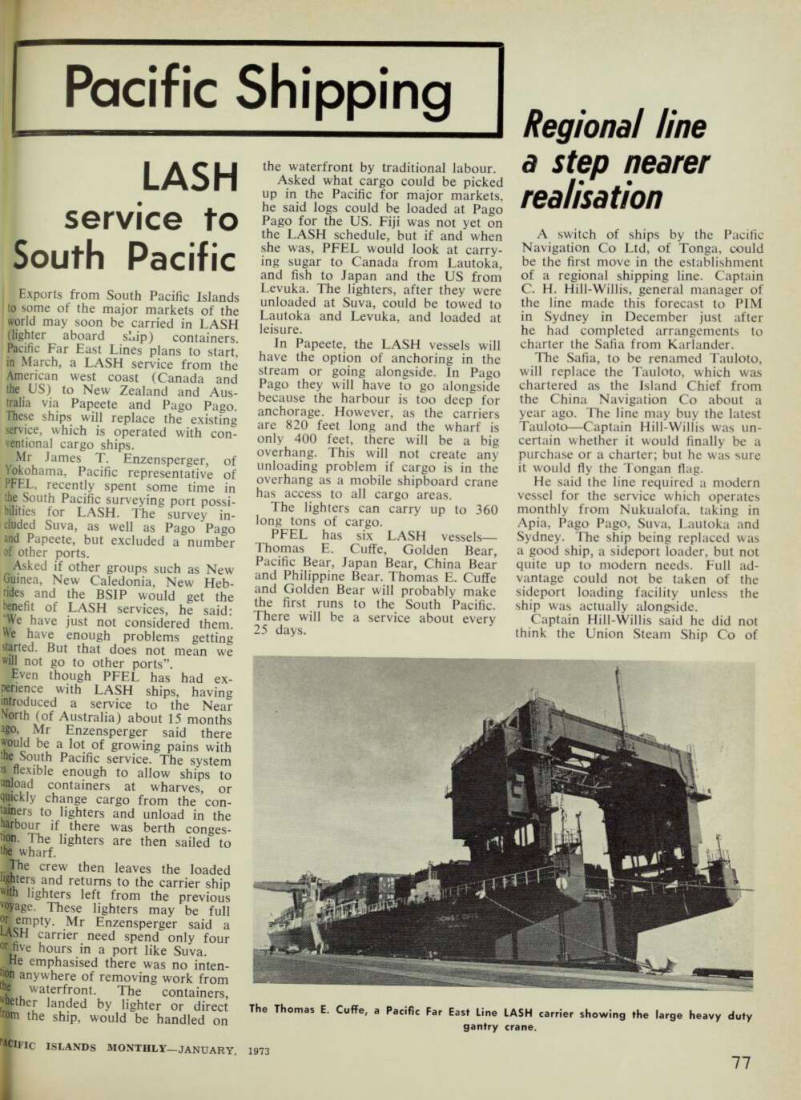
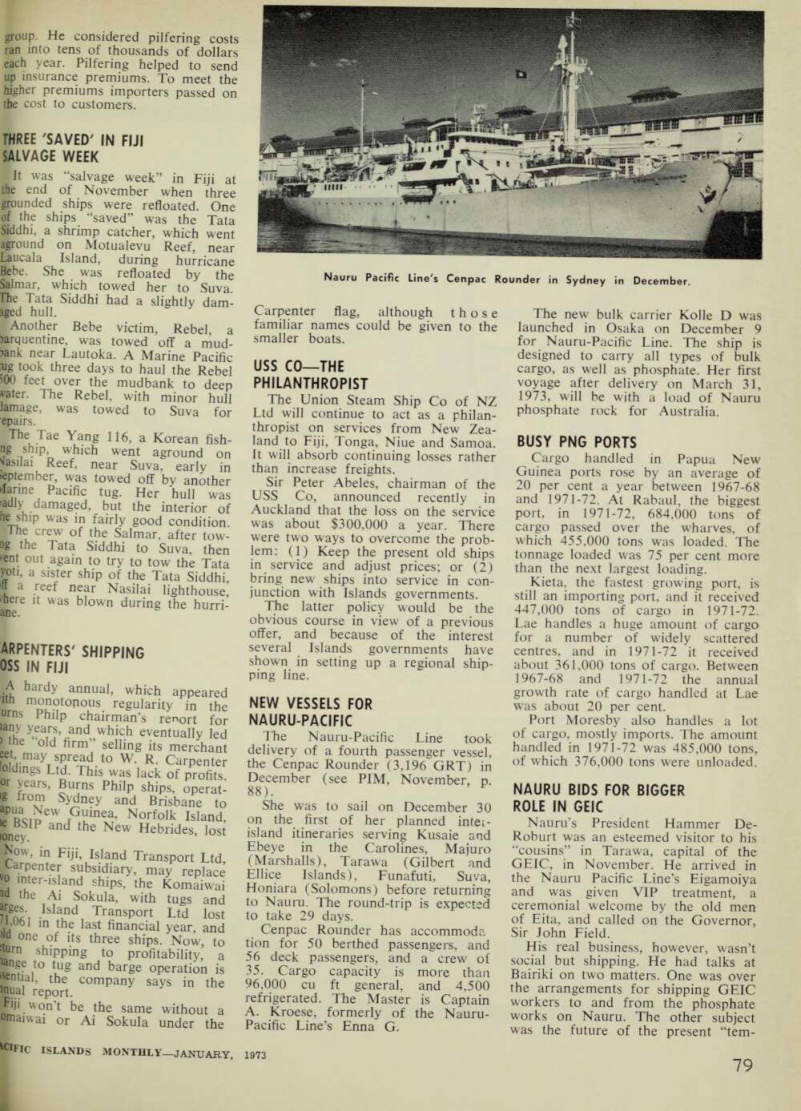
Lash
service to
South Pacific
Exports from South Pacific Islands to some of the major markets of the world may soon be carried in LASH (lighter aboard ship) containers.
Pacific Far East Lines plans to start, in March, a LASH service from the American west coast (Canada and the US) to New Zealand and Aus tralia via Papeete and Pago Pago.
These ships will replace the existing service, which is operated with con ventional cargo ships.
Mr James T. Enzensperger, of Yokohama, Pacific representative of PEEL, recently spent some time in the South Pacific surveying port possi bilities for LASH. The survey in ! duded Suva, as well as Pago Pago and Papeete, but excluded a number of other ports.
Asked if other groups such as New Guinea, New Caledonia, New Heb rides and the BSIP would get the benefit of LASH services, he said: We have just not considered them.
We have enough problems getting started. But that does not mean we will not go to other ports”.
Even though PEEL has had ex perience with LASH ships, having introduced a service to the Near North (of Australia) about 15 months ago, Mr Enzensperger said there would be a lot of growing pains with the South Pacific service. The system is flexible enough to allow ships to unload containers at wharves, or quickly change cargo from the con tamer* to lighters and unload in the harbour if there was berth conges- Jp. The lighters are then sailed to tlwharf.
The crew then leaves the loaded Ughters and returns to the carrier ship X lighters left from the previous Jyage. These lighters may be full ?Ac e « pty ‘ Mr Enzensperger said a LASH carrier need spend only four or five hours in a port like Suva.
He emphasised there was no inten- Sf 1 anywhere of removing work from 2 i waterfront. The containers, p ether landed by lighter or direct rom the ship, would be handled on
the waterfront by traditional labour.
Asked what cargo could be picked up in the Pacific for major markets, he said logs could be loaded at Pago Pago for the US. Fiji was not yet on the LASH schedule, but if and when she was, PFEL would look at carrying sugar to Canada from Lautoka, and fish to Japan and the US from Levuka. The lighters, after they were unloaded at Suva, could be towed to Lautoka and Levuka, and loaded at leisure.
In Papeete, the LASH vessels will have the option of anchoring in the stream or going alongside. In Pago Pago they will have to go alongside because the harbour is too deep for anchorage. However, as the carriers are 820 feet long and the wharf is only 400 feet, there will be a big overhang. This will not create any unloading problem if cargo is in the overhang as a mobile shipboard crane has access to all cargo areas.
The lighters can carry up to 360 long tons of cargo.
PFEL has six LASH vessels— Thomas E. Cuffe, Golden Bear, Pacific Bear, Japan Bear, China Bear and Philippine Bear. Thomas E. Cuffe and Golden Bear will probably make the first runs to the South Pacific.
There will be a service about every 25 days.
Regional line
a step nearer
realisation
A switch of ships by the Pacific Navigation Co Ltd, of Tonga, could be the first move in the establishment of a regional shipping line. Captain C. H. Hill-Willis, general manager of the line made this forecast to PIM in Sydney in December just after he had completed arrangements to charter the Safia from Karlander.
The Safia, to be renamed Tauloto, will replace the Tauloto, which was chartered as the Island Chief from the China Navigation Co about a year ago. The line may buy the latest Tauloto—Captain Hill-Willis was un certain whether it would finally be a purchase or a charter; but he was sure it would fly the Tongan flag.
He said the line required a modern vessel for the service which operates monthly from Nukualofa, taking in Apia, Pago Pago, Suva, Lautoka and Sydney. The ship being replaced was a good ship, a sideport loader, but not quite up to modem needs. Full ad vantage could not be taken of the sideport loading facility unless the ship was actually alongside.
Captain Hill-Willis said he did not think the Union Steam Ship Co of
The Thomas E. Cuffe, a Pacific Far East Line LASH carrier showing the large heavy duty gantry crane.
NZ Ltd proposals to introduce Tarros class vessels to the New Zealand- Pacific Islands service would material ise. Nor would a proposal made by a San Francisco company. He also thought the Tofua would cease operat ing to the Pacific Islands in April.
Pacific Islands governments, par ticularly Fiji, had made it quite clear they wanted a regional line. Tonga intended to go ahead. “We have a viable ship and we have the per sonnel,” Captain Hill-Willis said.
Captain Hill-Willis also said there was a misconception about union opposition to a regional line. The NZ Seamen’s Union would not object to a shipping line, flying the flag of its own country and operating from there to NZ and back. What that union, and also the Australian Sea men’s Union objected to, was ships flying the flag of another country, using Australia or New Zealand as a base and not going near their own country.
He had discussed that question with Mr W. Martin, secretary of the NZ Seamen’s Union. Mr Martin had told him there would be no objection to a Tongan ship, flying the Tongan flag operating from Tonga to NZ with Tongan produce, and returning to Tonga with NZ goods.
The Troubles Of
Fiji Marine System
Faults, real and imagined, are many in Fiji’s marine system. The Fiji Ports Commission of Inquiry heard of them from Levuka, Labasa, Lautoka and Suva. Reading between the lines it is apparent that the new wharves built at Lautoka and Suva in the early 1960 s were obsolete be fore they were officially opened.
Levuka used a thriving fishing in dustry as a lever for upgrading of port facilities. The Pacific Shipping Co Ltd fleet is expected to rise to 68 in 1973.
The Levuka-based fishing industry has grown spectacularly, but practic ally unnoticed alongside mushroom ing tourism. The 1971 catch was worth $5 million. Final figures were expected to show a catch worth $8 million from more than 12,000 tons in 1972, while in 1973, the catch is expected to reach more than 15,000 tons, worth more than $lO million.
Fishing now rates next to sugar as a leading export industry.
Labasa organisations sought to have Labasa declared a port of entry.
This would help to cut trans-shipment costs. As it is, a number of ships call at Malau, near the mouth of the Lagui River to load sugar and timber, but they arrived empty. All Vanua Levu would benefit from
lower costs if these ships were a to unload at Malau instead of ports of entry.
Lautoka’s main complaint i about time lags in clearing cargo ; obtaining documentation for it. general manager of the Pacific Lu ber Co, Mr David Price, said once spent three days on the t phone trying to find the right mar allocate berthing for a tug anc barge due to arrive from Kadi with timber.
He said Customs officials “pas the buck” from one to another w their aid was needed.
Lautoka handles more of F exports than any other Fiji p There were complaints in 1961, w it was finished (it cost $3 millii that facilities were inadequate.
Custom House Agents’ Associa submitted three main complain heavy pilferage, chaotic storage, slow cargo deliveries.
Mr Don Aidney, a well-known businessman, and a director of y liams and Gosling Ltd, stevedc etc, was critical of cargo hand at both Suva and Lautoka. He vocated a port authority, indepem of the Marine Department, to cargo handling at both ports oui the hands of private contractors.
There was *a lack of incentive the present system, under which large merchandising firms were 1 agents and stevedores. Large porters used their import tonnag! get agency and stevedoring contr With little fear of losing the tracts, inertia crept in, and attitude filtered down to labour.
Mr Aidney said sugar would bulk loaded in a few years, in of high capital cost for equip! and a social problem—elimint work for many rural Fijians. T Fiiians had little chance of firr other work.
Modern ships required bulk I ing to operate economically, had to be loaded quickly becaus high charter rates.
Suva stevedores were criticise*; the secretary of the Copra Board!
Tony Moore. He blamed the cost of handling copra on theiu different work—unloading the o ships from the outlying islands smoke-o, talanoa and half a bv of yaqona. Other slow work he to raise the cost of handling cope Suva alone to $5.31 a ton. In the cost was $3.85 a ton.
Pilferage was another matt© receive attention. It is rampanr some wharves, because of lac: supervision and long delays in o ing cargo, said Mr Geo O’Meagher, Fiii manager of ; Guardian Royal Exchange Assuii
group. He considered pilfering costs ran into tens of thousands of dollars each year. Pilfering helped to send up insurance premiums. To meet the higher premiums importers passed on the cost to customers.
Three 'Saved 7 In Fiji
Salvage Week
It was “salvage week” in Fiji at the end of November when three grounded ships were refloated. One of the ships “saved” was the Tata Siddhi, a shrimp catcher, which went aground on Motualevu Reef, near Laucala Island, during hurricane Bebe. She was refloated by the Salmar. which towed her to Suva.
The Tata Siddhi had a slightly dam aged hull. ■Another Bebe victim, Rebel, a )arquentine, was towed off a mud jank near Lautoka. A Marine Pacific ng took three days to haul the Rebel )00 feet over the mudbank to deep vater. The Rebel, with minor hull iamage, was towed to Suva for ■cpairs.
The Tae Yang 116, a Korean fish ng ship, which went aground on Yasilai Reef, near Suva, early in >eptember, was towed off by another K me j Pacific tug. Her hull was »adly damaged, but the interior of he ship was in fairly good condition.
The crew of the Salmar, after tow ng the Tata Siddhi to Suva, then i'ent out again to try to tow the Tata yoti, a sister ship of the Tata Siddhi, a reef near Nasilai lighthouse, mere it was blown during the hum ane.
ARPENTERS' shipping
Oss In Fiji
A hardy annual, which appeared l m p°j; tOPO L Us . regularity in the urns Philp chairman’s ren 0 rt for wk y u a , r i’/ nd which eventually led > the old firm” selling its merchant nu may T s ? read t 0 W - R - Carpenter foldings Ltd. This was lack of profits. ig F from’ £?“ Philp Ships ’ °Perat g from Sydney and Brisbane to r£rp eW /T nea ’ N °rfolk Island, *ney and hC NeW Hebr ides, lost Now, in Fiji, Island Transport Ltd, s s bs [ d . iar y, may replace inter-island ships, the Komaiwai 1(1 the Ai Sokula, with tugs and 7l g Isla . nd Transport Ltd lost /1, 061 m the last financial year, and JU one of its three ships. Now, to shipping to profitability, a Jige to tug and barge operation is 'senna!, the company says in the puai report.
Fiji won’t be the same without a omaiwai or Ai Sokula under the
Carpenter flag, although those familiar names could be given to the smaller boats.
Uss Co—The
Philanthropist
The Union Steam Ship Co of NZ Ltd will continue to act as a philan thropist on services from New Zea land to Fiji, Tonga, Niue and Samoa.
It will absorb continuing losses rather than increase freights.
Sir Peter Abeles, chairman of the USS Co, announced recently in Auckland that the loss on the service was about $300,000 a year. There were two ways to overcome the prob lem: (1) Keep the present old ships in service and adjust prices; or (2) bring new ships into service in con junction with Islands governments.
The latter policy would be the obvious course in view of a previous offer, and because of the interest several Islands governments have shown in setting up a regional ship ping line.
New Vessels For
Nauru-Pacific
The Nauru-Pacific Line took delivery of a fourth passenger vessel, the Cenpac Rounder (3,196 GRT) in December (see PIM, November, p. 88). y She was to sail on December 30 on the first of her planned intei island itineraries serving Kusaie and Ebeye in the Carolines, Majuro (Marshalls), Tarawa (Gilbert and Ellice Islands), Funafuti, Suva, Honiara (Solomons) before returning to Nauru. The round-trip is expected to take 29 days.
Cenpac Rounder has accommoda tion for 50 berthed passengers, and 56 deck passengers, and a crew of 35. Cargo capacity is more than 96,000 cu ft general, and 4,500 refrigerated. The Master is Captain A. Kroese, formerly of the Nauru- Pacific Line’s Enna G.
The new bulk carrier Kolle D was launched in Osaka on December 9 for Nauru-Pacific Line. The ship is designed to carry all types of bulk cargo, as well as phosphate. Her first voyage after delivery on March 31, 1973, will be with a load of Nauru phosphate rock for Australia.
Busy Png Ports
Cargo handled in Papua New Guinea ports rose by an average of 20 per cent a year between 1967-68 and 1971-72. At Rabaul, the biggest port, in 1971-72, 684,000 tons of cargo passed over the wharves, of which 455,000 tons was loaded. The tonnage loaded was 75 per cent more than the next largest loading.
Kieta, the fastest growing port, is still an importing port, and it received 447,000 tons of cargo in 1971-72.
Lae handles a huge amount of cargo for a number of widely scattered centres, and in 1971-72 it received about 361,000 tons of cargo. Between 1967-68 and 1971-72 the annual growth rate of cargo handled at Lae was about 20 per cent.
Port Moresby also handles a lot of cargo, mostly imports. The amount handled in 1971-72 was 485,000 tons, of which 376,000 tons were unloaded.
Nauru Bids For Bigger
Role In Geic
Nauru’s President Hammer De- Roburt was an esteemed visitor to his “cousins” in Tarawa, capital of the GEIC, in November. He arrived in the Nauru Pacific Line’s Eigamoiya and was given VIP treatment, a ceremonial welcome by the old men of Eita, and called on the Governor, Sir John Field.
His real business, however, wasn’t social but shipping. He had talks at Bairiki on two matters. One was over the arrangements for shipping GEIC workers to and from the phosphate works on Nauru. The other subject was the future of the present “tem
Nauru Pacific Line's Cenpac Rounder in Sydney in December.
porary” service operated to Tarawa every' six weeks by the Eigamoiya. So far this is on a trial basis. President Deßoburt, looking for more work for the Nauruans’ shipping line, Jwants it on a permanent basis. ■ And the latter subject is exercising the attention of Columbus Shipping tine, GElC’s one regular sea link Iwith the outside world. GEIC, one lof the most isolated territories in the world, wants all the links it can get.
It thinks its communications could be ■mproved but there’s no room for Itwo shipping lines.
I One will have to go. President De ißoburt wants his to stay. Columbus, ■with big plans for the future, doesn’t ■want to be pushed out either. Next ■larch, Columbus will launch its first ■container service from Australia and ■New Zealand to the West Coast of I the United States, similar to the one ! already operated from Australia and New Zealand to USA’s East Coast. It is planned to continue calling at ■Tarawa and, in fact, giving the Gi lberts an improved service through the Icontainers but there’s one difficulty I—how to get the containers onto the ■wharf.
I At first there will be three fully cellular 12,000-ton dwt container ■ships, two operating in the first ■quarter of next year and the third Eater in the year. They have been chartered by Columbus’s parent com pany in Hamburg and are equipped to meet the requirements of the Aus tralian trade with the United States. llf the trade develops, Columbus will [build its own ships.
I Each ship has 400 containers of ivhich 140 are refrigerated, and each jfcarries a gantry crane so that there will be no problem getting the con tainers off the ship and on to the lighter barges. The problem will be to lift them from the barges to the wharf but Columbus’s man on Tarawa, Captain J. F. Roubal, man ager at present of the South Pacific Marine Service there, thinks there’s a solution.
The big advantage to the GEIC, he said, was that with containers giving a much quicker turn-round, Columbus fcould have a ship in Tarawa every 19 days which, with a shortage of refrigerated space on Tarawa, is something to think about. Unloading would take only six to eight hours instead of days as at present.
This could be the decider between the rival services but there’s another consideration. The Gilbertese and the ■aururans are kith and kin.
Advertisements & other items, pp. 82-86 (3 items)
77
PA CIFIC ISLANDS MONTHLY-JANUARY, 1973
Handbook
OF FIJI fourth edition
In trade and as a mecca for tourists, Fiji is growing in importance. For businessmen, travellers, students and others who want to keep abreast of events, the fourth, 1972 edition, of the Handbook of Fiji is an essential guide.
As well as sections dealing exhaustively with history, geography, government and politics, finance, trade, education, social services, etc., there is a completely revised tourist section. This is in keeping with the growing importance to Fiji of this industry. An extensive accommodation guide and a folding road-map of Viti Levu are included. With 14 other maps and attractive full-colour cover. 264 pages.
Use the form overleaf when ordering
PAPUA
NEW GUINEA
PRINTING CO.
PTY. LTD.
Serving the Country from Aitape to Alotau Manus to Moresby Leaders in Commercial Offset and Letterpress Printing Stationery Office Supplies Office Equipment Rubber Stamps Self-Adhesive Labels In Fact:—Everything For the Office P.O. Box 633, Port Moresby P.O. Box 759, Lae P.O. Box 30, Mt Hagen P.O. Box 1239, Rabaul P.O. Box 466, Kieta P.O. Box 411, Goroka
Olae shells a little light on the generator problem There really isn’t very much point investing in a generator capable of running a hospital if all you want to operate is a hatchery!
CLAE has a complete range of mighty Detroit and Bedford Generator Sets priced to suit any pocket —geared to suit every purpose. Electric power systems for the electronic age.
Generators to provide instant power for light, heat, cooking, labor-saving, profit-producing industrial and agricultural equipment.
Efficiency to provide the power you need at the lowest possible operating costs.
Dependability. Rugged construction and a simple, time-proven, basic design result in a degree of dependability unapproached in the field by any other of their kind.
Simple Maintenance. Design is easy for service technicians to understand. Fewer components require adjustment. All components readily accessible.
Protection for the Future. Designed to utilize commercially available Generator Set equipment to prevent obsolescence.
Consult with Clae, and let them solve your problems of power. j s > <f .vW'-c- ,5?
THE POWER MOTOR-VArORS
w
79
ISLANDS MONTHLY—JANUARY, 1973
Shipping Briefs

• Pacific Islands visited by P and ip liners on holiday cruises should
benefit from a decision to cut down the number of line voyages from the UK to Australia in 1973, A cutback from 14 to four voyages will enable P and O to concentrate on cruises.
Four of the company’s 11 liners will cruise from Australia to the Pacific Islands. Worldwide, P and O expects the new policy to increase the num- SL^ erths r 5 rUlS^u Pa ?^?Ann S *° com P 150,000 in • The Flotta Lauro Line has withdrawn from the Pacific because of competition from airlines. Two 24,000-ton liners, Angelina Lauro and Achille Lauro, will now operate
Caribbean and Mediterranean ser vices. But Flotta Lauro ships will re turn to the Pacific if passenger traffic improves. The line has been in the Europe-Australia-New Zealand service for 25 years, * A South Korean sampan is still fast on a reef near F i ower Pot island, American Samoa, where she went aground two years ago. A recent at tempt by two tugs, the Talitaga and Tatoso, to pull her off, failed. After the cable attached to the Tatoso parted, the tugs tried to pull the sampan off in tandem. It has not yet been decided if another attempt will be made.
Advertisements & other items, pp. 87-88 (1 item)
insurance service
serves the
Islands with expert
and advice.
QUEENSLAND INSURANCE
COMPANY LIMITED
(Incorporated 1886 in Australia)
Head Office: 82 Pitt Street, Sydney FIJI —Branch Office, Suva, Manager for Fiji: F. N. Davies (AAII).
LAUTOKA District Manager: U. Singh.
PAPUA-NEW GUINEA Branch Office, Port Moresby: Manager for Papua-New Guinea; D. J. Granter. District Managers at Rabaul: C. D. Dickings; Lae: R. Jackson; Mt. Hagen: G. F. Donnelly.
HONIARA (8.5.1. P.) Breckwoldt & Company (5.1.) Pty.
Limited.
NOUMEA T. A. Hagen, Ste. W. A. Johnston, S.A.R.L.
VILA, SANTO Resident Officer for New Hebrides: R. J. Allsop.
TAHITI Arthur Chung: Immeuble B. 1., Front de Mer, Papeete.
NIUE, NORFOLK ISLAND, SAMOA, TONGA and other South Sea Islands Burns Philp (South Sea) Co. Limited.
Assets exceed $75,000,000 L 357
Small Boat Echo Sounder!
You can now own a low cost, high performance Echo Sounder for your small boat.
Furuno models FG-11 Mark 3 and FG-200 Mark 3 are portable, simple to operate and easy to read even in bright sunlight. Graphic and flasher read-outs can be done together or separately to indicate depths of fish and seabed down to 320 Fathoms (FG-11 B).
"White line" operation gives expensive sounder performance to these economical, portable sounders.
Si; % W-
rife
m Vv v v »H V v . -V >s. •»»» ' *A The future today with FURUNO's electronic technolootf-
FURUNO ELECTRIC CO., LTD.
, 9-52, Ashihara-cho, Nishinomiya-city* Japan
CABLE : FURUNO NISHINOMIYA,
TELEX : 5644498
>BS s % y
OTHER HANOI PRODUCTS!
'Handi' range of quality products also includes: a portable Twin-Burner Stovette and 'Handi' Pumpless Petrol Iron.
Keep a
HAND! handy!
No need to fumble and fumel Throw light on the subject with a 'Handi'. It's twice as bright as electric light. Completely stormproof. Simple and safe to use.
PRESSURE OPERATED
One filling gives 12 hours of brilliant 300 candle-power lighting. Built to last, with chromed, rust-proofed finish. Petrol or Kerosene models.
Ask for Handi! Everywhere!
HANOI WORKS PTY. LTD.
Compo Rd., Salisbury North - Ph. 472122
BRISBANE, QUEENSLAND, AUSTRALIA
Cruising
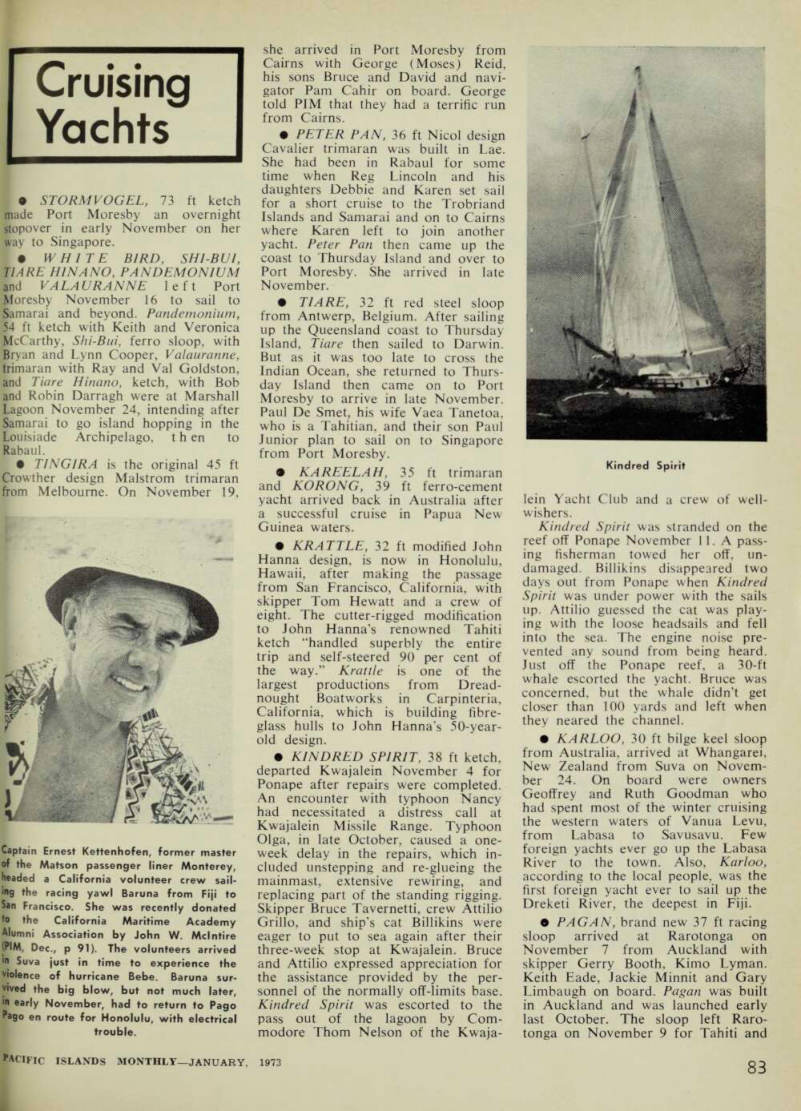
Yachts
• STORMVOGEL, 73 ft ketch made Port Moresby an overnight stopover in early November on her way to Singapore.
• White Bird, Shi-Bui,
Tiare Hinano, Pandemonium
and VALAURANNE left Port Moresby November 16 to sail to Samarai and beyond. Pandemonium, 54 ft ketch with Keith and Veronica McCarthy, Shi-Bui, ferro sloop, with Bryan and Lynn Cooper, Valauranne, trimaran with Ray and Val Goldston, and Tiare Hinano, ketch, with Bob and Robin Darragh were at Marshall Lagoon November 24, intending after Samarai to go island hopping in the Louisiade Archipelago, t h en to Rabaul. • TINGIRA is the original 45 ft Crowther design Malstrom trimaran from Melbourne. On November 19,
she arrived in Port Moresby from Cairns with George (Moses) Reid, his sons Bruce and David and navi gator Pam Cahir on board. George told PIM that they had a terrific run from Cairns. • PETER PAN, 36 ft Nicol design Cavalier trimaran was built in Lae.
She had been in Rabaul for some time when Reg Lincoln and his daughters Debbie and Karen set sail for a short cruise to the Trobriand Islands and Samarai and on to Cairns where Karen left to join another yacht. Peter Pan then came up the coast to Thursday Island and over to Port Moresby. She arrived in late November. • TIARE, 32 ft red steel sloop from Antwerp, Belgium. After sailing up the Queensland coast to Thursday Island, Tiare then sailed to Darwin.
But as it was too late to cross the Indian Ocean, she returned to Thurs day Island then came on to Port Moresby to arrive in late November.
Paul De Smet, his wife Vaea Tanetoa, who is a Tahitian, and their son Paul Junior plan to sail on to Singapore from Port Moresby. • KAREELAH, 35 ft trimaran and KORONG, 39 ft ferro-cement yacht arrived back in Australia after a successful cruise in Papua New Guinea waters. • KRATTLE, 32 ft modified John Hanna design, is now in Honolulu, Hawaii, after making the passage from San Francisco, California, with skipper Tom Hewatt and a crew of eight. The cutter-rigged modification to John Hanna’s renowned Tahiti ketch “handled superbly the entire trip and self-steered 90 per cent of the way.” Krattle is one of the largest productions from Dread nought Boatworks in Carpinteria, California, which is building fibre glass hulls to John Hanna’s 50-year old design. • KINDRED SPIRIT, 38 ft ketch, departed Kwajalein November 4 for Ponape after repairs were completed.
An encounter with typhoon Nancy had necessitated a distress call at Kwajalein Missile Range. Typhoon Olga, in late October, caused a one week delay in the repairs, which in cluded unstepping and re-glueing the mainmast, extensive rewiring, and replacing part of the standing rigging.
Skipper Bruce Tavernetti, crew Attilio Grille, and ship’s cat Billikins were eager to put to sea again after their three-week stop at Kwajalein. Bruce and Attilio expressed appreciation for the assistance provided by the per sonnel of the normally off-limits base.
Kindred Spirit was escorted to the pass out of the lagoon by Com modore Thom Nelson of the Kwaja-
lein Yacht Club and a crew of well wishers.
Kindred Spirit was stranded on the reef off Ponape November 11. A pass ing fisherman towed her off, un damaged. Billikins disappeared two days out from Ponape when Kindred Spirit was under power with the sails up. Attilio guessed the cat was play ing with the loose headsails and fell into the sea. The engine noise pre vented any sound from being heard.
Just off the Ponape reef, a 30-ft whale escorted the yacht. Bruce was concerned, but the whale didn’t get closer than 100 yards and left when they neared the channel. • KARLOO, 30 ft bilge keel sloop from Australia, arrived at Whangarei, New Zealand from Suva on Novem ber 24. On board were owners Geoffrey and Ruth Goodman who had spent most of the winter cruising the western waters of Vanua Levu, from Labasa to Savusavu. Few foreign yachts ever go up the Labasa River to the town. Also, Karloo, according to the local people, was the first foreign yacht ever to sail up the Dreketi River, the deepest in Fiji. • PAGAN, brand new 37 ft racing sloop arrived at Rarotonga on November 7 from Auckland with skipper Gerry Booth, Kimo Lyman.
Keith Fade, Jackie Minnit and Gary Limbaugh on board. Pagan was built in Auckland and was launched early last October. The sloop left Raro tonga on November 9 for Tahiti and
Captain Ernest Kettenhofen, former master of the Matson passenger liner Monterey, headed a California volunteer crew sail ing the racing yawl Baruna from Fiji to San Francisco. She was recently donated to the California Maritime Academy Alumni Association by John W. Mclntire (PIM, Dec., p 91). The volunteers arrived in Suva just in time to experience the violence of hurricane Bebe. Baruna sur vived the big blow, but not much later, in early November had to return to Pago Pago en route for Honolulu, with electrical trouble.
Kindred Spirit
Hawaii. Mr Booth and his crew intend to take part in next year’s Trans-Pac race and they will first sail to the US. • NADEGE, 41 ft sloop, also arrived at Rarotonga on November 7 on a delivery voyage from Auckland to Tahiti. On board were the yacht’s owner, M. Daniel Tardieu, skipper Jack Allen who is Com modore of Auckland’s Royal Akarana Yacht Club, Ron Gomas and Miles Cross. All the crew are New Zealanders. Nadege, a ferro-cement vessel, was built by Ferrocraft Marine and was also launched early last October. Heavy weather and rough seas forced the vessel to make an unscheduled stop at Rarotonga. M.
Tardieu is Director of Publications in Noumea for the daily newspapers Le Journal Caledonian and the Corail. • VALHALLA, 61 ft ketch, returned to Sydney November 30, completing an extended world circumnavigation. Skipper/owner Mrs Manfred Schmidt set out in 1966 as Ann Brittain and married her German husband in South Africa. Valhalla did charter cruising in the Great Barrier Reef, was refitted in Port Moresby, and finally cleared Australia from Thursday Island in June, 1968.
She touched at Cocos-Keeling a Seychelles Islands, Durban and Soi African ports, Gibraltar and Eu. pean ports, St Thomas, Panan Papeete, Bora Bora, Nukualofa a Suva, arriving just ahead of hui cane Bebe.
Valhalla is now up for sale. 1 Schmidts plan to build another err ing yacht, © TORO A, a mastrigged sic with owner-skipper Captain Brs and his wife on board arrived at A] in November having sailed with« damage through hurricane Bebe. Tt came from their home country Ni Zealand and had visited Fiji, Tor and Futuna. After a week at Ap Toroa left for Pago Pago, the Cc Islands and Tahiti. • QUE COISA, 43 ft 8 in ket: arrived at Rarotonga from Pape: on November 28 with skipper Stui Seaton, wife, Nancy, and Thon B. Ballard and Johan H. Moll, Americans, on board. The Seato are co-owners of the yacht, £ captain and crew are all fn Virginia. Que Colza's voyage star from the US early last July and a were made at Bermuda, St Crc Panama, the Galapagos Islands, I cairn, Mangareva and Tahiti.
Advertisements & other items, pp. 89-90 (2 items)
*Acific Islands Monthly—January, 1973
Jack
a ov SR ra^ t '-
SONS
GOOD FLAVOUR FOODS
available through our agents:
C. SULLIVAN EXPORT PTY. LTD.
SPECIAL CLEARANCE
SAVE NOW at our sale of surplus machinery. This equipment must sell so we won't refuse a reasonable offer.
6 LW GARDNER MARINE DIESEL
2/1 reduction transmission. This unit has been completely overhauled.
Ready for immediate use. Save big money on this reliable motor. Price on application. Trade-in accepted.
FORD 590 E 6 CYLINDER MARINE DIESEL Full marine conversion. New long motor fitted within last 40 hours. Supercharged and develops 135 hp at 2,400 rpm continuous. Capitol 2/1 hydraulic gearbox. Really keen value at $3,200.
FETTER AV2 12 HP STATIONARY DIESEL
Twin cylinder. Fully reconditioned throughout and mechanically guaranteed.
Save several hundred dollars on new price. $645.
PERKINS 4270 D STATIONARY DIESEL
45 hp. As is where is. A real bargain. $165.
SMITH RODLEY SUPER 10 DRAGLINE
Choice of two. Very tidy throughout and in good working order. Can be sold with either dragline, backaction or shovel rig. A great chance for any operator to buy right. Only $2,850 each.
SPECIAL VALUE
G.M. V 671 DETROIT MARINE DIESEL, BRAND NEW.
Fitted with 3/1 Allison transmission. This unit is brand new and is ideal for fishing or large pleasure boat. 176 hp and carries manufacturer's warranty. Big savings. Price on application.
POROWINI ENGINEERING LIMITED
P.O. BOX 521, WHANGAREI, NEW ZEALAND.
Phone: Whangarei 81824 collect. After Hours: Whangarei 87349.
Business and Development
Bananas To The Rescue Of
Ailing Fiji Agriculture!
From a PIM correspondent in Vanua Levu.
I Faced with falling production, dis ease and hurricane Bebe which flat tened almost all the banana groves in the Waidina and Wainimala valleys on Viti Levu, Fiji is looking to the copra planters of Vanua Levu to pull the banana industry out of the mire.
Aiming to recapture the New Zealand market, which has been “invaded” by the handsome Ecuadorian banana, the government has approached copra planters in the Savusavu area to plant 280 acres of bananas, producing a minimum of 64,000 cases a year.
This, says the Ministry of Agri culture, is the minimum required to ‘justify an overseas ship calling at Savusavu and then sailing direct to New Zealand about 16 times a year”.
Fhis wording suggests the ministry is thinking of “giving away” the tradi tional planters on Viti who, with he withdrawal years ago of the European planters from the industry, lave been fighting a losing battle igainst climate, disease and the South American banana.
The circular announcing the plan aught the Savusavu planters by sur irise—they’ve not thought about lananas for years. To ensure the ndustry (around Savusavu) “is stablished quickly and firmly”, it iaid, “development on a ‘nucleus’ state system is envisaged.” Initially, the system would consist n about 20 estates, each planting no ess than 10 acres of bananas. Future levelopment would be made up from mailer producers and the expansion )f the estate acreage. At the outset, he scheme would be confined to the »vusavu and Buca Bay areas to snsure “easy access to a loading 3oint and to ease problems of organi sation and co-ordination”. This would ®ean that Savusavu would be the hading centre, which raises an in teresting point. 4 The ministry talked in terms of an overseas vessel calling direct at Savu savu but Savusavu is not a port or mtry for Fiji. Presumably, the ship
would have to call at Suva first, in which case the planters on the Rewa would have a chance to load their bananas and so preserve their place in the industry, or Savusavu would be declared a port of entry with customs and other services. This would raise a howl from Labasa which has been laying claim to the right to be a port of entry.
A time-table has been drawn up by the ministry which proposes that Savusavu planting should begin in February, 1973, with 50,000 suckers available for 70 acres. The same acreage would be planted in March, April and May, so that the whole planting operation would take only four months. Eight months later would come the first of the harvest, 4.000 cases. Then would follow 8.000 in November, 9,000 in Decem ber and 12,000 in January, 1974.
Production would then be at the rate of 9,000 to 12,000 cases a month until February, 1976 when the trees would be ploughed out and the area replanted with alternative crops.
The ministry estimated that the net profit over three years for 900 cases per acre on the best estates would be $283 an acre, with a net profit of $133 an acre for “fair” estates and only $5B for “poor” estates. The suggestion is that the first 200 acres should be handled by the big estates, most of them Euro pean-owned, with smaller Fijian
estates dividing up the other 80 acres between them.
The scheme got a cautious recep tion from the Savusavu planters who, however, are willing to look at any thing which will lift them out of the copra doldrums which have turned the once-wealthy estates into de pressed areas. Some copra planters are already diversifying but, until now, they’ve not thought about bananas as an alternative income source. Bananas, say some of them, have too many enemies and crops would need much closer attention than the coconut.
This isn’t the first time the govern ment has turned its eyes towards Vanua Levu and its coconut plan tations for succour for the banana industry. During the 19605, the first Development Commissioner, Mr Eric Bevington, had dreams of large banana plantations near Labasa. It had been suggested that Japan would become Fiji’s largest banana market; that Japan would take logs from the area and then the bananas which would be planted where the forests had stood.
The Japanese were after a timber concession and also a base for their fishing fleets. They got their base which is now flourishing at Levuka.
The rest was just pure banana oil. A trial shipment of bananas from Viti Levu to Japan turned out a disaster; the Japanese would talk no more about bananas.
Royal Resort For Royal Tourists
Project manager of the Royal Samoan Hotel, Colonel John Collard, arrived in Apia recently with a team of experts to begin the first phase of the hotel. This consists of reclaiming 65 acres of land near Apia upon which the Royal Samoan Hotel will be built. The first 150 rooms are expected to be completed by the end of the year, and 300 more rooms are being planned to be added later. The hotel is owned by Richard Hadley, a Seattle, USA, multi-millionaire, but is expected to be eventually owned by the people of Western Samoa.
Honiara Hotels Getting
Down To Business
From a Honiara correspondent
Honiara has two hotels—one “quality” house, aimed fairly and squarely at the older tourist with money who demands comfort and the businessman, and another “where the action is”.
The second hotel, the Honiara Hotel, offers a standard of accom modation not that far removed from its competitor, the Hotel Mendana, but somehow it does not at present attract much custom. The Mendana’s 30 air-conditioned bedrooms, includ ing some quite old ones in asbestos cement buildings soon to be demo lished, run at capacity, while the Honiara—despite a new wing not long finished—attracts only small custom from visitors looking for ac commodation.
What the Honiara does have is the informal Pacific atmosphere which so many travellers look for, and this includes regular performances at least weekly by the superb Gilbert & Ellice Islands singing and dancing troupes.
One of the two groups, made up of Gilbert & Ellice emigrants to Honiara, may be as large as 60, and their
intensely rhythmic, enthusiastic and
yet professional performances are exciting and moving in the semi-out door beer garden. During the Sep tember visit by the cruise ship, Himalaya, Australians in the audience were moved at the end of a U hours performance to spontaneously rise and sing “For they are jolly good fellows” with almost as much gusto as the entertainers had shown.
This would not happen at the Mendana where there is usually no entertainment. But while the Honiara gets the fun-loving and drinking trade, it’s the Mendana which mints money from the bed trade, so much so that it is planning perhaps within this decade to grow to four times its present size on its beach front site.
The urge to do this has come from new ownership, a public company which is offering Solomon Islanders shares in the hotel enterprise for the first time, and a share in probable future investment in the Solomons.
Firstly, the company is Solomon Islands Investments Limited which has issued a prospectus inviting Solomon
Islanders especially to take up 250,C one-dollar shares. Late in Septemh the company bought half the sha in Mendana Hotels Limited fn Guadalcanal Plains Limited (an vestment company in the Solomc with rural interests, including ri coconuts, cattle and poultry) $200,000. The other half of the shai were already owned by Naviti vestments Limited, the Fiji-ba: company which is the driving s guiding force behind Solomon Islai Investments Limited.
Secondly, the expansion of Mendana is to be in four stag reaching 106 bedrooms.
Stage one is under way now. Thii three new air-conditioned bedroo overlooking Iron Bottom Sound Guadalcanal are being built, ak with the hotel’s swimming pool, at a cost of about $250,000. Fift« “new wing” bedrooms built thi years ago, and offering good tou accommodation, will together w the stage one rooms make a tc of 48, while 15 old rooms behind main block will be demolished.
Stage two which should foil! fairly quickly would see the pres; kitchens, reception area, dining ro« and offices demolished and replac with something done to the terr which is the only drinking pi within the hotel proper.
I Drinking facilities are a test for the new board of seven directors, including five Solomon Islanders, in dealing with a touchy problem. In fact, there is a “public bar”, an old asbestos-cement building on the fringe of the hotel property and barely within shouting distance of reception, and the terrace on the waterfront side. The directors have Agreed that they want to do away with the public bar, and the oc casional problem of pay night fights and brawls with visiting seamen. The problem is, how, without offending local people who would therefore be iirtually excluded from the Mendana.
The board apparently is not quib bling about wanting the Mendana to be a hotel almost exclusively for bests and their guests, although they would like to offer dining in a town not flush with restaurants for those who want it. But the hotel’s licence requires a public bar to be operated.
If the bar were to be shut, a change nver to a restaurant licence, for sxample, would mean the terrace was closed to all but diners or hotel juests.
Memories of its late owner barring Vlelanesians, including a bishop of he Anglican church on one occasion, from entering, because they were native people, are not eradicated, lespite the fact there is no trace of colour bar under the succeeding |wnership and management.
Cooks tourist boom?
I The Cook Islands tourist industry kill “have it made” when Rarotonga’s lew airport is opened towards the md of 1973. Air New Zealand will Irop in on the way to Tahiti in
December, the US has traffic rights, and France has the right to set up a service from Tahiti. It is doubtful if those three carriers will have things all their own way in virtually un touched tourist territory.
As a pipe-opener the Air NZ charter service from Nadi to Raro tonga with HS74Bs, was stepped up to two a week in December.
Tourism in a big way is not going to just happen. Planning has been under way since 1968, with both the NZ and Cook Islands taking an active part. Now there is the Cook Islands Tourist Authority, which will advise the Cook Islands Government.
The main tourist market is ex pected to lie in Australia and New Zealand. If Australian tourists want to go there in big numbers, Qantas will want to come in as a carrier.
The Cook Islands has many of the attractions of Tahiti, but costs should be lower, and for Australians and New Zealanders, there is the added advantage of the English language.
The Cooks group already has a surprisingly big volume of tourist traffic, but this will be “small beer” compared with the boom the airport is likely to bring. One wonders where the crowds will stay—hotel develop ment hasn’t got far yet.
BPs declare
source of earnings
The lead given by W. R. Carpenter Holdings Ltd in breaking down profits to show where they were earned has been followed by Burns Philp and Co Ltd. It was a refreshing move.
While it may be of little more than academic interest to many share
holders who are mainly concerned with the size of the dividend cheque, Islands administrations, already in dependent or about to gain a greater measure of self-government, will keep the information in mind.
Mr J. D, O. Burns, chairman of Burns Philp, told shareholders at the
annual meeting that the New Guinea operations contributed 33 per cent of the latest profit, Islands plantations 4.1 per cent, South Sea group 9.9 per cent and New Hebrides group 7.1 per cent. The remaining 45.9 per cent was from Australia and New Zealand.
Of the Carpenter profit of
$7,049,000, $2.7 million came frc Fiji, Tonga and Western Samoa, $1 million from Papua New Guinea a $2.8 million from Australia. Be companies, without weakening th* holdings in the Pacific Islands, £ increasing their strength in Austral This will make them less depends on the islands.
Mr C. H. V. Carpenter, chairm of W. R. Carpenter Holdings Ltd, s< in his annual report opportunities the Pacific would be available areas continued to develop in li with official policies. Carpente accepted their responsibilities as p: of the developing evolution of the countries. In Fiji - Tonga - Weste Samoa expatriate staff was about per cent, and in Papua New Guin it was 6 per cent.
Carpenters would step up tfi training programmes for local peo] to assume increased responsibility, r only within the company’s operatic; but also in the general economic a community life of their countries.
Both chairmen referred to cc tinued depressed prices for copra, t held out more hope for cocoa, w an appreciable rise in price likely.
Mr Burns said his compan policy of local participation had loi term benefits. But in the short tei it could be expected to reduce t company’s profits in areas where
applied. Increasing taxation was also having an effect on profits from the islands.
The higher taxes was a result of steady moves towards independence in the Pacific Islands and the need for those countries to be more self reliant.
I Throughout the address of each man there was an air of quiet con fidence about the Pacific, of develop ing and growing further with the in
iigenous populations.
Air Pacific asks
For Brisbane
I The Fiji Government has applied >n behalf of Air Pacific for landing ights in Brisbane. The airline hopes o begin a weekly BAC 1-11 jet service between Nadi and Brisbane via loniara in the first quarter of 1973.
If the application is approved, the mice will be the first operated by he regionally-owned airline to a point mtside the Pacific Islands.
Air Pacific envisages a rewarding low of tourists from Brisbane through he Solomons and the New Hebrides 0 Fiji and other countries in its egional network.
Meanwhile, Air Pacific has deferred mtil this year its plan to start a ervice between Tarawa in the Gilberts md Honiara in the Solomons. Air 4auru operates in the area.
Mo wastage of water
: An upgraded nine-hole golf course it the Fijian, the hotel on Yanuca sland on Viti Levu’s Coral Coast, 1 kept green, even in the middle of
the dry, hot summer, by an automatic watering system which uses water already earmarked as waste.
The Harvin Sprinkler irrigation system installed by the Christchurch (NZ) firm of Harding & Vincent Ltd covers the whole course—greens, tees, practice putting green, turf nursery and fairways—and uses treated effluent from the hotel’s sewerage system, a daily potential, with the proposed expansion of the hotel, of 100,000 gallons of water. As part of the oxidisation process of the sewage treatment plant, two reservoirs with a capacity of 1,500,000 gallons have been built by the hotel company.
The golf course irrigation pump station is housed in a chamber in one of the storage reservoirs which cost $20,000 just to line with concrete to prevent seepage.
Cunningham's take
Panduit agency
R. H. Cunningham Pty Ltd, im porters and distributors of electronic components with operations in the South Pacific Islands and Australia, have been appointed exclusive dis tributors for the complete line of wiring components manufactured by the giant Panduit Corporation of Tinley Park in the United States.
Panduit is one of the world’s largest makers of cable ties and clamps used in the electrical, electronic and tele phone industries. Cunninghams, whose headquarters are at Victoria Street, Melbourne, with branches in Sydney, Brisbane and Perth, carry considerable stocks of the components in their bond and free stores. Cata logues, which illustrate and describe
the various components, can be ob tained from Cunninghams at GPO Box 4533, Melbourne.
Business briefs
• The Directors of W. R. Car penter Holdings Limited announce the formation in Papua New Guinea of Arawa Motors Pty Ltd with 30 per cent local equity participation, Arawa Motors Pty Ltd will have an initial paid-up capital of $50,000 of which 30 per cent will be held by Mr Henry Moses of Bougainville Island
on behalf of his people. The balance of the issued capital will be held by Boroko Motors Ltd, a member com pany of the W. R. Carpenter (PNG) Ltd group. • Burns Philp (South Seas) Co Ltd reported a net profit for the year ended June 30 of $825,718, an increase of 2C.7 per cent over the previous year’s figure. A final dividend of 7i per cent per stock unit was de clared, making a total dividend of 12i per cent. • Fiji Industries Ltd, owners of the cement factory at Lami, near
Suva, made a net profit for the y ended June 30, 1972, of compared with a net profit of $139,': the previous year, shareholders w told at the annual meeting in Su The directors recommended a fi dividend of 8 per cent, making total dividend for the year of 15 cent (15c per stock unit), the sa as last year. • New Guinea Goldfields Limits timber operations at Vanimo may closed down if profit-making pot tial is not proved by the end of year. This was reported at the ann meeting in Sydney in Decern when a dividend of 2c per st< unit was declared. The timber ope tion lost $241,505 against a loss $112,582 the previous year. Pro from gold mining increased $94,908 to $151,524 and profits fr trading sections at Wau, Lae, Rab and Madang totalled $313,153, increase of $18,076. • Demka Pty Ltd, exclus marketing organisation in the So Pacific for many manufacturers c exporters, has moved “shop” fr Shell House in Sydney to the Ma National Building, 22 Central Aven Manly, Sydney. According to D. M. Kamerling, founder j governing director, the move was obtain more room to house a lar
staff recruited to cope with Demka’s growing business. There’s another advantage in the move as one of Demka’s English principals dis covered on his first visit to Australia recently. Most attractive route to the new headquarters from the city centre is via the hydrofoil. • For the first time since 1969, Emperor Gold Mines of Vatukoula in Fiji is paying a dividend—sc a share —and looking to a bright profit making 1972-73, shareholders were told at the annual meeting at which director Mr P. A. Browne handed in his resignation after a disagreement with the board over “accounting dis closures and trustee obligations”.
Chairman Mr J. L. Reid said higher gold prices had improved the com pany’s cash position. Only one sub sidiary had not operated profitably and all were budgeted to make a profit next year. • Sunhill Corporation (Australia) Ltd has contracted to buy 2,000,000 tons of nickel ore averaging 2.5 per cent nickel plus cobalt from New Caledonia. The company has bought a smelting complex at Electrona near Hobart. The contract is spread over five years. • Papua New Guinea is consider ing a package deal on rice supplies proposed by Australia’s Rice Growers’
Co-operative Mills Ltd. The co operative wants a monopoly right to the PNG market in return for setting up milling plants in PNG using local labour and offering practical en couragement to an indigenous rice growing industry.
• New Zealand’s Fletcher Timber Company has bought a 51 per cent interest in Fiji’s only gang-nail plant —Gang-Nail Fiji Ltd. Fletcher claims that nearly every hotel or house fitted with a gang-nail truss roof survived unscathed during hurricane Bebe. • New Guinea copra and cocoa growers, Plantation Holdings Ltd, has reported a 24 per cent drop in net profit from $211,423 to $161,330 for the year ended June 30. Dividend is held at 7.5 cents a 50 cent share with a final steady distribution of 3.75 cents a share. • An Australian contractor, Kil patrick Green, in a joint venture, completed nearly $3 million in electrical contracts with completion of the Bougainville copper project.
Kilpatrick Green installed the over head reticulation system at Panguna and the Arawa port area electrical works contract, both under super vision by Bechtel WKE, the project managers. • Site works have begun on the Saipan Continental, initially a 200 room resort hotel on Saipan, for Continental Airlines. The contractors, Swinerton & Walberg Co., expect to have the first stage ready for use early in 1974. A further 100 rooms are to be built later. • In association with the Mel bourne firm of Brighton Investments, Punja and Sons of Lautoka, Fiji’s main sugar town, is building a $60,000 hotel near Nadi Airport. The three-floor, 78-room cement block building with a thatched roof will be completed next July.
Advertisements & other items, pp. 92-97 (1 item)
irnmima
GRAIN IS PRECIOUS; keep it safe the Bisley way. BISLEY-LONG SILOS are extendible to meet your growing needs. Made from galvanised, high tensile corrugated steel, free of internal uprights, precision punched for easy erection. Bisley offer a COMPLETE range of continuous flow and in-bin drying equipment, bulk handling, storing as well as milling and mixing.
A.M. Bii & Co. Ltd,, 487, Hamilton, . New Zealand.
Please send me details oft handling and storage.
A.M. BISLEY & CO. LTD.
Head Office, East Street.
Hamilton. Ph. 56-179. Box 487.
New Zealand. Telex NZ2288.
Name.
Address.
P.I.M.J
Why Naco
Louvre
Windows won
the Good
Design Award
N - Hi ■ □ Sunsash Louvre Windows conform to Australian CAS3 (1970) and U.S. Standard A. 134.1 (1968) Residential Window Code requirements in terms of water penetration, air filtration, structural sufficiency and stiffness requirements. □ Proven features —Trouble-free operation becausetheheavygauge paired operating bars are protected within the channels.
Double riveted assembly provides life-long strength and reliability.
Precision hotforged special alloy bearings ensure that there is no friction between clips and channels.
PILLAR NACO PTY LIMITED
BOX 715 G.P.O.
BRISBANE, 4001
AUSTRALIA
naco
PIM3
FREE PARKING in a 4 seat Lake Buccaneer.
LAKE AIRCRAFT SOUTH PACIFIC & AUSTRALASIA LTD.
C/- MELITCO, BOX 213, PORT VILA, NEW HEBRIDES.
Cables: "MELTRUST", Vila. Phone: 511. Australian Agent; Phone, Sydney 605-1478. New Zealand Agent; Phone, Auckland 58-2651.
PORTABLE OR STANDBY POWER
PiffCOit 500 - 50,000 watts When power goes out— PINCOR goes on! A complete selection of dependable generators, alternators, transfer panels, and demand control systems. For further information, see your area PINCOR Distributor or write to: Pioneer Gen-E-Motor Corporation 5841 W. Dickens Avenue Chicago, 111. 60639, U.S.A.
DAIWA BANK SERVING YOU IN THE PACIFIC BASIN r Head Office : Osaka. Japan With 137 Branches throughout Japan Los Angeles Agency 555 South Flower St. Suite 4040 Los Angeles, Calif. 90071 Affiliated Bank P.T. BANK PERDANIA Djalan Raya Mangga Besar 7&9 Djakarta Our Correspondent Banks are in city— Apia, Suva, Lae, Madang Port Moresby, Rabau Wewak. Guam, all Principal cities in Australia and New Zealand Contact your banker or our office. J Sydney Representative Office Bth Floor Prudential Building 39-49, Martin Place, Sydney
THE DAIWA BANK LTD.
Head Office : 21. Bingomachi 2-chome, Higashi-ku, Osaka, Japan Overseas : London, New York, Los Angeles, Frankfurt, Sydney
What's
so special
about
SEGURALP
- It’s special because it’s simple, Secural Aluminium Balustrading is easy to assemble.
Versatile, too. You can use it on every type of building structure, commercial or residential.
And because it’s anodised aluminium, maintenance is kept to a minimum.
Secural Aluminium Balustrading comes with optional anodised finish in gold, black and Kalcolor.
PILLAR NACO PTY LIMITED
BOX 715 G.P.O.
BRISBANE, 4001
AUSTRALIA
naco
(m
PJM2
W. H. GROVE & SONS LTD
ESTABLISHED 1896
ISLAND MERCHANTS
Exporters to the Pacific of Dairy Products and all New Zealand consumer and manufactured goods.
ENTRUST YOUR REQUIREMENTS TO THE
ESTABLISHED FIRM.
P.O. Box 3718,
AUCKLAND
Cables
GROVE AUCKLAND
SOUTHERN PACIFIC INSURANCE
COMPANY LIMITED
Head Office: Equitable Life Building, 80 Alfred Street, AAilsons Point, N.S.W., 2061.
Specialising in Pacific Island Insurance requirement* for over 30 years. e FIRE • FIRE AND VOLCANIC ERUPTION • HOUSEHOLD COMPREHENSIVE • MOTOR VEHICLE • COMPULSORY THIRD PARTY • COMPULSORY WORKERS' COMPENSATION
• PUBLIC LIABILITY • MARINE
Enquiries invited for all classes of insurance from special representatives ati RA6AUL: Jack T. Ray— Manager for Papua & New Guinea, Mango Avenue. P.O. Box 123.
LAE: R. H. Meyer—Manager at Lae, Kam Hong's Building, Central Avenue. P.O. Box 758. PORT MORESBY: H. A. K. McKee—Manager at Port Moresby, Maloney's Budding Cuthbertson Street. P.O. Box 136. SUVA-FIJI: L. M. Rolls—Manager for Fiji, McGowan's Building, Margaret Street. P.O. Box 521. 5$ $
Kerr Bros, the Lightburn people for
Pacific Islands
We are able to offer immediate delivery of the complete range of Lightburn products . . . concrete mixers, hydraulic jacks, electric power tools and electric washing machines.
Due to the high standard of their engineering and their outstanding reliability, these Lightburn products are being exported in ever increasing volume to over 70 countries.
UGHTBURM
Exported to over 70 Countries For further information or supplies contact KERR BROTHERS PTY. LIMITED, 65 York St., Sydney, N.S.W. 2001
Elegant Displays
lONIC
SHOPFRONT
SYSTEM
The Pillar Naco lonic Shopfront System features elegant simplicity of design.
Outstanding appearance is combined with ruggedness and reliability.
Flush glazing gives clear, clean sight lines for optimum display of merchandise. An in-built drainage system provides a second line of defence against moisture entering through joints.
And three depths of framing and flexible glazing are available to intermix for variety and economy.
PILLAR NACO
PTY. LIMITED
BOX 715 G.P.O.
BRISBANE, 4001
AUSTRALIA
a.
naco
(w
PI M 1
SPECIALIST EXPORTERS
POTATOES ONIONS
GARLIC BLUEPEAS
FRESH FRUIT AND VEGETABLES
N.Z. DAIRY BOARD GHEE
GERRARD WIRE TYING EQUIPMENT
GENERAL MERCHANDISE COOLER
FREEZER
Current Quotations from:
Turners Supply Company Limited
P.O. Box 1370, AUCKLAND. Cables: "TUSCO" Auckland.
PACIFIC EXPORT DIVISION of TURNERS & GROWERS LTD. Wholesale Fruit and Produce Merchants, Auckland, New Zealand.
Produce Prices
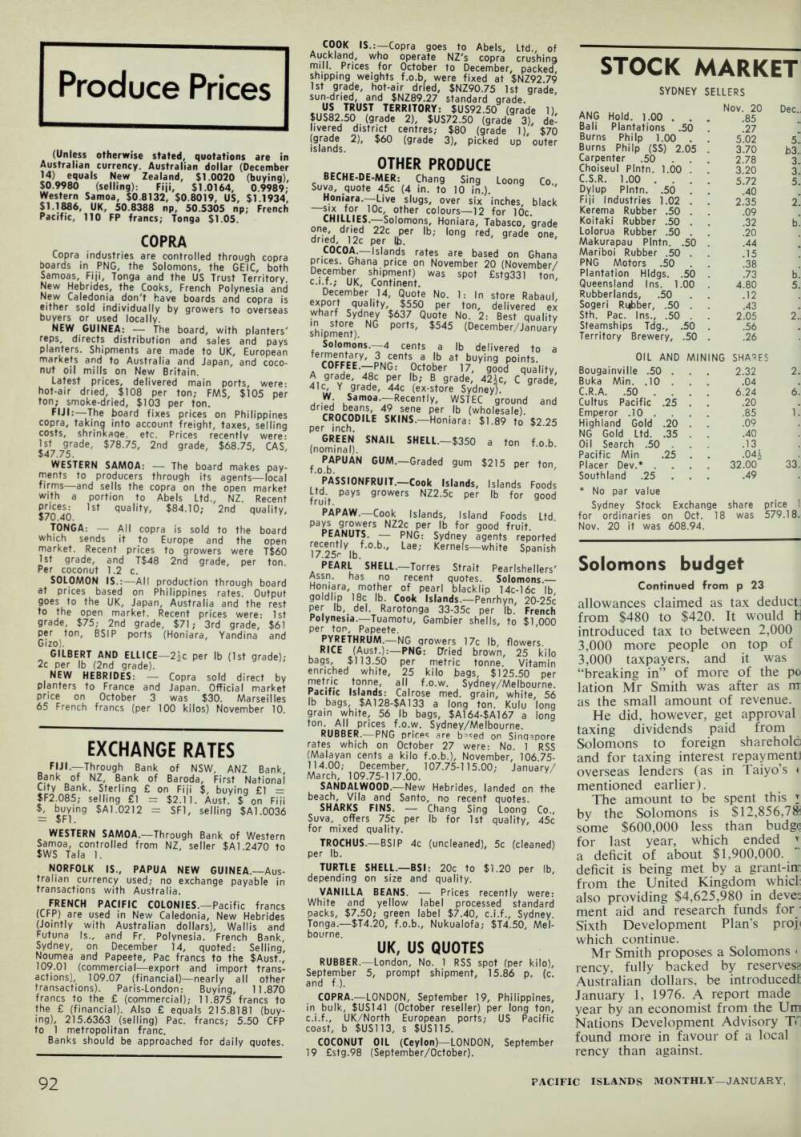
(Unless otherwise stated, quotations are in Australian currency. Australian dollar (December 14) equals New Zealand, $1.0020 (buying), $0.9980 (selling): Fiji, $1.0164, 0.9989; Western Samoa, $0.8132, $0.8019, US, $1.1934, $1.1886, UK, 50.8388 np, 50.5305 np; French Pacific, 110 FP francs; Tonga $1.05.
Copra
Copra industries are controlled through copra boards in PNG, the Solomons, the GEIC, both Samoas, Fiji, Tonga and the US Trust Territory New Hebrides, the Cooks, French Polynesia and New Caledonia don't have boards and copra is either sold individually by growers to overseas buyers or used locally.
NEW GUINEA: The board, with planters' reps, directs distribution and sales and pays planters. Shipments are made to UK, European markets and to Australia and Japan, and coco nut oil mills on New Britain.
Latest prices, delivered main ports, were: hot-air dried, $lOB per ton; FMS, $lO5 per ton; smoke-dried, $lO3 per ton.
FIJI:— The board fixes prices on Philippines copra, taking into account freight, taxes, selling costs, shrinkage, etc. Prices recently were: Ist grade, $78.75, 2nd grade, $68.75, CAS, $47 . 75 .
WESTERN SAMOA; The board makes pay ments to producers through its agents—local firms—and sells the copra on the open market with a portion to Abels Ltd., NZ. Recent prices: Ist quality, $84.10; 2nd quality, $70.40.
TONGA: All copra is sold to the board which sends it to Europe and the open market. Recent prices to growers were Ts6o Ist grade, and Ts4B 2nd grade, per ton Per coconut 1.2 c.
SOLOMON IS.: —All production through board at prices based on Philippines rates. Output goes to the UK, Japan, Australia and the rest to the open market. Recent prices were: Ist grade, $75; 2nd grade, $7l; 3rd grade, $6l per ton, BSIP ports (Honiara, Yandina and Gizo).
GILBERT AND ELLICE— 2£c per lb (Ist grade); 2c per lb (2nd grade).
NEW HEBRIDES: Copra sold direct by planters to France and Japan. Official market price on October 3 was $3O. Marseilles 65 French francs (per 100 kilos) November 10.
COOK IS.:— Copra goes to Abels, Ltd., of Auckland, who operate NZ's copra crushing mill. Prices for October to December, packed, shipping weights f.o.b, were fixed at $NZ92.79 Ist grade, hot-air dried, $NZ90.75 Ist grade sun-dried, and $NZ89.27 standard grade. e..!501R US , T lERRII ERRIT ORY: $U592.50 (grade 1), 5U5821.50 (grade 2), $U572.50 (grade 3), de ivered district centres; $BO (grade 1), $7O (grade 2), $6O (grade 3), picked up outer islands.
Other Produce
BECHE-DE-MER: Chang Sing Loong Co Suva, quote 45c (4 in. to 10 in.).
Hornara,— Live slugs, over six inches, black ~s.'x for JOc, other colours—l2 for 10c.
CHILLIES. Solomons, Honiara. Tabasco grade dried, VI? pe? It" ' b; '° ng red ' grade one ' COCQA —(shntis rates are based on Ghana prices. Ghana price on November 20 (November/ December shipment) was spot £stg33l ton, c.i.f.; UK, Continent.
December 14, Quote No. 1: In store Rabaul, export quality, $550 per ton, delivered ex wharf Sydney $637 Quote No. 2: Best quality shipment) NG P ° rtS ' $545 ( December / Ja ™ary Solomons.— 4 cents a lb delivered to a termentary, 3 cents a lb at buying points. a COF^ EE -T; PNG: october 17 > good quality, A grade, 48c per lb; B grade, A2\c, C grade 41c, Y grade, 44c (ex-store Sydney).
W Samoa.— Recently, WSTEC ground and dri ®d beans, 49 sene per lb (wholesale).
CROCODILE SKlNS. —Honiara: $1.89 to $2 25 per inch.
GREEN SNAIL SHELL. —S3SO a ton f.o.b. (nominal). f o P^ PUAN — Grac * ec * 9um $ 215 P er ton, PASSIONFRUIT.—Cook Islands, Islands Foods fruit PayS groWers NZ2 - 5c P er lb for good PAPAW. —Cook Islands, Island Foods Ltd pays growers NZ2c per lb for good fruit.
PEANUTS. PNG: Sydney agents reported recently f.0.b., Lae; Kernels—white Spanish \/.25r lb.
PEARL SHELL.— Torres Strait Pearlshellers' Assn, has no recent quotes. Solomons. — Honiara, mother of pearl blacklip 14c-16c lb goldhp 18c lb. Cook Islands.— Penrhyn, 20-25 c per lb, del. Rarotonga 33-35 c per lb. French Polynesia.— Tuamotu, Gambier shells, to $1 000 per ton, Papeete.
PYRETHRUM— NG growers 17c lb, flowers.
RICE (Aust.): — PNG: Pried brown, 25 kilo bags, $113.50 per metric tonne. Vitamin enriched white, 25 kilo bags, $125.50 per metric tonne, all f.o.w. Sydney/Melbourne.
Pacific Islands: Calrose med. grain, white, 56 lb bags, SAI2B-SAI33 a long ton. Kulu long grain white, 56 lb bags, SAI64-SAI67 a long ton. All prices f.o.w. Sydney/Melbourne.
RUBBER. —PNG prices are on Singapore rates which on October 27 were: No. 1 RSS (Malayan cents a kilo f.0.b.), November, 106 75- 114.00; December, 107.75-115.00; January/ March, 109.75-117.00.
SANDALWOOD. —New Hebrides, landed on the beach, Vila and Santo, no recent quotes.
SHARKS FINS. Chang Sing Loong Co., Suva, offers 75c per lb for Ist quality, 45c for mixed quality.
TROCHUS. —BSIP 4c (uncleaned), 5c (cleaned) per lb.
TURTLE SHELL.—BSI: 20c to $1.20 per lb, depending on size and quality.
VANILLA BEANS. Prices recently were: White and yellow label processed standard packs, $7.50; green label $7.40, c.i.f., Sydney.
Tonga.—sT4.2o, f.0.b., Nukualofa; $T4.50, Mel bourne.
Uk, Us Quotes
RUBBER. —London, No. 1 RSS spot (per kilo), September 5, prompt shipment, 15.86 p. (c. and f).
COPRA. —LONDON, September 19, Philippines, in bulk, SUSI4I (October reseller) per long ton, c.i.f., UK/North European ports; US Pacific coast, b SUSII3, s SUSIIS.
COCONUT OIL (Ceylon)— LONDON, September 19 £stg.9B (September/October).
Exchange Rates
FlJl.— Through Bank of NSW, ANZ Bank, Bank of NZ, Bank of Baroda, First National City Bank. Sterling £ on Fiji $, buying £1 = JF2.085; selling £1 = $2.11. Aust. $ on Fiji buying $A1.0212 = SFI, selling $A1.0036 $F 1.
WESTERN SAMOA. —Through Bank of Western Samoa, controlled from NZ, seller $A1.2470 to SWS Tala 1.
Norfolk Is., Papua New Gulnea.—Aus
tralian currency used; no exchange payable in transactions with Australia.
FRENCH PACIFIC COLONIES. —Pacific francs (CFP) are used in New Caledonia, New Hebrides (Jointly with Australian dollars), Wallis and Futuna Is., and Fr. Polynesia. French Bank, Sydney, on December 14, quoted: Selling, Noumea and Papeete, Pac francs to the sAust., 109.01 (commercial —export and import trans actions), 109.07 (financial) —nearly all other transactions). Paris-London: Buying, 11.870 francs to the £ (commercial); 11.875 francs to the £ (financial). Also £ equals 215.8181 (buy ing), 215.6363 (selling) Pac. francs; 5.50 CFP to 1 metropolitan franc.
Banks should be approached for daily quotes.
Stock Market
Sydney Sellers
Nov. 20 Dec ANG Hold. 1.00 . . . .85 Bali Plantations .50 .27 Burns Philp 1.00 . . 5.02 5 Burns Philp (SS) 2.05 . 3.70 b3 Carpenter .50 2.78 3 Choiseul Plntn. 1.00 . 3.20 3
C.S.R. 1.00 , . . .
5.72 5 Dylup Plntn. .50 . . .40 Fiji Industries 1.02 . 2.35 2 Kerema Rubber .50 . .09 Koitaki Rubber .50 . .32 b Lolorua Rubber .50 . .20 Makurapau Plntn. .50 .44 Mariboi Rubber .50 . .15 PNG Motors .50 . . .38 Plantation Hldgs. .50 .73 b Queensland Ins. 1.00 4.80 5 Rubberlands, .50 .12 Sogeri Rubber, .50 . .43 Sth. Pac. Ins., .50 . 2.05 2 Steamships Tdg., .50 . .56 Territory Brewery, .50 . .26
Oil And Mining
Shades
Bougainville .50 . 2.32 2 Buka Min, .10 . .04
C.R.A. .50 ... .
6.24 6 Cultus Pacific .25 . . .20 Emperor .10 . .85 1 Highland Gold .20 .09 NG Gold Ltd. .35 . . .40 Oil Search .50 . .13 Pacific Min .25 . . .04£ Placer Dev.* ... 32.00 33 Southland .25 .49 * No par value Sydney Stock Exchange share price I for ordinaries on Oct. 18 Nov. 20 it was 608.94. was 579.18.
Advertisements & other items, pp. 98-102 (2 items)
Solomons budget
92
Solomons budget Continued from p 23
PACIFIC ISLANDS MONTHLY—JANUARY,
Today, Tahiti.
Yesterday, the world.
Tomorrow, who knows?
HONDA.
% Si B > That's John! World traveler.
And journalist. The kind of man who knows how to mix business with pleasure.
Because he owns a machine that's enjoyed in more countries than he himself's been, 150 in all. One with power, dynamic and flexible, leaving him free to appreciate the ride. Road holding, backed by years of HONDA success, is unsurpassed, ensuring greater mobility. Safety, second to none. Then there's freedom of choice, a HONDA to suit every individual.
Honda offers John the opportunity to get the very best from himself and the machine. Who knows where he'll be tomorrow.
/'"N. WORLD’S LARGEST MOTORCYCLE MANUFACTURER
W) HONDA
HONDA MOTOR CO.. LTD. TOKYO. JAPAN
PAPUA NEW GUINEA: Steamships Trading Co., Ltd. P.O Box 74, Papua/U.S. TRUST TERRITORY: J.C.Tenorio Enterprise P.O Box 137, Saipan / FIJI ISLANDS: Coral Island Traders Ltd. P.O. Box 296, Suva / TARAWA: The Gilbert & Ellice Islands Development Authority Gilbert & Ellice Islands / WESTERN SAMOA: Motor Distributor (Samoa) Ltd. P.O. Box 576, Apia / AMERICAN SAMOA: Max Ha leek Inc. P.O. Box 99, Pago Pago /TONGA; E.M. ones Ltd. P.O. Box 34, Nukualofa / SOLOMON ISLANDS: British Solomons Trading Co., Ltd. P.O. Box 94, Honiara / NEW CALEDONIA: Establissements Ballande, Noumea / TAHITI: Ets. COMIMPEX P.O. Box 200, Papeete / COOK ISLANDS: Cook Islands Trading Corporation Ltd. P.O. Box 92, Rarotonga / NAURU ISLAND- Nauru Cooperative Society
We put off today...
what others leave
until tomorrow!
This is due to side-port, unit-loading—a fast, efficient, safe way to handle cargo. Our 4 ships, “New Guinea Chief,” “Island Chief,” “Coral Chief,” and “Papuan Chief,” are specially designed for side-port unit-loading, and to save ‘turn around’ time in port they carry their own ‘on board’ forklifts to speed the loading and discharge procedure. If you would like to see how side-port unitloading can save you money on our Sydney, Brisbane, Port Moresby, Samarai, Lae, Madang, Rabaul, Kavieng, Kieta and Honiara services let us show you our 20 minute film “Cargo Revolution” ... and you will see how we can “put off today what others leave until tomorrow”.
pH New Guinea Australia Line Pty.Ltd.
' Member of the Swire Group General Agents: PORT MORESBY—Steamships Trading Co. Ltd. SYDNEY—Swire & Gilchrist Pty. Ltd.
Agents at: BRISBANE—WiIIs, Gilchrist & Sanderson Pty. Ltd. PAPUA-NEW GUlNEA—Steamships Trading Co. Ltd. (for “New Guinea Chief" at Rabaul and “Island Chief" at Kavieng—Burns Philp (N.G.) Ltd.).
HONlARA—British Solomons Trading Co.
e ■. l . i
K# % v t if * " < -VX s. V : v - 7 j. : s «M 1 *<: ■ v ~* ‘ «¥*«**
V' Mr^
#»>v V«»
wfe
SSSMWWS
a *9*f„ ' |-
«l EXPERIENCED .'■' j .
#£#s#■lBllB
“ 4 S SINCE 1868
®sv;
PRODUCERS OF BRUNTONS
J -■ M - ;; r i
iVSNlffi
iiliii
i»Sj-jV.' ■ FAMOUS
ROITAL BAKERS' FLOURS
i CAKE, BISCUIT AND NOODLE
' • FLOURS, SHARPS, ETC.
*«mr.4na) fa a*~.. yioi * »;.
K
V* E f >*
IV OMw »dP^I
S VON£»
SBfHh
,l|N&
iii
Who says family motoring can’t be fun?
Meet the Mazda 808 sedan.
It is lavish glamour you can afford.
Along with its fine finish, you get high back front bucket seats that lay way back. And women, children and men appreciate the four doors with two stage checkers.
Plus the door locks are child-proof.
You also get a lockable gas door, thick foam dash, padded sun visors, door armrests, beautifully recessed instruments and more.
You even get front disc brakes. And the body is of semimonocoque construction with subframes designed for safe controlled-collapse under impact.
What’s more, the spare fits under the trunk so your luggage fits snugly.
Now load up and go. You hug the road with its wide track. And you take the lumps out of bumps thanks to its coil suspension up front and bias-mounted gas-filled shock absorbers in the rear.
And the center console with its 4-speed floor shift gives you more than crafty craftsmanship.
The thrifty but hefty 1300 cc overhead engine gives you the feeling of power.
There you have it. Power, safety, comfortable ride and all the things that make driving fun . . . because our engineers are family men, too.
And if you are not a family man, you can also get a sporty coupe with all of the above.
But that is another story.
Meet the Mazda 808 sedan first.
mmzn4
Toyo Kogyo Co . Ltd. Hiroshima . Japan American Samoa/MAX HALECK, INC. Pag© Pago, Amencan.Samoa 96920 Fiji Islands/NIRANJANS AUTOPORT LTD. G P 0 Box 450, Suva Tel 2269 T New Caledonia/SOCIETE RIVIERE ET BERNANOS 41 Rue de Sebastopol, Noumea New Guinea/PNG MOTORS LTD. PO. Box 1 394, Boroko. Papua Tel: 55788 New Zealand/MAZDA MOTORS OF NEW ZEALAND LIMITED Auckland Western Samoa/H & J RETZLAFF P.O Box 195. Apia Tel 237 "The trade mark MAZDA in this advertisement stands for AUTOMOBILES MAZDA as far as France and her territories are concerned.
Pacific Jet
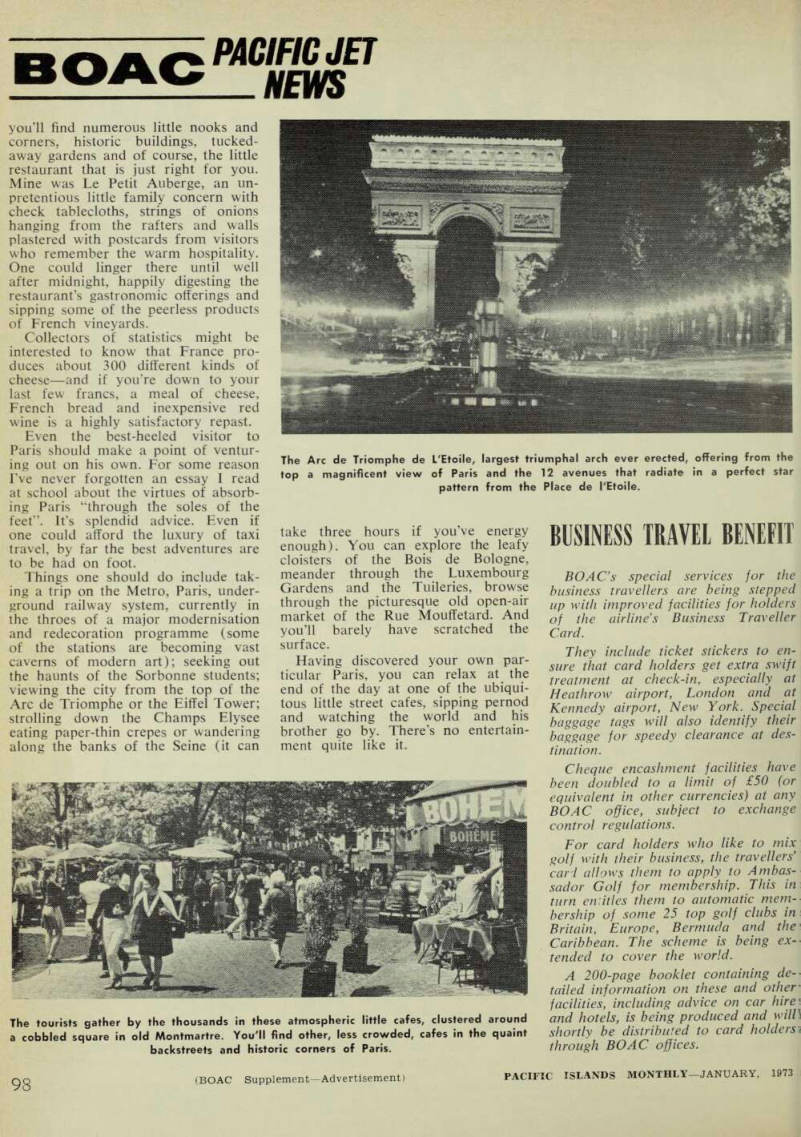
Boac
News
Paris, City Of Romance
(BOAC Supplement—Advertisement)
By Sue Wendt
Paris . . . city of romance, restau rants and the arts. Of glorious gar dens and the Eiffel Tower, Arc de Triomphe and the Champs Elysee, the Left Bank and the cathedrals of Notre Dame and Sacre Coeur. . . .
Paris is croissants and coffee to start the day; onion soup, French bread and carafes of good, cheap wine; frogs’ legs, fromages, crepes and Chantilly cream. It’s can-can and gorgeous girls, fountains and fashion, bidets, joie de vivre and “fly boats” on the Seine. It’s an extraordinary city, with something for everyone.
TTie French capital can sate any appetite at all, simple or luxurious.
With a choice of several thousand restaurants, it’s an epicure’s paradise.
You can spend a small fortune on satisfying the inner man—or you can wine and dine in the quaintest little cafes, soaking up the atmosphere and the music of the wandering trouba dours for a few dollars.
If you’re seeking more voluptuous entertainments, Paris offers nightclubs and cabarets, not to mention sex shops, striptease and nude shows and “adult” movie houses. Even the French flock to see the glittering bare-breasted spectacle of the Folies Bergere and the Casino de Paris and if your budget allows for only one real splurge, a night out at somewhere like the Folies is worth the expense.
Prefer more elevated pursuits? The French capital boasts no less than 362 art galleries and 25 museums. A visit to the Louvre is a must on any visitor’s itinerary and even those who prefer to leave antiquity to the his torians can’t help but thrill to the priceless exhibits in this vast treasure house.
For anyone with even the vaguest recollection of “school French”, com munication isn’t really a problem in Paris. The French appreciate efforts to speak their language and visitors with some knowledge of the con ventions shouldn’t be afraid to try.
It’s a good idea though to equip yourself with a pocket dictionary and phrase book. Taking a stab at a
menu can result in some surprises.
How was I to know that ‘merguez’ was a concoction of rice and piquant sauce and something very much akin to cabanossi sausage? And that ‘croque monseur’ was actually a pan fried cheese sandwich?
But if you can’t speak any French at all, don’t be discouraged from visiting Paris. If the vocabulary escapes you, there’s always someone in a shop or restaurant or in the street to help you out. After all, communication is largely attitude of mind. One guide book advises: “Don’t be afraid to be lavish with the word ‘pardon’ on all conceivable occa sions”. In other words, be polite. And that’s good advice for tourists in any country!
It’s said that Parisians suffer from a particularly virulent form of xenophobia and maybe it’s true. Cer tainly, at the height of the summer season when the city is bursting at the seams with foreign visitors, some restaurateurs actually close up shop and take off on their own holiday pursuits. Since they obviously prefer to cater for a regular clientele, who return faithfully during the less hectic months, they can’t be accused of being greedy for the tourist dollar.
Surely a very civilised attitude!
There are certainly more than enough superb eating-places left open to satisfy the stay-at-home Parisians and the millions of visitors who descend on the city in the European summer.
Visitors to London can avail them selves of numerous package tours across to Paris and some of them are surprisingly inexpensive. Paris is un deniably one of the world’s most expensive cities, but you don’t have to be a millionaire to enjoy it.
For the equivalent of SA9S, 1 booked an excursion offering six nights’ accommodation (plus con tinental breakfast) and including the return air fare from London to Paris.
I fully expected bedbugs at that price, since it was the peak of the tourist season, but I’d been listening to too many stories. The hotel, off the Rue de la Fayette, was spotless, comfort able, centrally-situated and what’s more, I had a private bath and a balcony. And the inevitable bidet.
Like numerous Paris hotels, this one had its own cosy little bar which never seemed to close, a friendly poodle and an amiable concierge always ready to dispense advice about things to do for the least amount of money.
Having arrived at one’s hotel, the next step is to explore the immediate vicinity—wherever you’re staying,
The Eiffel Tower, most famous landmark of all.
you’ll find numerous little nooks and corners, historic buildings, tucked away gardens and of course, the little restaurant that is just right for you.
Mine was Le Petit Auberge, an un pretentious little family concern with check tablecloths, strings of onions hanging from the rafters and walls plastered with postcards from visitors who remember the warm hospitality.
One could linger there until well after midnight, happily digesting the restaurant’s gastronomic offerings and sipping some of the peerless products of French vineyards.
Collectors of statistics might be interested to know that France pro duces about 300 different kinds of cheese—and if you’re down to your last few francs, a meal of cheese, French bread and inexpensive red wine is a highly satisfactory repast.
Even the best-heeled visitor to Paris should make a point of ventur ing out on his own. For some reason I’ve never forgotten an essay I read at school about the virtues of absorb ing Paris “through the soles of the feet”. It’s splendid advice. Even if one could afford the luxury of taxi travel, by far the best adventures are to be had on foot.
Things one should do include tak ing a trip on the Metro, Paris, under ground railway system, currently in the throes of a major modernisation and redecoration programme (some of the stations are becoming vast caverns of modern art); seeking out the haunts of the Sorbonne students; viewing the city from the top of the Arc de Triomphe or the Eiffel Tower; strolling down the Champs Elysee eating paper-thin crepes or wandering along the banks of the Seine (it can
take three hours if you’ve energy enough). You can explore the leafy cloisters of the Bois de Bologne, meander through the Luxembourg Gardens and the Tuileries, browse through the picturesque old open-air market of the Rue Mouffetard. And you’ll barely have scratched the surface.
Having discovered your own par ticular Paris, you can relax at the end of the day at one of the übiqui tous little street cafes, sipping pernod and watching the world and his brother go by. There’s no entertain ment quite like it.
The tourists gather by the thousands in these atmospheric little cafes, clustered around a cobbled square in old Montmartre. You'll find other, less crowded, cafes in the quaint backstreets and historic corners of Paris.
The Arc de Triomphe de L'Etoile, largest triumphal arch ever erected, offering from the top a magnificent view of Paris and the 12 avenues that radiate in a perfect star pattern from the Place de L'Etoile.
Boac Sets Industry
Cargo Record
A BOAC Boeing 747 passenger jet carried 32 i tons of cargo on a flight from New York to London recently—a load the airline believes is a record for cargo carried on any regular scheduled passenger flight.
There was no heavy individual item on the flight but, ap propriately, the largest consign ment was 28,000 kilos of long playing records.
Business Travel Benefit
BO AC's special services for the business travellers are being stepped up with improved facilities for holders of the airline's Business Traveller Card.
They include ticket stickers to en sure that card holders get extra swift treatment at check-in, especially at Heathrow airport, London and at Kennedy airport, New York. Special baggage tags will also identify their baggage for speedy clearance at des tination.
Cheque encashment facilities have been doubled to a limit of £50 (or equivalent in other currencies) at any BO AC office, subject to exchange control regulations.
For card holders who like to mix golf with their business, the travellers’ card allows them to apply to Ambas sador Golf for membership. This in turn entitles them to automatic mem bership of some 25 top golf clubs in Britain, Europe, Bermuda and the Caribbean. The scheme is being ex tended to cover the world.
A 200-page booklet containing de tailed information on these and other facilities, including advice on car hire and hotels, is being produced and will shortly be distributed to card holders through BO AC offices.
Seen In The Shops
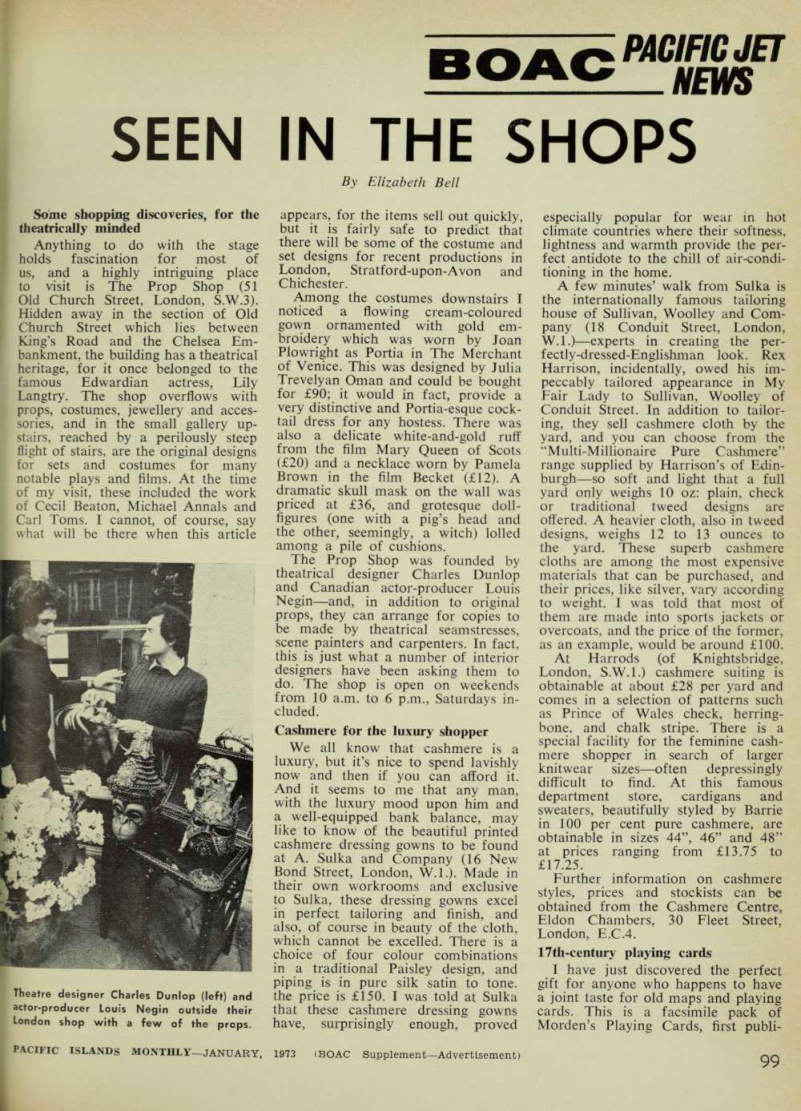
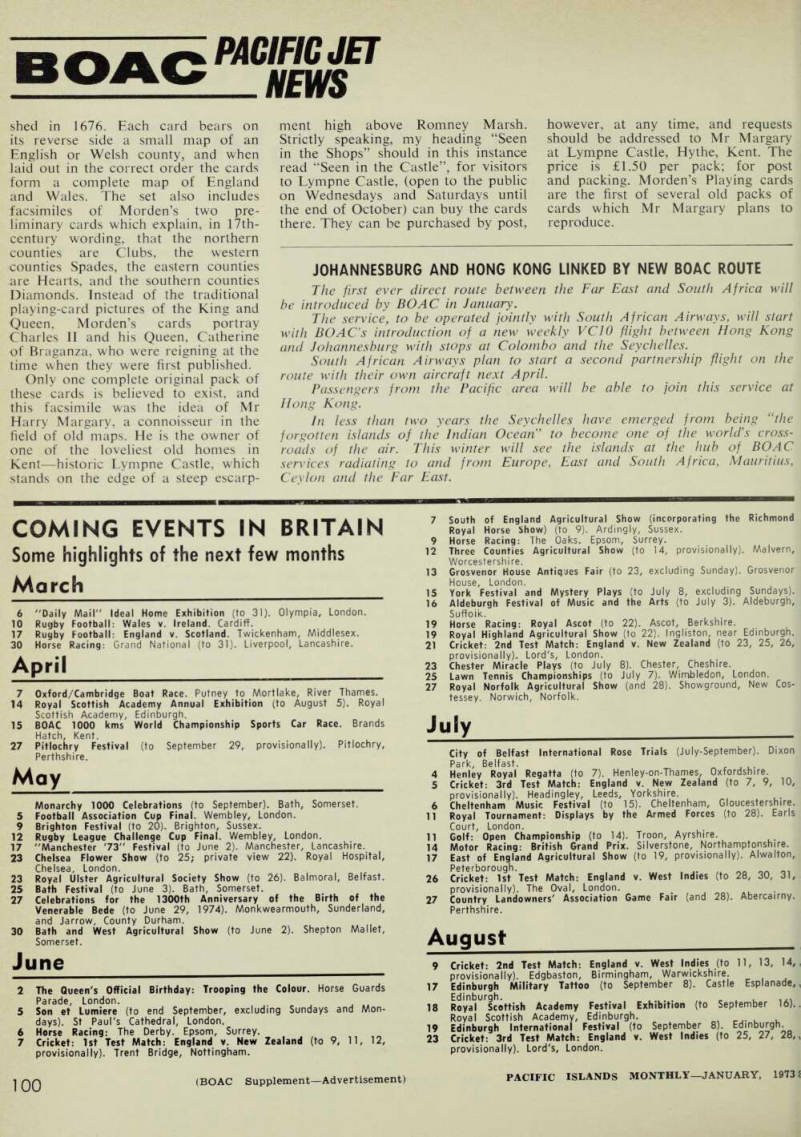
By Elizabeth Bell
Some shopping discoveries, for the theatrically minded Anything to do with the stage holds fascination for most of us, and a highly intriguing place to visit is The Prop Shop (51 Old Church Street, London, 5.W.3).
Hidden away in the section of Old Church Street which lies between King’s Road and the Chelsea Em bankment, the building has a theatrical heritage, for it once belonged to the famous Edwardian actress, Lily Langtry. The shop overflows with props, costumes, jewellery and acces sories, and in the small gallery up stairs, reached by a perilously steep flight of stairs, are the original designs for sets and costumes for many notable plays and films. At the time of my visit, these included the work of Cecil Beaton, Michael Annals and Carl Toms. I cannot, of course, say what will be there when this article
appears, for the items sell out quickly, but it is fairly safe to predict that there will be some of the costume and set designs for recent productions in London, Stratford-upon-Avon and Chichester. iMnong the costumes downstairs I noticed a flowing cream-coloured gown ornamented with gold em broidery which was worn by Joan Plowright as Portia in The Merchant of Venice. This was designed by Julia Trevelyan Oman and could be bought for £9O; it would in fact, provide a very distinctive and Portia-esque cock tail dress for any hostess. There was also a delicate white-and-gold ruff from the film Mary Queen of Scots (£2O) and a necklace worn by Pamela Brown in the film Becket (£l2). A dramatic skull mask on the wall was priced at £36, and grotesque doll figures (one with a pig’s head and the other, seemingly, a witch) lolled among a pile of cushions.
The Prop Shop was founded by theatrical designer Charles Dunlop and Canadian actor-producer Louis Negin—and, in addition to original props, they can arrange for copies to be made by theatrical seamstresses, scene painters and carpenters. In fact, this is just what a number of interior designers have been asking them to do. The shop is open on weekends from 10 a.m. to 6 p.m., Saturdays in cluded.
Cashmere for the luxury shopper We all know that cashmere is a luxury, but it’s nice to spend lavishly now and then if you can afford it.
And it seems to me that any man, with the luxury mood upon him and a well-equipped bank balance, may like to know of the beautiful printed cashmere dressing gowns to be found at A. Sulka and Company (16 New Bond Street, London, W.L). Made in their own workrooms and exclusive to Sulka, these dressing gowns excel in perfect tailoring and finish, and also, of course in beauty of the cloth, which cannot be excelled. There is a choice of four colour combinations in a traditional Paisley design, and piping is in pure silk satin to tone, the price is £l5O. I was told at Sulka that these cashmere dressing gowns have, surprisingly enough, proved
especially popular for wear in hot climate countries where their softness, lightness and warmth provide the per fect antidote to the chill of air-condi tioning in the home.
A few minutes’ walk from Sulka is the internationally famous tailoring house of Sullivan, Woolley and Com pany (18 Conduit Street, London, W.l.) —experts in creating the per fectly-dressed-Englishman look. Rex Harrison, incidentally, owed his im peccably tailored appearance in My Fair Lady to Sullivan, Woolley of Conduit Street. In addition to tailor ing, they sell cashmere cloth by the yard, and you can choose from the “Multi-Millionaire Pure Cashmere” range supplied by Harrison’s of Edin burgh—so soft and light that a full yard only weighs 10 oz: plain, check or traditional tweed designs are offered. A heavier cloth, also in tweed designs, weighs 12 to 13 ounces to the yard. These superb cashmere cloths are among the most expensive materials that can be purchased, and their prices, like silver, vary according to weight. I was told that most of them are made into sports jackets or overcoats, and the price of the former, as an example, would be around £lOO.
At Harrods (of Knightsb ridge, London, 5.W.1.) cashmere suiting is obtainable at alx)ut £2B per yard and comes in a selection of patterns such as Prince of Wales check, herring bone, and chalk stripe. There is a special facility for the feminine cash mere shopper in search of larger knitwear sizes—often depressingly difficult to find. At this famous department store, cardigans and sweaters, beautifully styled by Barrie in 100 per cent pure cashmere, are obtainable in sizes 44”, 46” and 48” at prices ranging from £13,75 to £17.25.
Further information on cashmere styles, prices and stockists can be obtained from the Cashmere Centre, Eldon Chambers, 30 Fleet Street, London, E.C.4. 17th-century playing cards I have just discovered the perfect gift for anyone who happens to have a joint taste for old maps and playing cards. This is a facsimile pack of Morden’s Playing Cards, first publi
Theatre designer Charles Dunlop (left) and actor-producer Louis Negin outside their London shop with a few of the props.
shed in 1676. Each card bears on its reverse side a small map of an English or Welsh county, and when laid out in the correct order the cards form a complete map of England and Wales. The set also includes facsimiles of Morden’s two pre liminary cards which explain, in 17th century wording, that the northern counties are Clubs, the western counties Spades, the eastern counties are Hearts, and the southern counties Diamonds. Instead of the traditional
playing-card pictures of the King and
Queen, Morden’s cards portray Charles II and his Queen, Catherine of Braganza, who were reigning at the time when they were first published.
Only one complete original pack of these cards is believed to exist, and this facsimile was the idea of Mr Harry Margary, a connoisseur in the field of old maps. He is the owner of one of the loveliest old homes in Kent —historic Lympne Castle, which stands on the edge of a steep escarp
ment high above Romney Marsh.
Strictly speaking, my heading “Seen in the Shops” should in this instance read “Seen in the Castle”, for visitors to Lympne Castle, (open to the public on Wednesdays and Saturdays until the end of October) can buy the cards there. They can be purchased by post,
however, at any time, and requests should be addressed to Mr Margary at Lympne Castle, Hythe, Kent. The price is £1.50 per pack; for post and packing. Morden’s Playing cards are the first of several old packs of cards which Mr Margary plans to reproduce.
Johannesburg And Hong Kong Linked By New Boac Route
The first ever direct route between the Far East and South Africa will be introduced by BOAC in January.
The service, to be operated jointly with South African Airways, will start with BO AC's introduction of a new weekly VC 10 flight between Hong Kong and Johannesburg with stops at Colombo and the Seychelles.
South African Airways plan to start a second partnership flight on the route with their own aircraft next April.
Passengers from the Pacific area will be able to join this service at Hong Kong.
In less than two years the Seychelles have emerged from being “the forgotten islands of the Indian Ocean” to become one of the world’s cross roads of the air. This winter will see the islands at the hub of BOAC services radiating to and from Europe, East and South Africa, Mauritius, Ceylon and the Far East.
April
Coming Events In Britain
Some highlights of the next few months
March
6 "Daily Mail" Ideal Home Exhibition (to 31). Olympia, London. 10 Rugby Football: Wales v. Ireland. Cardiff. 17 Rugby Football: England v. Scotland. Twickenham, Middlesex. 30 Horse Racing; Grand National (to 31). Liverpool, Lancashire.
April
7 Oxford/Cambridge Boat Race. Putney to Mortlake, River Thames. 14 Royal Scottish Academy Annual Exhibition (to August 5). Royal Scottish Academy, Edinburgh. 15 BOAC 1000 kms World Championship Sports Car Race. Brands Hatch, Kent. 27 Pitlochry Festival (to September 29, provisionally), Pitlochry, Perthshire.
Moy
Monarchy 1000 Celebrations (to September). Bath, Somerset. 5 Football Association Cup Final. Wembley, London. 9 Brighton Festival (to 20). Brighton, Sussex. 12 Rugby League Challenge Cup Final. Wembley, London. 17 "Manchester '73" Festival (to June 2). Manchester, Lancashire. 23 Chelsea Flower Show (to 25; private view 22). Royal Hospital, Chelsea, London. 23 Royal Ulster Agricultural Society Show (to 26). Balmoral, Belfast. 25 Bath Festival (to June 3). Bath, Somerset, 27 Celebrations for the 1300th Anniversary of the Birth of the Venerable Bede (to June 29, 1974). Monkwearmouth, Sunderland, and Jarrow, County Durham. 30 Bath and West Agricultural Show (to June 2). Shepton Mallet, Somerset.
June
2 The Queen's Official Birthday: Trooping the Colour. Horse Guards Parade, London. 5 Son et Lumiere (to end September, excluding Sundays and Mon days). St Paul's Cathedral, London. 6 Horse Racing: The Derby. Epsom, Surrey. 7 Cricket: 1st Test Match: England v. New Zealand (to 9, 11, 12, provisionally). Trent Bridge, Nottingham.
7 South of England Agricultural Show (incorporating the Richmond Royal horse Show) (to 9). Ardingly, Sussex. 9 Horse Racing: The Oaks. Epsom, Surrey. 12 Three Counties Agricultural Show (to 14, provisionally). Malvern, Worcestershire. 13 Grosvenor House Antiques Fair (to 23, excluding Sunday). Grosvenor House, London. 15 York Festival and Mystery Plays (to July 8, excluding Sundays). 16 Aldeburgh Festival of Music and the Arts (to July 3). Aldeburgh, Suffolk. 19 Horse Racing: Royal Ascot (to 22). Ascot, Berkshire. 19 Royal Highland Agricultural Show (to 22). Ingliston, near Edinburgh. 21 Cricket: 2nd Test Match: England v. New Zealand (to 23, 25, 26, provisionally). Lord's, London. 23 Chester Miracle Plays (to July 8). Chester, Cheshire. 25 Lawn Tennis Championships (to July 7). Wimbledon, London. 27 Royal Norfolk Agricultural Show (and 28). Showground, New Cos tessey. Norwich, Norfolk.
July
City of Belfast International Rose Trials (July-September). Dixon Park, Belfast. „ r ... 4 Henley Royal Regatta (to 7). Henley-on-Thames, Oxfordshire. 5 Cricket: 3rd Test Match: England v. New Zealand (to 7,9, 10, provisionally). Headingley, Leeds, Yorkshire. . 6 Cheltenham Music Festival (to 15). Cheltenham, Gloucestershire. 11 Royal Tournament: Displays by the Armed Forces (to 28). Earls Court, London. . 11 Golf: Open Championship (to 14). Troon, Ayrshire. 14 Motor Racing: British Grand Prix. Silverstone, Northamptonshire. 17 East of England Agricultural Show (to 19, provisionally). Alwalton, Peterborough. .. „ „ 26 Cricket: Ist Test Match: England v. West Indies (to 28, 30, 31, provisionally). The Oval, London. . 27 Country Landowners' Association Game Fair (and 28). Abercairny.
Perthshire.
August
9 Cricket: 2nd Test Match: England v. West Indies (to 11, 13, 14, provisionally). Edgbaston, Birmingham, Warwickshire. 17 Edinburgh Military Tattoo (to September 8). Castle Esplanade, 18 Royal Scottish Academy Festival Exhibition (to September 16).
Royal Scottish Academy, Edinburgh. 19 Edinburgh International Festival (to September 8). Edinburgh. 23 Cricket: 3rd Test Match: England v. West Indies (to 25, 27, 28, provisionally). Lord's, London.
(BOAC Supplement—Advertisement)
Advertisements & other items, p. 106 (1 item)
Boac News
100
PACIFIC ISLANDS MONTHLY—JANUARY, 1973
nr* jtr* PACIFIC JET
BOAC NEWS
Shipping & Airways Information
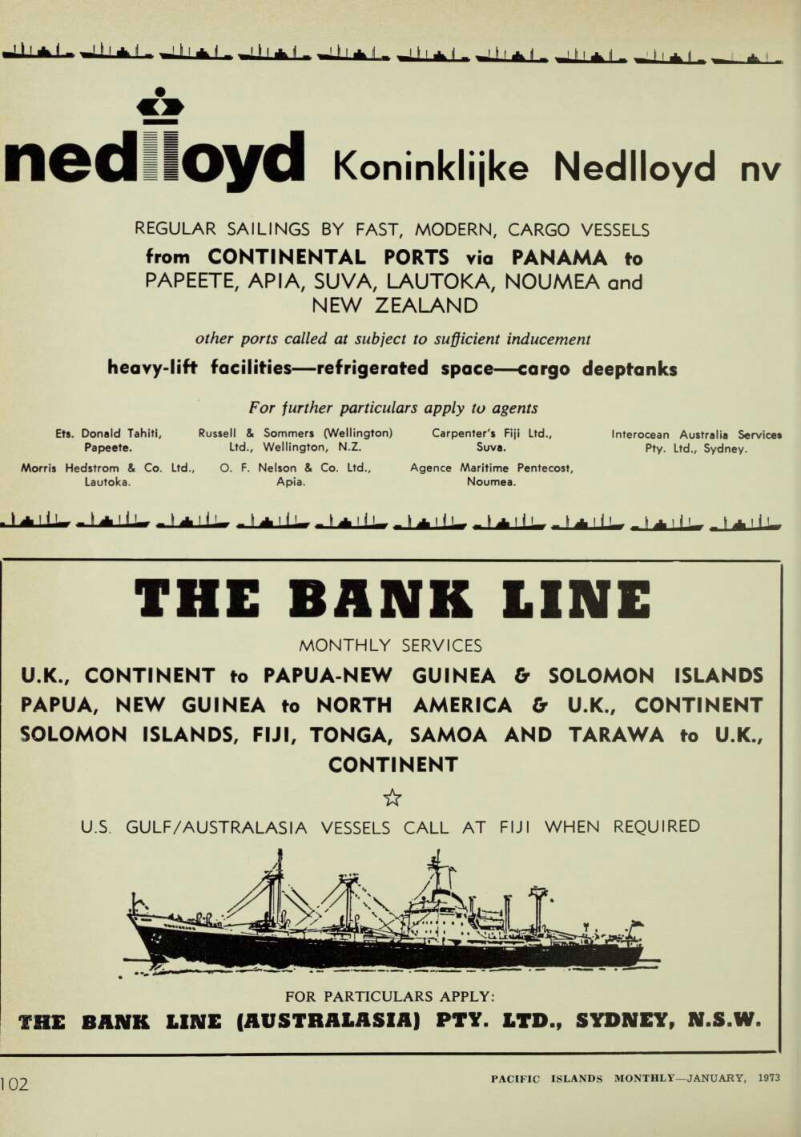
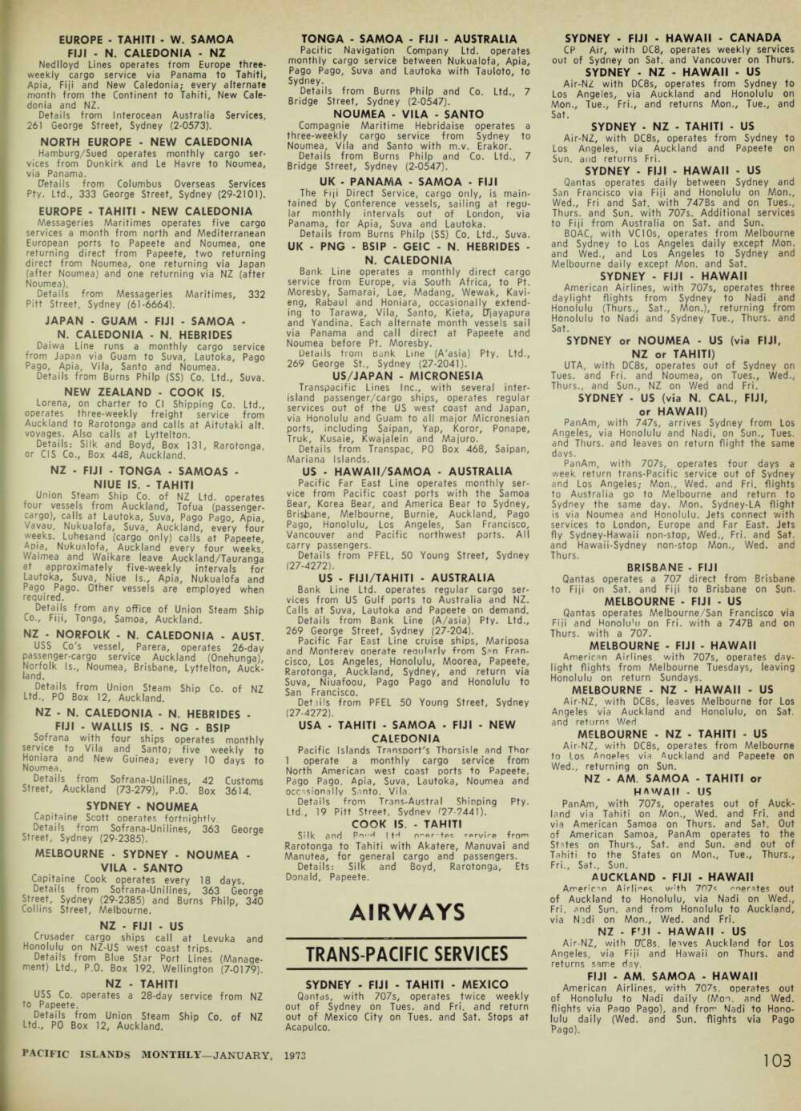
Shipping
Aust. • West Irian
Karlander New Guinea Line with Slembe operates cargo service every nine weeks from Sydney to Djayapura.
Details; Karlander (Aust.) Pty. Ltd., 19-31 Pitt Street, Sydney (27-6301).
SYDNEY - NZ - FIJI/TAHITI - UK Chandris Lines, with Australis, Britanis and Ellinis, maintains a twice-monthly passenger service from Sydney via NZ, Suva (Australis), via NZ, Tahiti (Britanis and Ellinis). Patris operates a regular service, Singapore-Australia- Singapore combined with "Ship-Jet" service to London, Athens, Amsterdam and Brussels via Singapore.
Details from Chandris Lines, 135 King Street, Sydney (28-2451).
Uk - Europe
Sitmar Line, with one liner, the Fairstar, operates a 10-weekly passenger service from Sydney, Melbourne or Brisbane to Southampton, UK, via NZ, Papeete, Panama and Lisbon and alternatively via South Africa.
Details from Sitmar Line (Australia) Pty. Ltd., 22-30 Bridge Street, Sydney (27-4521).
SYDNEY - LORD HOWE IS. - NORFOLK IS. - NEW CALEDONIA ■ NEW HEBRIDES Karlander operates 19-day service from Sydney to Lord Howe, Norfolk, New Caledonia and New Hebrides. Passenger accommodation available.
Details from Karlander (Aust.) Pty. Ltd., 19- 31 Pitt Street, Sydney (27-6301).
Charqeurs Caledoniens, with the Port de France operates two-weekly cargo service Sydney-Noumea.
Details: Hetherington Kingsbury Pty. Ltd., 4 Bridge Street, Sydney (27-1671).
Sydney - Geic - Honolulu
Columbus Lines operates monthly cargo sail ings from West Coast, US to Australasia, returning via Tarawa, GEIC and Honolulu to Nth. America.
Details from Columbus Overseas Services Pty.
Ltd., 333 George Street, Sydney (29-2101).
Sydney ■ New Caledonia -
New Hebrides
Polynesie maintains three-weekly passenger sailings—Sydney, Noumea, Vila and Santo.
Details from France Australia, 261 George Street, Sydney (27-2654).
SYDNEY - NZ - FIJI HAWAII -
Canada - Us
P and 0 liners call regularly at Auckland, Suva and Honolulu on eastbound and westbound voyages between Sydney and the US; occasional calls at Pago Pago and Tonga.
Details from P & 0 Australia Ltd., 55 Hunter Street, Sydney (2-0317).
SYDNEY - NZ - FIJI - TONGA - VILA ■
Noumea - Samoas ■ Tahiti
Shaw Savill's Ocean Monarch and Northern Star cruise in the Pacific sailing from Aus tralia and New Zealand calling at Suva, Lautoka, Tonga, Vila, Noumea, Pago Pago, Tahiti, Apia, Vavau.
Details; Shaw Savill Line, 8a Castlereagn St., Sydney (28-1481).
Australia - Fiji - Tahiti -
Mexico ■ Us - Nz
Karlander (Aust.) Pty. Ltd. operates three weekly cargo services from Melbourne and Syd ney for Suva, Lautoka, Tahiti, Los Angeles, San Francisco, Manzanillo and Auckland with side port door ships, Woolgar, Good Mariner, Good Navigator, Belle Isle.
Details from Karlander (Aust.) Pty. Ltd., 19- 31 Pitt Street, Sydney (27-6301); F. H. Stephens Pty. Ltd., 554 Flinders Street, Melbourne (62-3333); Burns Philp (SS) Co. Ltd., Suva and Lautoka.
AUSTRALIA - FIJI - NEW HEBRIDES -
New Caledonia
South Pacific United Lines with "Gange" operate a monthly cargo service from Mel bourne, Sydney, Suva, Lautoka, Santo, Port Vila and Noumea.
Details from France-Australia, 261 George Street, Sydney (27-2654).
Australia - New Zealand - Tahiti
South Pacific United Lines with "Wah Fung" operate a regular service from Melbourne, Sydney, Auckland and Papeete.
Details from France-Australia, 261 George Street, Sydney (27-2654).
Australia • Png
Nauru Pacific Line operates regular monthly cargo liner service from Melbourne and Sydney to Port Moresby, Lae and Rabaul.
Details from Nauru Pacific Line, 227 Collins Street, Melbourne (654-4977); Interocean Aus tralia Services, 261 George Street, Sydney (2-0573).
Australia - South Pacific And
Coral Sea Services
Nauru Pacific Line operates cargo/passenger service to Fiji, New Hebrides and South Pacific ports.
Details from Nauru Pacific Line, 227 Collins Street, Melbourne (654-4977); Interocean Aus tralia Services, 261 George Street, Sydney (2-0573).
Australia - Png - Bsip
Conpac Pacific Express (Burns Philp and AWP Line) operates three-weekly passenger cargo service from Sydney and Brisbane to Lae with Nimos, and from Melbourne and Sydney to Port Moresby and Lae with Tenos.
Details from Burns Philp and Co. Ltd., 7 Bridge Street, Sydney (2-0547).
New Guinea Australia Line's vessel Coral Chief operates every 17-18 days from Sydney to Brisbane, Port Moresby and Samarai (alt. voyages); Island Chief operates every 20/22 days from Sydney and Brisbane, to Lae and Rabaul, calling Kavieng alt. voyages; Papuan Chief operates every 21 days from Sydney and Brisbane to Honiara, Kieta and Gizo; New Guinea Chief operates every 21 days from Sydney and Brisbane to Rabaul and Madang.
All are cargo services.
Details from Swire and Gilchrist, 8 Spring Street, Sydney (20-522).
New Guinea Express Line with two ships operates three-weekly (Moresby Express), Mel bourne, Sydney, Port Moresby, Lae; (Lae Ex press), Sydney, Brisbane, Lae, Rabaul.
Details from New Guinea Express Line, 37 Pitt St., Sydney (241-1396) and 72 Eagle St., Brisbane (21-9333), Westralian Farmers Trans port Pty. Ltd., 459 Little Collins St., Melbourne (67-8291), Breckwoldt's Shipping Agencies (PNG).
Karlander New Guinea Line's five cargo vessels call at Melbourne, Sydney, Brisbane, Port Moresby, Samarai, Rabaul, Lae, Madang, Wewak, Kieta, Honiara, Gizo, Manus.
Details from Karlander (Aust.) Pty. Ltd., 19- 31 Pitt Street, Sydney (27-6301).
Australia - Guam - Philippines
Via New Guinea Ports
Nauru Pacific Line operates regular six weekly cargo services from Tasmania, Mel bourne, Sydney and Brisbane to Guam and the Philippines via New Guinea ports and returning via inducement ports. Rapid delivery to San Francisco via Guam trans-shipment is available.
Details from Nauru Pacific Line, 227 Collins Street, Melbourne (654-4977); Interocean Aus tralia Services, 261 George Street, Sydney (2-0573); Carpenter Shipping Agencies, New Guinea ports.
Australia - Hong Kong - Taiwan
Karlander (Aust.) Pty. Ltd. have been ap pointed general agents for the Taiwan National Flag Carrier the Eddie Steamship Co. Four vessels will operate an independent non conference service from Taiwan, Hong Kong to Brisbane, Sydney, Melbourne, Adelaide and Fremantle.
Details from Karlander (Aust.) Ptv. Ltd., 19- 31 Pitt Street, Sydney (27-6301).
Australia - Nauru - Marshall
Islands • Geic
Nauru Pacific Line operates regular monthly cargo/passenger liner service from Melbourne and Sydney to Nauru, Majuro and Tarawa.
Details from Nauru Pacific Line, 227 Collins Street, Melbourne (654-4977); Interocean Aus tralia Services, 261 George Street, Sydney (2-0573).
Australia - Png - Far East
E. and A. Line passenger ships, Cathay and Chitral, make monthly round voyages from Melbourne, Sydney and Brisbane calling at Port Moresby, Manila, Hong Kong, Keelung, Kobe, Yokohama (Tokyo), Guam and Rabaul.
Details from P & 0 Australia Ltd., 55 Hunter Street, Sydney (2-0317).
FAR EAST - FIJI - NEW ZEALAND China Navigation operates a three-weekly cargo service from Hong Kong to Lautoka, Suva, NZ ports, Manila, Kaoshiung, Keelung, Hong Kong.
Details from Swire and Gilchrist, 8 Spring Street, Sydney (20-522).
Royal Interocean lines operates monthly pass enger/cargo service with three ships from NZ to Bangkok, Pt. Kelang, Singapore, Djakarta to Fiji (alt. months) and NZ.
Details from Interocean Australia Services, 261 George Street, Sydney (2-0573); Burns Philp (SS) Co. Ltd., Suva and Lautoka.
Far East - Png - Bsi
China Navigation operates regular cargo service from Hong Kong to Wewak, Madang, Lae, Rabaul, Kieta, Honiara, Port Moresby.
Details from Swire and Gilchrist, 8 Spring Street, Sydney (20-522).
Europe - Tahiti - W. Samoa
Fiji - N. Caledonia - Nz
Nedlloyd Lines operates from Europe three weekly cargo service via Panama to Tahiti, Apia, Fiji and New Caledonia; every alternate month from the Continent to Tahiti, New Cale donia and NZ.
Details from Interocean Australia Services, 261 George Street, Sydney (2-0573).
North Europe - New Caledonia
Hamburg/Sued operates monthly cargo ser vices from Dunkirk and Le Havre to Noumea, via Panama.
Details from Columbus Overseas Services Pty. Ltd., 333 George Street, Sydney (29-2101).
Europe • Tahiti • New Caledonia
Messageries Maritimes operates five cargo services a month from north and Mediterranean European ports to Papeete and Noumea, one returning direct from Papeete, two returning direct from Noumea, one returning via Japan (after Noumea) and one returning via NZ (after Noumea).
Details from Messageries Maritimes, 332 Pitt Street, Sydney (61-6664).
JAPAN - GUAM ■ FIJI - SAMOA ■
N. Caledonia - N. Hebrides
Daiwa Line runs a monthly cargo service from Japan via Guam to Suva, Lautoka, Pago Pago, Apia, Vila, Santo and Noumea.
Details from Burns Philp (SS) Co. Ltd., Suva.
New Zealand - Cook Is.
Lorena, on charter to Cl Shipping Co. Ltd., operates three-weekly freight service from Auckland to Rarotonga and calls at Aitutaki alt. voyages. Also calls at Lyttelton.
Details: Silk and Boyd, Box 131, Rarotonga, or CIS Co., Box 448, Auckland.
NZ - FIJI - TONGA - SAMOAS -
Niue Is. ■ Tahiti
Union Steam Ship Co. of NZ Ltd. operates four vessels from Auckland, Tofua (passenger cargo), calls at Lautoka, Suva, Pago Pago, Apia, Vavau, Nukualofa, Suva, Auckland, every four weeks. Luhesand (cargo only) calls at Papeete, Apia, Nukualofa, Auckland every four weeks.
Waimea and Waikare leave Auckland/Tauranga at approximately five-weekly intervals for Lautoka, Suva, Niue Is., Apia, Nukualofa and Pago Pago. Other vessels are employed when required.
Details from any office of Union Steam Ship Co., Fiji, Tonga, Samoa, Auckland.
NZ - NORFOLK - N. CALEDONIA - AUST.
USS Co's vessel, Parera, operates 26-day passenger-cargo service Auckland (Onehunga), Norfolk Is., Noumea, Brisbane, Lyttelton, Auck land.
Details from Union Steam Ship Co. of NZ Ltd., PO Box 12, Auckland.
NZ ■ N. CALEDONIA - N. HEBRIDES - FIJI - WALLIS IS. - NG - BSIP Sofrana with four ships operates monthly service to Vila and Santo; five weekly to Honiara and New Guinea; every 10 days to Noumea.
Details from Sofrana-Unilines, 42 Customs Street, Auckland (73-279), P.O. Box 3614.
Sydney - Noumea
Capitaine Scott operates fortnightly.
Details from Sofrana-Unilines, 363 Georqe Street, Sydney (29-2385).
Melbourne ■ Sydney - Noumea -
Vila ■ Santo
Capitaine Cook operates every 18 days.
Details from Sofrana-Unilines, 363 George Street, Sydney (29-2385) and Burns Philp, 340 Collins Street, Melbourne.
Nz - Fiji - Us
Crusader cargo ships call at Levuka and Honolulu on NZ-US west coast trips.
Details from Blue Star Port Lines (Manage ment) Ltd., P.O. Box 192, Wellington (7-0179).
Nz - Tahiti
USS Co. operates a 28-day service from NZ to Papeete.
Details from Union Steam Ship Co. of NZ Ltd., PO Box 12, Auckland.
TONGA - SAMOA - FIJI - AUSTRALIA Pacific Navigation Company Ltd. operates monthly cargo service between Nukualofa, Apia, Pago Pago, Suva and Lautoka with Tauloto, to Sydney.
Details from Burns Philp and Co. Ltd., 7 Bridge Street, Sydney (2-0547).
Noumea - Vila - Santo
Compagnie Maritime Hebridaise operates a three-weekly cargo service from Sydney to Noumea, Vila and Santo with m.v. Erakor.
Details from Burns Philp and Co. Ltd., 7 Bridge Street, Sydney (2-0547).
UK - PANAMA - SAMOA - FIJI The Fiji Direct Service, cargo only, is main tained by Conference vessels, sailing at regu lar monthly intervals out of London, via Panama, for Apia, Suva and Lautoka.
Details from Burns Philp (SS) Co. Ltd., Suva.
UK - PNG - BSIP - GEIC - N. HEBRIDES -
N. Caledonia
Bank Line operates a monthly direct cargo service from Europe, via South Africa, to Pt.
Moresby, Samarai, Lae, Madang, Wewak, Kavi eng, Rabaul and Honiara, occasionally extend ing to Tarawa, Vila, Santo, Kieta, Djayapura and Yandina. Each alternate month vessels sail via Panama and call direct at Papeete and Noumea before Pt. Moresby.
Details trom Bank Line (A'asia) Pty. Ltd., 269 George St., Sydney (27-2041).
Us/Japan - Micronesia
Transpacific Lines Inc., with several inter island passenger/cargo ships, operates regular services out of the US west coast and Japan, via Honolulu and Guam to all major Micronesian ports, including Saipan, Yap, Koror, Ponape, Truk, Kusaie, Kwajalein and Majuro.
Details from Transpac, PO Box 468, Saipan, Mariana Islands.
Us ■ Hawaii/Samoa - Australia
Pacific Far East Line operates monthly ser vice from Pacific coast ports with the Samoa Bear, Korea Bear, and America Bear to Sydney, Brisbane, Melbourne, Burnie, Auckland, Pago Pago, Honolulu, Los Angeles, San Francisco, Vancouver and Pacific northwest ports. All carry passengers.
Details from PFEL, 50 Young Street, Sydney (27-4272).
Us - Fiji/Tahiti - Australia
Bank Line Ltd. operates regular cargo ser vices from US Gulf ports to Australia and NZ.
Calls at Suva, Lautoka and Papeete on demand.
Details from Bank Line (A/asia) Pty. Ltd., 269 George Street, Sydney (27-204).
Pacific Far East Line cruise ships, Mariposa and Monterey onerate reaularlv from S*n Fran cisco, Los Angeles, Honolulu, Moorea, Papeete, Rarotonga, Auckland, Sydney, and return via Suva, Niuafoou, Pago Pago and Honolulu to San Francisco.
Detiils from PFEL 50 Young Street, Sydney (27-4272).
USA - TAHITI - SAMOA - FIJI - NEW
Caledonia
Pacific Islands Transport's Thorsisle and Thor 1 operate a monthly cargo service from North American west coast ports to Papeete, Pago Pago, Apia, Suva, Lautoka, Noumea and occasionally Santo. Vila.
Details from Trans-Austral Shinping Pty.
Ltd., 19 Pitt Street, Sydney
Cook Is. • Tahiti
Silk and Po>'r( (H corvicp from Rarotonga to Tahiti with Akatere, Manuvai and Manutea, for general cargo and passengers.
Details: Silk and Boyd, Rarotonga, Ets Donald, Papeete.
Advertisements & other items, pp. 107-108 (1 item)
Interocean-New Zealand Ltd.
STEAMSHIP OPERATORS • AGENTS • BROKERS
TELEX. NZ3791 • ANS. BACK: PLYZETIM • TELEGRAPHIC ADDRESS: ZEAMARINER WELLINGTON • TELEPHONE: 71-976 • P.O. BOX 3637, WELLINGTON, N.Z.
LEVEL M. WILLIAMS PARKING CENTRE • BOULCOTT STREET, WELLINGTON
nedlloyd Koninklijke Nedlloyd nv
REGULAR SAILINGS BY FAST, MODERN, CARGO VESSELS
from CONTINENTAL PORTS via PANAMA to
PAPEETE, APIA, SUVA, LAUTOKA, NOUMEA and
NEW ZEALAND
other ports called at subject to sufficient inducement
heavy-lift facilities—refrigerated space—cargo deeptanks
For further particulars apply to agents Ets. Donald Tahiti, Russell & Sommers (Wellington) Carpenter's Fiji Ltd., Interocean Australia Services Papeete. Ltd., Wellington, N.Z. Suva. Pty. Ltd., Sydney.
Morris Hedstrom & Co. Ltd., O. F. Nelson & Co. Ltd., Agence Maritime Pentecost, Lautoka. Apia. Noumea.
THE BANK LINE
MONTHLY SERVICES
U.K., CONTINENT to PAPUA-NEW GUINEA & SOLOMON ISLANDS PAPUA, NEW GUINEA to NORTH AMERICA & U.K., CONTINENT SOLOMON ISLANDS, FIJI, TONGA, SAMOA AND TARAWA to U.K.,
CONTINENT
☆ U.S. GULF/AUSTRALASIA VESSELS CALL AT FIJI WHEN REQUIRED M, I 1 \
FOR PARTICULARS APPLY:
THE BANK LINE (AUSTRALASIA) PTY. LTD., SYDNEY, N.S.W,
Airways
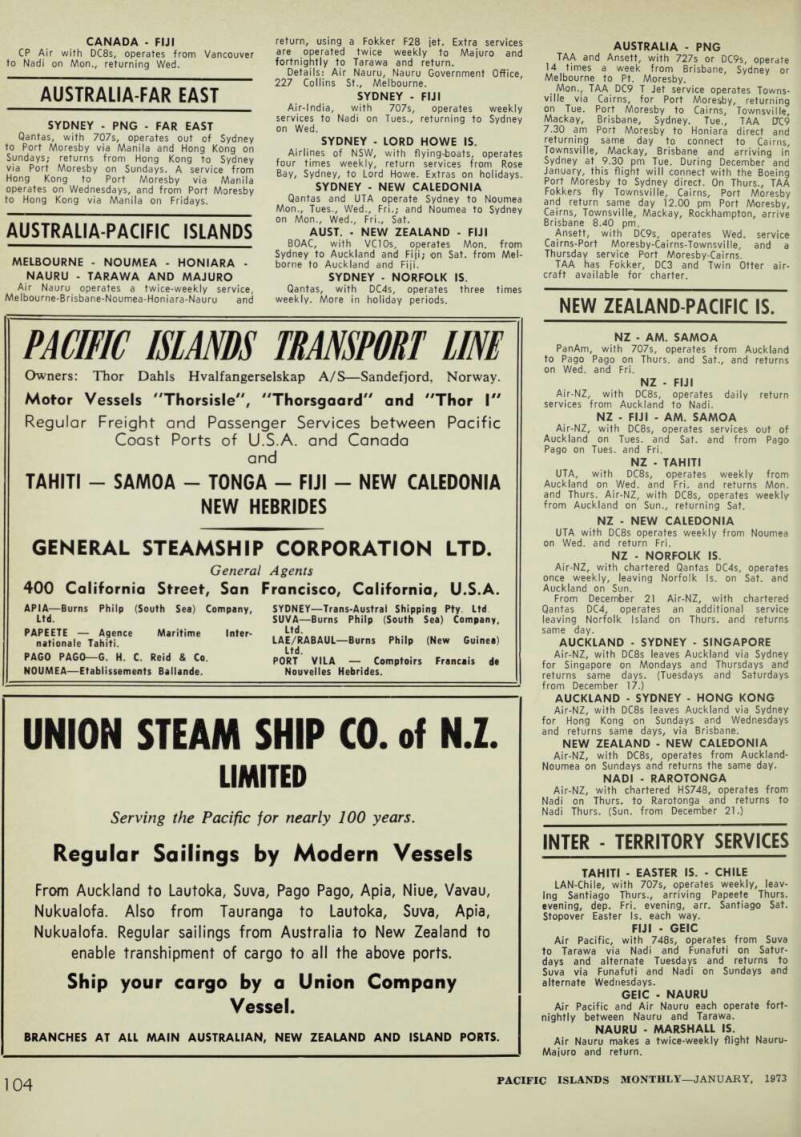
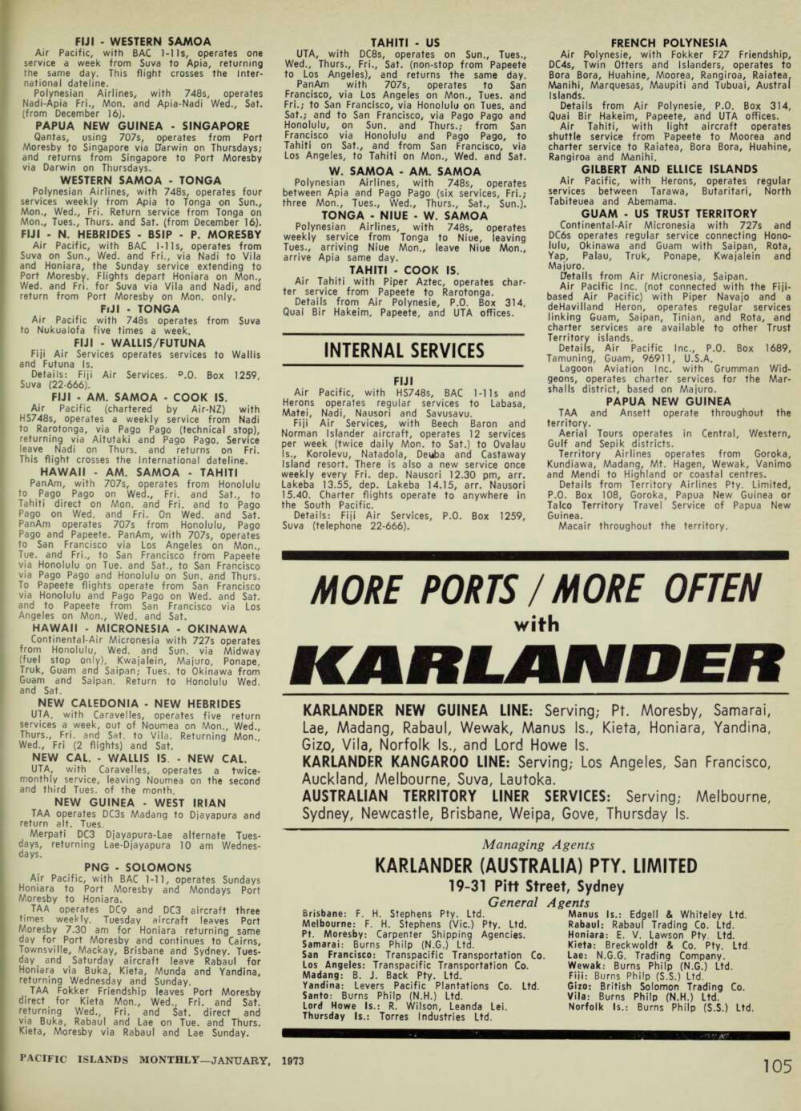
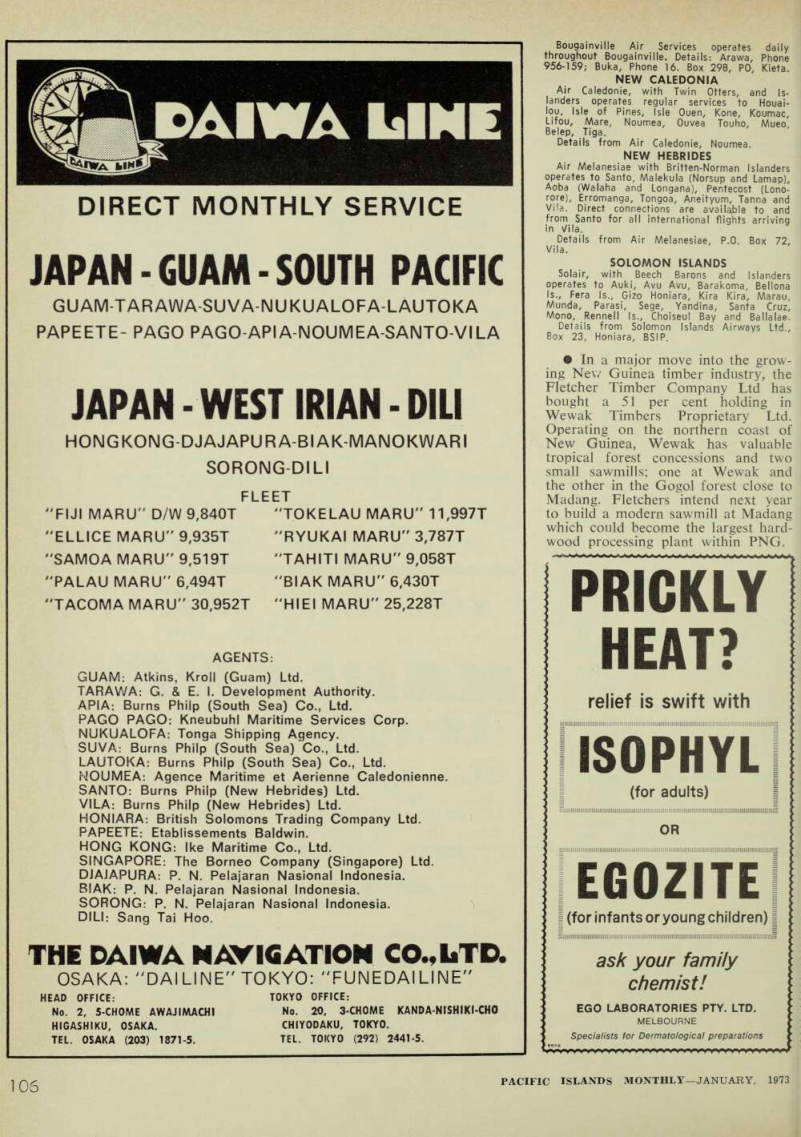
Trans Pacific Services
SYDNEY - FIJI - TAHITI - MEXICO Qantas, with 7075, operates twice weekly out of Sydney on Tues. and Fri. and return out of Mexico City on Tues. and Sat. Stops at Acapulco.
SYDNEY - FIJI - HAWAII - CANADA CP Air, with DCB, operates weekly services out of Sydney on Sat. and Vancouver on Thurs.
SYDNEY - NZ - HAWAII - US Air-NZ with DCBs, operates from Sydney to Los Angeles, via Auckland and Honolulu on Mon., Tue., Fri., and returns Mon., Tue., and Sat.
SYDNEY - NZ - TAHITI ■ US Air-NZ, with DCBs, operates from Sydney to Los Angeles, via Auckland and Papeete on Sun. and returns Fri.
SYDNEY - FIJI - HAWAII - US Qantas operates daily between Sydney and San Francisco via Fiji and Honolulu on Mon., Wed., Fri and Sat. with 7478 s and on Tues., Thurs. and Sun. with 7075. Additional services to Fiji from Australia on Sat. and Sun.
BOAC, with VClOs, operates from Melbourne and Sydney to Los Angeles daily except Mon. and Wed., and Los Angeles to Sydney and Melbourne daily except Mon. and Sat,
Sydney - Fiji - Hawaii
American Airlines, with 7075, operates three daylight flights from Sydney to Nadi and Honolulu (Thurs., Sat., Mon.), returning from Honolulu to Nadi and Sydney Tue., Thurs. and Sat.
SYDNEY or NOUMEA - US (via FIJI,
Nz Or Tahiti)
UTA, with DCBs, operates out of Sydney on Tues. and Fri. and Noumea, on Tues., Wed., Thurs., and Sun., NZ on Wed and Fri.
SYDNEY - US (via N. CAL, FIJI,
Or Hawaii)
PanAm, with 7475, arrives Sydney from Los Angeles, via Honolulu and Nadi, on Sun., Tues. and Thurs. and leaves on return flight the same days.
PanAm, with 7075, operates four days a week return trans-Pacific service out of Sydney and Los Angeles; Mon., Wed. and Fri. flights to Australia go to Melbourne and return to Sydney the same day. Mon. Sydney-LA flight is via Noumea and Honolulu. Jets connect with services to London, Europe and Far East. Jets fly Sydney-Hawaii non-stop. Wed., Fri. and Sat. and Hawaii-Sydney non-stop Mon., Wed. and Thurs.
Brisbane - Fiji
Qantas operates a 707 direct from Brisbane to Fiji on Sat. and Fiji to Brisbane on Sun.
Melbourne - Fiji - Us
Qantas operates Melbourne/San Francisco via Fiji and Horvolu'u on Fri. with a 7478 and on Thurs. with a 707.
Melbourne - Fiji - Hawaii
American Airlines with 7075, operates day light flights from Melbourne Tuesdays, leaving Honolulu on return Sundays.
MELBOURNE - NZ - HAWAII - US Air-NZ, with DCBs, leaves Melbourne for Los Angeles via Auckland and Honolulu, on Sat. and returns Wed MELBOURNE - NZ - TAHITI - US Air-NZ, with DCBs, operates from Melbourne to Los Anaeles via Auckland and Papeete on Wed., returning on Sun.
NZ - AM. SAMOA - TAHITI or
Hawaii - Us
PanAm, with 7075, operates out of Auck land via Tahiti on Mon., Wed. and Fri. and via American Samoa on Thurs. and Sat. Out of American Samoa, PanAm operates to the States on Thurs., Sat. and Sun. and out of Tahiti to the States on Mon., Tue., Thurs., Fri., Sat., Sun.
Auckland - Fiji • Hawaii
American Airlmps, w : th 707 s 'merates out of Auckland to Honolulu, via Nadi on Wed., Fri. and Sun. and from Honolulu to Auckland, via Nadi on Mon., Wed. and Fri.
NZ - F'JI - HAWAII - US Air-NZ, with DCBs, leaves Auckland for Los Angeles, via Fiji and Hawaii on Thurs. and returns same day.
Fiji - Am. Samoa - Hawaii
American Airlines, with 7075, operates out of Honolulu to Nadi daily (Mon. and Wed. flights via Paqo Pago), and from Nadi to Hono lulu daily (Wed. and Sun. flights via Pago Pago).
Canada - Fiji
CP Air with DCBs, operates from Vancouver to Nadi on Mon., returning Wed.
Australia-Far East
Sydney ■ Png - Far East
Qantas, with 7075, operates out of Sydney to Port Moresby via Manila and Hong Kong on Sundays; returns from Hong Kong to Sydney via Port Moresby on Sundays. A service from Hong Kong to Port Moresby via Manila operates on Wednesdays, and from Port Moresby to Hong Kong via Manila on Fridays.
Australia-Pacific Islands
Melbourne - Noumea - Honiara -
Nauru - Tarawa And Majuro
Air Nauru operates a twice-weekly service, Melbourne-Brisbane-Noumea-Honiara-Nauru and
return, using a Fokker F2B jet. Extra services are operated twice weekly to Majuro and fortnightly to Tarawa and return.
Details: Air Nauru, Nauru Government Office, 227 Collins St., Melbourne.
Sydney • Fiji
Air-lndia, with 7075, operates weekly services to Nadi on Tues., returning to Sydney on Wed.
Sydney - Lord Howe Is.
Airlines of NSW, with flying-boats, operates four times weekly, return services from Rose Bay, Sydney, to Lord Howe. Extras on holidays.
Sydney - New Caledonia
Qantas and UTA operate Sydney to Noumea Mon., Tues., Wed., Fri.; and Noumea to Sydney on Mon., Wed., Fri., Sat.
Aust. ■ New Zealand - Fiji
BOAC, with VClOs, operates Mon, from Sydney to Auckland and Fiji; on Sat. from Mel borne to Auckland and Fiji.
Sydney - Norfolk Is.
Qantas, with DC4s, operates three times weekly. More in holiday periods.
Australia - Png
TAA and Ansett, with 727 s or DC9s, operate 14 times a week from Brisbane, Sydney or Melbourne to Pt. Moresby.
Mon., TAA DC9 T Jet service operates Towns ville via Cairns, for Port Moresby, returning on Tue. Port Moresby to Cairns, Townsville, Mackay, Brisbane, Sydney. Tue., TAA DC9 7.30 am Port Moresby to Honiara direct and returning same day to connect to Cairns, Townsville, Mackay, Brisbane and arriving in Sydney at 9.30 pm Tue. During December and January, this flight will connect with the Boeing Port Moresby to Sydney direct. On Thurs., TAA Fokkers fly Townsville, Cairns, Port Moresby and return same day 12.00 pm Port Moresby, Cairns, Townsville, Mackay, Rockhampton, arrive Brisbane 8.40 pm.
Ansett, with DC9s, operates Wed. service Cairns-Port Moresby-Cairns-Townsville, and a Thursday service Port Moresby-Cairns.
TAA has Fokker, DCS and Twin Otter air craft available for charter.
New Zealand-Pacific Is.
Nz - Am. Samoa
PanAm, with 7075, operates from Auckland to Pago Pago on Thurs. and Sat., and returns on Wed. and Fri.
Nz ■ Fiji
Air-NZ, with DCBs, operates daily return services from Auckland to Nadi.
Nz - Fiji - Am. Samoa
Air-NZ, with DCBs, operates services out of Auckland on Tues. and Sat. and from Pago Pago on Tues. and Fri.
Nz - Tahiti
UTA, with DCBs, operates weekly from Auckland on Wed. and Fri. and returns Mon. and Thurs. Air-NZ, with DCBs, operates weekly from Auckland on Sun., returning Sat.
Nz - New Caledonia
UTA with DCBs operates weekly from Noumea on Wed. and return Fri.
Nz - Norfolk Is.
Air-NZ, with chartered Qantas DC4s, operates once weekly, leaving Norfolk Is. on Sat. and Auckland on Sun.
From December 21 Air-NZ, with chartered Qantas DC4, operates an additional service leaving Norfolk Island on Thurs. and returns same day.
Auckland - Sydney - Singapore
Air-NZ, with DCBs leaves Auckland via Sydney for Singapore on Mondays and Thursdays and returns same days. (Tuesdays and Saturdays from December 17.)
Auckland ■ Sydney - Hong Kong
Air-NZ, with DCBs leaves Auckland via Sydney for Hong Kong on Sundays and Wednesdays and returns same days, via Brisbane.
New Zealand - New Caledonia
Air-NZ, with DCBs, operates from Auckland- Noumea on Sundays and returns the same day.
Nadi - Rarotonga
Air-NZ, with chartered HS74B, operates from Nadi on Thurs. to Rarotonga and returns to Nadi Thurs. (Sun. from December 21.)
Inter - Territory Services
Tahiti • Easter Is. - Chile
LAN-Chile, with 7075, operates weekly, leav ing Santiago Thurs., arriving Papeete Thurs. evening, dep. Fri. evening, arr. Santiago Sat.
Stopover Easter Is. each way.
Fiji - Geic
Air Pacific, with 7485, operates from Suva to Tarawa via Nadi and Funafuti on Satur days and alternate Tuesdays and returns to Suva via Funafuti and Nadi on Sundays and alternate Wednesdays.
Geic • Nauru
Air Pacific and Air Nauru each operate fort nightly between Nauru and Tarawa.
Nauru • Marshall Is.
Air Nauru makes a twice-weekly flight Nauru- Majuro and return.
Fiji - Western Samoa
Air Pacific, with BAC 1-1 Is, operates one service a week from Suva to Apia, returning the same day. This flight crosses the Inter national dateline.
Polynesian Airlines, with 7485, operates Nadi-Apia Fri., Mon. and Apia-Nadi Wed., Sat. (from December 16).
Papua New Guinea - Singapore
Qantas, using 7075, operates from Port Moresby to Singapore via Darwin on Thursdays; and returns from Singapore to Port Moresby via Darwin on Thursdays.
Western Samoa - Tonga
Polynesian Airljnes, with 7485, operates four services weekly from Apia to Tonga on Sun., Mon., Wed., Fri. Return service from Tonga on Mon., Tues., Thurs. and Sat. (from December 16).
FIJI - N. HEBRIDES - BSIP - P. MORESBY Air Pacific, with BAC 1-1 Is, operates from Suva on Sun., Wed. and Fri., via Nadi to Vila and Honiara, the Sunday service extending to Port Moresby. Flights depart Honiara on Mon., Wed. and Fn. for Suva via Vila and Nadi, and return from Port Moresby on Mon. only.
Fiji - Tonga
Air Pacific with 748 s operates from Suva to Nukualofa five times a week.
Fiji ■ Wallis/Futuna
Fiji Air Services operates services to Wallis and Futuna Is.
Details: Fiji Air Services. D .O. Box 1259, Suva (22-666).
FIJI - AM. SAMOA - COOK IS.
Air Pacific (chartered by Air-NZ) with HS74Bs, operates a weekly service from Nadi to Rarotonga, via Pago Pago (technical stop), returning via Aitutaki and Pago Pago. Service leave Nadi on Thurs. and returns on Fri.
This flight crosses the International dateline.
Hawaii - Am. Samoa - Tahiti
PanAm, with 7075, operates from Honolulu to Pago Pago on Wed., Fri. and Sat., to Tahiti direct on Mon. and Fri. and to Pago Pago on Wed. and Fri. On Wed. and Sat.
PanAm operates 707 s from Honolulu, Pago Pago and Papeete. PanAm, with 7075, operates to San Francisco via Los Angeles on Mon., Tue. and Fri., to San Francisco from Papeete via Honolulu on Tue. and Sat., to San Francisco via Pago Pago and Honolulu on Sun. and Thurs.
To Papeete flights operate from San Francisco via Honolulu and Pago Pago on Wed. and Sat. and to Papeete from San Francisco via Los Angeles on Mon., Wed. and Sat.
Hawaii - Micronesia - Okinawa
Continental-Air Micronesia with 727 s operates
from Honolulu, Wed. and Sun. via Midway (fuel stop only), Kwajalein, Majuro, Ponape, Truk, Guam and Saipan; Tues. to Okinawa from Guam and Saipan. Return to Honolulu Wed. and Sat.
New Caledonia - New Hebrides
UTA, with Caravelles, operates five return services a week, out of Noumea on Mon., Wed., Thurs., Fri. and Sat. to Vila. Returning Mon., Wed., Fri (2 flights) and Sat.
NEW CAL. - WALLIS IS. - NEW CAL.
UTA, with Caravelles, operates a twice monthly service, leaving Noumea on the second and third Tues. of the month.
New Guinea - West Irian
TAA operates DC3s Madang to Djayapura and return alt. Tues.
Merpati DC3 Djayapura-Lae alternate Tues days, returning Lae-Djayapura 10 am Wednes days.
Png - Solomons
Air Pacific, with BAC 1-11, operates Sundays Honiara to Port Moresby and Mondays Port Moresby to Honiara.
TAA operates DC9 and DC3 aircraft three times weekly. Tuesday aircraft leaves Port Moresby 7.30 am for Honiara returning same day for Port Moresby and continues to Cairns, Townsville, Mackay, Brisbane and Sydney. Tues day and Saturday aircraft leave Rabaul for Honiara via Buka, Kieta, Munda and Yandina, returning Wednesday and Sunday.
TAA Fokker Friendship leaves Port Moresby direct for Kieta Mon., Wed., Fri. and Sat. returning Wed., Fri. and Sat. direct and via Buka, Rabaul and Lae on Tue. and Thurs.
Kieta, Moresby via Rabaul and Lae Sunday.
Tahiti - Us
UTA, with DCBs, operates on Sun., Tues., Wed., Thurs., Fri., Sat. (non-stop from Papeete to Los Angeles), and returns the same day.
PanAm with 7075, operates to San Francisco, via Los Angeles on Mon., Tues. and Fri.; to San Francisco, via Honolulu on Tues. and Sat.; and to San Francisco, via Pago Pago and Honolulu, on Sun. and Thurs.; from San Francisco via Honolulu and Pago Pago, to Tahiti on Sat., and from San Francisco, via Los Angeles, to Tahiti on Mon., Wed. and Sat.
W. Samoa - Am. Samoa
Polynesian Airlines, with 7485, operates between Apia and Pago Pago (six services, Fri.; three Mon., Tues., Wed., Thurs., Sat., Sun.).
Tonga - Niue - W. Samoa
Polynesian Airlines, with 7485, operates weekly service from Tonga to Niue, leaving Tues., arriving Niue Mon., leave Niue Mon., arrive Apia same day.
Tahiti - Cook Is.
Air Tahiti with Piper Aztec, operates char ter service from Papeete to Rarotonga.
Details from Air Polynesie, P.O. Box 314, Quai Bir Hakeim, Papeete, and UTA offices.
Internal Services
Fiji
Air Pacific, with HS74Bs, BAC 1-1 Is and Herons operates regular services to Labasa, Matei, Nadi, Nausori and Savusavu.
Fiji Air Services, with Beech Baron and Norman Islander aircraft, operates 12 services per week (twice daily Mon. to Sat.) to Ovalau Is., Korolevu, Natadola, Dek*ba and Castaway Island resort. There is also a new service once weekly every Fri. dep. Nausori 12.30 pm, arr.
Lakeba 13.55, dep. Lakeba 14.15, arr. Nausori 15.40. Charter flights operate to anywhere In the South Pacific.
Details: Fiji Air Services, P.O. Box 1259, Suva (telephone 22-666),
French Polynesia
Air Polynesie, with Fokker F 27 Friendship, DC4s, Twin Otters and Islanders, operates to Bora Bora, Huahine, Moorea, Rangiroa, Raiatea.
Manihi, Marquesas, Maupiti and Tubuai, Austral Islands.
Details from Air Polynesie, P.O. Box 314, Quai Bir Hakeim, Papeete, and UTA offices.
Air Tahiti, with light aircraft operates shuttle service from Papeete to Moorea and charter service to Raiatea, Bora Bora, Huahine, Rangiroa and Manihi.
Gilbert And Ellice Islands
Air Pacific, with Herons, operates regular services between Tarawa, Butaritari, North Tabiteuea and Abemama.
Guam - Us Trust Territory
Continental-Air Micronesia with 727 s and DC6s operates regular service connecting Hono lulu, Okinawa and Guam with Saipan, Rota, Yap, Palau, Truk, Ponape, Kwajalein and Majuro.
Details from Air Micronesia, Saipan.
Air Pacific Inc. (not connected with the Fiji based Air Pacific) with Piper Navajo and a deHavilland Heron, operates regular services linking Guam, Saipan, Tinian, and Rota, and charter services are available to other Trust
Territory islands.
Details, Air Pacific Inc., P.O. Box 1689, Tamuning, Guam, 96911, U.S.A.
Lagoon Aviation Inc. with Grumman Wid geons, operates charter services for the Mar shalls district, based on Majuro.
Papua New Guinea
TAA and Ansett operate throughout the territory.
Aerial Tours operates in Central, Western, Gulf and Sepik districts.
Territory Airlines operates from Goroka, Kundiawa, Madang, Mt. Hagen, Wewak, Vanimo and Mendi to Highland or coastal centres.
Details from Territory Airlines Pty. Limited, P.O. Box 108, Goroka, Papua New Guinea or Talco Territory Travel Service of Papua New Guinea.
Macair throughout the territory.
Bougainville Air Services operates daily throughout Bougainville. Details: Arawa, Phone 956-159; Buka, Phone 16. Box 298, PO, Kieta.
New Caledonia
Air Caledonie, with Twin Otters, and Is landers operates regular services to Houai lou, Isle of Pines, Isle Ouen, Kone, Koumac, Lifou, Mare, Noumea, Ouvea Touho, Mueo Belep, Tiga.
Details from Air Caledonie, Noumea.
New Hebrides
Air Melanesiae with Britten-Norman Islanders operates to Santo, Malekula (Norsup and Lamap), Aoba (Walaha and Longana), Pentecost (Lono rore), Erromanga, Tongoa, Aneityum, Tanna and Vila. Direct connections are available to and from Santo for all international flights arriving in Vila.
Details from Air Melanesiae, P.O. Box 72, Vila.
Solomon Islands
Solair, with Beech Barons and Islanders operates to Auki, Avu Avu, Barakoma, Bellona Is., Fera Is., Gizo Honiara, Kira Kira, Marau, Munda, Parasi, Sege, Yandina, Santa Cruz, Mono, Rennell Is., Choiseul Bay and Ballalae.
Details from Solomon Islands Airways Ltd., Box 23, Honiara, BSIP.
O In a major move into the grow ing New Guinea timber industry, the Fletcher Timber Company Ltd has bought a 51 per cent holding in Wewak Timbers Proprietary Ltd.
Operating on the northern coast of New Guinea, Wewak has valuable tropical forest concessions and two small sawmills; one at Wewak and the other in the Gogol forest close to Madang. Fletchers intend next year to build a modern sawmill at Madang which could become the largest hard wood processing plant within PNG.
Advertisements & other items, pp. 110-112 (1 item)
Union Steam Ship Co. Of N.Z.
PACIFIC ISLANDS TRANSPORT LINE
Owners: Thor Dahls Hvalfangerselskap A/S —Sandefjord, Norway.
Motor Vessels "Thorsisle", "Thorsgaard" and "Thor l /# Regular Freight and Passenger Services between Pacific
Coast Ports of U.S.A. and Canada
and
TAHITI - SAMOA - TONGA - FIJI - NEW CALEDONIA
NEW HEBRIDES
GENERAL STEAMSHIP CORPORATION LTD.
General Agents
400 California Street, San
APIA —Burns Philp (South Sea) Company, Ltd.
PAPEETE Agence Maritime Internationale Tahiti.
PAGO PAGO—G. H. C. Reid & Co.
NOUMEA —Etablissements Ballande.
Francisco, California, U.S.A.
SYDNEY —Trans-Austral Shipping Pty. Ltd SUVA —Burns Philp (South Sea) Company, Ltd.
LAE/RABAUL—Burns Philp (New Guinea) Ltd.
PORT VILA Comptoirs Francais de Nouvelles Hebrides.
UNION STEAM SHIP CO. of N.Z.
LIMITED
Serving the Pacific for nearly 100 years.
Regular Sailings by Modern Vessels
From Auckland to Lautoka, Suva, Pago Pago, Apia, Niue, Vavau, Nukualofa. Also from Tauranga to Lautoka, Suva, Apia, Nukualofa. Regular sailings from Australia to New Zealand to enable transhipment of cargo to all the above ports.
Ship your cargo by a Union Company Vessel.
BRANCHES AT ALL MAIN AUSTRALIAN, NEW ZEALAND AND ISLAND PORTS.
MORE PORTS /MOREOFTEN
with
IC/I HLJUUDER
KARLANDER NEW GUINEA LINE: Serving; Pt. Moresby, Samarai, Lae, Madang, Rabaul, Wewak, Manus Is., Kieta, Honiara, Yandina, Gizo, Vila, Norfolk Is., and Lord Howe Is.
KARLANDER KANGAROO LINE: Serving,* Los Angeles, San Francisco,
Auckland, Melbourne, Suva, Lautoka.
AUSTRALIAN TERRITORY LINER SERVICES: Serving,* Melbourne,
Sydney, Newcastle, Brisbane, Weipa, Gove, Thursday Is.
Managing Agents
KARLANDER (AUSTRALIA) PTY. LIMITED
19-31 Pitt Street, Sydney
General Agents Manus Is.: Edgell & Whiteley Ltd.
Brisbane: F. H. Stephens Pty. Ltd Melbourne; F. H. Stephens (Vic.) Pty. Ltd.
Pt. Moresby: Carpenter Shipping Agencies.
Samarai: Burns Philp (N.G.) Ltd.
San Francisco: Transpacific Transportation Co.
Los Angeles: Transpacific Transportation Co.
Madang; B. J. Back Pty. Ltd.
Yandina: Levers Pacific Plantations Co. Ltd.
Santo: Burns Philp (N.H.) Ltd.
Lord Howe Is.; R. Wilson, Leanda Lei.
Thursday Is.: Torres Industries Ltd.
Rabaul: Rabaul Trading Co. Ltd.
Honiara: E. V. Lawson Pty. Ltd.
Kieta: Breckwoldt & Co. Pty. Ltd Lae: N.G.G. Trading Company.
Wewak: Burns Philp (N.G.) Ltd.
Fiji: Burns Philp (S.S.) Ltd.
Gizo: British Solomon Trading Co.
Vila: Burns Philp (N.H.) Ltd.
Norfolk Is.: Burns Philp (S.S.) Ltd.
kite
DAIWA LINE
DIRECT MONTHLY SERVICE
JAPAN - GUAM - SOUTH PACIFIC
GUAM-TARAWA-SUVA-NUKUALOFA-LAUTOKA
PAPEETE- PAGO PAGO-APIA-NOUMEA-SANTO-VILA
JAPAN - WEST IRIAN - DILI
HONGKOIMG-DJAJAPURA-BIAK-MANOKWARI
SORONG-DI LI
FLEET
"FIJI MARU" D/W 9,840 T
"ELLICE MARU" 9,935 T
"SAMOA MARU" 9,519 T
"PALAU MARU" 6 f 494T
"TACOMA MARU" 30,952 T
"TOKELAU MARU" 11,997 T
"RYUKAI MARU" 3,787 T
"TAHITI MARU" 9,058 T
"BIAK MARU" 6,430 T
"HIEI MARU" 25,228 T
AGENTS:
GUAM; Atkins, Kroll (Guam) Ltd.
TARAWA: G. & E. i. Development Authority.
APIA; Burns Philp (South Sea) Co., Ltd.
PAGO PAGO: Kneubuhl Maritime Services Corp.
NUKUALOFA: Tonga Shipping Agency.
SUVA: Burns Philp (South Sea) Co., Ltd.
LAUTOKA: Burns Philp (South Sea) Co., Ltd.
NOUMEA; Agence Maritime et Aerienne Caledonienne.
SANTO: Burns Philp (New Hebrides) Ltd.
VILA: Burns Philp (New Hebrides) Ltd.
HONIARA: British Solomons Trading Company Ltd.
PAPEETE: Etablissements Baldwin, HONG KONG: Ike Maritime Co., Ltd.
SINGAPORE: The Borneo Company (Singapore) Ltd.
DJAJAPURA: P. N. Pelajaran Nasional Indonesia.
BIAK: P. N. Pelajaran Nasional Indonesia.
SORONG: P. N. Pelajaran Nasional Indonesia.
DILI: Sang Tai Hoo.
THE DAIWA N/ftTIGATIOM CO.. LTD.
OSAKA: "DAILINE" TOKYO; "FUNEDAILINE"
HEAD OFFICE: TOKYO OFFICE:
No. 2, 5-CHOME AWAJIMACHI No, 20, 3-CHOME KANDA NISHIKI-CHO
HIGASHIKU, OSAKA. CHIYODAKU, TOKYO.
TEL. OSAKA (203) 1871-5. TEL. TOKYO (292) 2441-5.
PRICKLY
HEAT?
relief is swift with
ISOPHYL
(for adults)
EGOZITE
(for infants or young children) ask your family chemist!
EGO LABORATORIES PTY. LTD.
MELBOURNE
Specialists lor Dermatological preparations
Nutshell
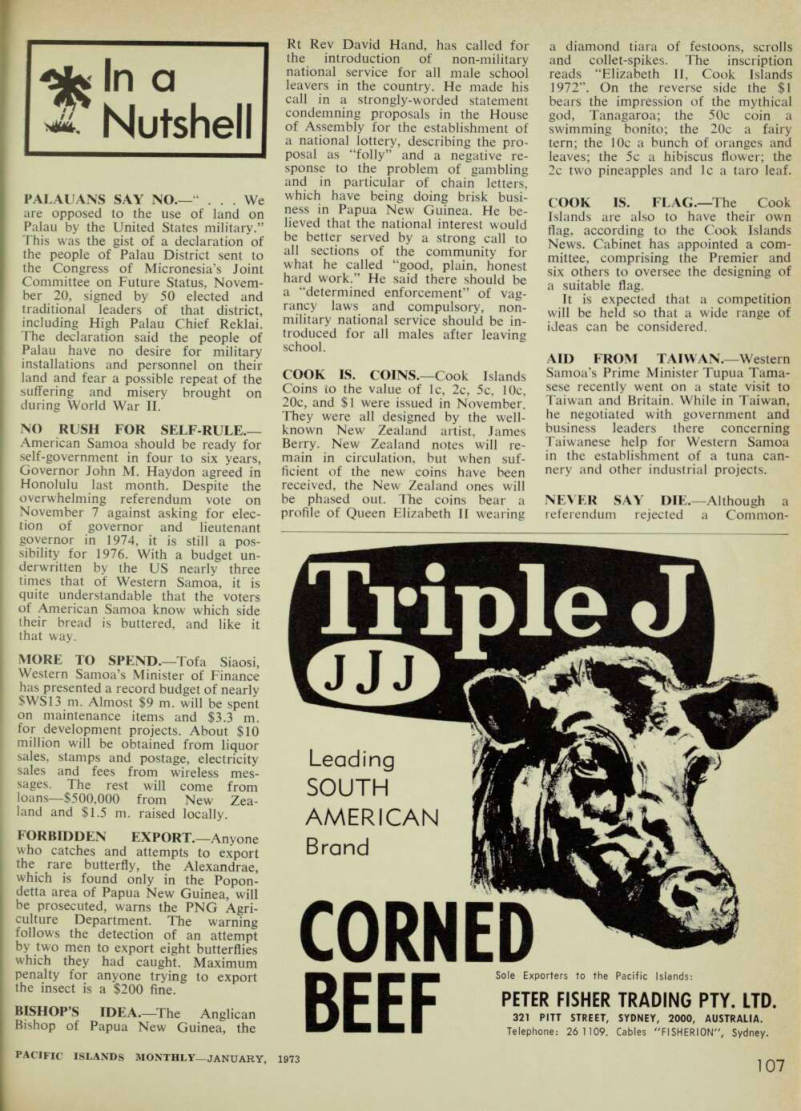
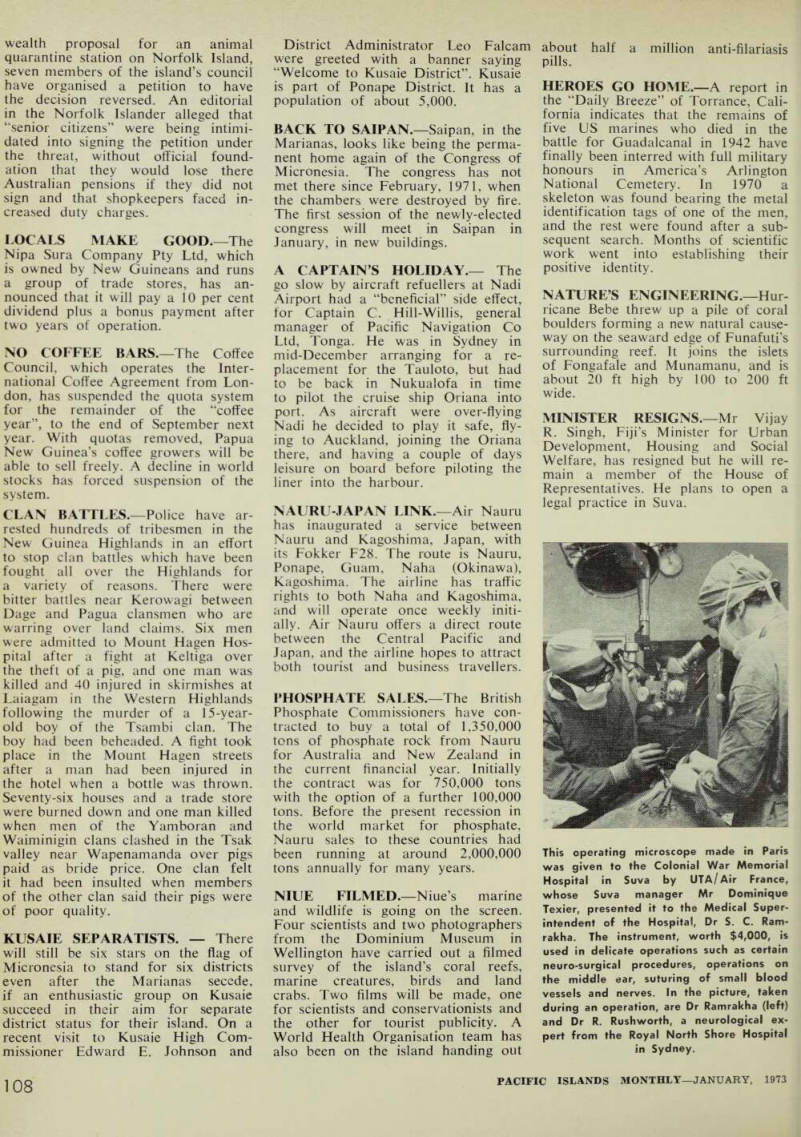
In a Nutshell
Palauans Say No.— ... We
are opposed to the use of land on Palau by the United States military.”
This was the gist of a declaration of the people of Palau District sent to the Congress of Micronesia’s Joint Committee on Future Status, Novem ber 20, signed by 50 elected and traditional leaders of that district, including High Palau Chief Reklai.
The declaration said the people of Palau have no desire for military installations and personnel on their land and fear a possible repeat of the suffering and misery brought on during World War 11.
No Rush For Self-Rule.—
American Samoa should be ready for self-government in four to six years, Governor John M. Haydon agreed in Honolulu last month. Despite the overwhelming referendum vote on November 7 against asking for elec tion of governor and lieutenant governor in 1974, it is still a pos sibility for 1976. With a budget un derwritten by the US nearly three times that of Western Samoa, it is quite understandable that the voters of American Samoa know which side their bread is buttered, and like it that way.
MORE TO SPEND.—Tofa Siaosi, Western Samoa’s Minister of Finance has presented a record budget of nearly SWSI3 m. Almost $9 m. will be spent on maintenance items and $3.3 m. for development projects. About $lO million will be obtained from liquor sales, stamps and postage, electricity sales and fees from wireless mes sages. The rest will come from loans—ssoo,ooo from New Zea land and $1.5 m. raised locally.
Forbidden Export.—Anyone
who catches and attempts to export the rare butterfly, the Alexandrae, which is found only in the Popon detta area of Papua New Guinea, will be prosecuted, warns the PNG Agri culture Department. The warning follows the detection of an attempt by two men to export eight butterflies which they had caught. Maximum penalty for anyone trying to export the insect is a $2OO fine.
BISHOP’S IDEA.—The Anglican Bishop of Papua New Guinea, the
Rt Rev David Hand, has called for the introduction of non-military national service for all male school leavers in the country. He made his call in a strongly-worded statement condemning proposals in the House of Assembly for the establishment of a national lottery, describing the pro posal as “folly” and a negative re sponse to the problem of gambling and in particular of chain letters, which have being doing brisk busi ness in Papua New Guinea. He be lieved that the national interest would be better served by a strong call to all sections of the community for what he called “good, plain, honest hard work.” He said there should be a “determined enforcement” of vag rancy laws and compulsory, non military national service should be in troduced for all males after leaving school.
COOK IS. COINS.—Cook Islands Coins to the value of Ic, 2c, sc, 10c, 20c, and $1 were issued in November.
They were all designed by the well known New Zealand artist, James Berry. New Zealand notes will re main in circulation, but when suf ficient of the new coins have been received, the New Zealand ones will be phased out. The coins bear a profile of Queen Elizabeth II wearing
a diamond tiara of festoons, scrolls and collet-spikes. The inscription reads “Elizabeth 11, Cook Islands 1972”. On the reverse side the SI bears the impression of the mythical god, Tanagaroa; the 50c coin a swimming bonito; the 20c a fairy tern; the 10c a bunch of oranges and leaves; the 5c a hibiscus flower; the 2c two pineapples and 1c a taro leaf.
Cook Is. Flag.—The Cook
Islands are also to have their own flag, according to the Cook Islands News. Cabinet has appointed a com mittee, comprising the Premier and six others to oversee the designing of a suitable flag.
It is expected that a competition will be held so that a wide range of ideas can be considered.
AID FROM TAlWAN.—Western Samoa’s Prime Minister Tupua Tama sese recently went on a state visit to Taiwan and Britain. While in Taiwan, he negotiated with government and business leaders there concerning Taiwanese help for Western Samoa in the establishment of a tuna can nery and other industrial projects.
NEVER SAY DlE.—Although a referendum rejected a Common
wealth proposal for an animal quarantine station on Norfolk Island, seven members of the island’s council have organised a petition to have the decision reversed. An editorial in the Norfolk Islander alleged that “senior citizens” were being intimi dated into signing the petition under the threat, without official found ation that they would lose there Australian pensions if they did not sign and that shopkeepers faced in creased duty charges.
Locals Make Good.—The
Nipa Sura Company Pty Ltd, which is owned by New Guineans and runs a group of trade stores, has an nounced that it will pay a 10 per cent dividend plus a bonus payment after two years of operation.
NO COFFEE BARS.— The Coffee Council, which operates the Inter national Coffee Agreement from Lon don, has suspended the quota system for the remainder of the “coffee year”, to the end of September next year. With quotas removed, Papua New Guinea’s coffee growers will be able to sell freely. A decline in world stocks has forced suspension of the system.
CLAN BATTLES. —PoIice have ar rested hundreds of tribesmen in the New Guinea Highlands in an effort to stop clan battles which have been fought all over the Highlands for a variety of reasons. There were bitter battles near Kerowagi between Dage and Pagua clansmen who are warring over land claims. Six men were admitted to Mount Hagen Hos pital after a fight at Keltiga over the theft of a pig, and one man was killed and 40 injured in skirmishes at Laiagam in the Western Highlands following the murder of a 15-year old boy of the Tsambi clan. The boy had been beheaded. A fight took place in the Mount Hagen streets after a man had been injured in the hotel when a bottle was thrown.
Seventy-six houses and a trade store were burned down and one man killed when men of the Yamboran and Waiminigin clans clashed in the Tsak valley near Wapenamanda over pigs paid as bride price. One clan felt it had been insulted when members of the other clan said their pigs were of poor quality.
Kusaie Separatists. There
will still be six stars on the flag of Micronesia to stand for six districts even after the Marianas secede, if an enthusiastic group on Kusaie succeed in their aim for separate district status for their island. On a recent visit to Kusaie High Com missioner Edward E. Johnson and
District Administrator Leo Falcam were greeted with a banner saying “Welcome to Kusaie District”. Kusaie is part of Ponape District. It has a population of about 5,000.
BACK TO SAlPAN.— Saipan, in the Marianas, looks like being the perma nent home again of the Congress of Micronesia. The congress has not met there since February, 1971, when the chambers were destroyed by fire.
The first session of the newly-elected congress will meet in Saipan in January, in new buildings.
A Captain’S Holiday.— The
go slow by aircraft refuellers at Nadi Airport had a “beneficial” side effect, for Captain C. Hill-Willis, general manager of Pacific Navigation Co Ltd, Tonga. He was in Sydney in mid-December arranging for a re placement for the Tauloto, but had to be back in Nukualofa in time to pilot the cruise ship Oriana into port. As aircraft were over-flying Nadi he decided to play it safe, fly ing to Auckland, joining the Oriana there, and having a couple of days leisure on board before piloting the liner into the harbour.
Nauru-Japan Link.— Air Nauru
has inaugurated a service between Nauru and Kagoshima, Japan, with its Fokker F2B. The route is Nauru, Ponape, Guam, Naha (Okinawa), Kagoshima. The airline has traffic rights to both Naha and Kagoshima, and will operate once weekly initi ally. Air Nauru offers a direct route between the Central Pacific and Japan, and the airline hopes to attract both tourist and business travellers.
PHOSPHATE SALES.— The British Phosphate Commissioners have con tracted to buy a total of 1,350,000 tons of phosphate rock from Nauru for Australia and New Zealand in the current financial year. Initially the contract was for 750,000 tons with the option of a further 100,000 tons. Before the present recession in the world market for phosphate, Nauru sales to these countries had been running at around 2,000,000 tons annually for many years.
NIUE FlLMED. —Niue’s marine and wildlife is going on the screen.
Four scientists and two photographers from the Dominium Museum in Wellington have carried out a filmed survey of the island’s coral reefs, marine creatures, birds and land crabs. Two films will be made, one for scientists and conservationists and the other for tourist publicity. A World Health Organisation team has also been on the island handing out
about half a million anti-filariasis pills.
HEROES GO HOME.— A report in the “Daily Breeze” of Torrance, Cali fornia indicates that the remains of five US marines who died in the battle for Guadalcanal in 1942 have finally been interred with full military honours in America’s Arlington National Cemetery, In 1970 a skeleton was found bearing the metal identification tags of one of the men, and the rest were found after a sub sequent search. Months of scientific work went into establishing their positive identity.
Nature’S Engineering.—Hur
ricane Bebe threw up a pile of coral boulders forming a new natural cause way on the seaward edge of Funafuti’s surrounding reef. It joins the islets of Fongafale and Munamanu, and is about 20 ft high by 100 to 200 ft wide.
Minister Resigns.—Mr Vijay
R. Singh, Fiji’s Minister for Urban Development, Housing and Social Welfare, has resigned but he will re main a member of the House of Representatives. He plans to open a legal practice in Suva.
This operating microscope made in Paris was given to the Colonial War Memorial Hospital in Suva by UTA/Air France, whose Suva manager Mr Dominique Texier, presented it to the Medical Super intendent of the Hospital, Dr S. C. Ram rakha. The instrument, worth $4,000, is used in delicate operations such as certain neuro-surgical procedures, operations on the middle ear, suturing of small blood vessels and nerves. In the picture, taken during an operation, are Dr Ramrakha (left) and Dr R. Rushworth, a neurological ex pert from the Royal North Shore Hospital in Sydney.
Advertisements & other items, p. 113 (1 item)
Triple J
L j J j j* A. i Leading
SOUTH
AMERICAN
Brand
CORNED
BEEF
Sole Exporters to the Pacific Islands:
PETER FISHER TRADING PTY. LTD.
321 PITT STREET, SYDNEY, 2000, AUSTRALIA.
Telephone: 26 1109. Cables "FI SHERI ON", Sydney.
Islands People
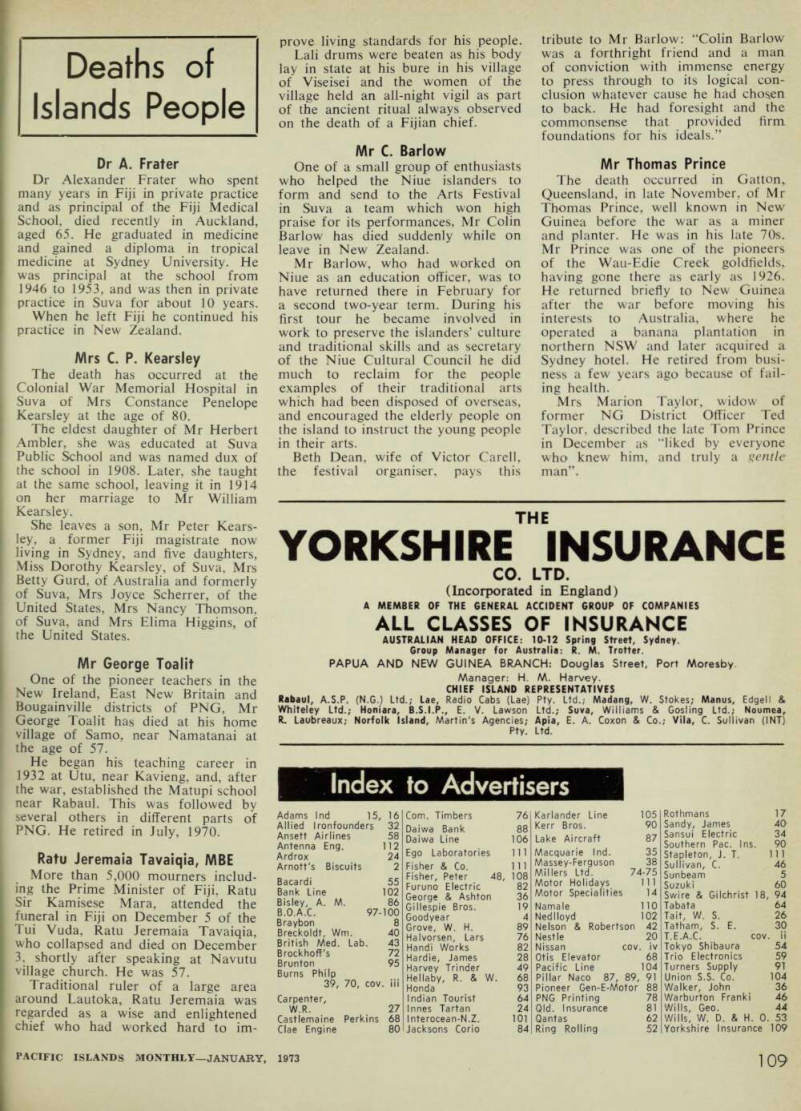
Deaths of Islands People
Dr A. Prater Dr Alexander Frater who spent many years in Fiji in private practice and as principal of the Fiji Medical School, died recently in Auckland, aged 65. He graduated in medicine and gained a diploma in tropical medicine at Sydney University. He was principal at the school from 1946 to 1953, and was then in private practice in Suva for about 10 years.
When he left Fiji he continued his practice in New Zealand.
Mrs C. P. Kearsley The death has occurred at the Colonial War Memorial Hospital in Suva of Mrs Constance Penelope Kearsley at the age of 80.
The eldest daughter of Mr Herbert Ambler, she was educated at Suva Public School and was named dux of the school in 1908. Later, she taught at the same school, leaving it in 1914 on her marriage to Mr William Kearsley.
She leaves a son, Mr Peter Kears ley, a former Fiji magistrate now living in Sydney, and five daughters, Miss Dorothy Kearsley, of Suva, Mrs Betty Gurd, of Australia and formerly of Suva, Mrs Joyce Scherrer, of the United States, Mrs Nancy Thomson, of Suva, and Mrs Elima Higgins, of the United States.
Mr George Toalit One of the pioneer teachers in the New Ireland, East New Britain and Bougainville districts of PNG, Mr George Toalit has died at his home village of Samo, near Namatanai at the age of 57.
He began his teaching career in 1932 at Utu, near Kavieng, and, after the war, established the Matupi school near Rabaul. This was followed by several others in different parts of PNG. He retired in July, 1970.
Ratu Jeremaia Tavaiqia, MBE More than 5,000 mourners includ ing the Prime Minister of Fiji, Ratu Sir Kamisese Mara, attended the funeral in Fiji on December 5 of the Tui Vuda, Ratu Jeremaia Tavaiqia, who collapsed and died on December 3, shortly after speaking at Navutu village church. He was 57.
Traditional ruler of a large area around Lautoka, Ratu Jeremaia was regarded as a wise and enlightened chief who had worked hard to im
prove living standards for his people.
Lali drums were beaten as his body lay in state at his bure in his village of Viseisei and the women of the village held an all-night vigil as part of the ancient ritual always observed on the death of a Fijian chief.
Mr C. Barlow One of a small group of enthusiasts who helped the Niue islanders to form and send to the Arts Festival in Suva a team which won high praise for its performances, Mr Colin Barlow has died suddenly while on leave in New Zealand.
Mr Barlow, who had worked on Niue as an education officer, was to have returned there in February for a second two-year term. During his first tour he became involved in work to preserve the islanders’ culture and traditional skills and as secretary of the Niue Cultural Council he did much to reclaim for the people examples of their traditional arts which had been disposed of overseas, and encouraged the elderly people on the island to instruct the young people in their arts.
Beth Dean, wife of Victor Carell, the festival organiser, pays this
tribute to Mr Barlow: “Colin Barlow was a forthright friend and a man of conviction with immense energy to press through to its logical con clusion whatever cause he had chos.en to back. He had foresight and the commonsense that provided firm foundations for his ideals.”
Mr Thomas Prince The death occurred in Gatton, Queensland, in late November, of Mr Thomas Prince, well known in New Guinea before the war as a miner and planter. He was in his late 70s.
Mr Prince was one of the pioneers of the Wau-Edie Creek goldfields, having gone there as early as 1926.
He returned briefly to New Guinea after the war before moving his interests to Australia, where he operated a banana plantation in northern NSW and later acquired a Sydney hotel. He retired from busi ness a few years ago because of fail
ing health.
Mrs Marion Taylor, widow of former NG District Officer Ted Taylor, described the late Tom Prince in December as “liked by everyone who knew him, and truly a gentle man”.
Index to Advertisers
Adams Ind 15, 16 Allied Ironfounders 32 Ansett Airlines 58 Antenna Eng. 112 Ardrox 24 Arnott's Biscuits 2 Bacardi 55 Bank Line 102 Bisley, A. M. 86 8.0.A.C. 97-100
Braybon 8
Breckoldt, Wm. 40 British Med. Lab. 43 Brockhoff's 72 Brunton 95 Burns Philp 39, 70, cov. iii Carpenter, W.R. 27 Castlemaine Perkins 68 Clae Engine 80
Com. Timbers 76 Daiwa Bank 88 Daiwa Line 106 Ego Laboratories 111 Fisher & Co. 11l Fisher, Peter 48, 108 Furuno Electric 82 George & Ashton 36 Gillespie Bros. 19 Goodyear 4 Grove, W. H. 89 Halvorsen, Lars 76 Handi Works 82 Hardie, James 28 Harvey Trinder 49 Hellaby, R. & W. 68 Honda 93 Indian Tourist 64 Innes Tartan 24 Interocean-N.Z. 101 Jacksons Corio 84
Karlander Line 105 Kerr Bros. 90 Lake Aircraft 87 Macquarie Ind. 35 Massey-Ferguson 38 Millers Ltd. 74-75 Motor Holidays 111 Motor Specialities 14 Namale 110 Nedlloyd 102 Nelson & Robertson 42 Nestle 20 Nissan cov. iv Otis Elevator 68 Pacific Line 104 Pillar Naco 87, 89, 91 Pioneer Gen-E-Motor 88 PNG Printing 78 Qld. Insurance 81 Qantas 62 Ring Rolling 52
Rothmans 17 Sandy, James 40 Sansui Electric 34 Southern Pac. Ins. 90 Stapleton, J. T. 11l Sullivan, C. 46 Sunbeam 5 Suzuki 60 Swire & Gilchrist 18, 94 Tabata 64 Tait, W. S. 26 Tatham, S. E. 30 T.E.A.C. cov. ii Tokyo Shibaura 54 Trio Electronics 59 Turners Supply 91 Union S.S. Co. 104 Walker, John 36 Warburton Franki 46 Wills, Geo. 44 Wills, W. D. & H. 0. 53 Yorkshire Insurance 109
Advertisements & other items, pp. 115-120 (4 items)
109
PACIFIC ISLANDS iMONTHLY—JANUARY, 1973
Yorkshire Insurance
THE
CO. LTD.
(Incorporated in England)
A MEMBER OF THE GENERAL ACCIDENT GROUP OF COMPANIES
ALL CLASSES OF INSURANCE
AUSTRALIAN HEAD OFFICE: 10-12 Spring Street, Sydney.
Group Manager for Australia: R. M. Trotter.
PAPUA AND NEW GUINEA BRANCH: Douglas Street, Port Moresby.
Manager: H. M. Harvey.
CHIEF ISLAND REPRESENTATIVES
Rabaul, A.S.P. (N.G.) Ltd.; Lae, Radio Cabs (Lae) Pty. Ltd.; Madang, W. Stokes; Manus, Edgell & Whiteley Ltd.; Honiara, 8.5.1. P., E. V. Lawson Ltd.; Suva, Williams & Gosling Ltd.; Noumea, R. Laubreaux; Norfolk Island, Martin's Agencies; Apia, E. A. Coxon & Co.; Vila, C. Sullivan (INT) Pty. Ltd.
Wanted
t
Line Advertisements
Per line, 950 Anst.; Minimum rate. 4 lines.
ALL BOOKS AND JOURNALS ON AUST-
RALASIA AND THE PACIFIC BOUGHT
AND SOLD. Catalogues issued and sent free on application. Correspondence invited. Berkelouw, 15-19 Boundary St., Rushcutters Bay, Sydney, 2011. Phone: 31-8215.
BODEN’S BOAT DESIGNS PTY. LTD.,
695 George St.. Sydney, 2000. Get your Bodens Boat Designs and Boat Building Book from newsagents everywhere. Posted direct 5A2.20 surface mail.
FLEETS trawlers 36 ft. $12,000, 48 ft. $35,000, 50 ft. $30,000, 57 ft. $36,000, also Auxiliary yachts from 22 ft. to 60 feet.
Fleets, Rowe’s Bldg., Edward St., Brisbane.
Cable: Fleets, Brisbane.
CONCRETE BLOCK MACHINE FOR SALE.
Makes blocks, flags, edgings, screen-blocks, garden stools—up to 8 at once and 06 an hour. SAI2O c.i.f. main ports. Send for leaflets. Forest Farm Research, Londonderry, N.S.W., 2753.
C. S. & JOHNSON YOUNG CO, 191 Johnston Rd, Hong Kong, G.P.O. Box 423.
Import: Fungus, sharkfin, M.O.P. shell, beche-de-mer. Export: Lamps, fishing appliances, enamelware, garments, camphorwood chests, footwear.
PENFRIENDS GALORE. Make new friends worldwide! For details, write now: Five Colntinents Company Ltd., P.O. Box 21219, Henderson, New Zealand.
STAMPS WANTED. Used stamps on paper from residents, banks, charities, schools, missions, etc. of Pacific Islands. Write stating weight and price to R. H. Cowley, c/o Post Office, Nightcliff, Northern Territory 5792, Australia.
PROMPT MAIL ORDER SERVICE. Save
up to 20% on exotic jewellery, pewter wares, ladies wigs. Write today for prices and brochures. Bilson Koh Corp, 329 D Mei Ling St, Singapore 3.
POSITION WANTED
Married couple, late 20s, no family ties, seek position Pacific Islands. Husband farming 4 years. Department of Agriculture 3 years, landscape contracting, also licensed cinema projectionist. Wife 7 years Social- Worker, Health Department.
Any position considered. Please reply: H. B.
Walker, 121 Muir Avenue, Mangere Bridge, Auckland, New Zealand.
VISITING BRISBANE?
Stay at TOWER MILL MOTEL. First class air-conditioned accommodation, T.V., private bathroom and verandah with a delightful view. Two restaurants.
From $lO.OO per day.
Book through your Travel Agent or Airline office or direct to 239, Wickham Terrace, Brisbane. Telephone 31-1421.
Stay at —
JOHN OXLEY
MOTEL
491 WICKHAM TERRACE,
BRISBANE.
(750 yards City Hall) Every possible facility.
At very sensible rates.
SEND FOR BROCHURE
1
SITUATION WANTED
HOTEL MANAGER
EXPERIENCED HOTEI/MOTEL
MANAGER seeks position anywhere in Pacific Islands. London trained in Hotel Management and a qualified Chef. Has previous S.P. Hotel experience. Own fare paid to point of engagement.
Please reply to: — Mr. R. C. Wilson, P.O. Box 108, Whangarei, New Zealand.
PARK VIEW MOTEL—BRISBANE
Quiet location—opp. Botanic Gardens.
Single, double, family suites, all with ref rig., air conditioning, phone, TV, radio, tea making facilities, from $lO. Pool and restaurant.
Phone 31-2695—Telex 40270.
Write for coloured brochure— Park View Motel, 128 Alice St, BRISBANE, Qld., 4000.
ESCAPE
FROM THE ORDINARY
Here is an idyllic paradise where you can enjoy the unspoiled beauty and serenity of a working coconut plantation. This privatelyowned Pacific retreat has been designed for a maximum of 12 people. Gracious surroundings, friendly service, relaxed accommodations with Fijian decor and American conveniences.
Activities available include: Deep sea fishing, reef and shell hunting, skin diving and snorkeling, water skiing, hiking, turf tennis court, badminton, horseback riding, and a beautiful tropical garden to relax in.
Send for free brochure: The Manager,
NAMALE PLANTATION,
SAVUSAVU, FIJI ISLANDS
WANTED
BUTTERFLIES, THE
LARGER MOTHS,
COLOURFUL OR LARGE
BEETLES, LARGE
INSECTS.
From ail regions of the Pacific Islands.
Good prices for good quality material.
Collectors who know how to pack for shipment please write to: BUTTERFLY WORLD, 51-17 Rockaway Beach Blvd, Far Rockaway, New York
11691, U.S.A.
sviixcourt
real
estate
mreinz estate as an investment, for vacations or retirement.
Anywhere in New Zealand' Write us: P.O. Box 22, Taupo. Phone 674 New Zealand
WANTED
FREEHOLD LAND
Am interested in buying a large tract of freehold land in the South Pacific.
Might pay cash. Please write: "PAM", c/- G.P.O.
Box 3408, Sydney, N.S.W. 2001, Australia.
• 5 • . m a ::jjs
Stay at a Cosmopolitan Inn -Sydney
Situated in charming Double Bay only 10 minutes from the city. Surrounded by bistros, boutiques and delightful covered walks. Close to harbour. Air-conditioned.
All rooms with bath, TV, radio, refrigerator, phone. Roof-top heated pool. Car park. There’s a Cosmopolitan Motor Inn at Bondi Beach too.
SEND FOR COLOUR BROCHURE.
Cosmopolitan Motor Inns Ply. Ltd. Central Booking Office, Knox Street, Double Bay.
Phone; 36 6871. Telegrams: COSINN.
Telex: 21187.
MOTOR HOLIDAYS (N.Z.) LTD.
PIONEERS
FOLLOWING THE
SUN SINCE '6l
COMPETITIVE RATES
HIRE MOTOR
CARAVANS FROM $3O
PER WEEK
PLUS 10c PER MILE
NORTH - SOUTH
FERRY BOOKINGS
AVAILABLE
SPECIALISTS IN
FULLY-EQUIPPED
MOTOR CARAVAN
TOURIST RENTALS
AVAILABLE FROM
AUCKLAND AND
CHRISTCHURCH
BOOK YOUR HOLIDAY
TOUR NOW
BOOKINGS AND ENQUIRIES
412 MT. EDEN ROAD, AUCKLAND. PHONE 600-288
NEW ZEALAND exporter of frozen meats offers merchants with refrigerated space facilities regular quotations, personalised service and wide supply access.
Write LEN R. HARLAND LTD., P.O. Box 289, New Plymouth, New Zealand. Cables:
"CANLEN".
AT A LOSS
TO COMFORT BABY?
Those distressing symptoms that come with teething troubles—sore gums, digestive disorders, intestinal upsets, can be, if used as directed, safely and quickly soothed with Fisher's Teething Powders. You'll be delighted at what an effective and soothing aid they are to baby— and when baby's happy your upsets and nervous tension will be soothed, too. Fisher's Teething Powders are available from your chemist or store, only 30c for 20 powders. Fisher & Co., Manufacturing Chemists (Est. 1876), 17 May St., St. Peters, N.S.W. 2044.
PIM 809/72
YOUR NEXT LEAVE
Modern up to the minute homes at Palm Beach, Avalon, Newport, Church Point, Mona Vale, etc., available to Island Residents for Holidays. Write for information to:—
J. T. STAPLETON PTY. LTD.
ESTATE AGENTS,
133 PITT STREET, SYDNEY, 2000. 25-5305, 25-1737 also Box 32, P. 0., Avalon Beach, Sydney 2107. 918-2221.
FOR SALE
66 FT. WORKBOAT $24,500 AUST.
★ Accom. for 6 —Gas Stove and Refrigerator * 30 Ton Hold —1£ Ton Derrick ★ 10 Ton Heavy Lift Winch + 18 Ft. Beam x 6' 6" Drft.—Hardwood Const. ★ 160 HP Hercules Diesel + Two H HP Petter Auxiliaries * Crammond Radio — Kelvin Hughes Sounder + Atlas Copco Diving Compressor Suitable for Use to 200
INSPECT AT VILA, NEW HEBRIDES
B. L. May, 16 Belgrave St., Manly 2095, Australia P. Wells, Box 166, Vila, New Hebrides
INVESTMENT OPPORTUNITY
INDUSTRIAL LAND FOR SALE
LIVERPOOL, AUSTRALIA
Half-acre industrial sites, level, all services. Priced from $A27,230.
Excellent capital gain prospects. Contact K. Anderson: Ronald Lyon Australia Pty. Ltd., 139 Macquarie St., Sydney, N.S.W GPO Box 4436, Sydney 2001.
ANTENNAS
for any purpose
tenna Engineering Australia a specialist company set up to ign, manufacture and install a wide range of antenna equipment 1 comprehensive engineering facilities include a modern test range <ilsyth, Victoria. -- -y—\ is continually engaged in new development engineering to vide unique and successful solutions to your radio transmission blems can design, manufacture and install your complete antenna tern.
INTENNA EQUIPMENT for—
Cadio Communications HF VHF Aobile systems land, sea or air oint to point services Aicrowave systems Ailitary systems to DBF specifications broadcasting Sound and Vision Javigational Aids
UHF
(CILIARY
HPMENT
;rs HF-VHF-UHF
exers and Aulticouplers leband RF ransformers, aluns xial loads and erminations enna Tuners and Couplers xial feeders and Connectors port Structures nd Hardware 4.1 -
IMR
Fig. 1.
Monitoring ontenr 300-3000 MHz c: polarization direct antenna Fig. 2.
Satellite receiving ante 138 MHz crossed yagii array Fig. 3.
Plane-Parabola wave dipole) 400-480 MHz 15db gain (ref. hr
UHF LINKS
A range of unidirectional antennas for 400 MHz to 7 GHz Yagis (27 to 1000 MHz Corner reflectors Plane parabolas Grid parabolas Spun parabolas X X -t * Fig. 4.
Mesh Parabolo 450-470 MHz 15 foot diarriif gives high gaii low wind loadii low side lobess
eliable equipment for the toughest conditio
ENNA ENGINEERING AUSTRALIA PTY. LTD., P.o. BOX 191, CROYDON, VIC., 3136. Phone (03) 7288 and also at P.O. BOX 14-151. WELLINGTON, N.Z. Phone 87-761
BURNS PHILP (NEW GUINEA) LIMITED
GENERAL MERCHANTS
SHIPPING AND CUSTOMS AGENTS
Head Office: Champion Parade, Port Moresby.
PHONE: 2202. TELEX: PAAII6. CABLE ADDRESS; BURPHIL.
BRANCHES;
V
BOROKO
BULOLO
DARU
GOROKA
KAINANTU
KAVIENG
PAPUA NEW GUINEA
KIETA PORT MORESBY
KOKOPO
LAE
MADANG
MT. HAGEN
POPONDETTA
RABAUL
SAMARAI
WAU
WEWAK
Subsidiary Companies Hotel Moresby Ltd.
Ela Motors Ltd.
Local Laundries Ltd.
Moresby Hire Services Ltd.
Papua Hotel Ltd.
The B.N.G. Trading Co. Ltd.
The Port Moresby Freezing Co. Ltd.
Overseas Agents Burns, Philp & Co. Ltd. All Aust. States.
Burns, Philp & Co. Ltd., London.
Burns-Philp Co. of San Francisco.
Burns Philp (South Sea) Co. Ltd.
Burns Philp (New Hebrides) Ltd.
Agents for Burns Philp Trustee Co. Ltd.
Queensland Insurance Co. Ltd.
Loyds of London.
Stewarts & Lloyds (Australia) Pty. Ltd.
Shell Company (Pacific Islands) Ltd.
Distributorships include
British Paints Buckingham & Carnatic Textiles Byford Products Citizen Watches "CeCoCo" Machinery Conditionaire Air Curtain Doors Guerlain Parfums Hardie's Building Products Heuga Carpet Tiles Jean Patou Parfums "John" Valves Johnson Ceramic Tiles Kienzle Clocks Marcel Rochas Parfums Mikimoto Pearls National Radios & Appliances Noritake Chinaware Rolex Watches Ronson Products Rover Power Mowers Sunbeam Appliances, Mowers & Rural Products Exporters of Coffee & Cocoa Beans, Peanuts, Rubber Shipping Agents for Bank Line Ltd.
Campagnie Des Messageries Maritimes Chandris Line Cogedar Line Containers Pacific Express Line Cunard Steamships Co. Ltd.
Eastern & Australian Steamship Co. Ltd.
P & O Lines of Australia Pty. Ltd.
Nederland Line Royal Dutch Mail Societe Francaise de Navigation The French Line Union Steam Ship Co. of N.Z. Ltd.
N.Y.K. Line Airline Agents for Ansett Airlines Qantas Airways Ltd.
Trans-Australia Airlines International Air Transport Association Representatives Travel Department For World Wide Travel 9
URNS PHILP (New Guinea) Ltd.
FOR SERVICE AND REAL VALUE
nTTETrr.I !■««» 4k m'£ I* * r H -v- -1% ..# % ST p :/%r
Mttil
I Hi® 1% i
And wherever you’ll go in over 120 nations throughout the world you’ll find proud DATSUN drivers.
Perhaps the main reason is that DATSUN was designed to meet a wide variety of conditions—mountain roads and super highways, blistering suns and freezing temperatures. DATSUN is indeed the international car that has precision engineering and a stunning string of rally victories behind it.
Its superb handling, safety features and high speed efficiency make DATSUN the choice of young and old alike. DATSUN— the car that really satisfies the world over.
DATSUN
NISSAN
sus satitlSlSil |i
e m I Sam fc - DATSUN distributor network covers the following areas: Fiji*T.P.N.G.*W. Samoa*New Caledonia• New Hebrides* B.S.l.P.'Timor*Norfolk* / A Comno .TotiUi.f'nAlf .Mourn. Tnmrn.Sflinnn.nnam. Ailafr»li».N<>V Zpaland
Published by PACIFIC PUBLICATIONS (AUST.) PTY. LTD.. 29 Alberta Street. Sydney, 2000. (Telephone: 61-91971 Wholly set ui
and printed in Australia by The Sydney and Melbourne Publishing Co. Pty. Ltd., 29 Alberta Street, Sydney, 2000 REGISTERED AT THE OPO SYDNEY FOR TRANSMISSION BY POST AS A NEWSPAPER CATEGORY B Australian price given on the front cover is recommended Australian retail price only.