PiM'iiu* Islands Mon I lib

News Magazine Of The South Pacific
December, 1972
Australia, Nz, Geic, Bsip 50C
PNG, FIJI, COOKS, TONGA, W. SAMOA, N. HEBRIDES 45c
Nauru, Norfolk, Niue 45C
American Samoa 70C Hawaii, Micronesia $L.Oo
NEW CALEDONIA 65 CFP FRENCH POLYNESIA 100 CFP
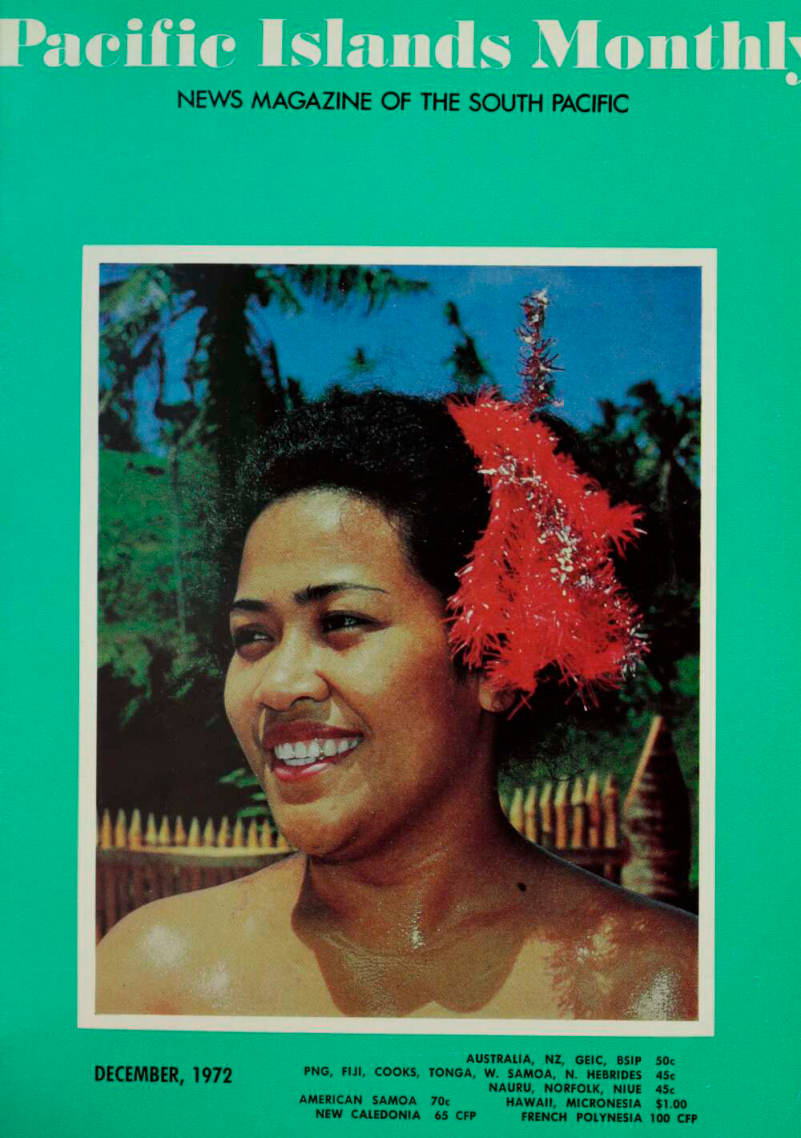
Our Cover
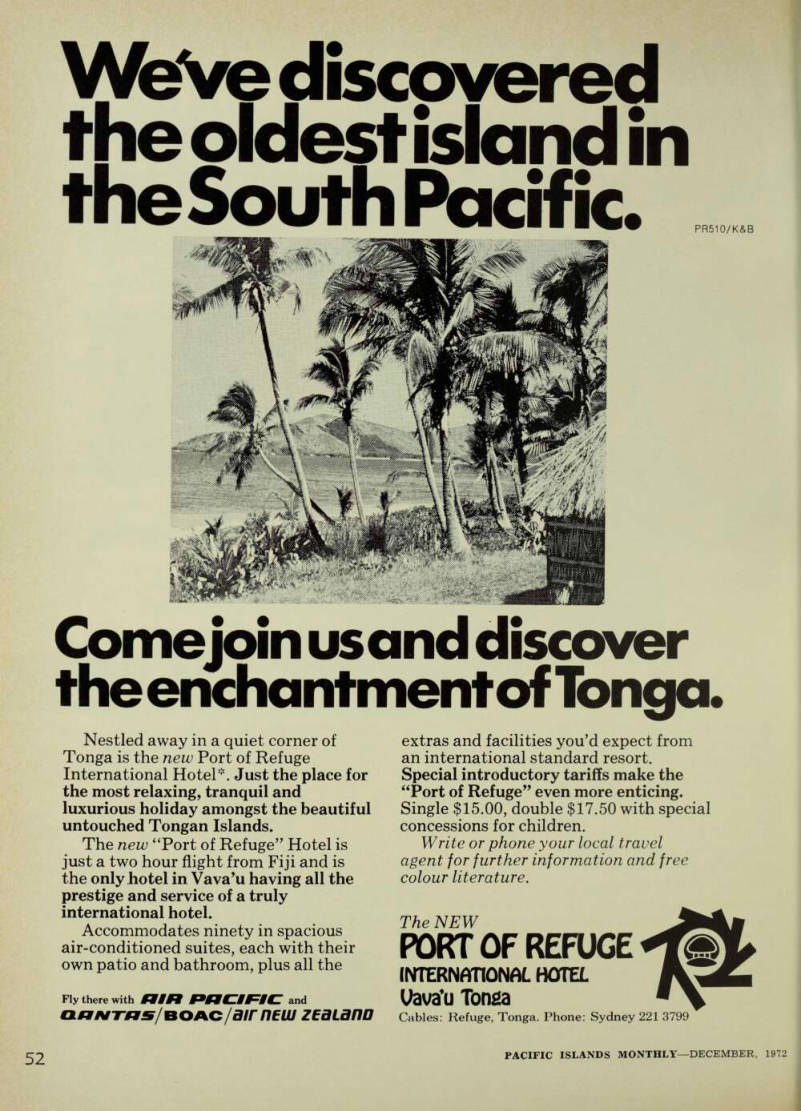
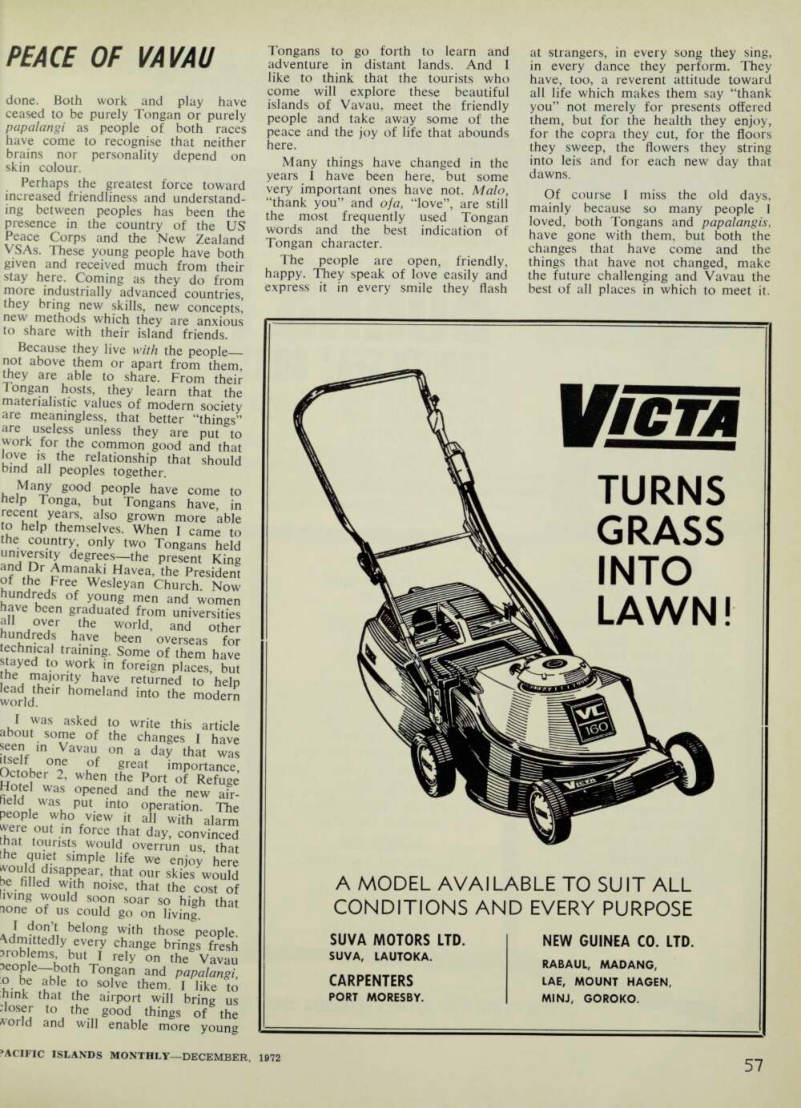
Vavau, Tonga is coming to the fore lately. Following the opening of the Port of Refuge Hotel, featured in PIM last month, we present long-time Vavau resident Patricia Matheson’s reflections on the winds of change there (inside, p 53). Q ant as photographer Warren Clarke captured this shot of an un-named Tongan dancer during the festivities which marked the hotel’s debut.
Advertisements & other items, p. 2 (1 item)
Double Your
Pleasure
New Toyota Corolla Buy two Toyotas. The Toyota Corolla on top. The Toyota Celica below. You get a big double combination.
That a single car can't give you. For more or less the same price. You get twice the beauty, power and economy. The Corolla really skips along. With famous Toyota good mileage. The Celica skips and skimps about the same. And you have a choice of five youthful, sporty models. But in both cars you get: Fresh air flow-through ventilation. Thick fully reclining front bucket seats. Safety padded interior.
Unit construction. Plus two Toyotas.
New Toyota Celica ■
IBS
PAPUA NEW GUINEA; ELA MOTORS LIMITED. Scratchier Pd 53d i. Papua U.S. TRUST TERRITORY CORPORATION. P.O. Box 267.Saipan FIJI ISLANDS: AUTOMOTIVE SUPPLIES CO. LTD , G.P.O. Box 355, Su. a AMERICAN SAMOA: B L RNS (SOUTH SEP) CO., LTD..Page Page WESTERN SAMOA. B URNS PhilP (SOUTH SEAI LTD . P O Box 188, Apia GUAM: RICKY's AUTO CO., P.O. Box 1458. Agana NEW HEBRIDES: NEW HEBRIDES MOTORS HD P C V. a SOLOMON ISLANDS; ZEPHYR SERVICE STATION PTY LTD.. P.O. Box 174, Honiara NEW CALEDONIA: SOCIETE D'IMPORT AT lON AUTOMOBILE DU PACIFIC. B.P. 438. Noumea TAHITI: ETABLISSEMENTS E.A MARTIN & FILS.B P 61 Papeete COOK ISLANDS: COOK ISLANDS TRADING CORPORATION LTD , P.O. Box 92. Rarotonga
TOYOTA
In This Issue
Jeral
rist film 23 ice and the SPC 59 >ther move for Islands line 85 ana expands 87 ricane Bebe hits shipping 87 communications costs 104 companies buy 'planes 105 trade documents ... 109 d year for WRC company 109
:Rican Samoa
ernor to be elected 60
)K Islands
:k death of Nekeare 9 linor crisis 26 lier Henry remains silent 39 hyn's forgotten grave 77 olics borrow from Diwali 19 valu is new Governor-General 22 h penalty gets vote 23 lan chairman of Consumer Assn 24 ie footballers reject guesthouse 25 icils on common roll ... 26
icane report . 29-32
book g 1
ie industry expands 85
seas industry welcomed 101 -' saves potato imports 101 luation hits planters 105 icane-battered budget 120
French Polynesia
James Boyack's Tahiti Letter 14
Gilbert And Ellice Islands
Separation movement 17 Funafuti hurricane 29
Lord Howe
Airstrip decision call 121
Nauru
Aust. High Commissioner 120 Gifts to disaster funds 120
New Caledonia
Helen Rousseau's diary 20 Tourist film 23
New Hebrides
Tourist film 23 Queen to visit? 125 $2 million wharf opens 85 Warning to developers 108
Norfolk Island
Quarantine rejected 121
Papua New Guinea
House of Assembly meeting 11 Famine report 13 What's in a name 17 Tourist film 23 Father Ross' golden jubilee 23 Localisation for Anglicans 25 Percy Chatterton's column 43
First missionaries 69 Wuvulu problem settled 107 Expatriate workers ban 121
Solomon Islands
Constitutional proposals 7 Tourist film 23 Mail for Admiral Halsey 26 Oil palm project . no
Tonga
Change brings problems in Vavau ... 53
U.S. Trust Territory
Eniwetok, et al 9 Marianas want US bases 37 Review: Unity problems 79
Wallis Island
Bishop Poncet's history 81
Western Samoa
Liquor import controversy 22 First novelist 25 Airline squeeze 121
47. L !L^ P 4O r °M Wlth th c e Edit ° r ' 5; Tr °P icalities ' 22; Footnotes, 43; Islands ? • 49; x J Aa 9 az,ne Section, 69; Yesterday, 77; Book Reviews, 79; Pacific n e 9/ p^ e rU m 9 It ' 9 ° ; l° AC jGt NeWS ' 97; Business and Development, 101; Knees, 113; Shipping and Airways Information, 115; In a Nutshell 120- Deaths, 123; Advertisers' Index, 128.
Advertisements & other items, p. 4 (1 item)
(even if your name’s not O’Grady)
How to be
aii expert drink-mixer
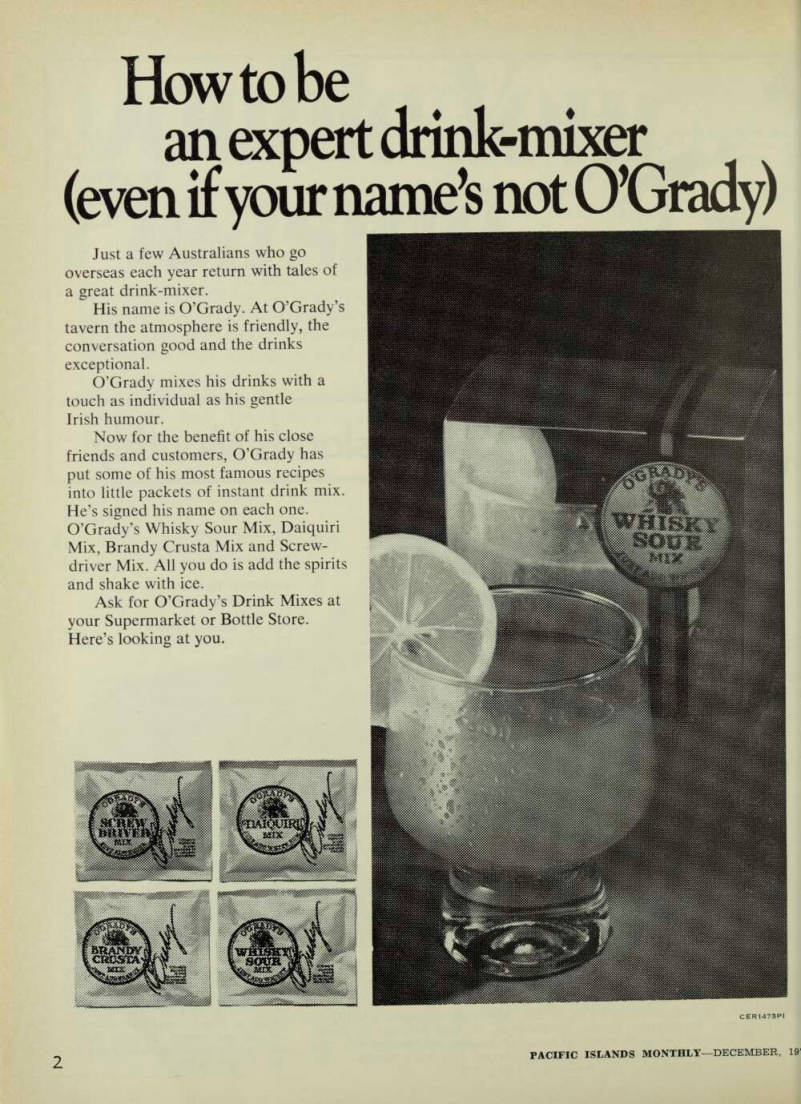
Just a few Australians who go overseas each year return with tales of a great drink-mixer.
His name is O’Grady. At O’Grady’s tavern the atmosphere is friendly, the conversation good and the drinks
exceptional.
O’Grady mixes his drinks with a touch as individual as his gentle Irish humour.
Now for the benefit of his close friends and customers, O’Grady has put some of his most famous recipes into little packets of instant drink mix.
He’s signed his name on each one.
O’Grady’s Whisky Sour Mix, Daiquiri Mix, Brandy Crusta Mix and Screwdriver Mix. All you do is add the spirits and shake with ice.
Ask for O’Grady’s Drink Mixes at your Supermarket or Bottle Store.
Here’s looking at you. t&tx 1
Pacific Islands
Monthly
FOUNDED BY R, W. ROBSON IN 1930
Owned And Published Monthly By
Pacific Publications (Aust.) Pty. Ltd
29 Alberta St., Sydney, N.S.W., 2000!
Postal Address: G.P.O. BOX 3408, SYDNEY
N.S.W., 2001.
Telegraphic Address: PACPUB, Sydney
Telephones: 61-9197, 61-7101, 61-4369.
msultmg Directors: R. W. Robson, Judy Tudor.
Chief Executives: General Manager: Selwyn Hughes Publisher: Stuart Inder.
Director of Advertising: W. A. Gasnier.
Pacific Islands Monthly
Editor: Stuart Inder.
Assistant Editor: John Carter.
Advertising Manager: W. A. Gasnier.
Circulation Manager: Barry Badger.
Subscription Rates:
acific Islands Monthly" is air-freighted to subscribers and agents in the Pacific Islands copies to other areas go by surface mail, stralia (including Lord Howe and Thursday ), 8.5.1. P., Gilbert and Ellice Is.: $5.50 Aust • pua New Guinea, Norfolk Island, Nauru, iga and New Hebrides.- $5.00 Aust.,- New Hand: $5.50 NZ; Fiji, Cook Islands, Niue 1 Western Samoa: $5.00 (local currency)encan Samoa.- $B.OO US; U.S. Mainland! <n/i S X« , Hawail / Micronesia (including im) $12.00 US; New Caledonia: 750 French ific francs; Tahiti and French Polynesia: 1 French Pacific francs; United Kingdom and elsewhere; £3.25.
Representatives
Pac '«£ Publications (Fiji) Ltd., Fiji Times d r" 9, 2 ° Gordon Street, Suva. Tel.: 25601- LA?i S TrSrA Ce T ( T nr - Pde ' and Namol'i , LAUTOKA. Telex: 1144. Tel.: 60-422. ,A a m Guinea: LAE, P.O. Box 227- U / L ' . Ste L ve Simpson, P.O. Box 433 (c/- Rabaul Photographic. Tel.: 2677) ich Polynesia: Distribution-Hachette Paci le, )0 Ave Bruat, Papeete. d Z A ala i n . d: . Pa £if ic Publications, C.P.O. Box ?H-n AuC r- a - nd u 379 ‘ 494 - Representative.- John td.ng. Civic House, 291 Queen St., Auckland, Tel.: 379-494. e park in9 qt°rTit '■ r B ‘ . Graham ' Par k House, Park Street Croydon, CR9 3NP. Tel • 01-6884177. -e eaS F l tlS aP D , ; S (Agencies) Ltd., Cromwell d i.. P,ace ' Lond on, W.C.I. Tel • 42-0661. Cables: WESNEWS, London, DS4 : : c A p d o ert r 9^ Un ;T Sal T M , edia Lorpora ii, L.P.U. Box 46, Tokyo. Te • 666-3mA »r,a : Advertising-Wilke & Co. Ltd 3 37 ms Road, Clayton, Vic., 3168 'Tel • 544-8222. • T' and: Advertising—Beale Media Services St. Fortitude Valley, Qld.,' 1 change of address notices. Form 3579 . . to the above address.) icat !°" t 0 j^ ail at second class postage rates pending at Honolulu, Hawaii. 9
Copyright ©, 1972,
acific Publications (Aust.) Pty. Ltd.
December, 1972 Vol. 43, No. 12
Advertisements & other items, pp. 5-6 (2 items)
Ific Islands Monthly—December. 1972
©nation
A 1 c
TJKACHT
mark
Condensed
M p^i
ENE p
C^EAM
SWEE?
©nation
V^PRODUCT
Now you can enjoy Peacock Full Cream Sweetened Condensed Milk... a top quality condensed milk made by the producers of Carnation Evaporated Milk. It’s on sale at your local store at a value-for-money price
The Qiristonas gift
that clicks...
with everyone
A Kodak Instamatic camera is one gift that clicks with all ages —from nine to ninety.
See the range at your Island dealers. m
Kodak
Instamatic
cameras KODAK (Australasia) PTV. LTD. \ K 614328
Up Front
with the Editor
hen, in 1970, British Solomon ders decided to introduce a imittee system” of government, ;ook a step away from the West er system, some well-wishers long experience of constitutions ' didn’t give it much hope of ing. theory the scheme was okay. It sd reasonable to adopt a type of nment that was related to the nesian way of doing things tting down and talking it over a solution emerges. As old and Dr Charles Fox says, “Melane do things in groups”, ere were a number of critics. I liber one was Honiara business- Eric Lawson, who had served a •er of terms on the old Legislaand who said the new iment would make a wonderful ng ground, but it wasn’t a step ds self-government. Members 1 learn by being on the commit but they wouldn’t get any closer kerning than they had before, he IP Financial Secretary at the Tom Russell, told a Port sby seminar in May, 1970, that ew system was what the Mela is themselves wanted as an ative to “the expensive trappings ministerial system, the prestige offices and houses”, the committee experiment, he ht, the traditional patterns of lesian authority were being syn ed, and it was worth trying out. iting the Solomons on the eve le new council’s launching I everywhere hope, but not over lence, that the experiment would 11, it now seems that the system ’t work. Not well enough to 'ere with. After many noises off over the last 12 months, it is : ormally acknowledged by mem }f the Governing Council them that a cabinet system, under a minister, would be more prac- J report of the BSIP constitu select committee, released in
November (see p 7) proposes that the Solomons establish such a system as the next constitutional step in 1973, and it’s a safe bet that this will now be done.
What went wrong with the com mittee system?
Ideally, said a constitutional report in the Solomons as far back as 1968, what the Solomons needed in its legislature was a system that would make the best use of available leaders; aim at unifying the diverse geo graphical and cultural elements of the protectorate; be in a form readily understandable by the electorate; and as far as possible be in accord with Melanesian custom, and allow for leaders with initiative to emerge with the support of the majority.
The committee system simply has not measured up to that criteria. It has got bogged down in trivialities, and has been unable to keep up with the fast pace needed by governments today. It has stifled leadership rather than promoted it, and Eric Lawson’s doubts were justified. It hasn’t been a big step towards self-government.
Yet it was a brave and necessary attempt, and not completely aban doned. The islanders have indicated in their report that there is still need to find a recipe which will involve traditional leaders in national decision making, and that everybody should go on looking.
Perhaps there is a pot of gold at the end of the constitutional rainbow, JULIUS CHAN, Papua New Guinea’s new Minister for Finance (he was, until a sudden name change a few weeks ago, the Minister for Internal Finance), had something in teresting to say in Sydney in Novem ber about Island attitudes to the well established Western practice of col lective cabinet responsibility and solidarity.
It was at a general news conference I attended (and at which I was im pressed by Mr Chan’s skill and in tegrity in handling a great number of direct and pressing questions from financial journalists). Mr Chan had been in Australia making an effort to
drum up some loan funds, and the response hadn't been too good.
Some of his questioners indicated that there wasn’t exactly confidence in PNG investment opportunities at the moment, as ministers (including PNG’s chief minister), had been uttering all sorts of noises to the effect that projects already signed might be renegotiated (such as Bougainville Copper). Why would anybody want to invest in that climate of uncertainty?
Mr Chan replied that there was no uncertainty; it might sound like it because in New Guinea cabinet ministers were able to give their own opinions publicly, or the opinions of their electorates. New Guinean people understood that what they had to say wasn’t necessarily supported by the cabinet.
This was a fact of New Guinea life, and needed to be understood by people outside.
He agreed, though, that by express ing their personal opinions publicly, ministers could help lose the con fidence of overseas investment, and that there could be an argument for collective responsibility in the PNG cabinet. He personally thought it would come. 1 can hardly wait till it comes. In vestment in PNG has had a bad knocking in recent months. Although it’s natural there should be trade un certainty with an untried government shortly taking full control, the knock ing is overdone. There are and will continue to be good, safe investment opportunities in Papua New Guinea —more, not less. In the long term, PNG must be a major economic force in this area of the world.
When the smoke clears and that fact becomes obvious to all the faint hearts, manv Australian investors will realise they have missed the boat.
But in the meantime, Chief Minister Somare could be getting a better share of investment capital now by keeping a rein on some of his talka tive cabinet ministers who are under mining confidence with word pictures of things that may never happen.
Stuart Inder
Advertisements & other items, pp. 7-8 (2 items)
5
■IC ISLANDS MONTHLY—DECEMBER, 1972
hite-size, cracuer.
araSBSS* 1 *
the man-si.
Cb m
BROCKHOft
* °4 a a □
OZNET
cracker
VERSATILE
the Crisp ’n’ golden Brockhoff Salada snaps into action!
Straight from the pack man-size for big healthy sandwiches. savouries and sippets with soup.
Snap them in four, and Salada serves bite-size for quick tasty nibbles. Oven-crisp Brockhoff Snap them into two for snack-size Salada is three crackers in one.
There’s value, variety and quality in
BROCKHOFF BISCUITS
7913/8 x6 1 / 4
Pacific Islands Monthly
Solomons Want A Chief Minister
And Cabinet (Like Other People!)
From a Honiara correspondent
The Solomons’ experiment in gov nment by committee has proved isuccessful, and the protectorate [Quid move on to the more familiar stem of legislature with a Chief inister and cabinet. That’s the sence of a report by a special select mmittee on constitutional develop ent, which is to be debated in the Dverning Council in November.
The comittee was appointed by the averning Council last November to opose the next steps in the con tutional development of the British lomons, with its population of 1,000 (density of 13 per square le), and its 74 separate languages d diverse cultural conditions.
The committee in fact comprised members of the Governing ►uncil, under the Chief Secretary, r Tom Russell, as chairman, so the ■thcoming debate is unlikely to ange the basic proposals. The next )ve is to give wide publicity to the mmittee’s suggestions before the *t general elections, to be held ween April and May, 1973. The oming council, in July, would then invited to draft a new constitution >ed on its final decisions.
The committee visited all parts of ; Solomons, and took oral and itten submissions. Some members ited South Pacific territories, and ilaysia, the Seychelles and luritius.
Hie present committee system of has been in operation ce 1970. Under it the old Legisla ‘ Council was renamed the Cov ing Council, and comprises 17 :ted members and three ex officio, e council is divided into five corn tees Social Services, Internal airs, Natural Resources, Communi ions and Works, and Commerce I Industry and every council mber has a place on a committee, fhe chairman of each committee has a place on the Finance Corn tee, chaired by the Financial Secre y- Tie Governing Council has both
public and private meetings; in private the various committees are expected to act like ministries, as there is no cabinet system. The method was pro posed by the last council as a way of making practical use of the Islanders’ tradition of “talking towards a de cision”, with everybody involved.
In its report, the select committee says the committee system has not turned out to be particularly cheap or simple. The appointment of chairmen of committees has given invaluable experience in government, but the system is defective because it doesn’t provide for individual leader ship, or co-ordination. Neither the Governing Council sitting in private, nor the Finance Committee, have been “effective substitutes for a cabinet”.
The working of the system has not proved politically easy to explain or to be understood. Private meetings are regarded by the public with “some suspicion”.
The committee comments: “Al though three political parties are in existence it is still uncertain whether the 1973 elections will be conducted on a party basis. There is some feel ing that lack of political parties is an advantage in local circumstances and the opinion is sometimes voiced that they should not be allowed to de velop. Whether or not parties do evolve in the next few years, the next constitution should be such that it is workable with or without a party system.”
The committee still likes the idea of finding some system that will in volve traditional leaders in govern ment-something like Fiji’s Great Council of Chiefs—but it is not cer tain how this can be done. As there is soon to be an expert investigation into local government in the BSIP, the committee suggests there is little use in discussing central and local government relationships meanwhile.
These are the main points of the committee’s report: o The Western Pacific High Com
missioner (who is based in Honiara) should become the Governor of the British Solomon Islands—but also High Commissioner for the New Hebrides. • The Chief Secretary should be come Deputy Governor. • The Governing Council should become the Legislative Assembly, with 24 elected members and three ex officio, and its term of office be in creased from the present three years to four. • The Leader of Government Business should become Chief Minister and select his own cabinet (of not less than four or more than six), who would accept the principle of collective responsibility. • The Governor would appoint as Chief Minister the man who, in the opinion of the assembly, was most likely to have the support of the majority of the assembly. • In the first instance the Governor should preside over the cabinet, but at a time to be announced the Chief Minister should take responsibility. • The present committee system would be replaced by one Standing Advisory Committee of all members except the ministers. This committee would have access to all papers, and would meet before each assembly session and in between times by a rotating quorum of one-third of its members. It would be able to advise cabinet on any government business. • A Speaker should be appointed by the Governor from outside the assembly. • There should be a National Day decided on, and after the new consti tution is introduced there should be competition for a national flag and anthem.
The committee commented that the options open to the BSIP after the life of the next legislature “appeared to be full independence, associated status or federation”, but it said it had no wish to bind any successive constitutional committees as to the future.
Advertisements & other items, pp. 9-10 (2 items)
7
bine ISLANDS MONTHLY—DECEMBER, 1972
The Astonishing Sony CF-550A
with unique Matrix Sound Stereo System
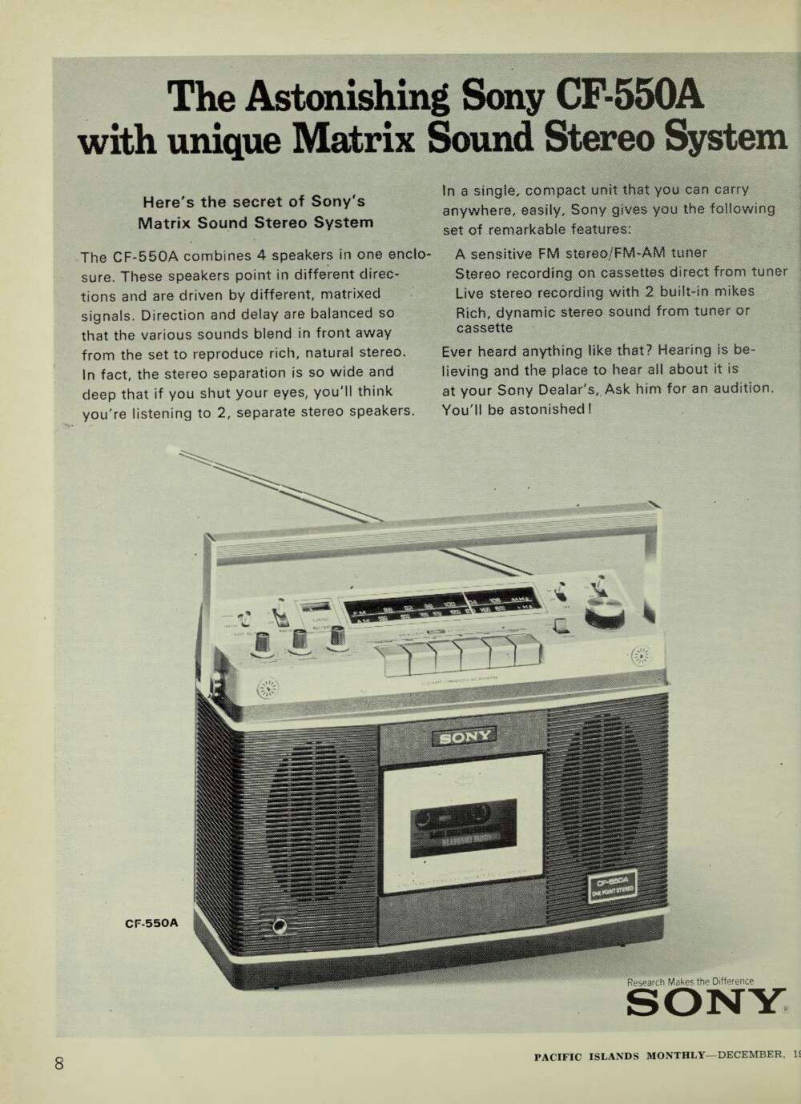
Here's the secret of Sony's Matrix Sound Stereo System The CF-550A combines 4 speakers in one enclosure. These speakers point in different directions and are driven by different, matrixed signals. Direction and delay are balanced so that the various sounds blend in front away from the set to reproduce rich, natural stereo.
In fact, the stereo separation is so wide and deep that if you shut your eyes, you'll think you're listening to 2, separate stereo speakers.
In a single, compact unit that you can carry anywhere, easily, Sony gives you the following set of remarkable features: A sensitive FM stereo/FM-AM tuner Stereo recording on cassettes direct from tuner Live stereo recording with 2 built-in mikes Rich, dynamic stereo sound from tuner or cassette Ever heard anything like that? Hearing is believing and the place to hear all about it is at your Sony Dealar's, Ask him for an audition.
You'll be astonished I
CF-550A
% > % % Cs*.
I i I
Shock Death In
The Cooks
Former police chief, and strong man of the Cook Islands opposition Demo cratic Party Tangata Nekeare, was found dead in his bed on the morning of Novem ber 6, in Rarotonga, pre sumably of a heart attack, although no post mortem was held. He had been out all the previous day talking with people and showed no sign of illness (Obituary p 123).
He was aged only 32.
Leader of the Democratic Party, Dr Tom Davis arrived in Rarotonga midnight Nov. 14, having sailed his yacht Torea from California. In his absence, the date of resump tion of the Cook Islands Legislative Assembly had been brought forward from November to October 20, with the result that Dr Davis was liable to forfeit his seat for being more than two weeks late for the session.
An engine breakdown con tributed to delay in Dr Davis' arrival, and a special dispen sation was obtained for him by Premier Albert Henry, enabling him to keep his seat. Dr Davis was given a warm welcome by a crowd of some hundreds.
During Dr Davis' absence.
Cook Islanders had gone to the polls on October 17 for the second time in six months. Voting this time was to elect representatives to the Island and District Coun cils. In Rarotonga, all 10 seats were won by Premier Albert Henry's Cook Islands Party. According to pro visional results, out of 13,105 people who voted, 7,162 voted CIP, the re mainder supporting the op position Democratic Party.
It's still war (on several
fronts) in Micronesia
From a Saipan correspondent
Associate High Court Justice D.
Kelly Turner, of the US Trust Terri tory, was alive and apparently well, in Majuro, in November, although Micronesians have, for some time, been hoping he would be elsewhere.
Judge Turner has grown into one of the most controversial current issues among Micronesians, especi ally those from Palau and the Mar shalls, where he has been dispensing the law since 1967.
In a word, the judge is unpopular, and Micronesians say, among a great many other things, that he is prejudiced against anyone with a brown skin.
In 1969, after the Palau District Legislature brought pressure to bear, Judge Turner was transferred to the Marshalls, but by April, 1972 the Marshalls District legislature had passed a resolution asking for the judge’s removal. Nothing happened because by now, said the cynics, the Administration had run out of Dis tricts to which Judge Turner could be sent.
In August, Senator Amata Kabua, President of the Senate of Micronesia, wrote to the Chief Justice of the Trust Territory, the Hon Harold Burnett, expressing local grievances resulting from the judge’s continued presence; and at the end of that month, the Congress of Micronesia, sitting at Ponape, unanimously passed a Senate resolution also demanding the removal of Judge Turner.
However, the judge is not without his supporters. Chief Justice Burnett, in a long, public letter to Senator Kabua, said that the Senate acted on the basis of charges not supported fully by facts; and that although he personally tried to follow up the Marshall Is legislature resolution of April, he received no co-operation. At the same time, another group of Mar shallese had sent him a petition which represented support for Judge Turner.
The Turner battle was still joined in November. Perhaps the best com ment on it comes from the local weekly Micronitor, which published the latest letters of the Chief Justice and Senator Kabua and appended this note; “The letters reprinted . . . rep resented a further investigation into some of the fantastic charges and counter-charges that have been levelled at the function of the judi ciary in the Marshall Is District.
Read at your own risk. Education can be a painful process.”
Among the statements made by Senator Kabua was that Judge Turner’s conduct “could no longer be tolerated in Micronesia”, and that Judge Turner was “insensitive to Micronesian cultures and customs, unprofessional and unethical to an extreme”.
Meantime, other events in the TT are proving that it is a hell of a long road that has no turning—2l years long, in fact.
Recently, a TT government lawyer flew into each district heralding the Micronesian Claims Commission.
The MCC was created by the Micronesian Claims Act of 1971, and is a US governmental agency. The commission operates under the con trol and direction of the Chairman of the Foreign Claims Settlement Com mission of the United States. The scope of the MCC appears to be broad and comprehensive.
Included are all claims of Micro nesian inhabitants resulting from loss of life, physical injury and property damage, caused by hostilities between the governments of Japan and the United States, from December 7, 1941, and the dates of “securing the various islands” in Micronesia by the US military. Also recoverable are payments arising from damage to, or use of, all kinds of property; and death or personal injury, occurring between the dates of “securing the various islands of Micronesia” and July 1, 1951.
The establishment of such a pro gramme is laudable, if late. [lt is interesting to note that war damage claims of indigenes of the New Guinea Trust Territory were settled by Australia within a few years of the end of hostilities, and getting down to cases with these was hard enough. Now, with a generation gap, claims of Micronesians will be just that more difficult to assess.] In the light of the complex and technical nature of the task, care should be taken in fully advising the Micronesians of their rights and this responsibility was given to Mr Robert Boles, a former TT Attorney General.
There is already local criticism of his procedures in that prior notice of meetings with Micronesian groups was short, and that they were con ducted in English, which few outer islanders speak.
Continued over page
All claims for compensation have to be filed before October 15, 1973.
Eniwetok’s problems, which also have something to do with war, are still in the news.
PIM reported then that the United States had agreed that the military would return Eniwetok to its people by the end of 1973, after the people had for years pleaded to be allowed to return and had finally, in 1971, made a public proclamation that they would return no matter what within one year. The Eniwetokese were exiled in 1946, when the atoll was used for US nuclear bomb testing.
But the Eniwetokese found that although the nuclear bombing was now long over, the US Air Force has been continuing to bomb the atoll under a Pacific Cratering Experiment (PACE), blasting what is left of Eniwetok with quantities of TNT so enormous that they simulate the effects of nuclear explosion.
On September 19, four months after a return visit to their former islands, Eniwetok leaders filed for an
injunction in the US Federal Court in Honolulu to stop the cratering experi ment. The case has been set for Feb ruary, 1973, but meanwhile bombing has been stopped.
Prior to the injunction being filed, the official TT administration policy was that the Micronesians were in accord with the way the Eniwetok situation was being handled. How ever, this has changed since a severely critical appraisal of the effect of the Air Force’s cratering experiments have had on the atoll was made in Washington by Deputy Secretary of the Interior, W. W. Lyon.
Deputy High Commissioner Peter T. Coleman said in Saipan, in early November that Lyon’s appraisal had become the TT administration’s official position concerning the pro ject.
“We assumed that the Air Force would comply with Federal environ mental laws,” he said.
The Air Force did not and it was on these grounds that the Eniwetokese
in early October, pleaded their cai in Honolulu, calling expert including radio-ecologists, geologist anthropologists, and others.
“The Air Force readily admitti that they failed to comply wi National Environmental Protects Agency laws in virtually every r sped,” said Micronesian legal servic director Therodore R. Mitchell.
“Judge Samuel P. King taught ; important lesson to the military wh he ordered the Eniwetok project e tirely cancelled,” said Mitchell. “E order means the US or anybody el does not have the right of the peopk Congressman Ataji Bales, w] attended the hearing at the request the Eniwetok leadership said: “This is the first time any Mici nesian has been able to obtain t protection of the United States cour Everyone has been telling these peoi for years that there is no way to st the US military. Many people ha told me and the Eniwetok peoi that we are crazy to even try. No they are stopped.”
Advertisements & other items, pp. 11-12 (2 items)
9
IFIC ISLANDS MONTHLY—DECEMBER, 1972
Presbyterian Colleges
BROTHER AND SISTER CAN NOW ENJOY EXCELLENT
EDUCATION IN A HEALTHY RURAL ENVIRONMENT
AT THE LEADING CO-EDUCATIONAL COLLEGES OF THE DARLING DOWNS Students of The Scots College for boys and the Presbyterian Girls College are taught at the well equipped Academic Centre at the Scots College.
THE BENEFITS THE CURRICULUM
• Temperate climate • Emphasis on individual attention • Freedom from the social pressures of urban areas • A traditional House system which encourages sound pastoral development • Remedial teaching.
THE FACILITIES
• Modern science laboratories and classrooms • Extensive library resource centre • Spacious grounds • Unlimited sporting opportunities • Complete academic, commercial, domestic science and manual training courses • Additional tuition in Music, Speech, Drama and Art. • A comprehensive post-Junior rural course for boys.
THE OPPORTUNITIES
Students are encouraged to develop: • Individual responsibility • Skills of independent study • An enquiring mind • Self discipline. n m • Up-to-date teaching aids • Pleasantly appointed separate boarding houses. REMOTE AREA ALLOWANCES AND SCHOLARSHIPS ARE AVAILABLE FOR BOTH PRIMARY AND SECONDARY PUPILS FROM COUNTRY AREAS. mm lllian RECIPROCAL AGREEMENT BETWEEN N.S.W. AND QLD. EDUCATION
DEPARTMENTS™ALLOWS FINANCIAL ASSISTANCE TO N.S.W. STUDENTS
ATTENDING THE WARWICK PRESBYTERIAN COLLEGES.
Vacancies for a limited number of boarding pupils still exist for 1973. (First term commences 29th January.) Write today for an illustrated prospectus to:- The Principal, H. J. Rodger, B.Sc., A. 1.8.5., M.A.C.E.
THE WARWICK
PRESBYTERIAN COLLEGES
DAY AND DOARDING SCHOOLS
Me mher s nee a m ft
constructive political opposition'
What New Guinea needs is a constructive political opposition'
7 rom Percy Chatterton, in Port Moresby
An assessment of the proceedings »f the November meeting of Papua »lew Guinea’s House of Assembly vi\\ have to wait, because the meeting las not progressed far enough, as his issue of PIM goes to press, for be final pattern to emerge. But, Doking into the crystal ball, I xpect that the United Party opposi ion will make an all-out effort to iscredit and destroy the National Coalition.
Since the September meeting it as become almost hysterical in its riticism of the government, and the bsence of several ministers overseas lay encourage it to hope that it ould win a snap division, possibly n a vote of censure.
Some of the criticism, particularly lat relating to loss of confidence mong overseas investors, has been itelligible and intelligent. Criticism f the public behaviour of individual linisters, and of an alleged “jobs ir the boys” approach by the overnment to certain senior ap ointments, is also fair enough, and alls for convincing refutation by le government.
But criticism by the United Party f the government’s handling of [ighlands famine relief is un arranted, and discredits only the ritics. It may be true that the avernment was a bit slow off the lark at the start, failing at first to ;alise the seriousness of the cata rophe. But once it moved, it moved lassively and effectively.
The United Party’s claim that the tuation has been exploited politically y the National Coalition will hardly jar examination. The Chief Electoral fficer, about as neutral a person Dlitically as one could find, has jaded the fund raising committee, hile the Civil Defence chief, a public rvant, has headed the actual relief Derations. It is difficult to see how e exercise could have been made ore unpolitical.
Father John Momis’ motion on iture mining activities has already uched off a major debate. Father [omis wants a PNG share-holding : at least 50 per cent in any future rge-scale mining ventures, and he so wants agreements for such sutures to allow for re-negotiation n the light of changing circumstances id the acquisition of new know dge”.
It should be noted that Father
Momis’ proposal refers only to future agreements. Mines Minister Paul Lapun’s hot potato—re-negotiation of the Bougainville Copper agree ment, is unlikely to be seriously debated at this juncture.
A commentator has pointed out that the Bougainville agreement “has only been recently negotiated in good faith, and approved by many of the same people now in power”.
This is verbally correct. But as one who took part in that “approval”
I cannot but remember that the agree ment was presented in a cut-and-dried, take-it-or-leave-it form by official members still confident of the sup port of an unsophisticated Highlands bloc.
We were told that it had been thrashed out between the experts on both sides, and that our experts had secured a good bargain for us for which we should be duly grateful.
Some of the more irreverent of us wondered privately whether perhaps CRA’s experts were more expert, as they were no doubt more expensive, than our experts. Anyway, the agree ment was bulldozed through.
Whether we like it or not, it is inevitable that decisions taken and agreements made by the Administra tion-dominated first and second Houses will be called into question by a genuinely autonomous legisla ture. But not, perhaps, just yet.
Those of us who would like to see Westminster-style democracy succeed in Papua New Guinea cannot but be dismayed by the performance of the present United Party opposi tion. Disappointed, disheartened and disarrayed, its only thought seems to be, as one of its own officials put it, to “destroy” the National coalition, without, apparently, a thought as to what happens if it were destroyed.
Matthias To Liman, who performed so well in the Education portfolio in the second House, seems to have be come more and more emotional in his outlook as leader of the op position, and is currently awaiting the outcome of his appeal against a sentence of two months’ imprison ment imposed on him for “riotous behaviour” on a occasion on which it was alleged he let his feelings run away with him.
What Papua New Guinea needs more than anything else at this juncture is an intelligent, urbane and constructive opposition.
During the debate in the November House of Assembly, Father John Momis watered down his motion to lay down radical new policy guide lines for foreign mining companies in PNG.
Father' Momis removed from his motion a call for worker participation in management, deleted the contro versial provision for re-negotiation to be written into all mining agreements and removed a phrase which would have allowed equity to be bought “in other no-interest ways”.
However, call for a majority share holding paid for from future earnings remained.
Despite the changes the opposition United Party still attacked the guide lines, describing them as “an im possible imposition”.
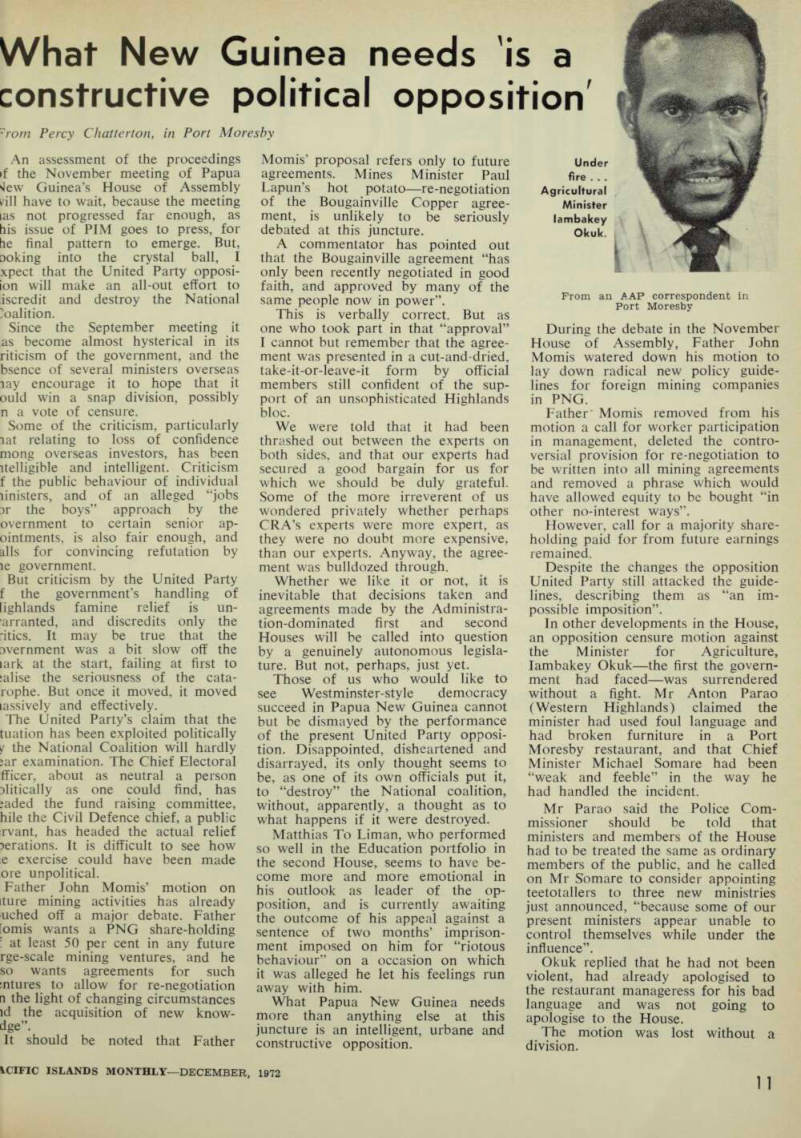
In other developments in the House, an opposition censure motion against the Minister for Agriculture, lambakey Okuk—the first the govern ment had faced—was surrendered without a fight. Mr Anton Parao (Western Highlands) claimed the minister had used foul language and had broken furniture in a Port Moresby restaurant, and that Chief Minister Michael Somare had been “weak and feeble” in the way he had handled the incident.
Mr Parao said the Police Com missioner should be told that ministers and members of the House had to be treated the same as ordinary members of the public, and he called on Mr Somare to consider appointing teetotallers to three new ministries just announced, “because some of our present ministers appear unable to control themselves while under the influence”.
Okuk replied that he had not been violent, had already apologised to the restaurant manageress for his bad language and was not going to apologise to the House.
The motion was lost without a division.
Under fire . . .
Agricultural Minister lambakey Okuk.
From an AAP correspondent in Port Moresby
Advertisements & other items, pp. 13-14 (2 items)
11
ICIFIC ISLANDS MONTHLY—DECEMBER, 1972
the Maharajah
invtesypu aboard
his giant new
Palace in the Sky.
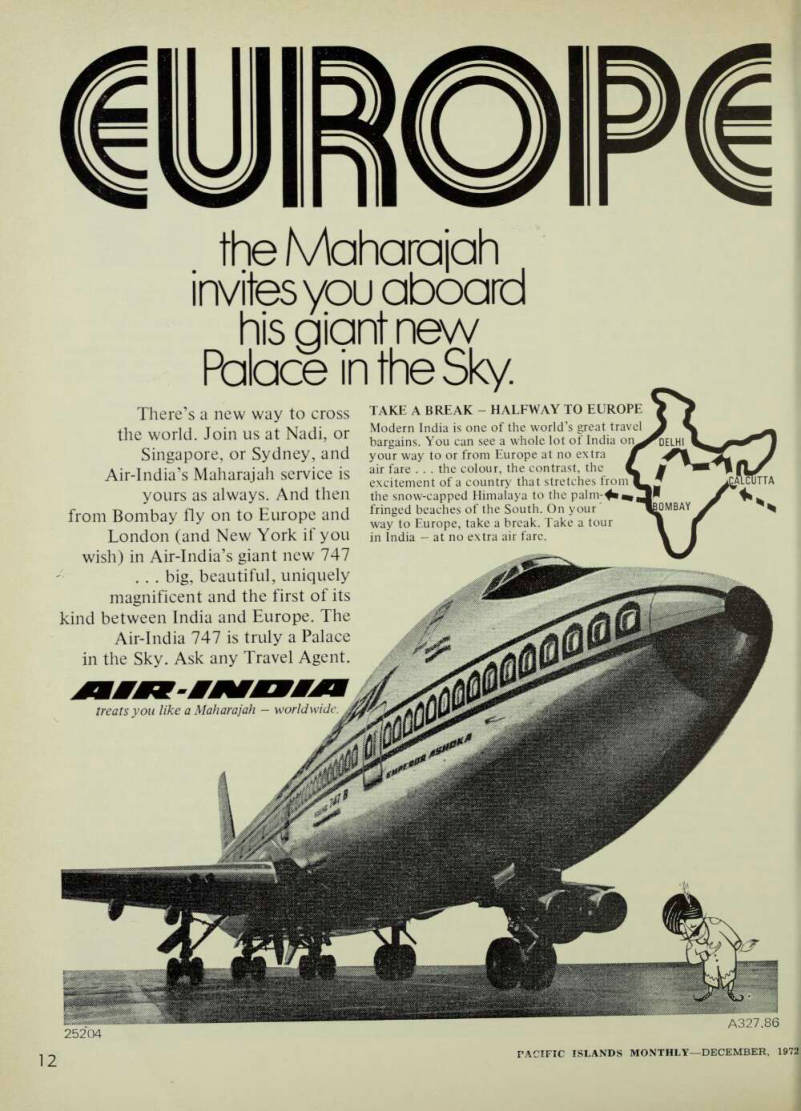
There’s a new way to cross the world. Join us at Nadi, or Singapore, or Sydney, and Air-India’s Maharajah service is yours as always. And then from Bombay fly on to Europe and London (and New York if you wish) in Air-India’s giant new 747 . . . big, beautiful, uniquely magnificent and the first of its kind between India and Europe. The Air-India 747 is truly a Palace in the Sky. Ask any Travel Agent. treats you like a Maharajah TAKE A BREAK - HALFWAY TO EUROPE Modern India is one of the world’s great travel bargains. You can see a whole lot of India on your way to or from Europe at no extra air fare . . . the colour, the contrast, the excitement of a country that stretches from the snow-capped Himalaya to the fringed beaches of the South. On your' way to Europe, take a break. Take a tour in India - at no extra air fare.
DELHI
TTA
OMBAY
A
fii
% M ; 25204 A 327.86
Highlands famine gives unity
where politics could not
From a Port Moresby correspondent The combination of drought and frost which brought a large area of the PNG Highlands to a crisis of famine (PIM, Nov, p 121) has had the further result of bringing the whole country together in a massive rescue operation. By mid-November a total of nearly 130,000 people were being fed on relief rations and Famine Appeal Committee Chairman Mr Simon Kaumi announced that a total of $826,382 had been given or promised to the appeal.
Special air charters carried rice and other foodstuffs and vitamins to the Highlands and helicopters have been kept busy making deliveries to remote hard-hit villages. Rice was a preferred commodity because of its concen trated food value (more people could be fed per plane-load), but a second ary appeal had to be made for dona tions of cooking vessels because the
Highlanders generally had nothing in which to cook rice.
Chief Minister Michael Somare made an inspection of the famine area and was shown sweet potato crops which had been the hope of not-too distant relief, completely blackened and dead from frost. Replacement plants were flown in, but some of these were also threatened by further frosts.
A problem arose in communicating the gravity of the situation to people in other areas. Representatives from the less-affected Western Highlands were taken on an inspection of the worse hit districts and immediately they reported back showing pictures of what they had seen, donations be gan to come from people who saw them.
This was part of a pattern of an unprecedented response from all round Papua New Guinea. Villages, schools, clubs and organisations of all
kinds began raising money by a multi tude of means. One group of school pupils went on a voluntary diet so the savings could be given. Dances, con certs and door-to-door collections raised thousands of dollars from small contributors, and it appeared likely that Mr Kaumi’s appeal for a united effort was bearing fruit.
Nevertheless there was need of sub stantial help from external sources, and donations came from the New Zealand Government ($50,000), Nauru ($10,000), Japan ($5,000) and a host of commercial donations were led by Bougainville Copper’s $lOO,OOO gift, with Burns Philp and Carpenters ($25,000 each) reflecting their very substantial commitment to the welfare of Papua New Guinea itself.
The Australian Government weighed in with the RAAF’s Caribou aircraft for the airlift, and voluntary groups have contributed substantially, notably Australia’s Jaycees, who fol lowed up a $l,OOO gift with a cam paign in support of the appeal. In Geneva the World Council of Churches asked its member churches around the world for $lOO,OOO for PNG food relief, and churches in PNG were early supporters of the national fund.
Advertisements & other items, p. 15 (1 item)
You'll feel that love was bom here
What light best shows the beauty of the Taj Mahal? The rose of dawn? The soft pearlwhite of a great moon, with the whole shimmer of slender marble afloat on its own image?
In each slight shift of the day's light, the Taj assumes a different look and feel. But always it is an expression of love. Pure love.
Shah Jahan felt it for the wife he lost 300 years ago. And twenty thousand workmen laboured twenty-two years to express his feelings. 28494 You'll feel it, too. In India.
Not just as you pause before the Taj Mahal, but in other Indian places, at other monuments from other ages and cultures.
Perhaps India is the last place in the world to offer you so much of it. The cost is low.
And this is the year. Any travel agent can show you the way.
Visit us in this year of pageants. (25th anniversary of the world's largest democracy.) For further details see your travel agent, or contact us at the Government of India Tourist Office, 55 Elizabeth Street,
Sydney 2000.
Illi
im
is for you this year
1T45.46
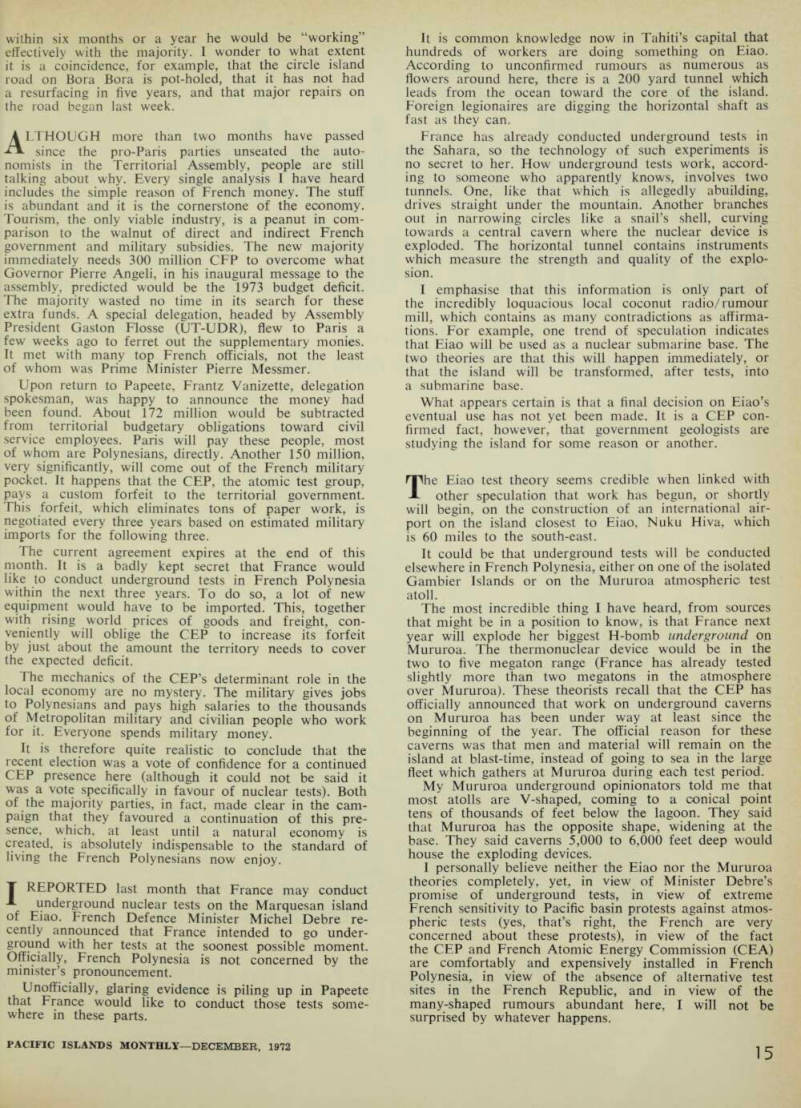
Tahiti
Polynesians learn realities of political power
Letter
From James Boyack
TERRITORIAL Assembly antics kept French Poly nesia’s newly elected legislative body in the head lines during the month of November. The new pro-Paris majority gave several demonstrations of how the glove of power, when it changes hands, fits as tightly for one political tendency as for another. The autonomist minority had less success adapting itself to the require ments of its new role. Techniques of opposition to an irreversible assembly majority (at least for the present), worked out during the past five years by those who now dictate assembly policy, did not serve the autonomists in the first legislative meetings. In fact, inept opposition tactics cost the autonomists one more assembly seat.
Take the copra subsidy debate early in the month.
The Gaullist-oriented majority had decided to free 76 million CFP (roughly SA800,000) from the 1972 equip ment budget to support the price of copra. Their logic was that infrastructural projects in the outer islands could be postponed until next year. It was more im portant to pay the islanders for their copra output to December 31 (copra, in most cases, being their sole source of income).
Perhaps because the majority blamed the previous assembly for part of the existing deficit (the remainder of the deficit will result from an estimated 3,000 ton over-production this year—lB,ooo tons in ’72 compared to 15,000 last year), the autonomists chose to argue against renewed subsidy. Which they did for almost two hours, in contradiction of precedents they them selves set. The opposition demanded that the Gaullists fulfil their campaign pledge to completely restructure the copra oil refinery accords with the government (the way in which this dying export product receives arti ficial respiration here is perhaps the most controversial political hot-potato outside the debate on self government).
When sarcasm and other manner of verbal assault failed to upset the majority resolve to vote the subsidy, the autonomists decided to walk out of the assembly session, thereby postponing it for lack of a quorum.
To accomplish this they needed the counsellor from Bora Bora, “Toro” Teriirere, on their withdrawing team. “Toro”, a sometimes autonomist (he voted with the previous assembly’s autonomist majority), refused to budge. The session continued, without the minority, and a subsidy vote passed.
Madame Tara Lenoir, elected on the Austral Islands autonomist “Pupu Here Ai’a” ticket with Pierre Hunter, left the chamber reluctantly. That she was not being allowed to follow her political conscience on this occa sion may have been the straw which broke her camel’s back.
AT the beginning of the session, her autonomist col leagues were aghast to find that she had been nominated to one of the assembly’s commissions.
During the very first assembly session in October, the
minority en masse decided to refuse interior assembly posts unless these were attributed in proportion to the number of assembly seats they held. John Teariki, Madame Lenoir’s party leader, demanded a suspension of the session to interview Madame Lenoir on her apparent defection from minority policy. This closed door meeting was reportedly very stormy. The lady counsellor, who two weeks before publicly declared that she might vote with the majority on questions directly related to the welfare of the Austral Islanders, was not happy with the disrespectful manner in which she was called to order by her political boss, Teariki.
All the same, when she returned to the assembly hall, she announced that she was withdrawing her candidacy for the commission post. She said, “I admit 1 had accepted this nomination, but now I must decline it.
But . . . there is a but ...” A woman’s but, it turned out, is no small thing.
She butted right into counsellor Hunter moments later with a resolution calling for an investigation of the Austral Island Transport Company. She recalled that Hunter, during the previous legislature, was not only responsible for the company’s creation, he ob tained a 15 million CFP subsidy from the assembly to purchase the company’s sole asset, the inter-island schooner Tuhaa Pae. Madame Lenoir charged that the company had failed to fulfil its moral obligation to the Austral Islands. She demanded an investigation of the company’s books, and a State take-over in case of shinanigans.
When the assemblymen returned from their lunch break (the minority having decided to cease its ineffec tive boycott), Madame Lenoir had made up her mind.
She submitted her letter of resignation to the “Here Ai’a” and announced that she was becoming the sixth member of Charles Taufa’s group of independents.
Which means the assembly majority picked up an other vote for a total of 17. The autonomists hold 12 sure seats. “Toro” persists in abstaining on almost every vote that does not directly concern the islands he represents. I have the feeling his neutral position will change, however. He shares with Madame Lenoir the opinion that he was elected “to work”, as he says.
I talked to him on Bora Bora a couple of weeks ago (in his non-assembly hours, he is the Air Polynesie agent on that island) and he seemed to tell me that
within six months or a year he would be “working” effectively with the majority. I wonder to what extent it is a coincidence, for example, that the circle island road on Bora Bora is pot-holed, that it has not had a resurfacing in five years, and that major repairs on the road began last week.
ALTHOUGH more than two months have passed since the pro-Paris parties unseated the auto nomists in the Territorial Assembly, people are still talking about why. Every single analysis I have heard includes the simple reason of French money. The stuff is abundant and it is the cornerstone of the economy.
Tourism, the only viable industry, is a peanut in com parison to the walnut of direct and indirect French government and military subsidies. The new majority immediately needs 300 million CEP to overcome what Governor Pierre Angeli, in his inaugural message to the assembly, predicted would be the 1973 budget deficit.
The majority wasted no time in its search for these extra funds. A special delegation, headed by Assembly President Gaston Flosse (UT-UDR), flew to Paris a few weeks ago to ferret out the supplementary monies.
It met with many top French officials, not the least of whom was Prime Minister Pierre Messmer.
Upon return to Papeete, Frantz Vanizette, delegation spokesman, was happy to announce the money had been found. About 172 million would be subtracted from territorial budgetary obligations toward civil service employees. Paris will pay these people, most of whom are Polynesians, directly. Another 150 million, very significantly, will come out of the French military pocket. It happens that the CEP, the atomic test group, pays a custom forfeit to the territorial government.
This forfeit, which eliminates tons of paper work, is negotiated every three years based on estimated military imports for the following three.
The current agreement expires at the end of this month. It is a badly kept secret that France would like to conduct underground tests in French Polynesia within the next three years. To do so, a lot of new equipment would have to be imported. This, together with rising world prices of goods and freight, con veniently will oblige the CEP to increase its forfeit by just about the amount the territory needs to cover the expected deficit.
The mechanics of the CEP’s determinant role in the local economy are no mystery. The military gives jobs to Polynesians and pays high salaries to the thousands of Metropolitan military and civilian people who work for it. Everyone spends military money.
It is therefore quite realistic to conclude that the recent election was a vote of confidence for a continued CEP presence here (although it could not be said it was a vote specifically in favour of nuclear tests). Both of the majority parties, in fact, made clear in the cam paign that they favoured a continuation of this pre sence, which, at least until a natural economy is created, is absolutely indispensable to the standard of living the French Polynesians now enjoy.
T REPORTED last month that France may conduct -*■ underground nuclear tests on the Marquesan island of Eiao. French Defence Minister Michel Debre re cently announced that France intended to go under ground with her tests at the soonest possible moment.
Officially, French Polynesia is not concerned by the minister’s pronouncement.
Unofficially, glaring evidence is piling up in Papeete that France would like to conduct those tests some where in these parts.
It is common knowledge now in Tahiti’s capital that hundreds of workers are doing something on Eiao.
According to unconfirmed rumours as numerous as flowers around here, there is a 200 yard tunnel which leads from the ocean toward the core of the island.
Foreign legionaires are digging the horizontal shaft as fast as they can.
France has already conducted underground tests in the Sahara, so the technology of such experiments is no secret to her. How underground tests work, accord ing to someone who apparently knows, involves two tunnels. One, like that which is allegedly abuilding, drives straight under the mountain. Another branches out in narrowing circles like a snail’s shell, curving towards a central cavern where the nuclear device is exploded. The horizontal tunnel contains instruments which measure the strength and quality of the explo sion.
I emphasise that this information is only part of the incredibly loquacious local coconut radio/rumour mill, which contains as many contradictions as affirma tions. For example, one trend of speculation indicates that Eiao will be used as a nuclear submarine base. The two theories are that this will happen immediately, or that the island will be transformed, after tests, into a submarine base.
What appears certain is that a final decision on Eiao’s eventual use has not yet been made. It is a CEP con firmed fact, however, that government geologists are studying the island for some reason or another.
The Eiao test theory seems credible when linked with other speculation that work has begun, or shortly will begin, on the construction of an international air port on the island closest to Eiao, Nuku Hiva, which is 60 miles to the south-east.
It could be that underground tests will be conducted elsewhere in French Polynesia, either on one of the isolated Gambier Islands or on the Mururoa atmospheric test atoll.
The most incredible thing I have heard, from sources that might be in a position to know, is that France next year will explode her biggest H-bomb underground on Mururoa. The thermonuclear device would be in the two to five megaton range (France has already tested slightly more than two megatons in the atmosphere over Mururoa). These theorists recall that the CEP has officially announced that work on underground caverns on Mururoa has been under way at least since the beginning of the year. The official reason for these caverns was that men and material will remain on the island at blast-time, instead of going to sea in the large fleet which gathers at Mururoa during each test period.
My Mururoa underground opinionators told me that most atolls are V-shaped, coming to a conical point tens of thousands of feet below the lagoon. They said that Mururoa has the opposite shape, widening at the base. They said caverns 5,000 to 6,000 feet deep would house the exploding devices.
I personally believe neither the Eiao nor the Mururoa theories completely, yet, in view of Minister Debre’s promise of underground tests, in view of extreme French sensitivity to Pacific basin protests against atmos pheric tests (yes, that’s right, the French are very concerned about these protests), in view of the fact the CEP and French Atomic Energy Commission (CEA) are comfortably and expensively installed in French Polynesia, in view of the absence of alternative test sites in the French Republic, and in view of the many-shaped rumours abundant here, I will not be surprised by whatever happens.
Advertisements & other items, p. 18 (1 item)
growing nuts.
How to be
a millionaire by
Hardie’s are helping the nuts grow at Dunoon, N.S.W.
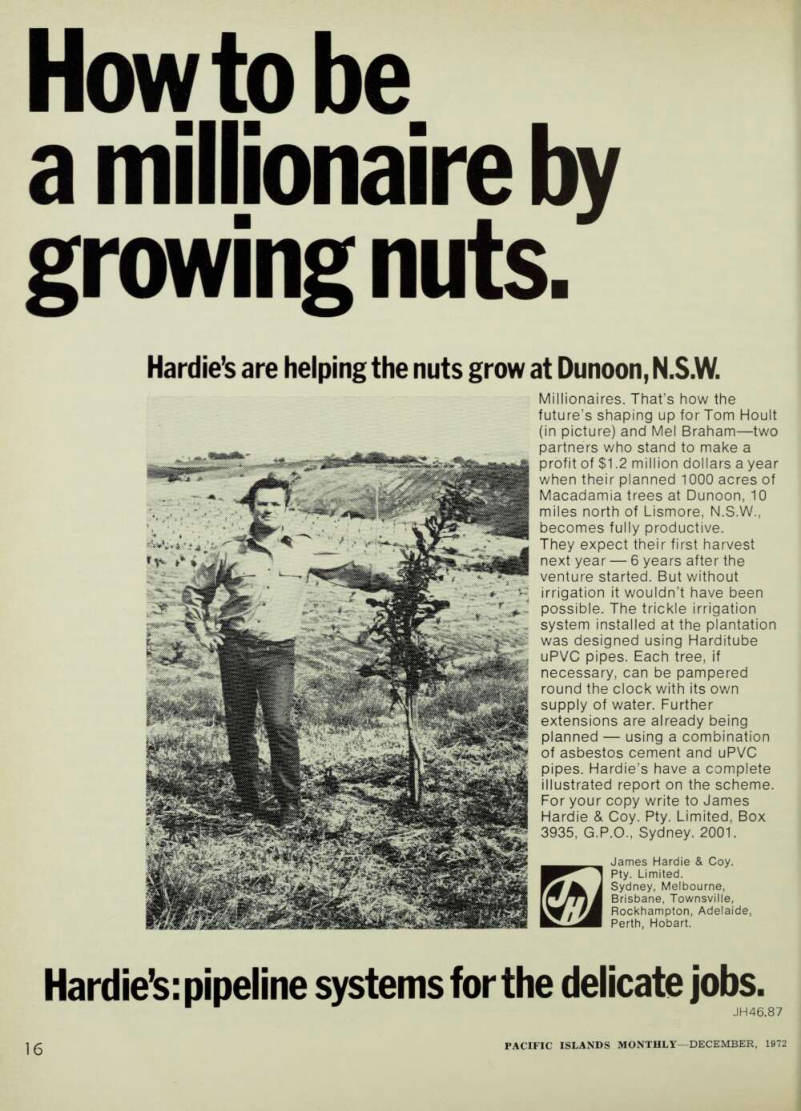
“V' #>, w 3 Millionaires. That’s how the future’s shaping up forlorn Hoult (in picture) and Mel Braham —two partners who stand to make a profit of $1.2 million dollars a year when their planned 1000 acres of Macadamia trees at Dunoon, 10 miles north of Lismore, N.S.W., becomes fully productive.
They expect their first harvest next year 6 years after the venture started. But without irrigation it wouldn’t have been possible. The trickle irrigation system installed at the plantation was designed using Harditube uPVC pipes. Each tree, if necessary, can be pampered round the clock with its own supply of water. Further extensions are already being planned using a combination of asbestos cement and uPVC pipes. Hardie’s have a complete illustrated report on the scheme.
For your copy write to James Hardie & Coy. Pty. Limited, Box 3935, G.P.0., Sydney. 2001. $ James Hardie & Coy.
Pty. Limited.
Sydney, Melbourne, Brisbane, Townsville, Rockhampton, Adelaide, Perth, Hobart.
Hardie’s: pipeline systems for the delicate jobs.
JH46.87
The Geic-One Colony Or Two?
By a special correspondent
One of the major problems posed for metropolitan countries by the decolonisation process has been to ensure political stability during the early years of self-government and independence. Without stability, at tempts to achieve or maintain econo mic viability and to improve living standards are jeopardised. The result is instability, and so the circle con tinues.
The problem has been complicated in many dependencies and former dependencies by the fact that colonial boundaries were drawn with scant -egard for cultural or ethnic con siderations. The outcome, seen in its ;xtreme form in Nigeria, can be an ntensification of racial rivalries luring the final stages of decolonisa lon and the early years of autonomy.
Where they have emerged, tensions lave arisen less from purely racial antagonism than from regional de rivation and from what are seen is inequalities of economic op >ortunity especially with regard to education and employment.
In the Pacific the potential for such livisive forces is seen most clearly in Japua New Guinea, in the Trust erntory of the Pacific Islands Micronesia) and the Gilbert and illice Islands Colony.
The GEIC now has a “member ystem” of government and could be xpected to progress to a ministerial ystem and then self-government /ithin a very few years. Whereas, in tie past, the future problems of the ?EIC have been seen almost ex lusively in terms of the expected jss of revenue from Ocean Island hosphates, the British administration as recently been forced to consider ie more immediate problem of mether the colony can, in fact Lirvive even to self-government with s present boundaries.
The Ellice Islanders fear future emulation by the Gilbertese numbering some 48,000 to the Ellice danders’ 8,000), and a low level of eyelopment in the Ellice once the nlbertese control the purse-strings, nd a consequent reduction in educa onal and employment opportunities, hus they have, through their elected jpresentatives, begun to request jparation from the Gilberts (PIM lov., p. 9).
The GEIC separation movement is ot new; its potential dates back to ie last years of the 19th century hen the Gilbert and Ellice Islands rotectorates were lumped together
under a single administration for reasons of cost and convenience. With the limited scope of administration— dominated in any case by expatriate personnel—there was little strife until the late 1950 s when the introduction of Colonial Development and Welfare Fund schemes, and changed attitudes towards localisation and political development, led to a rapid rise in the numbers of Gilbertese and Ellice Islanders in the civil service.
With their more flexible attitude towards social change, and their higher educational levels (schools in the Gilberts had suffered from war time occupation of the islands by the Japanese) Ellice Islanders were generally quicker to take advantage of the changed situation and the chances it offered. The result: a high proportion of Ellice Islanders in government schools and in the civil service, and resentment on the part of Gilbertese who also complained of racial arrogance on the part of Ellice Islanders then arriving in Tarawa in large numbers.
There were no demands for separa tion at this stage but racial feelings intensified in the early 19605, especially on Tarawa, and led to the formation of the colony’s first political parties. The initiative was with the Gilbertese at this time and was expressed in terms of resentment where the races were in a competitive situation.
With more rapid constitutional development in the late 19605, and the transfer of increased responsibility to elected representatives, the Ellice Islanders began to seek guarantees to protect minority interests. Some concessions were made in the 1966 constitution and then, in 1971, all islands of the Gilbert and Ellice
groups were given at least one member in the Legislative Council, resulting in average electorates in the Ellice having less than half the voters of those in the Gilberts.
With these concessions, together with assurances that the reserved powers allowed for the protection of minority groups, the administration was able to persuade the Ellice Islanders to withdraw their objections, but they continued to insist that they would seek separate dependent (on Britain) status when internal self government was granted to the colony.
In 1971 the issue nearly came to a head in the Legislative Council until the Ellice members were persuaded to withdraw a separation motion by the government’s promise that it would investigate the implica tions of separation. This was done, and Sir John Field, the Governor visited the Ellice to discuss the situation without, so far as can be seen, effect ing any change in the attitudes of the Ellice Islanders.
The problem has gained some urgency over the past few months; not so much because the demands for separation have been more widely and loudly expressed but because, if precedents are adhered to, a further constitutional “step” should be taken around the time of the next elections due early in 1974. This means that in the course of the next 12 months some agreement on the longer term constitutional status of the colony must be reached.
The Ellice position is fairly clear.
Their representatives will probably ask for separate colonial status.
The Gilbertese are in a somewhat ambivalent position. Many of their representatives favour separation or, at least, would not oppose it. At the same time they want to progress to a ministerial system of government but, they fear, any agitation for separation will slow down the transfer of responsibility.
Recent developments have forced the British administration to take a rather more positive approach to the situation. In the past it has vacillated between ignoring the problems and attempting to quiet any stirrings in the hope that they represented only transitory discontent. Seldom in the past has there been any serious attempt to examine the implications of separation for the Gilbertese, the Ellice Islanders, and Britain. Any
negotiations towards this end in the future would have to focus around the division of the colony’s reserve funds (built out of phosphate royalties); phosphate revenues, while they last; overseas employment op portunities; and the ability or other wise of each group to provide for and staff its own government and services—all potentially contentious issues.
Policies of centralisation on Tarawa followed since World War II could cause future problems. The Gilberts would have the infrastructure but would become even more heavily dependent on expatriate personnel.
The Ellice would lack the infra structure. Both would lack the ability to pay for government and services (at present levels) without substantial amounts of aid.
Britain is left with a dilemma— to sustain one non-viable government, or two? The outcome will depend on whether a compromise can be reached between the maximum that each party will allow, and the minimum that it will accept. Perhaps there are now second thoughts about past promises that dependent peoples ;ould have the constitution of their :hoice?
The What's-In-A-Name
Department
The Political Education Section of the PNG government has a new name. The assistant secretary, Mr Terry White announced recently that the Section was now called the Government Liaison Branch of the Division of Political Development of the Office of the Chief Minister.
The Political Education Section was formerly part of the Division of District Administration in the Department of the Administrator.
Advertisements & other items, pp. 19-20 (2 items)
17
4CIFIC ISLANDS MONTHLY—DECEMBER, 1972
fripte'
Ask for FOUREX the clear sparkling amber beer...
available in BOTTLES, CANS and STUBBIES
YVYY The Popular
AAAA BEER
n ‘lts Quality Never Varies’
Wholesale Distributors:
C. SULLIVAN
(NEW GUINEA) PTY. LTD.,
Port Moresby, Lae, Mt. Hagen, Rabaul, Kieta, Lautoka and Suva, Fiji.
AGENCIES :
R. Bensley—Madang. Ping Shee & Co. —Wewak. E. V. Lawson Pty. Ltd. — Honiara, British Solomon Islands. ii itstuNtni GQrnpJ mm xxxx
tUTIIMjIKj
eeu»w«t iu Brewed from the finest Ingredients by Castlemaine Perkins Limited, Brisbane, Queensland, Australia.
For
RUM
at its best... say
fripte'
OVERPROOF AND UNDERPROOF
In 5 oz. and 13 oz. flasks and 26 oz. and 40 oz. bottles.
BLENDED AND BOTTLED BY JOHN WALKER & SONS LIMITED.
-jZZZSZZZZZ.
K
Christianising a Hindu goddess
Hindu goddess
Lights flickered in small earthen vare dishes all over Fiji on Sunday, November 5 to celebrate the Hindu estival of Diwali, or Deepawali— here are several ways of spelling it— /hich is akin, in some respects to he Christian Christmas, with feast ng, the giving of presents and rayers.
The same lights flickered on the teps of the Roman Catholic Cathedral in Suva and on the high Itar itself. It was the Roman 'atholic Church adjusting itself to le customs of a section of its con regation. But, unlike the Hindus, .rchbishop George Pearce and his angregation at the Missa Punja ere not worshipping Laxmi, the addess of wealth, but Christ, the ight of the World.
The mass, in Hindustani, was said Y Archbishop Pearce whose pro anciation of the language was said Y some Indian members of the con ■egation to be “very good”.
The archbishop has been studying industani for about a year and has lid mass in the language several mes but never, until now, in public.
Some of the Hindu ritual was troduced including the offering of Dwers and the burning of incense id camphor.
Loveliness
New Loveliness for Your Skin
rpHE exquisite beauty of your A complexion is essentially your own responsibility.
Only you can give your skin the vital beauty care it needs. Only you can resolve to give it the beauty benefits of a unique tropically moist oil blend that will keep it always young and pretty.
Oil of Ulan, with its tremendous potential for softening against the dryness which causes wrinkles, can do much to ward off those tiny, ageing lines a woman fears most.
Because this unique beauty fluid enjoys an ideal compatibility with the skin’s own natural fluids, it helps to balance those precious “liquid” assets of combined oil and moisture that give the complexion its youthful softness and bloom.
Skin Needs Protection A film of Oil of Ulan smoothed over the face and neck is all that your skin needs to protect it from the dryness caused by artificial in door environments and the elemen tal consequences of exposure to wind and weather.
The rich moist oil provides a perfect beautifying base for make up, and at the same time brings out the best in your complexion.
Saturation of the skin with Oil of Ulan at night will ensure with even greater certainty that your com plexion gains optimum smoothness and loveliness.
Almost every skin has a moisture problem, and the tropically moist oil blend can help to solve this very important aspect of complex ion care. It is natural for the water content of the outer dermic layer to evaporate constantly, but when your skin is subjected to severe winter or hot, drying summer conditions, evaporation takes place too rapidly. Tiny lines, wrinkles and rough, flaky patches will put in a premature appearance unless there is some form of relief for the thirsty, dehydrated skin.
Oil of Ulan moist oil blend nur tures the natural conditions appro priate to maintain the health of the complexion and keeps the skin dew soft, moist and supple.
All your life—this year, next year and every year—your com plexion can be the living proof of your daily devotion. Pledge the remarkable beauty benefits of Oil of Ulan (which is available from chemists and beauty counters) to your complexion today.
Beauty Skin-Care
Consultants Recommend Beauty-care consultants are now recommending that, to take full advantage of the benefits of tropic ally moist Oil of Ulan, it should be smoothed over the face and neck daily before applying make up. In this way, tiny lines may be held at bay and the youthful bloom on a beautiful complexion can be carefully cherished.
Advertisements & other items, p. 21 (1 item)
Acific Islands Monthly—December, 1972
Christmas high jinks
but no rejoicing over nickel
New Caledonia Diary With
HELEN ROUSSEAU in Noumea
“Joyeux Noel” and “Bonne Annee” are the greeting phrases the French exchange as Christmas and New Year festivities approach.
Papa Noel sent his display wares well in advance to Noumea stores this year, so that from the end of October Caledonian mothers had an increasingly embarrassing time each occasion they escorted their infants through the doors of Maison Barrau, Ets. Ballande, Prisunic etc.
As the stocks of champagne expanded on supermarket shelves, adults also thought of the good time ahead, that is, if they could momentarily forget the fact that prices kept rising while incomes were falling with the nickel tide.
To prepare folk for more com petitive times, one local political newssheet carried some handy advice for its readers in the form of real festive spirit, imported straight from the Paris press. With a series of graphic explanations, the paper introduced its readers to a system of “wrangling, for our drunkard friends.”
The Paris advice began: 1. Put on a tie. 2. Stick a dry sponge behind the front of it. 3. While drinking with a friend, talk in such a way that he has to move back a step. By leaning over his glass, you get the tip of your tie to dip in his drink. 4. His glass will be emptied by your sponge. 5. turn your back to your friend and squeeze the tie into your glass . . . and you will drink two glasses in stead of one.
Of course, island drinkers would hardly be tempted by such prac tices. After all, wearing a tie in
this climate would make one im mediately suspect.
Noumea restaurant owners were certainly counting on clients bring thick wallets rather than padded ties to their end-of-year meals.
There has been a record pro liferation of new eating houses this year, each one trying to outdo the others in gastronomy, not for getting to add the astronomic prices.
This meant that the South Pacific Commission was not alone in watching the budget at this end of year. For their New Year ball the SPC staff had to consider whether they would hire a band at almost SA 1,000 for the evening or appoint a musical programme officer and invest in their own amplifying equipment. (They fin ally found a less expensive band.) Some glitter had nevertheless gone off the Christmas glamour with the retreat of the Japanese buyers from the Caledonian nickel ore market. After playing Papa Noel to the territory for some twenty years, the Japanese re called their dollar-bearing rein deer ships in October. Noumea price talks over future shipments broke down when the Japanese firmly opposed granting even half the price increase the Caledonians had expected to result from the recent price rise for nickel metal.
While about 1.3 million tons of ore thus waits by Caledonian mines and seashore, ready for shipment, it is feared that Japanese buyers may not show much further in terest until next April.
In the six months to the end of September, the Japanese had
taken out 1.3 million tons of Caledonian ore, while their pur chases were earlier expected to reach 2.7 million tons in the current Japanese financial year.
The New Caledonian Territorial Assembly raised plenty of protest over the nickel situation, calling for missions to Paris and even to China, to seek ways out of the recession. The Assembly also called once again on the Paris government to hasten the entry of Canadian INCO to have a second nickel factory on the island. In addition, the politicians repeated their opposition to the “Billotte” laws, and called for the repeal of these regulations by which Paris governs the exports of Caledonian nickel operators and deals with big companies such as the SLN which come to operate on Caledonian soil.
From one side of the House to the other, members for once fell in agreement in blaming Paris government policy for upsetting the Caledonian ore exporters’ traditional trade with Japan, and for hampering the entry to the territory of a second nickel com pany, which would be a competitor for the French SLN.
To one side of the Caledonian press, this solid questioning of the French Administration and fiery defence of Caledonian interests was a welcome sign of a new sense of purposeful combat in the Terri torial Assembly. From the pro- Administration and nickel company press, however, came sharp re primands and warnings that those political boys had better improve their behaviour. Otherwise, came
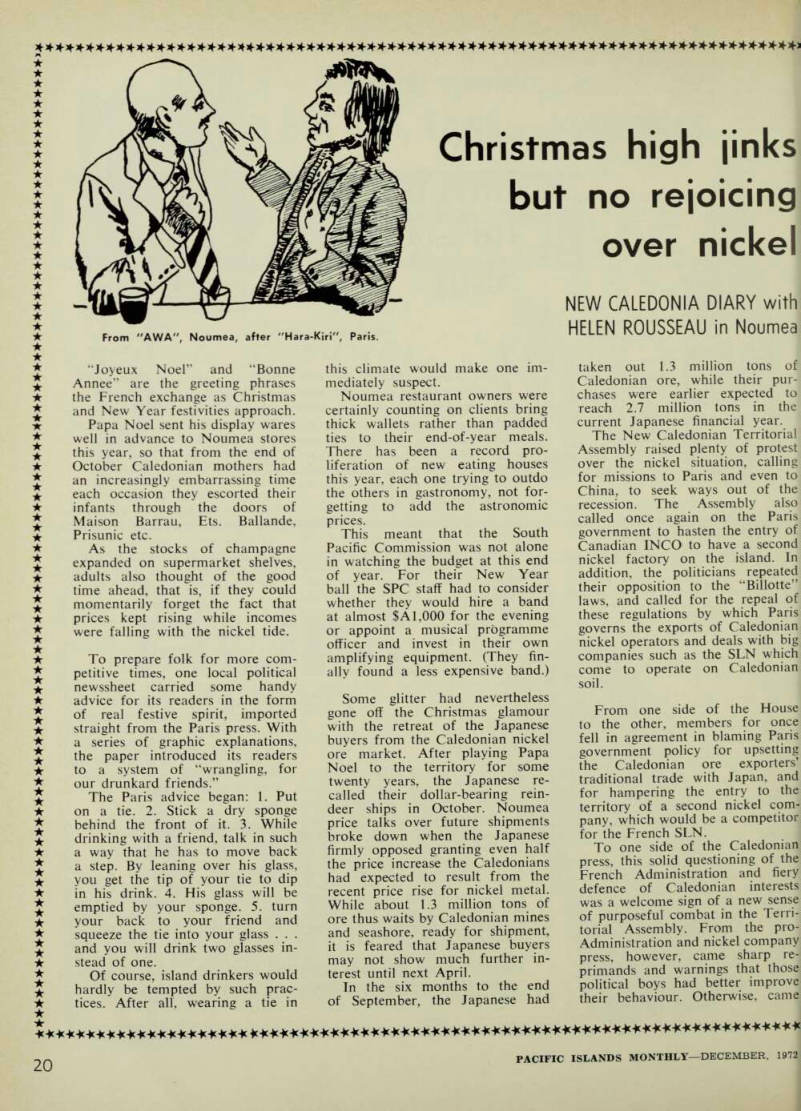
From "AWA", Noumea, after "Hara-Kiri", Paris.
the stern warning, Paris intentions to allow greater decentralisation might be changed, if such irrespon sible, inquisitive debates continued.
For their part, the Administra tion had to remind the Assembly, on another matter, that they had no right to intervene on an execu tive matter such as the premature recall to Paris of a public service chief, whom Assembly members considered was giving satisfaction.
Back on the nickel front, by this time the SLN was also raising the alarm, crying poor in the current recession and insisting it would not be able to continue operating if the territory’s nickel export tax laws remained unchanged. The company flew its managing direc tor, Mr Bernard de Villemejane, out to Noumea to denounce the Caledonian tax system, which hits the SLN shipments of nickel, re gardless of whether the company’s balance sheet shows a profit or loss.
Meanwhile, as the Japanese smiled and flew back to Tokyo, teams of prospecting geologists from various overseas mining com panies were also closing their dossiers and flying home. Their parting comments indicated that they could look at the situation again in 1974-76, but now exten sive world discoveries have made the nickel market more competi tive.
New Caledonia, with half the world’s known nickel reserves, had a good start in the contest, but in tervening factors such as rising local costs and government con trols are making the Caledonians wonder how they can keep in the race.
Ironically enough, as one Franco- American mining group has moved aut of its choice site on Noumea’s bayside promenade, the vacated building has been converted into a waterfront restaurant. For in the moment of crisis, the magic wand af tourism is being waved over the lormant nickel mines.
Undoubtedly, Noumea, its outer slands and coastal hinterland ;ould provide immense fascination or overseas visitors. But scenic ;pots, as much as local inhabitants, nust become accessible if they eally want to welcome travellers.
The French craving for indivi dual liberte restrains them from bothering” even their suburban leighbours with excessive doses of
friendliness. So visitors must not be daunted by this seeming indif ference. Rather, newcomers could indulge the whims of their own personalite and just enjoy being themselves, imbibing a changed atmosphere. There is certainly plenty to imbibe, through more than the purely oral senses.
The major problem for the visitor, of course, is to do this with out devouring his travellers’ cheques too fast. This may mean abandoning the popular idea that a holiday must be a bargain hunting spree, and instead deciding that a holiday can also include collecting fresh views of people, as seen on a 20 cent bus ride or over a 50 cent cup of coffee on a pave ment terrace.
French tour promoters are cer tainly concerned at the territory’s dwindling tourist traffic, but one of the major problems here still re mains the fact that most visitors are not millionaires, and if they are, they demand service when they pay.
So far the unhappy fact remains that in the first three-quarters of this year, New Caledonia has re ceived only 8,085 visitors staying on the island, a drop of over one third from the peak year of 1968.
As the Chateau Royal hotel ex tensions progress towards the opening scheduled for next July, its French promoters were plan ning to spend up to $A150,000 to advertise it on the Australian market. In addition, UTA French airlines were announcing a special bid to improve service on their flights.
While a Noumea barrister ad vertised in the local press for dis satisfied passengers to contact him with a view to forming an Asso ciation for the Protection of Clients, the French airline in formed Caledonians that extra (free) smiles and courtesy would be dispensed by the company from December 1.
There certainly should be more smiles all around, since the new passenger terminal has been opened at Tontouta, the island’s international airport. The new restaurants, bars and duty-free facilities give visitors an impres sive welcome to the French island.
Various Noumea tour and car operators have offices in the new terminal, while the decor is en hanced by mural pieces, from
locally-established French artists.
Not to be left behind, the Port of Noumea is still planning to build a Welcome Hall for cruise visitors. The building is now planned also to handle bus pas sengers from Tontouta. Credits of about $A200,000 have been aliocated for an imaginative design to feature New Hebridean timber. It is hoped these new tourist facilities can be completed before the end of 1973.
Meanwhile, since visitors usually face a language handicap, they have to be prepared to ask lots of questions if they are going to know all the interesting things that could be going on in Noumea —the location of the current art shows, the programme of star singers who now fly in regularly from France, and the venue of Melanesian women’s cricket.
Among some of these recent “spectacles” have been the shows of singers Rika Zarai then Jacques Dutronc, flown in from Paris; an exhibition of Indonesian art work, sponsored by the Indonesian Consul and Mrs Paul Samadiono; Jamaican, Japanese, Australian and New Zealand boxers, patronised by the SLN nickel company sports club. Caledonian boxing fans pay from SAI4 to $2B to watch what have now become regular monthly boxing evenings organised by the ASLN.
While the nickel company is diverting local aggressive instincts to this rowdy sport, figures from the French Administration indicated a need to cut territorial expenses, as revenue was to be SAI3 million below estimates on a planned 1972 budget of some $BO million.
For 1973, the Administration has proposed a budget reduced to $69 million. At the same time, Governor Verger continues to emphasise the need for Caledonians to seek more loan money from Europe to keep up the territory’s development programmes at a time when nickel earnings are not meeting earlier expectations.
Among the first loan items mentioned by the Administration were over a million dollars required for a rugby field and new indoor sports hall in Noumea.
Obviously, serious thoughts are already turning to the next South Pacific Games in Guam, 1975.
Advertisements & other items, p. 23 (1 item)
21
ACIFIC ISLANDS MONTHLY—DECEMBER, 1972
Tropicalities
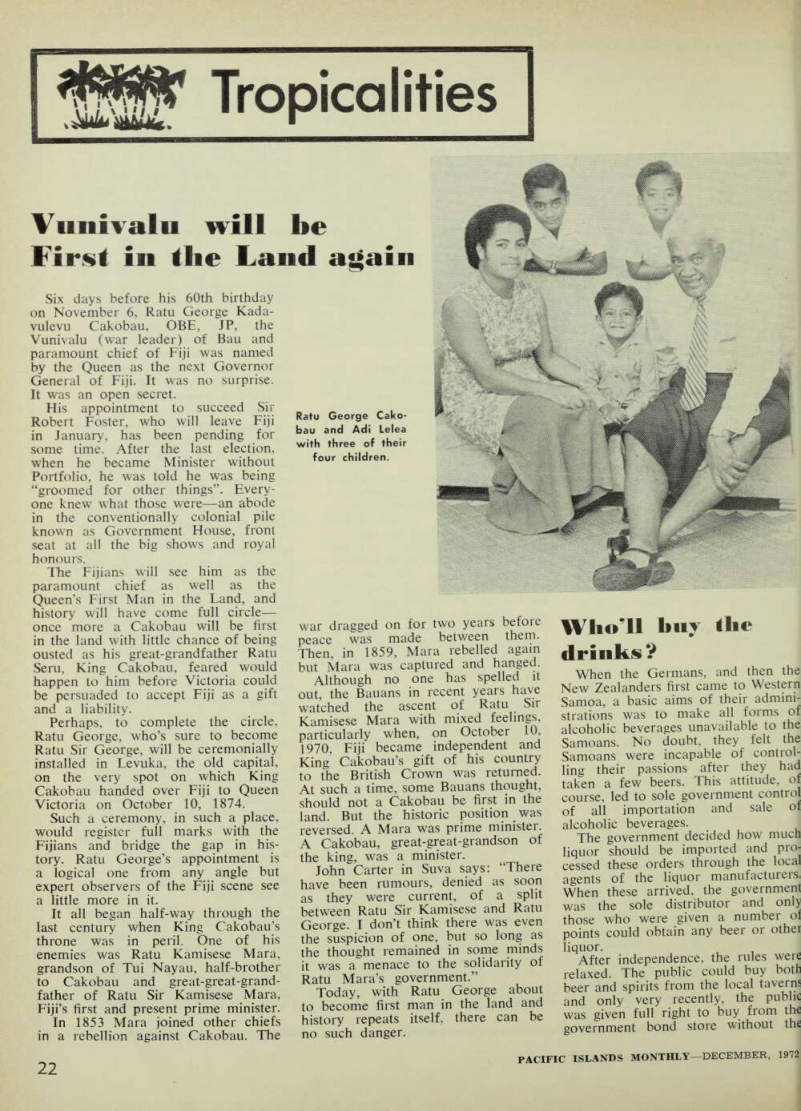
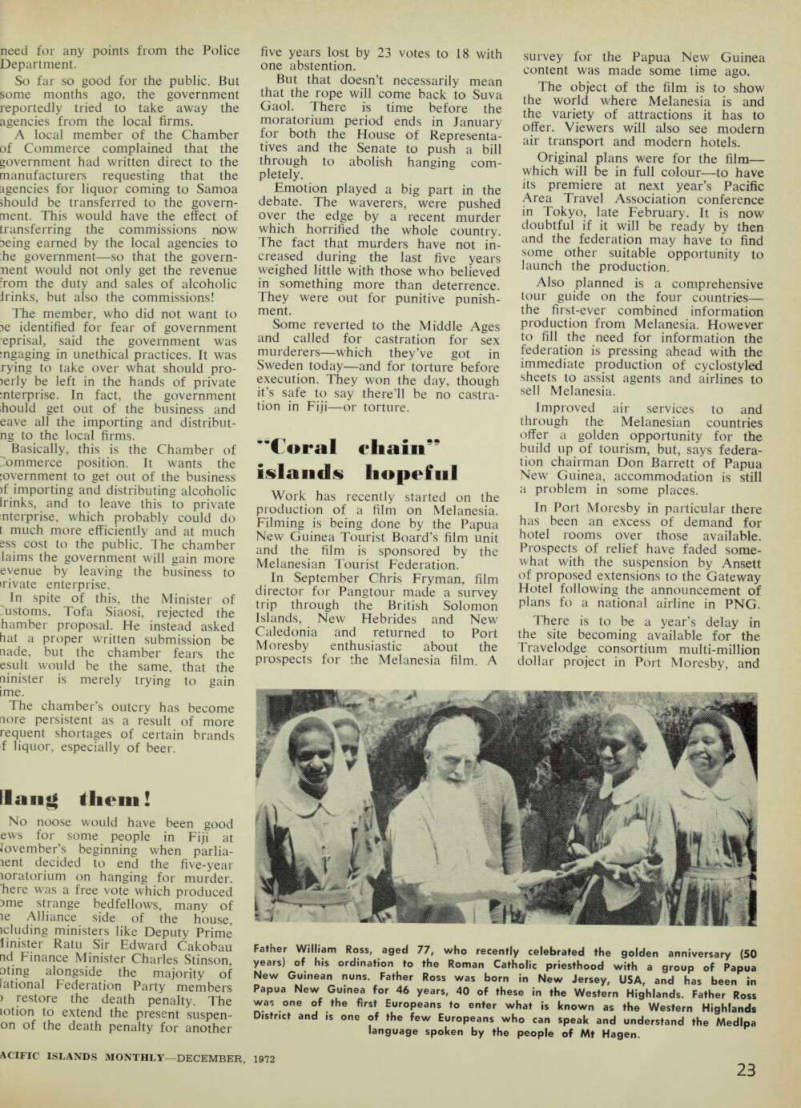
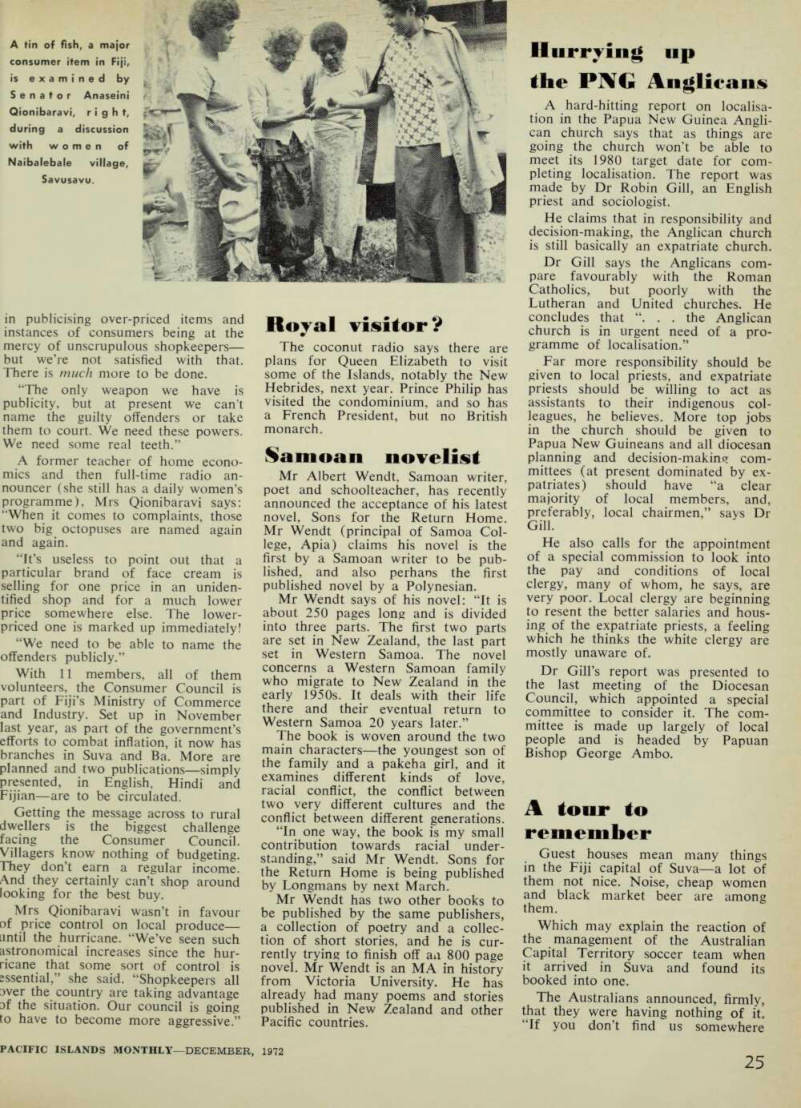
Vunivaln will be First in the Land again
Six days before his 60th birthday on November 6, Ratu George Kada vulevu Cakobau, OBE, IP, the Vunivalu (war leader) of Bau and paramount chief of Fiji was named by the Queen as the next Governor General of Fiji. It was no surprise.
It was an open secret.
His appointment to succeed Sir Robert Foster, who will leave Fiji in January, has been pending for some time. After the last election, when he became Minister without Portfolio, he was told he was being “groomed for other things”. Every one knew what those were —an abode in the conventionally colonial pile known as Government House, front seat at all the big shows and royal honours.
The Fijians will see him as the paramount chief as well as the Queen’s First Man in the Land, and history will have come full circle— once more a Cakobau will be first in the land with little chance of being ousted as his great-grandfather Ratu Seru, King Cakobau, feared would happen to him before Victoria could be persuaded to accept Fiji as a gift and a liability.
Perhaps, to complete the circle, Ratu George, who’s sure to become Ratu Sir George, will be ceremonially installed in Levuka, the old capital, on the very spot on which King Cakobau handed over Fiji to Queen Victoria on October 10, 1874.
Such a ceremony, in such a place, would register full marks with the Fijians and bridge the gap in his tory. Ratu George’s appointment is a logical one from any angle but expert observers of the Fiji scene see a little more in it.
It all began half-way through the last century when King Cakobau’s throne was in peril. One of his enemies was Ratu Kamisese Mara, grandson of Tui Nayau, half-brother to Cakobau and great-great-grand father of Ratu Sir Kamisese Mara, Fiji’s first and present prime minister.
In 1853 Mara joined other chiefs in a rebellion against Cakobau. The
war dragged on for two years before peace was made between them.
Then, in 1859, Mara rebelled again but Mara was captured and hanged.
Although no one has spelled it out, the Bauans in recent years have watched the ascent of Ratu Sir Kamisese Mara with mixed feelings, particularly when, on October 10, 1970, Fiji became independent and King Cakobau’s gift of his country to the British Crown was returned.
At such a time, some Bauans thought, should not a Cakobau be first in the land. But the historic position was reversed. A Mara was prime minister.
A Cakobau, great-great-grandson of the king, was a minister.
John Carter in Suva says: ‘There have been rumours, denied as soon as they were current, of a split between Ratu Sir Kamisese and Ratu George. I don’t think there was even the suspicion of one, but so long as the thought remained in some minds it was a menace to the solidarity of Ratu Mara’s government.”
Today, with Ratu George about to become first man in the land and history repeats itself, there can be no such danger.
W ho'll buy the
drinks ?
When the Germans, and then the New Zealanders first came to Western Samoa, a basic aims of their admini strations was to make all forms of alcoholic beverages unavailable to the Samoans. No doubt, they felt the Samoans were incapable of control ling their passions after they had taken a few beers. This attitude, of course, led to sole government control of all importation and sale of alcoholic beverages.
The government decided how much liquor should be imported and pro cessed these orders through the local agents of the liquor manufacturers.
When these arrived, the government was the sole distributor and only those who were given a number of points could obtain any beer or other liquor.
After independence, the rules weie relaxed. The public could buy both beer and spirits from the local taverns and only very recently, the public was given full right to buy from the government bond store without the
Ratu George Cako bau and Adi Lelea with three of their four children.
need for any points from the Police Department.
So far so good for the public. But some months ago, the government reportedly tried to take away the agencies from the local firms.
A local member of the Chamber of Commerce complained that the government had written direct to the manufacturers requesting that the agencies for liquor coming to Samoa should be transferred to the govern ment. This would have the effect of transferring the commissions now □eing earned by the local agencies to he government—so that the govern ment would not only get the revenue Torn the duty and sales of alcoholic irinks, but also the commissions!
The member, who did not want to me identified for fear of government eprisal, said the government was mgaging in unethical practices. It was rying to take over what should pro )erly be left in the hands of private mterprise. In fact, the government hould get out of the business and eave all the importing and distribut ng to the local firms.
Basically, this is the Chamber of Commerce position. It wants the ;overnment to get out of the business )f importing and distributing alcoholic Irinks, and to leave this to private mterprise, which probably could do t much more efficiently and at much ess cost to the public. The chamber laims the government will gain more evenue by leaving the business to •rivate enterprise.
In spite of this, the Minister of Customs, Tofa Siaosi, rejected the hamber proposal. He instead asked hat a proper written submission be nade, but the chamber fears the esult would be the same, that the ninister is merely trying to gain ime.
The chamber’s outcry has become nore persistent as a result of more requent shortages of certain brands f liquor, especially of beer.
Hang them!
No noose would have been good ews for some people in Fiji at Jovember’s beginning when parlia ment decided to end the five-year moratorium on hanging for murder.
Tmere was a free vote which produced mme strange bedfellows, many of me Alliance side of the house, icluding ministers like Deputy Prime linister Ratu Sir Edward Cakobau nd Finance Minister Charles Stinson, □ting alongside the majority of lational Federation Party members ) restore the death penalty. The lotion to extend the present suspen on of the death penalty for another
five years lost by 23 votes to 18 with one abstention.
But that doesn’t necessarily mean that the rope will come back to Suva Gaol. There is time before the moratorium period ends in January for both the House of Representa tives and the Senate to push a bill through to abolish hanging com pletely.
Emotion played a big part in the debate. The waverers, were pushed over the edge by a recent murder which horrified the whole country.
The fact that murders have not in creased during the last five years weighed little with those who believed in something more than deterrence.
They were out for punitive punish ment.
Some reverted to the Middle Ages and called for castration for sex murderers—which they’ve got in Sweden today—and for torture before execution. They won the day, though it’s safe to say there’ll be no castra tion in Fiji—or torture.
44 C«raI chain"
islands hopeful
Work has recently started on the production of a film on Melanesia.
Filming is being done by the Papua New Guinea Tourist Board's film unit and the film is sponsored by the Melanesian Tourist Federation.
In September Chris Fryman, film director for Pangtour made a survey trip through the British Solomon Islands, New Hebrides and New Caledonia and returned to Port Moresby enthusiastic about the prospects for the Melanesia film. A
survey for the Papua New Guinea content was made some time ago.
The object of the film is to show the world where Melanesia is and the variety of attractions it has to offer. Viewers will also see modern air transport and modern hotels.
Original plans were for the film— which will be in full colour—to have its premiere at next year’s Pacific Area Travel Association conference in Tokyo, late February. It is now doubtful if it will be ready by then and the federation may have to find some other suitable opportunity to launch the production.
Also planned is a comprehensive tour guide on the four countries— the first-ever combined information production from Melanesia. However to fill the need for information the federation is pressing ahead with the immediate production of cyclostyled sheets to assist agents and airlines to sell Melanesia.
Improved air services to and through the Melanesian countries offer a golden opportunity for the build up of tourism, but, says federa tion chairman Don Barrett of Papua New Guinea, accommodation is still a problem in some places.
In Port Moresby in particular there has been an excess of demand for hotel rooms over those available.
Prospects of relief have faded some what with the suspension by Ansett of proposed extensions to the Gateway Hotel following the announcement of plans fo a national airline in PNG.
There is to be a year’s delay in the site becoming available for the Travelodge consortium multi-million dollar project in Port Moresby, and
Father William Ross, aged 77, who recently celebrated the golden anniversary (50 years) of his ordination to the Roman Catholic priesthood with a group of Papua New Guinean nuns. Father Ross was born in New Jersey, USA, and has been in Papua New Guinea for 46 years, 40 of these in the Western Highlands. Father Ross was one of the first Europeans to enter what is known as the Western Highlands District and is one of the few Europeans who can speak and understand the Medlpa language spoken by the people of Mt Hagen.
Davara Motel is to remodel its “old wing” before proceeding with a plan ned extension.
The situation is brighter in other PNG towns. Rabaul’s Ascot Hotel has just completed remodelling that includes a new air-conditioned lounge bar and dining room; further plans include the converting of the present bar into a function room. Smugglers’
Motel in Madang is constructing a new block and several hotels in the Highlands have added rooms in the past six months.
Honiara has a doubled capacity.
The Air Pacific jet service from Suva to Port Moresby cut out a night stop over at the BSI capital and this has affected business this year. How ever in the long run Honiara should benefit since travellers can con veniently stop over for two days and go on to Port Vila, Noumea or Fiji.
BSI tourist interests are less happy with the service in the other direction since the Air Pacific jet and TAA’s jet are on Sunday and Tuesday respectively. A wider spacing would suit them they claim, but TAA has explained that operational require ments make it impossible, at least for
the present, to fly the route with a DC9 on any other day.
With the nickel building boom over in New Caledonia that country is really seeking tourists. New hotels, new restaurants and other attractions such as boat cruises are available — and prices are not “out of this world”.
Qantas and UTA are selling cheap packages to both New Caledonia and the New Hebrides. With really de pressed copra prices and not much other source of income (save offshore companies) the condominium has a large welcome sign out for tourists — and the number is increasing steadily, although New Caledonia is still the best customer.
The Melanesian Tourist Federation hopes to encourage more travel by individuals and family groups which do not pose such a strain on ac commodation in places like Port Moresby. It hopes to get more Aus tralian and New Zealand people going through the “coral chain”.
The counter attraction of cheap fares to UK, Europe and Singapore is a big hurdle to overcome but the federation is hopeful that there could be excursion fares through Melanesia in the not too distant future.
She's consumed
with zeal
Anaseini Qionibaravi, Fiji’s only woman senator, is softly-spoken, eminently feminine. Wife of a highly successful Fijian businessman and mother of four children, hers is far from the image of aggressive cam paigner, waver of banners, upholder of the rights of the underprivileged.
As first chairman of Fiji’s Consumer Council however, she’s all of those.
The job, for which she isn’t paid and to which she devotes almost all the normal working day, is one of the most important in inflation (and now hurricane) hit Fiji. It’s also one of the most frustrating.
Because the council still hasn’t any real power, she told PIM in November, shopkeepers won’t re cognise the existence of a pressure group protecting consumer interests.
A Consumer Council staff member, writing down prices recently in a certain store, was told to leave. “We don’t want any of that sort of thing here,” said the shopkeeper.
Mrs Qionibaravi says: “People say the council is doing a marvellous job
in publicising over-priced items and instances of consumers being at the mercy of unscrupulous shopkeepers— but we’re not satisfied with that.
There is much more to be done.
“The only weapon we have is publicity, but at present we can’t name the guilty offenders or take them to court. We need these powers.
We need some real teeth.”
A former teacher of home econo mics and then full-time radio an nouncer (she still has a daily women’s programme), Mrs Qionibaravi says: “When it comes to complaints, those two big octopuses are named again and again.
“It’s useless to point out that a particular brand of face cream is selling for one price in an uniden tified shop and for a much lower price somewhere else. The lower priced one is marked up immediately!
“We need to be able to name the offenders publicly.”
With 11 members, all of them volunteers, the Consumer Council is part of Fiji’s Ministry of Commerce and Industry. Set up in November last year, as part of the government’s efforts to combat inflation, it now has branches in Suva and Ba. More are
planned and two publications—simply
presented, in English, Hindi and Fijian—are to be circulated.
Getting the message across to rural dwellers is the biggest challenge facing the Consumer Council.
Villagers know nothing of budgeting.
They don’t earn a regular income.
And they certainly can’t shop around looking for the best buy.
Mrs Qionibaravi wasn’t in favour of price control on local produce— until the hurricane. “We’ve seen such astronomical increases since the hur ricane that some sort of control is essential,” she said. “Shopkeepers all over the country are taking advantage of the situation. Our council is going to have to become more aggressive.”
Royal visitor?
The coconut radio says there are plans for Queen Elizabeth to visit some of the Islands, notably the New Hebrides, next year. Prince Philip has visited the condominium, and so has a French President, but no British monarch.
Samoan novelist
Mr Albert Wendt, Samoan writer, poet and schoolteacher, has recently announced the acceptance of his latest novel, Sons for the Return Home.
Mr Wendt (principal of Samoa Col lege, Apia) claims his novel is the first by a Samoan writer to be pub lished, and also perhans the first published novel by a Polynesian.
Mr Wendt says of his novel; “It is about 250 pages long and is divided into three parts. The first two parts are set in New Zealand, the last part set in Western Samoa. The novel concerns a Western Samoan family who migrate to New Zealand in the early 19505. It deals with their life there and their eventual return to Western Samoa 20 years later.”
The book is woven around the two main characters—the youngest son of the family and a pakeha girl, and it examines different kinds of love, racial conflict, the conflict between two very different cultures and the conflict between different generations.
“In one way, the book is my small contribution towards racial under standing,” said Mr Wendt. Sons for the Return Home is being published by Longmans by next March.
Mr Wendt has two other books to be published by the same publishers, a collection of poetry and a collec tion of short stories, and he is cur rently trying to finish off aa 800 page novel. Mr Wendt is an MA in history from Victoria University. He has already had many poems and stories published in New Zealand and other Pacific countries.
Hurrying up
the PNC Anglicans
A hard-hitting report on localisa tion in the Papua New Guinea Angli can church says that as things are going the church won’t be able to meet its 1980 target date for com pleting localisation. The report was made by Dr Robin Gill, an English priest and sociologist.
He claims that in responsibility and decision-making, the Anglican church is still basically an expatriate church.
Dr Gill says the Anglicans com pare favourably with the Roman Catholics, but poorly with the Lutheran and United churches. He concludes that . . the Anglican church is in urgent need of a pro gramme of localisation.”
Far more responsibility should be given to local priests, and expatriate priests should be willing to act as assistants to their indigenous col leagues, he believes. More top jobs in the church should be given to Papua New Guineans and all diocesan planning and decision-making com mittees (at present dominated by ex patriates) should have “a clear majority of local members, and, preferably, local chairmen,” says Dr Gill.
He also calls for the appointment of a special commission to look into the pay and conditions of local clergy, many of whom, he says, are very poor. Local clergy are beginning to resent the better salaries and hous ing of the expatriate priests, a feeling which he thinks the white clergy are mostly unaware of.
Dr Gill’s report was presented to the last meeting of the Diocesan Council, which appointed a special committee to consider it. The com mittee is made up largely of local people and is headed by Papuan Bishop George Ambo.
A tour to
remember
Guest houses mean many things in the Fiji capital of Suva—a lot of them not nice. Noise, cheap women and black market beer are among them.
Which may explain the reaction of the management of the Australian Capital Territory soccer team when it arrived in Suva and found its booked into one.
The Australians announced, firmly, that they were having nothing of it.
“If you don’t find us somewhere
A tin of fish, a major consumer item in Fiji, is examined by Senator Anaseini Qionibaravi, right, during a discussion with women of Naibalebale village, Savusavu.
better to stay we are not playing,” they said.
The ultimatum led to much running around by the Fiji soccer officials.
Eventually the Australians were found alternative accommodation.
It was all very much a storm in a tea cup—the guest house in ques tion was one of Suva’s respectable ones —but typical of this hot-tempered tour.
The Australian side was the first overseas team to meet Fiji in Fiji in seven years. It’s going to take Fiji soccer fans about as long to forget these games.
In the first game of the two-match series, the Australians beat Fiji 2-0 and were hooted by the big crowd for their rough play. The Fiji players came off the field bitter at the maul ing they took at the hands of the Australians.
The second game looked like de veloping into open warfare. It did.
Police came on to the field to break up a wild brawl between the teams shortly before halftime. At least one prominent Fiji official had to be led off the field and referee S. A. Hus sain was pushed and sworn at by the Australian players.
Fighting continued through the second half. Linesman Humphery Chang got into a shouting match with the Australian players and referee Hussain had to step in and restore order. (The match, by the way, was a 2-2 draw).
Trying out the
common roll
Common roll voting, with all the races thrown together into one ballot —after land, Fiji’s most contentious subject—came to Suva and Lautoka on November 5 with the municipal elections fought on party lines.
People voted for party and not the man. The Alliance took over the Suva
City Council with 14 seats against the National Federation Party’s six, and the NFP, in an area where the Indian community predominates, won control of the Lautoka Town Council 8-4.
Suva’s Alliance group chose for mayor, Cr Peter Allan, a long-serving member, who was deputy mayor a few years ago, thereby dashing the hopes of Cr C. P. Bidesi of the NFP, who plaintively complained that a year ago there was a promise that he would be the next mayor.
Last year’s mayor. Dr Macu Salato, who didn’t exactly cover himself with glory in the post, did not stand for the council this year. There are rumours that he will be Fiji’s Number One man in London.
The NFP at Lautoka also steam rollered their man in but they fell out doing it. The caucus was split, one faction wanting popular, moderate Cr Hari Punja, the other Cr Wilfred Sugrim. It was alleged that at the party meeting one member had struck another.
Cr Punja got the nomination and all 12 councillors, both Federation and Alliance voted unanimously in the council meeting for Cr Punja.
Chickens may come home to roost with the election to the council of Cecil Bradnam, who a few months ago was sacked by the council from his job as City Engineer. Cecil would be more than human if, at some time or another, he doesn’t weigh heavily on those who encompassed his dis missal, both councillors and officials.
Crisis in the Cooks
In the interests of nature and human respect, the authorities at Rarotonga are going to have to streamline their Customs and immi gration procedures for seaborne visitors.
At any rate that’s what the crew and passengers of the charter yacht Winston Churchill think after drop ping anchor at Rarotonga in Sep tember. They were met by officials who told them that, in the interests of the campaign against pollution of lagoons, a brand new modern toilet facility had been established on shore and must be used in preference to yachts’ toilets which were not allowed to operate while in port.
So the crew and passengers waited patiently for clearance before going ashore. That took six hours at the end of which a crowd of uncomfort able people dashed for Rarotonga’s newest attraction. They found it locked. But it could be operated by the insertion of a New Zealand 5c piece. They hadn’t one between them.
Advertisements & other items, pp. 25-26 (2 items)
23
ACIFIC ISLANDS MONTHLY—DECEMBER, 1972
Huon GULF mom
If you’re going to Lae, book in at the Huon Gulf Motel, just down the road from Lae Airport.
The Huon Gulf is individually airconditioned in every suite. There’s a swimming pool to cool you down after your trip and attentive service for top standard meals in the modern restaurant and for liquor service to your table, suite or poolside.
For family groups there are family suites with interconnecting doors to adjoining suites.
Make the Huon Gulf Motel your base in Lae.
Book direct or through any office of Ansett Airlines of Papua New Guinea.
Huon GULF mom
Markham Road, Lae. Phone: Lae 3204.
AHO/129A
A member company of Ansett Transport Industries Limited.
Flying Dutchman
Copies of “Sail Magazine”, published in Boston, USA, keep arriving at Honiara Post Office, Guadalcanal, for Admiral “Bull”
Halsey, the wartime US com mander. The post office has sent some hack, with the note that the Admiral no longer is attached to Task Force 64, Guadalcanal, as the address states. It has no effect. Is the navy paying the subscription?
Advertisements & other items, pp. 28-30 (2 items)
Bubo
FIAT
CONCESSIONAIRES
American Samoa Silver Star Transport Inc., P.O. Box CB-4, Pago Pago.
Fiji Motibhai & Co. Ltd.,
P.O. Box 40, BA.
New Caledonia Agence Automobile S.A.,
P.O. 80x842, NOUMEA.
New Guinea New Guinea Motors Pty. Ltd.,
P.O. Box 1027, BOROKO
New Hebrides Societe Bourgeois & Cie.,
P.0.80x 28, PORT VILA.
New Zealand Torino Motors Ltd.,
P.O. Box 6240, AUCKLAND.
Norfolk Island Cascade Motors Ltd.,
P.O. Box 34, NORFOLK.
ISLAND.
Solomon Islands Chan Wing Motors Ltd.,
P.O. Box 820, HONIARA.
Tahiti Societe Tahitienne, D'Automobile S.A.R.L.,
P.O. Box 17-23, PAPEETE
Western Samoa E.A. Coxon & Co. Ltd.,
P.O. Box 38, APIA.
BUBO
Now you can
drive the car Ferrari
drives.
Enzo Ferrari. He probably knows more about what makes a great car than any man alive. His name is on some of the most exciting machines ever made. Cars capable of 180 m.p.h. To ride in one is to know the ultimate in performance and luxury.
What does Ferrari drive himself ?
The Fiat 128 Sport Coupe. Surprised?
You won't be when you think about this.
The 128 Coupe is a much better car to drive around town. An excitingly nimble machine that's quick off the mark and easy to park. With a rugged front wheel drive, five bearing crankshaft engine. It develops 75 bhp. The 1290 cc engine happily runs it to a top cruising speed. And for real stopping power, the brakes are power assisted, discs and drums. With dual cir cuits for maximum safety. And the interior is what you'd expect from an Italian thoroughbred.
See what it's like to drive around lik Ferrari.
Fiat 128 Sport Coupe
anna
FIAT OF AUSTRALIA PTY. LIMITED
ZEISS
UMBRAL
sunsasses
4 Hkn> jm A I
NATURALLY!
FASHION MODELS WITH THE
ORIGINAL ZEISS LENSES
mm I 1
C CARL
ZEISS
CARL ZEISS PTY.LTD, 569 george street, Sydney, phone: 6i-89oi.
Distributed by: PROUDS (FIJI) LIMITED, the triangle, suva, fui.
BRECKWOLDT & CO. PTY. LIMITED RABAUL • KIETA • WEWAK • PORT MORESBY • LAE • MADANG • MT. HAGEN • APIA • NOUMEA • HONIARA
’Acific Islands Monthly—December, 1972
mid-Pacific
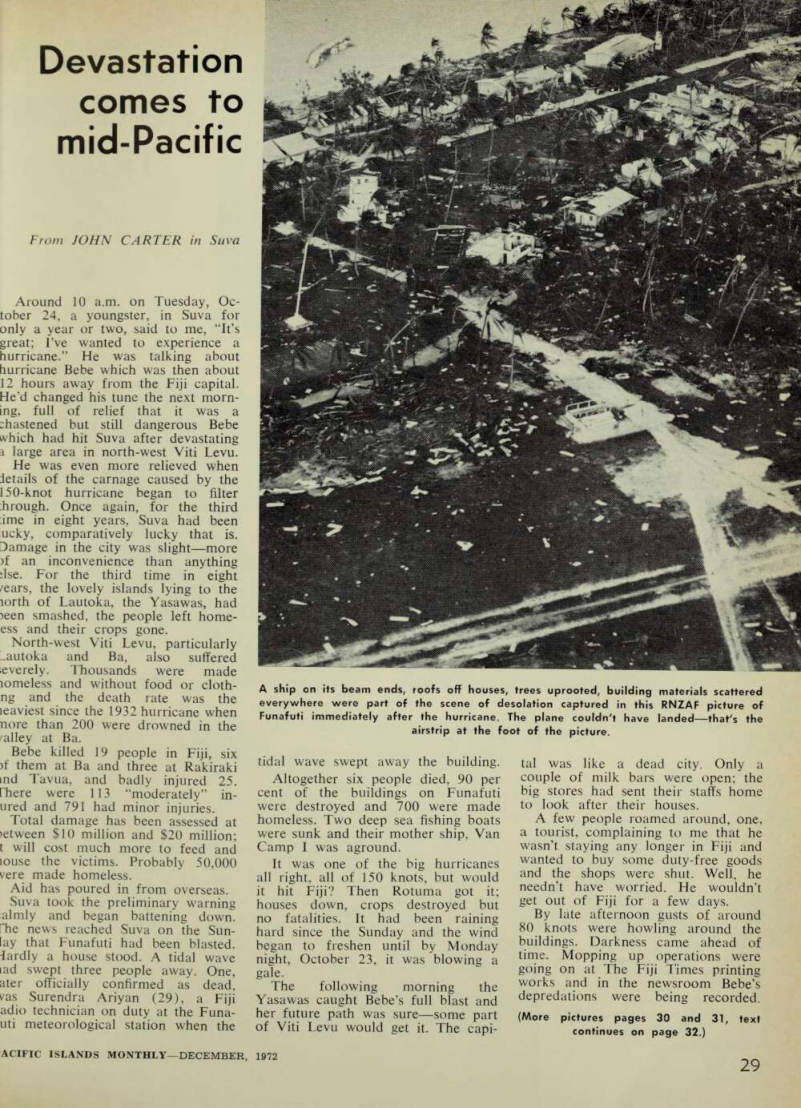
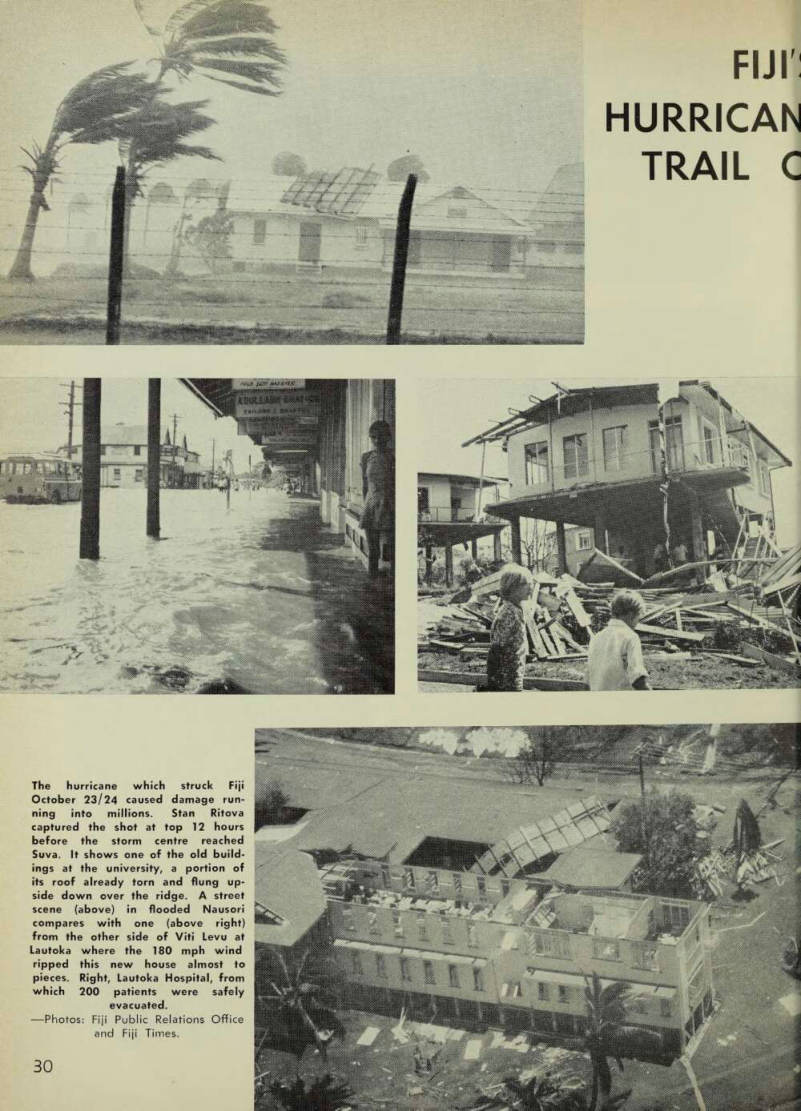
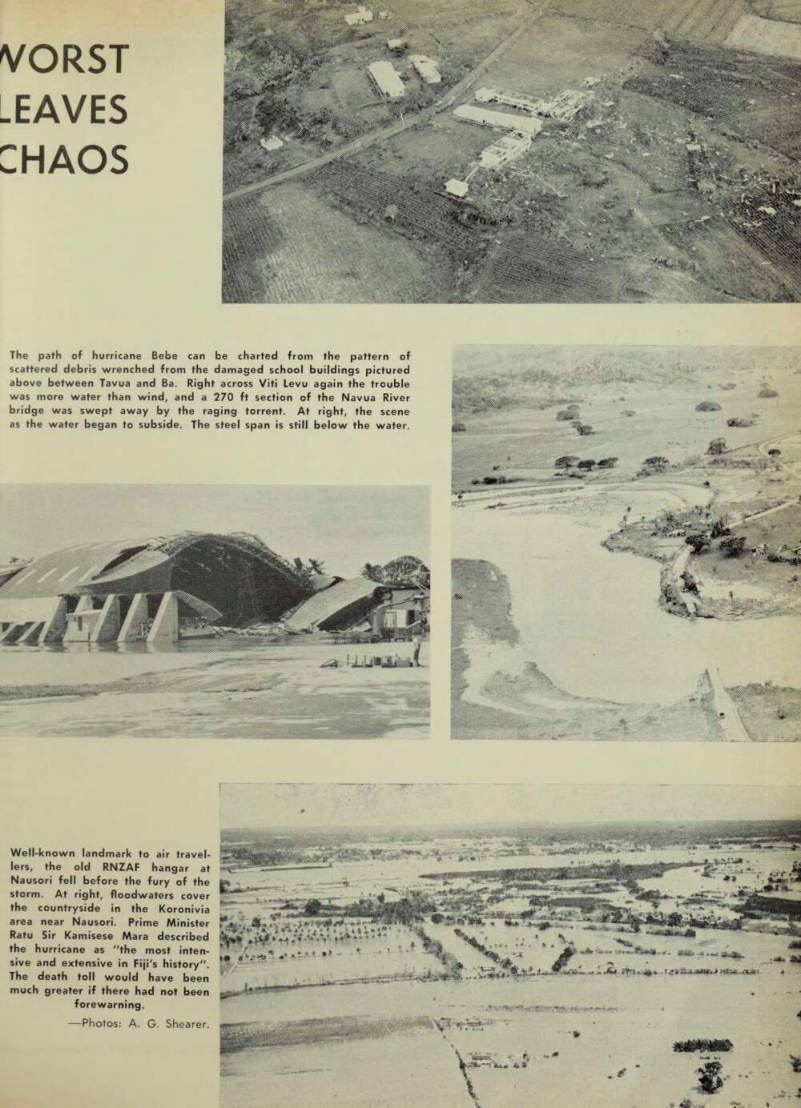
Devastation comes to mid-Pacific
From JOHN CARTER in Suva
Around 10 a.m. on Tuesday, Oc tober 24, a youngster, in Suva for only a year or two, said to me, “It’s great; I’ve wanted to experience a hurricane.” He was talking about hurricane Bebe which was then about 12 hours away from the Fiji capital.
He’d changed his tune the next morn ing, full of relief that it was a :hastened but still dangerous Bebe which had hit Suva after devastating a large area in north-west Viti Levu.
He was even more relieved when details of the carnage caused by the 150-knot hurricane began to filter hrough. Once again, for the third ;ime in eight years, Suva had been ucky, comparatively lucky that is.
Damage in the city was slight—more if an inconvenience than anything ;lse. For the third time in eight the lovely islands lying to the lorth of Lautoka, the Yasawas, had )een smashed, the people left home ess and their crops gone.
North-west Viti Levu, particularly and Ba, also suffered ;everely. Thousands were made lomeless and without food or cloth ng and the death rate was the leaviest since the 1932 hurricane when nore than 200 were drowned in the 'alley at Ba.
Bebe killed 19 people in Fiji, six )f them at Ba and three at Rakiraki md Tavua, and badly injured 25. fhere were 113 “moderately” in ured and 791 had minor injuries.
Total damage has been assessed at >etween SlO million and $2O million; t will cost much more to feed and muse the victims. Probably 50,000 vere made homeless.
Aid has poured in from overseas.
Suva took the preliminary warning almly and began battening down, fhe news reached Suva on the Sun lay that Funafuti had been blasted, lardly a house stood. A tidal wave tad swept three people away. One, ater officially confirmed as dead, /as Surendra Ariyan (29), a Fiji adio technician on duty at the Funa uti meteorological station when the
tidal wave swept away the building.
Altogether six people died, 90 per cent of the buildings on Funafuti were destroyed and 700 were made homeless. Two deep sea fishing boats were sunk and their mother ship, Van Camp I was aground.
It was one of the big hurricanes all right, all of 150 knots, but would it hit Fiji? Then Rotuma got it; houses down, crops destroyed but no fatalities. It had been raining hard since the Sunday and the wind began to freshen until by Monday night, October 23, it was blowing a gale.
The following morning the Yasawas caught Bebe’s full blast and her future path was sure—some part of Viti Levu would get it. The capi
tal was like a dead city. Only a couple of milk bars were open; the big stores had sent their staffs home to look after their houses.
A few people roamed around, one, a tourist, complaining to me that he wasn’t staying any longer in Fiji and wanted to buy some duty-free goods and the shops were shut. Well, he needn’t have worried. He wouldn’t get out of Fiji for a few days.
By late afternoon gusts of around 80 knots were howling around the buildings. Darkness came ahead of time. Mopping up operations were going on at The Fiji Times printing works and in the newsroom Bebe’s depredations were being recorded. (More pictures pages 30 and 31, text continues on page 32.)
A ship on its beam ends, roofs off houses, trees uprooted, building materials scattered everywhere were part of the scene of desolation captured in this RNZAF picture of Funafuti immediately after the hurricane. The plane couldn't have landed—that's the airstrip at the foot of the picture.
The Navua River had broken its banks. The big bridge had been swept away. The Rewa River was rising dangerously—it drowned 12 in 1965.
Lautoka, Ba and Nadi were getting it badly. Then it would be Suva’s turn, around 10 p.m. Why are the worst hours always at night?
As the hour neared people began wondering. There were 100 mph gusts but at Lautoka they were reckoned at 180 mph. What had happened to Bebe? She came over the mountains and the land of Viti Levu had sapped her energy. For a couple of hours a chastened Bebe blew through the city. Power and telephone lines went in some places.
A few roofs were damaged but Bebe was now more noisy than murderous. Suva had escaped.
Lautoka reporter Vijendra Kumar had a different story to tell. He saw, heard and felt Bebe at her worst.
Below is his story.
Night of feor
From Vijendra Kumar in Lautoka At Lautoka and Ba winds of up to 180 mph roared and howled during a terrifying two-hour spell of carnage. The winds ripped off entire roofs and flattened bures (grass thatched houses). Stout baka trees and even the strong coconut palms danced crazily before being up rooted.
It was a little after 4.30 p.m. and yet in our newspaper office in Lau toka it seemed as if night had fallen.
Vitogo Parade was a watery channel and Namoli Avenue was a roaring torrent with water two to four feet deep in places. As I watched, a length of roofing iron from a stack in the shop-yard across the road, flew up and smashed against a signpost a chain away. Coconut fronds broke off the tree-tops and were carried chains away. Flying debris that hit electric wires which were still live sent sparks flying like dozens of tiny stars falling in the sky.
Frightened and wet, an elderly man tottered to our door and said: “Please tell me where the temple is.
I must shelter somewhere.”
I gave them directions to the Sikh temple which has a dormitory for poor guests. The two said they were ordinary farmers from Ba and had not heard the hurricane notice broad cast half-hourly by Radio Fiji. They were in Lautoka to sell their market produce but had lost everything and were trapped by the storm.
As they waded in the flooded street towards the temple, I decided to walk home five chains away. Falling and slipping in the muddy water, I ducked and weaved to avoid being hit by flying debris. Reaching Nacula Street —the road to my home—l watched out for broken electric wires which would have put a sudden end to my journey. Nacula Street was a mess of broken branches and tree trunks, tins, timber and a maze of wires. How I got through it all is something I wonder about still.
With the help of a flashlight, I saw strange objects floating all around my house. Discarded boxes, car parts, fruit and vegetables, coconuts, cloth ing and even a woman’s brassiere floated past.
My wife had improvised a kerosene lamp from an empty milk can—the only light in the house after our power cut off. Windows and doors shut, we waited while the entire world seemed to be in a mad frenzy out side. At about six, we felt a sudden silence. Opening the window, we found the rain had stopped and the wind had abated.
Bebe had passed over Lautoka.
The next morning, the sun came out shining bright.
On an inspection tour, I saw roads washed away, sugar cane fields under water, hundreds of trees uprooted, dead birds and animals scattered about, and the entire countryside littered with debris from damaged houses. There was despair on almost every face.
At Karavi, an old Land-Rover was carrying a coffin. The driver told us of the tragic deaths of a mother and son who were buried under the roof of their house as it fell. Their bodies were found by neighbours.
At the Ba Methodist Mission Hos pital, 1 met Mr Bal Krishna, a farmer from Koronubu. His wife lay critically ill in the hospital as he waited out side. He could hardly speak. I pieced together a story of the family’s terror as their little house was lifted up by the wind while they were still inside.
“My little nephew, my sister’s one year-old boy, was carried five chains away in the wind. My father and sister were thrown out somewhere and we found them dead. My wife suffered deep cuts on her head,” Mr Krishna said. Incredibly, the little boy was picked up from a bush uninjured.
Amid the destruction, men and women went about picking up pieces of their homes, burying the dead, repairing damage and with painful slowness resuming normal life. Said a Ba farmer who lost his cane crop and home: “Life must go on. We have to start again. It’s all God’s will.”
Advertisements & other items, p. 31 (1 item)
29
ACIFIC ISLANDS MONTHLY—DECEMBER, 1972
Hurrican[?] [?]Eaves
Fiji's [?]Orst
Trail C[?]Haos
The hurricane which struck Fiji October 23/24 caused damage run ning into millions. Stan Ritova captured the shot at top 12 hours before the storm centre reached Suva. It shows one of the old build ings at the university, a portion of its roof already torn and flung up side down over the ridge. A street scene (above) in flooded Nausori compares with one (above right) from the other side of Viti Levu at Lautoka where the 180 mph wind ripped this new house almost to pieces. Right, Lautoka Hospital, from which 200 patients were safely evacuated. —Photos: Fiji Public Relations Office and Fiji Times.
The path of hurricane Bebe can be charted from the pattern of scattered debris wrenched from the damaged school buildings pictured above between Tavua and Ba. Right across Viti Levu again the trouble was more water than wind, and a 270 ft section of the Navua River bridge was swept away by the raging torrent. At right, the scene as the water began to subside. The steel span is still below the water.
Well-known landmark to air travel lers, the old RNZAF hangar at Nausori fell before the fury of the storm. At right, floodwaters cover the countryside in the Koronivia area near Nausori. Prime Minister Ratu Sir Kamisese Mara described the hurricane as "the most inten sive and extensive in Fiji's history".
The death toll would have been much greater if there had not been
forewarning.
—Photos: A. G. Shearer.
Advertisements & other items, pp. 33-38 (3 items)
Vorst
-EAVES
CHAOS
Fiji Hurricane
32
PACIFIC ISLANDS MONTHLY—DECEMBER, 1972
Continued from p .29
1
PAPUA
NEW GUINEA
PRINTING CO.
PTY. LTD.
• Commercial Offset and Letterpress printers to the territory.
Factories in Port Moresby and Lae.
And we also can supply your regular and specialised stationery needs.
OFFICE EQUIPMENT
RUBBER STAMPS
We welcome your mail orders.
P.O. Box 633, Port Moresby P.O. Box 759, Lae P.O. Box 30, Mount Hagen Cables & Telegrams: PRINTER Port Moresby and Lae
ext u are in London , you are cordially invited to visit The House of Dunhill. ie Dunhill King Size Filter Cigarette created and perfected by our blenders be the best
Virginia cigarette
in the world.
H* imm i
“UNHIL
\ l i
unhi
LONDON f*RS NEWVORK
The most distineu tobacco house in the world.
We put off today...
what others leave
until tomorrow!
This is due to side-port, unit-loading—a fast, efficient, safe way to handle cargo. Our 4 ships, “New Guinea Chief,” “Island Chief,” “Coral Chief,” and “Papuan Chief,” are specially designed for side-port unit-loading, and to save ‘turn around’ time in port they carry their own ‘on board’ forklifts to speed the loading and discharge procedure. If you would like to see how side-port unitloading can save you money on our Sydney, Brisbane, Port Moresby, Samarai, Lae, Madang, Rabaul, Kavieng, Kieta and Honiara services let us show you our 20 minute film “Cargo Revolution” ... and you will see how we can “put off today what others leave until tomorrow”.
XI New Guinea Australia Line Pty.Ltd
Member of the Swire Group General Agents: PORT MORESBY—Steamships Trading Co. Ltd. SYDNEY—Swire & Gilchrist Pty. Ltd.
Agents at: BRISBANE—WiIIs, Gilchrist & Sanderson Pty. Ltd. PAPUA-NEW GUlNEA—Steamships Trading Co. Ltd. (for "New Guinea Chief" at Rabaul and “Island Chief" at Kavieng—Burns Philp (N.G.) Ltd.).
HONlARA—British Solomons Trading Co.
fir
SGO32
!V ' j.
SS N \ \ \ $ m Hi mm
USHGO S
NEST
T) pa a 93 mM y Australia S’
ofGHET
i ij
wm Z'fi-’fi’Psm m
*oll£D
m
Flour that's milled fresh
when called for by your shipping agent Milled fresh—when called for—then packed in clean, strong sacks or drums. That's the reason why Mungo Scott's have the largest output of any mill in Australia.
Mungo Scott's skilled laboratory staff put to practice every modern method to ensure you receive the finest quality entoleted flour.
Since 1894 . . . Mungo Scott "a good firm to do business with . We pride ourselves on documentation.
BAKERS FLOUR • SHARPS • MEALS
CAKE FLOUR • BISCUIT FLOUR • SPONGE FLOUR
MUNGO SCOTT -
FLOUR MILLERS
A DIVISION OF ALLIED MILLS INDUSTRIES PTY. LTD.
Summer Hill, N.S.W., Australia Cable & Telegraphic SUPERB Sydney, Phone: 797-8333
Big enough to build a meal on!
Congress of Micronesia
Marianas rub with the Congress of Micronesia
From a Saipan correspondent
It appears that part of the stra tegically-located US Trust Territory of the Pacific Islands will soon be come a permanent part of the American defence system in the northern Pacific.
Senator Edward Dig. Pangelinan, chairman of the newly-formed Mariana Islands Political Status Com mittee, has confirmed reports here that the first round of negotiations between local leaders and top-level US officials will begin on Saipan early in December. Pangelinan, also of the Congress of Micronesia’s Joint Committee on Future Status, met Ambassador Franklin Haydn Wil liams, President Nixon’s personal representative to the Micronesian status talks, along with other Marianas leaders, at the conclusion of the sixth round of Micronesian talks that ended on October 6 at Barbers Point Naval Air Station at Oahu, Hawaii.
Marianas leaders here received permission from Williams last April to negotiate with the US for a separate status different from the rest of the territory “. . . leading to full political union with the United States . . .” according to a Marianas position paper. Until then, the official US position was to deal with the ter ritory as a single political entity until the trusteeship over Micronesia was terminated.
The Congress of Micronesia is cur rently negotiating for a semi-indepen dent status with the US delegation.
However, the Marianas move has caused some disagreement within the Micronesian congress. Official trans cripts just released by the US State Department quoted Micronesian Status Committee chairman Sen.
Lazarus Salii on the final day of the talks: “We have asked, and ask again, that the United States provide to our subcommittee on land the details of its requirements in the Marianas. As you are aware, the mandate received by this committee from the Congress of Micronesia requires that our con sideration and negotiations encompass the entire present Trust Territory and not only five out of the six districts.
The unilateral action of the United States in accepting separate negotia tions with the Marianas does not, obviously, relieve this committee
f Ul . . . , ... from the obliga ions with which the congress has entrusted us.
Ambassador Williams replied: “The position of the Marianas District with respect to its desire for a future political status is a matter of record, as is the response of my government to their request for separate talks
leading to permanent political union of the Marianas to my country.”
Exactly what kind of political relationship Marianas leaders want is still unclear. Until two years ago unofficial plebiscites favoured reunifi cation with Guam, an unincorporated and fortified American territory at the southern end of the Mariana Islands chain. But that movement is dying out today. Leaders here generally favour by-passing Guam for more direct ties with the United States, or Commonwealth status, similar to Puerto Rico.
People here, as in nearby Guam, want military bases for economic reasons.
Advertisements & other items, pp. 39-40 (1 item)
James Gready Pty. Ltd.
GLASS-JUG WASHERS
• HYGIENIC • LIFT OFF DOOR • HEAVY DUTY
• RELIABLE • CHANGEOVER COMPONENT SERVICE
We also manufacture; • S.S. URINALS • TANKS, VATS • SPECIAL PURPOSE EQUIPMENT • FOOD PROCESSING EQUIPMENT • S.S. BAIN MARIE UNITS • S.S.
FOOD TROLLEYS • JAFFLE COOKERS • PORTABLE S.S. BAR-B-Qs.
James Gready Pty. Ltd.
Pentex St., Salisbury North, Brisbane, Qld. 4107. Ph. 47-3966
COOL
THE CAR ACCESSORY
THAT REVOLUTIONISED
THE TRADE!
ii
STRETCH-ON
COMFORT FOR
YOUR CAR! BRI
NYLON
KEEP COOL IN COMFORTABLE, LUXURIOUS
"FRENCH KNIT" TERRY TOWELLING
OR STRETCH NYLON CAR SEAT COVERS.
Timm
Knit
FITS ALL MAKES OF CARS
TRADE ENQUIRIES:
FRENCH KNIT PTY. LTD., French Knit House, 18 Commonwealth Street, Sydney, 2000. Cable: Knitmills.
PETER FISHER TRADING PTY. LTD., 321 Pitt Street, Sydney, 2000. Cable: Fisherion.
A Dignified Silence

From The Cooks
From JOHN CARTER, in Suva
So the Cook Islands, the South Pacific and posterity will never read Premier Albert Henry’s reply to the allegations of dictatorship, nepotism and misgovernment levelled at him by Opposition Democratic Party leader Dr Tom Davis in the Sep tember PIM.
After a neat piece of feinting, shadow boxing and side-stepping in an interview in Suva in September, Mr Henry was seen by PlM’s man during the South Pacific Conference in Apia. Yes, he would write a reply to Dr Davis, promised Premier Henry, but he never got round to it. After several days pursuit, and on the eve of his departure for a more important engagement than the conference— celebrations on Nauru of President Hammer Deßoburt’s birthday—Mr Henry withdrew his promise.
After all, he said, there wasn’t much to reply to. It wasn’t important and anyway, Dr Davis wasn’t there any more. Dr Davis had left for the United States to sail his cutter back to Rarotonga.
Well, that was that. There would be no reply through PIM though it’s pretty sure the Premier will have something to say when he’s playing on his own home ground in parlia ment.
In his interview in Suva Mr Henry was voluble over a few things in Tom Davis’s article, but he was silent on much more—nepotism, for instance, the sacking of Democratic Party supporters from the government service, the driving of a wedge between people and traditional leaders, changing the constitution to allow political appointments to department top jobs and control of radio and the newspaper for political purposes.
Asked to comment on the allega tion that he abused his power Mr Henry replied with a lengthy’ and clear explanation of how his govern ment had responded to advice given by United Nations teams and New -ealand —on finance, harbour develop ment, pineapples and outdated financial methods left over from colonial days.
He was a little more to the point 3yer the allegation that he was a lictator.
“In what way do we dictate 9” isked the Premier. “He (Davis) says hat but the voters are not impressed because they know what a dictator
is and the result of the election doesn’t support the view that I was a dictator. The people know the difference between colonial days and now. The little man can now say the government is no good and he gets away with it, which he couldn’t do before. The press and radio are open to both parties and they are given
equal time free. The Democratic Party made more use of the radio than we did. We don’t dictate to the broadcasting station because it is semi-autonomous.”
After stressing that the people had more rights today than before and that they had village councils which made known the people’s needs to the government, Mr Henry admitted some of the islands were opposed to the government, but, he said, those islands had always opposed the government.
“Mangaia is the strongest in op position,” he said. “They still believe they are under Queen Victoria. They will not recognise Queen Elizabeth and their post office sign is still VR
and not ER. They are that kind of people.”
But, the Premier pointed out, they still helped Mangaia. They had ex tended their junior high school, built two new primary schools and built their harbour and Mangaia had had a fair share of loan money in com parison with the people of Rarotonga.
Atiu was also in opposition but the government aimed to build a harbour there because of the extension of the pineapple project.
Premier Henry discoursed at length over his request for more financial aid from New Zealand and how he had supported his case for an extra 51.2 million. To get the money, he said, he would have to make con stitutional changes and also to in crease taxes which had been stationary for many years. He intended to increase revenue by $250,000 as a result of expert advice and the increase would date from next January 1, Then Premier Henry referred to dictation by New Zealand, a state ment published in the Fiji Times and then refuted later by Mr Henry speaking at the South Pacific Con ference. ‘‘For more than 70 years,” said rn/y/J ll6 conference, “the Cook Islands have relied on some charity from New Zealand and with out any dictatorial methods. I am reported in the press as saying that New Zealand dictated to us, which 7ppi bl !i U - nfail V dldn t say that - N ew £ e /J and J S S( i far advanced in know ledge and understanding not to accept such statements.”
Which contrasts with what the Premier did say in the presence of three reporters including PlM’s man , an r, being dictated to by Wellington, he said, “but there are certain matters must accept because they are reasonable. There are certain commitments and certain of our rights are being taken away but we need this help to make m more self-sufficient. We no? actually losing our rights. They are 1 dictatmg this in matters of finance but I have made it clear that it must be a free system and better operated than what was inherited from the
colonial government.
Not being an accountant I don’t ' h l fl l ws were but I accept it and, though there is a flavour of d,c.at.o„;” wu accept it as Maybe, after all, Mr Henry would hke to reply through PIM to the a legations made by Dr Davis and also set the record straight on what he really thinks he said over New Zealand’s dictation.
Advertisements & other items, pp. 41-44 (2 items)
39
‘ACIFIC ISLANDS MONTHLT-DECEMBER, 1972
Peter Fisher Trading
PTY. LTD.
321 PITT STREET, SYDNEY, 2000, AUSTRALIA
TELEPHONE: 26-1109 CABLES: "FISHERION", SYDNEY
EXPORTERS TO THE PACIFIC
ISLANDS
Some of the firms and products we represent: BRYANT & MAY matches AAAURI BROS, yeast PMU food products TOOHEYS beer FRENCH KNIT car seat covers REPCO automotive parts
CRAVEN confectionery
BROWNBUILT office furniture ADVANCE containers HARDIE'S building products SEBEL furniture BEARD beds and mattresses HUNTER DOUGLAS furniture KLINKII plywood
STERLING bakery machinery
WHITE ABBEY Scotch whisky PETROMAX pressure lamps BATA shoes THREE STAR corned beef SPC tinned fruit LUCKY STAR tinned CHILTONIAN biscuits ATLAS plastic ware POLARIS stainless steel ware RENA tinned vegetables WALKER frozen meat BOND'S underwear ANDY spotlights COUNTRY CLUB shirts WILLOW metal ware FILLETTA tinned fish PAULCALL tools ASTRA razor blades WENGER quality knives GLYNGORE tinned fish VAN DER LAAN tinned meat CORDEX twine and ropes DEROPA gift paper WARBURTON FRANKI coolrooms DURABUILT prefabricated houses THREE X (XXX) tinned hake pilchards and sardines LIFESAVERS confectionery
AND MANY MORE
Supplying butchers' knives, cooks’ knives, sheath knives and pocket knives from Switzerland, Sweden, Norway, Finland and other countries.
Machettes and bush knives from Portugal, Spain and other countries.
World wide DX Reception is EASIER Now...
FINE TUNING & an “S”METER are Standard,
Built-in Features
in the ECIO Mk II
Eddystone
COMMUNICATION
RECEIVER
• 550 kHz to 30 MHz “S” Meter • 9" Straight line Dial for Easy Tuning • 5 Bands (1 Med. & 4 Short Wave) • Fine Tuning Control • World-Wide DX Reception • PRICE SA2OS plus Sales Tax For FREE Technical Literature MAIL this COUPON TODAY --| $ W 64 Alfred Street, Milsons Point
N.S.W. 2061, AUSTRALIA
Phone: 929 8066 Telex: 21707 Name
ECIO Mk. II
PIM 12/72
AUSTRALIAN AGENTS
for
EDDYSTONE
Communication
RECEIVERS
GRAIN IS PRECIOUS; keep it safe the Bisley way. BISLEY-LONG SILOS are extendible to meet your growing needs. Made from galvanised, high tensile corrugated steel, free of internal uprights, precision punched for easy erection. Bisley offer a COMPLETE range of continuous flow and in-bin drying equipment, bulk handling, storing as well as mill ing and mixing.
A.M. BISLEY & CO. LTD.
Head Office, East Street.
Hamilton. Ph. 56-179. Box 487.
New Zealand. Telex NZ2288.
Introducing...
The lEFFCO
Concrete Masonry
Block Making
Machine
m m for builders, contractors and country investors.
This unique, easy-to-operate machine mixes and casts concrete blocks for considerably less than the cost of pre-cast blocks. With a JEFFCO Concrete Masonry Block Making Machine two men can manufacture up to 300 blocks a day - a three man team can make and stack up to 450. Moulds are available for a wide range of blocks - including decorative types.
A JEFFCO Concrete Masonry Block Making Machine presents an excellent investment opportunity for country contractors and tradesmen in araas where transport costs prohibit the use of concrete blocks made by city manufacturers.
For an informative, illustrated brochure - and further details - complete the coupon.
I would be interested in hearing more about the I JEFFCO Concrete Masonry Block Making Machine.
j NAME I
I ADDRESS *
. POSTCODE..
Miirmss
BROS. LTD.
351 Melton Rd., Northgate East, Queensland 4013. Ph. 67 1677
GENERAL AGENTS AND WHOLESALERS
IN FIJI, SOLOMON ISLANDS, NEW HEBRIDES, TONGA
WESTERN SAMOA, AMERICAN SAMOA, NIUE
Cigarette Lighters, Pipes, Smokers Accessories Alfred Dunhill Ltd.
Colibri French Perfumes Balenciaga, Nina Ricci, Madeleine De Rauch, Gres, Paco Rabanne, Caron, Yves Saint Laurent, Le Galion.
Watches & Clocks Patek Philippe, Girard Perregaux, Consul, Looping, Schatz.
Royal Copenhagen Porcelain Lladro Spanish Porcelain Figures (also Guam, Singapore, Kuala Lumpur, Bangkok, Bali) Stockburger and Huger German Barometers Carl Zeiss Binoculars & Sunglasses (Fiji only) Trade enquiries should be directed to; Prouds (Fiji) Limited, G.P.O. Box 180, Suva, Fiji.
Retail outlets available in many countries
I Prouds
(FIJI) LIMITED
THE TRIANGLE SUVA, NADI, LAUTOKA
J. 569
Save hundreds of dollars
on most efficient
WALK IN, ALUMINIUM
COOLROOMS AND
FREEZE ROOMS
Hundreds already installed! The most economical supplementary coolrooms for bottles and food, providing the largest storage capacity of any comparable coolrooms of the same exterior dimensions. Five sizes —from 90-360 cu. ft. capacity; 16 models offering normal temp., two temp., deep freeze, or for pastry and ice storage applications. White vinyl interior, embossed rustproof aluminium exterior, • SUPPLIED IN EASY-TO-ERECT, DO-IT-YOURSELF KIT FORM • PETROL AND PETROL-ELECTRIC MODELS ARE AVAILABLE FOR AREAS WHERE POWER IS LIMITED OR NON-EXISTENT m Available from: AUSTRALIAN NEW CALEDONIA EXPORTS (SILVER & BARDA), 363 George St., Sydney, 2000 and Branches.
BRECKWOLDT & CO., 276 Pitt St., Sydney, 2000 and Branches.
PETER FISHER TRADING PTY. LTD., 321 Pitt St., Sydney, 2000.
HAGEMEYER (A'SIA), 59 Anzac Pde., Kensington, 2033 and Branches.
MILLERS LIMITED, Thompson St., Suva, Fiji.
Manufactured by:
NELSON & ROBERTSON PTY. LTD.,
RABAUL TRADING CO. PTY. LTD.,
ROY GALLIMORE & ASSOCIATES,
S.E. TATHAM & CO. PTY. LTD.,
and Branches.
C. SULLIVAN (EXPORT) PTY. LTD.,
Branches.
W. S. TAIT & CO. PTY. LTD., 31 Branches. 197 Clarence St., Sydney, 2000.
P.O. Box 219, Rabaul and Branches.
P.O. Box 179, Vila, New Hebrides. 364 Lonsdale St., Melbourne, 3000 60 Margaret St., Sydney, 2000 and Macquarie Place, Sydney, 2000 and 199 Parramatta Road., Cnr, Skarratt Street, Auburn, N.S.W. 2144, Australia. Phone: 648-1711.
Powered by Kelvinator.
Five-year warranty on compressor. Early delivery.
Footnotes
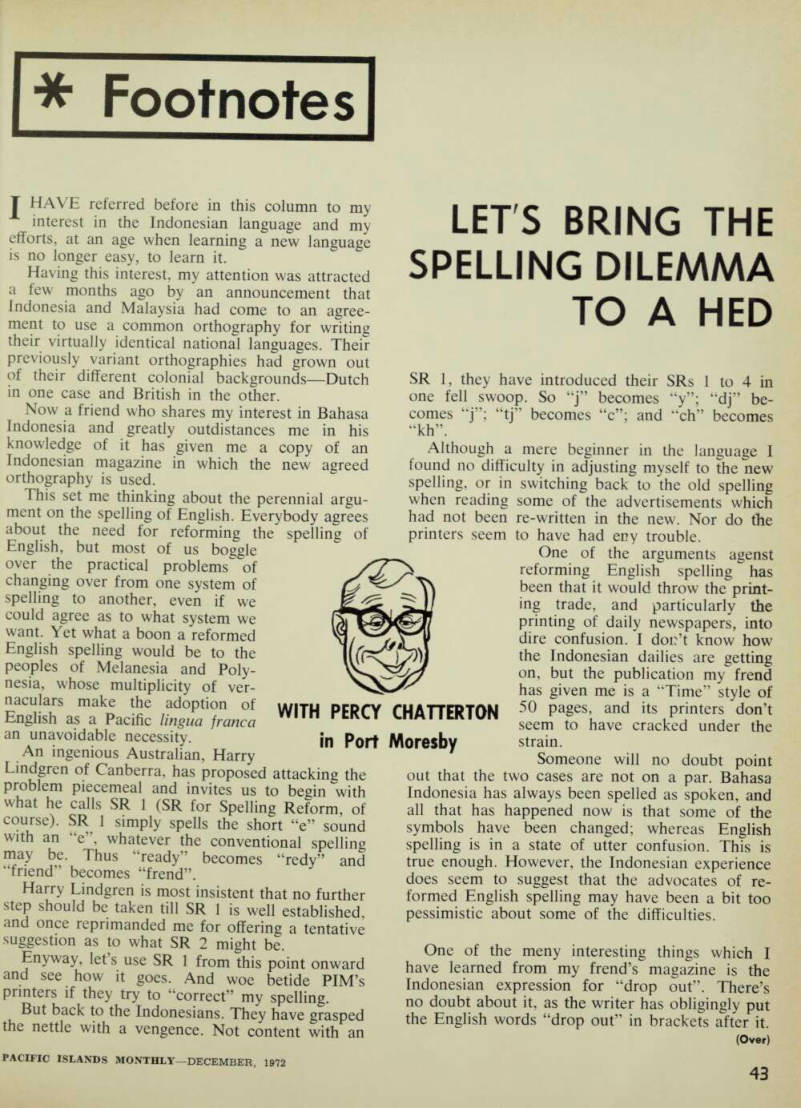
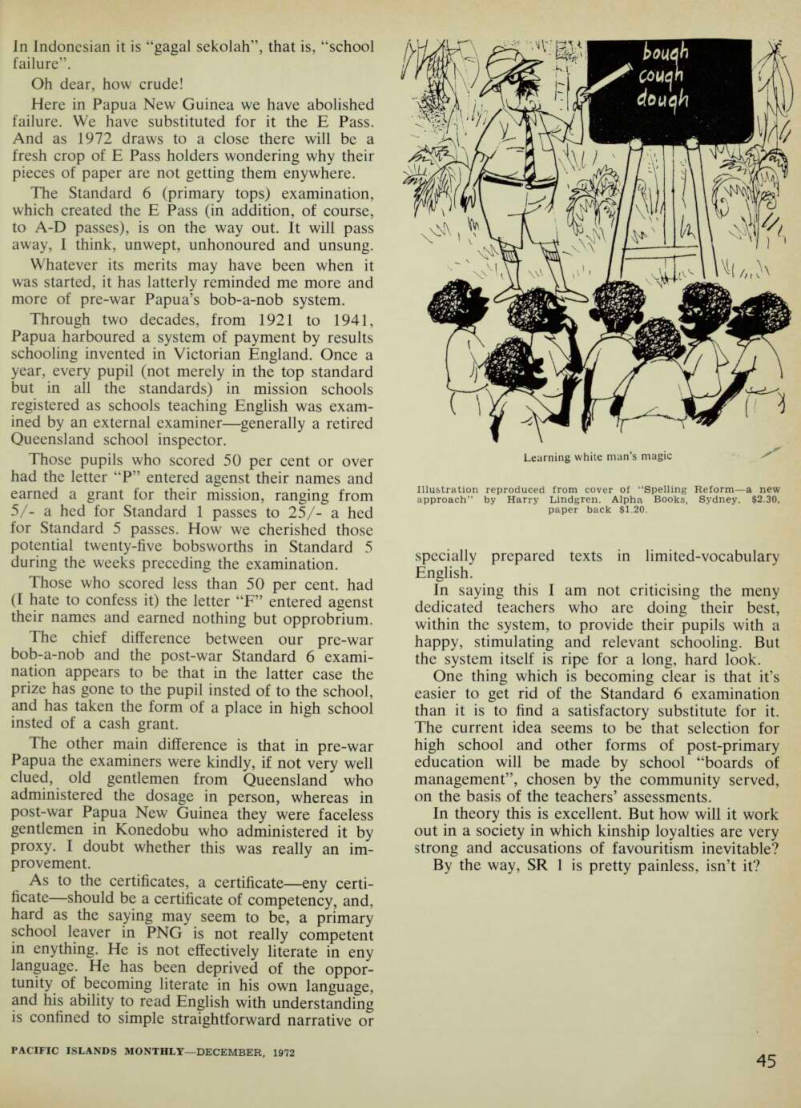
Let's Bring The
Spelling Dilemma
To A Hed
J HAVE referred before in this column to my interest in the Indonesian language and my efforts, at an age when learning a new language is no longer easy, to learn it.
Having this interest, my attention was attracted a few months ago by an announcement that Indonesia and Malaysia had come to an agree ment to use a common orthography for writing their virtually identical national languages. Their previously variant orthographies had grown out of their different colonial backgrounds—Dutch in one case and British in the other.
Now a friend who shares my interest in Bahasa Indonesia and greatly outdistances me in his knowledge of it has given me a copy of an Indonesian magazine in which the new agreed orthography is used.
This set me thinking about the perennial argu ment on the spelling of English. Everybody agrees about the need for reforming the spelling of
English, but most of us boggle over the practical problems of changing over from one system of spelling to another, even if we could agree as to what system we want. Yet what a boon a reformed English spelling would be to the peoples of Melanesia and Poly nesia, whose multiplicity of ver naculars make the adoption of English as a Pacific lingua franca an unavoidable necessity.
An ingenious Australian, Harry
Lmdgren of Canberra, has proposed attacking the problem piecemeal and invites us to begin with what he calls SR 1 (SR for Spelling Reform, of course). SR 1 simply spells the short “e” sound with an “e”, whatever the conventional spelling may be. Thus “ready” becomes “redy” and “friend” becomes “frend”.
Harry Lindgren is most insistent that no further step should be taken till SR 1 is well established, and once reprimanded me for offering a tentative suggestion as to what SR 2 might be.
Enyway, lets use SR 1 from this point onward and see how it goes. And woe betide PlM’s printers if they try to “correct” my spelling.
But back to the Indonesians. They have grasped the nettle with a vengence. Not content with an
SR 1, they have introduced their SRs 1 to 4 in one fell swoop. So “j” becomes “y”; “dj” be comes “j”; “tj” becomes “c”; and “ch” becomes “kh”.
Although a mere beginner in the language I found no difficulty in adjusting myself to the new spelling, or in switching back to the old spelling when reading some of the advertisements which had not been re-written in the new. Nor do the printers seem to have had eny trouble.
One of the arguments agenst
reforming English spelling has
been that it would throw the print ing trade, and particularly the printing of daily newspapers, into dire confusion. I don’t know how the Indonesian dailies are getting on, but the publication my frend has given me is a “Time” style of 50 pages, and its printers don’t seem to have cracked under the strain.
Someone will no doubt point
out that the two cases are not on a par. Bahasa Indonesia has always been spelled as spoken, and all that has happened now is that some of the symbols have been changed; whereas English spelling is in a state of utter confusion. This is true enough. However, the Indonesian experience does seem to suggest that the advocates of re formed English spelling may have been a bit too pessimistic about some of the difficulties.
One of the meny interesting things which I have learned from my frend’s magazine is the Indonesian expression for “drop out”. There’s no doubt about it, as the writer has obligingly put the English words “drop out” in brackets after it. (Over)
With Percy Chatterton
in Port Moresby
In Indonesian it is “gagal sekolah”, that is, “school failure”.
Oh dear, how crude!
Here in Papua New Guinea we have abolished failure. We have substituted for it the E Pass.
And as 1972 draws to a close there will be a fresh crop of E Pass holders wondering why their pieces of paper are not getting them enywhere.
The Standard 6 (primary tops) examination, which created the E Pass (in addition, of course, to A-D passes), is on the way out. It will pass away, I think, unwept, unhonoured and unsung.
Whatever its merits may have been when it was started, it has latterly reminded me more and more of pre-war Papua’s bob-a-nob system.
Through two decades, from 1921 to 1941, Papua harboured a system of payment by results schooling invented in Victorian England. Once a year, every pupil (not merely in the top standard but in all the standards) in mission schools registered as schools teaching English was exam ined by an external examiner—generally a retired Queensland school inspector.
Those pupils who scored 50 per cent or over had the letter “P” entered agenst their names and earned a grant for their mission, ranging from 5/- a hed for Standard 1 passes to 25/- a hed for Standard 5 passes. How we cherished those potential twenty-five bobsworths in Standard 5 during the weeks preceding the examination.
Those who scored less than 50 per cent, had (I hate to confess it) the letter “F” entered agenst their names and earned nothing but opprobrium.
The chief difference between our pre-war bob-a-nob and the post-war Standard 6 exami nation appears to be that in the latter case the prize has gone to the pupil insted of to the school, and has taken the form of a place in high school insted of a cash grant.
The other main difference is that in pre-war Papua the examiners were kindly, if not very well clued, old gentlemen from Queensland who administered the dosage in person, whereas in post-war Papua New Guinea they were faceless gentlemen in Konedobu who administered it by proxy. I doubt whether this was really an im provement.
As to the certificates, a certificate—eny certi ficate—should be a certificate of competency, and, hard as the saying may seem to be, a primary school leaver in PNG is not really competent in enything. He is not effectively literate in eny language. He has been deprived of the oppor tunity of becoming literate in his own language, and his ability to read English with understanding is confined to simple straightforward narrative or
specially prepared texts in limited-vocabulary English.
In saying this I am not criticising the meny dedicated teachers who are doing their best, within the system, to provide their pupils with a happy, stimulating and relevant schooling. But the system itself is ripe for a long, hard look.
One thing which is becoming clear is that it’s easier to get rid of the Standard 6 examination than it is to find a satisfactory substitute for it.
The current idea seems to be that selection for high school and other forms of post-primary education will be made by school “boards of management”, chosen by the community served, on the basis of the teachers’ assessments.
In theory this is excellent. But how will it work out in a society in which kinship loyalties are very strong and accusations of favouritism inevitable?
By the way, SR 1 is pretty painless, isn’t it?
Learning white man’s magic Illustration reproduced from cover of “Spelling Reform—a new approach” by Harry Llndgren. Alpha Books, Sydney. $2.30, paper back $1.20.
Advertisements & other items, pp. 46-50 (3 items)
<*> Parker
Patter /6 *4j*s& amdfy***%¥s
t>Jt*Wt< 'AS st/x>a&^\j.
u*As
ffrrker iSa
>£> Sr^^e
'UjnhrKf ■
■?. <P Jfi •AT Just dial a different angle until the nib position is exactly how you want it.
Your fingers rest in the curved grip of a Parker 75, so you write relaxed.
Fill up from an ink bottle, or load with a special Parker cartridge. It has a 'tap tank' in reserve, for up to 700 more words after you think your ink's run out!
Every Parker 75 passes 792 inspections before you see it. Sterling quality; so it's sterling silver. Or rolled gold, or Vermeil which is 14 ct gold on silver.
<*> PARKER
1 1 <■< 1.1 1 1"; world i most wanted pens
w 4 p
AUSTRALIA’S FOREMOST
GLASS MERCHANTS AND
MIRROR MANUFACTURERS
• SHEET, FIGURED ROLLED & PLATE
GLASS
• "ARMOURPLATE" GLASS
• ANTI-GLARE & HEAT ABSORBING
GLASS
• LAMINATED & TOUGHENED
AUTOMOTIVE GLASS
• GLASS LOUVRE BLADES
• GLASS BENDING
• GLAZING BARS
• "COPPERBAK" MIRROR—
CUT-TO-SIZE & STOCK SIZES
• FRAMED & UNFRAMED
DECORATIVE WALL MIRRORS
• CHEVAL MIRRORS
• VANITY TABLE MIRRORS
• ONE-WAY VISION MIRRORS
• SHOP FRONTS
• METAL MOULDINGS
• "KAWNEER" ALUMINIUM SECTIONS
• ENTRANCE DOORS & SCREENS
• ‘•ARMOURPLATE" DOORS
• "AQUALITE" SHOWER SCREENS
• MODULAR PARTITIONING
• “U-RECT-IT” STORE EQUIPMENT
• GLASS & SHOP FITTING TRADE
TOOLS, HARDWARE & SUPPLIES
• "COWDROY" & “LIDCO” SLIDING
GLASS DOORS & WINDOWS
• CARD KEY SECURITY SYSTEMS
ORDERS AND ENQUIRIES THROUGH THE GENERAL MERCHANTS IN YOUR AREA Catalogues and Price Lists Available
FRANK G. O’BRIEN LTD.
223 Botany Rd., Waterloo, N.S.W. 2017— Telegrams: FOBRON, Sydney
TELEPHONE SYDNEY 69 0466
FG21.44
TABATA SKIN & SCUBA DIVING EQUIPMENT
The TABATA line offers the importer a complete range of
RUBBER SKIN & SCUBA DI-
VING EQUIPMENT and ACC-
ESSORIES for both the professional and amateur. Years of specialized manufacturing experience has established our line’s
REPUTATION FOR QUALI-
TY, ATTRACTIVE and PRA-
CTICAL DESIGNS and VERY
COMPETITIVE PRICES. We
also offer a varied line of rubber sundries for golfing, skiing and other popular sports.
For full particulars on our lines, write to: Manufacturers O
TABATA CO., LTD
Yajima 81dg.,2-2 Yoshi-cho, Nihonbashi, Chuo-ku, Tokyo Cable: EASTABA Tokyo TELEX:2S2-2806
EASTABATA TOK Te1:(663)8651 ~5
From the
Islands Press
From an editorial in The Fiji Times on parliamen tarians who talk too much and without preparation: But when motions become merely a means of making wearisome political propaganda speeches, in the full knowledge that no practical result will emerge, they very rightly are resented by the taxpayers who have to foot the bill.
They not only lower the reputation of Parliament to that of an expensive "talking-shop", but they actively hamper the machinery for the good government of Fiji. They keep ministers away from their desks, clog the processes of administration, and weary Parliament itself.
Public Notice in the Cook Islands News: Notice is hereby given to all those who have made default in the payment of their outstanding fines to make final payments of your out standing fines by October 31, 1972, otherwise action will be taken against you which may result in your imprisonment. Christmas vacation in the Arorangi Prison is not advisable.
Panelled story in The Tonga Chronicle: Dog bites are one of the major causes of injury to volunteers in Tonga, says the Peace Corps Dr Richard Robinson. He told the Chronicle he had found it necessary to carry protection against dog attacks after being bitten by three different dogs in (a) month.
Dr Robinson lifted his trousers to show a nasty wound on his leg. He said that all three attacks had occurred while he was making professional visits to Tongan families.
From a report in the Papua New Guinea Post- Courier: The Pomio Kivung cargo cult will give $4,000 to the Highlands Famine Relief Appeal. The member of Pomio Open, Mr Koriam Irikit, said it would give all the interest accrued on the Kivung account at Rabaul. There is more than $120,000 in the account and the interest is believed to amount to about $3,400. Mr Irikit said that villagers in the Pomio district had also contributed another $5OO to the appeal.
Warning to "foolish siratro pickers" in Tohi Tala Niue: VVe are concerned that some people are picking siratro pods that are not properly ripe. If you are so desperate to race your neighbours and friends to every scattered siratro pod which is half ripe we are very sorry for you and think you are behaving
in a very silly way. We think people who wander around picking a few half ripe pods in a paddock full of green pods are unwise.
Premier Albert Henry in the Cook Islands News allaying uncertainty whether Gospel Day should be regarded as a Sunday or as a public holiday: It should be remembered that Gospel Day was introduced to commemorate a religious event. This was the coming of Christianity to these islands. ... If it had been intended that Gospel Day was to be observed as though it was a Sunday, then it would have been arranged to fall on a Sunday each year.
A letter from Heini Forsyth in The Samoa Times, complaining that Western Samoa's delegates to the South Pacific Conference did not object to French nuclear tests in the Pacific: But I for one am bitterly disappointed because the most important topic of all did not get enough discussion in the conference.
But please, do not say that this is a political issue, because in my opinion, it is a humanitarian one. With one hand the richer nations are giving us all the benefits in life, and with the other hand a foreigner is trying to blow up the South Pacific, the most beautiful place God ever created.
From a letter by Francis Bugotu in England to the editor of BSI News Sheet: I do not think the British Government will let us go unless we ask them to. It is true that they might wish to be rid of the responsibility of this small island dependency far away on the other side of the world and very little known to their taxpayers as soon as possible, but one thing I am certain of and that is the British people are not an unreasonable people. The steps they are taking now in handing over responsibility posts, decision making and control procedures to Melanesians are correct.
From an eyewitness account by Talafou Penaia of the 170 mph hurricane which devastated Funafuti, in the GEIC's Atoll Pioneer: . . . our roof suddenly collapsed. We ran to the nearby council office, and just before we got there the building collapsed. With other people, we sheltered behind the office’s remaining brick walls until daylight, without even noticing that we were lying in inches of water.
Editorial comment in The Fiji Times: on the suitability of hotpants as uniform for Fijian hotel
receptionists:
Fiji naturally wants to attract tourists from as many countries as it can, but not at the expense of losing its identity. The hotpants issue is a microcosm of the major one—how far is Fiji prepared to go in submerging its own style and ways of living info some sort of pattern for overseas consumption?
lop laste
c WISH c YOU
<A G MER
Christmas
at "J, *»: /ft (jl (£W \£Vrt' a<2> Vintage Christmas Puddings IP fAtii/"*** 21b. and 3lb. iced dark Christmas Cakes Fruit Mince Pies Hy * Traditional ‘Vintage’ 31b.
Christmas Cake, ‘Dundee’ 21b.
Christmas Cake and ‘Royal’ 21b. and 31b. dark Christmas Cakes also available.
Order now for delicious Manufactured by rhnctmac the biscuit company pty. eating.
Golden New 21b.
Golden Egg light Christmas Cake,
LOOK FOR THE FAMOUS
lop laste BRAND
Letters

Free Speech
I find it quite amusing that Mr Chatterton (PIM, September) is now so concerned about the future of free speech in PNG.
It seems he has forgotten that, just over three years ago, he was a most vocal supporter of the moves which led to the demise of “Black & White” magazine.
But, of course, censorship is only ever for opposing views and never for one’s own.
John R. Horne.
Leadville, NSW.
One Hundred Basic Books
I am glad you reviewed my book, Pacific Islands Literature: One Hundred Basic Books (PIM, Oct., p. 77). So far, the volume has not lost me any literary friends.
I am sorry, however, that you repeated the snide remarks of my friend, History Professor James Davidson of the Australian National University. He sounds like the “this will-never-do” school of nineteenth century Scottish reviewers.
Jim evidently did not read the part of my preface in which I pointed out that my chief criterion for selec tion of 100 basic books was “literary” merit. My main list, therefore, was chosen as contributions to belles lettres about Oceania.
If Professor Davidson would like to give me a better list of 100 Pacific literary classics, I’ll give a list of 100 classics of Pacific historiography.
And why not join the game yourself?
Any number can play. Maybe we could get more people actually to read the books we ‘'old Pacific hands” like to talk about!
A. Grove Day.
Senior Professor of English, Emeritus.
University of Hawaii, Honolulu.
All Clear In The Cooks
Why is such sinister emphasis always placed on happenings in the Cook Islands? Recently the Editor of Debates (Hansard Office) and Editor of the Press, exchanged jobs. Each having been 3 years in very demand ing positions, and obviously “a change was as good as a rest”.
At the same time during necessary repairs to the radio transmitter, there was staff pruning and reorganisation of the whole Broadcasting and News paper Corporation for economy
reasons. Shortly afterwards gales severely damaged the transmitting mast at Matavera, and the high winds made it impossible for anyone to climb the rigging for repairs until the wind abated some days later.
Meanwhile, while on vacation in Fiji I heard alarming rumours about riots and revolutions in the Cooks!
Fortunately I know Polynesia well enough to refute these, but they seem to have spread to your offices.
Don’t believe all you hear on the Coconut Radio, even if it is the only transmitter available!
Mary Gentle.
Rarotonga, Cook Islands.
Minervans V Tongans
I am a philatelist and have col lected the stamps of the Pacific Islands for many years. At the same time, I have made an in-depth study of the history of the Islands and its peoples. I have come to know several of the Minervans and am impressed with their sincerity and honesty.
It is time that the situation involv ing the Republic of Minerva and the Kingdom of Tonga is brought into proper perspective.
The Minervans are an international group organised for the purpose of establishing a free society—greater personal liberty, freedom from taxa tion, promotion of tourism, and establishment of tax-free business enterprises.
They searched the world for a place to settle and, having found it, formally announced the Republic of Minerva in a Declaration of Sovereignty on January 19, 1972.
In the declaration, the Minervans laid claim to the North and South Minerva Reefs, which lay in a remote part of the Pacific Ocean, about half way between New Zealand and the Fiji Islands. They noted that the reefs had remained unoccupied and un claimed by any nation.
To further support their claim, the Minervans raised portions of the two reefs so they would protrude above sea level at high tide. These “islands” were marked with plaques set in concrete.
In addition, navigation warning lights and radar equipment were erected to warn off-course shipping of the treacherous reefs. All this was done prior to the declaration of sovereignty in accordance with inter national law.
Perhaps the Minervans were un wise in not further consolidating their position on the reefs before the declaration was made, but they wanted to be straight-forward about their intentions. Be that as it may, certain forces were afoot to destroy what the Minervans were attempting to build.
Whether at the instigation of outsiders or simply for selfish reasons, the king of Tonga objected to the Minervan presence. Under the guise of investigation, King Taufa’ahau Tupou IV sent a fleet of ships to the reefs the latter part of May, 1972.
In supposed secrecy, “islands” were built on North and South Minerva by Tongan prison labour.
When the king returned to Nukualofa, he carried on the sub terfuge for a time, only stating that Tonga did not want unknowns in the area and declaring that Tonga had the right to choose its neighbours.
Then, in an announcement that was not in the least surprising, the king disclosed what had taken place at the Minerva Reefs and declared that the reefs were to be annexed to the kingdom. He added that the reefs were vital to the Tonga shipping lanes to Australia and New Zealand, and that fishing in the Minerva waters was very important to the Tonga economy.
The king’s statements were rubber stamped by the Tonga Legislative Assembly which met in special session on June 15.
In the annexation proclamation, it was noted that the Minerva Reefs had long been regarded as belonging to the Kingdom of Tonga. North Minerva was renamed Teleki Tokelau and South Minerva became Teleki Tonga.
Acting rapidly after the legislative action, annexation ceremonies were staged at the reefs on June 26, 1972.
Despite the Tonga king’s ruthless tactics and apparent victory over the Minervans, the international aspects of the situation must be considered.
The Minervans followed inter national law in laying claim to the Minerva Reefs. The chronological order of events and the facts show that the Minervans were FIRST.
Merely because it was stated that the reefs had long been regarded as belonging to Tonga does not make it so. The Tonga Government never had made a claim previously and only did so after the Minerva Republic’s declaration. Thus, the Tonga king flagrantly violated international law by proceeding with his invasion of other people’s rights.
Many of the king’s statements have been refuted in the book, Minerva Reef, by Olaf Ruhen. Contrary to what the king has said, Minerva is not vital to Tonga’s sea lanes. Ruhen said the sea route between Tonga and New Zealand lays to the east of Minerva, while the Tonga-Australia route is to the north. Inter-island shipping also is north and no air routes go anywhere near Minerva.
About 10 years after the tragic shipwreck described in Minerva Reef,
Minerva Could Be "Good" Neighbour
the Tonga Government set up a tubular relief station on South Minerva. If it took 10 years to do this, certainly Minerva was not of too great an interest to Tonga.
Although Captain Tevita Fifita, of the ill-fated Tuaikaepau, stopped at the reefs in 1966 and declared them annexed to Tonga, this was a private venture and there is no record that the Tonga Government approved this annexation. In fact, the Tonga Government redefined its territorial waters and the Minerva Reefs were not included!
That the Minerva fishing grounds are very important to the Tongan economy is a falsehood also. Excellent fishing abounds around the un inhabited Tonga island of ’Ata, ac cording to Ruhen, and it is un necessary for fishermen to travel the additional 180 miles to Minerva, It would seem much more sensible for the Tonga king to exert his country’s energies and money on redeveloping the resource-studded island of ’Ata, particularly when there is a land shortage on other islands of the king dom.
The king’s statement that Tonga has the right to choose its neigbours is quite ridiculous and a very foolish remark for a king, no less, to make.
Who in today’s world determines who his neighbours might be?
Rather than being “possibly un desirable” neighbours, the Minervans could be of great benefit to the Island nations in the area. Construction at the reefs would provide employment for many and would help solve the present serious unemployment prob lem. This influx of money, plus the need for transportation of supplies and people, would boost the economy of the area considerably, particularly in Tonga where even the unemployed must pay taxes.
While the king of the Not-so- Friendly Islands of Tonga sits con tentedly on his throne, smug in his hollow victory over the Minervans, there are those who are not content to see a “banana and coconut king dom” destroy their dreams. Some Minervans are willing to fight for their rights, if need be.
However, the Minervans would much prefer an amicable settlement.
Recently, the Minervan president went to Tonga and sought an audience with King Taufa’ahau, in an effort to reach a compromise, but was unable to see the king. The president was told to submit his proposals in writing if he wanted any considera tion. This procedure had been fol lowed some months before, but there was no response from the Tonga Government.
It can only be concluded that the king and his government do not want to negotiate, considering themselves in control of the situation.
While naked aggression is rampant in various parts of the world, that which the king of Tonga has initiated is no different. While it may be a small matter in comparison with other world situations, the pattern is the same and, therefore, the wrong is just as large.
Apparently, the Minervans are not too perturbed over the Tonga king’s actions, for they expect to proceed with the development of their reefs as planned.
They say that they did not search for a place to settle without the resolve and the means to protect themselves.
“The king of Tonga is free to try to dispossess us,” they say, “but neither he nor his advisers are free to evade the consequences of their action.”
This isn’t a threat; it is a response to one.
Robert D. West.
Chillicothe, Ohio,
Usa.
Advertisements & other items, pp. 52-54 (1 item)
family down
Don't let your
You've worked hard to give them a home, schooling and security. Don't let that hard-won security erode away because you continued to overlook making out a Will. With a properly planned Will, you can be certain in the knowledge that your property will eventually pass to the people you specify, and also that your Estate will be as large as possible after probate and duties. In this regard, we invite you to take advantage of the advisory service we provide, entirely free of obligation. Our specialists in Estate Planning will be delighted to help you plan your Will most efficiently, or to discuss it fully with your solicitor or accountant.
TH/tr the
BURNS PHILP TRUSTEE
COMPANY LIMITED
IXECUTOR © ADMINISTRATOR • TRUSTEE © ATTORNEY • AGENT Fiji Office: Mr. A. W. Cooper, Resident Manager, Rodwell Road, Suva. Telephone: 311 777.
Head Office: 51 Pitt Street, Sydney 2000.
Telephone: 241 1021. Telegrams: "BURNSTRUST," Sydney.
Branches and/or Registered Offices: Parramatta (N.S.W.), Canberra, Melbourne, Brisbane, Adelaide, Fremantle (W.A.), Port Moresby (Papua). 8P45
M QS 100
Mi V' 9-
m v. do «-1 r> 7> QS-500 m.
QSP-10
I-.
SaitsitL
4-channel stereo With Sansui’s QSP-10 Compact 4-Channel Consolidator QS-100 4-Channel Rear Amplifier, or QS-500 4-Channel Rear Amplifier, you can enjoy the incomparable richness and “presence” of 4-channel stereo at minimum cost. The secret lies in a 4-channel synthesizer decoder that magically transforms 2-channel sources, such as records, tapes, and FM broadcasts, into breathtaking “live sound field” concert-hall realism. QSP-10 combines this with a 20-watt stereo power amplifier and a set of highperformance 15-watt speaker systems. Hook it up with your present hi-fi system and—presto— you’ve got a complete, compact 4-channel stereo system that will quadruple your listening pleasure. QS-100 combines the 4-channel synthesizer decoder with a 50-watt power amplifier, while the QS-500 combines it with a 120-watt power amplifier. In either case all you need in addition to your present system is a second set of speaker systems.
If you’re building a new system from scratch, Sansui recommends its 210 A solid-state SW/MW tuner with stereo amplifier. It provides sensitive reception in both MW and SW bands, 36 watts of music power, and a wide 30 to 25,000 Hz power bandwidth, while limiting distortion to less than 1%. ■mtii a j 210 A Sansui products are available through; TEE VEE RADIO LTD. Teerad House 13, Midstone Street, Grey Lynn Auckland 2, New Zealand. Tel: 763064 / PRABHU BROTHERS LTD. P.O. Box 183, Nadi, Fiji islands Tel: 70183 / SERVONNAT Rue des Polius, Tahitiens Pateete, Tahiti. Tel: 03-29 / OCEANIA INDENT AGENCY P.O. Box 5518, Boroko, Port Moresby, Papua & New Guinea. Tel: 56406 / PAUL MOW & CO. 9th St., P.O. Box 449, Lae. Tel; 2954 / CHIN H. MEEN & SONS P/L Tabari Place, P.O. Box 1106, Boroko. Tel: 56546/Kamarere ' Street, P.O. Box 224, Rabaul. Tel: 2462 / MICHAEL CHOW & Co. P/L Okari Street, P.O. Box 1106, Boroko. Tel; 56338 / SEETO KONG & SONS P/L Taurama Road P.O. Box 1218, Boroko. Tel: 56445 / PINGS HAGENj P/L P.O. Box 165, Mt Hagen. Tel: 385 / BOUGAINVILLE COPPER Canteen, Panguna / PHOTOSONIC P.o! s Box 519, Madang. Tel; 2503 / MICHEL MERCIER Angle Des Rues Alma-Sebastopol B.P. 1123 Noumea, Nouveuc-Caledonia. Tel: 59-11 et 40-78 / SANSUI ELECTRIC CO., LTD. 14-1. 2-chome. Iziimi Siieinami-kn Tnh/n brun
WeVe discovered
the oldest island in
the South Pacific.
PRSIO/K&B
0*
Come join usand discover
theenchantment of Tonga.
Nestled away in a quiet corner of Tonga is the new Port of Refuge International Hotel*. Just the place for the most relaxing, tranquil and luxurious holiday amongst the beautiful untouched Tongan Islands.
The new “Port of Refuge” Hotel is just a two hour flight from Fiji and is the only hotel in Vava’u having all the prestige and service of a truly international hotel.
Accommodates ninety in spacious air-conditioned suites, each with their own patio and bathroom, plus all the Fly there with PUCK FtC and auwms/BOAc I air pew zeaLano extras and facilities you’d expect from an international standard resort.
Special introductory tariffs make the “Port of Refuge” even more enticing.
Single $15.00, double $17.50 with special concessions for children.
Write or phone your local travel agent for further information and free colour literature.
The NEW
FORT OF REFUGE
INTERNATIONAL HOTEL
Uava’u Tonga
Cables: Refuge, Tonga. Phone: Sydney 221 3799
Perhaps Vavauans May Change
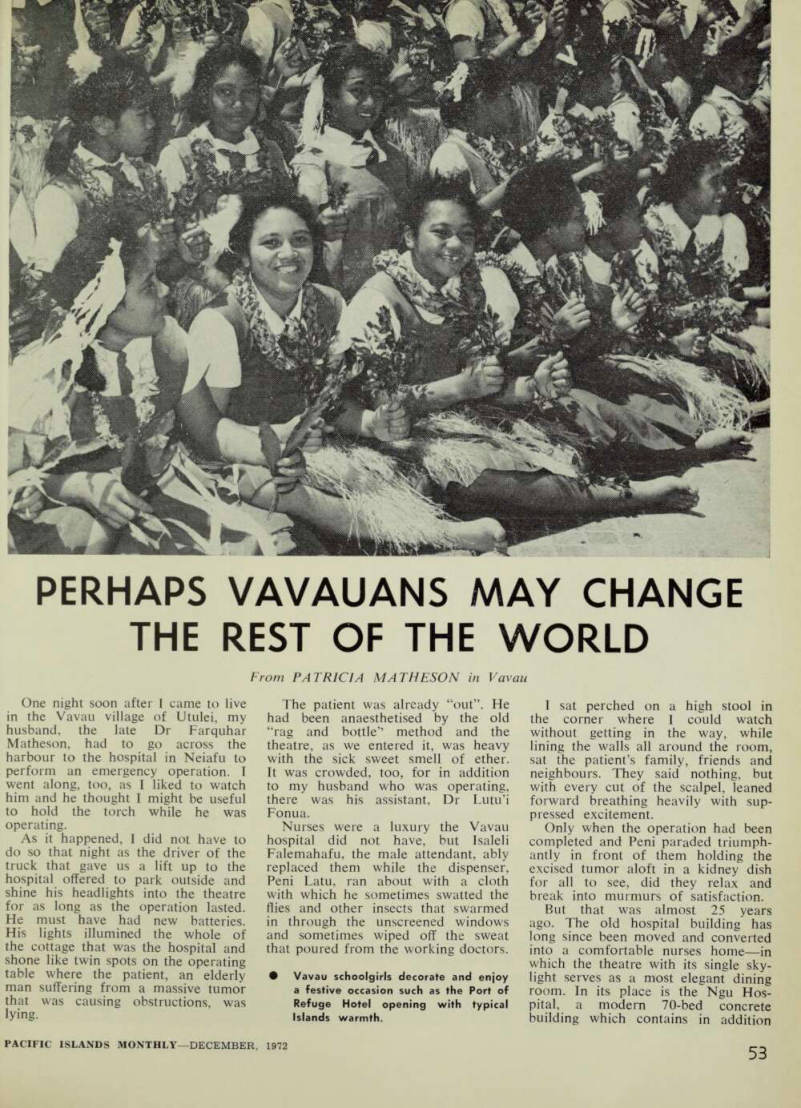
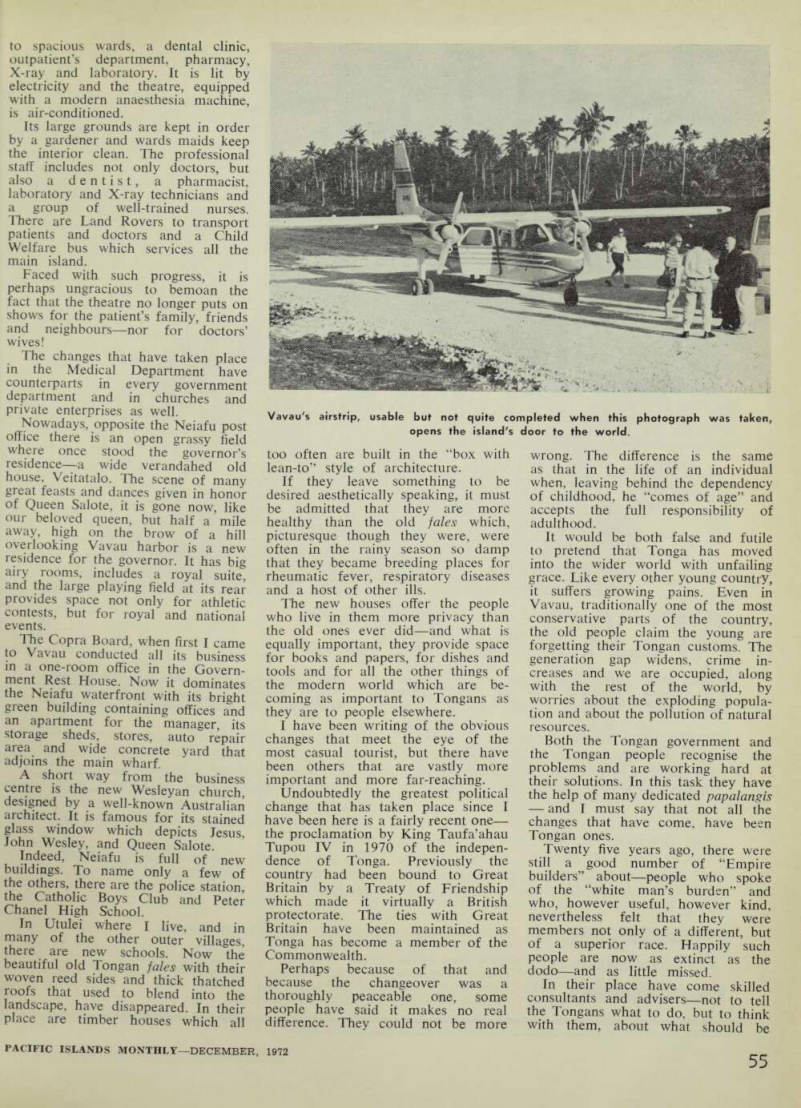
The Rest Of The World
From PATRICIA MATHESON in Vavau
One night soon after I came to live in the Vavau village of Utulei, my husband, the late Dr Farquhar Matheson, had to go across the harbour to the hospital in Neiafu to perform an emergency operation. I went along, too, as I liked to watch him and he thought I might be useful to hold the torch while he was operating.
As it happened, I did not have to do so that night as the driver of the truck that gave us a lift up to the hospital offered to park outside and shine his headlights into the theatre for as long as the operation lasted.
He must have had new batteries.
His lights illumined the whole of the cottage that was the hospital and shone like twin spots on the operating table where the patient, an elderly man suffering from a massive tumor that was causing obstructions, was lying.
The patient was already “out”. He had been anaesthetised by the old “rag and bottle” method and the theatre, as we entered it, was heavy with the sick sweet smell of ether.
It was crowded, too, for in addition to my husband who was operating, there was his assistant, Dr Lutu’i Fonua.
Nurses were a luxury the Vavau hospital did not have, but Isaleli Falemahafu, the male attendant, ably replaced them while the dispenser, Peni Latu, ran about with a cloth with which he sometimes swatted the flies and other insects that swarmed in through the unscreened windows and sometimes wiped off the sweat that poured from the working doctors.
I sat perched on a high stool in the corner where I could watch without getting in the way, while lining the walls all around the room, sat the patient’s family, friends and neighbours. They said nothing, but with every cut of the scalpel, leaned forward breathing heavily with sup pressed excitement.
Only when the operation had been completed and Peni paraded triumph antly in front of them holding the excised tumor aloft in a kidney dish for all to see, did they relax and break into murmurs of satisfaction.
But that was almost 25 years ago. The old hospital building has long since been moved and converted into a comfortable nurses home—in which the theatre with its single sky light serves as a most elegant dining room. In its place is the Ngu Hos pital, a modern 70-bed concrete building which contains in addition
Vavau schoolgirls decorate and enjoy a festive occasion such as the Port of Refuge Hotel opening with typical Islands warmth.
to spacious wards, a dental clinic, outpatient’s department, pharmacy, X-ray and laboratory. It is lit by electricity and the theatre, equipped with a modern anaesthesia machine, is air-conditioned.
Its large grounds are kept in order by a gardener and wards maids keep the interior clean. The professional staff includes not only doctors, but also a dentist, a pharmacist, laboratory and X-ray technicians and a group of well-trained nurses.
There are Land Rovers to transport patients and doctors and a Child Welfare bus which services all the main island.
Faced with such progress, it is perhaps ungracious to bemoan the fact that the theatre no longer puts on shows for the patient’s family, friends and neighbours—nor for doctors’ wives!
The changes that have taken place in the Medical Department have counterparts in every government department and in churches and private enterprises as well.
Nowadays, opposite the Neiafu post office there is an open grassy field where once stood the governor’s residence—a wide verandahed old house, Veitatalo. The scene of many great feasts and dances given in honor of Queen Salote, it is gone now, like our beloved queen, but half a mile away, high on the brow of a hill overlooking Vavau harbor is a new residence for the governor. It has big airy rooms, includes a royal suite, and the large playing field at its rear provides space not only for athletic contests, but for royal and national events.
The Copra Board, when first I came to Vavau conducted all its business in a one-room office in the Govern ment Rest House. Now it dominates the Neiafu waterfront with its bright green building containing offices and an apartment for the manager, its storage sheds, stores, auto repair area and wide concrete yard that adjoins the main wharf.
A short way from the business centre is the new Wesleyan church, designed by a well-known Australian architect. It is famous for its stained glass window which depicts Jesus, John Wesley, and Queen Salote.
Indeed, Neiafu is full of new buildings. To name only a few of the others, there are the police station, the Catholic Boys Club and Peter Chanel High School.
In Utulei where I live, and in many of the other outer villages, there are new schools. Now the beautiful old Tongan fales with their woven reed sides and thick thatched roofs that used to blend into the landscape, have disappeared. In their place are timber houses which all
too often are built in the “box with lean-to” style of architecture.
If they leave something to be desired aesthetically speaking, it must be admitted that they are more healthy than the old fales which, picturesque though they were, were often in the rainy season so damp that they became breeding places for rheumatic fever, respiratory diseases and a host of other ills.
The new houses offer the people who live in them more privacy than the old ones ever did—and what is equally important, they provide space for books and papers, for dishes and tools and for all the other things of the modern world which are be coming as important to Tongans as they are to people elsewhere.
I have been writing of the obvious changes that meet the eye of the most casual tourist, but there have been others that are vastly more important and more far-reaching.
Undoubtedly the greatest political change that has taken place since I have been here is a fairly recent one— the proclamation by King Taufa’ahau Tupou IV in 1970 of the indepen dence of Tonga. Previously the country had been bound to Great Britain by a Treaty of Friendship which made it virtually a British protectorate. The ties with Great Britain have been maintained as Tonga has become a member of the Commonwealth.
Perhaps because of that and because the changeover was a thoroughly peaceable one, some people have said it makes no real difference. They could not be more
wrong. The difference is the same as that in the life of an individual when, leaving behind the dependency of childhood, he “comes of age” and accepts the full responsibility of adulthood.
It would be both false and futile to pretend that Tonga has moved into the wider world with unfailing grace. Like every other young country, it suffers growing pains. Even in Vavau, traditionally one of the most conservative parts of the country, the old people claim the young are forgetting their Tongan customs. The generation gap widens, crime in creases and we are occupied, along with the rest of the world, by worries about the exploding popula tion and about the pollution of natural resources.
Both the Tongan government and the Tongan people recognise the problems and are working hard at their solutions. In this task they have the help of many dedicated papalangis and I must say that not all the changes that have come, have been Tongan ones.
Twenty five years ago, there were still a good number of “Empire builders” about—people who spoke of the “white man’s burden” and who, however useful, however kind, nevertheless felt that they were members not only of a different, but of a superior race. Happily such people are now as extinct as the dodo—and as little missed.
In their place have come skilled consultants and advisers— not to tell the Tongans what to do, but to think with them, about what should be
Vavau's airstrip, usable but not quite completed when this photograph was taken, opens the island's door to the world.
Peace Of Vavau
done. Both work and play have ceased to be purely Tongan or purely papalangi as people of both races have come to recognise that neither brains nor personality depend on skin colour.
Perhaps the greatest force toward increased friendliness and understand ing between peoples has been the presence in the country of the US Peace Corps and the New Zealand VSAs. These young people have both given and received much from their stay here. Coming as they do from more industrially advanced countries, they bring new skills, new concepts’ new methods which they are anxious to share with their island friends.
Because they live with the people not above them or apart from them, they are able to share. From their Tongan hosts, they learn that the materialistic values of modern society are meaningless, that better “things” are useless unless they are put to work for the common good and that IS n the relati °nship that should bind all peoples together.
Many good people have come to help Tonga, but Tongans have in recent years, also grown more able to help themselves. When I came to the country only two Tongans held univereity degrees—the present King and Dr Amanaki Havea, the President of the Free Wesleyan Church. Now hundreds of young men and women have been graduated from universities al! over the world, and other hundreds have been overseas for technical training. Some of them have stayed to work in foreign places, but he majority have returned to help world the,r h ° me,and into the modern I was asked to write this article about some of the changes I have n Y ava " a day that was nr!L o u f ! reat importance, October 2, when the Port of Refuge Hotel was opened and the new air field was put into operation. The people who view it all with alarm were out in force that day, convinced hat tourists would overrun us, that Tie quiet simple life we enjoy here k mi dlsa PP ear > tha t our skies would be filled with noise, that the cost of living would soon soar so high that lone of us could go on living. aJ belon 8 with those people.
Admittedly every change brings fresh Drob lems but I rely on the Vavau DeopJe—both Tongan and papalangi, o be able to solve them. I like to , m k that the airport will bring us Toser to the good things of the and will enable more young
Tongans to go forth to learn and adventure in distant lands. And I like to think that the tourists who come will explore these beautiful islands of Vavau, meet the friendly people and take away some of the peace and the joy of life that abounds here.
Many things have changed in the years I have been here, but some very important ones have not. Malo thank you and of a, love , are still h m ° St h F o? Ue k 1 Tongan words and the best indication of Tongan character.
The people are open, friendly, happy. They speak of love easily and express it in every smile they flash
at strangers, in every song they sing, in every dance they perform. They have, too, a reverent attitude toward all life which makes them say “thank you” not merely for presents offered them, but for the health they enjoy, for the copra they cut, for the floors they sweep, the flowers they string into leis and for each new day that dawns.
Q f course I miss the old days, mainly because so many people I loved, both Tongans and papalangis, have g Gne w hh them, but both the changes that have come and the things that have not changed, make the future challenging and Vavau the best of all places in which to meet it.
Advertisements & other items, pp. 56-60 (1 item)
Announcing....
Announcing...
your man at
Air Pacific.
To meet the growing needs of the people of the South Pacific Islands, Air Pacific is continually improving and expanding its services and equipment. But covering a route network of nearly five million square miles is no easy task. And the peoples of Fiji, Tonga, Samoa, the New Hebrides, the Gilbert and Ellice Islands, Nauru, the Solomon Islands and New Guinea all have different needs and different problems for Air Pacific to solve.
To help improve services still further, Air Pacific is establishing its own “Ombudsman department” men who can tour the vast network to investigate passenger services right on the spot.
Your “Man at Air Pacific” will take up any queries or problems you have regarding Air Pacific’s service to your country. Drop him a line at “Customer Service Enquiries”, Air Pacific, -qr Box 112, Suva, Fiji.
PORT MORESBY
GILBERT IS.
NAURU ELLICE IS.
SOLOMON IS.\ NEW
HEBRIDES
FIJI
SAMOA
TONGA
ata pac
“Jets you around the islands”
I 22928
ATLAS COPCO
the air power specialists
Compressed air and pneumatic equipment is our business. If you have a problem in this field, get in touch with us. Chances are, we already know how to solve it.
We have the full experience of our worldwide organisation to back us up —an organisation that designs, manufactures and supplies equipment for mining, tunnelling, construction and industry in general.
Drilling equipment for mineral exploration; rigs on wheels or tracks; rock drills, hand-held or boom-driven; overshot tunnel loaders on rails or rubbertyred; portable or stationary compressors; even metal finishing and spraying equipment.
So, if you have a problem that involves compressed air, call your nearest representative.
MtlasCopco
Atlas Copco Australia Pty. Limited, Bessemer St., Blacktown, or at branches throughout Australia.
Atlas Copco (New Zealand) Ltd., 18-22 Haining St., Wellington 1.
Atlas Copco (Philippines) Inc., CMS Building, Pasong Tamo Ext., Makati, Rizal.
Atlas Copco AB, 8 Lewis Road, Singapore 10.
In certain areas we are represented by distributors.
AC 3117 c
s
I iICTA
TURNS
GRASS
INTO
LAWN!
A MODEL AVAILABLE TO SUIT ALL
CONDITIONS AND EVERY PURPOSE
SUVA MOTORS LTD.
SUVA, LAUTOKA.
CARPENTERS
PORT MORESBY.
NEW GUINEA CO. LTD.
RABAUL, MADANG,
LAE, MOUNT HAGEN,
MINJ, GOROKO.
r > m w ***-
THROUGHOUT THE PACIFIC
FIJI, SAMOAJONBA, NIUE Is,NORFOLK Is.
BURNS PHIIP
[SOUTH SEA] CO. LTD.
REGISTERED OFFICE: SUVA,
TELEPHONE NO: 22661 f 1
TELEX NO: FJ1127
Code Address: a Wmmmm
iiSili
SHIPPING AGENCIES
The New Zealand Shipping Co. Ltd.
Shaw Savill & Albion Co. Ltd.
Blue Star Port Line (Management) Ltd.
Bank Line Ltd.
General Steamship Corporation Ltd.
Compagnie des Messageries Maritimes Royal Interocean Lines Daiwa Navigation Company Ltd.
Sitmar Line Flotta Lauro (Lauro Lines) Australasia Pty. Ltd.
Tonga Shipping Agency Karlander Kangaroo Line
EXCLUSIVE
DISTRIBUTORSHIPS
INCLUDE
Akai Taperecorders • Sunbeam Appliances Dunlop Products Hitachi Electronics Holden Motor Vehicles Rolex Watches Revlon Cosmetics Pentax Cameras Massey-Ferguson Tractors Olympic Tyres Penfold Wines Heuga Carpet Tiles Guerlain Parfums
AGENTS FOR
Queensland Insurance Co. Ltd.
Shell Company (P.L) Ltd.
Bureau Veritas
ASSOCIATED COMPANIES
Burns Philp (New Hebrides) Ltd.
Burns Philp Trustee Co. Ltd.
Automotive Supplies Co. Ltd.
Corrie & Co. Ltd.
Wrought Iron and Steel Construction Co. Ltd.
Bish Ltd.
SPECIALISED SERVICES
Expert advice on Shipping; Forwarding; Customs formalities; Insurance
COMPLETE TRAVEL
SERVICE
accredited agents for the
INTERNATIONAL AIR
TRANSPORT ASSOCIATION
OVERSEAS AGENTS: SYDNEY • LONDON • SAN FRANCISCO
France Explains Its
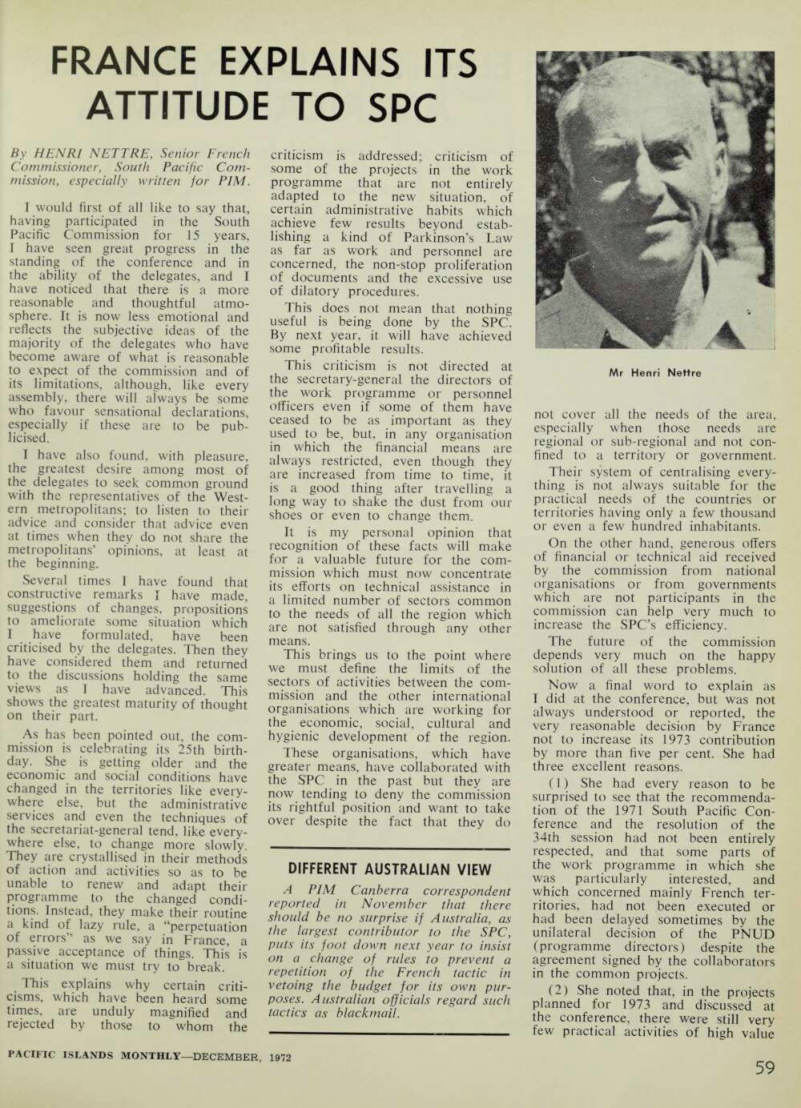
Attitude To Spc
By HENRI NETTRE, Senior French Commissioner, South Pacific Com mission, especially written for PIM.
I would first of all like to say that, having participated in the South Pacific Commission for 15 years, I have seen great progress in the standing of the conference and in the ability of the delegates, and I have noticed that there is a more reasonable and thoughtful atmo sphere. It is now less emotional and reflects the subjective ideas of the majority of the delegates who have become aware of what is reasonable to expect of the commission and of its limitations, although, like every assembly, there will always be some who favour sensational declarations, especially if these are to be pub licised.
I have also found, with pleasure, the greatest desire among most of the delegates to seek common ground with the representatives of the West ern metropolitans; to listen to their advice and consider that advice even at times when they do not share the metropolitans’ opinions, at least at the beginning.
Several times I have found that constructive remarks I have made, suggestions of changes, propositions to ameliorate some situation which I have formulated, have been criticised by the delegates. Then they have considered them and returned to the discussions holding the same views as I have advanced. This shows the greatest maturity of thought on their part.
As has been pointed out, the com mission is celebrating its 25th birth day. She is getting older and the economic and social conditions have changed in the territories like every where else, but the administrative services and even the techniques of the secretariat-general tend, like every where else, to change more slowly.
They are crystallised in their methods of action and activities so as to be unable to renew and adapt their programme to the changed condi tions. Instead, they make their routine a kind of lazy rule, a “perpetuation of errors’’ as we say in France, a passive acceptance of things. This is a situation we must try to break.
This explains why certain criti cisms, which have been heard some times, are unduly magnified and rejected by those to whom the
criticism is addressed; criticism of some of the projects in the work programme that are not entirely adapted to the new situation, of certain administrative habits which achieve few results beyond estab lishing a kind of Parkinson’s Law as far as work and personnel are concerned, the non-stop proliferation of documents and the excessive use of dilatory procedures.
This does not mean that nothing useful is being done by the SPC.
By next year, it will have achieved some profitable results.
This criticism is not directed at the secretary-general the directors of the work programme or personnel officers even if some of them have ceased to be as important as they used to be, but, in any organisation in which the financial means are always restricted, even though they are increased from time to time, it is a good thing after travelling a long way to shake the dust from our shoes or even to change them.
It is my personal opinion that recognition of these facts will make for a valuable future for the com mission which must now concentrate its efforts on technical assistance in a limited number of sectors common to the needs of all the region which are not satisfied through any other means.
This brings us to the point where we must define the limits of the sectors of activities between the com mission and the other international organisations which are working for the economic, social, cultural and hygienic development of the region.
These organisations, which have greater means, have collaborated with the SPC in the past but they are now tending to deny the commission its rightful position and want to take over despite the fact that they do
not cover all the needs of the area, especially when those needs are regional or sub-regional and not con fined to a territory or government.
Their system of centralising every thing is not always suitable for the practical needs of the countries or territories having only a few thousand or even a few hundred inhabitants.
On the other hand, generous offers of financial or technical aid received by the commission from national organisations or from governments which are not participants in the commission can help very much to increase the SPC’s efficiency.
The future of the commission depends very much on the happy solution of all these problems.
Now a final word to explain as I did at the conference, but was not always understood or reported, the very reasonable decision by France not to increase its 1973 contribution by more than five per cent. She had three excellent reasons. (1) She had every reason to be surprised to see that the recommenda tion of the 1971 South Pacific Con ference and the resolution of the 34th session had not been entirely respected, and that some parts of the work programme in which she was particularly interested, and which concerned mainly French ter ritories, had not been executed or had been delayed sometimes by the unilateral decision of the PNUD (programme directors) despite the agreement signed by the collaborators in the common projects. (2) She noted that, in the projects planned for 1973 and discussed at the conference, there were still very few practical activities of high value
Mr Henri Nettre
and long duration, but a great number, even for the secretariat, of meetings, conferences, seminars and travel which were of questionable value, and which have been questioned for several years by most of the ter ritories and the member-governments.
The inclusion of these limited the number of worthwhile projects. (3) Finally, and above all, the budget showed that at the end of 1972 the sum of $A 104,000 will still be unspent. Of this, $65,000 comes from uncompleted projects and $39,000 from incidental income, which is equal to 10 per cent of the total income.
Also, with a five per cent increase in contributions, the 1973 budget will already have resources of $A 1,342,611 instead of the $A 1,217,000 originally budgeted for in 1972, which means an increase of 10.4 per cent covering the cost of all useful planning projects, and representing a 37 per cent in crease on the 1972 work programme ($A1,199,379 instead of $A875,101).
In addition, the commission has requested the secretary-general to make certain savings on personnel and administrative expenses during 1973. This should increase the amount available for the execution of the work programme.
Different Australian View
A PIM Canberra correspondent reported in November that there should be no surprise if Australia, as the largest contributor to the SPC, puts its foot down next year to insist on a change of rules to prevent a repetition of the French tactic in vetoing the budget for its own pur poses. Australian officials regard such tactics as blackmail.
Elected Governor For
American Samoa
From a Pago Pago correspondent
It is virtually certain that the people of American Samoa will be electing their own governor within a minimum of two years and a maximum of four. This political advancement was pledged by the administration of President Nixon at the time of the appointment of Governor John M.
Haydon over three years ago.
Haydon has said repeatedly that it was his hope that he would be the last appointed governor to serve in American Samoa. In the past both the governor and lieutenant governor have been appointed by the Secretary of the Department of Interior. Peter Coleman, who is now deputy high commissioner of the Trust Territory, is the only Samoan who has held the number one spot.
The most recent development was the appointment by Interior Secretary Rogers C. B. Morton of a guberna torial study commission which began
functioning in September when the territory was visited by the commis sion chairman, Stanley S. Carpenter, Deputy Assistant Secretary of Interior for Territorial Affairs.
Carpenter was accompanied to Pago Pago by John de Young who served for years in the Trust Territory government and with the South Pacific Commission and who is now territorial officer in the Interior Department in Washington. Also on the commission are Governor Haydon, members of his staff, the leadership of the Legislature and the public representatives, who are the district governors of the territory.
The commission held four ex ploratory meetings during Carpenter’s visit. Carpenter stressed that the changeover will be made in an orderly manner.
Haydon said that the first meetings revealed about 50 fiscal areas in the government where changes and im provements are going to have to be made. He verbally instructed all of his department heads that every decision or policy made in the future months should be made with the consideration of the change in mind.
Appointment of the commission was timed to coincide with Haydon’s appointment of a constitutional revision committee. This committee is formed every five years to study and make necessary revisions to the constitution and subcommittees already are at work. The impending election of the governor is certain to figure in their studies and actions.
Whether the necessary changes can be made early enough to conduct the election in 1974 has not been deter mined. Both Carpenter and Haydon emphasised that the reorganisation of certain governmental functions must be developed completely and in an orderly manner and that the move could be delayed until 1976.
“I have told my staff people that they face the busiest period of their lives in the coming months,” Haydon said. “We are going to push every programme to improve our infra structure and every phase of the government so that the Samoan people have a more efficient operation when they take this important step to self-government.”
Advertisements & other items, pp. 62-70 (2 items)
Tiiree-^
★ ★★ V Leading
SOUTH
AMERICAN
Brand
CORNED
BEEF
Sole Exporters to the Pacific Islands:
PETER FISHER TRADING PTY. LTD.
321 PITT STREET, SYDNEY, 2000, AUSTRALIA.
Telephone: 26 1109. Cables "FISHERION", Sydney.
for extra freshness
Come up to Kool
c A * m
Kqd.
i <9% / i&t m U597-8/71
The finest Flours and Sharps
in the South Pacific.
0f X \ o O o 0 Seafoam Mills a» Brisbane, Toowoomba, Roma, Maryborough, Rockhampton
SEAFOAM FLOUR MILLS
Queensland's largest flour milling organisation a division of
The Queensland Co-op Milling
Assn, limited
Head office—Box 7, P.O. South Brisbane, Qld.
Cable Address: "Seafoam", Brisbane. manufacturers of
High quality products from Queensland
hard wheats
SEAFOAM W P rotein baker's flour) TOPIC (protein rich)
EXCELSIOR
SILVERSPRAY
(export flours)
SHARPS and MEALS
All products manufactured to suit your requirements—Enquiries welcome.
KENWOOD
'romise you creative sound!
r if hi f c h c r c Enravished with concert hall sounds of delicate tones, subtle notes and nuances from a powerful system that blends with decor.
Full background score or critical solo, reproduced with highest effect, create pleasing sounds.
Consider the following Kenwood suggestions: KA-4004: 95-watt (IHF 4 ohms) Stereo Amplifier incorporates Direct Coupling Circuitry; KP-2022: Belt-drive Stereo Turntable with auto-return/Auto-cut mechanism and 4-pole synchronous motor; KL-4090: Bass Reflex Type 50-watt 3-way 4-speaker system designed for most sensitive sound reproduction; the sound approach to quality
® KENWOOD
r minute information, write to: P-SECTION, TRIO ELECTRONICS, INC. 6-17, 3-c home, Aobadai, Meguro-ku, Tokyo, Japan
/ ■ & ■f- 3jpr m ac at Monte Carlo, you’ve got to fate good! ■H DATSUN zoomed through the 3,700 kilometer securely to second place in its engine class. sf wm. rally over icy blinding blizzards and Alpine peaks to capture third place over-all! This year’s event was so demanding that only 52 of the 264 entries were able to finish. But Nissan technology propelled DATSUN Engineering and technology is what a motorcar about. With satellite launching experiences bchincTit, Nissan offers themo stintegrated design production tests. Original resei And ingenious styling—distil and functional* These are onb a few of the many reasons motorists in ovef 120 nations more than satisfied with DA year aftSf year. in a motorcar you can buy today. Get on the winning side. Get Rigid quality control. Extensive yourself inside a DATSUN soon! r % :
jftfL 1
DATSUN
NISSAN
iflifly 1
Find out
where to test-drive your rally winner at the
DATSUN distributor nearest you!
Full line of DATSUN’s from pickups to luxury sedans.
Port Moresby, Lae, Madang, Mt. Hagen
BOROKO MOTORS LTD.
Rabaul
RABAUL GARAGE LTD.
Suva, Lautoka
SUVA MOTORS LTD.
Apia
MORRIS HEDSTROM LTD.
Noumea
E.D. PENTECOST
Norfolk
SIRIUS SERVICE STATION
Pago Pago
B.F. KNEUBUHL
Tahiti
SOCIETE POLYNESIENNE DE DISTRIBUTION
Nauru
JACOB ENTERPRISES
Nukualofa
RICKLEMAN BROTHERS
Port Vila, Santo
PENTECOST PACIFIC S.A.
Honiara
R.C. SYMES PTY. LTD.
Dili
SOCIEDADE AGRICOLA PATRIA E
TRABALHO LDA.
Saipan
J.C. TENORIO ENTERPRISES
Guam
J & G MOTORS CO., LTD.
Cook Islands
COOK ISLANDS MOTOR CENTRE LTD.
ail New DATSUN Pickup
New DATSUN 1808
Hardtop
DATSUN
DATSUN
Product of NISSAN
Sf Xx't : Vi S 1
W JS'J
jK *»'* ;t
ifl
S 3
jftfil ,*!
v ■ . s M’; a hni*rnt* ‘V.*.!*.™*.*
PRODUCERS OF BRUNTONS
ROm.&S 5 FLOURS
i CAKE, BISCUIT-AW fIbOBK
m I
% ETC.
r l ; ! f. * &I#* % Xjli -^s^:- vvS K > * Si i r&ti f m y&
Sound has "heart”...
* Dl<
r pK
H ?*y w You can feel it with TDK SO Cassette True High-Fidelity Sound Reproduction in cassettes has never been achieved until TDK SD cassettes. TDK, specialist in tape technology, developed SD cassettes only 4 years ago, and now they are favoured by audiophiles in as many as 93 countries. SD cassettes give the people such a true sound emotion as no other tape could. True High-Fidelitythat's what TDK has! • SD Cassettes are offered in both the popular C-60, C-90 and the C-30 type, as well as reel type 1800-SD and 1200-SD. * Also available low noise cassettes in C-30, C-40, C-60, C-90 and C-120.
DISTRIBUTORS WANTED FOR:
New Caledonia, New Hebrides, Tonga, West Samoa, American Samoa, Marquesas Nauru, Cook Islands, British Solomon Islands.
TDK Authorized distributors: Australia
CONVOY INTERNATIONAL PTY. LTD.
Cnr. Plunkett and Maclean Sts.
Woolloomooloo 2011 Sydney, Australia New Guinea Turner & Davey Electrical Pty. Ltd.
P.O. BOX 336, Goroka Tahiti
Ets. WIKING
132 Rue du Marechal Foch Papeete, Tahiti Fiji C. Maganlal & Co. 119, Vitogo Parade Lautoka, F iji
&TDK
2-14-6, Uchikanda, Chiyoda-ku, Tokyo, Japan Cable: TDK CORE TOKYO Telex: TODENKA J 24270
* m * * wf- J* > /
Yourfim.
11l
Agfacolor CTIB
with the natural colours.
ake no chances - make sure with Agfacolor CTIB. The formula for success. For sharp, brilliant lides with natural colours. Insist on Agfacolor CT 18. Known throughout the U SA. and Canada a<t Anfar.hrnmp CT 18 slide film. : W irj
Magazine Section
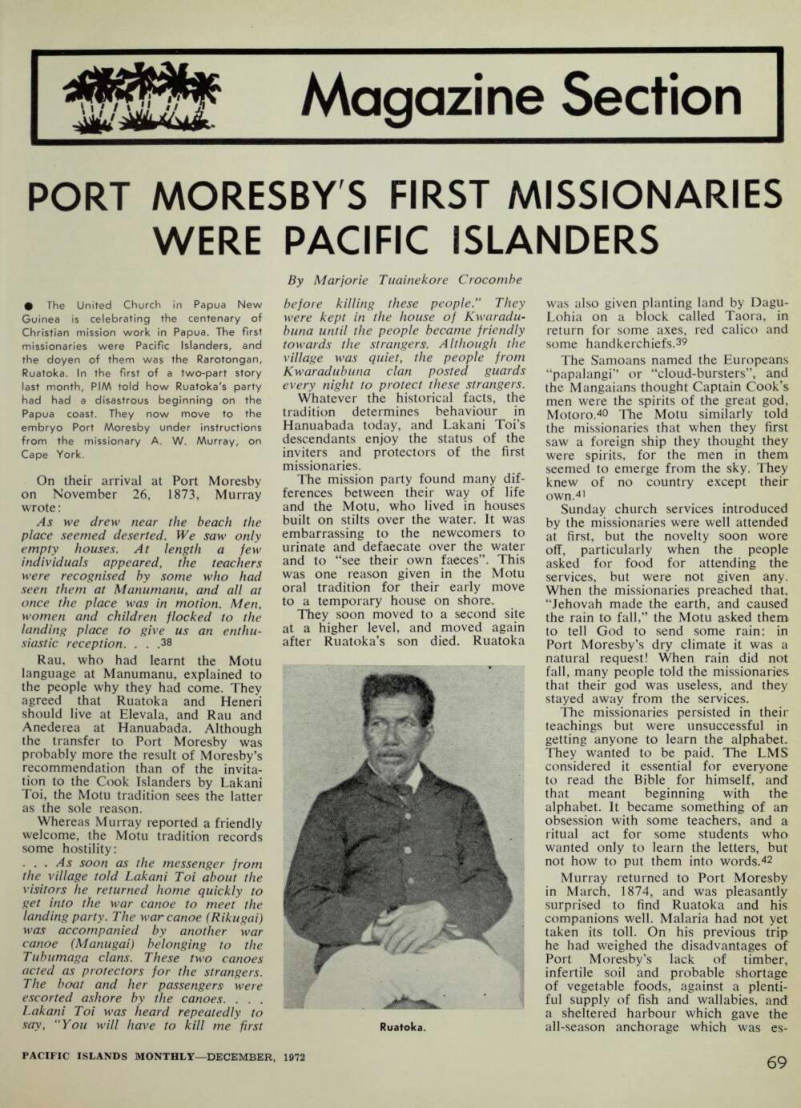
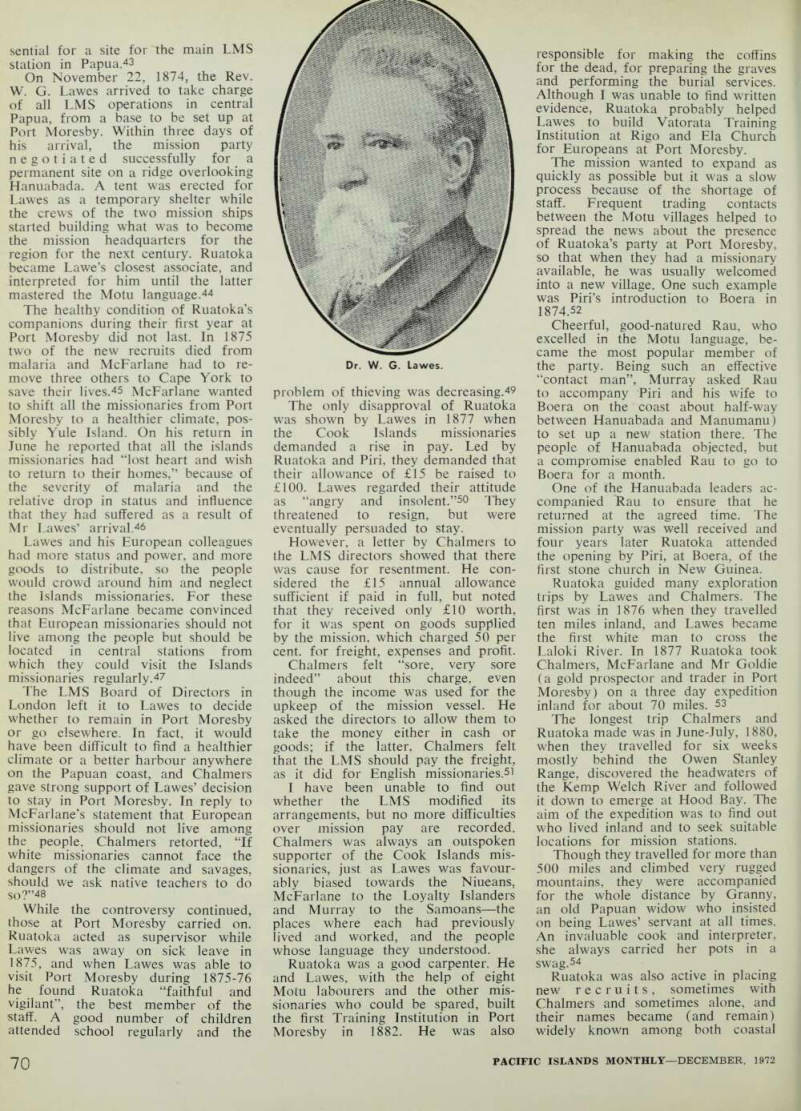
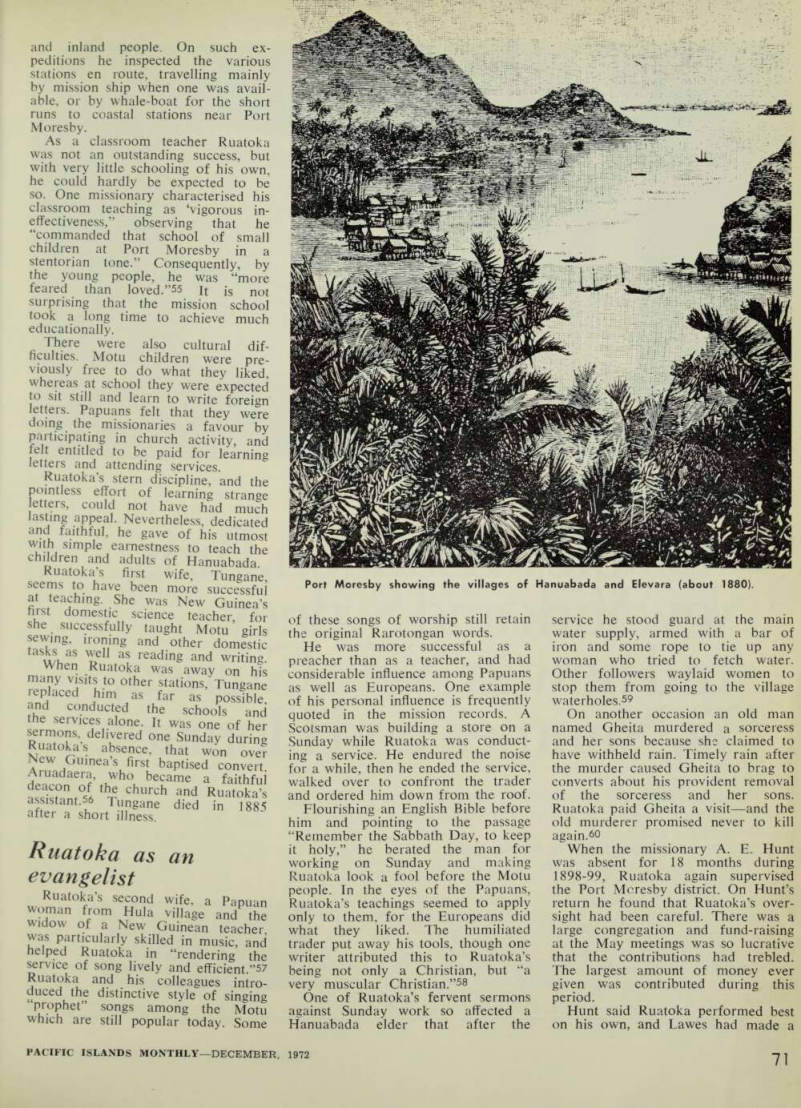
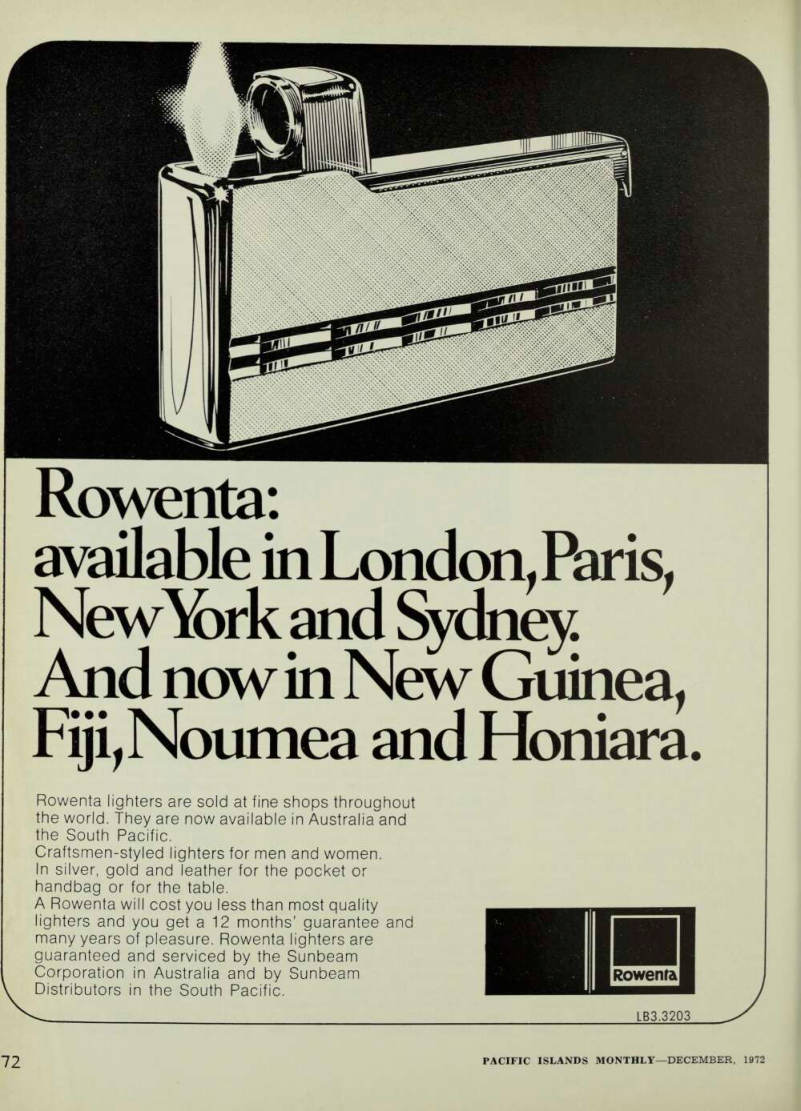
Port Moresby's First Missionaries
Were Pacific Islanders
By Marjorie Tuainekore Crocombe
• The United Church in Papua New Guinea is celebrating the centenary of Christian mission work in Papua. The first missionaries were Pacific Islanders, and the doyen of them was the Rarotongan, Ruatoka. In the first of a two-part story last month, PIM told how Ruatoka's party had had a disastrous beginning on the Papua coast. They now move to the embryo Port Moresby under instructions from the missionary A. W. Murray, on Cape York.
On their arrival at Port Moresby on November 26, 1873, Murray wrote: As we drew near the beach the place seemed deserted. We saw only empty houses. At length a few individuals appeared, the teachers were recognised by some who had seen them at Manumanu, and all at once the place was in motion. Men, women and children flocked to the landing place to give us an enthu siastic reception. . . ,38 Rau, who had learnt the Motu language at Manumanu, explained to the people why they had come. They agreed that Ruatoka and Heneri should live at Elevala, and Rau and Anederea at Hanuabada. Although the transfer to Port Moresby was probably more the result of Moresby’s recommendation than of the invita tion to the Cook Islanders by Lakani Toi, the Motu tradition sees the latter as the sole reason.
Whereas Murray reported a friendly welcome, the Motu tradition records some hostility: ... As soon as the messenger from the village told Lakani Toi about the visitors he returned home quickly to get into the war canoe to meet the landing party. The war canoe (Rikugai) was accompanied by another war canoe (Manugai) belonging to the Tubumaga clans. These two canoes acted as protectors for the strangers.
The boat and her passengers were escorted ashore by the canoes. . . .
Lakani Toi was heard repeatedly to say, “You will have to kill me first
before killing these people” They were kept in the house of Kwaradu buna until the people became friendly towards the strangers. Although the village was quiet, the people from Kwaradubuna clan posted guards every night to protect these strangers.
Whatever the historical facts, the tradition determines behaviour in Hanuabada today, and Lakani Toi’s descendants enjoy the status of the inviters and protectors of the first missionaries.
The mission party found many dif ferences between their way of life and the Motu, who lived in houses built on stilts over the water. It was embarrassing to the newcomers to urinate and defaecate over the water and to “see their own faeces”. This was one reason given in the Motu oral tradition for their early move to a temporary house on shore.
They soon moved to a second site at a higher level, and moved again after Ruatoka’s son died. Ruatoka
was also given planting land by Dagu- Lohia on a block called Taora, in return for some axes, red calico and some handkerchiefs. 39 The Samoans named the Europeans “papalangi” or “cloud-bursters”, and the Mangaians thought Captain Cook’s men were the spirits of the great god, Motoro. 40 The Motu similarly told the missionaries that when they first saw a foreign ship they thought they were spirits, for the men in them seemed to emerge from the sky. They knew of no country except their 0wn. 41 Sunday church services introduced by the missionaries were well attended at first, but the novelty soon wore off, particularly when the people asked for food for attending the services, but were not given any.
When the missionaries preached that, “Jehovah made the earth, and caused the rain to fall,” the Motu asked them to tell God to send some rain: in Port Moresby’s dry climate it was a natural request! When rain did not fall, many people told the missionaries that their god was useless, and they stayed away from the services.
The missionaries persisted in their teachings but were unsuccessful in getting anyone to learn the alphabet.
They wanted to be paid. The LMS considered it essential for everyone to read the Bible for himself, and that meant beginning with the alphabet. It became something of air obsession with some teachers, and a ritual act for some students who wanted only to learn the letters, but not how to put them into words. 42 Murray returned to Port Moresby in March, 1874, and was pleasantly surprised to find Ruatoka and his companions well. Malaria had not yet taken its toll. On his previous trip he had weighed the disadvantages of Port Moresby’s lack of timber, infertile soil and probable shortage of vegetable foods, against a plenti ful supply of fish and wallabies, and a sheltered harbour which gave the all-season anchorage which was es
Ruatoka.
sential for a site for the main LMS station in Papua 43 On November 22, 1874, the Rev.
W. G. Lawes arrived to take charge of all LMS operations in central Papua, from a base to be set up at Port Moresby. Within three days of his arrival, the mission party negotiated successfully for a permanent site on a ridge overlooking Hanuabada. A tent was erected for Lawes as a temporary shelter while the crews of the two mission ships started building what was to become the mission headquarters for the region for the next century. Ruatoka became Lawe’s closest associate, and interpreted for him until the latter mastered the Motu language. 44 The healthy condition of Ruatoka’s companions during their first year at Port Moresby did not last. In 1875 two of the new recruits died from malaria and McFarlane had to re move three others to Cape York to save their lives. 4s McFarlane wanted to shift all the missionaries from Port Moresby to a healthier climate, pos sibly Yule Island. On his return in June he reported that all the islands missionaries had “lost heart and wish to return to their homes,” because of the severity of malaria and the relative drop in status and influence that they had suffered as a result of Mr Lawes’ arrival. 4s Lawes and his European colleagues had more status and power, and more goods to distribute, so the people would crowd around him and neglect the Islands missionaries. For these reasons McFarlane became convinced that European missionaries should not live among the people but should be located in central stations from which they could visit the Islands missionaries regularly. 47 The LMS Board of Directors in London left it to Lawes to decide whether to remain in Port Moresby or go elsewhere. In fact, it would have been difficult to find a healthier climate or a better harbour anywhere on the Papuan coast, and Chalmers gave strong support of Lawes’ decision to stay in Port Moresby. In reply to McFarlane’s statement that European missionaries should not live among the people, Chalmers retorted, “If white missionaries cannot face the dangers of the climate and savages, should we ask native teachers to do 50?” 43 While the controversy continued, those at Port Moresby carried on.
Ruatoka acted as supervisor while Lawes was away on sick leave in 1875, and when Lawes was able to visit Port Moresby during 1875-76 he found Ruatoka “faithful and vigilant”, the best member of the staff. A good number of children attended school regularly and the
problem of thieving was decreasing. 49 The only disapproval of Ruatoka was shown by Lawes in 1877 when the Cook Islands missionaries demanded a rise in pay. Led by Ruatoka and Piri, they demanded that their allowance of £ls be raised to £IOO. Lawes regarded their attitude as “angry and insolent.” so They threatened to resign, but were eventually persuaded to stay.
However, a letter by Chalmers to the LMS directors showed that there was cause for resentment. He con sidered the £ls annual allowance sufficient if paid in full, but noted that they received only £lO worth, for it was spent on goods supplied by the mission, which charged 50 per cent, for freight, expenses and profit.
Chalmers felt “sore, very sore indeed” about this charge, even though the income was used for the upkeep of the mission vessel. He asked the directors to allow them to take the money either in cash or goods; if the latter, Chalmers felt that the LMS should pay the freight, as it did for English missionaries. sl I have been unable to find out whether the LMS modified its arrangements, but no more difficulties over mission pay are recorded.
Chalmers was always an outspoken supporter of the Cook Islands mis sionaries, just as Lawes was favour ably biased towards the Niueans, McFarlane to the Loyalty Islanders and Murray to the Samoans—the places where each had previously lived and worked, and the people whose language they understood.
Ruatoka was a good carpenter. He and Lawes, with the help of eight Motu labourers and the other mis sionaries who could be spared, built the first Training Institution in Port Moresby in 1882. He was also
responsible for making the coffins for the dead, for preparing the graves and performing the burial services.
Although I was unable to find written evidence, Ruatoka probably helped Lawes to build Vatorata Training Institution at Rigo and Ela Church for Europeans at Port Moresby.
The mission wanted to expand as quickly as possible but it was a slow process because of the shortage of staff. Frequent trading contacts between the Motu villages helped to spread the news about the presence of Ruatoka’s party at Port Moresby, so that when they had a missionary available, he was usually welcomed into a new village. One such example was Piri’s introduction to Boera in 1874.52 Cheerful, good-natured Rau, who excelled in the Motu language, be came the most popular member of the party. Being such an effective “contact man”, Murray asked Rau to accompany Piri and his wife to Boera on the coast about half-way between Hanuabada and Manumanu) to set up a new station there. The people of Hanuabada objected, but a compromise enabled Rau to go to Boera for a month.
One of the Hanuabada leaders ac companied Rau to ensure that he returned at the agreed time. The mission party was well received and four years later Ruatoka attended the opening by Piri, at Boera, of the first stone church in New Guinea.
Ruatoka guided many exploration trips by Lawes and Chalmers. The first was in 1876 when they travelled ten miles inland, and Lawes became the first white man to cross the Laloki River. In 1877 Ruatoka took Chalmers, McFarlane and Mr Goldie (a gold prospector and trader in Port Moresby) on a three day expedition inland for about 70 miles. 53 The longest trip Chalmers and Ruatoka made was in June-July, 1880, when they travelled for six weeks mostly behind the Owen Stanley Range, discovered the headwaters of the Kemp Welch River and followed it down to emerge at Hood Bay. The aim of the expedition was to find out who lived inland and to seek suitable locations for mission stations.
Though they travelled for more than 500 miles and climbed very rugged mountains, they were accompanied for the whole distance by Granny, an old Papuan widow who insisted on being Lawes’ servant at all times.
An invaluable cook and interpreter, she always carried her pots in a swag. s4 Ruatoka was also active in placing new recruits, sometimes with Chalmers and sometimes alone, and their names became (and remain) widely known among both coastal
Dr. W. G. Lawes.
and inland people. On such ex peditions he inspected the various stations en route, travelling mainly by mission ship when one was avail able, or by whale-boat for the short runs to coastal stations near Port Moresby.
As a classroom teacher Ruatoka was not an outstanding success, but with very little schooling of his own, he could hardly be expected to be so. One missionary characterised his classroom teaching as ‘vigorous in effectiveness,” observing that he “commanded that school of small children at Port Moresby in a stentorian tone.” Consequently, by the young people, he was “more feared than 10ved.” 55 It is not surprising that the mission school took a long time to achieve much
educationally.
There were also cultural dif ficulties. Motu children were pre viously free to do what they liked, whereas at school they were expected to sit still and learn to write foreign letters. Papuans felt that they were doing the missionaries a favour by participating in church activity, and felt entitled to be paid for learning letters and attending services.
Ruatoka’s stern discipline, and the pointless effort of learning strange etters, could not have had much lasting appeal. Nevertheless, dedicated and faithful, he gave of his utmost with simple earnestness to teach the children and adults of Hanuabada Ruatoka’s first wife, Tungane, seems to have been more successful at teaching. She was New Guinea’s nrst domestic science teacher, for she successfully taught Motu girls sewing, ironing and other domestic 1 a u/u as eII as readi ng and writing.
When Ruatoka was away on his many visits to other stations, Tungane replaced him as far as possible, and conducted the schools and the services alone. It was one of her S™ 0 " B ’. del ivered one Sunday during Ruatoka s absence, that won over New Guinea’s first baptised convert.
Aruadaera, who became a faithful deacon of the church and Ruatoka’s assistant. s6 Tungane died in 1885 after a short illness.
Ruatoka as an
evangelist
Ruatoka’s second wife, a Papuan woman from Hula village and the widow of a New Guinean teacher was particularly skilled in music, and helped Ruatoka in “rendering the service of song lively and efficient.” s9 Ruatoka and his colleagues intro duced the distinctive style of singing prophet” songs among the Motu which are still popular today. Some
of these songs of worship still retain the original Rarotongan words.
He was more successful as a preacher than as a teacher, and had considerable influence among Papuans as well as Europeans. One example of his personal influence is frequently quoted in the mission records. A Scotsman was building a store on a Sunday while Ruatoka was conduct ing a service. He endured the noise for a while, then he ended the service, walked over to confront the trader and ordered him down from the roof.
Flourishing an English Bible before him and pointing to the passage “Remember the Sabbath Day, to keep it holy,” he berated the man for working on Sunday and making Ruatoka look a fool before the Motu people. In the eyes of the Papuans, Ruatoka’s teachings seemed to apply only to them, for the Europeans did what they liked. The humiliated trader put away his tools, though one writer attributed this to Ruatoka’s being not only a Christian, but “a very muscular Christian.” sB One of Ruatoka’s fervent sermons against Sunday work so affected a Hanuabada elder that after the
service he stood guard at the main water supply, armed with a bar of iron and some rope to tie up any woman who tried to fetch water.
Other followers waylaid women to stop them from going to the village waterholes. s9 On another occasion an old man named Gheita murdered a sorceress and her sons because she claimed to have withheld rain. Timely rain after the murder caused Gheita to brag to converts about his provident removal of the sorceress and her sons.
Ruatoka paid Gheita a visit—and the old murderer promised never to kill again. 6o When the missionary A. E. Hunt was absent for 18 months during 1898-99, Ruatoka again supervised the Port Moresby district. On Hunt’s return he found that Ruatoka’s over sight had been careful. There was a large congregation and fund-raising at the May meetings was so lucrative that the contributions had trebled.
The largest amount of money ever given was contributed during this period.
Hunt said Ruatoka performed best on his own, and Lawes had made a
Port Moresby showing the villages of Hanuabada and Elevara (about 1880).
similar statement the previous year, when, disappointed with the large turnover of English missionaries at Port Moresby, he was consoled by the fact that Ruatoka was “discharging all the duties of a bishop effectively” and that he was at his best when in sole charge of the mission. 6l
Involvements with
government
Missionaries were supposed to keep out of politics, but as Koskinen has observed, it was often not possible for them to do so 6 2 They preached against warfare which was one of the important means for settling dis putes, and were therefore obliged to help bring peace by negotiation. Many local people consulted missionaries about political problems that beset them. Missionaries often, and under standably, negotiated with chiefs or headmen.
The following Motu oral tradition may illustrate the kind of punish ment meted out by missionaries to wrongdoers before formal govern ment was established. Warfare and physical aggression were denied to them, but “peaceful” substitutes were effective. No references to this incident appear in the written sources, and it probably happened while Ruatoka was supervisor of the Port Moresby Station when Lawes was away in 1875.
Ruatoka and his companions put up a store. They placed all their rice, sugar, clothing, beads, axes and different things in it. After that a man of Hohodae called Tauoa Konena went many times, each time taking whatever he wanted from the store.
He did so frequently. They didn’t discover him.
When they took stock they knew that some of their goods had been lost. The great Ruatoka assembled the people of the village and said, “I called you because I have dis covered how our food and goods were lost. Those things were stolen by Tauoa of Hohodae. I have found them. We should punish him.”
He told them not to get their weapons, but to bring vines only. .
“Take your vines and fasten them to the posts, cross pieces, and timbers of Tauoa Konena’s house . ..”
He, with the people of Elevala, took their vines and canes and fixed them firmly. Then sadly, they pulled at the house until it tumbled down. They took the thatch and burned it at Konedobu.
Then they bound the hands and feet of Tauoa Konena and took him to a green ants’ nest and bound him, and there he stayed. The ants bit him all over. They raised weals on his
eyebrows, mouth, face and whole body. He suffered thus until nearly sundown, when they released him.
Then he bathed in the sea. Thus they punished him because at that time there was no prison , 63 The year 1884 was politically im portant. There had been much talk about annexation, though Chalmers and Lawes both opposed it. On April 4, 1883, the Police Magistrate at Thursday Island, Mr H. M. Chester, hoisted the British flag at Port Moresby on behalf of the Queens land Government.
The missionaries at Port Moresby were asked to participate. Lawes translated into Motu what the pro clamation meant; Ruatoka distributed £5O worth of trade goods to all the heads of families at Hanuabada village. In the afternoon the villagers bore gifts to the mission house, then Lawes and Chalmers entertained all the Europeans, the missionaries and their wives, and Boe Vagi, one of the leaders of Port Moresby.
All the festivity was for nothing because the British Government refused to recognise the Queensland Government’s proclamation. The second attempt came in November, 1884, when H. H. Romilly misunder stood his instructions and proclaimed New Guinea a protectorate.
Later in November, Commodore Erskine, Commander-in-Chief of the Australian Station arrived, accom panied by four ships of the Aus tralian squadron. He disregarded Romilly’s action, and in order to ensure that the Papuans really under stood the significance of the flag hoisting, Erskine despatched Chalmers on HMS Espiegle to pick up im portant leaders in the villages between Port Moresby and Round Head and bring them to Port Moresby to see the ceremony.
Ruatoka went on HMS Raven as far west as Redscar Bay. Lawes was responsible for attracting those within the Port Moresby area. The third attempt at the proclamation was suc cessful, Ruatoka and all the other missionaries being given places of honour at the ceremony. Ruatoka was also present at the annexation of New Guinea by Britain in 1888.
Relations with the
miners
Ruatoka’s dedication in helping others was fully demonstrated during the gold rush to the Laloki River, 30 miles from Port Moresby, in 1878.
After the discovery of gold at Laloki in 1878 Lawes feared an influx of Australian miners who would be un sympathetic to the mission and who could not be adequately controlled in the absence of civil government. 64 Actually relatively few miners came and though there were some prob lems with local people, their worst enemies were malaria and other diseases which killed many of them.
Though its facilities and medical supplies were limited, the LMS bore the brunt of providing hospital services to sick miners. Both Lawes and Chalmers paid tribute to Ruatoka as the “hero of this humanitarian service.” He and his wife fed and nursed sick miners at their own expense.
On an annual pay of £l5 it was indeed a sacrifice. 6s At least twice Ruatoka carried to his home on his back, and over considerable distances at night, sick miners who had been left to die in the bush because Papuans who found them were afraid to touch dying men in case their spirits haunted them 66 Ruatoka was also an effective
Raising of the British flag in Port Moresby, November 6, 1884, by the naval con tingent led by Commodore Erskine (inset right).
mediator between the miners and the local landowners. In one instance he heard of an imminent attack upon a prospector’s camp and warned the miners. He offered to pacify the vil lagers but refused the offer of an armed escort. He went among the armed warriors of Moumiri and “reasoned with them, preached to them [and] prayed for them.” 67 The attack was averted and the Moumiri warriors dispersed to their homes.
Ruatoka’s courage and zeal earned him the respect of all the miners, who joined together to present him with a testimonial thanking him for his kindness and services since their arrival. They mentioned in particular his help in mediating between the Papuan landowners and themselves.
Chester’s suggestion that Ruatoka’s work need only be made known “to ensure some recognition from the people of New South Wales and Queensland” was acted upon in October, 1878. Recognition came in the form of a gun, inscribed with the words: Presented by the Government of Queensland to Ruatoka, a teacher in the employ of the London Missionary Society, in token of their appreciation of his kindness and attention to the sick gold-diggers from Queensland at Port Moresby, October, 1878.68 Chalmers noted that the present was a splendid breechloading fowling piece,” but was silent about its connotations. Chalmers always insisted that missionaries went unarmed. Soon after his arrival in New Guinea in 1877 he had been disappointed to find each island missionary the owner of two or three guns.
After seeing some examples of these being used to coerce villagers he reminded everyone in the mission that these “guns were for shooting birds, wild pigs and kangaroos and not to frighten the natives. ” 69
Chalmers never carried arms, and he expected others working with him to follow his example.
A life remembered
This description of Ruatoka’s work from 1872 to 1903 probably gives the impression of a vigorous, healthy man, but in fact, he often suffered from illness. When Chalmers sug gested in 1893 that Ruatoka should go for a visit home to Mangaia, he refused, saying that Papua was now his home. 7o Only once did he travel overseas, to spend a few days at Cooktown.
Lieutenant-Governor McGregor’s prediction in his 1888-89 report that Ruatoka “has done so much that his name should never be forgotten” has indeed come true. 71 He is the most written about of all the Pacific Islands
missionaries to New Guinea and there are many oral as well as physical testimonies to his memory to this day.
The people of Boera village for instance, value today an armshell which they say was brought to their village when Piri opened their first church in 1876. The armshell, parti cularly prized for exchange in marriage ceremonies, is named Ruatoka. 72 There is a Ruatoka Road in Port Moresby, and 30 miles from that town, at Kwikila, there was until recently Ruatoka College, where the United Church trained teachers for its mission schools.
His name lives on beyond Papua.
The United Church college at Gaulim in New Britain has called one of its main buildings “Ruatoka Home”, and the Pacific Theological College in Suva on December 5, 1969, dedicated a new block of student flats as Ruatoka House.
For over 20 years Chalmers and Ruatoka, whom the former called his “own son in the faith,” worked as close friends and colleagues. When Chalmers and the Rev. Oliver Tompkins were murdered at Dopima village in April, 1901, Ruatoka offered to work among the Dopima people, but the offer was declined, as Ruatoka himself was nearing the end of the road. He died on September 12, 1903, having spent 31 years in New Guinea, thus amply absolving Chalmers for allowing the ailing Ruatoka to go from Raro tonga with that pioneer group of missionaries in 1872.
In the Port Moresby cemetery Ruatoka has a permanent memorial in an honoured place. As the Pacific islands seek out indigenous heroes to supplement or replace the foreign heroes who have been given dis proportionate emphasis in the past, Ruatoka is likely to become much more widely known.
Memorial stone at Boera, commemorating the church opened by Piri in 1876.
Advertisements & other items, pp. 74-76 (1 item)
New¥>rkand Sydney.
Rowenta:
available in London, Paris,
And now in New Guinea,
Fiji, Noumea and Honiara.
Rowenta lighters are sold at fine shops throughout the world. They are now available in Australia and the South Pacific.
Craftsmen-styled lighters for men and women.
In silver, gold and leather for the pocket or handbag or for the table.
A Rowenta will cost you less than most quality lighters and you get a 12 months’ guarantee and many years of pleasure. Rowenta lighters are guaranteed and serviced by the Sunbeam Corporation in Australia and by Sunbeam in the South Pacific.
Rowenta L 83.3203
,?TI.LTO.*«.
Established 1890 offering merchants in the Pacific, buying service giving prompt, careful and expert attention to all requirements.
For that service with a difference, cable "Success", Sydney <r> & c/> l! % Representing Manufacturers of: Tilley Lamps, Success Footwear, Del Monte Products, Murray Valley Drinks, etc., Lingman Italian Gas Ranges, Success Petrol Washing Machines, E. W. Pipe Fittings, Sharp Calculators, Success Canned Fish, and other leading Brands.
B.^ r £5 HIGHEST PRICES OBTAINABLE ON THE WORLD MARKETS
FOR YOUR
SHELL - COCOA - COFFEE - COPRA - ETC.
31 Macquarie Place, Sydney, N.S.W. 2000
G.P.O. BOX 5315, SYDNEY, 2001.
CABLES: "TAITCO", SYDNEY.
Seatrans House, Gore St., Auckland, N.Z.
P.O. BOX 2044, AUCKLAND, N.Z.
CABLES: "TAITCO'', AUCKLAND.
Footnotes
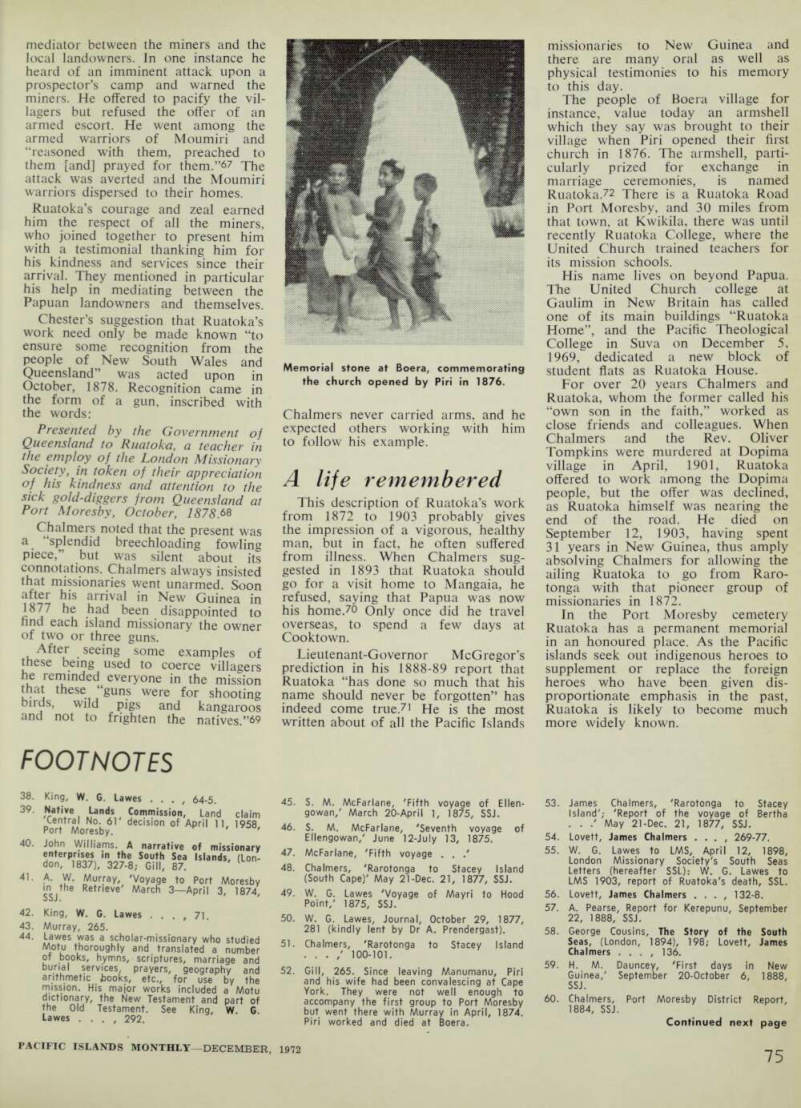
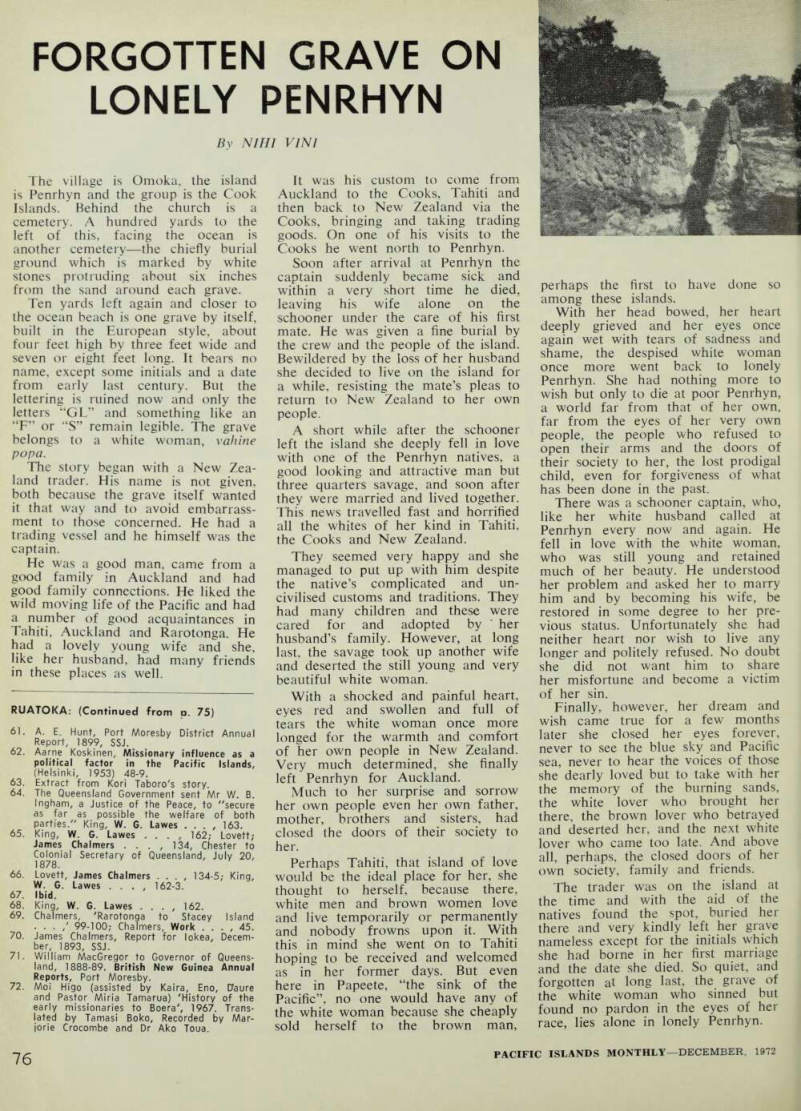
38. King, W. G. Lawes . . . , 64-5. 39. Unds Ccmmissici,, Land claim Central No. 61 decision of April 11, 1958, Port Moresby. 40. John Williams. A narrative of missionary enterprises in the South Sea Islands, (Lon don, 1837), 327-8; Gill, 87. 41. A. W. Murray, 'Voyage to Port Moresby Retrieve' March 3—April 3, 1874, 42. King, W. G. Lawes . . . , 71. 43. Murray, 265. 44. Lawes was a scholar-missionary who studied Motu thoroughly and translated a number of books, hymns, scriptures, marriage and burial services prayers, geography and arithmetic books, etc., for use by the mission. His major works included a Motu dictionary, the New Testament and part of the Old Testament, See King, W. G Lawes . . . , 292.
45. S. M. McFarlane, 'Fifth voyage of Ellen gowan,' March 20-April 1, 1875, SSJ. 46. S. M. McFarlane, 'Seventh voyage of Ellengowan,' June 12-July 13, 1875. 47. McFarlane, 'Fifth voyage . . 48. Chalmers, 'Rarotonga to Stacey Island (South Cape)' May 21-Dec. 21, 1877, SSJ. 49. W. G. Lawes 'Voyage of Mayri to Hood Point,' 1875, SSJ. 50. W. G. Lawes, Journal, October 29, 1877, 281 (kindly lent by Dr A. Prendergast). 51. Chalmers, 'Rarotonga to Stacey Island . . . ,' 100-101. 52. Gill, 265. Since leaving Manumanu, Piri and his wife had been convalescing at Cape York. They were not well enough to accompany the first group to Port Moresby but went there with Murray in April, 1874.
Piri worked and died at Boera.
53. James Chalmers, 'Rarotonga to Stacey Island'; 'Report of the voyage of Bertha . . .' May 21-Dec. 21, 1877, SSJ. 54. Lovett, James Chalmers . . . , 269-77. 55. W. G. Lawes to IMS, April 12, 1898, London Missionary Society's South Seas Letters (hereafter SSL); W. G. Lawes to LMS 1903, report of Ruatoka's death, SSL. 56. Lovett, James Chalmers . . . , 132-8. 57. A. Pearse, Report for Kerepunu, September
22, 1888, Ssj.
58. George Cousins, The Story of the South Seas, (London, 1894), 198; Lovett, James Chalmers . . . , 136. 59. H. M. Dauncey, 'First days in New Guinea,' September 20-october 6, 1888,
Ssj.
60. Chalmers, Port Moresby District Report,
1884, Ssj.
Continued next page
61. A. E. Hunt, Port Moresby District Annual Report, 1899, SSJ. 62. Aarne Koskinen, Missionary influence as a political factor in the Pacific Islands, (Helsinki, 1953) 48-9. 63. Extract from Kori Taboro's story. 64. The Queensland Government sent Mr W. B.
Ingham, a Justice of the Peace, to "secure as far as possible the welfare of both parties." King, W. G. Lawes . . . , 163. 65. King, W. G. Lawes . . . , 162; Lovett; James Chalmers . . . , 134, Chester to Colonial Secretary of Queensland, July 20, 1878. 66. Lovett, James Chalmers . . . , 134-5; King, W. G. Lawes . . . , 162-3. 67. Ibid. 68. King, W. G. Lawes . . . , 162. 69. Chalmers, 'Rarotonga to Stacey Island . . . ,' 99-100; Chalmers, Work . . . , 45. 70. James Chalmers, Report for lokea, Decem ber, 1893, SSJ. 71. William MacGregor to Governor of Queens land, 1888-89. British New Guinea Annual Reports, Port Moresby. 72. Moi Higo (assisted by Kaira, Eno, Daure and Pastor Miria Tamarua) 'History of the early missionaries to Boera', 1967. Trans lated by Tamasi Boko, Recorded by Mar jorie Crocombe and Dr Ako Toua.
Forgotten Grave On
Lonely Penrhyn
By Nihi Vini
The village is Omoka, the island is Penrhyn and the group is the Cook Islands. Behind the church is a cemetery. A hundred yards to the left of this, facing the ocean is another cemetery—the chiefly burial ground which is marked by white stones protruding about six inches from the sand around each grave.
Ten yards left again and closer to the ocean beach is one grave by itself, built in the European style, about four feet high by three feet wide and seven or eight feet long. It bears no name, except some initials and a date from early last century. But the lettering is ruined now and only the letters “GL” and something like an “F” or “S” remain legible. The grave belongs to a white woman, vahine popa.
The story began with a New Zea land trader. His name is not given, both because the grave itself wanted it that way and to avoid embarrass ment to those concerned. He had a trading vessel and he himself was the captain.
He was a good man, came from a good family in Auckland and had good family connections. He liked the wild moving life of the Pacific and had a number of good acquaintances in Tahiti, Auckland and Rarotonga. He had a lovely young wife and she, like her husband, had many friends in these places as well.
It was his custom to come from Auckland to the Cooks, Tahiti and then back to New Zealand via the Cooks, bringing and taking trading goods. On one of his visits to the Cooks he went north to Penrhyn.
Soon after arrival at Penrhyn the captain suddenly became sick and within a very short time he died, leaving his wife alone on the schooner under the care of his first mate. He was given a fine burial by the crew and the people of the island.
Bewildered by the loss of her husband she decided to live on the island for a while, resisting the mate’s pleas to return to New Zealand to her own people.
A short while after the schooner left the island she deeply fell in love with one of the Penrhyn natives, a good looking and attractive man but three quarters savage, and soon after they were married and lived together.
This news travelled fast and horrified all the whites of her kind in Tahiti, the Cooks and New Zealand.
They seemed very happy and she managed to put up with him despite the native’s complicated and un civilised customs and traditions. They had many children and these were cared for and adopted by ' her husband’s family. However, at long last, the savage took up another wife and deserted the still young and very beautiful white woman.
With a shocked and painful heart, eyes red and swollen and full of tears the white woman once more longed for the warmth and comfort of her own people in New Zealand.
Very much determined, she finally left Penrhyn for Auckland.
Much to her surprise and sorrow her own people even her own father, mother, brothers and sisters, had closed the doors of their society to her.
Perhaps Tahiti, that island of love would be the ideal place for her, she thought to herself, because there, white men and brown women love and live temporarily or permanently and nobody frowns upon it. With this in mind she went on to Tahiti hoping to be received and welcomed as in her former days. But even here in Papeete, “the sink of the Pacific”, no one would have any of the white woman because she cheaply sold herself to the brown man,
perhaps the first to have done so among these islands.
With her head bowed, her heart deeply grieved and her eyes once again wet with tears of sadness and shame, the despised white woman once more went back to lonely Penrhyn. She had nothing more to wish but only to die at poor Penrhyn, a world far from that of her own, far from the eyes of her very own people, the people who refused to open their arms and the doors of their society to her, the lost prodigal child, even for forgiveness of what has been done in the past.
There was a schooner captain, who, like her white husband called at Penrhyn every now and again. He fell in love with the white woman, who was still young and retained much of her beauty. He understood her problem and asked her to marry him and by becoming his wife, be restored in some degree to her pre vious status. Unfortunately she had neither heart nor wish to live any longer and politely refused. No doubt she did not want him to share her misfortune and become a victim of her sin.
Finally, however, her dream and wish came true for a few months later she closed her eyes forever, never to see the blue sky and Pacific sea, never to hear the voices of those she dearly loved but to take with her the memory of the burning sands, the white lover who brought her there, the brown lover who betrayed and deserted her, and the next white lover who came too late. And above all, perhaps, the closed doors of her own society, family and friends.
The trader was on the island at the time and with the aid of the natives found the spot, buried her there and very kindly left her grave nameless except for the initials which she had borne in her first marriage and the date she died. So quiet, and forgotten at long last, the grave of the white woman who sinned but found no pardon in the eyes of her race, lies alone in lonely Penrhyn.
Advertisements & other items, p. 78 (1 item)
RUATOKA: (Continued from p. 75)
Yesterday
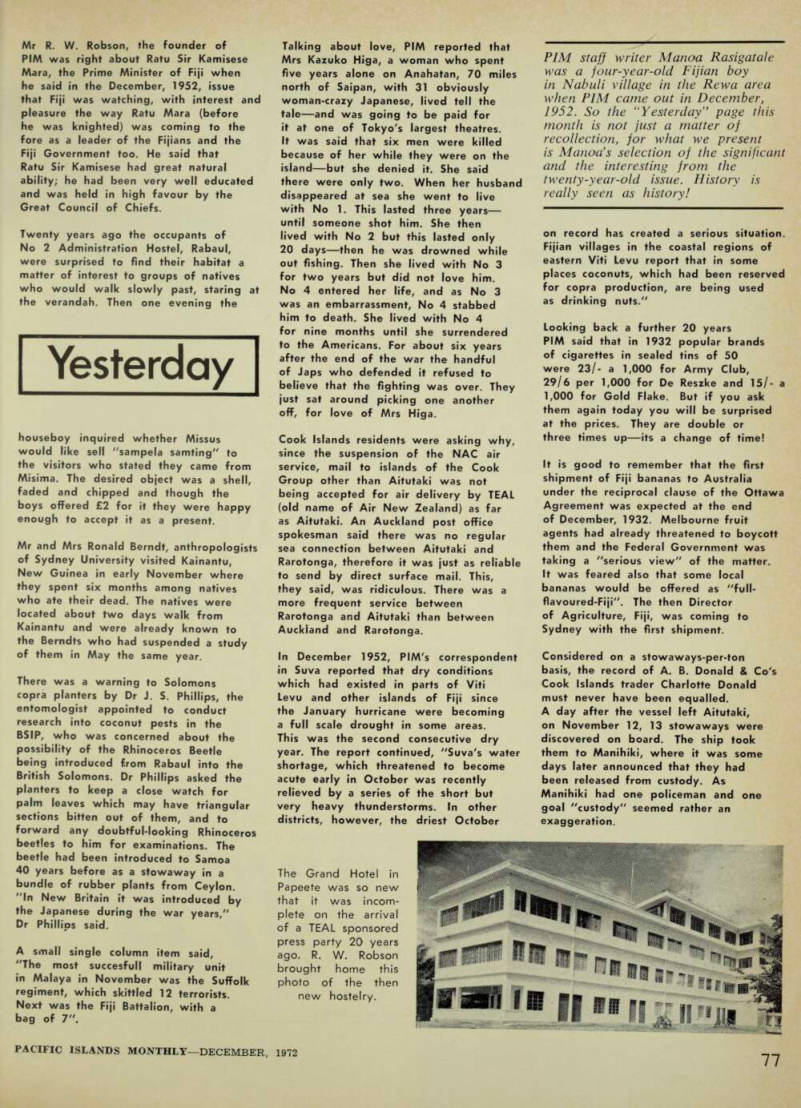
Mr R. W. Robson, the founder of PIM was right about Ratu Sir Kamisese Mara, the Prime Minister of Fiji when he said in the December, 1952, issue that Fiji was watching, with interest and pleasure the way Ratu Mara (before he was knighted) was coming to the fore as a leader of the Fijians and the Fiji Government too. He said that Ratu Sir Kamisese had great natural ability; he had been very well educated and was held in high favour by the Great Council of Chiefs.
Twenty years ago the occupants of No 2 Administration Hostel, Rabaul, were surprised to find their habitat a matter of interest to groups of natives who would walk slowly past, staring at the verandah. Then one evening the
houseboy inquired whether Missus would like sell "sampela samting" to the visitors who stated they came from Misima. The desired object was a shell, faded and chipped and though the boys offered £2 for it they were happy enough to accept it as a present.
Mr and Mrs Ronald Berndt, anthropologists of Sydney University visited Kainantu, New Guinea in early November where they spent six months among natives who ate their dead. The natives were located about two days walk from Kainantu and were already known to the Berndts who had suspended a study of them in May the same year.
There was a warning to Solomons copra planters by Dr J. S. Phillips, the entomologist appointed to conduct research into coconut pests in the BSIP, who was concerned about the possibility of the Rhinoceros Beetle being introduced from Rabaul into the British Solomons. Dr Phillips asked the planters to keep a close watch for palm leaves which may have triangular sections bitten out of them, and to forward any doubtful-looking Rhinoceros beetles to him for examinations. The beetle had been introduced to Samoa 40 years before as a stowaway in a bundle of rubber plants from Ceylon.
"In New Britain it was introduced by the Japanese during the war years,"
Dr Phillips said.
A small single column item said, "The most succesfull military unit in Malaya in November was the Suffolk regiment, which skittled 12 terrorists.
Next was the Fiji Battalion, with a bag of 7".
Talking about love, RIM reported that Mrs Kazuko Higa, a woman who spent five years alone on Anahatan, 70 miles north of Saipan, with 31 obviously woman-crazy Japanese, lived tell the tale—and was going to be paid for it at one of Tokyo's largest theatres.
It was said that six men were killed because of her while they were on the island—but she denied it. She said there were only two. When her husband disappeared at sea she went to live with No 1. This lasted three years— until someone shot him. She then lived with No 2 but this lasted only 20 days—then he was drowned while out fishing. Then she lived with No 3 for two years but did not love him.
No 4 entered her life, and as No 3 was an embarrassment. No 4 stabbed him to death. She lived with No 4 for nine months until she surrendered to the Americans. For about six years after the end of the war the handful of Japs who defended it refused to believe that the fighting was over. They just sat around picking one another off, for love of Mrs Higa.
Cook Islands residents were asking why, since the suspension of the NAC air service, mail to islands of the Cook Group other than Aitutaki was not being accepted for air delivery by TEAL (old name of Air New Zealand) as far as Aitutaki. An Auckland post office spokesman said there was no regular sea connection between Aitutaki and Rarotonga, therefore it was just as reliable to send by direct surface mail. This, they said, was ridiculous. There was a more frequent service between Rarotonga and Aitutaki than between Auckland and Rarotonga.
In December 1952, PlM's correspondent in Suva reported that dry conditions which had existed in parts of Viti Levu and other islands of Fiji since the January hurricane were becoming a full scale drought in some areas.
This was the second consecutive dry year. The report continued, "Suva's water shortage, which threatened to become acute early in October was recently relieved by a series of the short but very heavy thunderstorms. In other districts, however, the driest October
PIM staff writer Manoa Rasigatale was a four-year-old Fijian boy in Nabuli village in the Rewa area when PIM came out in December, 1952. So the “Yesterday” page this month is not just a matter of recollection, for what we present is Manoa’s selection of the significant and the interesting from the twenty-year-old issue. History is really seen as history!
on record has created a serious situation.
Fijian villages in the coastal regions of eastern Viti Levu report that in some places coconuts, which had been reserved for copra production, are being used as drinking nuts."
Looking back a further 20 years RIM said that in 1932 popular brands of cigarettes in sealed tins of 50 were 23/- a 1,000 for Army Club, 29/6 per 1,000 for De Reszke and 15/- a 1,000 for Gold Flake. But if you ask them again today you will be surprised at the prices. They are double or three times up—its a change of time!
It is good to remember that the first shipment of Fiji bananas to Australia under the reciprocal clause of the Ottawa Agreement was expected at the end of December, 1932. Melbourne fruit agents had already threatened to boycott them and the Federal Government was taking a "serious view" of the matter.
It was feared also that some local bananas would be offered as "full flavoured-Fiji". The then Director of Agriculture, Fiji, was coming to Sydney with the first shipment.
Considered on a stowaways-per-ton basis, the record of A. B. Donald & Co's Cook Islands trader Charlotte Donald must never have been equalled.
A day after the vessel left Aitutaki, on November 12, 13 stowaways were discovered on board. The ship took them to Manihiki, where it was some days later announced that they had been released from custody. As Manihiki had one policeman and one goal "custody" seemed rather an exaggeration.
The Grand Hotel in Papeete was so new that it was incom plete on the arrival of a TEAL sponsored press party 20 years ago. R. W. Robson brought home this photo of the then new hostelry.
Advertisements & other items, p. 80 (1 item)
abettertimetogo
BE
There’s never been
than now!
Qantas gives you the big, smooth, quiet and beautiful 7478. This is the plane with the biggest First Class Lounge in the skies. The one with movies and stereo*, with wide, wide aisles and wide custombuilt seats. The Qantas 7478 has 15 washrooms. Separate Shaver Bars.
And it’s a quieter plane from nose to tail.
Even the main galley is below, so you’re really away from any noise.
You can fly the Qantas 7478 between Australia, Singapore, Europe and London, and between Australia and San Francisco.
OiHisrras
7478 The service is as big as the plane. lATA regulations require us to make a charge of US$2.5O for the use of headsets.
' L 81.1418
Book Reviews
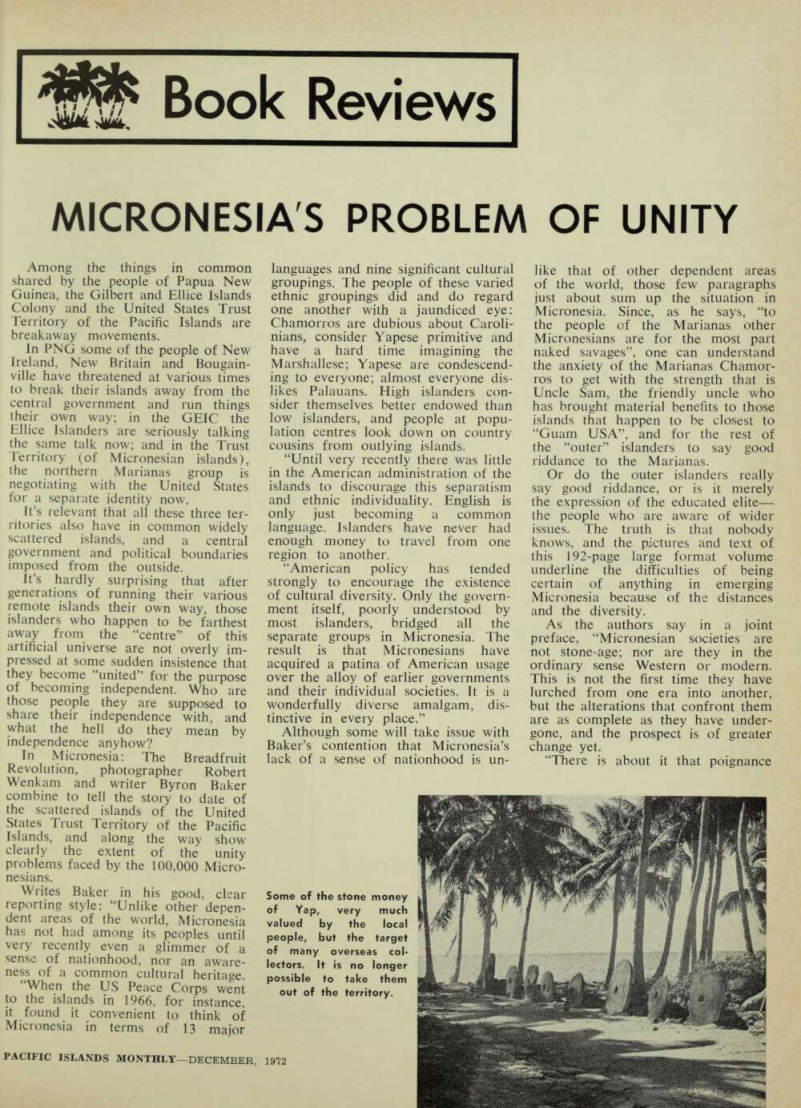
Micronesia's Problem Of Unity
Among the things in common shared by the people of Papua New Guinea, the Gilbert and Ellice Islands Colony and the United States Trust Territory of the Pacific Islands are breakaway movements.
In PNG some of the people of New Ireland, New Britain and Bougain ville have threatened at various times to break their islands away from the central government and run things their own way; in the GEIC the Ellice Islanders are seriously talking the same talk now; and in the Trust Territory (of Micronesian islands), the northern Marianas group is negotiating with the United States for a separate identity now.
It’s relevant that all these three ter ritories also have in common widely scattered islands, and a central government and political boundaries imposed from the outside.
It’s hardly surprising that after generations of running their various remote islands their own way, those islanders who happen to be farthest away from the “centre” of this artificial universe are not overly im pressed at some sudden insistence that they become “united” for the purpose of becoming independent. Who are those people they are supposed to share their independence with, and what the hell do they mean by independence anyhow?
In Micronesia: The Breadfruit Revolution, photographer Robert Wenkam and writer Byron Baker combine to tell the story to date of the scattered islands of the United States Trust Territory of the Pacific Islands, and along the way show clearly the extent of the unity problems faced by the 100,000 Micro nesians.
Writes Baker in his good, clear reporting style: “Unlike other depen dent areas of the world, Micronesia has not had among its peoples until very recently even a glimmer of a sense of nationhood, nor an aware ness of a common cultural heritage.
“When the US Peace Corps went to the islands in 1966, for instance, it found it convenient to think of Micronesia in terms of 13 major
languages and nine significant cultural groupings. The people of these varied ethnic groupings did and do regard one another with a jaundiced eye: Chamorros are dubious about Caroli nians, consider Yapese primitive and have a hard time imagining the Marshallese; Yapese are condescend ing to everyone; almost everyone dis likes Palauans. High islanders con sider themselves better endowed than low islanders, and people at popu lation centres look down on country cousins from outlying islands.
“Until very recently there was little in the American administration of the islands to discourage this separatism and ethnic individuality. English is only just becoming a common language. Islanders have never had enough money to travel from one region to another.
“American policy has tended strongly to encourage the existence of cultural diversity. Only the govern ment itself, poorly understood by most islanders, bridged all the separate groups in Micronesia. The result is that Micronesians have acquired a patina of American usage over the alloy of earlier governments and their individual societies. It is a wonderfully diverse amalgam, dis tinctive in every place.”
Although some will take issue with Baker’s contention that Micronesia’s lack of a sense of nationhood is un
like that of other dependent areas of the world, those few paragraphs just about sum up the situation in Micronesia. Since, as he says, “to the people of the Marianas other Micronesians are for the most part naked savages”, one can understand the anxiety of the Marianas Chamor ros to get with the strength that is Uncle Sam, the friendly uncle who has brought material benefits to those islands that happen to be closest to “Guam USA”, and for the rest of the “outer” islanders to say good riddance to the Marianas.
Or do the outer islanders really say good riddance, or is it merely the expression of the educated elite— the people who are aware of wider issues. The truth is that nobody knows, and the pictures and text of this 192-page large format volume underline the difficulties of being certain of anything in emerging Micronesia because of the distances and the diversity.
As the authors say in a joint preface, “Micronesian societies are not stone-age; nor are they in the ordinary sense Western or modern.
This is not the first time they have lurched from one era into another, but the alterations that confront them are as complete as they have under gone, and the prospect is of greater change yet.
“There is about it that poignance
Some of the stone money of Yap, very much valued by the local people, but the target of many overseas col lectors. It is no longer possible to take them out of the territory.
known to any who have read of the vanishing of the red man, or of pearl traders, palm trees and lagoons; a poignance the more special because islanders do still wear loin-cloths and lavalavas and sail outrigger canoes— and ride jet planes and send their children to college in the United States.”
Between them Wenkam and Baker have produced more than a picture book and more than another re porter’s view of Micronesia. They have needed each other.
The black and white pictures illustrate better than words the diversity of history—Spanish, German,
Japanese, American occupation—and the diversity of cultures and scenery such as the bare-breasted Yapese with their giant stone cartwheel money, the Banzai cliffs of Saipan, the Palau rock islands, the barrier reef of Truk, the Nan Madol ruins of Ponape. But above all they illustrate the type of people who inhabit these places, and it is the people who will decide whether 2,000 islands stretching 3,000 miles across the Western Pacific can, or should, share a common
destiny.-
EW.
(Micronesia: The Breadfruit
REVOLUTION. By Robert Wenkam with text by Byron Baker. University of Hawaii Press. SUSIS ).
Who wants
Australian cricket
history illustrated?
The legendary contestants and the famous contests of Australian cricket over the last 150 years are chronicled by word and picture in this magni ficent, relatively inexpensive, volume.
The facts and figures are there, but they do not intrude because they are linked by numerous anecdotes written with wit and warmth.
Arthur Mailey, for instance, was a famous bowler but no batting genius. In a match against the Callan Park Mental Asylum side in Sydney, his bowling was hit around by an inmate who imagined he was Mailey; the real Mailey’s reaction was “Thank God the feller doesn’t fancy he’s Trumper”.
And there’s Trumper, whose batting was the epitome of style: minimum effort for maximum effect. A photo graph of his classic straight drive adorns the cover of the book. Trum per, who in 1891 as a schoolboy of 13 could score a century in every match of the season, and at whose funeral in 1915, 20,000 people lined Sydney’s streets while London’s news papers interrupted the wartime news to announce the “death of a great cricketer”.
Interspersed among the stories are 190 black and white illustrations. The selection of photographs, some of them very rare, as much as the photo graphs themselves, conveys the spirit of Australian cricket, so that the reader gradually and subconsciously feels, for instance, why Sir Neville Cardus wrote of those two giants of different eras: “Trumper was the bird in flight, Bradman was the aeroplane”.
Perhaps the reader should be warned that this reviewer is a help less, hopeless cricket addict who has even umpired cricket in Port Moresby.
He has not admired some of Dick Whitington’s previous books, but he feels that the author and publisher are to be congratulated for this ven
ture.-
Tony Shannon.
(An Illustrated History Of Aus
TRALIAN CRICKET. By R. S. Whitington forewords by Sir Robert Menzies and Lindsay Hassett. Lansdowne Press. $8.50.)
Australian
Seabirds
“Birds in Bass Strait” is written by Ken Simpson, one of Australia’s leading seabird ornithologists, who has spent a number of years working with the CSIRO, and from 1964-66 spent 20 months at Macquarie Island, and, during his two visits, assisted in long-term research on the Wandering Albatross and Royal Penguins.
The book’s 112 pages are profusely illustrated in both black and white and colour. Numerous diagrams ex plain and amplify the text, parti cularly on bird migration and ocean currents in the Bass Strait area. These currents play a major part in the breeding and feeding biology of sea birds of this area. The photographs have been chosen for both quality and presentation of diagnostic features of each species.
The valuable part that bird banding has played in discovering movement of sea birds is covered. Much of this banding has been done by amateurs working under the Australian Bird Banding Scheme, operated by the CSIRO Division of Wildlife Research.
Conservation has not been neglected with a description and history of the commercial harvesting of the Tas manian Muttonbird, and the desecra tion of Cat Island as a major Aus tralian Gannet rookery. “The rookery on Cat island in 1936 had 800-1,000 birds nesting, but in 1966-7 only twelve pairs were present and breed ing”. Perhaps the most interesting and one of the most controversial of the Bass Strait breeding birds is the Cape Barren Goose, “today con sidered to be the second rarest goose species in the world, after the Ne Ne (Hawaian Goose). The maxi mum number of Cape Barren goose in the wild and in captivity probably does not exceed 6,000 birds” yet, “In 1965 a two day open season was per
mitted for shooting the species in the Furneaux Group. In an effort to restore the goose population in West ern Victoria to its former level, the Fisheries & Wildlife Department established a feral flock at the Serendip Field Station, Lara, Vic toria”.
Ornithologists and students of natural history will find this book a complete study of the avian fauna of the Bass Strait area. A large number of the birds described occur over large areas of the Eastern coast of Australian and Pacific Ocean, giving this book a much wider relevance then the title implies.
Alan Leishman.
(Birds In Bass Strait. By Ken
Simpson. A. H. & A. W. Reed, Sydney, for the Oil and Gas Division of BHP Cos Ltd. $4.95.)
Colourful birds
of Fiji
Another recent bird book comes from Collins in New Zealand and is called Birds of Fiji In Colour. The paintings were done by W. J. Belcher between 1924 and 1935, and the text is contributed by the Auckland ornithologist R. B. Sibson.
The birds of Fiji are varied, beautiful and sometimes very shy. It was thus a great service by Belcher to produce, as a result of long and patient study, a superb collection of paintings covering most of the dominant species. Those included in this book are 24 of a collection of 90 bird paintings, reproduced by permission of the Trustees of the Fiji Museum. They are not available for regular viewing, and so this volume will be appreciated by both visitors to Fiji and bird lovers everywhere. (BIRDS IN FIJI IN COLOUR. W. J.
Belcher/R. B. Sibson. Collins, SNZ3.6O).
Bonanza Year
For Wallis
Island
Wallis Island, lying north of Fiji and north-east of New Caledonia, is a little-known French territory of 95 square kilometres.
It was first made known to Euro peans after Captain Samuel Wallis of HMS Dolphin chanced to discover it in 1767 and named it after himself.
Most of the 205 years since Wallis’ discovery have managed to pass with out the publication of any books de voted to that island.
This year, however, there have already been at least two. One is a coloured picture book of 64 pages entitled lies Wallis; the other is volume 2 of a Histoire de ITle Wallis by Bishop Alexandre Poncet, who was bishop of Wallis and Futuna from 1936 to 1962.
Because of the paucity of literature on Wallis Island, both books should be welcomed by Pacific libraries and collectors.
Both suggest that Wallis is an island where nothing much ever happens, and where much of what does hap pen is associated with the Roman Catholic Church, which first gained a foothold there in 1837. lies Wallis, published by Editions Delroisse, 113 Rue de Paris, Boulogne 92, France, is available from Mile Pise, of the South Pacific Commis sion, Noumea for 400 Pacific francs.
Bishop Poncet’s history, which covers the period of the French pro tectorate over Wallis Island from 1886 to 1959, is published by the Societe des Oceanistes, Paris, at 45 French francs. The first volume of the history, which will no doubt cover the period from the earliest times to 1886, has not yet been pub lished. Its appearance has been con siderably delayed by the exigencies of
archival research.
Robert Langdon.
Advertisements & other items, pp. 82-86 (1 item)
Queensland
BENEFIT FROM 87 YEARS
OF INSURANCE EXPERIENCE
INSURANCE
Company Limited
(INCORPORATED 1886 IN AUSTRALIA)
HEAD OFFICE: 82 Pitt Street, Sydney FIJI —Branch Office, Suva, Manager for Fiji: F. N, Davies.
LAUTOKA, BA, LEVUKA, LABASA— Bums Philp (South Sea) Co. Limited. District Manager at Lautoka: U. Singh.
PAPUA-NEW GUINEA— Branch Office, Port Moresby: Manager for Papua-New Guinea: D. J. Granter.
SAMARAI, LAE, MADANG, RABAUL, KAVIENG,
MT. HAGEN —Burns Philp (New Guinea) Limited.
District Manager at Rabaul: C. D. Dickings. District Manager at Lae: R. Jackson. District Manager at Mt. Hagen: G. F. Donnelly.
HONIARA (b.s.i.p.)— Breckwoldt & Company (s.i.) Pty. Limited.
NOUMEA —T. A. Hagen, Ste. W. A. Johnston, S.A.R.L.
VILA —Burns Philp (New Hebrides) Limited.
Resident Officer: R. J. Allsop.
SANTO—Bums Philp (New Hebrides) Limited.
NORFOLK ISLAND— Bums Philp (South Sea) Co. Limited TAHITI —Arthur Chung; Immeuble B.I., Front deMer, Papeete.
OTHER SOUTH SEA ISLANDS— Bums Philp (South Sea) Co. Limited.
Assets exceed $A70,ooo,ooo
MARSDEN SCHOOL FOR GIRLS
A COUNTRY
ENVIRONMENT
ACADEMIC
EXCELLENCE
BATHURST,
NSW.
MILLERS
MARINE AND GENERAL ENGINEERS
t m i. ... . i m 5 •■4 ■ i \v a i 1 : »■ >*■ griSlg
THE "WAKAYA"
A standard 50 ft tug built for Marine Pacific Ltd to be used for berthing operations and inter-island barge towing. The propulsion unit in this tug is a 12V71M 340 H.P. G.M.
Detroit diesel, nozzle propeller, with a bollard pull of 6 tons.
Work in hand is the Mission ship for the Gilbert and Ellice Islands, 86 ft. x 22 ft. x 7 ft. 9 in. This ship is powered by twin 180 H.P. T 6 Kel-
LIMITED
SHIP BUILDERS TO THE PACIFIC
: & Wb s
s *ht a
W 1 m m
THE MISSION SHIP
vin diesels, 2 x 20 K.V.A. alternators and is capable of a top speed of 10 knots.
It has accommodation for 12 crew and 10 passengers and has a cargo capacity of 70 tons. Also under construction is a 72 ft. flbreglassed wood hull tourist launch, two 40 ft. and two 30 ft. steel work boats and six 250 ton capacity barges.
MILLERS
P.O. BOX 296, SUVA, FIJI. PHONE: 23031.
D A
MARINE PROPULSION DIESEL ENGINE
■ m /J m * 4
f wti > * j
■ t * M 6LX Marine Engine with "shallow" type Twin Disc MG.509 gearbox showing gearcase support members with integrally constructed bearer feet.
THE CHOICE OF THE DISCERNING OWNER
The Gardner Marine Diesel Engine sets the standard by which all other engines are judged and is the only choice for the owner requiring complete dependability, efficiency and durability second to none. Designed and built from the start as a true marine engine.
The complete range of Gardner engines from 56 to 230 hp are now available for immediate delivery.
For information on availability—or technical data—contact:
KNOX SCHLAPP
135-139 McEvoy Street, Alexandria, N.S.W. 2015. Tel.; 699-8333.
Telex: AA20483. Telegrams: "Knoxschlap", Sydney.
Agents in N.S.W. and Pacific Islands for Gardner Diesels.
SUB DISTRIBUTORS: SHERWOOD ENGINEERING, RABAUL;
S. A. HEATH & SONS, PORT MORESBY.
PTY.
LTD.
Write for literature on our complete range of marine diesel engines Name r Address Code
POST THIS COUPON TODAY!
Pacific Shipping
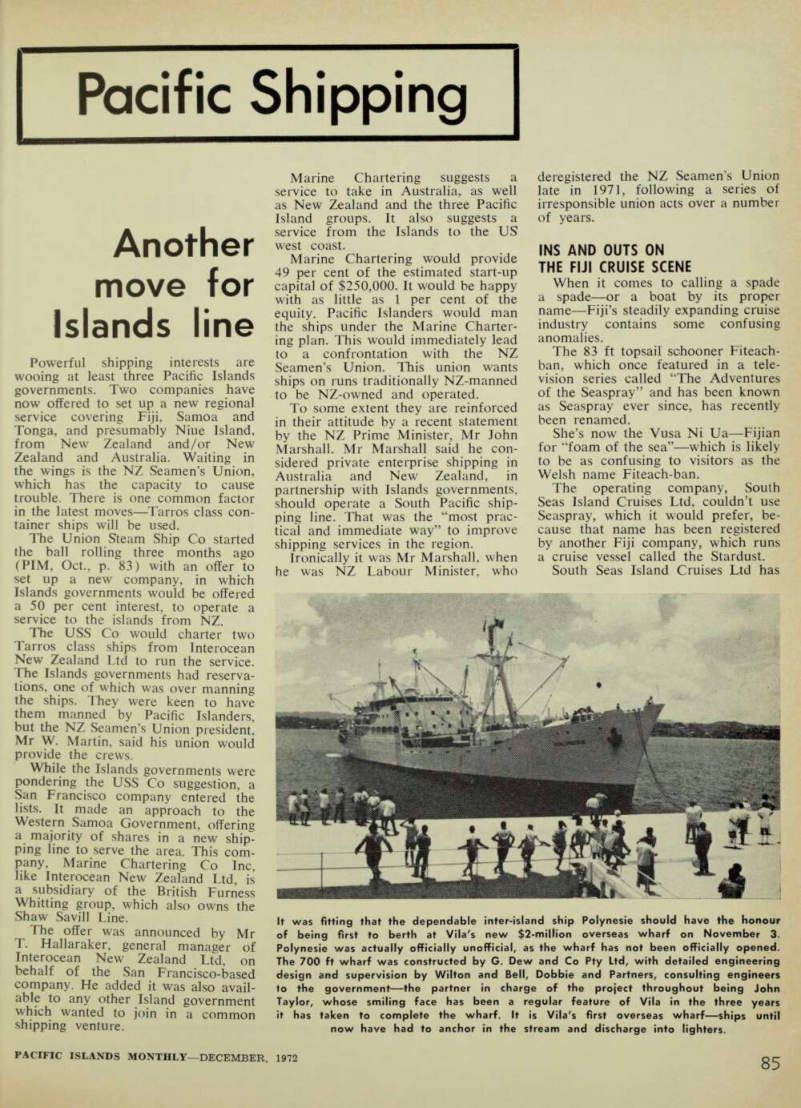
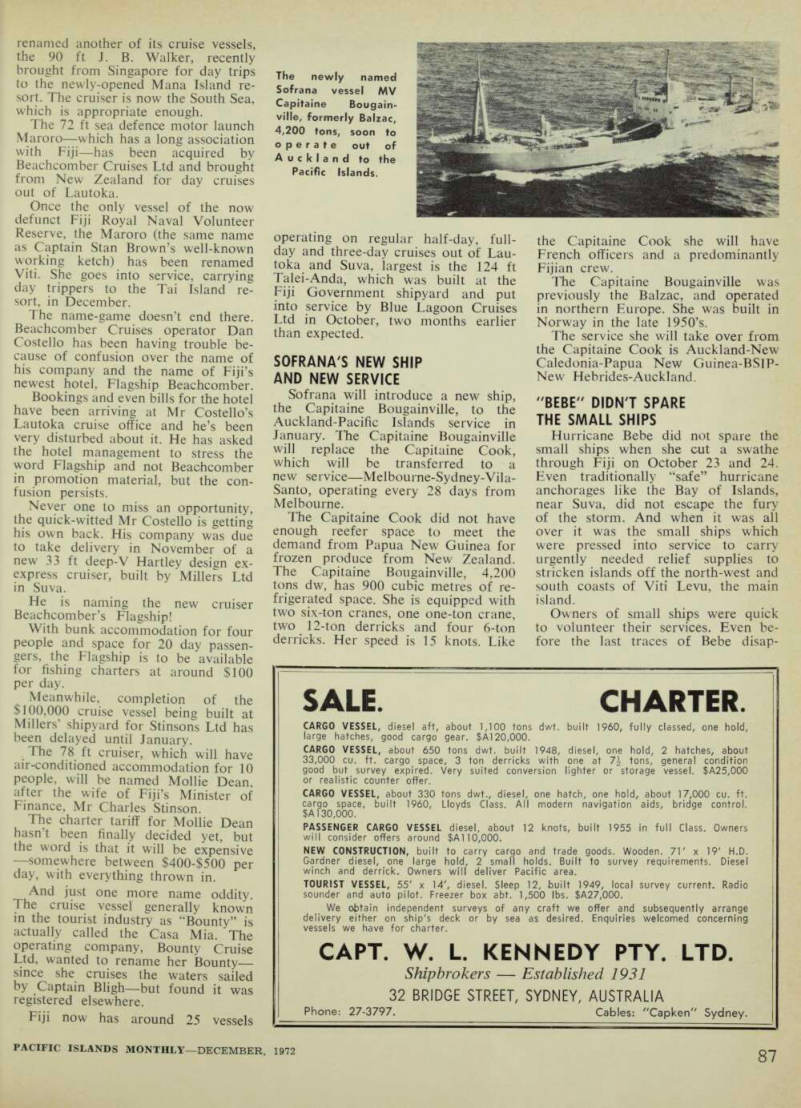
Another
move tor
Islands line
Powerful shipping interests are wooing at least three Pacific Islands governments. Two companies have now offered to set up a new regional service covering Fiji, Samoa and Tonga, and presumably Niue Island, from New Zealand and/or New Zealand and Australia. Waiting in the wings is the NZ Seamen’s Union, which has the capacity to cause trouble. There is one common factor in the latest moves—Tarros class con tainer ships will be used.
The Union Steam Ship Co started the ball rolling three months ago (PIM, Oct., p. 83) with an offer to set up a new company, in which Islands governments would be offered a 50 per cent interest, to operate a service to the islands from NZ.
The USS Co would charter two Tarros class ships from Interocean New Zealand Ltd to run the service.
The Islands governments had reserva tions, one of which was over manning the ships. They were keen to have them manned by Pacific Islanders, but the NZ Seamen’s Union president, Mr W. Martin, said his union would provide the crews.
While the Islands governments were pondering the USS Co suggestion, a San Francisco company entered the lists. It made an approach to the Western Samoa Government, offering a majority of shares in a new ship ping line to serve the area. This com pany, Marine Chartering Co Inc, like Interocean New Zealand Ltd, is a subsidiary of the British Furness Whitting group, which also owns the Shaw Savill Line.
The offer was announced by Mr T. Hallaraker, general manager of Interocean New Zealand Ltd, on behalf of the San Francisco-based company. He added it was also avail able to any other Island government which wanted to join in a common shipping venture.
Marine Chartering suggests a service to take in Australia, as well as New Zealand and the three Pacific Island groups. It also suggests a service from the Islands to the US west coast.
Marine Chartering would provide 49 per cent of the estimated start-up capital of $250,000. It would be happy with as little as 1 per cent of the equity. Pacific Islanders would man the ships under the Marine Charter ing plan. This would immediately lead to a confrontation with the NZ Seamen’s Union. This union wants ships on runs traditionally NZ-manned to be NZ-owned and operated.
To some extent they are reinforced in their attitude by a recent statement by the NZ Prime Minister, Mr John Marshall. Mr Marshall said he con sidered private enterprise shipping in Australia and New Zealand, in partnership with Islands governments, should operate a South Pacific ship ping line. That was the “most prac tical and immediate way” to improve shipping services in the region.
Ironically it was Mr Marshall, when he was NZ Labour Minister, who
deregistered the NZ Seamen’s Union late in 1971, following a series of irresponsible union acts over a number of years, me amh OUTS ON . ... rp||K r r f r N r ' ,JI LKU,it altiNC When it comes to calling a spade a spade—or a boat by its proper name—Fiji’s steadily expanding cruise industry contains some confusing anomalies.
The 83 ft topsail schooner Fiteach ban, which once featured in a tele vision series called “The Adventures of the Seaspray” and has been known as Seaspray ever since, has recently been renamed.
She’s now the Vusa Ni Ua—Fijian for “foam of the sea”—which is likely to be as confusing to visitors as the Welsh name Fiteach-ban.
The operating company, South Seas Island Cruises Ltd, couldn’t use Seaspray, which it would prefer, be cause that name has been registered by another Fiji company, which runs a cruise vessel called the Stardust, South Seas Island Cruises Ltd has
It was fitting that the dependable inter-island ship Polynesie should have the honour of being first to berth at Vila's new $2-million overseas wharf on November 3.
Polynesie was actually officially unofficial, as the wharf has not been officially opened.
The 700 ft wharf was constructed by G. Dew and Co Pty Ltd, with detailed engineering design and supervision by Wilton and Bell, Dobbie and Partners, consulting engineers to the government —the partner in charge of the project throughout being John Taylor, whose smiling face has been a regular feature of Vila in the three years it has taken to complete the wharf. It is Vila's first overseas wharf —ships until now have had to anchor in the stream and discharge into lighters.
renamed another of its cruise vessels, the 90 ft J. B. Walker, recently brought from Singapore for day trips to the newly-opened Mana Island re sort. The cruiser is now the South Sea, which is appropriate enough.
The 72 ft sea defence motor launch Maroro—which has a long association with Fiji—has been acquired by Beachcomber Cruises Ltd and brought from New Zealand for day cruises out of Lautoka.
Once the only vessel of the now defunct Fiji Royal Naval Volunteer Reserve, the Maroro (the same name as Captain Stan Brown’s well-known working ketch) has been renamed Viti. She goes into service, carrying day trippers to the Tai Island re sort, in December, The name-game doesn’t end there.
Beachcomber Cruises operator Dan Costello has been having trouble be cause of confusion over the name of his company and the name of Fiji’s newest hotel. Flagship Beachcomber.
Bookings and even bills for the hotel have been arriving at Mr Costello’s Lautoka cruise office and he’s been very disturbed about it. He has asked the hotel management to stress the word Flagship and not Beachcomber in promotion material, but the con fusion persists.
Never one to miss an opportunity, the quick-witted Mr Costello is getting his own back. His company was due to take delivery in November of a new 33 ft deep-V Hartley design ex express cruiser, built by Millers Ltd in Suva.
He is naming the new cruiser Beachcomber’s Flagship!
With bunk accommodation for four people and space for 20 day passen gers, the Flagship is to be available for fishing charters at around Sioo per day.
Meanwhile, completion of the $lOO,OOO cruise vessel being built at Millers’ shipyard for Stinsons Ltd has been delayed until January.
The 78 ft cruiser, which will have air-conditioned accommodation for 10 people, will be named Mollie Dean, after the wife of Fiji’s Minister of Finance, Mr Charles Stinson.
The charter tariff for Mollie Dean hasn’t been finally decided yet, but the word is that it will be expensive —somewhere between S4OO-S5OO per day, with everything thrown in.
And just one more name oddity.
The cruise vessel generally known in the tourist industry as “Bounty” is actually called the Casa Mia. The operating company, Bounty Cruise Ltd, wanted to rename her Bounty— since she cruises the waters sailed by Captain Bligh—but found it was registered elsewhere.
Fiji now has around 25 vessels
operating on regular half-day, full day and three-day cruises out of Lau toka and Suva, largest is the 124 ft Talei-Anda, which was built at the Fiji Government shipyard and put into service by Blue Lagoon Cruises Ltd in October, two months earlier than expected,
Sofrana's New Ship
And New Service
Sofrana will introduce a new ship, the Capitaine Bougainville, to the Auckland-Pacific Islands service in January. The Capitaine Bougainville will replace the Capitaine Cook, which will be transferred to a
new service—Melboume-Sydney-Vila-
Santo, operating every 28 days from Melbourne.
The Capitaine Cook did not have enough reefer space to meet the demand from Papua New Guinea for frozen produce from New Zealand.
The Capitaine Bougainville, 4,200 tons dw, has 900 cubic metres of re frigerated space. She is equipped with two six-ton cranes, one one-ton crane, two 12-ton derricks and four 6-ton derricks. Her speed is 15 knots. Like
the Capitaine Cook she will have French officers and a predominantly Fijian crew.
The Capitaine Bougainville was previously the Balzac, and operated in northern Europe. She was built in Norway in the late 1950’5.
The service she will take over from the Capitaine Cook is Auckland-New Caledonia-Papua New Guinea-BSIP- New Hebrides-Auckland.
"Bebe" Didn't Spare
The Small Ships
Hurricane Bebe did not spare the small ships when she cut a swathe through Fiji on October 23 and 24.
Even traditionally “safe” hurricane anchorages like the Bay of Islands, near Suva, did not escape the fury of the storm. And when it was all over it was the small ships which were pressed into service to carry urgently needed relief supplies to stricken islands off the north-west and south coasts of Viti Levu, the main island.
Owners of small ships were quick to volunteer their services. Even be fore the last traces of Bebe disap
The newly named Sofrana vessel MV Capitaine Bougain ville, formerly Balzac, 4,200 tons, soon to operate out of Auckland to the Pacific Islands.
peared, members of the Royal Suva Yacht Club were plying their craft up the flooded Rewa River, and in the Rewa delta, offering whatever help might be needed.
The adventures of four small shrimping vessels, on their way from Mexico to southern India, were hard to beat. They lost sight of each other in Fiji waters, scraped over reefs, two of them going aground, before the other two groped their way to Suva.
These ships were the Tata Siddhi and Tata Jyoti, both owned by Tata Oil Mills, a subsidiary of the vast Tata complex of India, and Ave Maria I and Ave Maria 11, owned by Esmeralda Fernando of Quilton, Cochin.
The Tata Siddhi, after narrowly missing a manned lighthouse at Wai lagilala, in the north of Fiji, drove ashore on a reef. The Tata Jyoti hit Nasilai Reef, about 20 miles north east of Suva. The Fiji Government’s Degei picked up the crew of the Tata Siddhi, The ship itself was a wreck.
The crew of the Tata Jyoti took to the lifeboats and rowed out to a pas sing ship, the Canterbury Star, which took them to Levuka.
The Ave Maria I and Ave Maria II drifted for two days in the storm before making Suva.
The Nam Hae 278, a Korean fishing vessel, was driven aground at Biunika, about three miles south of Levuka, At Levuka, the heavy seas tore away parts of the decking of the small ships’ wharf.
In Suva, four ships at the Kings Wharf, rode out the storm the hard way, doubling their anchors.
In the Bay of Islands, Captain Stan Brown’s auxiliary ketch, Maroro, was driven aground, but not holed.
The tourist cruise boat Sayandra, also sheltering in the Bay of Islands, was driven ashore, and was refloated later.
Offers of ships to help alleviate distress were made immediately Bebe passed. The Carpenter group put two ships at the disposal of the govern ment. These were the Ai Sokula, which made a run to Rotuma, and the Komaiwai, which took supplies to Kadavu, Carpenters met the cost of the voyages.
Blue Lagoon Cruises, operating from Lautoka, offered the use of the Lycianda and the Taleianda. Both these ships took supplies to the Yasa was. Also taking supplies and water out from Lautoka were three govern ment ships, Rogovoka, Gonedau and Agnes. Lautoka businessman, Mr Dan Costello, was another to offer the use of a cruise vessel, the Ratu Buluma kau.
In the Ellice Islands at Funafuti, which was first hit by Bebe, two fishing boats were sunk, and the mother ship, Van Camp 1, was washed onto a reef and heavily damaged. The three ships were on a skipjack tuna research mission. The crews were Koreans and Okinawans.
Shipping Briefs
• Admiralty charts of Fairway Reef, west of New Caledonia, were strongly criticised, following the recent rescue of 17 survivors of a Nationalist Chinese fishing boat off the reef. Captain H. C. Walker, master of the P & O freighter Zaida, who rescued the men, said “soundings in the area bear no relation to the ones of the Admiralty chart and were alarming”. • The Levuka-based Neptune 1. which went aground on a reef near Noumea on October 15, may be abandoned. She is in such a position that a salvage vessel would find it difficult to get near. The steel-hulled Neptune 1 is owned by the Pacific Fishing Co. She arrived in Fiji about three years ago.
• The harbour entrance at Taunganui Landing, Mauke, Cook Islands, is finished. The inner harbour is now being deepened. Work on the landing and the approach to the harbour, including construction of retaining walls and the wharf, is in progress. • Next move to establish a regular shipping service from Sydney to Norfolk and Lord Howe Islands rests with the promoters in Norfolk Island. Their Sydney agent Hethering ton Kingsbury Pty Ltd, is watching the market for a suitable vessel, and if anything offers, it will investigate and report to the promoters. But, before a ship can be bought, a com pany will have to be formed, and the necessary capital raised. • The people of Labasa, Fiji, are unhappy about the state of the local wharf. Supported by their local council, they say it is inadequate the volume of traffic which passes over it. They complain that ap proaches to the government have been abortive. Conditions would im prove if Labasa were declared a port of entry. The wharf caters only for local ships. Overseas vessels calling at Labasa for timber and sugar load by lighter at Malau near the mouth of the Labasa River.
Advertisements & other items, pp. 88-91 (1 item)
N.Q.E.A
SHIPBUILDERS - SHIPREPAIRERS
SLIPWAY OPERATORS
Slipway Capacities: 30 ft. x 25 ton 60 ft. x 50 ton 200 ft. x 1,000 ton Slipway Facilities: Shore Power—Compressed Air— Fresh Water—Fire Fighting Equipment—General Amenities.
SHIPS REPAIRED FROM NEW GUINEA:
FRISIA" (REBUILT AFTER FIRE); "KUANUA" (GENERAL SURVEY REPAIRS); "CORAL QUEEN" (LENGTHENED BY 30 FEET).
DESIGNERS OF COASTAL CARGO BARGES—FLOATING CRANES-
FLAT TOP PONTOONS.
STRUCTURAL - MECHANICAL - MARINE ENGINEERS
Modern heavy duty machine shop—large fabricating shops served by eight overhead gantry cranes covering 10 acres with a workforce of 350.
Design and fabrication of large steel buildings—mill, mining and bulk handling equipment—machinery installation.
NORTH QUEENSLAND ENGINEERS & AGENTS
BUCHAN STREET, CAIRNS, QUEENSLAND 4870, AUSTRALIA.
PHONE: 51-1600 (5 LINES). P.O. BOX 1105. TELEGRAPHIC ADDRESS: N.Q.E.A. CAIRNS.
SALE.
CHARTER.
CARGO VESSEL, diesel aft, about 1,100 tons dwt. built 1960, fully classed, one hold, large hatches, good cargo gear. $A120,000.
CARGO VESSEL, about 650 tons dwt. built 1948, diesel, one hold, 2 hatches, about 33,000 cu. ft. cargo space, 3 ton derricks with one at tons, general condition good but survey expired. Very suited conversion lighter or storage vessel. $A25,000 or realistic counter offer.
CARGO VESSEL, about 330 tons dwt., diesel, one hatch, one hold, about 17,000 cu. ft. cargo space, built 1960, Lloyds Class. All modern navigation aids, bridge control. $A 130,000.
PASSENGER CARGO VESSEL diesel, about 12 knots, built 1955 in full Class. Owners will consider offers around SAIIO,OOO.
NEW CONSTRUCTION, built to carry cargo and trade goods. Wooden. 71' x 19' H.D.
Gardner diesel, one large hold, 2 small holds. Built to survey requirements. Diesel winch and derrick. Owners will deliver Pacific area.
TOURIST VESSEL, 55' x 14', diesel. Sleep 12, built 1949, local survey current. Radio sounder and auto pilot. Freezer box abt. 1,500 lbs. $A27,000.
We obtain independent surveys of any craft we offer and subsequently arrange delivery either on ship's deck or by sea as desired. Enquiries welcomed concerning vessels we have for charter.
CART. W. L. KENNEDY PTY. LTD.
Shipbrokers Established 1931
32 BRIDGE STREET, SYDNEY, AUSTRALIA
Phone: 27-3797.
Cables: "Capken" Sydney.
1 Newage BMC marine engines are economical, rugged, reliable and virtually unbreakable. But if something should go wrong, it’s good if/ JB|£ to know you can get any part quickly— ft , from Lars Halvorsen.
Lars Halvorsen are C sole East Coast dis- a if* tributors for New- MSSmy age BMC, and to Bj|L fjT them, after sales service is a big thing. When you buy Newage I BMC you don’t buy worries in the unlikely event of a breakdown all you need do Is make one phone call for spare parts, to Lars Halvorsen. Dealer enquiries Invited C i
VEDETTE PETROL 24 BHP
CAPTAIN DIESEL. 38 BHP
COMMANDER
DIESEL 65 BHP
COMMODORE
DIESEL 70 BHP
SEALORD
5*7 DIESEL. . 100 BHP
HR
SONS
PTY. LTD.
Waterview Street, Ryde 80 0251
Telegrams: “Halvorsens”, Sydney
Builders of Halvorsen Boats Ul/IS7t/7t
I u.
=sfe
r*
Fibreglass Islander 43' and Karitane 29'
especially designed for tropical conditions
Satisfied Customers in the whole of the South Pacific have proven the suitability of “Islander 43” and “Karitane 29” for tropical conditions.
Their fibreglass construction is highly resistant to weathering, rot, corrosion, marine organisms etc., and is easy to clean. Both boats are built to a Lloyds moulding specification. The construction is heavy duty fibreglass laminate equal in strength to an equivalent steel boat.
ISLANDER 43
Length: 42ft. 6in. Beam: 12ft.
Draught: sft. Displacement 16 tons.
KARITANE 29
Length: 29ft. Beam; 9ft.
Draught: 2ft, Tin.
Displacement 4j tons.
For further information (including lines drawings) contact:
GEORGE & ASHTON
P.O. Box 2056, South Dunedin, New Zealand. Phones 54-108 & 54-109 or George & Ashton (P. 1.) Ltd., Suva, Fiji. P.O. Box 296. Phone 26-249.
MORE PORTS / MORE OFTEN
with
KARLANDER NEW GUINEA LINE: Serving; Pt. Moresby, Samarai, Lae, Madang, Rabaul, Wewak, Manus Is., Kieta, Honiara, Yandina, Gizo, Vila, Norfolk Is., and Lord Howe Is.
KARLANDER KANGAROO LINE: Serving; Los Angeles, San Francisco, Auckland, Melbourne, Suva, Lautoka.
AUSTRALIAN TERRITORY LINER SERVICES: Serving, Melbourne,
Sydney, Newcastle, Brisbane, Weipa, Gove, Thursday Is.
Managing Agents
KARLANDER (AUSTRALIA) PTY. LIMITED
19-31 Pitt Street, Sydney
General Agents
Brisbane: F. H. Stephens Pty. Ltd.
Melbourne: F. H. Stephens (Vic.) Pty. Ltd.
Pt. Moresby: Carpenter Shipping Agencies.
Samarai: Burns Philp (N.G.) Ltd.
San Francisco: Transpacific Transportation Co.
Los Angeles: Transpacific Transportation Co.
Madang: B. J. Back Pty. Ltd.
Yandina: Levers Pacific Plantations Co. Ltd.
Santo: Burns Philp (N.H.) Ltd.
Lord Howe Is.; R. Wilson, Leanda Lei.
Thursday Is.: Torres Industries Ltd.
Manus Is.: Edgell & Whiteley Ltd.
Rabaul: Rabaul Trading Co. Ltd.
Honiara: E. V. Lawson Pty. Ltd.
Kieta: Breckwoldt & Co. Pty. Ltd.
Lae: N.G.G. Trading Company.
Wewak; Burns Philp (N.G.) Ltd.
Fiji: Burns Philp (S.S.) Ltd.
Gizo: British Solomon Trading Co.
Vila: Burns Philp (N.H.) Ltd.
Norfolk Is.: Burns Philp (S.S.) Ltd.
Cruising
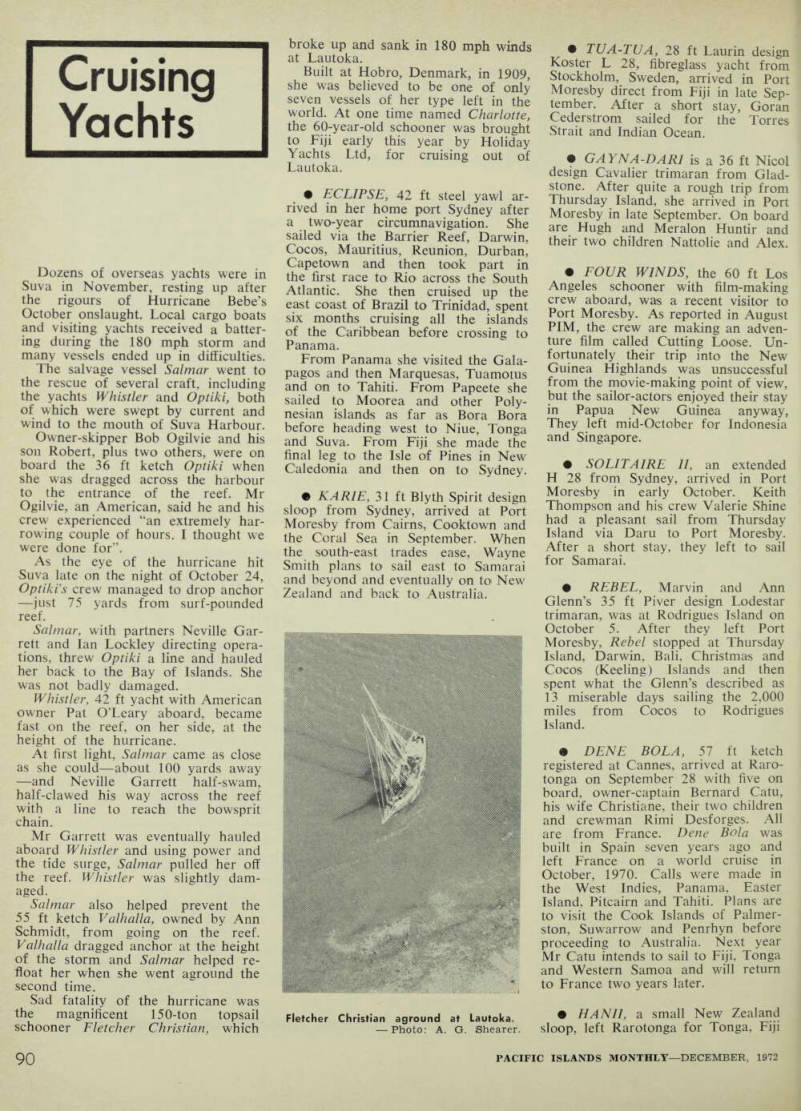
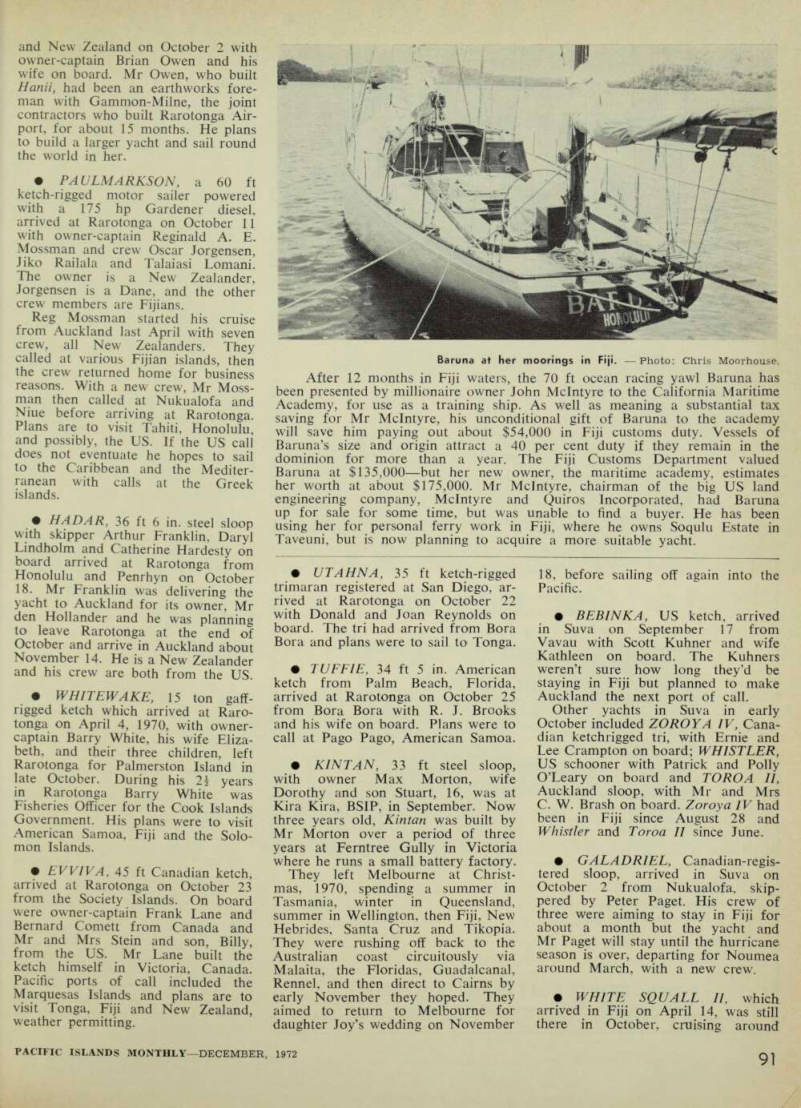
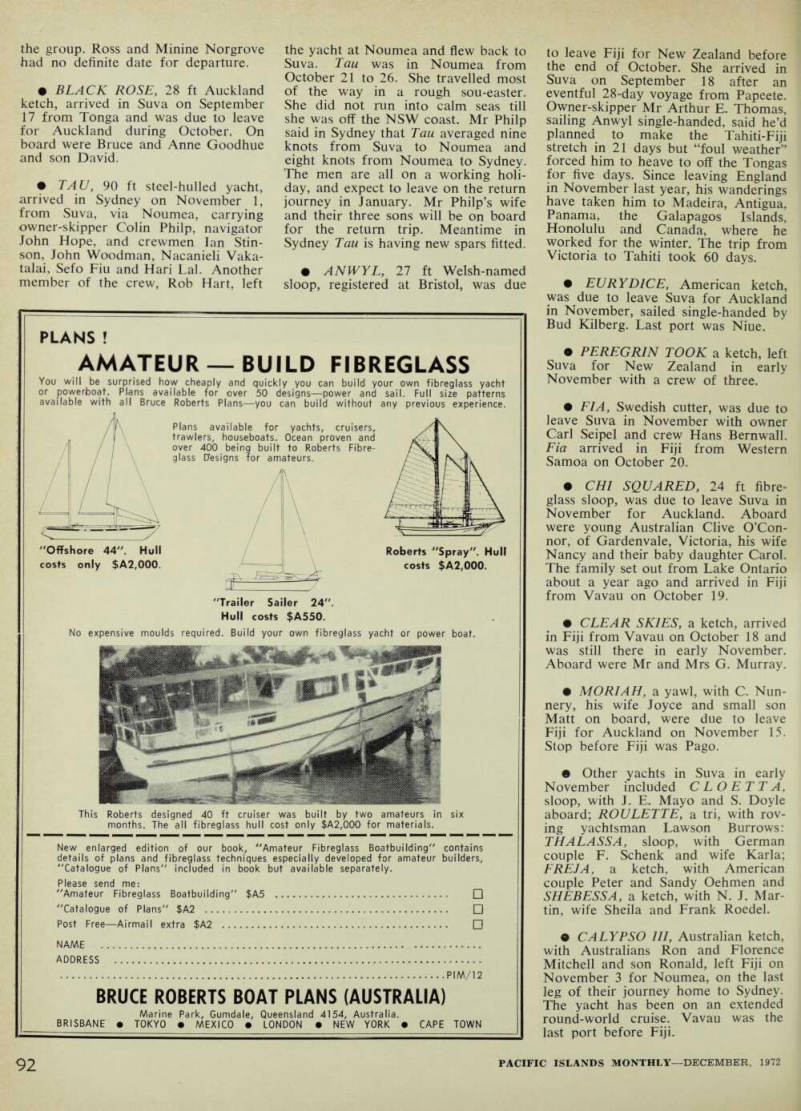
Yachts
Dozens of overseas yachts were in Suva in November, resting up after the rigours of Hurricane Bebe’s October onslaught. Local cargo boats and visiting yachts received a batter ing during the 180 mph storm and many vessels ended up in difficulties.
The salvage vessel Salmar went to the rescue of several craft, including the yachts Whistler and Optiki, both of which were swept by current and wind to the mouth of Suva Harbour.
Owner-skipper Bob Ogilvie and his son Robert, plus two others, were on board the 36 ft ketch Optiki when she was dragged across the harbour to the entrance of the reef. Mr Ogilvie, an American, said he and his crew experienced “an extremely har rowing couple of hours. I thought we were done for”.
As the eye of the hurricane hit Suva late on the night of October 24, Optiki’s crew managed to drop anchor —just 75 yards from surf-pounded reef.
Salmar, with partners Neville Gar rett and lan Lockley directing opera tions, threw Optiki a line and hauled her back to the Bay of Islands. She was not badly damaged.
Whistler, 42 ft yacht with American owner Pat O’Leary aboard, became fast on the reef, on her side, at the height of the hurricane.
At first light, Salmar came as close as she could—about 100 yards away —and Neville Garrett half-swam, half-clawed his way across the reef with a line to reach the bowsprit chain.
Mr Garrett was eventually hauled aboard Whistler and using power and the tide surge, Salmar pulled her off the reef. Whistler was slightly dam aged.
Salmar also helped prevent the 55 ft ketch Valhalla, owned by Ann Schmidt, from going on the reef.
Valhalla dragged anchor at the height of the storm and Salmar helped re float her when she went aground the second time.
Sad fatality of the hurricane was the magnificent 150-ton topsail schooner Fletcher Christian, which
broke up and sank in 180 mph winds at Lautoka.
Built at Hobro, Denmark, in 1909, she was believed to be one of only seven vessels of her type left in the world. At one time named Charlotte, the 60-year-old schooner was brought to Fiji early this year by Holiday Yachts Ltd, for cruising out of Lautoka. • ECLIPSE, 42 ft steel yawl ar rived in her home port Sydney after a two-year circumnavigation. She sailed via the Barrier Reef, Darwin, Cocos, Mauritius, Reunion, Durban, Capetown and then took part in the first race to Rio across the South Atlantic. She then cruised up the east coast of Brazil to Trinidad, spent six months cruising all the islands of the Caribbean before crossing to Panama.
From Panama she visited the Gala pagos and then Marquesas, Tuamotus and on to Tahiti. From Papeete she sailed to Moorea and other Poly nesian islands as far as Bora Bora before heading west to Niue, Tonga and Suva. From Fiji she made the final leg to the Isle of Pines in New Caledonia and then on to Sydney. • KARIE, 31 ft Blyth Spirit design sloop from Sydney, arrived at Port Moresby from Cairns, Cooktown and the Coral Sea in September. When the south-east trades ease, Wayne Smith plans to sail east to Samarai and beyond and eventually on to New Zealand and back to Australia.
• TUA-TUA, 28 ft Laurin design Koster L 28, fibreglass yacht from Stockholm, Sweden, arrived in Port Moresby direct from Fiji in late Sep tember. After a short stay, Goran Cederstrom sailed for the Torres Strait and Indian Ocean. • GAYNA-DARI is a 36 ft Nicol design Cavalier trimaran from Glad stone. After quite a rough trip from Thursday Island, she arrived in Port Moresby in late September. On board are Hugh and Meralon Huntir and their two children Nattolie and Alex. • FOUR WINDS, the 60 ft Los Angeles schooner with film-making crew aboard, was a recent visitor to Port Moresby. As reported in August PIM, the crew are making an adven ture film called Cutting Loose. Un fortunately their trip into the New Guinea Highlands was unsuccessful from the movie-making point of view, but the sailor-actors enjoyed their stay in Papua New Guinea anyway, They left mid-October for Indonesia and Singapore. • SOLITAIRE 11, an extended H 28 from Sydney, arrived in Port Moresby in early October. Keith Thompson and his crew Valerie Shine had a pleasant sail from Thursday Island via Daru to Port Moresby.
After a short stay, they left to sail for Samarai. • REBEL, Marvin and Ann Glenn’s 35 ft Piver design Lodestar trimaran, was at Rodrigues Island on October 5. After they left Port Moresby, Rebel stopped at Thursday Island, Darwin, Bali, Christmas and Cocos (Keeling) Islands and then spent what the Glenn’s described as 13 miserable days sailing the 2,000 miles from Cocos to Rodrigues Island. « DENE BOLA, 57 ft ketch registered at Cannes, arrived at Raro tonga on September 28 with five on board, owner-captain Bernard Catu, his wife Christiane, their two> children and crewman Rimi Desforges. All are from France. Dene Bola was built in Spain seven years ago and left France on a world cruise in October, 1970. Calls were made in the West Indies, Panama, Easter Island, Pitcairn and Tahiti. Plans are to visit the Cook Islands of Palmer ston, Suwarrow and Penrhyn before proceeding to Australia. Next year Mr Catu intends to sail to Fiji, Tonga and Western Samoa and will return to France two years later. e HAN 11, a small New Zealand sloop, left Rarotonga for Tonga, Fiji
Fletcher Christian aground at Lautoka. -Photo: A. G. Shearer.
and New Zealand on October 2 with owner-captain Brian Owen and his wife on board. Mr Owen, who built Hanii, had been an earthworks fore man with Gammon-Milne, the joint contractors who built Rarotonga Air port, for about 15 months. He plans to build a larger yacht and sail round the world in her.
• Paulmarkson, A 60 Ft
ketch-rigged motor sailer powered with a 175 hp Gardener diesel, arrived at Rarotonga on October 11 with owner-captain Reginald A. E.
Mossman and crew Oscar Jorgensen, Jiko Railala and Talaiasi Lomani.
The owner is a New Zealander, Jorgensen is a Dane, and the other crew members are Fijians.
Reg Mossman started his cruise from Auckland last April with seven crew, all New Zealanders. They called at various Fijian islands, then the crew returned home for business reasons. With a new crew, Mr Moss man then called at Nukualofa and Niue before arriving at Rarotonga.
Plans are to visit Tahiti, Honolulu, and possibly, the US. If the US call does not eventuate he hopes to sail to the Caribbean and the Mediter ranean with calls at the Greek islands. • HADAR, 36 ft 6 in. steel sloop with skipper Arthur Franklin, Daryl Lindholm and Catherine Hardesty on board arrived at Rarotonga from Honolulu and Penrhyn on October 18. Mr Franklin was delivering the yacht to Auckland for its owner, Mr den Hollander and he was planning to leave Rarotonga at the end of October and arrive in Auckland about November 14. He is a New Zealander and his crew are both from the US. • WHITEWAKE, 15 ton gaff rigged ketch which arrived at Raro tonga on April 4, 1970, with owner captain Barry White, his wife Eliza beth, and their three children, left Rarotonga for Palmerston Island in late October. During his 2J years in Rarotonga Barry White was Fisheries Officer for the Cook Islands Government. His plans were to visit American Samoa, Fiji and the Solo mon Islands. • EVVIVA, 45 ft Canadian ketch, arrived at Rarotonga on October 23 from the Society Islands. On board were owner-captain Frank Lane and Bernard Cornett from Canada and Mr and Mrs Stein and son, Billy, from the US. Mr Lane built the ketch himself in Victoria, Canada.
Pacific ports of call included the Marquesas Islands and plans are to visit Tonga, Fiji and New Zealand, weather permitting.
After 12 months in Fiji waters, the 70 ft ocean racing yawl Baruna has been presented by millionaire owner John Mclntyre to the California Maritime Academy, for use as a training ship. As well as meaning a substantial tax saving for Mr Mclntyre, his unconditional gift of Baruna to the academy will save him paying out about $54,000 in Fiji customs duty. Vessels of Banina’s size and origin attract a 40 per cent duty if they remain in the dominion for more than a year. The Fiji Customs Department valued Baruna at $135,000 —but her new owner, the maritime academy, estimates her worth at about $175,000. Mr Mclntyre, chairman of the big US land engineering company, Mclntyre and Quiros Incorporated, had Baruna up for sale for some time, but was unable to find a buyer. He has been using her for personal ferry work in Fiji, where he owns Soqulu Estate in Taveuni, but is now planning to acquire a more suitable yacht.
• UTAHN A, 35 ft ketch-rigged trimaran registered at San Diego, ar rived at Rarotonga on October 22 with Donald and Joan Reynolds on board. The tri had arrived from Bora Bora and plans were to sail to Tonga. • TUFFIE, 34 ft 5 in. American ketch from Palm Beach, Florida, arrived at Rarotonga on October 25 from Bora Bora with R. J. Brooks and his wife on board. Plans were to call at Pago Pago, American Samoa. • KINTAN, 33 ft steel sloop, with owner Max Morton, wife Dorothy and son Stuart, 16, was at Kira Kira, BSIP, in September, Now three years old, Kintan was built by Mr Morton over a period of three years at Ferntree Gully in Victoria where he runs a small battery factory.
They left Melbourne at Christ mas, 1970, spending a summer in Tasmania, winter in Queensland, summer in Wellington, then Fiji, New Hebrides, Santa Cruz and Tikopia.
They were rushing off back to the Australian coast circuitously via Malaita, the Floridas, Guadalcanal, Rennel, and then direct to Cairns by early November they hoped. They aimed to return to Melbourne for daughter Joy’s wedding on November
18, before sailing off again into the Pacific. • BEBINKA, US ketch, arrived in Suva on September 17 from Vavau with Scott Kuhner and wife Kathleen on board. The Kuhners weren’t sure how long they’d be staying in Fiji but planned to make Auckland the next port of call.
Other yachts in Suva in early October included ZOROYA IV, Cana dian ketchrigged tri, with Ernie and Lee Crampton on board; WHISTLER, US schooner with Patrick and Polly O’Leary on board and TOROA 11, Auckland sloop, with Mr and Mrs C. W. Brash on board. Zoroya IV had been in Fiji since August 28 and Whistler and Toroa II since June. • GALADRIEL, Canadian-regis tered sloop, arrived in Suva on October 2 from Nukualofa, skip pered by Peter Paget. His crew of three were aiming to stay in Fiji for about a month but the yacht and Mr Paget will stay until the hurricane season is over, departing for Noumea around March, with a new crew. • WHITE SQUALL 11, which arrived in Fiji on April 14, was still there in October, cruising around
Baruna at her moorings in Fiji. — Photo: Chris Moorhouse.
the group. Ross and Minine Norgrove had no definite date for departure. • BLACK ROSE, 28 ft Auckland ketch, arrived in Suva on September 17 from Tonga and was due to leave for Auckland during October. On board were Bruce and Anne Goodhue and son David. • TAU, 90 ft steel-hulled yacht, arrived in Sydney on November 1, from Suva, via Noumea, carrying owner-skipper Colin Philp, navigator John Hope, and crewmen lan Stinson, John Woodman, Nacanieli Vaka talai, Sefo Fiu and Had Lai. Another member of the crew, Rob Hart, left
the yacht at Noumea and flew back to Suva. Tau was in Noumea from October 21 to 26. She travelled most of the way in a rough sou-easter.
She did not run into calm seas till she was off the NSW coast. Mr Philp said in Sydney that Tau averaged nine knots from Suva to Noumea and eight knots from Noumea to Sydney.
The men are all on a working holi day, and expect to leave on the return journey in January. Mr Philp’s wife and their three sons will be on board for the return trip. Meantime in Sydney Tau is having new spars fitted, • ANWYL, 27 ft Welsh-named sloop, registered at Bristol, was due
to leave Fiji for New Zealand before the end of October. She arrived in Suva on September 18 after an eventful 28-day voyage from Papeete.
Owner-skipper Mr Arthur E. Thomas, sailing Anwyl single-handed, said he’d planned to make the Tahiti-Fiji stretch in 21 days but “foul weather” forced him to heave to off the Tongas for five days. Since leaving England in November last year, his wanderings have taken him to Madeira, Antigua, Panama, the Galapagos Islands, Honolulu and Canada, where he worked for the winter. The trip from Victoria to Tahiti took 60 days. • EURYDICE, American ketch, was due to leave Suva for Auckland in November, sailed single-handed by Bud Kilberg. Last port was Niue. • PEREGRIN TOOK a ketch, left Suva for New Zealand in early November with a crew of three. • FIA, Swedish cutter, was due to leave Suva in November with owner Carl Seipel and crew Hans Bernwall.
Fia arrived in Fiji from Western Samoa on October 20. • CHI SQUARED, 24 ft fibre glass sloop, was due to leave Suva in November for Auckland. Aboard were young Australian Clive O’Con nor, of Gardenvale, Victoria, his wife Nancy and their baby daughter Carol.
The family set out from Lake Ontario about a year ago and arrived in Fiji from Vavau on October 19. • CLEAR SKIES, a ketch, arrived in Fiji from Vavau on October 18 and was still there in early November.
Aboard were Mr and Mrs G. Murray. • MORIAH, a yawl, with C. Nun nery, his wife Joyce and small son Matt on board, were due to leave Fiji for Auckland on November 15.
Stop before Fiji was Pago. • Other yachts in Suva in early November included CLOE T T A, sloop, with J. E. Mayo and S. Doyle aboard; ROULETTE, a tri, with rov ing yachtsman Lawson Burrows: THALASSA, sloop, with German couple F. Schenk and wife Karla; FREJA, a ketch, with American couple Peter and Sandy Oehmen and SHEBESSA, a ketch, with N. J. Mar tin, wife Sheila and Frank Roedel.
O CALYPSO HI, Australian ketch, with Australians Ron and Florence Mitchell and son Ronald, left Fiji on November 3 for Noumea, on the last leg of their journey home to Sydney.
The yacht has been on an extended round-world cruise. Vavau was the last port before Fiji.
Advertisements & other items, pp. 94-98 (1 item)
Amateur —Build Fibreglass
PLANS !
You will be surprised how cheaply and quickly you can build your own fibreglass yacht or powerboat. Plans available for over 50 designs—power and sail. Full size patterns available with all Bruce Roberts Plans—you can build without any previous experience.
"Trailer Sailer 24".
Hull costs SASSO.
No expensive moulds required. Build your own fibreglass yacht or power boat.
This Roberts designed 40 ft cruiser was built by two amateurs in six months. The all fibreglass hull cost only $A2,000 for materials.
New enlarged edition of our book, "Amateur Fibreglass Boatbuilding" contains details of plans and fibreglass techniques especially developed for amateur builders, "Catalogue of Plans" included in book but available separately.
Please send me: "Amateur Fibreglass Boatbuilding" SAS □ "Catalogue of Plans" SA2 □ Post Free—Airmail extra SA2 □ Marine Park, Gumdale, Queensland 4154, Australia.
BRISBANE • TOKYO • MEXICO • LONDON • NEW YORK • CAPE TOWN Plans available for yachts, cruisers, trawlers, houseboats. Ocean proven and over 400 being built to Roberts Fibreglass Designs for amateurs.
"Offshore 44". Hull costs only $A2,000.
Roberts "Spray". Hull costs $A2,000.
NAME
ADDRESS
PIM/12
BRUCE ROBERTS BOAT PLANS (AUSTRALIA)
MazdaBoB isT
ft % e mm m >.s I ■ ■ **■ . mm ■■ ■ ; Who says family motoring can’t be fun?
Meet the Mazda 808 sedan.
It is lavish glamour you can afford.
Along with its fine finish, you get high back front bucket seats that lay way back. And women, children and men appreciate the four doors with two stage checkers.
Plus the door locks are child-proof.
You also get a lockable gas door, thick foam dash, padded sun visors, door armrests, beautifully recessed instruments and more.
You even get front disc brakes. And the body is of semimonocoque construction with subframes designed for safe controlled-collapse under impact.
What’s more, the spare fits under the trunk so your luggage fits snugly.
Now load up and go. You hug the road with its wide track. And you take the lumps out of bumps thanks to its coil suspension up front and bias-mounted gas-filled shock absorbers in the rear.
And the center console with its 4-speed floor shift gives you more than crafty craftsmanship.
The thrifty but hefty 1300 cc overhead engine gives you the feeling of power.
There you have it. Power, safety, comfortable ride and all the things that make driving fun . . . because our engineers are family men, too.
And if you are not a family man, you can also get a sporty coupe with all of the above.
But that is another story.
Meet the Mazda 808 sedan first.
mmzu4
Toyo Kogyo Co . Ltd . Hiroshima. Japan American Samoa/MAX HALECK, INC. Pager p ago . AmencarvSamoa 96920 Fiji Islands/N IRAN JANS AUTOPORT LTD. GP 0 Box 450 Suva Tel 22691 New Caledoma/SOCIETE RIVIERE ET BERNANOS 41 Rue de Sebastopol. Noumea New Guinea/PNG MOTORS LTD. P 0 Box 1 394, Boroko Papua Tel 55788 New Zealand/MAZDA MOTORS OF NEW ZEALAND LIMITED Auckland Western Samoa/H. 8< J RETZLAFF P.O Box 195, Apia Tel 237 "The trade mark MAZDA in this advertisement stands for AUTOMOBILES MAZDA as far as France and her territories are concerned.
KP 5o s
Whm
ITS
'... sfe 000 50! %l i# < * JOOCE wtumuM
2§ KG iff
■ ■ ■ fii • • pRV * “ JeTS 8 -,...,_■ r -- ■ : i * nr « 4 i# ** > >% » V" s
* s^ksssd
the most
BREAD FLOURS: ®
CAKE FLOURS: ®
e
BISCUIT FLOURS: •
SPECIALITY FLOURS: 9
important ingredient
MAINTOP—high protein bread flour ANCHOR—bakers flour • 50/50 MEAL-—brown bread MEDlUM—cake and pastry • SPONGE —sponge cakes SPECIAL CAKE—madeira and cup cakes STRONG —cracker biscuits ® MEDIUM —Shortbreads SOFT —sweet biscuits RYE flour • RYE meal • KIBBLED RYE SHARPS—roti and chapati flour • 100% STONE GROUND
WHOLEMEAL
GILLESPIE BROS. PTY. LTD.
HEAD OFFICE: BRISBANE OFFICE:
52 UNION ST., PYRMONT, SYDNEY, N.S.W. CABLE ADDRESS: ALBION, BRISBANE, QUEENSLAND. (G.P.O. BOX 2518, SYDNEY, 2001.) "GILLESPIE", (P.O. BOX 8, ALBION, BRISBANE, 4010.) PHONE: 660-4933. SYDNEY AND BRISBANE. PHONE: 6-1121.
The
China Navigation Company
was launched on theYangtse
ninety nine years ago
In 1873 the China Navigation Company commenced operations with two paddle steamers, the “Glengyle” and the “Tunsin,” serving the Yangtse River trade.
Today, the China Navigation Company provides
the most extensive network of cargo routes within the area bordered by Japan, Tahiti, New Zealand, Australia and the Malay Peninsula.
The two paddle steamers have been replaced
by twenty-six cargo ships.
The Company’s early dependence on the
Yangtse and the China coast for its living is marked nowadays only by the names of some of its ships . . . traditionally of those towns and provinces in China where the Company grew to its present high standing.
The China Navigation Company—the name that has become synonymous
with experience . . .
reliability . . . speed
. . . service.
For further details and all enquiries there are Agents at the following ports: Melbourne: P. & 0. Lines of Australia Pty. Ltd.
Brisbane: Wills, Gilchrist & Sanderson Pty. Ltd.
Papua and New Guinea: Steamships Trading Co. Ltd., Port Moresby, Samarai, Lae, Madang, Rabaul, Kieta.
Wewak: Kavieng: Burns Philp (New Guinea) Ltd.
Fiji: Morris Hedstrom Ltd., Suva, Lautoka.
Western Samoa: Morris Hedstrom Ltd., Apia.
Tonga: Morris Hedstrom Ltd.
Nukualofa and Vava’u.
Tahiti: Etablissements Donald, Papeete.
Japan: Swire McKinnon, Tokyo, Yokohama, Osaka, Kobe and Nagoya.
Eastern Managers: Butterfield & Swire, 9 Connaught Rd., Central, Hong Kong.
New Caledonia: Etablissements Ballande, Noumea. 8.5.1. P.: British Solomons Trading Co. Ltd., Honiara.
New Hebrides; Les Comptoirs Francais des Nouvelles-Hebrides Vila and Santo. m CN CO
SWIRE & GILCHRIST PTY. LTD.,
General Agents in Australia, 8 Spring Street, Sydney. Phone: 2 0522
THE CHINA NAVIGATION CO LTD
Member of the Swire Group
SGO4I
U 0 (*' ■■ I' : r- -1-1 V\j * ■ * « a
We'd like to take you
back through time
to the stone age
To Papua New Guinea. To the land of primitive rituals, of living legends. To the Islands inhabited by Stone Age people being thrust in one lifetime into the Space Age.
Rough it in untamed jungles. Sleep in an outpost in the wilderness. Tread where no other feet have ever been. See the traditional tribal dances performed as they were many centuries ago.
Or relax in the air-conditioned comfort of your first-class hotel. Laze by the swimming pool. Fly Serving the country-yesterday, today & tomorrow
ANSETT AIRLINES OF PAPUA NEW GUINEA
with us from town to town. And wander dreamily through spectacular landscapes, amidst a profusion of plant and wild life seen nowhere else on earth.
Whatever you do, discover the Past now—before it’s swallowed up by the Present. Discover the most a delightful, fascinating and informative country of the Twentieth Century . . . With us!
ETT
& in conjunction with ANSETT AIRLINES OF AUSTRALIA
APOBI/PIM
News
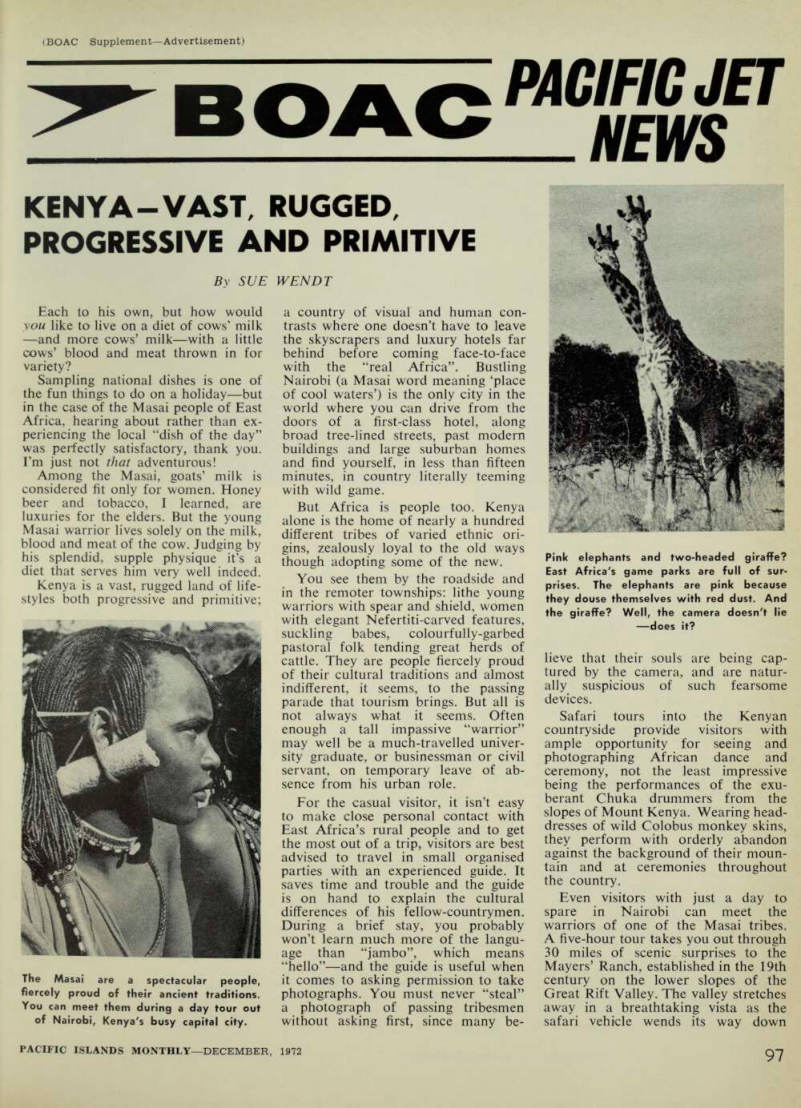
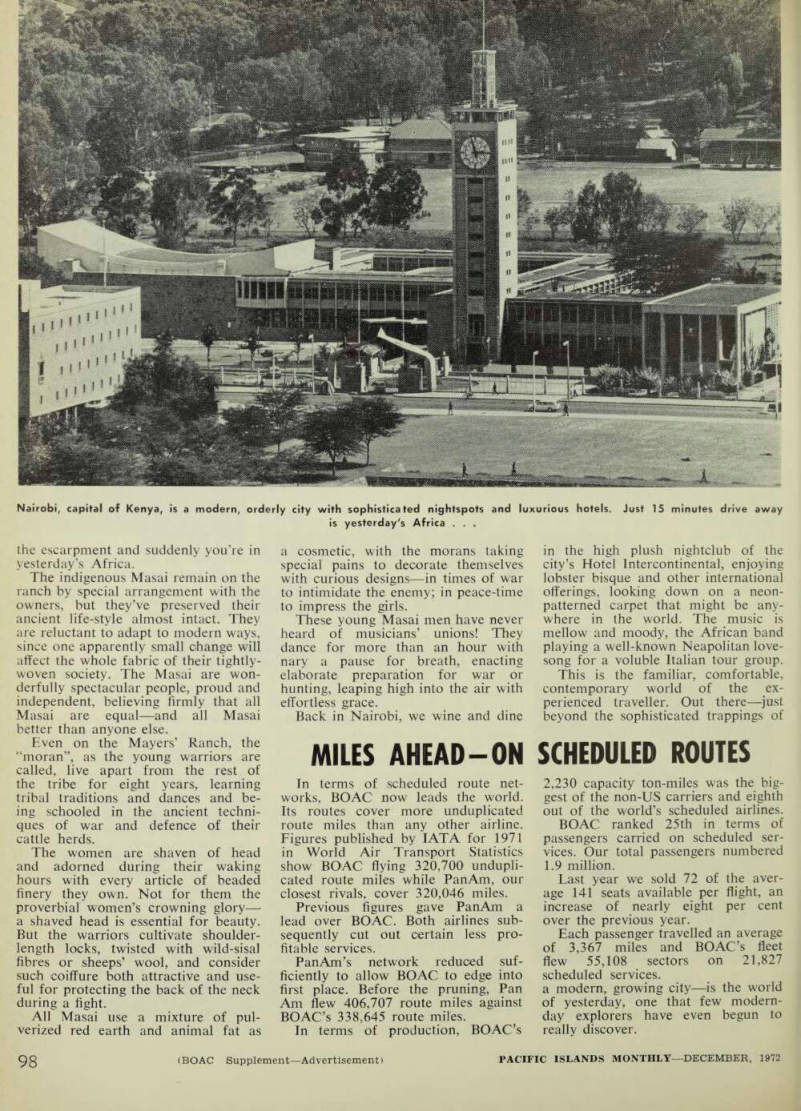
Boac Pacific Jet
Kenya-Vast, Rugged,
Progressive And Primitive
(BOAC Supplement—Advertisement)
By Sue Wendt
Each to his own, but how would you like to live on a diet of cows’ milk —and more cows’ milk—with a little cows’ blood and meat thrown in for variety?
Sampling national dishes is one of the fun things to do on a holiday—but in the case of the Masai people of East Africa, hearing about rather than ex periencing the local “dish of the day” was perfectly satisfactory, thank you.
I’m just not that adventurous!
Among the Masai, goats’ milk is considered fit only for women. Honey beer and tobacco, I learned, are luxuries for the elders. But the young Masai warrior lives solely on the milk, blood and meat of the cow. Judging by his splendid, supple physique it’s a diet that serves him very well indeed.
Kenya is a vast, rugged land of life styles both progressive and primitive;
a country of visual and human con trasts where one doesn’t have to leave the skyscrapers and luxury hotels far behind before coming face-to-face with the “real Africa”. Bustling Nairobi (a Masai word meaning ‘place of cool waters’) is the only city in the world where you can drive from the doors of a first-class hotel, along broad tree-lined streets, past modern buildings and large suburban homes and find yourself, in less than fifteen minutes, in country literally teeming with wild game.
But Africa is people too. Kenya alone is the home of nearly a hundred different tribes of varied ethnic ori gins, zealously loyal to the old ways though adopting some of the new.
You see them by the roadside and in the remoter townships: lithe young warriors with spear and shield, women with elegant Nefertiti-carved features, suckling babes, colourfully-garbed pastoral folk tending great herds of cattle. They are people fiercely proud of their cultural traditions and almost indifferent, it seems, to the passing parade that tourism brings. But all is not always what it seems. Often enough a tall impassive “warrior” may well be a much-travelled univer sity graduate, or businessman or civil servant, on temporary leave of ab sence from his urban role.
For the casual visitor, it isn’t easy to make close personal contact with East Africa’s rural people and to get the most out of a trip, visitors are best advised to travel in small organised parties with an experienced guide. It saves time and trouble and the guide is on hand to explain the cultural differences of his fellow-countrymen.
During a brief stay, you probably won’t learn much more of the langu age than “jambo”, which means “hello”—and the guide is useful when it comes to asking permission to take photographs. You must never “steal” a photograph of passing tribesmen without asking first, since many be-
lieve that their souls are being cap tured by the camera, and are natur ally suspicious of such fearsome devices.
Safari tours into the Kenyan countryside provide visitors with ample opportunity for seeing and photographing African dance and ceremony, not the least impressive being the performances of the exu berant Chuka drummers from the slopes of Mount Kenya. Wearing head dresses of wild Colobus monkey skins, they perform with orderly abandon against the background of their moun tain and at ceremonies throughout the country.
Even visitors with just a day to spare in Nairobi can meet the warriors of one of the Masai tribes.
A five-hour tour takes you out through 30 miles of scenic surprises to the Mayers’ Ranch, established in the 19th century on the lower slopes of the Great Rift Valley. The valley stretches away in a breathtaking vista as the safari vehicle wends its way down
The Masai are a spectacular people, fiercely proud of their ancient traditions.
You can meet them during a day tour out of Nairobi, Kenya's busy capital city.
Pink elephants and two-headed giraffe?
East Africa's game parks are full of sur prises. The elephants are pink because they douse themselves with red dust. And the giraffe? Well, the camera doesn't lie —does it?
the escarpment and suddenly you’re in yesterday’s Africa.
The indigenous Masai remain on the ranch by special arrangement with the owners, but they’ve preserved their ancient life-style almost intact. They are reluctant to adapt to modern ways, since one apparently small change will affect the whole fabric of their tightly woven society. The Masai are won derfully spectacular people, proud and independent, believing firmly that all Masai are equal—and all Masai better than anyone else.
Even on the Mayers’ Ranch, the “moran”, as the young warriors are called, live apart from the rest of the tribe for eight years, learning tribal traditions and dances and be ing schooled in the ancient techni ques of war and defence of their cattle herds.
The women are shaven of head and adorned during their waking hours with every article of beaded finery they own. Not for them the proverbial women’s crowning glory— a shaved head is essential for beauty.
But the warriors cultivate shoulder length locks, twisted with wild-sisal fibres or sheeps’ wool, and consider such coiffure both attractive and use ful for protecting the back of the neck during a fight.
All Masai use a mixture of pul verized red earth and animal fat as
a cosmetic, with the morans taking special pains to decorate themselves with curious designs—in times of war to intimidate the enemy; in peace-time to impress the girls.
These young Masai men have never heard of musicians’ unions! They dance for more than an hour with nary a pause for breath, enacting elaborate preparation for war or hunting, leaping high into the air with effortless grace.
Back in Nairobi, we wine and dine
in the high plush nightclub of the city’s Hotel Intercontinental, enjoying lobster bisque and other international offerings, looking down on a neon patterned carpet that might be any where in the world. The music is mellow and moody, the African band playing a well-known Neapolitan love song for a voluble Italian tour group.
This is the familiar, comfortable, contemporary world of the ex perienced traveller. Out there—just beyond the sophisticated trappings of
Nairobi, capital of Kenya, is a modern, orderly city with sophisticated nightspots and luxurious hotels. Just 15 minutes drive away is yesterday's Africa . . .
Miles Ahead-On Scheduled Routes
In terms of scheduled route net works, BOAC now leads the world.
Its routes cover more unduplicated route miles than any other airline.
Figures published by lATA for 1971 in World Air Transport Statistics show BOAC flying 320,700 undupli cated route miles while PanAm, our closest rivals, cover 320,046 miles.
Previous figures gave PanAm a lead over BOAC. Both airlines sub sequently cut out certain less pro fitable services.
Pan Am’s network reduced suf ficiently to allow BOAC to edge into first place. Before the pruning, Pan Am flew 406,707 route miles against BOAC’s 338,645 route miles.
In terms of production, BOAC’s
2,230 capacity ton-miles was the big gest of the non-US carriers and eighth out of the world’s scheduled airlines.
BOAC ranked 25th in terms of passengers carried on scheduled ser vices. Our total passengers numbered 1.9 million.
Last year we sold 72 of the aver age 141 seats available per flight, an increase of nearly eight per cent over the previous year.
Each passenger travelled an average of 3,367 miles and BOAC’s fleet flew 55,108 sectors on 21,827 scheduled services. a modern, growing city—is the world of yesterday, one that few modern day explorers have even begun to really discover.
Strictly For
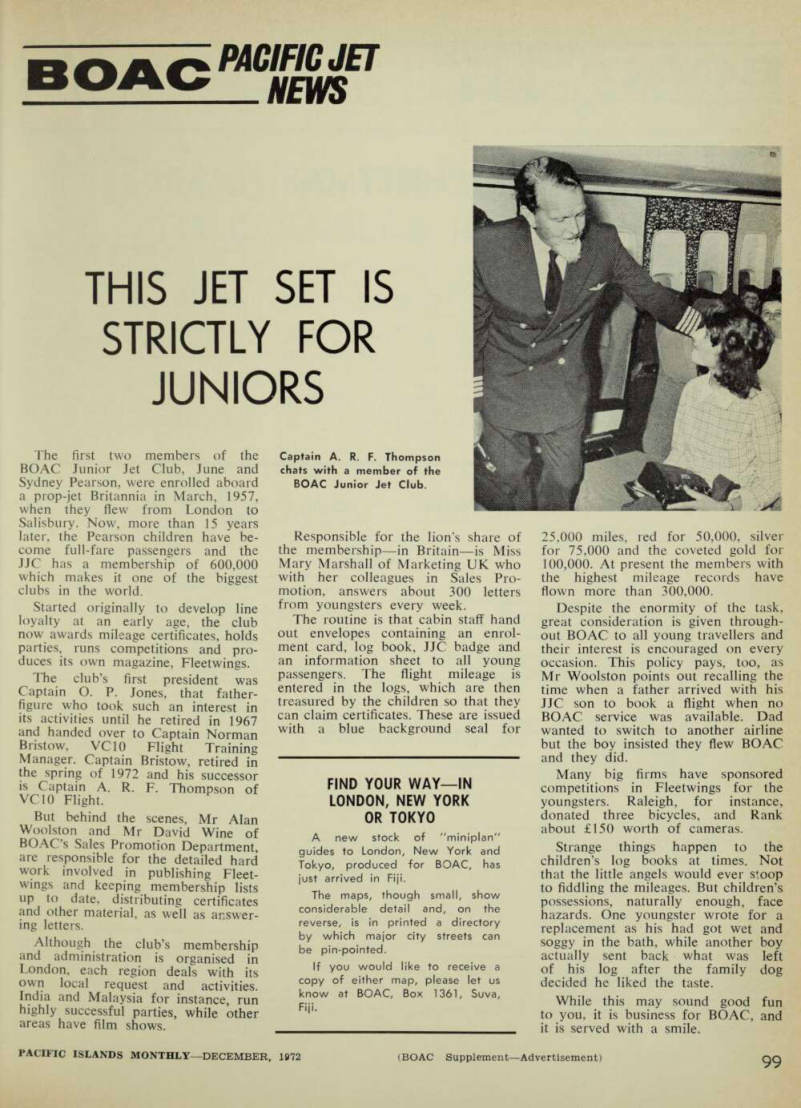
This Jet Set Is
Juniors
The first two members of the BOAC Junior Jet Club, June and Sydney Pearson, were enrolled aboard a prop-jet Britannia in March, 1957, when they flew from London to Salisbury. Now, more than 15 years later, the Pearson children have be come full-fare passengers and the JJC has a membership of 600,000 which makes it one of the biggest clubs in the world.
Started originally to develop line loyalty at an early age, the club now awards mileage certificates, holds parties, runs competitions and pro duces its own magazine, Fleetwings.
The club’s first president was Captain O. P. Jones, that father figure who took such an interest in its activities until he retired in 1967 and handed over to Captain Norman Bristow, VCIO Flight Training Manager. Captain Bristow, retired in the spring of 1972 and his successor is Captain A. R. F. Thompson of VC 10 Flight.
But behind the scenes, Mr Alan Woolston and Mr David Wine of BOAC’s Sales Promotion Department, are responsible for the detailed hard work involved in publishing Fleet wings and keeping membership lists up to date, distributing certificates and other material, as well as answer ing letters.
Although the club’s membership and administration is organised in London, each region deals with its own local request and activities.
India and Malaysia for instance, run highly successful parties, while other areas have film shows.
Responsible for the lion’s share of the membership—in Britain—is Miss Mary Marshall of Marketing UK who with her colleagues in Sales Pro motion, answers about 300 letters from youngsters every week.
The routine is that cabin staff hand out envelopes containing an enrol ment card, log book, JJC badge and an information sheet to all young passengers. The flight mileage is entered in the logs, which are then treasured by the children so that they can claim certificates. These are issued with a blue background seal for
25,000 miles, red for 50,000, silver for 75,000 and the coveted gold for 100,000. At present the members with the highest mileage records have flown more than 300,000.
Despite the enormity of the task, great consideration is given through out BOAC to all young travellers and their interest is encouraged on every occasion. This policy pays, too, as Mr Woolston points out recalling the time when a father arrived with his JJC son to book a flight when no BOAC service was available. Dad wanted to switch to another airline but the boy insisted they flew BOAC and they did.
Many big firms have sponsored competitions in Fleetwings for the youngsters. Raleigh, for instance, donated three bicycles, and Rank about £l5O worth of cameras.
Strange things happen to the children’s log books at times. Not that the little angels would ever stoop to fiddling the mileages. But children’s possessions, naturally enough, face hazards. One youngster wrote for a replacement as his had got wet and soggy in the bath, while another boy actually sent back what was left of his log after the family dog decided he liked the taste.
While this may sound good fun to you, it is business for BOAC, and it is served with a smile.
Captain A. R. F. Thompson chats with a member of the BOAC Junior Jet Club.
Find Your Way—In
London, New York
Or Tokyo
A new stock of "miniplan" guides to London, New York and Tokyo, produced for BOAC, has just arrived in Fiji.
The maps, though small, show considerable detail and, on the reverse, is in printed a directory by which major city streets can be pin-pointed.
If you would like to receive a copy of either map, please let us know at BOAC, Box 1361, Suva, Fiji.
What A Christmas Feast
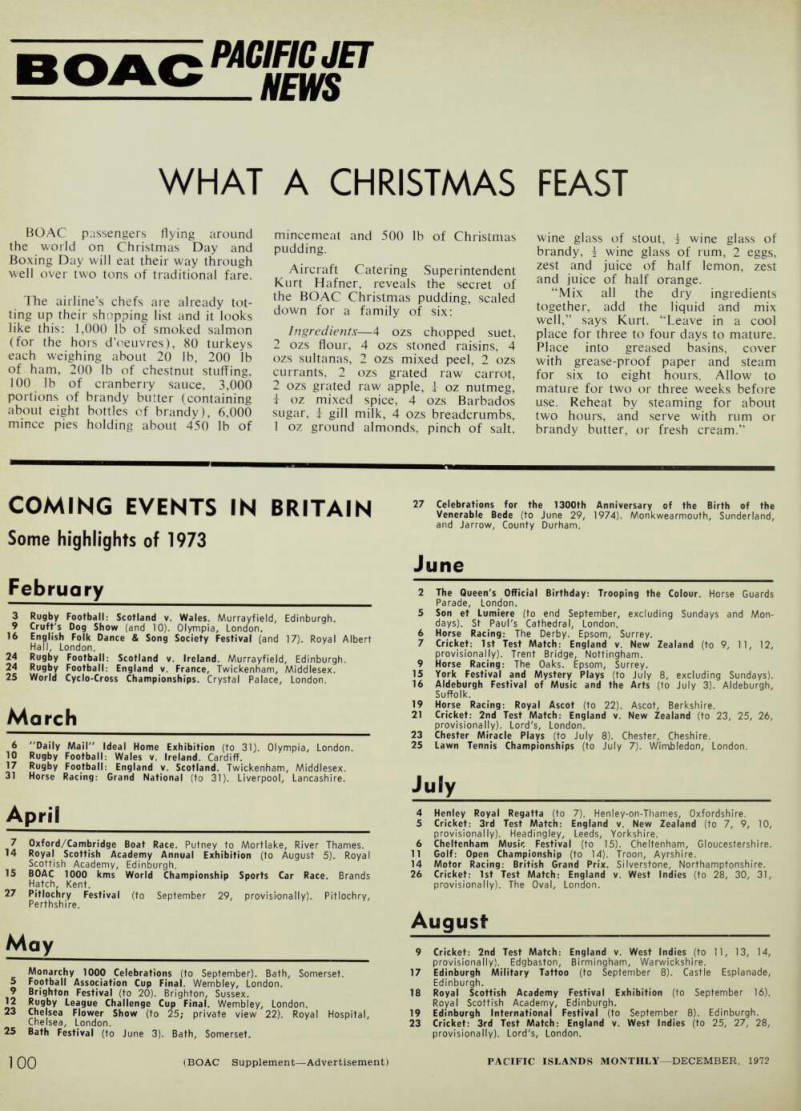
BOAC passengers flying around the world on Christmas Day and Boxing Day will eat their way through well over two tons of traditional fare.
The airline’s chefs are already tot ting up their shopping list and it looks like this: 1,000 lb of smoked salmon (for the hors d’oeuvres), 80 turkeys each weighing about 20 lb, 200 lb of ham, 200 lb of chestnut stuffing, 100 lb of cranberry sauce, 3,000 portions of brandy butter (containing about eight bottles of brandy), 6,000 mince pies holding about 450 lb of
mincemeat and 500 lb of Christmas pudding.
Aircraft Catering Superintendent Kurt Hafner, reveals the secret of the BOAC Christmas pudding, scaled down for a family of six: Ingredients —4 ozs chopped suet, 2 ozs flour, 4 ozs stoned raisins, 4 ozs sultanas, 2 ozs mixed peel, 2 ozs currants, 2 ozs grated raw carrot, 2 ozs grated raw apple, i oz nutmeg, 4 oz mixed spice, 4 ozs Barbados sugar, 4 gill milk, 4 ozs breadcrumbs, 1 oz ground almonds, pinch of salt.
wine glass of stout, i wine glass of brandy, \ wine glass of rum, 2 eggs, zest and juice of half lemon, zest and juice of half orange.
“Mix all the dry ingredients together, add the liquid and mix well,” says Kurt. “Leave in a cool place for three to four days to mature.
Place into greased basins, cover with grease-proof paper and steam for six to eight hours. Allow to mature for two or three weeks before use. Reheat by steaming for about two hours, and serve with rum or brandy butter, or fresh cream.”
February
Coming Events In Britain
Some highlights of 1973
3 Rugby Football: Scotland v. Wales. Murrayfield, Edinburgh, 9 Cruft's Dog Show (and 10). Olympia, London. 16 English Folk Dance & Song Society Festival (and 17). Royal Albert Hall, London. 24 Rugby Football; Scotland v. Ireland. Murrayfield, Edinburgh. 24 Rugby Football: England v. France, Twickenham, Middlesex. 25 World Cyclo-Cross Championships. Crystal Palace, London.
Morch
6 "Daily Mail" Ideal Home Exhibition (to 31). Olympia, London. 10 Rugby Football: Wales v. Ireland. Cardiff. 17 Rugby Football; England v. Scotland. Twickenham, Middlesex. 31 Horse Racing: Grand National (to 31). Liverpool, Lancashire.
April
■7a Oxford/Cambridge Boat Race. Putney to Mortlake, River Thames. 14 Royal Scottish Academy Annual Exhibition (to August 5). Royal Scottish Academy, Edinburgh. 15 BOAC 1000 kms World Championship Sports Car Race. Brands Hatch, Kent. 27 Pitlochry Festival (to September 29, provisionally). Pitlochry, Perthshire.
May
Monarchy 1000 Celebrations (to September). Bath, Somerset. 5 Football Association Cup Final. Wembley, London. 9 Brighton Festival (to 20). Brighton, Sussex, oo {?“9by League Challenge Cup Final. Wembley, London. 23 Che sea Flower Show (to 25; private view 22). Royal Hospital, Chelsea, London. 25 Bath Festival (to June 3). Bath, Somerset,
27 Celebrations for the 1300th Anniversary of the Birth of the Venerable Bede (to June 29, 1974). Monkwearmouth, Sunderland, and Jarrow, County Durham,
June
2 The Queen's Official Birthday: Trooping the Colour. Horse Guards Parade, London. 5 Son et Lumiere (to end September, excluding Sundays and Mon days). St Paul's Cathedral, London. 6 Horse Racing: The Derby. Epsom, Surrey. 7 Cricket: Ist Test Match: England v. New Zealand (to 9, 11, 12, provisionally). Trent Bridge, Nottingham. 9 Horse Racing: The Oaks. Epsom, Surrey. 15 York Festival and Mystery Plays (to July 8, excluding Sundays). 16 Aldeburgh Festival of Music and the Arts (to July 3). Aldeburgh, Suffolk. 19 Horse Racing; Royal Ascot (to 22). Ascot, Berkshire. 21 Cricket: 2nd Test Match: England v. New Zealand (to 23, 25, 26, provisionally). Lord's, London. 23 Chester Miracle Plays (to July 8). Chester, Cheshire. 25 Lawn Tennis Championships (to July 7). Wimbledon, London.
July
4 Henley Royal Regatta (to 7). Henley-on-Thames, Oxfordshire. 5 Cricket: 3rd Test Match: England v. New Zealand (to 7,9, 10, provisionally). Headingley, Leeds, Yorkshire. 6 Cheltenham Music Festival (to 15). Cheltenham, Gloucestershire. 11 Golf: Open Championship (to 14). Troon, Ayrshire. 14 Motor Racing: British Grand Prix. Silverstone, Northamptonshire. 26 Cricket: Ist Test Match; England v. West Indies (to 28, 30, 31, provisionally). The Oval, London.
August
9 Cricket: 2nd Test Match; England v. West Indies (to 11, 13, 14, provisionally). Edgbaston, Birmingham, Warwickshire. 17 Edinburgh Military Tattoo (to September 8). Castle Esplanade, Edinburgh. 18 Royal Scottish Academy Festival Exhibition (to September 16).
Royal Scottish Academy, Edinburgh. 19 Edinburgh International Festival (to September 8). Edinburgh. 23 Cricket: 3rd Test Match: England v. West Indies (to 25, 27, 28, provisionally). Lord's, London.
Business and Development
Fiji Spreading The Welcome Mat
To Overseas Industry
From a PIM staff correspondent in Suva
“Welcome” signs for industrialists in Australia, New Zealand and other developed countries are going up all over Fiji, with the government lead ing the campaign to provide jobs for its workforce, swollen each year by between 6,000 and 7,000 school leavers.
A few years ago there was no industrial land to be had, especially around Suva where companies were competing for a few small plots in Walu Bay and the suburb of Lami.
Now, the government, with private developers jogging alongside, is spend ing thousands of dollars acquiring and developing land for local and over seas firms and giving tax holidays and customs duty concessions to at tract the foreign investors.
Not only that, but red tape is being cut to speed up the processing of ap plications for land and licences to build factories.
Since the drive began in earnest in 1970 about 200 acres have been carved out of Crown and Native land reserves and by the end of this year nearly three quarters of a million dollars will have been spent by the government on developing the land for industry. But Crown land is in short supply and the Native Land Trust Board, guardian of the Fijian owned land, much of which is in “reserve” and doing nothing, is being persuaded to release land at Sigatoka, Tavua and Rakiraki.
Biggest areas of development are, naturally, near the capital and main port—43 acres at Nabua and 41 acres at Kalabu—but there is also important site development at Vatukoula, the gold town, Ba and Labasa. The Lautoka Town Council has also weighed in with a land-reclamation scheme of its own which will be used for factory sites. The government is anxious, however, to avoid large in dustrial concentrations in a few places to the detriment of many other smaller centres of population. Near the ports will go the manufacturers of goods for exports. The rest will
be spread over as many areas as pos sible on the two main islands of Viti Levu and Vanua Levu.
The industrialist, looking from Australia or New Zealand, Japan or anywhere else for an opening for in dustrial investment can expect to get from the Fiji Government a piece of land already serviced for a factory, with electricity and water laid on, tax holidays, in some cases for as long as eight years, a lower import duty for his machinery—lo per cent from non- Commonwealth countries and half that from Commonwealth areas—for raw materials or semi-processed items and for accessories such as packaging materials.
If he opts for a site at Vatukoula, he’ll get the maximum concessions.
These are; • A tax holiday for eight years, during which he won’t pay any tax on profits; other areas will be up to five years; • No import duty at all on manu facturing components, machinery and raw materials.
The government, with admirable
foresight and, maybe a little trepida tion, has classified Vatukoula as a “depressed area” although gold is still coming out of the ground. But for how long?
Bolstered up by government sub sidies over the last few years, the gold mine provides jobs and a living for a township of 5,000 people, the largest concentration of workers outside the capital. But, its future is very much in doubt. Labour troubles—there was a brief strike in October and a longer one a few weeks before that—could force a closure any time.
So far there have only been hints that Emperor Mines Ltd is losing patience and money. Any more serious trouble and the doors might be shut.
In any case, if more reserves of gold bearing ore are not found soon, there’ll be no mine.
This, perhaps more than anything else, has been the driving force be hind the government’s industrialisa tion policy, though maybe the thought that Fiji looks like being the manu facturer for the Islands has had some thing to do with it. At any rate, the
Pacific Singapore
accent is on Vatukoula. With the mining company’s agreement, the government has earmarked 120 acres in the area for factories, and 43 acres are now being developed.
Vatukoula is an each-way bet for the government. If the mine continues, then other workers can be brought in to man the new factories. There’s plenty of room in which to spread the town. If the mine closes, then in coming industrialists will find a ready made work force, disciplined in work
ing conditions.
“The whole idea of all these favour able concessions is to divert industry to Vatukoula in preference to any where else in the dominion,” Mr Shardha Nand, Secretary to Fiji’s Ministry of Commerce, Industry and Co-operatives, told PIM. “But we want new industries wherever we can get them and we think we have an attractive proposition for investors in Australia, New Zealand and else where.
“We have a large labour force, and though much of it is unskilled it can be trained. Fiji is the Singapore of the Pacific and has much to offer.
We would welcome especially off shore industries which can supply
ready-made or partly-completed goods for use in more sophisticated in dustries in the developed countries such as car parts, including cable, and also components for heavy industry.
“Many Australian and New Zealand investors might find they can invest here and generate industrial growth for onward expansion of the market beyond Fiji into the South Pacific region including Latin America. What is more, there is no hit and miss about our planning. We see things clearly and should be able to supply answers to any queries. We have the machinery for processing applications quickly.”
This machinery, a recent innova tion, is the Industrial Review Com mittee on which sit Mr Shardha Nand as chairman, the Secretary for Finance, Commissioner of Inland Revenue, Director of Economic Planning, Comptroller of Customs and Com merce and Industry’s economist.
They’re able to give an application the once-over in a week and, usu ally, never take more than a month to do the job. Any delays are usually outside their control, due maybe to protracted negotiations over mach inery or partnerships or through in adequate information being given.
Already several new industries are being set up including a flour mill, now being built at Walu Bay, a steel
rolling mill in the same area, a foam rubber factory which is coming from the United Kingdom and will be built at the Suva suburb of Vatuwaqa, a garment manufacturing firm from Taiwan, a laminated board factory
and a ginger processing plant. There
are others in the pipeline but pro posals are confidential until the in vestors want to talk publicly.
The last word on any application to set up an industry comes from the Minister of Finance, Mr C. A. Stin son, and the Minister for Commerce, Industry and Co-operatives, Mr M. T.
Khan.
Guarantee of local participation is almost an “open sesame” to any over seas applicant but some, especially those requiring high capital invest ment, “foreign” skill, technical know how, marketing expertise and inter national marketing connections, have an easy passage without having to promise to allow a local finger in the pie. In others there must be guarantees of local participation. In the flour mill and steel rolling mill ventures the requirement is up to 49 per cent of the shares for locals.
There are restrictions however.
There’s little chance of an outsider getting a permit to set up a restaurant, or in tailoring, laundry, curry powder making, blacksmith shops or any
business already “native” to the place.
Some butchers’ shops got in from overseas recently but this Minister Mr Khan put down to a “lack of co ordination” and government mach inery not being “geared to deal with this sort of thing.” Those will be the last to break into the exclusive local circle.
Private enterprise is also taking a share of the operation, for profit of course. One such estate is being deve loped on 50 acres of reclaimed man grove swamp at the side of the Queens Road three miles from Suva.
Named the Wailada Industrial Estate by the developers, Industrial Developers (South Pacific) Ltd, it will be completed by next August. Already 60 of the 100 lots have been sold, many to overseas companies in Aust ralia, New Zealand and Hong Kong.
Some of the sites, however, will be for warehouses rather than factories.
The same company has similar schemes, but smaller, at Vatuwaqa, Nausori and Kinoya on the Kings Road, and has also embarked on the construction of a four-acre shopping complex on the corner of Mead and Princes roads Suva. In the complex will be a department store, super market, speciality shops, a 12-storey, 60-bed hotel with a restaurant on top and a 14-floor apartments block—all for $1,800,000. Building will begin early next year with completion in two years.
The high cost of
spreading the word
When the Islands get together in the South Pacific Forum and the South Pacific Conference around 1974 a lot of the talk will be about tele communications and the Islanders’ ambitions for improved togetherness.
And they’ll talk in millions of dollars.
The desire for closer links in the way of telecommunications was first pinpointed by Nauru’s President Hammer Deßoburt at the Forum’s first meeting, in Wellington in August, 1971.
Australia and New Zealand offered to do a preliminary study and this year they came up with the result.
A communications network linking all Island territories is feasible —if you don’t consider the cost.
President Deßoburt thought a sub marine cable network stretching 8,000 miles at a capital cost of about SUSSO million might provide a satisfactory link for regional com munications. The experts in Australia and New Zealand doing the preli minary study came up with a much bigger figure—sAB3.2 million for the submerged plant of a submarine cable
system with major and minor ter minals.
The system, the experts considered, would cost $A 10,944,000 a year to run it. And their estimates do not include the cost of customs duty and sales tax on equipment, though that could be waived, the cost of land for stations and staff houses, the cost of housing and also landline transmis sion equipment.
The experts studied several systems as well as the submarine cable. They discarded two the tropospheric scatter system, which is transmission at ultra-high frequencies with reflec tion from the troposphere, and the microwave system, with transmission at ultra-high frequencies from tower to tower mounted in the ground. They considered they were unsuitable.
The other systems which are avail able, are the submarine cable, satellite and the high frequency radio system.
The capital cost of a satellite earth station was estimated at $A4,220,000 and the annual running costs $1,017,000, plus an annual space segment rental for a half circuit of $A15,000. The experts estimated that 12 such stations would be needed, making a total capital cost of $A50,640,000 and annual running costs $A 12,204,000 plus the space segment rentals.
Capital cost of HF radio with
sufficient stations to cover the region was estimated at $A9,968,000 with annual bill at $A2,480,000.
The United Nations Development Programme (UNDP) has taken a hand in the project study and has appointed experts to make a complete study. They are expected to come up with the answers by 1974.
Fiji revaluation
hits copra growers
With the pound sterling afloat, Fiji revalued its dollar in October by 5i per cent, and upset the des pondent and struggling copra growers who stand to lose $3.90 a ton on top of the $BO a ton they are down on the 1970 price. The planters have been sore for a long time about what they feel is governmental neglect of them.
They were given a freight subsidy of $5 to $lO a ton, but this latest move, they say, robs them of the small advantage they got from the subsidy.
Minister of Finance Charles Stinson explained that as most copra exports went to the UK payments for the coconut oil and meal would now be less. This would also apply to sugar but there are other markets in which the sugar industry will benefit from revaluation.
Fiji’s food bill, which is paid in Australia and New Zealand, was growing bigger. Since June it had increased by 9.7 per cent. To offset this the government decided on revaluation.
Why, ask some, must Fiji be still tied to sterling when the dominion is now independent? According to Mr Stinson, Fiji will be affected by an undulating pound until she gets her own central monetary authority. That would provide the machinery for real independence in the financial field.
But the experts fear that, when Fiji gets this authority, it will be out of the frying pan into the fire.
Little Fiji with no Fort Knox — although it’s got a gold mine—and precious little to support its dollar, will be at the mercy of the world’s financial bandits and the chill winds of economic recession. • UTA French Airlines will take delivery of five new DC 10s, the Douglas Corporation’s version of the jumbo, beginning in December, The airline has options on three more.
The first will be seen in Fiji on June 1 next year. • Air Micronesia, in association with Continental Airlines, is putting its Second Boeing 727 into service on December 15, greatly increasing TT services.
The Smell Of Hot Cakes
It’s an ill wind that blows no one any good, even a hurricane. Bebe, which blasted Funafuti and half Fiji, was no exception. She got the Fiji National Marketing Authority off the hook over a deal in potatoes.
Fearing the Sigatoka potato crop, which is now Fiji’s main supply, would be late this year, the authority bought 300 tons from New Zealand’s South Island. But, the Sigatoka potatoes came along in time—at the controlled wholesale prices of Bic a pound, 9ic to the retailer and 12c to the consumer.
The NZ potatoes came along as well and the authority, which bought them at around 5c offered them to the merchants at 8c but the merchants, who were used to paying much below
that for the NZ potatoes—in the days when they were allowed to import them—refused to buy. There were plenty of potatoes, anyhow. The result was a large concentration of rejected potatoes on the Suva wharf.
Three weeks after arriving, most of them were still there and rotting, The authority cut the price to 6c but there were no takers until Bebe blew along.
Said marketing authority chief Alf Hazelman; “We’ve no trouble selling them. We sold 150 tons in the last week and there’s only about 10 tons left. They’re going like hot cakes.”
But the smell on the wharf, as the sorters picked out the rotten ones, wasn’t the sort which comes with hot cakes.
Advertisements & other items, pp. 104-108 (1 item)
Su Lli Vans
MELBOURNE SYDNEY
C. SULLIVAN (EXPORT) PTY. LTD.,
4TH FLOOR, KEMBLA BUILDING.
60 MARGARET STREET, SYDNEY
(G.P.O. BOX 3373).
AUCKLAND CABLES AND TELEGRAMS: ~C HASULL”.
BRISBANE
LONDON
OFFERS A COMPREHENSIVE AND EFFICIENT
BUYING SERVICE TO THE PACIFIC ISLANDS
OFFICES AT;
PORT MORESBY • LAE • RABAUL • KIETA • MOUNT HAGEN • BULUMA • SUVA • LAUTOKA • NOUMEA • HONIARA • PORT VILA
"SULLIVANS for SERVICE"
AVAILABLE FROM:
JAMES SANDY PTY. LTD.
687 GARDENERS ROAD, MASCOT,
N.S.W., 2020, AUSTRALIA.
• GLASS MERCHANTS
• ALUMINIUM STOREFRONTS
• ALUMINIUM WINDOWS AND DOORS
• SHOWER SCREENS
• MIRRORS
SANDYS
EXTRUDED ALUMINIUM
ADJUSTABLE LOUVRES
FITTED WITH ALUMINIUM OR GLASS BLADES
FOR SUN AND VENTILATION CONTROL
SANDYS EXTRUDED ALUMINIUM GLAZING BAR FOR
ECONOMICAL SIDEWALL GLAZING
' 3 ...
BESSER MULTI-MOLD
The most simple, versatile, convenient hand
operated block making machine ever made
1. EASY FILLING MOULD.
2. INTENSE ELECTRIC VIBRATION.
3. EASY STRIPPING BY HAND LEVER.
4. EASY OFFBEARING BECAUSE PALLETS ARE SLIGHTLY
LONGER THAN UNIT.
5. ONE MAN CAN MAKE 250/300 BLOCKS PER DAY.
DISTRIBUTED BY:
CHICAGO COMPANY PTY. LIMITED
3 SHORT STREET, CHATSWOOD, N.S.W. 2067, AUSTRALIA PHONE: 40-4644 (3 LINES). CABLES: "CHICO AUSTRALIA".
NEED ECONOMICM. POWER?
mm
CONTACT Braybon
FOR OBLIGATION-FREE QOOTATION
Braybon Bros, manufacture a complete range of Lister engine-powered diesel sets to suit your particular requirements as fully automatic; remote: electric; or manual start.
Represented in all States, P.N.G., New Hebrides and N.Z.
Braybon Bros
97 PTY. LTD.,
2 ROTHWELL AVENUE, CONCORD WEST 2138.
Tel.: 73-3246.
COUPON
NOW
Please send me details of your Lister engine-powered alternating sets.
NAME
ADDRESS
.1
KERR BROS.
THE
nrmaac!®
PEOPLE FOR THE PACIFIC ISLANDS
It Pays to Buy WEEKS the Big Value Trailer Range!
From 3 ton up to 10 ton, 2 or 4 wheels, tipping and non-tipping. Weeks trailers are specially designed for heavy duty work and long life. From the Weeks range, you will find a trailer to suit your particular carrying application. For further details, please write to
KERR BROS. PTY. LTD
ISLAND MERCHANTS,
65 YORK STREET, SYDNEY. CABLES: CAREFULNESS, SYDNEY.
Felling, cutting,
parting, carpentering
DOLMAR
solves your problems Distributors:
BRECKWOLDT & CO. (N.G.) PTY. LTD.
P.O. Box 222, RmBAUL.
P.O. Box 1549, Boroko, PORT MORESBY.
P.O. Box 185, MADANG.
P.O. Box 1188, LAE.
P.O. Box 72, KIETA.
P.O. Box 237, MT. HAGEN
P.O. Box 178, WEWAK.
BRECKWOLDT & CO.,
P.O. Box 47, APIA.
BRECKWOLDT & CO. (5.1.) LTD.,
P.O. Box 140, HONIARA.
BRECKWOLDT S.A.R.L., B.P. 65, NOUMEA.
DOLMAR
Hamburg/Germany
Guide Bar Saw Type CL 8 Ripping Saw Type S 150/200 C For big trunks of tropical hard wood with diameter up to 80"
Looking for an
all-purpose ply
that's
EXTRA TOUGH
hut
EXTRA LIGHT?
KLINKII
Made by Commonwealth New Guinea Timbers Ltd, Bulolo, New Guinea Available from plywood suppliers in the Territory & Pacific area PA 4 S se
King Solomon's
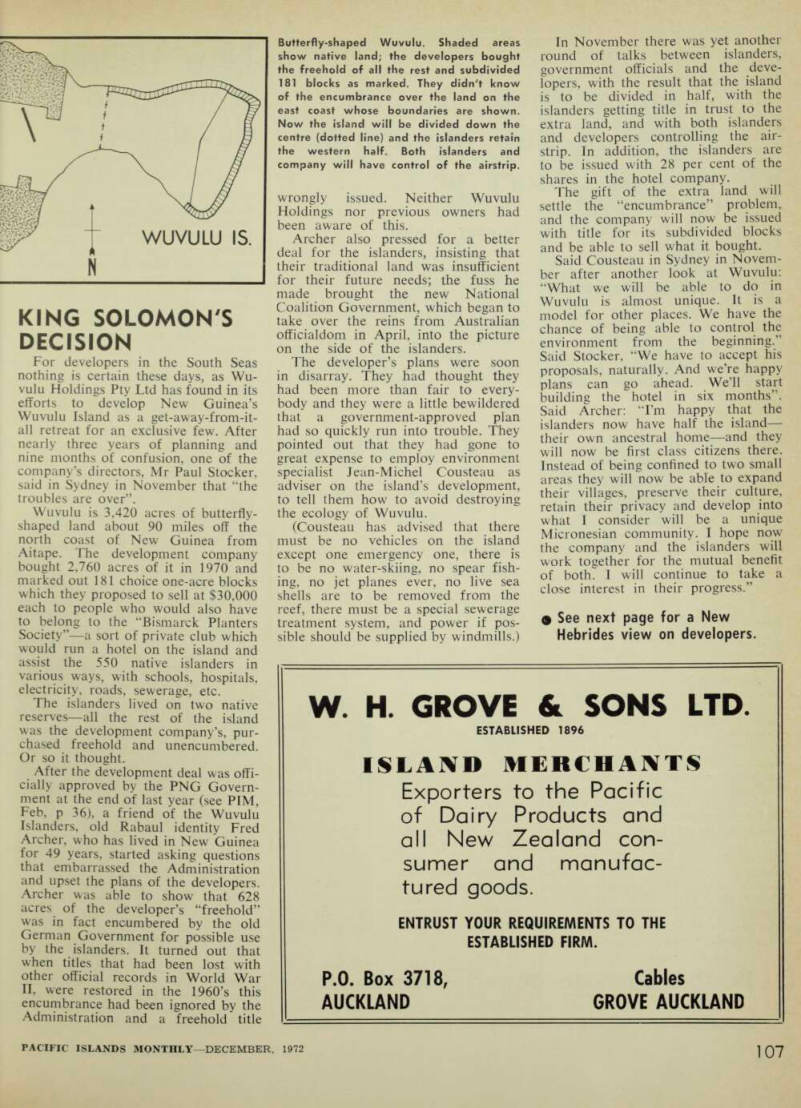
Decision
For developers in the South Seas nothing is certain these days, as Wu vulu Holdings Pty Ltd has found in its efforts to develop New Guinea’s Wuvulu Island as a get-away-from-it all retreat for an exclusive few. After nearly three years of planning and nine months of confusion, one of the company’s directors, Mr Paul Stocker, said in Sydney in November that “the troubles are over”.
Wuvulu is 3,420 acres of butterfly shaped land about 90 miles off the north coast of New Guinea from Aitape. The development company bought 2,760 acres of it in 1970 and marked out 181 choice one-acre blocks which they proposed to sell at 130,000 each to people who would also have to belong to the “Bismarck Planters Society”—a sort of private club which would run a hotel on the island and assist the 550 native islanders in various ways, with schools, hospitals, electricity, roads, sewerage, etc.
The islanders lived on two native reserves—all the rest of the island was the development company’s, pur chased freehold and unencumbered.
Or so it thought.
After the development deal was offi cially approved by the PNG Govern ment at the end of last year (see PIM, Feb, p 36), a friend of the Wuvulu Islanders, old Rabaul identity Fred Archer, who has lived in New Guinea for 49 years, started asking questions that embarrassed the Administration and upset the plans of the developers.
Archer was able to show that 628 acres of the developer’s “freehold” was in fact encumbered by the old German Government for possible use by the islanders. It turned out that when titles that had been lost with other official records in World War H, were restored in the 1960’s this encumbrance had been ignored by the Administration and a freehold title
Butterfly-shaped Wuvulu. Shaded areas show native land; the developers bought the freehold of all the rest and subdivided 181 blocks as marked. They didn't know of the encumbrance over the land on the east coast whose boundaries are shown.
Now the island will be divided down the centre (dotted line) and the islanders retain the western half. Both islanders and company will have control of the airstrip. wrongly issued. Neither Wuvulu Holdings nor previous owners had been aware of this.
Archer also pressed for a better deal for the islanders, insisting that their traditional land was insufficient for their future needs; the fuss he made brought the new National Coalition Government, which began to take over the reins from Australian officialdom in April, into the picture on the side of the islanders.
The developer’s plans were soon
in disarray. They had thought they
had been more than fair to every body and they were a little bewildered that a government-approved plan had so quickly run into trouble. They pointed out that they had gone to great expense to employ environment specialist Jean-Michel Cousteau as adviser on the island’s development, to tell them how to avoid destroying the ecology of Wuvulu. (Cousteau has advised that there must be no vehicles on the island except one emergency one, there is to be no water-skiing, no spear fish ing, no jet planes ever, no live sea shells are to be removed from the reef, there must be a special sewerage treatment system, and power if pos sible should be supplied by windmills.)
In November there was yet another round of talks between islanders, government officials and the deve lopers, with the result that the island is to be divided in half, with the islanders getting title in trust to the extra land, and with both islanders and developers controlling the air strip. In addition, the islanders are to be issued with 28 per cent of the shares in the hotel company.
The gift of the extra land will settle the “encumbrance” problem, and the company will now be issued with title for its subdivided blocks and be able to sell what it bought.
Said Cousteau in Sydney in Novem ber after another look at Wuvulu: “What we will be able to do in Wuvulu is almost unique. It is a model for other places. We have the chance of being able to control the environment from the beginning.”
Said Stocker, “We have to accept his proposals, naturally. And we’re happy plans can go ahead. We’ll start building the hotel in six months”.
Said Archer: “I’m happy that the islanders now have half the island — their own ancestral home —and they will now be first class citizens there.
Instead of being confined to two small areas they will now be able to expand their villages, preserve their culture, retain their privacy and develop into what I consider will be a unique Micronesian community. I hope now the company and the islanders will work together for the mutual benefit of both. I will continue to take a close interest in their progress.”
9 See next page for a New Hebrides view on developers.
Advertisements & other items, pp. 109-110 (1 item)
W. H. Grove & Sons Ltd.
ESTABLISHED 1896
ISLAND MERCHANTS
Exporters to the Pacific of Dairy Products and all New Zealand consumer and manufactured goods.
ENTRUST YOUR REQUIREMENTS TO THE
ESTABLISHED FIRM.
P.O. Box 3718, Cables
AUCKLAND GROVE AUCKLAND
Concentrated Pea-Ben
is lethal to flies, mosquitoes
and all insect pests ...
Yet so pure it’s safe to spray anywhere With tropical weather providing ideal conditions for prolifically breeding flies and mosquitoes, serious outbreaks of disease can be spread by swarms of these insect invaders. Once more householders are urged to combat this threat to public health by killing every disease carrying insect seen. A.N.I. Research Chemists are constantly at work worldwide to ensure that Pea-Beu aerosol insecticide is effective in eliminating flies c.nd mosquitoes from households. Pea-Beu is specifically formulated to contain Pyrethrins, one of the most powerful insecticidal ingredients known—deadly to flies and mosquitoes and yet harmless to man and his pets. rest with their irritating whine and inflicting painful toxic bites, mosqui toes pass on many serious disease including malaria, hepatitis, dengue and yellow fever, disfiguring elephantiasis and encephalitis.
Total Killing Power with Total Safety Controlling these dangerous disease spreaders demands rapid destruction wherever they appear. Long-term research was needed to formulate the insect spray that combines high killing potential with complete safety for users, as powerful Pea-Beu aerosol does. Pea-Beu is particularly effective against flies and mosquitoes as the wide action spray ensures total coverage of any room. Pea-Beu’s efficient spray seeks out and destroys flies and mosquitoes before they have a chance to bring irritation and illness to your family. £ The Deadliest Traffickers of Disease Four centuries ago flies were suspected of spreading tropical ulcers.
Modern pathologists have proved they spread a whole list of infections, ranging from mild but unpleasant stomach upsets to infective hepatitis, bacillary, dysentery, typhoid and persistent ameobiasis. Worse still, flies transmit crippling scourges such as cholera, smallpox, poliomyelitis, opthalmia and trachoma. A highly efficient method of fly extermination is to use powerful Pea-Beu aerosol insecticide. A few short bursts of Pea-Beu in a room will kill all flies on the wing. The permeating action of Pea-Beu also spreads into hidden corners of the room, thus eliminating any hidden insects.
The mosquitoe’s record is just as grim. Besides wrecking your night’s .1. >°S!*
Pea-Beu-the safe, powerful insecticide
developers

New Hebrides warning to developers
From a Vila correspondent The British Government in the New Hebrides sees the growing finance in dustry there as an important credit facility which will help boost local development. At the same time it warns that if financiers and developers neglect Melanesian aspirations, and fail to key their roles to them, the end will be disaster.
Britain’s view was put clearly in Vila in November by the British Resident Commissioner, Mr Colin Allan, in officially opening Melitco House, headquarters of the Melanesia International Trust. It was plain speaking of a sort not often heard in public at this level. Financiers present reacted favourably; but there was some soreness in other quarters.
Mr Allan said the history of the Pacific Island territories showed that provision of irresponsible credit had been a curse, and the lack of correct evaluation of viable commercial enter prises had hampered development.
Responsible credit for balanced de velopment, in private and public sectors, was now in the process of being provided in the New Hebrides.
The spin-off from the recent expan sion of the New Hebrides investment industry included an increase in the number of visitors who spent money there, and construction of office buildings and houses, and provision of new industries and services all of which meant more jobs. There were signs that the improved economy was penetrating the rural area.
First priority now was to reduce the quantities of processed and fresh foodstuffs being imported, and the investment industry could help in this and thus close the growing unfavour able balance of trade.
Mr Allan said the New Hebrides was today feeling the effects of an inflationary spiral of far-away coun tries of 1969 and 1970, and it was determined to control it. He added: “The day has gone when a few in dividuals may hold the New Hebrides to ransom and pollute these islands and seas for their private exorbitant profits. I would like to make it clear that my Administration and I will not be even faintly deterred by the political pressurising of those few irresponsible property owners who simply seek their personal enrichment at the expense of the fair and reason
able expectations of the people of this territory.
“Already, thanks to the exaggerated and ill-conceived optimism which has developed in this field, we in Vila have 121 years’ supply of so-called residential plots in and around the town while, not very far afield on the environs, the euphoria for subdivision which exists is such that a splendid carpet of coconuts covers the grass of certain plantations and the quality of some of the cattle would scarcely qualify for the glue factory. On other plantations, however, correct hus bandry is being practised and our beef is already establishing a reputa tion which justifies entry into inter national markets.”
Mr Allan said that just as the forward-thinking banks of the world had to present anew image, so the investment industry “must re-think its image and re-define its role in the South Pacific.”
The Melanesians of the New Hebrides had an insatiable zest for communication, understanding and participation, and would look to the investment industry to respond.
“The industry must come to terms with all the people of these islands,”
Mr Allan said. “We would be all well advised to forget anything we ever felt we knew about other places, start afresh and decide what is best in the circumstances of the New Hebrides and our neighbours in the Pacific. I am not here talking about social justice but political sensibility.
“I believe that new guidelines of lending and monetary expertise must be carefully thought out and that the long-term success and mutual benefits of the industry depend upon adequate and fruitful communication between yourselves and ordinary people.
“Put another way—the traditional principles of sound commercial monetary and financial practices will continue to hold good but variants are needed to suit the different cir cumstances here in the New Hebrides and in doing business with our neighbours. In other words the in dustry should see itself not as an isolated identity but rather as part of the overall New Hebrides and South Pacific scene in which sound inter relationship of all men and women of whatever race, creed, language and occupation is fundamental. In par ticular the system must keep in mind the need for renewal—it should not become stale and atrophied. Other wise, 1 must tell you, the end will be disaster.”
The disaster, Mr Allan appeared to be warning, would occur to the financiers and the developers, not to the Melanesians.
Carpenter success
leads to expansion
W. R. Carpenter (South Pacific) Ltd, which has been undergoing a streamlining in its operations, plans to invest another $1,600,000 in capital works in Fiji next year. The new investment will include a 200-ton slipway, joinery and motor complex, all in the Walu Bay area. The figure does not include the bill for the rescue operation on Islands Trans port Ltd.
The report for the year ending June 30 shows increased turnover and pro fits for the company’s branches in Fiji, Tonga and Western Samoa.
Merchandise sales rose by nearly 16 per cent, automotive sales by 31 per cent and the industrial group sales by 19 per cent.
Net profit for W. R. Carpenter (South Pacific) Ltd was $2,636,800, and this after paying local suppliers $13,149,000 for goods and services, $6,094,000 in taxes and duties and $4,449,000 in salaries and wages.
Net operating profit for W. R.
Carpenter Holding Ltd increased from $A6,748,000 to $7,049,000.
NZ standardising
Trade Documents
New Zealand business firms are gradually changing over to a standard Aligned Export Documentation scheme, launched by New Zealand’s Customs Department. This, together with a standard invoice specially designed to be acceptable to Aus tralian and Fiji importers, will relieve Islands businessmen who’ve moaned for many years over the incomplete or inaccurate documentation issuing from Kiwi business houses.
The New Zealand Customs, who’ve mounted a campaign to persuade business to use the new standard forms, are underlining the savings in time and money. They could have mentioned the improvement in public relations with overseas customers that will result from the use of uniform documents. • Shortly after Fiji’s latest resort hotel, the Flagship Beachcomber, at Deuba, was officially opened in November, Flagship Hotels announced that the chain had changed its name to Americana Hotels, and the Flag ship Beachcomber would henceforth be known as the Beachcomber, “an Americana hotel”. The hotel com pany’s parent corporation. Flagship International Inc., which is involved in various activities, and is a wholly owned subsidiary of American Air lines, will continue to take the Flag ship name.
Advertisements & other items, pp. 111-112 (1 item)
Nairnflor
•J 3 j ■
The Commercial
and Domestic
Vinyl
Flooring
Nairnflor is a fully flexible vinyl flooring available in 4 thicknesses I.lmm; I.smm; 2.omm; 2.5 mm; Nairnflor is manufactured in accordance with B.S. 3261: 1960 in a range of 19 colours in either 48” wide sheet or 12” x 12” tiles.
Nairnflor is marketed by W
Fletcher
International
For further information and name of nearest stockist contact Fletcher International, Private Mail Bag, Auckland, New Zealand
PENTA-VITE'
THE ABC OF
VITAMINS
/ n) Nicholas Vitamins are essential for the healthy growth of young children.
And an insufficient intake of the right kind of vitamins can sometimes lead to illnesses of one kind or another. ‘Penta-Vite’ products are specially designed to provide the daily requirements of the important vitamins when the diet is inadequate. ‘Penta-Vite’ Infant Formula supplements baby’s milk diet when breast feeding has ceased. And ‘Penta-Vite’ Syrup, with extra Vitamin C and iron, can be of special value if toddlers are a little pale and off their food.
Penta-Vite’, Australia’s leading infant vitamin supplement. From chemists only.
Nicholas Proprietary Limited 699 Warrigal Road, Chadstone.
Vic. Aust. 3148.
NPII4
Fright For Bsip
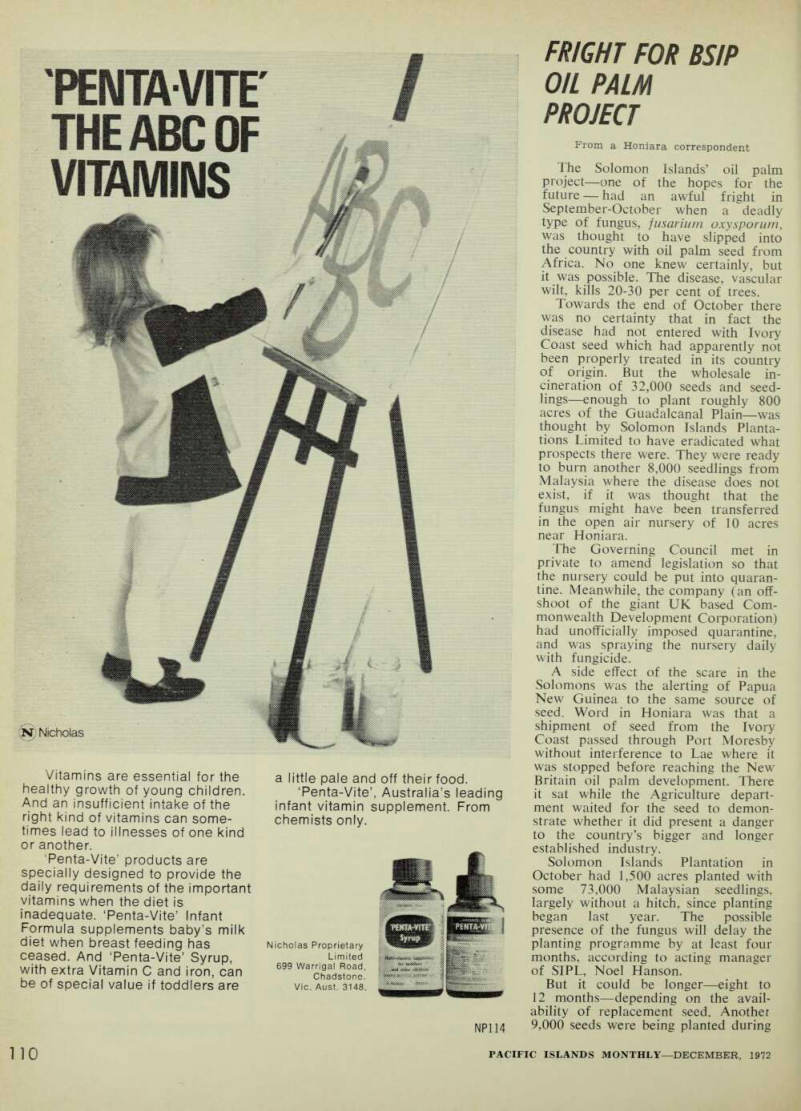
Oil Palm
Project
From a Honiara correspondent The Solomon Islands’ oil palm project—one of the hopes for the future — had an awful fright in September-October when a deadly type of fungus, fusarium oxysporum, was thought to have slipped into the country with oil palm seed from Africa. No one knew certainly, but it was possible. The disease, vascular wilt, kills 20-30 per cent of trees.
Towards the end of October there was no certainty that in fact the disease had not entered with Ivory Coast seed which had apparently not been properly treated in its country of origin. But the wholesale in cineration of 32,000 seeds and seed lings—enough to plant roughly 800 acres of the Guadalcanal Plain—was thought by Solomon Islands Planta tions Limited to have eradicated what prospects there were. They were ready to burn another 8,000 seedlings from Malaysia where the disease does not exist, if it was thought that the fungus might have been transferred in the open air nursery of 10 acres near Honiara.
The Governing Council met in private to amend legislation so that the nursery could be put into quaran tine. Meanwhile, the company (an off shoot of the giant UK based Com monwealth Development Corporation) had unofficially imposed quarantine, and was spraying the nursery daily with fungicide.
A side effect of the scare in the Solomons was the alerting of Papua New Guinea to the same source of seed. Word in Honiara was that a shipment of seed from the Ivory Coast passed through Port Moresby without interference to Lae where it was stopped before reaching the New Britain oil palm development. There it sat while the Agriculture depart ment waited for the seed to demon strate whether it did present a danger to the country’s bigger and longer established industry.
Solomon Islands Plantation in October had 1,500 acres planted with some 73,000 Malaysian seedlings, largely without a hitch, since planting began last year. The possible presence of the fungus will delay the planting programme by at least four months, according to acting manager of SIPL, Noel Hanson.
But it could be longer—eight to 12 months—depending on the avail ability of replacement seed. Another 9,000 seeds were being planted during
November, but that will not go near the planned planting of about 2,000 acres a year at 48 seeds to the acre.
South East Asia and the Pacific are free from vascular wilt, which attacks the oil palm tree from the roots after it is well established and kills it. The preferred Malaysian seed has become scarce with the massive planting campaign going on in that country, so to keep to its own plant ing plan, SIPL resorted to the Ivory Coast seed.
From the first lot of 20,000 seeds only about 13,000 germinated, and this was what aroused suspicion. In mid-September, SIPL went to the Solomons Agriculture Department’s principal research officer, Derek Taysam, to get his opinion on this poor result which was about twice as bad as could be expected. Taysam quickly suspected the deadly form of fusarium oxyspomm, especially when the Agriculture Department’s own Dala Research Station revealed there
were fungi present in the badly affected seed kernels.
At the same time Taysam had sent samples to the Commonwealth Mycological Institute (specialising in fungi) at Kew in England. Less than three weeks after first seeing the fungus-affected seed, Taysam had con firmation that it was the type of fungus he feared. Dr Peter Turner, British authority on oil palm diseases and consultant to Commonwealth Development Corporation, had also visited and was coming to the same conclusion.
Where the doubt still lay was in the similarity of the fungi which caused the non-germination or suspended germination of the seed but which ceased being a problem at that stage, and their relatives which stayed around until they killed the developing tree.
With the burning of the African seed we may never be sure if the deadly relative was the sinister visitor.
Much Expected Of The Oil Palm Industry
The Solomons Sixth Development Plan has been relying on the oil palm becoming the Solomons’ second biggest agricultural export industry, with oil and kernel production starting in late 1975-76, and total value of output reaching $2.3 million by 1980. This could be added to by a peasant outgrower scheme which could bring the value of export output to $3 million f.o.b. by roughly the same date.
In fact, the whole picture of future export priorities could change, depending on the price of copra which was to be easily the biggest export earner when the plan was written for 1971-73. With copra prices continuing to be low, and with poor prospects, oil palm could be competing with the proposed commercial fishing industry in partnership with Taiyo, for the position of top export earner. Final negotiations on the fishing agreement were going on between Taiyo, the Solomons government and its advisors late in October.
Advertisements & other items, pp. 113-114 (1 item)
Plycopyne
Particle Board
The all-purpose
Joinery Board
Plycopyne particle board is a grainless, knot free, all purpose joinery board which will reduce time and labour costs. Plycopyne is an engineered product made under accurate and precise controls and comes close to perfection in workability.
Plycopyne is marketed by w
Fletcher
International
For further information and name of nearest stockist contact Fletcher International, Private Mai! Bag, Auckland, New Zealand
SPECIALIST EXPORTERS
POTATOES ONIONS
GARLIC BLUEPEAS
FRESH FRUIT AND VEGETABLES
N.Z. DAIRY BOARD GHEE
GERRARD WIRE TYING EQUIPMENT
GENERAL MERCHANDISE COOLER
FREEZER
Current Quotations from:
Turners Supply Company Limited
P.O. Box 1370, AUCKLAND. Cables; "TUSCO" Auckland.
PACIFIC EXPORT DIVISION of TURNERS & GROWERS LTD. Wholesale Fruit and Produce Merchants, Auckland, New Zealand.
J ✓ s / *
aMfudlr~
Pomwpefro/ iRON
Australia's best selling non-electric Iron! For reliability, ease of handling, and excellence of quality at a low price, you can't beat the HANOI. It's simplicity itself to operate—NO PUMPING IS REQUIRED. IT'S IMPOSSIBLE TO OVERFILL THE FUEL TANK and one filling does approximately 2 hours effortless ironing. Attractively finished in nickel plate. Spare parts always available.
THE PORTABLE OUTDOORS COOKER at a sensible price!
Twin independent burners for fast cooking. Twin tanks for double capacity. Steel case, when opened, acts as triple-wind shield. Rustproof. Noisy or silent burners as required. Small or large porcelain enamel ovens also available separately. HANOl—the lowest priced QUALITY Twin Burner Portable!
no:i-n"
Pfy.Ud.
Compo Rd., Salisbury North, Ph. 47 2121
BRISBANE, QUEENSLAND, AUSTRALIA
Continually growing
in popularity
HELLABY’S CANNED MEATS
‘CROWN’
‘PACIFIC’ HFIIARY
‘ARROW’
U iS A %
Produce Prices
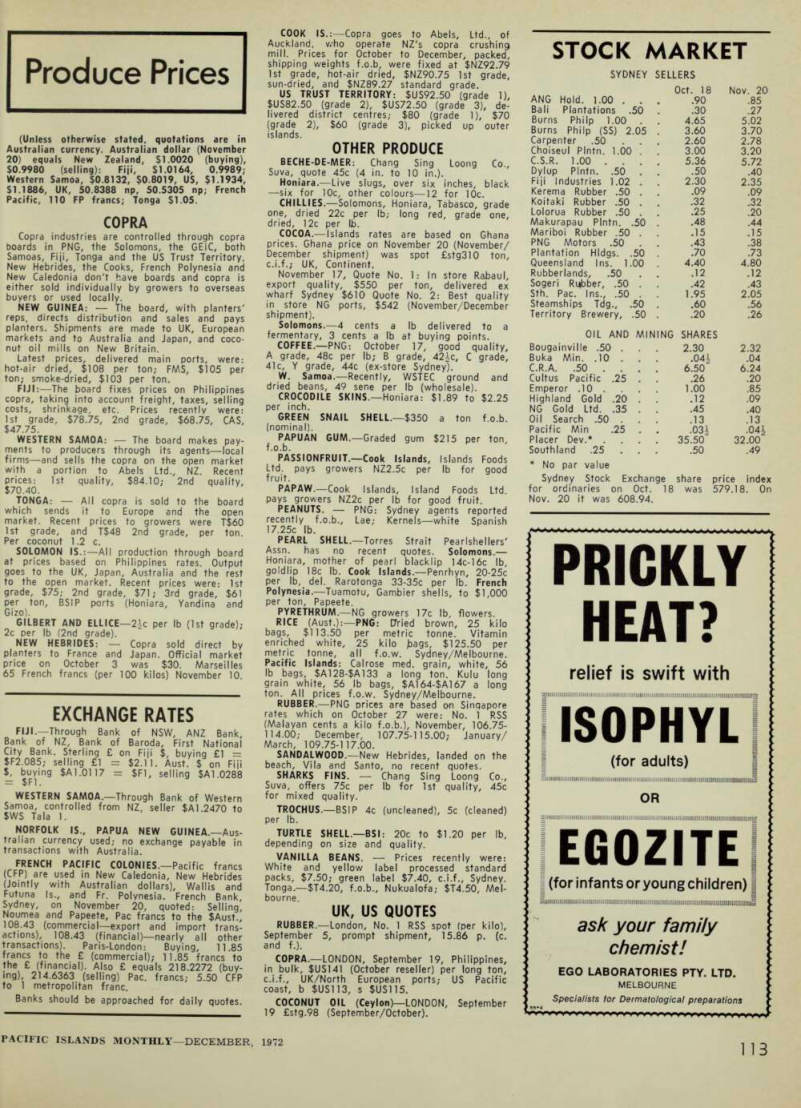
(Unless otherwise stated, quotations are in Australian currency. Australian dollar (November 20) equals New Zealand, $1.0020 (buying), 50.9980 (selling): Fiji, $1.0164, 0.9989; Western Samoa, $0.8132, $0.8019, US, $1.1934, $1.1886, UK, 50.8388 np, 50.5305 np; French Pacific, 110 FP francs; Tonga $1.05.
Copra
Copra industries are controlled through copra boards in PNG, the Solomons, the GEiC, both Samoas, Fiji, Tonga and the US Trust Territory.
New Hebrides, the Cooks, French Polynesia and New Caledonia don't have boards and copra is either sold individually by growers to overseas buyers or used locally.
NEW GUINEA; The board, with planters' reps, directs distribution and sales and pays planters. Shipments are made to UK, European markets and to Australia and Japan, and coco nut oil mills on New Britain.
Latest prices, delivered main ports, were: hot-air dried, $lOB per ton; FMS, $lO5 per ton; smoke-dried, $lO3 per ton.
FIJI: —The board fixes prices on Philippines copra, taking into account freight, taxes, selling costs, shrinkage, etc. Prices recently were: Ist grade, $78.75, 2nd grade, $68.75, CAS, $47.75.
WESTERN SAMOA: The board makes pay ments to producers through its agents—local firms—and sells the copra on the open market with a portion to Abels Ltd., NZ. Recent prices: Ist quality, $84.10; 2nd quality, $70.40.
TONGA: All copra is sold to the board which sends it to Europe and the open market. Recent prices to growers were Ts6o Ist grade, and Ts4B 2nd grade, per ton.
Per coconut 1.2 c.
SOLOMON IS.: —All production through board at prices based on Philippines rates. Output goes to the UK, Japan, Australia and the rest to the open market. Recent prices were: Ist grade, $75; 2nd grade, $7l; 3rd grade, $6l per ton, BSIP ports (Honiara, Yandina and Gizo).
GILBERT AND ELLICE— per lb (Ist grade); 2c per lb (2nd grade).
NEW HEBRIDES: Copra sold direct by planters to France and Japan. Official market price on October 3 was $3O. Marseilles 65 French francs (per 100 kilos) November 10.
Exchange Rates
FlJl.— Through Bank of NSW, ANZ Bank, Bank of NZ, Bank of Baroda, First National City Bank. Sterling £ on Fiji $, buying £1 = $F2.085; selling £1 = $2.11. Aust. $ on Fiji $, buying $A 1.0117 = SFI, selling $A1.0288
Sfi.
WESTERN SAMOA. —Through Bank of Western Samoa, controlled from NZ, seller $A1.2470 to SWS Tala 1.
Norfolk Is., Papua New Gulnea.—Aus
tralian currency used; no exchange payable in transactions with Australia.
FRENCH PACIFIC COLONIES. —Pacific francs (CFP) are used in New Caledonia, New Hebrides (Jointly with Australian dollars), Wallis and Futuna Is., and Fr. Polynesia. French Bank, Sydney, on November 20, quoted: Selling, Noumea and Papeete, Pac francs to the sAust., 108.43 (commercial —export and import trans actions), 108.43 (financial) —nearly all other transactions). Paris-London: Buying, 11.85 francs to the £ (commercial); 11.85 francs to the £ (financial). Also £ equals 218.2272 (buy ing), 214.6363 (selling) Pac. francs; 5.50 CFP to 1 metropolitan franc.
Banks should be approached for daily quotes.
COOK IS.: —Copra goes to Abels, Ltd., of Auckland, who operate NZ's copra crushing mill. Prices for October to December, packed, shipping weights f.o.b, were fixed at $NZ92.79 Ist grade, hot-air dried, $NZ90.75 Ist grade, sun-dried, and $NZ89.27 standard grade.
Us Trust Territory: $U592.50 (Grade 1),
$U582.50 (grade 2), $U572.50 (grade 3), de livered district centres; $BO (grade 1), $7O (grade 2), $6O (grade 3), picked up outer islands.
Other Produce
BECHE-DE-MER: Chang Sing Loong Co., Suva, quote 45c (4 in. to 10 in.).
Honiara. —Live slugs, over six inches, black —six for 10c, other colours—l2 for 10c.
CHILLIES. —SoIomons, Honiara, Tabasco, grade one, dried 22c per lb; long red, grade one, dried, 12c per lb.
COCOA. —lslands rates are based on Ghana prices. Ghana price on November 20 (November/ December shipment) was spot £stg3lo ton, c.i.f.; UK, Continent.
November 17, Quote No. 1; In store Rabaul, export quality, $550 per ton, delivered ex wharf Sydney $6lO Quote No. 2: Best quality in store NG ports, $542 (November/December shipment).
Solomons. —4 cents a lb delivered to a fermentary, 3 cents a lb at buying points.
COFFEE. —PNG: October 17, good quality, A grade, 48c per lb; B grade, 42£c, C grade, 41c, Y grade, 44c (ex-store Sydney).
W. Samoa. —Recently, WSTEC ground and dried beans, 49 sene per lb (wholesale).
CROCODILE SKlNS.— Honiara: $1.89 to $2.25 per inch.
GREEN SNAIL SHELL.— S3SO a ton f.o.b. (nominal).
PAPUAN GUM. —Graded gum $215 per ton, f.o.b.
PASSIONFRUIT. — Cook Islands, Islands Foods Ltd. pays growers NZ2.5c per lb for good fruit.
PAPAW. —Cook Islands, Island Foods Ltd. pays growers NZ2c per lb for good fruit.
PEANUTS. PNG: Sydney agents reported recently f.0.b., Lae; Kernels—white Spanish 17.25 c lb.
PEARL SHELL. —Torres Strait Pearlshellers' Assn, has no recent quotes. Solomons. — Honiara, mother of pearl blacklip 14c-16c lb, goldlip 18c lb. Cook Islands. —Penrhyn, 20-25 c per lb, del. Rarotonga 33-35 c per lb. French Polynesia.— Tuamotu, Gambier shells, to $l,OOO per ton, Papeete.
PYRETHRUM. —NG growers 17c lb, flowers.
RICE (Aust.):— PNG: Dried brown, 25 kilo bags, $113.50 per metric tonne. Vitamin enriched white, 25 kilo £>ags, $125.50 per metric tonne, all f.o.w. Sydney/Melbourne.
Pacific Islands; Calrose med. grain, white, 56 lb bags, SAI2B-SAI33 a long ton. Kulu long grain white, 56 lb bags, SAI64-SAI67 a long ton. All prices f.o.w. Sydney/Melbourne.
RUBBER. —PNG prices are based on Singapore rates which on October 27 were: No. 1 RSS (Malayan cents a kilo f.0.b.), November, 106.75- 114.00; December, 107.75-115.00; January/ March, 109.75-117.00.
SANDALWOOD. —New Hebrides, landed on the beach, Vila and Santo, no recent quotes.
SHARKS FINS. Chang Sing Loong Co., Suva, offers 75c per lb for Ist quality, 45c for mixed quality.
TROCHUS. —BSIP 4c (uncleaned), 5c (cleaned) per lb.
TURTLE SHELL.—BSI: 20c to $1.20 per lb, depending on size and quality.
VANILLA BEANS. Prices recently were: White and yellow label processed standard packs, $7.50; green label $7.40, c.i.f., Sydney.
Tonga.—sT4.2o, f.0.b., Nukualofa; $T4.50, Mel bourne.
Uk, Us Quotes
RUBBER. —London, No. 1 RSS spot (per kilo), September 5, prompt shipment, 15.86 p. (c. and f.).
COPRA. —LONDON, September 19, Philippines, in bulk, SL)SI4I (October reseller) per long ton, c.i.f., UK/North European ports; US Pacific coast, b SUSII3, s SUSIIS.
COCONUT OIL (Ceylon)— LONDON, September 19 £stg.9B (September/October).
Stock Market
Sydney Sellers
Sydney Stock Exchange share price index for ordinaries on Oct. 18 was 579.18. On Nov. 20 it was 608.94.
Oct. 18 Nov. 20 ANG Hold. ].00 . .90 .85 Bali Plantations . 50 . .30 .27 Burns Philp 1.00 4.65 5.02 Burns Philp (SS) 2 .05 .' 3.60 3.70 Carpenter .50 2.60 2.78 Choiseul Plntn. 1.00 3.00 3.20
C.S.R. 1.00 . .
5.36 5.72 Dylup Plntn, .50 .50 .40 Fiji Industries 1.02 2.30 2.35 Kerema Rubber .50 .09 .09 Koitaki Rubber .50 .32 .32 Lolorua Rubber .50 .25 .20 Makurapau Plntn. .50 .* .48 .44 Mariboi Rubber .50 .15 .15 PNG Motors .50 .43 .38 Plantation Hldgs. 50 ! .70 .73 Queensland Ins. 1. 00 . 4.40 4.80
Rubberlands, .50
.12 .12 Sogeri Rubber, .50 .42 .43 Sth. Pac. Ins., .50 1.95 2.05 Steamships Tdg., . 50 ! .60 .56 Territory Brewery, .50 . .20 .26
Oil And
Mining Shares
Bougainville .50 . 2.30 2.32 Buka Min. .10 .04^ .04
C.R.A. .50 . .
6.50 6.24 Cultus Pacific .25 .26 .20 Emperor .10 . 1.00 .85 Highland Gold .20 .12 .09 NG Gold Ltd. .35 .45 .40 Oil Search .50 .13 .13 Pacific Min .25 .03 i .04£ Placer Dev.* . 35.50 32.00 Southland .25 .50 .49 * No par value
Advertisements & other items, pp. 115-116 (1 item)
Prickly
HEAT?
relief is swift with
ISOPHYL
(for adults) OR
EGOZITE
(for infants or young children) ask your family chemist!
EGO LABORATORIES PTY. LTD.
MELBOURNE
Specialists lor Dermatological preparations
THE BANK LINE
MONTHLY SERVICES
U.K., CONTINENT to PAPUA-NEW GUINEA & SOLOMON ISLANDS PAPUA, NEW GUINEA to NORTH AMERICA & U.K., CONTINENT SOLOMON ISLANDS, FIJI, TONGA, SAMOA AND TARAWA to U.K.,
CONTINENT
☆ U.S. GULF/AUSTRALASIA VESSELS CALL AT FIJI WHEN REQUIRED SlMl ■•Jii
FOR PARTICULARS APPLY:
THE BANK LINE (AUSTRALASIA) PTY. LTD., SYDNEY, N.S.W.
New Guinea Express Lines
FAST NEW SERVICE IN FAST NEW SHIPS AA.V.s Lae Express/Moresby Express.
Direct Express Services.
Melbourne • Sydney • Port Moresby • Lae Sydney • Brisbane • Lae • Rabaul. 80 ft Hatches 20 ton lifts—2o ton Refrigerated containers, Unitised and Palletised, General Cargo.
Sydney —Refrigerated Express Lines (A'asia) Pty Ltd, 37 Pitt Street, Sydney. Telephone 2411396.
Brisbane —Refrigerated Express Lines (A'asia) Pty Ltd, 70 Eagle Street, Brisbane. Telephone 21 9333.
Melbourne —Westralian Farmers Transport Pty Ltd, 459 Collins Street, Melbourne. Telephone 67 8766.
Port Moresby —Breckwoldt Shipping Agencies, P.O. Box 1549, Port Moresby. Telephone 2985.
Lae —Breckwoldt Shipping Agencies, Telephone 4 2819.
Rabaul —Breckwoldt Shipping Agencies, Telephone 92 3381. , Lae.
Rabaul. 557 P.O.
Box > -
Shipping & Airways Information
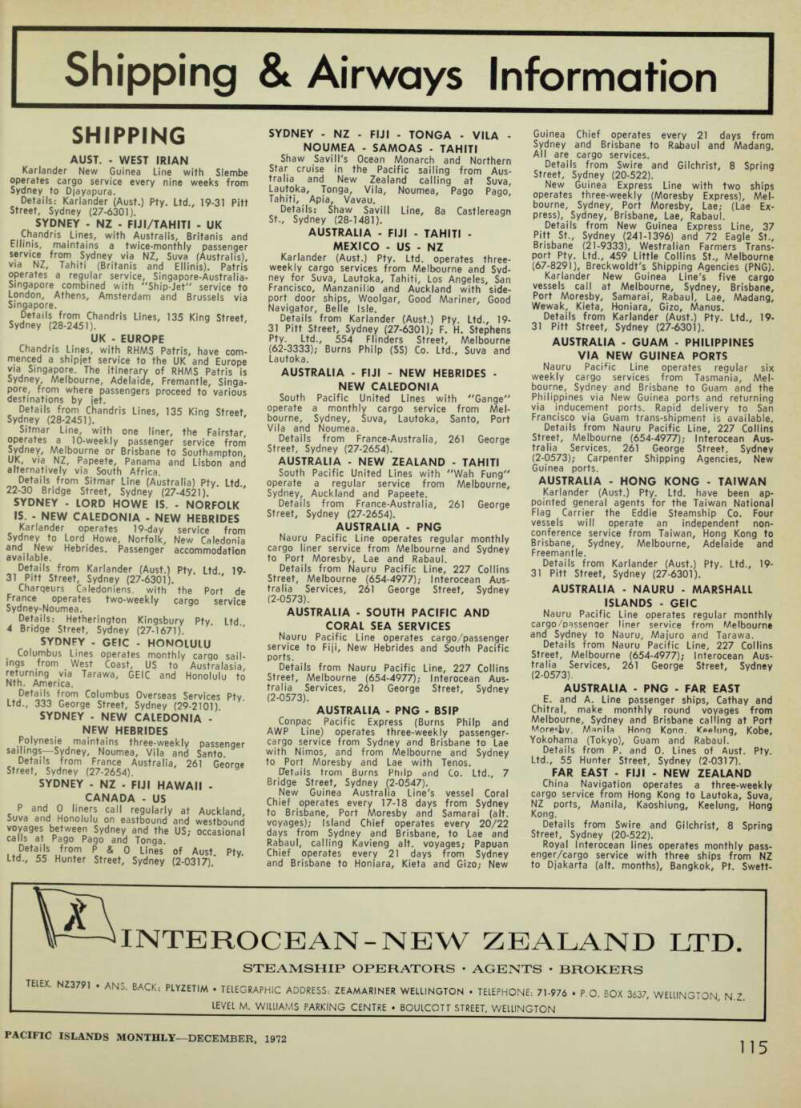
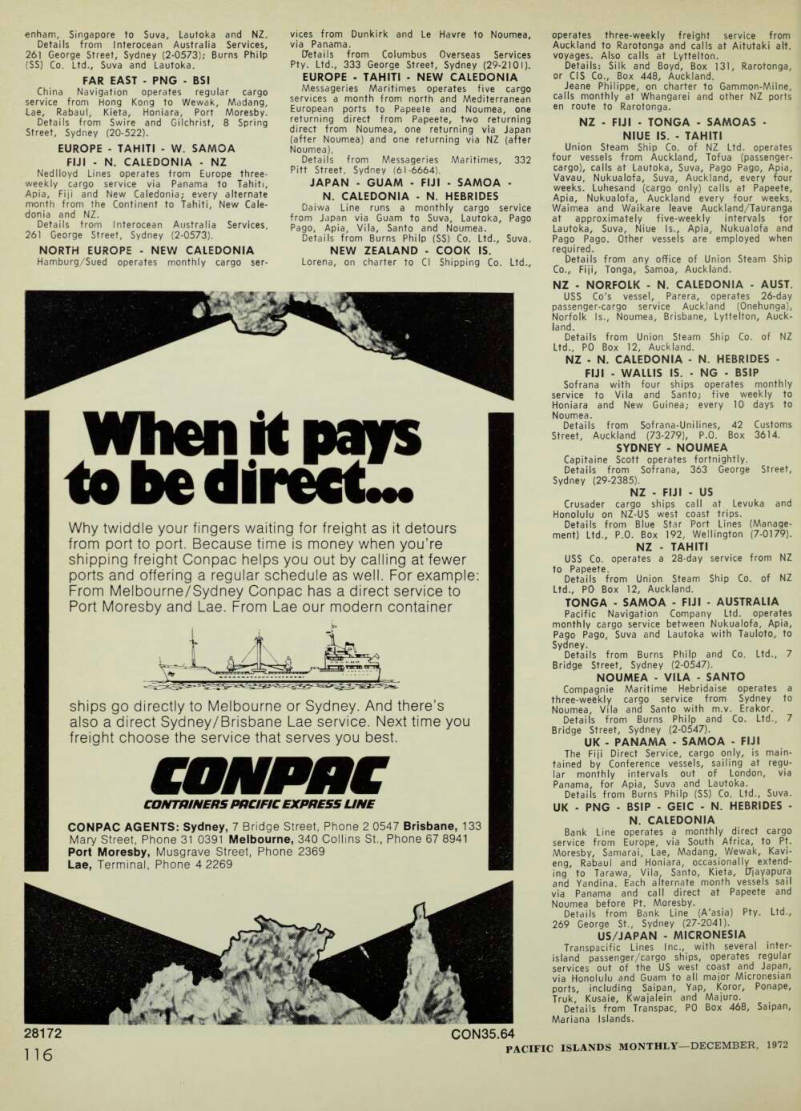
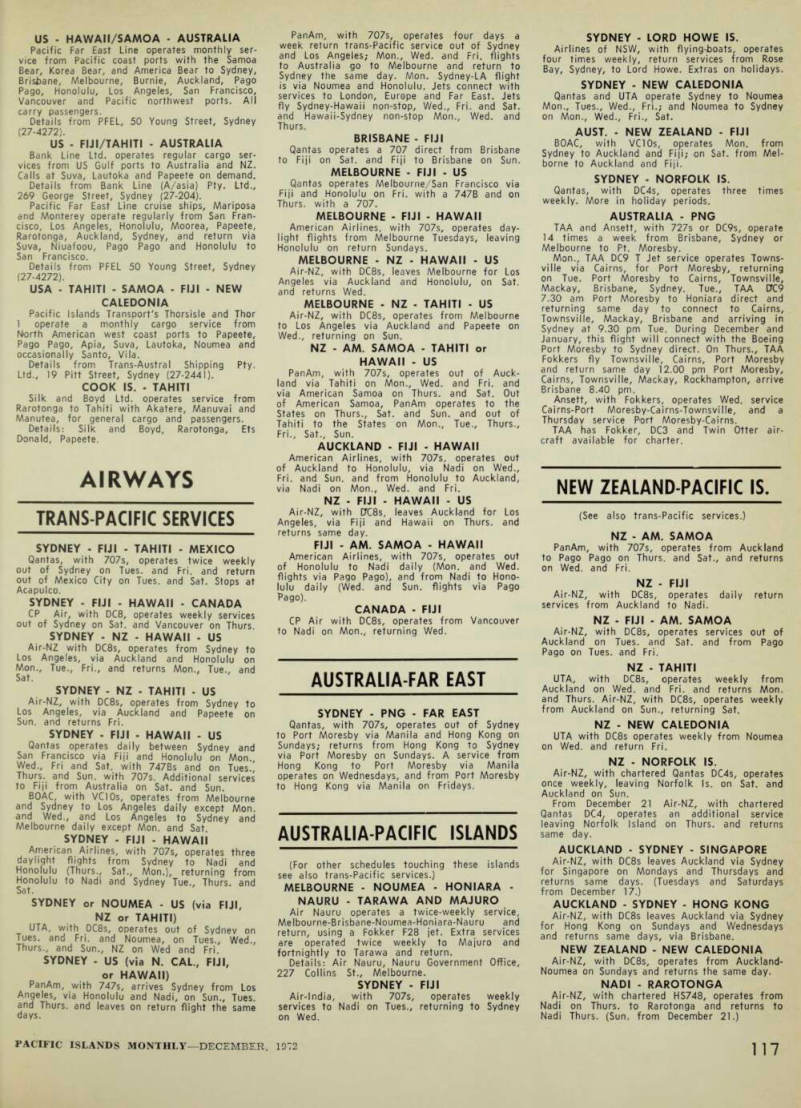
Shipping
Aust. - West Irian
Karlander New Guinea Line with Slembe operates cargo service every nine weeks from Sydney to Djayapura.
Details: Karlander (Aust.) Pty. Ltd., 19-31 Pitt Street, Sydney (27-6301), SYDNEY - NZ - FIJI/TAHITI - UK Chandris Lines, with Australis, Britanis and Emms, maintains a twice-monthly passenger service from Sydney via NZ, Suva (Australis), via NZ, Tahiti (Britanis and Ellinis). Patris operates a regular service, Singapore-Australia- Smgapore combined with "Ship-Jet" service to London, Athens, Amsterdam and Brussels via Singapore.
Details from Chandris Lines, 135 King Street, Sydney (28-2451).
Uk - Europe
Chandris Lines, with RHMS Patris, have com menced a shipjet service to the UK and Europe via Singapore. The itinerary of RHMS Patris is Sydney, Melbourne, Adelaide, Fremantle, Singa pore, from where passengers proceed to various destinations by jet.
Details from Chandris Lines, 135 King Street, Sydney (28-2451).
Sitmar Line, with one liner, the Fairstar, operates a 10-weekly passenger service from Sydney, Melbourne or Brisbane to Southampton, UK, via NZ, Papeete, Panama and Lisbon and alternatively via South Africa.
Details from Sitmar Line (Australia) Pty. Ltd., 22-30 Bridge Street, Sydney (27-4521).
SYDNEY - LORD HOWE IS. - NORFOLK IS. - NEW CALEDONIA - NEW HEBRIDES Karlander operates 19-day service from Sydney to Lord Howe, Norfolk, New Caledonia and New Hebrides. Passenger accommodation available.
Details from Karlander (Aust.) Pty Ltd 19- 31 Pitt Street, Sydney (27-6301).
Charqeurs Caledoniens, with the Port de France operates two-weekly cargo service Sydney-Noumea.
Details: Hetherington Kingsbury Pty Ltd 4 Bridge Street, Sydney (27-1671).
Sydney - Geic ■ Honolulu
Columbus Lines operates monthly cargo sail ings from West Coast, US to Australasia, returning via Tarawa, GEIC and Honolulu to Nth. America.
Details from Columbus Overseas Services Pty.
Ltd., 333 George Street, Sydney (29-2101)
Sydney - New Caledonia -
New Hebrides
Polynesia maintains three-weekly passenger sailings—Sydney, Noumea, Vila and Santo.
Details from France Australia, 261 George Street, Sydney (27-2654).
SYDNEY - NZ - FIJI HAWAII -
Canada - Us
P and 0 liners call regularly at Auckland, Suva and Honolulu on eastbound and westbound voyages between Sydney and the US; occasional calls at Pago Pago and Tonga.
Details from P & 0 Lines of Aust. Pty.
Ltd., 55 Hunter Street, Sydney (2-0317).
SYDNEY - NZ - FIJI - TONGA ■ VILA -
Noumea - Samoas - Tahiti
Shaw Savill's Ocean Monarch and Northern Star cruise in the Pacific sailing from Aus tralia and New Zealand calling at Suva, Lautoka, Tonga, Vila, Noumea, Pago Pago, Tahiti, Apia, Vavau, Details: Shaw Savill Line, 8a Castlereagn St., Sydney (28-1481).
Australia - Fiji - Tahiti -
Mexico - Us - Nz
Karlander (Aust.) Pty. Ltd. operates three weekly cargo services from Melbourne and Syd ney for Suva, Lautoka, Tahiti, Los Angeles, San Francisco, Manzanillo and Auckland with side port door ships, Woolgar, Good Mariner, Good Navigator, Belle Isle, Details from Karlander (Aust.) Pty. Ltd., 19- 31 Pitt Street, Sydney (27-6301); F. H. Stephens Pty. Ltd., 554 Flinders Street, Melbourne (62-3333); Burns Phi Ip (SS) Co. Ltd., Suva and Lautoka.
AUSTRALIA - FIJI - NEW HEBRIDES -
New Caledonia
South Pacific United Lines with "Gange" operate a monthly cargo service from Mel bourne, Sydney, Suva, Lautoka, Santo, Port Vila and Noumea.
Details from France-Australia, 261 George Street, Sydney (27-2654).
Australia - New Zealand ■ Tahiti
South Pacific United Lines with "Wah Fung" operate a regular service from Melbourne, Sydney, Auckland and Papeete.
Details from France-Australia, 261 George Street, Sydney (27-2654).
Australia - Png
Nauru Pacific Line operates regular monthly cargo liner service from Melbourne and Sydney to Port Moresby, Lae and Rabaul.
Details from Nauru Pacific Line, 227 Collins Street, Melbourne (654-4977); Interocean Aus tralia Services, 261 George Street, Sydney (2-0573).
Australia - South Pacific And
Coral Sea Services
Nauru Pacific Line operates cargo/passenger service to Fiji, New Hebrides and South Pacific ports.
Details from Nauru Pacific Line, 227 Collins Street, Melbourne (654-4977); Interocean Aus tralia Services, 261 George Street, Sydney (2-0573).
Australia - Png - Bsip
Conpac Pacific Express (Burns Philp and AWP Line) operates three-weekly passenger cargo service from Sydney and Brisbane to Lae with Nimos, and from Melbourne and Sydney to Port Moresby and Lae with Tenos.
Details trom Burns Philp and Co. Ltd., 7 Bridge Street, Sydney (2-0547).
New Guinea Australia Line's vessel Coral Chief operates every 17-18 days from Sydney to Brisbane, Port Moresby and Samarai (alt. voyages); Island Chief operates every 20/22 days from Sydney and Brisbane, to Lae and Rabaul, calling Kavieng alt. voyages; Papuan Chief operates every 21 days from Sydney and Brisbane to Honiara, Kieta and Gizo; New
Guinea Chief operates every 21 days from Sydney and Brisbane to Rabaul and Madang.
All are cargo services.
Details from Swire and Gilchrist, 8 Spring Street, Sydney (20-522).
New Guinea Express Line with two ships operates three-weekly (Moresby Express), Mel bourne, Sydney, Port Moresby, Lae; (Lae Ex press), Sydney, Brisbane, Lae, Rabaul.
Details from New Guinea Express Line, 37 Pitt St., Sydney (241-1396) and 72 Eagle St., Brisbane (21-9333), Westralian Farmers Trans port Pty. Ltd., 459 Little Collins St., Melbourne (67-8291), Breckwoldt's Shipping Agencies (PNG).
Karlander New Guinea Line's five cargo vessels call at Melbourne, Sydney, Brisbane, Port Moresby, Samarai, Rabaul, Lae, Madang, Wewak, Kieta, Honiara, Gizo, Manus.
Details from Karlander (Aust.) Pty, Ltd., 19- 31 Pitt Street, Sydney (27-6301).
Australia - Guam - Philippines
Via New Guinea Ports
Nauru Pacific Line operates regular six weekly cargo services from Tasmania, Mel bourne, Sydney and Brisbane to Guam and the Philippines via New Guinea ports and returning via inducement ports. Rapid delivery to San Francisco via Guam trans-shipment is available.
Details from Nauru Pacific Line, 227 Collins Street, Melbourne (654-4977); Interocean Aus tralia Services, 261 George Street, Sydney (2-0573); Carpenter Shipping Agencies, New Guinea ports.
Australia - Hong Kong - Taiwan
Karlander (Aust.) Pty. Ltd. have been ap pointed general agents for the Taiwan National Flag Carrier the Eddie Steamship Co. Four vessels will operate an independent non conference service from Taiwan, Hong Kong to Brisbane, Sydney, Melbourne, Adelaide and Freemantle.
Details from Karlander (Aust.) Pty. Ltd., 19- 31 Pitt Street, Sydney (27-6301).
Australia - Nauru - Marshall
Islands - Geic
Nauru Pacific Line operates regular monthly cargo/passenqer liner service from Melbourne and Sydney to Nauru, Majuro and Tarawa.
Details from Nauru Pacific Line, 227 Collins Street, Melbourne (654-4977); Interocean Aus tralia Services, 261 George Street, Sydney (2-0573).
Australia - Png - Far East
E. and A. Line passenger ships, Cathay and Chitral, make monthly round voyages from Melbourne, Sydney and Brisbane calling at Port Moresby, Manila Hong Kona. Kaelung, Kobe, Yokohama (Tokyo), Guam and Rabaul.
Details from P. and 0. Lines of Aust. Pty.
Ltd., 55 Hunter Street, Sydney (2-0317).
FAR EAST - FIJI - NEW ZEALAND China Navigation operates a three-weekly cargo service from Hong Kong to Lautoka, Suva, NZ ports, Manila, Kaoshiung, Keelung, Hong Kong.
Details from Swire and Gilchrist, 8 Spring Street, Sydney (20-522).
Royal Interocean lines operates monthly pass enger/cargo service with three ships from NZ to Djakarta (alt. months), Bangkok, Pt. Swett
«nham, Singapore to Suva, Lautoka and NZ.
Details from Interocean Australia Services, 261 George Street, Sydney (2-0573); Burns Philp (SS) Co. Ltd., Suva and Lautoka.
Far East - Png - Bsi
China Navigation operates regular cargo service from Hong Kong to Wewak, Madang, Lae, Rabaul, Kieta, Honiara, Port Moresby.
Details from Swire and Gilchrist, 8 Spring Street, Sydney (20-522).
Europe - Tahiti - W. Samoa
Fiji - N, Caledonia - Nz
Nedlloyd Lines operates from Europe three weekly cargo service via Panama to Tahiti, Apia, Fiji and New Caledonia; every alternate month from the Continent to Tahiti, New Cale donia and NZ.
Details from Interocean Australia Services, 261 George Street, Sydney (2-0573).
North Europe - New Caledonia
Hamburg/Sued operates monthly cargo ser
vices from Dunkirk and Le Havre to Noumea, via Panama.
Details from Columbus Overseas Services Pty. Ltd., 333 George Street, Sydney (29-2101).
Europe - Tahiti - New Caledonia
Messageries Maritimes operates five cargo services a month from north and Mediterranean European ports to Papeete and Noumea, one returning direct from Papeete, two returning direct from Noumea, one returning via Japan (after Noumea) and one returning via NZ (after Noumea).
Details from Messageries Maritimes, 332 Pitt Street, Sydney (61-6664).
JAPAN - GUAM - FIJI - SAMOA -
N. Caledonia - N. Hebrides
Daiwa Line runs a monthly cargo service from Japan via Guam to Suva, Lautoka, Pago Pago, Apia, Vila, Santo and Noumea.
Details from Burns Philp (SS) Co. Ltd., Suva.
New Zealand - Cook Is.
Lorena, on charter to Cl Shipping Co. Ltd.,
operates three-weekly freight service from Auckland to Rarotonga and calls at Aitutaki alt. voyages. Also calls at Lyttelton.
Details: Silk and Boyd, Box ]3l, Rarotonga, or CIS Co., Box 448, Auckland.
Jeane Philippe, on charter to Gammon-Milne, calls monthly at Whangarei and other NZ ports en route to Rarotonga.
NZ - FIJI - TONGA - SAMOAS •
Niue Is. - Tahiti
Union Steam Ship Co. of NZ Ltd. operates four vessels from Auckland, Tofua (passenger cargo), calls at Lautoka, Suva, Pago Pago, Apia, Vavau, Nukualofa, Suva, Auckland, every four weeks. Luhesand (cargo only) calls at Papeete, Apia, Nukualofa, Auckland every four weeks.
Waimea and Waikare leave Auckland/Tauranga at approximately five-weekly intervals for Lautoka, Suva, Niue Is., Apia, Nukualofa and Pago Pago. Other vessels are employed when required.
Details from any office of Union Steam Ship Co., Fiji, Tonga, Samoa, Auckland.
NZ - NORFOLK - N. CALEDONIA - AUST.
USS Co's vessel, Parera, operates 26-day passenger-cargo service Auckland (Onehunga), Norfolk Is., Noumea, Brisbane, Lyttelton, Auck land.
Details from Union Steam Ship Co. of NZ Ltd., PO Box 12, Auckland.
NZ - N. CALEDONIA - N. HEBRIDES - FIJI - WALLIS IS. - NG - BSIP Sofrana with four ships operates monthly service to Vila and Santo; five weekly to Honiara and New Guinea; every 10 days to Noumea.
Details from Sofrana-Unilines, 42 Customs Street, Auckland (73-279), P.O. Box 3614.
Sydney - Noumea
Capitaine Scott operates fortnightly.
Details from Sofrana, 363 George Street, Sydney (29-2385).
Nz - Fiji - Us
Crusader cargo ships call at Levuka and Honolulu on NZ-US west coast trips.
Details from Blue Star Port Lines (Manage ment) Ltd., P.O. Box 192, Wellington (7-0179).
Nz - Tahiti
USS Co. operates a 28-day service from NZ to Papeete.
Details from Union Steam Ship Co. of NZ Ltd., PO Box 12, Auckland.
TONGA - SAMOA - FIJI - AUSTRALIA Pacific Navigation Company Ltd. operates monthly cargo service between Nukualofa, Apia, Pago Pago, Suva and Lautoka with Tauloto, to Sydney.
Details from Burns Philp and Co. Ltd., 7 Bridge Street, Sydney (2-0547).
Noumea - Vila - Santo
Compagnie Maritime Hebridaise operates a three-weekly cargo service from Sydney to Noumea, Vila and Santo with m.v. Erakor.
Details from Burns Philp and Co. Ltd., 7 Bridge Street, Sydney (2-0547).
UK - PANAMA - SAMOA - FIJI The Fiji Direct Service, cargo only, is main tained by Conference vessels, sailing at regu lar monthly intervals out of London, via Panama, for Apia, Suva and Lautoka.
Details from Burns Philp (SS) Co. Ltd., Suva.
UK - PNG - BSIP - GEIC - N. HEBRIDES -
N. Caledonia
Bank Line operates a monthly direct cargo service from Europe, via South Africa, to Pt.
Moresby, Samarai, Lae, Madang, Wewak, Kavi eng, Rabaul and Honiara, occasionally extend ing to Tarawa, Vila, Santo, Kieta, Djayapura and Yandina. Each alternate month vessels sail via Panama and call direct at Papeete and Noumea before Pt. Moresby.
Details from Bank Line (A'asia) Pty. Ltd., 269 George St., Sydney (27-2041).
Us/Japan - Micronesia
Transpacific Lines Inc., with several inter island passenger/cargo ships, operates regular services out of the US west coast and Japan, via Honolulu and Guam to all major Micronesian ports, including Saipan, Yap, Koror, Ponape, Truk, Kusaie, Kwajalein and Majuro.
Details from Transpac, PO Box 468, Saipan, Mariana Islands.
Us - Hawaii/Samoa - Australia
Pacific Far East Line operates monthly ser vice from Pacific coast ports with the Samoa Bear, Korea Bear, and America Bear to Sydney, Brisbane, Melbourne, Burnie, Auckland, Pago Pago, Honolulu, Los Angeles, San Francisco, Vancouver and Pacific northwest ports. All carry passengers.
Details from PFEL, 50 Young Street, Sydney (27-4272).
Us - Fiji/Tahiti - Australia
Bank Line Ltd. operates regular cargo ser vices from US Gulf ports to Australia and NZ.
Calls at Suva, Lautoka and Papeete on demand.
Details from Bank Line (A/asia) Pty. Ltd., 269 George Street, Sydney (27-204).
Pacific Far East Line cruise ships, Mariposa and Monterey operate regularly from San Fran cisco, Los Angeles, Honolulu, Moorea, Papeete, Rarotonga, Auckland, Sydney, and return via Suva, Niuafoou, Pago Pago and Honolulu to San Francisco.
Details from PFEL 50 Young Street, Sydney (27-4272).
USA ■ TAHITI - SAMOA - FIJI - NEW
Caledonia
Pacific Islands Transport's Thorsisle and Thor 1 operate a monthly cargo service from North American west coast ports to Papeete, Pago Pago, Apia, Suva, Lautoka, Noumea and occasionally Santo, Vila.
Details from Trans-Austral Shipping Pty.
Ltd., 19 Pitt Street, Sydney (27-2441).
Cook Is. - Tahiti
Silk and Boyd Ltd. operates service from Rarotonga to Tahiti with Akatere, Manuvai and Manutea, for general cargo and passengers.
Details: Silk and Boyd, Rarotonga, Ets Donald, Papeete.
Advertisements & other items, pp. 117-118 (1 item)
Interocean-New Zealand Ltd
\B
STEAMSHIP OPERATORS • AGENTS • BROKERS
TELEX. N 23791 . ANS. BACK: PLYZETIM • TELEGRAPHIC ADDRESS: ZEAMARINER WELLINGTON • TELEPHONE: 71-976 • P.O. BOX 3637, WELLINGTON, N.Z.
LEVEL M. WILLIAMS PARKING CENTRE • BOULCOTT STREET, WELLINGTON
When it pays
to be direct—
Why twiddle your fingers waiting for freight as it detours from port to port. Because time is money when you’re shipping freight Conpac helps you out by calling at fewer ports and offering a regular schedule as well. For example: From Melbourne/Sydney Conpac has a direct service to Port Moresby and Lae. From Lae our modern container ships go directly to Melbourne or Sydney. And there’s also a direct Sydney/Brisbane Lae service. Next time you freight choose the service that serves you best.
tONPnc
CONTRINERS PHCIFIC EXPRESS UNE
CONPAC AGENTS: Sydney, 7 Bridge Street, Phone 2 0547 Brisbane, 133 Mary Street, Phone 31 0391 Melbourne, 340 Collins St., Phone 67 8941 Port Moresby, Musgrave Street, Phone 2369 Lae, Terminal, Phone 4 2269
Airways
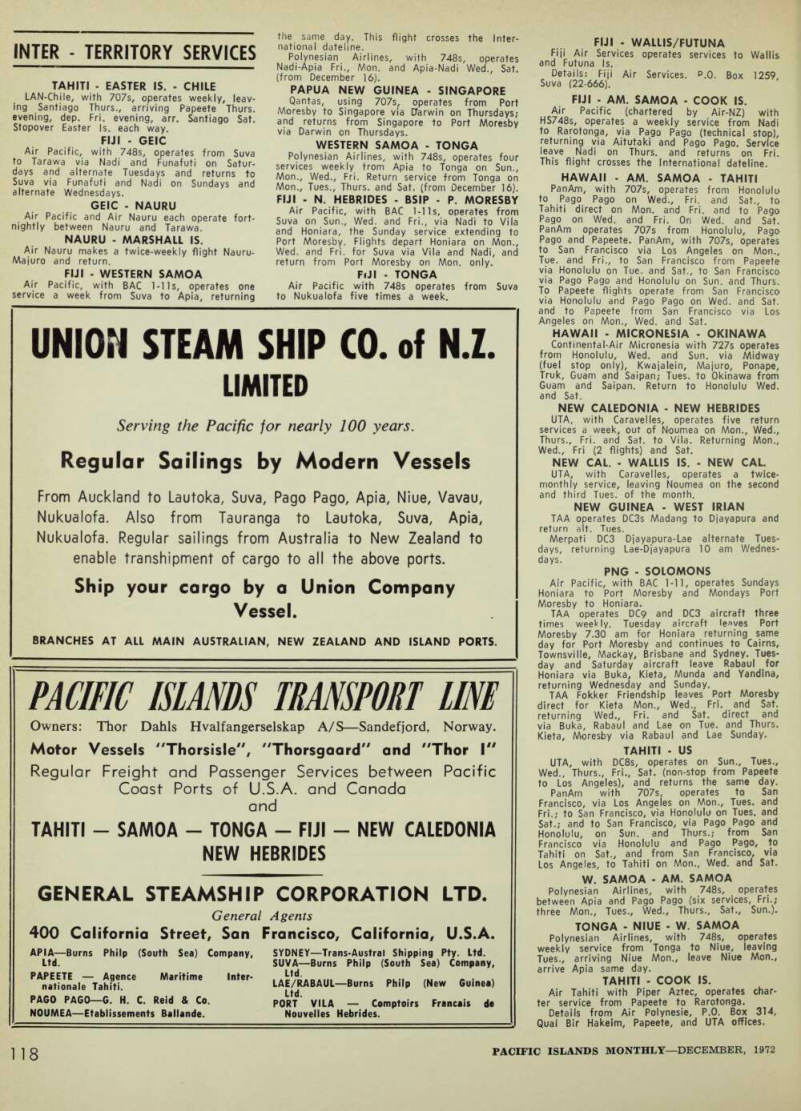
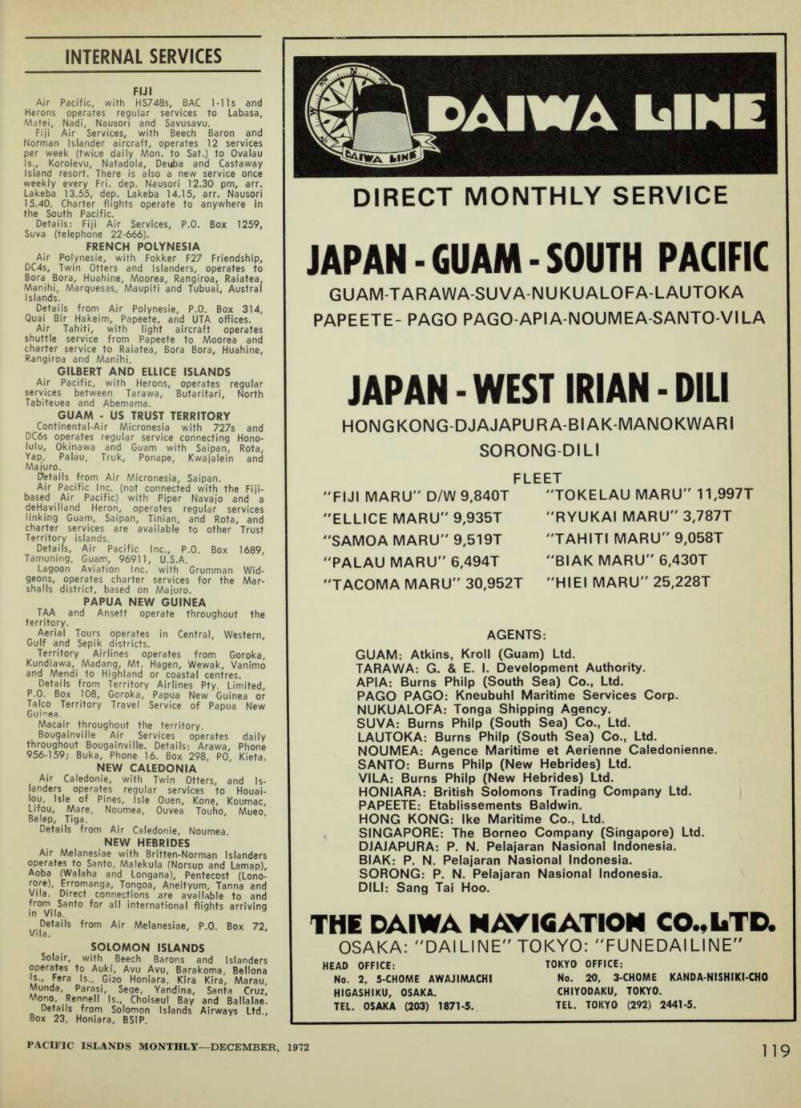
Trans Pacific Services
SYDNEY ■ FIJI - TAHITI - MEXICO Qantas, with 7075, operates twice weekly out of Sydney on Tues. and Fri. and return out of Mexico City on Tues. and Sat. Stops at Acapulco.
SYDNEY - FIJI - HAWAII - CANADA CP Air, with DCS, operates weekly services out of Sydney on Sat. and Vancouver on Thurs.
SYDNEY - NZ • HAWAII - US Air-NZ with DCBs, operates from Sydney to Los Angeles, via Auckland and Honolulu on Mon., Tue., Fri., and returns Mon., Tue., and Sat.
SYDNEY - NZ - TAHITI - US Air-NZ, with DCBs, operates from Sydney to Los Angeles, via Auckland and Papeete on Sun. and returns Fri.
SYDNEY - FIJI - HAWAII - US Qantas operates daily between Sydney and San Francisco via Fiji and Honolulu on Mon.
Wed., Fri and Sat. with 7478 s and on Tues.' Thurs. and Sun. with 7075. Additional services to Fiji from Australia on Sat. and Sun.
BOAC, with VClOs, operates from Melbourne and Sydney to Los Angeles daily except Mon. and Wed., and Los Angeles to Sydney and Melbourne daily except Mon. and Sat.
Sydney - Fiji - Hawaii
American Airlines, with 7075, operates three daylight flights from Sydney to Nadi and Honolulu (Thurs., Sat., Mon.), returning from Honolulu to Nadi and Sydney Tue., Thurs. and Sat.
SYDNEY or NOUMEA - US (via FIJI,
Nz Or Tahiti)
UTA, with DCBs, operates out of Sydney on Tues. and Fri. and Noumea, on Tues., Wed., Thurs., and Sun., NZ on Wed and Fri.
SYDNEY - US (via N. CAL, FIJI,
Or Hawaii)
PanAm, with 7475, arrives Sydney from Los Angeles, via Honolulu and Nadi, on Sun., Tues. and Thurs. and leaves on return flight the same days.
PanAm, with 7075, operates four days a week return trans-Pacific service out of Sydney and Los Angeles; Mon., Wed. and Fri. flights to Australia go to Melbourne and return to Sydney the same day. Mon. Sydney-LA flight is via Noumea and Honolulu. Jets connect with services to London, Europe and Far East. Jets fly Sydney-Hawaii non-stop. Wed., Fri. and Sat. and Hawaii-Sydney non-stop Mon., Wed. and Thurs.
Brisbane - Fiji
Qantas operates a 707 direct from Brisbane to Fiji on Sat. and Fiji to Brisbane on Sun.
Melbourne - Fiji - Us
Qantas operates Melbourne/San Francisco via Fiji and Honolulu on Fri. with a 7478 and on Thurs. with a 707.
Melbourne - Fiji - Hawaii
American Airlines, with 7075, operates day light flights from Melbourne Tuesdays, leaving Honolulu on return Sundays.
MELBOURNE - NZ - HAWAII - US Air-NZ, with DCBs, leaves Melbourne for Los Angeles via Auckland and Honolulu, on Sat. and returns Wed.
MELBOURNE • NZ - TAHITI - US Air-NZ, with DCBs, operates from Melbourne to Los Angeles via Auckland and Papeete on Wed., returning on Sun.
NZ - AM. SAMOA - TAHITI or
Hawaii - Us
PanAm, with 7075, operates out of Auck land via Tahiti on Mon., Wed. and Fri. and via American Samoa on Thurs. and Sat. Out of American Samoa, PanAm operates to the States on Thurs., S>at. and Sun. and out of Tahiti to the States on Mon., Tue., Thurs., Fri., Sat., Sun.
Auckland - Fiji - Hawaii
American Airlines, with 7075, operates out of Auckland to Honolulu, via Nadi on Wed., Fri. and Sun. and from Honolulu to Auckland, via Nadi on Mon., Wed. and Fri.
NZ - FIJI - HAWAII - US Air-NZ, with DCBs, leaves Auckland for Los Angeles, via Fiji and Hawaii on Thurs. and returns same day.
Fiji - Am. Samoa ■ Hawaii
American Airlines, with 7075, operates out of Honolulu to Nadi daily (Mon. and Wed. flights via Pago Pago), and from Nadi to Hono lulu daily (Wed. and Sun. flights via Pago Pago).
Canada - Fiji
CP Air with DCBs, operates from Vancouver to Nadi on Mon., returning Wed.
Australia-Far East
Sydney - Png - Far East
Qantas, with 7075, operates out of Sydney to Port Moresby via Manila and Hong Kong on Sundays; returns from Hong Kong to Sydney via Port Moresby on Sundays. A service from Hong Kong to Port Moresby via Manila operates on Wednesdays, and from Port Moresby to Hong Kong via Manila on Fridays.
Australia-Pacific Islands
(For other schedules touching these islands see also trans-Pacific services.)
Melbourne - Noumea - Honiara -
Nauru ■ Tarawa And Majuro
Air Nauru operates a twice-weekly service, Melbourne-Brisbane-Noumea-Honiara-Nauru and return, using a Fokker F2B jet. Extra services are operated twice weekly to Majuro and fortnightly to Tarawa and return.
Details: Air Nauru, Nauru Government Office, 227 Collins St., Melbourne.
Sydney - Fiji
Air-lndia, with 7075, operates weekly services to Nadi on Tues., returning to Sydney on Wed.
Sydney - Lord Howe Is.
Airlines of NSW, with flying-boats, operates four times weekly, return services from Rose Bay, Sydney, to Lord Howe. Extras on holidays.
Sydney - New Caledonia
Qantas and UTA operate Sydney to Noumea Mon., Tues., Wed., Fri.; and Noumea to Sydney on Mon., Wed., Fri., Sat.
Aust. - New Zealand - Fiji
BOAC, with VClOs, operates Mon. from Sydney to Auckland and Fiji; on Sat. from Mel borne to Auckland and Fiji.
Sydney - Norfolk Is.
Qantas, with DC4s, operates three times weekly. More in holiday periods.
Australia - Png
TAA and Ansett, with 727 s or DC9s, operate 14 times a week from Brisbane, Sydney or Melbourne to Pt. Moresby.
Mon., TAA DC9 T Jet service operates Towns ville via Cairns, for Port Moresby, returning on Tue. Port Moresby to Cairns, Townsville, Mackay, Brisbane, Sydney. Tue., TAA D’C9 7.30 am Port Moresby to Honiara direct and returning same day to connect to Cairns, Townsville, Mackay, Brisbane and arriving in Sydney at 9.30 pm Tue. During December and January, this flight will connect with the Boeing Port Moresby to Sydney direct. On Thurs., TAA Fokkers fly Townsville, Cairns, Port Moresby and return same day 12.00 pm Port Moresby, Cairns, Townsville, Mackay, Rockhampton, arrive Brisbane 8.40 pm.
Ansett, with Fokkers, operates Wed. service Cairns-Port Moresby-Cairns-Townsville, and a Thursday service Port Moresby-Cairns.
TAA has Fokker, DC3 and Twin Otter air craft available for charter.
New Zealand-Pacific Is.
(See also trans-Pacific services.)
Nz - Am. Samoa
PanAm, with 7075, operates from Auckland to Pago Pago on Thurs. and Sat., and returns on Wed. and Fri.
Nz - Fiji
Air-NZ, with DCBs, operates daily return services from Auckland to Nadi.
Nz - Fiji - Am. Samoa
Air-NZ, with DCBs, operates services out of Auckland on Tues. and Sat. and from Pago Pago on Tues. and Fri.
Nz - Tahiti
UTA, with DCBs, operates weekly from Auckland on Wed. and Fri. and returns Mon. and Thurs. Air-NZ, with DCBs, operates weekly from Auckland on Sun., returning Sat.
Nz - New Caledonia
UTA with DCBs operates weekly from Noumea on Wed. and return Fri,
Nz - Norfolk Is.
Air-NZ, with chartered Qantas DC4s, operates once weekly, leaving Norfolk Is. on Sat. and Auckland on Sun.
From December 21 Air-NZ, with chartered Qantas DC4, operates an additional service leaving Norfolk Island on Thurs. and returns
same day.
Auckland - Sydney - Singapore
Air-NZ, with DCBs leaves Auckland via Sydney for Singapore on Mondays and Thursdays and returns same days. (Tuesdays and Saturdays from December 17.)
Auckland - Sydney - Hong Kong
Air-NZ, with DCBs leaves Auckland via Sydney for Hong Kong on Sundays and Wednesdays and returns same days, via Brisbane.
New Zealand - New Caledonia
Air-NZ, with DCBs, operates from Auckland- Noumea on Sundays and returns the same day.
Nadi - Rarotonga
Air-NZ, with chartered HS74B, operates from Nadi on Thurs. to Rarotonga and returns to Nadi Thurs. (Sun. from December 21.)
Inter - Territory Services
Tahiti - Easter Is. - Chile
LAN-Chile, with 7075, operates weekly, leav ing Santiago Thurs., arriving Papeete Thurs. evening, dep. Fri. evening, arr. Santiago Sat.
Stopover Easter Is. each way.
Fiji • Geic
Air Pacific, with 7485, operates from Suva to Tarawa via Nadi and Funafuti on Satur days and alternate Tuesdays and returns to Suva via Funafuti and Nadi on Sundays and alternate Wednesdays.
Geic - Nauru
Air Pacific and Air Nauru each operate fort nightly between Nauru and Tarawa.
Nauru - Marshall Is.
Air Nauru makes a twice-weekly flight Nauru- Majuro and return.
Fiji - Western Samoa
Air Pacific, with BAC 1-1 Is, operates one service a week from Suva to Apia, returning
the same day. This flight crosses the Inter national dateline.
Polynesian Airlines, with 7485, operates Nadi-Apia Fri., Mon. and Apia-Nadi Wed., Sat. (from December 16).
Papua New Guinea - Singapore
Qantas, using 7075, operates from Port Moresby to Singapore via Oarwin on Thursdays; and returns from Singapore to Port Moresby via Darwin on Thursdays.
Western Samoa - Tonga
Polynesian Airlines, with 7485, operates four services weekly from Apia to Tonga on Sun., Mon., Wed., Fri. Return service from Tonga on Mon., Tues., Thurs. and Sat. (from December 16).
FIJI - N. HEBRIDES - BSIP - P. MORESBY Air Pacific, with BAC 1-1 Is, operates from Suva on Sun., Wed. and Fri., via Nadi to Vila and Honiara, the Sunday service extending to Port Moresby. Flights depart Honiara on Mon., Wed. and Fri. for Suva via Vila and Nadi, and return from Port Moresby on Mon. only.
Fiji ■ Tonga
Air Pacific with 748 s operates from Suva to Nukualofa five times a week.
Fiji ■ Wallis/Futuna
Fiji Air Services operates services to Wallis and Futuna Is.
Details: Fiji Air Services, p.O. Box 1259, Suva (22-666).
FIJI - AM. SAMOA - COOK IS.
Air Pacific (chartered by Air-NZ) with HS74Bs, operates a weekly service from Nadi to Rarotonga, via Pago Pago (technical stop), returning via Aitutaki and Pago Pago. Service leave Nadi on Thurs. and returns on Fri.
This flight crosses the International dateline.
Hawaii - Am. Samoa - Tahiti
PanAm, with 7075, operates from Honolulu to Pago Pago on Wed., Fri. and Sat., to Tahiti direct on Mon. and Fri. and to Pago Pago on Wed. and Fri. On Wed. and Sat.
PanAm operates 707 s from Honolulu, Pago Pago and Papeete. PanAm, with 7075, operates to San Francisco via Los Angeles on Mon., Tue. and Fri., to San Francisco from Papeete via Honolulu on Tue. and Sat., to San Francisco via Pago Pago and Honolulu on Sun. and Thurs.
To Papeete flights operate from San Francisco via Honolulu and Pago Pago on Wed. and Sat. and to Papeete from San Francisco via Los Angeles on Mon., Wed. and Sat.
Hawaii • Micronesia - Okinawa
Continental-Air Micronesia with 727 s operates from Honolulu, Wed. and Sun. via Midway (fuel stop only), Kwajalein, Majuro, Ponape, Truk, Guam and Saipan; Tues. to Okinawa from Guam and Saipan. Return to Honolulu Wed. and Sat.
New Caledonia - New Hebrides
UTA, with Caravelles, operates five return services a week, out of Noumea on Mon., Wed., Thurs., Fri. and Sat. to Vila. Returning Mon., Wed., Fri (2 flights) and Sat.
NEW CAL. - WALLIS IS. - NEW CAL.
UTA, with Caravelles, operates a twice monthly service, leaving Noumea on the second and third Tues. of the month.
New Guinea - West Irian
TAA operates DC3s Madang to Djayapura and return alt. Tues.
Merpati DCS Djayapura-Lae alternate Tues days, returning Lae-Djayapura 10 am Wednes days.
Png ■ Solomons
Air Pacific, with BAC 1-11, operates Sundays Honiara to Port Moresby and Mondays Port Moresby to Honiara.
TAA operates DC? and DCS aircraft three times weekly. Tuesday aircraft leaves Port Moresby 7.30 am for Honiara returning same day for Port Moresby and continues to Cairns, Townsville, Mackay, Brisbane and Sydney. Tues day and Saturday aircraft leave Rabaul for Honiara via Buka, Kieta, Munda and Yandina, returning Wednesday and Sunday.
TAA Fokker Friendship leaves Port Moresby direct for Kieta Mon., Wed., Fri. and Sat. returning Wed., Fri. and Sat. direct and via Buka, Rabaul and Lae on Tue. and Thurs.
Kieta, Moresby via Rabaul and Lae Sunday.
Tahiti - Us
UTA, with DCBs, operates on Sun., Tues., Wed., Thurs., Fri., Sat. (non-stop from Papeete to Los Angeles), and returns the same day.
PanAm with 7075, operates to San Francisco, via Los Angeles on Mon., Tues. and Fri.,- to San Francisco, via Honolulu on Tues. and Sat.; and to San Francisco, via Pago Pago and Honolulu, on Sun. and Thurs.; from San Francisco via Honolulu and Pago Pago, to Tahiti on Sat., and from San Francisco, via Los Angeles, to Tahiti on Mon., Wed. and Sat.
W. Samoa - Am. Samoa
Polynesian Airlines, with 7485, operates between Apia and Pago Pago (six services, Fri.; three Mon., Tues., Wed., Thurs., Sat., Sun.).
Tonga ■ Niue - W. Samoa
Polynesian Airlines, with 7485, operates weekly service from Tonga to Niue, leaving Tues., arriving Niue Mon., leave Niue Mon., arrive Apia same day.
Tahiti - Cook Is.
Air Tahiti with Piper Aztec, operates char ter service from Papeete to Rarotonga.
Details from Air Polynesie, P.O. Box 314, Quai Bir Hakeim, Papeete, and UTA offices.
Internal Services
Fiji
Air Pacific, with HS74Bs, BAC 1-1 Is and Herons operates regular services to Labasa, Matei, Nadi, Nausori and Savusavu.
Fiji Air Services, with Beech Baron and Norman Islander aircraft, operates 12 services per week (twice daily Mon. to Sat.) to Ovalau Is., Korolevu, Natadola, Deyba and Castaway Island resort. There is also a new service once weekly every Fri. dep. Nausori 12.30 pm, arr.
Lakeba 13.55, dep. Lakeba 14.15, arr. Nausori 15.40. Charter flights operate to anywhere in the South Pacific, Details: Fiji Air Services, P.O. Box 1259, Suva (telephone 22-666).
French Polynesia
Air Polynesie, with Fokker F 27 Friendship, DC4s, Twin Otters and Islanders, operates to Bora Bora, Huahine, Moorea, Rangiroa, Raiatea, Manihi, Marquesas, Maupiti and Tubuai, Austral Islands.
Details from Air Polynesie, P.O. Box 314, Quai Bir Hakeim, Papeete, and UTA offices.
Air Tahiti, with light aircraft operates shuttle service from Papeete to Moorea and charter service to Raiatea, Bora Bora, Huahine, Rangiroa and Manihi.
Gilbert And Ellice Islands
Air Pacific, with Herons, operates regular services between Tarawa, Butaritari, North Tabiteuea and Abemama.
Guam - Us Trust Territory
Continental-Air Micronesia with 727 s and DC6s operates regular service connecting Hono lulu, Okinawa and Guam with Saipan, Rota, Yap, Palau, Truk, Ponape, Kwajalein and Majuro.
Details from Air Micronesia, Saipan.
Air Pacific Inc. (not connected with the Fiji based Air Pacific) with Piper Navajo and a deHavilland Heron, operates regular services linking Guam, Saipan, Tinian, and Rota, and charter services are available to other Trust
Territory islands.
Details, Air Pacific Inc., P.O. Box 1689, Tamuning, Guam, 96911, U.S.A.
Lagoon Aviation Inc. with Grumman Wid geons, operates charter services for the Mar shalls district, based on Majuro.
Papua New Guinea
TAA and Ansett operate throughout the territory.
Aerial Tours operates in Central, Western, Gulf and Sepik districts.
Territory Airlines operates from Goroka, Kundiawa, Madang, Mt. Hagen, Wewak, Vanimo and Mendi to Highland or coastal centres.
Details from Territory Airlines Pty. Limited, P.O. Box 108, Goroka, Papua New Guinea or Talco Territory Travel Service of Papua New Guinea.
Macair throughout the territory.
Bougainville Air Services operates daily throughout Bougainville. Details: Arawa, Phone 956-159; Buka, Phone 16. Box 298, PO, Kieta.
New Caledonia
Air Caledonie, with Twin Otters, and Is landers operates regular services to Houai ou. Isle of Pines, Isle Ouen, Kone, Koumac, Lifou, Mare, Noumea, Ouvea Touho, Mueo Belep, Tiga.
Details from Air Caledonie, Noumea.
New Hebrides
Air Melanesiae with Britten-Norman Islanders operates to Santo, Malekula (Norsup and Lamap), Aoba (Walaha and Longana), Pentecost (Lono rore), Erromanga, Tongoa, Aneityum, Tanna and Vila. Direct connections are available to and from Santo for all international flights arriving in Vila.
Details from Air Melanesiae, P.O Box 72, Vila.
Solomon Islands
Solair, with Beech Barons and Islanders operates to Auki, Avu Avu, Barakoma, Bellona Is., Fera Is., Gizo Honiara, Kira Kira, Marau, Munda, Parasi, Sege, Yandina, Santa Cruz, Mono, Rennell Is., Choiseul Bay and Ballalae.
Details from Solomon Islands Airways Ltd., Box 23, Honiara, BSIP.
Advertisements & other items, pp. 120-121 (1 item)
Union Steam Ship Co. Of N.Z.
LIMITED
Serving the Pacific for nearly 100 years.
Regular Sailings by Modern Vessels
From Auckland to Lautoka, Suva, Pago Pago, Apia, Niue, Vavau, Nukualofa. Also from Tauranga to Lautoka, Suva, Apia, Nukualofa. Regular sailings from Australia to New Zealand to enable transhipment of cargo to all the above ports.
Ship your cargo by a Union Company Vessel.
BRANCHES AT ALL MAIN AUSTRALIAN, NEW ZEALAND AND ISLAND PORTS.
PACIFIC ISLANDS TRANSPORT LINE
Owners: Thor Dahls Hvalfangerselskap A/S —Sandefjord, Norway.
Motor Vessels "Thorsisle", "Thorsgaard" and 'Thor I"
Regular Freight and Passenger Services between Pacific
Coast Ports of U.S.A. and Canada
and
TAHITI - SAMOA - TONGA - FIJI - NEW CALEDONIA
NEW HEBRIDES
GENERAL STEAMSHIP CORPORATION LTD.
General Agents
400 California Street, San
APlA—Burns Philp (South Sea) Company, Ltd.
PAPEETE Agence Maritime Internationale Tahiti.
PAGO PAGO—G. H. C. Reid & Co.
NOUMEA—Etablissements Ballande.
Francisco, California, U.S.A.
SYDNEY—Trans-Austral Shipping Pty. Ltd.
SUVA—Burns Philp (South Sea) Company, Ltd.
LAE/RABAUL—Burns Philp (New Guinea) Ltd.
PORT VILA Comptoirs Francais de Nouvelles Hebrides.
hlNf
DAIWA LINE
DIRECT MONTHLY SERVICE
JAPAN-GUAM-SOUTH PACIFIC
GUAM-TARAWA-SUVA IMUKUALOFA-LAUTOKA
PAPEETE- PAGO PAGO-APIA IMOUMEA-SAIMTO-VILA
JAPAN - WEST IRIAN - DILI
HONGKONG-DJAJAPURA-BIAK-MANOKWARI
SORONG-DI LI
FLEET
“FIJI MARU" D/W 9,840 T
"ELLICE MARU" 9,935 T
"SAMOA MARU" 9,519 T
"PALAU MARU" 6,494 T
"TACOMA MARU" 30,952 T
"TOKELAU MARU" 11,997 T
"RYUKAI MARU" 3,7871
"TAHITI MARU" 9,058 T
"BIAK MARU" 6,430 T
"HIEI MARU" 25,2281
AGENTS:
GUAM: Atkins, Kroll (Guam) Ltd.
TARAWA: G. & E. I. Development Authority.
APIA: Burns Philp (South Sea) Co., Ltd.
PAGO PAGO: Kneubuhl Maritime Services Corp.
NUKUALOFA: Tonga Shipping Agency.
SUVA: Burns Philp (South Sea) Co., Ltd.
LAUTOKA: Burns Philp (South Sea) Co., Ltd.
NOUMEA: Agence Maritime et Aerienne Caledonienne.
SANTO: Burns Philp (New Hebrides) Ltd.
VILA: Burns Philp (New Hebrides) Ltd.
HONIARA: British Solomons Trading Company Ltd.
PAPEETE: Etablissements Baldwin.
HONG KONG: Ike Maritime Co., Ltd.
SINGAPORE: The Borneo Company (Singapore) Ltd.
DJAJAPURA: P. N. Pelajaran Nasional Indonesia.
BIAK: P. N. Pelajaran Nasional Indonesia.
SORONG: P. N. Pelajaran Nasional Indonesia.
DILI: Sang Tai Hoo.
THE DAIWA NAVIGATION CO..LTD.
OSAKA: "DAILINE" TOKYO: "FUNEDAILINE"
HEAD OFFICE: TOKYO OFFICE:
No. 2, 5-CHOME AWAJIMACHI No. 20, 3-CHOME KANDA-NISHIKI-CHO
HIGASHIKU, OSAKA. CHIYODAKU, TOKYO.
TEL. OSAKA (203) 1871-5. TEL. TOKYO (292) 2441-5.
Nutshell


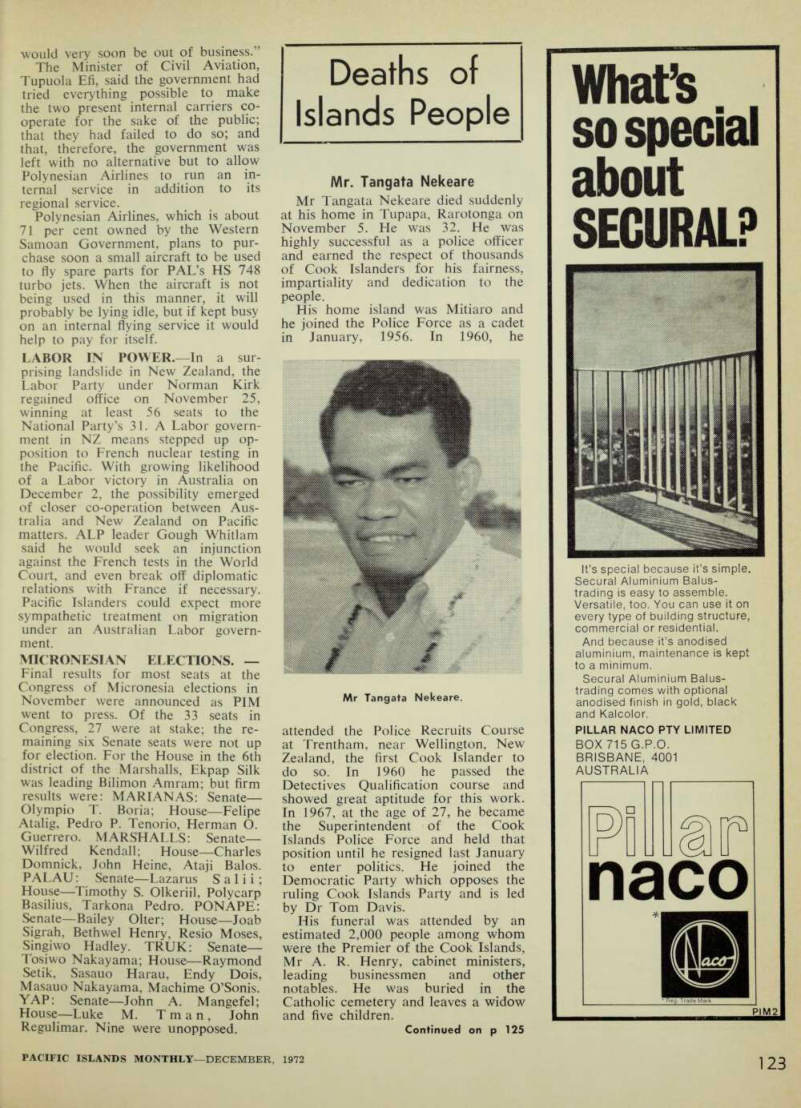
In a Nutshell
Hurricane-Battered Bud-
GET.—Fiji’s budget brought down on November 21 by Finance Minister Charles Stinson aims to raise nearly s96m, S2om more than the last budget. Tax rises were 2.5 c a gallon
on petrol (tax is now 19c, but port service tax of 0.75 c a gallon) imported beer 24c a gallon, wines 50c a gallon, cigarettes o.BBc, tobacco 40c per lb, private vehicle traffic fees up 50 per cent, with an extra $5 for first vehicle licence application.
Dividend income will be taxed as personal income, plus a tax on bonus shares and other revenue profits.
Private vehicle imports will be limited to 2,000 in 1973, with price control.
Hurricane relief will receive s2million from reserves. Tourists are expected to yield s4om. Capital expenditure includes $7 million for SPSM shares and land.
VISITORS.—The Fiji Visitors Bureau office in Sydney was inundated with telephone calls offering assistance for the victims of Hurricane Bebe.
Manager Russ Gribble said for several days telephone calls came every two minutes, many from far distances.
Some calls were late at night. He was able to report that some Fiji tourist
resorts were badly damaged, but they
managed to survive. Several hotels on the north and western coasts of Viti Levu closed till repairs were made, and Mana Island resort was out of action. The Beachcomber at Tai Island closed its accommodation till early December.
Fiji Workers For Nz.—New
Zealand will admit about 130 Fiji Islanders to cut scrub. Most of the labour is required in the middle of the North Island to develop farming in areas where suitable local workers are not available. The NZ gesture is, in part, a hurricane relief move and came after the NZ High Commis sioner in Fiji reported that thousands of people, particularly small farmers, had been affected.
GENEROUS NAURU.—In addition to the gift of $lO,OOO to the New Guinea famine relief, the government of Nauru has recently made gifts to disaster-stricken countries all around the Pacific. The depredations of hur ricane Bebe called forth a donation of $lO,OOO to Fiji and $5,000 to the GEIC for Funafuti. During the emergency the services of Air Nauru were offered to back up the inter rupted flights of Air Pacific, and radio communications were routed via Nauru. A gift of $5,000 was made to the Philippines for food relief.
Nauru High Commission.—It
has been announced from Canberra that Mr L. G. Sellars, 49, an Aus tralian career diplomat, who earlier was named Australian representative in Nauru in succession to Mr R. K.
Gates, will be Australia’s first High Commissioner to Nauru. His respon sibilities will also include Australian interests in Micronesia and the Gilbert and Ellice Islands. A reciprocal ap pointment by Nauru had not been announced at PlM’s going to press.
FINGERNAIL CLUE.—Using blood samples, hair and finger-nail parings says, Dr Carlton Gadjusek of the United States Institute of Health, scientists from the Scripps Institute of Oceanography have established a re lationship between the people of Tongariki in the New Hebrides, Aust ralian aborigines and Samoans. Dr Gadjusek was in the New Hebrides arranging for a visit of the Scripps Institute’s ship Alpha Helix. The
ship will take scientists to the Banks and Torres Island where they will attempt to trace the genetic history of the islanders.
P & O Wrangle Continues.—
Seven of the 16 directors of ship ping giant P & O resigned on Novem ber 20 following the failure of a move to merge with the Bovis company. Mr Ford Geddes, the chairman of P & O was among those who resigned. The influence of Hong Kong shipping magnate Mr Y. K. Pao is hinted in the move to block Bovis. Meanwhile, although directors are fighting for independence for P & O, there is still a strong possibility of a merger with the Inchcape group (PIM Nov, p 86).
Lord Howe Alrstrlp.—Aus
tralia will soon have to decide whether to go ahead with its proposed air strip on Lord Howe Island. Sir Reginald Ansett warned in November that unless a decision is made he will stop the flying-boat service from Sydney after next July, thus leaving the island without an air link. The flying-boats were old and un economic, he said, and the govern ment subsidy paid for them over the years could have built an airstrip.
ROAD HORROR.—Western Samoa’s worst traffic accident this year had been in late September when three people died after a truck failed to take a corner. But then in October eight people, six women and two men, died as a result of a collision involving a bus and a truck at a bend on the West Coast Road. The disaster could perhaps have been avoided. Speeding and drunken driving have been alleged as contributing to the accident.
M.A.—Mr Francis Bugotu, a senior education officer in the BSIP has been awarded the degree of Master of Arts in English language linguistics at the University of Lancaster in the UK. He is the first Solomon Islander to receive an MA. He has sub
sequently been doing a course in administration before returning to the Solomons at the end of this year.
Quarantine Rejected.—At A
referendum in November, Norfolk Island electors rejected a Common wealth proposal that a high security animal quarantine station be built on the island. Voting was 452 for no, and 384 for yes, with nine informal.
Australian Minister for Health, Senator Anderson had said earlier that agreement by the islanders was essential for the station.
MESSIAH. —A number of villagers from the Maprik area of the PNG’s Sepik were charged with murder in November, after it was alleged that they took part, with a ringleader known as the Messiah, in the murder of two men, who had themselves volunteered to be stoned and clubbed to death after the Messiah assured them they would be resurrected.
Workers Ban.—Png In Novem
ber added to the list of occupations at which expatriates may not work.
Forty-two occupations have been pro hibited immediately, with another 53 to be restricted after two years, and five others after three years. On the two- and three-year restrictions, the employer must meanwhile provide training for one New Guinean for each expatriate employed. Immediate restrictions include shop assistants and seamen (other than on overseas vessels). Two-year restrictions include radio announcers, display artists and motor drivers. Three-year restrictions includes typists, general bookkeepers and bank tellers.
Samoan Airlines Squeezed.—
Western Samoa intends to allow Polynesian Airlines to operate an in ternal flying service, in competition with Air Samoa Ltd and Samoa Aviation. Mr I. R. Best, Managing Director of Air Samoa said: “Should Polynesian Airlines introduce an air craft internally, both present operators
would very soon be out of business.”
The Minister of Civil Aviation, Tupuola Efi, said the government had tried everything possible to make the two present internal carriers co operate for the sake of the public; that they had failed to do so; and that, therefore, the government was left with no alternative but to allow Polynesian Airlines to run an in ternal service in addition to its regional service.
Polynesian Airlines, which is about 71 per cent owned by the Western Samoan Government, plans to pur chase soon a small aircraft to be used to fly spare parts for PAL’s HS 748 turbo jets. When the aircraft is not being used in this manner, it will probably be lying idle, but if kept busy on an internal flying service it would help to pay for itself.
Labor In Power. —In A Sur
prising landslide in New Zealand, the Labor Party under Norman Kirk regained office on November 25, winning at least 56 seats to the National Party’s 31. A Labor govern ment in NZ means stepped up op position to French nuclear testing in the Pacific. With growing likelihood of a Labor victory in Australia on December 2, the possibility emerged of closer co-operation between Aus tralia and New Zealand on Pacific matters. ALP leader Gough Whitlam said he would seek an injunction against the French tests in the World Court, and even break off diplomatic relations with France if necessary.
Pacific Islanders could expect more sympathetic treatment on migration under an Australian Labor govern ment.
Micronesian Elections.
Final results for most seats at the Congress of Micronesia elections in November were announced as PIM went to press. Of the 33 seats in Congress, 27 were at stake; the re maining six Senate seats were not up for election. For the House in the 6th district of the Marshalls, Ekpap Silk was leading Bilimon Amram; but firm results were: MARIANAS: Senate— Olympic T. Boria; House—Felipe Atalig, Pedro P. Tenorio, Herman O.
Guerrero. MARSHALLS; Senate— Wilfred Kendall; House—Charles Domnick, John Heine, Ataji Balos.
PALAU: Senate—Lazarus Sal i i; House—Timothy S. Olkeriil, Polycarp Basilius, Tarkona Pedro. PONAPE: Senate—Bailey Olter; House—Joab Sigrah, Bethwel Henry, Resio Moses, Singiwo Hadley. TRUK: Senate— Tosiwo Nakayama; House—Raymond Setik, Sasauo Harau, Endy Dois, Masauo Nakayama, Machime O’Sonis.
YAP: Senate—John A. Mangefel; House—Luke M. Tma n , John Regulimar. Nine were unopposed.
Advertisements & other items, pp. 122-124 (1 item)
Sdfdf
m *8
pll'
120 IW I , 2 <x 2 or mmd •pt Of each muinfkl bowel re9»ior#f keep wtsfm 4 I* 0-ttr.bw.OM - A«•*
,r * rABOOAIOBS^^
KEEP SLIM, TRIM
and HEALTHY . . .
take FORD PILLS
Ford Pills and the Ford Pill diet chart help you to lose that extra weight.
Ford Pills are a mild laxative containing the gentlest of ingredients to rid your body of excess fluids and toxins.
AVAILABLE FROM CHEMISTS AND
STORES EVERYWHERE.
BML
BRITISH MEDICAL LABORATORIES,
115-125 Turrella Street, Turrelia, N.S.W. 2205, Australia.
SDFDF
Why Naco
Louvre
Windows won
the Good
Design Award
N □ Sunsash Louvre Windows conform to Australian CAS3 (1970) and U.S. Standard A. 134.1 (1968) Residential Window Code requirements in terms of water penetration, airfilt ration, structural sufficiency and stiffness requirements. □ Proven features —Trouble-free operation because the heavy gauge paired operating bars are protected within the channels.
Double riveted assembly provides life-long strength and reliability.
Precision hot forged special alloy bearings ensure that there is no friction between clips and channels.
PILLAR NACO PTY LIMITED
BOX 715 G.P.O.
BRISBANE, 4001
AUSTRALIA
3
naco
(■ • Reg. 7 rade Mark
PJM3
THE
YORKSHIRE INSURANCE
CO. LTD.
(Incorporated in England)
A MEMBER OF THE GENERAL ACCIDENT GROUP OF COMPANIES
ALL CLASSES OF INSURANCE
AUSTRALIAN HEAD OFFICE: 10-12 Spring Street, Sydney.
Group Manager for Australia: R. M. Trotter.
PAPUA AND NEW GUINEA BRANCH: Douglas Street, Port Moresby.
Manager: H. M. Harvey.
CHIEF ISLAND REPRESENTATIVES
Rabaul, A.S.P. (N.G.) Ltd.; Lae, Radio Cabs (Lae) Pty. Ltd.; Madang, W. Stokes; Manus, Edgell & Whiteley Ltd.; Honiara, 8.5.1. P., E. V. Lawson Ltd.; Suva, Williams & Gosling Ltd.; Noumea, R. Laubreaux; Norfolk Island, Martin's Agencies; Apia, E. A. Coxon & Co.; Vila, C. Sullivan (INT) Pty. Ltd.
c u
THE WATER PEOPLE
11 IBC/ESCA has 83 years of specialised experience in the Water business and export their products all over the world—famous for their quality manufacture and unmatched performance in the field. From foot valves to irrigation sprinklers, from big centrifugal pumps to domestic water pressure l systems, from automatic water conditioners to swimming pool filters and chemicals, IBC is the one name to remember.
WATER PRESSURE SYSTEMS
IBC manufacture a range of reliable automatic water pressure systems from small domestic models to high capacity units for both deep and shallow wells or surface supply. Illustrated at right "Twin-Pak", left "Econojet".
More time to enjoy your pool with
"The Saturday
PM Series POOL FILTERS
With this quality equipment, you don't have to spend all day Saturday messing around maintaining your filter and don't have to keep adding expensive materials just to keep it working, like you do with an oldfashioned D.E. filter. Just the turn or pull of a multi-port valve and the job is done with an IBC/Jacuzzi. 3 c I \ ( Send for free literature or expert advice STATION ROAD, YEERONGPILLY, BRISBANE, QLD. 4105, AUSTRALIA. PHONE: 40-9011
Islands People
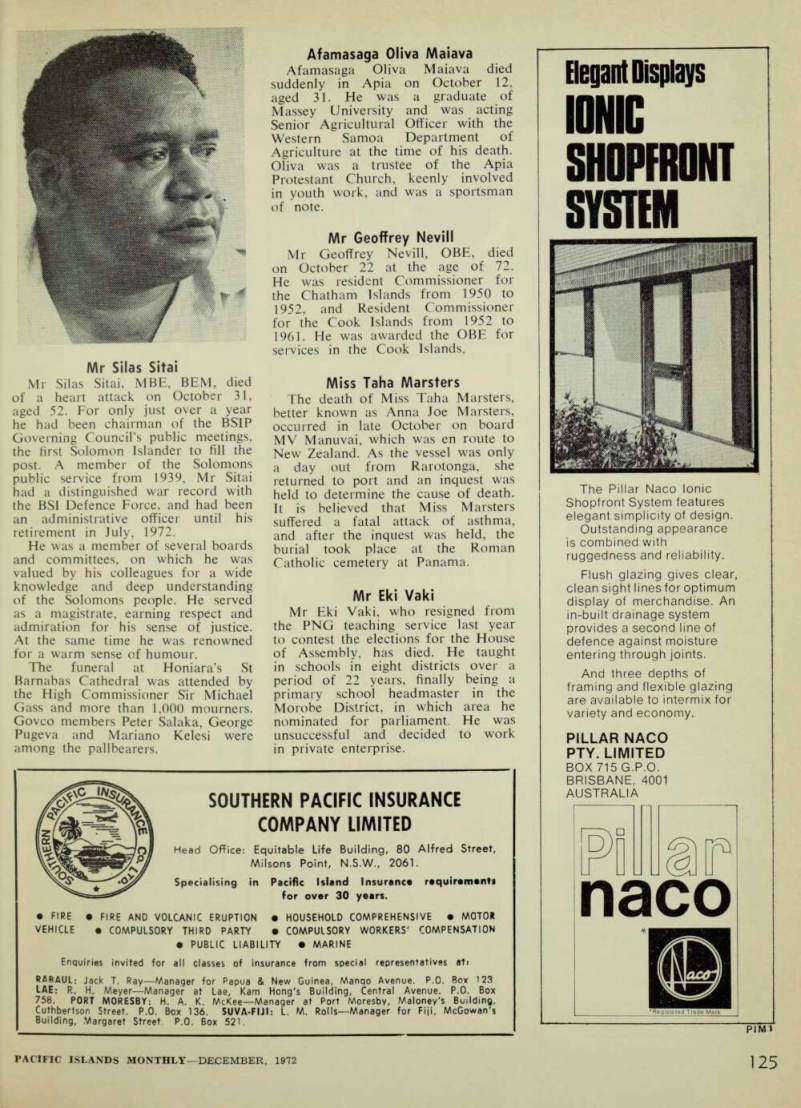
Deaths of Islands People
Mr. Tangata Nekeare Mr Tangata Nekeare died suddenly at his home in Tupapa, Rarotonga on November 5. He was 32. He was highly successful as a police officer and earned the respect of thousands of Cook Islanders for his fairness, impartiality and dedication to the people.
His home island was Mitiaro and he joined the Police Force as a cadet in January, 1956. In 1960, he
attended the Police Recruits Course at Trentham, near Wellington, New Zealand, the first Cook Islander to do so. In 1960 he passed the Detectives Qualification course and showed great aptitude for this work.
In 1967, at the age of 27, he became the Superintendent of the Cook Islands Police Force and held that position until he resigned last January to enter politics. He joined the Democratic Party which opposes the ruling Cook Islands Party and is led by Dr Tom Davis.
His funeral was attended by an estimated 2,000 people among whom were the Premier of the Cook Islands, Mr A. R. Henry, cabinet ministers, leading businessmen and other notables. He was buried in the Catholic cemetery and leaves a widow and five children.
Continued on p 125
Mr Tangata Nekeare.
Mr Silas Sitai Mr Silas Sitai, MBE, BEM, died of a heart attack on October 31, aged 52. For only just over a year he had been chairman of the BSIP Governing Council’s public meetings, the first Solomon Islander to fill the post. A member of the Solomons public service from 1939, Mr Sitai had a distinguished war record with the BSI Defence Force, and had been an administrative officer until his retirement in July, 1972.
He was a member of several boards and committees, on which he was valued by his colleagues for a wide knowledge and deep understanding of the Solomons people. He served as a magistrate, earning respect and admiration for his sense of justice.
At the same time he was renowned for a warm sense of humour.
The funeral at Honiara’s St Barnabas Cathedral was attended by the High Commissioner Sir Michael Gass and more than 1,000 mourners.
Govco members Peter Salaka, George Pugeva and Mariano Kelesi were among the pallbearers.
Afamasaga Oliva Maiava Afamasaga Oliva Maiava died suddenly in Apia on October 12, aged 31. He was a graduate of Massey University and was acting Senior Agricultural Officer with the Western Samoa Department of Agriculture at the time of his death.
Oliva was a trustee of the Apia Protestant Church, keenly involved in youth work, and was a sportsman of note.
Mr Geoffrey Nevill Mr Geoffrey Nevill, OBE, died on October 22 at the age of 72.
He was resident Commissioner for the Chatham Islands from 1950 to 1952, and Resident Commissioner for the Cook Islands from 1952 to 1961. He was awarded the OBE for services in the Cook Islands.
Miss Taha Marsters The death of Miss Taha Marsters, better known as Anna Joe Marsters, occurred in late October on board MV Manuvai, which was en route to New Zealand. As the vessel was only a day out from Rarotonga, she returned to port and an inquest was held to determine the cause of death.
It is believed that Miss Marsters suffered a fatal attack of asthma, and after the inquest was held, the burial took place at the Roman Catholic cemetery at Panama.
Mr Eki Vaki Mr Eki Vaki, who resigned from the PNG teaching service last year to contest the elections for the House of Assembly, has died. He taught in schools in eight districts over a period of 22 years, finally being a primary school headmaster in the Morobe District, in which area he nominated for parliament. He was unsuccessful and decided to work in private enterprise.
Advertisements & other items, pp. 125-130 (1 item)
so special
What’s
about
SEGURAL?
■■l It’s special because it’s simple.
Secural Aluminium Balustrading is easy to assemble.
Versatile, too. You can use it on every type of building structure, commercial or residential.
And because it’s anodised aluminium, maintenance is kept to a minimum.
Secural Aluminium Balustrading comes with optional anodised finish in gold, black and Kalcolor.
PILLAR NACO PTY LIMITED
BOX 715 G.P.O.
BRISBANE, 4001
AUSTRALIA
naco
im ■LL-
S. E. TATHAM & CO. PTY. LTD.
ASKEW HOUSE, 364 LONSDALE ST,
MELBOURNE, 3001, AUSTRALIA.
G.P.O. BOX B—CABLES "SET"
TELEPHONE: 601125
Buyers for the Pacific Islands
FIJI: S. E. TATHAM (FIJI) LTD.,
LAUTOKA P.O. BOX 366,
SUVA G.P.O. BOX 671,
PAPUA NEW GUINEA: S. E. TATHAM (P.N.G.) PTY. LTD.,
AND IN
MALEKULA ST., LAE.
P.O. BOX 1562
YOUR GUARANTEE FOR SERVICE
Elegant Displays
lONIC
SHOPFRONT
SYSTEM
The Pillar Naco lonic Shopfront System features elegant simplicity of design.
Outstanding appearance is combined with ruggedness and reliability.
Flush glazing gives clear, clean sight lines for optimum display of merchandise. An in-built drainage system provides a second line of defence against moisture entering through joints.
And three depths of framing and flexible glazing are available to intermix for variety and economy.
PILLAR NACO
PTY. LIMITED
BOX 715 G.P.O.
BRISBANE, 4001
AUSTRALIA
ai r
naco
PIMI
ss !is® $
SOUTHERN PACIFIC INSURANCE
COMPANY LIMITED
Head Office: Equitable Life Building, 80 Alfred Street Milsons Point, N.S.W., 2061.
Specialising in Pacific Island Insurance requirements for over 30 years. e FIRE • FIRE AND VOLCANIC ERUPTION • HOUSEHOLD COMPREHENSIVE • MOTOR VEHICLE • COMPULSORY THIRD PARTY • COMPULSORY WORKERS' COMPENSATION
• PUBLIC LIABILITY • MARINE
Enquiries invited for all classes of insurance from special representatives att RARAUL: Jack T. Ray—Manager for Papua & New Guinea, Mango Avenue. P.O. Box 123 LAE: R. H. Meyer—Manager at Lae, Kam Hong's Building, Central Avenue. P.O. Box 758. PORT MORESBY: H. A. K. McKee —Manager at Port Moresby, Maloney's Building, Cuthbertson Street. P.O. Box 136. SUVA-FIJI: L. M. Rolls—Manager for Fiji, McGowan's Building, Margaret Street P.O. Box 521.
aMaMM]
Stay at a Cosmopolitan Inn -Sydney
Situated in charming Double Bay only 10 minutes from the city. Surrounded by bistros, boutiques and delightful covered walks. Close to harbour. Air-conditioned.
All rooms with bath, TV, radio, refrigerator, phone. Roof-top heated pool. Car park. There's a Cosmopolitan Motor Inn at Bondi Beach too.
SEND FOR COLOUR BROCHURE.
Cosmopolitan Motor Inns Pty. Ltd. Central Booking Office, Knox Street, Double Bay.
Phone; 36 6871. Telegrams: COSINN.
Telex: 21187.
THE cosmopolitai\jni\
WANTED
BUTTERFLIES, THE
LARGER MOTHS,
COLOURFUL OR LARGE
BEETLES, LARGE
INSECTS.
From all regions of the Pacific Islands.
Good prices for good quality material.
Collectors who know how to pack for shipment please write to: BUTTERFLY WORLD, 51-17 Rockaway Beach Blvd, Far Rockaway, New York
11691, U.S.A.
■Mi
ESCAPE
FROM THE ORDINARY
Here is an idyllic paradise where you can enjoy the unspoiled beauty and serenity of a working coconut plantation. This privately-owned Pacific retreat has been designed for a maximum of 12 people. Gracious surroundings, friendly service, relaxed accommodations with Fijian decor and American conveniences.
Activities available include; Deep sea fishing, reef and shell hunting, skin diving and snorkeling, water skiing, hiking, turf tennis court, badminton, horseback riding, and a beautiful tropical garden to relax in.
Send for free brochure: The Manager,
NAMALE PLANTATION,
SAVUSAVU, FIJI ISLANDS
WANTED
FREEHOLD LAND
Am interested in buying a large tract of freehold land in the South Pacific.
Might pay cash. Please write: "PAM", c/- G.P.O.
Box 3408, Sydney, N.S.W. 2001, Australia.
suncourt
real
estate
mreinz estate as an investment, for vacations or retirement.
Anywhere in New Zealand?
Write us: P. 0. Box 22, Taupo. Phone 674 New Zealand
VILA LAND FOR SALE
Absolute water frontage with views over the picturesque Erakor Lagoon.
Cleared and in town area with street access 4355 square metres. Could be subdivided, $A12.00 per square metre.
Box 283, Vila, New Hebrides.
PARK VIEW MOTEL—BRISBANE
Quiet location —opp. Botanic Gardens.
Single, double, family suites, all with refrig., air conditioning, phone, TV, radio, tea making facilities, from $lO. Pool and restaurant.
Phone 31-2695—Telex 40270.
Write for coloured brochure — Park View Motel, 128 Alice St, BRISBANE, Old., 4000.
POSITION WANTED
ELECTRICAL/MECHANICAL ENGINEER, re-
tired British Sapper Officer (R.E. Works Services) wishes change and seeks interesting position South Pacific Region. 25 years overseas experience in all aspects of E & M Installations and Plant from design stage, including H.T. distribution generating plant, air-conditioning/refrigeration, mechanical equipment, water supply, hospitals, Workshops/Directly Employed Labour, motor-transport, etc.
Also wide experience in building construction, roads, and drainage. 6 years Senior Executive post with P.W.Cf.
E & M Services. Would also consider position in new residential/tourist development field.
Reply: MAJOR F. ROWE, Estate Organisation, P.O. Box 8, University of Ghana,
Legon, ACCRA, GHANA.
Stay at —
JOHN OXLEY
MOTEL
491 WICKHAM TERRACE,
BRISBANE.
(750 yards City Hall) Every possible facility.
At very sensible rates.
SEND FOR BROCHURE
SAY IT IN
FIJIAN
helps you enjoy Fiji more by learning and using its language.
Priced at $1.20 Aust., plus 12c posted. $1.50 U.S. posted.
Pacific Publications (Aust.) Pty. Ltd., G.P.O. Box 3408, Sydney,
N.S.W. 2001.
VISITING BRISBANE?
Stay at TOWER MILL MOTEL. First class air-oonditioned accommodation, T.V., private bathroom and verandah with a delightful view. Two restaurants.
From $lO.OO per day.
Book through your Travel Agent or Airline office or direct to 239, Wickham Terrace, Brisbane. Telephone 31-1421.
Line Advertisements
Per line, 950 Anst.; Minimum rate. 4 lines.
The
best night out in
Port Moresby
Join the beautiful people in the Weinkeller Disco at the Gateway Hotel, Boroko Music every night of the week.
Phone: 5 3855
AHO/128A
ALL BOOKS AND JOURNALS ON AUST-
RALASIA AND THE PACIFIC BOUGHT
AND SOLD. Catalogues issued and sent free on application. Correspondence invited. Berkelouw, 15-19 Boundary St., Rushcutters Bay, Sydney, 2011. Phone: 31-8215.
BODEN’S BOAT DESIGNS PTY. LTD.,
695 George St., Sydney, 2000. Get your Bodens Boat Designs and Boat Building Book from newsagents everywhere. Posted direct 5A2.20 surface mail.
FLEETS 65 ft. carvel refrigerated trawler, bit. 1964, in survey, double rig, fully equipped, 4 cyl. A.P.U., suit cargo work. $70,000. Fleets, Rowe’s Bldg., Edward St., Brisbane. Cable: Fleets, Brisbane.
JINGSING & CO., Box 15792, Hong Kong.
Export: Fishnet, toys, radios, perfumes, garments, umbrellas, plastic and paper ware. Import: Island produce.
STAMPS WANTED. Used stamps on paper from residents, banks, charities, schools, missions, etc. of Pacific Islands. Write stating weight and price to R. H. Cowley, c/o Post Office, Nightcliff, Northern Territory 5792, Australia.
CONCRETE BLOCK MACHINE FOR SALE.
Makes blocks, flags, edgings, screen-blocks, garden stools—up to 8 at once and 86 an hour. SAI2O c.i.f. main ports. Send for leaflets. Forest Farm Research, Londonderry, N.S.W., 2753.
NEW ZEALAND exporter of frozen meats offers merchants with refrigerated space facilities regular quotations, personalised service and wide supply access.
Write LEN R. HARLAND LTD., P.O. Box 289, New Plymouth, New Zealand. Cables:
"CANLEN".
LOGGING PLANT WITH WORK. Two
skidders, 5 trucks, 3 loaders, 2 Landcruisers, equipped workshop, fuel agency, large house, own power, phone, television, septic. Full price $A70,000. Owner will finance approved operator on half deposit.
For further particulars write; Fraser Island Logging, Thinoomba, Qld. 4619, Australia.
PROMPT MAIL ORDER SERVICE. Save
up to 20% on exotic jewellery, pewter wares, ladies wigs. Write today for prices and brochures. Bilson Koh Corp, 329 D Mei Ling St, Singapore 3.
HOTEL MANAGER
SOUTHERN PACIFIC ISLAND RESORT
Premier offshore Hotel Resort requires the services of a fully experienced manager.
He will be directly responsible to the board of directors as total management will be in his control.
The position carries substantial salary remuneration commensurate with experience together with full accommodation and regular leave.
The resort maintains an experienced staff in all sub departments.
All replies stating history and previous experience in strictest confidence to: Hotel Manager, Box 2225, G.P.0., Sydney, N.S.W. 2001, Australia.
YOUR NEXT LEAVE
Modern up to the minute homes at Palm Beach, Avalon, Newport, Church Point, Mona Vale, etc., available to Island Residents for Holidays. Write for information
J. T. STAPLETON PTY. LTD.
ESTATE AGENTS ,
133 PITT STREET, SYDNEY, 2000. 25-5305, 25-1737 also Box 32, P. 0., Avalon Beach, Sydney 2107. 918-2221.
INVESTMENT
OPPORTUNITY
A property comprising a block of three tenanted 3-Bedroom Flats in good condition is for sale. There is a keen demand for accommodation in this area and enquiries should be addressed to P.O. Box 2, Honiara, 8.5.1. P.
JACK
SDNS
GOOD FLAVOUR FOODS
available through our agents:
C. SULLIVAN EXPORT PTY. LTD.
FIJI
JOHNNY
REPRINT NOW AVAILABLE!
A delightful story for children in colour and black-and-white.
Priced at $2.50 Aust., plus 25c posted; $3.20 U.S. posted.
Pacific Publications (Aust.) Pty. Ltd., G.P.O. Box 3408, Sydney,
N.S.W. 2001.
KEEPING BABY
HAPPY & WELL-
By giving your baby a Fisher's Teething Powder as needed, you not only keep the little one happy and well, but save yourself all those upsets and nervous tension that beset a mother when baby suffers distress. If used as directed Fisher's Teething Powders quickly and safely soothe baby's sore gums, digestive disorders and intestinal upsets.
Get a packet from your chemist or store today—only 30c for 20 powders —you'll be so glad you did. Fisher & Co., Manufacturing Chemists (Est. 1876), 17 May St., St. Peters, N.S.W. 2044.
PIM 808/72
FREE PARKING in a 4 seat Lake Buccaneer. m i LAKE AIRCRAFT SOUTH PACIFIC & AUSTRALASIA LTD.
Cl- MELITCO, BOX 213, PORT VILA, NEW HEBRIDES.
Cables: "MELTRUST", Vila. Phone: 511. Australian Agent: Phone, Sydney 605-1478. New Zealand Agent; Phone, Auckland 58-2651.
Index to Advertisers
Adams Ind. 19, 108 Agfa-Gevaert 68 Air India 12 Air Pacific 54 Ansett Airways 96 Ansett Hotels 27, 127 Arnott's 36 Atlas Copco 56 Bank Line 114 Bisley, A. M. 40 8.0.A.C. 97-100 Braybon 104 Breckwoldt, Wm. 106 British Med. Lab. 120 Brockhoff's 6 Brunton 66 Burns Philp 50, 58, cov. iii Carnation 3 Carpenter, W. R. 57, cov. iv Castlemaine Perkins 18 Cerebos 2 Chicago Co. 103 Classified 126, 127
Commonwealth N.G.
Timbers 106 Conpac 116 Cunningham, R. H. 40 Daiwa Line 119 Ego Lab. 109 Fiat 26, 27 Fisher & Co. 128 Fisher, Peter 39, 60 Fletcher 109, 111 French Knit 38 George & Ashton 88 Gillespie Bros. 94 Grove, W. H. 107 Halvorsen, Lars 88 Handi Works 112 Hardie, James 16 Hellaby 112
1.8.C./E.S.C.A. 122
Indian Tourist 13 Jacksons Corio 128 Jeffress 41 Karlander Line 89 Kennedy, Capt. 87 Kerr Bros. 105
Knox Schlapp 84 Kodak 4 Lake Aircraft 128 Millers Ltd. 82, 83 Mungo Scott 35 Namale 126 N.G. Express Lines 114 Nicholas 110 Nissan 64, 65
N.Q.E.A. 86
O'Brien, F. G. 46 Pacific Is. Transport 118 Parker Pen 44 Pillar Naco 121-3-5 PNG Printing 32 Prouds 42 Qantas 78 Old. Co-op. 62 Qld. Insurance 80 Roberts, Bruce 92 Ring Rolling 37 Rothmans 23 Sandy, J. 102 Sansui Electric 51
Sony 8 Southern Pacific Insurance 125 Stapleton, J. T. 127 Sullivan, C. 102 Sunbeam 72 Swire & Gilchrist 34, 95 Tabata 46 Tait, W. S. 74 Tatham, S. E. 124
T.D.K. 67
Tonga Tourist 52 Toyo Kogyo 93 Toyota cov. ii Trio Electronics 63 Turners Supply 111 Union S.S. Co. 118 Walker, John 18 Warwick Colleges 10 Warburton Franki 42 Webster, David 48 Wills, W.D.&H.O. 61 Yorkshire Insurance 121 Zeiss, Carl 28
Advertisements & other items, pp. 131-132 (1 item)
Burns Philp (New Guinea) Limited
*m
GENERAL MERCHANTS
SHIPPING AND CUSTOMS AGENTS
Head Office: Champion Parade, Port Moresby.
PHONE: 2202. TEtEX: PAAII6. CABLE ADDRESS: BURPHIL,
PAPUA NEW GUINEA
BRANCHES
BOROKO
BULOLO
DARU
GOROKA
KAINANTU
KAVIENG
Subsidiary Companies Hotel Moresby Ltd.
Ela Motors Ltd.
Local Laundries Ltd.
Moresby Hire Services Ltd.
Papua Hotel Ltd, The B.N.G. Trading Co. Ltd.
The Port Moresby Freezing Co. Ltd.
Overseas Agents Burns, Philp & Co. Ltd. All Aust. States.
Burns, Philp & Co. Ltd., London.
Burns-Philp Co. of San Francisco.
Burns Philp (South Sea) Co. Ltd.
Burns Philp (New Hebrides) Ltd.
Agents for Burns Philp Trustee Co. Ltd.
Queensland Insurance Co. Ltd.
Lloyds of London.
Stewarts & Lloyds (Australia) Pty. Ltd.
Shell Company (Pacific Islands) Ltd.
Distributorships include British Paints Buckingham & Carnatic Textiles Byford Products Citizen Watches "CeCoCo" Machinery Conditionaire Air Curtain Doors Guerlain Parfums Hardie's Building Products Heuga Carpet Tiles Jean Patou Parfums "John" Valves Johnson Ceramic Tiles Kienzle Clocks Marcel Rochas Parfums Mikimoto Pearls National Radios & Appliances Noritake Chinaware Rolex Watches Ronson Products Rover Power Mowers Sunbeam Appliances, Mowers & Rural Products Exporters of Coffee & Cocoa Beans, Peanuts, Rubber Shipping Agents for Bank Line Ltd.
Campagnie Des Messageries Marltimes Chandris Line Cogedar Line Containers Pacific Express Line Cunard Steamships Co. Ltd.
Eastern & Australian Steamship Co. Ltd.
P & O Lines of Australia Pty. Ltd.
Nederland Line Royal Dutch Mail Societe Francaise de Navigation The French Line Union Steam Ship Co. of N.Z. Ltd.
N.Y.K. Line Airline Agents for Ansett Airlines Qantas Airways Ltd.
Trans-Australia Airlines International Air Transport Association Representatives Travel Department For World Wide Travel
URNS PHILP (New Guinea) Ltd.
FOR SERVICE AND REAL VALUE
IT V N 9 S \
NEW
GUINEA
WORLD TRADERS
IN THE PACIFIC
M \ ✓ M
SUVA •
r //MBER
LD MA > 19/ % 1
SYDNEY
c-*3 Ml X‘fc
NEW ZEALAND
AUCKLAND
T The W. R. Carpenter Group has been a major trader between the Pacific Islands and the rest of the world for more than 55 years. As a grower, buyer and processor of island produce such as copra, coffee and cocoa beans, the Group has contributed to the economic progress of the area and
of its peoples
Associated companies of the Group in the Pacific Islands include:
PAPUA AND NEW GUINEA
W. R. Carpenter (T.P.N.G.) Limited.
Coconut Products Limited.
New Guinea Company Limited.
Boroko Motors Limited.
The Group is also a wholesaler and retailer and holds many
leading agencies, including
• NISSAN/DATSUN • FORD • DEWARS WHISKY
* ELECTROLUX • GORDON'S GIN
• EVINRUDE • VICTA
FIJI
W. R. Carpenter (South Pacific: Limited.
Carpenters (Fiji) Limited.
Morris Hedstrom Limited.
Millers Limited.
Island Industries Limited.
Suva Motors Limited.
W. R. CARPENTER & COMPANY LIMITEt
Aft PITT STREET CABLES: U.K. OFFICE: