Pacific Islands Monthly
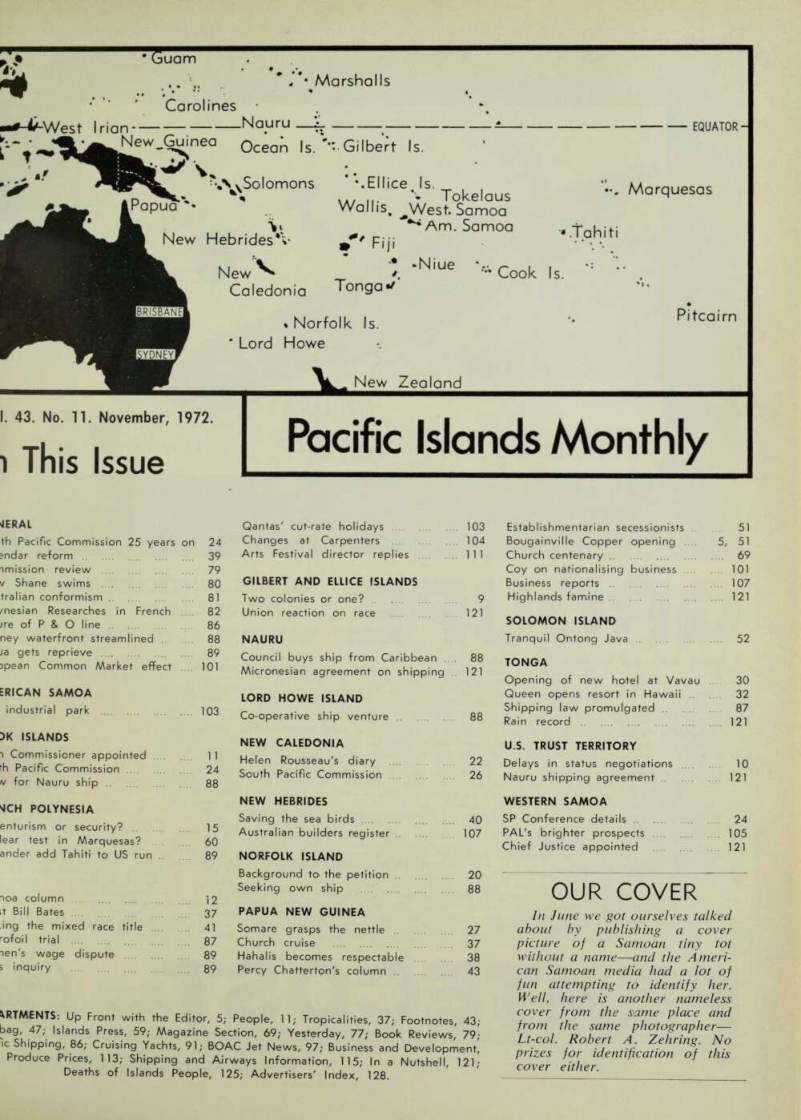
New Magazine Of The South Pacific
November, 1972
Australia, Nz, Geic, Bsip 50C
PNG, FIJI, COOKS, TONGA, W. SAMOA, N. HEBRIDES 45c
Nauru, Norfolk, Niue 45C
American Samoa 70C Hawaii, Micronesia $L.Oo
NEW CALEDONIA 65 CFP FRENCH POLYNESIA 100 CFP
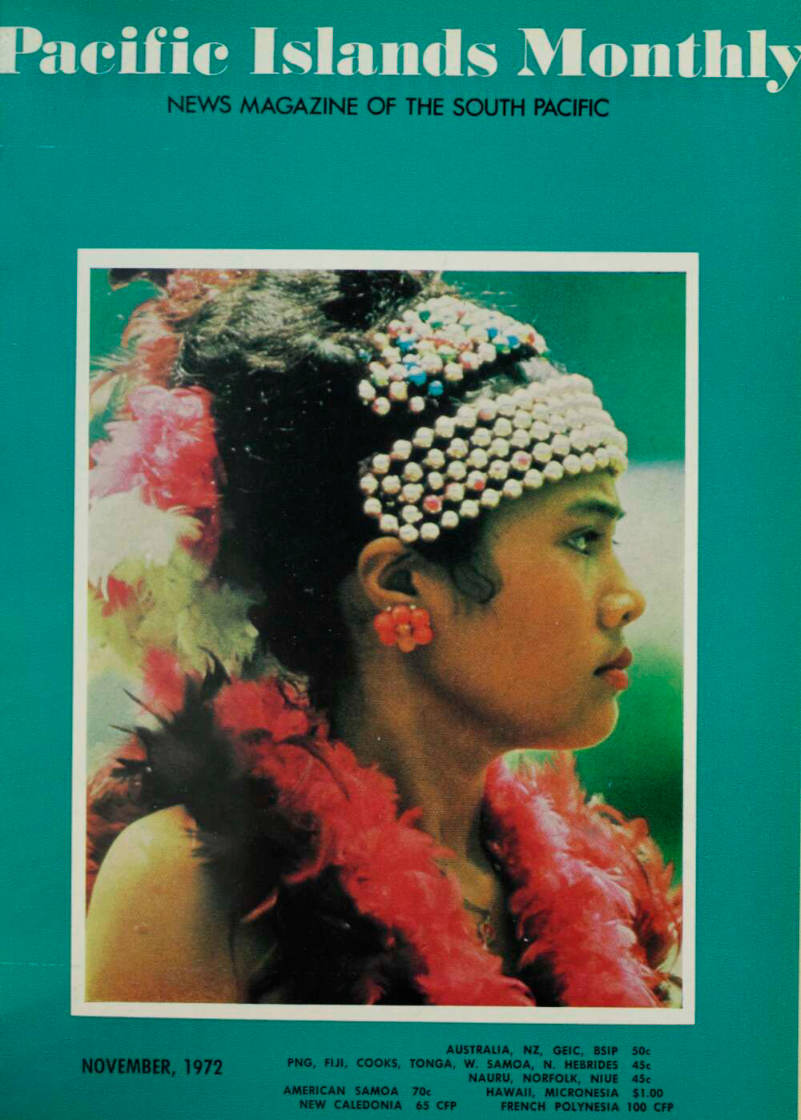
Our Cover
In June we got ourselves talked about by publishing a cover picture of a Samoan tiny tot without a name—and the Ameri can Samoan media had a lot of fun attempting to identify her.
Well, here is another nameless cover from the same place and from the same photographer — Lt-col. Robert A. Zehring. No prizes for identification of this cover either.
Advertisements & other items, p. 2 (1 item)
w
CD CD w as £ 1 \ m % \ £< * 99!
In This Issue
Jeral
th Pacific Commission 25 years on 24 jndar reform 39 imission review 79 v Shane swims 80 tralian conformism 81 rnesian Researches in French ... 82 jre of P & O line 86 ney waterfront streamlined 88 ja gets reprieve 89 >pean Common Market effect 101
Erican Samoa
industrial park 103
3K Islands
i Commissioner appointed 11 fh Pacific Commission 24 v for Nauru ship .. 88
Mch Polynesia
enturism or security? 15 lear test in Marquesas? 60 ander add Tahiti to US run .. 89 ioa column ... 12 it Bill Bates 37 ing the mixed race title 41 'of oil trial 87
len's wage dispute 89
5 inquiry 89
Qantas' cut-rate holidays 103 Changes at Carpenters 104 Arts Festival director replies 11l
Gilbert And Ellice Islands
Two colonies or one? 9 Union reaction on race 121
Nauru
Council buys ship from Caribbean ... 88 Micronesian agreement on shipping 121
Lord Howe Island
Co-operative ship venture 88
New Caledonia
Helen Rousseau's diary 22 South Pacific Commission 26
New Hebrides
Saving the sea birds 40 Australian builders register 107
Norfolk Island
Background to the petition .. 20 Seeking own ship 88
Papua New Guinea
Somare grasps the nettle 27 Church cruise 37 Hahalis becomes respectable 38 Percy Chatterton's column 43
Establishmentarian secessionists 51 Bougainville Copper opening 5, 51 Church centenary 69 Coy on nationalising business 101 Business reports 107 Highlands famine 121
Solomon Island
Tranquil Ontong Java 52
Tonga
Opening of new hotel at Vavau 30 Queen opens resort in Hawaii 32 Shipping law promulgated 87 Rain record 121
U S. Trust Territory
Delays in status negotiations 10 Nauru shipping agreement 121
Western Samoa
SR Conference details 24 PAL's brighter prospects 105 Chief Justice appointed 121
\RTMENTS; Up Front with the Editor, 5; People, 11; Topicalities, 37; Footnotes, 43; bag, 47; Islands Press, 59; Magazine Section, 69; Yesterday, 77; Book Reviews, 79; ic Shipping, 86; Cruising Yachts, 91; BOAC Jet News, 97; Business and Development, Produce Prices, 113; Shipping and Airways Information, 115; In a Nutshell, 121; Deaths of Islands People, 125; Advertisers' Index, 128.
Advertisements & other items, p. 4 (1 item)
Groupe
OUVEfi
7
UFOV
mum
NOW BUB-C&t&POMB
ILF
OSS P/A/S
GROUPE
GROUPE PENTECOST
34, RUE DE L'ALMA.
TELEPHONE: 21.14/NOUMEA.
• AGENCE ALMA S.A. 2, rue de I'Alma—Tel. 30 02. Distributor for; Citroen Nissan Jeep Willys Vespa Velosolex —Clark John Deere Evinrude Topper Craft General Tire CRC etc. ... • AGENCE CALEDONIENNE DE 6.F.A., 34, rue de I'Alma —Tel. 28 65. Insurance Agents: fire, accident, burglary, motor, transport. Marine and life insurance arranged. • AGENCE MARITIME ET AERIENNE CALEDONIENNE S.A. (A.M.A.C.) Shipping Agents, 26, rue George Cleemenceau —Tel. 21 14. Agents for: Nedlloyd Lines Nippon Yusen Kaisha Ltd. Shinwa Kaiun Kaisha Daiwa Navigation Co. Ltd. Showa Kaiun Kaisha Sakae Kaiun Kaisha Taiheiyo Kaiun Kaisha —Holm Shipping Co. Ltd. Lloyd Triestino Flotta Lauro. • CALTRAC S.A., 7 and 9, rue Jean Jaures—Tel. 34 60. Caterpillar dealer.
CLAUDE FRANCE S.A., 34, rue de I'Alma—Tel. 34 51. Everything from Paris French perfumes Fashionwear for Ladies, Children and Babies' Garment Lux lingerie Christofle silverware Novelties. • CINE OPTIC BUREAU SERVICE S.A. (C. 0.8.5.), 24, rue de I'Alma Tel. 38 14. Distributor for; Japy and Hermes typewriters Facit Odhner Friden — 3M Gestetner Kodak Zeiss Ikon Rollei Werk Bolex. • ELECTRIC RADIO S.A., 35, rue de I'Alma— Tel. 48 24. Everything dealing with radio and TV Electric supplies Fittings Installations and repairs. Distributors for: Norge Sanyo Ray-O-Vac Onan Ignis Calor Silex etc. . . . • ESTATE DEPARTMENT, 34 rue de I'Alma—Tel. 21 14. Real Estate —Builders and Contractors. • LIBRAIRIE PENTECOST S.A., 34 rue de I'Alma—Tel. 21 14. Magazines Books School and office requisites Stationery. • L'UTILE ET L'AGREABLE S.A., 33 rue de I Alma —Tel. 29 76. Complete kitchenware Crockery Cutlery Plated ware Pottery Ornamental brass ware Garden furniture Elna sewing machines. • METO S.A., 2 and 5, rue de I'Alma—Tel. 34 84. Repair workshops Motor cars Tractors Boat engines Distributor for: Mercedes Auto Union Hyster Dunlop Subaru Daf Bosch etc. . . . • MINING, GROUPE MINIER PENTECOST, 34, rue de I'Alma—Tel. 21 14. Nickel Chrome Manganese Tungstene Copper etc. E *£°^l io 2 , of i' ,ickel Dre to Japan. Agents of Mitsubishi Shoji Kaisha Ltd. (Tokyo) and of Sumitomo Shop Kaisha Ltd. (Tokyo). • PACIFIC MOTORS S.A., 9, rue Jean Jaures—Tel. 34 75. Distributors for; Chrysler Massey Ferguson Kohler Hyster Johnson Lawn Boy Rust Oleum De Havilland boats, etc. . . . • PENTECOST AVIATION, Magenta Airport—Tel. 41 19. Cessna distributors Cessna 150, 172, 185 206, 310 D. 310 P. Aircraft for hire. • S.C.A.T. S.A., SOCIETE CALEDONIENNE D'ACCONAGE ET DE TRANSPORTS S.A., 4 rue de la Republique— Tel. 27 91. Stevedoring Transport on the whole territory Cartage. • VOYAGENCE S.A., 26, rue Georges Clemenceau Tel 20 85, Travel agents: UTA Air France Air Caledonip Air Npw Zealand Qantas Pan American Airways Air India, etc. Passenger sales agents • S.V.P., SOCIETE DES VEHICULES DU PACIFIQUE S.A., 34, rue de I'Alma—Tel. 21 14. Sole representative agency for MAN trucks. • MARKETING DEPARTMENT. 43, rue de I'Alma—Tel. 27 93. Representative agency for: Black and White Hannapier Gillette. • SOCAFLU S.A., SOCIETE CALEDONIENNE DES FLUIDES, 34, rue de I'Alma—Tel. 21 14. Water supply “ Air conditioning Drying. • PENTECOST PACIFIC S.A., in Port-Vila and Santo, New Hebrides. • SAT. NUI. SOCIETE D ACCONAGE TAHITIEN, 513, rue des Remparts, Papeete, Tahiti. Stevedoring Transport on whole territory Cartage.
PENTECOST
Pacific Islands

Monthly
FOUNDED BY R. W. ROBSON IN 1930
Owned And Published Monthly By
Pacific Publications (Aust.) Pty. Ltd.,
29 Alberta St., Sydney, N.S.W., 2000.
Postal Address: G.P.O. BOX 3408, SYDNEY,
N.S.W., 2001.
Telegraphic Address: PACPUB, Sydney.
Telephones: 61-9197, 61-7101, 61-4369.
insulting Directors: R. W. Robson, Judy Tudor.
Chief Executives: General Manager: Selwyn Hughes.
Publisher; Stuart Inder.
Director of Advertising: W. A. Gasnier.
Pacific Islands Monthly
Editor: Stuart Inder.
Assistant Editor: John Carter.
Advertising Manager; W. A. Gasnier.
Circulation Manager; Barry Badger.
Subscription Rates:
’acific Islands Monthly" is air-freighted to I subscribers and agents in the Pacific Islands,copies to other areas go by surface mail.
JStralia (including Lord Howe and Thursday .), 8.5.1. P., Gilbert and Ellice Is.: $5.50 Aust.; ipua New Guinea, Norfolk Island, Nauru, mga and New Hebrides: $5.00 Aust.; New ialand: $5.50 NZ; Fiji, Cook Islands, Niue d Western Samoa: $5.00 (local currency); nerican Samoa.- $B.OO US; U.S. Mainland: 4.00 US; Hawaii, Micronesia (including iam) $12.00 US;- New Caledonia: 750 French cific francs; Tahiti and French Polynesia: 0 French Pacific francs; United Kingdom and elsewhere; £3.25.
Representatives
[i: Pacific Publications (Fiji) Ltd., Fiji Times ilding, 20 Gordon Street, Suva. Tel.: 25601; 1 Times Office, Cnr. Vitogo Pde, and Namoli e, LAUTOKA. Telex: 1144. Tel.: 60-422. pua New Guinea: LAE, P.O. Box 227; iBAUL, Mr. Steve Simpson, P.O. Box 433 (c/- Rabaul Photographic. Tel.: 2677.) ;nch Polynesia: Distribution—Hachette Paci |ue, 10 Ave Bruat, Papeete, w Zealand: Pacific Publications, C.P.O. Box 29, Auckland. 379-494. Representative: John edding. Civic House, 291 Queen St., Auckland, Tel.: 379-494. ited Kingdom: I. B. Graham, Park House, Park Street, Croydon, CR9 3NP. Tel..- 01-6884177. erseas Newspapers (Agencies) Ltd., Cromwell use, Fulwood Place, London, W.C.I. Tel : -242-0661. Cables: WESNEWS, London, DS4.
Jan.- Advertising—Universal Media Corpora on, C.P.O. Box 46, Tokyo. Tel.: 666-3036 :tona : Advertising—Wilke & Co. Ltd., 37 >wn's Road, Clayton, Vic., 3168. Tel.: 544-8222. eensland: Advertising—Beale Media Services 2 St. Paul's Terrace, Fortitude Valley, Qld ' 4006. Tel.: 52-5827. waii and U.S. Mainland only: Mrs. W. A.
Grath, 225 Queen Street, 178, Honolulu, 96813. nd change of address notices. Form 3579 to the above address.) plication to mail at second class postage rates pending at Honolulu, Hawaii.
Copyright ©, 1972,
Pacific Publications (Aust.) Pty. Ltd.
November, 1972 Vol. 43, No. 11.
Advertisements & other items, pp. 5-6 (2 items)
3
iCIFIC ISLANDS MONTHLY—NOVEMBER, 1972
key to the safe insect killer
m\ %
This little flower is your
ONE of the safest and most potent insect-killers known to contemporary science is derived from an innocent-looking small white flower, the African Pyrethrum daisy. Pure pyrethrins, as chemists call this substance, is the active ingredient in Pea-Beu insect spray, and the key to its concentrated killing-power. Continuing research by the chemists in the laboratories of A.N.I. Chemical Research and by health and environmental authorities throughout the world, confirms that insects do not become immune to pyrethrum. Pea- Beu contains a high concentration of pyrethrins which means that short bursts only are needed to kill flies, mosquitoes and every type of insect pest.
Filthy flies: universal health menace Entomologists and medical research workers have established the common fly to be a carrier of typhoid, cholera, smallpox, infective hepatitis amoebiasis in epidemic proportions.
Every fly you kill lessens the risk to your family, helps keep their food uncontaminated. Pea-Beu is recommended to kill every fly that enters your home because it is guaranteed completely effective yet absolutely safe.
No fears near food At this season your kitchen and food-cupboards are the favourite places for both blowflies and houseflies, especially when attracted by exposed food as you cook or serve. Of course you’re reluctant to use pungent insecticides, and fear toxic effects. But never hesitate to use Pea-Beu. Its active ingredient guarantees it’s harmless to humans and pets, and thanks to the purity of all its ingredients, it is completely safe to spray anywhere in the home. so pure it’s safe to spray
anywhere
ftHi
a m
Pea-Beu-the safe powerful insecticide,
Arnott’s Cracker Biscuits...
always crispy-fresh and
good to eat!
Always keep Arnott’s famous Cracker Biscuits handy for parties, for light snacks, for nibbling anytime.
They’re always crisp and fresh, ready to go with your favourite foods or just to eat straight from the pack.
The triple-wrapped packs keep the biscuits fresh.
Qrnott's/Biscuits
There is no Substitute for Quality
Up Front
with the Editor
It seems that the near-bonanza ich is the Bougainville copper pro t is not to be officially opened in vember after all. The decision to icel the formal tea party has been en since PlM’s presses printed the agraph on p. 51 of this issue.
Vs this page goes to press, the cial government/company explana i for the cancellation is that the ney for the ceremony, which was have been presided over by PNG’s ef Minister Michael Somare, jld be better spent as a gift to ? alleviate the food shortages in Highlands caused by drought and >t. 0 it would. But I believe the 1 reason for the cancellation is : Chief Minister Somare was re am to go through with it because political pressure from anti ipany colleagues and electors, his underlines the fact that there e been other recent noises issuing n PNG which appear to be ical of investment, oth Chief Minister Somare and les Minister Paul Lapun have cated that some business arrange
ments, including the one with Bougain ville Copper Pty Ltd, may have to be renegotiated after PNG becomes self-governing at the ond of 1973.
And Trade Minister John Poe has recently spoken oddly about “nationalisation” (see p. 101 for a report of an interview attended by a PIM reporter).
I don’t know what Mr Poe has in mind, but I have had a couple of recent opportunities to talk to Mr Somare, and I believe that he has no specific intentions about Bougainville, or any other company. He merely intends to remind people that changes are always possible in a situation of swift political development such as PNG is now undergoing.
But, as he said in Sydney in October, in any investment there has to be equity for PNG, for PNG “doesn’t want to be late in catching the boat as Australia has done in controlling overseas investment”. In short, he wants investment on PNG’s terms—and who could argue against that?
What concerns me is whether in vestment will be frightened away as
a result of the present uncertainty as to just how the policy will operate in practice. Even a hint of repudi ation of present contracts will cer tainly damage investment confidence.
If the present government has thought this out, and is fully expect ing to suffer a development slump while it consolidates its political power, then so be it. You can’t ex pect an emerging country to have the stability you get with a developed economy and parliamentary system; it can’t meet all its objectives at once.
But has it thought it out? From where I sit, it seems it is not fully aware of the extent of the uncertainty caused by recent loose comments.
Let’s look at one of these corporate monsters—Bougainville Copper.
The company has spent more than 5350 million in developing the mine to this stage, where it has only in recent months begun to produce.
That’s big, but I don’t think of Bougainville Copper as a giant with out a soul, but as a big, bluff, warm personality called Frank Espie. 1 first remember Panguna as a drill hole in a hill, reached by helicopter, with Frank Espie the competent organising engineer enthusiastically hopeful that one day she might be a “goer”.
Espie, climbing up and down muddy mountains, finally seeing that the dream can become airborne; planning it so that everyone can share (“what the hell’s the point of work ing in a country if the locals aren’t going to be happy to have you?”); planning Arawa town half-way up the mountain so nobody loses agri cultural land (in the end the town had to be built on the coast, mostly on white man’s land); being appalled when the Australian Cabinet insisted that the Bougainville landowners had no rights to royalties (“Jesus, we want to give ’em royalties—why should Australia stick to a British policy imported with the First Fleet?”) and being wildly delighted when the Cabinet gave in.
Espie, enthusiastically pushing a plan for a business co-operative for the benefit of Bougainvilleans so that
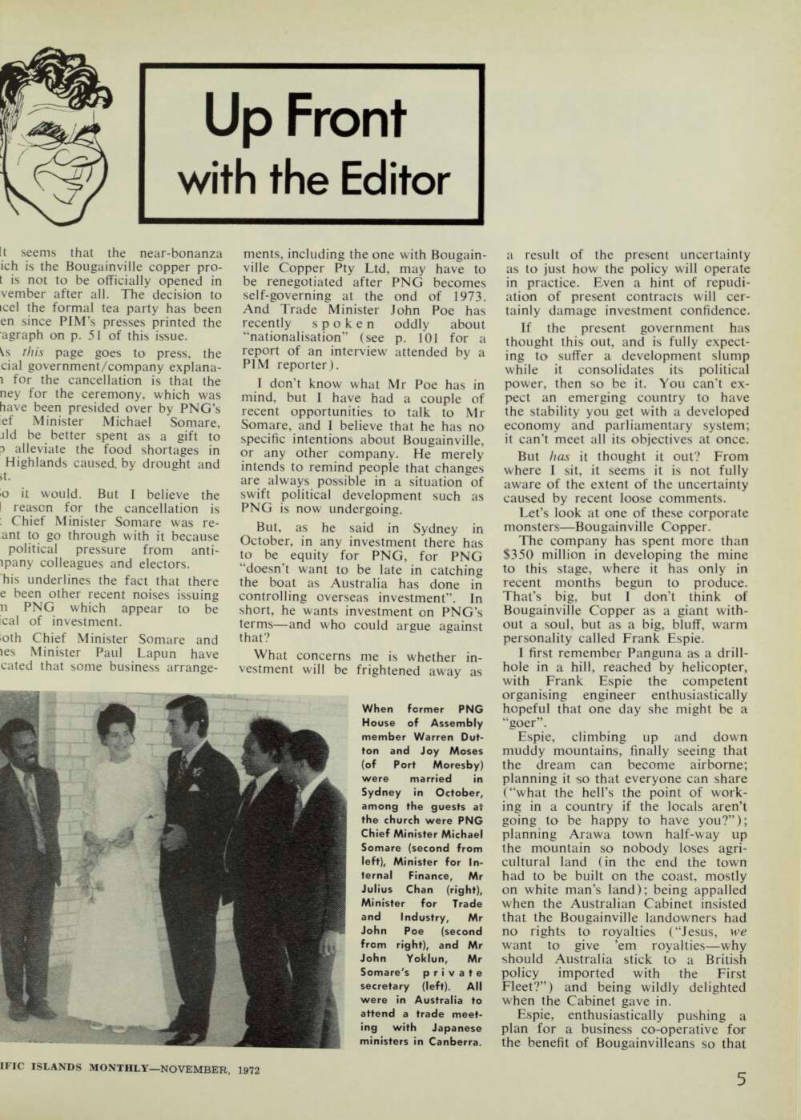
When former PNG House of Assembly member Warren Dut ton and Joy Moses (of Port Moresby) were married in Sydney in October, among the guests at the church were PNG Chief Minister Michael Somare (second from left), Minister for In ternal Finance, Mr Julius Chan (right).
Minister for Trade and Industry, Mr John Poe (second from right), and Mr John Yoklun, Mr Somare's private secretary (left). All were in Australia to attend a trade meet ing with Japanese ministers in Canberra.
jatriate firms couldn't corner the finess opportunities; Espie insisting racial equality and a real training igramme for New Guineans (at a ic when most PNG expatriate busi s was still paying lip service to twin aims); Espie organising an >ensive, territory-wide educational gramme to teach New Guineans >ut the intricacies of share scrip they will know of the advantages the copper shares issued to them par. remember that the company had nt something like S 5 million in specting money before it ap ached the then PNG Government guarantees that it could have tten into a “bankable document” ch would enable it to raise bank is to prove the copper deposit, hat document was thrashed out, i the endorsement of the PNG jse of Assembly, before either government or the company w the mine would be a “goer”, vas a lottery, with the company ing up the cash and being re asible to world banks for its repay it.
Tiose banks loaned a lot of money short term. If the mine was a r , they were to have first bite he cherry. The contract with the j government was so structured after the banks were repaid, the its were shared between govern it and company in what was ed to be a reasonable proportion, t’s without even taking into >unt the extra fillip to the tomy caused by the very existence he project.
D now you hear talk in PNG it the better deals the govern ts have in Zambia and Chile, doubt. But those mines have i operated for generations, not a few months. And the Bougain agreement has only been re ly negotiated in good faith, and oved by many of the same people in power. It’s not the kind of mous document foisted on the ispecting Ocean Islanders by ish phosphate exploiters at the of the century. his is not to say that PNG ildn’t try to get an improved deal can negotiate it. But the present ade of some smacks to me of dover tactics, which can’t do i’s reputation any good. Who blame Kennecott, which is sit on a potential copper mine in tern Papua, and who won’t move the PNG Government tells it what it is prepared to do to
—Stuart Inder
Advertisements & other items, pp. 7-10 (3 items)
5
IFIC ISLANDS MONTHLY—NOVEMBER, 1972
Buyers for the Pacific Islands
a % Va S. E. TATHAM & CO. PTY. LTD.
ASKEW HOUSE, 364 LONSDALE ST.,
MELBOURNE, 3001, AUSTRALIA.
G.P.O. BOX B—CABLES "SET"
TELEPHONE: 601125
Buyers for the Pacific Islands
AND IN
FIJI: S. E. TATHAM (FIJI) LTD.,
LAUTCKA P.O. BOX 366,
SUVA G.P.O. BOX 671,
PAPUA NEW GUINEA: s. E, TATHAM (P.N.G.) PTY. LTD.,
MALEKULA ST., LAE.
P.O. BOX 1652.
YOUR GUARANTEE
FOR SERVICE
% \ \ i i
L V *
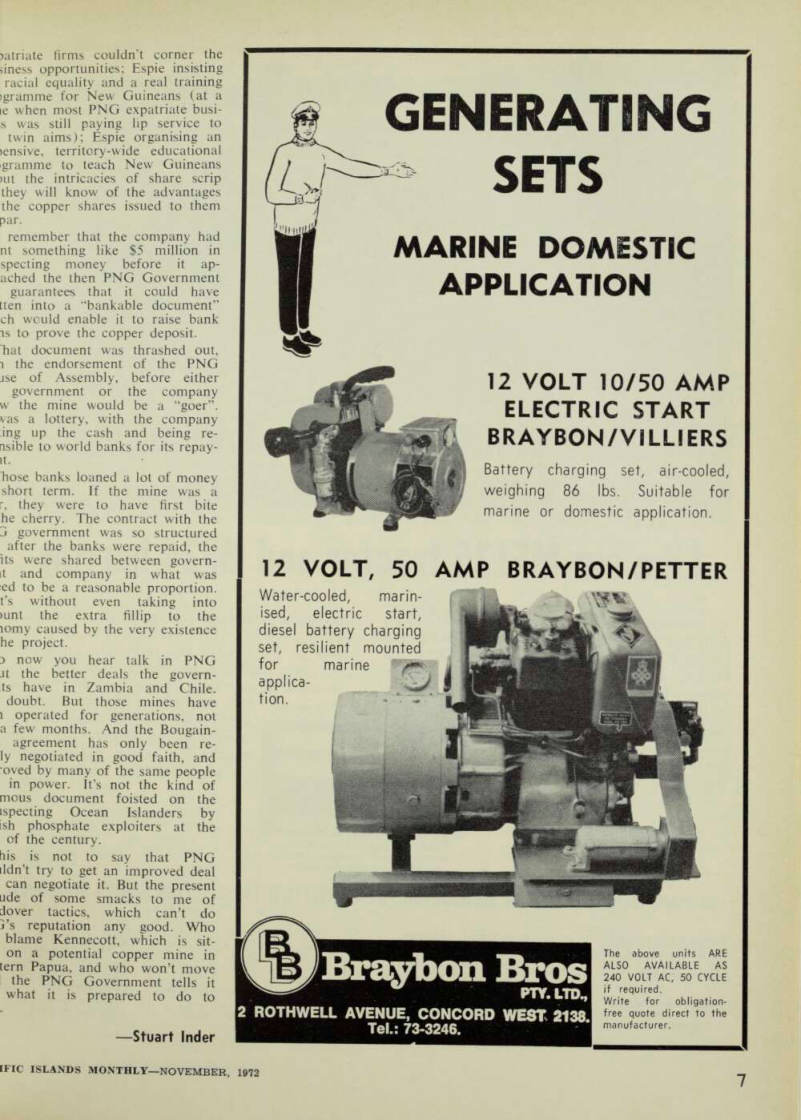
GENERATING
SETS
MARINE DOMESTIC
APPLICATION
12 VOLT 10/50 AMP
ELECTRIC START
BRAYBON/VILLIERS
Battery charging set, air-cooled, weighing 86 lbs. Suitable for marine or domestic application.
12 VOLT, 50 AMP BRAYBON/PETTER
Water-cooled, marinised, electric start, diesel battery charging set, resilient mounted for marine J| application.
M \
Braybon Bros
PTY. LTD,
2 ROTHWELL AVENUE, CONCORD WEST 2138
Tel.: 73-3246.
The above units ARE
ALSO AVAILABLE AS
240 VOLT AC, 50 CYCLE
if required.
Write for obligationfree quote direct to the manufacturer.
mmm
i tm.
% m m S: i*£* £ Like our MFI3S tractor and MF34 harrow All over the world, farmers buy more MFl3s’s than any other tractor in its class. And, the reason is quite simple. On any size farm, the
MFI3S does more work, more economically
because it has the best power-to-weight ratio in its class a powerful high-torque engine
that delivers plenty of power with
economy and the advanced Fer-
guson System, that puts the finest
implement control plus tremendous
power at your fingertips (more than enough to lift 2,850 lbs.). Hitch up the MF34 Disc Har-. row on the linkage and you make up a most
versatile, hard-working combination that is un-
beatable in any field. Choose the MF34 in 12, 16, 20 disc sizes with 20" or 22" plain or scalloped discs. You can offset this disc harrow to the right or left of the
tractor and extend the rear gang
an additional 204" left or right.
MF
Massey Ferguson
World’s largest maker of tractors, headers, cane harvesters, diesel engines, backhoes and loaders.
MF72010 ASK YOUR MASSEY FERGUSON DISTRIBUTOR FOR COMPLETE DETAILS ... THE MAN TO SEE IS HERE
PAPUA NEW GUINEA
Ela Motors Limited, P.O. Box 75,
PORT MORESBY
Branches and Dealers throughout Papua New Guinea
FIJI, TONGA. WESTERN
SAMOA AND OTHER SOUTH
PACIFIC TERRITORIES
Motor Division, Burns Philp (South Sea) Co. Ltd., P.O. Box 355,
SUVA, FIJI
Branches throughout the region
NEW CALEDONIA
Pacific Motors, S.A.,
B.P. 41, NOUMEA
BRITISH SOLOMON ISLANDS
R. C. Symes Pty. Ltd. 7
HONIARA, GUADALCANAL
TAHITI
Ets, Donald,
P.O. Box 131, PAPEETE
NEW HEBRIDES
CONDOMINIUM
Pentecost Pacific S.A., Santo and Port Vila
[Fic Islands Monthly—November, 1972
Pacific Islands Monthly
The Ellice Islanders Say They
Want To Secede From Geic
The Ellice islanders of the Gilbert id Ellice Islands Colony are asking • be allowed to secede when the >lony becomes self-governing.
With a population of about 7,000 ;ainst the 40,000-odd Gilbertese, e Ellice people, who live in the uth of the group with Funafuti as eir “capital”, fear that when Britain vers her ties with the colony, they 11 be politically dominated and erally submerged by the Gilbertese.
Seven of the eight Ellice islanders i the Governing Council are agitat g for secession and, led by Telavi lati, have been touring their islands lipping up support for their plans prevail on Britain to allow them remain a dependency and let the Ibertese go it alone with constitu nal changes.
The eighth Ellice islander member the council, Mr Isakala Paeniu, smber for Natural Resources for ; last two years, sympathises with i fellows but is opposed to seces n.
“I do not support them,” he told M, “but I am not against their ws. In my view political domina n by the Gilbertese could happen, j Ellice peonle have a right to ex ;ss our views, but I don’t agree that should pull out. We all want :ionhood, to be independent, but ' people would be much better off momically if they stayed with the Ibertese. ‘We have come a long way to iler and to conclude a separate •cement with Britain would not be )d. We must be one country ngaru-Tuvalu (Gilbert and Ellice).” :sa said the seven Ellice leaders 1 gained support in the villages ough informal meetings, but it was d to say whether the villagers lly understood what was at stake.
The ordinary people know very le about politics,” he said. “Even majority of representatives are v to politics.”
Britain is perturbed about the eatened split and Mr Anthony rshaw, Parliamentary Under-Sec iry for Commonwealth and
Foreign Affairs, was in the GEIC in October for talks with both sides.
Mr Kershaw, who was billed as leader of the British team at the South Pacific Conference in Apia, was only in Apia for about two days.
Then he left for Tarawa, from where he soon made an extensive tour.
What Mr Kershaw learned was that the Ellice Islanders appear to be adamant that they would be better off as a separate colony under Britain, than self-governing in association with the Gilbertese. They are not at all sure as to what their colony status should look like, and neither is Britain, who rather hopes that the problem will go away.
When Mr Kershaw finished his tour in October he gave a broadcast over Radio Tarawa in which he stressed the advantages of “getting with the strength”. He said in Britain with a 50-million population, they were “too small to manage our own affairs entirely by ourselves as we used to. We were getting pushed around”. But now that Britain had joined the Common Market it was 250 million strong as a trading bloc, “and it will not be easy for anyone to push 250 million people around”.
The moral, implied Mr Kershaw, could apply to the GEIC.
“I know there is an opinion here that the Gilberts and Ellice should separate,” he said. “Such a step would be a very important one to take. It would not increase the influence of either the Gilberts or the Ellice in the world. It would bring problems and extra expense. I’m not here to compel or insist. All I can do is advise, point out the experience of others, including ourselves in the UK.
I do say this: reflect carefully before you make up your minds.”
It couldn’t have been a relaxing visit for Mr Kershaw, because he was also under pressure on the Banaban situation, which has a bearing on the GEIC’s economic future.
The Banabans (owners of Ocean Island, but now living in Rabi, Fiji) have a lawsuit pending against Britain in which they are demanding
$2l million damages for worked-out phosphate lands on Ocean Island, un less Britain restores them. This law suit is likely to take years to resolve.
Far more urgent is the need for a decision by the Banabans on whether they will allow the BPC to mine 111 acres of unleased lands worth about $3 million in total royalties to the Banabans and the GEIC on present prices. Ocean Island’s present leased lands should be worked out by 1976 or 1977, and the BPC has said that if it can’t get a decision in the next few weeks on whether it can mine the others, it won’t ever mine them.
The unleased lands can now be reached by existing roads across the phosphate, but the BPC is at the point where it wants to begin tearing up the roads and mining the high quality phosphate beneath. This would cut off access to the unleased lands, which have a lower quality phos phate anyway, and which the BPC would mix with the higher quality.
The Banabans currently get slightly more than 15 per cent of the phos phate “benefit” (that is the price re maining after the BPC has sub tracted the costs of mining and selling the phosphate), and the GEIC Gov ernment gets slightly more than 84 per cent of the benefit. The Banabans have always been unhappy at their small share and are holding out for a bigger cut of the unleased lands.
Britain has offered 50 per cent; but the Banabans have had their Sydney economic advisers, Phillip Shrapnel and Co, take a look at the details of the British proposal (which is rather complicated, involving some payments by “grant”) and are not satisfied that it’s in their best interests.
Tebuke Rotan, the Banaban who is one of the leaders of the fight for a better phosphate deal, flew to London in October to discuss the matter with Mr Kershaw.
If Britain can’t get an early de cision—and it looks as if it won’t— the GEIC stands to lose its share of the cash too—which means more handouts by Britain in addition to its present problems over the Ellice.
Advertisements & other items, p. 11 (1 item)
9
2IFIC ISLANDS MONTHLY—NOVEMBER, 1972
Independence Claim Puts Spanner
In Micronesian-Us. Works
From a Honolulu correspondent
Micronesia’s political future went into the melting pot in Hawaii on October 6 with the sudden ending by the United States of the sixth round of negotiations over a free political association for the islands with the US.
Faced with a new demand from the Micronesian Congress for double barrelled talks on a pact of free as sociation and for independence (PIM, Oct., p. 11), America called a halt after eight days, and left the date of the next talks in the air.
Though the whole thing was couched in the language of diplomacy, and all exchanges were friendly, there was no mistaking the attitude of the US Ambassador Frank Haydn Wil liams, who told the Micronesians that there would be no arrangement that did not ensure a continued Ameri can presence in the area.
The Americans were aware, of course, of the new situation before the talks began on September 28,
following the surprising about-turn
by the Congress of Micronesia, which refused at its special session at Ponape in September to ratify the agree ments reached at the Washington talks on the Draft Compact of Free Association. Instead, the Congress told the status committee to add independence to its goals. (PIM, Oct., p. ID- Senator Salii, the status committee chairman, was then upset and bitter at the change in direction. Ambas sador Williams was perplexed. Con gress had already approved free as sociation as the objective, and now independence had reared its head.
This was the backround as the sixth round of talks began.
At the talks, the Micronesians were dissatisfied with financial projections.
They wanted a budget of SUSIOO million, $4O million more than the United States had earmarked for it.
They were dissatisfied with what they considered was the vagueness of the US over its military plans and the unsatisfactory programme to com pensate the owners of the land.
Senator Salii said his committee had been authorised to continue negotiations regarding “the establish ment of Micronesia as an independent nation while continuing the negotia tions towards free association. There is an important and growing senti ment in Micronesia for independence on its own merits.”
He added that the “Congress of Micronesia took the position that the only acceptable type of plebiscite which would one day be submitted to the people of Micronesia must include the choice of more than one political alternative.”
Ambassador Williams replied, “We also came to the talks with concern at the changed atmosphere. Reluc tantly, we have come to the con clusion there are indeed degrees of uncertainty which cannot be wholly dismissed.”
After referring to the “diversity of opinion and the lack of solidarity” shown by the Micronesians, Haydn Williams said. “You can hardly ex pect the United States Government, in addressing free association, to make binding financial offers, proposals of termination and recommendations about the transitional process when it has not had the opportunity to consider the new framework within which we are now negotiating. The United States will not move pre maturely or piecemeal on such important matters.”
After several other exchanges with the Micronesians clearly wanting the talks to continue and the Americans determined not to talk about anything except a postponement of the talks, Ambassador Williams said, “The situation which led to the Trust Ter ritories’ designation as a strategic
trust will continue to exist whatevet your future status might be.
“I cannot imagine, for instance that my government would agree t«; termination of the trusteeship on termi which would in any way threatei: stability in the area and which would in the opinion of the United States endanger international peace an»i security. Aside from such securit; considerations I can visualis* relatively few issues that would neet to be negotiated. Taking all of thi foregoing into account I feel thi time has come for a pause.” HI suggested that the Micronesians, too should use the pause for a re evaluation.
Salii stressed the urgency oc completing the draft Compact of Fre; Association.
“There can be no doubt,” he said “that the pressures for the statui of independence are growing and . continuing delay in the developmenr of the Compact of Free Associatior might make these pressures irresis tible”.
Salii’s apprehension is real. HI believes that because the independence movement is growing stronger, ; lengthy intermission might lead thi Micronesians to believe that thi attempt to work out a free association with the US failed —and the demanu for independence will take control..
It seems vital that the parties shouli get together again as soon after thi forthcoming Micronesian elections aE is possible, and come to a decision.
Key differences to be resolved an the termination clause of the compao (whether the Micronesians can or for independence or some other statu: within five or 15 years), and thi amount of money which the US i willing to provide.
As the Honolulu Advertiser said in an editorial: “The outlook is mon uncertain, but not impossible. Whs could, and should not, happen is situation where nobody wins—when the powerless Micronesians don’t go the future status they want ami where the US gets another inten national black eye by placinr our ‘security’ above other peoples; humanity.”
The US meanwhile should mow ahead on talks with the Marianas people for a separate, closer relatiom ship with the US. The present dit Acuities apply only to the Marshall! 1 and Carolines,
PNG airline surprise
A plan announced jointly in September by the PNG Government and the Australian Department of Civil Aviation, to the effect that PNG is to have a nationl airline consisting of a consortium of Qantas, TAA, Ansett and the PNG Government, has caused some perplexity in Aus tralian aviation circles.
None of the airlines was aware of the decision before the announce ment, and Sir Reginald Ansett is violently opposed to it. He said in October that he couldn’t see it being carried out in the manner proposed.
The plan seems to be the work of DCA and the Australian Government.
Although the PNG Government agreed to the announcement, the attitude of some of its ministers is that it is not binding, and that some other arrangement will be made.
People
By PIM staff reporter
Manoa Rasigatale
Mr John Maneke, MHA, in the apua New Guinea House of As ?mbly, said in September that ”too lany long-haired people go to Papua few Guinea”, and he asked “will ’gislation be brought before this J ouse to ensure that people with mg hair are not accepted in this luntry”.
Mr Julius Chan, on behalf of the finister for the Interior, replied that ie government was not considering gislation because it had “a lot of nportant things to do at this stage f the country’s development”.
What did Mr Maneke really mean’ oes he want to ban the long-haired ‘ppies or all the long-haired in meral?
Long hair is a part of the customs some countries, such as my native iji. I for example have long hair, >en though I don’t comb it like we <ed to do.
I’m happy with this style just like V Maneke himself is satisfied with s short hair. This is also a fad or shion of today’s world and we can’t m away from it.
Things will come and go and it a freedom of choice to choose hich hairstyle we like.
• Western Samoa’s Prime Minister Tupua Tamasese left early in October on an official visit of one week to Nationalist China and two weeks to the United Kingdom. He was accom panied by his wife, his private sec retary and several high level govern ment officials. Tonga’s Premier, Prince Tu’ipelehake, should be in London about the same time. • Two young Papua New Guineans, Mr Anthony Farapo and Mr Thomas Tobunbun, are in the third six-month stage of training in international affairs. Following courses in Port Moresby and Canberra, Mr Farapo has been appointed a third secretary in the Australian Embassy in Jakarta and Mr Tobunbun was similarly appointed in Brussels. • Manus-born Mr Gabriel Gris, Chief of Dental Services in PNG’s Department of Public Health, has been appointed to the council of the University of PNG. A Fiji Medical School graduate, Mr Gris also is a Master of Public Health of the University of Michigan. • Sir Donald Cleland has been appointed to continue as a member of the council of the University of PNG, following his resignation as Chancellor of the university. • Mr C. Rockett has been ap pointed Ports Manager for the New Hebrides. He has been General Mana ger of the Ports Authority in Sierra Leone and was manager of the Ton nage Department of the Australia/ Europe Shipping Conference in Syd ney. • The new minister for the Apia Protestant Church, the Rev Richard Hambly, arrived in Western Samoa recently with his wife and three children. He is originally from England where he served as a pastor for nine years in Surrey. He replaces the Rev Bruce Deverell who has returned to New Zealand. • NZ has appointed Mr George James Brocklehurst, OBE, of Welling ton as High Commissioner of the Cook Islands.
He was an accountant with the New Zealand Broadcasting Service from 1927 to 1939, when he joined the Social Security Department in which he has since specialised. He has been
chairman of NZ’s Social Security Commission and Secretary of War Pensions, and was appointed Director of Rehabilitation in 1965. In 1955-56 he was a UN advisor to the Singapore and Trinidad and Tobago Govern ments on their Social Security pro grammes. • After resigning from 11 public posts in September, including that of Opposition Whip and general secre tary of the National Federation Party (PIM, Oct., p. 12), unpredictable Fiji politician Mr K. C. Ramrakha re versed his decision in October and returned to all posts. Whether or not his mass resignations were sincerely intended (an impulsive, explosive per sonality, he undoubtedly meant what he said when he vented his spleen in September on political colleagues and the executive of the Fiji Teachers’
Union); Ramrakha’s about-turn was seen as a clever political ploy, con solidating his party role. • Mr Matthias Yaliwan, famous as the representative in PNG’s House of Assembly of the cargo cult prac tising Peli Association, announced his resignation from parliament on October 13. Under pressure for fail ing to lead PNG into immediate in dependence, he claimed he was sick as a result of sorcery worked against him. • Fred and Dorothy Hargesheimer are visiting the US from Ewasse, New Britain, where they have been work ing for the Airmen’s Memorial School which Fred, a former wartime US air force pilot, founded. They’ve now decided to make their permanent home at Ewasse on their return.
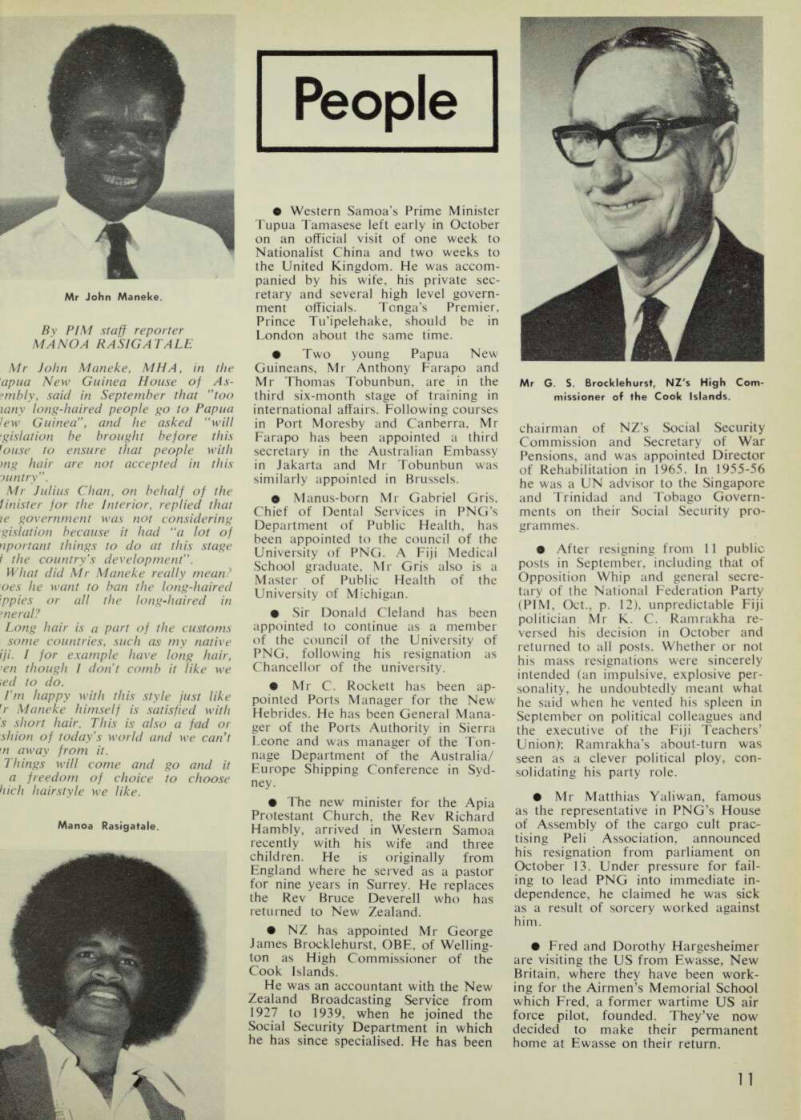
Mr John Maneke.
Manoa Rasigatale
Mr G. S. Brocklehurst, NZ's High Com missioner of the Cook Islands.
fiji talanoa
Building a nation's pride the Pacific way
With Sue Wendt,
in Suva
FFHOSE over-worked words—peace, tolerance, harmony and goodwill —have been spouted so often in Fiji since independence that it sometimes seems as if everyone is protesting just a bit too much. Is Fiji, still the New Boy in the independence stakes, really achieving the ideal that some other emergent countries have so disastrously missed?
The dominion celebrated its second anniversary of independence in October and the ‘‘Pacific way”, that catchy phrase coined by Prime Minister Ratu Sir Kamisese Mara, was very much in evidence. And it rang true.
Fiji has remained stable, both politically and economically, and words like tolerance and harmony aren’t empty cliches after all. People of amazingly, almost irreconcilably, diverse cultures, religions and beliefs are co-existing peacefully and happily, and various ethnic leaders are exhibiting an increasing sense of national responsibility.
Sir Robert Foster, giving his last Dominion Day address as Fiji’s Governor-General (Ratu George Cako bau, Minister Without Portfolio, was being tipped in October as the next, and first Fijian, incumbent) spoke of Fiji’s “solid achievements” during the past two years. These included grow ing co-operation and friendship be tween Fiji, other Pacific islands and Australia and New Zealand, closer links with India and continuing close ties with Britain. “Fiji has added a Pacific voice to the deliberations in the United Nations,” Sir Robert said.
“As the Prime Minister once put it ‘We have sought the friendship of all and enmity of none'.”
But in tackling the problems of inflation, unemployment, poverty, ignorance, inadequate housing and a rising crime rate, Sir Robert declared, Fiji people needed to develop a greater sense of national pride.
“They need to acquire the habit
of putting the country's interest be fore self-interest; they need, above all, to increase productivity; and in seeking to settle industrial and other disputes they need to resort more to discussion and, if necessary, to mediation, than to action which can harm the community as a whole,” he said.
INTOLERANCE still exists in Fiji; it * would be unrealistic to expect otherwise. The Prime Minister ex pressed disappointment in October at opposition from some quarters over Fiji's decision to accept a token number of expelled Uganda Asians, saying he’d hoped to see the prin ciples of ‘‘goodwill” tolerance and
understanding” accepted right down
the line.
The Fijian Association, a constituent organisation of Ratu Sir Kamisese's Alliance Party, had passed a resolu tion opposing Fiji’s acceptance of any of the deported Asians. Ratu Sir Kamisese described such objections as the tip of the iceberg of in tolerance and racialism in Fiji. He announced that the government’s previous decision to take in 10 of the deported Asians had been recon sidered and the figure of 10 would now represent heads of families.
Fiji had received about 20 applica tions, he said.
The Prime Minister added that Fiji people were being accepted as permanent citizens, by Commonwealth countries which had agreed to take in Uganda Asians. If Fiji refused to accept any of the deportees, oppor tunities for Fiji citizens to become permanent residents of those Com
monwealth countries might be preju diced.
Meanwhile, with the deadline for
Fiji citizenship applications having
expired on October 10, the Immigra tion Department was still ploughing!
through a big backlog of paperwork.,
The Minister for Labour, Mr Jonatii Mavoa, assured the public that people who hadn’t applied in time wouldn’t be deported just yet. Hei rejected claims that the citizenshipi issue and deadline date hadn’t beem publicised enough—and added that) the $l5 application fee was beingi waived for those who couldn’t pay it., The Immigration Department couldn’t produce any figures for the number of people who’ve applied for citizen ship during the past two years, but) there were still thought to be numerous long-time residents of Fiji who hadn't come forward, perhaps through confusion about the pro cedure involved or ignorance of the need to ratify their position. Many ofl the old people who came from India or neighbouring Pacific Islands stilll couldn’t comprehend why they needed: to go through all that red tape whenf their children and grandchildren had! been born in Fiji.
Others, though probably only very\ few, were still baulking because they\ wanted to retain sentimental links? with the ‘‘old country” and were loathr to exchange one passport for an other. People who were born in the?
UK, Australia and New Zealand have? been assured that they’d have noc problem getting their old passports? back if they decided to relinquish Fijii citizenship.
There’s still a lot of sorting out to(
10, but in the end people in Fiji will all into three categories—Fiji citizens, xempt people (including civil ser ants, United Nations personnel, and acognised foreign diplomats and taff) and those who hold residential r work permits. Mass deportations re not on the cards. i MONG the busiest men about Fiji’s towns these days is the roverbial “man in the grey flannel jit”. He favours less formal garb nd lacks the slick expense-account resence of his Madison Avenue con imporaries, but he’s raking in the jsiness just the same.
The ad-man has been seducing the ji public for many a long year, nee the last century in fact, when 3 promoted the virtues of all manner : fascinating commodities. Back in 569, the Fiji Times—on page one : its very first issue—carried an jvertisement for Pure Drugs and ruggist's Sundries, including such iracle cure-alls as Mrs Kidder’s id Dr Jacob’s cordial for Diarrhoea id Dysentery; Dr Churchill’s hypo ilphite of lime and soda, for con imption; Mrs Winslow’s soothing rup for children teething, Poor an’s Friend; and Dr Hunter’s eradi tor. Ladies could buy “bone gum igs, nipple shields, breast tubes, ip boats, puff boxes and atmos eric oderators”. Gentlemen could come hirsute again with Fish’s hair storative.
In 1880, H. Raddock and Co, vuka, advertised dinner plates at 3 a dozen, wine glasses at 4/- a zen, decanters at 2/6 each, Turkish /vels at 10d each, white damask Dlecloth at 1/6 a yard. In 1920, alter Horne and Co Ltd advertised m innovation for evening dress jar, introduced by the vice-regal rty of India and worn by His Royal ghness the Prince of Wales”. It is "an evening suit, consisting of 3ss sac coat, evening vest and 'users, all of white drill” and cost ) 63/- a suit.
In 1918, Morris Hedstrom Ltd ad rtised “The universal car, the rd” at £196 for cash. The latest )del Dodge Brothers’ touring car s £395. In 1933. The Morris 10 loon was selling for £240.
Those old advertisements make in going reading, recording as they do : fads and trends of the day. From )se early beginnings, the promotion me has become a multi-million
dollar business in Fiji, supporting not only the Fiji Times and its asso ciated vernacular newspapers and tourism publications, but earning substantial revenue for other Fijian and Hindi newspapers, the Fiji Broad casting Commission, cinemas, Beach Press Ltd (which produces a fort nightly tourist paper for the Fiji Hotel Association), even town councils and transport companies.
Advertising messages adorn parking
metres in Suva streets and garish illustrations on the backs of buses exhort us to sample anything from whisky, breath fresheners and head ache powders to electronic equip ment, cars and air travel. This year, the Fiji Visitors Bureau is spending $13,800 on local promotion and $153,650 on advertising and promo tion overseas.
TV/’HEN it comes, to getting the " message across however, India’s High Commission in Fiji—selling that
intangible product, “goodwill”—
leaves high-powered advertising pro
motions in the shade. Gregarious
High Commissioner Mr Bhagwan
Singh dispenses goodwill with urbane professionalism, so successfully that aside from the Prime Minister, he’s probably leading contender for the award of Fiji’s Most Photographed
Personality.
It’s a rare week when Mr Singh isn’t photographed at some charity function or social occasion, touring the outer islands, opening an exhibi tion or fund-raising festival, welcom ing technical experts from India, entertaining young Fiji people at his home or farewelling Fiji dignitaries
off to India as guests of the Indian government.
India’s “image-building” campaign is making a big impact in Fiji. In August, flourish and festivity accom panied the opening of an Indian Cultural Centre in Suva, timed to co incide with celebrations marking India’s 25th anniversary of indepen dence.
TN October, an India On The Move trade exhibition described by Bhagwan Singh as a “modest dis play”, but presenting a variety of products ranging from arms and ammunition to cosmetics, jewellery and electrical goods—was opened in Suva by Fiji’s Paramount Chief and Minister Without Portfolio, Ratu George Cakobau. Ratu George praised India’s contribution to Fiji’s development, through technical assist ance and the training of personnel, and said he was glad to learn that India would be providing experts to work with the Minister of Fijian Affairs, expressly to train Fijians in industry.
As he opened the exhibition and performed the Indian lamp-lighting ritual, the venerable Fijian leader wore traditional sulu and a glittering mala, or ceremonial Indian garland —sartorial evidence of changing cul tural patterns in the dominion.
“If you noticed me making several false starts to get to the microphone,” said Ratu George jokingly, after rising from his cross-legged position on Indian embroidered cushions,” it’s because I don’t really like sitting on the floor!”
More changing cultural patterns . . .
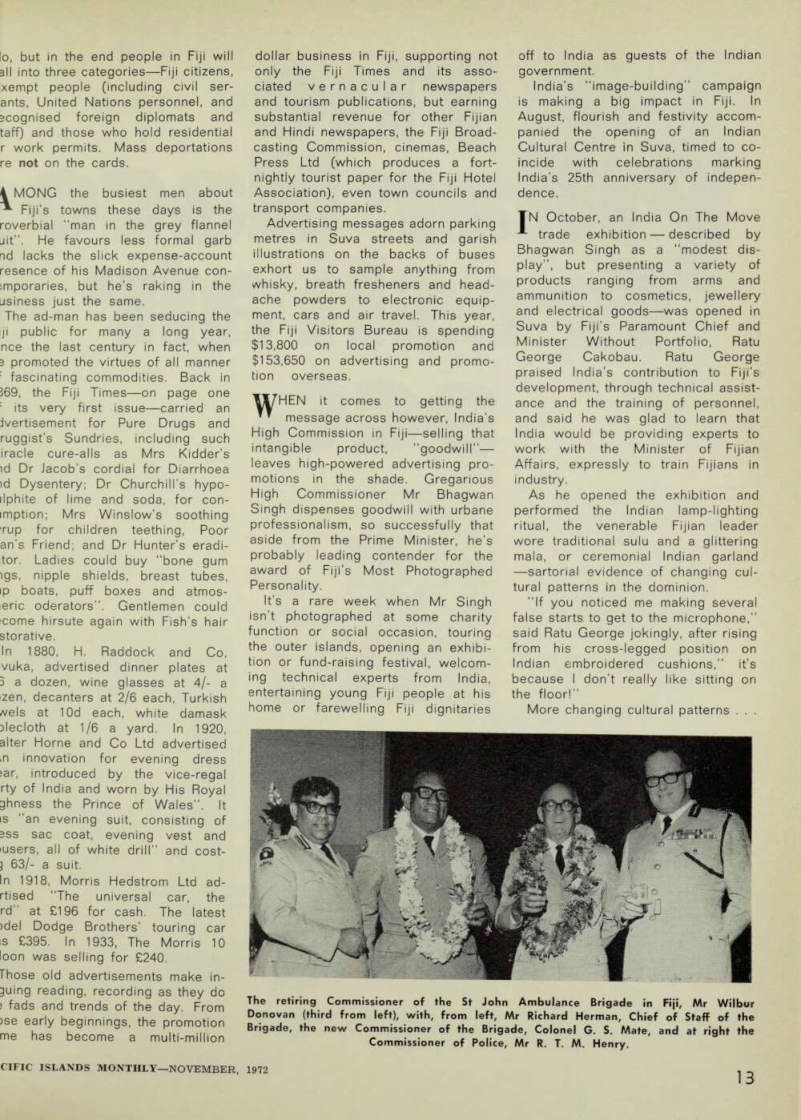
The retiring Commissioner of the St John Ambulance Brigade in Fiji, Mr Wilbur Donovan (third from left), with, from left, Mr Richard Herman, Chief of Staff of the Brigade, the new Commissioner of the Brigade, Colonel G. S. Mate, and at right the Commissioner of Police, Mr R. T. M. Henry.
Advertisements & other items, pp. 15-16 (2 items)
13
CIFIC ISLANDS MONTHLY—NOVEMBER, 1972
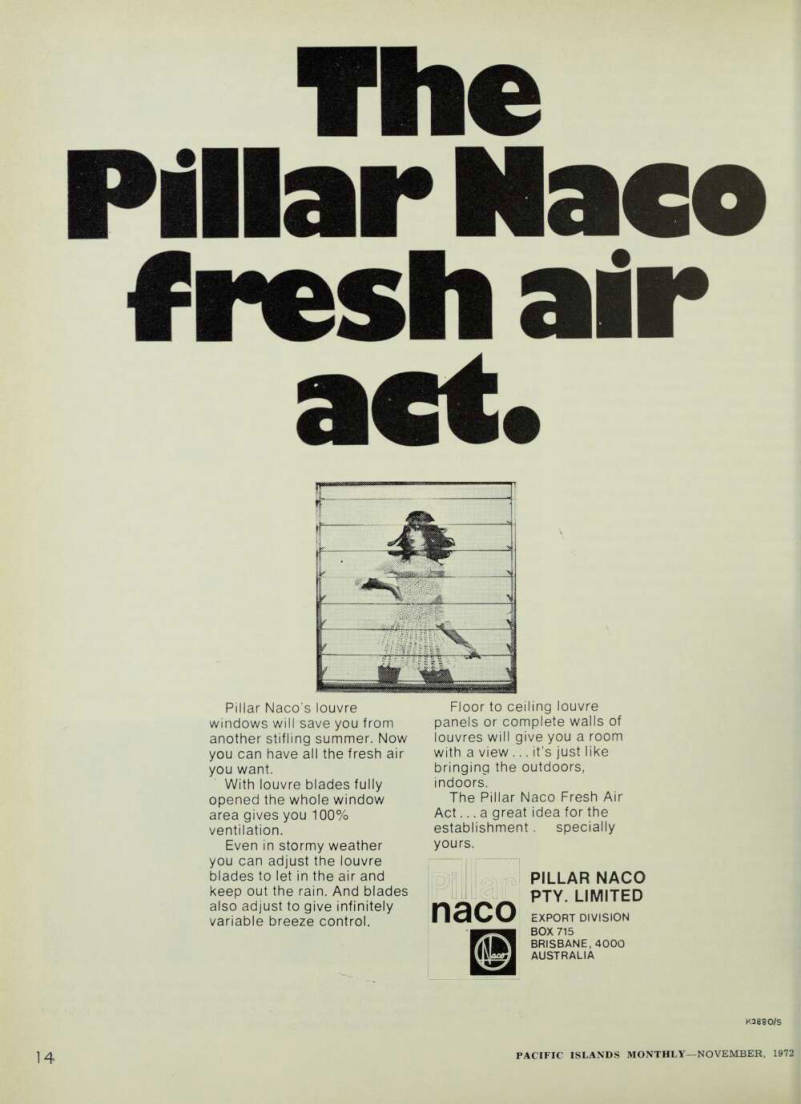
Pillar Naco
The
fresh air
act*
Pillar Naco’s louvre windows will save you from another stifling summer. Now you can have all the fresh air you want.
With louvre blades fully opened the whole window area gives you 100% ventilation.
Even in stormy weather you can adjust the louvre blades to let in the air and keep out the rain. And blades also adjust to give infinitely variable breeze control.
Floor to ceiling louvre panels or complete walls of louvres will give you a room with a view ... it’s just like bringing the outdoors, indoors.
The Pillar Naco Fresh Air Act... a great idea for the establishment. specially yours.
naco
Ril
PILLAR NACO
PTY. LIMITED
EXPORT DIVISION
BOX 715
BRISBANE, 4000
AUSTRALIA
K3BBO/S
French Polynesia prefers

security to adventure
From JAMES BOY AC K, in Papeete
Drama, bitterness and a sprinkle )f comedy in October transformed he inaugural budgetary session of he newly elected pro-Paris Territorial \ssembly into a standing-room-only heatrical event.
The initial gathering of those who vill legislate in French Polynesia for he next five years permitted auto lomist guru, Senator Pouvanaa A )opa, 77, to strut through his first and probably final) major ap )earance on the political stage since lis return to Tahiti from exile in 968. It also gave French Governor ’ierre Angeli the chance to tear off lis political kid gloves for an un irecedented display of who’s-in harge, and why.
Everyone knew that a majority :oalition contract had been signed he previous day by the 11 members >f the Gaullist Tahitian Union UDR md the five centrist assemblymen if the Te Autahoeraa. Voting late n the session for assembly officers ind commission membership was, as xpected, perfunctory; however, just is a play like King Lear chills the epeat spectator at each performance,
so did the pre-scripted inaugural as sembly session give format to the free reign of all the passions that colour the political spectrum in French Polynesia.
For example, it was newspaper headline knowledge that Pouvanaa, acting as interim president because he is the oldest of the 30 assembly men, would speak only in Tahitian.
And yet, at 9.01 a.m., when the old man initiated proceedings in the language understood by the greatest number of people here, there was aghast silence . . . for the few seconds before Governor Angeli, seated next to Pouvanaa on the podium, loudly interrupted him.
Angeli’s intrusion was as much of a surprise, as part of the rite.
Pouvanaa had not completed one full sentence before the governor was on his feet, gesticulating, blurting to cut Pouvanaa short; “It seems that the doyen of this assembly insists on expressing himself only in the Tahitian language, which leads me to con clude that either he does not speak French, in which case I question the legality of his election because the law requires those elected to express themselves in French, or he is seeking to provoke an incident.
“I warn you right away that I am not willing to play such a game. I will, however, remain here and decide whether his tone does or does not warrant a reply.”
The first act had barely begun, yet there was carnage on the stage.
Pouvanaa continued. (It was his final performance. He resigned his assembly seat ope week later to permit dynamic autonomist Yannick Amaru to return to the assembly).
In spite of his 77 years and failing health, Pouvanaa’s Polynesian rhetorical prowess was undiminished.
The reasons for his reputation as perhaps the most eloquent public figure of the past decades were obvious. The governor’s castigation did not perturb him.
He spoke extemporaneously, in short phrases. He repeated the words with which he had begun (transla tion courtesy of the Journal de Tahiti): “This land is called Tahiti, the language 1 use is the Tahitian language. ... I repeat. We are in
Tahiti. If the governor has something to say, let him say it”. Long pause.
John Martin, the official translator, was busy at a nearby table scribbling the French equivalent of the old man’s remarks. These were im mediately shuttled to the governor on the podium.
“I repeat once again, if he has something to say, let him say it . .
Governor Angeli sat calmly during these pauses. A slight ironic smile wavered on his face. Finally he stood up again, and said, “If he wants me to reply, here I am with my inaugural speech. I can begin immediately”.
Nedo Salmon, a trumpeting Poly nesian orator in his own right, who happens to adhere to the Tahitian Union, began to accept the challenge to debate.
The old man cut him off. “It’s his reply I want,” Pouvanaa said, point ing to the governor. Silence.
“Our language is not considered fit for humans . . . when I was in prison, another governor, his name is
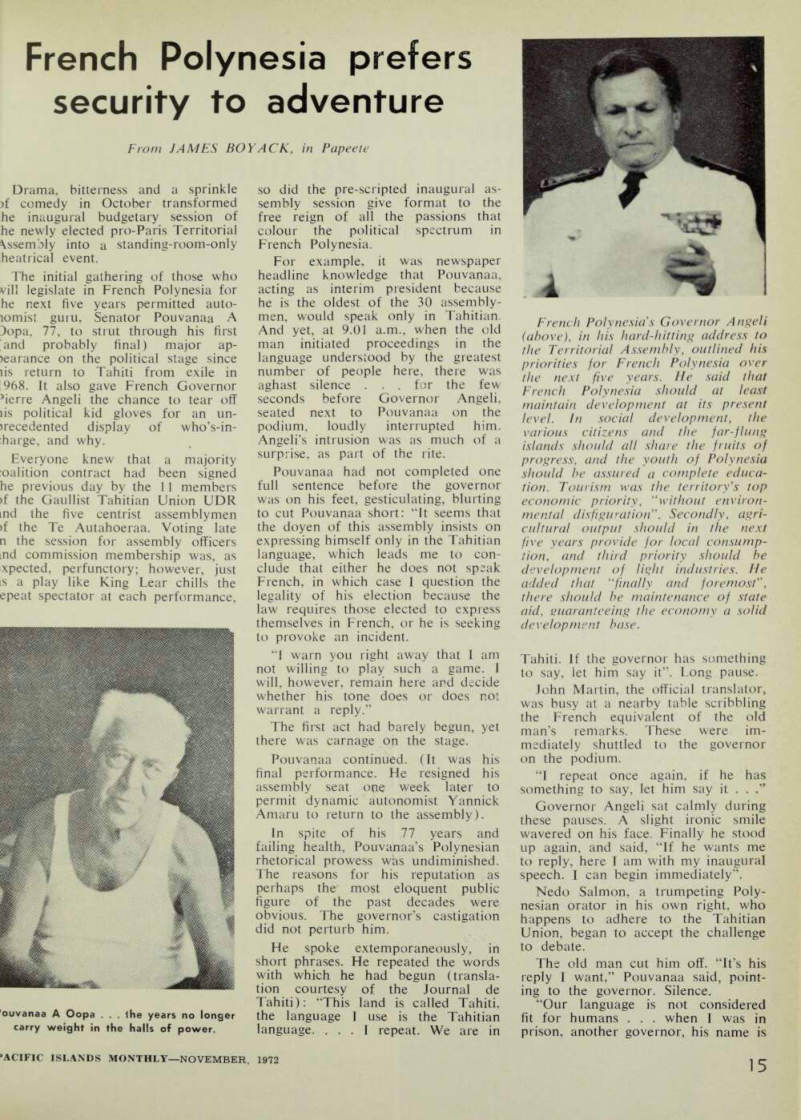
ouvanaa A Oopa . . . the years no longer carry weight in the halls of power.
French Polynesia’s Governor Angeli (above), in his hard-hitting address to the Territorial Assembly, outlined his priorities for French Polynesia over the next five years. He said that French Polynesia should at least maintain development at its present level. In social development, the various citizens and the far-flung islands should all share the fruits of progress, and the youth of Polynesia should be assured a complete educa tion. Tourism was the territory’s top economic priority, “without environ mental disfiguration” . Secondly, agri cultural output should in the next five years provide for local consump tion, and third priority should be development of light industries. He added that “finally and foremost”, there should be maintenance of state aid, guaranteeing the economy a solid development base.
Maestracci, told me Tahitian is animal talk. ... In 1914 when 1 joined the army to defend France, no one told me I spoke an animal language. No one asked me if I spoke French.”
And Pouvanaa began an account Df the long life which had led him ;o that platform. His jowls shook is he made a point and drew gunfire ipplause from the excited autonomist ;ympathisers in the assembly. Puffed >ags hung limply beneath his eyes is he thumped another point on the able in front of him. Four times his ;peech was greeted with applause.
He said, “I cannot hold myself >ack any longer. Today the vase has werflowed”. He said he would defend us people until his eyes closed.
At which remark Nedo Salmon, the JT-UDR assemblyman and school eacher rose to his feet. “If you are true aito, a chief, you should have be courage to let me speak,” he said a Tahitian.
Pouvanaa impassively nodded as ent.
Continuing in Tahitian, Salmon aid that by asking the governor to sply, Pouvanaa was demanding a ialogue of deaf mutes. He noted lat the governor was a guest of the ssembly, and deserved to be treated s such.
He said that whether his own guest Tahitian, French or American etermines whether he will speak ahitian, French or English, It is a latter of simple politeness. The avernor deserves no less. (Applause).
“You hold a position,” he told ouvanaa, “which allows you the full eedom to say everything which is i your heart. Use this freedom. But ;t everyone understand you.”
This plea ignited the loudest and ingest applause of the session.
Pouvanaa, offering something of a apology, said he would not have ioken as he did if the governor had ot interrupted him. Then, he began > ennumerate examples of his long ersecution as a public figure. (He as gaoled and exiled in France in 958 for allegedly plotting to burn own Papeete, a charge whose sub ance he still denies). And he spoke f governors who had wronged him i the past.
Salmon intervened again. He said lat Pouvanaa must stop associating le present governor with the errors f those who had preceded him. \nd if you are an intelligent and X)d man,” Salmon intoned, “you lust permit your guest to understand ou”.
To illustrate his message, the aullist Tahitian told the story of ic fox and the stork. Each invited le other to dinner and each cooked
only what he himself could eat.
“'That’s what you are doing,” Salmon concluded.
The Tahitian word used for fox was uri, which means dog. Pouvanaa asked innocently, “And which one of us is the dog?” The tight-packed assembly hall echoed with laughter as a brimming smile enveloped the old man’s face. Tension in the room subsided.
Finally, Salmon said, “We are two bad actors, enough of playing to the crowd, we are becoming ridicu lous.”
Pouvanaa ended his remarks by noting the absence of Mrs Lenoir, autonomist assemblywoman from the Austral Islands. Mrs Lenoir could
Pa Ying The Price Of Security
not obtain transport to Tahiti from Rimatara. Pouvanaa said that with out her, the inaugural session was illegal and should be postponed.
After a last recollection of priva tions suffered by him and his country, Pouvanaa A Oopa sat down, perhaps never to be heard from in a public forum again.
It was Governor Angeli’s turn to dish out political rabbit punches. The governor traditionally opens each budgetary session with an outline of territorial economic and social horizons. Such a composite picture was eventually traced, but Governor
Angeli chose first to make the most biting political statement of his almost four-year administration. Part of his preamble was devoted to an analysis of why the autonomist majority was overturned in the Sep tember Territorial Assembly election.
“First, let me assure you 1 will not speak in my native Corsican language,” he began, and then he questioned whether Pouvanaa’s speech in Tahitian was not proof that the autonomists, in fact, do not want dialogue with the central government.
In any event, he said since he did not have an advance copy of the doyen’s speech, he would not be able to reply immediately. Instead, he recalled another inflammatory and surprise address, that one given at the opening of the preceding assembly session by then President John Teariki (PIM, Sept., p. 12).
“In view of how things stand today,”
Governor Angeli said, “one can reasonably wonder whether the ex cesses of language which charac terised that speech did not influence the political turnabout we have just witnessed.
“By calling the prison riot a political manifestation, did not the former majority think it had an election issue capable of swaying public opinion? By presenting the “No” vote in the important 1958 referendum as an act of courage (Pouvanaa led those who voted “No” to remaining French in 1958. “Yes” won by a 2-1 margin), while every one knows that had “No” triumphed the territory would have lost every thing, didn’t they think they had tantalising bait for the electorate?
Is it really a surprise that this ter ritory voted in 1972 just as it did in 1958?
“Who really believes that adven turism is preferable to security?
“Where would we be today . . .
Where would the schools be, the hospitals, the dispensaries, the stadiums, the youth centres, the roads, the ports, the airports? What would be the standard of living of our fellow-citizens? What hope would there be for our youth?”
The Governor of French Polynesia said that rabble-rousing language and political maladroiteness, like auto nomist National Assembly Deputy Francis Sanford’s visit to the United Nations (PIM, Aug., p. 15), were contributing factors in the triumph of a Gaullist-oriented majority in this assembly.
And he stressed his major criticism of autonomist politics. “To subordinate all activity in the ter ritory for the satisfaction of a
statutory complaint leads only to paralysis.”
He said there was not an auto nomist and an anti-autonomist way of solving Polynesia’s real problems, because, he emphasised, “the key to these economic and social problems is an active and increased solidarity with metropolitan France. Who can Joubt this?”
Shortly afterwards, when Governor \ngeli criticised the outgoing Govern ■nent Council, autonomist Henri Bouvier tried to speak. “People were ible to interrupt Pouvanaa at will,”
Bouvier exclaimed, “now I will answer hat last comment immediately.”
But the governor did not miss a )eat. His voice even rose another lecibel and his words fell more apidly. Bouvier, drowned out, lumped back into his chair.
Governor Angeli is not a tall man, >ut he seemed very big as he spoke.
Be would remove his glasses and hake them at the congregation to tress a thought. Several times he /ould reach a critical point and, to mphasise it, he would throw his peech down in front of him,.
He blamed the former Government rnuncil for political gamesmanship vhich blocked the machinery of :ovemment, and he urged the new ouncillors to put aside past rivalry ietween elected officials and the ’aris-appointed administration.
As for the political status quo, governor Angeli said, “Let us apply, □yally and in all of its detail, the tatute which governs us. Afterwards, •ut only afterwards, if the wheels of overnment need to be changed, we vill have the well-founded demon tration of why. We must not re aain in the closed universe of sterile irotest.”
Only after reviewing the available nodes of government and expressing •ptimism that the new majority would lave the sense to use them, did the hief executive outline what he con iders priorities for the next five ears.
Before leaving the assembly, the overnor shook hands with a smiling ‘ouvanaa. AFer a short recess, lebate resumed ... in Tahitian. It /as time to elect assembly officers nd commissioners. Nado Salmon nformed the autonomist opposition hat, unlike during their just-expired ive-year reign, the minority would be •ermitted on commissions. The utonomists requested a recess to this offer.
Discussions were resumed shortly fterwards, this time in French. )nly Pouvanaa continued to speak 'ahitian. Spokesmen for the two parties each rejected the naiority offer, calling it a “cheap Boy”. They reminded the pro-Paris
parties of their campaign demand for proportionality in assembly posts.
Unless they received positions in pro portion to the 16-13 assembly break down (the assemblyman from Bora Bora remained aloof, PIM, October, p. 13), the minority preferred to offer “constructive opposition” at a distance.
Charles Taufa’s five “centrist” members of the Te Autahoeraa party, although less than one-third of the majority coalition, played their balance-of-power trump card to oblige the 11 Gaullists to cede 40 per cent of the assembly prestige cake.
Their hard-line attitude, which included a declaration of indepen
dence except on the principle of op position to “autonomic interne”, persisted through a month’s negotia tion of the majority contract. That contract was signed less than 24 hours before the opening session.
Announcement of it was postponed at the last minute one day earlier when the Gaullists stalked out of a meeting, outraged that five people could demand so much from 11.
In any case, Gaullist luminary Gaston Flosse, the Mayor of Pirae and the leader of the Tahitian Union UDR, became the assembly’s first president. He will be succeeded in one year by Charles Taufa. Frantz Vanizette will preside over the key Permanent Commission.
Advertisements & other items, pp. 17-21 (4 items)
15
ACIFIC ISLANDS MONTHLY—NOVEMBER, 1972
in aluminium,
Now there’s a 21 footer
you don’t need
on power...
lOOhp is plenty
to go overboard
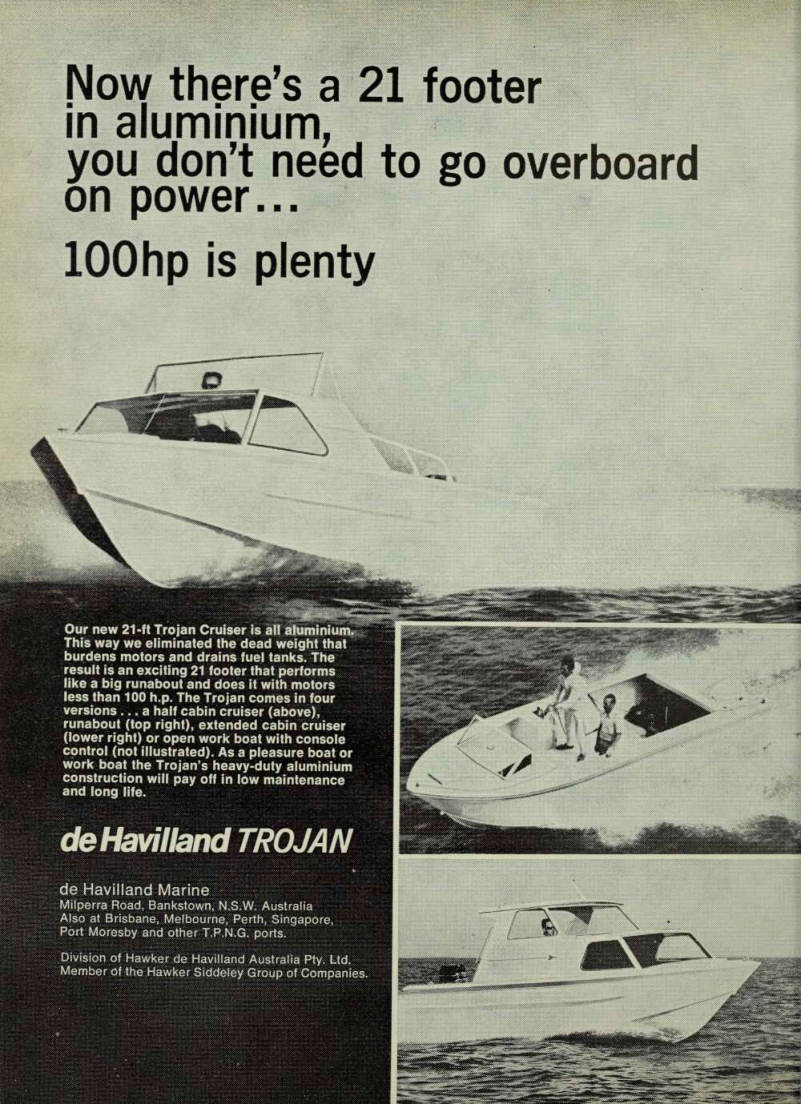
Our new 21-ft Trojan Cruiser is all aluminium* This way we eliminated the dead weight that burdens motors and drains fuel tanks. The result is an exciting 21 footer that performs like a big runabout and does it with motors less than 100 h.p. The Trojan comes in four versions... a half cabin cruiser (above), runabout (top right), extended cabin cruiser (lower right) or open work boat with console control (not illustrated). As a pleasure boat or work boat the Trojan’s heavy-duty aluminium construction will pay off in low maintenance and long life.
deHavilland TROJAN
de Havilland Marine Milperra Road, Bankstown, N.S.W. Australia Also at Brisbane, Melbourne, Perth, Singapore, Port Moresby and other T.P.N.G. ports.
Division of Hawker de Havilland Australia Pty. Ltd.
Member of the Hawker Siddeley Group of Companies.
mmmm
Experienced sailor, hiker,
explorer
will join
any expedition
V fresh UHT milk wm PAULS fresh UHT milk is a safe traveller. It goes anywhere you go. Keeps up to five months without refrigeration.
It’s full cream dairy milk with the wholesome fresh milk taste. With its body-building proteins, health-giving vitamins, energy ingredients and essential minerals. Absolutely germ-free in its sterile TETRABRIK, PAULS fresh UHT milk is ideal for infant feeding.
Cd UHT
LIQUID MILK
—no refrigeration needed
T N
BENEFIT FROM 87 YEARS
OF INSURANCE EXPERIENCE
Company Limited
(INCORPORATED 1886 IN AUSTRALIA)
HEAD OFFICE: 82 Pill Street, Sydney FIJI —Branch Office, Suva. Manager for Fiji: F. N. Davies.
LAUTOKA, BA, LEVUKA, LAB AS A—Burns Philp (South Sea) Co. Limited. District Manager at Lautoka: U. Singh.
PAPUA-NEW GUlNEA—Branch Office, Port Moresby: Manager for Papua-New Guinea: D. J. Granter.
SAMARAI, LAE, MADANG, RABAUL, KAVIENG,
MT. HAGEN—Burns Philp (New Guinea) Limited.
District Manager at Rabaul: C. D. Dickings. District Manager at Lae: R. Jackson. District Manager at Mt. Hagen: G. F. Donnellv.
HONIARA (b.s.i.p.) —Breckwoldt & Company (s.i.) Pty. Limned.
NOUMEA—T. A. Hagen, Ste. W. A. Johnston, S.A.R.L.
VlLA—Burns Philp (New Hebrides) Limited.
Resident Officer; R. J. Allsop.
SANTO—Burns Philp (New Hebrides) Limited.
NORFOLK ISLAND—Burns Philp (South Sea) Co. Limited TAHlTl—Arthur Chung; Immeuble B. 1., Front deMer, Papeete.
OTHER SOUTH SEA ISLANDS—Burns Philp (South Sea) Co. Limited.
OEEENSLAND
INSURANCE
Assets exceed SAjo, 000,000 JL K 303
k
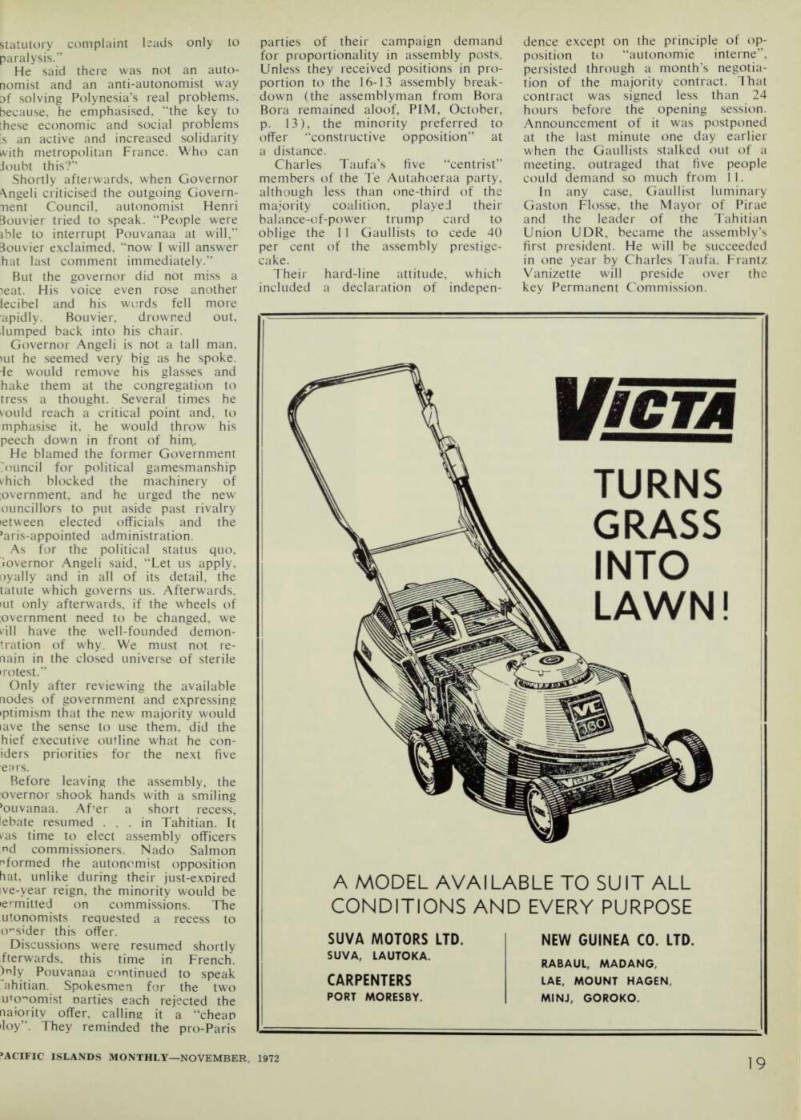
|fiQTA
TURNS
GRASS
INTO
LAWN!
A MODEL AVAILABLE TO SUIT ALL
CONDITIONS AND EVERY PURPOSE
SUVA MOTORS LTD.
SUVA, LAUTOKA.
CARPENTERS
PORT MORESBY.
NEW GUINEA CO. LTD.
RABAUL, MADANG,
LAE, MOUNT HAGEN,
MINJ, GOROKO.
17
*CIFIC ISLANDS MONTHLY—NOVEMBER, 1972
19
*ACIFIC ISLANDS MONTHLY—NOVEMBER, 1972
We Norfolk
Islanders need to know who we are
By TOM LLOYD, publisher of The Norfolk Islander.
Many statements have been made over the air and in the mainland press regarding the petition to the Queen, at the moment gathering signatures on Norfolk Island.
Such headlines as “Bounty Crew Mutiny Again”, “Norfolk Petition will fail”, etc., miss the underlying enigma that is Norfolk Island. And unfortunately these “sensational” type headlines give rise to doubts here and abroad, as to the ultimate object of the petition.
The base of this petition is really the same as those which have gone before—one in 1896 and the other in 1955. Although different in context, all three have one common denominator; the preservation of the character of Norfolk Island and its way of life.
Many probably wonder what it is that we have here that is so special. Well, apart from the perennial favourites—we don’t pay income tax, and burial is free—there is some undefinable something—call it a freedom of the soul that we, who were born here, accept naturally. Visitors sample it and want to share it with us; others try, but find that their earlier mainland, more especially suburban upbringing is too much to overcome. As a consequence they try to alter things to suit their own inherited way of living.
While we owe much of our way of life to our Pitcairn forbears, we owe equally as much to those who joined the Norfolk community in early years; American whalers, carpenters and traders from all over the world.
In those early days, as is the case today, people saw (and still see), appreciated (and still appreciate), that here is a community which, given the right guidance, could become a shining example of true democracy unfettered by bureaucratic control.
But these idealistic views, while sounding good, need certain basic requirements and one of these involves the legal status of the residents of Norfolk Island.
Ever since the arrival of the Pitcairn community to Norfolk Island in 1856 doubt as to what exactly Queen Victoria meant when she offered Norfolk Island as a new home to her loyal subjects from Pitcairn Island, has plagued us here.
Personally, I have no doubt that Queen Victoria felt that the first Norfolk Island community should be able to work out its own destiny, and that that is why she created it “a separate and distinct settlement”.
The bureaucratic mind of the late 1800’s was pretty much the same as that of 1972 and one can well imagine Viscount Hampden fwho visited the island in 1896) saying to his confreres, “These poor people don’t know what they are missing, being isolated as they are from the civilised world; we must change this un fortunate state of affairs”.
From then on, there followed a series of Orders in Council, recommendations by various experts,
evictions and public meetings, until on July 1, 1914, King George V proclaimed that Australia should administer Norfolk Island as an external territory.
The king stipulated that this administration was confined to “the peace, order and good government of Norfolk Island”. Unfortunately, nobody sought to ask just how far-reaching this statement was meant to go and what, at that point in time, the fundamental right of Norfolk Island and its council was.
Over the years the island has been fortunate to have men in the community willing to serve on the local council. These councils have ranged in name from the Council of Elders, the Executive Council to an Advisory Council. The present Norfolk Island Council, while having certain powers of raising and spending local revenue is really only an “advisory” body.
It has been the lot of these councils, together with the Administrator, to help guide the island in all its ups and downs. We have experienced that well-known (and trite expression used particularly here) “boom and bust” economy—with a fair share of both.
It would be wrong to attribute all our problems to the Commonwealth, but in many instances the island has been made the ham in the political Australia-New Zealand trans-Tasman sandwich, and we have seen the island’s fortunes climb, only to crash again. Each time we have had to pick ourselves up and start again.
During these times a few more island-born families have had to sell up and return to the mainland to eke out a living.
The unfortunate thing about all these past (and not
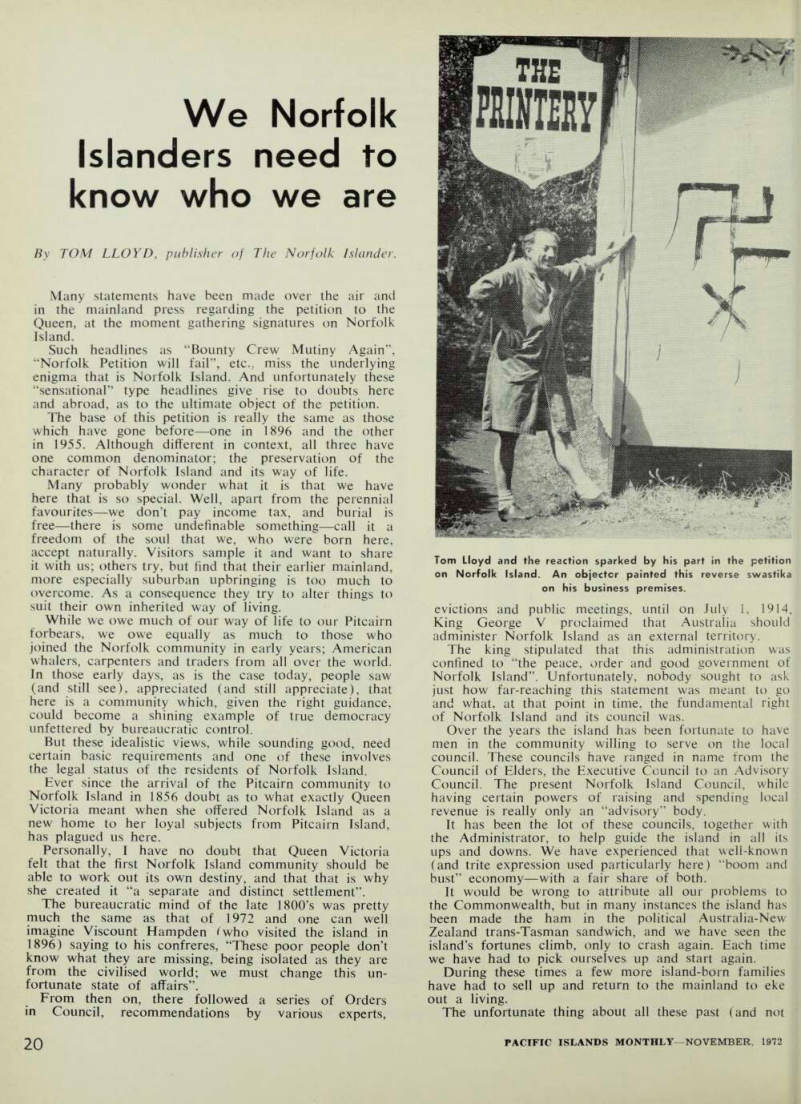
Tom Lloyd and the reaction sparked by his part in the petition on Norfolk Island. An objector painted this reverse swastika on his business premises.
Scant regard to Norfolk view
so distant past) ups and downs, is that the “powers that be” in Canberra appear to have given scant consideration to the wishes of the Norfolk Island Council and the people generally. In fact, the minister reserves the right unto himself to disregard the wishes of council and the people of Norfolk Island and to legislate “if it is in the national interests of the Com monwealth”.
Now, admittedly, this does not happen often, but the dreadful thought forever hangs over the heads of council like the Sword of Damocles. At the moment all the council can do if it disagrees with the minister or his department, is to resign. For what? They are re-elected again and nothing is really proved. In these nstances it would be good to think that the council fand therefore the people of Norfolk) could appeal iirectly to the Queen to mediate in our disagreements.
It might appear that I am anti-Australian. Please et me dispel that idea. The greater part of my educa ion was had in Australia; I served my apprenticeship is a printer in Australia; my wife is Australian and I’m sure that the “give the bloke a fair go” attitude of he average Australian would be extended to us here on Norfolk at the present time.
Norfolk is much too small to be drifting alone in he Pacific. We need a country like Australia to turn o. By the same token, we would like to feel that it s a mutually respectful relationship. We would like o feel that the value of our purchases from the main and are worthy of recognition in the way of our
yearly grant; we would like to feel that the island’s purchases from foreign countries help in some small way to balance the Commonwealth’s trading agree ments; we would like to feel that the Norfolk Island airport, which was built to help protect Australia (and paid for by Norfolk Island) does still have some strategic and economic value to the Commonwealth and is not being kept operative at the taxpayer’s expense so that the island can depend on its thrice-weekly Qantas service.
Let it be known that the tax-haven status of Norfolk Island has been very beneficial to Australia and that it has not been a complete waste of taxpayer’s money.
So, in a nutshell, what I hope the petition will determine is 1. Preservation of the character of Norfolk Island and its way of life, according to the will of its people through the Norfolk Island Council. 2. An end to the uncertainty concerning the fundamental rights of Norfolk Island and its people. 3. Government by law as decided by the Norfolk Island Council consistently with the above principles. 4. Preservation of the right of reference direct to the Crown. 5. Maintainance of, and close, cordial and mutually respectful relationship with Australia subject to the above principles.
Inherent in these five points is the underlying anxiety, expressed by one of the island’s senior residents when he signed the petition. “It’s a pity we nor se find this out 50 years ago. Before we go any further we must know whether we se com a nit-os”.
That’s not a misprint. Those last few words are Norfolkese for “Whether we have become nothing’’.
Advertisements & other items, p. 23 (2 items)
21
ACIFIC ISLANDS MONTHLY—NOVEMBER, 1972
The Big Flavours Come To The
SOUTH PACIFIC
tv iov p
rtanM
§inger<M
/ The red hibiscus symbol proudly marks the introduction of some of New Zealand's most popular soft drinks by Island Bottlers of Fiji Ltd. from their new modern factory.
In Apia in Western Samoa the same flavourful range is produced by the Apia Bottling Company and people everywhere are asking for these famous names -
LEMON and PAEROA, TARTAN DRY GINGER
ALE and the colourful fruity range of JU'CY
SOFT DRINKS.
They're yours to enjoy . . . time after time.
Manufactured under franchise to Innes Tartan Ltd., Auckland, New Zealand by-
ESS ISLAND BOTTLERS OF FIJI LTD.
APIA BOTTLING COMPANY LTD.
Western
Style
All The Wa
New Caledonian Diary
with
Helen Rousseau
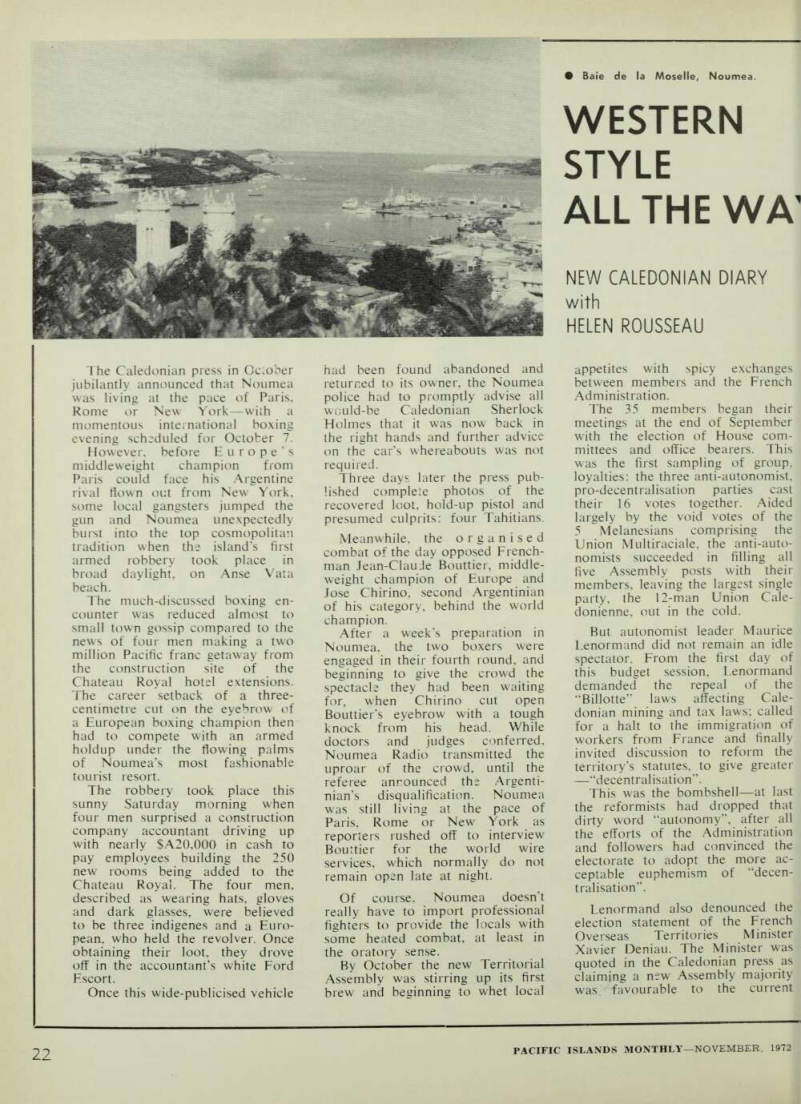
The Caledonian press in October jubilantly announced that Noumea was living at the pace of Paris, Rome or New York —with a momentous international boxing evening scheduled for October 7.
However, before Europe’s middleweight champion from Paris could face his Argentine rival flown out from New York, some local gangsters jumped the gun and Noumea unexpectedly burst into the top cosmopolitan tradition when the island’s first armed robbery took place in broad daylight, on Anse Vata beach.
The much-discussed boxing en counter was reduced almost to small town gossip compared to the news of four men making a two million Pacific franc getaway from the construction site of the Chateau Royal hotel extensions.
The career setback of a three centimetre cut on the eyebrow of a European boxing champion then had to compete with an armed holdup under the flowing palms of Noumea’s most fashionable tourist resort.
The robbery took place this sunny Saturday morning when four men surprised a construction company accountant driving up with nearly $A20,000 in cash to pay employees building the 250 new rooms being added to the Chateau Royal. The four men, described as wearing hats, gloves and dark glasses, were believed to be three indigenes and a Euro pean, who held the revolver. Once obtaining their loot, they drove off in the accountant’s white Ford Escort.
Once this wide-publicised vehicle
had been found abandoned and returned to its owner, the Noumea police had to promptly advise all would-be Caledonian Sherlock Holmes that it was now back in the right hands and further advice on the car’s whereabouts was not required.
Three days later the press pub lished complete photos of the recovered loot, hold-up pistol and presumed culprits: four Tahitians.
Meanwhile, the organised combat of the day opposed French man Jean-Claude Bouttier, middle weight champion of Europe and Jose Chirino, second Argentinian of his category, behind the world champion.
After a week’s preparation in Noumea, the two boxers were engaged in their fourth round, and beginning to give the crowd the spectacle they had been waiting for, when Chirino cut open Bouttier’s eyebrow with a tough knock from his head. While doctors and judges conferred, Noumea Radio transmitted the uproar of the crowd, until the referee announced the Argenti nian’s disqualification. Noumea was still living at the pace of Paris, Rome or New York as reporters rushed off to interview Bouttier for the world wire services, which normally do not remain open late at night.
Of course, Noumea doesn’t really have to import professional fighters to provide the locals with some heated combat, at least in the oratory sense.
By October the new Territorial Assembly was stirring up its first brew and beginning to whet local
appetites with spicy exchanges between members and the French Administration.
The 35 members began their meetings at the end of September with the election of House com mittees and office bearers. This was the first sampling of group, loyalties: the three anti-autonomist, pro-decentralisation parties cast their 16 votes together. Aided largely by the void votes of the 5 Melanesians comprising the Union Multiraciale, the anti-auto nomists succeeded in filling all five Assembly posts with their members, leaving the largest single party, the 12-man Union Cale donienne, out in the cold.
But autonomist leader Maurice Lenormand did not remain an idle spectator. From the first day of this budget session, Lenormand demanded the repeal of the “Billotte” laws affecting Cale donian mining and tax laws; called for a halt to the immigration of workers from France and finally invited discussion to reform the territory’s statutes, to give greater —“decentralisation”.
This was the bombshell —at last the reformists had dropped that dirty word “autonomy”, after all the efforts of the Administration and followers had convinced the electorate to adopt the more ac ceptable euphemism of “decen tralisation".
Lenormand also denounced the election statement of the French Overseas Territories Minister Xavier Deniau. The Minister was quoted in the Caledonian press as claiming a new Assembly majority was favourable to the current
Bale de la Moselle, Noumea.
political statutes and that this esult was due to four reasons— he success of recent municipal eforms, the financial support from -ranee, the anxiety provoked by certain autonomist leaders, and he feeling of French solidarity milt up during the recent boycott mposed on New Caledonia by ome of her Anglo-Saxon neigh murs, during the French Pacific mclear testing.
Lenormand countered that the reformed” inland municipalities lad voted in favour of autonomy; hat French economic policy had ailed and the official picture of he situation was a “bluff”; he epudiated charges against out oing leaders and finally claimed he French nuclear tests had not ontributed to Caledonian pride r dignity among their island eighbours.
These issues were not forgotten nd at the next Assembly session le debate was resumed by Mr lichel L e v a 11 o i s , Secretary- Jeneral and representative of the rench Administration at the assembly.
Lenormand is a keen debator nd tactician. His next move was n open letter to the leader of the fnion Multiraciale, Yann Celene [regei, who was charged, through is party’s void votes for Assembly resident, etc., with being a tacit ipporter of the pro-Administra on bloc. The nickel company ress, in the meantime, had Dyered the Multiraciale vote as sing the action of a young party, lore interested in social reform ian occupying House posts. The nion Multiraciale had been ected on an “autonomist” ticket id their failure to vote with enormand had been the first lock in the new Assembly.
Next vote in the House was for e five members of the Governor’s ouncil (Conseil de Gouverne ent). This gave two seats to the nion Caledonienne and one each 1 the Multiraciale, Liberals and ntente Democratique et Sociale. hree new members were then heduled to move up into the ouse, replacing those joining the ouncil, and this way the first two 'allis islanders joined the New aledonian Territorial Assembly.
The election of the Governor’s ouncil signalled more sparks om Lenormand, who demanded at this executive Council should
play its real role, rather than re main simply consultative with the governor maintaining what he described as “dictatorial powers”.
Meanwhile, the Liberals plugged for a reduction in the monthly fee of the members of the Governor’s Council, proposing that these men, who meet once a week and are provided with secretary and private car, should be paid around SABSO per month instead of the current $1,300.
Early in October, Governor Louis Verger, addressing a group of mainly metropolitan French reporters, had sharply criticised certain overseas press coverage of the Caledonian elections. Pro- Administration papers which took up the Governor’s criticism referred to overseas newspapers which stated “New Caledonia wants relief from French colonial yoke” and which described Governor Louis Verger donning sports togs to play two public soccer matches on the eve of the elections. The press also criticised an Australian national TV team after it had spent six days filming in Noumea without requesting a “working visa”.
Once the elections were over, but before the new Assembly had to face the debate of a difficult 1973 budget, there were differing press reactions to the Caledonian economic situation.
The anti-autonomist Lafleur press instantly grew optimistic over their election results and not only saw immediate signs of a business recovery and greater interest in local investment, but also heralded the disappearance of the nickel recession.
The nickel company press on the other hand, published detailed official figures outlining an “obvious slowing down in numerous sectors (of the Ter ritory’s economy) compared to last year”. The figures showed a 12 per cent, decline in exports and 20 per cent, drop in imports over the first eight months of this year, compared to the same period last year; a 70 per cent, drop in migration, a slowing down in the numbers of new workers registered and a 60 per cent, drop in the number of building permits issued.
All this, of course, is running counter to the ambitious develop ment projects of the French Sixth Plan to increase the island’s nickel production.
At the same time, the nickel press published a report to SLN shareholders from company Presi dent Guy de Rothschild. During the first half of this year, the SLN states that on its nickel operations it has suffered a deficit of about 46 million French francs (approx. 5A7.5 m.) while at the same time paying some $7 million in tax to New Caledonia. While unsold nickel is being stockpiled in France, the SLN pays tax on nickel shipped out of the Ter ritory, regardless of the company’s profit or loss account, a form of territorial revenue which the Baron Rothschild continues to find disastrous for his company.
Meanwhile, at the end of Sep tember, the SLN closed the last of three blast furnaces at its Noumea smelters, leaving eight Elkem and three Demag electric furnaces in operation, with an annual production capacity of 65,000 tons of metal.
On the Caledonian nickel mines, extraction of ore for the first eight months of this year totalled only 3.3 million wet tons, compared with 5.1 million tons for the same period last year.
While world prices of nickel metal rose, Japanese ore buyers were reluctant to pay higher rates for Caledonian nickel ore. As a resumption of nickel price talks was awaited in Noumea, all ship ments of Caledonian ore to Japan were reported to be suspended.
Trucking operators who had been particularly hit by the nickel market recession, found temporary relief when the Noumea city council late September contracted a convoy of heavy vehicles to begin filling in the foreshores of the Baie de la Moselle. This area, in front of the Noumea Museum and new city post office, is to be a parking area for 1,500 cars.
Another recent development in Noumea, on a hill top at Mont Te, has been the opening of the Territory’s first botanical and zoological park. Work on the 60acre site has continued for ten years and is still incomplete.
However, Caledonians have wel comed this first initiative to create a natural reserve for a limited number of local and imported varities of animal and plant life, including the island’s indigenous “barking”, flightless cagou bird.
Advertisements & other items, p. 25 (1 item)
23
VCIFIC ISLANDS MONTHLY—NOVEMBER, 1972
Well (But Hungry) After 25 Years
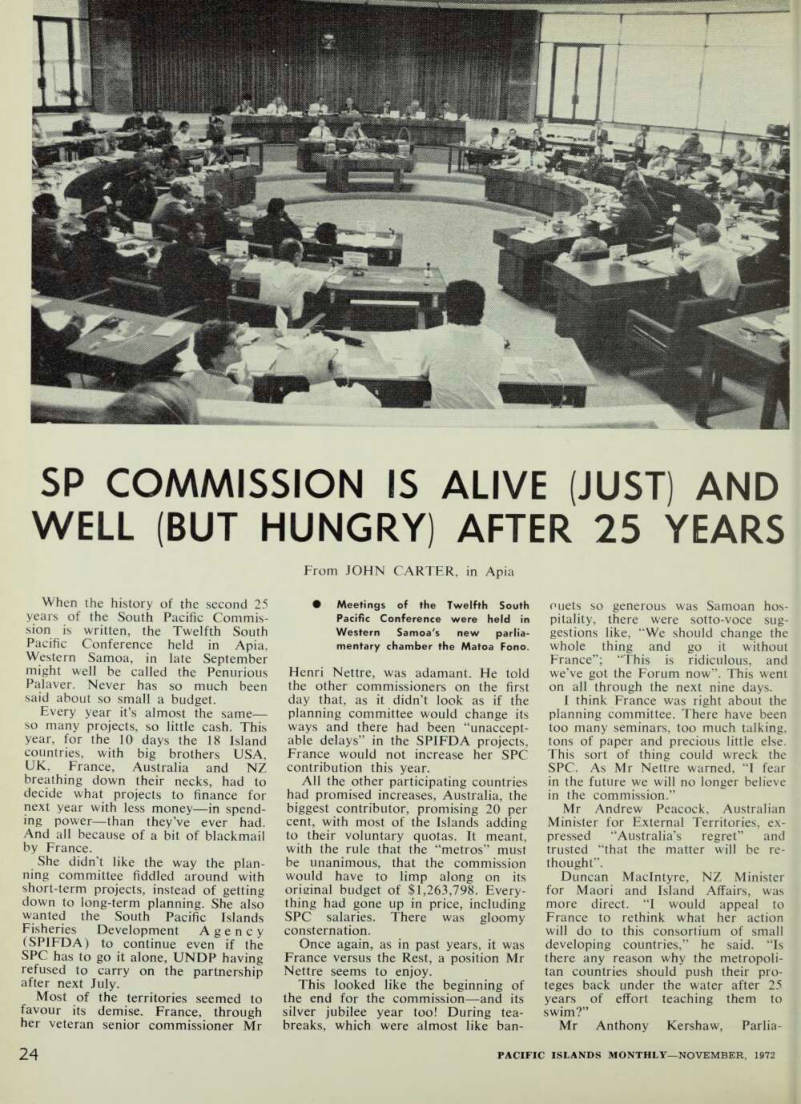
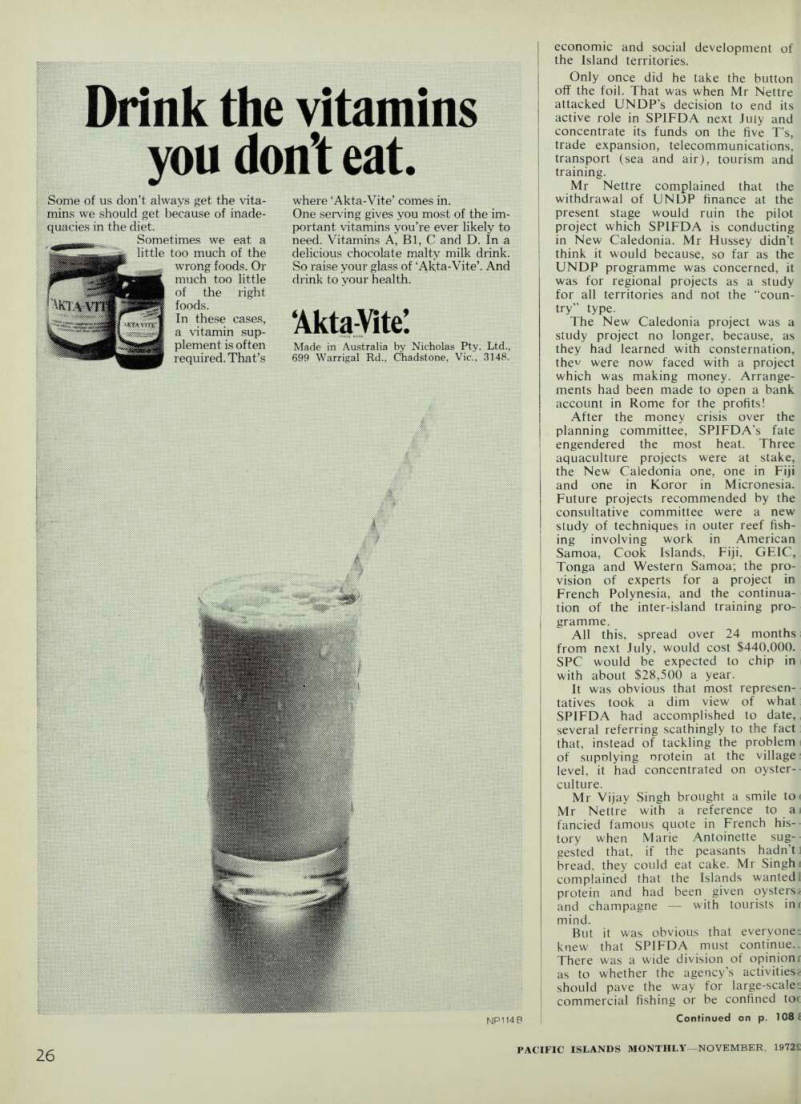

Sp Commission Is Alive (Just) And
From JOHN CARTER, in Apia
When the history of the second 25 years of the South Pacific Commis sion is written, the Twelfth South Pacific Conference held in Apia, Western Samoa, in late September might well be called the Penurious Palaver. Never has so much been said about so small a budget.
Every year it’s almost the same— so many projects, so little cash. This year, for the 10 days the 18 Island countries, with big brothers USA, UK, France, Australia and NZ breathing down their necks, had to decide what projects to finance for next year with less money—in spend ing power—than they’ve ever had.
And all because of a bit of blackmail by France.
She didn’t like the way the plan ning committee fiddled around with short-term projects, instead of getting down to long-term planning. She also wanted the South Pacific Islands Fisheries Development Agency (SPIFDA) to continue even if the SPC has to go it alone, UNDP having refused to carry on the partnership after next July.
Most of the territories seemed to favour its demise. France, through her veteran senior commissioner Mr
Henri Nettre, was adamant. He told the other commissioners on the first day that, as it didn’t look as if the planning committee would change its ways and there had been “unaccept able delays” in the SPIFDA projects, France would not increase her SPC contribution this year.
All the other participating countries had promised increases, Australia, the biggest contributor, promising 20 per cent, with most of the Islands adding to their voluntary quotas. It meant, with the rule that the “metros” must be unanimous, that the commission would have to limp along on its original budget of $1,263,798. Every thing had gone up in price, including SPC salaries. There was gloomy consternation.
Once again, as in past years, it was France versus the Rest, a position Mr Nettre seems to enjoy.
This looked like the beginning of the end for the commission—and its silver jubilee year too! During tea breaks, which were almost like ban
ouets so generous was Samoan hos pitality, there were sotto-voce sug gestions like, “We should change the whole thing and go it without France”; “This is ridiculous, and we’ve got the Forum now”. This went on all through the next nine days.
I think France was right about the planning committee. There have been too many seminars, too much talking, tons of paper and precious little else.
This sort of thing could wreck the SPC. As Mr Nettre warned, “I fear in the future we will no longer believe in the commission.”
Mr Andrew Peacock, Australian Minister for External Territories, ex pressed “Australia’s regret” and trusted “that the matter will be re thought”.
Duncan Maclntyre, NZ Minister for Maori and Island Affairs, was more direct. “I would appeal to France to rethink what her action will do to this consortium of small developing countries,” he said. “Is there any reason why the metropoli tan countries should push their pro teges back under the water after 25 years of effort teaching them to swim?”
Mr Anthony Kershaw, Parlia-
Meetings of the Twelfth South Pacific Conference were held in Western Samoa's new parlia mentary chamber the Matoa Fono.
Move Toward Long-Term Planning
icntary Under-Secretary for Britain’s r oreign and Commonwealth Office, choed Australian and NZ senti icnts.
If France felt herself out in the old, Mr Nettre gave no sign. There ould be no walk-out this year (as Ir Nettre walked out last year) and e contented himself with a reminder ow and again that he would come ) the party if France got what she anted.
And that is how it was. Gradually lere was a shift of opinion by other luntries. Maybe the planning com ittee did want changing; there was lot of sense in having only a few ng-termed projects; what was the ;e of seminars and surveys without ly action, etc.
Then Mr Fred Thorburn of the ooks moved that the planning com ittee should prepare a plan con ntrating on a few long-term prac :al projects of significance for the gion, without being concerned imarily with the financial implica )ns or the commission’s annual ark programme.
Mr C. D. Reseigh, Australia’s nior commissioner, the most ex rienced commissioner there after r Nettre, backed it up after ensur g that small, short-term projects auld survive, and Fiji’s Mr Vijay Singh crystallised the whole thing th a suggestion that the motion ould be used as a basis for draw g up terms of reference for both rig and short-term planning.
This is close to what I have been essing for a long time,” Mr Nettre id, on the seventh day. “You should ways separate long-term plans from e annual budget.”
Quick to seize the opportunity, Mr ne Naisara, Fiji’s Minister for lucation, Youth and Sport, who was “ commission session chairman, lied a meeting of the commissioners at evening. But France still held t. It wasn’t something “near” their sires which would satisfy France, was all or nothing, and nothing >uld, I think, have damaged the ’C irreparably. “There’s always the >rum,” was a thought underlying ents in Apia.
Then senior NZ Commissioner mrles Craw announced that NZ )uld contribute up to 15 per cent, nch meant an extra $20,000 in the ty. Mr, Nettre’s reaction was ini tiate. He said—with the black nlmg touch of course—that if the nference in its wisdom concentrated long-term projects he might be le to recommend his government agree to an increased contribution
of not more than five per cent, but, if more attention was not given to long-term projects, France’s increased contribution would be devoted to French territories only.
The conference’s reaction was almost as swift. In no time at all a resolution went through from a special ad hoc committee which had been struggling to unravel the tangle.
This was a directive to the planning committee to present to next year’s conference a long-term plan concen trating on practical projects of sig nificance to the region.
Moving the motion, Vijay Singh, who had been closest to Mr Nettre all along, commented that it was time to concentrate on projects lasting from one to five years instead of on “things like interminable seminars”.
Everybody agreed.
Not long afterwards, SPIFDA’s future was also assured. That even ing, a smug Mr Nettre, who’s really an engaging fellow when he’s not being a chauvinistic Frenchman, told me he would be adding France’s five
per cent to the budget, the next, and final, day.
He did, but he would not go higher than five per cent. As the unanimity rule prevailed, all other participating governments, seven of them, gave the same. Some, however, said they would add voluntary contributions.
Ever-generous New Zealand said it would add another 10 per cent.
Nauru and the UK gave the same.
Fiji and Western Samoa gave ad ditional amounts on top of their statutory percentages (see panel for these details). The additional cash was promptly allocated.
But there was resentment over the French tactics. Several representatives said afterwards that France wouldn’t get away with it a second time.
Mr Nettre, who is in the top flight of the French Civil Service, is both an expert tactician and a rough in fighter. He’s also down to earth. Over the last few years he has played a large part in turning the conference into a training ground for diplomats and politicians. The whole struggle surrounding the business of increased contributions was an exercise in chicanery, Machiavellianism, brink manship, tactical retreating and the other political sciences so ably prac tised at the United Nations.
France has objected to “politics” several times in the conference in past years but she practises it the most. This year she did it perfectly because, unlike last year and the year before when Mr Nettre had recalci trant French Polynesian autonomists to needle him and cause him to walk out, the Frenchmen were a united team. All their representatives voted as a bloc and talked in the same strain.
One longed for another Henri Bouvier to relieve the tedium of the conference which, for the most part, became very dull after the first two days of drama.
Mr Nettre’s obvious main target was Bill Hussey and his United Nations Development Programme. He attacked UNDP over SPIFDA, charging it with developing “an in creasingly rigid attitude and enforc ing its authoritarian and centralistic ideas” at the prompting of its regional representative, who is Bill Hussey.
Mr Hussey replied several times, or at least spoke on joint UNDP-SPC projects, without really crossing foils with Nettre, or losing his cool.
He explained UNDP’s position and defended it against the accusation of hogging the action in the field to the detriment of the SPC. If it did hog the action, he implied, it was with the idea of letting the SPC get on with its main job of furthering the
economic and social development of the Island territories.
Only once did he take the button off the foil. That was when Mr Nettre attacked UNDP’s decision to end its active role in SPIFDA next July and concentrate its funds on the five T’s, trade expansion, telecommunications, transport (sea and air), tourism and
training.
Mr Nettre complained that the withdrawal of UNDP finance at the present stage would ruin the pilot project which SPIFDA is conducting in New Caledonia. Mr Hussey didn’t think it would because, so far as the UNDP programme was concerned, it was for regional projects as a study for all territories and not the “coun try” type.
The New Caledonia project was a study project no longer, because, as they had learned with consternation, the v were now faced with a project which was making money. Arrange ments had been made to open a bank account in Rome for the profits!
After the money crisis over the planning committee, SPIFDA’s fate engendered the most heat. Three aquaculture projects were at stake, the New Caledonia one, one in Fiji and one in Koror in Micronesia.
Future projects recommended by the consultative committee were a new study of techniques in outer reef fish ing involving work in American Samoa, Cook Islands. Fiji, GEIC, Tonga and Western Samoa; the pro vision of experts for a project in French Polynesia, and the continua tion of the inter-island training pro gramme.
All this, spread over 24 months! from next July, would cost $440,000.
SPC would be expected to chip in i with about $28,500 a year.
It was obvious that most represen- tatives took a dim view of what; SPIFDA had accomplished to date,, several referring scathingly to the fact J that, instead of tackling the problem i of supolying nrotein at the village; level, it had concentrated on oyster— culture.
Mr Vijay Singh brought a smile to< Mr Nettre with a reference to a< fancied famous quote in French his tory when Marie Antoinette sug gested that, if the peasants hadn't J bread, they could eat cake. Mr Singh i complained that the Islands wanted! protein and had been given oysters * and champagne with tourists inr mind.
But it was obvious that everyones knew that SPIFDA must continue..
There was a wide division of opinionr as to whether the agency’s activitiesa should pave the way for large-scales commercial fishing or be confined toe
Continued on p. 108
ensuring adequate supplies and teach- j ing techniques to the various terri-1 tones.
Mr Isaac Qoloni (BSIP), Mr Tom Koraea (PNG), Mr George Kalkoaj (New Hebrides) and Mr Isakala Paeniu (GEIC) all thought there could be joint actions by agency and commercial concerns, but Mr Singh, wanted SPIFDA to die and let terri-| tories deal directly with UNDP.
Dealing direct with UNDP and I other agencies, thus bypassing the| SPC, would condemn the commis4 sion to death, Mr Nettre warned. He: sounded the same warning several) times whenever anyone suggested! cutting out the SPC middleman.
Mr David Kausimae of the BSIP' and Mr Singh used the debates om fisheries as a vehicle to snipe at) France over the nuclear tests, a sub ject banned in the conference because: politics “aren’t allowed”.
Mr Kausimae made only am oblique reference to the tests, com plaining that a certain country had spread fish poisoning throughout the region. Mr Singh, however, pointed at France, declaring, after charging the developed countries with polluting the ocean with industrial waste, “it seems a great pity that one of the nations deeply interested in the wel fare of the South Pacific is currently accused by Island territories of de-; stroying fish in the Pacific by nucleai bombs.”
Urbane Mr Nettre wasn't rising to the bait that contributed to last year’s walk-outs. He even remained silent) though his face flushed, when on anjj other occasion, when he assured the conference France would help to pro-* mote knowledge of her language, Mi Singh exclaimed, “We know French tricks without learning the language”' SPIFDA was spared when the coni ference decided to spend $21,200 on the agency up to next July. If UNDH funds are not forthcoming then, thti commission will prepare a report on the feasibility of continuing the proc ject with its own resources and witH assistance from “such other source;; as might be found”.
What seemed to be a bright ideas a development bank for the SoutH Pacific, got a mixed reception when; the conference discussed a UNDI mission’s study report on the subject!: The mission calculated that thu current net external capital gap foe the whole region, excepting of PNO which had no estimate available, was between SUS3O million and SUS4M
nillion. In other words the region leeded that much more capital for levelopment and a development bank yas the best thing for bridging the :ap.
Cook Islands Premier Mr Albert lenry, who knows all about financial aps, urged further studies when it Doked as if representatives were ikewarm. Several pointed out that ie report was too sketchy.
The metropolitan powers, with the tception of France, said little, be eving, as it was explained by Mr raw on one occasion, that the Island :rritories should do the talking and aiding. Mr Nettre said a regional mk would prove highly expensive id would duplicate existing facilities some countries including the rench territories. Ways should be •und of gaining access to loans from e Asian Development Bank and the odd Bank.
Mr Singh, who knew about the rubles associated with the Fiji De lopment Bank which spent 20 per nt of its paid up capital in annual •crating costs, also suggested a rther study, although he seemed to eard it as a waste of time, “But > not the Pacific way,” he said, “to oot a thing down. We would rather it wither away.”
And wither away it probably will if * territories dwell on the words of
Mr Akira Tsusaka of the Asian De velopment Bank, who did a fine job of “selling” his bank.
He pointed out that there were already four members of the ADB in the region, Fiji, PNG, Tonga and Western Samoa, and they’d never had a loan request turned down. There were other potential members in the region who, if they qualified, could join and take advantage of the bank’s services.
ADB’s assistance to the region in cluded loans of SUS 4.7 million to Fiji for power development besides technical assistance to the Fiji De velopment Bank, a SUS4.S million Joan to the PNG Development Bank and two loans to Western Samoa of a little over SUS 2.7 million for air port and road development and beef cattle projects. Much more was in the offing and moves were being made to help Tonga, the newest member.
“The mere creation of a bank does not create any money, and finding adequate resources for a new regional or sub-regional bank is quite a serious problem,” said Mr Tsusaka.
After that, it was a wonder the conference pursued the idea. But it recommended that UNDP seek poten tial donor countries to see where the capital is coming from and also pro vide more details on the cost of establishing the bank.
Mr Tsusaka is likely to recommend the ADB to find ways of extending membership to all the territories, so that the idea of a South Pacific Regional Development Bank is pretty sure to wither away, the Pacific way.
And the Pacific way of doing things added hours to debates as chairman Mr Tamasese Lealofi, Western Samoa’s Prime Minister, and his deputy, Mr George Kalkoa, gave representatives loads of leeway in making speeches. As, for instance, when they discussed the venue for next year.
The conference turned down Guam’s invitation on the grounds of cost as it would put $60,000 on the bill against only $lB,OOO if it was at home in Noumea. It decided to stay home. The following day Guam’s man, Mr Jose S. Perez, pleaded for another chance, offering not only $25,000 towards expenses but asking for 90 days in which to find ways of cutting expenses to the Noumea level.
All the Island representatives voted for that.
Guam will make a nice change, especially as Mr Perez was sure that the three floors of living space in the now-building, 12-floor World Trade Centre there would be available free, and there would be no charge for secretarial work.
It was a struggle to complete the
agenda in the apportioned 10 days, mainly because of penury. Time and] again, important projects on the works programme were put aside for! a later decision, which meant until!
France’s Oui was heard.
There was one good result. Projects! were scrutinised more carefully and only the really practical ones got
through. Unproductive jaunts and]
seminars for experts and ephemeral!
theory-producing get-togethers, got j
the chopper. Projects such as school syllabuses suitable for the Islands in stead of those exported from metro- 1 politan countries, the rhinoceros beetle project, language teaching pro-* jects, experts for animal production! and new moves for solving nutrition! problems, all survived.
Considerable time was devoted toi the Arts Festival revolving fund sup posed to have been created out of: the Fiji Arts Festival profits, but Mr Singh soon disillusioned the con ference. There was no fund because! there had been no profits, only a loss! of $50,000 which Fiji had paid, mak-| in» the dominion’s contribution to the) festival $150,000.
Dr Fanaafi Larkin, of Western Samoa, was a severe critic of the Fiji festival she said it was more a theatrical spectacle for commercial, interests than a display of the Islands” ancient cultures for the Islanders’ de light—but the festival is destined to< live again, maybe in PNG next; lime. The conference decided to ask; UNESCO for a larger grant than it; gave for the Fiji festival —a niggardly' 16 000 and the secretariat willl sound out the territories on the ideal of another festival in five years.
So now the SPC moves into the second 25 years. What of the future** There will be some radical changes.
All the members want them, buti what form they will take is uncertain.
What is certain is that the commission; will have to have much more moneys if it is to survive. US Trust Terri tories representative Mr Ambilos lehsi gave the secretariat a back hander on the final day when he blamed it for the commission’s poverty, saying it didn’t know how to beg, and that there was plenty of money around if it knew where to look. He suggested approaches to the European countries, Switzerland!
Holland, Denmark and others ano suggested Japan was only waiting to pour out her gold to whoever askeo for it. , ..
A resolution was passed directing the secretariat to study ways of raise ing the wind for more projects.
As in past years, Canada was repc resented at the conference and seemet: eager to contribute, her representative Mr C. V. Svoboda, telling the conn
jrence that “the South Pacific ualifies as a region of eligibility for 'anadian assistance”. He sounded as his country would willingly become partner in the SPC if some way 3uld be found.
It was suggested outside the fono ile that maybe the Cooks would and one of their small islands, awarrow for instance, to Canada so lat she could qualify as a participatg country having a dependency in e region. If the money was right, e Cooks might do a deal!
But whatever way is used, the SPC ust be more effective if it is to last. ie Islands have now a mini-United ations of their own, the Forum. d, being way past weaning age, ey want something more than icken feed from the commission.
L . .
iTrS festival
irector replies
Mr Vic,or Caretl.who directed the I strongly dispute Dr Larkin’s ack on the festival. She alleges immercialism”. All this spate of ticism from her is merely a okescreen to hide the facts.
Nothing could have been less iimercial than this remarkable tival in which all of the countries the South Pacific so warmly )wed their very best traditional s to one another and to the world. all this they stated their respect one another and for human f i Ihe fact that five or six permances were given free for every-
one for which admission was charged, should be strong enough proof that this was a non-com mercial event. Even at the paid performances 50 per cent, of the seats were at the very low price of 50 cents.
All of the countries entered into the spirit of giving with joy and a remarkable sense of co-operation, of togetherness—all except Western Samoa. Dr Larkin kept her group from giving a free scheduled per formance on the stage over Nubu kalau Creek and thereby disap pointed thousands of eager spec tators. She also was the lone person to stop her dancers from being especially filmed for the official film even though she knew that the film was to be given free to all the participating countries and that the profits from the film were to benefit future festivals and thus the culture of the South pacific.
cr £j nanf
Vr they generated a great deal of enthusiasm from this coming together in warm and friendly brotherhood. And the future ad vantages are great. Beside the film record, there are over 30 disc record ings which were made “live” at the festival—a truly significant gift to posterity. All of the other countries agreed to the contractual payment for the recordings except ing Dr Larkin who demanded more, As a result, only one name will be missing from the recording list— Western Samoa!
One wonders who is being com mercial.
The Money
They'll Get
With the five per cent, in crease agreed by the participating governments, their contributions to the 1973 budget are as follows: Australia (contributing 31 per cent, of the total) $359,801; France (14 per cent.) $162,491; New Zealand (16 per cent.) $185,704; United Kingdom (16 per cent.) $185,704; United States (20 per cent.) $232,128; Fiji, Nauru, Western Samoa (one per cent, each) $11,607 each, a total for the eight govern ments of $1,160,649.
New Zealand promised an additional 10 per cent, increase as a voluntary contribution to overcome the unanimity rule, making her total contribution $203,390. Others added varying amounts and Australia, unable to make a decision on “volun tary” contributions until cabinet approval is given, “stuck” at five per cent, but is expected to increase this to 10 or 15 per cent.
Altogether, the budget was increased by about $BO,OOO as some of the territorial govern ments also increased their voluntary contributions.
The budget total now stands at about $1,342,611.
Advertisements & other items, pp. 27-28 (2 items)
25
VCIFIC ISLANDS MONTHLY—NOVEMBER, 1972
you don’t eat.
Drink the vitamins
Some of us don’t always get the vitamins we should get because of inadequacies in the diet.
Sometimes we eat a little too much of the wrong foods. Or much too little of the right foods.
In these cases, a vitamin supplement is often required. That’s where ‘Akta-Vite’ comes in.
One serving gives you most of the important vitamins you’re ever likely to need. Vitamins A, 81, C and D. In a delicious chocolate malty milk drink.
So raise your glass of ‘Akta-Vite’. And drink to vour health.
‘Akta-Vite!
Made in Australia by Nicholas Pty. Ltd., 699 Warrigal Rd., Chadstone, Vic., 3148.
NPII4B
Somare Grasps The Nettle Safely
From PERCY CHATTERTON, in Port Moresby
During the second half of the September meeting of PNG’s House of Assembly, which started on Mon day, September 18, and ended ignominiously in a count out on the forenoon of Friday, September 29, the United Party’s enfant terrible, Anton Parao, accused the National Coalition government’s ministers of being stooges of their departmental permanent heads.
Events rather than words disproved this slur. Chief Minister Michael Somare has shown himself adept at grasping nettles without getting stung.
After the gloomy white paper tabled ay the chairman of the Public Ser vice Board during the first part of ; he meeting (see October PIM), Mr somare took the opportunity offered ay the budget debate to tell the House hat he and his cabinet had quite lifferent ideas about the future of the > ublic Service from those of the 3 ublic Service Board. During the next ew years, he said, the number of :xpatriates in the Public Service vould be reduced from 7,000 to 3,000.
Phis would be done, not by sackings, »ut by non-replacement of expatriate •fficers retiring, resigning or com ileting their contracts. Those left, irown and white, would have to work iarder, he declared. Papua New juinea, he continued, could not fford an Australian-style Public ervice; it would have to opt for small, streamlined and inexpensive ne.
This bombshell was received com aratively calmly. Public Service loard Chairman Sere Pitoi explained moothly that the report tabled a artnight earlier had been based on le then extant policy. If the govern lent decided to change the policy, would be the duty of his board ) do its best to implement the new olicy.
Over in New Britain ex-MLC/MHA ►on Barrett is no doubt chuckling appily, for the new policy sounds le death knell of the kind of civil ;rvice empire building against which e inveighed so frequently and so igorously for years.
In passing, on the subject of ►calisation, it has been announced tat the offices of Government rinter and Chief Archivist will be •calised shortly, when the present (patriate holders of these offices fire.
It looks, too, as if Mr Somare’s avernment may be nearing success
in dealing with another nettle—the Gazelle Peninsula impasse, a problem to which the moguls of Konedobu’s administration headquarters have so signally failed to find a solution during the past few years. It has been announced that at the next meeting of the House in November legislation will be introduced to abolish the controversial Gazelle Local Govern-
ment Council, and to recognize on an equal footing the Mataungan As sociation “Council”, the Warbete Kivung group, and the "Toma” pro council group, and, as a temporary measure, to place the assets of the council in the hands of a Trust made up of representatives of the three groups. This arrangement would be preliminary to the establishment
PNG's own decisions
next year of a new-style local government structure for the Gazelle, in which smaller tax raising bodies would be loosely linked together in a central authority.
The signs are that all the groups are reasonably happy about the pro posals. If they do succeed, it will certainly be a feather in Mr Somare’s cap.
Another recent incident is indi cative of a new shape of things to come. An outcry arose in Wewak over the siting of a new police station.
The contract for its erection had already been let, and if the situation had arisen during the life of either the first or the second House, the protesters would have been told, “Sorry, too late”. But for Mr Somare’s government it was not too late. After looking into the matter with the Chief Minister, Minister for Works Thomas Kavali announced that the job would be halted and a new site selected. That such an in cident as this could have happened prior to this year of grace 1972 is quite unthinkable.
In fact, none of the happenings so far chronicled could have hap pened if the National Coalition ministry were dominated by the permanent departmental heads, as claimed by Mr Parao.
Another welcome announcement made during this memorable fort night was that the government in tends to proceed with the establish ment of village courts, with power to deal with matters such as simple stealing, common assault, wilful dam age, dangerous driving and bride price disputes; and possibly with the appointment of “peace officers” to fill the vacuum left by the aboli tion of the offices of village const able in Papua and luluai and tultul in New Guinea.
If these policies had been adopted five years ago, as they should have been, the maintenance of law and order in the villages of Papua New Guinea might not be in the parlous condition into which it has fallen.
Gambling has come in for its share of attention. Yet another attempt to repeal the Playing Cards Ordinance has been adjourned, but it seems to have a much better chance of success than its prede cessors. And the House has expressed approval in principle of the idea of a national lottery. However, Treasurer Ritchie has expressed his doubt as to whether such a lottery would turn out to be very profitable, and has
suggested that a “premium bond” scheme on the British model might be a better bet for the national ex chequer.
While on the subject of finance it should be recorded that Minister for Internal Finance Julius Chan has foreshadowed the setting up by Papua New Guinea of its own central bank on the lines of Australia’s Reserve Bank. But Mr Chan is still not pre pared to commit himself as to whether a separate PNG currency is contemplated.
What may be more than a tea cup storm was touched off by Bougainville’s forceful politicians, Paul Lapun and Father John Momis.
The former is Minister for Mines in the National Coalition government while the latter, new to the House but already showing signs of be coming one of its leading figures, is deputy chairman of the committee charged with the task of preparing a draft constitution. Both have ex pressed dissatisfaction with the agree ment concluded between the monster Bougainville Copper company and the previous, administration-domi nated PNG government, and it seems likely that at no distant date a ca.ll for its re-negotiation will be pressed.
Southern Highlands Regional mem ber, Ron Neville has renewed his oft-repeated plea for a road outlet from the Southern Highlands to the Gulf of Papua. While the government has not yet committed itself on this project, the Chief Minister has finally and formally confirmed the demise of the World Bank inspired doctrine of rapid economic development by concentration on the most promising areas, and has made it clear that his government has committed it self to the policy of a more balanced style of development with special consideration for the deve lopment of previously neglected areas.
This naturally gives me a good deal of satisfaction, as it has been one of my pet hobby-horses ever since the World Bank report first appeared.
The Chief Minister has got his green light for self-government by the end of 1973, though not by so good a margin of votes as he had hoped for. The voting was 52 to 34, a majority of 60 per cent, instead of the 75 per cent, which had been his target.
Finally, this meeting’s funny story.
The ebullient and ever optimistic member for Tari, Matiabe Yuwi, asked the House to recommend a reduction in the salaries of its mem bers. The motion was lost on the voices.
Advertisements & other items, pp. 29-31 (3 items)
27
ACIFIC ISLANDS MONTHLY—NOVEMBER, 1972
family down
Don't let your
You've worked hard to give them a home, schooling and security. Don't let that hard-won security erode away because you continued to overlook making out a Will. With a properly planned Will, you can be certain in the knowledge that your property will eventually pass to the people you specify, and also that your Estate will be as large as possible after probate and duties. In this regard, we invite you to take advantage of the advisory service we provide, entirely free of obligation. Our specialists in Estate Planning will be delighted to help you plan your Will most efficiently, or to discuss it fully with your solicitor or accountant. ->c the
BURNS PHILP TRUSTEE
COMPANY LIMITED
CCECUTOR o ADMINISTRATOR • TRUSTEE • ATTORNEY • AGENT Fiji Office: Mr. A. W. Cooper, Resident Manager, Rodwell Road, Suva. Telephone: 311 777.
Head Office: 51 Pitt Street, Sydney 2000.
Telephone: 241 1021. Telegrams: "BURNSTRUST," Sydney Mslhnn heS a ß n^° r Re f'i^ ° ffices: Parramatta (N.S.W.), Canberra, Melbourne, Brisbane, Adelaide, Fremantle (W.A.), Port Moresby (Papua). 8P45
FIAT
CONCESSIONAIRES
American Samoa Silver Star Transport Inc., P.O. Box CB-4, Pago Pago.
Fiji Motibhai &Co. Ltd.,
P.0.80x 40, BA.
New Caledonia Agence Automobile S.A.,
P.0.80x 842, NOUMEA.
New Guinea New Guinea Motors Pty. Ltd.,
P.O. Box 1027, BOROKO
New Hebrides Societe Bourgeois & Cie.,
P.0.80x 28, PORT VILA.
New Zealand Torino Motors Ltd.,
P.0.80x 6240, AUCKLAND.
Norfolk Island Cascade Motors Ltd.,
P.O. Box 34, NORFOLK.
ISLAND.
Solomon Islands Chan Wing Motors Ltd.,
P.O. Box 820, HONIARA.
Tahiti Societe Tahitienne, D'Automobile S.A.R.L.,
P.O. Box 17-23, PAPEETE
Western Samoa E.A. Coxon & Co. Ltd.,
P.O. Box 38, APIA.
Now you can
drive the car Ferrari
drives.
Enzo Ferrari. He probably knows more about what makes a great car than any man alive. His name is on some of the most exciting machines ever made. Cars capable of 180 m.p.h. To ride in one is to know the ultimate in performance and luxury.
What does Ferrari drive himself ?
The Fiat 128 Sport Coupe. Surprised?
You won't be when you think about this.
The 128 Coupe is a much better car to drive around town. An excitingly nimble machine that's quick off the mark and easy to park. With a rugged front wheel drive, five bearing crankshaft engine. It develops 75 bhp. The 1290 cc engine happily runs it to a top cruising speed. And for real stopping power, the brakes are power assisted, discs and drums. With dual circuits for maximum safety. And the interior is what you'd expect from an Italian thoroughbred.
See what it's like to drive around like Ferrari.
Fiat 128 Sport Coupe
o 1
FIAT OF AUSTRALIA PTY. LIMITED
Cific Islands Monthly—November, 1972
The world comes to Vavau
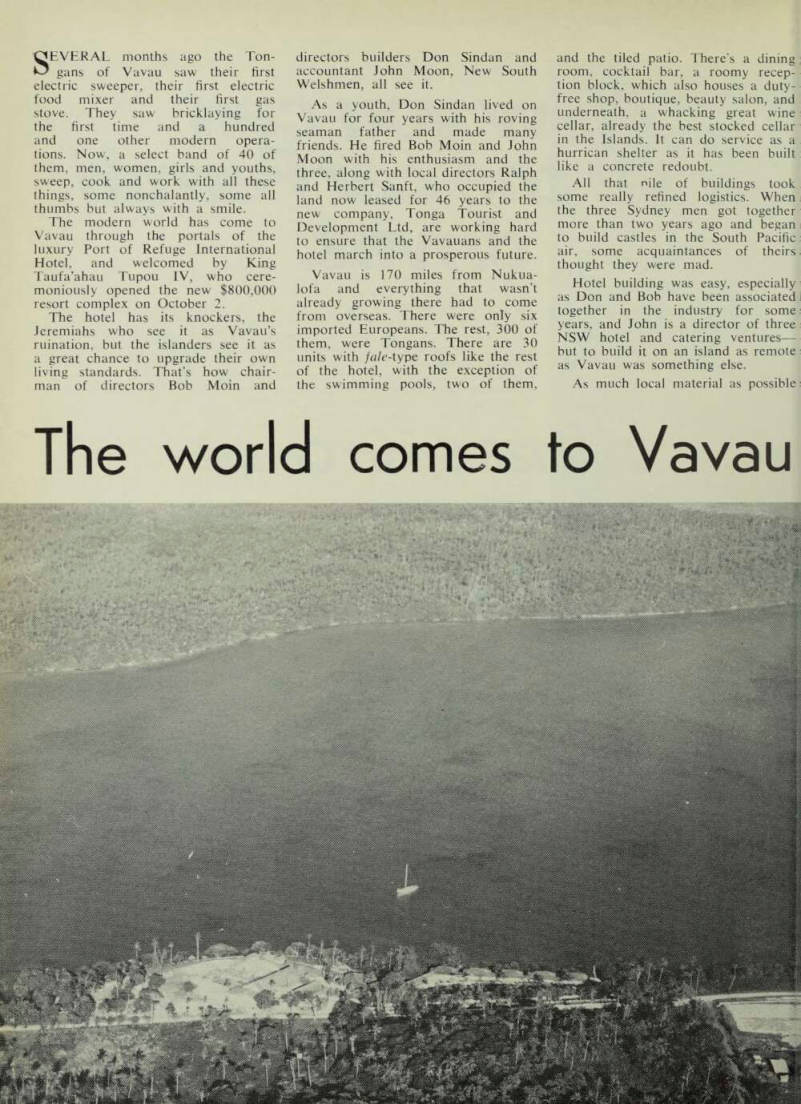
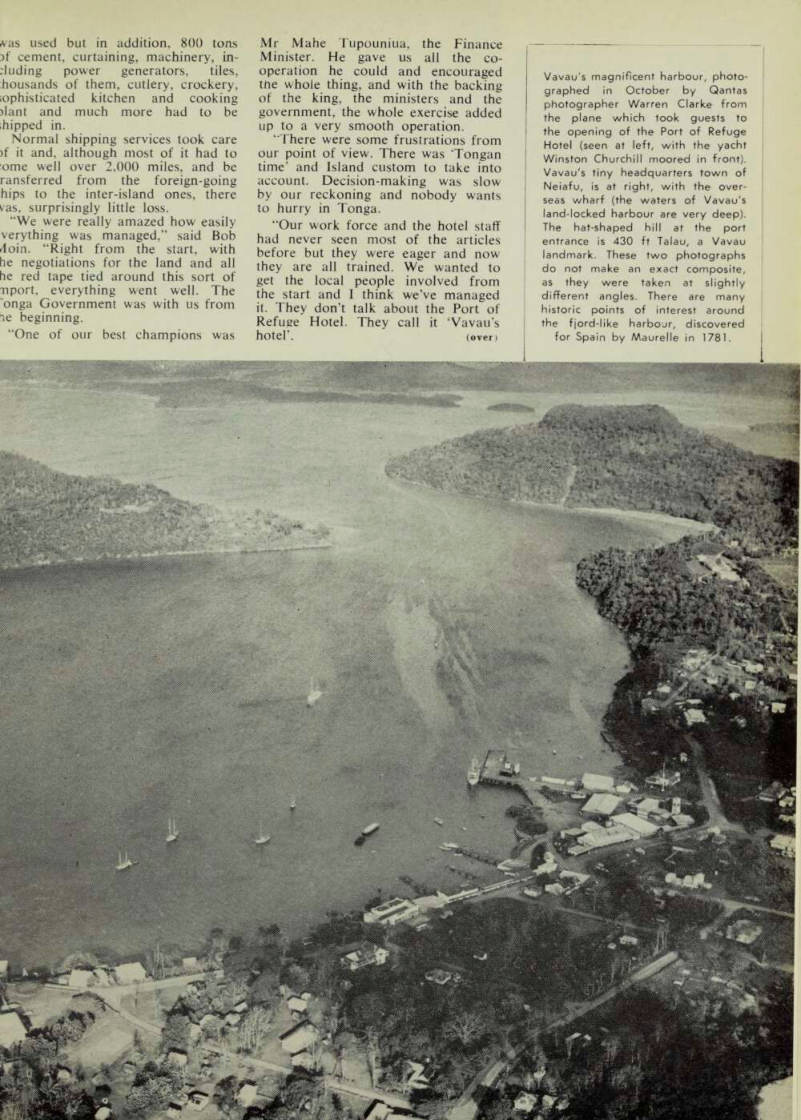
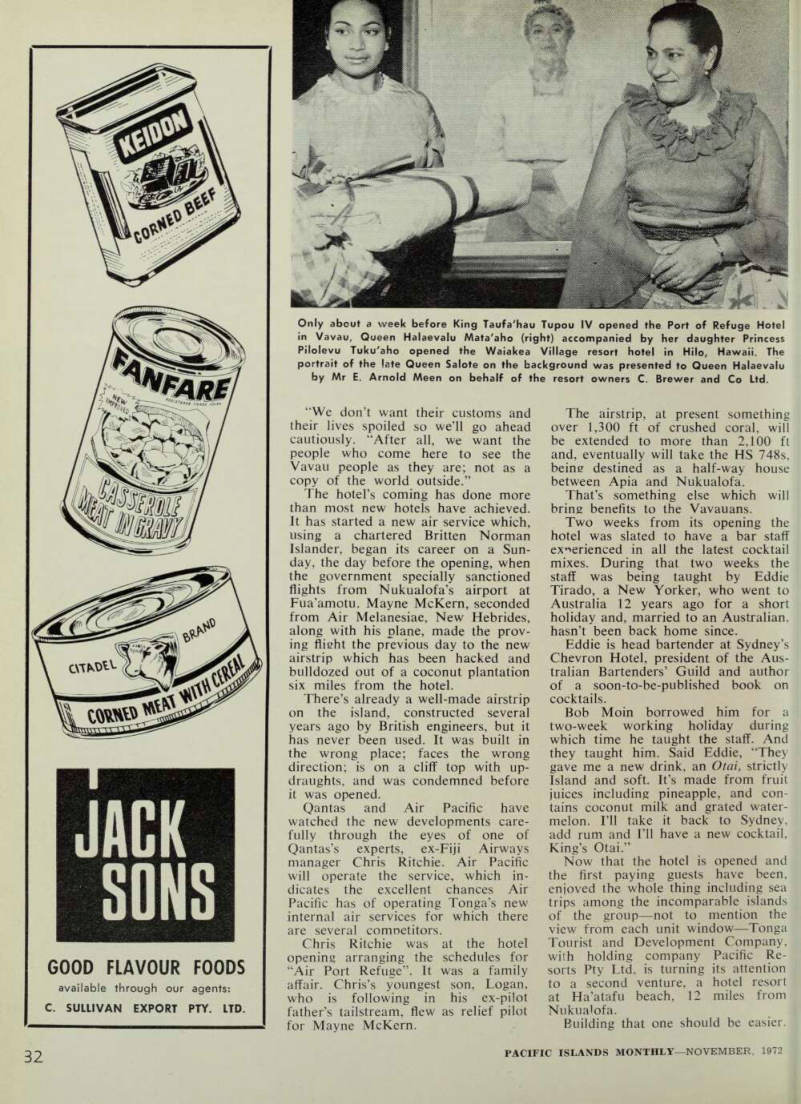

SEVERAL months ago the Tongans of Vavau saw their first electric sweeper, their first electric food mixer and their first gas stove- They saw bricklaying for the first time and a hundred and one other modern operalions. Now, a select band of 40 of them, men women, girls and youths, sweep, cook and work with all these things, some nonchalantly, some all thumbs but always with a smile.
The modern world has come to Vavau through the portals of the luxury Port of Refuge International Hotel. and welcomed by King Taufa’ahau Tupou IV, who ceremoniously opened the new $BOO,OOO resort complex on October 2.
The hotel has its knockers, the Jeremiahs who see it as Vavau’s ruination, but the islanders see it as a great chance to upgrade their own living standards. That's how chairman of directors Bob Moin and
directors builders Don Sindan and accountant John Moon, New South Welshmen, all see it.
As a youth Don sindan lived on V avau for four years with his roving seaman father and made m friends . He fired Boh Moin and John Moon with his enthusiasm and the three> along with local directors Ra , ph and Herbert Sanft, who occupied the j anc j now j easec j f or 45 years to the new company, Tonga Tourist and Development Ltd, are working hard to ens Lire that the Vavauans and the hotel march into a prosperous future.
Vavau is 170 miles from Nukua lofa and everything that wasn’t already growing there had to come from overseas. There were only six imported Europeans. The rest, 300 of them, were Tongans. There are 30 units with fate- type roofs like the rest of the hotel, with the exception of the swimming pools, two of them,
and the tiled patio. There's a dining room, cocktail bar, a roomy recep tion block, which also houses a duty free shop boutique, beauty salon, and underneath a whacking great wine cellar, already the best stocked cellar in the Islands It can do service as a Humean shelter as it has been built like a concrete redoubt, Ail that mle of buildings took some really refined logistics. When the three Sydney men got together more than two years ago and began to build castles in the South Pacific air, some acquaintances of theirs thought they were mad. a b U H as a " d B ° b * a h n J , Jl “ J vLI™ 66 NSW hotel and catering ventures b ld * remote as Vavau was something else, As much local material as possible
•vas used but in addition, 800 tons }f cement, curtaining, machinery, in :luding power generators, tiles, housands of them, cutlery, crockery, lophisticated kitchen and cooking )lant and much more had to be ;hipped in.
Normal shipping services took care )f it and, although most of it had to ome well over 2,000 miles, and be ransferred from the foreign-going hips to the inter-island ones, there
vas, surprisingly little loss.
“We were really amazed how easily verything was managed,” said Bob doin. “Right from the start, with he negotiations for the land and all he red tape tied around this sort of nport, everything went well. The 'onga Government was with us from
he beginning.
“One of our best champions was
Mr Mahe Tupouniua, the Finance Minister. He gave us all the co operation he could and encouraged the whole thing, and with the backing of the king, the ministers and the government, the whole exercise added up to a very smooth operation.
“There were some frustrations from our point of view. There was Tongan time’ and Island custom to take into account. Decision-making was slow by our reckoning and nobody wants to hurry in Tonga.
“Our work force and the hotel staff had never seen most of the articles before but they were eager and now they are all trained. We wanted to get the local people involved from the start and I think we’ve managed it. They don’t talk about the Port of Refuge Hotel. They call it ‘Vavau’s hotel . (over)
Vavau's magnificent harbour, photo graphed in October by Qantas photographer Warren Clarke from the plane which took guests to the opening of the Port of Refuge Hotel (seen at left, with the yacht Winston Churchill moored in front).
Vavau's tiny headquarters town of Neiafu, is at right, with the over seas wharf (the waters of Vavau's land-locked harbour are very deep).
The hat-shaped hill at the port entrance is 430 ft Talau, a Vavau landmark. These two photographs do not make an exact composite, as they were taken at slightly different angles. There are many historic points of interest around the fjord-like harbour, discovered for Spain by Maurelle in 1781.
“We don’t want their customs and their lives spoiled so we’ll go ahead cautiously. “After all, we want the people who come here to see the Vavau people as they are; not as a copy of the world outside.”
The hotel’s coming has done more than most new hotels have achieved.
It has started a new air service which, using a chartered Britten Norman Islander, began its career on a Sunday, the day before the opening, when the government specially sanctioned flights from Nukualofa’s airport at Fua’amotu. Mayne McKern, seconded from Air Melanesiae, New Hebrides, along with his plane, made the proving flight the previous day to the new airstrip which has been hacked and bulldozed out of a coconut plantation six miles from the hotel.
There’s already a well-made airstrip on the island, constructed several years ago by British engineers, but it has never been used. It was built in the wrong place; faces the wrong direction; is on a cliff top with updraughts, and was condemned before it was opened.
Qantas and Air Pacific have watched the new developments carefully through the eyes of one of Qantas’s experts, ex-Fiji Airways manager Chris Ritchie. Air Pacific will operate the service, which indicates the excellent chances Air Pacific has of operating Tonga’s new internal air services for which there are several comnetitors.
Chris Ritchie was at the hotel opening arranging the schedules for “Air Port Refuge”. It was a family affair. Chris’s youngest son, Logan, who is following in his ex-pilot father’s tailstream, flew as relief pilot for Mayne McKern.
The airstrip, at present something over 1,300 ft of crushed coral, will be extended to more than 2,100 ft and, eventually will take the HS 7485, berns destined as a half-way house between Apia and Nukualofa.
That’s something else which will bring benefits to the Vavauans.
Two weeks from its opening the hotel was slated to have a bar staff experienced in all the latest cocktail mixes. During that two weeks the staff was being taught by Eddie Tirado, a New Yorker, who went to Australia 12 years ago for a short holiday and, married to an Australian, hasn’t been back home since, Eddie is head bartender at Sydney’s Chevron Hotel, president of the Aus tralian Bartenders’ Guild and author of a soon-to-be-published book on cocktails, Bob Moin borrowed him for a two-week working holiday during which time he taught the staff. And they taught him. Said Eddie, “They gave me a new drink, an Otai, strictly Island and soft. It’s made from fruit juices including pineapple, and con tains coconut milk and grated water melon. I’ll take it back to Sydney, add rum and I’ll have a new cocktail, King’s Otai.”
Now that the hotel is opened and the first paying guests have been, enjoved the whole thing including sea trips among the incomparable islands of the group—not to mention the view from each unit window—Tonga Tourist and Development Company, with holding company Pacific Re sorts Pty Ltd, is turning its attention to a second venture, a hotel resort at Ha’atafu beach, 12 miles from Nukualofa.
Building that one should be easier.
Only about a week before King Taufa'hau Tupou IV opened the Port of Refuge Hotel in Vavau, Queen Halaevalu Mata'aho (right) accompanied by her daughter Princess Pilolevu Tuku'aho opened the Waiakea Village resort hotel in Hilo, Hawaii. The portrait of the late Queen Salote on the background was presented to Queen Halaevalu by Mr E. Arnold Meen on behalf of the resort owners C. Brewer and Co Ltd.
Islands
Lithographer
American artist and cartoonist Bill lates, now living in Fiji, is using the ujians and Fiji village life in the iuter islands as models for litho raphs in his own style.
Firstly, he prepares a Masonite card with five coats of acrylic, to lake the surface coating very thick, le then sketches his subject onto le board, using finely sharpened encils. When this sketch is com leted, he takes a penknife, and, sing the scratchboard technique, matches out the highlights.
At this stage, the drawing is photo raphed and Bates retouches the egative to match the original by paquing the highlights. This step lone may take as much as a day to Dmplete. From this negative, the thograph plate is made and the icture reproduced either as a large rint or as a notecard.
Bates “discovered” the South acific in 1968 when he asked the inner Matson Lines—now Pacific ar East Lines—if he could make iricatures of the passengers in ex lange for passage. For the next /o years he regularly did just that, it in 1970, Bates left the ship in arotonga, the Cook Islands, to make oser contact with Islands life, and •ent several months sketching and tinting water colours in Rarotonga id the outer islands of Aitutaki, tiu and Mitiaro.
In 1971 he went to Fiji, where he :cided on the lithograph technique ;cause he felt he could obtain with a greater degree of contrast and hieve more depth and detail in his ctures.
Bates’ other side is cartooning. His tlitical cartoons appear weekly in le Fiji Times, keeping him in touch th the “outside” world. A collec >n of cartoons done aboard the
Mariposa and Monterey will be pub lished this year. Born in Texas, Bates’ home before moving to Fiji was San Francisco, where his comic strip “Ping” ran daily in The San Fran cisco Examiner.
He plans to sketch the peoples of the other South Pacific islands, using friendly Fiji as his base.
Adventuring in
paradise
The explorer Marco Polo would have been proud. The 9,000-ton Dominion Far East ship bearing his name has just completed a cruise along the Papua New Guinea coast which, if not exactly a voyage of discovery, was nevertheless undertaken in a spirit of adventure.
The vessel was chartered by the Anglican church to show 370 Aus tralian sympathisers something of the life and work of the church in Papua New Guinea. The itinerary included calls at places which have never seen a cruise ship before.
The nautical fun began after a three-day stay in Port Moresby, where the Marco Polo picked up Captain Ray Taylor, a sea dog of 30 years’ experience in Papua New Guinea, to< guide her through the reefs and other hazards of the north east coast. “It is unusual to say the least,” he observed drily, “for a ship this size to go gallivanting up through the reefs like this,”
First stop was at East Cape, in response to a request from the United church mission there, whose inhabi tants wanted the chance to stare at such an unusual phenomenon as a large and lovely liner. The Marco Polo’s captain, Peter Carlson, whose readiness to oblige was a key factor in the success of the cruise, brought his ship close inshore.
A flock of canoes came out to the vessel and eventually some of
the occupants were persuaded to come alongside, mount the gangway and chat with the tourists.
Next morning saw the Marco Polo hove to off Dogura, the “mother” station of the Anglican church in Papua New Guinea. Passengers were ferried to and fro in the ship’s life boats, while she cruised slowly up and down all day because the water was too deep for her to anchor.
It was a big day for everyone— most of the tourists had never seen anything like Dogura and Dogura had never seen anything like the Marco Polo, nor been visited by so l many white people at once.
The next stop was at Oro Bay, the new deep water port for the Northern District. Here, too, the Marco Polo was the first cruise ship to come calling and the largest vessel to be seen there since World War 11.
So it was another fascinating day for all concerned: while the tourists were busy seeing the sights, local residents were pouring in from miles
Bill Bates attracts a lively crowd of Fijian youngsters when he gets down to work with his special style of graphic art.
The meeting of cultures: Mrs. Anna Martin, Marco Polo passenger from Adelaide, in summer frock, jungle boots and grass skirt eats her Papuan-style food at Dogura off a banana leaf with the aid of fingers and sharpened stick.
Advertisements & other items, pp. 34-44 (3 items)
Sdns
$
OTfkOS-V
*S
WWW
JACK
SDNS
GOOD FLAVOUR FOODS
available through our agents:
C. SULLIVAN EXPORT PTY. LTD.
When next you are in London , you are cordially invited to visit The House of D unhill.
The Dunhill King Size Filter Cigarette created and perfected by our blenders to be the best
Virginia cigarette
in the world. d tobacco house in the worlds
Ca it
l ILL
*< s T> r *5
CAS
TDK
<<* *5 0' ,\^ 9 % True High-Fidelity Sound Reproduction in cassettes has never been achieved until TDK SD cassettes. TDK, specialist in tape technology, developed SD cassettes only 4 years ago, and now they are favoured by audiophiles in as many as 93 countries. SD cassettes give the people such a true sound emotion as no other tape could. True High-Fidelity— that's what TDK has! • SD Cassettes are offered in both the popular C-60, C-90 and the C-30 type, as well as reel type 1800-SD and 1200-SD. *Also available low noise cassettes in C-30, C-40, C-60, C-90 and C-120.
DISTRIBUTORS WANTED FOR:
New Caledonia, New Hebrides, Tonga, West Samoa, American Samoa, Marquesas Nauru, Cook Islands, British Solomon Islands.
TDK Authorized distributors: Australia
CONVOY INTERNATIONAL PTY. LTD.
Cnr. Plunkett and Maclean Sts.
Woolloomooloo 2011 Sydney, Australia New Guinea Turner & Davey Electrical Pty. Ltd.
P.O. BOX 336, Goroka Tahiti Ets. Wl KING 132 Rue du Marechal Foch Papeete, Tahiti Fiji C. Maganlal & Co. 119, Vitogo Parade Lautoka, Fiji
&TDK
2-14-6, Uchikanda, Chiyoda-ku, Tokyo, Japan Cable: TDK CORE TOKYO Telex: TODENKA J 24270
m aft/srrns mm m ««b
The Qantas747B
a better way to fly.
Qantas gives you the big, smooth, quiet and beautiful 7478. This is the plane with the biggest First Class Lounge in the skies. The one with movies and stereo* with wide, wide aisles and wide custombuilt seats. The Qantas 7478 has 15 washrooms. Separate Shaver Bars.
And it’s a quieter plane from nose to tail.
Even the main galley is below, so you’re really away from any noise.
You can fly the Qantas 7478 between Australia, Singapore, Europe and London, and between Australia, Fiji and San Francisco.
M ;
a a nth s
7478 The service is as big as the plane. lATA regulations require us to make a charge of U. 5.52.50 for the use of headsets' L 81.1277
A Sw
MazdaBoB KST
9 I . .*. mi 1P& “ *» • as . m mt ■ E. m «w ** / *9 NaMf m w M-4 -- 7 m Who says family motoring can’t be fun?
Meet the Mazda 808 sedan.
It is lavish glamour you can afford.
Along with its fine finish, you get high back front bucket seats that lay way back. And women, children and men appreciate the four doors with two stage checkers.
Plus the door locks are child-proof.
You also get a lockable gas door, thick foam dash, padded sun visors, door armrests, beautifully recessed instruments and more.
You even get front disc brakes. And the body is of semimonocoque construction with subframes designed for safe controlled-collapse under impact.
What’s more, the spare fits under the trunk so your luggage fits snugly.
Now load up and go. You hug the road with its wide track. And you take the lumps out of bumps thanks to its coil suspension up front and bias-mounted gas-filled shock absorbers in the rear.
And the center console with its 4-speed floor shift gives you more than crafty craftsmanship.
The thrifty but hefty 1300 cc overhead engine gives you the feeling of power.
There you have it. Power, safety, comfortable ride and all the things that make driving fun . . . because our engineers are family men, too.
And if you are not a family man, you can also get a sporty coupe with all of the above.
But that is another story.
Meet the Mazda 808 sedan first.
MM4ZD4
Toyo Kogyo Co , Ltd. Hiroshima. Japan American Samoa/MAX HALECK, INC. Pago Pago. AmencarvSamoa 96920 Fiji Islands/NIRANJANS AUTOPORT LTD. G P.O, Box 450. Suva Tel: 22691 New Caledonia/SOCIETE RIVIERE ET BERNANOS 41 Rue de Sebastopol. Noumea New Guinea/PNG MOTORS LTD. P 0. Box 1 394. Boroko. Papua Tel: 55788 New Zealand/MAZDA MOTORS OF NEW ZEALAND LIMITED Auckland Western Samoa/H. & J RETZLAFF P.O Box 195. Apia Tel 237 "The trade mark MAZDA m this advertisement stands for AUTOMOBILES MAZDA as far as France and her territories are concerned.
37
iCIFIC ISLANDS MONTHLY—NOVEMBER. 1972
Got a pump problem?
Davey have the solution - read on.
Bore Hole Pumps
For a simple, reliable method of delivering big volumes of water from bores and wells up to 500 feet deep, ask about Davey SUBMERSIBLE PUMPS.
Range of models with capacities from 200 G.P.H. to 2800 G.P.H. They’re the easiest pumps in the world to install simply drop them down the bore hole and connect to your 240 volt single phase power supply. 415 volt 3-phase models also available.
For shallower bores (up to 70 feet deep) Davey PRIME JET PUMPS are the best you can buy. With no moving parts down the hole, and with capacities up to
1800 G.P.H., Davey PRIME JET PUMPS
provide efficient and economical farm water supply.
For pumping surface water supplies (such as creeks, rivers and tanks) these same pumps can be used with a Shallow Well Injector, providing capacities from 750
G.P.H. to 1800 G.P.H.
Close Coupled Electric
Pumps
Ask about SUPERFLO models (general purpose centrifugal pumps) which offer efficient and dependable performance at competitive prices. Then there are the PRIME FLO models designed to overcome the priming difficulties encountered with centrifugal pumps, and to give large volumes of water at high delivery pressures. They’re suitable for hosing, garden watering, limited irrigation, swimming pool filtration, fire fighting, tank filling, sump pumping, dairy washdown, etc.
Portable Engine-Driven
Self-Priming Pumps
Davey have matched the world’s finest industrial engines with precision engineered and built pumps, to form an unbeatable team. High pressures up to 100 P.S.I. are available ideal for fire fighting, sheep jetting, boom spraying, tank filling and water transfer duties.
Capacities up to 100 G.P.M.
Other Davey Pumps
Davey have a completely automatic SUMP PUMP which is portable, submersible, drains basements, transfers effluent and works in or under water.
The Davey EASYFLO BARE SHAFT PUMPS
are designed to be driven by your existing electric motor or engine. The
MUDFLO DIAPHRAGM PUMPS are for
dewatering excavations (capacity 2000
G.P.H.). Davey LIQUID MANURE PUMPS
are available in medium pressure for transfer duties, high pressure for manure sprinkling both self priming.
IMOVILLI OIL-OPERATED DIAPHRAGM
PUMPS provide up to 850 P.S.I. with complete reliability, and are ideal for use with highly corrosive liquids.
Davey have a Pump
for every pumping job!
i.
See your local Davey Dealer or mail the coupon below! To: DAVEY PUMP COMPANY, 37 COLCHESTER STREET, I idunute SOUTH BRISBANE, OLD., 4101. Please post details on
I PUMP COMPANY NAME
DIVISION OF PYE INDUSTRIES ADDRESS ■
I DP2071/Q I
TABATA SKIN & SCUBA DIVING EQUIPMENT
The TABATA line offers the importer a complete range of
RUBBER SKIN & SCUBA DI-
VING EQUIPMENT and ACC-
ESSORIES for both the professional and amateur. Years of specialized manufacturing experience has established our 9 & , line’s
REPUTATION FOR QUALI-
TY, ATTRACTIVE and PRA-
CTICAL DESIGNS and VERY
COMPETITIVE PRICES. We
also offer a varied line of rubber sundries for golfing, skiing and other popular sports.
For full particulars on our lines, write to: Manufacture rs O
TABATA CO , LTD.
Yajima 81dg.,2-2 Yoshi-cho, Nihonbashi, Chuo-ku, Tokyo Cable: EASTABA Tokyo TELEX:2S2-2806
EASTABATA TOK Te1:(663)8651 ~5
Wh UTMea
\ 4* jS:
Hour
IpA
4s V& S »//* \ I
THAT CANNOT BE BEATEN!
Wise Bros, dependable flour is blended to perfection from high quality wheat including the finest premium wheats from North- Western New South Wales.
Our mills subject them to the most rigid laboratory tests to ensure uniform quality, yield and colour.
Shipments can be made from Sydney, Melbourne or Brisbane.
Wise Bros, also supply a complete range of Mono bakery equipment.
PLEASE NOTE OUR NEW ADDRESS."^—
PYRAMID BRAND
WISE BROS. LIMITED
17th Floor, The Royal Exchange Building, 56 Pitt Street, Sydney (G.P.O. Box 2705, Sydney, N.S.W. 2001).
Phone: 27-3541.
Cables: “Purity”, Sydney.
Cool, easy-to-lay
Vmylflex floor tiles
Vinylflex floor tiles are unaffected by tropical conditions— they go on looking good as new.
The Vinylflex range includes embossed, smooth surface and marbleised patterns— suitable for homes, offices, shops and commercial buildings.
Floor tiles are much easier to lay.
When you want wall-to-wall comfort and over a hundred fashion colours to choose from, Stockists: T.P.N.G.
Steamships Trading Company Limited, Port Moresby, Lae, Samarai Madang, Goroka, Mt. Hagen, Rabaul, Kieta.
Bowmans (P. & N.G.) Pty. Ltd.. Port Moresby, Kieta.
FIJI AND WESTERN SAMOA: Burns Philp (S.S.) Co. Ltd. ask for CSR Vinylflex Floor Tiles.
csr Vinylflex’
VINYL ASBESTOS FLOOR AND WALL TILES
MARKETED BY C.S.R. BUILDING MATERIALS
Export Sales: 4 O'Connell St., Sydney, Australia 2000.
Q25PE322E
□ STARTS WET MOTORS □ STOPS SQUEAKS □ PREVENTS RUST □ PROTECTS ALL METALS □ PREVENTS WET IGNITION □ LUBRICATES □ PROTECTS ALL ELECTRICAL SYSTEMS
□ FIGHTS SALT SPRAY CORROSION
□ PENETRATES AND LOOSENS TIGHT NUTS
□ PROTECTS RIFLES AND SPORTING EQUIPMENT
□ PREVENTS BATTERY CORROSION
MECHANIC IN A CAN
WD4O is available in handy aerosol cans or gallon and half gallon cans with applicator.
Other chemicals manufactured by Ardrox include degreasers, decarbonisers, detergents, paint removers, rust and scale removers, corrosion removers, safety solvents, marine cleaning solvents, industrial cleaning materials, general cleaning products and steam cleaning additives ... all developed and approved for aircraft, marine, electrical and general engineering industries.
Send for more information.
ARDROX AUSTRALIA PTY. LIMITED ahawkersiddeleycompany HEAD OFFICE: BIRNIE AVENUE, LIDCOMBE, N.S.W., AUSTRALIA. TEL: 649 0111 Port Moresby: ANG House. Singapore: 193 b Goldhill Centre, Thompson Rd, Singapore 11
tropic or temperate climate —Fibreglass Refrigerated
units by George & Ashton exceed requirements George and Ashton moulded fibreglass refrigerated units are unaffected by rust, rot, fatigue, weathering or corrosion. No joints to harbour vermin, so cleaning is easy. Used for any type of vehicle or as static storage units. Any size units can be supplied assembled or in prefabricated sections for easy shipping and erection on site.
Approved by N.Z. Depts of Health and Agriculture.
GEORGE &
ASHTON
P.O. Box 2056, South Dunedin.
New Zealand.
Phones 54-108, 54-109 George & Ashton (P. 1.) Ltd, Box 296, Suva, Fiji.
Phone 26-249.
FIJI NEATS
The Fiii Meats unit illustrated is the second supplied to this Company
sjsrstrssz-zsssi
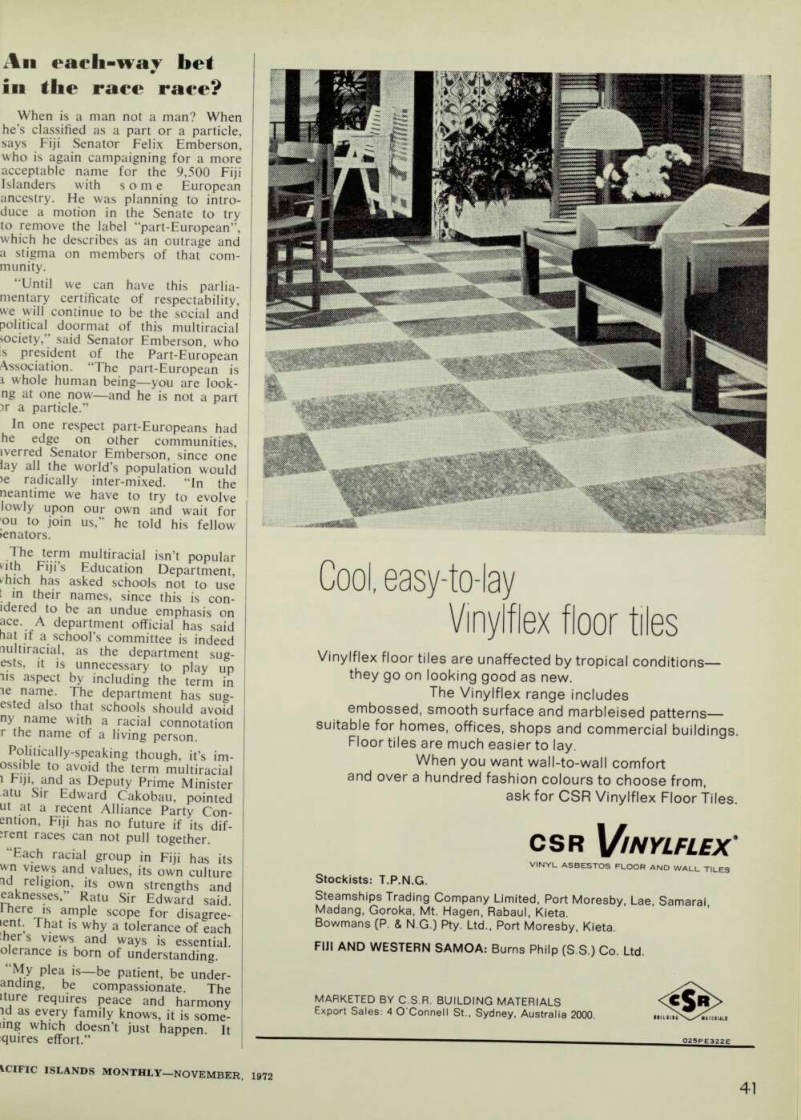
around to see them and their ship.
Large crowds thronged the wharf, hundreds of local people were able to look round the ship, dancing groups performed with gusto, and the authorities chose the occasion to open the new wharf formally.
llahali*
respectable . . .
One of Papua New Guinea's best-
aa si. ssr»A
Island, has apparently entered a new era of respectability. Hahalis presi- S iOTernmSt n coundf d last e month Iw government council last month that anyone referring to the society as a cargo cult would be taken to court and sued for damages.
Another Hahalis leader, Francis Hagai, said that society members had been “hurt” when a news story referred to them as cargo “wp don’t practice 1 a § cuffluid it’s not right for anyone to sav we do ” he said Tniticm n v t i a u i Cultism on Buka Island has a long War n’ d if ing before W ° rld War 11. It seemed to fade away after
about 1935 but flared up again during the war when the Japanese forces invaded Bougainville. In 1943 several cargo cult leaders were beheaded by the Japanese who held the mistaken belief that the cult was an anti- Japanese uprising
Xhpn • • , .
96 ere i WaS the vlol T .u W h F° ICe , 0n ? S o n ? y beach on the east coast of Buka Island. John Teosin and Francis Hagai—then young men—led the time h h r „ •, adherents have noi exactly' been
sjsrstrssz-zsssi
to do their own thing. But there could be changes on thf way.
A ‘ 3 m . ee,ing of . th % Buka local government council, Teosm and Hagai said thev wanted the council and Hahalis to co-operate and he friends The onvpmmpnt ™ aofficer at Sohano, Dr Tom Sawa, himself a Buka, raised a quizzical eyebrow at this statement. q c * , . , D J Sawa told the two men he was closm § an aid P "J the Hahalis area . because of * he fa,lure of the people to support it. He said he had received “no co-operation at all” from the Hahalis people in the two years he’d worked in the Buka area.
• a l*
vpponilllUy lor
* , . , Maybe its up to one of the new nations of the Pacific who aren’t ham strung by Western traditions to put Dr Willard E. Edwards out of his miser >' and give his -Perpetual Calendar” a go. F p. c , , ’ . . , Dr Edwards and his calendar havA
fcwfJuwwSd T SK
«p«f pragress Vwas
ijc m , rom *he L 3g °' fT 0n publicising his ideas for calendar Te form. it* ?is perpelual calendar has been officially endorsed by the legislatures the Massachusetts and Mr VaU^ an Ecur 7 emcal C ° unci ;
membe? The 1
members or the US House of Repre sentatives bring it before the US Congress as a private members bill regularly, but without success.
Dr Edwards despairs of getting any thing settled in his lifetime but mavbe he shouldn’t give up yet. It took about 1.000 vear s of agitation to give
Catholic Europe its present Gregorian calendar in 1582, by which time the old style Julian calendar had got the date and the seasons about 10 days out of kilter. (It took England almost another 200 years to go Gregorian.) It takes the earth 365.2422 days to make a complete journey around the sun and although even the early experts could cope with the 365 days they were fouled up by the .2422 expressed in days, hours and split seconds. Even the Gregorian calendar, complete with an extra day in every
fourth year, is not completely accurate and will have gained one day in 3,323 years.
Dr Edwards does not aim to fiddle with these seconds; his proposed calendar simply plans to get most of the irregularities out of the present system and substitute a calendar that is good indefinitely—that is, per petual.
He would divide the year into four quarters—January, February, March/ April, May, June/July, August, September/October, November, De cember —each quarter having 91 days, the first two months in each quarter 30 days, and the last month, 31 days.
The month at the beginning of the
quarter would always start on a Monday; the second month in the quarter, on a Wednesday, and the third month in the quarter, Friday. (The first day in January would always be a Monday.) To bring the year up to the re quired 365 days, there would be a day without a date called New Years Day (NYD) which would come be tween December 31 and January 1 and would be a world-wide holiday.
Similarly, to take care of the present February 29, every Leap Year, there would be a no-date day called Leap Year Day sandwiched between June and July.
Easter would always be on the same dates, so would one’s birthday and other anniversaries. Public holi days would always be on convenient Fridays or Mondays. In recent years the US Congress has passed laws to enable some public holidays to be celebrated on the nearest Monday.
In most British Commonwealth countries the concept of the long holiday week-end has long since be come a tradition.
Murder in the
New Hebrides
If “Japanese duck” appears on a menu in the New Hebrides, it’s an odds-on chance that the nearest the bird got to be a duck was as a cormorant. And it’s frequent appear ance on the menu is a threat to the existence of the species in the con dominium.
Naturalist Mr Bregulla, who is adviser to the Vila Cultural Centre, fears for the existence of many of the New Hebrides species of birds on two counts, delegates to a South Pacific Conference on National Parks in Sydney were told.
Breeding places are being destroyed by land development and the hunters are trying hard to ensure that the need for breeding places will die with the birds. A colony of cormorants, which made Duck Lake on Efate their home for generations, has been wiped out entirely. They were prized as “Japanese duck”.
The albatross, the world’s largest sea fowl, is proctected by law in the New Hebrides as it is elsewhere. It was extremely rare there. Now, it’s even rarer. Two, which lived in the north of Efate, were recently beaten to death with sticks. That was an easy job for the murderers. The albatross were tame and allowed people to approach them.
“It just shows how much remains to be done too educate the public of the New Hebrides”, said Mr. Bregulla.
Aii eaeli-way bet
in the race race?
When is a man not a man? When he’s classified as a part or a particle, says Fiji Senator Felix Emberson, who is again campaigning for a more acceptable name for the 9,500 Fiji Islanders with some European ancestry. He was planning to intro duce a motion in the Senate to try to remove the label “part-European”, which he describes as an outrage and a stigma on members of that com munity.
“Until we can have this parlia mentary certificate of respectability, we will continue to be the social and political doormat of this multiracial society,” said Senator Emberson, who is president of the Part-European Association. “The part-European is i whole human being—you are look ng at one now—and he is not a part 3r a particle.”
In one respect part-Europeans had he edge on other communities, iverred Senator Emberson, since one lay all the world’s population would >e radically inter-mixed. “In the neantime we have to try to evolve lowly upon our own and wait for ;ou to join us,” he told his fellow >enators.
The term multiracial isn’t popular yith Fiji’s Education Department, k'hich has asked schools not to use [ m their names, since this is con idered to be an undue emphasis on ace. A department official has said hat if a school’s committee is indeed multiracial, as the department sug ests, it is unnecessary to play up ns aspect by including the term in ic name. The department has sug ested also that schools should avoid ny name with a racial connotation r the name of a living person.
Politically-speaking though, it’s im ossible to avoid the term multiracial 1 hip, and as Deputy Prime Minister atu Sir Edward Cakobau, pointed ut at a recent Alliance Party Con ention, Fiji has no future if its dif jrent races can not pull together.
Each racial group in Fiji has its wn views and values, its own culture nd religion, its own strengths and eaknesses,” Ratu Sir Edward said, there is ample scope for disagree icnt. That is why a tolerance of each her s views and ways is essential, olerance is born of understanding.
“My plea is—be patient, be under anding, be compassionate. The dure requires peace and harmony . as every family knows, it is some mg which doesn’t just happen. It quires effort.”
Advertisements & other items, pp. 41-43 (2 items)
Acific Islands Monthly— November, 1972
Icific Islands Monthly— November, 1972
Footnotes
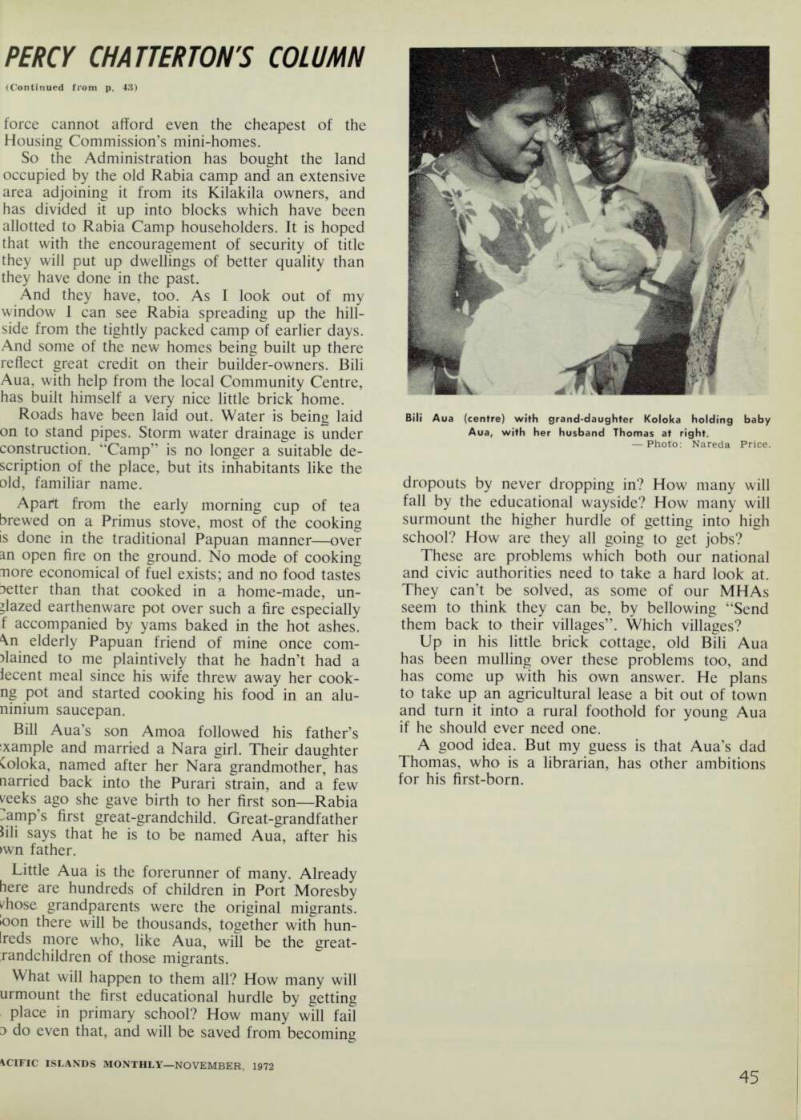
Urban Dwellers
Of The Fourth
Generation
DILI AUA was born in the Purari Delta village of lari, in Papua’s Gulf District, and raised 3n a diet of sago and crabs.
As a young man he joined the Royal Papuan Constabulary, and served successively at Kairuku, Samarai and Baniara. It was while he was at Kairuku, on Yule Island, that he met and married Koloka, from the Nara village of Oroi.
At the outbreak of the Pacific war his unit vas recalled to Port Moresby, and he has lived lere ever since.
After the war was over Bili left the police orce and worked for several contractors, finally )ecoming a contractor in a small way himself.
Quite shortly after the war he became asso rted with the late Tommy Kabu, about whom o much has been written. It still remains a noot point whether Tommy Kabu should be [escribed as a cargo cult leader, an entrepreneur ,r a Papuan nationalist. Perhaps he was a little fit of each.
1 feel sure that all his life he lung to the hope that there was cargo secret to be discovered, ndeed, I suspect that at one eriod he credited me with being i possession of it and hoped that would share it with him. If he ad stopped to think about it he '°uld have realised that I would ardly have remained so non ffluent for so long had I pos ted it.
However, Tommy Kabu did not sit around waiting for the secret to be revealed. He rganised his people to put aside their old ways nd plunge into the ways of the white man. imong the many enterprises which he promoted as the harvesting of sago, with which the Purari »elta abounds, for sale in Port Moresby. This reject brought him into contact with Bili Aua.
In the late 1940 s Kilakila was still a village n the outskirts of Port Moresby, not yet vallowed up by the expanding town. A Kilakila tan who had married a woman from the Purari 'elta heard of the proposed sago marketing •heme, and suggested that Bili and other Purari elta men already in Port Moresby should estab ;h a settlement on Kilakila land and use it as a
centre for the sale of sago to be shipped by the organisation being built up in the Purari Delta by Tommy Kabu.
So was established “Rabia Camp”—‘Tabia” is the Motu word for sago—a shanty settlement a mile or so on the town side of Kilakila village.
Bili Aua and his confreres settled down there and continued with their wage earning jobs while carrying on the sago marketing venture in their spare time. For a while it must have been a
With Percy Chatterton
in Port Moresby
success, since at one stage they had their own truck for handling the sago. But, like most of Tommy Kabu’s commercial ventures this one petered out in a bog of finan cial chaos.
His was a tragic case. Full of energy and initiative, and inspired by a genuine desire to better the way of life of his people, he lacked the managerial know-how and the understanding of the workings of a cash economy which were
needed to make his ambitious schemes successful.
However, the little nucleus of Purari Delta people stayed on at Rabia Camp and were joined by others from the home villages. Tommy Kabu himself commuted between Rabia Camp and the Purari in his efforts to keep his varied enterprises afloat.
During the last two or three years Rabia Camp has been getting a face lift. It has become the Administration’s pilot project for a new kind of suburb—the no-covenant suburb. Belatedly it has been realised that this is the only way to tackle the shanty settlement problem in a city in which a substantial proportion of the work
force cannot afford even the cheapest of the Housing Commission’s mini-homes.
So the Administration has bought the land occupied by the old Rabia camp and an extensive area adjoining it from its Kilakila owners, and has divided it up into blocks which have been allotted to Rabia Camp householders. It is hoped that with the encouragement of security of title they will put up dwellings of better quality than they have done in the past.
And they have, too. As I look out of my window 1 can see Rabia spreading up the hill side from the tightly packed camp of earlier days.
And some of the new homes being built up there reflect great credit on their builder-owners. Bili Aua, with help from the local Community Centre, has built himself a very nice little brick home.
Roads have been laid out. Water is being laid on to stand pipes. Storm water drainage is under construction. “Camp” is no longer a suitable de scription of the place, but its inhabitants like the old, familiar name.
Apart from the early morning cup of tea brewed on a Primus stove, most of the cooking is done in the traditional Papuan manner—over an open fire on the ground. No mode of cooking nore economical of fuel exists; and no food tastes aetter than that cooked in a home-made, unearthenware pot over such a fire especially f accompanied by yams baked in the hot ashes. \n elderly Papuan friend of mine once com >lained to me plaintively that he hadn’t had a lecent meal since his wife threw away her cook ng pot and started cooking his food in an alu
ninium saucepan.
Bill Aua’s son Amoa followed his father’s example and married a Nara girl. Their daughter Coloka, named after her Nara grandmother, has named back into the Purari strain, and a few ago she gave birth to her first son—Rabia .amp’s first great-grandchild. Great-grandfather fili says that he is to be named Aua, after his ►wn father.
Little Aua is the forerunner of many. Already here are hundreds of children in Port Moresby diose grandparents were the original migrants, loon there will be thousands, together with hun- Ireds more who, like Aua, will be the great randchildren of those migrants.
What will happen to them all? How many will urmount the first educational hurdle by getting place in primary school? How many will fail 3 do even that, and will be saved from becoming
dropouts by never dropping in? How many will fall by the educational wayside? How many will surmount the higher hurdle of getting into high school? How are they all going to get jobs?
These are problems which both our national and civic authorities need to take a hard look at.
They can’t be solved, as some of our MHAs seem to think they can be, by bellowing “Send them back to their villages”. Which villages?
Up in his little brick cottage, old Bili Aua has been mulling over these problems too, and has come up with his own answer. He plans to take up an agricultural lease a bit out of town and turn it into a rural foothold for young Aua if he should ever need one.
A good idea. But my guess is that Aua’s dad Thomas, who is a librarian, has other ambitions for his first-born.
Bill Aua (centre) with grand-daughter Koloka holding baby Aua, with her husband Thomas at right.
Photo; Nareda Price.
Advertisements & other items, pp. 45-48 (3 items)
43
CIFIC ISLANDS MONTHLY—NOVEMBER, 1972
Burns Phiip
ri rs
the pacific
FIJI,SAMOA,TONGA,NIUE Is,NORFOLK Is.
BURNS PHIIP
[SOUTH SEA! CO. LTD.
REGISTERED OFFICE: SUVA, FIJI.
TELEPHONE NO: 22661
TELEX NO; FJ1127
Code Address: "BURNSOUTH'
SHIPPING AGENCIES
The New Zealand Shipping Co. Ltd.
Shaw Savill & Albion Co. Ltd.
Blue Star Port Line (Management) Ltd.
Bank Line Ltd.
General Steamship Corporation Ltd.
Compagnie des Messageries Maritimes Royal Interocean Lines Daiwa Navigation Company Ltd.
Sitmar Line Flotta Lauro (Lauro Lines) Australasia Pty. Ltd.
Tonga Shipping Agency Karlander Kangaroo Line
EXCLUSIVE
DISTRIBUTORSHIPS
INCLUDE
Akai Taperecorders Sunbeam Appliances Dunlop Products Hitachi Electronics Holden Motor Vehicles Rolex Watches Revlon Cosmetics Pentax Cameras Massey-Ferguson Tractors Olympic Tyres Penfold Wines Heuga Carpet Tiles
AGENTS FOR
Queensland Insurance Co. Ltd.
Shell Company (P. 1.) Ldt.
Bureau Veritas
ASSOCIATED COMPANIES
Burns Philp (New Hebrides) Ltd.
Burns Philp Trustee Co. Ltd.
Automotive Supplies Co. Ltd.
Corrie & Co. Ltd.
Wrought Iron and Steel Construction Co. Ltd.
Bish Ltd.
SPECIALISED SERVICES
Expert advice on Shipping; Forwarding; Customs formalities; Insurance
COMPLETE TRAVEL
SERVICE
accredited agents for the
INTERNATIONAL AIR
TRANSPORT ASSOCIATION
OVERSEAS AGENTS: SYDNEY • LONDON • SAN FRANCISCO
r \ For
RUM
at its best... say
frigate
OVERPROOF AND UNDERPROOF
In 5 oz. and 13 oz. flasks and 26 oz. and 40 oz. bottles, BLENDED AND BOTTLED BY JOHN WALKER & SONS LIMITED.
Save hundreds of dollars
on Australians most efficient
WALK IN, ALUMINIUM
COOLROOMS AND
FREEZE ROOMS
Hundreds already installed! The most economical supplementary coolrooms for bottles and food, providing the largest storage capacity of any comparable coolrooms of the same exterior dimensions. Five sizes ■from 90-360 cu. ft. capacity; 16 models offering normal temp., two temp., deep freeze, or for pastry and ice storage applications. White vinyl interior, embossed rustproof aluminium exterior. • SUPPLIED IN EASY-TO-ERECT, DO-IT-YOURSELF KIT FORM • PETROL AND PETROL-ELECTRIC MODELS ARE AVAILABLE FOR AREAS WHERE POWER IS LIMITED OR NON-EXISTENT Available from: AUSTRALIAN NEW CALEDONIA EXPORTS, (SILVER AND BARDA), 363 George St, 2000 and Branches.
BRECKWOLDT AND CO., 276 Pitt St, Sydney 2000 and Branches.
HAGEMEYER (AUST.), 59 Anzac Parade, Kensington 2033 and Branches.
MILLERS LIMITED, Thompson St, Suva, Fiji.
Manufactured by:
Clarence St, Sydney, 2000. 179 Vila, New Hebrides.
NELSON AND ROBERTSON PTY. LTD., 19
RABAUL TRADING CO., and Branches.
ROY GALLIMORE AND ASSOCIATES, POB ... ...
S AND E. TATHAM, 364 Lonsdale St, Melbourne, 3000 and Branches SULLIVAN (EXPORT) PTY. LTD., Kembla Bldg., 60 Margaret St, Sydney 2000 and Branches.
W. S. TAIT, 31 Macquarie St, Sydney 2000 and Branches.
® WARBURTON FRANK!
199 Parramatta Road., Cnr. Skarratt Street, Auburn, N.S.W. 2144, Australia. Phone: 648-1711.
Powered by Kelvinator.
Five-year warranty on compressor. Early delivery.
Percy Chatterton's Column
45
*CIFIC ISLANDS MONTHLY— NOVEMBER 1972
(Continued from p. 43)
The Editor's Mailbag
Bairiki Cover
I was most appreciative of PlM’s
August cover photograph, showing a
Gilbertese canoe about the foreshore of the island of Bairiki, for I spent a week on that island in October, 1945, on my way to Fanning Island in the Awahou, and I retain fond memories of the voyage from Suva to Fanning Island, which took a month, via the Ellice and Gilbert Islands.
I would ask you if you could obtain for me a copy of that photo
graph, suitably mounted, for framing?
[ have been a subscriber to PIM for ;ome years, following my two tours )f Fanning Island, of two years each, md seven years in Suva, as an execu ive of Cable and Wireless Limited.
Arthur J. Black
3 enpermint Grove, Western Australia. • PIM has had a number of inquiries ibout that cover. Photographer was mr friend and colleague Bruce 4 dams, of 16 Ormonde St, Epping, VSW 2121, a professional photo grapher who can supply prints.
Micronesians
In reference to “Micronesians -ome Out Fighting In Fifth Round )f Status Talks” (PIM, Aug., p. 11). 1 for one have always thought that he military, naval, and general trategic value of the US trust terri ories was about equivalent to their conomic value and to the economic alue of the GEIC, less Ocean Island, lie only reason for an American iresence that I can see is the need of he Islanders for a “Big Daddy”.
The Japs got precious little strategic dvantage from their possession ex ept before the war they did perhaps Buffalo” us somewhat. We have erived some advantages since the /ar for their use as nuclear and nissile test sites.
As military or naval bases, there > no place to hide on most of them, /hile all Oceania is subject to inter iction of its normal and base re upply by highly sophisticated sub marine fleets. And I have little doubt hat the computers at the ICBM sites an find them if they need to.
I am not speaking from complete >norance, I have travelled extensively irough the Pacific—New Zealand to Vake Is.; Ulithi to Soccoro; Pitcairn 3 Quemoy; and etceteras; and have
quite a few years’ experience as a senior naval and merchant marine officer.
As a taxpayer I do not mind our picking up the tab at the level we now do; but if this makes the Micronesians unhappy let them unhitch their little red wagon and trundle it off to where it pleases them. If they have the idea that if they pull the covers over their heads and ignore the world their problems will be solved, they have another think coming. The world’s major communities are growing by quantum jumps, and reaching out for power bases, influence, food sources and raw materials as never before.
The way to meet the future is with mature intelligence; not the pettiness displayed by so many of the “under developed world’s” politicians.
Geo. R. Jacobs
Glendale, California, USA.
I note the irony of calling Micro nesia’s future status one of a ‘com pact of Free Association’ with the US. It is a sheer farce for the US to declare that it “recognises its responsibility of promoting the development of the Micronesians to wards self-government and indepen dence” when all the implications of
the terms of agreement about its military presence there will make this impossible. Your Honolulu corres pondent is to be congratulated for highlighting the crucial inconsistencies in these ‘negotiated arrangements’.
Jone Dakuvula.
University of the South Pacific, Suva.
Dr Davis's Criticism
Dr Tom Davis’s article (PIM, Sept., p. 11) leaves little to the imagination—his fears are all enu merated. It does, however, appear that he has written this as a disgruntled loser and nothing else.
Dr Davis left these islands many years ago to better himself and only returned after that absence when a number of dissatisfied persons asked for him to return as they were all incapable of acting as a political opposition; they appeared to need someone who has a “name”, especially someone like Dr Davis, who is re membered by many for what he has done for them in the past.
I have resided here now for some years and have seen the benefits of New Zealand’s “paternal” administra tion and what the present government have tried to do since self-government.
This government has made many strides in all spheres and it was only due to New Zealand’s past adminis tration that it has been unable to meet the “status quo” caused by it. Cook Islanders all insist on pay rises with out a thought of where the money is coming from; previously New Zea land met that bill and unfortunately
Advertisements & other items, pp. 49-52 (3 items)
Acific Islands Monthly— November 1972
Handbook of Fiji
4th EDITION
In trade and as a mecca for tourists, Fiji is growing in importance. For businessmen, travellers, students and others who want to keep abreast of events, the fourth, 1972 edition, of the Handbook of Fiji is an essential guide.
As well as sections dealing exhaustively with history, geography, government and politics, finance, trade, education, social services, etc., there is a completely revised tourist section. This is in keeping with the growing importance to Fiji of this industry. An extensive accommodation guide and a folding road-map of Viti Levu are included. With 14 other maps and attractive full-colour cover. 264 pages.
PRICE; Australia and PNG, $3.50 Aust., plus 45c posted; Pacific Islands and overseas countries, $3.50 Aust., plus 70c posted; USA, $4.80 U.S. posted.
Pacific Publications (Aust.) Pty. Ltd.
29 ALBERTA STREET, SYDNEY, N.S.W. 2000.
(Postal Address: Box 3408, G.P.0., Sydney, N.S.W. 2001.)
Yvcltd.* S
% % Established 1890 offering merchants in the Pacific, buying service giving prompt, careful and expert attention to all requirements.
For that service with a difference, cable ''Success", Sydney » c/> 15 % Representing Manufacturers of: Tilley Lamps, Success Footwear, Del Monte Products, Murray Valley Drinks, etc., Lingman Italian Gas Ranges, Success Petrol Washing Machines, E. W. Pipe Fittings, Sharp Calculators, Success Canned Fish, and other leading Brands.
HIGHEST PRICES OBTAINABLE ON THE WORLD MARKETS
FOR YOUR
SHELL - COCOA - COFFEE - COPRA - ETC.
31 Macquarie Place, Sydney, N.S.W. 2000
G.P.O. BOX 5315, SYDNEY, 2001.
CABLES: "TAITCO", SYDNEY.
Seatrans House, Gore St., Auckland, N.Z.
P.O. BOX 2044, AUCKLAND, N.Z.
CABLES: "TAITCO", AUCKLAND.
YOU'RE ALWAYS RIGHT - WITH LECTROLITEI'
•- » * Z' \ dr-t> A 4? <#: 'JJ*& cS
AUTOMOTIVE
PARTS AND
ACCESSORIES
& Sales Promotional Representatives for the South Pacific: DEMKA PTY. LTD., 2-12 Carrington St., Sydney, Australia
1 QS 100 " r M QS 500 4m*
QSP
10
Sansui.
4-CHANNEL STEREO
Vith Sansui’s QSP-10 Compact 4-Channel Consolidator QS-100 4-Channel Rear Amplifier, •r QS-500 4-Channel Rear Amplifier, you can njoy the incomparable richness and “presence” •f 4-channel stereo at minimum cost. The secret ies in a 4-channel synthesizer decoder that tragically transforms 2-channel sources, such as ecords, tapes, and FM broadcasts, into breathtaking “live sound field” concert-hall ealism. QSP-10 combines this with a 20-watt tereo power amplifier and a set of high- >erformance 15-watt speaker systems. Hook it ip with your present hi-fi system and —presto — you’ve got a complete, compact 4-channel stereo ystem that will quadruple your listening bleasure. QS-100 combines the 4-channel synthesizer decoder with a 50-watt power amplifier, while the QS-500 combines it with a 120-watt power amplifier. In either case all you need in addition to your present system is a second set of speaker systems.
If you’re building a new system from scratch, Sansui recommends its 210 A solid-state SW/MW tuner with stereo amplifier. It provides sensitive reception in both MW and SW bands, 36 watts of music power, and a wide 30 to 25,000 Hz power bandwidth, while limiting distortion to less than 1%. 210 A ansui products are available through; EE VEE RADIO LTD. Teerad House 13, Midstone Street, Grey Lynn Auckland 2, New Zealand. Tel: 763064 / PRABHU BROTHERS LTD. P.O. Box 183, Nadi, Fiji islands el; 70183 / SERVONNAT Rue des Polius, Tahitiens Pateete, Tahiti. Tel: 03-29 / OCEANIA INDENT AGENCY P.O. Box 5518, Boroko, Port Moresby, Papua & New luinea. Tel: 56406 / PAUL MOW & CO. 9th St., P.O. Box 449, Lae. Tel: 2954 / CHIN H. MEEN & SONS P/L Tabari Place, P.O. Box 1106, Boroko. Tel: 56546/Kamarere treet, P.O. Box 224, Rabaul. Tel: 2462 / MICHAEL CHOW & Co. P/L Okari Street, P.O. Box 1106, Boroko. Tel: 56338 / SEETO KONG & SONS P/L Taurama Road, O. Box 1218, Boroko. Tel: 56445 / PINGS (MT HAGEN) P/L P.O. Box 165, Mt Hagen. Tel: 385 / BOUGAINVILLE COPPER Canteen, Panguna / PHOTOSONIC P.O. ox 519, Madang. Tel: 2503 / MICHEL MERCIER Angle Des Rues Alma-Sebastopol B.P. 1123 Noumea, Nouveue-Caledonia. Tel; 59-11 et 40-78 / SANSUI ELECTRIC !0.. LTD. 14-1 2-rhome Dnmi ‘siipinami-kn Tnkvo lanan
Letters

(Continued) many of our people here think that “money grows on trees”.
Accusations by Dr Davis of dic tatorial powers makes one think of Haiti; let Dr Davis think backwards a little when New Zealand’s adminis tration of these Islands was far more dictatorial than now. Economic de velopment has been encouraged, yet with falling prices of copra, refusals by New Zealand to take mandarins (although NZ originally encouraged the growing of such), etc., can only lead to the thought that there has been no encouragement.
Political control or influence does not appear in the Church. We have four denominations and I am sure that all would deny the allegations made. He is quick to add that there
is political influence in the Women’s Federation yet his own political organisation has created a “women’s group” for itself in direct opposition.
The government, as did the previous administration, has encouraged youth groups and women’s organisations for the betterment of the country not for political gain; maybe Dr Davis’s accusation applies to the previous administration as well; if it does then the influence of the previous adminis tration was very weak as no one from these groups supported NZ when self government was granted.
Accusations of deportations by him leave other readers with the impres sion that you only have to cough wrongly and “bye-bye”. To my know ledge recent deportations were of marihuana growers. Presumably Dr Davis’s American upbringing does not frown on this type of occupation.
If there is political control of the local news then why did it publish a series of articles just prior to the recent elections on Dr Davis and his career? If there was such control then
no such articles would have appeared.
His moans about the elections are also intriguing—he doesn’t say that two constituencies rejected his party outright. He mainly harps on about Rarotonga, which has the largest population, yet he overlooks other islands in the Group.
Generally speaking his article is devoted to trying to justify his return and is an open criticism of a country he has been absent from for many years. I am very disappointed in him as I had thought that he was ex tremely capable, but not the type to sink to the level of the article you have published.
A Cook Islands Resident
Rarotonga, Cook Islands. • The writer is a prominent Cook Islands resident, and we would prefer him to have published the letter under his own name. PIM doesnt encour age the use of a nom de plume in the letters column except in special cir cumstances.
Bougainville secessionists
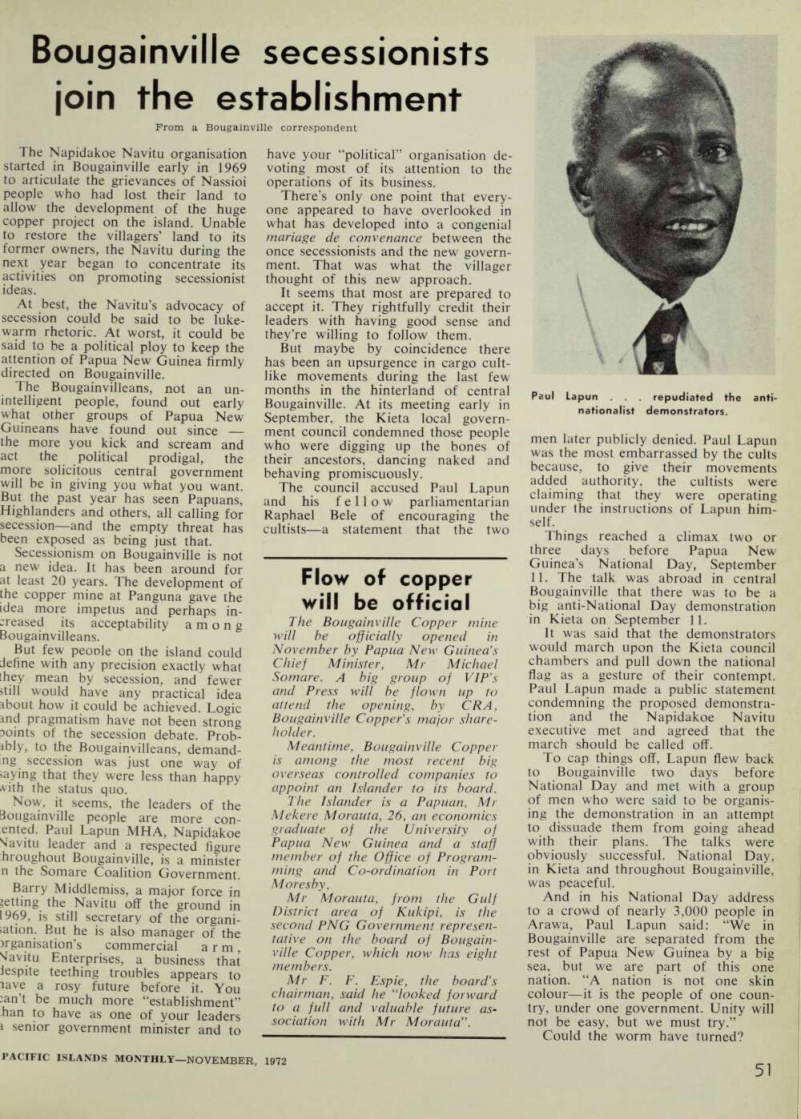
join the establishment
Prom a Bougainville correspondent
The Napidakoe Navitu organisation started in Bougainville early in 1969 to articulate the grievances of Nassioi people who had lost their land to allow the development of the huge copper project on the island. Unable to restore the villagers’ land to its former owners, the Navitu during the next year began to concentrate its activities on promoting secessionist ideas.
At best, the Navitu’s advocacy of secession could be said to be luke warm rhetoric. At worst, it could be said to be a political ploy to keep the attention of Papua New Guinea firmly directed on Bougainville.
The Bougainvilleans, not an un intelligent people, found out early what other groups of Papua New Guineans have found out since the more you kick and scream and act the political prodigal, the more solicitous central government will be in giving you what you want.
But the past year has seen Papuans, Highlanders and others, all calling for secession —and the empty threat has been exposed as being just that.
Secessionism on Bougainville is not a new idea. It has been around for at least 20 years. The development of the copper mine at Panguna gave the idea more impetus and perhaps in creased its acceptability among Bougainvilleans.
But few peoole on the island could define with any precision exactly what they mean by secession, and fewer still would have any practical idea about how it could be achieved. Logic and pragmatism have not been strong aoints of the secession debate. Prob ably, to the Bougainvilleans, demand ng secession was just one way of >aying that they were less than happy -vith the status quo.
Now, it seems, the leaders of the Bougainville people are more con ented. Paul Lapun MHA, Napidakoe Vavitu leader and a respected figure hroughout Bougainville, is a minister n the Somare Coalition Government.
Barry Middlemiss, a major force in getting the Navitu off the ground in 1969, is still secretary of the organi sation. But he is also manager of the organisation’s commercial arm, Navitu Enterprises, a business that lespite teething troubles appears to lave a rosy future before it. You :an’t be much more “establishment” han to have as one of your leaders \ senior government minister and to
have your “political” organisation de voting most of its attention to the operations of its business.
There’s only one point that every one appeared to have overlooked in what has developed into a congenial manage de convenance between the once secessionists and the new govern ment. That was what the villager thought of this new approach.
It seems that most are prepared to accept it. They rightfully credit their leaders with having good sense and they’re willing to follow them.
But maybe by coincidence there has been an upsurgence in cargo cult like movements during the last few months in the hinterland of central Bougainville. At its meeting early in September, the Kieta local govern ment council condemned those people who were digging up the bones of their ancestors, dancing naked and behaving promiscuously.
The council accused Paul Lapun and his fellow parliamentarian Raphael Bele of encouraging the cultists—a statement that the two
men later publicly denied. Paul Lapun was the most embarrassed by the cults because, to give their movements added authority, the cultists were claiming that they were operating under the instructions of Lapun him self.
Things reached a climax two or three days before Papua New Guinea’s National Day, September 11. The talk was abroad in central Bougainville that there was to be a big anti-National Day demonstration in Kieta on September 11.
It was said that the demonstrators would march upon the Kieta council chambers and pull down the national flag as a gesture of their contempt.
Paul Lapun made a public statement condemning the proposed demonstra tion and the Napidakoe Navitu executive met and agreed that the march should be called off.
To cap things off, Lapun flew back to Bougainville two days before National Day and met with a group of men who were said to be organis ing the demonstration in an attempt to dissuade them from going ahead with their plans. The talks were obviously successful. National Day, in Kieta and throughout Bougainville, was peaceful.
And in his National Day address to a crowd of nearly 3,000 people in Arawa, Paul Lapun said: “We in Bougainville are separated from the rest of Papua New Guinea by a big sea, but we are part of this one nation. “A nation is not one skin colour—it is the people of one coun try, under one government. Unity will not be easy, but we must try.”
Could the worm have turned?
Paul Lapun . . . repudiated the anti nationalist demonstrators.
Flow of copper
will be official
The Bougainville Copper mine will be officially opened in November by Papua New Guinea’s Chief Minister, Mr Michael Sotnare. A big group of VlP’s and Press will be flown up to attend the opening, by CRA, Bougainville Copper’s major share holder.
Meantime, Bougainville Copper is among the most recent big overseas controlled companies to appoint an Islander to its board.
The Islander is a Papuan, Mr Mekere Morauta, 26, an economics graduate of the University of Papua New Guinea and a staff member of the Office of Program ming and Co-ordination in Port Moresby.
Mr Morauta, from the Gulf District area of Kukipi, is the second PNG Government represen tative on the board of Bougain ville Copper, which now has eight members.
Mr F. F. Espie, the board’s chairman, said he “looked forward to a full and valuable future as sociation with Mr Morauta”.
Advertisements & other items, p. 54 (1 item)
Isolation Threatens The Future
F "Too-Tranquil" Ontong Java
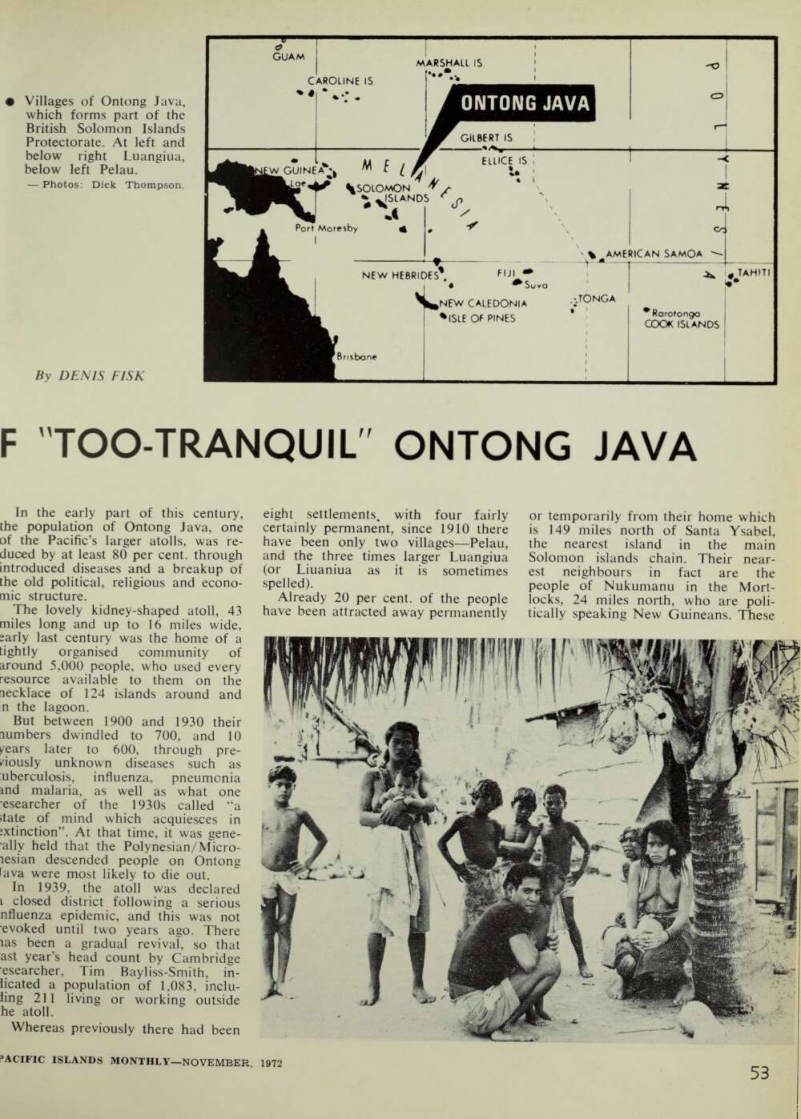
By Denis Fisk
In the early part of this century, the population of Ontong Java, one of the Pacific’s larger atolls, was re duced by at least 80 per cent, through introduced diseases and a breakup of the old political, religious and econo mic structure.
The lovely kidney-shaped atoll, 43 miles long and up to 16 miles wide, sarly last century was the home of a tightly organised community of around 5,000 people, who used every resource available to them on the lecklace of 124 islands around and n the lagoon.
But between 1900 and 1930 their lumbers dwindled to 700, and 10 /ears later to 600, through pre viously unknown diseases such as überculosis, influenza, pneumonia md malaria, as well as what one •esearcher of the 1930 s called “a state of mind which acquiesces in sxtinction”. At that time, it was gene ally held that the Polynesian/Micro lesian descended people on Ontong tava were most likely to die out.
In 1939, the atoll was declared i closed district following a serious nfluenza epidemic, and this was not evoked until two years ago. There las been a gradual revival, so that ast year’s head count by Cambridge esearcher, Tim Bayliss-Smith, in iicated a population of 1,083, inclu ling 211 living or working outside he atoll.
Whereas previously there had been
eight settlements, with four fairly certainly permanent, since 1910 there have been only two villages—Pelau, and the three times larger Luangiua (or Liuaniua as it is sometimes spelled).
Already 20 per cent, of the people have been attracted away permanently
or temporarily from their home which is 149 miles north of Santa Ysabel, the nearest island in the main Solomon islands chain. Their near est neighbours in fact are the people of Nukumanu in the Mort locks, 24 miles north, who are poli tically speaking New Guineans. These
Villages of Ontong Java, which forms part of the British Solomon Islands Protectorate. At left and below right Luangiua, below left Pelau.
Photos; Dick Thompson.
Advertisements & other items, pp. 55-56 (2 items)
53
’ACIFIC ISLANDS MONTHLY—NOVEMBER. 1972
Announcing....
Announcing...
your man at
Air Pacific.
To meet the growing needs of the people of the South Pacific Islands, Air Pacific is continually improving and expanding its services and equipment. But covering a route network of nearly five million square miles is no easy task. And the peoples of Fiji, Tonga, Samoa, the New Hebrides, the Gilbert and Ellice Islands, Nauru, the Solomon Islands and New Guinea all have different needs and different problems for Air Pacific to solve.
To help improve services still further, Air Pacific is establishing its own “Ombudsman department” men who can tour the vast network to investigate passenger services right on the spot.
Your “Man at Air Pacific” will take up any queries or problems you have regarding Air Pacific’s service to your country. Drop him a line at “Customer Service Enquiries”, Air Pacific, Box 112, Suva, Fiji.
GILBERT IS.
V ELLICE IS
PORT MORESBY
NAURU
SAMOA
SOLOMON IS. \ NEW
HEBRIDES
FIJI
TONGA
“Jets you around the islands” 22928
two are far closer to one another
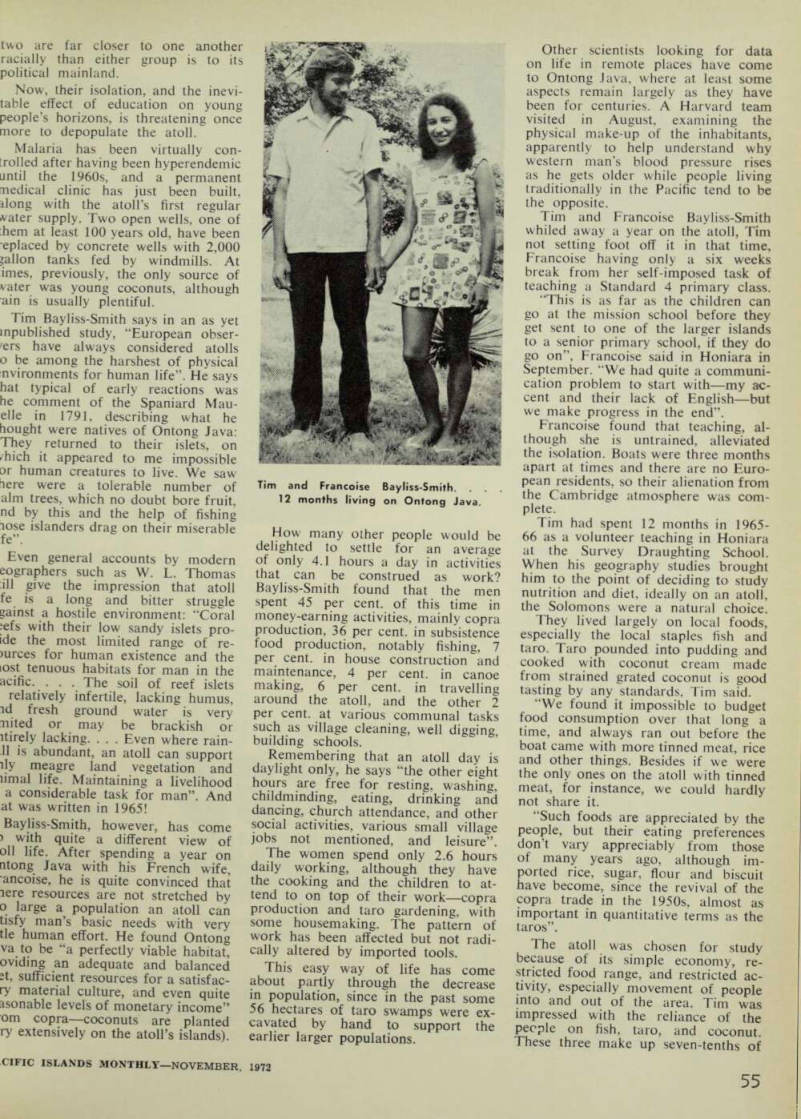
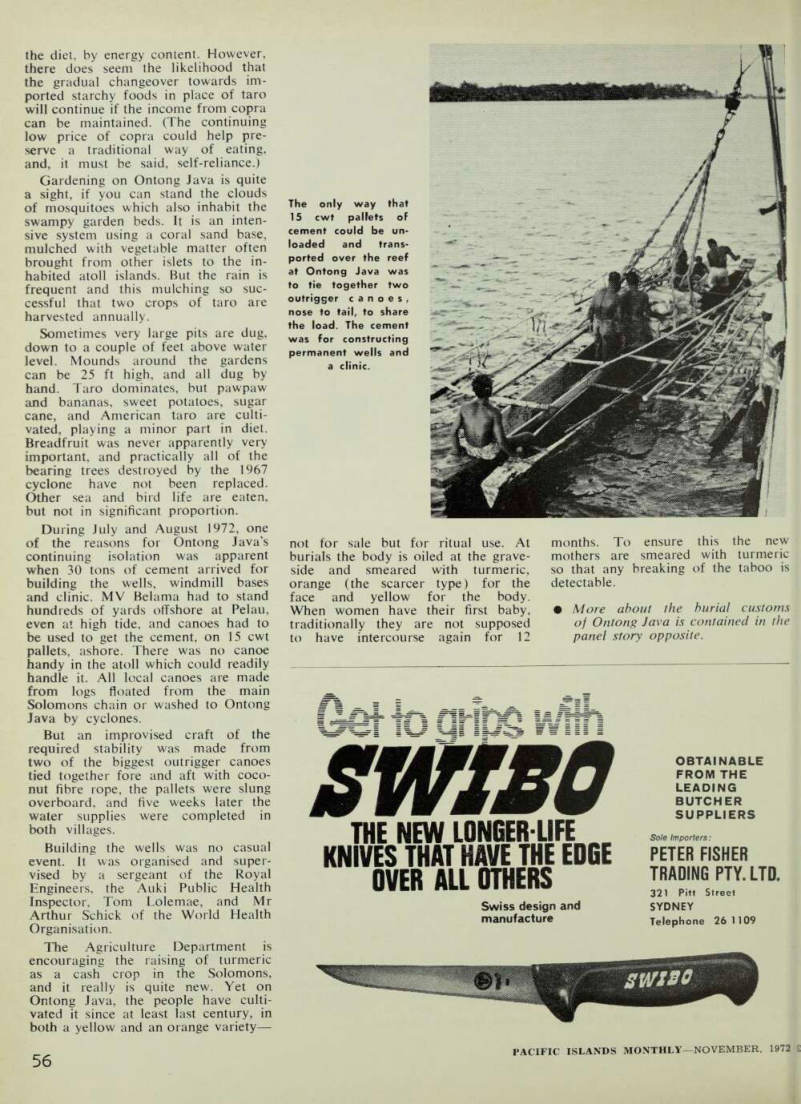
racially than either group is to its political mainland.
Now, their isolation, and the inevi table effect of education on young people’s horizons, is threatening once more to depopulate the atoll.
Malaria has been virtually con trolled after having been hyperendemic until the 19605, and a permanent medical clinic has just been built, along with the atoll’s first regular vater supply. Two open wells, one of :hem at least 100 years old, have been eplaced by concrete wells with 2,000 gallon tanks fed by windmills. At imes, previously, the only source of vater was young coconuts, although ain is usually plentiful.
Tim Bayliss-Smith says in an as yet mpublished study, “European obser vers have always considered atolls o be among the harshest of physical nvironments for human life”. He says hat typical of early reactions was he comment of the Spaniard Mau elle in 1791, describing what he bought were natives of Ontong Java: They returned to their islets, on /hich it appeared to me impossible or human creatures to live. We saw tere were a tolerable number of aim trees, which no doubt bore fruit, nd by this and the help of fishing lose islanders drag on their miserable fe”.
Even general accounts by modern eographers such as W. L. Thomas ill give the impression that atoll fe is a long and bitter struggle gainst a hostile environment; “Coral ;efs with their low sandy islets pro ide the most limited range of re mrces for human existence and the tost tenuous habitats for man in the acific. . . . The soil of reef islets relatively infertile, lacking humus, id fresh ground water is very mited or may be brackish or itirely lacking, . , . Even where rain -11 is abundant, an atoll can support ily meagre land vegetation and umal life. Maintaining a livelihood a considerable task for man”. And at was written in 1965!
Bayliss-Smith, however, has come ) with quite a different view of oil life. After spending a year on ntong Java with his French wife, ancoise, he is quite convinced that lere resources are not stretched by o large a population an atoll can tisfy man’s basic needs with very tie human effort. He found Ontong va to be “a perfectly viable habitat, oviding an adequate and balanced ;t, sufficient resources for a satisfac ry material culture, and even quite asonable levels of monetary income” om copra—coconuts are planted ry extensively on the atoll’s islands).
How many other people would be delighted to settle for an average of only 4.1 hours a day in activities that can be construed as work?
Bayliss-Smith found that the men spent 45 per cent, of this time in money-earning activities, mainly copra production, 36 per cent, in subsistence food production, notably fishing, 7 per cent, in house construction and maintenance, 4 per cent, in canoe making, 6 per cent, in travelling around the atoll, and the other 2 per cent, at various communal tasks such as village cleaning, well digging building schools.
Remembering that an atoll day is daylight only, he says “the other eight hours are free for resting, washing, childminding, eating, drinking and dancing, church attendance, and other social activities, various small village jobs not mentioned, and leisure”.
The women spend only 2.6 hours daily working, although they have the cooking and the children to at tend to on top of their work—copra production and taro gardening, with some housemaking. The pattern of work has been affected but not radi cally altered by imported tools.
This easy way of life has come about partly through the decrease in population, since in the past some 56 hectares of taro swamps were ex cavated by hand to support the earlier larger populations.
Other scientists looking for data on life in remote places have come to Ontong Java, where at least some aspects remain largely as they have been for centuries. A Harvard team visited in August, examining the physical make-up of the inhabitants, apparently to help understand why western man’s blood pressure rises as he gets older while people living traditionally in the Pacific tend to be the opposite.
Tim and Francoise Bayliss-Smith whiled away a year on the atoll, Tim not setting foot off it in that time, Francoise having only a six weeks break from her self-imposed task of teaching a Standard 4 primary class.
“This is as far as the children can go at the mission school before they get sent to one of the larger islands to a senior primary school, if they do go on”, Francoise said in Honiara in September. “We had quite a communi cation problem to start with—my ac cent and their lack of English—but we make progress in the end”.
Francoise found that teaching, al though she is untrained, alleviated the isolation. Boats were three months apart at times and there are no Euro pean residents, so their alienation from the Cambridge atmosphere was com plete.
Tim had spent 12 months in 1965- 66 as a volunteer teaching in Honiara at the Survey Draughting School.
When his geography studies brought him to the point of deciding to study nutrition and diet, ideally on an atoll, the Solomons were a natural choice.
They lived largely on local foods, especially the local staples fish and taro. Taro pounded into pudding and cooked with coconut cream made from strained grated coconut is good tasting by any standards, Tim said.
“We found it impossible to budget food consumption over that long a time, and always ran out before the boat came with more tinned meat, rice and other things. Besides if we were the only ones on the atoll with tinned meat, for instance, we could hardly not share it.
“Such foods are appreciated by the people, but their eating preferences don’t vary appreciably from those of many years ago, although im ported rice, sugar, flour and biscuit have become, since the revival of the copra trade in the 19505, almost as important in quantitative terms as the taros”.
The atoll was chosen for study because of its simple economy, re stricted food range, and restricted ac tivity, especially movement of people into and out of the area. Tim was impressed with the reliance of the people on fish, taro, and coconut.
These three make up seven-tenths of
Tim and Francoise Bayliss-Smith. 12 months living on Ontong Java.
the diet, by energy content. However, there does seem the likelihood that the gradual changeover towards im ported starchy foods in place of taro will continue if the income from copra can be maintained. (The continuing low price of copra could help pre serve a traditional way of eating, and, it must be said, self-reliance.) Gardening on Ontong Java is quite a sight, if you can stand the clouds of mosquitoes which also inhabit the swampy garden beds. It is an inten sive system using a coral sand base, mulched with vegetable matter often brought from other islets to the in habited atoll islands. But the rain is frequent and this mulching so suc cessful that two crops of taro are harvested annually.
Sometimes very large pits are dug, down to a couple of feet above water level. Mounds around the gardens can be 25 ft high, and all dug by hand. Taro dominates, but pawpaw and bananas, sweet potatoes, sugar cane, and American taro are culti vated, playing a minor part in diet.
Breadfruit was never apparently very important, and practically all of the bearing trees destroyed by the 1967 cyclone have not been replaced.
Other sea and bird life are eaten, but not in significant proportion.
During July and August 1972, one of the reasons for Ontong Java’s continuing isolation was apparent when 30 tons of cement arrived for building the wells, windmill bases and clinic. MV Belama had to stand hundreds of yards offshore at Pelau, even at high tide, and canoes had to be used to get the cement, on 15 cwt pallets, ashore. There was no canoe handy in the atoll which could readily handle it. All local canoes are made from logs floated from the main Solomons chain or washed to Ontong Java by cyclones.
But an improvised craft of the required stability was made from two of the biggest outrigger canoes tied together fore and aft with coco nut fibre rope, the pallets were slung overboard, and five weeks later the water supplies were completed in both villages.
Building the wells was no casual event. It was organised and super vised by a sergeant of the Royal Engineers, the Auki Public Health Inspector. Tom Lolemae, and Mr Arthur Schick of the World Health Organisation.
The Agriculture Department is encouraging the raising of turmeric as a cash crop in the Solomons, and it really is quite new. Yet on Ontong Java, the people have culti vated it since at least last century, in both a yellow and an orange variety—
not for sale but for ritual use. At burials the body is oiled at the graveside and smeared with turmeric, orange (the scarcer type) for the face and yellow for the body.
When women have their first baby, traditionally they are not supposed to have intercourse again for 12
months. To ensure this the new mothers are smeared with turmeric so that any breaking of the taboo is detectable, • More about the burial customs of Ontong Java is contained in the panel story opposite.
The only way that 15 cwt pallets of cement could be un loaded and trans ported over the reef at Ontong Java was to tie together two outrigger canoes, nose to tail, to share the load. The cement was for constructing permanent wells and a clinic.
Advertisements & other items, pp. 57-58 (2 items)
55
CIFIC ISLANDS MONTHLY—NOVEMBER, 1972
Swibo
THE NEW LONGER-LIFE
KNIVES THAT HAVE THE EDGE
OVER ALL OTHERS
Swiss design and manufacture
OBTAINABLE
FROM THE
LEADING
BUTCHER
SUPPLIERS
Sole Importers:
PETER FISHER
TRADING PTY.LTD.
321 Pitt Street
SYDNEY
Telephone 26 1109
SWISS
1
Mixed burial ground reminds of earlier intolerance
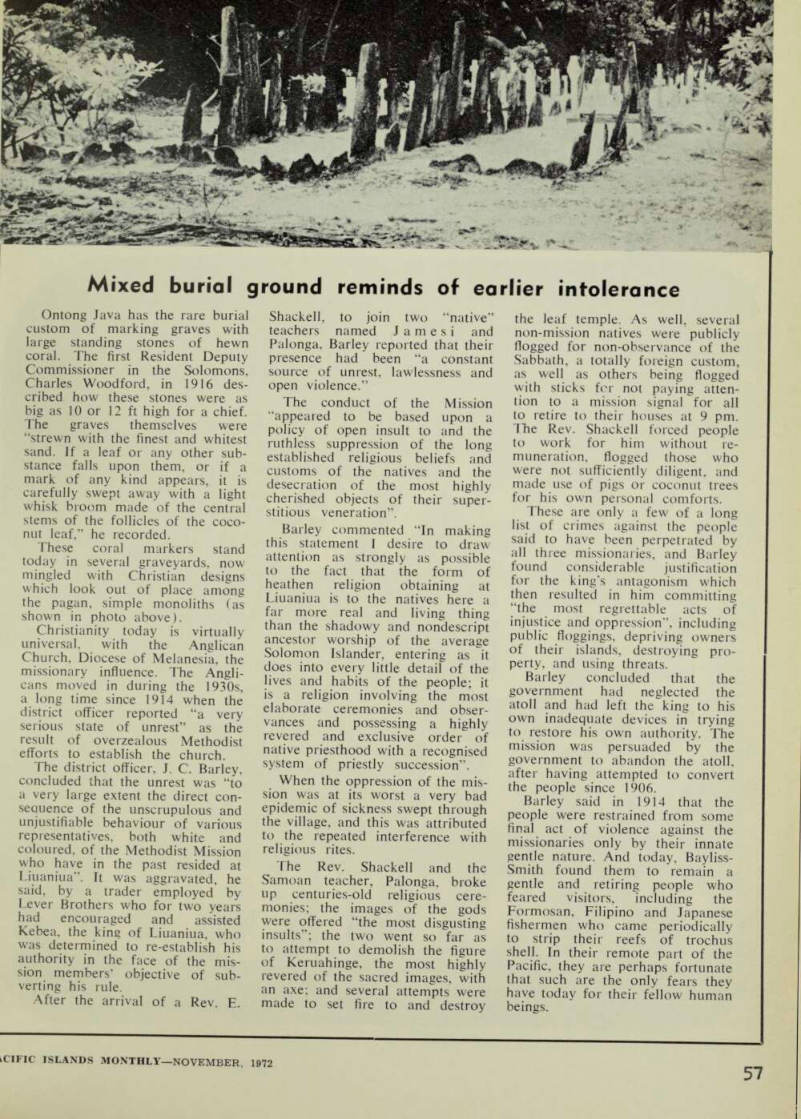
Ontong Java has the rare burial custom of marking graves with large standing stones of hewn coral. The first Resident Deputy Commissioner in the Solomons, Charles Woodford, in 1916 des cribed how these stones were as big as 10 or 12 ft high for a chief.
The graves themselves were “strewn with the finest and whitest sand. If a leaf or any other sub stance falls upon them, or if a mark of any kind appears, it is carefully swept away with a light whisk broom made of the central stems of the follicles of the coco nut leaf,” he recorded.
These coral markers stand today in several graveyards, now mingled with Christian designs which look out of place among the pagan, simple monoliths (as shown in photo above).
Christianity today is virtually universal, with the Anglican Church, Diocese of Melanesia, the missionary influence. The Angli cans moved in during the 19305, a long time since 1914 when the district officer reported “a very serious state of unrest” as the result of overzealous Methodist efforts to establish the church.
The district officer, J. C. Barley, concluded that the unrest was “to a very large extent the direct con sequence of the unscrupulous and unjustifiable behaviour of various representatives, both white and coloured, of the Methodist Mission who have in the past resided at Liuaniua”. It was aggravated, he said, by a trader employed by Lever Brothers who for two years had encouraged and assisted Kebea, the king of Liuaniua, who was determined to re-establish his authority in the face of the mis sion members’ objective of sub verting his rule.
After the arrival of a Rev. E.
Shackell, to join two “native” teachers named J a m e s i and Palonga, Barley reported that their presence had been “a constant source of unrest, lawlessness and open violence.”
The conduct of the Mission “appeared to be based upon a policy of open insult to and the ruthless suppression of the long established religious beliefs and customs of the natives and the desecration of the most highly cherished objects of their super stitious veneration”.
Barley commented “In making this statement I desire to draw attention as strongly as possible to the fact that the form of heathen religion obtaining at Liuaniua is to the natives here a far more real and living thing than the shadowy and nondescript ancestor worship of the average Solomon Islander, entering as it does into every little detail of the lives and habits of the people; it is a religion involving the most elaborate ceremonies and obser vances and possessing a highly revered and exclusive order of native priesthood with a recognised system of priestly succession”.
When the oppression of the mis sion was at its worst a very bad epidemic of sickness swept through the village, and this was attributed to the repeated interference with religious rites.
The Rev. Shackell and the Samoan teacher, Palonga, broke up centuries-old religious cere monies; the images of the gods were offered “the most disgusting insults”; the two went so far as to attempt to demolish the figure of Keruahinge, the most highly revered of the sacred images, with an axe; and several attempts were made to set fire to and destroy
the leaf temple. As well, several non-mission natives were publicly flogged for non-observance of the Sabbath, a totally foreign custom, as well as others being flogged with sticks for not paying atten tion to a mission signal for all to retire to their houses at 9 pm.
The Rev, Shackell forced people to work for him without re muneration, flogged those who were not sufficiently diligent, and made use of pigs or coconut trees for his own personal comforts.
These are only a few of a long list of crimes against the people said to have been perpetrated by all three missionaries, and Barley found considerable justification for the king’s antagonism which then resulted in him committing “the most regrettable acts of injustice and oppression”, including public floggings, depriving owners of their islands, destroying pro perty, and using threats.
Barley concluded that the government had neglected the atoll and had left the king to his own inadequate devices in trying to restore his own authority. The mission was persuaded by the government to abandon the atoll, after having attempted to convert the people since 1906.
Barley said in 1914 that the people were restrained from some final act of violence against the missionaries only by their innate gentle nature. And today, Bayliss- Smith found them to remain a gentle and retiring people who feared visitors, including the Formosan, Filipino and Japanese fishermen who came periodically to strip their reefs of trochus shell. In their remote part of the Pacific, they are perhaps fortunate that such are the only fears they have today for their fellow human beings.
Advertisements & other items, pp. 59-61 (4 items)
57
CIFIC ISLANDS MONTHLY—NOVEMBER, 1972
covered.
Bank of Hawaii
the bank of the Pacific* w\
we’ve
When it comes to full banking services for the Pacific, Bank of Hawaii’s got you covered. With 70 offices to serve you throughout Hawaii, plus Guam, Tamuning, Koror, Yap, Saipan, Roi Namur, Wake, Kwajalein, Ponape, Midway, American Samoa and an affiliate with Banque de Tahiti. When it comes to financial assistance reach for Bank of Hawaii,
you
covered.
From the
Islands Press
Maiden speech of Mr. John Fifita of the PNG House of Assembly, as reported in the PNG Post-Courier, debating the (playing) Cards Ordinance: "We here in the House are all gamblers," he said.
We were all gamblers when we paid our fees to stand for the House of Assembly."
From the full judgment on an appeal against dismissal of a prosecution under the Price Control Act, published in The Samoa Times: In the case of an ambiguity the Courts have power to settle which of two possible meanings is to prevail. But there is no power to confer a meaning on legislation which has none.— Halsbury (XXXVI) p. 392 para. 586 “Speculation as to Parliament’s intention not permissible”.
Advertisement in Cook Islands News: TO WHOM IT MAY CONCERN. This advertisement is inserted in the interests of Public Health. Would the person/persons who have taken clothing from room 14 at the Otera, or from the saddle bags of Tiy bike, please report immediately to the Health Department for a medical checkup as the previous wner of these items of clothing suffers from m incurable skin disease.
Torn an editorial in The Fiji Times France shows no signs of intentions to decolonise in he South Pacific—-a process which Britain is continuing Ihe region provides considerable mineral wealth for he French, from New Caledonia, and a nuclear estmg zone for them in French Polynesia There ire well-entrenched French business interests in the \ew Hebrides as well. In view of repeated calls it the United Nations for the Anglo-Saxon countries 0 grant immediate independence to their territories, 1 fair question is why the same calls are not directed o France. The UN’s Special Committee on Colonialism for Pitcairn Island (population bout 80) Surely, to be consistent, it should urge nn"nnn r \ f“ ture f° r Mew Caledonia (population over OO.OOQ), French Polynesia (about 100,000) and Va hs and Futuna (about 11,000). The reason for the lck of such suggestions is not hard to find The r st rT v ° c , al cri ! ics w °f Britain’s colonial policies at ne UN have included African countries with which ranee has maintained strong economic and , in some uses, political links after decolonising them, hese countries are quiet when it comes to French oloniahsm, but they have a lot to say—most of it ot constructive— when it comes to other varieties n view of France’s attitude in Apia, perhaps it is
time other countries with less commitments to French friendship spoke up—and sharply— at the UN about the future of the French Pacific territories.
"In Our Opinion", contributed by Joseph Koroma to PNG's Highland News: We, the educated are already outsiders, nearly as foreign as any Europeans, because we are already drunk on the milk of western ideology. We have gone further than the assimilation point because we are now part of the west no longer bound under traditional bonds. Now it is too late to turn back because we have formed a new social class which must seek identity by some means. In the name of nationalism we must claim Papua Niugini as being ours. We are the ones with no particular world, transitional people trying to found a social level for ourselves and in the process dragging the traditional age group with us. Through nationalism we are out to convert the older generation to adopt our ways because we do not want to be in the minority.
'From The Editor's Chair' in Cook Islands News: The Public Forum is hotting up nicely. I’m very pleased about that because it’s a very good chance for anyone to blow off a head of steam. One thing about the letters from our men of the cloth—as a mere layman, my comment on the decline of church attendance is because the average man is so puzzled about what is the true faith that he falls by the wayside, not knowing what day to worship, what food to eat, whether or not to dance or go to the pictures, whether to practice a form of contraception or not—very puzzling. ... I look forward to Monday.
Should get a few hand grenades thrown back at me for this little bit.
From a letter by S. F. Edwards in the first issue of Atoll Pioneer, the 'new look' newspaper of the GEIC (answering a letter quoted in this column last month): Butiraoi Cinema has always tried its best to be good, and efficient, but at times, things do happen which are beyond the control of the operators, or indeed the management . . . if there is a complete breakdown, money will be refunded, but this has to be done in an orderly manner, and it was attempted on the evening in question . . . there should be no hatred just because of a breakdown.
Letters from Isae Amosi and Joel Patrick in PNG Department of Information's Our News: The village where I teach, the people are still using bows and arrows nearly every day.
Do you think these people are ready for self government? I must say strongly that self government should not be granted until everyone
is ready.
We won’t get anywhere if we sit on our backsides and say ‘Self-government should be granted later, we are not ready.’ If does not matter if there are still primitive people within our country.
Such problems will be overcome later. No country in the world is free of problems and difficulties.
59
ACIFIC ISLANDS MONTHLY—NOVEMBER, 1972
Will nuclear tests come
to the Marquesas?
From JAMES BOY AC K, in Tahiti
France may conduct nuclear tests on the Marquesan island of Eiao, about 1,000 miles north-east of Tahiti. This is the rumour being spread by major world newspapers, including the reliable Paris daily, Le Monde.
The rumour got started as follows.
Someone at the Journal de Tahiti heard from a friend that some kind of work was about to begin on Eiao, the deserted, northernmost island in the Marquesas group. The work was to be done by the Pacific Experiments Centre (CEP), the atomic test out fit. The local journalist published a “coconut radio” item to this effect.
It was in the hypothetical tense.
I am the local correspondent for United Press International. I called the CEP spokesman and asked him if the rumour was true. He said he didn’t know. I said I would cable the item before the evening. If the story were false, I would cable a CEP denial.
At about 4 p.m. that day, August 14, the spokesman flatly denied the rumour. He said the CEP was not beginning work on an underground test facility at Eiao. He did admit, however, that a team of “tens” from the Bureau of Geological and Mineral
Research (BRGM) would be going to the island to search for exploitable minerals. The CEP, he said, would provide logistic support for the team —that was all. He said the CEP has often in the past helped government scientists working in French Poly nesia, notably CNEXO, the French oceanographic institute now con structing an installation in Tahiti.
The French news agency cor respondent and I sent out identical reports of this CEP denial, which the spokesman termed “categoric”.
Our reports contained the follow ing speculative information. Eiao was classified one year previously as a
“protected site”. No geological poking
around, or exploitation of the island in any way, could be accomplished except with written consent from the Government Council here. No such permission had been accorded the CEP. The governor, however, had given his verbal authorisation to the CEP and the BRGM. (This oversight was corrected two weeks later by the Government Council).
Eiao, a volcanic island, presents no
geological particularities to dis
tinguish it from other islands in the group. Its only distinguishing feature is its remoteness and inaccessibility.
We noted that two of the Marquesas Islands have airstrips, housing, regular food and fuel supplies, etc., all the necessities of life Eiao lacks.
I recalled an announced French government plan to build a third air strip in the Marquesas. Work on this strip, one which would be big enough to handle jet traffic, was tentatively scheduled to begin in 1974. The official reason for such a strip was that North American tourists could visit the Marquesas. The only prob lem would be that there is no accommodation in the Marquesas.
Otherwise, it was something of a mystery why a jet strip was needed for an archipelago with a population of just over 5,000.
The jet strip is planned for Nuku Hiva, the island closest to Eaio.
Our reports speculated that France intended to study the island’s struc ture for the purpose of deciding whether underground tests could be conducted there.
We discounted the mineral research theory. The mineral allegedly to be investigated is abundant in Tahiti.
The week following our reports saw our speculation spread around the world. I read a story written for The Economist and published in the Honolulu Star-Bulletin, for which I am also local correspondent, which used terms identical to those of my first cable.
In France, opposition Deputy Michel Rocard addressed a “written question” to Defence Minister Michel Debre concerning the Papeete specula tion. Local Deputy Francis Sanford cabled congratulations to Rocard and said, “Polynesian community awaits government reply.”
At the end of the week, the heli copter carrier Ouragan left Tahiti for a two-month visit to Eiao. It carried dozens of crates to the island which took more than one full day to load aboard. The Journal de Tahiti photographed these crates marked “Eiao” and “BRGM”.
Prior to the Ouragan’s departure, local Governor Pierre Angeli joined the CEP in denying that the BRGM team intended to prepare underground tests.
While denying the Eiao speculation, the CEP spokesman revealed that underground compartments were being constructed on Mururoa. Men and material would seek shelter in them at the time of each future nuclear test on Mururoa.
Which means France will conduct more nuclear tests in the atmosphere, probably in June and July, until 1975.
No underground tests are contem plated there.
Advertisements & other items, pp. 62-70 (1 item)
Lake Aircraft Sales Pty. Ltd.
PDri? D ADi llVfr Any beach is yours for the taking I liJjJj I illilVlllll in a 4 seat Lake Buccaneer. ■
154 INGLEBURN ROAD, INGLEBURN, N.S.W. 2565, AUSTRALIA.
Phone Sydney 605-1478. Australasian and South Pacific Distributor.
“Jacqueline, how lovely to see you.”
The girl turned, surprised, and gazed at me.
“My name is Anna,” she said. ‘And I’ve never seen you in my life before.”
“But that’s impossible,” I answered.
“Remember last summer in Dubrovnik?”
“Where’s Dubrovnik?” she asked. ‘And remember that little funicular railway in Switzerland?”
“No,” she answered. ‘And do you still own that scarlet E-type?”
“I’ve never owned a car in my life,” she said.
But this time she smiled, and accepted my offer of a Benson and Hedges. ‘Anyway,” she added, “I’ve had it r(Pj)c i,r,^fikr i Kinn ** Benson & v v ucu umy me oesi will do.
m??’' A-.’ *S? % '•*&' ■■■> -?* igCt Y m*'ij *;%& m ‘ t ***4 %y v* &V Mfl# * <SJ 47 #7
JSf *>,? «# t> ■■/
w -;KV >- . ■ %!f » ‘ip
If ‘A. V
lr%r% li. I* Wire pfJsnq w»ons
m^Mm
iw MS3dMx?wu ■
IoL, JL
«A"A P
j»
IfLgj AUSTRALIA'S j ■'
ifefer I MOST EXPERIENCED
cydadt rmiio junhrdc i H I -
|fkv*v
llife
SIV:
OF BRUNTONS
FAMOUS
. ROYAL, BAKERS'FL6URS ’
CAKE, BISCUIT AND NOODLE
FLOURS, SHARPS, ETC.
> . o s iH i l-\ ■ - ■ [V I 'i SmmSS 1 0R Sill l ; ■ •& i i»Mi| *v 1/1 : .-T M Bt :*< :*% iv. i Mitiil 2203! < ;
* •i Si > N f i ♦A ■
% JaiPi
* *> & vH it* * ■
Serving the country
yesterday today and
tomorrow
That is the proud claim of Ansett Airlines of Papua New Guinea.
We are the only airline in Papua New Guinea with 38 years’ flying experience behind us. With more than 200 flights every week to no less than 40 ports throughout the length and breadth of the country With pilots who have notched up over 18,000 hours’ flying time.
For these reasons—and for many others —we feel we have the right to claim that we know Papua New Guinea best. After all, it is our home.
A
ANSETTI
r Serving the country-yesterday today & tomorrow
ANSETT AIRLINES OF PAPUA NEW GUINEA
in conjunction with ANSETT AIRLINES OF AUSTRALIA APogc:
GW*
mSk
m at Monte Carlo, you’ve got to be g DATS UN zoomed through the 3,700 kilometer rally over icy blinding blizzards and Alpine peaks to capture third place over-all! This year’s event was so demanding that only 52 of the 264 entries were able to finish. But Nissan technology propelled DATSUN securely to second place in its engine class. x * Engineering and technology is what a motorcar is*really*all about. With satellite launching experiences behind*it, Nissan offers the raostlntegrated design in a motorcar you can buy tO|lay.
Rigid quality control. Extensive production test And ingenious sty] and functional. Tlk a few of the many motorists in over more than satisfied with D; year aftlf year.
Get on-the*winning side. Uet yourself inside a DATSUN soor
DATSUN
Pngducfcof NISSAN
Find out
where to test-drive your rally winner at the
DATSUN distributor nearest you!
Full line of DATSUN’s from pickups to luxury sedans.
Port Moresby, Lae, Madang, Mt. Hagen
BOROKO MOTORS LTD.
Rabaul
RABAUL GARAGE LTD.
Suva, Lautoka
SUVA MOTORS LTD.
Apia
MORRIS HEDSTROM LTD.
Noumea
E.D. PENTECOST
Port Vila, Santo
PENTECOST PACIFIC S.A.
Honiara
R.C. SYMES PTY. LTD.
Dili
SOCIEDADE AGRICOLA PATRIA E
TRABALHO LDA.
Norfolk
SIRIUS SERVICE STATION
Pago Pago
B.F. KNEUBUHL
Tahiti
SOCIETE POLYNESIENNE DE DISTRIBUTION
Nauru
JACOB ENTERPRISES
Nukualofa
RICKLEMAN BROTHERS
Saipan
J.C. TENORIO ENTERPRISES
Guam
J & G MOTORS CO., LTD.
Cook Islands
COOK ISLANDS MOTOR CENTRE LTD.
New DATSUN Pickup
New DATSUN 1808
Hardtop
DATSUN
Product of NISSAN
We put off today...
what others leave
until tomorrow!
This is due to side-port, unit-loading—a fast, efficient, safe way to handle cargo. Our 4 ships, “New Guinea Chief,” “Island Chief,” “Coral Chief,” and “Papuan Chief,” are specially designed for side-port unit-loading, and to save ‘turn around’ time in port they carry their own ‘on board’ forklifts to speed the loading and discharge procedure. If you would like to see how side-port unitloading can save you money on our Sydney, Brisbane, Port Moresby, Samarai, Lae, Madang, Rabaul, Kavieng, Kieta and Honiara services let us show you our 20 minute film “Cargo Revolution” ... and you will see how we can “put off today what others leave until tomorrow”.
XI New Guinea Australia Line Pty. Ltd.
Member of the Swire Group General Agents: PORT MORESBY—Steamships Trading Co. Ltd. SYDNEY—Swire & Gilchrist Pty. Ltd.
Agents at: BRISBANE—WiIIs, Gilchrist & Sanderson Pty. Ltd. PAPUA-NEW GUlNEA—Steamships Trading Co. Ltd. (for "New Guinea Chief” at Rabaul and "Island Chief” at Kavieng—Burns Philp (N.G.) Ltd.).
HONlARA—British Solomons Trading Co.
SGO32
If / ' tr
Kenwood Delivers
t-to-R Quality In Cassettes
Kenwood technology always keeps in pace with the state of the art in audio amplification. And the hottest things on the cassette market today are the Dolby System and Chromium Dioxide tape. Dolby dramatically reduces hiss and other noise inherent in tape recordings while chrome tape promises phenomenal improvements in performance.
The new Kenwood KX-700 Cassette Deck not only incorporates a but is also equipped with Super Ferrite Head (SFH) specifical| y designed to handle chrome tapes.
These features boost quality characteristics of cassette recordings to reel-to-reel level.
The KX-700 has a Tape Selector which enables you to get maximum performance from regular, noiseless or chrome tape. ■ * Dolby is a trademark of Dolby Laboratories, Inc. the sound approach to quality
SKENWOOD
ninu.e information, write to: P-SECTION, TRIO ELECTRONICS, INC. 6-6, 1-chome, Shibuva. Shibuva-kn Tnl,„n ,
Yesterday, the world.
Today, Tahiti.
Tomorrow, who knows?
HONDA.
That's John! World traveler.
And journalist. The kind of man who knows how to mix business with pleasure.
Because he owns a machine that's enjoyed in more countries than he himself's been, 150 in all. One with power, dynamic and flexible, leaving him free to appreciate the ride. Road holding, backed by years of HONDA success, is unsurpassed, ensuring greater mobility. Safety, second to none. Then there's freedom of choice, a HONDA to suit every individual.
Honda offers John the opportunity to get the very best from himself and the machine. Who knows where he'll be tomorrow.
World's Largest Motorcycle Manufacturer
HONDA MOTOR CO., LTD. TOKYO, JAPAN
Magazine Section
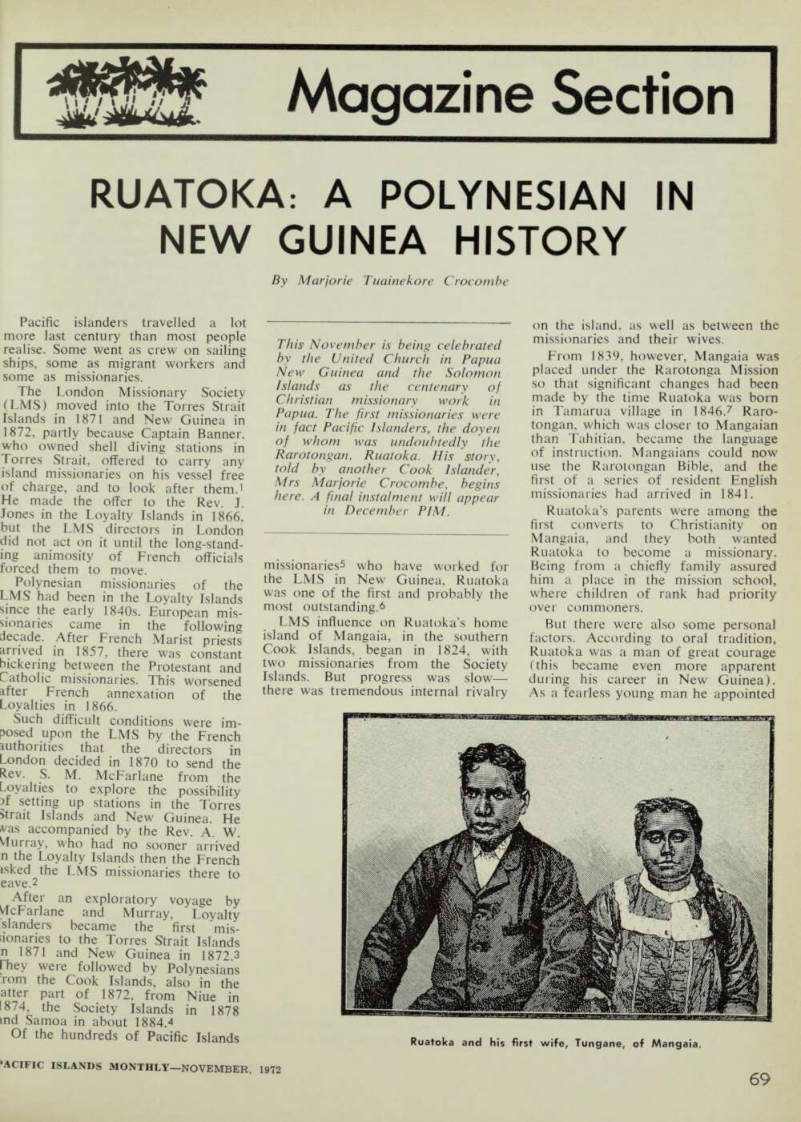
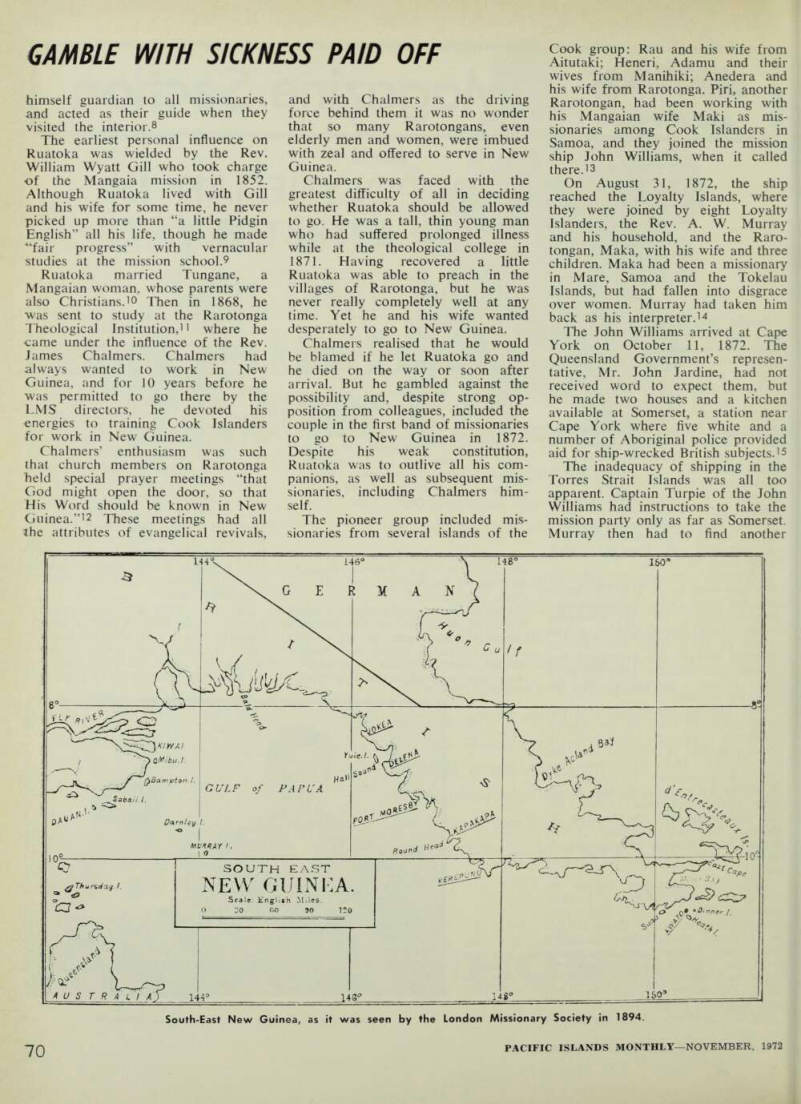
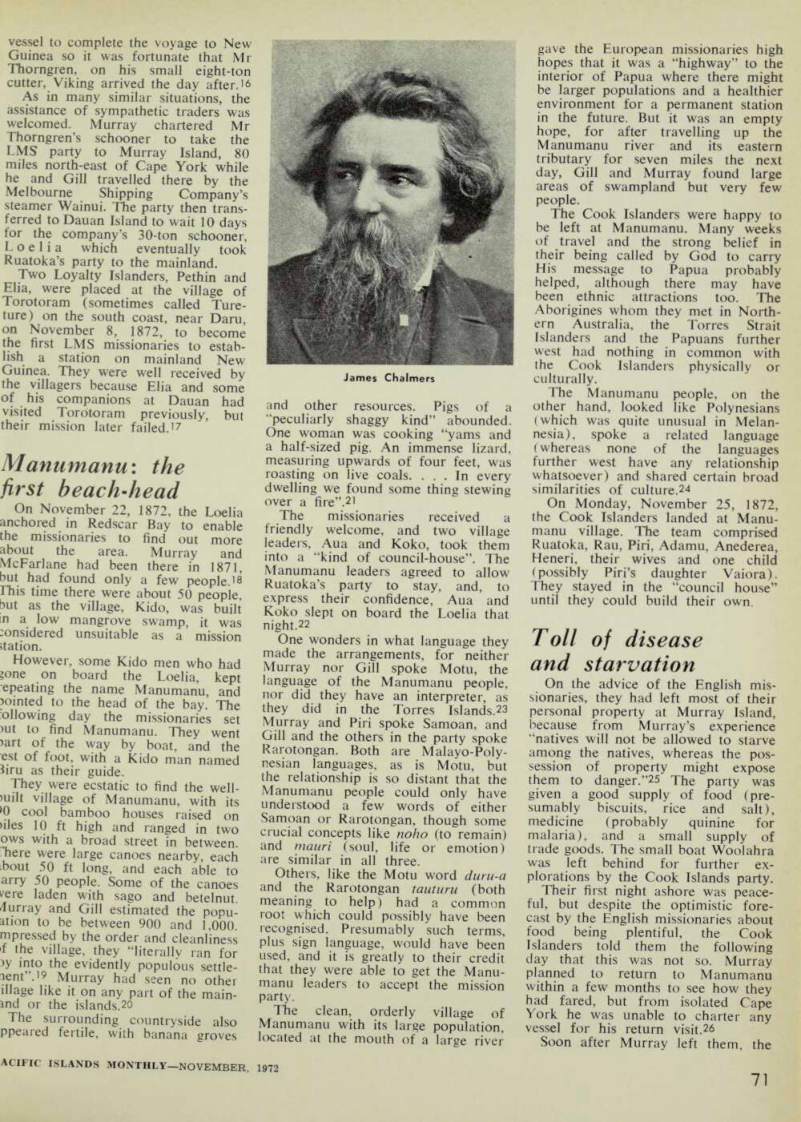
Ruatoka: A Polynesian In
New Guinea History
By Marjorie Tuainekore Crocombe
Pacific islanders travelled a lot more last century than most people realise. Some went as crew on sailing ships, some as migrant workers and some as missionaries.
The London Missionary Society (LMS) moved into the Torres Strait Islands in 1871 and New Guinea in 1872, partly because Captain Banner, who owned shell diving stations in Torres Strait, offered to carry any island missionaries on his vessel free of charge, and to look after them. l He made the offer to the Rev. J.
Jones in the Loyalty Islands in 1866, but the LMS directors in London did not act on it until the long-stand ing animosity of French officials forced them to move.
Polynesian missionaries of the LMS had been in the Loyalty Islands since the early 1840 s. European mis sionaries came in the following decade. After French Marist priests arrived in 1857, there was constant bickering between the Protestant and Catholic missionaries. This worsened after French annexation of the Loyalties in 1866.
Such difficult conditions were im posed upon the LMS by the French authorities that the directors in London decided in 1870 to send the Rev. S. M. McFarlane from the Loyalties to explore the possibility n setting up stations in the Torres Strait Islands and New Guinea. He vas accompanied by the Rev. A. W.
Murray, who had no sooner arrived n the Loyalty Islands then the French asked the LMS missionaries there to eave. 2 After an exploratory voyage by McFarlane and Murray, Loyalty slanders became the first mis lionaries to the Torres Strait Islands n 1871 and New Guinea in 1872.3 Phey were followed by Polynesians :rom the Cook Islands, also in the alter part of 1872, from Niue in 1874, the Society Islands in 1878 md Samoa in about 18847 Of the hundreds of Pacific Islands
This November is being celebrated by the United Church in Papua New Guinea and the Solomon Islands as the centenary of Christian missionary work in Papua. The first missionaries were in fact Pacific Islanders, the doyen of whom was undoubtedly the Rarotongan, Ruatoka. His story, told by another Cook Islander, Mrs Marjorie Crocombe, begins here. A final instalment will appear in December PIM.
missionariesS who have worked for the LMS in New Guinea, Ruatoka was one of the first and probably the most outstanding. 6 LMS influence on Ruatoka’s home island of Mangaia, in the southern Cook Islands, began in 1824, with two missionaries from the Society Islands. But progress was slow— there was tremendous internal rivalry
on the island, as well as between the missionaries and their wives.
From 1839, however, Mangaia was placed under the Rarotonga Mission so that significant changes had been made by the time Ruatoka was born in Tamarua village in 18467 Raro tongan, which was closer to Mangaian than Tahitian, became the language of instruction. Mangaians could now use the Rarotongan Bible, and the first of a series of resident English missionaries had arrived in 1841.
Ruatoka’s parents were among the first converts to Christianity on Mangaia, and they both wanted Ruatoka to become a missionary.
Being from a chiefly family assured him a place in the mission school, where children of rank had priority over commoners.
But there were also some personal factors. According to oral tradition, Ruatoka was a man of great courage (this became even more apparent during his career in New Guinea).
As a fearless young man he appointed
Ruatoka and his first wife, Tungane, of Mangaia.
Gamble With Sickness Paid Off
himself guardian to all missionaries, and acted as their guide when they visited the interior. B The earliest personal influence on Ruatoka was wielded by the Rev.
William Wyatt Gill who took charge of the Mangaia mission in 1852.
Although Ruatoka lived with Gill and his wife for some time, he never picked up more than “a little Pidgin English” all his life, though he made “fair progress” with vernacular studies at the mission school. 9 Ruatoka married Tungane, a Mangaian woman, whose parents were also Christians. lo Then in 1868, he was sent to study at the Rarotonga Theological Institution, 11 where he came under the influence of the Rev.
James Chalmers. Chalmers had always wanted to work in New Guinea, and for 10 years before he was permitted to go there by the LMS directors, he devoted his energies to training Cook Islanders for work in New Guinea.
Chalmers’ enthusiasm was such that church members on Rarotonga held special prayer meetings “that God might open the door, so that His Word should be known in New Guinea.” l2 These meetings had all the attributes of evangelical revivals,
and with Chalmers as the driving force behind them it was no wonder that so many Rarotongans, even elderly men and women, were imbued with zeal and offered to serve in New Guinea.
Chalmers was faced with the greatest difficulty of all in deciding whether Ruatoka should be allowed to go. He was a tall, thin young man who had suffered prolonged illness while at the theological college in 1871. Having recovered a little Ruatoka was able to preach in the villages of Rarotonga, but he was never really completely well at any time. Yet he and his wife wanted desperately to go to New Guinea, Chalmers realised that he would be blamed if he let Ruatoka go and he died on the way or soon after arrival. But he gambled against the possibility and, despite strong op position from colleagues, included the couple in the first band of missionaries to go to New Guinea in 1872.
Despite his weak constitution, Ruatoka was to outlive all his com panions, as well as subsequent mis sionaries, including Chalmers him self.
The pioneer group included mis sionaries from several islands of the
Cook group: Rau and his wife from Aitutaki; Heneri, Adamu and their wives from Manihiki; Anedera and his wife from Rarotonga. Piri, another Rarotongan, had been working with his Mangaian wife Maki as mis sionaries among Cook Islanders in Samoa, and they joined the mission ship John Williams, when it called there. l3 On August 31, 1872, the ship reached the Loyalty Islands, where they were joined by eight Loyalty Islanders, the Rev. A. W. Murray and his household, and the Raro tongan, Maka, with his wife and three children. Maka had been a missionary in Mare, Samoa and the Tokelau Islands, but had fallen into disgrace over women. Murray had taken him back as his interpreter. l4 The John Williams arrived at Cape York on October 11, 1872. The Queensland Government’s represen tative, Mr. John Jardine, had not received word to expect them, but he made two houses and a kitchen available at Somerset, a station near Cape York where five white and a number of Aboriginal police provided aid for ship-wrecked British subjects. l s The inadequacy of shipping in the Torres Strait Islands was all too apparent. Captain Turpie of the John Williams had instructions to take the mission party only as far as Somerset.
Murray then had to find another
South-East New Guinea, as it was seen by the London Missionary Society in 1894
vessel to complete the voyage to New Guinea so it was fortunate that Mr Thorngren, on his small eight-ton cutter, Viking arrived the day after. 16 As in many similar situations, the assistance of sympathetic traders was welcomed. Murray chartered Mr Thorngren’s schooner to take the LMS party to Murray Island, 80 miles north-east of Cape York while he and Gill travelled there by the Melbourne Shipping Company’s steamer Wainui. The party then trans ferred toDauan Island to wait 10 days for the company’s 30-ton schooner, Loelia which eventually took Ruatoka’s party to the mainland.
Two Loyalty Islanders, Pethin and Elia, were placed at the village of Torotoram (sometimes called Ture ture) on the south coast, near Daru, on November 8, 1872, to become the first LMS missionaries to estab lish a station on mainland New Guinea. They were well received by the villagers because Elia and some of his companions at Dauan had visited Torotoram previously, but their mission later failed. 17
Manumanu : the
first beach-head
On November 22, 1872, the Loelia anchored in Redscar Bay to enable the missionaries to find out more about the area. Murray and McFarlane had been there in 1871, but had found only a few people. l B This time there were about 50 people, but as the village, Kido, was built in a low mangrove swamp, it was :onsidered unsuitable as a mission station.
However, some Kido men who had ?°ne on board the Loelia, kept epeating the name Manumanu, and pointed to the head of the bay. The Allowing day the missionaries set )ut to find Manumanu. They went )art of the way by boat, and the est of foot, with a Kido man named liru as their guide.
They were ecstatic to find the well milt village of Manumanu, with its >0 cool bamboo houses raised on files 10 ft high and ranged in two ows with a broad street in between, liere were large canoes nearby, each ibout 50 ft long, and each able to arry 50 people. Some of the canoes laden with sago and betelnut. durray and Gill estimated the popu ation to be between 900 and 1,000. mpressed by the order and cleanliness 'f the village, they “literally ran for ay into the evidently populous settle lent”.l9 Murray had seen no other illage like it on any part of the main and or the islands.2o The surrounding countryside also ppeared fertile, with banana groves
and other resources. Pigs of a “peculiarly shaggy kind” abounded.
One woman was cooking “yams and a half-sized pig. An immense lizard, measuring upwards of four feet, was roasting on live coals. ... In every dwelling we found some thing stewing over a fire”.2i The missionaries received a friendly welcome, and two village leaders, Aua and Koko, took them into a “kind of council-house”. The Manumanu leaders agreed to allow Ruatoka’s party to stay, and, to express their confidence, Aua and Koko slept on board the Loelia that night. 22 One wonders in what language they made the arrangements, for neither Murray nor Gill spoke Motu, the language of the Manumanu people, nor did they have an interpreter, as they did in the Torres Islands. 23 Murray and Piri spoke Samoan, and Gill and the others in the party spoke Rarotongan. Both are Malayo-Poly nesian languages, as is Motu, but the relationship is so distant that the Manumanu people could only have understood a few words of either Samoan or Rarotongan, though some crucial concepts like noho (to remain) and mauri (soul, life or emotion) are similar in all three.
Others, like the Motu word duru-a and the Rarotongan tauturu (both meaning to help) had a common root which could possibly have been recognised. Presumably such terms, plus sign language, would have been used, and it is greatly to their credit that they were able to get the Manu manu leaders to accept the mission party.
The clean, orderly village of Manumanu with its large population, located at the mouth of a large river
gave the European missionaries high hopes that it was a “highway” to the interior of Papua where there might be larger populations and a healthier environment for a permanent station in the future. But it was an empty hope, for after travelling up the Manumanu river and its eastern tributary for seven miles the next day, Gill and Murray found large areas of swampland but very few people.
The Cook Islanders were happy to be left at Manumanu. Many weeks of travel and the strong belief in their being called by God to carry His message to Papua probably helped, although there may have been ethnic attractions too. TTie Aborigines whom they met in North ern Australia, the Torres Strait Islanders and the Papuans further west had nothing in common with the Cook Islanders physically or culturally.
The Manumanu people, on the other hand, looked like Polynesians (which was quite unusual in Melan nesia), spoke a related language (whereas none of the languages further west have any relationship whatsoever) and shared certain broad similarities of culture. 24 On Monday, November 25, 1872, the Cook Islanders landed at Manu manu village. The team comprised Ruatoka, Rau, Piri, Adamu, Anederea, Heneri, their wives and one child (possibly Piri’s daughter Vaiora).
They stayed in the “council house” until they could build their own.
T oil of disease
and starvation
On the advice of the English mis sionaries, they had left most of their personal property at Murray Island, because from Murray’s experience “natives will not be allowed to starve among the natives, whereas the pos session of property might expose them to danger.”2s The party was given a good supply of food (pre sumably biscuits, rice and salt), medicine (probably quinine for malaria), and a small supply of trade goods. The small boat Woolahra was left behind for further ex plorations by the Cook Islands party.
Their first night ashore was peace ful, but despite the optimistic fore cast by the English missionaries about food being plentiful, the Cook Islanders told them the following day that this was not so. Murray planned to return to Manumanu within a few months to see how they had fared, but from isolated Cape York he was unable to charter any vessel for his return visit. 26 Soon after Murray left them, the
James Chalmers
First Contact With Port Moresby
Cook Islanders prepared timber to build their house. Adamu injured his foot and was unable to do any more work, and his wife died of malaria.
Adamu died soon after. The wives of Rau and Heneri both died in child birth, and all other members of the party became weak from malaria and starvation, Murray later said that this was because they were “improvident with reference to the supplies we had left them. Instead of carefully husband ing them, they had been serving them out among the natives.” 27 But despite the English mis sionaries’ impressions on the first day, food seemed to have been genuinely scarce. The Motu inhabited an infertile stretch of the Papuan coast line and have never been able to “live off the land”. Men of Manu manu and other Motu tribes were obliged until recently to sail on annual trading voyages (hiri) to the Gulf of Papua to trade clay pots for sago to supplement their diet during the north-west monsoon season.2B The missionaries had arrived at the worst possible time, when sup plies of the staple vegetable (yam) begin to rot, and food gets scarcer until the harvest in April or May Groves says bananas were always in short supply and famine was endemic”.
It would be difficult indeed for visitors who arrived unexpectedly and were at the mercy of their hosts, not to share their food and medical sup plies It is not surprising that the Look Islanders were starving when 1873 29 ren ViSit6d them early in The search for food by another Motu-speakmg clan from Hanuabada village (m the Port Moresby area ibout thirty miles from Manumanu) wrought them in contact with the r ook Islanders, thus laying the :oundation for the friendly reception ater given to Ruatoka and his party n Hanuabada. 3 <s GiU scribed h ow frightened some the Manumanu people were when m landed with a red shirt which hey thought was an outer skin, but ney do not mention any one person is leader of the party. Motu oral rad i t ions recorded by other esearchers and by me, however all efer to Ruatoka as the leader. > - an old woman from an village, near Port Moresby, lescnbed the contact this way: One day the elders of Kwaradubu tan of Poreporena [Hanuabada ] vent to Manumanu and Gorohu to *et building material and gather
edible mangrove. At that time the South Sea islanders brought the Gospel of Jesus the Lord. A man called Ruatoka of these good men was the leader, with his wife. Kwara dubu people saw them at Manumanu.
Kwaradubu elders asked the Manu manu people, “Where did that boat anchored there come from?” They said, “The people of God. Don’t answer them when they call you.
Don’t go near them.”
But the Kwaradubu elders, Lakani Toi, Vagi Tau and their brothers said, “Let’s try. Let’s go and have a look at them.” So they rowed their canoe towards Ruatoka and his people. By looking them over they concluded that these were real men. We were the same as they were.
But the Manumanu said again, “They are gods who have come down from Tauru, the spirit world.”
Rautoka and his party were show ing many signs of peace and friend
. . Where did that boat anchored there come from?" They said , “The people of God. Don't answer them when they call you . Don't go near them''
ship in case they were attacked. They displayed and gave cloth, axes, knives, beads and different good things to the Motu chiefs there.
From the receiving of these things they were known to be of good wi11.31 Another oral tradition collected by myself and Dr Ako Toua, refers to other contacts with the visitors at Manumanu, and the introduction of new foods to the Motu: While in Manumanu, Lakani and his clansmen and women were given watermelon and other foods to taste. Because these watermelons and other foods were strange, and they were given by strangers, Lakani and his friends were afraid that he might die from eating these strange foods, but Lakani warned them that if he died the rest of the party should then avoid eating the watermelon . 32 Because of their friendliness at
Manumanu, Ruatoka asked Lakani to tell him about his village. Lakani described with hand signals the direction and rough estimate of the distance there as indicated by the passage of a number of nights. . . .
Before Lakani left Manumanu he gave Ruatoka a piece of string with about 14 knots. Ruatoka was told how many landmarks he should pass before reaching Hanuabada. These landmarks are as follows: The first was Lagava (Redscar Point) and Varivara, a small un inhabited off-shore island. Then Iduata, a rocky landmark with Boera village to the east of the point. Next was H aid ana, an island off a sandy beach, which they were told to by pass, and proceed eastwards past a lagoon called Roku until they sighted two small islands, Gemo and Lolorua, at the mouth of a harbour. From these islands they would see the large village of Hanuabada. They were told to call for Lakani Toi on their arrival at Hanuabada.
On his return to Hanuabada, Lakani Toi told the other members of Kwaradubuna clan of his meeting with the strangers at Manumanu and that he expected a visit from them. 33 On January 25, 1873, Mr Thorn gren of the Viking, told Murray at Cape York that, while prospecting for gold on the Manumanu River, he had found the mission party weak from illness and starvation. Murray therefore wrote to ask Captain Moresby, who was about to make a voyage of exploration to New Guinea, to visit Manumanu and help them.
He also sent them quinine, and some trade goods for barter. Captain Moresby called at Manumanu and took two very sick missionaries and one of the women on board. He then continued his voyage and discovered the huge harbour now called Port Moresby on February 21, 1873. 34 On his way back to Cape York, Captain Moresby called again at Manumanu to pick up the wife of one of the two sick missionaries on board. He took them to Murray’s headquarters at Somerset to re cuperate. Three months later, on May 25, 1873, the three remaining mission families were picked up by a Mr Orkney of the Loelia and taken to Cape York. The Manumanu mission was abandoned. 3s After almost five months recupera tion at Somerset, Ruatoka and Anederea and their wives sailed with Rau, Heneri and Murray on Mr Thorngren’s new ship Retrieve, to set up a new station at Port Moresby.
They called at Manumanu, but found that their houses had been demolished by an inland tribe while the men of Manumanu were away on a hiri to
Ruatoka Missed
the Gulf of Papua. Tire last of their salt and fowls had been taken. 36
Murray explained to the people
why the missionaries had been re
newed and promised to bring others
is soon as he could. But it was a ong time before the LMS could nation a permanent missionary there )ecause of the small population and lazards to health. In August, 1880, he old chief Naime, who claimed hat he protected the Cook Islanders when others wanted to kill them for fusing sickness in the village, chided
Chalmers for continually leaving
danumanu “out in the cold”, while
ither Motu people already had
missionaries. Naime disregarded
Chalmers’ explanation about the
nhealthiness of Manumanu for
oreigners, explaining that Ruatoka’s
arty was there during an unusually ad period in a “year of great sick ess.” Everyone, the young, old and Treigners alike had been sick. 37
> Next month: Ruatoka takes
control.
Footnotes . Richard Lovett, James Chalmers; his auto biography and letters, (London, 1902), p.
Joseph King, W. G Lawes of Savage Island and New Guinea, (London, 1909), pp. 47-50 • Placed there by Murray and McFarlane on frnm m t b h er , 7 ' I! 72 '. .' V ‘ sit to New Guinea from the Loya!ty Islands', Papua reports aru c^' B C V 5, 1871, London Mission after S SSj e ) tyS S ° Uth Seas Journa,s (here ■ James Chalmers, Life and work in New Guinea, (London, 1895), 23-4. • Only Chalmers and Lieutenant Governor le Hunte of British New Guinea referred to Ch. a r S ., ™ ssl °naries', others called them teachers —Lovett, James Chalmers: . . . and king, W. G. Lawes, 279. But if a rT*? n r Y J /? ne who Peaches the Gospel to, and tries to make converts to Christianity (The Universal English Dic tionary, London 1961) the islands mission uthis definition and performed this task better than that of classroom teachers.
Unlike some of his contemporaries, Ruatoka did not write much. A translation ?; ® ne , of h| s letters is contained in James Chalmers . . . , 502.
W. Wyatt Gill, Life in the Southern Isles, (London, 1876), 87-110; Maretu, untitled vernacular manuscript of 516 pp. (Raro Turn M UII L . ibrar y' Wellington.
Ural tradition on Mangaia in 1970 records mm as the youngest of three sons of Taooa, (genealogical information supplied list ,lr arua school - Mangaia ' Lovett, James Chalmers . . . , 132-7 For his limited knowledge of English see Gill L| fe . .. , 104 Gill, Life . . . , 133.
The Rarotonga Institution (later named the in 1839 Theo,ogical C01, «9e) was opened Lovett, James Chalmers . . . , 77.
Cook Islanders then in Samoa were prob ebly mainly Rarotongan labourers on some ot the larger European cotton plantations.
R -,. i . P - Gilson, Samoa 1830-1900: the ft 0 * iu CS a multi-cultural community, (Melbourne, 1970), 225. 1
14. A. W. Murray, Forty years mission work in Polynesia and New Guinea (London, 1876) 450-63. 15. Gill, Life . . . , 199; A. W. Murray, 'Voyage from the Loyalty Islands', Sep tember-December, 1872, SSJ. 16. Murray, Ibid. 17. Ibid. 18. Murray and McFarlane, 'Visit to New Guinea from the Loyalty Islands', SSJ. 19. Gill, 247. 20. Murray, 472. 21. Gill, 256-9. 22. Murray, 'Voyage from the Loyalty Islands . . .' 23. Ibid. In the Torres Strait islands the inter preter was a Tongan, John Joseph Ive, who worked for Captain Banner's pearling station. He had been away from Tonga for thirty years, had served m the Crimean War and lived in London and Sydney. He had an extensive knowledge of the people of Torres Strait. 24. For Manumanu social organisation, includ ing certain similarities with Polynesian societies, see Murray Groves, 'Western Motu descent groups'. Ethnology, II (1963), 15-30. I am also aware of similarities of language and culture from my own ex perience. 25. Murray, 474. 26. Ibid, 480. 27. Ibid. 28. Murray Groves, 'Motu pottery'. Journal of the Polynesian Society, 69 (1960), 5.
Groves notes that their uniquely poor en vironment made the Motu worse off for vegetable food than all the surrounding peoples. 29. Lovett, James Chalmers . . . 130 30. Murray said part of the reason for the friendly welcome his party received in Port Moresby in 1873 was that some Hanua bada people recognised Rau, who was fluent in Motu, after seeing him at Manu manu. 31. Extract from Kori Taboro's story. Recorded by Peter Livingston and translated by Smaka Goava. G. A. V. Stanley collection.
University of Papua and New Guinea Library. Not dated. 32. This visit probably occurred either in March or April, the approximate time it would have taken for watermelons to mature.
It was the practice for missionaries to introduce new plants both for their own needs and to broaden the diet of their hosts. One species of sweet potato intro duced by these missionaries has retained the name Pin. In Delena, Chatterton records (Journal of the Papua and New Guinea Society 2, 1968, 53) that another species is called Waunaea, after one of the two first missionaries there. In the Milne Bay district, the variety of taro called tarua in Rarotonga, is known as taro Rarotonga.
In various villages I have visited on the south central coast of Papua, people have pointed out varieties of breadfruit, tubers, and other produce, as well as cultural items, including certain forms of song, dance, weaving and food preparation which they credited to Cook Islands missionaries.
On the other hand Cook Islands mission anes who returned home took plants with them. These became known as originating m Papua, e.g., nu Papua (Papuan coconut) and ora Papua (derris eliptica) a vine used tor fish poison. 33. 'The first missionary in Hanuabada', a Motu coconut on tape and typescript held by the author (copy at the University of Papua and New Guinea Library, Port Moresby). Narrated by Tau Lakani, Nao Lakani and others. Recorded in Hanuabada by Marione Crocombe, October, 1967, and translated by Dr. Ako Toua. 34. Captain John Moresby, Discoveries and surveys in New Guinea and the D'Entre -35. 48, ' (L ° ndon ' 1876) ' ' 39 ’ 41 - 36 ‘ M urra y/,'Voyage to Redscar Bay and Port Moresby, Nov. 13-Dec. 17, 1873, SSJ. 37. James Chalmers, Work and adventure in New Guinea, (London, n.d.) 145; Lovett, James Chalmers . . . , 78
Advertisements & other items, pp. 71-78 (5 items)
69
‘ACIFIC ISLANDS MONTHLY—NOVEMBER, 1972
71
ACIFIC ISLANDS MONTHLY—NOVEMBER, 1972
ikhit 7s
Padur /S *4jrtsts amdtfy<ss£.
!>Jt**4< ’AS Vy»>**V
<7 -Af
ikhit 7s
ffarkw
ijpAAf wythrvf ■
jf> d> Q'&ul & Just dial a different angle until the nib position is exactly how you want it. : Your fingers rest in the curved grip of a Parker 75, so you write relaxed.
Fill up from an ink bottle, or load with a special Parker cartridge. It has a 'tap tank' in reserve, for up to 700 more words after you think your ink's run out!
Every Parker 75 passes 792 inspections before you see it. Sterling quality, so it's sterling silver. Or rolled gold, or Vermeil which is 14 ct gold on silver.
•tPARKER
Maker or th< world s most wanted pens
the Maharajah
invites you aboard
his giant new
Palace in the Sky.
There’s a new way to cross the world. Join us at Nadi, or Singapore, or Sydney, and Air-India’s Maharajah service is yours as always. And then from Bombay fly on to Europe and London (and New York if you wish) in Air-India’s giant new 747 . . . big, beautiful, uniquely magnificent and the first of its kind between India and Europe. The Air-India 747 is truly a Palace in the Sky. Ask any Travel Agent.
TAKE A BREAK - HALFWAY TO EUROPE Modern India is one of the world’s great travel bargains. You can see a whole lot of India on your way to or from Europe at no extra air fare ... the colour, the contrast, the excitement of a country that stretches from the snow-capped Himalaya to the fringed beaches of the South. On your way to Europe, take a break. Take a tour in India - at no extra air fare.
DELHI
TTA
OMBAY
treats you like a Maharajah £ r a* if m ■ m m m A 327.86
The authentic account
of Port Moresby's
history
PORT
MORESBY
YESTERDAY AND
In Port Moresby's short life, history has washed over it. There was a change of ownership, from Britain to Australia, early this century. There were wars, depressions, royal commissions, scandals, witch-hunts, pioneering fortitude, acts of self-sacrifice, self-reliance and bravery—all the normal behaviour of people thrown together in an isolated, tropical outpost.
Port Moresby is a mine of information for those seeking knowledge of the town or the Territory of Papua; to people who have been actively connected with either, and believe they know them well, the book brings new awareness and insight.
"PORT MORESBY Yesterday and Today" sells in Australia and PNG for 55.50 Aust., plus 26c posted; Pacific Islands and overseas countries, $5.50 Aust., plus 70c posted; U.S.A. $7.00 U.S., posted.
Available from:—
lan Stuart
Pacific Publications
Box 3408, G.P.0., Sydney, N.S.W., Aust., 2001.
(Aust.) Pty. Ltd.
r r- * '
imaeam
Mixmaster Mixer
3 times better than any
other mixer ■ Designed especially for family food preparation. 12-speed mixfinder dial indicates the conec * speed for each mixing action. Complete with 2 heat-resistant bowls and juice extractor. Sunbeam’s exclusive 3-way beating action extra large, contained beaters, and automatic bowl movement— gives perfect aeration and more even mixing. It can handle everything from beating one egg to mixing a large fruit cake.
LB3 .3336
73
'ACIFIC ISLANDS MONTHLY—NOVEMBER, 1972
75
IFIC ISLANDS MONTHLY—NOVEMBER, 1972
Yesterday
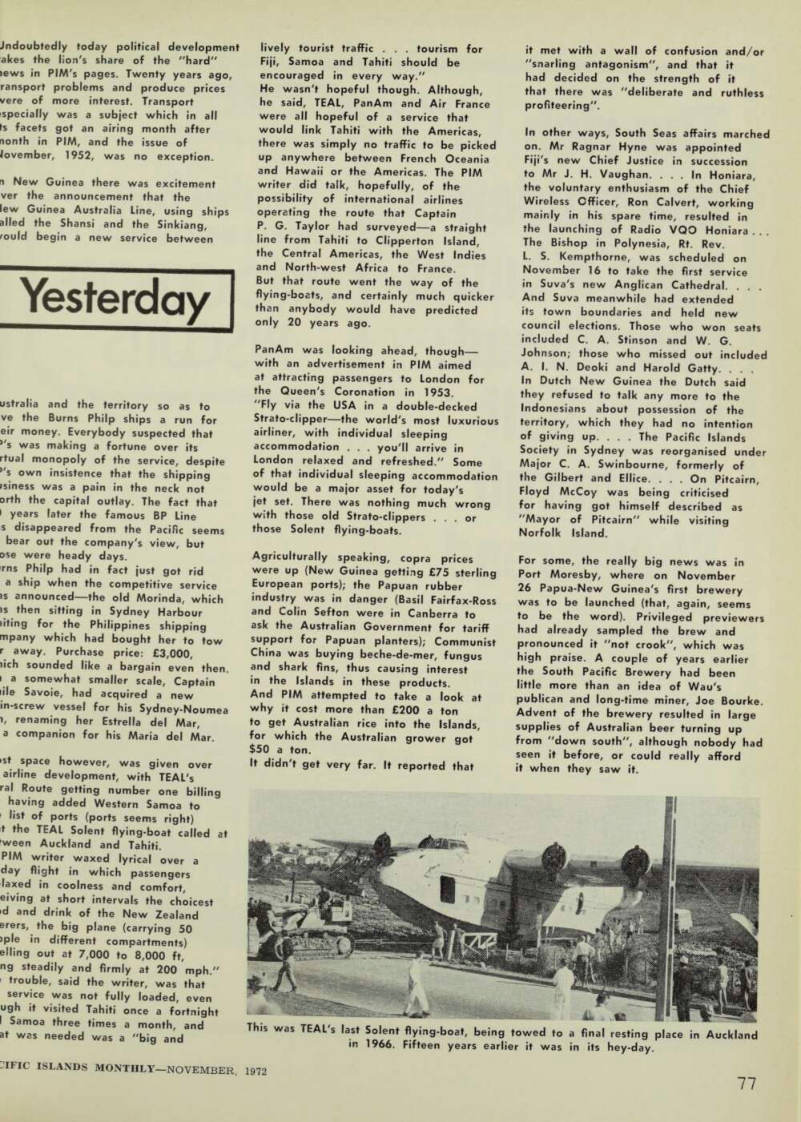
Jndoubtedly today political development
akes the lion's share of the "hard" tews in PlM's pages. Twenty years ago, ransport problems and produce prices vere of more interest. Transport specially was a subject which in all Is facets got an airing month after Tenth in PIM, and the issue of lovember, 1952, was no exception. i New Guinea there was excitement ver the announcement that the lew Guinea Australia Line, using ships ailed the Shansi and the Sinkiang, 'ould begin a new service between
ustralia and the territory so as to ve the Burns Philp ships a run for eir money. Everybody suspected that *'s was making a fortune over its rtual monopoly of the service, despite *'s own insistence that the shipping isiness was a pain in the neck not orth the capital outlay. The fact that • years later the famous BP Line s disappeared from the Pacific seems bear out the company's view, but
ose were heady days,
rns Philp had in fact just got rid a ship when the competitive service is announced—the old Morinda, which is then sitting in Sydney Harbour liting for the Philippines shipping mpany which had bought her to tow r away. Purchase price: £3,000, lich sounded like a bargain even then, i a somewhat smaller scale, Captain n'le Savoie, had acquired a new in-screw vessel for his Sydney-Noumea i, renaming her Estrella del Mar, a companion for his Maria del Mar. •st space however, was given over airline development, with TEAL's ral Route getting number one billing having added Western Samoa to list of ports (ports seems right) t the TEAL Solent flying-boat called at ween Auckland and Tahiti.
PIM writer waxed lyrical over a day flight in which passengers laxed in coolness and comfort, eivmg at short intervals the choicest id and drink of the New Zealand erers, the big plane (carrying 50 >ple in different compartments) elling out at 7,000 to 8,000 ft, ng steadily and firmly at 200 mph." * trouble, said the writer, was that service was not fully loaded, even ugh it visited Tahiti once a fortnight I Samoa three times a month, and at was needed was a "big and
lively tourist traffic . . . tourism for Fiji, Samoa and Tahiti should be encouraged in every way."
He wasn't hopeful though. Although, he said, TEAL, PanAm and Air France were all hopeful of a service that would link Tahiti with the Americas, there was simply no traffic to be picked up anywhere between French Oceania and Hawaii or the Americas. The PIM writer did talk, hopefully, of the possibility of international airlines operating the route that Captain P. G. Taylor had surveyed—a straight line from Tahiti to Clipperton Island, the Central Americas, the West Indies and North-west Africa to France.
But that route went the way of the flying-boats, and certainly much quicker than anybody would have predicted only 20 years ago.
PanAm was looking ahead, though— with an advertisement in PIM aimed at attracting passengers to London for the Queen's Coronation in 1953.
"Fly via the USA in a double-decked Strato-clipper—the world's most luxurious airliner, with individual sleeping accommodation . . . you'll arrive in London relaxed and refreshed." Some of that individual sleeping accommodation would be a major asset for today's jet set. There was nothing much wrong with those old Strato-clippers ... or those Solent flying-boats.
Agriculturally speaking, copra prices
were up (New Guinea getting £75 sterling European ports); the Papuan rubber industry was in danger (Basil Fairfax-Ross and Colin Sefton were in Canberra to ask the Australian Government for tariff support for Papuan planters); Communist China was buying beche-de-mer, fungus and shark fins, thus causing interest in the Islands in these products.
And PIM attempted to take a look at why it cost more than £2OO a ton to get Australian rice into the Islands, for which the Australian grower got $5O a ton.
It didn't get very far. It reported that
it met with a wall of confusion and/or "snarling antagonism", and that it had decided on the strength of it that there was "deliberate and ruthless profiteering".
In other ways. South Seas affairs marched on. Mr Ragnar Hyne was appointed Fiji's new Chief Justice in succession to Mr J. H. Vaughan. ... In Honiara, the voluntary enthusiasm of the Chief Wireless Officer, Ron Calvert, working mainly in his spare time, resulted in the launching of Radio VQO Honiara . . .
The Bishop in Polynesia, Rt. Rev.
L. S. Kempthorne, was scheduled on November 16 to take the first service in Suva's new Anglican Cathedral. . . .
And Suva meanwhile had extended its town boundaries and held new council elections. Those who won seats included C. A. Stinson and W. G.
Johnson; those who missed out included A. I. N. Deoki and Harold Gatty. . . .
In Dutch New Guinea the Dutch said they refused to talk any more to the Indonesians about possession of the territory, which they had no intention of giving up. . . . The Pacific Islands Society in Sydney was reorganised under Major C. A. Swinbourne, formerly of the Gilbert and Ellice. ... On Pitcairn, Floyd McCoy was being criticised for having got himself described as "Mayor of Pitcairn" while visiting Norfolk Island.
For some, the really big news was in Port Moresby, where on November 26 Papua-New Guinea's first brewery was to be launched (that, again, seems to be the word). Privileged previewers had already sampled the brew and pronounced it "not crook", which was high praise. A couple of years earlier the South Pacific Brewery had been little more than an idea of Wau's publican and long-time miner, Joe Bourke.
Advent of the brewery resulted in large supplies of Australian beer turning up from "down south", although nobody had seen it before, or could really afford it when they saw it.
This was TEAL's last Solent flying-boat, being towed to a final resting place in Auckland in 1966. Fifteen years earlier it was in its hey-day.
Advertisements & other items, pp. 79-80 (2 items)
2Ific Islands Monthly—November, 1972
eggs’n’butter
The rich and golden eggs’n’butter shortbread: Brockhoff Edinburgh Shortbread.
Farm fresh eggs and creamy dairy butter a quarter by weight, make Edinburgh Shortbread melt in your mouth. Traditional Scottish biscuits that serve so deliciously with coffee or tea.
Edinburgh Shortbread is baked oven-crisp with the flavour-fresh goodness that’s unmistakably Brockhoff.
There’s value, variety and quality in
BROCKHOff
BISCUITS
brockhoff 8442/BX6
Book Reviews
South Pacific Commission may be in danger of losing its ideals
At the South Pacific Conference in abaul, New Guinea, in 1959, the len Secretary-General of the South acific Commission, Mr T. R. Smith, marked to me that he was glad to e PIM continuing its close interest commission affairs, because he idn’t forgotten that it was PlM’s 'Under, R. W. Robson, who had spared the way for the commission.
R. W. Robson, said Smith, had gued forcibly before the war that Pacific Islands Association of oples in the Pacific should be tablished, which would send legates to an annual conference to held perhaps in Suva, Auckland Sydney, to discuss common prob ns and secure common action.
This information was new to me that time, but on the strength of PlM’s Assistant Editor, Robert ngdon, did some of the research the kind he is now famed for, d turned up statements that >bson had made in PIM as early January 1931, and especially an iboration of the proposal which made in a Fiji radio broadcast July, 1936.
Now Tom Smith has produced a ok, South Pacific Commission: i Analysis After 25 Years, in which records chapter and verse of bson’s campaigning, together with names of those many others who ally got the commission off the >und —names like Dr H. V. Evatt.
Australia, and particularly one of att’s men, W. D. Forsyth. Forsyth s a tireless worker in the vineyard.
Mter 25 years, the history of the ith Pacific Commission needed to written. And here it is—facts, ires, footnotes. A scholarly work de possible by the New Zealand titute of International Affairs. Not olourful nor a dramatic book not n a general good “read”—but a )k that certainly fills a gan quately. rhe real interest, is in the final pter when he discusses the role the commission today and lorrow. Here he has to get away ti pure record and make assump is and predictions on the basis of
what can be learned from the past record, and not everybody will see it his way. If recent South Pacific conferences have shown anything, it is that there are many points of view about where the SPC should go from here.
Smith speaks of the commission as having passed through two stages, and its usefulness in the future will, he thinks, depend on a full attain ment of a third.
In the first stage the people of the Islands were called together by the metropolitan governments to offer advice on matters of common interest, which the governments either ac cepted or rejected. In the second stage, Islanders themselves success fully asserted their own right to decide on an acceptable programme and to allocate a budget for it, which included some of their own money.
The third stage is whether the SPC can become a real forum for discus sion and a clearing house for inter national aid.
On the matter of aid, Smith doesn’t believe that the commission should attempt to do what can be done more effectively by somebody else. But he says it does have the advantages of an intimate knowledge of the needs of the area, and the ability to take a regional approach, which agencies
working directly to separate govern ments find more difficult.
There is need, now, says Smith, for the SPC to decide, with Island leaders, what best can be done for the region with aid from various out side sources, and then to get things moving. The SPC should be a planner, involved with the over-view of the area. It needed to widen its outlook and not be so determinedly utilitarian.
As examples of the planning work he thinks it can do, Smith suggests that the problems of the atoll dwellers, with their need for cheap power, adequate water supplies and soil improvement, can be met with the scientific knowledge that the European powers have now built up.
Solar power, miniature atomic reac tors, soil science, might all be used.
Smith reminds us that most of the metropolitan powers have atoll-type islands and are aware of their dif ficulties, but there appears to be no concerted effort to find solutions.
Conservation is another pressing subject that needs a regional assault.
The rights of Islanders to their assets —to phosphate on Nauru and minerals on Bougainville—are slowly being recognised but not quickly enough. Two centuries ago the large whale populations in the Pacific were a potential reserve of Islands food, which was not needed, but visitors from far places massacred the whales at a time when they might have been useful.
In the last 20 years large quantities of deep sea fish previously unknown to the Polynesians have been found in the same waters, and exploited for the benefit of residents of distant countries. What is the SPC doing about it?
Smith argues there is still room for active intervention to ensure that the interests of Pacific Islanders in the products of their own region are not disregarded, and he adds that the commission should “once more be inspired by the ideals of its founders.”
Stuart Inder.
(South Pacific Commission. By
T. R. Smith. Published by Price Milburn for the New Zealand Institute of Inter national Affairs. Price $A7.50).
"Pacific Perspective" Due Soon
Unexpected printing delays have now been overcome, and the first issue of Pacific Perspective, a new biannual journal concerned with eco nomic, social and political affairs m the Pacific Islands, is due off the press shortly. Its editor, political scientist Sione Tupouniua of the Uni versity of the South Pacific, says that the response to the publication already has been encouraging Approximately $2,500 in subscrip tions has already been received, which is much beyond the expectations of the journal’s founders—a group of social scientists from various Pacific countries and territories.
Advertisements & other items, p. 81 (1 item)
79
'IFIC ISLANDS MONTHLY—NOVEMBER, 1972
The Shane
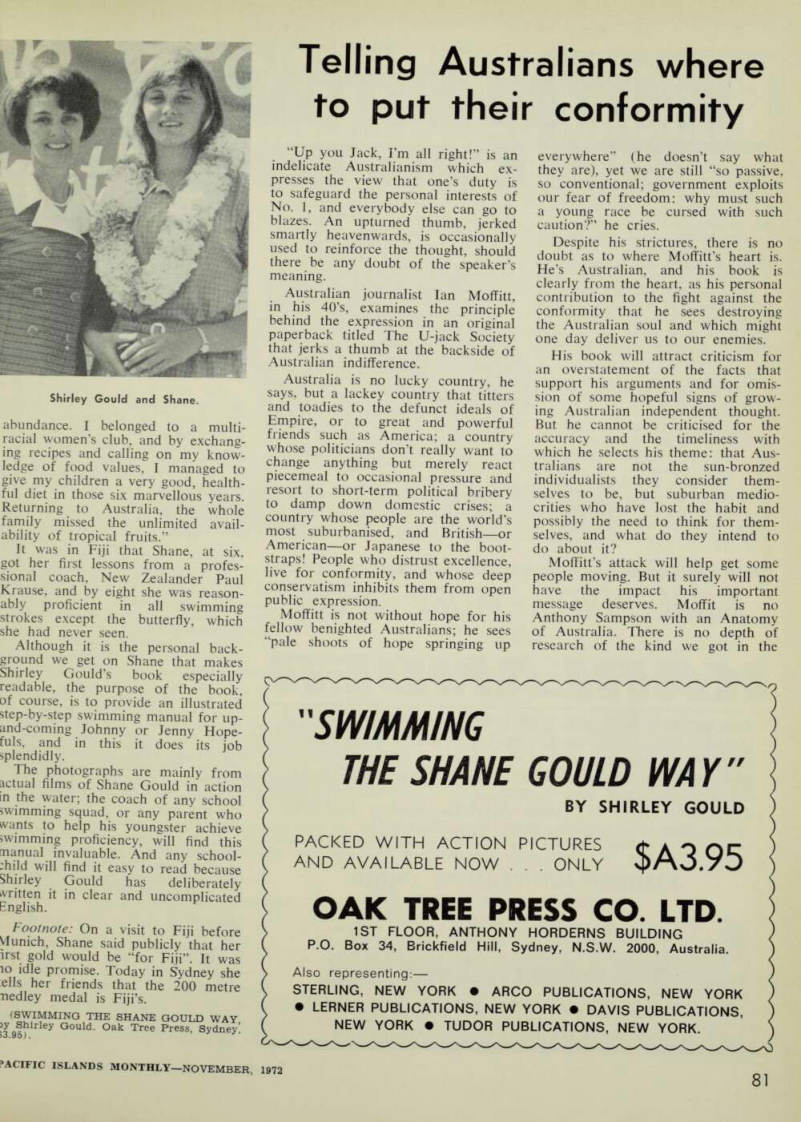
Gould way
You get to the top and they begin to tear you down, and it’s no different if you happen to be only 15 when you reach the top. Fifteen-year-old Sydney swimmer Shane Gould has carved her niche by taking three golds, a silver and bronze at the Munich Olympics, but the knockers have since got at her because her mother has published an illustrated book called Swimming the Shane Gould Way, designed to help those less proficient with their swimming styles. Claim the critics: Mother’s book endangers the daughter’s amateur status.
There are hundreds of people in Fiji who know Ron and Shirley Gould intimately enough to be certain that they are not the kind of parents to exploit a daughter’s suc cess, and that the charge of profes sionalism is nonsense. But it must hurt.
Ron Gould has been 25 years in the airline industry, and was with PanAm in Fiji for seven years. Young Shane lived there between the ages of three and nine, which happened to be formative years for her swimming.
Ron Gould was for some of that time president of the Nadi Sports Club, and his wife Shirley travelled extensively as a trained social worker, with an interest in living standards and physical fitness.
The book includes photographs of the young champion (the only swim mer in the world to have held world 100, 200, 400, 800 and 1500 metre freestyle records at the one time) splashing about on . Fiji beaches where, at five, she was a miniature expert in snorkel and mask around the reefs.
Without realising it, recalls Shirley Gould now, Shane was probably doing a considerable amount of swimming-exercising as a small child in Fiji, as she swung from ropes and trapezes rigged up in massive mango trees, and climbed up and down ladders in tree houses. The Nadi Airport School had a strong emphasis on sport and physical fitness due to the influence of the then headmaster, Ron Bruce, and there were first-class climbing frames for the 100 pupils and plenty of active sport.
“And in Fiji we found the local food a real delight,” writes Shirley Gould. “We bought all those fabulous tropical fruit and vegetables from the local market, and the mangoes we had growing next to the house povided weeks of chin-dripping
abundance. I belonged to a multi racial women’s club, and by exchang ing recipes and calling on my know ledge of food values, I managed to give my children a very good, health ful diet in those six marvellous years.
Returning to Australia, the whole family missed the unlimited avail ability of tropical fruits.”
It was in Fiji that Shane, at six, got her first lessons from a profes sional coach, New Zealander Paul Krause, and by eight she was reason ably proficient in all swimming strokes except the butterfly, which she had never seen.
Although it is the personal back ground we get on Shane that makes Shirley Gould’s book especially readable, the purpose of the book, of course, is to provide an illustrated step-by-step swimming manual for up and-coming Johnny or Jenny Hope fuls, and in this it does its job splendidly.
The photographs are mainly from actual films of Shane Gould in action in the water; the coach of any school swimming squad, or any parent who wants to help his youngster achieve swimming proficiency, will find this manual invaluable. And any school child will find it easy to read because Shirley Gould has deliberately written it in clear and uncomplicated English.
Footnote: On a visit to Fiji before Vlunich, Shane said publicly that her irst gold would be “for Fiji”. It was 10 idle promise. Today in Sydney she ells her friends that the 200 metre medley medal is Fiji’s.
(Swimming The Shane Gould Way
!3 95) lirley Gould- ° ak Tree Press . Sydney!
Shirley Gould and Shane.
Advertisements & other items, p. 82 (1 item)
Consult
For Insurance
Service
at Its Best
Consult
HARVEY TRINDER
INSURANCE BROKERS
to Industry and Commerce Hunter Street, Port Moresby. Tel. 2241-2 Agents:
STEAMSHIPS TRADING COMPANY LIMITED,
Port Moresby, Samarai, Popondetta, Goroka, Mount Hagen, Rabaul, Madang and Kieta, Bougainville.
R. ALLEN, Bulolo.
MACDONALD HAMILTON
TRADING PTY. LIMITED, Lae.
D. J. GUBBAY & COMPANY (N.H.) PTY. LTD., Honiara.
And at Sydney, Melbourne, Brisbane, Adelaide, Perth, Hobart and Launceston.
Personal, commercial, industrial insurances at Lloyd’s and companies
HT.4170R
to put their conformity
Telling Australians where to put their conformity
. Y-P ou J Irn all right!” is an indelicate Australianism which expresses the view that one’s duty is to safeguard the personal interests of No. 1, and everybody else can go to blazes. An upturned thumb, jerked ttfn OC ht aS^ nal m there he anv Hnnht^f^h sh P u , d meaning Y speaker’s . • Australian journalist lan Mofiitt, iP s ’ exam n es the principle behind the expression in an original paperback titled The U-jack Society Au^al, !v 3 S n a ,ndXt^? he baCkside ° f Australian indifference.
Australia is no lucky country, he says, but a lackey country that titters and toadies to the defunct ideals of Empire, or to great and powerful fnends such as America; a country whose politicians don’t really want to change anything but merely react piecemeal to occasional pressure and resort to short-term political bribery to damp down domestic crises; a country whose people are the world’s most suburbanised, and British—or American—or Japanese to the bootstraps! People who distrust excellence, live for conformity, and whose deep conservatism inhibits them from open public expression.
Mofiitt is not without hope for his fellow benighted Australians; he sees pale shoots of hope springing up
everywhere” (he doesn’t say what they are), yet we are still “so passive, so conventional; government exploits our fear of freedom: why must such a young race be cursed with such caution?” he cries.
Despite his strictures, there is no doubt as to where Moffitt’s heart is.
H e’s Australian, and his book is clearly from the heart, as his personal contribution to the fight against the conformity that he sees destroying the Australian soul and which might one day deliver us to our enemies.
His book will attract criticism for an overstatement of the facts that support his arguments and for omis sion of some hopeful signs of grow ing Australian independent thought.
But he cannot be criticised for the accuracy and the timeliness with which he selects his theme: that Aus tralians are not the sun-bronzed individualists they consider them selves to be, but suburban medio critics who have lost the habit and possibly the need to think for them selves, and what do they intend to do about it?
MofTitt’s attack will help get some people moving. But it surely will not have the impact his important message deserves. Moffit is no Anthony Sampson with an Anatomy of Australia. There is no depth of research of the kind we got in the
Anatomy of Britain. While certainly Moffitt’s book is a personal view of his country, he still has insufficient straw for his bricks. He builds his book mainly from honest indignation cemented by his considerable literary powers of persuasion.
Perhaps though this is merely the first assault in Moffitt’s war. Now that he’s blooded with his first book after a career of writing newspaper articles, he’ll perhaps sharpen his lance to a finer point for a more carefully planned attack. Stuart Jnder. (THE U-JACK SOCIETY: An Experience of Being Australian. By lan Moffitt. Ure Smith, Sydney. $1.50).
The Australian Book Of
Health Food Cookery, By
Joan Haddon, published by Pan at $1.95 is an answer to the criticism that a vegetarian diet is monotonous.
It includes 240 meatless recipes for every course at table, with additional menus for weight-watchers. The 140 pages include colour photographs.
Advertisements & other items, pp. 83-87 (2 items)
81
> ACIFIC ISLANDS MONTHLY— NOVEMBER, 1972
"Swimming
THE SHANE GOULD WAY"
BY SHIRLEY GOULD
PACKED WITH ACTION PICTURES A O OC AND AVAILABLE NOW .. . ONLY n(>Ao.>o
OAK TREE PRESS CO. LTD.
IST FLOOR, ANTHONY HORDERNS BUILDING
P.O. Box 34, Brickfield Hill, Sydney, N.S.W. 2000, Australia.
Also representing:— STERLING, NEW YORK • ARGO PUBLICATIONS, NEW YORK • LERNER PUBLICATIONS, NEW YORK • DAVIS PUBLICATIONS, NEW YORK • TUDOR PUBLICATIONS, NEW YORK.
MORE PORTS /MOREOFTEN
with
Ui\ HLJUMPER
KARLANDER NEW GUINEA LINE: Serving; Ft. Moresby, Samarai, Lae, Madang, Rabaul, Wewak, Manus Is., Kieta, Honiara, Yandina, Gizo, Vila, Norfolk Is., and Lord Howe Is.
KARLANDER KANGAROO LINE: Serving,- Los Angeles, San Francisco, Auckland, Melbourne, Suva, Lautoka.
AUSTRALIAN TERRITORY LINER SERVICES: Serving,- Melbourne,
Sydney, Newcastle, Brisbane, Weipa, Gove, Thursday Is.
Managing Agents
KARLANDER (AUSTRALIA) PTY. LIMITED
19-31 Pitt Street, Sydney
General Agents
Brisbane: F. H. Stephens Pty. Ltd.
Melbourne; F. H. Stephens (Vic.) Pty. Ltd.
Pt. Moresby: Carpenter Shipping Agencies.
Samarai: Burns Philp (N.G.) Ltd.
San Francisco: Transpacific Transportation Co.
Los Angeles: Transpacific Transportation Co.
Madang: B. J. Back Pty. Ltd.
Yandina; Levers Pacific Plantations Co. Ltd.
Santo: Burns Philp (N.H.) Ltd.
Lord Howe Is.: R. Wilson, Leanda Lei.
Thursday Is.: Torres Industries Ltd.
Manus Is.: Edgell & Whiteley Ltd.
Rabaul: Rabaul Trading Co. Ltd.
Honiara: E. V. Lawson Pty. Ltd.
Kieta: Breckwoldt & Co. Pty, Ltd.
Lae: N.G.G. Trading Company.
Wewak: Burns Philp (N.G.) Ltd.
Fiji: Burns Philp (S.S.) Ltd.
Gizo: British Solomon Trading Co.
Vila: Burns Philp (N.H.) Ltd.
Norfolk Is.: Burns Philp (S.S.) Ltd.
PIT MOTORHATIOM
In |w mark Milk
SWf? - G.M. Bedford Industrial Diesel Engine, Models 330, 330 T.
CLAE make engines. Engines for trucks. For boats. For Industry. Generators, power units and pumping sets.
CLAE are proud of their hard-earned reputation as the most reliable name in the business of precision. They look after you from the moment your enquiry is received. And they keep looking after you—long after the sale is made— by efficient, expert after-sales service and by the very largest spare parts department in the country.
If your equipment is not running as well as it should—lf your costs are too high—if you’re too long off the Job through costly delays in finding spare parts—you NEED Clael!
CLAE Parts and Service back-up guarantees down-time being kept to an absolute minimum. Send us details of your application NOW.
It’ll be different from all the rest, and that’s the kind of challenge we like the best.
G.M. Bedford Diesel Generator Sets, Models 220 G and 330 Q.
CLAE 8D145 Diesel Marine Engine, 145 h.p.
Paragon P4OO Series Hydraulic Transmission.
G.M. Bedford 6 cyl. 466 c ./. fitted with 15" Flood Pump Clae Engine Sales & Service, 31 Hoskins Ave., Bankstown, N.S.W. 2200.
Clae Engine (Old.) Pty. Ltd., Lavarack Ave., Eagle Farm, Queensland 4007.
Please send me details of.
Name Address
the power
f
Date ®
B m memm mmm mm mm mm mm MM mm ww mb mmm mm mi mms wnw mmeast 1020 s Jde laide^Raach B Motors!/!!?Pty.^Lt^Ph• P Hiinhih?‘ £ h ’- 79 1688,I 688 , * Melb <>urne: Motor Spares Ltd. Ph. 30 0271 • Ph. 28 3155 • Hobart: Motors Pty. Ltd! Ph. 2 0571 Uunceston: H, 9 h,,n ® Marine Services. Ph. 31 3082 • Perth: Attwooda Marine Centre.
MILLERS
MARINE AND GENERAL ENGINEERS
m .-y .
I 11 I*l «« m m *•* - n i
THE "WAKAYA"
A standard 50 ft tug built for Marine Pacific Ltd to be used for berthing operations and inter-island barge towing. The propulsion unit in this tug is a 12V71M 340 H.P. G.M.
Detroit diesel, nozzle propeller, with a bollard pull of 6 tons.
Work in hand is tH Mission ship for tH Gilbert and Elliti Islands, 86 ft. x 2 ft. x 7 ft. 9 in. Ifr
ship is powered ti
twin 180 H.P. T 6 Ke
LIMITED
SHIP BUILDERS TO THE PACIFIC
I V m l i i v: la
S $NT4*
m . i»» i m
THE MISSION SHIP
n diesels, 2 x 20 K.V A. alternators and is capable of a top speed of 10 knots, has accommodation for 12 crew and 10 passengers and has a cargo capacity ■ 70 tons. Also under construction is a 72 ft. fibreglassed wood hull tourist unch, two 40 ft. and
work JV
)dts ton 11111 l I P.o. BOX 296, SUVA, FIJI. PHONE: 23031
Ellis Goes French
A French translation of William Ellis’ famous classic Polynesian Researches, has recently been pub lished in Paris under the title, A la Recherche de la Polynesie d’Autrefois.
It is the third notable book on early Tahiti and the surrounding islands to be translated from English and published by the Societe des Oceanistes. The others are Teuira Henry’s Ancient Tahiti and the Journal of James Morrison (of Bounty fame).
The first two translations were the work of Mr Bertrand Jaunez of Tahiti. Mr Jaunez also began work on Ellis; but, as he himself told me three or four years ago, Ellis’ long windedly ponderous prose and frequent expressions of piety were more than he cared to cope with, and he gave it up.
In the end, Ellis’ 1,000-odd pages were turned into French by two ladies, Mane Sergueiew and Colette de Buyer-Mimeure, whose capacity for difficult, exacting work is some thing to marvel at.
Now that it is done, French-speak ing students of the Pacific have ready access to a book which the Quarterly Review described on its appearance
as “the most interesting work, in all its parts, we have ever perused.”
The French readers are, in fact, somewhat better off than their English counterparts, for the translation has i three important features that the English editions lack.
One is an introduction by Dr Colin W. Newbury which explains who Ellis was and how he came to write his Polynesian Researches. The others are a subject index and an an index of indigenous words. The latter make it almost worth buying the French edition so that you can find things more readily in the various English editions.
Ellis’ work, which was first pub lished in 1829, falls into three, not
always-well-ordered parts.
The first is an ethnography of Eastern Polynesia as it was before the arrival of Europeans. Then follows an account of the arrival of the missionaries of the London Mis sionary Society in Tahiti in 1797 and of their work in spreading the Gospel through that and the surrounding islands over the next 30 years.
Finally, there is an account of Ellis’ tour of Hawaii in 1822-24, which was originally published as a separate book.
Ellis, as Dr Newbury explains in his introduction, was a man of little formal education who rose to be foreign secretary of the London Missionary Society.
He was born in London in 1794; went to Tahiti as an LMS missionary in 1817; and spent eight years in the Society Islands and Hawaii. During his time in the Pacific, Christianity made enormous strides and the old Polynesian order was overthrown.
Ellis was thus on hand during an important period of transition; and it was fortunate for posterity that he was interested and observant enough to note down details both of the old order that he had a hand in destroying, as well as of the new.
It is a pity, on the other hand, that Ellis did not write well. This, it seems, was partly because he was constantly travelling—that some of his passages were written in inns, in coaches, under hedgerows or in the open fields. It also happened that he was in Madagascar when the proofs; of Polynesian Researches came from; the printer, so that he had no op portunity to make corrections or
improvements. —Robert Langdon.
(A La Recherche De La Polynesie
D’ AUTREFOIS. Societe des Oceamstes, Musee de 1’Homme, Paris. Price nofl available).
Advertisements & other items, pp. 85-87 (2 items)
83
ICIFIC ISLANDS MONTHLY— NOVEMBER, 1972
85
IFIC ISLANDS MONTHLY—NOVEMBER, 1972
Pacific Shipping
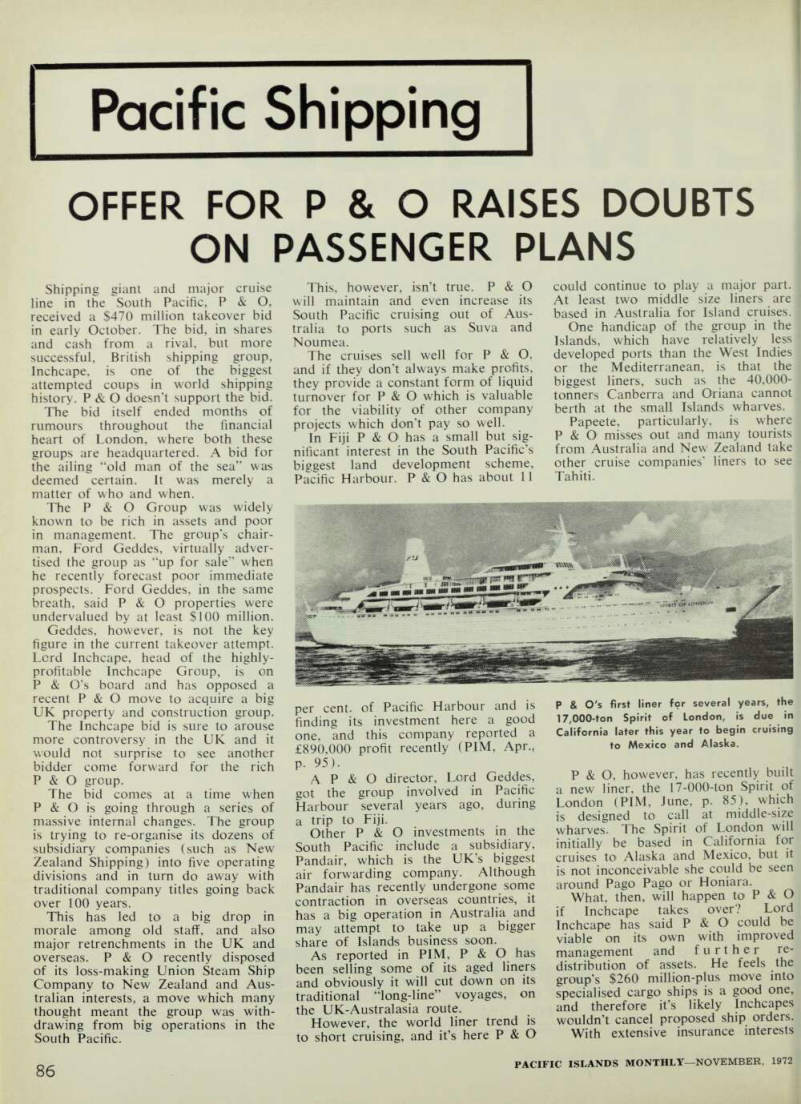
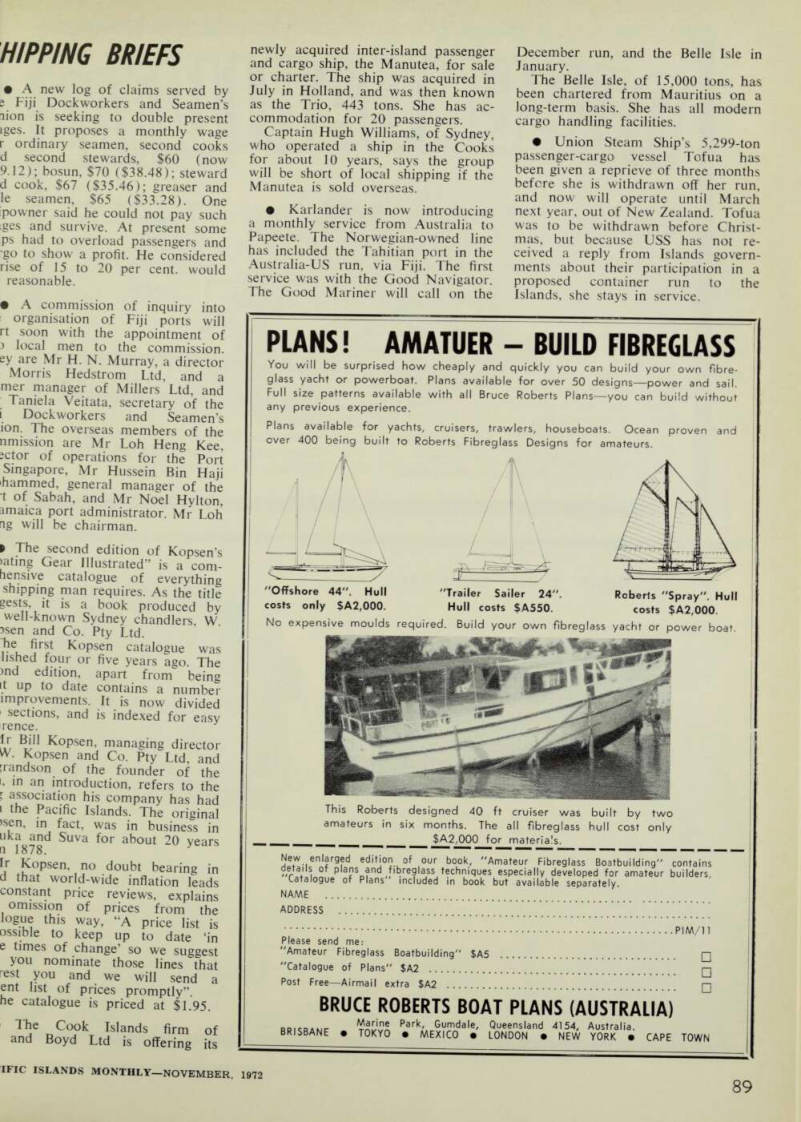
OFFER FOR P & O RAISES DOUBTS
On Passenger Plans
Shipping giant and major cruise line in the South Pacific, P & O, received a $470 million takeover bid in early October. The bid, in shares and cash from a rival, but more successful, British shipping group, Inchcape, is one of the biggest attempted coups in world shipping history. P & O doesn’t support the bid.
The bid itself ended months of rumours throughout the financial heart of London, where both these groups are headquartered. A bid for the ailing “old man of the sea” was deemed certain. It was merely a matter of who and when.
The P & O Group was widely known to be rich in assets and poor in management. The group’s chair man, Ford Geddes, virtually adver tised the group as “up for sale” when he recently forecast poor immediate prospects. Ford Geddes, in the same breath, said P & O properties were undervalued by at least $lOO million.
Geddes, however, is not the key figure in the current takeover attempt.
Lord Inchcape, head of the highly profitable Inchcape Group, is on P & O’s board and has opposed a recent P & O move to acquire a big UK property and construction group.
The Inchcape bid is sure to arouse more controversy in the UK and it would not surprise to see another bidder come forward for the rich P & O group.
The bid comes at a time when P & O is going through a series of massive internal changes. The group is trying to re-organise its dozens of subsidiary companies (such as New Zealand Shipping) into five operating divisions and in turn do away with traditional company titles going back over 100 years.
This has led to a big drop in morale among old staff, and also major retrenchments in the UK and overseas. P & O recently disposed of its loss-making Union Steam Ship Company to New Zealand and Aus tralian interests, a move which many thought meant the group was with drawing from big operations in the South Pacific.
This, however, isn’t true. P & O will maintain and even increase its South Pacific cruising out of Australia to ports such as Suva and Noumea.
The cruises sell well for P & O, and if they don’t always make profits, they provide a constant form of liquid turnover for P & O which is valuable for the viability of other company projects which don’t pay so well.
In Fiji P & O has a small but significant interest in the South Pacific’s biggest land development scheme, Pacific Harbour. P & O has about 11
per cent, of Pacific Harbour and is finding its investment here a good one, and this company reported a £890,000 profit recently (PIM, Apr., p. 95).
A P & O director, Lord Geddes, got the group involved in Pacific Harbour several years ago, during a trip to Fiji.
Other P & O investments in the South Pacific include a subsidiary, Pandair, which is the UK’s biggest air forwarding company. Although Pandair has recently undergone some contraction in overseas countries, it has a big operation in Australia and may attempt to take up a bigger share of Islands business soon.
As reported in PIM, P & O has been selling some of its aged liners and obviously it will cut down on its traditional “long-line” voyages, on the UK-Australasia route.
However, the world liner trend is to short cruising, and it’s here P & O
could continue to play a major part, At least two middle size liners are based in Australia for Island cruises, One handicap of the group in the Islands, which have relatively less developed ports than the West Indies or the Mediterranean, is that the biggest liners, such as the 40,000tonners Canberra and Oriana cannot berth at the small Islands wharves, Papeete, particularly, is where P & O misses out and many tourists from Australia and New Zealand take other cruise companies’ liners to see Tahiti.
P & O, however, has recently built a new liner, the 17-000-ton Spirit of London (PIM, June, p. 85), which is designed to call at middle-size wharves. The Spirit of London will initially be based in California for cruises to Alaska and Mexico, but it is not inconceivable she could be seen around Pago Pago or Honiara.
What, then, will happen to P & O if Inchcape takes over? Lord Inchcape has said P & O could be viable on its own with improved management and further re distribution of assets. He feels the group’s $260 million-plus move into specialised cargo ships is a good one, and therefore it’s likely Inchcapes wouldn’t cancel proposed ship orders.
With extensive insurance interests
P & O's first liner for several years, the 17,000-ton Spirit of London, is due in California later this year to begin cruising to Mexico and Alaska.
of its own, Inchcapes would be in clined to merge P & O insurance (Bishopsgate) companies, and also sell oft P & O real estate not earning good returns (and there’s plenty of that!). Lord Inchcape’s views on P & O’s liners, whicn until several months ago comprised the world’s biggest liner fleet, are unknown.
Last year, on its world-wide liner operations (Passenger Division), P & O earned $76 million in turn over, but cost $BO million to main ain, producing a good liquidity iource (always $l6 million in cash, >n hand), but hardly producing an overall profit picture. It is in this ;ection of the diverse P & O interests hat the biggest questions arise, akeover or not.
4 Ew Law For
Rongan Ships
Tonga’s Parliament has passed the lew Snipping Act, which will enable oreign ships to register under the fongan flag (PIM, Sept., p. 128).
"he act in early October was await ag the king’s signature.
While the legislation will go some /ay towards modernising Tongan hipping regulations in line with de elcped countries and international onventions, it also introduces possi ilities that the kingdom may attract verseas shipping companies to sgister their ships for tax and other masons.
However, the idea of attracting verseas companies to use Island orts as registration bases has yet to chieve any great success. Nauru led the same in very early legisla on, following its independence, in 968. With a couple of minor excep ons, Nauru has not attracted any gnificant overseas tonnage.
Most successful has been Vila, in le New Hebrides, which has dracted several Australian and New paland shipowners to register ships, iberia and Panama, the world’s mice registration centres, have lost => sleep over possible Island rivals.
Indeed, shipping sources in London, e acknowledged hub of world ship ng, are mostly unaware of Nauru’s gislation, let alone similar Tongan Forts.
It would be unfair, however, to te the new Tongan Act as merely i attempt to attract overseas lippers intent on saving dollars. The t incorporates everything from reckage to safety regulations. Its ccess in Parliament means that Dnga still wishes to play its part regional shipping services, despite me misadventures in recent years.
Tonga realises its own hand in ipping means trade, overseas
revenue and strategic value. Just how to go about it is Tonga’s problem, one which the king will have no small say in when it is made.
Skimming The Waves
Around Viti Levu
A Sydney businessman has plans to ease the ordeal tourists in Fiji face when they motor over the Queen’s Road, linking Suva and Lautoka. Mr John Bracey, managing director of Downhead Manor Pty Ltd, will have a 100-passenger hydrofoil running a return ferry service with stops at the Fijian Ho t el, west of Sigatoka, and Naboutini (near Korolevu) just as soon as he can get a chartered hydro foil, the Sun Arrow, to Fiji.
The idea has been in the melting pot for two years, when Mr Bracey went to Fiji to look at an island on which he had an option. He wanted to enter the Fiji tourist industry, but saw the major problem was to get people to the island. He then looked at the transport situation generally, and after driving over the Queen’s Road, he decided a hydrofoil service would save tourists a lot of jolting and jarring.
The Port Jackson and Manly Ferry Service and Mr Bracey were linked in plans to set up the service; earlier this year the company pulled out, and now Mr Bracey is “going it alone”. He has one problem, and it is a big one. He has chartered a ferry in Italy for six months with an option to purchase. He is allowing six weeks to get it to Fiji, three months for operations, and six weeks to get it back to Italy, if he decides not to buy it. He has to find a
suitable ship to get it to either Suva or Lautoka, and late in September he had not been successful.
However, he has been granted a trial licence to operate the service.
But before he can get a full licence he has to do a passenger reaction survey and show the results to the Fiji Marine Department.
The hydrofoil will carry 100 passengers at speeds of up to 40 mph.
It is 94 ft long and weighs 64 tons.
It can operate in seas with waves up to 12 ft, and in some circumstances in waves up to 17 ft. The journey between the two main centres will take 4j hours. The hydrofoil will be crewed by a master, a mate, an engineer, two sailors and two hostesses. The crew will be local, except for the master and mate. Mr Bracey has given an undertaking to train local men to take over as cap tain and mate. He will send them to Hong Kong where they may qualify for their licences.
The time-table and fare structure are; Leave Lautoka 8 a.m., arr.
Fijian Hotel 9.36 (SI 1.40); leave Fijian Hotel 9.56, arr. Naboutini 10.56 (515.55); leave Naboutini 11,16, arr. Suva (Tradewinds Hotel) 12.36 (522.50). On return the hydro foil will leave Suva at 1.16 p.m., arr. Naboutini at 2.36, leave at 2.56; arr. Fijian Hotel at 3.56, leave at 4.16; arr. Lautoka at 5.52. In the cooler months the hydrofoil will arrive at Lautoka after dark. Inter mediate fares will be: Fijian Hotel- Naboutini, $4.15; Fijian Hotel-Suva, $14.50; Naboutini-Suva, $10.35.
Mr Bracey says he will add Deuba to the schedule later.
Cutting Time Lost
On Sydney Waterfront
A determined effort will be made to eliminate expensive delays in hand ling Pacific Islands’ cargo on the Sydney waterfront. A time-slot system will be introduced under which ship pers will be given a time to send their cargo to the wharves.
Successful operation of the scheme depends on the complete co-operation of shippers.
A committee was set up last year to go into the question of delays on the waterfront. Represented were ship ping companies, the Australian Steve doring Industry Authority, the NSW Maritime Services Board (which con trols the wharves), shippers and transport operators.
The appointment of the committee was not before time. Delays were chronic. Long queues of trucks waited in streets for access to the
Harder Look At Norfolk Island
Hetherington Kingsbury Pty Ltd is looking for a ship to provide a regular service from Sydney to Nor folk Island and Lord Howe Island.
A director of Hetherington Kings bury, of Sydney, told PIM a ship with proper gear to handle lighterage cargo and with adequate refrigerated space was required.
A group of Norfolk Island mer chants, started negotiations with Lord Howe merchants and Hetherington Kingsbury to form a new shipping company, South Pacific Shipping Co. (Norfolk Island) Ltd. The capital is estimated at $70,000, which will be raised either totally by share alloca tions, or by allocations and a loan.
The allocation of shares to Lord Howe will be in proportion to the amount of cargo. This would be about 12i per cent, or about $lO,OOO of the capital.
Hetherington Kingsbury, the manag ing agents, will take up shares worth $5,000 and will provide $20,000 at 8 per cent. This loan will be re payable at the rate of $5,000 a year.
Will the venture be profitable?
The Hetherington Kingsbury director said it depends on what a ship costs, and the amount of cargo available.
Asked why a new service was re quired, with Karlander calling at each island every 19 days, and also offer ing passenger accommodation, he said the new service would operate to only two islands. There would be no delays at other ports which could affect the arrival dates of cargo.
A major factor in feasibility is all exports from Australia being offered to the proposed company. Exports
wharves. There were ludicrous situa tions where big vehicles, carrying a few outers of foodstuffs, waited for several hours to get on the wharves. The cost of the delays was borne by the consumer.
The committee reported that a survey team set up by the Stevedo ring Industry Authority had measured dramatic improvements when the time-slot system was applied to some Karlander ships. For 11 ships, over a test involving 2,585 trucks, the average vehicle turnround time at the wharves was reduced by 82 minutes, compared with previous averages. The result included loading four ships, at which, for various reasons, the scheme did not function as intended. (PIM, in November, 1971, reported on a pilot scheme conducted by Kar lander with the Golden Swan, load ing for Honiara, Kieta and Rabaul, Although there were a few “bugs”,
from Australia in the last two or three years have risen at the rate of 30 per cent, a year, and the pro moters expect that trend to continue.
This is not the first attempt to set up a new service for Norfolk Island.
There was a move early in 1971 to launch a service from there to take in Japan, Australia and New Zealand.
It is believed the promoters were un able to get a suitable ship.
The current proposal is for a three weekly service, which allows plenty of time for loading and ample time at each island for unloading.
Benefits expected from the service include: 9 Merchants will be able to reduce amount of stock held, which would free storage space and reduce the money tied up in stock; e Through ownership of the ship, the merchants would be able to stabilise freight rates. (They also ex pect profits will help to reduce freight rates.) Norfolk Islanders interested in the plan have been active. They have circulated a questionnaire to mer chants asking them to help in com pleting final arrangements. Intending merchants are also asked to give information about the tonnage they imported last year, how much they expect next year, the classification of cargo and tonnage for each class, whether they would direct all ship ments through the company, the notice required for first shipment, how many shares they require, and how much notice they need before taking up shares.
the speed which vehicles passed over I the wharf was amazing).
The committee suggests that the J time-slot system be introduced for I all operators and shippers in the Pacific Islands trade, financed by a small levy on outward cargoes.
Sydney is not on its own in this approach to the problem. London and Liverpool have instituted ap- ! pointment systems. Reports from those ports suggest reductions in delays J in handling vehicles of 60 to 70%. I This is how the system works; Space booking. Cargo is booked with the ship’s agent in the usual way. Where cargo is to be supplied by a second party the name, the person to contact and telephone number of that supplier are required.
Receiving advice. On notification of berth allocation by the Maritime Services Board, the ship’s agent ad vises all shippers/suppliers of the wharf and days of receiving.
Appointment. An appointments clerk retained by the ship’s agent liaises with the stevedore and with suppliers or companies actually deli vering the cargo to arrange mutually suitable appointments for trucks deli vering to the wharf, within one hour time-slots. • Reporting at the wharf. On arrival at the wharf, truck drivers report to the receiving clerk, who checks the interim receipt to ensure that each vehicle is handled in its correct time-slot order.
Cook Islands Crew
For Nauru's Newest Ship
The Nauru Local Government Council, owners of the Nauru Pacific Line, have purchased the Federal Palm, of 3,196 dwt, from the Carib bean. Federal Palm was built in 1961 by Canadian Vickers Ltd. It has been operated since then by the West Indies Shipping Corporation and registered at Port of Spain.
The Federal Palm is to be re-named Cenpac Rounder. She is 298 ft long j with a beam of 51 ft 8 in. and 15 ft; 6i in. draught.
Nauru has turned to the Cook Islands j for crew for the new ship. Ten Cook; Islands men have been selected by' the government on behalf of the; Nauru Line, and these were flying out of Rarotonga early October by' Polynesian Airlines charter.
They have been engaged on wages? of $lOB to 5125 per month with over time rates of 57 to 69 cents per hour, , for one year. Their first task is toe crew the ship on its delivery voyages from Curacao.
Nauru Pacific’s 30,000 ton bulk) carrier, at present under construction r in Japan, is scheduled for launchings on December 9.
Hipping Briefs
• A new log of claims served by 2 Fiji Dockworkers and Seamen’s lion is seeking to double present iges. It proposes a monthly wage r ordinary seamen, second cooks d second stewards, $6O (now 9.12); bosun, $7O ($38.48); steward d cook, $67 ($35.46); greaser and le seamen, $65 ($33.28). One powner said he could not pay such iges and survive. At present some ps had to overload passengers and go to show a profit. He considered rise of 15 to 20 per cent, would reasonable. • A commission of inquiry into organisation of Fiji ports will rt soon with the appointment of ) local men to the commission, ey are Mr H. N. Murray, a director Morris Hedstrom Ltd, and a mer manager of Millers Ltd, and Taniela Veitata, secretary of the i Dockworkers and Seamen’s ion. The overseas members of the nmission are Mr Loh Heng Kee, "ctor of operations for the Port Singapore, Mr Hussein Bin Haji hammed, general manager of the t of Sabah, and Mr Noel Hylton, amaica port administrator. Mr Loh ig will be chairman. > The second edition of Kopsen's gating Gear Illustrated” is a com hensive catalogue of everything shipping man requires. As the title gests, it is a book produced by well-known Sydney chandlers, W isen and Co. Pty Ltd. v C u S l- ? Ko P sen catalogue was lished four or five years ago. The and edition, apart from being it up to date contains a number improvements. It is now divided 1 sections, and is indexed for easv rence.
Ir Bill Kopsen, managing director W. Kopsen and Co. Pty Ltd, and ;randson of the founder of the l ’ i n an introduction, refers to the > association his company has had i the Pacific Islands. The original >sen, in fact, was in business in uka and Suva for about 20 years a 1878.
Ir Kopsen, no doubt bearing in d that world-wide inflation leads constant price reviews, explains omission of prices from the logue this way, “A price list is ossible to keep up to date ‘in e times of change’ so we suggest you nominate those lines that rest you and we will send a ent list of prices promptly”, he catalogue is priced at $1.95.
The Cook Islands firm of and Boyd Ltd is offering its
newly acquired inter-island passenger and cargo ship, the Manutea, for sale or charter. The ship was acquired in July in Holland, and was then known as the Trio, 443 tons. She has accommodation for 20 passengers.
Captain Hugh Williams, of Sydney, who operated a ship in the Cooks for about 10 years, says the group will be short of local shipping if the Manutea is sold overseas. • Karlander is now introducing a monthly service from Australia to Papeete. The Norwegian-owned line has included the Tahitian port in the Australia-US run, via Fiji. The first service was with the Good Navigator.
The Good Mariner will call on the
December run, and the Belle Isle in January.
The Belle Isle, of 15,000 tons, has been chartered from Mauritius on a long-term basis. She has all modem cargo handling facilities. TT . * Union Steam Ship s 5,299-ton passenger-cargo vessel Tofua has glv^n * reprieve of three months before she is withdrawn off her run, and now will operate until March next year, out of New Zealand. Tofua was to be withdrawn before Christ mas, but because USS has not re ceived a reply from Islands govern ments about their participation in a proposed container run to the Islands, she stays in service.
Advertisements & other items, pp. 89-92 (3 items)
87
ICIFIC ISLANDS MONTHLY— NOVEMBER, 1972
For Sale
CARGO VESSEL about 650 tons dwt. built 1948, diesel, one hold 2 hatches, about 33,000 cu. ft. cargo space, 3 ton derricks with one at tons, general condition good but survey expired. Very suited conversion lighter or storage vessel. $A25,000 or realistic counter offer.
CARGO VESSEL about 330 tons dwt. diesel, one hatch, one hold, about 17,000 cu. ft. cargo space built 1960, Lloyds Class. All modern navigation aids, bridge control. $A130,000. 9 9 PASSENGER CARGO VESSEL DIESEL, about 12 knots, built 1955 in full Class. Owners considering offers around SAIIO,OOO.
NEW CONSTRUCTION, built to carry cargo and trade goods. Wooden. 71' x 19' H.D.
Gardner diesel, one large hold, 2 small holds. Built to survey requirements. Diesel winch and derrick. Owners will deliver Pacific area, TOURIST VESSEL 55' x 14' diesel. Sleep 12, built 1949, local survey current. Radio, Sounder and auto pilot. Freezer box about 1,500 lbs. $A27,000.
We obtain independent surveys of any craft we offer and subsequently arrange delivery either on ship's deck or by sea as desired.
CART. W. L. KENNEDY PTY. LTD.
Shipbrokers Established 1931
32 BRIDGE STREET, SYDNEY, AUSTRALIA
Phone: 27-3797. Cables: "Capken" Sydney.
PLANS! AMATUER - BUILD FIBREGLASS
You will be surprised how cheaply and quickly you can build your own fibreglass yacht or powerboat. Plans available for over 50 designs—power and sail.
Full size patterns available with all Bruce Roberts Plans—you can build without any previous experience.
Plans available for yachts, cruisers, trawlers, houseboats. Ocean proven and over 400 being built to Roberts Fibreglass Designs for amateurs.
"Offshore 44". Hull costs only $A2,000.
'Trailer Sailer 24".
Hull costs SASSO.
Roberts "Spray". Hull costs $A2,000 No expensive moulds required. Build your own fibreglass yacht or power boat.
apr
This Roberts designed 40 ft cruiser was built by two amateurs in six months. The all fibreglass hull cost only $A2,000 for material.
New enfargeci edition of our book, "Amateur Fibreglass Boatbuilding" contains P f S m nd J'breglass techniques especially developed for amateur builders, Catalogue of Plans included in book but available separately.
NAME
ADDRESS
PIM/11
Please send me: "Amateur Fibreglass Boatbuilding" SAS q "Catalogue of Plans" SA2 q Post Free—Airmail extra SA2 p
BRUCE ROBERTS BOAT PLANS (AUSTRALIA)
BRISBANE . %W 0 SiTdoM Wt CAPE TOWN
Newage BMC marine engines are economical, rugged, reliable and virtually unbreakable. But if something should go wrong, it’s good to know you can get any part quickly from Lars Halvorsen.
Lars Halvorsen are sole East Coast distributors for Newage BMC, and to them, after sales service is a big thing. When you buy Newage BMC you don’t buy worries in the unlikely event of a breakdown all you need do is make one phone call for spare parts, to Lars Halvorsen. Dealer enquiries invited
VEDETTE PETROL 24 BMP
CAPTAIN DIESEL. 38 BMP
COMMANDER
DIESEL 55BHP
COMMODORE
DIESEL 70 BMP
SEALORD
5-7 DIESEL. . 100 BHP
o >1 mm illiilii
SONS PTY. LTD.
Waterview Street, Ryde 80 0251
Telegrams: “Halvorsens”, Sydney
Builders of Halvorsen Boats
Small Boat Echo Sounder!
You can now own a low cost, high performance Echo Sounder for your small boat.
Furuno models FG-11 Mark 3 and FG-200 Mark 3 are portable, simple to operate and easy to read even in bright sunlight. Graphic and flasher read-outs :an be done together or separately to indicate depths of fish and seabed down to 320 Fathoms (FG-11 B).
"White line" operation gives expensive sounder performance to these economical, portable sounders. * ft.
'M /s' z' ■ H%r f ‘ < - ' -.
The future today with FURUNO's electronic tecto'OioaV..
FURUNO ELECTRIC CO., LTD.
9-52, Ashihara-cho, Nishinomiya-city, Japan CABLE ; FURUNO NISH I MOM IY A,
TELEX : 5644-498
Ific Islands Monthly—November, 1972
Cruising
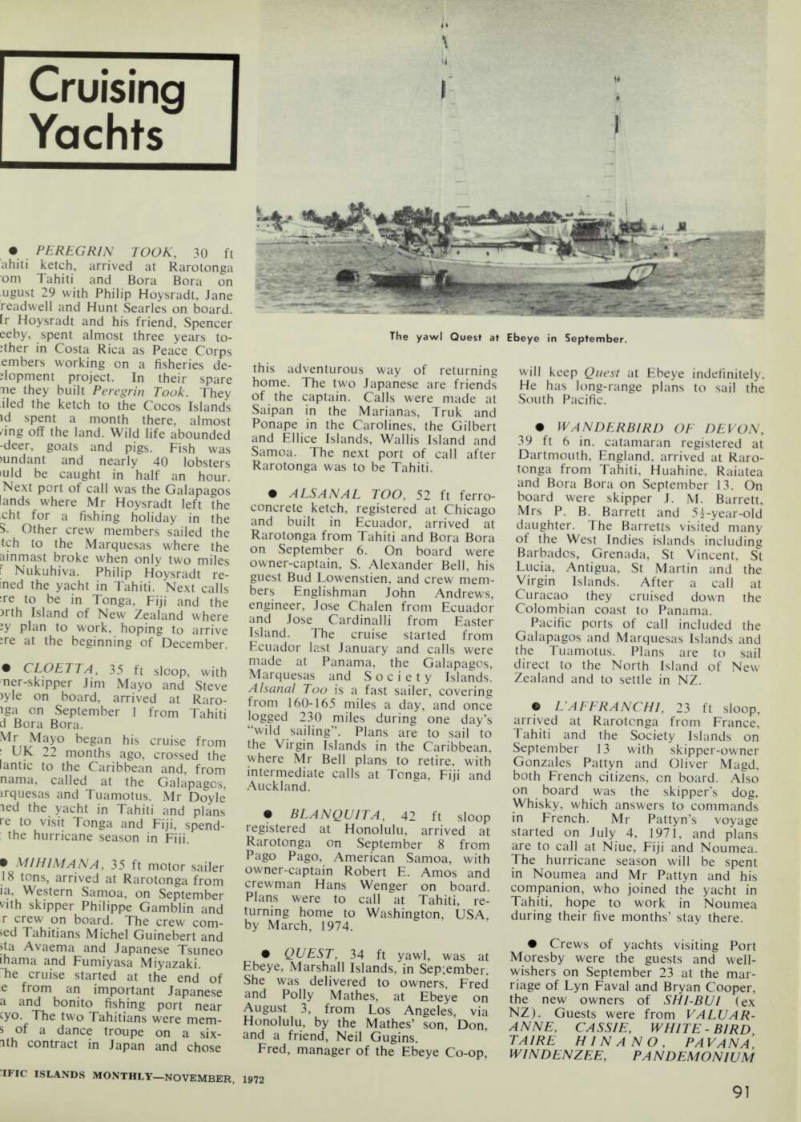
Yachts
• Peregrin Took, 30 Ft
ahiti ketch, arrived at Rarotonga om Tahiti and Bora Bora on ugust 29 with Philip Hoysradt, Jane feadwell and Hunt Searles on board. lr Hoysradt and his friend, Spencer eeby, spent almost three years to cher in Costa Rica as Peace Corps embers working on a fisheries de dopment project. In their spare Tie they built Peregrin Took. They iled the ketch to the Cocos Islands id spent a month there, almost /ing off the land. Wild life abounded -deer, goats and pigs. Fish was mndant and nearly 40 lobsters •uld be caught in half an hour.
Next port of call was the Galapagos lands where Mr Hoysradt left the cht for a fishing holiday in the 5. Other crew members sailed the tch to the Marquesas where the ainmast broke when only two miles • Nukuhiva. Philip Hoysradt re ined the yacht in Tahiti. Next calls :re to be in Tonga, Fiji and the arth Island of New Zealand where ly plan to work, hoping to arrive jre at the beginning of December. • CLOETTA, 35 ft sloop, with ner-skipper Jim Mayo and Steve >yle on board, arrived at Raro iga on September 1 from Tahiti d Bora Bora.
Mr Mayo began his cruise from • 22 months ago, crossed the lantic to the Caribbean and, from nama, called at the Galapagos, irquesas and Tuamotus. Mr Doyle Ted the yacht in Tahiti and plans re to visit Tonga and Fiji, spend the hurricane season in Fiji. • MIHIMANA, 35 ft motor sailer 18 tons, arrived at Rarotonga from ia, Western Samoa, on September vith skipper Philippe Gamblin and r crew on board. The crew com bed Tahitians Michel Guinebert and >ta Avaema and Japanese Tsuneo mama and Fumiyasa Miyazaki.
Tie cruise started at the end of e from an important Japanese a and bonito fishing port near tyo. The two Tahitians were mem s of a dance troupe on a six ith contract in Japan and chose
this adventurous way of returning home. The two Japanese are friends of the captain. Calls were made at Saipan in the Marianas, Truk and Ponape in the Carolines, the Gilbert and Ellice Islands, Wallis Island and Samoa. The next port of call after Rarotonga was to be Tahiti. • AES ANAL TOO, 52 ft ferro concrete ketch, registered at Chicago and built in Ecuador, arrived at Rarotonga from Tahiti and Bora Bora on September 6. On board were owner-captain, S. Alexander Bell, his guest Bud Lowenstien, and crew mem bers Englishman John Andrews, engineer, Jose Chalen from Ecuador and Jose Cardinalli from Easter Island. The cruise started from Ecuador last January and calls were made at Panama, the Galapagos, Marquesas and Society Islands.
Alsanal Too is a fast sailer, covering from 160-165 miles a day, and once logged 230 miles during one day’s “wild sailing’’. Plans are to sail to the Virgin Islands in the Caribbean, where Mr Bell plans to retire, with intermediate calls at Tonga, Fiji and Auckland. • BLANQUITA, 42 ft sloop registered at Honolulu, arrived at Rarotonga on September 8 from Pago Pago, American Samoa, with owner-captain Robert E. Amos and crewman Hans Wenger on board.
Plans were to call at Tahiti, re turning home to Washington, USA by March, 1974. • QUEST, 34 ft yawl, was at Ebeye, Marshall Islands, in Sepiember.
She was delivered to owners, Fred and Polly Mathes, at Ebeye on August 3, from Los Angeles, via Honolulu, by the Mathes’ son, Don, and a friend, Neil Gugins.
Fred, manager of the Ebeye Co-op,
will keep Quest at Ebeye indefinitely.
He has long-range plans to sail the South Pacific.
• Wanderbird Of Devon ,
39 ft 6 in. catamaran registered at Dartmouth, England, arrived at Raro tonga from Tahiti, Huahine, Raiatea and Bora Bora on September 13. On board were skipper J. M. Barrett, Mrs P. B. Barrett and si-year-old daughter. The Barretts visited many of the West Indies islands including Barbados, Grenada, St Vincent, St Lucia, Antigua, St Martin and the Virgin Islands. After a call at Curacao they cruised down the Colombian coast to Panama.
Pacific ports of call included the Galapagos and Marquesas Islands and the Tuamotus. Plans are to sail direct to the North Island of New Zealand and to settle in NZ. © L'AFFRANCHI, 23 ft sloop, arrived at Rarotonga from France, Tahiti and the Society Islands on September 13 with skipper-owner Gonzales Pattyn and Oliver Magd, both French citizens, on board. Also on board was the skipper’s dog, Whisky, which answers to commands in French. Mr Pattyn’s voyage started on July 4, 1971, and plans are to call at Niue, Fiji and Noumea.
The hurricane season will be spent in Noumea and Mr Pattyn and his companion, who joined the yacht in Tahiti, hope to work in Noumea during their five months’ stay there. • Crews of yachts visiting Port Moresby were the guests and well wishers on September 23 at the mar riage of Lyn Faval and Bryan Cooper, the new owners of SHI-BUI (ex NZ). Guests were from VALUAR
Anne, Cassie, White-Bird
Taire Hinano, P Avan A
Windenzee, Pandemonium
The yawl Quest at Ebeye in September.
and ORIENTAL LADY, all of whom (excepting Oriental Lady west bound) plan to move eastward in November. • GAYNA DARI, a trimaran arrived in Port Moresby September 24 from Bundaberg via Thursday Island with Merilon and Hugh Hunter and their two children.
• IN VICTUS, from Whangarei, NZ, was in Vavau during the last week of September and will be return ing to her home port via Suva after having visited Rarotonga, Tahiti, the Society Islands and Niue. On board were skipper-owner Selwyn Matheson, his wife Jewel and two-year-old son Brett, Eileen Blake from New York, John Olsen from Seattle, and Kerry Marvin from Colorado. • ISBJORN, Dr David Lewis’s 39 ft ketch, has been abandoned about 40 miles off Efate, New Hebrides. On board at the time were skipper Barry Lewis, the owner’s son, and Clifford Bellamy. They were on their way to Sydney from the
Geic.
They left Vila early in September, but struck trouble soon after when a porthole started to leak badly. The crew sent out an emergency signal and were picked up early next morn ing. Isbjorn was abandoned in mid ocean.
Dr Lewis later received a message from his son saying that Isbjorn had not been found. It was possible she had sunk for there was also a struc tural failure, Dr Lewis told PIM.
She had been in the GEIC for the last three years, trading as a copra boat.
Dr Lewis was then in the midst of preparation to leave Sydney about mid-October in his 32 ft steel-hulled sloop ICE BIRD and sail round the world, across the bottom of the Pacific, Atlantic, and Indian Oceans.
He expected to be away from Aus tralia about six months.
O Many of the yachts in Suva in early October were planning to move on before the end of the month. They included NAT ASH A, 38 ft ketch, which arrived in Fiji on September 29 with captain-owner James Bercaw, his wife and three children on board and SPIRIT OF THE WIND, a tri, which arrived in Suva from Tonga on September 24, with A. S. King, Margaret King, Michael Wroughton and Nancy Dengler on board. d MUSTANG, US cutter, with Keith and Rosemary Jones on board, was due to leave Suva for New Caledonia during the second week in November. • MAUD, 50 ft ketch, arrived in Suva on September 25 from Tonga skippered by Shaun Redward. Crew were David Lynch-Watson, Bob Greenslade and Gary Morey. She was due to leave for Russell, NZ before the end of October. • RIK, 38 ft Dutch sloop was still in Suva in October after arriving with Amsterdam couple Claes and Wilmoed Honig on September 16 from Nukualofa. The Honigs were planning to sail for Auckland early m November. • KUAN YIN, Canadian schooner, arrived in Suva on September 16 from Tonga and was due to leave for Australia before the end of October. On board were Roger Clancy and Sheila Mitchell. 9 Still in Suva in early October were WIN DC ALL, which arrived J from Tonga on September 22 with j skipper Keith Higgins and Herman i Du Plessis on board; and BOLERO,.
US sloop, which arrived on August] 29 from Vavau, with Bill and Sue; Schmidt on board. Bolero was bound! for Noumea some time in October..
• Alsanal Two, Us Ketch,,
was in Suva in early October withr skipper S. Alexander Bell and crewv of four. Plans were to cruise Fiju waters for an indefinite period.
Advertisements & other items, pp. 93-98 (4 items)
91
IFIC ISLANDS MONTHLY—NOVEMBER, 1972
jghuk
AITCHISON YACHT MASTS OF
NEW ZEALAND
CONSTRUCT AND SUPPLY FOR YACHTS:
WOODEN MASTS AND SPARS • ALUMINIUM MASTS AND SPARS • ALL SPAR FITTINGS, LIGHTING, ROPES, RIGGING,
WINCHES, STAINLESS STEEL BOAT FITTINGS.
Yachties for quick experienced service contact the specialist firm with the world wide reputation now !!! We air freight and ship all over the islands. Flagpoles also made and supplied.
AITCHISON YACHT MASTS,
ROWANDALE AVE., MANUREWA (P.O. BOX 274, MANUREWA),
AUCKLAND, N.Z. Ph: 6-3500
KOPSENS
3 %
W.KOPSEN
& C & &
srm
cutaume w
».K<*S£**CO>T*tm.
NEW RELEASE!!
Boating Gear Catalogue—sl.9s including postage. Features the largest range of Marine Equipment available.
A MUST
FOR "OUTFITTING"
W. Kopsen & Co. Pty. ltd.
189 A SUSSEX STREET, SYDNEY,
N.S.W, 2000, AUSTRALIA.
Name Address ’Enel. $1.95 Aust.
Double Your
Pleasure
Buy two Toyotas. The Toyota Corolla on top. The Toyota Celica below. You get a big double combination.
That a single car can't give you. For more Dr less the same price. You get twice the aeauty, power and economy. The Borolla really skips along. With famous Foyota good mileage. The Celica skips and skimps about the same. And you have 3 choice of five youthful, sporty models. But in both cars you get: Fresh lir flow-through ventilation. Thick fully reclining ront bucket seats. Safety padded interior.
J nit construction. Plus two Toyotas.
New Toyota Corolla New Toyota Celica
n=qr
£toßA™n U PO E £ SCrd,Ch,eV Rd ■ Bad "'- “,S. ™UST TERRITORY: MICROL ,moa burns pwlpis^uthTa 0 . rn p° S: automotive supplies go., ltd .g.p.o. box 355,Suva American
AUTOMOBILE OU
pee.eCOOK ISLANDS: COOK ISLANDS TRADING CORPORATION LTD . P O. Box 92 Rarotonga
TOYOTA
% 4 m -1,- ■ rp -*• I?
I f % V \ -*s y^ h ; 7S m K C . n ? rSt 1 *■■■,. /C r.s
This many shaves
from one blade:
And more. In fact you’ll probably give up counting. It’s the miracle polymer coating on the edge that gives you unbelievably long lasting comfort, more smooth close shaves than any other blade, every one as easy as the first... shave after shave . after shave after shave after shave after shave after shave...
Gillette 1% » ZMspet
STAWL ESS STEEL
BLADt
M Gi
Stand
i ■ :■ r 1)
& onr a m ' \ o * * I ■ % mp
SYDNEY M.S.W.
WOe 0F AUS
25 KGWfr
■ m y fee »*■■ a *- *# i *>T *(.
the most important ingredient
LEAD FLOURS:
LKE FLOURS:
SCUIT FLOURS:
ECIALITY FLOURS:
• MAINTOP—high protein bread flour • ANCHOR—bakers flour • 50/50 MEAL— brown bread • MEDlUM—cake and pastry • SPONGE —sponge cakes • SPECIAL CAKE —madeira and cup cakes • STRONG—cracker biscuits • MEDIUM —Shortbreads • SOFT —sweet biscuits • RYE flour • RYE meal • KIBBLED RYE • SHARPS —roti and chapati flour • 100% STONE GROUND
WHOLEMEAL
GILLESPIE BROS. PTY. LTD.
HEAD OFFICE: rpicrawp ncnrc (GPO ?0X P SIT OTNEY N MO1 N i S ‘ W ‘ CAB r E ADDRESS: ALBION - BRISBANE, QUEENSLAND.
PHONE L«m Y ' 2001 J em "GILLESPIE", (P.O. BOX 8, ALBION, BRISBANE, 4010.
PHONE: 660-4933. SYDNEY AND BRISBANE. PHONE- 6-1121
m X f J ' Jt -E - v pupp of m i W us* sors*
12FL8L
TSfeM
So Superior It’s Sensational!
Discover the easy, delicious way famous chefs use to enhance the flavor of meat, poultry, fish . . . casseroles, stews and gravies.
There's no substitute for "vintage flavor"
Kikkoman - the preferred soy sauce.
shKIKKOMAN SHOYU CO., LTD.
M;u An u. c hi Tokwn 103 .lanan
Icific Islands Monthly—November, 1972
95
IFIC ISLANDS MONTHLY—NOVEMBER, 1972
Boac Pacific Jet New
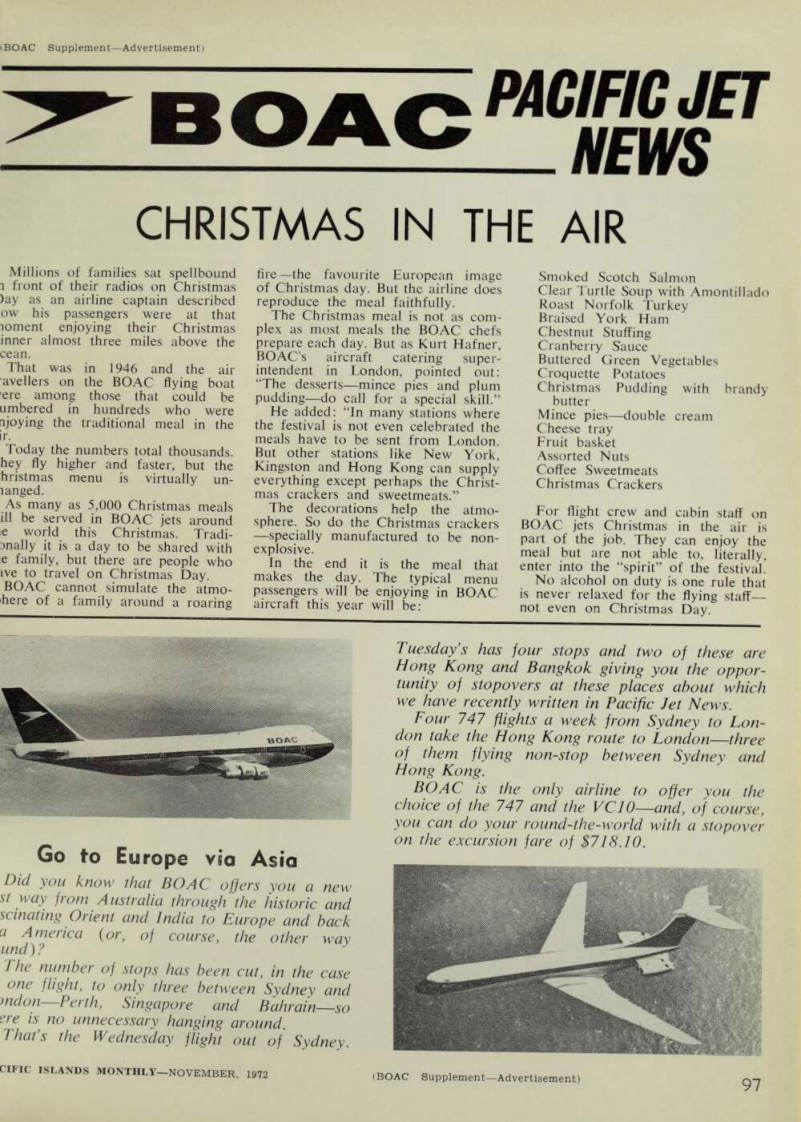
Christmas In The Air
BOAC Supplement—Advertisement)
Millions of families sat spellbound i front of their radios on Christmas )ay as an airline captain described ow his passengers were at that loment enjoying their Christmas inner almost three miles above the cean.
That was in 1946 and the air avellers on the BOAC flying boat r ere among those that could be umbered in hundreds who were njoying the traditional meal in the ir.
Today the numbers total thousands, hey fly higher and faster, but the hristmas menu is virtually un langed.
As many as 5,000 Christmas meals ill be served in BOAC jets around e world this Christmas. Tradi- Dnally it is a day to be shared with e family, but there are people who ive to travel on Christmas Day.
BOAC cannot simulate the atmo here of a family around a roaring
fire—the favourite European image of Christmas day. But the airline does reproduce the meal faithfully.
The Christmas meal is not as com plex as most meals the BOAC chefs prepare each day. But as Kurt Hafner, BOAC’s aircraft catering super intendent in London, pointed out: “The desserts—mince pies and plum pudding—do call for a special skill.”
He added: “In many stations where the festival is not even celebrated the meals have to be sent from London.
But other stations like New York, Kingston and Hong Kong can supply everything except perhaps the Christ mas crackers and sweetmeats.”
The decorations help the atmo sphere. So do the Christmas crackers —specially manufactured to be non explosive.
In the end it is the meal that makes the day. The typical menu passengers will be enjoying in BOAC aircraft this year will be;
Smoked Scotch Salmon Clear Turtle Soup with Amontillado Roast Norfolk Turkey Braised York Ham Chestnut Stuffing Cranberry Sauce Buttered Green Vegetables Croquette Potatoes Christmas Pudding with brandy butter Mince pies—double cream Cheese tray Fruit basket Assorted Nuts Coffee Sweetmeats Christmas Crackers For flight crew and cabin staff on BOAC jets Christmas in the air is part of the job. They can enjoy the meal but are not able to, literally, enter into the “spirit” of the festival.
No alcohol on duty is one rule that is never relaxed for the flying staff— not even on Christmas Day.
Go to Europe via Asia
Did you know that BOAC offers you a new st way from Australia through the historic and scinating Orient and India to Europe and back a America {or, of course, the other way und)?
The number of stops has been cut, in the case one flight, to only three between Sydney and mdon — Perth, Singapore and Bahrain—so ere is no unnecessary hanging around.
ThaTs the Wednesday flight out of Sydney.
Tuesday’s has four stops and two of these are Hong Kong and Bangkok giving you the oppor tunity of stopovers at these places about which we have recently written in Pacific Jet News.
Four 747 flights a week from Sydney to Lon don take the Hong Kong route to London—three of them flying non-stop between Sydney and Hong Kong.
BOAC is the only airline to offer you the choice of the 747 and the VC 10 — and, of course, you can do your round-the-world with a stopover on the excursion fare of $718.10.
Advertisements & other items, p. 99 (1 item)
97
(BOAC Supplement—Advertisement)
TFIC ISLANDS MONTHLY—NOVEMBER, 1972
The Call Of The Wild
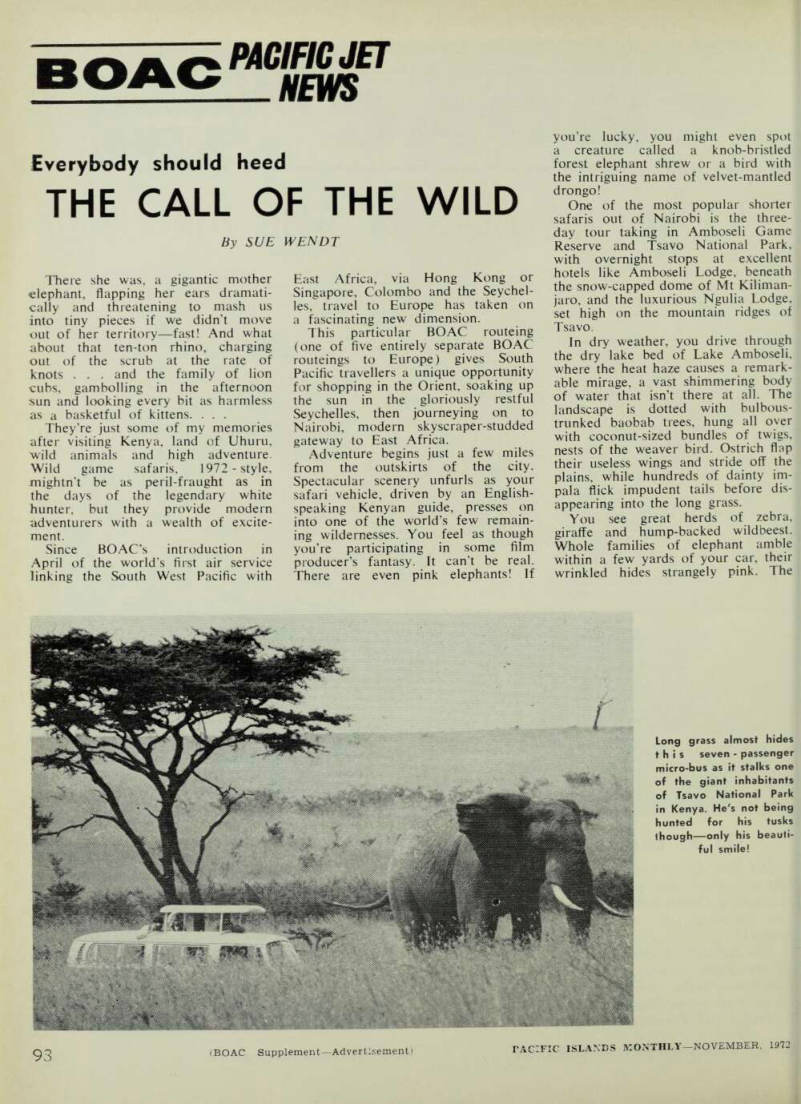
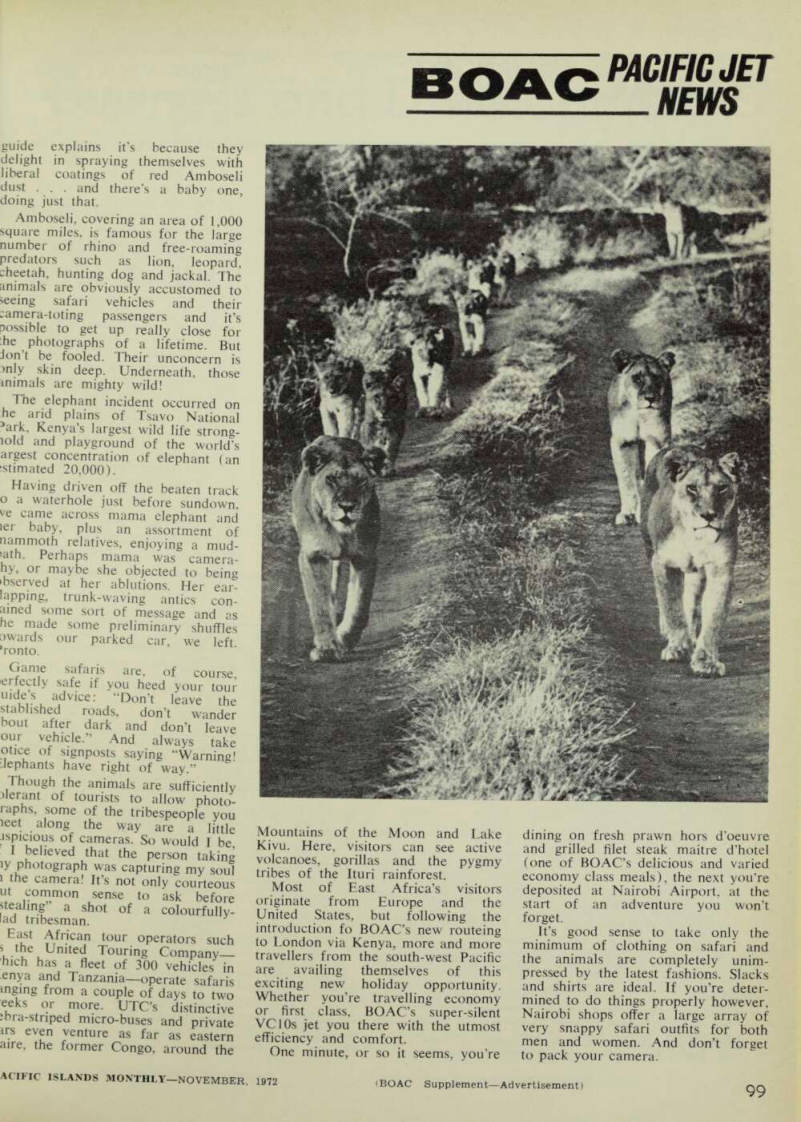
Everybody should heed
By Sue Wendt
There she was, a gigantic mother elephant, flapping her ears dramati cally and threatening to mash us into tiny pieces if we didn’t move out of her territory—fast! And what about that ten-ton rhino, charging out of the scrub at the rate of knots . . . and the family of lion cubs, gambolling in the afternoon sun and looking every bit as harmless as a basketful of kittens. . . .
They’re just some of my memories after visiting Kenya, land of Uhuru, wild animals and high adventure.
Wild game safaris, 1972 -style, mightn't be as peril-fraught as in the days of the legendary white hunter, but they provide modem adventurers with a wealth of excite ment.
Since BOAC’s introduction in April of the world's first air service linking the South West Pacific with
East Africa, via Hong Kong or Singapore, Colombo and the Seychel les, travel to Europe has taken on a fascinating new dimension.
This particular BOAC routeing (one of five entirely separate BOAC routeings to Europe) gives South Pacific travellers a unique opportunity for shopping in the Orient, soaking up the sun in the gloriously restful Seychelles, then journeying on to Nairobi, modern skyscraper-studded gateway to East Africa.
Adventure begins just a few miles from the outskirts of the city.
Spectacular scenery unfurls as your safari vehicle, driven by an English speaking Kenyan guide, presses on into one of the world’s few remain ing wildernesses. You feel as though you're participating in some film producer’s fantasy. It can’t be real.
There are even pink elephants! If
you’re lucky, you might even spot a creature called a knob-bristled forest elephant shrew or a bird with the intriguing name of velvet-mantled drongo!
One of the most popular shorter safaris out of Nairobi is the three day tour taking in Amboseli Game Reserve and Tsavo National Park, with overnight stops at excellent hotels like Amboseli Lodge, beneath the snow-capped dome of Mt Kiliman jaro, and the luxurious Ngulia Lodge, set high on the mountain ridges of Tsavo.
In dry weather, you drive through the dry lake bed of Lake Amboseli, where the heat haze causes a remark able mirage, a vast shimmering body of water that isn’t there at all. The landscape is dotted with bulbous trunked baobab trees, hung all oyer with coconut-sized bundles of twigs, nests of the weaver bird. Ostrich flap their useless wings and stride off the plains, while hundreds of dainty im pala flick impudent tails before dis appearing into the long grass.
You see great herds of zebra,
giraffe and hump-backed wildbeest.
Whole families of elephant amble within a few yards of your car, their wrinkled hides strangely pink. The
Long grass almost hides this seven - passenger micro-bus as it stalks one of the giant inhabitants of Tsavo National Park in Kenya. He's not being hunted for his tusks though—only his beauti ful smile!
guide explains it’s because they delight in spraying themselves with liberal coatings of red Amboseli dust , . . and there’s a baby one, doing just that.
Amboseli, covering an area of 1,000 square miles, is famous for the large number of rhino and free-roaming predators such as lion, leopard, cheetah, hunting dog and jackal. The animals are obviously accustomed to seeing safari vehicles and their camera-toting passengers and it’s possible to get up really close for he photographs of a lifetime. But Jon’t be fooled. Their unconcern is anly skin deep. Underneath, those mimals are mighty wild!
The elephant incident occurred on he arid plains of Tsavo National s ark, Kenya’s largest wild life strong lold and playground of the world’s argest concentration of elephant (an
istimated 20,000).
Having driven off the beaten track 0 a waterhole just before sundown ve came across mama elephant and icr baby, plus an assortment of nammoth relatives, enjoying a mud ►ath. Perhaps mama was camera hy, or maybe she objected to being •bserved at her ablutions. Her ear
lapping, trunk-waving antics con
amed some sort of message and as he made some preliminary shuffles □wards our parked car, we left Tonto.
Game safaris are, of course erfectly safe if you heed your tour U '! e , S . a . dvice: “ Don t leave the stabhshed roads, don’t wander bout after dark and don’t leave our vehicle.” And always take otice of signposts saying “Warning! dephants have right of way.”
Though the animals are sufficiently jlerant of tourists to allow photo raphs, some of the tribespeople you icet along the way are a little jspicious of cameras. So would I be 1 believed that the person taking iy photograph was capturing my soul 1 the camera! It’s not only courteous ut common sense to ask before stealing a shot of a colourfully lad tribesman.
Past African tour operators such > the United Touring Company hich has a fleet of 300 vehicles in enya and Tanzania—operate safaris mgmg from a couple of days to two eeks or more. UTC’s distinctive mra-stnped micro-buses and private irs even venture as far as eastern aire, the former Congo, around the
Mountains of the Moon and Lake Kivu. Here, visitors can see active volcanoes, gorillas and the pygmy tribes of the Ituri rainforest.
Most of East Africa’s visitors originate from Europe and the United States, but following the introduction fo BOAC’s new routeing to London via Kenya, more and more travellers from the south-west Pacific are availing themselves of this excitmg new holiday opportunity.
Whether you’re travelling economy or first class, BOAC s super-silent VC 10s jet you there with the utmost efficiency and comfort.
One minute, or so it seems, you’re
dining on fresh prawn hors d’oeuvre and grilled filet steak maitre d’hotel (one of BO AC’s delicious and varied economy class meals), the next you’re deposited at Nairobi Airport, at the start of an adventure you won’t forget.
It’s good sense to take only the minimum of clothing on safari and the animals are completely unim pressed by the latest fashions. Slacks and shirts are ideal. If you’re deter mined to do things properly however, Nairobi shops offer a large array of very snappy safari outfits for both men and women. And don’t forget to pack your camera.
Advertisements & other items, pp. 100-101 (2 items)
Pacific Jet
98
PACIFIC ISLANDS MONTHLY —NOVEMBER, 1972
i BOAC Supplement—Advertisement!
PACIFIC JET
BOAC NEWS
Boac
99
(BOAC Supplement—Advertisement)
ACIFIC ISLANDS MONTHLY—NOVEMBER, 1972
The Holiday Of "Your Choice"
People often say that a low air fare to Europe, though wonderful value, is not the end of the matter. You’ve still got to live when you get there!
So here’s how you do it—BOAC’s “Your Choice” two week holiday for from as little as SA9O. The price depends on the hotel of your choice.
Here’s what it includes: * 13 nights’ accommodation in room with private bath, con tinental breakfast daily, hotel service charges (not at all the hotels listed). * Transfers by motor coach be tween London Airport and town terminal on arrival and de parture. * A “Welcome to London” get together party at which a leading personality will give an interest ing talk on the London theatre scene and afternoon tea will be served. * Stalls or dress circle tickets to five of London’s popular shows.
* Two half-day sightseeing tours. * An evening at Mr Fogg’s where the decor reflects scenes from “Around the World in 80 Days”.
You have the choice of two dif ferent restaurants for dinner. * Admission to Madame Tussaud’s famous waxworks exhibition. * The use of an Avis self-drive for three days, free of rental, paying only for mileage driven at seven cents a mile. * An evening pub tour including the famous Dirty Dick’s and the Anchor at Bankside. * You will be made a member of one of London’s leading casinos during your stay. * A 16-page colour illustrated book, 12” x 14”, describing the traditions and ceremonies of the Queen’s Guards and a stereo record of regimental marches played by the band of the Cold stream Guards will be presented to you as a souvenir of your
London visit. * A resident host will be at your service throughout your stay.
How’s that for value? Want to know more? If you do please write to BOAC, Box 1361, Suva, Fiji, for a brochure —but, please, it does not include the air fare to London!
Become A Vcio Expert
In One Easy Lesson!
Schoolchildren around the world are well familiar with the BOAC VCIO. Not so their counterparts scattered through out the outback of Australia —pupils of the "schools of the air."
Their lessons are conducted by radio and they see their teacher only once a year when he does an eight-week tour by Land Rover of the outlying sheep stations where his pupils live.
The aeroplanes these children know are dad's single-engine runabout or those of the Royal Flying Doctor Service.
Now they have one great ambition— to fly on the VCIO. This was inspired recently by a BOAC captain flying over head accidentally tuning in their class room frequency.
With lessons superseded for a while, he was bombarded with questions on the VCIO by the children who are all experts in radio talking procedures. Now all are experts on the VCIO as well.
January
Coming Events In Britain
Some highlights of 1973
Bellini to Michelangelo; Italian Renaissance Drawings (until further notice). Queen's Gallery, Buckingham Palace, London.
Camping, Outdoor Life and Travel Exhibition (to 7). Olympia, London. 1 "Sunday Times"/N.U.S. National Student Drama Festival (to 6).
Durham. 1 Fanfare for Europe (programme of events to celebrate Britain's entry into the Common Market) (to 14). Countrywide. 3 International Boat Show (to 13). Earls Court, London. 3 International Racing Car Show (to 13) Olympia, London. 5 International Holiday Exhibition (to 18; preview—4). Olympia, London. 6 Rugby Football: England v. New Zealand. Twickenham, Middlesex. 20 Rugby Football: Wales v. England. Cardiff.
February
3 Rugby Football; Scotland v. Wales. Murrayfield, Edinburgh. 9 Cruft's Dog Show (and 10). Olympia, London. 16 English Folk Dance & Song Society Festival (and 17). Royal Albert Hall, London. 24 Rugby Football; Scotland v. Ireland. Murrayfield, Edinburgh. 24 Rugby Football: England v. France, Twickenham, Middlesex. 25 World Cyclo-Cross Championships. Crystal Palace, London.
March
6 "Daily Mail" Ideal Home Exhibition (to 31). Olympia, London. 10 Rugby Football: Wales v. Ireland. Cardiff. 17 Rugby Fcotbafl; England v. Scotland. Twickenham, Middlesex. 31 Horse Racing: Grand National (to 31). Liverpool, Lancashire.
April
7 Oxford/Cambridge Boat Race. Putney to Mortlake, River Thames. 14 Royal Scottish Academy Annual Exhibition (to August 5). Royal Scottish Academy, Edinburgh. . „ x D , 15 BOAC 1000 kms World Championship Sports Car Race. Brands 27 (to September 29, provisionally). Pitlochry, Perthshire.
May
Monarchy 1000 Celebrations (to September). Bath, Somerset. 5 Football Association Cup Final. Wembley, London. 9 Brighton Festival (to 20). Brighton, Sussex. 12 Rugby League Challenge Cup Final. Wembley, London. 23 Chelsea Flower Show (to 25; private view 22). Royal Hospital, Chelsea, London. 25 Bath Festival (to June 3). Bath, Somerset. 27 Celebrations for the 1300th Anniversary of the Birth of the Venerable Bede (to June 29, 1974). Monkwearmouth, Sunderland, and Jarrow, County Durham.
June
2 The Queen's Official Birthday: Trooping the Colour. Horse Guards Parade, London. , . . , .. „ 5 Son et Lumiere (to end September, excluding Sundays and Mon days). St Paul's Cathedral, London. 6 Horse Racing: The Derby. Epsom, Surrey. 7 Cricket: Ist Test Match: England v. New Zealand (to 9, 11, 12, provisionally). Trent Bridge, Nottingham. 9 Horse Racing: The Oaks. Epsom, Surrey. , . 15 York Festival and Mystery Plays (to July 8, exdudmg Sundays). 16 Aldeburgh Festival of Music and the Arts (to July 3). Aldeburgh, 19 Horse Racing: Royal Ascot (to 22). Ascot, Berkshire. 21 Cricket: 2nd Test Match: England v. New Zealand (to 23, 25, 26, provisionally). Lord's, London. 23 Chester Miracle Plays (to July 8) Chester Cheshire. 25 Lawn Tennis Championships (to July 7). Wimbledon, London.
Advertisements & other items, p. 102 (1 item)
Boac News
100
PACIFIC ISLANDS MONTHLY —NOVEMBER, 1972
(BOAC Supplement—Advertisement)
n n «« PACIFIC JET
BOAC NEWS
Business and Development
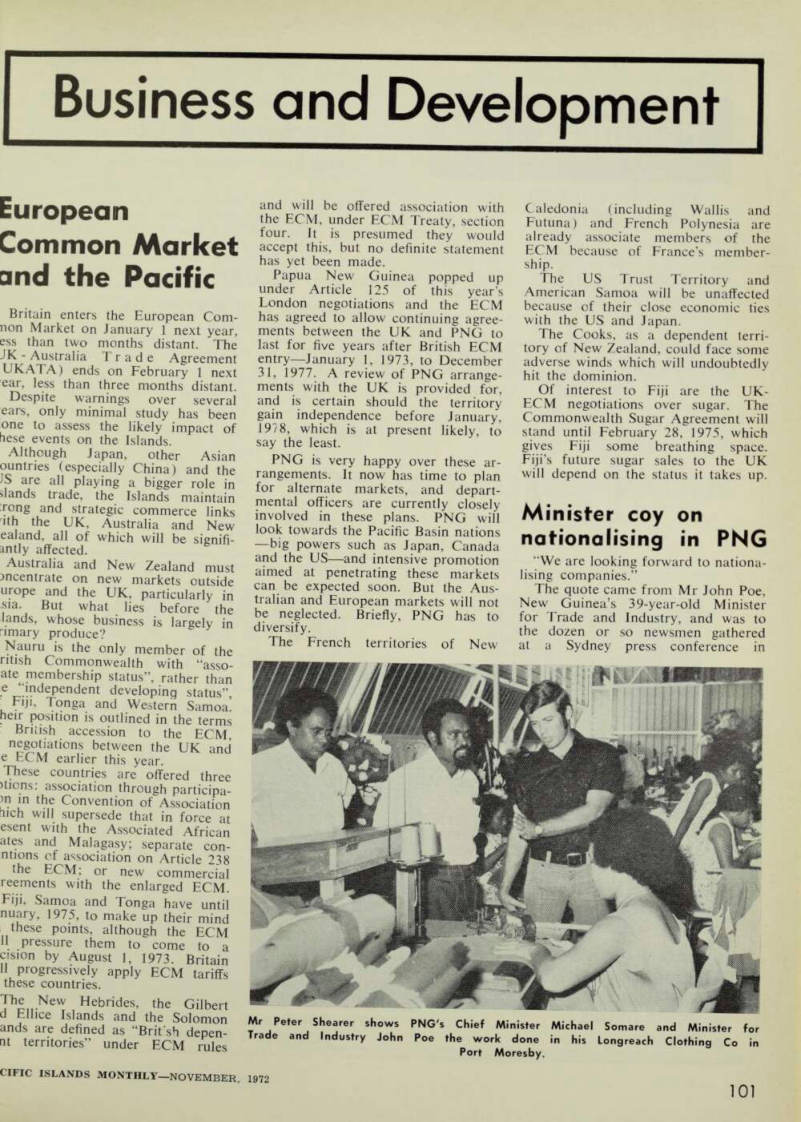
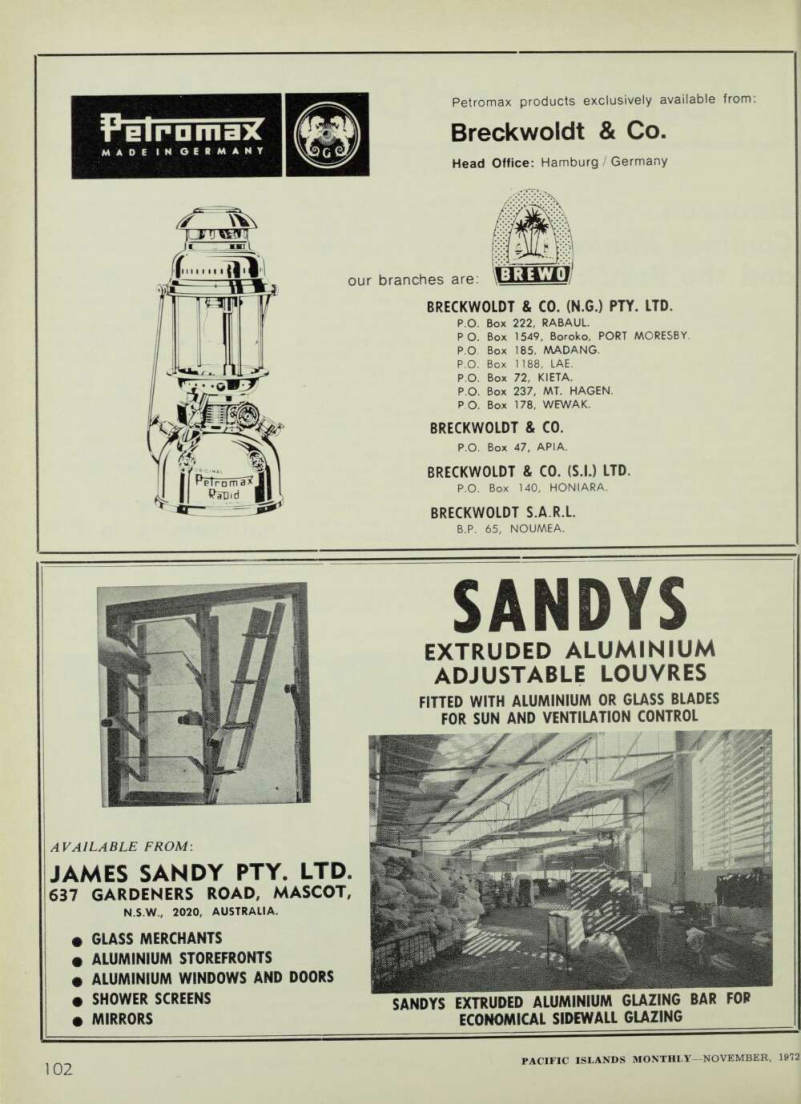

European Common Market and the Pacific
Britain enters the European Com non Market on January 1 next year, ess than two months distant. The JK - Australia Trade Agreement UKATA) ends on February 1 next ear, less than three months distant.
Despite warnings over several ears, only minimal study has been one to assess the likely impact of liese events on the Islands.
Although Japan, other Asian ountnes (especially China) and the JS are all playing a bigger role in dands trade, the Islands maintain rong and strategic commerce links I th the UK, Australia and New ealand, all of which will be signifi antly affected.
Australia and New Zealand must ancentrate on new markets outside urope and the UK, particularly in sia. But what lies before the lands, whose business is largely in rimary produce?
Nauru is the only member of the ritish Commonwealth with “asso ate membership status”, rather than
, e developing status”,
Fiji, Tonga and Western Samoa, heir position is outlined in the terms British accession to the ECM negotiations between the UK and e ECM earlier this year.
These countries are offered three )tions: association through participa nt m the Convention of Association will supersede that in force at esent with the Associated African ates and Malagasy; separate con ntions of association on Article 238 the ECM; or new commercial reements with the enlarged ECM.
Fiji, Samoa and Tonga have until nuary, 1975, to make up their mind these points, although the ECM II pressure them to come to a cision by August 1, 1973. Britain II progressively apply ECM tariffs these countries.
The New Hebrides, the Gilbert d hllice Islands and the Solomon ands are defined as “Brifsh depen nt territories” under ECM rules
and will be offered association with the ECM, under ECM Treaty, section four. It is presumed they would accept this, but no definite statement has yet been made.
Papua New Guinea popped up under Article 125 of this year’s London negotiations and the ECM has agreed to allow continuing agreements between the UK and PNG to last for five years after British ECM entry—January 1, 1973, to December 31, 1977. A review of PNG arrangements with the UK is provided for, and is certain should the territory gain independence before January, 1978, which is at present likely, to say the least.
PNG is very happy over these arrangements. It now has time to plan for alternate markets, and depart mental officers are currently closely involved in these plans. PNG will look towards the Pacific Basin nations —big powers such as Japan, Canada and the US—and intensive promotion aimed at penetrating these markets can be expected soon. But the Austrahan and European markets will not be neglected. Briefly, PNG has to
<^l^ru
The French territories of New
Caledonia (including Wallis and Futuna) and French Polynesia are already associate members of the ECM because of France’s member ship.
Hie US Trust Territory and American Samoa will be unaffected because of their close economic ties with the US and Japan, The Cooks, as a dependent terri tory of New Zealand, could face some adverse winds which will undoubtedly hit the dominion, Of interest to Fiji are the UK ECM negotiations over sugar. The Commonwealth Sugar Agreement will stand until February 28, 1975, which gives Fiji some breathing space.
Fiji’s future sugar sales to the UK will depend on the status it takes up. ka • • Minister COy On * DM/"*
nationalising IH r NCj
"We are looking forward to nationa lising companies.”
The quote came from Mr John Poe, New Guinea’s 39-year-old Minister for Trade and Industry, and was to the dozen or 80 newsmen gathered at a Sydney press conference in
Mr Peter Shearer shows PNG's Chief Minister Michael Somare and Minister for Trade and Industry John Poe the work done in his Longreach Clothing Co in
Port Moresby.
October. It produced pens and note books out of thin air.
“The government won’t take over firms by force,” Mr Poe went on.
“We will buy them out.” Mr Poe would not disclose which industries the PNG Government was exami ning to “nationalise”, but he did add that “much concern” was felt by Papua New Guineans because all in dustry was overseas-owned.
Asked to comment on recent statements from Papua New Guinea saying that some big contracts such as the Bougainville Copper project, would have to be “re-negotiated” with the PNG Government, he said: “This is not the true attitude of the govern ment. I think when the Bougainville agreement was signed it was afair deal. I still think it is a fair deal, but we may look into it later on.”
Mr Poe was on a short visit to Canberra to open a new menswear store owned by a firm with a Port Moresby subsidiary.
He wouldn’t enlarge on his com ments but they were sufficient food for thought. Unfortunately, no pro bing would bring more details.
Mr Poe was being interviewed while in Sydney to see the principals of a new PNG clothing factory (see below).
Making and selling 18,000 trousers and shorts a month, turning over $612,000 annually, is the achievement of 29-year-old Australian businessman Peter Shearer in Papua New Guinea.
Peter went to New Guinea in 1969 to start a clothing factory, won a five-year’s tax free holiday under the territory’s Pioneer Industries Act, and built a $350,000 plant at Gordon, Port Moresby.
Seventy-five per cent, of his sales are long trousers, selling from $2.95 to $6.50 a pair; his shorts sell from $1.50 to $6.50 a pair Peter told PIM he had no trouble finding labour in Port Moresby. His major problems were expensive train ing programmes and getting his pro ducts accepted by PNG retailers, who previously sold only fully imported wear. He now employs 200 people, of whom only four are Europeans, and of the 196 locals, 75 per cent, are women. His company, Lonereach Clothing Company Pty Ltd intends to export to the Solomons in the near future, and has a long-range plan of exporting to Canada.
Shirt production is proposed for later this year and he hopes to boost staff to a total of 1,000 in five years.
Peter says he can undersell Aus tralian trousers by about $4, but Communist Chinese trousers in New Guinea are still more than a match tor Longreach.
Biq Samoan contract
J The SUSIm contract to design and construct Tafuna Industrial Park, near Pago Pago International Airport, American Samoa, has gone to Honolulu-based engineering and planning firm. Belt Collins and Associates Ltd. Belt Collins signed the contract in late September.
The firm’s first job is to prepare plans for a 63-acre site including utility facilities, streets and roads.
Contract stipulations also call for the preparation of an environmental impact statement and standards for architectural and site development.
The plan must be submitted to
the US Economic Development Ad ministration for approval before im plementation. Target date for com pletion of the park is May I, next year.
Two companies—Pacific Time Inc (a Bulova Watch subsidiary) and Gulli Construction Co—already occupy sites in the park area,
OoiltOS chortCT
Holidays 111 Fiji
The F[i Government has given the green Mght for Qantas to go ahead with j ts p j an to operate inclusive tour charter flights to Fiji, despite a very cool reception from local travel
agents and some hotels. The Qantas charters will probably begin in April next year and operate at off-peak periods, bringing in about 160 passengers a week.
The week-long holidays look like costing Australians in the vicinity of S2OO, although no price had been officially announced by mid-October.
Fiji has also granted entry rights to one of the world’s largest charter companies, Trans-International Air lines. The company has been given permission to operate nine ITC flights between August, 1973 and February, 1974.
Local travel agents are far from enthusiastic about the Qantas charters, because the airline will be marketing all-inclusive seven-day holidays at a price far lower than the agents can offer. Hotels are concerned that the airline should limit its charter pro gramme to the off-peak periods. The rest of the time, many Fiji hotels don’t really need the business.
New look at
Carpenters (SthP)
Sweeping changes are taking place in one of the South Pacific’s oldest companies, W. R. Carpenter (South Pacific) Ltd, a subsidiary of Sydney based W. R. Carpenter Holdings Ltd.
Eight companies are embraced by the South Pacific subsidiary which operates in Fiji, Western Samoa and Tonga—Morris Hedstrom Ltd, Millers Ltd, Carpenters Fiji Ltd, Island Industries Ltd, Island Transport Ltd, Suva Motors Ltd, Mainline Millers Ltd and Carlton Brewery (Fiji) Ltd.
Carpenters own half the shares in the last-named company.
For years, the companies have operated separately, but management is to be streamlined for greater efficiency and as part of the process of localisation.
A shuffle of positions among the top executives announced in June foreshadowed the reorganisation which places Mr David Crowe as the first chief executive the group has had.
He became managing director and chief executive with overall respon sibility for the group’s development. (Mr I. M. Hedstrom remains resident chairman of the Fiji-based group).
Mr Lyle Cupit, formerly general manager of Suva Motors Ltd and Carpenters (Fiji) Ltd, is now chief general manager with the key respon sibility for day-to-day operations of the whole group and also executive director of the motor group.
Ex-resident director of Morris Hedstrom Ltd at Lautoka, Mr Laurie Glover is next in line as executive director of the merchandising group.
Other executives are Mr Tom
Copley (administration), Mr Alwyn O’Reilly (finance) and Mr Ken Clemens (industrial).
Changes in the new set-up will include: • The taking over of Millers retailing activities by Morris Hedstrom; • Improvements in M.H.’s Suva stores; • New Ford sales and service centre in Argo Street, Suva; o Redevelopment of Millers industrial area at Walu Bay which includes the rapidly-developing ship building yard; • A tractor sales and service centre at Walu Bay, and,
? T? 16 , in partnership
with Barclays Bank, of the nine storey shop and office block in Suva which will be called Dominion House Mr Cupit told PIM that the three well-known names, which have figured so prominently in Fiji’s economic development. Millers, Carpenters and Morns Hedstrom will be retained Reorganisation will make its influence felt among the local employees who will have greater op portunities for promotion and will pe helped by a training scheme, part )f which centred in new workshops ias already cost $50,000. In the end, dr Cupit said, the scheme will make i profit.
The reorganisation plan, which will ake care of operations for the next ah °r envisa B es a greater hareholding for Fiji’s citizens, dready locals can buy into Carlton aewery (Fiji) Ltd and the Dominion louse project. Later, local participa on m the major holding company , be considered but so far this is nly a possibility.
Operating in wholesaling and retail ing merchandise and building supplies, motor and machinery sales and
service, shipbuilding, engineering,
refrigeration, copra processing, ship ping, coconut plantations, car rentals and property development, the group had a sales turnover in 1971-72 of S4B million. Profit after tax the previous year was $2 million and the tax and duties bill came to $5.4 mil lion. The group also paid out $3.8 million in wages.
At June this year the group employed 3,740 people in Fiji, West ern Samoa and Tonga and only 43 of these were expatriates on work permits. Next year there will be less
than 30 expatriate employees, well below one per cent, of the total strength.
Polynesian Airlines
are doing better
Polynesian Airlines Ltd held its annual general meeting recently and it was a momentous occasion. For many years since the start of the air line in 1960, the company had been operating at a loss. In fact it was these losses that had made govern ment participation in the company easier.
Now, for the second year in a row,
Lyle Cupit, Carpenters (South Pacific) Jcutive director and chief general nager. An Australian, he has been in for 18 years and has applied for Fiji
citizenship.
oard chairman Ted Annandale was bie to announce to the shareholders lat the company had made a profit f $W535,531 for the financial year iding March 31, 1972, as compared ith SWSI 1,357 for the previous year, evenue and expenditure for the year rider review amounted to $839,970 id $804,439 respectively and, Mr nnandale said, revenues for 1973 ere expected to exceed the million ark.
Of greater national importance was e foreign exchange earning achieve ent of Polynesian. In 1971/72 the >mpany earned net foreign exchange excess of SWS2OO,OOO, said Mr nnandale.
All this information must have eased the shareholders immensely, course. The airline is at last begin ng to make money, but apparently is not yet quite ready to face com tition, from PanAm, that is. Pan in has repeatedly been trying to •tain landing rights in Western moa but has repeatedly been re iffed by the government, or more ecifically, by the Minister of Civil /iation, Tupuola Efi.
It appears that there are many ople, some of them influential, who >uld like to see the establishment of PanAm service to Western Samoa, icy are of the opinion that this >uld help create more efficient air e services and this in turn would in the interests of the public.
Advertisements & other items, pp. 103-108 (3 items)
101
CIFIC ISLANDS MONTHLY—NOVEMBER 1972
Sandys
JlllUllll h t
MADE IN G E R
Petromax products exclusively available from
Breckwoldt & Co.
Head Office: Hamburg / Germany [ M (f U K fa.
jffer^j
PaPid P
our branches are; i\ i 4
BRE WO
BRECKWOLDT & CO. (N.G.) PTY. LTD.
P.O. Box 222, RABAUL
PO. Box 1549, Boroko, PORT MORESBY.
P.O Box 185, MADANG.
P.O. Box 1188, LAE.
P.O. Box 72, KIETA.
P.O. Box 237, MT. HAGEN.
P O. Box 178, WEWAK.
BRECKWOLDT & CO.
P.O. Box 47, APIA.
BRECKWOLDT & CO. (5.1.) LTD.
P.O. Box 140, HONIARA.
BRECKWOLDT S.A.R.L.
B.P. 65, NOUMEA.
AVAILABLE FROM :
JAMES SANDY PTY. LTD.
637 GARDENERS ROAD, MASCOT,
N.S.W., 2020, AUSTRALIA.
• GLASS MERCHANTS
• ALUMINIUM STOREFRONTS
• ALUMINIUM WINDOWS AND DOORS
• SHOWER SCREENS
• MIRRORS
SANDYS
EXTRUDED ALUMINIUM
ADJUSTABLE LOUVRES
FITTED WITH ALUMINIUM OR GLASS BLADES
FOR SUN AND VENTILATION CONTROL
f iT v ■4 P-
SANDYS EXTRUDED ALUMINIUM GLAZING BAR FOR
ECONOMICAL SIDEWALL GLAZING
PETER FISHER TRADING
PTY. LTD.
321 PITT STREET, SYDNEY, 2000, AUSTRALIA
TELEPHONE: 26-1109 CABLES: "FISHERION", SYDNEY
EXPORTERS TO THE PACIFIC
ISLANDS
Some of the firms and products we represent: BRYANT & MAY matches AAAURI BROS, yeast
PMU FOOD PRODUCTS
TOOHEYS beer FRENCH KNIT car seat covers REPCO automotive parts
CRAVEN confectionery
BROWNBUILT office furniture
ADVANCE CONTAINERS
HARDIE'S building products SEBEL furniture BEARD beds and mattresses HUNTER DOUGLAS furniture
KLINKII plywood
STERLING bakery machinery
WHITE ABBEY Scotch whisky PETROMAX pressure lamps
BATA SHOE COMPANY
CHILTONIAN biscuits ATLAS plastic ware POLARIS stainless steel ware RENA tinned vegetables WALKER frozen meat BOND'S underwear ANDY spotlights COUNTRY CLUB shirts WILLOW metal ware FILLETTA tinned fish
PAULCALL TOOL INDUSTRIES
ASTRA razor blades WENGER quality knives GLYNGORE tinned fish VAN DER LAAN tinned meat CORDEX twine and ropes DEROPA Christmas paper WARBURTON FRANKI coolrooms DURABUILT prefabricated houses
AND MANY MORE
Supplying butchers' knives, cooks' knives, sheath knives and pocket knives from Switzerland, Sweden, Norway, Finland and other countries.
Machettes and bush knives from Portugal, Spain and other countries.
AUSTRALIA’S
TOP SELLING
CAPILLARY FITTINGS
Ask your supplier tor Yorkshire Imperial fittings:—~
YORKSHIRE
IMPERIAL
YORKSHIRE IMPERIAL AUSTRALIA PTY. LTD.
N.S.W. 77 0561. Vic. 569 0859. Old. 36 0455. W.A. 24 1017. S.A. 57 4445.
YL/4C
PORTABLE OR STANDBY POWER
Vf Pimm 500 - 50,000 watts When power goes out— PINCOR goes on! A complete selection of dependable generators, alternators, transfer panels, and demand control systems. For further information, see your area PINCOR Distributor or write to: Pioneer Gen-E-Motor Corporation 5841 W. Dickens Avenue Chicago, 111. 60639, U.S.A.
NEW HEBRIDES CONDOMINIUM
SECRETARY'MANAGER
CONDOMINIUM HOUSING AUTHORITY
Department of Lands Registry and Survey
The Joint Administration have a vacancy for a new appointment on contract for an initial period of three years.
The age limit is 45 years and the successful applicant will be required to take up his duties in January 1973 or earlier if possible.
QUALIFICATIONS
(a) At least to University Entrance (Matriculation) standard and preferably to hold a degree in commerce, economics or qualification in accountancy. (b) Knowledge of French. (c) Experience of low cost urban housing in tropical regions either on administrative or constructional side. Some knowledge of civil engineering would be an advantage.
DUTIES
To establish and manage the newly created Housing Authority and to act as Secretary to the Board of Management. Operations will initially be confined to Port Vila.
SALARY (per annum) From $A5,371 x 226 6,501 EB;
$A6,727 x 226 7,857 EB;
$A8,083 x 226 8,535.
PLUS 20% gratuity of earned emoluments on completion of contract.
GENERAL
* Free housing with hard furnishings provided.
* THERE IS NO INCOME TAX.
* Medical expenses subsidised, mostly to 75%. * Contract renewable by mutual agreement. * LEAVE—S days for each completed month of residential service. Local leave 10 days p.a. * Attractive allowances for children. * Overseas education allowances. * Movement and baggage grants. * Travel is by Air.
Applications in writing with copies only of testimonials should be forwarded to Crown Agents for Oversea Governments, 10th Floor, I.A.C. Building, 54-62 Carrington Street, Sydney, N.S.W. 2000, Australia.
Make light work of it!...
.V.V.V/.VAVA v . , . yjy A
OTHER HANOI PRODUCTS!
'Handi' range of quality products also includes: a portable Twin-Burner Stovette and 'Handi' Pumpless Petrol Iron
Keep a
HANOI handy!
No need to fumble and fume! Throw light on the subject with a 'Handi'. It's twice as bright as electric light. Completely stormproof. Simple and safe to use.
PRESSURE OPERATED
One filling gives 12 hours of brilliant 300 candle-power lighting. Built to last, with chromed, rust-proofed finish. Petrol or Kerosene models.
Ask for Handi! Everywhere!
HANDI WORKS PTY. LTD.
Compo Rd., Salisbury North - Ph. 472122
BRISBANE, QUEENSLAND, AUSTRALIA
Ask for FOUREX— the dear sparkling amber beer..
available in BOTTLES, CANS and STUBBIES
The Popular
KOI
'lts Quality Never ’
Wholesale Distributors:
C. SULLIVAN
(NEW GUINEA) PTY. LTD.,
Port Moresby, Lae, Mt, Hagen, Rabaul, Kieta, Lautoka and Suva, Fiji.
AGENCIES :
R. Bensley—Madang. Ping Shee & Co. —Wewak. E. V. Lawson Pty. Ltd. — Honiara, British Solomon Islands. fan ipniwnl
xxxx
Brewed from the finest Ingredients by Castlemaine Perkins Limited, Brisbane, Queensland, Australia.
105
CIFIC ISLANDS MONTHLY—NOVEMBER, 1972
Business Briefs
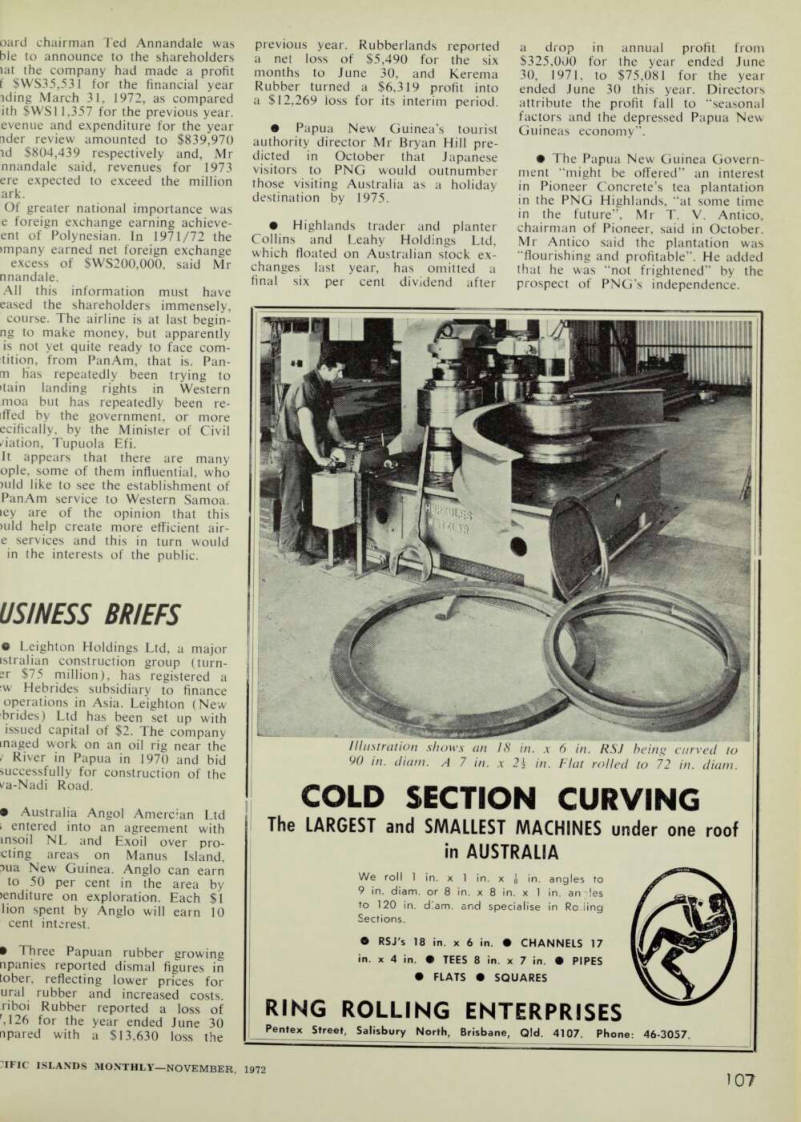
© Leighton Holdings Ltd, a major istralian construction group (turn er $75 million), has registered a :w Hebrides subsidiary to finance operations in Asia. Leighton (New brides) Ltd has been set up with issued capital of $2. The company inaged work on an oil rig near the / River in Papua in 1970 and bid successfully for construction of the va-Nadi Road. • Australia Angol Amercian Ltd 1 entered into an agreement with msoil NL and Exoil over pro ving areas on Manus Island, ?ua New Guinea. Anglo can earn to 50 per cent in the area by >enditure on exploration. Each $1 lion spent by Anglo will earn 10 cent interest. © Three Papuan rubber growing npanies reported dismal figures in tober, reflecting lower prices for ura l rubber and increased costs, riboi Rubber reported a loss of r ,126 for the year ended June 30 npared with a $13,630 loss the
previous year. Rubberlands reported a net loss of $5,490 for the six months to June 30, and Kerema Rubber turned a $6,319 profit into a $12,269 loss for its interim period. • Papua New Guinea’s tourist authority director Mr Bryan Hill pre dicted in October that Japanese visitors to PNG would outnumber those visiting Australia as a holiday destination by 1975. • Highlands trader and planter Collins and Leahy Holdings Ltd, which floated on Australian stock ex changes last year, has omitted a final six per cent dividend after
a drop in annual profit from $325,000 for the year ended June 30, 1971, to $75,081 for the year ended June 30 this year. Directors attribute the profit fall to “seasonal factors and the depressed Papua New Guineas economy”. • The Papua New Guinea Govern ment “might be offered” an interest in Pioneer Concrete’s tea plantation in the PNG Highlands, “at some time in the future”, Mr T. V. Antico, chairman of Pioneer, said in October.
Mr Antico said the plantation was “flourishing and profitable”. He added that he was “not frightened” by the prospect of PNG’s independence.
Advertisements & other items, p. 109 (2 items)
Ific Islands Monthly—November, 1972
Cold Section Curving
Illustration shows an 18 in. x 6 in. RSJ heini> carved to 90 in. diam. A 7 in. x 2\ in. Flat rolled to 72 in. diam.
The LARGEST and SMALLEST MACHINES under one roof
in AUSTRALIA
RING
We roll 1 in. x 1 in. x 5 in. angles to 9 in. diam. or 8 in. x 8 in. x 1 in. an les to 120 in. diam. and specialise in Ro.iing Sections. ® RSJ's 18 in. x 6 in. • CHANNELS 17 in. x 4 in. • TEES 8 in. x 7 in. • PIPES
• FLATS • SQUARES
ROLLING ENTERPRISES
(S J’entex Street, Salisbury North, Brisbane, Qld. 4107. Phone; 46-3057.
Lovelier Complexion
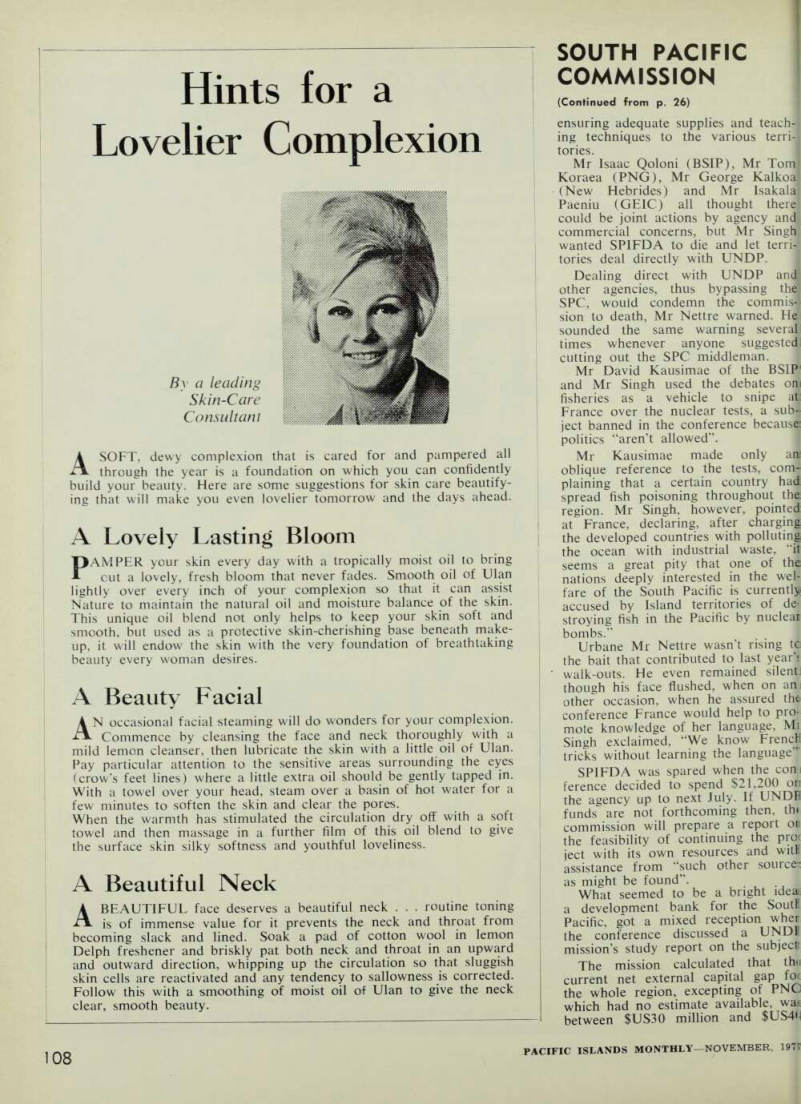
Hints for a Lovelier Complexion
A SOFT, dewy complexion that is cared for and pampered all through the year is a foundation on which you can confidently build your beauty. Here are some suggestions for skin care beautify ing that will make you even lovelier tomorrow and the days ahead.
A Lovely Lasting Bloom
PAMPER your skin every day with a tropically moist oil to bring cut a lovely, fresh bloom that never fades. Smooth oil of Ulan lightly over every inch of your complexion so that it can assist Nature to maintain the natural oil and moisture balance of the skin.
This unique oil blend not only helps to keep your skin soft and smooth, but used as a protective skin-cherishing base beneath make up, it will endow the skin with the very foundation of breathtaking beauty every woman desires.
A Beauty Facial
AN occasional facial steaming will do wonders for your complexion.
Commence by cleansing the face and neck thoroughly with a mild lemon cleanser, then lubricate the skin with a little oil of Ulan.
Pay particular attention to the sensitive areas surrounding the eyes (crow’s feet lines) where a little extra oil should be gently tapped in.
With a towel over your head, steam over a basin of hot water for a few minutes to soften the skin and clear the pores.
When the warmth has stimulated the circulation dry off with a soft towel and then massage in a further film of this oil blend to give the surface skin silky softness and youthful loveliness.
A Beautiful Neck
A BEAUTIFUL face deserves a beautiful neck . . . routine toning is of immense value for it prevents the neck and throat from becoming slack and lined. Soak a pad of cotton wool in lemon Delph freshener and briskly pat both neck and throat in an upward and outward direction, whipping up the circulation so that sluggish skin cells are reactivated and any tendency to sallowness is corrected.
Follow this with a smoothing of moist oil of Ulan to give the neck clear, smooth beauty.
By a leading Skin-Care Consultant
Advertisements & other items, pp. 110-114 (4 items)
Commission
108
PACIFIC ISLANDS MONTHLY —NOVEMBER, 197
SOUTH PACIFIC
COMMISSION
(Continued from p. 26)
109
FIC ISLANDS MONTHLY—NOVEMBER, 1972
Prickly
camion
Tarpaulin Material
A Cover for
all seasons
Camion is a double sided P.V.C. coated nylon tarpaulin material for use in any situation where protection from the weather is required. Manufactured in rolls 50” wide Camion can be seam welded to provide a cover of any size or shape.
Camion is marketed by w
Fletcher
International
For further information and name of nearest stockist contact Fletcher International, Private Mail Bag, Auckland, New Zealand
PRICKLY
HEAT?
relief is swift with
ISOPHYLI
(for adults)
egozite
(for infants or young children) ask your family chemist!
EGO LABORATORIES PTY. LTD.
MELBOURNE
Specialists for Dermatological preparations
C)6E/??-'
76 Years' Experience
Selling
"SERVICE"
to the Pacific Islands
NELSON & ROBERTSON
PLANTATION HOUSE, 197 CLARENCE STREET, SYDNEY
CABLES; "IVAN", SYDNEY, BRISBANE. TELEX; AA22381, SYDNEY.
ISLAND MERCHANTS
SHIPPING AGENTS
TRAVEL AGENTS
INSURANCE AGENTS
REAL ESTATE AGENTS
Branch Office; Nelson 8 Robertson Ply. Ltd., 303 Adelaide St., Brisbane, Old New Guinea Representatives: Rabaol Trading Co. Pty. Ltd., Rabaul Lae Madang Kieta.
PTY. LIMITED
(Established 1895)
THE
YORKSHIRE INSURANCE
CO. LTD.
(Incorporated in England)
A MEMBER OF THE GENERAL ACCIDENT GROUP OF COMPANIES
ALL CLASSES OF INSURANCE
AUSTRALIAN HEAD OFFICE: 10-12 Spring Street, Sydney.
Group Manager for Australia: R. M. Trotter.
PAPUA AND NEW GUINEA BRANCH: Douglas Street, Port Moresby.
Manager: H. M. Harvey.
CHIEF ISLAND REPRESENTATIVES
Rabaul ASP (N G ) Ltd • Lae Radio Cabs (Lae) Pty. Ltd.; Madang, W. Stokes; Manus, Edgell & Whl feley A Ltd.; Ltd.; Suva, Williams & Gosling Ltd Noumea R. Laubreaux; Norfolk Island, Martin's Agencies; Apia, E. A. Coxon & Co., Vila, C. Sullivan (INI) Pty. Ltd.
Duralfoil
Aluminium Foil
The space-age
Insulator '
Duralfoil is a high grade aluminium foil membrane available in rolls either single or double sided. When installed within the roof of a building Duralfoil protects against the heat of the sun to give greatly improved working and living conditions.
Duralfoil is marketed by w
Fletcher
International
For further information and name of nearest stockist contact Fletcher International, Private Mail Bag, Auckland, New Zealand
SPECIALIST EXPORTERS
POTATOES ONIONS
GARLIC BLUEPEAS
FRESH FRUIT AND VEGETABLES
N.Z. DAIRY BOARD GHEE
GERRARD WIRE TYING EQUIPMENT
GENERAL MERCHANDISE COOLER
FREEZER
Current Quotations from:
Turners Supply Company Limited
P.O. Box 1370, AUCKLAND. Cables: "TUSCO" Auckland.
PACIFIC EXPORT DIVISION of TURNERS & GROWERS LTD. Wholesale Fruit and Produce Merchants, Auckland, New Zealand.
SU LLI VANS
MELBOURNE SYDNEY
C. SULLIVAN (EXPORT) PTY. LTD.,
4TH FLOOR. KEMBLA BUILDING.
60 MARGARET STREET. SYDNEY
(G.P.O. BOX 3373).
AUCKLAND CABLES AND TELEGRAMS: “CHASULL”.
BRISBANE
LONDON
OFFERS A COMPREHENSIVE AND EFFICIENT
BUYING SERVICE TO THE PACIFIC ISLANDS
OFFICES AT:
PORT MORESBY • LAE • RABAUL • KIETA • MOUNT HAGEN • BULUMA • SUVA • LAUTOKA • NOUMEA • HONIARA • PORT VILA
"SULLIVANS for SERVICE”
r\ v/ X I i Looking for an
INTERIOR
PLYWOOD
that won’t get eaten by insects?
KLINKII
PRUFPLY
Made by Commonwealth New Guinea Timbers Ltd, Bulolo, New Guinea Available from plywood suppliers in the Territory Pacific area
Tfic Islands Monthly—November, 1972
Produce Prices
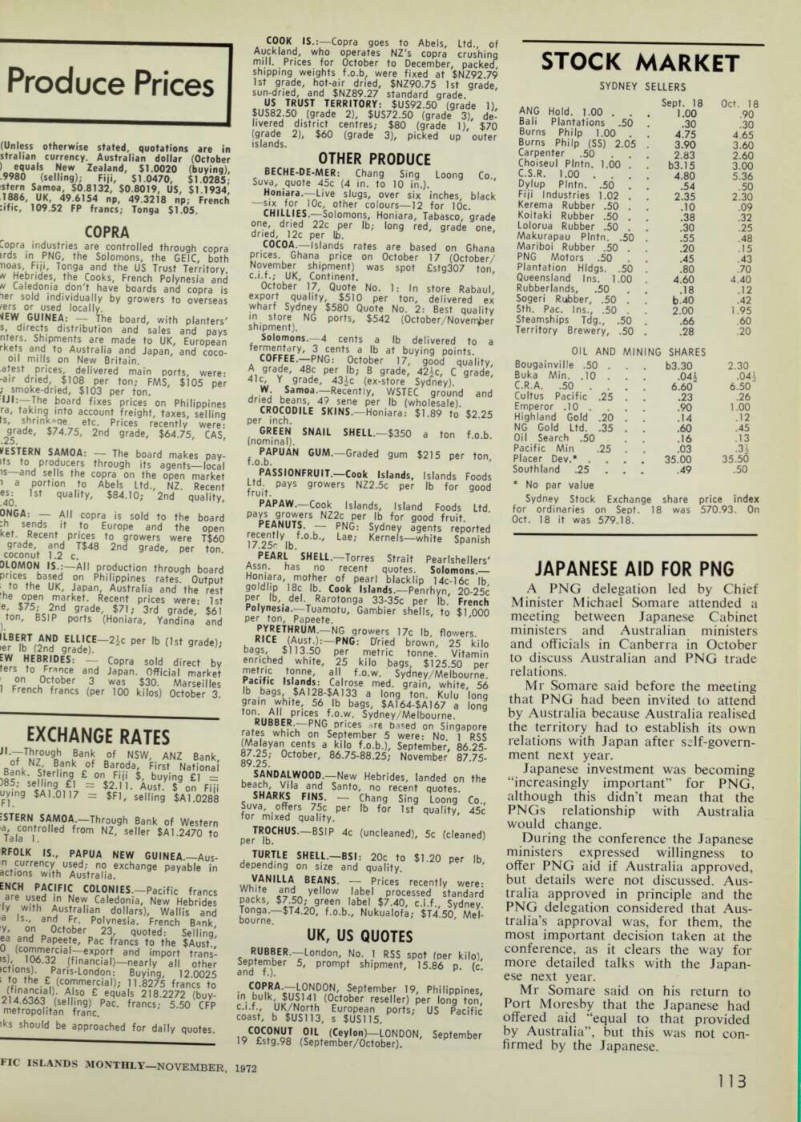
(Unless otherwise stated, quotations are in strahan currency. Australian dollar (October ) equals New Zealand, $1.0020 (buying), .9980 (selling); Fiji, $1.0470, $1.0285stern Samoa, $0.8132, $0.8019, US, $1.1934, ■ 1.888, UK, 49.6154 np, 49.3218 np; French :ific, 109.52 FP francs; Tonga $1.05.
Copra
Copra industries are controlled through copra irds in PNG, the Solomons, the GEIC, both no ??V F . l ! i ' Tonga and the us Trust Territory.
H Hebrides, the Cooks, French Polynesia and n Caledonia don't have boards and copra is ier sold individually by growers to overseas 'ers or used locally.
GUINEA: The board, with planters' s, directs distribution and sales and pays nters. Shipments are made to UK, European rkets and to Australia and Japan, and coco oil mills on New Britain, atest prices, delivered main ports, were ■air dried, $lOB per ton; FMS, $lO5 per ; smoke-dried, $lO3 per ton.
Uh—-The board fixes prices on Philippines ra, taking into account freight, taxes, selling rs, shrinkage, etc. Prices recently were: 574.75, 2nd grade, $64.75, CAS, WESTERN SAMOA: The board makes pay its to producers through its agents—local is— and sells the copra on the open market i a portion to Abels Ltd., NZ. Recent 40 St quality ' $ B4 -10; 2nd quality, ONGA: All copra is sold to the board -h sends it to Europe and the open ket. Recent prices to growers were Ts6o grade, and Ts4B 2nd grade, per ton coconut 1.2 c. y ‘ DLOMON IS.:— All production through board prices besed on Philippines rates. Output to the UK, Japan, Australia and the rest he mar ket. Recent prices were- Ist ifWff' 2 * 1 per ib (,s * 9rade,; EW HEBRIDES; Copra sold direct by ters to France and Japan. Official market i P°rnn . oc l° ber , 3 was $3O. Marseilles 1 French francs (per 100 kilos) October 3.
COOK IS.:— Copra goes to Abels, Ltd., of Auckland, who operates NZ's copra crushing rnill. Prices for October to December, packed, shipping weights f.o.b, were fixed at $NZ92.79 Ist grade, hot-air dried, $NZ90.75 Ist grade sun-dried, and $NZ89.27 standard grade.
Us Trust Territory: $U592.50 (Grade 1),
5U582.50 (grade 2), $U572.50 (grade 3), de livered district centres,- $BO (grade 1), $7O (grade 2), $6O (grade 3), picked up outer islands.
Other Produce
BECHE-DE-MER; Chang Sing Loong Co Suva, quote 45c (4 in. to 10 in.).
Honiara.—Live slugs, over six inches, black —six for 10c, other colours—l2 for 10c.
CHILLIES. Solomons, Honiara, Tabasco, grade one, dried 22c per lb; long red, grade one, dried, 12c per lb.
COCOA.— lslands rates are based on Ghana prices. Ghana price on October 17 (October/ November shipment) was spot £stg3o7 ton, c.i.f.; UK, Continent.
October 17, Quote No. 1: In store Rabaul, export quality, $5lO per ton, delivered ex wharf Sydney $5BO Quote No. 2: Best quality shipment) NG P ° rtS/ $542 (october / Noverr * )er Solomons.—4 cents a lb delivered to a termentary, 3 cents a lb at buying points.
COFFEE. PNG: October 17, good quality, A grade, 48c per lb; B grade, A2\c, C grade, 41c, Y grade, 43£c (ex-store Sydney).
W Samoa.—Recently, WSTEC ground and d 49 sene P er lb (wholesale).
CROCODILE SKlNS. —Honiara: $1.89 to $2 25 per inch.
GREEN SNAIL SHELL.— S3SO a ton f.o.b. (nominal). f Q P^ PUAN GUM Graded 9um $215 per ton, JASSIONFRUIT. —Cook Islands, Islands Foods fruit PayS 9roWers NZ2 - 5c P er to for good PAPAW.— Cook Islands, Island Foods Ltd Pa DcA 9 J.°.Tc erS NZ2c per lb for 9°°d fruit. rAr P onf| NUT ?‘ F NG: Sydney a 9ents reported 17 25r y |b f ' 0 ' b ‘' Lae ' Kernels — white Spanish PEARL SHELL.— Torres Strait Pearlshellers' Assn, has no recent quotes. Solomons.— H ij l r ra/ ,^ not ,L er of pearl blacklip 14c-16c lb goldhp 18c lb. Cook Islands.— Penrhyn, 20-25 c Per lb, del. Rarotonga 33-35 c per lb. French Polynesia.— Tuamotu, Gambier shells, to $1 000 per ton, Papeete. d.^c ET^ RUM ;~ NG 9rowers 17c lb, flowers.
RICE (Aust.): — PNG: Dried brown, 25 kilo bags, $113.50 per metric tonne. Vitamin enriched white, 25 kilo bags, $125.50 per p® t . r J. c , t< ? nna ' all . f°-w. Sydney/Melbourne.
Pacific Islands: Calrose med. grain, white, 56 lb bags, SAI2B-$A 133 a long ton. Kulu long gram white, 56 lb bags, SAI64-SAI67 a long t 0n D. I ™L prices f ‘°-y v - Sydney/Melbourne.
RUBBER.— PNG prices nre based on Singapore rates which on September 5 were: No. 1 RSS (Malayan cents a kilo f.0.b.), September, 86.25- 89 25'' ° Ctober ' 86 - 75 - 88 -25; November 87.75- SANDALWOOD.— New Hebrides, landed on the Deach, Vila and Santo, no recent Quotes SHARKS FINS. Chang Sing Loong Co., Suva, offers 75c per lb for Ist quality, 45c for mixed quality. peMb CHUS BSIP 4 ° ( unc,eaned )/ 5c (cleaned) TURTLE SHELL.—BSI: 20c to $1.20 per lb depending on size and quality.
VANILLA BEANS. - Prices’ recently were: White and yellow label processed standard packs, $7.50; green label $7.40, c.i.f., Sydney Tonga.—sl4.2o, f.0.b., Nukualofa; $14.50* Mel bourne.
Uk, Us Quotes
RUBBER. —London. No. I RSS spot (per kilo), September 5, prompt shipment, 15.86 p. (c. • G O™A,-LONDON, September 19, Philippines, in bulk SUSI4I (October reseller) per long ton, UK/North European ports; US Pacific coast, b SUSII3, s SUSIIS. io C^?n N oJ .? ,L k ( c ®y |o n)—LONDON, September 19 £stg.9B (September/October).
Exchange Rates
J, ;T Tbr 7 0tJ 9 h Ba "k Of NSW, ANZ Bank, R °J. NZ ; ank O of Baroda, First National Bank. Sterling £ on Fiji $, buying £1 = )85 ; selling £1 = $2.11. Aust. $ on Fiii uymg $A 1 .011 7 = SFI, selling $A1.0288 ■STERN SAMOA — Through Bank of Western a fala° n i tr ° Cd fr ° m NZ ' SCller * A 1.2470 t 0
Rfolk Is., Papua New Guinea.—Aus
n currency used; no exchange payable in actions with Australia.
E ?r? COLONIES.— Pacific francs •I® 1 * u .fh d i" Caledonia, New Hebrides ly with Australian dollars), Wallis and * L' and F . r - Po| Ynesia. French Bank, Y' °" „ October 23, quoted: Selling ea and Papeete, Pac francs to the sAusf 9 , C mx n oo Cia t“ €Xp ?'T and import trans rtinnl? 6 ’ 3 ? - (fl ' nan s ia !)—nearly all other ict ions). Pans-London: Buying 12 0025 ; mnln!- £ h (c * r ] imer r. cial); 11 -3275 francs to Also £ equals 218.2272 (buy -2146363 (selling) Pac. francs; 5.50 CFP metropolitan franc. iks should be approached for daily quotes.
Stock Market
• No par value Sydney Stock Exchange share price index for ordinaries on Sept. 18 was 570.93. On Oct. 18 it was 579.18.
Sydney Sellers
Sept. 18 Oct. 18 ANG Hold. 1.00 . . . 1.00 .90 Bali Plantations .50 .30 .30
Burns Philp 1.00 .
4.75 4.65 Burns Philp (SS) 2.05 3.90 3.60 Carpenter .50 2.83 2.60 Choiseul Plntn. 1.00 b3.15 3.00
C.S.R. 1.00 . . ,
4.80 5.36 Dylup Plntn. .50 . .54 .50 Fiji Industries 1.02 . 2.35 2.30 Kerema Rubber .50 . .10 .09 Koitaki Rubber .50 . .38 .32 Lolorua Rubber .50 . .30 .25 Makurapau Plntn. .50 .55 .48 Mariboi Rubber .50 . .20 .15 PNG Motors .50 .45 .43 Plantation Hldgs. .50 .80 .70 Queensland Ins. 1.00 4.60 4.40 Rubberlands, .50 .18 .12 Sogeri Rubber, .50 . b.40 .42 Sth. Pac. Ins., .50 . 2.00 1.95 Steamships Tdg., .50 .66 .60 Territory Brewery, .50 .28 .20
Oil And Mining Shares
Bougainville .50 . b3.30 2.30 Buka Min. .10 . .04 J .04 i
C.R.A. .50 ... .
6.60 6.50 Cultus Pacific .25 . .23 .26 Emperor .10 . .90 1.00 Highland Gold .20 . .14 .12 NG Gold Ltd. .35 . . .60 .45 Oil Search .50 .16 .13 Pacific Min .25 . .03 •3£ Placer Dev.* ... 35.00 35.50 Southland .25 .49 .50
Japanese Aid For Png
A PNG delegation led by Chief Minister Michael Somare attended a meeting between Japanese Cabinet ministers and Australian ministers and officials in Canberra in October to discuss Australian and PNG trade relations.
Mr Somare said before the meeting that PNG had been invited to attend by Australia because Australia realised the territory had to establish its own relations with Japan after sdf-govern ment next year.
Japanese investment was becoming “increasingly important” for PNG, although this didn’t mean that the PNGs relationship with Australia would change.
During the conference the Japanese ministers expressed willingness to offer PNG aid if Australia approved, but details were not discussed. Aus tralia approved in principle and the PNG delegation considered that Aus tralia’s approval was, for them, the most important decision taken at the conference, as it clears the way for more detailed talks with the Japan ese next year.
Mr Somare said on his return to Port Moresby that the Japanese had offered aid “equal to that provided by Australia”, but this was not con firmed by the Japanese,
Advertisements & other items, pp. 115-116 (2 items)
113
FIC ISLANDS MONTHLY—NOVEMBER, 1972
The Bank Line
nedlloyd Koninklijke Nedlloyd
nv REGULAR SAILINGS BY FAST, MODERN, CARGO VESSELS
from CONTINENTAL PORTS via PANAMA to
PAPEETE, APIA, SUVA, LAUTOKA, NOUMEA and
NEW ZEALAND
other ports called at subject to sufficient inducement
heavy-lift facilities —refrigerated space—cargo deeptonks
For further particulars apply to agents Ets Donald Tahiti, Russell & Sommers (Wellington) Carpenter's Fiji Ltd., Papeete. Ltd., Wellington, N.Z. Suva.
Morris Hedstrom & Co. Ltd., O. F. Nelson & Co. Ltd., Agence Maritime Pentecost, Lautoka. Apia. Noumea.
Interocean Australia Services Pty. Ltd., Sydney.
THE BANK LINE
MONTHLY SERVICES
U.K., CONTINENT to PAPUA-NEW GUINEA Cr SOLOMON ISLANDS PAPUA, NEW GUINEA to NORTH AMERICA & U.K., CONTINENT SOLOMON ISLANDS, FIJI, TONGA, SAMOA AND TARAWA to U.K.,
CONTINENT
☆ US GULF/AUSTRALASIA VESSELS CALL AT FIJI WHEN REQUIRED W
FOR PARTICULARS APPLY:
THE BANK LINE (AUSTRALASIA) PTY. LTD., SYDNEY, N.S.W,
Shipping
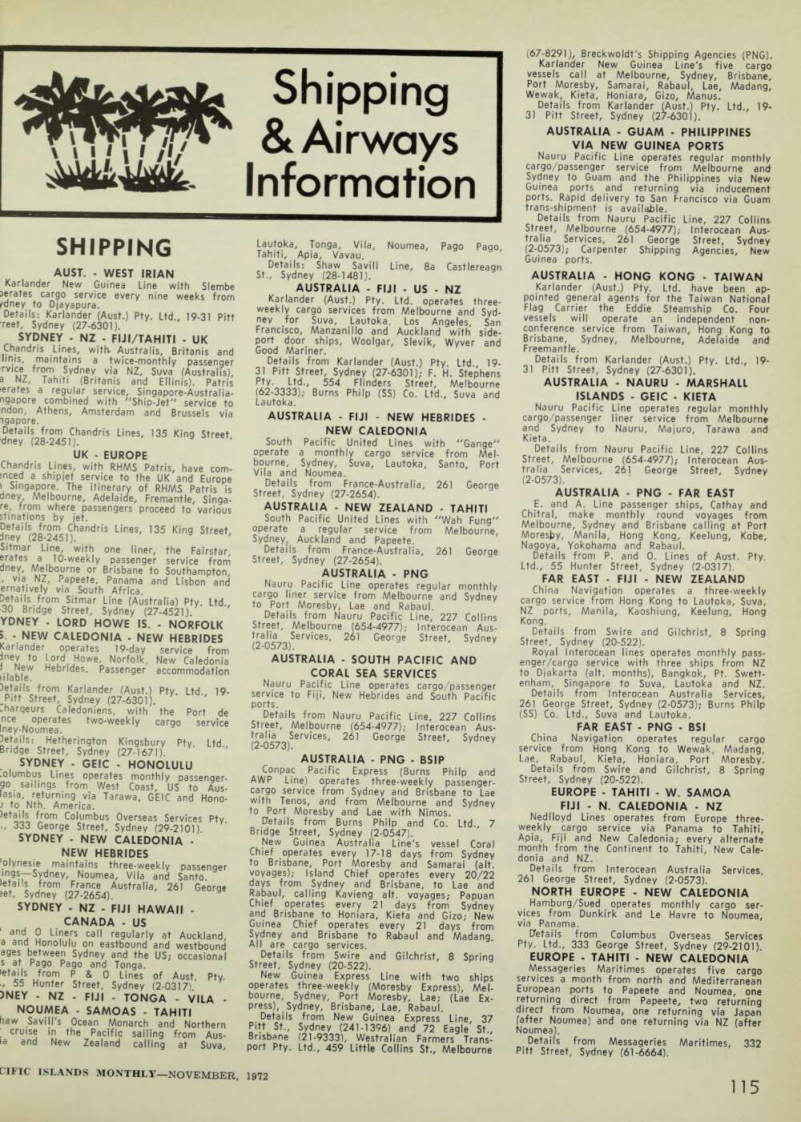
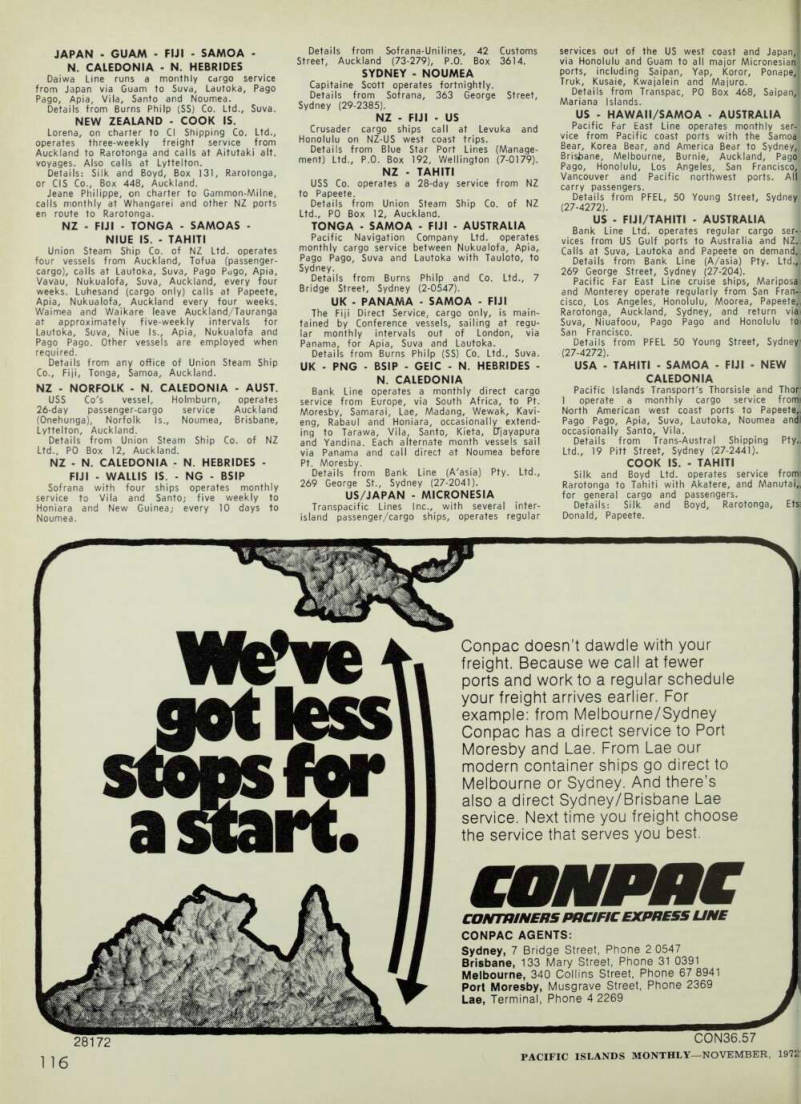
& Airways Information
Aust. - West Irian
Karlander New Guinea Line with Slembe aerates cargo service every nine weeks from rdney to Djayapura.
Details: Karlander (Aust.) Pty. Ltd., 19-31 Pitt reet, Sydney (27-6301).
SYDNEY - NZ - FIJI/TAHITI - UK Chandns Lines, with- Australis, Britanis and lims, maintains a twice-monthly passenger rvice from Sydney via NZ, Suva (Australis), a NZ, Tahiti (Britanis and Ellinis). Patris crates a regular service, Singapore-Australia ngapore combined with "Ship-Jet" service to ndon, Athens, Amsterdam and Brussels via igapore.
Details from Chandris Lines, 135 King Street, dney (28-2451).
Uk - Europe
Chandris Lines, with RHMS Patris, have corn iced a shipjet service to the UK and Europe i Singapore. The itinerary of RHMS Patris is dney Melbourne, Adelaide, Fremantle, Singa re, from where passengers proceed to various stinations by jet. fnly l (28-2451 < j handrIS LineS ' 135 Ki " 9 Street ' Sitmar Line, with one liner, the Fairstar j rates .. a ,J°' week| y Passenger service from dney, Melbourne or Brisbane to Southampton, , via NZ, Papeete, Panama and Lisbon and ernatively via South Africa.
Details from Sitmar Line (Australia) Pty. Ltd., 30 Bridge Street, Sydney (27-4521).
YDNEY - LORD HOWE IS. - NORFOLK 5. • NEW CALEDONIA - NEW HEBRIDES Karlander operates 19-day service from ney to Lord Howe, Norfolk, New Caledonia 1 New Hebrides. Passenger accommodation nlable.
Details from Karlander (Aust.) Ptv Ltd 19- _Pitt Street, Sydney (27-6301). V ' .hargeurs Caledoniens, with the Port de nee operates two-weekly cargo service Iney-Noumea.
Details.- Hetherington Kingsbury Pty Ltd Bridge Street, Sydney (27-1671).
Sydney - Geic - Honolulu
.olumbus Lines operates monthly passenger go sailings from West Coast, US to Aus lasia, returning via Tarawa, GEIC and Hono- J to Nth. America.
Details from Columbus Overseas Services Pty 333 George Street, Sydney (29-2101)
Sydney - New Caledonia -
New Hebrides
’olynesie maintains three-weekly passenger mgs—Sydney, Noumea, Vila and Santo.
Details from France Australia, 261 George ;et, Sydney (27-2654).
SYDNEY - NZ - FIJI HAWAII -
Canada - Us
’ and „ 2 Li ? e . rs caM regularly at Auckland, a and Honolulu on eastbound and westbound ages between Sydney and the US; occasional s at Pago Pago and Tonga.
Details from P & 0 Lines of Aust Pty. 55 Hunter Street, Sydney (2-0317) DNEY - NZ - FIJI - TONGA - VILA -
Noumea - Samoas - Tahiti
haw SaviM's Ocean Monarch and Northern ; cruise in the Pacific sailing from Aus ia and New Zealand calling at Suva,
Lautoka, Tonga, Vila, Noumea, Pago Pago, Tahiti, Apia, Vavau.
Details: Shaw Savill Line, 8a Castlereagn St., Sydney (28-1481).
AUSTRALIA - FIJI - US - NZ Karlander (Aust.) Pty. Ltd. operates three weekly cargo services from Melbourne and Syd ney for Suva, Lautoka, Los Angeles, San Francisco, Manzanillo and Auckland with side port door ships, Woolgar, Slevik, Wyver and Good Mariner.
Details from Karlander (Aust.) Pty. Ltd., 19- 31 Pitt Street, Sydney (27-6301); F. H. Stephens Pty. Ltd., 554 Flinders Street, Melbourne (62-3333); Burns Philp (SS) Co. Ltd., Suva and Lautoka.
AUSTRALIA - FIJI - NEW HEBRIDES -
New Caledonia
South Pacific United Lines with "Gange" operate a monthly cargo service from Mel bourne, Sydney, Suva, Lautoka, Santo, Port Vila and Noumea.
Details from France-Australia, 261 George Street, Sydney (27-2654).
Australia - New Zealand - Tahiti
South Pacific United Lines with "Wah Fung" operate a regular service from Melbourne, Sydney, Auckland and Papeete.
Details from France-Australia, 261 George Street, Sydney (27-2654).
Australia - Png
Nauru Pacific Line operates regular monthly cargo liner service from Melbourne and Sydney to Port Moresby, Lae and Rabaul.
Details from Nauru Pacific Line, 227 Collins Street, Melbourne (654-4977); Interocean Aus tralia Services, 261 George Street, Sydney (2-0573). V
Australia - South Pacific And
Coral Sea Services
Nauru Pacific Line operates cargo/passenger service to Fiji, New Hebrides and South Pacific ports.
Details from Nauru Pacific Line, 227 Collins Street, Melbourne (654-4977); Interocean Aus tralia Services, 261 George Street, Sydney (2-0573).
Australia - Png - Bsip
Conpac Pacific Express (Burns Philp and AWP Line) operates three-weekly passenger cargo service from Sydney and Brisbane to Lae with Tenos, and from Melbourne and Sydney to Port Moresby and Lae with Nimos.
CTetails from Burns Philp and Co. Ltd. 7 Bridge Street, Sydney (2-0547).
New Guinea Australia Line's vessel Coral Chief operates every 17-18 days from Sydney to Brisbane, Port Moresby and Samarai (alt. voyages); Island Chief operates every 20/22 days from Sydney and Brisbane, to Lae and Rabaul, calling Kavieng alt. voyages; Papuan Chief operates every 21 days from Sydney and Brisbane to Honiara, Kieta and Gizo,- New Guinea Chief operates every 21 days from Sydney and Brisbane to Rabaul and Madang.
All are cargo services.
Details from Swire and Gilchrist, 8 Spring Street, Sydney (20-522).
New Guinea Express Line with two ships operates three-weekly (Moresby Express), Mel bourne, Sydney, Port Moresby, Lae; (Lae Ex press), Sydney, Brisbane, Lae, Rabaul.
Details from New Guinea Express Line, 37 Pitt St., Sydney (241-1396) and 72 Eagle St., Brisbane (21-9333), Westralian Farmers Trans port Pty. Ltd., 459 Little Collins St., Melbourne
(67-8291), Breckwoldt's Shipping Agencies (PNG).
Karlander New Guinea Line's five cargo vessels call at Melbourne, Sydney, Brisbane, Port Moresby, Samarai, Rabaul, Lae, Madang, Wewak, Kieta, Honiara, Gizo, Manus.
Details from Karlander (Aust.) Pty. Ltd., 19- 31 Pitt Street, Sydney (27-6301).
Australia - Guam - Philippines
Via New Guinea Ports
Nauru Pacific Line operates regular monthly cargo/passenger service from Melbourne and Sydney to Guam and the Philippines via New Guinea ports and returning via inducement ports. Rapid delivery to San Francisco via Guam trans-shipment is available.
Details from Nauru Pacific Line, 227 Collins Street, Melbourne (654-4977); Interocean Aus tralia Services, 261 George Street, Sydney (2-0573); Carpenter Shipping Agencies, New Guinea ports.
Australia - Hong Kong - Taiwan
Karlander (Aust.) Pty. Ltd. have been ap pointed general agents for the Taiwan National Flag Carrier the Eddie Steamship Co. Four vessels will operate an independent non conference service from Taiwan, Flong Kong to Brisbane, Sydney, Melbourne, Adelaide and Freemantle.
Details from Karlander (Aust.) Pty. Ltd., 19- 31 Pitt Street, Sydney (27-6301).
Australia - Nauru - Marshall
Islands - Geic - Kieta
Nauru Pacific Line operates regular monthly cargo/passenger liner service from Melbourne and Sydney to Nauru, Majuro, Tarawa and Kieta.
Details from Nauru Pacific Line, 227 Collins Street, Melbourne (654-4977); Interocean Aus tralia Services, 261 George Street, Sydney (2-0573).
Australia - Png - Far East
E. and A. Line passenger ships, Cathay and Chitral, make monthly round voyages from Melbourne, Sydney and Brisbane calling at Port Moresby, Manila, Flong Kong, Keelung, Kobe, Nagoya, Yokohama and Rabaul.
Details from P. and 0. Lines of Aust. Pty.
Ltd., 55 Hunter Street, Sydney (2-0317).
FAR EAST - FIJI - NEW ZEALAND China Navigation operates a three-weekly cargo service from Hong Kong to Lautoka, Suva, NZ ports, Manila, Kaoshiung, Keelung, Hong Kong.
Details from Swire and Gilchrist, 8 Spring Street, Sydney (20-522).
Royal Interocean lines operates monthly pass enger/cargo service with three ships from NZ to Djakarta (alt. months), Bangkok, Pt. Swett enham, Singapore to Suva, Lautoka and NZ.
Details from Interocean Australia Services, 261 George Street, Sydney (2-0573); Burns Philp (SS) Co. Ltd., Suva and Lautoka.
Far East - Png - Bsi
China Navigation operates regular cargo service from Hong Kong to Wewak, Madang, Lae, Rabaul, Kieta, Honiara, Port Moresby.
Details from Swire and Gilchrist, 8 Spring Street, Sydney (20-522).
Europe - Tahiti - W. Samoa
Fiji - N. Caledonia - Nz
Nedlloyd Lines operates from Europe three weekly cargo service via Panama to Tahiti, Apia, Fiji and New Caledonia; every alternate month from the Continent to Tahiti, New Cale donia and NZ.
Details from Interocean Australia Services, 261 George Street, Sydney (2-0573).
North Europe - New Caledonia
Hamburg/Sued operates monthly cargo ser vices from Dunkirk and Le Havre to Noumea, via Panama.
CTetails from Columbus Overseas Services Pty. Ltd., 333 George Street, Sydney (29-2101).
Europe - Tahiti - New Caledonia
Messageries Maritimes operates five cargo services a month from north and Mediterranean European ports to Papeete and Noumea, one returning direct from Papeete, two returning direct from Noumea, one returning via Japan (after Noumea) and one returning via NZ (after Noumea).
Details from Messageries Maritimes, 332 Pitt Street, Sydney (61-6664).
JAPAN - GUAM - FIJI - SAMOA -
N. Caledonia . N. Hebrides
Daiwa Line runs a monthly cargo service from Japan via Guam to Suva, Lautoka, Pago Pago, Apia, Vila, Santo and Noumea.
Details from Burns Philp (SS) Co. Ltd., Suva.
New Zealand - Cook Is.
Lorena, on charter to Cl Shipping Co. Ltd., operates three-weekly freight service from Auckland to Rarotonga and calls at Aitutaki alt. voyages. Also calls at Lyttelton.
Details: Silk and Boyd, Box 131, Rarotonga, or CIS Co., Box 448, Auckland.
Jeane Philippe, on charter to Gammon-Milne, calls monthly at Whangarei and other NZ ports en route to Rarotonga.
NZ - FIJI - TONGA - SAMOAS -
Niue Is. - Tahiti
Union Steam Ship Co. of NZ Ltd. operates four vessels from Auckland, Tofua (passenger cargo), calls at Lautoka, Suva, Pago Pago, Apia, Vavau, Nukualofa, Suva, Auckland, every four weeks. Luhesand (cargo only) calls at Papeete, Apia, Nukualofa, Auckland every four weeks.
Waimea and Waikare leave Auckland/Tauranga at approximately five-weekly intervals for Lautoka, Suva, Niue Is., Apia, Nukualofa and Pago Pago. Other vessels are employed when required.
Details from any office of Union Steam Ship Co., Fiji, Tonga, Samoa, Auckland.
NZ - NORFOLK - N. CALEDONIA - AUST.
USS Co's vessel, Holmburn, operates 26-day passenger-cargo service Auckland (Onehunga), Norfolk Is., Noumea, Brisbane, Lyttelton, Auckland.
Details from Union Steam Ship Co. of NZ Ltd., PO Box 12, Auckland.
NZ - N. CALEDONIA - N. HEBRIDES • FIJI - WALLIS IS. - NG • BSIP Sofrana with four ships operates monthly service to Vila and Santo; five weekly to Honiara and New Guinea; every 10 days to Noumea.
Details from Sofrana-Unilines, 42 Customs Street, Auckland (73-279), P.O. Box 3614.
Sydney - Noumea
Capitaine Soott operates fortnightly.
Details from Sofrana, 363 George Street, Sydney (29-2385).
Nz - Fiji - Us
Crusader cargo ships call at Levuka and Honolulu on NZ-US west coast trips.
Details from Blue Star Port Lines (Manage ment) Ltd., P.O. Box 192, Wellington (7-0179).
Nz - Tahiti
USS Co. operates a 28-day service from NZ to Papeete.
Details from Union Steam Ship Co. of NZ Ltd., PO Box 12, Auckland.
TONGA - SAMOA - FIJI - AUSTRALIA Pacific Navigation Company Ltd. operates monthly cargo service between Nukualofa, Apia, Pago Pago, Suva and Lautoka with Tauloto, to Sydney.
Details from Burns Philp and Co. Ltd., 7 Bridge Street, Sydney (2-0547).
UK - PANAMA - SAMOA - FIJI The Fiji Direct Service, cargo only, is main tained by Conference vessels, sailing at regu lar monthly intervals out of London, via Panama, for Apia, Suva and Lautoka.
Details from Burns Philp (SS) Co. Ltd., Suva.
UK - PNG - BSIP - GEIC - N. HEBRIDES -
N. Caledonia
Bank Line operates a monthly direct cargo service from Europe, via South Africa, to Pt.
Moresby, Samarai, Lae, Madang, Wewak, Kavi eng, Rabaul and Honiara, occasionally extend ing to Tarawa, Vila, Santo, Kieta, D’jayapura and Yandina. Each alternate month vessels sail via Panama and call direct at Noumea before Pt. Moresby.
Details from Bank Line (A'asia) Pty. Ltd., 269 George St., Sydney (27-2041).
Us/Japan - Micronesia
Transpacific Lines Inc., with several inter island passenger/cargo ships, operates regular
services out of the US west coast and Japan,! via Honolulu and Guam to all major Micronesianj ports, including Saipan, Yap, Koror, Ponape, Truk, Kusaie, Kwajalein and Majuro.
Details from Transpac, PO Box 468, Saipan,!
Mariana Islands.
Us - Hawaii/Samoa - Australia
Pacific Far East Line operates monthly ser-j vice from Pacific coast ports with the Samoal Bear, Korea Bear, and America Bear to Sydney,!
Brisbane, Melbourne, Burnie, Auckland, Pago Pago, Honolulu, Los Angeles, San Francisco,!
Vancouver and Pacific northwest ports. All carry passengers.
Details from PFEL, 50 Young Street, Sydney (27-4272).
Us - Fiji/Tahiti - Australia
Bank Line Ltd. operates regular cargo ser4 vices from US Gulf ports to Australia and NZ..
Calls at Suva, Lautoka and Papeete on demand.!.
Details from Bank Line (A/asia) Pty. Ltd.,, 269 George Street, Sydney (27-204).
Pacific Far East Line cruise ships, Mariposaji and Monterey operate regularly from San Fran-i cisco, Los Angeles, Honolulu, Moorea, Papeete,, Rarotonga, Auckland, Sydney, and return viai Suva, Niuafoou, Pago Pago and Honolulu toe San Francisco.
Details from PFEL 50 Young Street, Sydneys (27-4272).
USA - TAHITI ■ SAMOA - FIJI - NEW
Caledonia
Pacific Islands Transport's Thorsisle and Thon 1 operate a monthly cargo service fromr North American west coast ports to Papeete,, Pago Pago, Apia, Suva, Lautoka, Noumea and! occasionally Santo, Vila.
Details from Trans-Austral Shipping Pty..
Ltd., 19 Pitt Street, Sydney (27-2441).
Cook Is. - Tahiti
Silk and Boyd Ltd. operates service fromr Rarotonga to Tahiti with Akatere, and Manutai,, for general cargo and passengers.
Details: Silk and Boyd, Rarotonga, Etss Donald, Papeete.
Advertisements & other items, pp. 117-118 (2 items)
115
CIFIC ISLANDS MONTHLY—NOVEMBER, 1972
got less
We've
stops for
a start.
Conpac doesn’t dawdle with your freight. Because we call at fewer ports and work to a regular schedule your freight arrives earlier. For example: from Melbourne/Sydney Conpac has a direct service to Port Moresby and Lae. From Lae our modern container ships go direct to Melbourne or Sydney. And there’s also a direct Sydney/Brisbane Lae service. Next time you freight choose the service that serves you best.
CONPAC
CONTAINERS PACIFIC EXPRESS UNE
CONPAC AGENTS:
Sydney, 7 Bridge Street, Phone 2 0547 Brisbane, 133 Mary Street, Phone 31 0391 Melbourne, 340 Collins Street, Phone 67 8941 Port Moresby, Musgrave Street, Phone 2369 Lae, Terminal, Phone 4 2269 C0N36.57
Airways
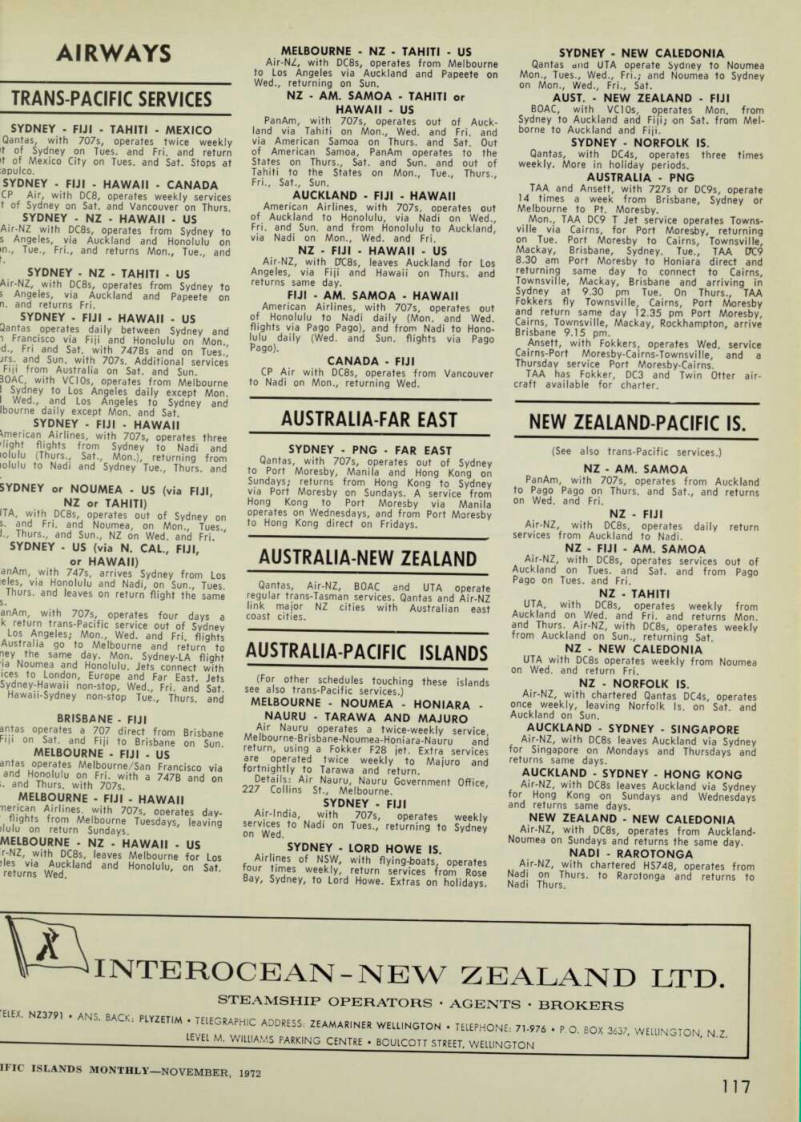
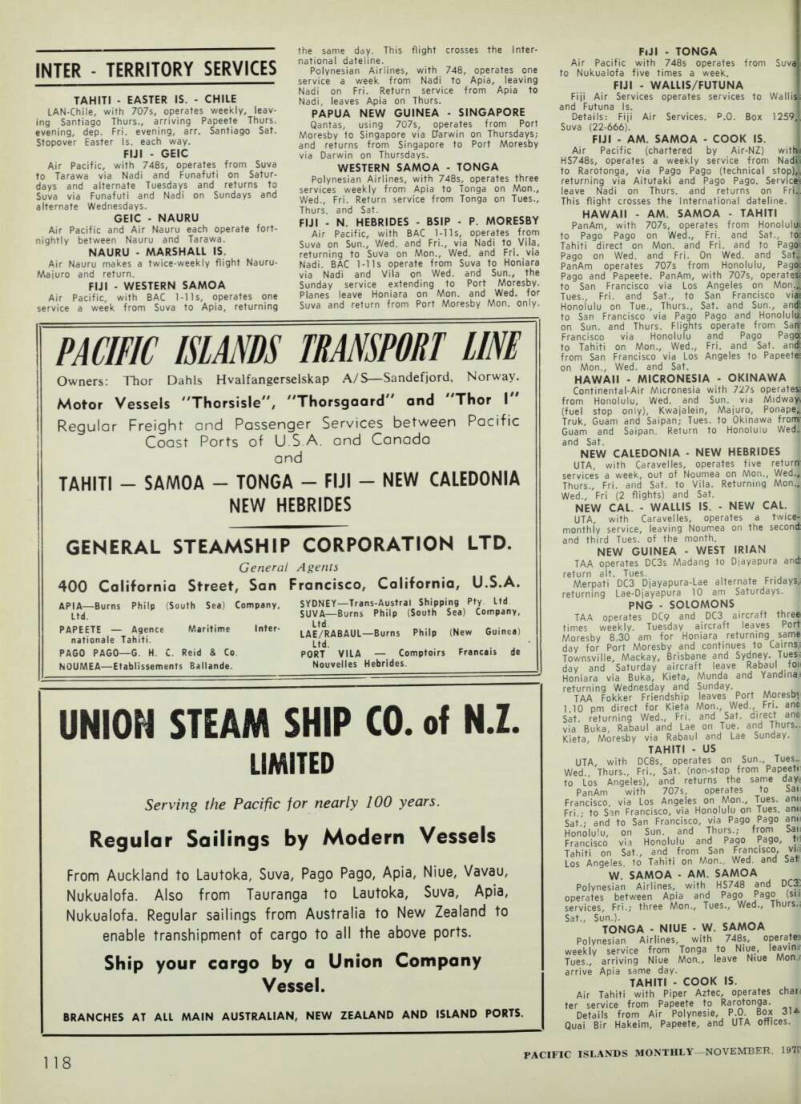
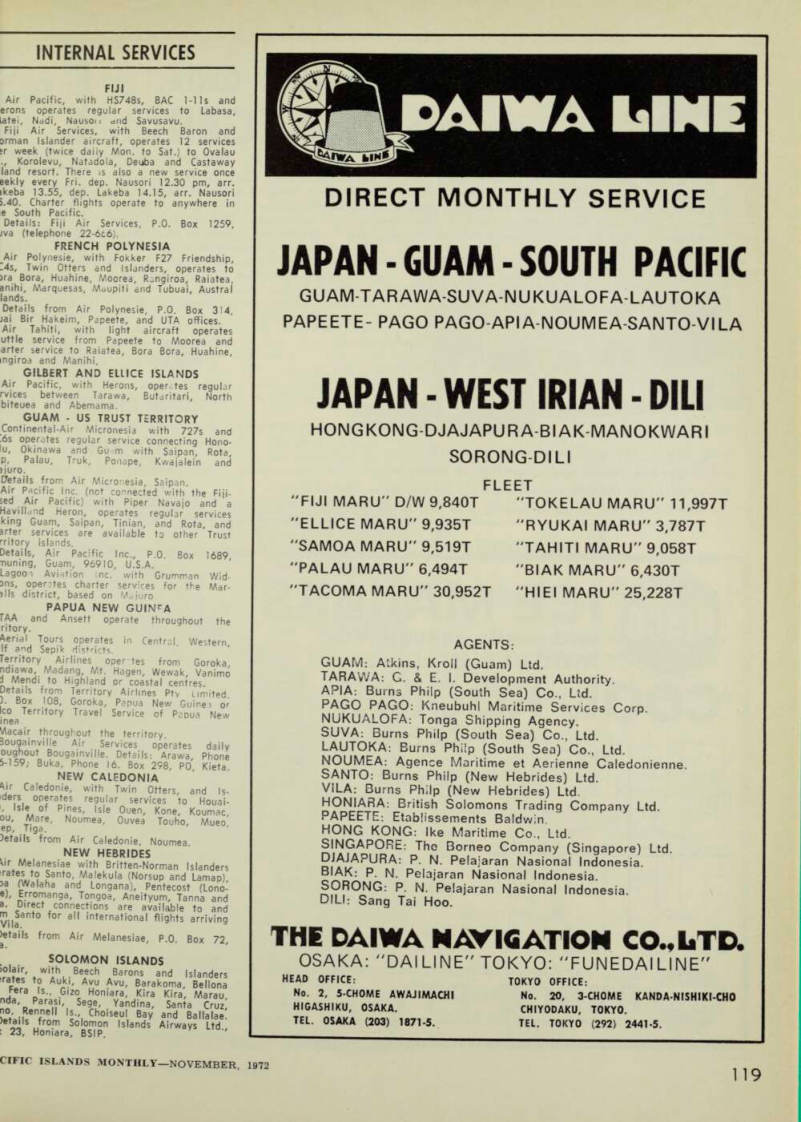
Trans Pacific Services
SYDNEY - FIJI ■ TAHITI - MEXICO Qantas, with 7075, operates twice weekly 't of Sydney on Tues. and Fri. and return it of Mexico City on Tues. and Sat. Stops at apulco.
SYDNEY ■ FIJI - HAWAII - CANADA CP Air, with DCS, operates weekly services t of Sydney on Sat. and Vancouver on Thurs SYDNEY - NZ ■ HAWAII - US Air-NZ with DCBs, operates from Sydney to s Angeles, via Auckland and Honolulu on m. Tue., Fri., and returns Mon., Tue., and SYDNEY - NZ - TAHITI - US Air-NZ, with DCBs, operates from Sydney to > Angeles, via Auckland and Papeete on n. and returns Fri.
SYDNEY - FIJI - HAWAII - US Qantas operates daily between Sydney and i Francisco via Fiji and Honolulu on Mon. d., Fri and Sat. with 7478 s and on Tues., a , n “ Sun. with 7075. Additional services Fi|i from Australia on Sat. and Sun.
BOAC with VClOs, operates from Melbourne Sydney to Los Angeles daily except Mon.
Wed., and Los Angeles to Sydney and Ibourne daily except Mon. and Sat
Sydney - Fiji - Hawaii
\merican Airlines, with 7075, operates three 'light flights from Sydney to Nadi and io u u (Thurs., Sat., Mon.), returning from lolulu to Nadi and Sydney Tue., Thurs. and SYDNEY or NOUMEA - US (via FIJI,
Nz Or Tahiti)
ITA, with DCBs, operates out of Sydney on s. and Fri. and Noumea, on Mon., Tues., 1., Thurs., and Sun., NZ on Wed. and Fri.
SYDNEY - US (via N. CAL., FIJI,
Or Hawaii)
anAm, with 7475, arrives Sydney from Los eles, via Honolulu and Nadi, on Sun., Tues. s Thurs. and leaves on return flight the same anAm, with 7075, operates four days a k return trans-Pacific service out of Sydney Los Angeles; Mon., Wed. and Fri. flights Australia go to Melbourne and return to riey the same day. Mon. Sydney-LA flight ia Noumea and Honolulu. Jets connect with ices to London, Europe and Far East. Jets Sydney-Hawaii non-stop. Wed., Fri. and Sat.
Hawau-Sydney non-stop Tue., Thurs. and
Brisbane - Fiji
antas operates a 707 direct from Brisbane '* 11 on Sat. and Fiji to Brisbane on Sun.
Melbourne - Fiji - Us
antas operates Melbourne/San Francisco via and Hoi>olulu on Fri. with a 7478 and on :. and Thurs. with 7075.
Melbourne - Fiji - Hawaii
Air,ine S- with 7075, operates day flights from Melbourne Tuesdays, leaving ilulu on return Sundays.
MELBOURNE - NZ - HAWAII - US r-NZ, with DCBs, leaves Melbourne for Los Hes via Auckland and Honolulu, on Sat returns Wed.
MELBOURNE - NZ - TAHITI - US Air-NZ, with DCBs, operates from Melbourne to Los Angeles via Auckland and Papeete on Wed., returning on Sun.
NZ ■ AM. SAMOA - TAHITI or
Hawaii - Us
PanAm, with 7075, operates out of Auck land via Tahiti on Mon., Wed. and Fri. and via American Samoa on Thurs. and Sat. Out of American Samoa, PanAm operates to the States on Thurs., Sat. and Sun. and out of Tahiti to the States on Mon., Tue., Thurs., Fri., Sat., Sun.
Auckland - Fiji - Hawaii
American Airlines, with 7075, operates out of Auckland to Honolulu, via Nadi on Wed., Fri. and Sun. and from Honolulu to Auckland, via Nadi on Mon., Wed. and Fri.
NZ - FIJI - HAWAII - US Air-NZ, with DCSs, leaves Auckland for Los Angeles, via Fiji and Hawaii on Thurs. and returns same day.
Fiji - Am. Samoa - Hawaii
American Airlines, with 7075, operates out of Honolulu to Nadi daily (Mon. and Wed. flights via Pago Pago), and from Nadi to Hono lulu daily (Wed. and Sun. flights via Pago
Pago).
Canada - Fiji
CP Air with DCBs, operates from Vancouver to Nadi on Mon., returning Wed.
Australia-Far East
Sydney ■ Png - Far East
Qantas, with 7075, operates out of Sydney to Port Moresby, Manila and Hong Kong on Sundays; returns from Hong Kong to Sydney via Port Moresby on Sundays. A service from Hong Kong to Port Moresby via Manila operates on Wednesdays, and from Port Moresby to Hong Kong direct on Fridays.
Australia-New Zealand
Qantas, Air-NZ, BOAC and UTA operate regular trans-Tasman services. Qantas and Air-NZ link major NZ cities with Australian east coast cities.
Australia-Pacific Islands
(For other schedules touching these islands see also trans-Pacific services.)
Melbourne - Noumea - Honiara -
Nauru - Tarawa And Majuro
A[ r Nauru operates a twice-weekly service
Melboume-Bnsbane-Noumea-Honiara-Nauru and
return, using a Fokker F2B jet. Extra services are operated twice weekly to Majuro and fortnightly to Tarawa and return.
D etai, s : . Air Nauru, Nauru Government Office, 227 Collins St., Melbourne.
Sydney - Fiji
Air-lndia, with 7075, operates weekly services to Nadi on Tues., returning to Sydney on Wed.
Sydney - Lord Howe Is.
Airlines of NSW, with flying-boats, operates four times weekly, return services from Rose Bay, Sydney, to Lord Howe. Extras on holidays.
Sydney - New Caledonia
Qantas <ind UTA operate Sydney to Noumea Mon., Tues., Wed., Fri.; and Noumea to Sydney on Mon., Wed., Fri., Sat.
Aust. - New Zealand - Fiji
BOAC, with VClOs, operates Mon. from Sydney to Auckland and Fiji; on Sat, from Mel borne to Auckland and Fiji.
Sydney - Norfolk Is.
Qantas, with DC4s, operates three times weekly. More in holiday periods.
Australia - Png
TAA and Ansett, with 727 s or DC9s, operate 14 times a week from Brisbane, Sydney or Melbourne to Pt. Moresby.
Mon., TAA DC9 T Jet service operates Towns ville via Cairns, for Port Moresby, returning on Tue. Port Moresby to Cairns, Townsville, Mackay, Brisbane, Sydney. Tue., TAA L7C9 8.30 am Port Moresby to Honiara direct and returning same day to connect to Cairns, Townsville, Mackay, Brisbane and arriving in Sydney at 9.30 pm Tue. On Thurs., TAA Fokkers fly Townsville, Cairns, Port Moresby and return same day 12.35 pm Port Moresby, Cairns, Townsville, Mackay, Rockhampton, arrive Brisbane 9.15 pm.
Ansett, with Fokkers, operates Wed. service Cairns-Port Moresby-Cairns-Townsville, and a Thursday service Port Moresby-Cairns.
TAA has Fokker, DC3 and Twin Otter air craft available for charter.
New Zealand-Pacific Is.
(See also trans-Pacific services.)
Nz - Am. Samoa
PanAm, with 7075, operates from Auckland to Pago Pago on Thurs. and Sat., and returns on Wed. and Fri.
Nz - Fiji
Air-NZ, with DCBs, operates daily return services from Auckland to Nadi.
Nz - Fiji - Am. Samoa
Air-NZ, with DCBs, operates services out of Auckland on Tues. and Sat. and from Pago Pago on Tues. and Fri,
Nz - Tahiti
UTA, with DCBs, operates weekly from Auckland on Wed. and Fri. and returns Mon. and Thurs. Air-NZ, with DCBs, operates weekly from Auckland on Sun., returning Sat.
Nz - New Caledonia
UTA with DCBs operates weekly from Noumea on Wed. and return Fri.
Nz - Norfolk Is.
Air-NZ, with chartered Qantas DC4s, operates once weekly, leaving Norfolk Is. on Sat. and Auckland on Sun.
Auckland - Sydney - Singapore
Air-NZ, with DCBs leaves Auckland via Sydney for Singapore on Mondays and Thursdays and returns same days.
Auckland - Sydney - Hong Kong
Air-NZ, with DCBs leaves Auckland via Sydney for Hong Kong on Sundays and Wednesdays and returns same days.
New Zealand - New Caledonia
Air-NZ, with DCBs, operates from Auckland- Noumea on Sundays and returns the same day.
Nadi - Rarotonga
Air-NZ, with chartered HS74B, operates from Nadi on Thurs. to Rarotonga and returns to Nadi Thurs.
Inter - Territory Services
Tahiti - Easter Is. - Chile
LAN-Ghile, with 7075, operates weekly, leav ing Santiago Thurs., arriving Papeete Thurs. evening, dep. Fri. evening, arr. Santiago Sat.
Stopover Easter Is. each way.
Fiji • Geic
Air Pacific, with 7485, operates from Suva to Tarawa via Nadi and Funafuti on Satur days and alternate Tuesdays and returns to Suva via Funafuti and Nadi on Sundays and alternate Wednesdays.
Geic - Nauru
Air Pacific and Air Nauru each operate fort nightly between Nauru and Tarawa.
Nauru ■ Marshall Is.
Air Nauru makes a twice-weekly flight Nauru- Majuro and return.
Fiji - Western Samoa
Air Pacific, with BAG 1-1 Is, operates one service a week from Suva to Apia, returning
the same day. This flight crosses the Inter national dateline.
Polynesian Airlines, with 748, operates one service a week from Nadi to Apia, leaving Nadi on Fri. Return service from Apia to Nadi, leaves Apia on Thurs.
Papua New Guinea - Singapore
Qantas, using 7075, operates from Port Moresby to Singapore via Darwin on Thursdays; and returns from Singapore to Port Moresby via Darwin on Thursdays.
Western Samoa • Tonga
Polynesian Airlines, with 7485, operates three services weekly from Apia to Tonga on Mon., Wed., Fri. Return service from Tonga on Tues., Thurs. and Sat.
FIJI ■ N. HEBRIDES - BSIP - P. MORESBY Air Pacific, with BAG 1-1 Is, operates from Suva on Sun., Wed. and Fri., via Nadi to Vila, returning to Suva on Mon., Wed. and Fri. via Nadi. BAG 1-1 Is operate from Suva to Honiara via Nadi and Vila on Wed. and Sun., the Sunday service extending to Port Moresby.
Planes leave Honiara on Mon. and Wed. for Suva and return from Port Moresby Mon. only.
Fiji • Tonga
Air Pacific with 748 s operates from Suva to Nukualofa five times a week.
Fiji - Wallis/Futuna
Fiji Air Services operates services to Wallis* and Futuna Is.
Details: Fiji Air Services. p.O. Box 12591 Suva (22-666).
FIJI • AM. SAMOA - COOK IS.
Air Pacific (chartered by Air-NZ) with!
HS74Bs, operates a weekly service from Nadif to Rarotonga, via Pago Pago (technical stop)J returning via Aitutaki and Pago Pago. Service' leave Nadi on Thurs. and returns on Frii This flight crosses the International dateline. I
Hawaii - Am. Samoa - Tahiti
PanAm, with 7075, operates from Honolului to Pago Pago on Wed., Fri. and Sat., toi Tahiti direct on Mon. and Fri. and to Pagoi Pago on Wed. and Fri. On Wed. and Sati PanAm operates 707 s from Honolulu, Pagd Pago and Papeete. PanAm, with 7075, operates! to San Francisco via Los Angeles on Mon.,, Tues., Fri. and Sat., to San Francisco via) Honolulu on Tue., Thurs., Sat. and Sun., andl to San Francisco via Pago Pago and Honolului on Sun. and Thurs. Flights operate from Sam Francisco via Honolulu and Pago Pagoi to Tahiti on Mon., Wed., Fri. and Sat. andl from San Francisco via Los Angeles to Papeete on Mon., Wed. and Sat.
Hawaii - Micronesia - Okinawa
Continental-Air Micronesia with 727 s operates! from Honolulu, Wed. and Sun. via Midway) (fuel stop only), Kwajalein, Majuro, Ponape,, Truk, Guam and Saipan; Tues. to Okinawa fromi Guam and Saipan. Return to Honolulu Wed. and Sat.
New Caledonia - New Hebrides
UTA, with Caravelles, operates five returni services a week, out of Noumea on Mon., Wed., Thurs., Fri. and Sat. to Vila. Returning Mon.i Wed., Fri (2 flights) and Sat.
NEW CAL. - WALLIS IS. ■ NEW CAL.
UTA, with Caravelles, operates a twice monthly service, leaving Noumea on the second and third Tues. of the month.
New Guinea ■ West Irian
TAA operates DC3s Madang to Djayapura and return alt. Tues. _., J Merpati DCS Djayapura-Lae alternate Fridays, returning Lae-Djayapura 10 am Saturdays. 1
Png - Solomons
TAA operates DC9 and DCS aircraft three times weekly. Tuesday aircraft leaves Port Moresby 8.30 am for Honiara returning same day for Port Moresby and continues to Cairns,; Townsville, AAackay, Brisbane and Sydney. Tuesv day and Saturday aircraft leave Rabaul toi Honiara via Buka, Kieta, Munda and Yandmaj returning Wednesday and Sunday.
TAA Fokker Friendship leaves Port Moresby 1.10 pm direct for Kieta Mon., Wed., Fri. ano Sat. returning Wed., Fri. and Sat. direct ano via Buka, Rabaul and Lae on Tue. and Thurs..
Kieta, Moresby via Rabaul and Lae Sunday.
Tahiti - Us
UTA, with DCBs, operates on Sun., Tues..
Wed Thurs., Fri., Sat. (non-stop from Papeeti to Los Angeles), and returns the same PanAm with 7075, operates to Sa» Francisco, via Los Angeles on Mon., Tues. am Fri ,- to San Francisco, via Honolulu on Tues. am Sat.,- and to San Francisco, via Pago Pago am Honolulu, on Sun. and Thurs.; from Sai Francisco via Honolulu and Pago Pago, tr Tahiti on Sat., and from San Francisco, vi.i Los Angeles, to Tahiti on Mon., Wed. and Sat
W. Samoa - Am. Samoa
Polynesian Airlines, with HS74B and DC! operates between Apia and Pago Pago (su services, Fri.; three Mon., Tues., Wed., Thurs., Sat., Sun.).
Tonga - Niue - W. Samoa
Polynesian Airlines, with 7485, operates weekly service from Tonga to Niue, leavim Tues., arriving Niue Mon., leave Niue Mon.i arrive Apia same day.
Tahiti - Cook Is.
Air Tahiti with Piper Aztec, operates char ter service from Papeete to Rarotonga.
Details from Air Polynesie, P.O. Box 31* Quai Bir Hakeim, Papeete, and UTA offices.
Internal Services
Fiji
Air Pacific, with HS74Bs, BAC 1-1 Is and erons operates regular services to Labasa, Latei, Nadi, Nauson and Savusavu.
Fiji Air Services, with Beech Baron and orman Islander aircraft, operates 12 services jr week (twice daily Mon. to Sat.) to Ovalau Korolevu, Natadola, Deuba and Castaway land resort. There is also a new service once eekly every Fri. dep. Nausori 12.30 pm, arr. ikeba 13.55, dep. Lakeba 14.15, arr. Nausori 5.40. Charter flights operate to anywhere in e South Pacific.
Details: Fiji Air Services, P.O. Box 1259, jva (telephone 22-666).
French Polynesia
Air Polynesie, with Fokker F 27 Friendship, .4s, Twin Otters and Islanders, operates to )ra Bora, Huahine, Moorea, Rangiroa, Raiatea, anihi, Marquesas, Maupiti and Tubuai, Austral lands.
Details from Air Polynesie, P.O. Box 314, jai Bir Hakeim, Papeete, and UTA offices.
Air Tahiti, with light aircraft operates uttle service from Papeete to Moorea and arter service to Raiatea, Bora Bora, Huahine, mgiroa and Manihi.
Gilbert And Ellice Islands
Air Pacific, with Herons, operates regular rvices between Tarawa, Butaritari, North biteuea and Abemama.
Guam - Us Trust Territory
Continental-Air Micronesia with 727 s and
.6s operates regular service connecting Hono lu, Okinawa and Gu-m with Saipan, Rota, p, Palau, Truk, Ponape, Kwajalein and siuro.
Details from Air Micronesia, Saipan.
Air Pacific Inc. (not connected with the Fiji sed Air Pacific) with Piper Navajo and a Havilland Heron, operates regular services king Guam, Saipan, Tinian, and Rota, and arter services are available to other Trust rritory islands.
Details, Air Pacific Inc., P.O. Box 1689 nuning, Guam, 96910, U.S.A.
Lagoon Aviation Inc. with Grumman Wid ans, operates charter services for the Mar alls district, based on Majuro.
Papua New Guinea
TAA and Ansett operate throughout the ntory.
Aerial Tours operates in Central Western If and Sepik districts.
Territory Airlines opertes from Goroka ndiawa, Madang, Mt. Hagen, Wewak, Vanimo 1 Mendi to Highland or coastal centres.
Details from Territory Airlines Ptv Limited, J. Box 108, Goroka, Papua New Guinea or Ico Territory Travel Service of Papua New mea Macair throughout the territory.
Bougainville Air Services operates daily oughout Bougainville. Details: Arawa Phone 5-159; Buka, Phone 16. Box 298, PO Kieta
New Caledonia
Air Caledonie, with Twin Otters, and Is -1 , s operates regular services to Houai , Isle of Pines, Isle Ouen, Kone, Koumac, ou, Mare, Noumea, Ouvea Touho, Mueo ep, Tiga.
Betails from Air Caledonie, Noumea
New Hebrides
Lir Melanesiae with Britten-Norman Islanders rate n»/? £ an t°< Malekula (Norsup and Lamap) 3a (Walaha and Longana), Pentecost (Lono e), Erromanga, Tongoa, Aneityum, Tanna and a. Direct connections are available to and Vila t 0 f ° r 3 mternational flights arriving letails from Air Melanesiae, P.O. Box 72,
Solomon Islands
* wi l h .- Be A ech A Barons a "d Islanders r V® s a t ° Aukl ' Avu Avu, Barakoma, Bellona J -' . GIZO . Honiara . Kira Kira, Marau nda Paras', Sege, Yandina, Santa Cruz, K'*" neM Choiseul Bay and Ballalae. >e oo S .l ro - m So,orn °n Islands Airways Ltd : 23, Honiara, BSIP.
Advertisements & other items, pp. 119-122 (3 items)
117
IFIC ISLANDS MONTHLY—NOVEMBER, 1972
Interocean-New Zealand Ltd.
STEAMSHIP OPERATORS • AGENTS • BROKERS
ANS. BACK, PLYZETIM ' ™ E = RA ™^™ WELLINGTON • TELEPHONE: 71-576 . P.O. BOX 3637, WELLINGTON, N 2 IEV EI M - WILLIA.,,S PARKING CENTRE . BOULCOTT STREET, WELLINGTON
PACIFIC ISLANDS TRANSPORT LINE
Owners: Thor Dahls Hvalfangerselskap A/S—Sandefjord, Norway.
Motor Vessels "Thorsisle", "Thorsgaard" and "Thor I"
Regular Freight and Passenger Services between Pacific Coast Ports of U S A. and Canada and TAHITI - SAMOA - TONGA - FIJI - NEW CALEDONIA
NEW HEBRIDES
GENERAL STEAMSHIP CORPORATION LTD.
General Agents 400 California Street, San Francisco, California, U.S.A.
APlA—Burns Philp (South Sea) Company, SYDNEY— Trans-Austrai Shipping Lt«L jjd SUVA —Burns Philp (South Sea) Company, PAPEETE Agence Maritime Inter- LAE/RABAUL —Burns Philp (New Guinea) nationale Tahiti.
PAGO PAGO —G. H. C. Reid & Co PORT VILA Comptoirs Francais de NOUMEA—Etablissements Ballande. Nouvelles Hebrides.
UNION STEAM SHIP CO. of N.Z.
LIMITED
Serving the Pacific for nearly 100 years.
Regular Sailings by Modern Vessels
From Auckland to Lautoka, Suva, Pago Pago, Apia, Niue, Vavau, Nukualofa. Also from Tauranga to Lautoka, Suva, Apia, Nukualofa. Regular sailings from Australia to New Zealand to enable transhipment of cargo to all the above ports.
Ship your cargo by a Union Company Vessel.
BRANCHES AT ALL MAIN AUSTRALIAN, NEW ZEALAND AND ISLAND PORTS.
m
DAIWA LINE
DIRECT MONTHLY SERVICE
JAPAN-GUAM-SOUTH PACIFIC
GUAM-TARAWA-SUVA-IMUKUALOFA-LAUTOKA
PAPEETE- PAGO PAGO-APIA NOUMEA-SANTO-VILA
JAPAN - WEST IRIAN - DILI
HONGKONG-DJAJAPUR A-BIAK-MANOKWARI
SORONG-DI LI
FLEET
'FIJI MARU" D/W 9,840 T
'ELLICE MARU" 9,935 T
'SAMOA MARU" 9,519 T
'PALAU MARU" 6,494 T
'TACOMA MARU" 30,952 T
"TOKELAU MARU" 11,997 T
"RYUKAI MARU" 3,787 T
"TAHITI MARU" 9,058 T
"BIAK MARU" 6,430 T
"HIEI MARU" 25,228 T
AGENTS:
GUAM; Atkins, Kroll (Guam) Ltd.
TARAWA: G. & E. I. Development Authority.
APIA: Burns Philp (South Sea) Co., Ltd.
PAGO PAGO: Kneubuhl Maritime Services Corp.
NUKUALOFA: Tonga Shipping Agency.
SUVA: Burns Philp (South Sea) Co., Ltd.
LAUTOKA; Burns Philp (South Sea) Co., Ltd.
NOUMEA: Agence Maritime et Aerienne Caledonienne.
SANTO: Burns Philp (New Hebrides) Ltd.
VILA: Burns Philp (New Hebrides) Ltd.
HONIARA: British Solomons Trading Company Ltd.
PAPEETE: Etablissements Baldwin.
HONG KONG: Ike Maritime Co., Ltd.
SINGAPORE: The Borneo Company (Singapore) Ltd.
DJAJAPURA: P. N. Pelajaran Nasional Indonesia.
BIAK: P. N. Pelajaran Nasional Indonesia.
SORONG: P. N. Pelajaran Nasional Indonesia.
DILI: Sang Tai Hoo.
THE DAIWA NAVIGATION CO.. LTD.
OSAKA: "DAILINE" TOKYO
HEAD OFFICE:
No. 2, 5-CHOME AWAJIMACHI
HIGASHIKU, OSAKA.
TEL. OSAKA (203) 1871-5.
FUNEDAI LINE"
TOKYO OFFICE:
No. 20, 3-CHOME
CHIYODAKU, TOKYO.
TEL. TOKYO (292) 2441-5.
KANDA-NISHIKI-CHO
WHEN YOU NEED RADIO CONTACT
YOU NEED TRAEGER
TRAEGER
When radio is your only link with the outside world, reliable communications are essential. For this reason the Royal Flying Doctor Service, Police, Government, and commercial organisations have always depended on TRAEGER equipment. Now, with plans by many telecommunication authorities throughout the South Pacific to change over to Single Side Band systems, TRAEGER have introduced the revolutionary SSB 100, a fully compatible AM/SSB set using the maximum power, very low battery drain, and with versions to suit Base Stations (Battery or ac mains), Portables, Marine vessels, and of course vehicles. This reliable, transistorised, easy-to-operate set is fully approved by PMG and P&T and meets all relevant specifications. To find out more contact— m 6 m m
MADE UNDER
LICENCE BY
TELECOM
SERVICES
ALSO STOCKIST
OF:—
ANTENNAE
POWER SUPPLIE
COMPONENTS
CONNECTORS
CABLE
VHF TWO WAY
RADIOS AND
ACCESSORIES
SSB 100
TELECOM SERVICES PTY. LTD.,
Post Office Box 3399,
© HIGH POWER —100 watts pep (maximum allowed). • VERSATILE —Base station, marine, portable, or vehicle use. • COMPATIBLE—AII TRAEGER equipment can call AM stations as standard feature. • ECONOMIC —Less than 50 mA on receive, gives long battery life.
PORT MORESBY, P.N.G.
PHONE P.M. 54877.
CABLE TELESERVE P.M.
TELEX TELSERV P.N.G. 160.
ICE MAKERS
and easily assembled
MODULE-BILD panel
COOL ROOMS
FREEZERS
Ice Maker & Bin Chunk-ice Maker Module-Bild Cool Room
UITSKtj
.c,~ Coin-op Dispenser
• ICE MAKERS
Standard 1,2, 3 and 5 ton fresh water models that harvest 67 KW tons of Chunk-Ice every 30 minutes are usually available ex stock. Larger models can be built as required. 2,000 and 8,000 lb. storage bins for attachment to units are readily available
• COOLROOMS & FREEZERS
Modular panels 2 and 4 ft, metal clad and up to 35 ft. in length, easily assembled by unskilled labour.
An unlimited range of refrigerated coolrooms and freezers available.
MANUFACTURING Et REFRIGERATION ENGINEERS
RESCO PTY. LTD.
98 Grand Junction Rd., Kilburn Sth. Aust. 5084 Tel. 62 5011
BLOCK
ICE
MAKER
BLOCK ICE MAKERS
Packaged self-contained J and 1 ton block ice manufacturing plants designed to give the minimum of on-site installation work.
Each block-ice maker supplied with one set of heavy duty ice moulds and freezing solution. Refrigeration unit features air-cooled belt driven condenser and is pre-wired ready for connection to power supply.
Enquiries on special voltages welcomed.
119
CIFIC ISLANDS MONTHLY—NOVEMBER, 1972
Nutshell
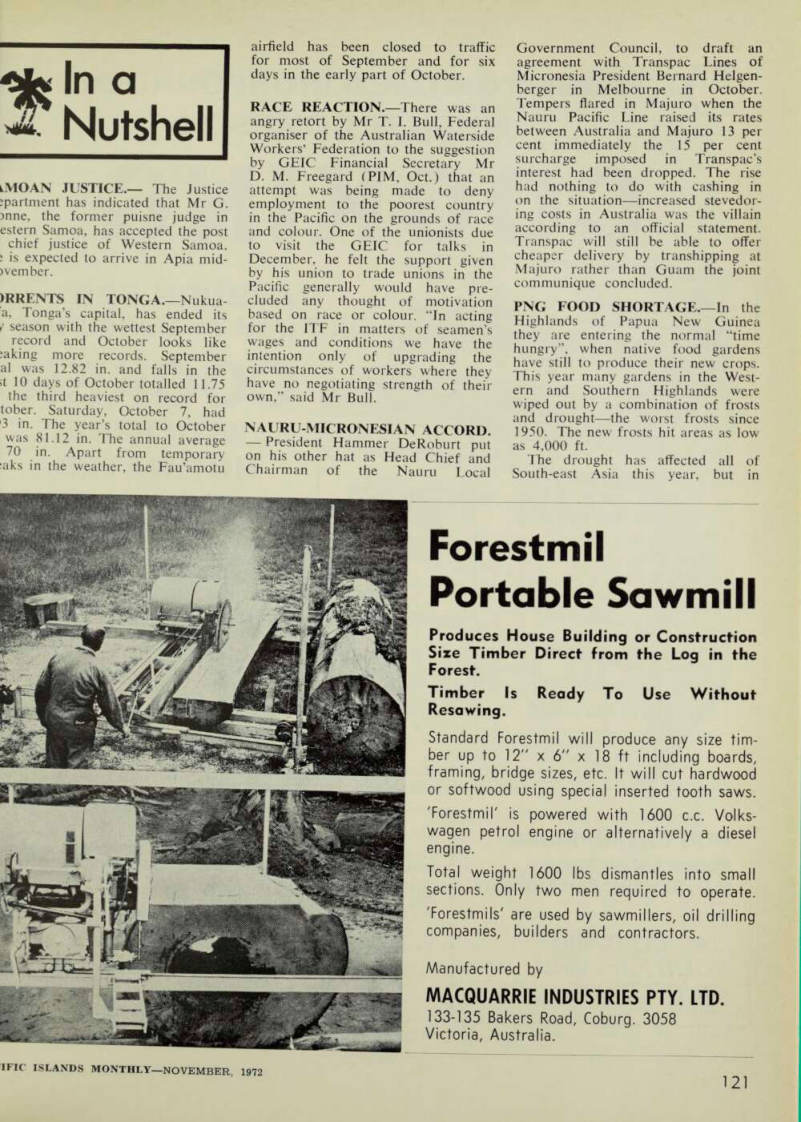

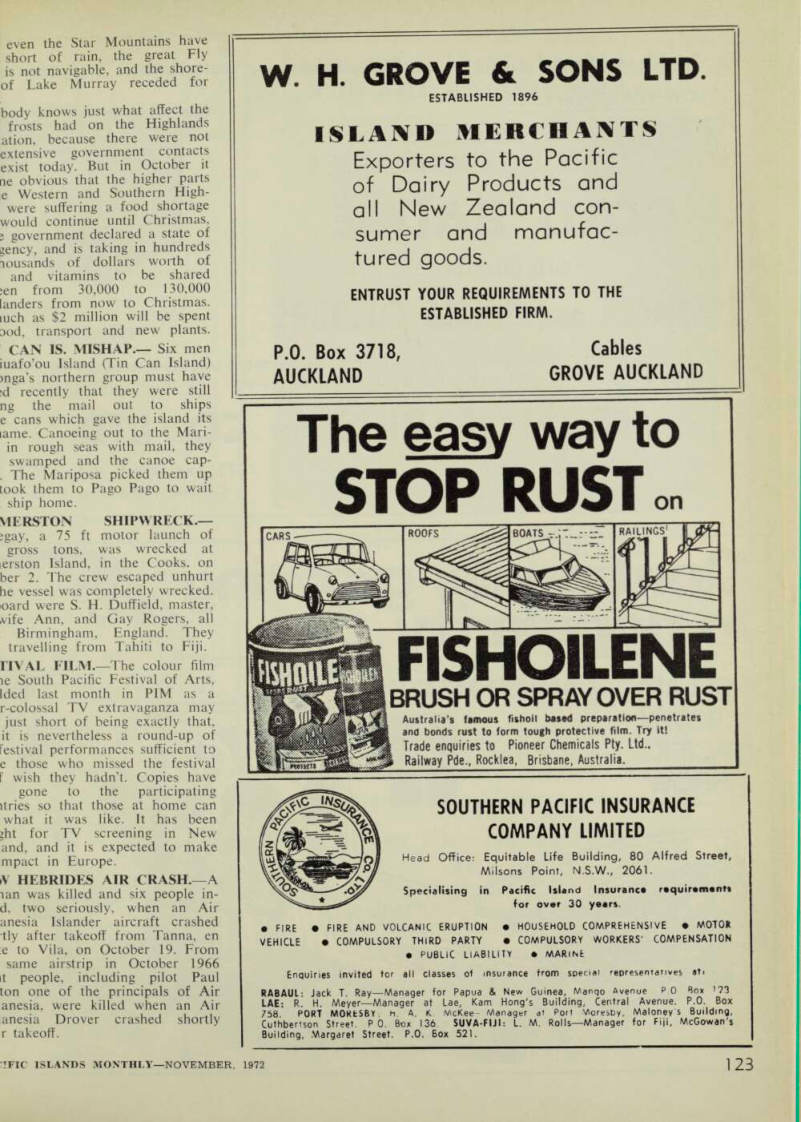
In a Nutshell
iMOAN JUSTICE.— The Justice apartment has indicated that Mr G. )nne, the former puisne judge in estern Samoa, has accepted the post chief justice of Western Samoa. ‘ is expected to arrive in Apia mid >vember.
)Rrents In Tonga.—Nukua
a, Tonga’s capital, has ended its / season with the wettest September record and October looks like making more records. September al was 12.82 in. and falls in the it 10 days of October totalled 11.75 the third heaviest on record for tober. Saturday, October 7, had '3 in. The year’s total to October was 81.12 in. The annual average 70 in. Apart from temporary :aks in the weather, the Fau’amotu
airfield has been closed to traffic for most of September and for six days in the early part of October.
RACE REACTION.—There was an angry retort by Mr T. I. Bull, Federal organiser of the Australian Waterside Workers’ Federation to the suggestion by GEIC Financial Secretary Mr D. M. Freegard (PIM, Oct.) that an attempt was being made to deny employment to the poorest country in the Pacific on the grounds of race and colour. One of the unionists due to visit the GEIC for talks in December, he felt the support given by his union to trade unions in the Pacific generally would have pre cluded any thought of motivation based on race or colour. “In acting for the ITF in matters of seamen’s wages and conditions we have the intention only of upgrading the circumstances of workers where they have no negotiating strength of their own,” said Mr Bull,
Nauru-Micronesian Accord.
President Hammer Deßoburt put on his other hat as Head Chief and Chairman of the Nauru Local
Government Council, to draft an agreement with Transpac Lines of Micronesia President Bernard Helgen berger in Melbourne in October.
Tempers flared in Majuro when the Nauru Pacific Line raised its rates between Australia and Majuro 13 per cent immediately the 15 per cent surcharge imposed in Transpac’s interest had been dropped. The rise had nothing to do with cashing in on the situation—increased stevedor ing costs in Australia was the villain according to an official statement.
Transpac will still be able to offer
cheaper delivery by transhipping at
Majuro rather than Guam the joint communique concluded.
Png Food Shortage.—In The
Highlands of Papua New Guinea they are entering the normal “time hungry”, when native food gardens have still to produce their new crops.
This year many gardens in the West ern and Southern Highlands were wiped out by a combination of frosts and drought—the worst frosts since 1950. The new frosts hit areas as low as 4,000 ft.
The drought has affected all of South-east Asia this year, but in
even the Star Mountains have short of rain, the great Fly is not navigable, and the shore of Lake Murray receded for body knows just what affect the frosts had on the Highlands ation, because there were not extensive government contacts exist today. But in October it ne obvious that the higher parts e Western and Southern High were suffering a food shortage would continue until Christmas, » government declared a state of gency, and is taking in hundreds lousands of dollars worth of and vitamins to be shared ;en from 30,000 to 130,000 landers from now to Christmas, mch as $2 million will be spent aod, transport and new plants.
Can Is. Mishap.— Six Men
iuafo’ou Island (Tin Can Island) mga’s northern group must have :d recently that they were still ng the mail out to ships e cans which gave the island its lame. Canoeing out to the Mari in rough seas with mail, they swamped and the canoe cap . The Mariposa picked them up took them to Pago Pago to wait ship home.
Merston Shipwreck.—
;gay, a 75 ft motor launch of gross tons, was wrecked at icrston Island, in the Cooks, on ber 2. The crew escaped unhurt he vessel was completely wrecked, oard were S. H. Duffield, master, vife Ann, and Gay Rogers, all Birmingham, England. They travelling from Tahiti to Fiji.
EIYAL FILM.— The colour film le South Pacific Festival of Arts, Ided last month in PIM as a r-colossal TV extravaganza may just short of being exactly that, it is nevertheless a round-up of Festival performances sufficient to e those who missed the festival F wish they hadn’t. Copies have gone to the participating itries so that those at home can what it was like. It has been »ht for TV screening in New and, and it is expected to make mpact in Europe.
A Hebrides Air Crash.—A
lan was killed and six people in d, two seriously, when an Air anesia Islander aircraft crashed tly after takeoff from Tanna, en :e to Vila, on October 19. From same airstrip in October 1966 it people, including pilot Paul ton one of the principals of Air anesia, were killed when an Air anesia Drover crashed shortly r takeoff.
Advertisements & other items, pp. 123-126 (3 items)
121
IFIC ISLANDS MONTHLY—NOVEMBER, 1972
Portable Sawmill
n/f 4 % M
Forestmil
Produces House Building or Construction Size Timber Direct from the Log in the Forest.
Timber Is Ready To Use Without Resawing.
Standard Forestmil will produce any size timber up to 12" x 6" x 18 ft including boards, framing, bridge sizes, etc. It will cut hardwood or softwood using special inserted tooth saws.
'Forestmil' is powered with 1600 c.c. Volkswagen petrol engine or alternatively a diesel engine.
Total weight 1600 lbs dismantles into small sections. Only two men required to operate.
'Forestmils' are used by sawmillers, oil drilling companies, builders and contractors.
Manufactured by
MACQUARRIE INDUSTRIES PTY. LTD.
133-135 Bakers Road, Coburg. 3058 Victoria, Australia.
COME TO ALLIED IRONFOUNDERS
WHEN IT COMES TO
COOKING
‘RAYBURN 620’
Oil Fired or Solid Fuel
COOKER
..WITH FREE...
HOT WATER
The easiest way to perfect cooking!
Twin cast-iron ovens store heat in the walls, giving you a constant temperature for convenient no-fat cooking without shrinkage or flavour loss. Big, easy-to-clean hotplates and oven regulator, too. But Rayburn 620 doesn’t just cook for you it automatically supplies all the piping hot water you need in kitchen, bathroom and laundry! And you’ll have no maintenance worries with Rayburn they’re built to last a lifetime.
ALSO . . DOMESTIC PORTABLE OIL FIRED COOKING BOILERS SMALL BLACK IRON DOVER STOVES • COMPLETE RANGE COMMERCIAL COOKING EQUIPMENT mm si ■///"
DUO ENTERPRISES
Papua & New Guinea P.O. Box 494, Port Moresby
FOR
GAS, ELECTRIC,
SOLID FUEL AND
OIL COOKERS
MAIL THIS COUPON FOR FREE LITERATURE
TICK IF REQUIRED □ RAYBURN 620 □ COOKING BOILERS □ DOVER STOVES □ COMMERCIAL COOKING EQUIPMENT.
DUO ENTERPRISES Papua & New Guinea
P.O. Box 494, Port Moresby, T.P.N.G.
NAME
ADDRESS
W. H. GROVE & SONS LTD.
ESTABLISHED 1896
ISLAND MERCHANTS
Exporters to the Pacific of Dairy Products and all New Zealand consumer and manufactured goods.
ENTRUST YOUR REQUIREMENTS TO THE
ESTABLISHED FIRM.
P.O. Box 3718, Cables
AUCKLAND GROVE AUCKLAND
The easy way to
STOP RUST on
CARS
>wikh
RAILINGS
BOATS
ROOFS
FISHOILENE
BRUSH OR SPRAY OVER RUSTi
Australia’s famous fisholi based preparation—penetrates and bonds rust to form tough protective film. Try it!
Trade enquiries to Pioneer Chemicals Pty. Ltd-
Railway Pde., Rocklea, Brisbane, Australia.
*'S
SOUTHERN PACIFIC INSURANCE
COMPANY LIMITED
Head Office: Equitable Life Building, 80 Alfred Street, Milsons Point, N.S.W., 2061.
Specialising in Pacific Island Insurance requirements for over 30 years. • FIRE • FIRE AND VOLCANIC ERUPTION • HOUSEHOLD COMPREHENSIVE • MOTOR VEHICLE • COMPULSORY THIRD PARTY • COMPULSORY WORKERS' COMPENSATION
e PUBLIC LIABILITY • MARINE
Enquiries invited tor all classes ot insurance From special representatives at i RABAUL: Jack T. Ray—Manager for Papua & New Guinea, Mango Avenue P.O Box ’23 LAE: R. H. Meyer—Manager at Lae, Kam Hong's Building, Central Avenue. P.O. Box 758. PORT MORESBY; h. A. K. McKee- Manager at Port Moresby, Maloneys Building, Cuthbertson Street. PO. Box 136. SUVA-FIJI: L. M. Rolls—Manager for Fiji, McGowan's Building, Margaret Street. P.O. Box 521.
• To Islands Cordial-makers . . . Pastrycooks
FOLLOW THE EXAMPLE OF
AUSTRALIA'S LEADING FOOD PROCESSORS
WHO FOR 30 YEARS HAVE CONSISTENTLY USED
GOLD BADGE
FINE QUALITY
ESSENCES and EDIBLE COLOURS
. . Confectioners . . .Canners c
BRAND
AND
CO LT Samples are available for manufacturers We are Flavouring Specialists producing highly concentrated soluble essences for the fooc industries and invite your enquiries, either direct or through your usual buying channels.
KEITH HARRIS & CO. LTD.
Sefton Road, Thornleigh, N.S.W.
Cables: Kehar, Sydney 1015 Ann Street, Valley N.l, Qld Cables: Keharbris, Brisbane
Continually growing
in popularity
HELLABY’S CANNED MEATS
‘CROWN’
‘PACIFIC’ HELLABY
‘ARROW’
m is A %
123
IFIC ISLANDS MONTHLY—NOVEMBER, 1972
Islands People
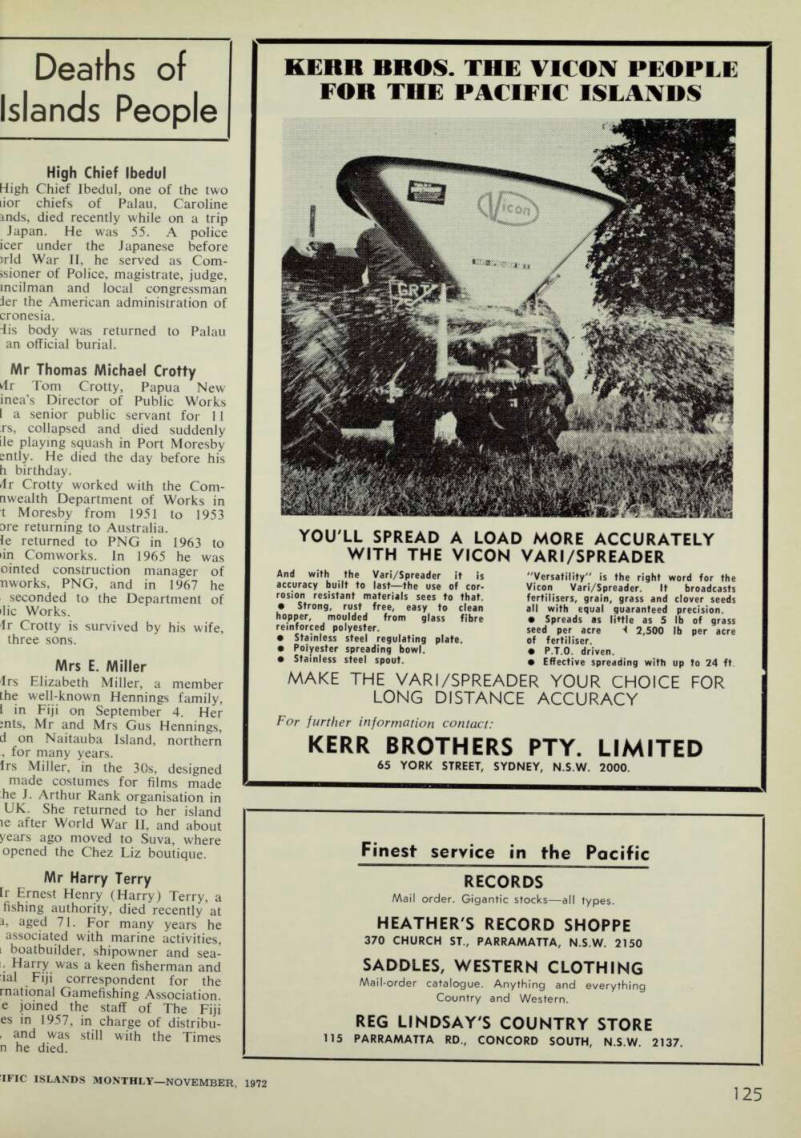
Deaths of Islands People
High Chief Ibedul High Chief Ibedul, one of the two lior chiefs of Palau, Caroline ands, died recently while on a trip Japan. He was 55. A police icer under the Japanese before arid War 11, he served as Com moner of Police, magistrate, judge, incilman and local congressman Jer the American administration of cronesia. -lis body was returned to Palau an official burial.
Mr Thomas Michael Crotty rtr Tom Crotty, Papua New inea’s Director of Public Works I a senior public servant for 11 rs, collapsed and died suddenly ile playing squash in Port Moresby ently. He died the day before his h birthday. tfr Crotty worked with the Com nwealth Department of Works in t Moresby from 1951 to 1953 are returning to Australia, le returned to PNG in 1963 to ►in Comworks. In 1965 he was ointed construction manager of nworks, PNG, and in 1967 he seconded to the Department of •lie Works.
Ir Crotty is survived by his wife, three sons.
Mrs E. Miller Irs Elizabeth Miller, a member the well-known Hennings family, I in Fiji on September 4. Her mts, Mr and Mrs Gus Hennings, d on Naitauba Island, northern , for many years.
Irs Miller, in the 30s, designed made costumes for films made he J. Arthur Rank organisation in UK. She returned to her island le after World War 11, and about years ago moved to Suva, where opened the Chez Liz boutique.
Mr Harry Terry
lr Ernest Henry (Harry) Terry, a fishing authority, died recently at a, aged 71. For many years he associated with marine activities, i boatbuilder, shipowner and sea . Harry was a keen fisherman and ial Fiji correspondent for the
rnational Gamefishing Association
e joined the staff of The Fiji es in 1957, in charge of distribu , and was still with the Times n he died.
Advertisements & other items, pp. 127-130 (3 items)
125
IFIC ISLANDS MONTHLY—NOVEMBER, 1972
Kerr Brothers Pty. Limited
KERR BROS. THE VICON PEOPLE
FOR THE PACIFIC ISLANDS
YOU'LL SPREAD A LOAD MORE ACCURATELY
WITH THE VICON VARI/SPREADER
And with the Vari/Sprcader it is accuracy built to last—the use of corrosion resistant materials sees to that. • Strong, rust free, easy to clean hopper, moulded from glass fibre reinforced polyester. • Stainless steel regulating plate. • Polyester spreading bowl. • Stainless steel spout.
"Versatility" is the right word for the Vicon Vari/Spreader. It broadcasts fertilisers, grain, grass and clover seeds all with equal guaranteed precision. • Spreads as little as 5 lb of grass seed per acre i 2,500 lb per acre of fertiliser. • P.T.O. driven. • Effective spreading with up to 24 ft
MAKE THE VARI/SPREADER YOUR CHOICE FOR
LONG DISTANCE ACCURACY
For further information contact:
KERR BROTHERS PTY. LIMITED
65 YORK STREET, SYDNEY, N.S.W. 2000.
Finest service in the Pacific
RECORDS
Mail order. Gigantic stocks—all types.
HEATHER S RECORD SHOPPE
370 CHURCH ST., PARRAMATTA, N.S.W. 2150
SADDLES, WESTERN CLOTHING
Mail-order catalogue. Anything and everything Country and Western.
REG LINDSAY'S COUNTRY STORE
115 PARRAMATTA RD., CONCORD SOUTH, N.S.W. 2137.
iLtanja
PARK VIEW MOTEL—BRISBANE
Quiet location —opp. Botanic Gardens.
Single, double, family suites, all with refrig., air conditioning, phone, TV, radio, tea making facilities, from $lO. Pool and restaurant.
Phone 31-2695—Telex 40270.
Write for coloured brochure — Park View Motel, 128 Alice St, BRISBANE, Old., 4000.
Line Advertisements
Per line, 95c Aust.; Minimum rate. 4 lines.
HUME BREWING AND WINE MAKINi
SUPPLIES BY “OLINDA”. All requiremeni including prepared packs and ingredienj for the home brewer and winemake Full instructions and price lists fron de Pasquale Bros. Pty. Ltd., Frederick St Northgate, Qld. 4013 or P.O. Box 14 Nundah, Qld. 4012, Australia. Distribute enquiries welcome.
MERCANTILE TRADING CO., Box 13!
Hong Kong. Export; Footwear, Chines food stuffs, seagrass mats, shell and ivoi ware. Import: Shell, beche de mer.
PENFRIENDS OVERSEAS. Tour the worl by letter. For details, write: Fh Coiutinents Company Ltd., P.O. Box 2121: Henderson, New Zealand.
CONCRETE BLOCK MACHINE FOR SALI
Makes blocks, flags, edgings, screen-block garden stools —up to 8 at once and 1 an hour. SAI2O c.i.f. main ports. Sen for leaflets. Forest Farm Research, Lor donderry, N.S.W., 2753.
\LL BOOKS AND JOURNALS ON AUST-
RALASIA AND THE PACIFIC BOUGHT
\ND SOLD. Catalogues issued and sent free on application. Correspondence Invited. Berkelouw, 15-10 Boundary St., Rushcutters Bay, Sydney, 2011. Phone: 31-8215.
BODEN’S BOAT DESIGNS PTT. LTD.,
695 George St.. Sydney, 2000. Get your Bodens Boat Designs and Boat Building Book from newsagents everywhere. Posted direct SA2 20 surface mail FLEETS 98 ft. Landing Barge expensively modified 1971, 35,000 gal. bulk fuel cargo capacity, 70 ft. cargo deck, dry hold, accom. & machinery aft. $126,500.00.
Fleets, Rowe’s Bldg., Edward St., Brisbane.
Cable; “FLEETS BRISBANE”.
Stay at —
JOHN OXLEY
MOTEL
491 WICKHAM TERRACE,
BRISBANE
(750 yards City Hall) Every possible facility At very sensible rates
SEND FOR BROCHURE
VISITING BRISBANE?
Stay af TOWER MILL MOTEL. First class air-oonditloned accommodation, T.V., private bathroom and verandah with a delightful view. Two restaurants.
From $lO.OO per day.
Book through your Travel Agent or Airline office or direct to 239, Wickham Terrace, Brisbane. Telephone 31-1421.
NEW ZEALAND exporter of frozen meats offers merchants with refrigerated space facilities regular quotations, personalised service and wide supply access.
Write LEN R. HARLAND LTD., P.O. Box 289, New Plymouth, New Zealand. Cables:
"CANLEN".
WANTED
BUTTERFLIES, THE
LARGER MOTHS,
COLOURFUL OR LARGE
BEETLES, LARGE
INSECTS.
From all regions of the Pacific Islands.
Good prices for good quality material.
Collectors who know how to pack for shipment please write to: BUTTERFLY WORLD, 51-17 Rcckaway Beach Blvd, Far Rockaway, New York
11691, U S.A.
mm
ESCAPE
FROM THE ORDINARY
Here is an idyllic paradise where you can enjoy the unspoiled beauty and serenity of a working coconut plantation. This privately-owned Pacific retreat has been designed for a maximum of 12 people. Gracious surroundings, friendly service, relaxed accommodations with Fijian decor and American conveniences.
Activities available include: Deep sea fishing, reef and shell hunting, skin diving and snorkeling, water skiing, hiking, turf tennis court, badminton, horseback riding, and a beautiful tropical garden to relax in.
Send for free brochure; The Manager,
NAMALE PLANTATION,
SAVUSAVU, FIJI ISLANDS
WANTED
FREEHOLD LAND
Am interested in buying a large tract of freehold land in the South Pacific. Might pay cash.
Please write: "PAM", c/- G.P.O.
Box 3408, Sydney, N.S.W. 2001, Australia.
t i m
fx'M
£■ A JS
Stay at a Cosmopolitan Inn -Sydney
Situated in charming Double Bay only 10 minutes from the city. Surrounded by bistros, boutiques and delightful covered walks. Close to harbour. Air-conditioned.
All rooms with bath, TV, radio, refrigerator, phone. Roof-top heated pool. Car park. There’s a Cosmopolitan Motor Inn at Bondi Beach too.
SEND FOR COLOUR BROCHURE.
Cosmopolitan Motor Inns Pty. Ltd. Central Booking Office, Knox Street, Double Bay.
Phone; 36 6871. Telegrams: COSINN.
Telex: 21187.
3HE COSMOPOLITAI\JNI\^
INVESTMENT
OPPORTUNITY
A property comprising a block of three tenanted 3-Bedroom Flats in good condition is for sale. There is a keen demand for accommodation in this area and enquiries should be addressed to P.O. Box 2, Honiara, 8.5.1. P.
MOTOR HOLIDAYS (N.Z.) LTD.
FOLLOWING THE
SUN SINCE '6l
HIRE MOTOR
CARAVANS $3O
PER WEEK
PLUS 10c PER MILE
NORTH - SOUTH f S
FERRY BOOKINGS
AVAILABLE A
SPECIALISTS IN
FULLY-EQUIPPED
MOTOR CARAVAN
TOURIST RENTALS
AUCKLAND AND
CHRISTCHURCH
BOOK YOUR HOLIDAY
TOUR NOW
BOOKINGS AND ENQUIRIES
412 MT. EDEN ROAD, AUCKLAND. PHONE 600-288
SUNCOURT REAL ESTATE
M.R.E.I.N.Z.
TAUPO, NEW ZEALAND
P.O. BOX 22 TEL: 674
For Real Estate Anywhere in N.Z.
INVESTMENT
PROPOSITION
building company actively mgaged in local construction n developing area is ivailable for purchase and inquiries should be directed o
INVESTMENT", C/- P.O. Box
I, HONIARA, 8.5.1. P.
)VERHAULED and NEW
MACHINERY
FOR SALE
GENERATOR SETS
lew sets 40 KVA to 590 KVA.
Overhauled sets 69 KVA to
1,000 KVA.
MINING and QUARRY
EQUIPMENT
sw and Gyratory Stone Crushers, all and Rod Mills. Hammer Mills.
AIR COMPRESSORS
oth electric and diesel engine riven from 80 c.f.m. upwards.
WINCHES
ir, electric and diesel engine powered.
D. H. BERGHOUSE
PTY, LTD.,
Machinery Merchants since 1928. >l-65 Macarthur Street, Ultimo, lydney, N.S.W. 2007, Australia.
Cables; "Bergmachines", Sydney.
YOUR NEXT LEAVE
Modern up to the minute homes at Palm Beach, Avalon, Newport, Church Point, Mona Vale, etc., available to Island Residents for Holidays. Write for information to:
J. T. STAPLETON PTY. LTD.
ESTATE AGENTS,
133 PITT STREET, SYDNEY, 2000. 25-5305, 25-1737 also Box 32, P. 0., Avalon Beach, Sydney 2107. 918-2221.
WE WILL PAY FOR NEWS
Required: permanent correspondents in all islands to provide copy for a marine magazine. Full details: W. J. & J. D. KEANE LTD., P.O. Box 1189, Auckland, N.Z.
VILA LAND FOR SALE
Absolute water frontage with views over the picturesque Erakor Lagoon.
Cleared and in town area with street access 4355 square metres. Could be subdivided. $A12.00 per square metre.
Box 283, Vila, New Hebrides.
POSITION WANTED
ELECTRICAL/MECHANICAL ENGINEER, re-
tired British Sapper Officer (R.E. Works Services) wishes change and seeks interesting position South Pacific Region. 25 years overseas experience in all aspects of E & M Installations and Plant from design stage, including H.T. distribution generating plant, air-conditioning/refrigeration, mechanical equipment, water supply, hospitals, Workshops/Directly Employed Labour, motor-transport, etc.
Also wide experience in building construction, roads, and drainage. 6 years Senior Executive post with P.W.O.
E & M Services. Would also consider position in new residential/tourist development field.
Reply: MAJOR F. ROWE, Estate Organisation, P.O. Bex 8, University of Ghana,
Legon, ACCRA, GHANA.
A SOOTHING
AID FOR BABY
You'll be delighted what a soothing and effective aid Fisher's Teething Powders are to baby's natural teething disorders. Sore gums, digestive disturbances and intestinal upsets quickly respond to Fisher's Teething Powders.
So safe too, if used as directed, they do not contain Calomel, Opiates, Bromides, or any harmful substances. Save yourself distress and keep the little one happy and well by using Fisher's Teething Powders as needed. Only 30c for 20 powders from your chemist or store.
Fisher & Co., Manufacturing Chemists (Est. 1876), 17 May St., St. Peters,
N.S.W. 2044.
PIM 807/72
SOUTH AMERICAN STYLE HAMMOCKS
These cool, airy hammocks are ideal for tropical conditions. Softly woven and hand strung in either soft finish nylon or cotton net (illustrated).
NYLON
Orange only, no fringe $A19.50
COTTON
Bone, purple, black with bone or orange fringe $A29.50 Plus freight (packed c weight 3£ lbs.).
Cheque or C.O.D. (letter of credit ANZ Bank, Kings Cross, N.S.W.) OBLOMOV TRADING CO., is Glendon Road, Double Bay.
Mail enquiries to BOX 411, POTTS POINT, AUST. 2011.
Phone 35-5805. mmi
127
IC ISLANDS MONTHLY— NOVEMBER, 1972
Index to Advertisers
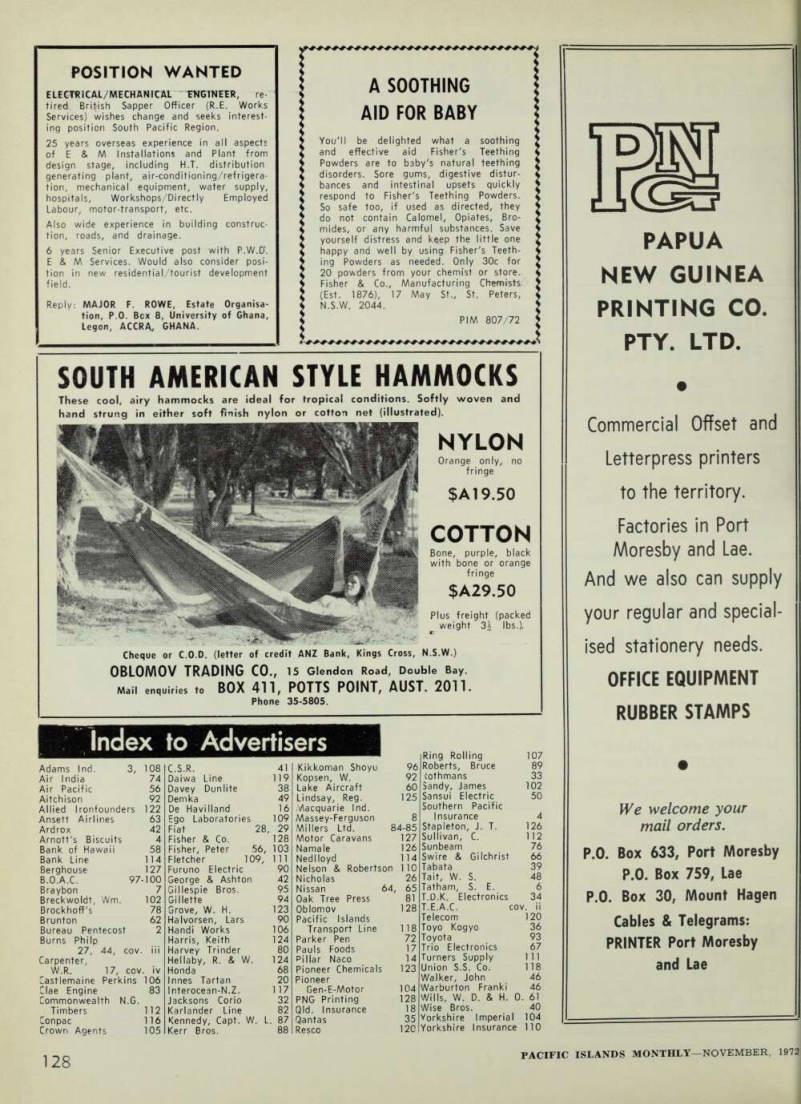
Adams Ind. 3, 108 Air India 74 Air Pacific 56 Aitchison 92 Allied Ironfounders 122 Ansett Airlines 63 Ardrox 42 Arnott's Biscuits 4 Bank of Hawaii 58 Bank Line 114 Berghouse 127 8.0.A.C. 97-100 Braybon 7 Breckwoldt, Wm. 102 Brockhoff's 78 Brunton 62 Bureau Pentecost 2 Burns Philp 27, 44, oov. iii Carpenter, W.R. 17, cov. iv Castlemaine Perkins 106 Clae Engine 83 Commonwealth N.G.
Timbers 112 Conpac 116 Crown Agents 105
C.S.R. 41
Daiwa Line 119 Davey Dunlite 38 Demka 49 De Havilland 16 Ego Laboratories 109 Fiat 28, 29 Fisher & Co. 128 Fisher, Peter 56, 103 Fletcher 109, 111 Furuno Electric 90 George & Ashton 42 Gillespie Bros. 95 Gillette 94 Grove, W. H. 123 Halvorsen, Lars 90 Handi Works 106 Harris, Keith 124 Harvey Trinder 80 Hellaby, R. &W. 124 Honda 68 Innes Tartan 20 Interocean-N.Z. 117 Jacksons Corio 32 Karlander Line 82 Kennedy, Capt. W. L. 87 Kerr Bros. 88
Kikkoman Shoyu 96 Kopsen, W. 92 Lake Aircraft 60 Lindsay, Reg. 125 Macquarie Ind.
Massey-Ferguson 8 Millers Ltd. 84-85 Motor Caravans 127 Namale 126 Nedlloyd 114 Nelson & Robertson 110 Nicholas 26 Nissan 64, 65 Oak Tree Press 81 Oblomov 128 Pacific Islands Transport Line 118 Parker Pen 72 Pauls Foods 17 Pillar Naco 14 Pioneer Chemicals 123 Pioneer Gen-E-Motor 104 PNG Printing 128 Qld. Insurance 18 Qantas 35 Resco 120
Ring Rolling 107 Roberts, Bruce 89 tothmans 33 Sandy, James 102 Sansui Electric 50 Southern Pacific Insurance 4 Stapleton, J. T. 126 Sullivan, C. 112 Sunbeam 76 Swire & Gilchrist 66 Tabata 39 Tait, W. S. 48 Tatham, S. E. 6 T.D.K. Electronics 34 T.E.A.C. cov. ii Telecom 120 Toyo Kogyo 36 Toyota 93 Trio Electronics 67 Turners Supply 111 Union S.S. Co. 118 Walker, John 46 Warburton Franki 46 Wills, W. D. & H. 0. 61 Wise Bros. 40 Yorkshire Imperial 104 Yorkshire Insurance 110
Advertisements & other items, pp. 130-132 (2 items)
1
PAPUA
NEW GUINEA
PRINTING CO.
PTY. LTD.
Commercial Offset and Letterpress printers to the territory.
Factories in Port Moresby and Lae.
And we also can supply your regular and specialised stationery needs.
OFFICE EQUIPMENT
RUBBER STAMPS
• We welcome your mail orders.
P.O. Box 633, Port Moresby P.O. Box 759, Lae P.O. Box 30, Mount Hagen Cables & Telegrams: PRINTER Port Moresby and Lae
BURNS PHILP (NEW GUINEA) LIMITED
GENERAL MERCHANTS
SHIPPING AND CUSTOMS AGENTS
Head Office: Champion Parade, Port- Moresby.
PHONE: 2202. TELEX: PMII6. CABLE ADDRESS: BURPHIL.
BRANCHES:
PAPUA NEW GUINEA
Subsidiary Companies Hotel Moresby Ltd. :la Motors Ltd. ocal Laundries Ltd.
Aoresby Hire Services Ltd.
'apua Hotel Ltd. he B.N.G. Trading Co. Ltd. he Port Moresby Freezing Co. Ltd.
Overseas Agents urns, Philp & Co. Ltd. All Aust. States, urns, Philp & Co. Ltd., London. urns-Philp Co. of San Francisco, urns Philp (South Sea) Co. Ltd. urns Philp (New Hebrides) Ltd.
Agents for urns Philp Trustee Co. Ltd, lueensland Insurance Co. Ltd. oyds of London. fewarts & Lloyds (Australia) Pty. Ltd. nell Company (Pacific Islands) Ltd.
Distributorships include British Paints Buckingham & Carnatic Textiles Byford Products Citizen Watches "CeCoCo" Machinery Conditionaire Air Curtain Doors Hardie's Building Products Heuga Carpet Tiles Jean Patou Partums "John" Valves Johnson Ceramic Tiles Kienzle Clocks Marcel Rochas Parfums Mikimoto Pearls National Radios & Appliances Noritake Chinaware Rolex Watches Ronson Products Rover Power Mowers Sunbeam Appliances, Mowers & Rural Products Exporters of Coffee & Cocoa Beans, Peanuts, Rubber Shipping Agents for Bank Line Ltd.
Campagnie Des Messageries Maritimes Chandris Line Cogedar Line Containers Pacific Express Line Cunard Steamships Co. Ltd.
Eastern & Australian Steamship Co. Ltd.
P & O Lines of Australia Pty. Ltd, Nederland Line Royal Dutch Mail Societe Francaise de Navigation The French Line Union Steam Ship Co. of N.Z. Ltd.
N.Y.K. Line Airline Agents for Ansett Airlines Qantas Airways Ltd.
Trans-Australia Airlines International Air Transport Association Representatives Travel Department For World Wide Travel ft*
BURNS PHILP (New Guinea) Ltd.
FOR SERVICE AND REAL VALUE
*rm. \ \
I GUINEA
/ ' • s X %
WORLD TRADERS
IN THE PACIFIC
i 3 ai?y f ♦ NR or « V
SUVA
'^//VIBER-G
\ I
MAR
& <P /» r %
r 7 FEB 197
-A ft
SYDNEY
W M X^v. 1
NEW ZEALAND
KLAND
AUC
The W. R. Carpenter Group has been a major trader between the Pacific Islands and the rest of the world for more than 55 years. As a grower, buyer and processor of island produce such as copra, coffee and cocoa beans, the Group has contributed to the economic progress of the area and of its peoples Associated companies of the Group in the Pacific Islands include:
PAPUA AND NEW GUINEA
W. R. Carpenter (T.P.N.G.) Limited.
Coconut Products Limited.
New Guinea Company Limited.
Boroko Motors Limited.
The Group is also a wholesaler and retailer and holds many
leading agencies, including
• NISSAN/DATSUN • FORD • DEWARS WHISKY
• ELECTROLUX • GORDON'S GIN
• EVINRUDE • VICTA
FIJI
W. R. Carpenter (South Pacific) Limited.
Carpenters (Fiji) Limited.
Morris Hedstrom Limited.
Millers Limited.
Island Industries Limited.
Suva Motors Limited.
W. R. CARPENTER & COMPANY LIMITED
68 PITT STREET CABLES: U.K. OFFICE;