Pacific Islands Monthly

October, 1972
Australia, Nz, Geic, Bsip 50C
PNG, FIJI, COOKS, TONGA, W. SAMOA, N. HEBRIDES 45c
Nauru, Norfolk, Niue 45C
AMERICAN SAMOA 70c HAWAII, MICRONESIA $1 00 NEW CALEDONIA 65 CFP FRENCH POLYNESIA 100 CFP
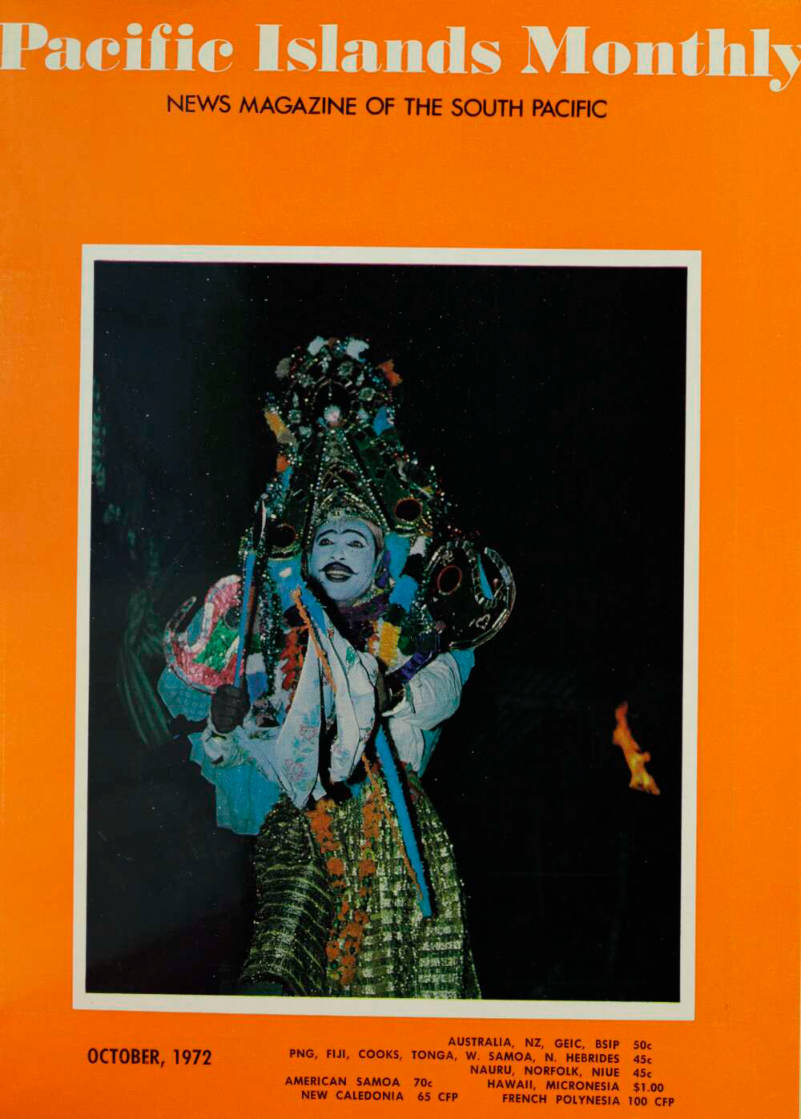
Our Cover
PIM started off 1972 with a cover picture of a Fiji Indian fire-walker with a trident driven through his tongue.
Some readers found it a ghastly spectacle, so for those we offer a less eye popping aspect of Fiji fire walking. This regal "goddess" was photographed beside the firepit by Sheree Upton, much travelled photographer whose book on Fiji should appear soon.
Advertisements & other items, p. 2 (1 item)
famous
f? (#’/ ' .
vfv
t \ 4*o & « * :-v*£ m m -: mm. y^h;
famous
There is no Substitute tor Quality
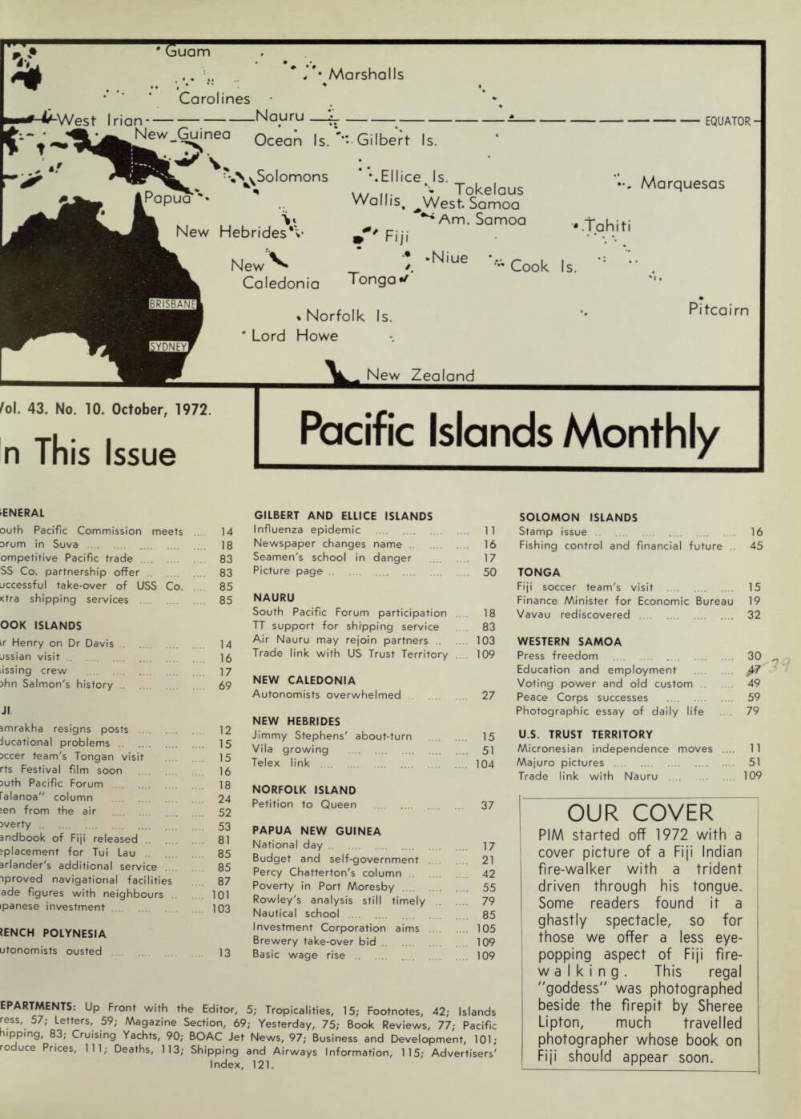
In This Issue
General
outh Pacific Commission meets 14 :>rum in Suva 18 ompetitive Pacific trade 83 SS Co. partnership offer 83 uccessful take-over of USS Co. ... 85 <tra shipping services 85
Ook Islands
ir Henry on Dr Davis 14 jssian visit 16 •issing crew 17 >hn Salmon's history 69 Jl amrakha resigns posts 12 fucational problems 15 xxer team's Tongan visit 15 rts Festival film soon 16 >uth Pacific Forum 18 falanoa" column 24 Jen from the air 52 >verty 53 andbook of Fiji released 81 jplacement for Tui Lau 85 arlander's additional service 85 iproved navigational facilities ... 87 ade figures with neighbours 101 ipanese investment 103
Lench Polynesia
utonomists ousted 13
Gilbert And Ellice Islands
Influenza epidemic 11 Newspaper changes name 16 Seamen's school in danger 17 Picture page 50
Nauru
South Pacific Forum participation ... 18 IT support for shipping service ... 83 Air Nauru may rejoin partners 103 Trade link with US Trust Territory ... 109
New Caledonia
Autonomists overwhelmed 27
New Hebrides
Jimmy Stephens' about-turn 15 Vila growing 51 Telex link 104
Norfolk Island
Petition to Queen 37
Papua New Guinea
National day 17
Budget and self-government 21
Percy Chatterton's column 42 Poverty in Port Moresby 55 Rowley's analysis still timely 79 Nautical school 85 Investment Corporation aims 105 Brewery take-over bid 109 Basic wage rise 109
Solomon Islands
Stamp issue 16 Fishing control and financial future .. 45
Tonga
Fiji soccer team's visit 15 Finance Minister for Economic Bureau 19 Vavau rediscovered 32
Western Samoa
Press freedom 30 Education and employment Voting power and old custom 49 Peace Corps successes 59 Photographic essay of daily life 79
U.S. Trust Territory
Micronesian independence moves ... 11 Majuro pictures 51 Trade link with Nauru ... 109
EPARTMENTS: Up Front with the Editor, 5; Tropicalities, 15; Footnotes, 42; Islands ress, 57; Letters, 59; Magazine Section, 69; Yesterday, 75; Book Reviews, 77; Pacific hipping, 83; Cruising Yachts, 90; BOAC Jet News, 97; Business and Development, 101; reduce Prices, 111; Deaths, 113; Shipping and Airways Information, 115; Advertisers' Index, 121.
Advertisements & other items, p. 4 (1 item)
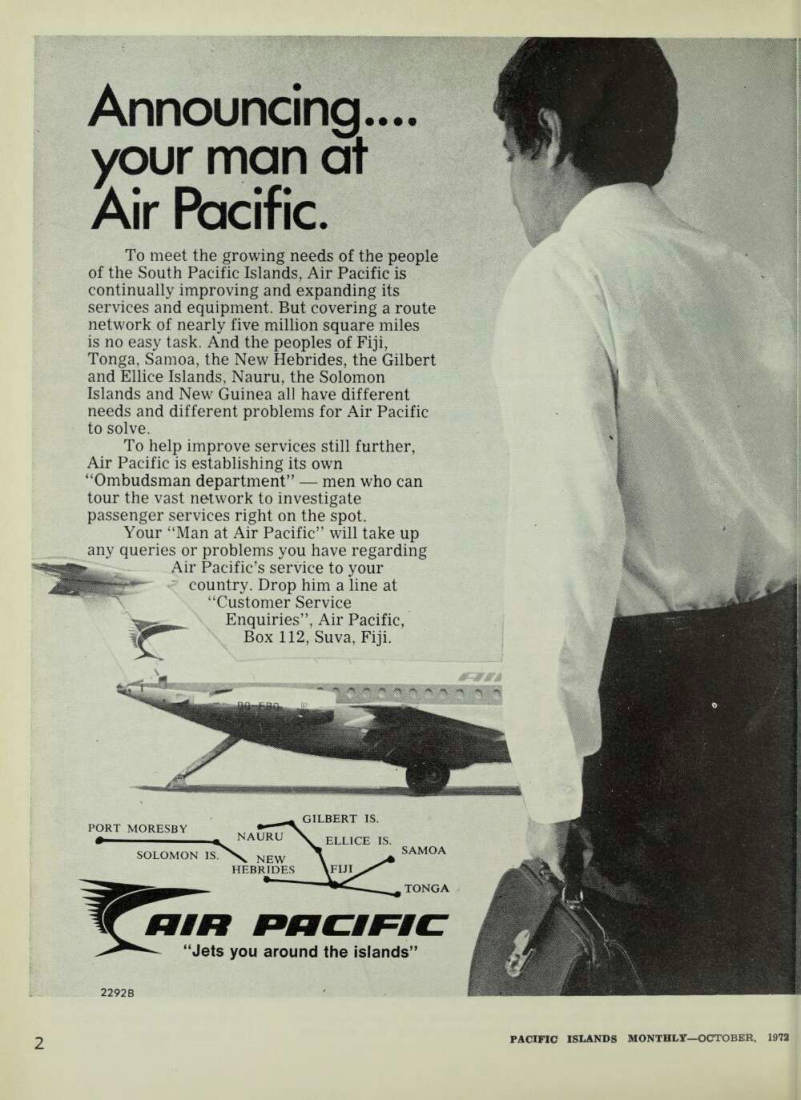
Announcing....
Announcing...
your man at
Air Pacific.
To meet the growing needs of the people of the South Pacific Islands, Air Pacific is continually improving and expanding its services and equipment. But covering a route network of nearly five million square miles is no easy task. And the peoples of Fiji, Tonga, Samoa, the New Hebrides, the Gilbert and Ellice Islands, Nauru, the Solomon Islands and New Guinea all have different needs and different problems for Air Pacific to solve.
To help improve services still further, Air Pacific is establishing its own “Ombudsman department” men who can tour the vast network to investigate passenger services right on the spot.
Your “Man at Air Pacific” will take up any queries or problems you have regarding Air Pacific’s service to your country. Drop him a line at “Customer Service Enquiries”, Air Pacific, Box 112, Suva, Fiji. n <V
GILBERT IS.
PORT MORESBY
NAURU
ELLICE IS.
SAMOA
HEBRIDES
FIJI
TONGA
mu r*aciF=ic
Jets you around the islands” 2292 B
Pacific Islands

Monthly
FOUNDED BY R. W. ROBSON IN 1930
Owned And Published Monthly By
Pacific Publications (Aust.) Pty. Ltd.,
29 Alberta St., Sydney, N.S.W., 2000.
Postal Address: G.P.O. BOX 3408, SYDNEY,
N.S.W., 2001.
Telegraphic Address: PACPUB, Sydney.
Telephones: 61-9197, 61-7101, 61-4369.
Consulting Directors: R. W. Robson, Judy Tudor.
Chief Executives: General Manager: Selwyn Hughes.
Publisher: Stuart Inder.
Director of Advertising: W. A. Gasnier.
Pacific Islands Monthly
Editor: Stuart Inder.
Assistant Editor; John Carter.
Advertising Manager: W. A. Gasnier.
Circulation Manager: Barry Badger.
Subscription Rates:
'Pacific Islands Monthly" is air-freighted to ill subscribers and agents in the Pacific Islands,copies to other areas go by surface mail. \ustralia (including Lord Howe and Thursday s.), 8.5.1. P., Gilbert and Ellice Is.: $5.50 Aust.; ’apua New Guinea, Norfolk Island, Nauru, onga and New Hebrides: $5.00 Aust.; New !ealand: $5.50 NZ; Fiji, Cook Islands, Niue md Western Samoa: $5.00 (local currency); imerican Samoa.- $B.OO US; U.S. Mainland; 14.00 US; Hawaii, Micronesia (including luam) $12.00 US; New Caledonia; 750 French acific francs; Tahiti and French Polynesia: 50 French Pacific francs,- United Kingdom and elsewhere: £3.25.
Representatives
i|i: Pacific Publications (Fiji) Ltd., Fiji Times uilding, 20 Gordon Street, Suva. Tel.: 25601; iji Times Office, Cnr. Vitogo Pde, and Namoli ive, LAUTOKA. Telex: 1144. Tel.: 60-422. apua New Guinea: LAE, P.O. Box 227; ABAUL, Mr. Steve Simpson, P.O. Box 433 (c/- Rabaul Photographic. Tel.: 2677.) rench Polynesia; Distribution—Hachette Paci ique, 10 Ave Bruat, Papeete, lew Zetland; Pacific Publications, C.P.O. Box 229, Auckland. 379-494. Representative: John pedding. Civic House, 291 Oueen St., Auckland, Tel..- 379-494. nited Kingdom; I. B. Graham, Park House, 2 Park Street, Croydon, CR9 3NP. Tel • 01-6884177. verseas Newspapers (Agencies) Ltd., Cromwell ouse, Fulwood Place, London, W.C.I. Tel.: 1-242-0661. Cables: WESNEWS, London, DS4. span: Advertising—Universal Media Corpora tion, C.P.O. Box 46, Tokyo. Tel.: 666-3036. ictona: Advertising—Wilke & Co. Ltd., 37 rown's Road, Clayton, Vic., 3168. Tel.: 544-8222. ueensland: Advertising—Beale Media Services, 32 St. Paul's Terrace, Fortitude Valley, Qld , 4006. Tel.: 52-5827. awaii and U.S. Mainland only: Mrs. W. A. cGrath, 225 Queen Street, 178, Honolulu, , 96813. iend change of address notices. Form 3579 to the above address.) pplication to mail at second class postage rates pending at Honolulu, Hawaii.
Copyright ©, 1972,
Pacific Publications (Aust.) Pty. Ltd.
October, 1972 Vol. 43, No. 10.
Advertisements & other items, pp. 5-6 (2 items)
Acific Islands Monthly— October, 1972
Chocolate...
CADBURY
DAIRY MILK
ONE OF TODAYS
GREAT TASTES
Cadbury’s Dairy Milk Chocolate. There’s a glass and a half of pure, fresh, full-cream milk in every half-pound. Nothing else has the same great taste.
Smooth, creamy, delicious. Look for the famous purple wrapper... and say “I want Cadbury’s”.
The biggest selling block chocolate in Australia and New Zealand. m mm csn
Quadruple your
lii :i
Ml
irnmi;
Ul ' 55 .
Ip 0 ij #i|
i- § : QS-100 : BH ,V *» m ■ / QS-500
QSP-10
SctnsiiJL
4-CHANNEL STEREO
With Sansui’s QSP-10 Compact 4-Channel Consolidator QS-100 4-Channel Rear Amplifier, or QS-500 4-Channel Rear Amplifier, you can enjoy the incomparable richness and “presence” of 4-channel stereo at minimum cost. The secret lies in a 4-channel synthesizer decoder that magically transforms 2-channel sources, such as records, tapes, and FM broadcasts, into breathtaking “live sound field” concert-hall realism. QSP-10 combines this with a 20-watt stereo power amplifier and a set of highperformance 15-watt speaker systems. Hook it up with your present hi-fi system and—presto— you’ve got a complete, compact 4-channel stereo system that will quadruple your listening pleasure. QS-100 combines the 4-channel synthesizer decoder with a 50-watt power amplifier, while the QS-500 combines it with a 120-watt power amplifier. In either case all you need in addition to your present system is a second set of speaker systems.
If you’re building a new system from scratch, Sansui recommends its 210 A solid-state SW/MW tuner with stereo amplifier. It provides sensitive reception in both MW and SW bands, 36 watts of music power, and a wide 30 to 25,000 Hz power bandwidth, while limiting distortion to less than 1%. 210 A Sansui products are available through: TEE VEE RADIO LTD. Teerad House 13, Midstone Street, Grey Lynn Auckland 2, New Zealand. Tel: 763064 / PRABHU BROTHERS LTD. P.O. Box 183, Nadi, Fiji islands Tel: 70183 / SERVONNAT Rue des Polius, Tahiticns Patcctc, Tahiti. Tel: 03-29 / OCEANIA INDENT AGENCY P.O. Box 5518, Boroko, Port Moresby, Papua & New Guinea. Tel: 56406 / PAUL MOW & CO. 9th St., P.O. Box 449, Lae. Tel: 2954 / CHIN H. MEEN & SONS P/L Tabari Place, P.O. Box 1106, Boroko. Tel: 56546/Kamarere Street, P.O. Box 224, Rabaul. Tel: 2462 / MICHAEL CHOW & Co. P/L Okari Street, P.O. Box 1106, Boroko. Tel: 56338 / SEETO KONG & SONS P/L Taurama Road, P.O. Box 1218, Boroko. Tel: 56445 / PINGS (MT HAGEN) P/L P.O. Box 165, Mt Hagen. Tel: 385 / BOUGAINVILLE COPPER Canteen, Panguna / PHOTOSONIC P.O.
Box 519, Madang. Tel: 2503 / MICHEL MERCIER Angle Des Rues Alma-Sebastopol B.P. 1123 Noumea, Nouveue-Caledonia. Tel; 59-11 et 40-78 / SANSUI ELECTRIC CO., LTD. 14-1, 2-chome, Izumi, Suginami-ku, Tokyo, Japan
Up Front
with the [?]
Anthropological legend has it that a team of bright young researchers, descending from an American uni versity onto one of the Pacific Islands, were somewhat taken aback to find the local paper running an article, directed at rather than to anthro pologists, entitled ‘Life in the Goldfish Bowl’.
The writer had perhaps not re flected that the fish were gold in another sense—golden, or at least gilded, academic reputations were ex :racted from them. Although the vast aulk of inquiry by social scientists ias been disinterested in the sense hat the substantial motivation was iimply to add to the sum of mankind’s knowledge of mankind, and in very nany cases the findings have been of lirect value to Islander’s or have :ontributed to a more sympathetic ittitude to their cultures, it cannot be lenicd that careers were so made, ind all too often there was too little eciprocity for information, often on luite intimate matters, or hospitality.
But now the natives are restless onight, Jenkins, With four univer ities in the Islands themselves (at Vaigani, Suva, Guam, and Hono ulu), the goldfish naturally are be :inning to snap.
This is salutary, up to a point. Now hat so many groups are, or are be ommg, independent, the old colonial srms of trade in the research field annot apply, nor should they. How ver, there is a danger that reasonable emands for hospitality may be scalated and ossified by the normal xpansionist proclivities of bureauc acy.
Adequate information must be re amed to the Islands; local people iust be drawn in, increasingly as o-workers rather than assistants, yhere facilities exist, researchers lould make their knowledge and rills available to local educational istitutions, and will themselves be ie better for it. But I think that there fe better ways of securing these ceded objectives than by issuing a Lit-and-dried hard-and-fast document > be signed by the researcher, [tempting to cover all things and taking unrealistic demands.
Ten or 20 copies of all publications for example: it is a safe bet in many cases that eight or 18 at least will moulder in the files. After all, in the 1930s an expert inquiry into (shall we say) peanut cultivation in Kere kere pointed out that the job had been done as well as it could be done by an expert inquiry in 1907; and the trade in peanut inquiries still flourishes.
It is one thing, and absolutely legitimate, to demand that researchers should sign a cast-iron engagement not to take part in missionary or political activities: this can be policed.
But to demand fixed percentages of time in teaching is just not practicable nor policeable — not all researchers can teach, anyway, and it could also in some cases be a confounded nuisance to the local institution fitting them in.
As for publications, some copies of bulky works should come gratis to the Islands; but the number depends very much on the nature of the work, and if a large number of copies are truly needed, it could be crippling for the researcher to supply them.
Such things may frighten off the scrupulous researcher, who could be of real use to the Islands; the careerist will sign, and dodge.
Far more valuable in many cases, in my opinion, would be the legal provision of summaries of findings in clear non-technical language so that the results of research could really be used. I myself take pride in the fact that I adapted the 100,000 words of The Fijian People : Economic Prob lems and Prospects into 30,000 words, cutting out a lot that I learnt from the Fijians themselves (and how much that was! one of the most dis turbing yet exhilarating educational experiences of my life) and expanding The Editor magnanimously has decided to invite selected guests occasionally to take over his column.
This month’s guest is Professor Oskar Spate, shortly retiring from the post of Director of the Research School of Pacific Studies, Australian National University.
on such themes as marketing. The result was Na Kawa ni Taukei, and I trust it was useful.
I am sure that a reasonable modus yivendi will be reached on this thorny issue, assisted perhaps by another propensity of bureaucracy, procrasti nation. One student of mine reported in distress that his research visa still had not been received after seven months: I pointed out that he had only five to go, and if he filed an other three reminders the visa might arrive a month or two after he left the island. I believe it did: at any rate he did his job and left in his own appointed time.
There is, I think, a quite different legitimate complaint about re searchers. They are empirical creatures, even when trailing clouds of theory as they go; and they like the nice defined case-study. Anthro pologists for example still chase the I,oolst tribe, geographers the I,oolst gardening economy, without noticing that diminishing returns set in about the 101st.
The poor old Pacific is fragmented enough already; as Kenneth Cumber land put it, the Islands are like hand fuls of confetti drifting over a blue lake. We desperately need much more in the way of overviews; Harold Brookfield has given a lead in Melanesia .
The basic problem of development in the Islands is this fragmentation: they are scattered over something like a quarter of the globe, but leav ing out New Guinea and New Zea land and rolling the rest into one they would form a ‘landmass’ of some 130,000 square kilometres. They are in fact point-economies, and coupled with their reliance on a very narrow resource basis in tropical crops and tourism, this makes economic man agement damnably difficult.
We need much more research based not on this island or that people, but on topics—on the common problems facing all the islands and all the peoples. First priority: tourism, a Pandora’s Box, or more appropriately the latest and perhaps the greatest of the cargo cults?
O. H. K. Spate
Advertisements & other items, pp. 7-12 (4 items)
5
ACIFIC ISLANDS MONTHLY—OCTOBER, 1972
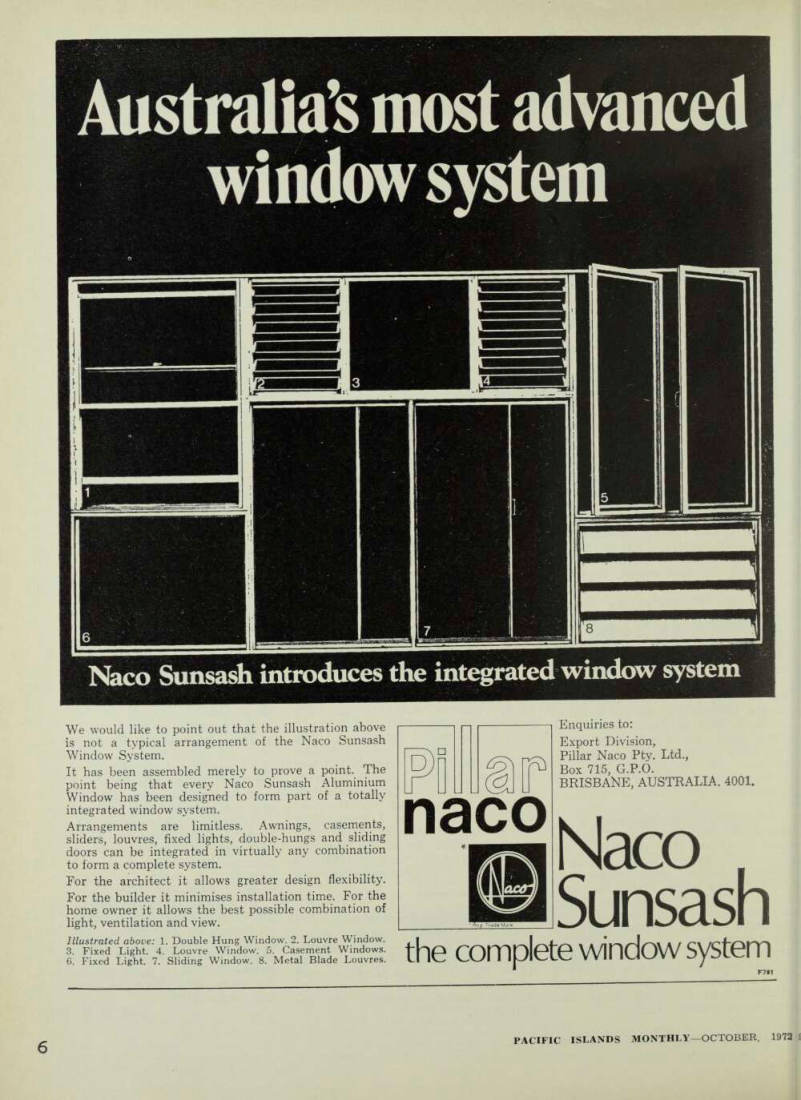
window system
Australia's most advanced
Li Naco Sunsash introduces the integrated window system We would like to point out that the illustration above is not a typical arrangement of the Naco Sunsash Window System.
It has been assembled merely to prove a point. The point being that every Naco Sunsash Aluminium Window has been designed to form part of a totally integrated window system.
Arrangements are limitless. Awnings, casements, sliders, louvres, fixed lights, double-hungs and sliding doors can be integrated in virtually any combination to form a complete system.
For the architect it allows greater design flexibility.
For the builder it minimises installation time. For the home owner it allows the best possible combination of light, ventilation and view.
Illustrated above: 1. Double Hung Window. 2. Louvre Window. 3. Fixed Light. 4. Louvre Window. 5. Casement Windows. 6. Fixed Light. 7. Sliding Window. 8. Metal Blade Louvres. if
naco
life
Enquiries to: Export Division, Pillar Naco Pty. Ltd., Box 715, G.P.O.
BRISBANE, AUSTRALIA. 4001.
Naco
Sunsash
the complete window system
COOL
THE CAR ACCESSORY
THAT REVOLUTIONISED
THE TRADE!
m i ss i m sra
COMFORT
YOUR CAR!
KEEP COOL IN COMFORTABLE, LUXURIOUS
"FRENCH KNIT" TERRY TOWELLING
OR STRETCH NYLON CAR SEAT COVERS.
FITS ALL MAKES OF CARS
TRADE ENQUIRIES:
FRENCH KNIT PTY. LTD., French Knit House, 18 Commonwealth Street, Sydney, 2000. Cable: Knitmills.
PETER FISHER TRADING PTY. LTD., 321 Pitt Street, Sydney, 2000. Cable: Fisherion.
Vmtck Knit
PETER FISHER TRADING
PTY. LTD.
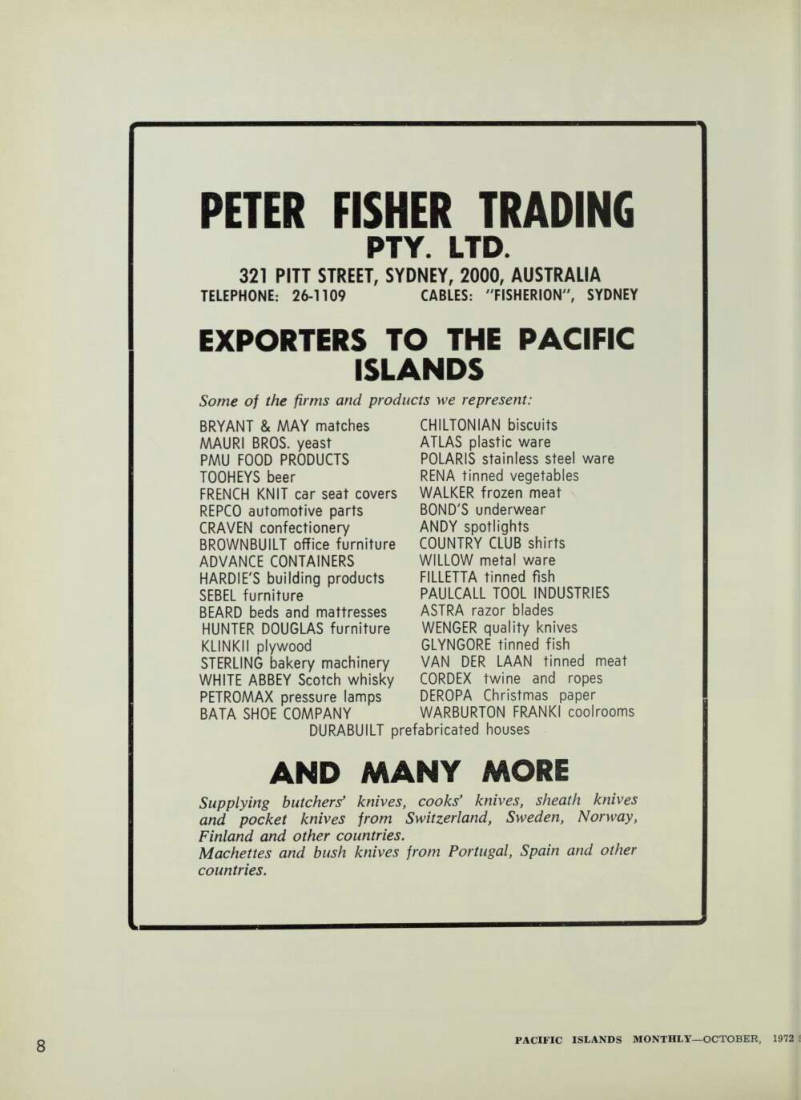
321 PITT STREET, SYDNEY, 2000, AUSTRALIA
TELEPHONE: 26-1109 CABLES: "FISHERION", SYDNEY
EXPORTERS TO THE PACIFIC
ISLANDS
Some of the firms and products we represent: BRYANT & MAY matches AAAURI BROS, yeast
PMU FOOD PRODUCTS
TOOHEYS beer FRENCH KNIT car seat covers REPCO automotive parts CRAVEN confectionery BROWNBUILT office furniture
ADVANCE CONTAINERS
HARDIE'S building products SEBEL furniture BEARD beds and mattresses HUNTER DOUGLAS furniture KLINKII plywood STERLING bakery machinery WHITE ABBEY Scotch whisky PETROMAX pressure lamps
BATA SHOE COMPANY
CHILTONIAN biscuits ATLAS plastic ware POLARIS stainless steel ware RENA tinned vegetables WALKER frozen meat BOND'S underwear ANDY spotlights COUNTRY CLUB shirts WILLOW metal ware FILLETTA tinned fish
PAULCALL TOOL INDUSTRIES
ASTRA razor blades WENGER quality knives GLYNGORE tinned fish VAN DER LAAN tinned meat CORDEX twine and ropes DEROPA Christmas paper WARBURTON FRANKI coolrooms DURABUILT prefabricated houses
AND MANY MORE
Supplying butchers’ knives, cooks’ knives, sheath knives and pocket knives from Switzerland, Sweden, Norway, Finland and other countries.
Machettes and bush knives from Portugal, Spain and other countries.
m-:. % * m Mi mm
Onl
F
It keeps them going in conditions
that would stop others short
The rugged range of MF Slashers will make short work of any shredding, clearing or cutting job. Nine models, in mounted and trailed designs provide an extensive range of cutting widths from four to six feet. And, each model has a range of attachments that equip it for a wide range of slasher applications. Top-quality construction and advanced design pay off with superior performance
and long-life dependability. Among
many refinements, two features MF
Massey Ferguson
World’s largest maker of tractors, headers, cane harvesters, diesel engines, backhoes and loaders. stand out a unique, large-diameter disc with four swing-back blades, that utilises the flywheel principle to maintain constant drive revs, even under the most severe cutting conditions.
In addition, it drastically reduces the horsepower requirement. The fully shrouded design of the output shaft is another oustandine feature. It eliminates any possibility of fencing wire or other foreign material wrapping around the shaft to cause damage to the machine.
MF72011 ASK YOUR MASSEY FERGUSON DISTRIBUTOR FOR COMPLETE DETAILS ... THE MAN TO SEE IS HERE
PAPUA NEW GUINEA
Eia Motors Limited, P.O. Box 75,
PORT MORESBY
Branches and Dealers throughout Papua New Guinea
TAHITI
Ets, Donald,
P.O. Box 131, PAPEETE
NEW HEBRIDES
CONDOMINIUM
Pentecost Pacific S.A., Santo and Port Vila
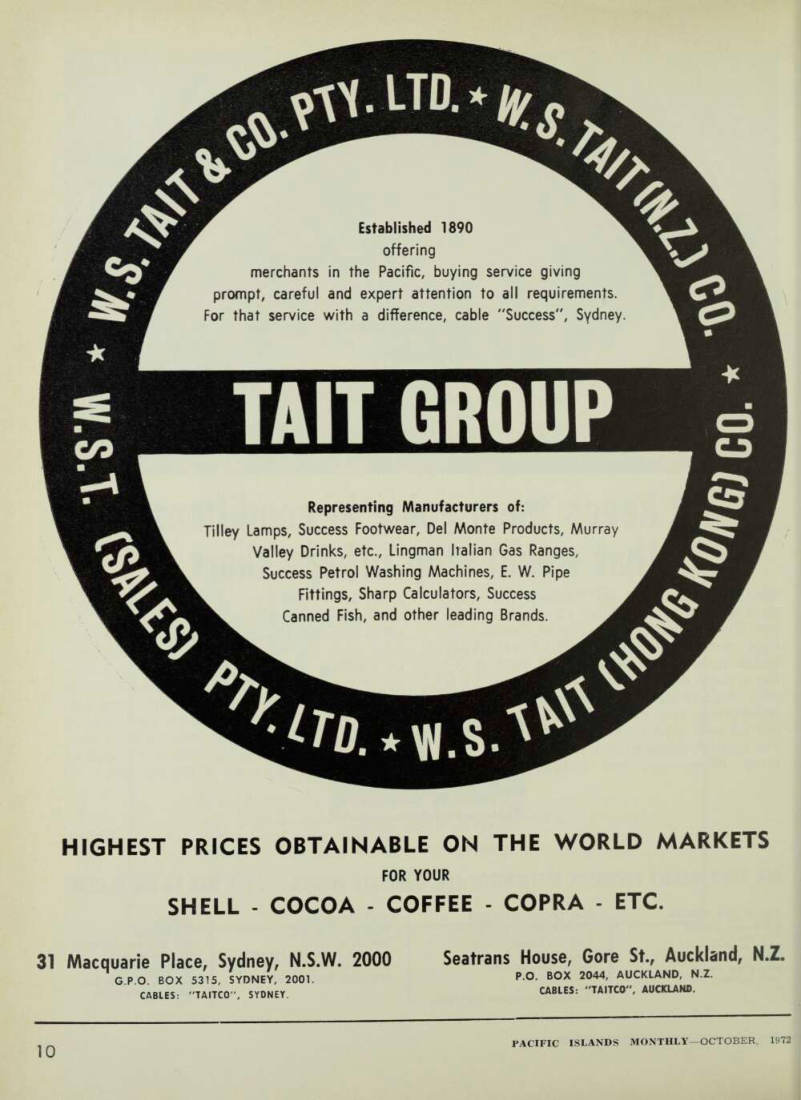
Established 1890 offering merchants in the Pacific, buying service giving prompt, careful and expert attention to all requirements.
For that service with a difference, cable "Success", Sydney. <r> i Representing Manufacturers of: Tilley Lamps, Success Footwear, Del Monte Products, Murray Valley Drinks, etc., Lingman Italian Gas Ranges, Success Petrol Washing Machines, E. W. Pipe Fittings, Sharp Calculators, Success Canned Fish, and other leading Brands. ’Wo* HIGHEST PRICES OBTAINABLE ON THE WORLD MARKETS
FOR YOUR
SHELL - COCOA - COFFEE - COPRA - ETC.
31 Macquarie Place, Sydney, N.S.W. 2000
G.P.O. BOX 5315, SYDNEY, 2001.
CABLES; "TAITCO", SYDNEY.
Seatrans House, Gore St., Auckland, N.Z.
P.O. BOX 2044, AUCKLAND, N.Z.
CABLES: "TAITCO", AUCKLAND.
7
ICIFIC ISLANDS MONTHLY—OCTOBER, 1972
9
DIFIC ISLANDS MONTHLY— OCTOBER, 1972
Pacific Islands Monthly
Micronesia: Out Of The Woods And
Into A Political Maze
Round six in the negotiations between the Congress of Micronesia and the United States on a free political association for Micronesia begins in Hawaii on September 28— amid uncertainty. After the fifth meeting in August, in Washington, it looked as if Micronesia’s political future was agreed upon, only needing the ratification of the Congress of Micronesia on the main points. The details were to follow at this September Hawaii meeting.
But the Congress of Micronesia, at its special session in Ponape in September, a meeting called primarily to give the Joint Committee on Future Status the go-ahead for Hawaii, gave the committee an un expected back-hander.
Congress took no action on bills to establish a Constitutional Convention, a Commission on Government Tran sition and a Commission on National Unity—all major requirements for change in status. Furthermore, it took no action to approve the vital sections of the Draft Compact of Free As sociation which the status committee had hammered out in Washington (PIM, Sept., p. 9).
The Ponape meeting directed Senator Lazarus Salii’s committee to continue to negotiate towards free association, but also to negotiate for independence. The committee now las to decide whether it can continue with the draft in Hawaii or ask for ;xtra talks to discuss the question of ndependence. What is US feeling on m independence alternative on any alebiscite ballot?
The draft compact proposes a ?eriod of self-government, followed ?y independence should the Micro icsians want it. Said Senator Salii in Jaipan, “We just have no choice but o take into account the growing sup )ort for independence. A lot of people vho sponsored the independence esolution were not happy about )ortions of the draft compact and leither were members of the district egislatures we met.”
Senator Salii has now created a üb-committee of the Joint Committee
on Future Status to review US military land requirements in Micro nesia, one of the objections made at congress. It is headed by Senator Amaraich, of Truk.
On the closing day of the Ponape session Senator Salii was bitter at the congress’s change of direction.
He said, “And what, may 1 ask, are we going to do without a govern ment For we cannot have a govern ment without a constitution. And we cannot have a constitution with out a constitutional convention. . . .
This situation will necessitate, at the
very least, the unnecessary expense of a special election for delegates some time next spring. At the worst, the failure to hold the convention could delay the resolution of our political status as long as a year”.
Senator Salii said he would con tinue to think about the problems caused by the congress’s lack of fore sight, planning and organisation, during the coming years, “when we are still a Trust Territory despite the efforts of some to the contrary, because others of us looked the wrong way at this session”.
Background to nation building
From a Saipan correspondent
Washington’s attitudes and tactics toward the Micronesian status questi°n have obviously changed since representatives of the Congress of Micronesia accepted an invitation from then Secretary of Interior Walter Hickel to meet with members of his staff to discuss the territory’s political future for the first time in September, *969.
But the impression of most ob-
servers concerning America’s “strategic trust” islands is that despite a more forthcoming approach, the basic strategy and principles remain the same.
During the first two rounds of negotiations in 1969, with a delega tion headed by Interior Under secretary Harrison Loesch, a man noted for his friendly hometown style, a proposal of “commonwealth” status was offered to Micronesia.
The arrangement, which would have given Washington virtual con trol over all Micronesia’s affairs, was labelled “a camouflaged offer of out right territorial status” by Micronesian status delegation Chairman Senator Lazarus Salii, and rejected by the congress as a whole, save the Mari anas Islands delegates. That district for years had been advocating closer ties with the United States and to close the deal they were prepared to offer miles of now-unused airstrips on Saipan and Tinian built by the Ameri can Air Force in 1944.
But both the United Nations and Washington said all six culturally diverse districts of Micronesia would have to be dealt with as a single
political entity as long as the trustee ship remained in force.
In an immediate move to ease strained Micronesian-US relations, the State Department dispatched a Pacific affairs expert from Canberra to Saipan, but no sooner had he arrived than did some Micronesian unity go up in smoke. The meeting chambers of the Congress of Micro nesia on Saipan were burnt to the ground by arsonists in February, 1971. That same week, the Mariana Islands District Legislature threatened to secede from the rest of the terri tory “by force of arms if necessary”, presumably to join nearby Guam, geographically and culturally part of the Marianas, but since 1898, an unincorporated US territory.
Political differences had polarized sharply now, and in an apparent grandstand play, Marianas delegates attempted to boycott a special session of the Micronesian Congress in Truk District three months after the mys terious fire. It was the first congress session ever held away from Saipan, and before the session ended, an “independence coalition” composed of one-third of the congress member ship was formed.
To relieve this potentially explosive situation, President Nixon personally took the task of dealing with the Micronesian dilemma out of the Interior Department’s hands and into more experienced ones. To give the situation an air of greater importance he appointed Ambassador Franklin Haydn Williams, former head of the partially Central Intelligence Agency financed Asia Foundation, and the Office of Micronesian Status Nego tiations was promptly established in Washington.
Shortly thereafter, more negotia tions were held and new initiatives were taken.
For the first time the US spelled out its military requirements in Micro nesia and accommodated, at least in principle, Micronesian demands for a “free association” status which would include full internal self government. However, full foreign affairs and defence authority would be delegated to the United States, including a security agreement guaranteeing specific land rights to the US in case Micronesia opted to uni laterally terminate the agreement.
But it must be noted that these “accommodations” by the United States did not come about until after a deal had been sealed by Ambassador Williams and Marianas leaders to conduct separate negotiations leading
to “full political union with the United States,” in the words of the Marianas proposal.
Senator Saui said later tL~t the arrangement was made without the consent of the congress or its status committee, although to date the con gress has not taken an official position on the matter.
The US and Micronesian delega tions met in Hawaii this August, tnis time to discuss the political future of the five remaining Micronesian districts, and drafted a partial draft compact which would have become the basis of the future relationship of “free association” between the two governments. But to the dismay of Salii and his committee, the con gress, at its just-ended special session in Ponape, did not approve the docu ment as they had requested.
Spelled out in the compact were American military access rights to all Micronesian waters, harbours and airports in the event of “emergencies”, and specific land requirements were outlined in the Marshalls and Palau (see PIM Sept., p. 127).
However, in a move that surprised no one at the congress, a delegation from the Palau District Legislature testified strongly against any military presence in that district.
The legislature had passed two resolutions during the past three years stating that no military of any nation would be welcome. Senator Salii, who has led the congress in the negotia tion since 1969, is himself a Palauan.
Either he wasn’t speaking for the rest of Palau or he saw the compact as the only way the US would let the islands go.
Aside from that, most objections to the partial draft compact centred around the fact that the document was admittedly incomplete. Senate President Amata Kabua of the Mar shalls said it was silly to ask for approval of US military rights when future financial arrangements, along with trade and commerce agreements, were yet to be worked out. And for a territory that lacks anything that resembles a healthy economy—last year imports rose 25 per cent, while exports fell 25 per cent. —the territory is clearly at the mercy of US hand outs.
More than half of the territory’s wage earners are government em ployees and American expenditures have jumped from $7 million to over $6O million in the last decade alone.
Not much has been said either in public or private about US grants to the future government of Micronesia, but last April the Micronesian dele gation proposed an annual handout of SUSIOO,OOO,OOO half of which would be earmarked for economic development projects.
Geic Hit By 'Flu
Influenza has struck the GEIC, and 13 deaths had been reported up to September 14, 11 of them on the island of Betio, Tarawa.
Air services within the colony were cancelled that week because of illness among crew members.
The hospital was both over whelmed with small patients suffering from pneumonia and depleted of staff by illness.
The ’flu epidemic was ap parently sweeping the Pacific, with outbreaks reported also in Western Samoa, Fiji and Tonga.
Mr. Rarakha
embittered
From a Suva correspondent Fiji’s Opposition Whip, and general secretary of the Opposition National Federation party, mercurial Karam Ramrakha, 39, in September resigned from these posts, plus nine others, with characteristic flamboyance.
“K.C.”—who has long aspired to leadership of the NFP now held by Mr Siddiq Koya—announced his resigna tion over radio Fiji, at the same time giving an unexpected resume of grievances about his own “misunder stood” position with his colleagues, and that of Fiji’s “politically and economically isolated” Indian com munity. He drew a tear-jerking picture of racial inequality of the kind that nobody has heard since independence (since when the government, and Mr Koya, have been stressing the obvious virtues of racial harmony).
He talked of increasing intolerance towards Fiji’s Indians, who, he said, were sitting on sand, with no real stake in the economy; doomed to eternal opposition because of voting patterns which showed little sign of change.
“The so-called booming economy, the rise in salaries of the middle and upper-class artisans and clerical workers give all a false impression of economic growth and belie the real dangers that beset us,” said Mr Ram rakha. “We are faced with false festivals, false forums, false facades, which conceal the real basic problem.”
He told of lack of sympathy for what he was attempting to do by some members of the electorate, by his political colleagues and by the execu tive of the Fiji Teachers’ Union, of which he was president (a position which he has also resigned).
Mr Ramrakha will not resign his seat in parliament or resign from the
Nfp.
Mr Ramrakha’s leader, Mr Koya, seemed unperturbed by the resigna tion. He said it was a “normal hap pening’ in a democratic party, and the party would suffer no adverse effects.
It was generally conceded that one of Mr Ramrakha’s reasons for resig nation was his continued failure to get support enough for leadership.
As the Fiji Times said in an editorial, “There is always something a little embarrassing about public displays about personal hurts, but Mr Ramrakha would have gained, and deserved, much sympathy if he had not accompanied his confession of failure by an intemperate parade of unreal racial grievances”.
Advertisements & other items, p. 14 (1 item)
Micronesia's future
12
PACIFIC ISLANDS MONTHLY—OCTOBER, 1972
Micronesia's future (Continued from previous page)
at French-Polynesian polls
Autonomists set back on their heels at French-Polynesian polls
The French Pacific territories went to the polls in September, and as a result the autonomy movement in both French Polynesia and New Caledonia received a setback. The Polynesian elections are reported below —for what happened in New Caledonia see Helen Rousseau's report on p. 27.
French Polynesia’s evolution toward self-government, “autonomic interne”, was halted on September 10 when the autonomist majority in the Ter ritorial Assembly lost five seats and its dominant position in the 30member body. Victorious were 16, perhaps 17, assemblymen who oppose any change in the political statute of this French overseas territory.
Almost 29,000 voters, 63.5 per cent, of the electorate, redirected the territory’s political future by voting 15,463 to 13,233 in favour of non autonomist candidates who should hold the new majority for the next five years.
The Territorial Assembly is French Polynesia’s unicameral legislature. Its political profile is the best available test of the territory’s political ambi tions.
Gaston Flosse, Mayor of the Pirae township, and his Tahitian Union UDR Gaullist party, were the biggest election winners. His party became the assembly’s largest single group when it picked up two seats for a total of nine.
National Assembly Deputy Francis Sanford’s T'e E’a Api (New Road Party), was the big loser. It dropped hree of 10 seats previously held, to become leader of the new opposition.
With six seats was the other half )f the former 18-member majority coalition, the Pupu Here Ai’a, led )y the 73-year-old veteran of auto lomist causes, French Senator Pou- A Oopa. The Here Ai’a (“The 3 arty which loves its country”) only et slip a single seat.
An important element in the new inti-autonomy coalition will be the fe Autahoeraa, labour leader Charles faufa’s (PIM, Dec., 71, p. 28) lynamic centrist party. Only pre enting candidates in the Leeward sland (Tahiti, Moorea, Bora Bora, laiatea, etc.), it nailed down three eats, one more than it held in the ►ld legislature.
Five independents, all of whom ampaigned against autonomists, won sland seats on local issues.
Post-election headlines have pro laimed a 17-13 balance in favor 'f anti-autonomist candidates, but Iready some of those in the hypothet ical minority have warned that ap-
pearances may deceive and that only the first assembly session will produce the new line-up. This session will be in October, at which time the all important executive Government Council will be elected by the assembly.
Opposition doubts to the contrary, back-stage power-brokers appear to be exchanging their wares as expected.
Gaullist Mayor Flosse, the new man of the hour and the Polynesian politician with the most direct line to Paris coffers, seems assured of Charles Taufa’s critical support.
Taufa, and his party’s spokesman Frantz Vanizette, told a news con ference the day after the election that coalition with the UT-UDR would be normal, on their terms. They pro claimed independence from the Paris Gaullism on which Mayor Flosse relies. They suggested that two or three of the five independents would prefer alliance with them in the centre, rather than dependency on either of the large parties to the left and right. Social Welfare Services Director Vanizette noted that Andre Porlier in the Tuamotus, and Guy Rauzy from the Marquesas, both fought off UT-UDR opposition.
Only one of the five independents might cast his lot with the autono mists, although his past performances show an unashamed inclination to side with the winner. Taratua “Toro”
Teriirere, whose Bora Bora con stituents always come first, won as
sembly election in 1967 under the wing of Alfred Poroi’s UTD group.
Shortly after the opening session he began to vote with the E’a Api side of the autonomist majority, much to Poroi’s chagrin. Some months before this last election he rean nounced his independence and defeated E’a Api opposition.
The day after the election, each party claimed him as one of its own.
He is obviously his own man.
Although the autonomists were surprisingly cheerful after the elec tion, there is no question that a new majority of Polynesian voters have opted for the tightening of ties to France.
The major accomplishment of the out-going autonomist assembly was the composition of an 88-article law which would give total control of domestic affairs to local politicians.
That law languishes this minute in a French National Assembly com mittee-room. Unless Spring elections in France unseat the Gaullist majority, that law will probably not be ratified.
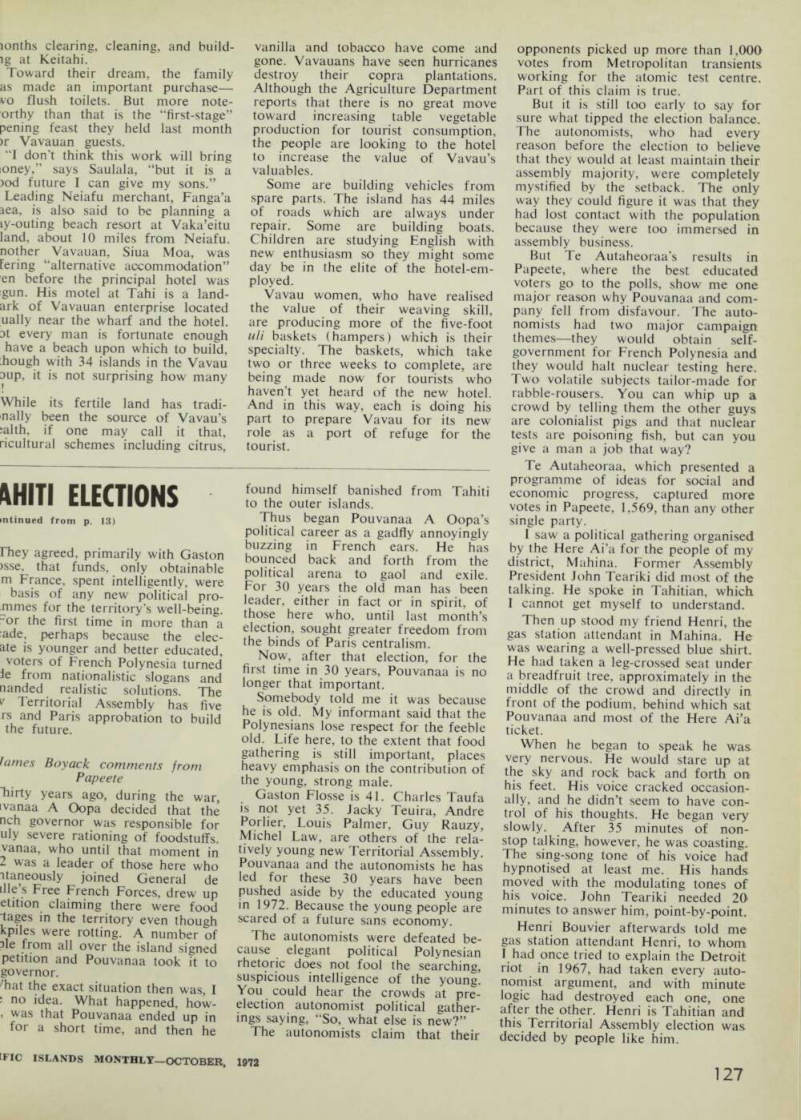
The voters here expressed their dissatisfaction with the concept that a piece of paper in France would become the catch-all solution to their problems. They accepted anti-autono mist arguments that social and economic problems were being over looked in the repetitious presentation of the need for self-government over the past five years. (Continued on p. 127)
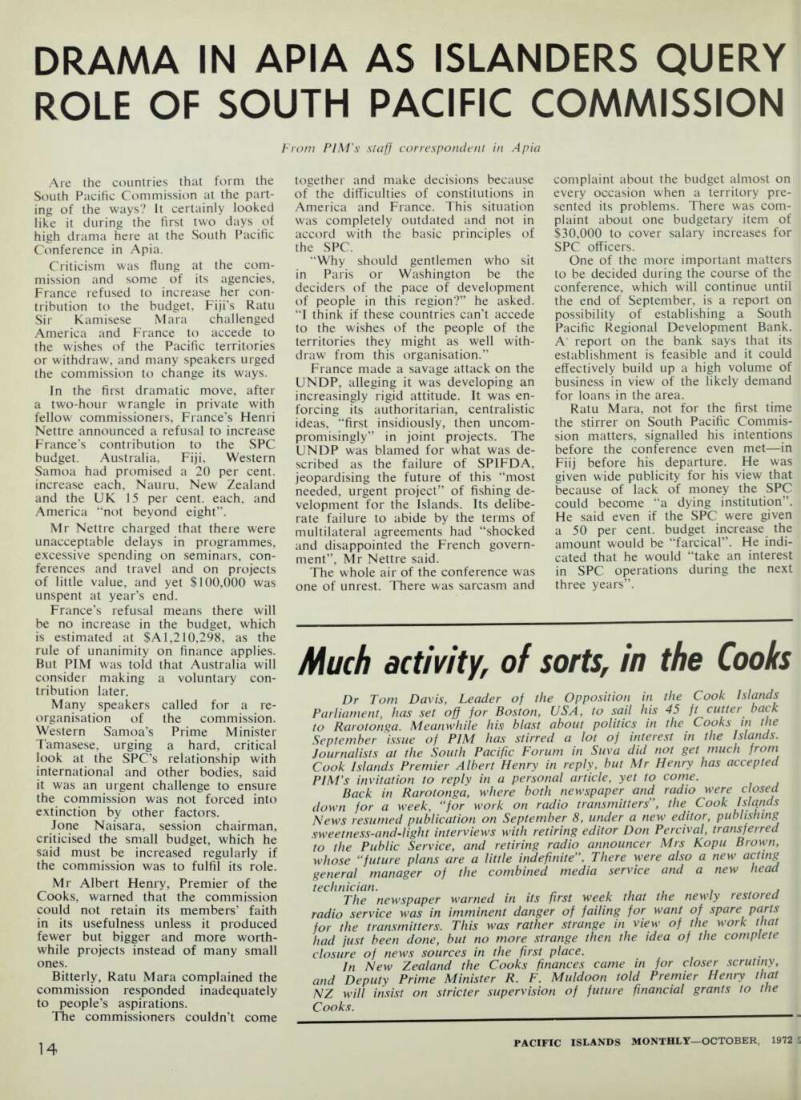
The heart of French Polynesia.
Fhey agreed, primarily with Gaston )sse, that funds, only obtainable m France, spent intelligently, were basis of any new political pro crimes for the territory’s well-being. ~or the first time in more than a ade, perhaps because the elec ate is younger and better educated, voters of French Polynesia turned le from nationalistic slogans and nanded realistic solutions. The v Territorial Assembly has five rs and Paris approbation to build the future.
Janies Boyack comments from Papeete Tirty years ago, during the war, ivanaa A Oopa decided that the nch governor was responsible for uly severe rationing of foodstuffs, vanaa, who until that moment in 2 was a leader of those here who itaneously joined General de file’s Free French Forces, drew up etition claiming there were food tages in the territory even though kpiles were rotting. A number of 3le from all over the island signed petition and Pouvanaa took it to governor.
Tiat the exact situation then was, I 5 no idea. What happened, how , was that Pouvanaa ended up in for a short time, and then he
found himself banished from Tahiti to the outer islands.
Thus began Pouvanaa A Oopa’s political career as a gadfly annoyingly buzzing in French ears. He has bounced back and forth from the political arena to gaol and exile.
For 30 years the old man has been leader, either in fact or in spirit, of those here who, until last month’s election, sought greater freedom from the binds of Paris centralism.
Now, after that election, for the first time in 30 years, Pouvanaa is no longer that important.
Somebody told me it was because he is old. My informant said that the Polynesians lose respect for the feeble old. Life here, to the extent that food gathering is still important, places heavy emphasis on the contribution of the young, strong male.
Gaston Flosse is 41. Charles Taufa is not yet 35. Jacky Teuira, Andre Porher, Louis Palmer, Guy Rauzy, Michel Law, are others of the rela tively young new Territorial Assembly.
Pouvanaa and the autonomists he has led for these 30 years have been pushed aside by the educated young in 1972. Because the young people are scared of a future sans economy.
The autonomists were defeated be cause elegant political Polynesian rhetoric does not fool the searching, suspicious intelligence of the young.
You could hear the crowds at pre election autonomist political gather ings saying, “So, what else is new?”
The autonomists claim that their
opponents picked up more than 1,000 votes from Metropolitan transients working for the atomic test centre.
Part of this claim is true.
But it is still too early to say for sure what tipped the election balance.
The autonomists, who had every reason before the election to believe that they would at least maintain their assembly majority, were completely mystified by the setback. The only way they could figure it was that they had lost contact with the population because they were too immersed in assembly business.
But Te Autaheoraa’s results in Papeete, where the best educated voters go to the polls, show me one major reason why Pouvanaa and com pany fell from disfavour. The auto nomists had two major campaign themes—they would obtain self government for French Polynesia and they would halt nuclear testing here.
Two volatile subjects tailor-made for rabble-rousers. You can whip up a crowd by telling them the other guys are colonialist pigs and that nuclear tests are poisoning fish, but can you give a man a job that way?
Te Autaheoraa, which presented a programme of ideas for social and economic progress, captured more votes in Papeete, 1,569, than any other single party.
I saw a political gathering organised by the Here Ai’a for the people of my district, Mahina. Former Assembly President John Teariki did most of the talking. He spoke in Tahitian, which I cannot get myself to understand.
Then up stood my friend Henri, the gas station attendant in Mahina, He was wearing a well-pressed blue shirt.
He had taken a leg-crossed seat under a breadfruit tree, approximately in the middle of the crowd and directly in front of the podium, behind which sat Pouvanaa and most of the Here Ai’a ticket.
When he began to speak he was very nervous. He would stare up at the sky and rock back and forth on his feet. His voice cracked occasion ally, and he didn’t seem to have con trol of his thoughts. He began very slowly. After 35 minutes of non stop talking, however, he was coasting.
The sing-song tone of his voice had hypnotised at least me. His hands moved with the modulating tones of his voice. John Teariki needed 20 minutes to answer him, point-by-point.
Henri Bouvier afterwards told me gas station attendant Henri, to whom I had once tried to explain the Detroit riot in 1967, had taken every auto nomist argument, and with minute logic had destroyed each one, one after the other. Henri is Tahitian and this Territorial Assembly election was decided by people like him.
Advertisements & other items, p. 15 (1 item)
13
ACIFIC ISLANDS MONTHLY—OCTOBER, 1972
Drama In Apia As Islanders Query
Role Of South Pacific Commission
From PlM’s staff correspondent in Apia
Are the countries that form the South Pacific Commission at the part ing of the ways? It certainly looked like it during the first two days of high drama here at the South Pacific Conference in Apia.
Criticism was flung at the com mission and some of its agencies, France refused to increase her con tribution to the budget, Fiji’s Ratu Sir Kamisese Mara challenged America and France to accede to the wishes of the Pacific territories or withdraw, and many speakers urged the commission to change its ways.
In the first dramatic move, after a two-hour wrangle in private with fellow commissioners, France’s Henri Nettre announced a refusal to increase France’s contribution to the SPC budget. Australia, Fiji, Western Samoa had promised a 20 per cent, increase each, Nauru, New Zealand and the UK 15 per cent, each, and America “not beyond eight”.
Mr Nettre charged that there were unacceptable delays in programmes, excessive spending on seminars, con ferences and travel and on projects of little value, and yet $lOO,OOO was unspent at year’s end.
France’s refusal means there will be no increase in the budget, which is estimated at $A1,210,298, as the rule of unanimity on finance applies.
But PIM was told that Australia will consider making a voluntary con tribution later.
Many speakers called for a re organisation of the commission.
Western Samoa’s Prime Minister Tamasese, urging a hard, critical look at the SPC’s relationship with international and other bodies, said it was an urgent challenge to ensure the commission was not forced into extinction by other factors. lone Naisara, session chairman, criticised the small budget, which he said must be increased regularly if the commission was to fulfil its role.
Mr Albert Henry, Premier of the Cooks, warned that the commission could not retain its members’ faith in its usefulness unless it produced fewer but bigger and more worth while projects instead of many small ones.
Bitterly, Ratu Mara complained the commission responded inadequately to people’s aspirations.
The commissioners couldn’t come
together and make decisions because of the difficulties of constitutions in America and France. This situation was completely outdated and not in accord with the basic principles of the SPC.
“Why should gentlemen who sit in Paris or Washington be the deciders of the pace of development of people in this region?” he asked.
“I think if these countries can’t accede to the wishes of the people of the territories they might as well with draw from this organisation.”
France made a savage attack on the UNDP, alleging it was developing an increasingly rigid attitude. It was en forcing its authoritarian, centralistic ideas, “first insidiously, then uncom promisingly” in joint projects. The UNDP was blamed for what was de scribed as the failure of SPIFDA, jeopardising the future of this “most needed, urgent project” of fishing de velopment for the Islands. Its delibe rate failure to abide by the terms of multilateral agreements had “shocked and disappointed the French govern ment”, Mr Nettre said.
The whole air of the conference was one of unrest. There was sarcasm and
complaint about the budget almost on every occasion when a territory pre sented its problems. There was com plaint about one budgetary item of $30,000 to cover salary increases for SPC officers.
One of the more important matters to be decided during the course of the conference, which will continue until the end of September, is a report on possibility of establishing a South Pacific Regional Development Bank.
A' report on the bank says that its establishment is feasible and it could effectively build up a high volume of business in view of the likely demand for loans in the area.
Ratu Mara, not for the first time the stirrer on South Pacific Commis sion matters, signalled his intentions before the conference even met—in Fiij before his departure. He was given wide publicity for his view that because of lack of money the SPC could become “a dying institution”.
He said even if the SPC were given a 50 per cent, budget increase the amount would be “farcical”. He indi cated that he would “take an interest in SPC operations during the next three years”.
Much activity of sorts, in the Cooks
Dr Tom Davis, Leader of the Opposition in the Cook Islands Parliament, has set off for Boston, USA, to sail his 45 ft cutter hack to Rarotonga. Meanwhile his blast about politics in the Cooks in the September issue of PIM has stirred a lot of interest in the Islands.
Journalists at the South Pacific Forum in Suva did not get much from Cook Islands Premier Albert Henry in reply, but Mr Henry has accepted PlM’s invitation to reply in a personal article, yet to come.
Back in Rarotonga, where both newspaper and radio were closed down for a week, “for work on radio transmitters”, the Cook If mas News resumed publication on September 8, under a new editor, publishing sweetness-and-light interviews with retiring editor Don Percival, transferred to the Public Service, and retiring radio announcer Mrs Kopu Brown, whose “future plans are a little indefinite”. There were also a new acting general manager of the combined media service and a new head technician. „ . . , , The newspaper warned in its first week that the newly restored radio service was in imminent danger of failing for want of spare parts for the transmitters. This was rather strange in view of the work that had just been done, but no more strange then the idea of the complete closure of news sources in the first place.
In New Zealand the Cooks finances came in for closer scrutiny, and Deputy Prime Minister R. F. Muldoon told Premier Henry that NZ will insist on stricter supervision of future financial grants to the Cooks.
Tropicalities
He’s grappling
(intelligently)
with edueation
Education is high on the list of Fiji’s “national problems” and if youthful new Minister for Education, ¥outh and Sport, Mr Jone Naisara, xrnld perform miracles, he would.
Since taking on the job four nonths ago, Mr Naisara’s task has ?een to sort out priorities, a thankless occupation even the most ardent critic of government policies might shirk.
He has on his desk a long and growing list of things his ministry vould like to achieve—and they all xost money.
Fiji this year spent $9.4m on edu cation—or 22i cents out of every lollar’s worth of revenue raised by he government. Just under S7m of his went on teachers’ salaries—which loesn’t leave much over for the nultitude of urgent projects jostling or priority.
Fiji has 12,000 children of primary chool age who’ve never attended chool, or who’ve had to leave be cause their parents can’t pay the fees, the money spent by the Fiji jovernment on educating one handi capped child, five of the non-handi capped children could be educated.
Vhich should come first?
Mr Naisara’s ministry is under in creasing pressure to assist financially n the introduction of a widespread ystem of pre-school education. Is it nore important than the provision of )rimary school facilities for those 2,000 non-attenders?
The government has already de cided to introduce fee-free primary education in the next five years, but t will be many years before a similar ystem can be adopted for secondary chool pupils. With secondary school tudents increasing by more than •’OOO a year, there’s a great need to ncrease government expenditure on he award of free or partly-free places, iut is it more urgent than providing •re-school facilities, for instance, or acilities for handicapped youngsters?
As a major cause of spiralling
building industry costs in Fiji is the growing shortage of competent trades men, part of the answer would be to establish up-grading courses for those already in jobs and initial training courses in the basic skills for the un employed. But should they have priority though over the increased allocation of teacher-training scholar ships, when last year more than 1,300 untrained teachers were employed in Fiji’s schools, 300 of them at second ary school level?
During Education Week in Fiji in September, Mr Naisara posed these and other questions, adding that his ministry certainly didn’t claim to know all the answers.
“We obviously cannot expect a big increase in our present share of 221 per cent, of government revenue,” he said.
“To decide what we should do first and what we should defer is not as easy a task as some of our critics seem to think. I am in no doubt that the priority list we are now preparing will be a sensible one. I am equally sure that it will not please everyone.”
That’s for sure—but at least Mr Naisara can’t be accused of talking pie in the sky. He doesn’t promise miracles.
Jimmy Stephens
about-turn
Has Jimmy Stephens, leader of the Na-Griamel movement in the New Hebrides, changed his tune?
British and French officials there think that Na-Griamel, which was a thorn in their side, has altered its policy of non-co-operation to a more positive, helpful one.
Their hopes were raised through speeches he made at the movement’s headquarters at Vanafo, Santo, in August.
Jimmy told more than 400 of his followers during five days of celebra tions to mark their anniversary that they must co-operate more with the French and British authorities. This, opinioned the British Newsletter, the British administration’s mouthpiece, appeared to mark a welcome change in Na-Griamel policy.
Tongan soc*4*er
gets a boost
Tonga’s keenest soccer fan, King Taufa’ahau Tupou IV, was away in England when the combined Fiji Southern Division and Labasa soccer side arrived in Nukualofa on Sep tember 1. But the king had given clear instructions before he left. “Look after them,” he told Tongan soccer officials.
Well, they did. The 17 Fiji players and two officials found everything throughout the 11-day tour free—the return voyage from Suva in the Tongan Government ship Aoniu, accommodation at Tongan Football Association president Hameti Mataele’s huge house, all meals and a lot of the New Zealand Steinlager beer at the ageing Tongan Club.
But while they may have over whelmed the Fiji side with hospitality
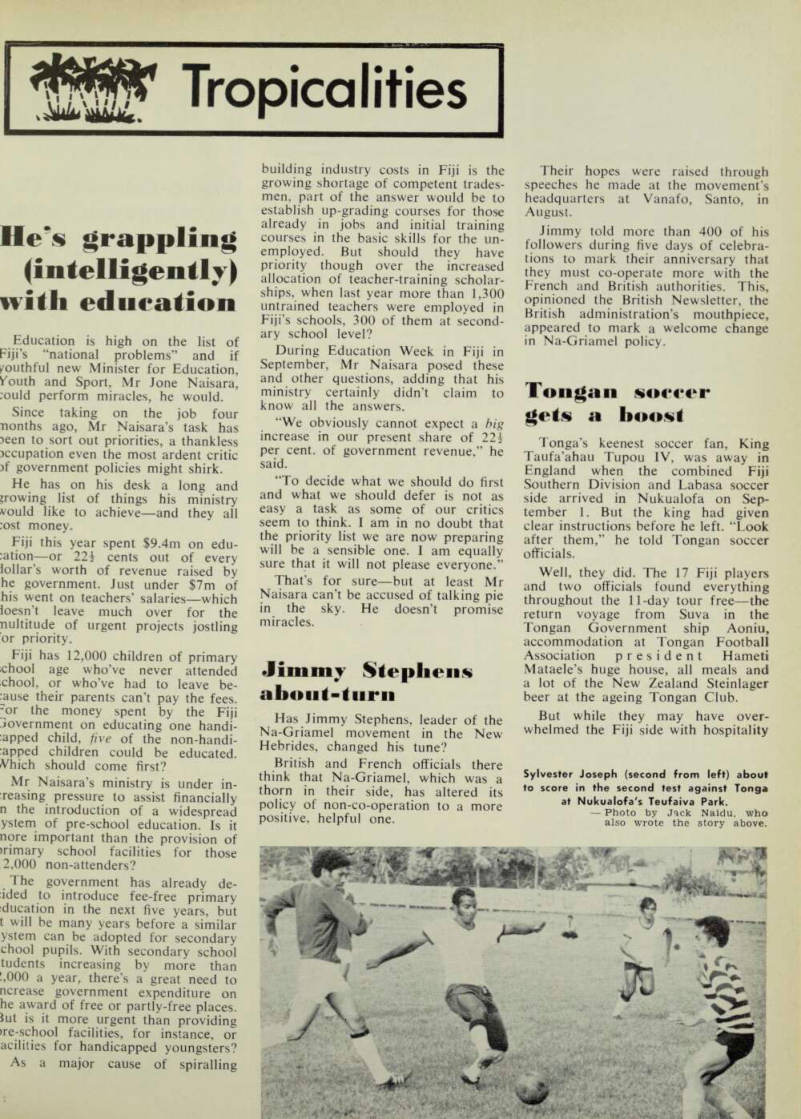
Sylvester Joseph (second from left) about to score in the second test against Tonga at Nukualofa's Teufaiva Park.
Photo by Jack Naidu, who also wrote the story above.
—they lagged on the field of play.
The first test, which was the first match of the tour, showed that Tongan soccer was a little behind the times. Fiji won 6-0.
But keenness and interest in the game were very much to the fore.
What is really needed is a good soccer coach to teach them the basics of the game. Perhaps the only person in Tonga who has some idea of the game is the secretary to the British High Commission in Nukualofa, John Carrol who hails from Liverpool, England.
As the visitors played the Tongans quickly caught on to some of the tactical and positional play. Fiji’s second last match against a combined Ngeleia and Uta side nearly ended in a draw, but Fiji just managed to score in the dying minutes of the game to win 2-1, On the tour the Fiji side scored 24 goals and conceded only three.
It could have done even better, but the team stormed trying to get goals and concentrated on demonstrating some finer points of the game. Dribb ling, ball control, long and short passes, running into the gaps and some hard shooting from outside the penalty box had the Tongans puzzled for a while.
The Tongans should take the in itiative and start its soccer in the primary schools.
“ The Tongan Football Association is virtually penniless and outside com petition is scarce,” said association president, Hameti Mataele. “But we hope that this step of inviting a com bined side here will improve our standard of the game and we hope in years to come that we may be able to send a good side to Fiji.”
Fiji’s manager, Mr Moti Musadilal has already invited a Tongan side to tour Fiji next year. But if a Tongan side should tour Fiji, it ought to play club sides and be given special coach ing sessions.
A remarkable part of the tour was
the Tongan friendliness and hospitality. Even their girls who outnumber the boys three to one were never so friendlv It the Fiji team did not find much to keep it occupied on the field, it surely found it when it came off!
All comrades
in the Cooks
It’s not recorded that anyone sang the Volga Boatmen but a Russian officer whirled around the stage in a Georgian dance at Rarotonga’s Maruaiai Danceland during a visit to the Cooks in August by the Russian meteorological ship Volna.
The islanders entertained their guests as only islanders can and the Russian were no less friendly.
Not to be outdone in hospitality, the Volna’s captain threw a party on board his ship for Cabinet Chairman Mr Geoffrey Henry and other
cabinet members and also presented films on the USSR to Tereora College.
The junket lasted four hours.
“The visit of the Russian Meteor ological Research team has certainly done something to create friendship between our two nations,” enthused the Cook Islands News.
Super-colossal TV
extravaganza soon
The hour-long colour film on the first South Pacific Arts Festival, which was held in Suva in May, is about to be released to the world television. The festival’s executive officer, Victor Carell, put the last of the film together in Sydney in Sep tember—including a narration taped by Raymond Burr and flown from Hollywood. Burr, surely one of TV’s “greats”, has extensive Fiji interests and has done the narration (written by Carell) for free as his contribution to the festival.
Pacific Hotels and Developments Ltd., the company behind the big Deuba development in Fiji, has put up the money to make it possible for every one of the 18 territories which took part in the festival to receive free copies of the 16 mm film. The South Pacific Commission gets two copies.
Said Carell in Sydney: “Every territory is represented on the film, and all aspects of the festival.
There were five cameras there. The TV impact can be nothing less than enormous.”
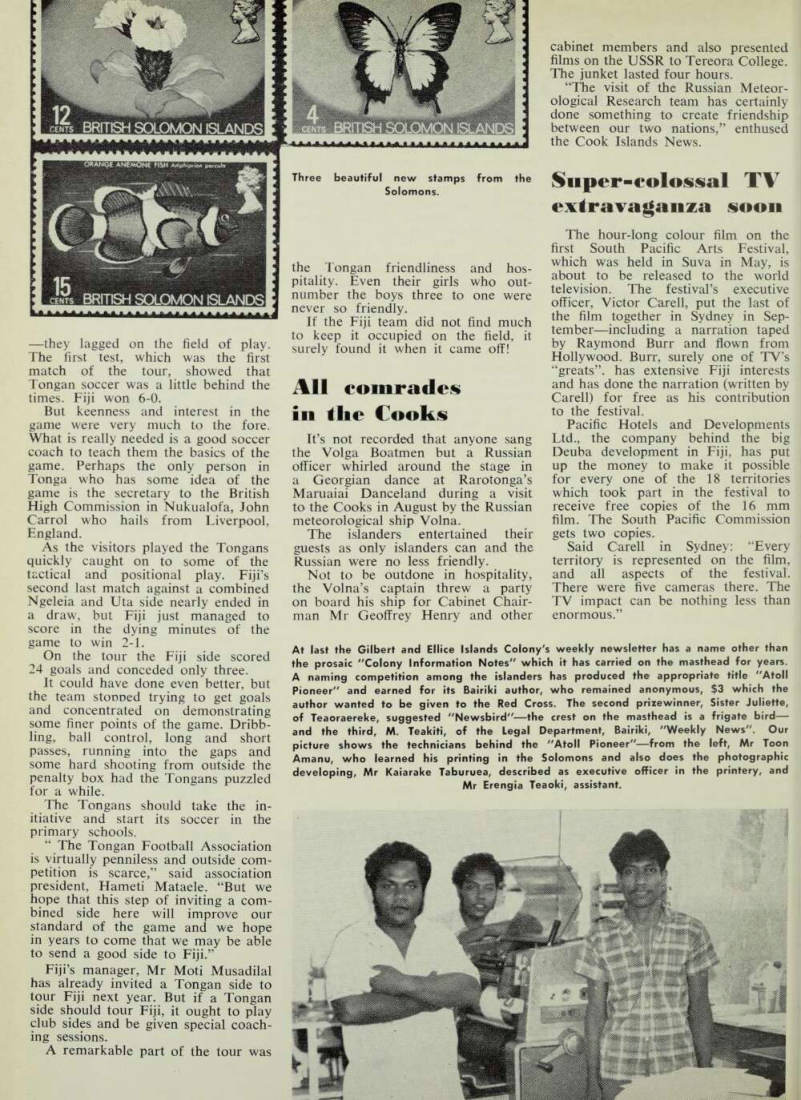
At last the Gilbert and Ellice Islands Colony's weekly newsletter has a name other than the prosaic "Colony Information Notes" which it has carried on the masthead for years.
A naming competition among the islanders has produced the appropriate title "Atoll Pioneer" and earned for Its Bairiki author, who remained anonymous, $3 which the author wanted to be given to the Red Cross. The second prizewinner, Sister Juliette, of Teaoraereke, suggested "Newsbird" —the crest on the masthead is a frigate bird— and the third, M. Teakiti, of the Legal Department, Bairiki, "Weekly News". Our picture shows the technicians behind the "Atoll Pioneer" —from the left, Mr Toon Amanu, who learned his printing in the Solomons and also does the photographic developing, Mr Kaiarake Taburuea, described as executive officer in the printery, and
Mr Erengia Teaoki, assistant.
Three beautiful new stamps from the Solomons.
On fire for
National Dav
w Papua New Guinea’s National Day celebrations, held this year on Mon day, September 11, seem to be settling down into a discernible pat tern. This pattern includes plenty of fun and games, ranging from tradi tional singing and dancing through string band competitions to football matches and other sporting fixtures, laced with speeches by kiaps, parlia mentarians and other dignitaries on :he subject of national unity.
It will soon become as difficult to jay anything fresh in a National Day speech as it already is in an Anzac Day one. Nevertheless, this year some 'ery good speeches were made, and ve were encouraged to note that ome of the sentiments expressed sug gested that the speakers who voiced hem were regular readers of Percy :hatterton’s PIM “Footnotes”!
In Port Moresby, a soccer match >etween a PNG team and a visiting earn from the New Hebrides drew i capacity crowd of 15,000 to the »ir Hubert Murray Stadium to see he home side win 3-1. Later they leard speeches from the Adminis rator, the Lord Mayor of Port Moresby, Gala Gala Rarua, and the aernber for Central Regional, Miss • M. Abaijah, The last-named per ormed gracefully in a role for which lost people would never have dared 3 cast her.
All, or nearly all, was peace and oodwill. Even the lion and the lamb, by the Australian Broad asting Commission and the Adminis ■ation Radio Network, lay down to ether and concocted a joint National )ay programme. Everybody tried ery hard, yet listening one came to -alise how fatally easy it is for any ne with a microphone thrust in ont of him to waffle on without dually saying anything.
Probably not all was peace and lodwill. At Popondetta, in the orthern District, an angry crowd lased two men from the Gulf Dis ict through the town and stoned ic buildings in which they succes vely took refuge.
Two days after the nationwide chortations to bung wantaim, a mini ar, causing three deaths and much jstruction of property, broke out Jtween rival tribal groups in the
Astern Highlands.
Is National Day worth celebrating 9 r e believe it is. Well, it’s fun, in a orld in which there’s not nearly as uch fun as there should be. And it merates a lot of goodwill, even if me of it is rather evanescent.
But clearly National Day will not ilidate New Guinea’s national unity.
It will have to be the other way round.
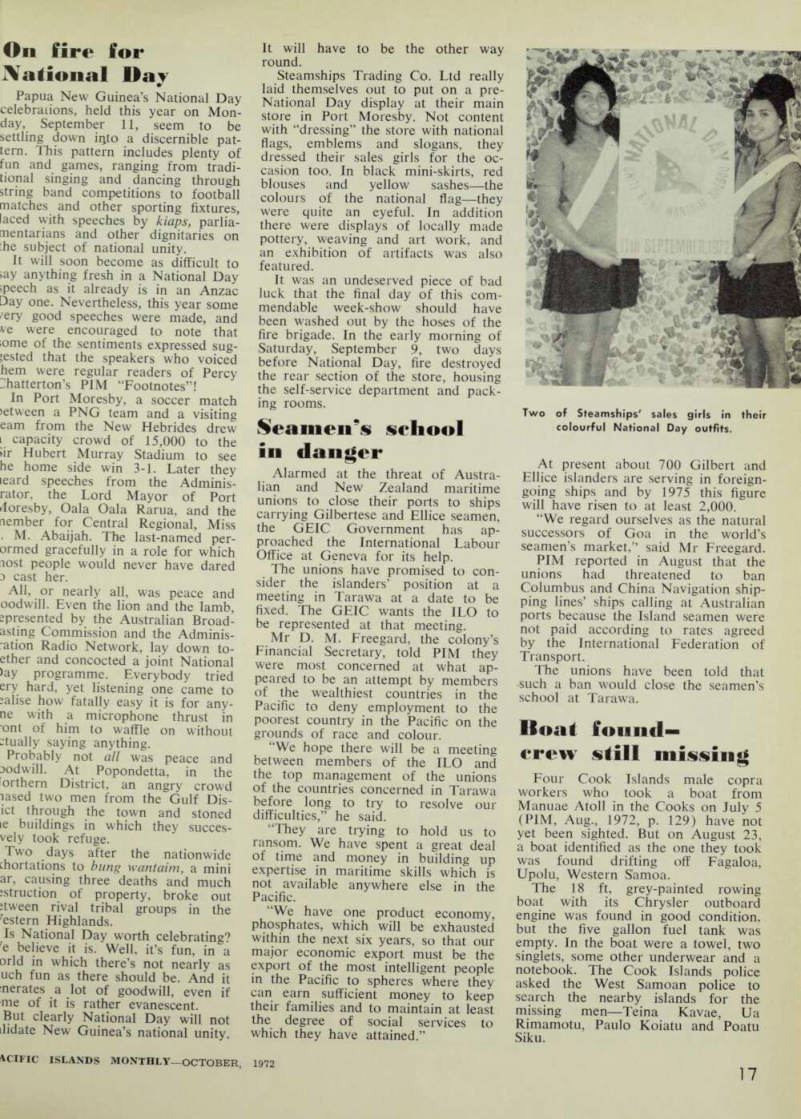
Steamships Trading Co. Ltd really laid themselves out to put on a pre- National Day display at their main store in Port Moresby. Not content with “dressing” the store with national flags, emblems and slogans, they dressed their sales girls for the oc casion too. In black mini-skirts, red blouses and yellow sashes—the colours of the national flag—they were quite an eyeful. In addition there were displays of locally made pottery, weaving and art work, and an exhibition of artifacts was also featured.
It was an undeserved piece of bad luck that the final day of this com mendable week-show should have been washed out by the hoses of the fire brigade. In the early morning of Saturday, September 9, two days before National Day, fire destroyed the rear section of the store, housing the self-service department and pack ing rooms.
Seamen’s school
in danger
Alarmed at the threat of Austra lian and New Zealand maritime unions to close their ports to ships carrying Gilbertese and Ellice seamen, the GEIC Government has ap proached the International Labour Office at Geneva for its help.
The unions have promised to con sider the islanders’ position at a meeting in Tarawa at a date to be fixed. The GEIC wants the ILO to be represented at that meeting.
Mr D. M. Freegard, the colony’s Financial Secretary, told PIM they were most concerned at what ap peared to be an attempt by members of the wealthiest countries in the Pacific to deny employment to the poorest country in the Pacific on the grounds of race and colour.
“We hope there will be a meeting between members of the ILO and the top management of the unions of the countries concerned in Tarawa before long to try to resolve our difficulties,” he said.
“They are trying to hold us to ransom. We have spent a great deal of time and money in building up expertise in maritime skills which is not available anywhere else in the Pacific.
“We have one product economy, phosphates, which will be exhausted within the next six years, so that our major economic export must be the export of the most intelligent people in the Pacific to spheres where they can earn sufficient money to keep their families and to maintain at least the degree of social services to which they have attained.”
At present about 700 Gilbert and Ellice islanders are serving in foreign going ships and by 1975 this figure will have risen to at least 2,000.
“We regard ourselves as the natural successors of Goa in the world’s seamen’s market,” said Mr Freegard.
PIM reported in August that the unions had threatened to ban Columbus and China Navigation ship ping lines’ ships calling at Australian ports because the Island seamen were not paid according to rates agreed by the International Federation of Transport.
The unions have been told that such a ban would close the seamen’s school at Tarawa.
Koat found—
crew still missing
Four Cook Islands male copra workers who took a boat from Manuae Atoll in the Cooks on July 5 (PIM, Aug., 1972, p. 129) have not yet been sighted. But on August 23, a boat identified as the one they took was found drifting off Fagaloa, Upolu, Western Samoa.
The 18 ft, grey-painted rowing boat with its Chrysler outboard engine was found in good condition, but the five gallon fuel tank was empty. In the boat were a towel, two singlets, some other underwear and a notebook. The Cook Islands police asked the West Samoan police to search the nearby islands for the missing men—Teina Kavae, Ua Rimamotu, Paulo Koiatu and Poatu Siku.
Two of Steamships' sales girls in their colourful National Day outfits.
Advertisements & other items, p. 19 (1 item)
17
*CIFIC ISLANDS MONTHLY—OCTOBER, 1972
of post-colonial relationships"
They're building together "a new pattern of post-colonial relationships"
From JOHN CARTER , in Suva
The three days which the leaders of the five independent or self governing Island countries spent at the South Pacific Forum on the campus at the University of the South Pacific in Suva in September could be the most momentous in the history of the Islands.
In about 13 hours of discussion, the Forum, meeting for the third time, tabulated the Islands’ problems, suggested some solutions, created its first infant—the Bureau for Economic Co-operation—gave the infant some pointers on how to earn its keep and ensured the willing co-operation of the elder brethren, Australia and New Zealand.
It was only mildly political, ad ministering a rap to France over the nuclear tests. The rest of its labours were confined to the things which can make the Islands pros perous.
It is traditional to have a Fijian ceremony of welcome at all such occasions but the one that started the Forum ball rolling had an added significance. The ceremony, the Fijian bure in which the Forum met —a building put up for the Fiji Arts Festival—the palm trees, the distant vista of the white breakers on the reef, and Ratu Sir Kamisese Mara’s
words of welcome all added up to the fact that the Forum, conceived in the Islands, born in New Zealand and cradled in Australia, had got home at last.
“The seedling has become a suf ficiently sturdy plant to be trans planted from the colder climes of our southern neighbours to the soil of the Islands where it must find firm
roots if it is to grow and flourish,” said Fiji’s Prime Minister.
Then, summing up the whole pur pose of the Forum, he said: “I believe the Forum is showing healthy signs of meeting the need felt by the Island members to reach out beyond the confines of their own shores to share the common experience of govern ment with their neighbours, and it is meeting the wish too of our Aus tralian and New Zealand friends to build together a new pattern of post
colonial relationships.”
Western Samoa’s Tamasese Lealofi IV was even more succinct. The Forum, he said, was to “establish areas in which we might collectively do better than we might do individu ally . . . and speed up the task of raising the standard of living of our
peoples”.
The first session opened at 11 a.m. on September 12 without any trumpet voluntaries and got down to business immediately. As at the previous two meetings, the Press had been excluded and later, at special briefing sessions, was given the bare crumbs. Nauru s President was the Forum’s spokes man at the Suva briefings and it was starvation fare he handed out.
The first official communique was but a few sentences —Mr Mahe
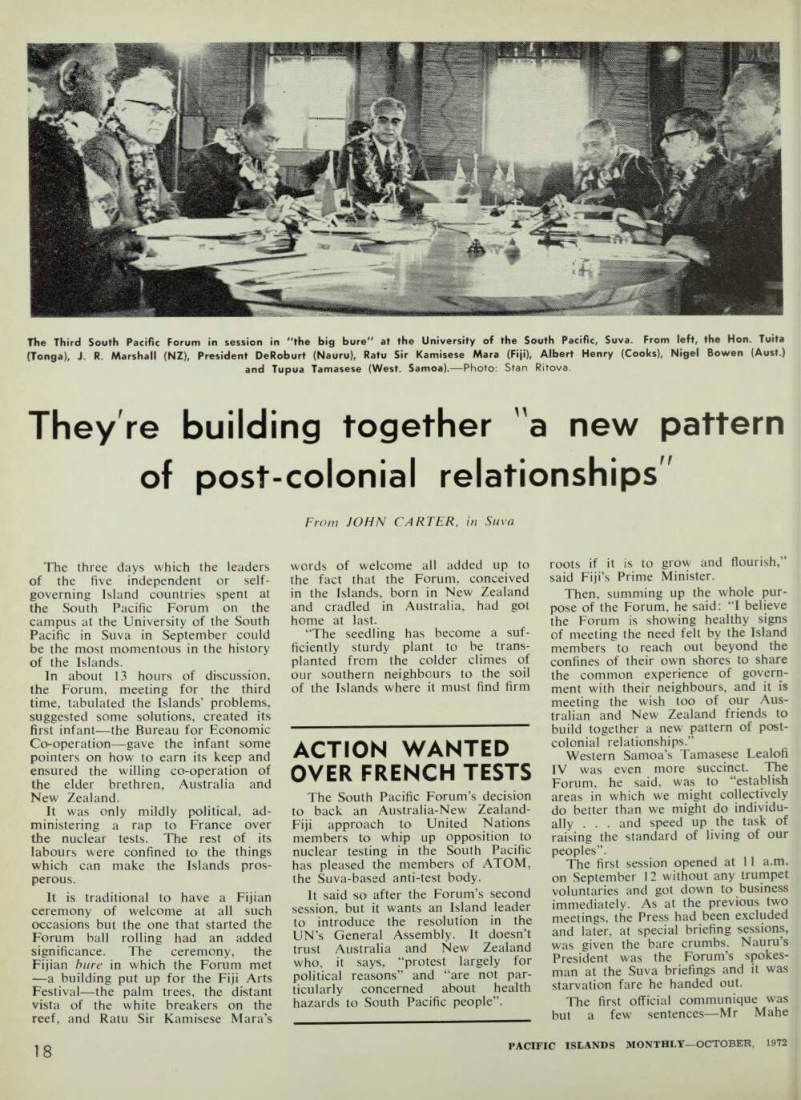
The Third South Pacific Forum in session in "the big bure" at the University of the Sooth Pacific, Suva. From left, the Hon. Tuita (Tonga), J. R. Marshall (NZ), President DeRoburt (Nauru), Ratu Sir Kamisese Mara (Fiji), Albert Henry (Cooks), Nigel Bowen (Aust.) and Tupua Tamasese (West. Samoa). — Photo: Stan Ritova.
Islands Want Wider Trade Ties
Tupouniua was confirmed in his ap pointment as director of the Bureau for Economic Co-operation with New Zealander Mr Ken Piddington as his deputy; it was decided in principle that there should be a written agree ment to establish the bureau and it was considered that its future task will include studies in trade patterns and trade expansion. That was all.
It wasn’t exciting but President Deßoburt agreed it was important and a “matter of urgency” that the bureau got off the ground without delay. Trade relations were touched on by the Forum members as a con tinuation of the talks held earlier this year in Wellington.
NAFTA, the New Zealand-Australia Free Trade Agreement—and GATT, the General Agreement on Trade and Lariffs, came into the picture, only briefly at first, but as the session wore an, more and more talk centred round NAFTA. The Islands want to be in it. The main task of the bureau will be to get a foot in the door, but :he two partners are coy.
Tonga’s delegate, Minister of Lands Luita, told PIM the kingdom wanted •fade barriers lifted. It’s difficult, 00, to see how the Forum members :an better the people’s lot without a digger share of world markets, par icularly Australia and New Zealand.
Australia and NZ did some think ng aloud about how the Island gov ernments could try to better trade )atterns and the course they could :hart in trade relations between hemselves and the metropolitan governments, but they weren’t promis ng anything in the way of NAFTA nembership. New Zealand had most deas on these things but the Islands lave always found New Zealand nuch easier to handle than Australia vhere primary producers, in the shape •f the Country Party, wag the gov rnment dog.
All the things that can be done idth the coconut, cocoa, fruit, imber, fish and a dozen other wind aising products were bandied back nd forth. Eventually, a pattern merged. The bureau will be told to 3ok at further processing of primary roducts, new industries making cods for export, avoidance of dupli ated industries and the lowering of rade barriers.
One sentence stood out in the keleton communique put out on the day—“The bureau will xamine the implications for the outh Pacific Islands of the enlarge ment of the European Economic immunity, the generalised system of
preference agreed by the United Nations Committee on Trade and Development (UNCTAD) and a variety of possible commercial arrangements with Australia and New Zealand which might help their economic development.”
It is obvious that the New Zealand Australia Free Trade Agreement was tied up with this, but development of opportunities in this set-up for the Islands will be a slow process, if NZ Prime Minister Mr Marshall is any judge, and he should be.
As he said outside the Forum, he was one of the authors of NAFTA along with Sir John McEwen of Aus tralia. They began negotiations in 1961 and just under five years later NAFTA was born. What took the time was the exploration of prob
lems likely to develop in the future.
Trade between the two partners in creased dramatically as a result of
Nafta.
Mr Marshall said the agreement provided for extension to other Pacific countries, but further investi gation in depth would be needed for that.
This could mean, presumably, that the Forum countries might see them selves members of NAFTA in four to five years’ time!
And what could the Islands trade with Australia and New Zealand?
Fruit and vegetables for New Zealand, artifacts and curios for Australia?
That would be chicken feed. Mr Marshall saw Islands’ exports to the NAFTA partners in terms of man power.
“One resource the Islands have got is manpower,” he said. “If it were possible to organise labour so that
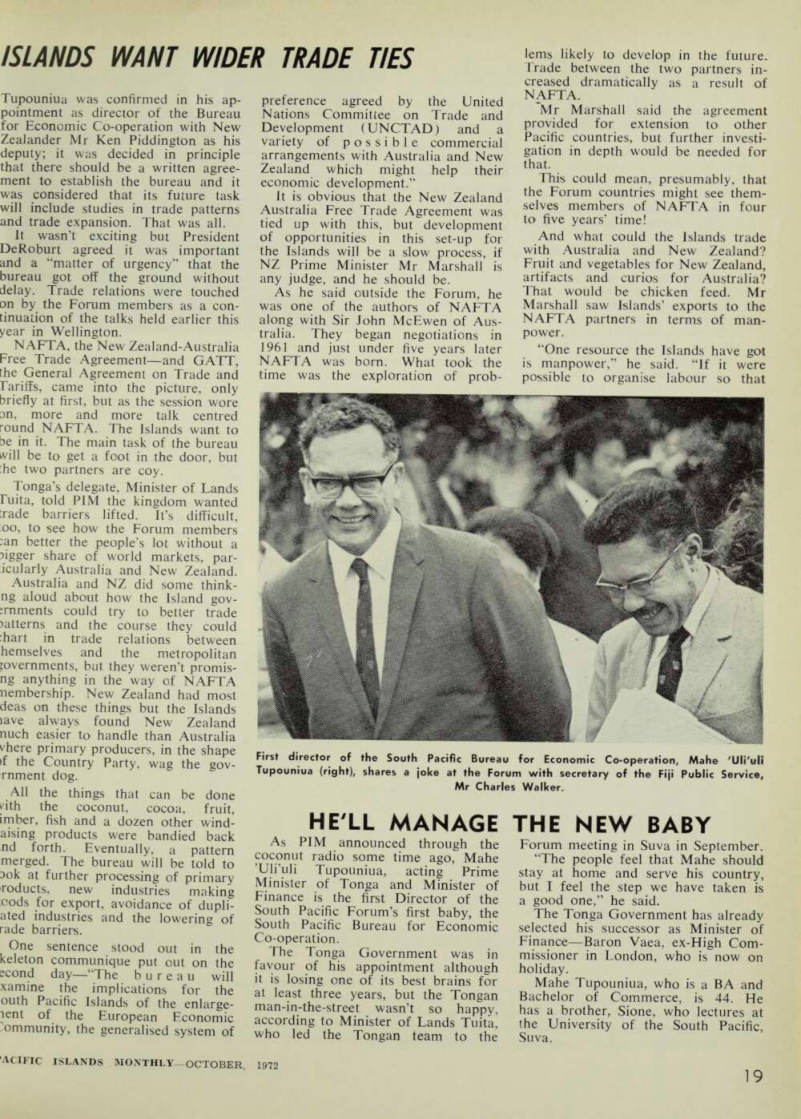
First director of the South Pacific Bureau for Economic Co-operation, Mahe 'Uli'uli Tupouniua (right), shares a joke at the Forum with secretary of the Fiji Public Service, Mr Charles Walker.
the Islands could produce components and assemble more sophisticated pro ducts for which there is an export market that would be one answer.”
And that’s the sort of thing the bureau, which is already known as SPEC, will tackle.
Another subject which brought some verbiage and a resolution from the Forum was that of nuclear test ing—with France in mind, of course.
As the preliminary communique put it, “The Forum supported steps being taken by Australia, New Zealand and Fiji to mobilise inter national opinion to bring about the cessation of all nuclear weapon tests”.
Spokesman President DeRoburt said the Forum was generalising and didn’t single out France.
But it was obvious when the final communique was produced—and it took some time for the Forum to agree on its wording—that the Forum had meanwhile decided to point the finger at France. ‘‘Members were unanimous in ex pressing their deep concern that the French Government should have failed so signally to accord recog nition to the wishes of the peoples of the South Pacific area despite the views so clearly indicated by both governments and peoples,” said the communique.
Despite the ban on politics in the South Pacific Commission, it wouldn't be surprising if there’s a nuclear fall out at the Apia meeting in late Sep tember.
With so much water and so little land, the members concentrated a lot of thinking on the Law of the Sea Conference planned in Geneva. There are some knotty problems there— what constitutes territorial waters and international waters in the middle of an archipelago*, and control of fishery zones?
The Forum heard from Tonga about its Minerva Reef dispute with the self-styled Republic of Minerva.
There have been rumours sparked off by a United States newspaper report that the republic is recruiting an army of mercenaries to defend its rights to the reef.
“President” Davis was quoted as saying that they wouldn’t attack Tonga itself because Tonga had nothing they wanted. Judging by the Forum’s tone, the republic would have to take on the whole of the South Pacific.
The Forum’s view was that it “welcomed the Tongan Government’s continuing interest in the area and agreed that there could be no ques tion of recognising other claims, and specifically that of the Ocean Life Research Foundation to sovereignty over the reefs”.
Regional shipping was an impor
tant item but although the subject was given a thorough airing the Forum made little progress and will depend on the bureau to come up with some answers on how to create a viable shipping line and keep freight rates down.
There was no mention in the re lease of the Union Steam Ship Company’s offer of a 50 per cent, share in a new shipping project (see p. 83) but Ratu Mara revealed after the meeting that the members were less than lukewarm over the offer.
The Forum as a whole did not lean towards accepting the offer, he said.
The largest increase in freight rates had been in the New Zealand services.
There was probably another factor influencing the Forum—the impudent declaration by the NZ Seamen’s Union that it would “interfere” with services by ships of a South Pacific regionally-owned line if their mem bers’ jobs were threatened.
Mr Marshall, however, doesn’t favour an Islands’ regional shipping line. He said outside the Forum that he much preferred private enterprise to gov
ernment-owned shipping.
“We wouldn’t oppose the sug gestion of an Islands regional ship ping line but we would point out the problems, of the need for suitable ships, regularity of service and reasonable freight rates, he said.
This was one area where Australia must have felt it could do some par ticular good because Mr Bowen offered his country’s help in the study the bureau will make of shipping.
It was early in the agenda that the Forum showed wise statesmanship in dealing with a tricky problem posed by Papua New Guinea, which had asked for membership of the Forum.
From the beginning, membership has
been confined to independent or self
governing countries.
The Forum stuck to its guns but neatly cut a back door for PNG. It did it this way. PNG has now been invited to attend future meetings as an observer until such time as it meets the criterion for full member
ship.
Unless something unusual happens to bring the Forum together it won’t meet again till next September, and PNG may have met the criterion by then. It expects to be self-governing by the end of next year.
Meanwhile, the Forum decided that membership of the bureau could be opened to others if their applications were approved and it also decided to make the bureau’s services avail able to any territory in the region whether it contributed to the finances or not. That should earn the forum some goodwill.
There were other matters con sidered and pronounced upon — education, an approach to UNESCO for a conference along with the SPC
on population problems, urbanisation
and resettlement, tourism, university finances and the UNDP’s recom mendation of the establishment of a regional development bank.
Australia’s Foreign Minister, Mr Bowen, thought it had been a very satisfactory three days. He told PIM: "Discussions were very full and very frank and I think the topics dealt with have been very important to the region. I think the bureau which has been created will bring a concentra tion on trade and economic issues which will assist the Forum towards getting real solutions.”
To sum up, the Forum’s meeting was a great success. It has come of age in just over a year, and in three meetings.
• Full communique, p. 123.
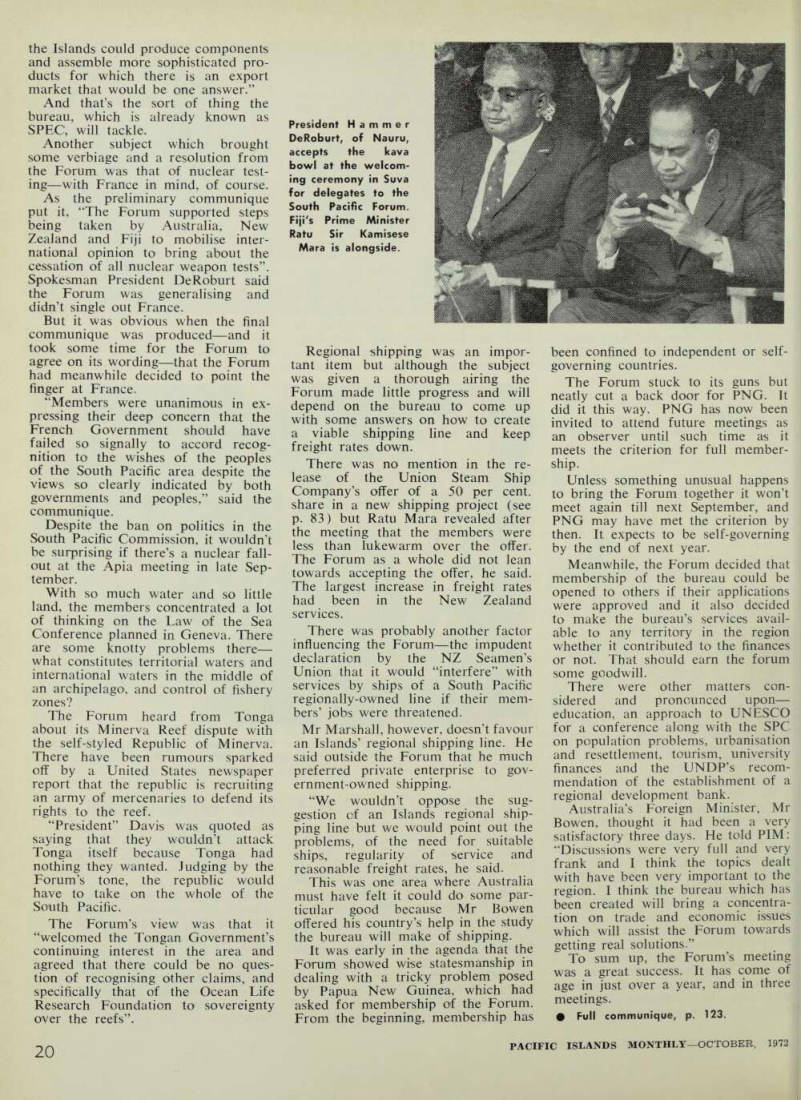
President Hammer DeRoburt, of Nauru, accepts the kava bowl at the welcom ing ceremony in Suva for delegates to the South Pacific Forum.
Fiji's Prime Minister Ratu Sir Kamisese Mara is alongside.
Action Wanted
Over French Tests
The South Pacific Forum’s decision to back an Australia-New Zealand- Fiji approach to United Nations members to whip up opposition to nuclear testing in the South Pacific has pleased the members of ATOM, the Suva-based anti-test body.
It said so after the Forum’s second session, but it wants an Island leader to introduce the resolution in the UN’s General Assembly. It doesn’t trust Australia and New Zealand who, it says, “protest largely for political reasons” and “are not par ticularly concerned about health hazards to South Pacific people”.
Advertisements & other items, p. 20 (1 item)
18
PACIFIC ISLANDS MONTHLT-OCTOBER, 1972
He'll Manage The New Baby
As PIM announced through the coconut radio some time ago, Mahe ’Uli’uli Tupouniua, acting Prime Minister of Tonga and Minister of Finance is the first Director of the South Pacific Forum’s first baby, the South Pacific Bureau for Economic Co-operation.
The Tonga Government was in favour of his appointment although it is losing one of its best brains for at least three years, but the Tongan man-in-the-street wasn’t so happy, according to Minister of Lands Tuita, who led the Tongan team to the
Forum meeting in Suva in September.
“The people feel that Mahe should stay at home and serve his country, but I feel the step we have taken is a good one,” he said.
The Tonga Government has already selected his successor as Minister of Finance—Baron Vaea, ex-High Com missioner in London, who is now on holiday.
Mahe Tupouniua, who is a BA and Bachelor of Commerce, is 44. He has a brother, Sione, who lectures at the University of the South Pacific, Suva.
Advertisements & other items, p. 21 (1 item)
Acific Islands Monthly—October, 1972
Png Government Gets Practice
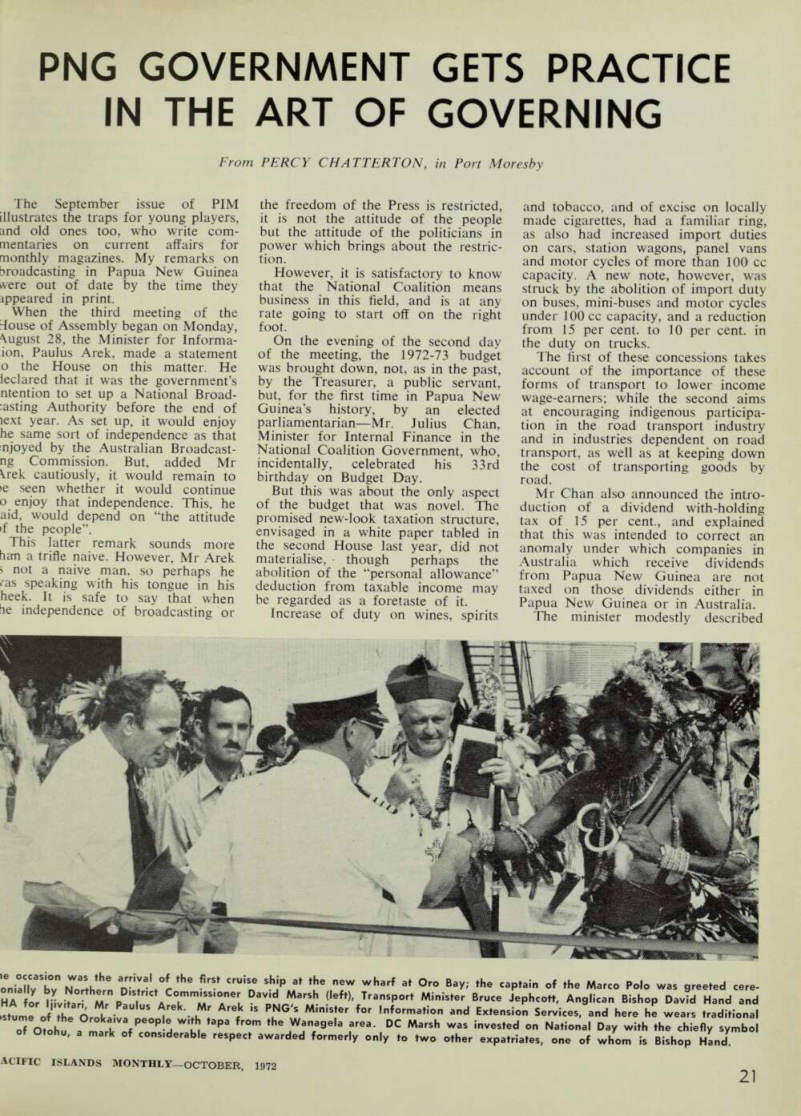
In The Art Of Governing
From PERCY CHATTERTON, in Port Moresby
The September issue of PIM illustrates the traps for young players, and old ones too, who write com mentaries on current affairs for monthly magazines. My remarks on broadcasting in Papua New Guinea were out of date by the time they appeared in print.
When the third meeting of the Touse of Assembly began on Monday, August 28, the Minister for Informa ion, Paulus Arek, made a statement o the House on this matter. He ieclared that it was the government’s mention to set up a National Broad :asting Authority before the end of lext year. As set up, it would enjoy he same sort of independence as that njoyed by the Australian Broadcast ng Commission. But, added Mr Vrek cautiously, it would remain to •e seen whether it would continue o enjoy that independence. This, he aid, would depend on “the attitude •f the people”.
This latter remark sounds more ban a trifle naive. However, Mr Arek > not a naive man, so perhaps he /as speaking with his tongue in his heek. It is safe to say that when be independence of broadcasting or
the freedom of the Press is restricted, it is not the attitude of the people but the attitude of the politicians in power which brings about the restric tion.
However, it is satisfactory to know that the National Coalition means business in this field, and is at any rate going to start off on the right foot.
On the evening of the second day of the meeting, the 1972-73 budget was brought down, not, as in the past, by the Treasurer, a public servant, but, for the first time in Papua New Guinea’s history, by an elected parliamentarian—Mr. Julius Chan, Minister for Internal Finance in the National Coalition Government, who, incidentally, celebrated his 33rd birthday on Budget Day.
But this was about the only aspect of the budget that was novel. The promised new-look taxation structure, envisaged in a white paper tabled in the second House last year, did not materialise, though perhaps the abolition of the “personal allowance” deduction from taxable income may be regarded as a foretaste of it.
Increase of duty on wines, spirits
and tobacco, and of excise on locally made cigarettes, had a familiar ring, as also had increased import duties on cars, station wagons, panel vans and motor cycles of more than 100 cc capacity. A new note, however, was struck by the abolition of import duty on buses, mini-buses and motor cycles under lOOcc capacity, and a reduction from 15 per cent, to 10 per cent, in the duty on trucks.
The first of these concessions takes account of the importance of these forms of transport to lower income wage-earners; while the second aims at encouraging indigenous participa tion in the road transport industry and in industries dependent on road transport, as well as at keeping down the cost of transporting goods by road.
Mr Chan also announced the intro duction of a dividend with-holding tax of 15 per cent., and explained that this was intended to correct an anomaly under which companies in Australia which receive dividends from Papua New Guinea are not taxed on those dividends either in Papua New Guinea or in Australia.
The minister modestly described
[?]e cocasion was the arival of the first cruse ship at the new whart at Oro Bay: the captain of the Matco Polo was greeted cere onially by Nortern District Commissioner David Marsh (left), Transport Minister Bruce Jephcott, Anglican Bishop David Hand and HA for Ijivitari, Mr Paulus Arek. Mr Arek is PNG's Minister for Information and Extension Services and here he wears traditional [?]stume of the Orokaiva people with the Wanagela area. DC Marsh was invested on National Day with the chiefly symbol of Otohu,a mark of considerable respect awarded formerly only to two other expatriates, one of whom is Bishop Hand
his first budget as a “stocktaking” one, and drew attention to the dif ficulties under which it had been prepared. There was the fact that the prices of many of our exports were falling, while those of our most important imports were rising. There was a need to increase domestic pro duction and so to reduce Papua New Guinea’s dependence on imports, he said.
Then there was the problem of the government’s rising salaries bill, which now stood at $6O million, 27 per cent, of total spending. We must ensure that we do not build up a public service structure which the country cannot afford, said Mr. Chan.
A report tabled at a later sitting from the Papuan chairman of the Public Service Board, Mr Sere Pitoi, seems to foreshadow the possibility that the Public Service may find itself pruned down willy-nilly. Localisation of the Public Service has not gone nearly as well as was envisaged in an earlier white paper tabled in the House last year.
The main reasons for the failure appear to have been, firstly, the inability of the Administration to provide housing of the quality now looked for by the more sophisticated sector of the indigenous work-force and the non-availability of funds to remedy this deficiency; and, secondly, increasing competition for the avail able personnel from a private sector at last awakened to the need for rapid localisation. Mr Pitoi predicts that in 1976, the Chief Minister’s favoured date for independence, the Public Service will still need the services of 7,000 expatriates. Will it be able to get them at a price that Papua New Guinea can afford, and, if not, where do we go from there?
However, back to the budget.
Finally, said Mr Chan, there was the problem created by the fact that final shaping of the budget could not take place until the amount of aid which Australia would provide was known, and it was only known a few weeks before the budget had to be brought down in the House. This meant, explained Mr Chan that the Treasury had to prepare several tentative budgets based on different levels of Australian aid. It was greatly to be desired, he added, that the next Australian Government would be prepared to negotiate an advance agreement on its aid level over a period of years, so that the PNG Government could get on with some advance planning.
On the whole the budget has been well received, and the opposition United Party has conceded that it does not differ greatly from the kind
All Share In National Airline
of budget which it would have intro duced had it been able to form a government.
The withdrawal of the taxpayer’s “personal allowance” concessional deduction has been criticised, notably by the PSA, which fears that it will largely nullify recent salary increases granted to local officers in the Public Service. However, it is difficult to find any intelligible rationale for this allowance; indeed, while as a tax payer I have always been glad to be able to claim it, I have never under stood why I got it.
During the first two weeks of this meeting, the budget itself has been aver-shadowed by other events both nside and outside the House.
The announcement in the first week )f the meeting that the government ntends to press on without delay with he establishment of a National Broadcasting Authority was followed n the second week by a more sensa ional one, namely that of the im pending formation of a national air ine. This decision is in line with a ecommendation of a select com nittee of the second House, chaired >y former member for New Ireland md Manus Regional, Wally Lussick.
Jut few people expected it to bear ruit so soon.
It is intended that the national air ine will be set up within the next 8 months as a consortium in which tie PNG Government, Trans Aus tria Airlines, Ansett and Qantas /ill be equal partners. It will start y taking over and rationalising iternal air services now operated by 'AA and Ansett.
For the present, these two airlines dll continue to operate the services etween Australia and Papua New iuinea, but it is envisaged that after idependence the national airline and )antas will have reciprocal rights to y these routes. Australia’s Depart icnt of Civil Aviation will continue ?r the present to provide technical nd safety services.
Transport Minister Jephcott has irecast that the rationalisation of le internal services may lead to a eduction in fares. Let us hope that e is right.
Outside the House, overshadowing /ery other happening, there has sen the catastrophic crash of an AAF “Caribou” carrying over a :ore of school cadets returning to icir school in Port Moresby, the 'e La Salle College, after a train ig exercise. Only five of the cadets ere rescued, and one of these died iter in hospital. The rest, together
with the crew of the aircraft and two army officers, perished.
In the House, Miss Josephine Abaijah, member for Central Regional, moved that the Australian Government be asked to appoint a Royal Commission to investigate the disaster.
“The country has suffered a great blow,” she said, “in the loss of these fine, educated young men who were at the beginning of a life of service to our country. We need as a parlia ment, we need as a nation, and the parents and relatives need a full, all powerful, independent public inquiry, covering all aspects of this disaster.”
Miss Abaijah has not been very popular with the National Coalition Government of late, but this time they agreed with her, and her motion was carried on the voices. It remains to be seen whether the Australian Government will accede to or reject the request.
Three other motions accepted by the House are of some interest. One, moved by Mr John Matik, member for Wosera-Gaui, calls for local government council “advisers” to be given specific training for their task.
This motion is the latest manifesta tion of continuing dissatisfaction with the performance of district adminstra tion officers appointed as council advisers.
The second, sponsored by Western Regional’s Naipuri Marina, called on the government to state the qualifica tions, experience and training of officers engaged in political education.
This again expresses a continuing dis satisfaction with the present system and a feeling that political education should not be in the hands of public servants.
The third came from Gulf Regional’s Tom Koraea, and amount ed to a criticism of the government of which he is a supporter and in particular of the Minister for Agri culture, Mr lambakey Okuk.
At the June meeting of the House Mr Koraea had expressed his con cern at the lack of development in his electorate, and asked that con sideration should be given to the establishment of an oil-palm industry there. Mr Okuk replied brusquely that conditions in the Gulf District were not suitable for oil-palm cultiva tion.
Outside the House this snub pro voked a retired LMS missionary, Rev Sue Rankin, to retort, in an ABC current affairs programme, that oil palms planted at Veiru, near Kikori, at the time of World War I by Rev
Ben Butcher (still alive at 95 in NSW) had survived and thrived, self sown and untended to the present day. Confronted with Mr Okuk’s statement, Mrs Rankin, a small but wiry Welshwoman, retorted tartly that she and Mr Koraea knew the area while Mr Okuk evidently didn’t.
During the current meeting, Mr Koraea raised the issue again in the form of a motion calling on the government to investigate the potential of the country’s under-developed districts before initiating any more oil-palm projects. (The two estab lished to date are both in New Britain).
Mr Koraea’s blunt speaking on this occasion was all the more significant because although only a back bencher in the National Coalition he is national chairman of the Pangu Party, the Coalition Government’s senior partner.
Party affiliations continue to exhibit a certain fluidity. During the current sittings three members have crossed the floor of the House. Two High lands United Party members have defected to the National Coalition, while the honourable member of Menyamya, who was elected on the UP ticket and later defected to the Coalition, has now re-defected to the United Party.
The reasons given by members for these manoeuvres suggest that many PNG politicians regard party allegiance as a means of securing benefits for their electorates rather than as an instrument for the pro motion of sound national policies.
Moreover, party members are still liable to exercise a free vote on issues they feel strongly about. In one recent division, two government supporters voted with the opposition while two opposition members voted with the government—a novel variant of Westminster’s pairing system.
Then, after an adjournment for National Day, the Coalition won a majority 53-34 vote on a motion set ting the date for self-government as December 1, 1973. The vote, follow ing a 10-hour debate, was short of the 75 per cent, majority. Mr Somare said in June that he wanted—and the Opposition reminded him of it. But Mr Somare said the vote was “sub stantial”, and he was satisfied.
In the meantime the target date debate has produced the piquant story of a meeting at which West Sepik Regional’s Paul Langro tried to explain the meaning of self-govern ment to some of his constituents.
Following the explanation, a member of the audience said he wanted three self-governments, one for himself, one for his wife, and one for his child.
Advertisements & other items, pp. 23-25 (3 items)
Acdic Islands Monthly-October, 1972
(arnation
PEACOCK
T»*Of HAH* StOJS
M
Condensed
m 11Ik
p^Ll
SWEE Tt
cream A
(arnation
PRODUCT
Now you can enjoy Peacock Full Cream Sweetened Condensed Milk ... a top quality condensed milk made by the producers of Carnation Evaporated Milk. It’s on sale at your local store at a value-for-money price.
23
ACIFIC ISLANDS MONTHLY—OCTOBER, 1972
fiji talanoa

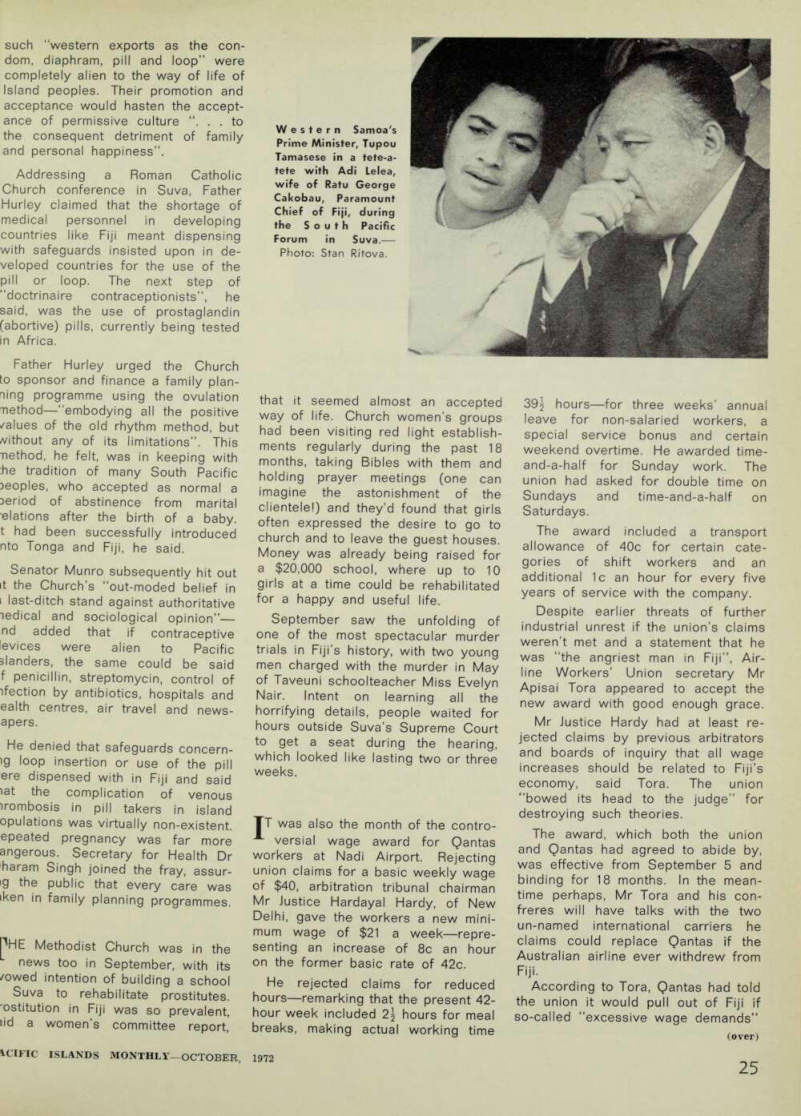
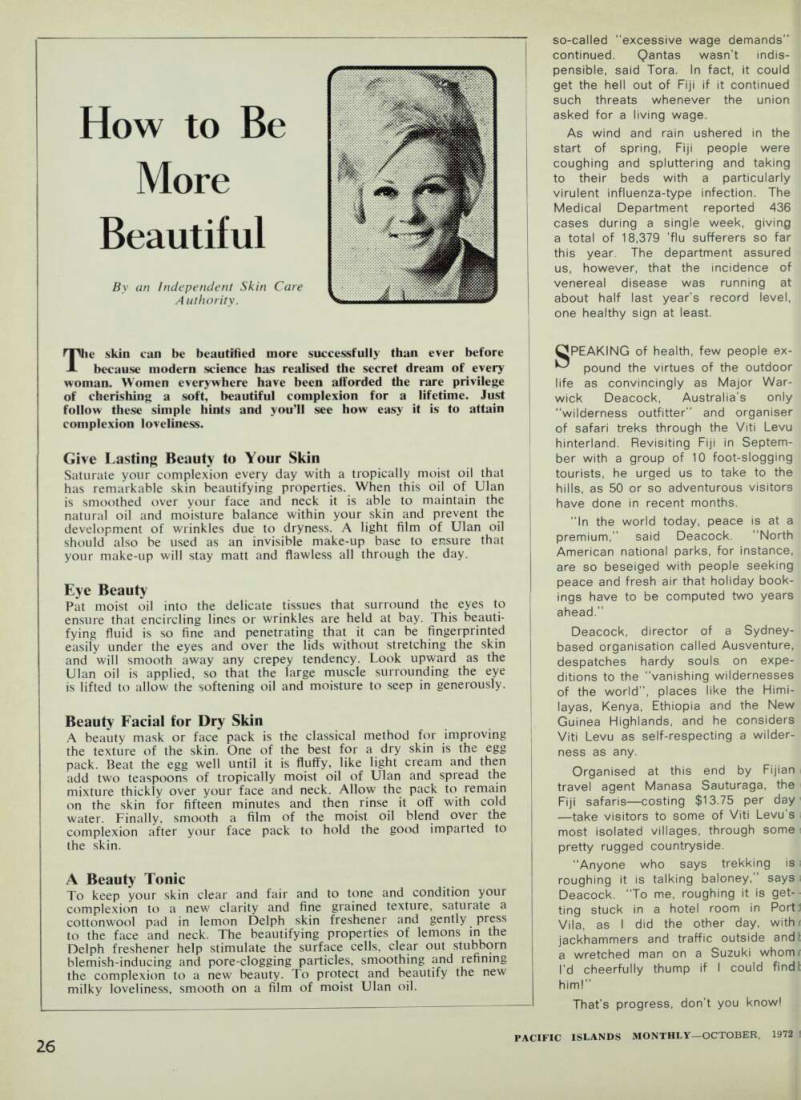
With Sue Wendt,
in Suva
'l/’ISITING Kenya in August, I dined ’ one evening in the plush confines of the Nairobi Intercontinental. Hot topic of conversation was the plight of Uganda’s expelled Asians. “Would Fiji take any of the 60,000 refugees?” my African hosts wanted to know.
“Would other Pacific Islands?”
I got the feeling that my hosts weren’t so much concerned with the fate of the ousted Asians, as with the possible success of the exercise.
Black Kenyans were watching Uganda with an eager eye, I was told, and many believed that President Amin’s actions would accelerate a similar movement in Kenya.
“We can see the signs,” an African lawyer said. “There are more busi nesses and properties for sale in Kenya than before. It’s a quiet move ment—the Asians don't want to create a panic and with investment pouring into Kenya, neither does the Govern ment.
“But President Amin’s actions have started a lot of Kenyans thinking. We Africans are asking what we’ve really achieved since independence. The expatriates, including Asians, have enormous, control. On the question of who really controls Kenya, we are sitting on a volcano.
“The trouble is, even those out siders who’ve taken Kenyan citizen ship don’t think Kenyan and they don’t integrate. I believe the day will come when Kenya expels such people. So what if the economy suffers?”
A questionable philosophy perhaps, undoubtedly anathema to Kenya’s present leadership—but that’s what the gentleman said. It’s the kind of talk that must send ripples of unease through any non-indigenous minority community anywhere and make the multi-racial population of a country like Fiij thankful for a sane and humane regime.
Fiji is, of course, in no position to open its doors to large numbers of homeless refugees. Faced with a
delicate situation, although under no pressure from the British Government to make any magnanimous, gesture, Prime Minister Ratu Sir Kamisese Mara went about as far as he could practic ally go.
The government was already ex tremely concerned about housing Fiji’s own people, the PM said, and about the problems of its destitutes and would-be tenants seeking land on which to settle. However, Fiji would “certainly consider favourably allow ing in professional people whom we need or who come here with money to invest”. They would have to meet the usual requirements before they could be granted citizenship.
Ratu Sir Kamisese said he was dis
turbed by the lack of reaction among Commonwealth countries to President Amin’s decision to expel the Asians.
He commented: “It appears that President Amin is getting away with something that Mr Smith of Rhodesia is not allowed to do—discrimination of race. If this sort of thing is allowed to go on, there will be dis turbances in many other countries in the world with leaders getting out of the wrong side of the bed and de ciding to kick someone out.”
Humanitarian considerations
aside, Fiji has problems a-plenty when it comes to population. Latest news on the “birth boom” is, en couraging however, with Family Planning Association president, Senator Robert Munro, reporting one of the fastest reductions in birth
rates, without demographic assist ance, recorded anywhere.
The birthrate last year was down to 30.2 per 1,000, compared with a rate of 41.78 in 1959. The Indian birthrate was recorded as between 29.6 and 29.3 and the Fijian rate as 30.5 per 1,000. Official target for Fiji is a birthrate of 25 per 1,000 popula tion by 1975.
The dominion had a total population of 535,357 at the end of last year, a net increase (after allowing for migra tion) of 10,900 over the previous, year.
Indians totalled 272,040; Fijians 231,042; Part-Europeans 9,497; other Islanders 6,679; Rotumans 6,643; Chinese 4,725; Europeans 4,600; and “others” 131.
Racist ripples from Uganda felt in Fiji
While the Family Planning Asso ciation is justifiably pleased with the results of its programme (which in cluded distributing 165,000 condoms during the year, for retail by shop keepers at 1c each), it still considers Fiji “grossly over-populated”.
Senator Munro points out in his report that the real picture is seen not so much in the number of people —but in the number of dependents.
Fiji, with 46 per cent, of the popula tion 15 years and under, has 86 de pendents to every 100 workers.
The Roman Catholic Church in Fiji isn’t much pleased with the family-curbing efforts. Outspoken priest Father Dermot Hurley, director of Fiji’s Responsible Parenthood Council, was severely critical in Sep tember of population control methods in the South Pacific, declaring that
such “western exports as the con dom, diaphram, pill and loop” were completely alien to the way of life of Island peoples. Their promotion and acceptance would hasten the accept ance of permissive culture ", . . to the consequent detriment of family and personal happiness”.
Addressing a Roman Catholic Church conference in Suva, Father Hurley claimed that the shortage of medical personnel in developing countries like Fiji meant dispensing with safeguards insisted upon in de veloped countries for the use of the pill or loop. The next step of "doctrinaire contraceptionists”, he said, was the use of prostaglandin (abortive) pills, currently being tested in Africa.
Father Hurley urged the Church to sponsor and finance a family plan ning programme using the ovulation method —“embodying all the positive ✓alues of the old rhythm method, but without any of its limitations”. This method, he felt, was in keeping with :he tradition of many South Pacific peoples, who accepted as normal a neriod of abstinence from marital elations after the birth of a baby, t had been successfully introduced nto Tonga and Fiji, he said.
Senator Munro subsequently hit out it the Church’s “out-moded belief in i last-ditch stand against authoritative nedical and sociological opinion”— nd added that if contraceptive levices were alien to Pacific slanders, the same could be said f penicillin, streptomycin, control of ifection by antibiotics, hospitals and ealth centres, air travel and news apers.
He denied that safeguards concern ig loop insertion or use of the pill ere dispensed with in Fiji and said lat the complication of venous irombosis in pill takers in island opulations was. virtually non-existent, epeated pregnancy was far more angerous. Secretary for Health Dr haram Singh joined the fray, assur ig the public that every care was iken in family planning programmes. pHE Methodist Church was in the news too in September, with its /owed intention of building a school Suva to rehabilitate prostitutes, 'ostitution in Fiji was so prevalent, lid a women’s committee report,
that it seemed almost an accepted way of life. Church women’s groups had been visiting red light establish ments regularly during the past 18 months, taking Bibles with them and holding prayer meetings (one can imagine the astonishment of the clientele!) and they’d found that girls often expressed the desire to go to church and to leave the guest houses.
Money was already being raised for a $20,000 school, where up to 10 girls at a time could be rehabilitated for a happy and useful life.
September saw the unfolding of one of the most spectacular murder trials in Fiji’s history, with two young men charged with the murder in May of Taveuni schoolteacher Miss Evelyn Nair. Intent on learning all the horrifying details, people waited for hours outside Suva’s Supreme Court to get a seat during the hearing, which looked like lasting two or three weeks.
TT was also the month of the contro- A versial wage award for Qantas workers at Nadi Airport. Rejecting union claims for a basic weekly wage of $4O, arbitration tribunal chairman Mr Justice Hardayal Hardy, of New Delhi, gave the workers a new mini mum wage of $2l a week—repre senting an increase of 8c an hour on the former basic rate of 42c.
He rejected claims for reduced hours—remarking that the present 42hour week included 2\ hours for meal breaks, making actual working time
39$ hours—for three weeks’ annual leave for non-salaried workers, a special service bonus and certain weekend overtime. He awarded time and-a-half for Sunday work. The union had asked for double time on Sundays and time-and-a-half on Saturdays.
The award included a transport allowance of 40c for certain cate gories of shift workers and an additional 1c an hour for every five years of service with the company.
Despite earlier threats of further industrial unrest if the union’s claims weren’t met and a statement that he was “the angriest man in Fiji”, Air line Workers’ Union secretary Mr Apisai Tora appeared to accept the new award with good enough grace.
Mr Justice Hardy had at least re jected claims by previous arbitrators and boards of inquiry that all wage increases should be related to Fiji’s economy, said Tora. The union “bowed its head to the judge” for destroying such theories.
The award, which both the union and Qantas had agreed to abide by, was effective from September 5 and binding for 18 months. In the mean time perhaps, Mr Tora and his con freres will have talks with the two un-named international carriers, he claims could replace Qantas if the Australian airline ever withdrew from Fiji.
According to Tora, Qantas had told the union it would pull out of Fiji if so-called “excessive wage demands” (over)
Western Samoa's Prime Minister, Tupou Tamasese in a tete-a tete with Adi Lelea, wife of Ratu George Cakobau, Paramount Chief of Fiji, during the South Pacific Forum in Suva.— Photo: Stan Ritova.
so-called “excessive wage demands” continued. Qantas wasn’t indis pensible, said Tora. In fact, it could get the hell out of Fiji if it continued such threats whenever the union asked for a living wage.
As wind and rain ushered in the start of spring, Fiji people were coughing and spluttering and taking to their beds with a particularly virulent influenza-type infection. The Medical Department reported 436 cases during a single week, giving a total of 18,379 ’flu sufferers so far this year. The department assured us, however, that the incidence of venereal disease was running at about half last year’s record level, one healthy sign at least.
CREAKING of health, few people expound the virtues of the outdoor life as convincingly as Major War wick Deacock, Australia’s only “wilderness outfitter” and organiser of safari treks through the Viti Levu hinterland. Revisiting Fiji in Septem ber with a group of 10 foot-slogging tourists, he urged us to take to the hills, as 50 or so adventurous visitors have done in recent months.
“In the world today, peace is at a premium,” said Deacock. “North American national parks, for instance,
are so beseiged with people seeking
peace and fresh air that holiday book ings have to be computed two years ahead.”
Deacock, director of a Sydney based organisation called Ausventure, despatches hardy souls on expe ditions to the “vanishing wildernesses of the world”, places like the Himi layas, Kenya, Ethiopia and the New Guinea Highlands, and he considers Viti Levu as self-respecting a wilder ness as any.
Organised at this end by Fijian travel agent Manasa Sauturaga, the Fiji safaris —costing $13.75 per day —take visitors to some of Viti Levu’s most isolated villages, through some
pretty rugged countryside.
“Anyone who says trekking is roughing it is talking baloney,” says Deacock. “To me, roughing it is get ting stuck in a hotel room in Port Vila, as I did the other day, with jackhammers and traffic outside and a wretched man on a Suzuki whom I’d cheerfully thump if I could find him!”
That’s progress, don’t you know!
Advertisements & other items, pp. 27-28 (2 items)
Islands Monthly—October, 1972
Beautiful
How to Be
More
By an Independent Skin Care A uthority. rphe skin can be beautified more successfully than ever before JL because modern science has realised the secret dream of every woman. Women everywhere have been afforded the rare privilege of cherishing a soft, beautiful complexion for a lifetime. Just follow these simple hints and you’ll see how easy it is to attain complexion loveliness.
Give Lasting Beauty to Your Skin Saturate your complexion every day with a tropically moist oil that has remarkable skin beautifying properties. When this oil of Ulan is smoothed over your face and neck it is able to maintain the natural oil and moisture balance within your skin and prevent the development of wrinkles due to dryness. A light film of Ulan oil should also be used as an invisible make-up base to ensure that your make-up will stay matt and flawless all through the day.
Eye Beauty
Pat moist oil into the delicate tissues that surround the eyes to ensure that encircling lines or wrinkles are held at bay. This beautifying fluid is so fine and penetrating that it can be fingerprinted easily under the eyes and over the lids without stretching the skin and will smooth away any crepey tendency. Look upward as the Ulan oil is applied, so that the large muscle surrounding the eye is lifted to allow the softening oil and moisture to seep in generously.
Beauty Facial for Dry Skin A beauty mask or face pack is the classical method for improving the texture of the skin. One of the best for a dry skin is the egg pack. Beat the egg well until it is fluffy, like light cream and then add two teaspoons of tropically moist oil of Ulan and spread the mixture thickly over your face and neck. Allow the pack to remain on the skin for fifteen minutes and then rinse it off with cold water. Finally, smooth a film of the moist oil blend over the complexion after your face pack to hold the good imparted to the skin.
A Beauty Tonic To keep your skin clear and fair and to tone and condition your complexion to a new clarity and fine grained texture, saturate a cottonwool pad in lemon Delph skin freshener and gently press to the face and neck. The beautifying properties of lemons in the Delph freshener help stimulate the surface cells, clear out stubborn blemish-inducing and pore-clogging particles, smoothing and refining the complexion to a new beauty. To protect and beautify the new milky loveliness, smooth on a film of moist Ulan oil.
Caledonians Say A Careful No'
To The Autonomists
New Caledonia Diary With Helen Rousseau
September was a very sporting month for the Caledonians: there was the eleven-day cycling “Tour de Caledonie” around the island; boxers flew from Australia and Tonga; the Caledonian soccer team played in New Zealand, while the decisive round was con tested in the territory’s “politball” championship.
The outcome of the final match did not give an outright victory to either side, although it was obvious that the anti-autonomists had increased their strength since the 1967 vote. The new Territorial Assembly elected on September 10, actually resulted in an almost identical division to the outgoing one: 17 members in favour of autonomy, 16 declared anti-auto nomists, with two anti-autonomists who are nevertheless closer to the autonomists on social issues.
The main lines of the election campaign were set by August 20, when the nomination of candidates revealed eight main groups con testing 35 seats, with no less than 11 rival lists in the southern elec torate, around Noumea. Campaign posters began to appear on the official billboards while party sup porters travelled the length and breadth of the island, making personal contacts and holding small public meetings.
It was a busy time for the gendarmes too, as they called on families of autonomist candidates and checked the identity of those putting up autonomist posters.
The autonomist parties generally avoided open criticism of each other, even though they had slightly different policies over how to implement internal self-govern ment. In the anti-autonomist camp, however, there was bitter rivalry over cutting up the enlarged Caledonian nickel cake: the EDS party of Messrs Laroque and
Lafleur strongly attacked their former “Entente” coalition allies in Georges Chatenay’s Union Democratique.
The Laroque-Lafleur group finally won six seats, with four going to Chatenay. The third anti autonomist group, MLC, led by outgoing President Jean Leques, won five seats and the Melanesian AICLF obtained one.
In the autonomist camp, Maurice Lenormand, founder of the Union Caledonienne, made a political comeback after eight years to lead the party and win 12 seats. This was their strength in the outgoing Assembly: due to intervening splits, the party had been severely cut back from the 22 seats it won in the 1967 elections.
The Union Multiraciale, led by Yann Celene Uregei, won 5 seats all held by Melanesians.
Gerald Rousseau (Union Civique) was not returned, despite an aggressive campaign warning against the elimination of Cale donians from responsible positions and proposing a comprehensive legal reform of the political statutes.
Rousseau’s former colleague, Alain Bemut (MPC), was return ed with two seats. Bernut may now hold the balance of power, since his campaign was not direc ted for or against autonomy: although he has previously voted against autonomy, his social policy is closer to that of the auto nomists.
The swing against autonomy was registered in the predominately European electorate around Noumea: among 18,662 registered voters, only four out of 16 seats went to the autonomists. By con trast, on the three island and inland electorates, where most of the Melanesians live, 27,687 voters are registered and 13 out
of 19 seats went to the auto nomists.
Autonomists leader Lenormand was quoted in the local Press as saying he was satisfied with the result, considering the financial means used against his party, as well as the open political inter vention of the Administration. He also said he could not take the vote as an expression of the Cale donian majority when anti-auto nomists lists were supported by temporary residents (i.e. mainly metropolitan French) and by military men disembarked in Noumea at the eleventh hour.
The Union Caledonienne later announced it was contesting the election results over the eligibility of certain voters.
Whatever is said, however, it must be noted that even the so called "workers” at the SLN nickel factory voted for the “capitalists” of the EDS, UD and MLC. The well-paid nickel men are a special category of “workers” however; with their cars, boats, overseas holidays and apartments to-let, they are already “mini capitalists” themselves.
It seems that economic issues played a more vital part in the Caledonian elections than any political ideology; some workers afterwards claimed they were “autonomists” but they voted for the kind of men they believe can go to Paris and obtain the develop ment money the territory needs.
So, more important than any ideological struggle for internal self-government, is the Cale donian desire to have continued support from France to maintain the island’s infrastructure pro grammes and support the locals’ living standards.
In this regard, the Caledonians lack confidence that the territory over
Lenormand's political comeback
could be self-sufficient. They ap pear quite ready to forsake certain liberty of decision and leave to Paris the responsibility of direct ing certain territorial affairs.
The French Administration will still remain the popular target it has always been for local grievances. However, the popula tion has chosen to elect to the Territorial Assembly men who can come to a working agreement with the French departmental heads, rather than to vote for men who could provoke open confrontation.
The electors had a wide span of political proposals to choose from, through the elected ministers advocated by the Union Cale donienne; a federal system with status like Hawaii in the USA (Union Cifique); decentralisation and greater power to the Governor’s Council {Conseil de Gouvernement ) proposed by the UD and MLC; or keeping all the way with the mother country and giving the governor some of the powers now held by Paris public servants (EDS). This last policy could eventually lead to New Caledonia being treated as a departement of France.
An interesting feature of the electoral campaign was that all parties insisted reforms are needed.
But to one side the word “auto nomic” spelt fear, uncertainty and adventure, and however close their aspirations might be, they chose the word “decentralisation” which Governor Louis Verger, from the beginning, had indicated was more acceptable.
Of course, there were not only political parties and electors at work during the campaign period.
The French nickel company SLN launched a new paper within a month of polling day. The com pany turned the twice-weekly Bul letin du Commerce into an evening daily—Noumea-Soir, with a team of six journalists working to produce this 16-page paper.
The SLN also has a controlling interest in the territory’s oldest morning daily—La France Aus trale—which is operated by 14 journalists. The SLN Press generally avoids local contro versies and underlines the efforts France is making to develop the territory.
During the week before the elections the SLN also began to
move the first Wallisian workers out of unsavoury barracks besides the factory and into the apart ments and row-houses recently completed for 166 SLN workers behind the Riviere Salee area.
The Administration was also on its toes. After the extensive island and inland tours made before the elections by Governor Louis Verger, the Administration pro duced a soccer team led by the governor, to play two public matches against the Noumea City Council, led by mayor and EDS leader, Roger Laroque. The second match was played two nights before election day.
In the Education Department, retiring head Mr R. Delpias, held a Press meeting in which he out lined the very real progress made in educational facilities in the ter ritory and also spoke of the project to build a university in Noumea.
This university was first promised bv General de Gaulle, during his 1966 visit to Noumea.
The French have not yet been able to realise this dream, but the Caledonian Press pointed out that one of its primary objectives would be to spread French culture around the Pacific and counter balance the neighbouring Anglo- Saxon universities.
Other reassuring news came through from Paris. On the day before the elections, Caledonians were advised that the French Government had decided to indemnify to the extent of some $A250,000, the losses suffered by six regional French vessels, victims of the recent two-month boycott imposed by Australian and New Zealand dock workers.
At the same time, on the political front, Prime Minister Pierre Messmer was quoted as promising the French people a greater decentralisation away from Paris control.
Back home in Noumea, pressure was applied to speed up develop ment works and the impressive new system of by-passes and over head roadways finally came into operation at the Ducos intersection.
Caledonians can now really feel they live in a big town, as they drive along the intricate new road network. However, work on the project, begun in May, 1970, is not yet finished and has lagged far behind the planned 1971 com pletion date.
Governor Louis Verger, in his recent island tours, has emphasised the need for funds to continue the territory’s infrastructure development. Since other ways are not permitted, loan demands are always addressed to French and Common Market agencies.
With the current nickel recession, the territorial budget already by June faced a SAIO million deficit on this year’s planned expen diture of some SBO million. Cut backs in spending then became necessary, as the Caledonian budget must balance each year.
The new Assembly faces tough decisions over the new budget it must debate this session, while the nickel crisis continues. Under the present laws, most territorial revenue is derived from tax im posed on imports and exports (99 per cent, of which is nickel).
President of the SLN nickel company, Baron Guy de Rothschild, already told company shareholders in June that the Caledonian fiscal system, taxing nickel exports irrespective of his company’s profit or loss, was grossly unfair. He claimed the SLN was the “most heavily taxed company in the western world” (In 1971 the SLN paid a total of SAI7 million in various Cale donian taxes).
Rothschild thus told his French shareholders, “Be assured, ladies and gentlemen, all of us here will spare no effort to convince the authorities and public opinion in New Caledonia and metropolitan France that this state of affairs is an economic freak”. Mr Messmer, not then French Prime Minister, was to echo this tax problem during his May visit to Noumea.
The Caledonians have voted for men who have the best relations with France, but they know that the French taxpayer and the SLN cannot be counted on forever to supply funds: the introduction of income tax in New Caledonia ap pears inevitable.
So there has been only restrained jubilation over the anti autonomist gain in strength. The first decisions of the new As sembly, scheduled to meet from September 26 to discuss the new budget, will indicate how the seven groups will divide their power structure.
Advertisements & other items, p. 30 (1 item)
Sharp Sharp Corporation Of Australia
range of Transistor radios, Tape recorders, Stereograms, Closed Circuit Television, Medical equipment and Electronic Calculators. of Sharp making for better communication with these areas.
Progress in Australia over the last twelve months with SHARP equipment has been spectacular and this influence should be felt throughout the Pacific.
The areas under examination are: Agents in a strong financial position are invited to apply giving history of past performance and bank references to:
PTY. LTD.
22 BURROWS ROAD, ST. PETERS, N.S.W. 2044.
P.O. BOX 96, ST. PETERS, N.S.W. 2044. TELEPHONE: 519-5522.
Established 1912.
The above company wishes to appoint agents in the Pacific for their Pacific Island territories are now administered from the Australian Division
• WESTERN SAMOA
• NEW HEBRIDES
• AMERICAN SAMOA
• TONGA
• GILBERT AND ELLICE ISLANDS • NAURU
• SOLOMON ISLANDS
® NORFOLK ISLAND
P. J. BROWN,
OVERSEAS MARKETING DIVISION,
SHARP CORPORATION OF AUSTRALIA PTY. LTD.,
22 BURROWS ROAD,
ST. PETERS, N.S.W. 2044, AUSTRALIA.
On freedom
and truth in Western Samoa
A rejoinder from Felise Va’a
It is my personal belief that I should not reply to Mr Tumele Tuimavave’s letter which appeared in the September issue of PIM. However, on a professional level 1 think Mr Tuimavave’s letter should not go un challenged.
Mr Tuimavave indicated that an article I wrote for PIM recently “inferred that there is almost a ‘police-state’ suppression of criticism in Western Samoa under the present regime”.
However, there is in fact no such inference. I was merely describing an actual state of affairs. Mr Tuima vave cannot validly conclude that therefore I meant there was some kind of police-state in Western Samoa.
But it is logically possible to infer that the government couldn’t care less about its relations with the press, that it doesn’t care about public opinion or even that it is ignorant of its function to inform the public, and even the government may secretly be plotting to establish a police-state.
But certainly not that there is one, or one almost.
The article merely asked a question.
It did not provide a solution. More careful reading would establish this.
The question, therefore whether I should be in prison or not is meaning less because I never claimed that there was a police-state in Western Samoa. (However, this does not rule out the possibility that I could be im prisoned later on for my forthright views.) Secondly, Mr Tuimavave is being very unfair to the former prime minister Hon Mata’afa F.M. 11, whom I consider to be one of the ablest, most distinguished and most honest of Samoa’s leaders today.
When we got independence in 1962, the main newspaper editors from that period onward to 1969 approximately were two men, Messrs Peter Creevey of the Bulletin and Bob Rankin of the Samoana. They are both here in Samoa. Both are married to Samoan girls and both had been at times extremely critical of the Mata’afa government. If they were encouraged to leave by Mata’afa, how come they are both here? Rankin particularly was almost vehement and sometimes insulting in his criticisms of the doings
of the Mata’afa government. In reply to these criticisms, Mata’afa was mostly silent. He kept his dignity and peace and was much admired thereby.
Lastly, I find it insulting to the public interest that a mere public servant should have the audacity to pass judgment on the present and past governments. Surely, it is not the duty of a public servant to comment on political matters. This right be longs more to the public and their representative, the press.
I should remind Mr Tuimavave that 1 had worked for the government public relations office from 1962 to 1965, and from 1965 to the present in local newspapers in both Samoas.
I should know what I happen to be talking about. I know what govern ment policy is and whether it is good or bad. (I never claimed the government “suppressed” the news, as Mr Tuimavave erroneously con cluded.) I should also know the people involved in my field of journalism.
I also know that one of the key employees of the Samoa Times, an outsider, was recently refused ex tension of his permit, presumably as retaliation for criticism of the govern ment by the Samoa Times. (A short extension was later granted but only after certain complicated political manoeuvres by the newspaper owners.) Finally, I would remind Mr Tuimavave that the biggest blessing his country can get is criticism by out siders. It means a country is im portant, that people care about it.
Why not profit from the criticism? 1 appreciated Mr Matthews’ article mainly because he was so right in many matters. He may be laughing at us, but he also wants us to laugh with him. Without a sense of humour we would all be lost in the world.
The Romans laughed at Jesus because he claimed to be God and yet could not save Himself from the cross.
But Jesus had the last laugh. His religion subsequently conquered the Romans.
Serious omission
Tom Hepworth, of Pigeon Island in BSIP’s Reef Islands, got a shock recently. Asa partner in the firm of Pigeon Island Traders he received a telegram which, he told PIM, alarmed him.
The telegram read: {< Unable to find any ladies in Honiara. Please advise.” Later, the black cloud lifted. He realised there was a word missing — bicycles.
Advertisements & other items, pp. 32-33 (2 items)
Bbeuho
FIAT
CONCESSIONAIRES
American Samoa Silver Star Transporting,
P.O. Box CB-4, PAGO PAGO.
Fiji Motibhai & Co. Ltd.,
P.O. Box 40, BA.
New Caledonia Agence Automobile S.A.,
P.O. Box 842, NOUMEA.
New Guinea New Guinea Motors Pty. Ltd.,
P.O. Box 1027, BOROKA.
New Hebrides Societe Bourgeois & Cie.,
P.O. Box 28, PORT VILA.
New Zealand Torino Motors Ltd.,
P.O. BOX 6240, AUCKLAND.
Norfolk Island Red Rental Ltd.,
P.O. Box 147, NORFOLK ISLAND.
Solomon Islands Chan Wing Motors Ltd.,
P.O. BOX 820, HONIARA.
Tahiti Societe Tahitienne, D’Automobile S.A.R.L.,
P.O. BOX 1723, PAPEETE.
Western Samoa E. A. Coxon & Co. Ltd.,
P.O. Box 38, APIA.
BBEUHO
saunas
fall in love
Now you can
all over again.
Rat introduce a new 124 Sport Coupe \W m You know how it is when you’ve been in love a long time. And you hardly notice you’re in love anymore. Then suddenly she changes. Just a little. And all the old magic returns.
Our 124 Sport Coupe has changed too. See the difference? The bonnet has new curving lines. There are four headlights, with quartz iodine bulbs that would light a landing strip.
Larger stop lights a wise precaution with a new twin circuit, four disc, brake system.
And the reversing light has moved under the bumper out of harms way. “ Inside, our bucket seats are now trimmed with cloth, which is cooler.
Passengers have individual ventilation, which could be hotter or cooler. And the dash looks even more aeronautical. ft] When will your Italian Love Affair begin? Again.
Discovered at last: Tonga's by-passed Paradise
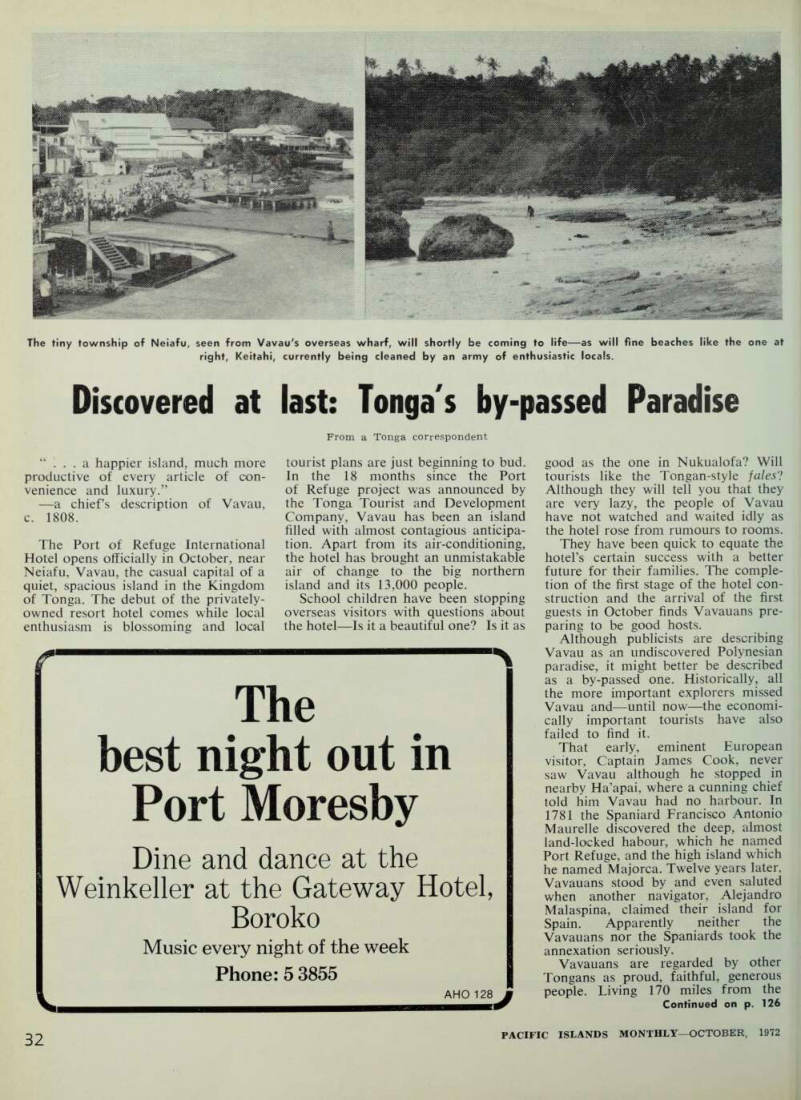


From a Tonga correspondent
“ . . . a happier island, much more productive of every article of con venience and luxury.” —a chiefs description of Vavau, c. 1808.
The Port of Refuge International Hotel opens officially in October, near Neiafu, Vavau, the casual capital of a quiet, spacious island in the Kingdom of Tonga. The debut of the privately owned resort hotel comes while local enthusiasm is blossoming and local
tourist plans are just beginning to bud.
In the 18 months since the Port of Refuge project was announced by the Tonga Tourist and Development Company, Vavau has been an island filled with almost contagious anticipa tion. Apart from its air-conditioning, the hotel has brought an unmistakable air of change to the big northern island and its 13,000 people.
School children have been stopping overseas visitors with questions about the hotel—ls it a beautiful one? Is it as
good as the one in Nukualofa? Will tourists like the Tongan-style falesl Although they will tell you that they are very lazy, the people of Vavau have not watched and waited idly as the hotel rose from rumours to rooms.
They have been quick to equate the hotel’s certain success with a better future for their families. The comple tion of the first stage of the hotel con struction and the arrival of the first guests in October finds Vavauans pre paring to be good hosts.
Although publicists are describing Vavau as an undiscovered Polynesian paradise, it might better be described as a by-passed one. Historically, all the more important explorers missed Vavau and—until now—the economi cally important tourists have also failed to find it.
That early, eminent European visitor, Captain James Cook, never saw Vavau although he stopped in nearby Ha’apai, where a cunning chief told him Vavau had no harbour. In 1781 the Spaniard Francisco Antonio Maurelle discovered the deep, almost land-locked habour, which he named Port Refuge, and the high island which he named Majorca. Twelve years later, Vavauans stood by and even saluted when another navigator, Alejandro Malaspina, claimed their island for Spain. Apparently neither the Vavauans nor the Spaniards took the annexation seriously.
Vavauans are regarded by other Tongans as proud, faithful, generous people. Living 170 miles from the Continued on p. 126
The tiny township of Neiafu, seen from Vavau's overseas wharf, will shortly be coming to life—as will fine beaches like the one at right, Keitahi, currently being cleaned by an army of enthusiastic locals.
capital and the Tongan mainland and separated from them by Ha’apai, another sub-group, Vavauans are often last in line. However, they are not surprised that their island is be coming the prime tourist attraction of the kingdom, for they feel it should be so.
“Foreigners must surely be tired of seeing Nukualofa which is not beautiful and Tonga (island) which is flat and has no trees,” they argue.
Where Tongatapu and Nukualofa are flat, Vavau and Neiafu are high, with undulating wooded hills and fertile soil. The magnificent island studded harbour which the hotel over looks, is generally regarded as the most outstanding scenic feature of the kingdom. Although they them selves may never have seen them, the people add that the Vavau group features famous caves which have interested foreigners for 150 years.
They believe they will be able to lure tourists from the hotel refuge and guide them into the interior, across the island to the best beaches, and
among the many smaller islands in the harbour. They are leasing market space for tour offices and clearing the bush to enhance natural beaches.
Unlike Nukualofa, Neiafu has few tourist amenities other than the hotel itself. There are branch offices of the major trading houses, a few other shops and weekend cinema. There is no taxi office, only one bus, and no place to eat or drink. There is much to be done, Vavauans agree.
They have little money to do it with.
In 1938, the Union Company ship “Matua” began making regular calls at Neiafu, a custom now carried on since 1951 by the “Tofua”. The first shipboard groups of tourists did not stay long in port, but they taught Vavauans the ropes which must now be handled more efficiently. The cruiseships “Chusan” and “West Star” will call five times at Neiafu before the end of the year.
Other communications were sorely lacking until the twice-weekly “Olo vaha” ferry service was begun last
year. Because of this relative isola tion. In fact, up till now, visiting foreigners were always assumed to be yachtsmen. Those who had no yacht had to have patience. The airport a Leimatua, expected to begin operation in October, is the third to be plannee and the second to be built in Vavau without the advent of the intendeo internal air service. But times are changing.
With the assistance of Vavau Governor Ma’afu Tupou, certain stretches of beach are being developed privately by Vavauans. How can ; local man with little or no capita) build a tourist attraction of inter national standard? He must be ; special kind of dreamer and mus have a labour force willing to worl for nothing. In short, he must be i Tongan with a large family.
Uiliami Saulala, with his fathe; and his relatives, has already begui such a project at Keitahi, widel; recognised as one of the best beache in the kingdom. Mr Saulala plan to build a model Tongan villag; where future tourists may spend thi night and where presently hotel guest) can spend the day. An army a labourers, all in the family am all unsalaried, have been at work fc
lonths clearing, cleaning, and build ig at Keitahi.
Toward their dream, the family as made an important purchase— vo flush toilets. But more note orthy than that is the “first-stage” pening feast they held last month )r Vavauan guests.
“I don’t think this work will bring loney,” says Saulala, “but it is a )od future I can give my sons.”
Leading Neiafu merchant, Fanga’a aea, is also said to be planning a ly-outing beach resort at Vaka’eitu land, about 10 miles from Neiafu. nother Vavauan, Siua Moa, was fering “alternative accommodation” en before the principal hotel was gun. His motel at Tahi is a land ark of Vavauan enterprise located ually near the wharf and the hotel.
Dt every man is fortunate enough have a beach upon which to build, Lough with 34 islands in the Vavau aup, it is not surprising how many While its fertile land has tradi nally been the source of Vavau’s ?alth, if one may call it that, ricultural schemes including citrus,
vanilla and tobacco have come and gone. Vavauans have seen hurricanes destroy their copra plantations.
Although the Agriculture Department reports that there is no great move toward increasing table vegetable production for tourist consumption, the people are looking to the hotel to increase the value of Vavau’s valuables.
Some are building vehicles from spare parts. The island has 44 miles of roads which are always under repair. Some are building boats.
Children are studying English with new enthusiasm so they might some day be in the elite of the hotel-em ployed.
Vavau women, who have realised the value of their weaving skill, are producing more of the five-foot uli baskets (hampers) which is their specialty. The baskets, which take two or three weeks to complete, are being made now for tourists who haven’t yet heard of the new hotel.
And in this way, each is doing his part to prepare Vavau for its new role as a port of refuge for the tourist.
Advertisements & other items, pp. 34-38 (2 items)
Port Moresby
The
best night out in
Dine and dance at the Weinkeller at the Gateway Hotel, Boroko Music every night of the week Phone: 5 3855
AHO 128
i Pete*
UIMES^'
Paris, Rome, Tokyo—
wherever the jet routes meet, Peter Stuyvesant is there.
A wide new world of taste.
Swvesail
Rich choice tobaccos.
Miracle Filter— so much more to enjoy! filte 11 n s m .4 1671 1591 umcE tobaccos rich size * I Ct I^l f.
X r i ,/■ m iff m z Iff £ Iff The International Passport to Smoking Pleasure.
WORLD COPYRIGHT.
Anything floes.
With Bacardi rum
The worlds great rum:
With Bacardi rum do your own thing, tonic ... soda ... dry ... Coke; One jigger of Bacardi and they all become something else.
"Coca-Cola” and "Coke aie registered trade marks ol Ihe Coca-Cola Company Limited Bacardi and Bat device are registered trade marks of Bacardi & Company Limited.
r |ir f - N * 0 % n i f n .'W I* I V ♦ % 4£ ' ... *«*» ■•f 1 S v- •.<V.,»v i <* >
Awake to this
weird and
wonderful world
The world of Papua New Guinea, the last place on earth where you can truly get away from it all.
Exciting, wildly exotic landscapes ... a profusion of piant and wild life seen nowhere else. Untamed untrodden jungles. Acre upon acre of highly productive plantation land.
Exciting peopie. Like the "Mud Men" of the Eastern Highlands. Stone Age people being thrust in one lifetime into the Space Age. A land of living legends, legends that are a part of everyday life, legends that in other countries died out centuries ago.
Papua New Guinea is the last frontier a Country that will fascinate, delight and inform you. And it is our home. We serve over fifty ports throughout the length and breadth of the land, with 150 flights every week, so when you come and make it soon, before it all changes see us.
A A &-
AIMSETT AIRLINES OF
in conjunction with ANSETT AIRLINES OF AUSTRALIA
Serving the country-yesterday, today & tomorrow
PAPUA NEW GUINEA
APOB3/PIM
What’s
the Stout got that the
Land Cruiser and
these other Toyotas
9
got
Quality and guts.
The TOYOTA LAND CRUISER has got it. 4-wheel drive. 6-cylinder 155 HP engine.
Fantastic gear combinations of six forward speeds and two reverse. It doubles as a versatile family fun car, too.
Then there’s the big horse pickup, TOYOTA STOUT. The front and rear axles, suspension and powerful brakes feature the stoutness of those used in heavier duty trucks. Plus it packs a 106 HP engine. Big cab and cargo box.
Plenty of legroom in front and space in back.
And the split bench seat has cushion comfort.
You get power, safety, economy and stoutness,
tOO. ~N
I* V / .*> V * But you may like the dual rear wheel TOYOTA DYNA. You can choose a heavy duty pickup. Or a bigger payload platform truck.
Even a double cab and delivery van. With either a husky 106 HP gasoline engine or an economical 70HP diesel job.
Or you may want the big one.
The TOYOTA TRUCK. Six big models built to take the rough and tough.
With 130 HP diesel or 155 HP regular fuel engines under an alligator bonnet.
Got room for a Toyota?
TOYOTA TRUCK
TOYOTA DYNA
PAPUA NEW GUINEA ELA MOTORS LIMITED Scratchley Rd., Badih, Papua U.S. TRUST TERRITORY: MICROL CORPORATION, P O Box 267, Saipan FIJI ISLANDS: AUTOMOTIVE SUPPLIES CO., LTD , G.P 0. Box 355, Suva AMERICAN SAMOA; BURNS PHILP (SOUTH SEA) CO.. LTD , Pago Pago WESTERN SAMOA: BURNS PHI LP (SOUTH SEA) LTD , P.O. Box 188, Apia GUAM: RICKY's AUTO CO , P.O Box 1458, Agana NEW HEBRIDES: NEW HEBRIDES MOTORS LTD , P O Box 18, Vila SOLOMON ISLANDS; ZEPHYR SERVICE STATION PTY LTD., P.O Box 174, Honiara NEW CALEDONIA: SOCIETE D'IMPORT AT lON AUTOMOBILE DU PACIFIC, B.P 438, Noumea TAHITI: ETABLISSEMENTS E A MARTIN & FILS. B.P 61 Papeete COOK ISLANDS: COOK ISLANDS TRADING CORPORATION LTD , P O Box 92, Rarotonga
TOYOTA
35
ACIFIC ISLANDS MONTHLY—OCTOBER, 1972
Norfolk Islanders Not Mutinous -

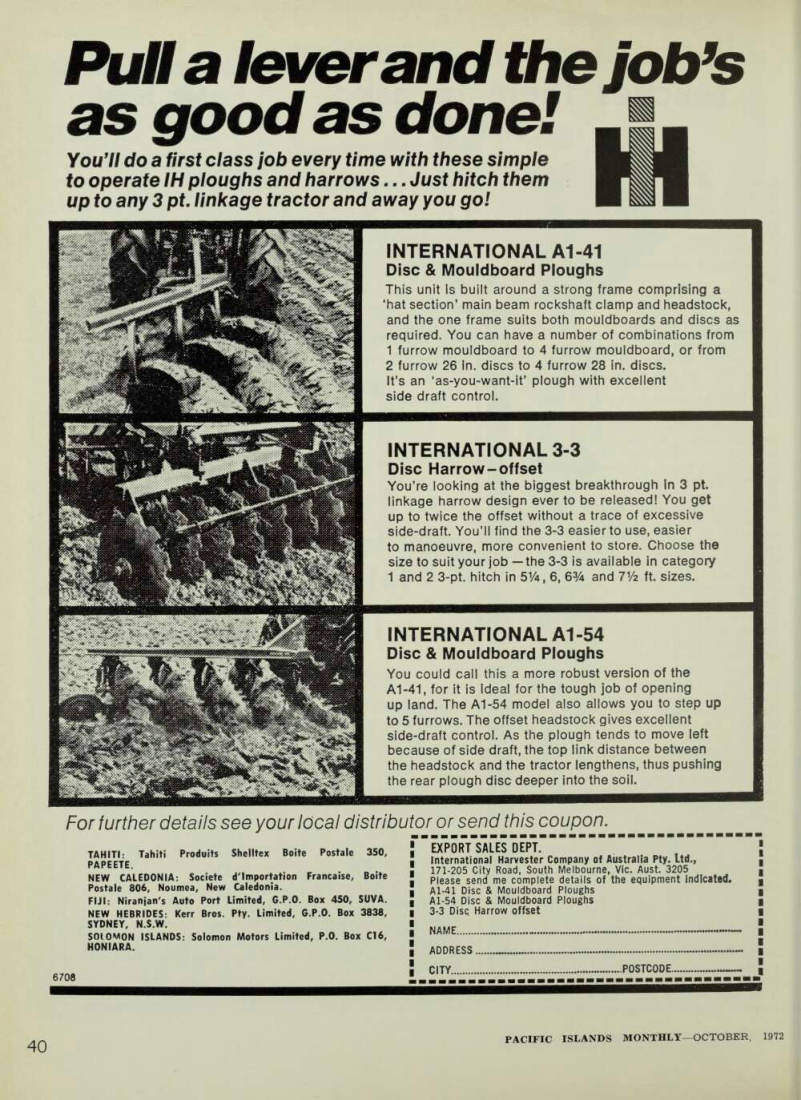
Just Short Of Straight Answers
From a Norfolk Island correspondent
Norfolk Island, after having drafted a petition to Queen Elizabeth asking for her help in establishing the island’s constitutional position, in September got on with the job of collecting signatures for it. This was going very well when one of the island’s not infrequent schisms developed.
The launching of the petition had been given wide publicity in the over seas Press, with headlines suggesting that the islanders were in mutiny, and wanted their freedom from Australia at all costs. The publicity brought a reaction from three of the most famous Bounty names on Norfolk.
Adams, Quintal and Christian, who sent a letter to leading Australian md New Zealand newspapers protest ing that the islanders were loyal and luggesting that the petition to the )ueen did not have islander support >ecause it was the result of the work )f “mainlander malcontents”—main ander being the phrase used to de cribe expatriates on Norfolk.
The battle was being fought well ato September.
The petition was mainly the work f Tom Lloyd, owner of the small weekly newspaper, The Norfolk slander, who is an islander himself.
Ir. Lloyd supports the retention of lorfolk Island as a tax free haven ecause he believes there are many enefits for the islanders. In this he nds himself on the same side as lany mainlanders who have more to ain than the islanders in keeping the land tax free.
But the island’s tax haven days are obably over, because Australia has at pressure on company activities (Mowing introduction into Norfolk land of a new company ordinance 3 IM, Sept., p. 10). The petition to e Queen which Tom Lloyd helped aft takes a hit at these recent de ;lopments, complaining that Aus alia has “brought down complicated ws which appear to deal with Aus alian conditions rather than with the dfare of our community”.
But oddly enough, the petition to e Queen is not mainlander-inspired.
It is the manifestation of an age d uneasiness among the islanders ;out their constitutional position, id or did not Queen Victoria give □rfolk Island to the Pitcairn corn unity as a “distinct and separate
settlement” in perpetuity? If so, how is it that Norfolk now finds itself under the complete control of Aus tralia? If Norfolk is not legally a distinct and separate settlement, at what point did it cease to be?
Tom Lloyd and some of his friends have recently seen a legal opinion which throws doubt on Norfolk’s present position as an Australian territory. The opinion has come from the top level, and a small group of islanders wants to clean up the situa tion. The petition to the Queen is really the first move in what will probably become a court challenge.
The challenge is not aimed at seeking freedom, but merely at resolv ing once and for all an unanswered question. The islanders would prob ably be horrified if they found, after all, that they could become independ ent and it is not likely they would want to accept the honour. But they say they “have to know”.
It’s unfortunate for Tom Lloyd that the petition and its attendant publicity happen to coincide with the aims of the mainlander group that wants to see the island’s position as a tax haven protected, because the suspicion now is that the whole chal lenge is mainlander-inspired, for a selfish purpose. And anything with a mainlander taint doesn’t get very far on Norfolk Island, where they are still mutineers at heart.
Here is the petition that was cir culating on the island in September:
At Norfolk Island A Petition
TO
Her Majesty Queen Elizabeth Ii
Buckingham Palace, London, England.
May It Please Your Majesty;
In 1856 Your great-great-grandmother Her Majesty the late Queen Victoria reserved Nor folk Island as a new home for her loyal sub jects of Pitcairn Island.
Our original Pitcairn community were moved here, and Norfolk Island was proclaimed a distinct and separate settlement in the Crown's Dominions. Since then both the men and women of Norfolk Island have willingly fought for the Crown in every war in which our Sovereign has called on us to serve.
In 1914 Your grandfather the late King George V gave to the Commonwealth of Aus tralia responsibility for the peace, order and good government of Norfolk Island.
Like a Colony we do not have representative government or right to vote how we shall be governed. We do not seek representation in Australia s government or ask any right to vote how that country shall be governed.
In governing us Australia has given to Nor
folk Island certain benefits. We are deeply grateful for its benevolence. Yet our com munity does not want charity to support itself.
Now Australia has begun making changes on Norfolk Island which are not to secure our peace order and good government and which in some cases may harm us greatly. It has brought down complicated laws which appear to deal with Australian conditions rather than with the welfare of our community. It has announced a new scheme of taxation laws in our Island to solve problems that are Aus tralia's and not ours. It is considering making Norfolk Island a maximum security animal quarantine station for Australia, so that if there were unexpected dangerous diseases they would be prevented from infecting Australia by being confined to our few square miles of land—and has plainly said that this decision will be made by Australia and that our own Island will not be the deciding factor. It has dealt weakly with the protection of our fishing waters, which are essential to us, even though we recognise that they may have little importance among the larger matters which Australia must nego tiate with other nations.
In such actions Australia appears to believe that it has the right to govern Norfolk Island and the land we have inherited as if we were a Colony owned by Australia. We do not believe that it has ever lawfully been given such a right. The resolving of this difference of belief between Australia and ourselves appears to depend on the true meaning of proclamations by past Sovereigns of Norfolk Island and we respectfully believe that only Your Majesty can impartially rule— WHETHER His Majesty the late King George V gave Australia only the power to take actions for our peace, order and good government; or whether he gave Australia power to govern Norfolk Island in any way it wishes.
WHETHER Norfolk Island remains, as Her Majesty the late Queen Victoria declared it to be a distinct and separate settlement; or whether Norfolk Island has become part of Australia.
WHETHER we may continue to give our first loyalty to Your Majesty and to look to You for our ultimate protection; or whether by accept ing Her Majesty the late Queen Victoria's offer of Norfolk Island, our original community was unknowingly sacrificing its rights and privileges as a dependency of the Crown as Pitcairn Island still is.
Our way of life and the future of our com munity depend on how these questions are answered. If we remain silent and Australia continues to exercise its assumed power over us, we fear that our birthright will soon have been lost forever.
We, whose signatures are attached, therefore respectfully beseech Your Majesty, with as great urgency as may be thought fit, to direct us and those who govern us how these ques tions shall be answered.
We have the pleasure to be Your Majesty's loyal and loving subjects.
This is the letter which, following
the circulation of the petition to the
Queen, was sent to leading Aus
tralian and New Zealand newspapers
by three Norfolk Island men:
We, the undersigned direct descen
dants of the Bounty men who
mutinied under Captain Bligh in
(Continued on p. 121)
'789, would like to make it known 0 the public that, despite the pro phesies in the mainland papers that mutiny” is imminent on Norfolk stand, the Norfolk Islanders are, Imost without exception, entirely atisfied with conditions on the island.
Visiting journalists eager for copy ave mistaken the grumbles and roans from the Australian company pemtors on the island, who have een hit by the Federal Treasurer’s ecision to close Norfolk as a tax aven, for genuine and outraged rotests from the Norfolk Islanders lemselves.
Norfolk Islanders served in the outh African war, in two world wars nd in the war in Korea. In the last \ree wars many Norfolk Islanders icrificed their lives. Their loyalty 1 the Crown and to the Common ealth of Australia is unquestionable, hey are certainly not planning a gal challenge to the Australian overnment’s authority over the 'and as an Australian Territory, as is been stated more than once in e mainland press. Any such allenge will come from the few nainlander” malcontents on Norfolk ho are stirring up trouble to suit eir own ends.
The petition to the Queen which gan circulating on the island in rly September will attract very few ’natures from Norfolk Islanders, le nature of the petition is summed in the following extract concerning ? Australian Government’s right to ’islate for Norfolk Island: “We do t believe that it has ever lawfully ?n given such a right.”
Norfolk Islanders are proud of ’ir descent from the Bounty men
and of their heritage on Norfolk Island. And they are also proud of their status as Australian citizens.
G. A. Adams.
G. R. Quintal.
B. E. Christian.
Norfolk Island.
September 5, 1972.
Distribution of this letter caused the organisers of the petition to reflect on whether the petition should be re-worded, especially as in the meantime somebody painted a swastika on The Norfolk Islander’s printery.
It was decided that the petition to the Queen should remain as it was and by late September Tom Lloyd had collected more than 350 signa tures (the island’s electoral roll con tains 951 names). A big number of the signatories are of Bounty names.
And Lloyd announced in his Norfolk Islander that he intended to leave the swastika where it was, as a reminder to the population of the kind of tactics that existed in less enlightened countries but weren’t needed on Norfolk Island. • After 32 years in the Solomon Islands Mr Don Scott and his family are returning to Australia to live.
Mr Scott, an Australian, came first to the Solomons in 1924 when his father was appointed Bums Philp manager at Makambo. Following war service in Papua New Guinea and Borneo, Don Scott returned to Gizo in the Western Solomons before finally settling down at Munda.
In 1964 he bought the 40 acre island of Kolo Hite in the Wana Wana Lagoon, an island originally belonging to the Wickham family.
Mr Scott has recently negotiated the sale of his island to Mr J. Milldrum of Hawaii for an undisclosed price.
Advertisements & other items, pp. 39-40 (2 items)
37
tCIFIC ISLANDS MONTHLY—OCTOBER, 1972
oplaste
m ' m SL
Get*
oa La V A* 3% * % Jh a * /. * r * «-
Suit
a u* <a Lb
BUY
ONE
Manufactured by The Webster Biscuit Company Pty. Ltd., 468 Gympie Road, Kedron, Queensland, 4031.
Phone 59 6566.
Who answers it education
teaches them to ask?
From FELISE VA*A in Apia
What does the educated young Samoan want to do with his educa tion? No one knows for sure; no thorough study of employment pros pects and aims has been done in Western Samoa. The Bureau of Statis tics has a study of employment in mind, but its execution is a long way off.
Meanwhile it is possible to say what the parents of schoolchildren want. It is well known that parents are sending their children to school to qualify them for decent jobs in government, industry and commerce.
Those who are not fortunate enough to get one of the limited number of jobs usually return to work on the family plantation.
There is another attractive alterna tive for those who cannot find jobs in town migration. Every year, hundreds of young Samoans migrate to New Zealand, their fares paid by relatives already there. A few go to the United States and elsewhere.
Western Samoa thus stands to lose some of its most promising young sters, for migration is not restricted to the low level graduates of the pri mary and secondary schools. The young of brilliant academic and tech nical accomplishments sometimes leave in disgust because they do not find in Samoan society the things that they want, whether these be wages, opportunity or freedom.
Nowadays it is as a rule the bright youngsters who leave their villages for the higher incomes in the towns, Apia or elsewhere, while it is fre quently the not so successful ex pupils who must stay behind in the villages and serve the matais. Their efforts are not in vain, for often they succeed the matais and on their shoulders rests the responsibility of preserving the country’s traditions and customs.
As matais, they alone can vote and be candidates for parliament. They are the true pacemakers for they are unconsciously delaying the changes that are bound to come, the changes that will be accompanied by certain destructive effects, perhaps the elimi nation of the matai system itself.
The universal desire in Samoa is for change but there is disagreement on the nature of the changes and on the methods of bringing them about.
This goes double for young school leavers. Unless business and govern
ment combine to provide jobs for the young, more and more of them will emigrate, with the result that in the long run, Samoa will be poorer.
But the opportunity must not be merely in employment; there is also needed in Western Samoa an atmos phere that is politically, socially and morally congenial to the young
(Continued over page)
Diluted Samoan Titles
people. Hence many of the present social and political restrictions ought to be removed.
For example on the political level, the vote should be extended to all persons 21 and over, and parents and families should do away with their authoritarian attitudes towards the young.
Meanwhile the matai system is developing problems too.
With voting power confined to holders of matai titles (heads of ex tended families) in Western Samoa, the titles have proliferated and some villages are, literally, mass producing them.
This state of affairs has so de teriorated that the government has been compelled to intervene. Recently, cabinet appointed a sub-committee to look into the matter and see if this mass production of titles can be con trolled.
At the bottom of the problem is the need for parliamentary candidates to obtain sufficient support. Some times, the voters are compelled to vote a certain way because of family ties, because they must respect the dignity of a high title or because of an obligation. What happens to the well-educated matai, who wishes well for his constituency and for the coun try but who has not got a hope against a formidable opponent in the person of a very high-titled matai who probably has finished his educa tion at only second grade? The best alternative, some think, is to create more matai titles for those who could be relied upon to vote for him in a general election. This is what has hap pened during the last three general elections.
The most famous example of this arose in one such electoral contest between the present Minister of Works, Tupuola Efi, and one of the Vaai brothers. Both candidates set about “mass-producing” matai titles so that at the end, it was believed, the number of new matai titles exceeded the population of the villages con cerned, something unheard of, since on the average the number of matais to a village is only about a tenth of the village population.
To curb this increasing habit, the parliament some years ago passed a law regulating the manner in which matai titles could be conferred. This law has been enforced repeatedly.
One of its most unpopular aspects is that it applies retroactively so that many of the titles conferred in the “mass-production” manner in the past have been reviewed by the court. In
most cases, the titleholders have been ordered to go through with the proper ceremonies laid down by the law and where the titles are spurious, they have been abolished altogether.
Naturally, the many hundreds that have come before the Land and Titles Court feel a resentment against the government. “What business is it of the government to try to regulate Samoan custom?” they would ask. “If the Samoan people in the villages approve of it, it is no business of the government.”
And so, the government finds that
it has put itself in a spot. But now, it feels it must intervene to protect the matai system. The committee will include at least three cabinet mem bers. The outcome is uncertain but there is little doubt that the practice will continue.
Some suspect that what the govern ment really fears is that “mass-produc tion” of matai titles might bring pres sure to bear on the government to introduce universal suffrage. This it has been felt would be preferable to the destruction of the matai system.
But the government does not want universal suffrage. It prefers the status quo, which many already feel is out of place in the modern world.
Advertisements & other items, pp. 41-43 (1 item)
Queensland
Rambler's Guide to
Norfolk Island
A stimulating tour of every point of interest on this second-oldest British settlement in the South Seas. Price $1.50 Aust., plus 18c posted, or $2.00 U.S. posted.
Pacific Publications (Aust.)
Pty. Ltd.
29 Alberta St., Sydney, N.S.W. 2000. (Postal Address: Box 3408, G.P.0., Sydney, N.S.W. 2001).
BENEFIT FROM 86 YEARS
OF INSURANCE EXPERIENCE
QUEENSLAND
INSURANCE
Company Limited
(INCORPORATED 1886 IN AUSTRALIA)
HEAD OFFICE: 82 Pitt Street, Sydney FlJl—Branch Office, Suva, Manager for Fiji: K. Galloway.
LAUTOKA, BA, LEVUKA, LABASA—Bums Philp (South Sea) Co. Limited. District Manager at Lautoka: U. Singh.
PAPUA-NEW GUlNEA—Branch Office, Port Moresby: Manager for Papua & New Guinea: D. J. Granter.
SAMARAI, LAE, MADANG, RABAUL, KAVIENG,
MT. HAGEN—Bums Philp (New Guinea) Limited.
District Manager at Rabaul: C. D. Dickings. Acting District Manager at Lae: B. Wain. District Manager at Mt. Hagen: G. F. Donnelly.
HONIARA (b.s.i.p.)— Brcckwoldt & Company (s.i.) Pty. Limited.
NOUMEA—W. Johnston.
VlLA—Bums Philp (New Hebrides) Limited.
SANTO—Bums Philp (New Hebrides) Limited.
NORFOLK ISLAND—Bums Philp (South Sea) Co. Limited.
TAHlTl—Arthur Chung j Immeuble B. 1., Front deMer, Papeete OTHER SOUTH SEA ISLANDS—Bums Philp (South Sea) Co. Limited.
Assets exceed 5A65,000,000
Pull a lever and die job’s
as good as done!
You’ll do a first class job every time with these simple to operate IH ploughs and harrows,.. Just hitch them up to any 3 pt. linkage tractor and away you go! wVn&Z&nrtlSi ii, - ''
INTERNATIONAL Al-41
Disc & Mouldboard Ploughs
This unit is built around a strong frame comprising a ‘hat section’ main beam rockshaft clamp and headstock, and the one frame suits both mouldboards and discs as required. You can have a number of combinations from 1 furrow mouldboard to 4 furrow mouldboard, or from 2 furrow 26 In. discs to 4 furrow 28 in. discs.
It’s an ‘as-you-want-lt’ plough with excellent side draft control.
INTERNATIONAL 3-3
Disc Harrow-offset You’re looking at the biggest breakthrough In 3 pt. linkage harrow design ever to be released! You get up to twice the offset without a trace of excessive side-draft. You’ll find the 3-3 easier to use, easier to manoeuvre, more convenient to store. Choose the size to suit your job the 3-3 is available in category 1 and 2 3-pt, hitch in SVa, 6, 6 3 /a and 7Vz ft. sizes.
Mm*
INTERNATIONAL Al-54
Disc & Mouldboard Ploughs You could call this a more robust version of the Al-41, for it is Ideal for the tough job of opening up land. The Al-54 model also allows you to step up to 5 furrows. The offset headstock gives excellent side-draft control. As the plough tends to move left because of side draft, the top link distance between the headstock and the tractor lengthens, thus pushing the rear plough disc deeper into the soil.
For further details see your local distributor or send this coupon.
TAHITI: Tahiti Produits Shelltex Boite Postale 350.
PAPEETE.
NEW CALEDONIA: Societe d'lmportation Francaise, Boite Postale 806, Noumea, New Caledonia.
FIJI: Niranjan's Auto Port Limited, G.P.O. Box 450, SUVA.
NEW HEBRIDES; Kerr Bros. Pty. Limited, G.P.O. Box 3838,
SYDNEY, N.S.W.
SOLOMON ISLANDS: Solomon Motors Limited, P.O. Box CI6,
HONIARA.
6708
EXPORT SALES DEPT.
International Harvester Company of Australia Pty. Ltd., 171-205 City Road, South Melbourne, Vic. Aust. 3205 Please send me complete details of the equipment indicated.
Al-41 Disc & Mouldboard Ploughs Al-54 Disc & Mouldboard Ploughs 3-3 Disc. Harrow offset
NAME
ADDRESS
CITY POSTCODE
V/CTA
TURNS
GRASS
INTO
LAWN!
A MODEL AVAILABLE TO SUIT ALL
CONDITIONS AND EVERY PURPOSE
SUVA MOTORS LTD.
SUVA, LAUTOKA.
CARPENTERS
PORT MORESBY.
NEW GUINEA CO. LTD.
RABAUL, MADANG,
LAE, MOUNT HAGEN,
MINJ, GOROKO.
Footnotes
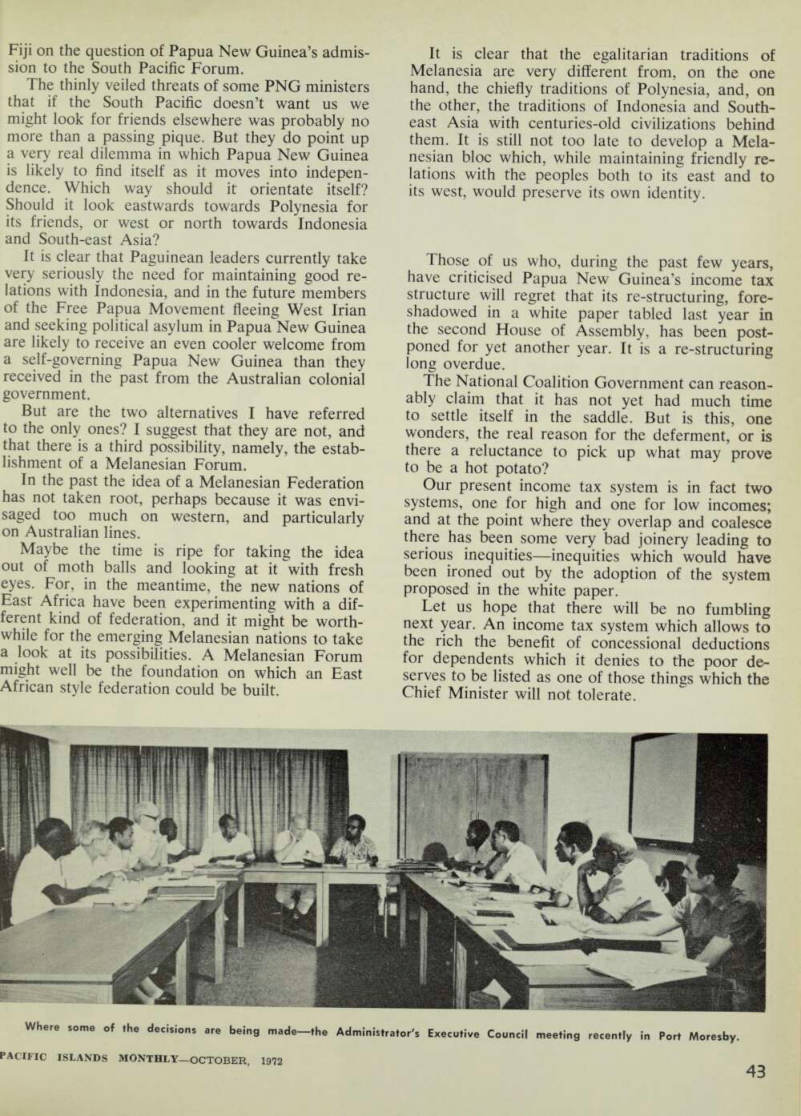
the recent round of talks, referred to in last month’s PIM, between Australian Minister for External Territories Andrew Peacock and Papua New Guinea’s National Coalition Government, two interesting announcements were made by Chief Minister Michael Somare.
The first was that District Administration, until now a division within the Department of the Administrator, will in future come under the control of the Office of the Chief Minister.
The second was that it is Mr Somare’s intention to maintain the “kiap system” intact.
“Kiap” is a Pidgin word which is applied to the hierarchy of officers of the district admini stration service from district commissioners down to patrol officers. Father Mihalic’s dictionary derives it from the English word “captain”; other derivations have been suggested. Wherever it came
from, it has long been a key word in the language of govern ment in New Guinea; and since World War II it has become widely known and used in Papua, sometimes with a slightly oppro brious connotation which per haps it doesn’t bear on its New Guinea homeland.
In both territories it has con noted an authoritarian system of government, which, to be fair to it, was necessary, and not un acceptable to the governed in the
past. In the present, though less necessary, it is still acceptable to the people in some areas, though less so in others.
What then, in essence, is the “kiap system”?
I suggest that basically it may be defined as the decentralised implementation of centrally made decisions. Formerly made by Konedobu and Canberra, these decisions are being made more and more by an elected central government. This is a step in the right direction, but it isn’t what I mean by decentralisation, and it isn’t what Dr John Guise, now Mr. Somare’s Minister for the Interior, used to mean, and I hope still means, by decentralisation.
What we have meant by decentralisation is
Time For A
Melanesian
Forum?
decentralisation of decision making—to local government councils and to intermediate bodies such as the proposed “area authorities” and Dr Guise’s envisaged “provincial assemblies”.
Failure to face up to the distinction between these two kinds of decentralisation has been re sponsible not only for much muddled think
ing but also for some tense situa tions. It has been the main cause of friction between local govern ment councils and their kiap ad visers; and in the past no one has more vehemently espoused the cause of the councils vis-a vis the kiaps than Dr Guise.
Does the declared intention of the Chief Minister to retain the kiap system mean that he wants centralised decision making, with decentralisation only of the de cision implementation? And if
so where does his deputy, Dr Guise, now stand?
But perhaps Mr. Somare doesn’t mean this.
In a recent address at the Administrative Col lege, he. stated that there was a great need for regional government in Papua New Guinea. Let us hope that he really means regional govern ment, that is, regional decision making, and not merely regional administration.
Recently a certain coolness sprang up between the ministry of not yet completely self-governing Papua New Guinea and that of now independent
With Percy Chatterton
in Port Moresby
Fiji on the question of Papua New Guinea’s admis sion to the South Pacific Forum.
The thinly veiled threats of some PNG ministers that if the South Pacific doesn’t want us we might look for friends elsewhere was probably no more than a passing pique. But they do point up a very real dilemma in which Papua New Guinea is likely to find itself as it moves into indepen dence. Which way should it orientate itself?
Should it look eastwards towards Polynesia for its friends, or west or north towards Indonesia and South-east Asia?
It is clear that Paguinean leaders currently take very seriously the need for maintaining good re lations with Indonesia, and in the future members of the Free Papua Movement fleeing West Irian and seeking political asylum in Papua New Guinea are likely to receive an even cooler welcome from a self-governing Papua New Guinea than they received in the past from the Australian colonial government.
But are the two alternatives I have referred to the only ones? I suggest that they are not, and that there is a third possibility, namely, the estab lishment of a Melanesian Forum.
In the past the idea of a Melanesian Federation has not taken root, perhaps because it was envi saged too much on western, and particularly on Australian lines.
Maybe the time is ripe for taking the idea out of moth balls and looking at it with fresh eyes. For, in the meantime, the new nations of East Africa have been experimenting with a dif ferent kind of federation, and it might be worth while for the emerging Melanesian nations to take a look at its possibilities. A Melanesian Forum might well be the foundation on which an East African style federation could be built.
It is clear that the egalitarian traditions of Melanesia are very different from, on the one hand, the chiefly traditions of Polynesia, and, on the other, the traditions of Indonesia and South east Asia with centuries-old civilizations behind them. It is still not too late to develop a Mela nesian bloc which, while maintaining friendly re lations with the peoples both to its east and to its west, would preserve its own identity.
Those of us who, during the past few years, have criticised Papua New Guinea’s income tax structure will regret that its re-structuring, fore shadowed in a white paper tabled last year in the second House of Assembly, has been post poned for yet another year. It is a re-structuring
long overdue.
The National Coalition Government can reason ably claim that it has not yet had much time to settle itself in the saddle. But is this, one wonders, the real reason for the deferment, or is there a reluctance to pick up what may prove to be a hot potato?
Our present income tax system is in fact two systems, one for high and one for low incomes; and at the point where they overlap and coalesce there has been some very bad joinery leading to serious inequities—inequities which would have been ironed out by the adoption of the system proposed in the white paper.
Let us hope that there will be no fumbling next year. An income tax system which allows to the rich the benefit of concessional deductions for dependents which it denies to the poor de serves to be listed as one of those things which the Chief Minister will not tolerate.
Where some of the decisions are being made—the Administrator's Executive Council meeting recently in Port Moresby.
Pacific Islands Monthly—October, 1972
Advertisements & other items, p. 46 (1 item)
Some Of The Firms
% % m %
S. E. TATHAM
& Co. Pty. Ltd.
Melbourne, Australia,
G.P.O. Box 8, Cables "SET
Telephone 60-1125
SOME OF THE FIRMS
WE REPRESENT ARE:
Frappier (French Brandy) Huvet (French Brandy) Indika (Belgium Dairy Produce) Durobor S.A. (Belgium Glassware) Miroiterie Gen. de Belgique S.A. (Louvre glass and mirrors) City Engineers (U.K. Bicycles) F.H.I. Japan (Subaru Cars) Sunshine Biscuits Sunrise (Confectionery) Flamenco (Instant Coffee & Tea) Quaker Products (Oats, Jets) Merchants (Canned Soft Drinks, Cordials) Hancocks (Spaghetti, Cereals) Melbourne Canning (Jams) Water Wheel (Flour, Sharps, Wheat) A. P. & D. (Twisties, Twirlies) Edward Zorn (Margarine, Cooking Fats) Allens (Confectionery) Red Tulip (Fine Chocolates) Robert Timms (New Guinea Gold Instant Coffees and Teas) Highness (Canned Vegetables, Fruit Juices) S.P.C. (Abalone) Lunchtime (Honey) Wing Lee (See You Sauce) Hardings (Sauces) Magnet (Mattresses) Essteel (Cookware) Warner-Drayton (Fans) Mitchell's (Abrasives) Regent (Swiss watches) Austramax (Pressure Lanterns) Preservene (Soap Products) Lawn Chair; Tubco (Garden Furniture) Sunrise Lustertone (S.S. Sinks, Plumbers Supplies) Electronic Industries (Electrical Household Appliances) Jex (Steelwool) Arnbro (Folding Beds) Elmaco (Plastics —Electrical Fittings) B.X. (Plastics) Franklite (Light Fittings) J.J. Cash (Embroidered Labels) Disston (Saws) Supa-Swift (Motor Mowers, Tractors) « \ % % 54 \ 1
DIRECT ENQUIRIES WELCOMED
ASSOCIATE COMPANY
S. E. TATHAM (FIJI
LAUTOKA, P. 0., BOX 366.
SUVA, G.P.0., BOX 671.
SINCE 1924
i
LTD
Solomons Fish Troubled Waters
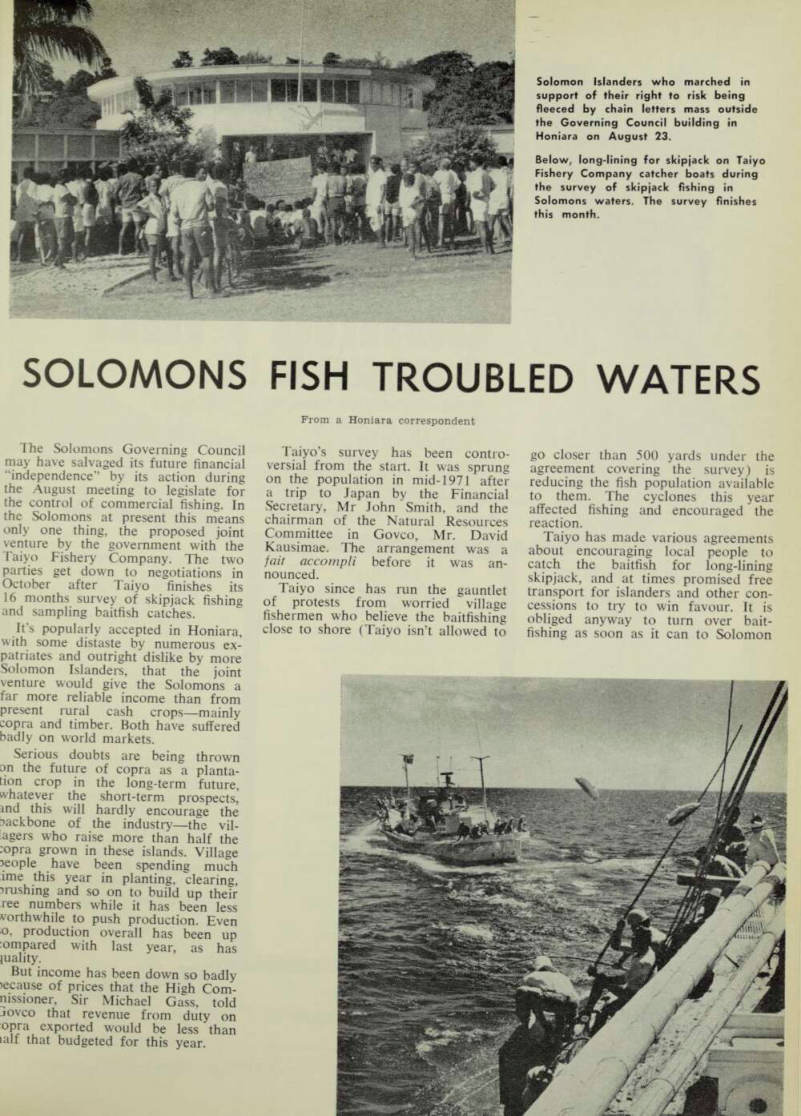
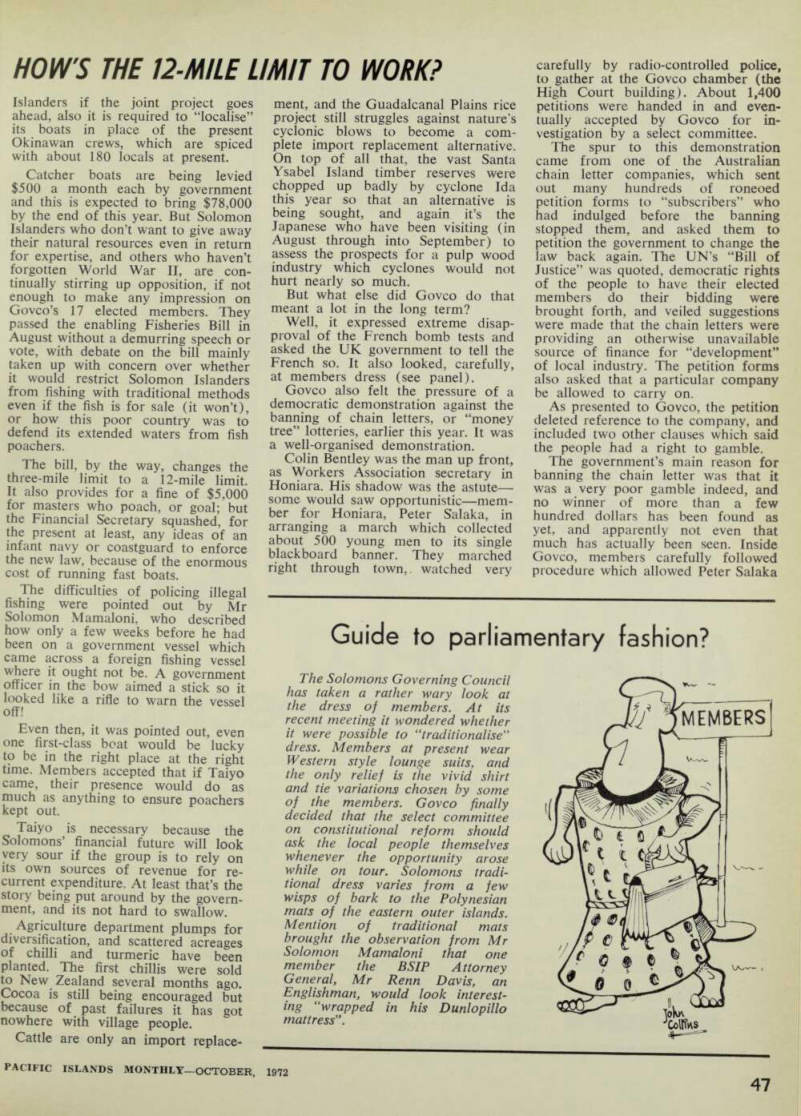

Prom a Honiara correspondent
The Solomons Governing Council may have salvaged its future financial "independence” by its action during the August meeting to legislate for the control of commercial fishing. In the Solomons at present this means only one thing, the proposed joint venture by the government with the Taiyo Fishery Company. The two parties get down to negotiations in October after Taiyo finishes its 16 months survey of skipjack fishing and sampling baitfish catches.
It’s popularly accepted in Honiara, with some distaste by numerous ex patriates and outright dislike by more Solomon Islanders, that the joint venture would give the Solomons a far more reliable income than from present rural cash crops—mainly copra and timber. Both have suffered badly on world markets.
Serious doubts are being thrown on the future of copra as a planta tion crop in the long-term future, whatever the short-term prospects, and this will hardly encourage the backbone of the industry—the vil lagers who raise more than half the :opra grown in these islands. Village aeople have been spending much ime this year in planting, clearing, a rushing and so on to build up their ree numbers while it has been less vorthwhile to push production. Even o, production overall has been up :ompared with last year, as has }uality.
But income has been down so badly >ecause of prices that the High Com missioner, Sir Michael Gass, told jovco that revenue from duty on opra exported would be less than talf that budgeted for this year.
Taiyo’s survey has been controversial from the start. It was sprung on the population in mid-1971 after a trip to Japan by the Financial Secretary, Mr John Smith, and the chairman of the Natural Resources Committee in Govco, Mr. David Kausimae. The arrangement was a fait accompli before it was announced. 1 aiyo since has run the gauntlet of protests from worried village fishermen who believe the baitfishing close to shore (Taiyo isn’t allowed to
go closer than 500 yards under the agreement covering the survey) is reducing the fish population available to them. The cyclones this year affected fishing and encouraged the reaction.
Taiyo has made various agreements about encouraging local people to catch the baitfish for long-lining skipjack, and at times promised free transport for islanders and other con cessions to try to win favour. It is obliged anyway to turn over bait fishing as soon as it can to Solomon
Solomon Islanders who marched in support of their right to risk being fleeced by chain letters mass outside the Governing Council building in Honiara on August 23.
Below, long-lining for skipjack on Taiyo Fishery Company catcher boats during the survey of skipjack fishing in Solomons waters. The survey finishes this month.
How's The 12-Mile Limit To Work?
Islanders if the joint project goes ahead, also it is required to “localise” its boats in place of the present Okinawan crews, which are spiced with about 180 locals at present.
Catcher boats are being levied S5OO a month each by government and this is expected to bring $78,000 by the end of this year. But Solomon Islanders who don’t want to give away their natural resources even in return for expertise, and others who haven’t forgotten World War 11, are con tinually stirring up opposition, if not enough to make any impression on Govco’s 17 elected members. They passed the enabling Fisheries Bill in August without a demurring speech or vote, with debate on the bill mainly taken up with concern over whether it would restrict Solomon Islanders from fishing with traditional methods even if the fish is for sale (it won’t), or how this poor country was to defend its extended waters from fish poachers.
The bill, by the way, changes the three-mile limit to a 12-mile limit.
It also provides for a fine of $5,000 for masters who poach, or goal; but the Financial Secretary squashed, for the present at least, any ideas of an infant navy or coastguard to enforce the new law, because of the enormous cost of running fast boats.
The difficulties of policing illegal fishing were pointed out by Mr Solomon Mamaloni, who described how only a few weeks before he had been on a government vessel which came across a foreign fishing vessel where it ought not be. A government officer in the bow aimed a stick so it looked like a rifle to warn the vessel off!
Even then, it was pointed out, even one first-class boat would be lucky to be in the right place at the right time. Members accepted that if Taiyo came, their presence would do as much as anything to ensure poachers kept out.
Taiyo is necessary because the Solomons’ financial future will look very sour if the group is to rely on its own sources of revenue for re current expenditure. At least that’s the story being put around by the govern ment, and its not hard to swallow.
Agriculture department plumps for diversification, and scattered acreages of chilli and turmeric have been planted. The first chillis were sold to New Zealand several months ago.
Cocoa is still being encouraged but because of past failures it has got nowhere with village people.
Cattle are only an import replace
ment, and the Guadalcanal Plains rice project still struggles against nature’s cyclonic blows to become a com plete import replacement alternative.
On top of all that, the vast Santa Ysabel Island timber reserves were chopped up badly by cyclone Ida this year so that an alternative is being sought, and again it’s the Japanese who have been visiting (in August through into September) to assess the prospects for a pulp wood industry which cyclones would not hurt nearly so much.
But what else did Govco do that meant a lot in the long term?
Well, it expressed extreme disap proval of the French bomb tests and asked the UK government to tell the French so. It also looked, carefully, at members dress (see panel).
Govco also felt the pressure of a democratic demonstration against the banning of chain letters, or “money tree” lotteries, earlier this year. It was a well-organised demonstration.
Colin Bentley was the man up front, as Workers Association secretary in Honiara. His shadow was the astute— some would saw opportunistic—mem ber for Honiara, Peter Salaka, in arranging a march which collected about 500 young men to its single blackboard banner. They marched right through town, watched very
to gather at the Govco chamber (the High Court building). About 1,400 petitions were handed in and even tually accepted by Govco for in vestigation by a select committee.
The spur to this demonstration came from one of the Australian chain letter companies, which sent out many hundreds of roneoed petition forms to “subscribers” who had indulged before the banning stopped them, and asked them to petition the government to change the law back again. The UN’s “Bill of Justice” was quoted, democratic rights of the people to have their elected members do their bidding were brought forth, and veiled suggestions were made that the chain letters were providing an otherwise unavailable source of finance for “development” of local industry. The petition forms also asked that a particular company be allowed to carry on.
As presented to Govco, the petition deleted reference to the company, and included two other clauses which said the people had a right to gamble.
The government’s main reason for banning the chain letter was that it was a very poor gamble indeed, and no winner of more than a few hundred dollars has been found as yet, and apparently not even that much has actuall y been seen - Inside Govco, members carefully followed procedure which allowed Peter Salaka
to present the petition “from all over the Solomons”, as he said. To be accepted, 14 of the 19 members in the chamber had to be in favour.
Fifteen were, including some who privately disparaged the particular gamble. Only one elected member, Gordon Siama (chairman of Com merce and Industry Committee) re mained seated with the three nominated civil servant members.
Cynics say that a number supported it because they fear the election early next year; there is no doubt a strong body of feeling is in favour of the chain letters.
Among the marchers were many Liu —a north Malaita word meaning roughly one who walks about doing nothing, a good description of Honiara’s body of school dropouts who are jobless. Absenteeism was said to be slight around town, although domestic servants’ absen teeism was difficult to assess.
And how are the leadership stakes, mentioned in these pages several months ago? Who could be the strong man in BSIP government? It’s a mighty man who can sit through all Govco sessions, so one can miss good performances, but of the Solomon Islanders one must look seriously at David Kausimae (chairman of Natural Resources Committee), who acquits himself well despite his obvious preference for wanting to use pidgin in place of the obligatory English; and the once flamboyant and now intense and thoughtful Solomon Mamaloni (member for Makira, Santa Cristoval). Others miss out for waffling, parochialism, lack of educa tion, extreme reticence, or op portunism, and perhaps old age.
But the next elected Govco will be the real proving ground, and the speed at which a leader can appear in a Pacific country under the pres sures of rapid localisation and progress to independence can be gauged by a look at Papua New Guinea next door, its chief minister, Michael Somare.
A woman at Ta’aru village on South Malaita, BSL, is growing jour new teeth. This would not normally be news, but Teresia Tarehoia is a 70year-old grandmother.
Many people from the surrounding area have visited the lady to inspect her new molars. Teresia can’t see what all the fuss is about. “It’s only a few teeth” she said.
Advertisements & other items, p. 48 (1 item)
Burns Philp
Jk, **•»-
THROUGHOUT THE PACIFIC
FIJI,SAMOA,TONGA,NIUE Is,NORFOLK IS.
BURNS PHILP
(SOUTH SEA] CO. LTD.
REGISTERED OFFICE; SUVA, FIJI,
TELEPHONE NO: 22661
TELEX NO: FJ1127
Code Address: "BURNSOUTFT
SHIPPING AGENCIES
The New Zealand Shipping Co. Ltd.
Shaw Savill & Albion Co. Ltd.
Blue Star Port Line (Management) Ltd.
Bank Line Ltd.
General Steamship Corporation Ltd.
Compagnie des Messageries Maritimes Royal Interocean Lines Daiwa Navigation Company Ltd.
Sitmar Line Flotta Lauro (Lauro Lines) Australasia Pty. Ltd.
Tonga Shipping Agency Karlander Kangaroo Line
EXCLUSIVE
DISTRIBUTORSHIPS
INCLUDE
Akai Taperecorders Sunbeam Appliances Dunlop Products Hitachi Electronics Holden Motor Vehicles Rolex Watches Revlon Cosmetics Pentax Cameras Massey-Ferguson Tractors Olympic Tyres Penfold Wines Heuga Carpet Tiles
AGENTS FOR
Queensland Insurance Co. Ltd.
Shell Company (P. 1.) Ldt.
Bureau Veritas
ASSOCIATED COMPANIES
Burns Philp (New Hebrides) Ltd.
Burns Philp Trustee Co. Ltd.
Automotive Supplies Co. Ltd.
Corrie & Co. Ltd.
Wrought Iron and Steel Construction Co. Ltd.
Bish Ltd.
SPECIALISED SERVICES
Expert advice on Shipping; Forwarding; Customs formalities; Insurance
COMPLETE TRAVEL
SERVICE
accredited agents for the
INTERNATIONAL AIR
TRANSPORT ASSOCIATION
OVERSEAS AGENTS: SYDNEY •LONDON* SAN FRANCISCO
Guide to parliamentary fashion?
The Solomons Governing Council has taken a rather wary look at the dress of members. At its recent meeting it wondered whether it were possible to “traditionalise” dress. Members at present wear Western style lounge suits, and the only relief is the vivid shirt and tie variations chosen by some of the members. Govco finally decided that the select committee on constitutional reform should ask the local people themselves whenever the opportunity arose while on tour. Solomons tradi tional dress varies from a few wisps of bark to the Polynesian mats of the eastern outer islands.
Mention of traditional mats brought the observation from Mr Solomon Mamaloni that one member the BSIP Attorney General, Mr Renn Davis, an Englishman, would look interest ing “wrapped in his Dunlopillo mattress’ '.
Advertisements & other items, pp. 50-51 (1 item)
Atlas Copco
the air power specialists
Compressed air and pneumatic equipment is our business. If you have a problem in this field, get in touch with us. Chances are, we already know how to solve it.
We have the full experience of our worldwide organisation to back us up—an organisation that designs, manufactures and supplies equipment for mining, tunnelling, construction and industry in general.
Drilling equipment for mineral exploration; rigs on wheels or tracks; rock drills, hand-held or boom-driven; overshot tunnel loaders on rails or rubbertyred; portable or stationary compressors; even metal finishing and spraying equipment.
So, if you have a problem that involves compressed air, call your nearest representative.
Atlas Copco Australia Pty. Limited, Bessemer St., Blacktown, or at branches throughout Australia.
Atlas Copco (New Zealand) Ltd., 18-22 Haining St., Wellington 1 Allas Copco (Philippines) Inc., CMS Building, Pasong Tamo Ext., Makati, Rizal.
Atlas Copco AB, 8 Lewis Road, Singapore 10.
I In certain areas we are represented by distributors. ———
AC 3117 B
PENTA-VITE'
THE ABC OF
VITAMINS
n; Nicholas ✓ Vitamins are essential for the healthy growth of young children.
And an insufficient intake of the right kind of vitamins can sometimes lead to illnesses of one kind or another. ‘Penta-Vite’ products are specially designed to provide the daily requirements of the important vitamins when the diet is inadequate. ‘Penta-Vite’ Infant Formula supplements baby’s milk diet when breast feeding has ceased. And ‘Penta-Vite’ Syrup, with extra Vitamin C and iron, can be of special value if toddlers are a little pale and off their food.
Penta-Vite’, Australia’s leading infant vitamin supplement. From chemists only.
Nicholas Proprietary Limited 699 Warrigal Road, Chadstone.
Vic. Aust. 3148.
NPII4
Pilot's-Eye View Of The [?]Slands
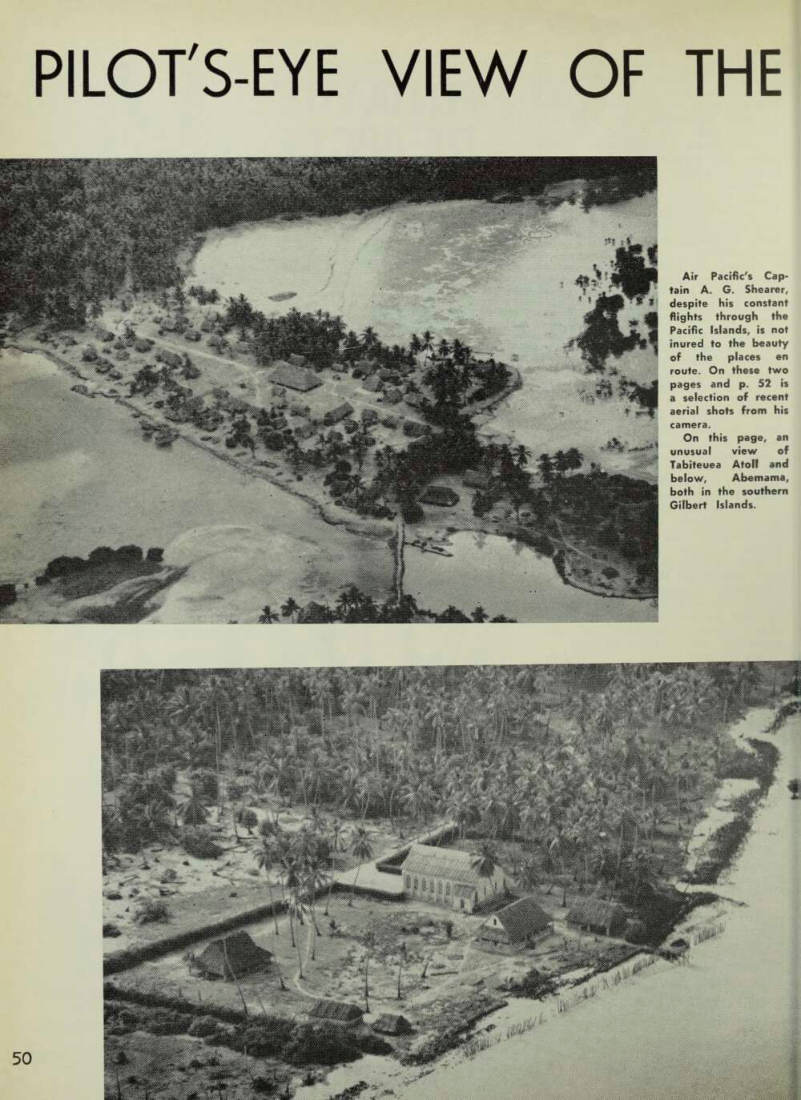
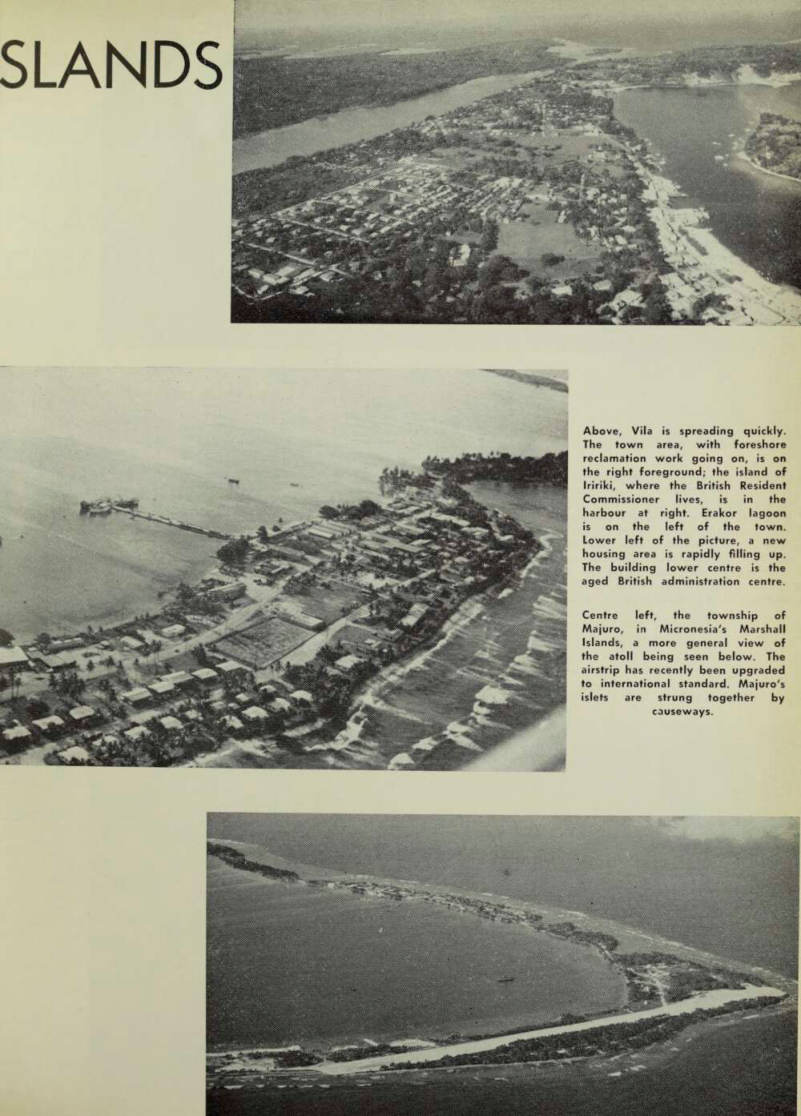
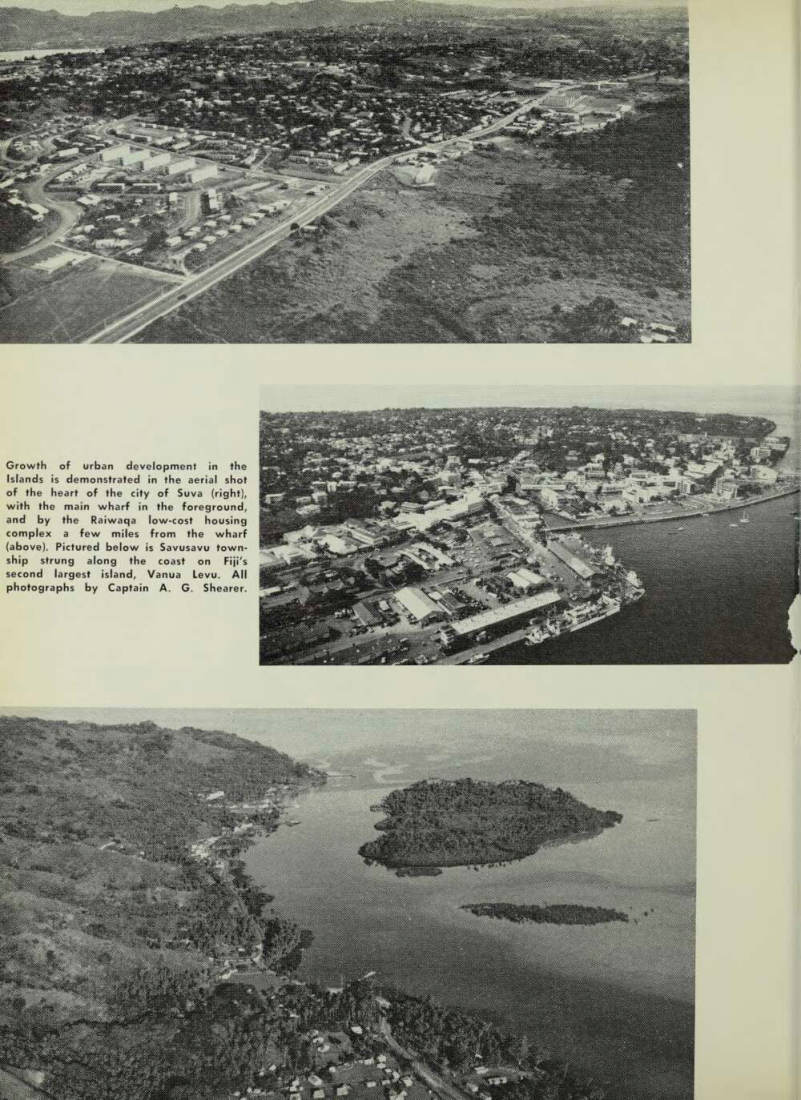
Air Pacific's Cap tain A. G. Shearer, despite his constant flights through the Pacific Islands, is not inured to the beauty of the places en route. On these two pages and p. 52 is a selection of recent aerial shots from his camera.
On this page, an unusual view of Tabiteuea Atoll and below, Abemama, both in the southern Gilbert Islands.
Above, Vila is spreading quickly.
The town area, with foreshore reclamation work going on, is on the right foreground; the island of Iririki, where the British Resident Commissioner lives, is in the harbour at right. Erakor lagoon is on the left of the town.
Lower left of the picture, a new housing area is rapidly filling up.
The building lower centre is the aged British administration centre.
Centre left, the township of Majuro, in Micronesia's Marshall Islands, a more general view of the atoll being seen below. The airstrip has recently been upgraded to international standard. Majuro's islets are strung together by causeways.
Growth of urban development in the Islands is demonstrated in the aerial shot of the heart of the city of Suva (right), with the main wharf in the foreground, and by the Raiwaqa low-cost housing complex a few miles from the wharf (above). Pictured below is Savusavu town ship strung along the coast on Fiji's second largest island, Vanua Levu. All photographs by Captain A. G. Shearer.
Advertisements & other items, p. 53 (1 item)
Slands
Islands
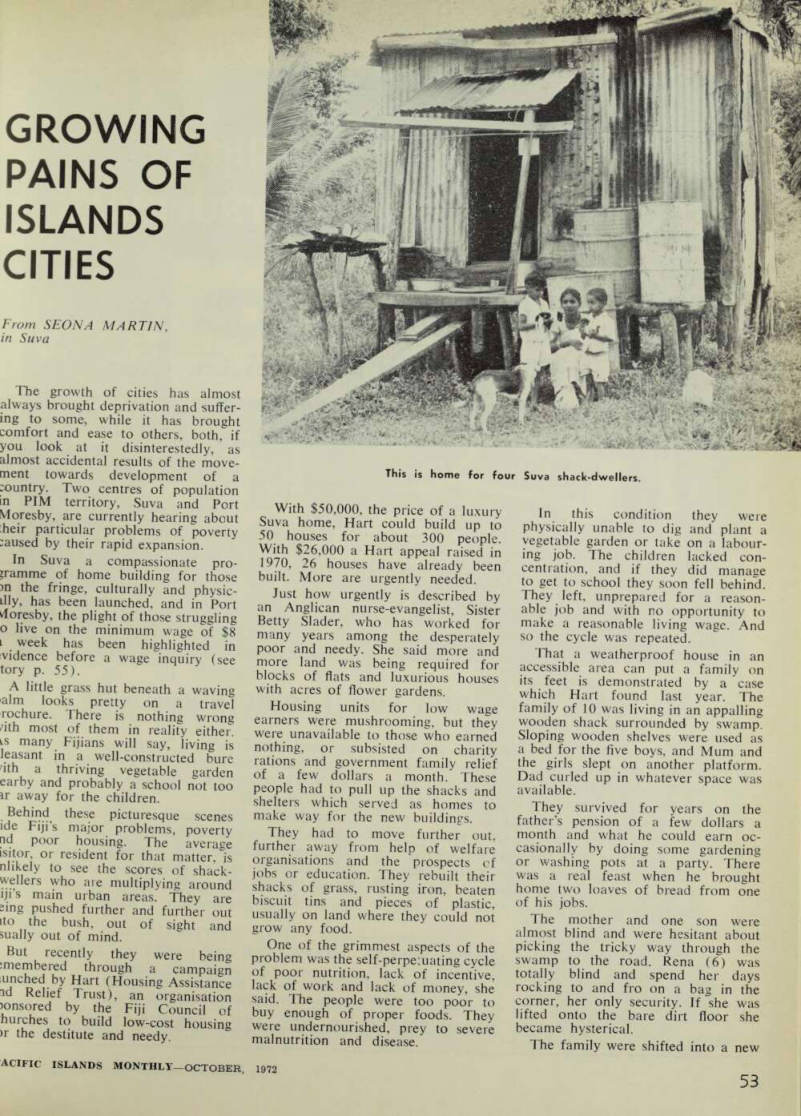

Growing
Pains Of
Cities
From Seona Martin,
in Suva
The growth of cities has almost always brought deprivation and suffer ing to some, while it has brought comfort and ease to others, both, if you look at it disinterestedly, as almost accidental results of the move ment towards development of a country. Two centres of population in PIM territory, Suva and Port Moresby, are currently hearing about Jieir particular problems of poverty caused by their rapid expansion.
In Suva a compassionate pro gramme of home building for those m the fringe, culturally and physic illy, has been launched, and in Port Moresby, the plight of those struggling 0 live on the minimum wage of $8 1 week has been highlighted in vidence before a wage inquiry (see tory p. 55).
A little grass hut beneath a waving aim looks pretty on a travel rochure. There is nothing wrong dth most of them in reality either, is many Fijians will say, living is leasant in a well-constructed bure dth a thriving vegetable garden earby and probably a school not too it away for the children.
Behind these picturesque scenes ide Fiji s major problems, poverty pd poor housing. The average isitor, or resident for that matter, is nlikely to see the scores of shack wellers who are multiplying around iji’s main urban areas. They are cing pushed further and further out ito the bush, out of sight and sually out of mind.
But recently they were being :membered through a campaign lunched by Hart (Housing Assistance id Relief Trust), an organisation jonsored by the Fiji Council of hurches to build low-cost housing )r the destitute and needy.
With $50,000, the price of a luxury Suva home, Hart could build up to 50 houses for about 300 people.
With $26,000 a Hart appeal raised in 1970, 26 houses have already been built. More are urgently needed.
Just how urgently is described by an Anglican nurse-evangelist, Sister Betty Slader, who has worked for many years among the desperately poor and needy. She said more and more land was being required for blocks of flats and luxurious houses with acres of flower gardens.
Housing units for low wage earners were mushrooming, but they were unavailable to those who earned nothing, or subsisted on charity rations and government family relief of a few dollars a month. These people had to pull up the shacks and shelters which served as homes to make way for the new buildings.
They had to move further out, further away from help of welfare organisations and the prospects of jobs or education. They rebuilt their shacks of grass, rusting iron, beaten biscuit tins and pieces of plastic, usually on land where they could not grow any food.
One of the grimmest aspects of the problem was the self-perpe:uating cycle of poor nutrition, lack of incentive, lack of work and lack of money, she said. The people were too poor to buy enough of proper foods. They were undernourished, prey to severe malnutrition and disease.
In this condition they were physically unable to dig and plant a vegetable garden or take on a labour ing job. The children lacked con centration, and if they did manage to get to school they soon fell behind.
They left, unprepared for a reason able job and with no opportunity to make a reasonable living wage. And so the cycle was repeated.
That a weatherproof house in an accessible area can put a family on its feet is demonstrated by a case which Hart found last year. The family of 10 was living in an appalling wooden shack surrounded by swamp.
Sloping wooden shelves were used as a bed for the five boys, and Mum and the girls slept on another platform.
Dad curled up in whatever space was available.
They survived for years on the father’s pension of a few dollars a month and what he could earn oc casionally by doing some gardening or washing pots at a party. There was a real feast when he brought home two loaves of bread from one of his jobs.
The mother and one son were almost blind and were hesitant about picking the tricky way through the swamp to the road. Rena (6) was totally blind and spend her days rocking to and fro on a bag in the corner, her only security. If she was lifted onto the bare dirt floor she became hysterical.
The family were shifted into a new
This is home for four Suva shack-dwellers.
concretc-block house in a low cost settlement and a new way of life began. Sister Slader could reach them with rations and medical care.
A group of bank wives helped furnish the home and put up bright curtains.
Arrangements were made for the boys to go to school, one with the prospect of a job later this year. Dad found more gardening work to be done in the more populated area.
Best of all, Rena could go to the new school for intellectually handi capped children several miles away.
She is now walking with confidence and beginning to use her sense of touch.
Meanwhile, Sister Slader keeps un covering cases just as pitiful which need a new start just as badly. Pan Kuar, for example, who trudges many weary miles up and down steep gullies to get her weekly charity rations for a family of six—five cups of sharps, three cups of sugar, five cups of milk powder, two cups of dhall, three cups of rice and two small tins of fish.
Her husband is sick and cannot work, the family has no income at all and the children do not go to school. There is only one bed in their tiny grass shack patched with plastic.
Or there is Janki, her two young
sons and chronically ill and debilitated husband who live in a tiny tumble down iron shack which floods when it rains.
The one bed in the house is for her husband. She and her children sleep on the floor on sacks. She walks
11 miles for her weekly charity rations and $4.50 monthly Government family relief.
This is the plight of hundreds. At the end of August the appeal had raised $ll,OOO in Suva—enough for 11 houses.
Advertisements & other items, pp. 55-56 (2 items)
53
ACIFIC ISLANDS MONTHLY—OCTOBER, 1972
when it carries this trademark
It costs a little more
D U R R H a* r H t &
jjg
a I Lv 20 years from now you’ll understand why!
In this age of planned redundancy, too few products are built to last. Exceptions, however, do exist. Over the past 50 years, Wild Heerbrugg has developed a range of optical and mechanical instruments whose superior precision and absolute accuracy have withstood the test of time under the most arduous conditions . . . from the frozen wastes of Antarctica to deep in space. This unique degree of precision and reliability is backed in Australia by fully equipped service centres staffed by Swisstrained specialists—together with all necessary parts and accessories to maintain a lifetime of unimpaired accuracy.
The range of Wild instruments includes microscopes, theodolites, tachometers, levelling instruments, distance measuring equipment, photogrammetric equipment and stainless steel drawing instruments —all covered by long term manufacturer’s guarantees.
WH
WILD (AUSTRALIA) PTY. LTD.
45 Epping Road, North Ryde, N.S.W. 11 Buchanan Street, West End, Brisbane, Old. 5 Errol Street, East Prahran, Victoria.
BRIAN BELL & CO. PTY. LTD., BOROKO, T.P.N.G.
Poverty in Port Moresby
Papua New Guinea has its poverty problems too with the burgeoning metropolis of Port Moresby, according to MHA Miss Josephine Abaijah. She should know what she’s talking about— she was formerly principal of Port Moresby’s Institute of Health Edu cation, and has studied nutrition education in India and South-East Asia .
Giving evidence before a Mini mum Wages Board hearing of a union claim for a rise in the city’s minimum wage of $8 per week, Miss Abaijah said that malnourish ment in young children in poor family settlements in Port Moresby was comparable with what she had seen in poor villages in India.
She quoted a local study which
showed widespread susceptibility to disease and deficiency among small children who were suffering from some degree of starvation.
It was impossible, she concluded, for a family to be properly nou rished, and to pay for other essen tials like clothes, rent, light, trans port, school and hospital fees on an income of much below $2O a week. “A family on $8 to $l2 a week will have some of its mem bers deprived and starving,” Miss Abaijah said.
“If the economy cannot sup port a general urban minimum wage of $2O, society must find some other method of caring for its citizens who are now starving and suffering.”
Advertisements & other items, pp. 57-60 (4 items)
For
RUM
at its best... say
OVERPROOF AND UNDERPROOF
In 5 oz. and 13 oz. flasks and 26 oz. and 40 oz. bottles.
BLENDED AND BOTTLED BY JOHN WALKER & SONS LIMITED. zzzzzzZzzzz
'l'S*
sh4W' /& &4jrtSts amdfy &Mmtm^
WS^**ts8 N !
/S&o^sa£
,’£-$O2/ i-iyU^As
ffark&r 75<xetyt*&&>
jr>
'£o &&c*~/* A" ? -~yA~ ‘•~*'''yc^
j&W Atuit’
just dial a different angle until the nib position is exactly how you want it.
Your fingers rest in the curved grip of a Parker 75, so you write relaxed.
Fill up from an ink bottle, or load with a special Parker cartridge. It has a 'tap tank in reserve, for up to 700 more words after you think your ink's run out!
Every Parker 75 passes 792 inspections before you see it. Sterling quality, so it’s sterling silver. Or rolled gold, or Vermeil which is 14 ct gold on silver.
+PARKER
|.• Maker of the world's; mpsUwanJed.peris:
From the
Islands Press
The answer given to a rhetorical question asked editorially in the Micronitor, as to whether the average islander was getting more money out of the greatly expanded US expenditure in Micronesia: No. That money is being spent for capital improvements and expatriates' salaries and fantastic transportation costs which are seditiously tricking the people into believing that if they want the good life they have to pay for it, and that in order to pay for it they must be tied to the US like an infant on a tit.
Letter from "Old Timer" in the Norfolk Islander: Cries for “independence for Norfolk Island” are increasing in volume, in fact, they’re becoming hysterical Could it be that some people on the island are afraid of taxation? Or is there, in this small community, some deeply-rooted dissatisfaction with the Australian Government? However, the Australian Government does not seem to be noticeably grinding the faces of the poor Norfolk Island peasantry at the present time. And judging by the numbers of new settlers who are winging their joyous way to our shores each month, the view of Norfolk Island, from the outside ooking in, must be positively irresistible. c rom a Brisbane (Queensland) report )y AAR in the Fiji Times: Fwo men attacked and robbed a Fiji visitor iere on Thursday night and he said later he had second thoughts about extending his holiday Mr Panin Prosdam (29) said: This would not have happened in Fiji. We ust don’t have this kind of thing.” rom the Fiji Times: rwo youths blackened their faces with soot, et up roadblocks, waylaid two people and bashed md robbed them, Suva Court heard. Onoriko Porovugalei and Jope Rakautoga, both 19, Colo-i-Suva, pleaded guilty on Monday to wo charges of robbery with violence at last Saturday. They were sent o gaol for three years. rom a New Hebrides radio news report: he Agriculture Department says it wants to reassure eople that rat poison which has been distributed round the roup ,s quite safe to use . . . The bait does not taste nice to hildren or other animals, but it will not make them sick.
Extract from a report in the Tonga Chronicle: Tobacco farming makes more money than other forms of growing says a retired
Free Wesleyan Church minister, Rev Siosifa
Lokotui (82) of Haveluloto. Mr Lokotui and his neighbours Sione Kelo (35) and Koliniasi Palu (41) have teamed up in planting more than 10,000 young tobacco plants.
“Tobacco farming is the ideal farming for people of my age. It's easy, unlike banana and vegetables that need so many labourers to look after it,” Mr Lokotui said.
From an interview in the Micronitor: Development, as it is presently by the rip-off artists and indigenous elitists, would mean nothing more than the physical and psychological disruption of all that is beautiful and meaningful in Micronesia today.
In Majuro alone, where the up-to-date machinery for the conversion of "backward" Micronesia into the goosestepping 20th Century is working 24 hours a day, there have been three major suicides of young men in the last three months.
Extract from a letter by B. T. Bataua in the GEI Colony Information Notes about a film show at the Bonriki Maneaba which ended suddenly when the film, which had begun in the middle of the reel, caught fire: The audience, who after a long period of waiting for the machine to function again, started getting up one by one, claiming their money back. By this time the crowd became so thick that one could hardly push his/her way through. Hands grabbed the box of money from the girl who collected the fees, so some were unable to have their money back.
The result was the screen was stormed with stones which caused such a frightful scene in the place.
From a New Hebrides radio news report: An unusual snake has been found at Point Cross, Pentecost. Assessor Martin reports seeing a large brown snake, about six feet long with two tails. He says the tail was split down the middle from about half-way along the snake's body ... A young chicken killed last week (on Paama) was found to have one wing only . .
Previously (on Paama) a chicken was found to have three legs and two young coconuts, only a foot from the ground, were already bearing fruit.
From “Christian Comment" by the Rev D. J. Inglis writing in the Samoa Times on the increase in import duty: ... We are indeed back in the time of Amos when he prophetically denounced the selling of the poor for a pair of shoes. Today we sell our poor in Samoa for the vast last increase of road, water, fono house, electricity, aeroplanes and so forth. But their stomachs are beginning to go empty. It is not that I am against taxes, far from if, but I am against exploiting the poor. This is not Christian. It is not just. It is not human . . .
57
*ACIFIC ISLANDS MONTHLY—OCTOBER, 1972
Brockhoff
taste the rea ' pss
The freshest, nchest ta 0 f rea' rasp » crU ’ n chy sandwiched ke spar'dir>9 with sugar a a ckho ff Raspberry svs/ee tVy, I to V° cottee or tea. 1 anvf'h 16^'
MSS
SHOP
8 OZ.NU
3 a u There’s value, variety and quality in
BROCKHOFF BISCUITS
5546/8x6 1 /4
Letters
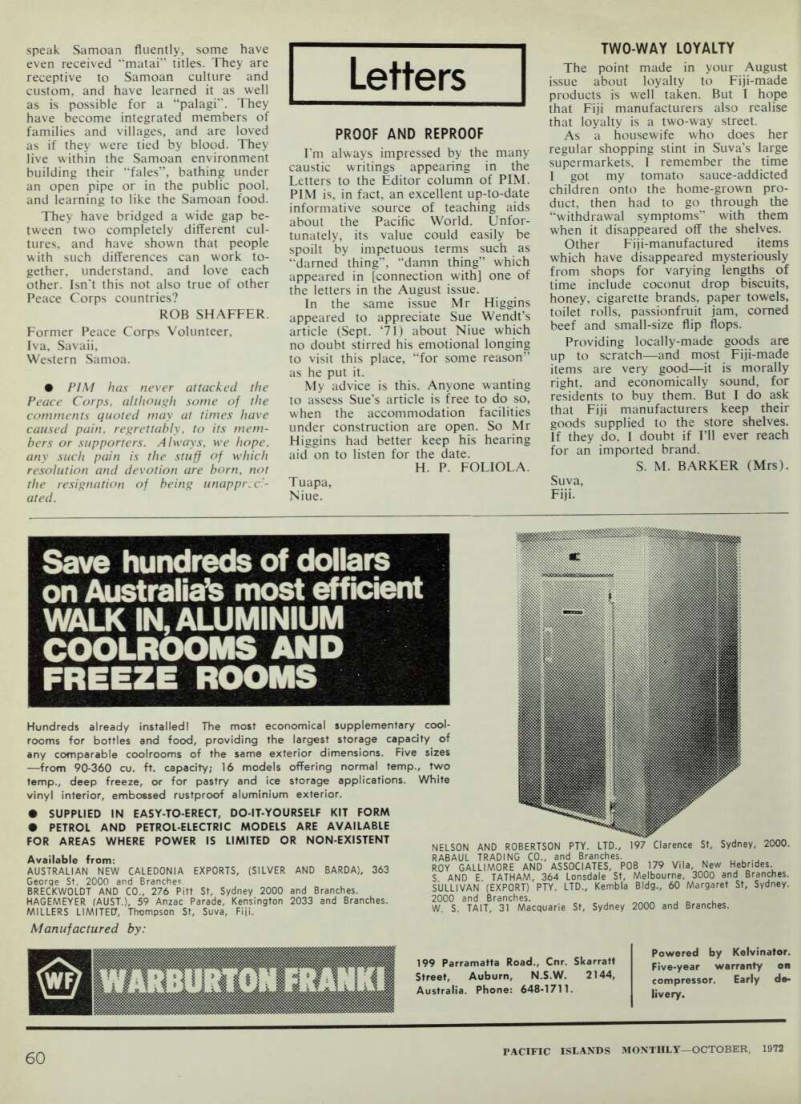
Achievements
Of The
Peace Corps
I would like to call your attention to a paragraph under the article “About Samoa With Sympathy” (PIM June, p. 51), The sub-headline at the top of the column reads “Peace Corps failings” and the article reads as follows: “I asked him about education. (Former Prime Minister Fiame Mata’afa). He was not happy about the contribution of Peace Corps Volunteers, too many of whom were unqualified for the positions they occupied. It would be better to stick to New Zealand for the source of teachers Western Samoa needed, and to maintain the professional standards they could offer.”
The Peace Corps, originally pro posed by Senator Hubert Humphrey, and implemented by President John F. Kennedy, has undergone a steady and constant change since its incep tion nearly ten years ago. Its idea was revolutionary, its first volunteers were pioneers. Today, under the progres sive leadership of Joseph Blatchford, Peace Corps is not the same organi sation it was at its birth. Responding to new problems for an increasing number of new countries, the Peace Corps must, and is, reforming its goals to keep up with the ever changing wishes of host countries.
As is natural for an organisation of this kind, the Peace Corps has come under a lot of criticism both in the United States as well as abroad.
Much of the criticism has been con structive and helpful to this organisa tion, which has tried to improve on past mistakes and set its goals pro perly for the future. Some of the criticism has not been constructive, but only one-sided, degrading, and political.
The Peace Corps will have been in Western Samoa five years this Novem ber. It has been in other areas of the Pacific a few years longer. In Western Samoa, the Peace Corps has not been immune to attack, taking occasional rebuffs from the Samoa Times or the Pacific Islands Monthly, and rightly so, its record is not one of perfection.
If the Peace Corps of Senator Hum phrey and President Kennedy was an experiment, this experiment was mag nified considerably with the arrival of Group I in Western Samoa in Novem-
Letters
ber, 1967. I doubt if there were many people in the country at that time who knew what Peace Corps was doing there, or what it was supposed to do. It was with this shaky and un certain situation that Peace Corps began in Samoa.
Five years have passed. Peace Corps programme have come and gone, yet the Peace Corps remains.
Why? If this organisation is such a failure, why should the Government of Western Samoa waste its time?
The answer is simple, the Peace Corps in Western Samoa has been success ful and continues to be. Its successes far outweigh its failures.
Having been involved in a number of programmes, such as fisheries, treasury, economic development, architecture, agriculture, turtle re search, and education, the Peace Corps is planning for the arrival of two new groups within the next nine months.
It is education, however, where the Peace Corps has made incredible strides to make education more rele vant to the Samoan child, both in the rural villages, and in the urban areas.
What Peace Corps teachers found in the Education Department in 1968 was an irrelevant and stagnant situa tion. No thought was given to the differences between the village student and his counterpart in Apia. All students were required to take the same year-end final examination in Form II to qualify for a higher edu cation. This test, printed in New Zealand or Australia, dealt with sub jects such as parking meters and skyscrapers, and was concerned only with math and English. The highest scores in the country often showed a percentage of less than 20 per cent.
The “unqualified” Americans set out to change these and other dis crepancies within the department.
Under the tireless efforts of John Ryding, the UN science advisor, and with the co-operation of UNESCO, which provided science equipment, the Department of Education launched a new science and math programme which eventually in cluded social studies. This programme was possible only with the presence of the Peace Corps.
With the arrival of Peace Corps volunteer Dr. Jerry Hanna, the test ing system underwent a thorough re vamping. Working ceaselessly for three years, Dr. Hanna proceeded to provide a system of tests, testing, dis
tribution and correction that will surely be with the Education Depart ment for years to come.
If I may, I would like to take the efforts of one Peace Corps group to demonstrate what a bunch of “un professional” volunteers can do.
Group 111, consisting of 12 volunteers, arrived in Samoa in January, 1969.
All had BA or BS degrees from American universities. Five had done post-graduate work, while one held an MA in physics, another in math.
Four also had previous teaching ex perience in the United States.
Two years later, at the end of their regular two year hitch this is what had transpired; Five volunteers taught in Savaii, five in or around Apia. One volunteer worked in Treasury, while one returned home after about a year. The five Savaii volunteers had a record high success in initiating and implementing the fledgling science programme. The Savaii students achieved higher scores than ever be fore in competing with the students in Apia. The Apian teachers devised and expanded new programmes in scheduling, science, math, and coach ing. Six out of 11 volunteers signed on to stay for a third year, five in Western Samoa, one moving to Thai land. Two returned to Western Samoa as Peace Corps training staff, and two returned home.
One of the Savaii teachers remained in his village for the third year con tinuing to build on his outstanding math programme, while the other transferred to TTC in Apia to begin a new art programme. Following this he went to Fiji, and as a volunteer, worked as Assistant Director of the South Pacific Arts Festival in Fiji.
On the level of personal relationships, these volunteers were also responsive to local needs. Two stocked their school libraries with books from the United States, four taught school after hours for local villagers, one built a new house for his Samoan family, another sent his Samoan “sister” to the United States for an education.
These were the efforts of 11 Peace Corps volunteers of one Peace Corps group, but it doesn’t stop there. What about the architects who created the new “fale fono” in Apia, the excel lent teachers at Samoa College, Avele, St Joseph’s and the coaches at Chanel, and the members of a Samoan sing ing group, whose recordings, aired on 2AP, are sung by Samoan children throughout the country. If these volunteers were not successful on a “professional” basis, couldn’t they at least be counted for what they’ve done in human relations?
Many volunteers have learned to
speak Samoan fluently, some have even received “matai” titles. They are receptive to Samoan culture and custom, and have learned it as well as is possible for a “palagi”. They have become integrated members of families and villages, and are loved as if they were tied by blood. They live within the Samoan environment building their “fales”, bathing under an open pipe or in the public pool, and learning to like the Samoan food.
They have bridged a wide gap be tween two completely different cul tures, and have shown that people with such differences can work to gether, understand, and love each other. Isn’t this not also true of other Peace Corps countries?
Rob Shaffer.
Former Peace Corps Volunteer, Iva, Savaii, Western Samoa. • PIM has never attacked the Peace Corps, although some of the comments quoted may at times have caused pain, regrettably, to its mem bers or supporters. Always, we hope, any such pain is the stuff of which resolution and devotion are born, not the resignation of being unappreci ated.
Letters
Proof And Reproof
I'm always impressed by the many caustic writings appearing in the Letters to the Editor column of PIM.
PIM is, in fact, an excellent up-to-date informative source of teaching aids about the Pacific World. Unfor tunately, its value could easily be spoilt by impetuous terms such as “darned thing”, “damn thing” which appeared in [connection with] one of the letters in the August issue.
In the same issue Mr Higgins appeared to appreciate Sue Wendt’s article (Sept. ‘7l) about Niue which no doubt stirred his emotional longing to visit this place, “for some reason” as he put it.
My advice is this. Anyone wanting to assess Sue’s article is free to do so, when the accommodation facilities under construction are open. So Mr Higgins had better keep his hearing aid on to listen for the date.
H. P. Foliola.
Tuapa, Niue.
Two-Way Loyalty
The point made in your August issue about loyalty to Fiji-made products is well taken. But I hope that Fiji manufacturers also realise that loyalty is a two-way street.
As a housewife who does her regular shopping stint in Suva’s large supermarkets, I remember the time I got my tomato sauce-addicted children onto the home-grown pro duct, then had to go through the “withdrawal symptoms” with them when it disappeared off the shelves.
Other Fiji-manufactured items which have disappeared mysteriously from shops for varying lengths of time include coconut drop biscuits, honey, cigarette brands, paper towels, toilet rolls, passionfruit jam, corned beef and small-size flip flops.
Providing locally-made goods are up to scratch—and most Fiji-made items are very good—it is morally right, and economically sound, for residents to buy them. But I do ask that Fiji manufacturers keep their goods supplied to the store shelves.
If they do, I doubt if I’ll ever reach for an imported brand.
S. M. Barker (Mrs).
Suva, Fiji.
Advertisements & other items, pp. 62-70 (1 item)
Coolrooms And
Save hundreds of dollars
on Australians most efficient
WALK IN, ALUMINIUM
COOLROOMS AND
FREEZE ROOMS
Hundreds already installed! The most economical supplementary coolrooms for bottles and food, providing the largest storage capacity of any comparable coolrooms of the same exterior dimensions. Five sizes —from 90-360 cu. ft. capacity; 16 models offering normal temp., two temp., deep freeze, or for pastry and ice storage applications. White vinyl interior, embossed rustproof aluminium exterior. • SUPPLIED IN EASY-TO-ERECT, DO-IT-YOURSELF KIT FORM • PETROL AND PETROL-ELECTRIC MODELS ARE AVAILABLE FOR AREAS WHERE POWER IS LIMITED OR NON-EXISTENT Available from; AUSTRALIAN NEW CALEDONIA EXPORTS, (SILVER AND BARDA), 363 George St, 2000 and Branches.
BRECKWOLDT AND CO., 276 Pitt St, Sydney 2000 and Branches.
HAGEMEYER (AUST.), 59 Anzac Parade, Kensington 2033 and Branches.
MILLERS LIMITED, Thompson St, Suva, Fiji.
Manufactured by:
NELSON AND ROBERTSON PTY. LTD., 197 Clarence St, Sydney, 2000, RABAUL TRADING CO., and Branches.
ROY GALLIMORE AND ASSOCIATES, POB 179 Vila, New Hebrides.
S AND E. TATHAM, 364 Lonsdale St, Melbourne, 3000 and Branches.
SULLIVAN (EXPORT) PTY. LTD., Kembla Bldg., 60 Margaret St, Sydney. 2000 and Branches. , „ .
W. S. TAIT, 31 Macquarie St, Sydney 2000 and Branches.
WARBURTOHFRAHKI
199 Parramatta Road., Cnr. Skarratt Street, Auburn, N.S.W. 2144, Australia. Phone: 648-1711.
Powered by Kelvinator.
Five-year warranty on compressor. Early delivery.
Come up to Kool
for extra freshness
£ w* r ■am. % 1
KQDL
r» • -ii 5% n * * T ✓ A 7 -i, , c Z>r - K x- K U597-8/71
the most important ingredient
BREAD FLOURS:
CAKE FLOURS:
BISCUIT FLOURS:
SPECIALITY FLOURS:
• MAINTOP —high protein bread flour • ANCHOR—bakers flour • 50/50 MEAL—brown bread • MEDIUM —cake and pastry • SPONGE —sponge cakes • SPECIAL CAKE —madeira and cup cakes • STRONG —cracker biscuits • MEDIUM —Shortbreads • SOFT —sweet biscuits • RYE flour • RYE meal • KIBBLED RYE • SHARPS—roti and chapati flour • 100% STONE GROUND
WHOLEMEAL
GILLESPIE BROS. PTY. LTD.
HEAD OFFICE: BRISBANE OFFICE:
52 UNION ST., PYRMONT, SYDNEY, N.S.W. CABLE ADDRESS: ALBION, BRISBANE, QUEENSLAND. (G.P.O. BOX 2518, SYDNEY, 2001.) "GILLESPIE", (P.O. BOX 8, ALBION, BRISBANE, 4010.) PHONE: 660-4933. SYDNEY AND BRISBANE. PHONE: 6-1121.
H Y s E / R m * • * * *« »* •»
If you drove a lift truck,
youd choose Hyster
Hyster lift trucks are people’s trucks. We build them easy to handle, easy to live with. Comfortable seats.
Full circle visibility. Plenty of leg and foot room. Humanengineered features. Naturally positioned controls.
We also consider managing directors, company secretaries and maintenance men. Find out now how Hyster trucks will reduce your materials handling costs. Ask your Hyster dealer for a demonstration. He’s listed in the Pink Pages. Or write to Hyster Australia Pty. Ltd., Ashford Avenue, Milperra, N.S.W. 2214.
HYSTER AUSTRALIA PTY. LTD.
‘Hyster’ and the Company symbol are trademarks.
HR29.FP2
r 0 M tWt * 9 t . „ ft m sc DATSUN zoomed through the 3*700 kilometer rally over icy roads* blinding blizzards and Alpine peaks to capture third place over-all! This year’s event was so demanding that only 52 of the 264 entries were able to finish. But Nissan technology propelled DATSUN securely to second place in its engine class. r * Engineering and technology is what a motorcar about. With satellite launching experiences behincHt* Nissan offers the*mostlntegrated design in a motorcar you can buy toflay.
Rigid quality control. Extensive Pmctucteof NISSAN -: "
I
JBI
production tests: 6rh And ingenious stylingand functional Th< a few of the many i motorists in oyef more year aft* year^ Get on* the*winning side. Get yourselfitaside a DATSUN sc
Findout
where to test-drive your rally winner at the
DATSUN distributor nearest you!
Full line of DATSUN’s from pickups to luxury sedans.
Port Moresby, Lae, Madang, Mt. Hagen
BOROKO MOTORS LTD.
Rabaul
RABAUL GARAGE LTD.
Suva, Lautoka
SUVA MOTORS LTD.
Norfolk
SIRIUS SERVICE STATION
Pago Pago
B.F. KNEUBUHL
Tahiti
SOCIETE POLYNESIENNE DE DISTRIBUTION
Apia
MORRIS HEDSTROM LTD.
Noumea
E.D. PENTECOST
Port Vila, Santo
PENTECOST PACIFIC S.A.
Honiara
R.C. SYMES PTY. LTD.
Dili
SOCIEDADE AGRICOLA PATRIA E
TRABALHO LDA.
Nauru
JACOB ENTERPRISES
Nukualofa
RICKLEMAN BROTHERS
Saipan
J.C. TENORIO ENTERPRISES
Guam
J & G MOTORS CO., LTD.
Cook Islands
COOK ISLANDS MOTOR CENTRE LTD.
New DATSUN Pickup
New DATSUN 1808
Hardtop Product of NISSAN
The
China Navigation Company
was launched on theYangtse
ninety nine years ago
In 1873 the China Navigation Company commenced operations with two paddle steamers, the “Glengyle” and the “Tunsin,” serving the Yangtse River trade.
Today, the China Navigation Company provides
the most extensive network of cargo routes within the area bordered by Japan, Tahiti, New Zealand, Australia and the Malay Peninsula.
The two paddle steamers have been replaced
by twenty-six cargo ships.
The Company’s early dependence on the
Yangtse and the China coast for its living is marked nowadays only by the names of some of its ships . . . traditionally of those towns and provinces in China where the Company grew to
its present high standing.
The China Navigation Company—the name that has become synonymous
with experience . . .
reliability . . . speed
. . , service.
For further details and all enquiries there are Agents at the following ports: Melbourne: P. & 0. Lines of Australia Pty. Ltd.
Brisbane; Wills, Gilchrist & Sanderson Pty. Ltd.
Papua and New Guinea: Steamships Trading Co. Ltd., Port Moresby, Samarai, Lae, Madang, Rabaul, Kieta.
Wewak: Kavieng: Burns Philp (New Guinea) Ltd.
Fiji: Morris Hedstrom Ltd., Suva, Lautoka.
Western Samoa: Morris Hedstrom Ltd., Apia.
Tonga: Morris Hedstrom Ltd., Nukualofa and Vava’u.
Tahiti; Etablissements Donald, Papeete.
Japan: Swire McKinnon, Tokyo, Yokohama, Osaka, Kobe and Nagoya.
Eastern Managers: Butterfield & Swire, 9 Connaught Rd., Central, Hong Kong.
New Caledonia: Etablissements Ballande, Noumea. 8.5.1. P.: British Solomons Trading Co. Ltd., Honiara.
New Hebrides: Les Comptoirs Francais des Nouvelles-Hebrides Vila and Santo.
\CNJ SWIRE & GILCHRIST PTY. LTD.,
General Agents in Australia, 8 Spring Street, Sydney. Phone: 2 0522
THE CHINA NAVIGATION CO LTD
Member of the Swire Group SGO4I
Kenwood Delivers
Mo-R Quality In Cassettes
KX-700 Kenwood technology always keeps in pace with the state of the art in audio amplification. And the hottest things on the cassette market today are the Dolby System and Chromium Dioxide tape. Dolby dramatically reduces hiss and other noise inherent in tape recordings while chrome tape promises phenomenal improvements in performance.
The new Kenwood KX-700 Cassette Deck not only incorporates a Dolby unit but is also equipped with Super Ferrite Head (SFH) specifically designed to handle chrome tapes.
These features boost quality characteristics of cassette recordings to reel-to-reel level.
The KX-700 has a Tape Selector which enables you to get maximum performance from regular, noiseless or chrome tape. * Dolby is a trademark of Dolby Laboratories, Inc.
Im 1 r the sound approach to quality
® KENWOOD
r minute information, write to P-SECTION, TRIO ELECTRONICS, INC. 6-5, 1-chome, Shibuya, Shibuya-ku, Tokyo, Japan
Mazda 808
O.H.Cam
Power
Who says family motoring can’t be fun?
Meet the Mazda 808 sedan.
It is lavish glamour you can afford.
Along with its fine finish, you get high back front bucket seats that lay way back. And women, children and men appreciate the four doors with two stage checkers.
Plus the door locks are child-proof.
You also get a lockable gas door, thick foam dash, padded sun visors, door armrests, beautifully recessed instruments and more.
You even get front disc brakes. And the body is of semimonocoque construction with subframes designed for safe controlled-collapse under impact.
What’s more, the spare fits under the trunk so your luggage fits snugly.
Now load up and go. You hug the road with its wide track. And you take the lumps out of bumps thanks to its coil suspension up front and bias-mounted gas-filled shock absorbers in the rear.
And the center console with its 4-speed floor shift gives you more than crafty craftsmanship.
The thrifty but hefty 1300 cc overhead engine gives you the feeling of power.
There you have it. Power, safety, comfortable ride and all the things that make driving fun . . . because our engineers are family men, too.
And if you are not a family man, you can also get a sporty coupe with all of the above.
But that is another story.
Meet the Mazda 808 sedan first.
MMAZDA
Toyo Kogyo Co , Ltd., Hiroshima. Japan American Samoa/MAX HALECK, INC. PagoPago, American Samoa 96920 Fiji Islands/NIRANJANS AUTOPORT LTD. G.P.O Box 450. Suva Tel: 22691 New Caledonia/SOCIETE RIVIERE ET BERNANOS 41 Rue de Sebastopol. Noumea New Guinea/PNG MOTORS LTD. P 0 Box 1 394. Boroko. Papua Tel: 55788 New Zealand/MAZDA MOTORS OF NEW ZEALAND LIMITED Auckland Western Samoa/H. & J RETZLAFF P.O Box 195. Apia Tel 237 The trade mark MAZDA in this advertisement stands for AUTOMOBILES MAZDA as far as France and her territories are concerned.
Magazine Section
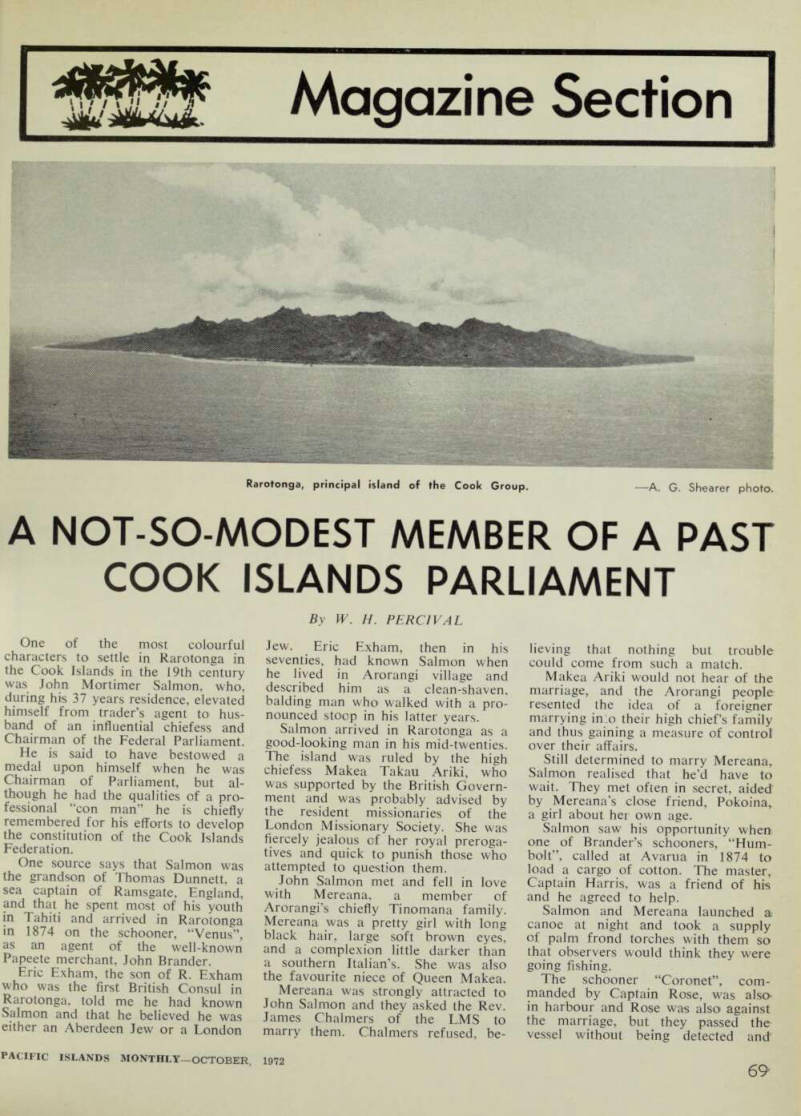

A Not-So-Modest Member Of A Past
Cook Islands Parliament
By W. H. Percival
f f th f*i mOS B colourful characters to settle in Rarotonga in S 0 ®* Is S nd f. m the c 9th cent^ry HiSnchi Mortimer Salmon who, , . m f his 37 years residence, elevated of an™ ,nfl ader t- i ag t?V 0 hus : ofairmL nf >£»£!! , ch ' ef f? s and Chairman of the Federal Parliament. have bestowed a rwi P f h T e i Wh f n ih^ arlian ?^ t ’ hut alfpf “ h d the aa h ties .°f a P r ok i*? !? an a: he 18 chiefly thnitinn* 5?°?? 1 n d T e y el ° p Fp!i C 11on of the Cook Islands * o , thp°^ a n^n e rt S f a xh that S j| mon f+ was sea J h 8 t Du nnett, a Sf P . ta i n of Ramsgate, England, L Tv?!* ent . m ® st , °f h!s youth n 1874 an< tu aTr u m Ra J? ton g, a “an nc^nt hC nf Ch tVT^ ner ' nX enus ’ p 8 J agei V the well-known Papeete merchant, John Brander. r' RamtonL th fnM tI IS \S 0I S U m Salmon an 4 uv ha ? known pfthTr a and that he T believed T he was either an Aberdeen Jew or a London
Jew. Eric Exham, then in his seventies, had known Salmon when he lived in Arorangi village and described him as a clean-shaven, balding man who walked with a pron °u n , ced stoop in his latter years.
Salmon arrived in Rarotonga as a good-looking man in his mid-twenties.
The island was ruled by the high chiefess Makea Takau Ariki, who was supported by the British Governrocnt and was probably advised by the resident missionaries of the Jr° nd ? n Missionary Society. She was fiercely jealous of her royal prerogatlves and quick to punish those who attempted to question them.
John Salmon met and fell in love with Mereana, a member of Arorangi’s chiefly Tinomana family.
Mereana was a pretty girl with long black ha,r ’ lar S e soft br own eyes, and a complexion little darker than a southern Italian’s. She was also the favourite niece of Queen Makea.
T Mereana was strongly attracted to I° hn Salmon and they asked the Rev.
James Chalmers of the LMS to marry them. Chalmers refused, be-
lieving that nothing but trouble could come from such a match Makea Ariki would not hear of the marriage, and the Arorangi people resented the idea of a foreigner marrying in o their high chiefs family and thus gaining a measure of control over their affairs.
Still determined to marry Mereana, Salmon realised that he’d have to wait. They met often in secret, aided by Mereana’s close friend, Pokoina, a girl about her own age.
Salmon saw his opportunity when one of Brander’s schooners, “Hum bolt”, called at Avarua in 1874 to load a cargo of cotton. The master, Captain Harris, was a friend of his and he agreed to help.
Salmon and Mereana launched a canoe at night and took a supply of palm frond torches with them so that observers would think they were going fishing.
The schooner “Coronet”, com manded by Captain Rose, was also in harbour and Rose was also against the marriage, but they passed the vessel without being detected and
Rarotonga, principal island of the Cook Group.
—A. G. Shearer photo.
Elopement Falls But Marriage Follows
reached the “Humbolt” which sailed for Mangaia immediately.
The elopement was discovered the following day and a furious Makea sent men off in the “Coronet” to bring the lovers back. The two schooners reached Mangaia about the same time and a boatload of men was sent over to the “Humbolt”.
“I’ll shoot any man who attempts to board my vessel,” Captain Harris warned them grimly.
But Captain Rose had an answer to that. The “Humbolt’s” cotton cargo was still lying on Avarua wharf, and the “Coronet” was the faster of the two vessels. Rose said that if Mereana was not handed over he would return to Rarotonga and burn the cotton. Knowing that Rose would carry out his threat, Harris and Salmon had to give in, and the two schooners returned to Rarotonga.
For some months after this Salmon lived in various islands including Raiatea, Flint and Mauke. He re ceived occasional letters from Mereana and sent replies by friendly schooner captains. Then he learnt that Makea was no longer opposed
to the marriage and returned to Rarotonga on the small schooner, “Atalanta”, in 1875.
Makea was away in Atiu Island visiting her consort, Ngamaru Ariki.
She sent the “Venus” from Atiu with orders to bring John Salmon and Mereana to Atiu where they would be married. Chalmers was still set against the match.
But the Rarotongans refused to let John Salmon leave. He pretended to give in to them but had himself smuggled on board hidden in a pile of mats. The vessel was searched by the suspicious islanders but Salmon was not discovered.
Still suspicious, the Rarotongans followed the “Venus” in their own schooner, “Ngamaru Ariki”, but when they arrived at Atiu Makea ordered them to leave. This they did and John Salmon and Mereana finally became man and wife.
For several years Salmon managed Brander’s store at Avatiu, a settle ment on Rarotonga’s northern coast with a small harbour used by local and overseas vessels. Then, in 1888, one of Mereana’s uncles died and she
inherited the title of Tinomana Ariki.
John Salmon had still not been accepted by the Arorangi people who described him as “the fifth wheel of the carriage”, but he used his wife’s influence to finally get one of his ideas across. This was for them to buy their own vessel and use it for trading between the Cook Islands, other island groups and New Zealand.
There were about 80 shareholders, Mereana among them. Through his contacts in Tahiti, Salmon bought a schooner of about 80 tons, “Poe”, for £405. She was a fast vessel with beautiful lines, built as a yacht by Mr Ben Chapman of Tahiti. The “Poe” arrived in Rarotonga in December, 1891, was careened on the beach, caulked and made ready for sea. She had two masts and an “iron keel”.
Salmon renamed the vessel “City of Arorangi”. The name was painted in bold letters on bow and stern, although Arorangi was no more than a village, as it is still. He began to fancy himself as a sea captain and practised navigation, taking sights on land, and having himself examined and passed as a capable navigator by local schooner skippers Harris and Emil Piltz. Then he made his first and only voyage as a ship’s
master, a voyage that almost ended in complete disaster.
He embarked 48 passengers, eight of whom were children, for a voyage to the southern Cook Islands of Mitiaro, Mauke and Mangaia. The crew consisted of a mate, supercargo, a cook and four seamen.
One informant said that soon after John Salmon went on board he became violently seasick and thereafter spent a great deal of his time in his bunk. Another informant who had also known John Salmon when he was an old man, said that on this voyage the schooner lacked a chronometer and no local charts were on board.
Providentially, the cargo included 12 pigs, six of which belonged to Mereana, and four ducks. There were also the normal ship’s stores.
The Polynesian voyagers travelled deck, taking enough food to last them for the anticipated two-day voyage. There was also a plentiful supply of drinking water, carried in Casks ' Skipper John Salmon maintained strict discipline. Every evening all hands were mustered for a religious atC'n C d e: after en he th had h e a 1 <h S 'd a th *l° attend alter he had lashed the wheel. !k° vetches were kept because
S^p^^^c^f^^^h^CoPk^s^anH 11
and Salmon followed Sfnll! i
board hk fhin Thf rlnit f.u
(maim nroit results ° f able 1 P d eat sea were P redict ’ * Un the fourth day, two days after
they should have made their first landfall, somebody dared to ask the seasick captain where they were. John Salmon, who didn’t know either, tried to bluff it °ut.
“I believe that my sextant is unreliable. It doesn’t read the same here as it did in Rarotonga. And I was 80 busy on the second night out thut I forgot to wind my watch,” he is reported to have said. He told them that they would reach land by following the seabirds which returned to nearby land at dusk. And from then on they followed the birds.
The air grew colder as they proceeded further south. The food gave out a nd the ducks were killed and eaten with the ship’s rice. By the eud of the second week two of the P*B S had been eaten and two more were killed a few days later.
There was angry and mutinous talk among the shivering islanders and Salmon, sick at heart as well as physically, had to reverse his course.
Three weeks and four days after their departure from Rarotonga, they sighted land. By a freak of fate it proved to be Rarotonga. fi The lt news s Pr ea d faster than a bush fire. It was decided at indignation meetings that John Salmon would no longer addressed as “ captain ”- The schooner was renamed “Maungaroa ”’ by which name she is commonl V remembered today. The Banks’
Diaries show that the “Maungaroa” was used as an interisland trader in the Cooks, also making calls at
Auckland, Tahiti, Niue and Rurutu between 1891 and 1903, and that sometimes she was chartered by the Cook Islands Trading Company, John Salmon and Tinomana Mere u^ a continued to live in Arorangi village. They adopted a son of Tahitian-Chinese parentage, named Taripo Ah Foo, who arrived in Raro tonga from Tahiti in 1895 at about the age of 20. Taripo later owned ai *d operated a store and bakery at Avatiu.
When I interviewed him several years ago, old Taripo was aged about 90 > but was still mentally alert, with go< ? d sight and hearing. When he ?J r l ved J- n , said Taripo, i^ akea , T ? kau was the ruling Queen of Rarotonga, Rev. Hutchms as T resident missionary, and J -. Moss was the British Resident replaced by Resident ►mmissionerj. a time Tan P° hyed with a oMhe A^a™?dttric'fca'lled Maraj l st orVand bakery nextdoor to^on^d
Cook w£S!
branch at Avatiu Not lons after completing his business premises and residence a hurricane destroyed the lot He married Tauvira of the Uriarau family, by whom he had five children, and some of their descen dants are well known in Rarotonga today. * About 1898 John Salmon conceived the idea of using the limes that grew prolifically on his wife’s land to start
Watered Lime Juke Disaster
a lime juice industry. He talked Mereana into the idea and sent a sample cask of Rarotonga lime juice to San Francisco. He received a highly satisfactory report on the pro duct and a substantial order for more.
He plunged into his new project with enthusiasm and by July, 1898, he was being described in Rarotonga’s only newspaper, “loi Karanga”, as “J. M. Salmon Lime juice manu facturer and Manufacturer’s Agent”.
By this time he had also become the “Chairman of the Cook Islands Parliament”.
An editorial in the March 17, 1900, issue of “loi Karanga”, owned and printed by Oscar Owen, said: “The lime juice trade is being boosted of late and several new machine presses are coming in. The old system was to tread limes out with bare feet in canoes, etc. CITC (Cook Islands Trading Company) has recently made a contract to take the total output of machine-made lime juice from Arorangi—possibly 75 per cent, of the total produced in Rarotonga . . . under the personal supervision of Mr J. M. Salmon, and the limes are the property of his wife.”
Salmon wrote to a large carriage company in California saying that he had been “instructed by Her Majesty, Queen Tinomana, to request that 11 buggies be forwarded to her through the Rarotonga branch of Donald and Edenborough”. He stipulated that the invoices be sent with the buggies and that the invoices would be sent to the firm’s head office in Auckland, where they would be paid.
In due course, the carriages arrived and were assembled in Rarotonga, and one each was presented to the leading chiefs of the island. The buggies were the latest models, two seaters with rubber-tyred wheels, candle-burning side lanterns and lace curtains.
However, Salmon’s newly - won prosperity came to a sudden end when his Californian clients dis covered that many of the casks of supposed lime juice contained nothing but salt water.
Donald and Edenborough had to pay for the carriages, nearly £7OO worth—and they never succeeded in recovering the money from Salmon.
Tinomana Mereana seems to have been a devoted wife, for she con tinued to live with Salmon for the
remainder of her life, in Arorangi village.
Charles Wells Banks, a contempo rary of Salmon, who lived in Raro tonga after reputedly stealing more than $20,000 from the Wells, Fargo Company in the United States (PIM, Feb., 1971, p. 71), made a few references to Salmon in a diary he kept.
On September 23, 1900, Banks wrote that he was “surprised at Salmon’s debts to natives”. On November 11, 1903, he noted that Tinomana and Salmon visited the “store and spent about £1 in after noon”. (This would have been Donald and Edenborough’s store at Avatiu where Banks was employed as accountant.) Salmon is also mentioned in “Rt.
Hon. R. J. Seddon’s Visit to the South Sea Islands” (Wellington, 1900). It is there stated that Seddon’s party passed some “long well-kept streets (in Arorangi) on which pleasant homes abutted” until they came to “the residence of Mr.
Salmon, Speaker of the local Parlia ment, and . . . Tinomana, the high born lady who had assisted to receive us at the levee the day before”.
“The large house,” the account continues, “is well furnished in the European style, and in one of the rooms stands an organ on which Mr Salmon played selections of music for us in a finished and masterly manner.”
As he grew older, Salmon’s hair receded and he used reading glasses.
He usually wore a locally-made pan danus hat, jacket and long trousers.
When Tinomana died on September 2, 1908, her relatives hustled Salmon out of the Arorangi ‘palace’ and took away his lands. But they allowed him to live in a small house he had built opposite the ‘palace’.
By this time he was a bent old man, but his knowledge of the Cook Islands Maori language enabled him to eke out a miserable existence as a Gov ernment interpreter.
The bitter blow of Mereana’s death had robbed him of all will to live and he followed her to the grave two or three years later.
Those who knew Salmon during his later years said he was about 70 when he died and “looked half starved, just a bag of skin and bones”.
His grave was obliterated when the site was made into a playground for Arorangi School.
Advertisements & other items, p. 72 (1 item)
Tabata Skin & Scuba Diving Equipment
a> ! m The TABATA line offers the importer a complete range of
RUBBER SKIN & SCUBA DI-
VING EQUIPMENT and ACC-
ESSORIES for both the professional and amateur. Years of specialized manufacturing experience has established our line’s
REPUTATION FOR QUALI-
TY, ATTRACTIVE and PRA-
CTICAL DESIGNS and VERY
COMPETITIVE PRICES. We
also offer a varied line of rubber sundries for golfing, skiing and other popular sports.
For full particulars on our lines, write to: Manufacturers
TABATA CO., LTD
0 Yajima 81dg.,2-2 Yoshi-cho, Nihonbashi, Chuo-ku, Tokyo Cable: EASTABA Tokyo TELEX:2S2-2806
EASTABATA TOK Te1:(663)8651 ~5
More Light on J. M. Salmon's background
Robert Langdon of the Pacific Manuscripts Bureau, Australian National University, has this to say of John Mortimer Salmon’s origins: The South Seas Salmons are descended from a family of French Jews who fled to England during the French Revolution. One member of the family, John, settled at Hastings, Sussex, with his wife Rebecca. John and Rebecca Salmon had eight children—four sons and four daughters. Three of the sons emigrated to California about 1839 and went into business there. Their names were Alexandre, Julius William and Mortimer. Mortimer subsequently went to Russia, married a rich countess and eventually returned to England. Alexandre went to Tahiti in 1840 in a ship commanded by a friend and associate of his, Captain George Dunnett. And Julius William remained in California where, in 1847, he married Dunnett’s sister, Esther. Meanwhile, in the early part of 1842, Alexandre married the Tahitian chiefess Arii Taimai, and Dunnett married a friend of hers called Tua. Both had dispensations to do so from Queen Pomare IV, as marriages between Tahitians and Europeans were then forbidden by law.
Alexandre Salmon and Arii Taimai had nine children.
The eldest of these was a daughter, Titaua. She married the Scottish merchant, John Brander, who established himself in Tahiti in 1851. The seventh child, another daughter, Marau, became the wife in 1875 of a Tahitian prince, who, two years later, became King Pomare V. Alexandre Salmon thus fathered a girl who became queen of Tahiti — indeed, she was the last queen, for Pomare V abdicated in 1880. Alexandre Salmon also prospered as a businessman.
As for Alexandre's brother, Julius William, he, too, went to Tahiti after his marriage to Esther Dunnett.
His wife gave birth to four children, two girls and two boys. One of the boys was John Mortimer Salmon, the subject of W. H. Percival's story, who seems to have been named after his grandfather in Sussex and his uncle in Russia. John Mortimer was possibly educated outside Tahiti; but, as Percival tells in his story, he was sent to Rarotonga in 1874 as an agent for John Brander, whose relative he was by marriage. Having observed the business and social success of his uncle Alexandre through marrying an island chiefess, John Mortimer may well have deliberately set out to marry the chiefly Mereana . . . which, at any rate, he did.
Advertisements & other items, pp. 74-76 (1 item)
than now!
There’s never been
a better time to go
Qantas gives you the big, smooth, quiet and beautiful 7478. This is the plane with the biggest First Class Lounge in the skies. The one with movies and stereo*, with wide, wide aisles and wide custombuilt seats. The Qantas 7478 has 15 washrooms. Separate Shaver Bars.
And it’s a quieter plane from nose to tail.
Even the main galley is below, so you’re really away from any noise.
You can fly the Qantas 7478 between Australia, Singapore, Europe and London, and between Australia and San Francisco.
OIHNTTHS
7478 The service is as big as the plane. lAT A regulations require us to make a charge of US$2.5O for the use of headsets. ” " L 81.1418
The only book telling the vivid history of Tahiti from its discovery by Europeans to the present day.
Tahiti:
Island
of
Love
ROBERT LANGDON
276 pages, illustrated; soft cover.
Price: Australia and P.N.G., $3.50 Aust., plus 16c posted; Pacific Islands and overseas countries, $3.50 Aust., plus 25c posted; U.S.A., $4.46 U.S. posted.
Available from: — Pacific Publications (Aust.) Pty. Ltd.
Box 3408, G.P.0., Sydney, N.S.W, Aust., 2001.
Five highly versatile screening
systems for sun control, building
refacing and ventilation.
» m Every screening project has unique characteristics and requirements of its own. Wunderlich manufactures a large range of high quality screening systems for use on new buildings or the refacing of existing structures. Octalinear Grilles. Adjustable Sun Louvres. Metal Louvres Alumatex II and Vert-A-Cade. Their design flexibility and the wide variation provide the opportunity to design to a budget consideration. Combined with their permanence and light weight, these systems are particularly economical in a variety of uses including space dividers, fascias, free air intakes, sign and display backgrounds, vision barriers, solar fins, and cooling tower screens All are available in anodised finishes such as rich bronzes, golds, architectural greys and blacks. Architects, builders and engineers are invited to consult with our technical representatives in the early stages of their design projects. For free color literature, or full technical details, write or phone Wunderlich.
C.S.R. Building Materials.
Export Department: Box 483, G.P.0., Sydney, 2001 For free literature on Screening Systems, send this coupon to Wunderlich Ltd Name Address Postcode
Screening systems for
sun control and refacing
building products that have a
beautiful place in your plans
138/16/12
Yesterday
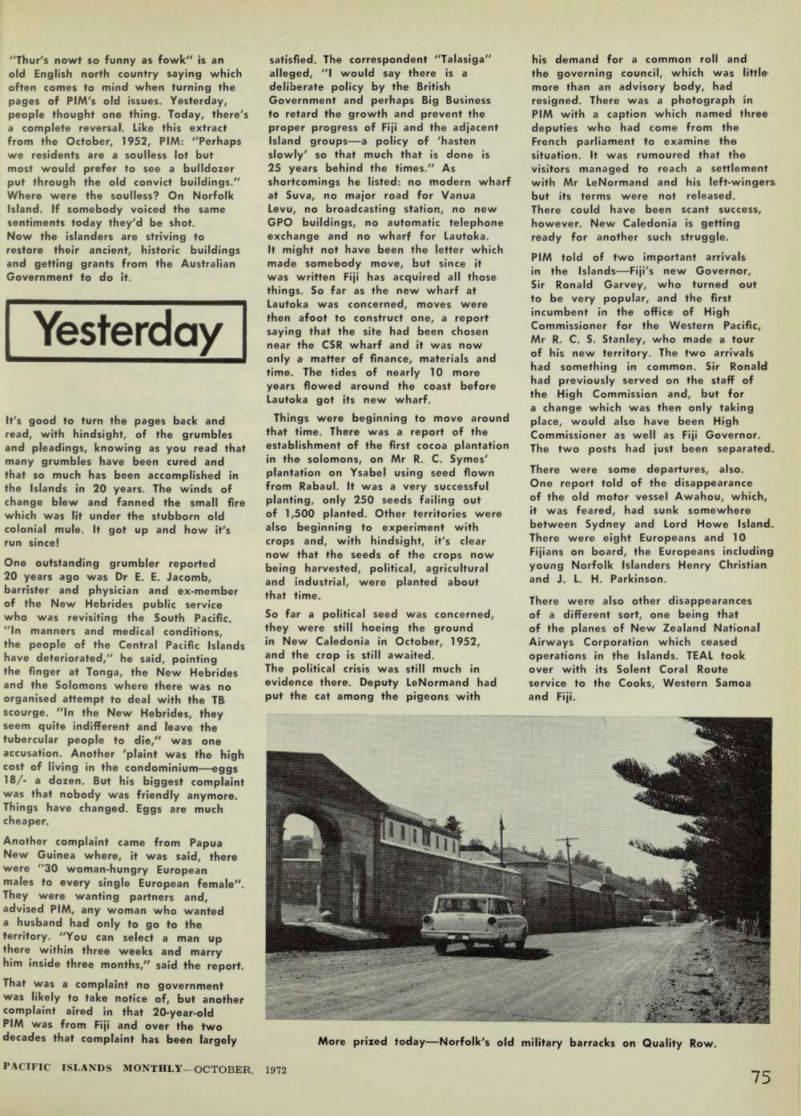
"Thor's nowt so funny as fowk" is an old English north country saying which often comes to mind when turning the pages of PlM's old issues. Yesterday, people thought one thing. Today, there's a complete reversal. Like this extract from the October, 1952, PIM: "Perhaps we residents are a soulless lot but most would prefer to see a bulldozer put through the old convict buildings."
Where were the soulless? On Norfolk Island. If somebody voiced the same sentiments today they'd be shot.
Now the islanders are striving to restore their ancient, historic buildings and getting grants from the Australian Government to do it.
It's good to turn the pages back and read, with hindsight, of the grumbles and pleadings, knowing as you read that many grumbles have been cured and that so much has been accomplished in the Islands in 20 years. The winds of change blew and fanned the small fire which was lit under the stubborn old colonial mule. It got up and how it's run since!
One outstanding grumbler reported 20 years ago was Dr E. E. Jacomb, barrister and physician and ex-member of the New Hebrides public service who was revisiting the South Pacific.
"In manners and medical conditions, the people of the Central Pacific Islands have deteriorated," he said, pointing the finger at Tonga, the New Hebrides and the Solomons where there was no organised attempt to deal with the TB scourge. "In the New Hebrides, they seem quite indifferent and leave the tubercular people to die," was one accusation. Another 'plaint was the high cost of living in the condominium—eggs 18/- a dozen. But his biggest complaint was that nobody was friendly anymore.
Things have changed. Eggs are much cheaper.
Another complaint came from Papua New Guinea where, it was said, there were "30 woman-hungry European males to every single European female".
They were wanting partners and, advised PIM, any woman who wanted a husband had only to go to the territory. "You can select a man up there within three weeks and marry him inside three months," said the report.
That was a complaint no government was likely to take notice of, but another complaint aired in that 20-year-old PIM was from Fiji and over the two decades that complaint has been largely
satisfied. The correspondent "Talasiga" alleged, "I would say there is a deliberate policy by the British Government and perhaps Big Business to retard the growth and prevent the proper progress of Fiji and the adjacent Island groups —a policy of 'hasten slowly' so that much that is done is 25 years behind the times." As shortcomings he listed: no modern wharf at Suva, no major road for Vanua Levu, no broadcasting station, no new GPO buildings, no automatic telephone exchange and no wharf for Lautoka.
It might not have been the letter which made somebody move, but since it was written Fiji has acquired all those things. So far as the new wharf at Lautoka was concerned, moves were then afoot to construct one, a report saying that the site had been chosen near the CSR wharf and it was now only a matter of finance, materials and time. The tides of nearly 10 more years flowed around the coast before Lautoka got its new wharf.
Things were beginning to move around that time. There was a report of the establishment of the first cocoa plantation in the solomons, on Mr R. C. Symes' plantation on Ysabel using seed flown from Rabaul. It was a very successful planting, only 250 seeds failing out of 1,500 planted. Other territories were also beginning to experiment with crops and, with hindsight, it's clear now that the seeds of the crops now being harvested, political, agricultural and industrial, were planted about that time.
So far a political seed was concerned, they were still hoeing the ground in New Caledonia in October, 1952, and the crop is still awaited.
The political crisis was still much in evidence there. Deputy LeNormand had put the cat among the pigeons with
his demand for a common roll and the governing council, which was little more than an advisory body, had resigned. There was a photograph in PIM with a caption which named three deputies who had come from the French parliament to examine the situation. It was rumoured that the visitors managed to reach a settlement with Mr LeNormand and his left-wingers but its terms were not released.
There could have been scant success, however. New Caledonia is getting ready for another such struggle.
PIM told of two important arrivals in the Islands—Fiji's new Governor, Sir Ronald Garvey, who turned out to be very popular, and the first incumbent in the office of High Commissioner for the Western Pacific, Mr R. C. S. Stanley, who made a tour of his new territory. The two arrivals had something in common. Sir Ronald had previously served on the staff of the High Commission and, but for a change which was then only taking place, would also have been High Commissioner as well as Fiji Governor.
The two posts had just been separated.
There were some departures, also.
One report told of the disappearance of the old motor vessel Awahou, which, it was feared, had sunk somewhere between Sydney and Lord Howe Island.
There were eight Europeans and 10 Fijians on board, the Europeans including young Norfolk Islanders Henry Christian and J. L. H. Parkinson.
There were also other disappearances of a different sort, one being that of the planes of New Zealand National Airways Corporation which ceased operations in the Islands. TEAL took over with its Solent Coral Route service to the Cooks, Western Samoa and Fiji.
More prized today—Norfolk's old military barracks on Quality Row,
Advertisements & other items, pp. 78-80 (2 items)
8-Speed
Power
Blender
-the
appliance
you can use
every meal.
With powerful, Solid-state motor. Solid-state means added versatility for exactly the blending action you need —to stir, puree, cream, whip, grate, mix, chop or liquefy.
Stainless steel cutters operate at high speed for fast food preparation.
Switch from speed to speed without turning off.
L 83.3335
&& Book Reviews
T r\ I r\cc lITCDADV
CD,C NDS
11th edition
PACIFIC ISLANDS
YEAR BOOK
THE STANDARD REFERENCE BOOK ON THE PACIFIC ISLANDS The Pacific Islands Year Book was first published in 1932. It has now become the recognised standard reference work on the Pacific. The 11th edition, like its predecessors, covers in depth every Pacific Island in the 68 million square miles of the wodd'sJargest ocean. There is also a section dealing with the Asian countries bordering the western periphery of the Pacific Ocean which are having an increasing impact on the whole area. Each territory is dealt with exhaustively— geography history, method of government, people, industries, trade, commerce, transport and communications, tourism, listing of public servants, business firms, etc. For those who want a quick reference, there is a "summary section" where the main territories and islands are treated in brief.
TOURIST SECTION
The Pacific is the fastest growing tourist area in the world. All Islands' governments are now fostering the industry. The Pacific Islands Year Book gives all available information on where to go, how to get there, what to see and where to stay 542 pages, cloth bound. accounts of worthacific history that tinue to sell well, sn’t tell us he has that fill a gap, elected 100 with s he in fact con- :tion methods? I with then is what iomewhere in the ice he was trying has “merely tried richness of the English from the le that, although 11 as it might be acts of the books s on their authors, vith a new interest > feel his way 5 as biased in his us. —Stuart Inder.
LITERATURE; ONE
DKS. A. Grove Day. [awaii. SUS7.SO).
Use the form overleaf when ordering
“b v “ v uu ‘ u «'»o IUV UIUI. )t Capricorn, Richard Tregaskis’
Guadalcanal Diary, Basil Thomson’s »outh Sea Yarns, and James F.
J Connell’s A Residence of Eleven (ears in New Holland and the lslands, to name some.
But I heartily endorse the inclusio f Mariner’s Tonga, Charles Wilke Narrative of the United States E> loring Expedition, Robert Dea nsbie’s The Book of Puka-Puk; ; nc Feldt’s The Coast Watchers, Tho leyerdahl’s The Kon-Tiki Expeditio nd James Ramsey Ullman’s Wher ie Bong Tree Grows (which gets i s No. 100 on the list).
As you can see from this sampling, lere is variety enough for anybody i A. Grove Day’s selection.
FIJI
In trade and as a mecca for tourists, Fiji is growing in importance. For businessmen, travellers, students and others who want to keep abreast of events, the fourth, 1972 edition, of the Handbook of Fiji is an essential guide.
As well as sections dealing exhaustively with history, geography, government and politics, finance, trade, education, social services, etc., there is a completely revised tourist section. This is in keeping with the growing importance to Fiji of this industry. An extensive accommodation guide and a folding road-map of Viti Levu are included. With 14 other maps and attractive full-colour cover. 264 pages.
PRICE: Australia and PNG, $3.50 Aust., plus 45c posted; Pacific Islands and overseas countries, $3 50 Aust., plus 70c posted; USA, $4.80 U.S. posted.
PACIFIC PUBLICATIONS (AUST.) PTY. LTD.
29 ALBERTA STREET, SYDNEY, N.S.W. 2000.
(Postal Address: Box 3408, G.P.0., Sydney, N.S.W. 2001.)
Now you can take movies you couldn’t take before in everything from candlelight to bright sunlight. Kodak have made it possible with two brand new movie cameras and a new movie film.
Both the new Kodak XL33 and XLSS Movie Cameras have a remarkable automatic precision exposure system and special low light viewfinder. Both have drop-in loading.
Both are battery powered.
New Kodak Ektachrome 160 Movie Film is designed to complete the low light capability of these new cameras.
It’s four times faster than Kodachrome II Movie Film. (Check with your dealer about trying it in other movie cameras.) Choose the Kodak XL33 Movie Camera or the XLSS model which also has power zoom, rangefinder and a sports-type viewfinder.
Tempt yourself today. At your photo dealer. • • KODAK (Australasia) PTY. LTD.
New Kodak XL Movie Cameras/ Ektachrome 160 Movie Film
77
ACIHC ISLANDS MONTHLY —OCTOBER, 1972
Rowley's perceptive New
Guinea in paperback
WHEN C. D. Rowley first produced his oddly-titled The New Guinea Villager in 1965, a PIM reviewer described it as a “book of real sig nificance ... a highly perceptive and timely analysis of the current prob lems of the big Australian territory . . with urgent comment in almost ;very paragraph.”
Although it has since gone into hree editions, and a fourth is now ivailable in large format paperback, vhat Professor Rowley had to say in 1965 is still as timely, and possibly wen more valuable for anybody vanting to understand what is going m in a New Guinea that will be self ;overning by the end of 1973. This lew issue has not been added to; it s still “retrospective from 1964”, but fi-ofessor Rowley has laid firm foun lations.
The new issue is part of the Cheshire Group’s Studies in Society eries, and retails for $3.25.
FREDERIC Koehler Sutter’s ■ Samoa: A Photograph Essay University of Hawaii Press, SUSI 6) mst be one of the most sumptuous □lour books produced on the South acific. The binding, paper, colour and general presentation re almost magnificent. Somebody at le Hawaii Press is doing fine work, )r a PIM reviewer last month also Dmplimented that organisation on s beautiful presentation of Robert lampier’s To the Sandwich Islands n HMS Blonde.
In his photographic essay, Western amoa resident Sutter (he and his ife came in 1962). presents us with lotographs of Samoan life we don’t :ten see mourners at a funeral, Ilage sports, tatooists at work, night ihing, house building—all the prints ghly competent, some of them •ectacular. Nobody who lives there, • has visited there, can fail to be ipressed. Extensive notes at the ick of the book explain the pictures detail and point up the rhythm of uly Samoan life.
The author has tied most of his lotographs to Samoan proverbs, ven in both Samoan and English the text. Oddly, this device is an itation to some readers, merely cause it is patently a device. Many the proverbs are old and have me out of use and thus don’t rep sent the modern-day Samoa as the etures do. They make the book just
a little bit “precious”. Nevertheless, a volume worth owning, covering an area that doesn’t get much attention. 7 of The Journal of ▼ Pacific History is now available (at $5.50 through booksellers or $4.75 by subscription to the Aus tralian National University, Canberra, which produces it).
As usual the annual issue is a first rate “read”, with No. 7 perhaps better than last year’s (which was better than the year before). Jack Golson has the lead story on “The Remark able History of Indo-Pacific Man” (from a lecture that many people missed); there is an absorbing study by W. H. Pearson of just how Hawkesworth went about editing Captain Cook; there is a backwards look at the influence of the well known Hennings family of Fiji, by Deryck Scarr; and a fascinating account (the most readable in the issue) by Jim Allen and Roger Green on their recent Solomons investiga tions into Mendana’s lost ship. And much more.
This is the first issue not edited by the journal’s founder, H. E. Maude, and one of the tributes paid to him in this issue is that he “possessed the capacity to write to authors of manu scripts the Journal was unable to pub lish in terms of such generosity and delicacy that rejection must have
seemed almost as welcome as acceptance”. High praise for any editor! jDAPERS read at the 1971 con ference of the New Zealand Institute of International Affairs have now been printed in booklet form by the institute’s publishers, Price Milburn and Co., Wellington, for $2.
The theme of that conference was ‘‘Pacific Horizons: A regional role for New Zealand”, and the papers were by R. Q. Quentin-Baxter, S. M.
Koya, Keith Jackson, Sir Alan Watt, W. David Mclntyre and Alexander MacLeod. There is a worthwhile introduction by Mary Boyd, reader in history at Wellington’s Victoria University.
The institute has also published (for 50 cents, direct to the institute at PO Box 196, Wellington) a 40page booklet titled New Zealand and Nuclear Testing in the Pacific, by Nigel Roberts, lecturer in political science at Canterbury University.
The author concludes that NZ protests probably haven’t done much to discourage the French, but that NZ or other nations can’t afford to stop protesting because continuing, unabated protests add to France’s difficulties. The booklet has some useful references.
Advertisements & other items, pp. 81-82 (2 items)
Tcific Islands Monthly— October, 1972
The Journal of Pacific History
A scholarly journal concerned with the history of the peoples of the Pacific Islands, containing much of the most authoritative writing on the subject.
VOLUME VII 1972
256 pages: articles based on recent research, sections on Current Developments, Manuscripts and Publications, Book Reviews, and Index to volumes I-VI.
Published annually—subscription 5A4.75 or equivalent
(SUS6.OO).
Correspondence and subscriptions to Editors, The Journal of Pacific History, Australian National University, Box 4, P. 0., Canberra A.C.T. 2600, Australia.
Bank of
Queensland
Limited
invest with absolute
capital safety in our
INTEREST BEARING
TERM DEPOSITS
p i i i i 3 2 years to less than 4 years 5.0% p.a 12 months to less than 2 years 4.5% p.a 3 months to less than 12 months 4.3% p.a For amounts $50,000 and over, special Rates will be quoted on application. & ■MCUT OUT AND MAIL TODAY M J Manager, Bank of Queensland Limited, 115 Queen Street, Brisbane, Qld. 4000 l/We wish to place $ on interest bearing term deposit with your Bank for a period of years, and enclose cheque for $ Pfease forward application form to: (Full Name).
Address ..
Signature/ i
one handy reference
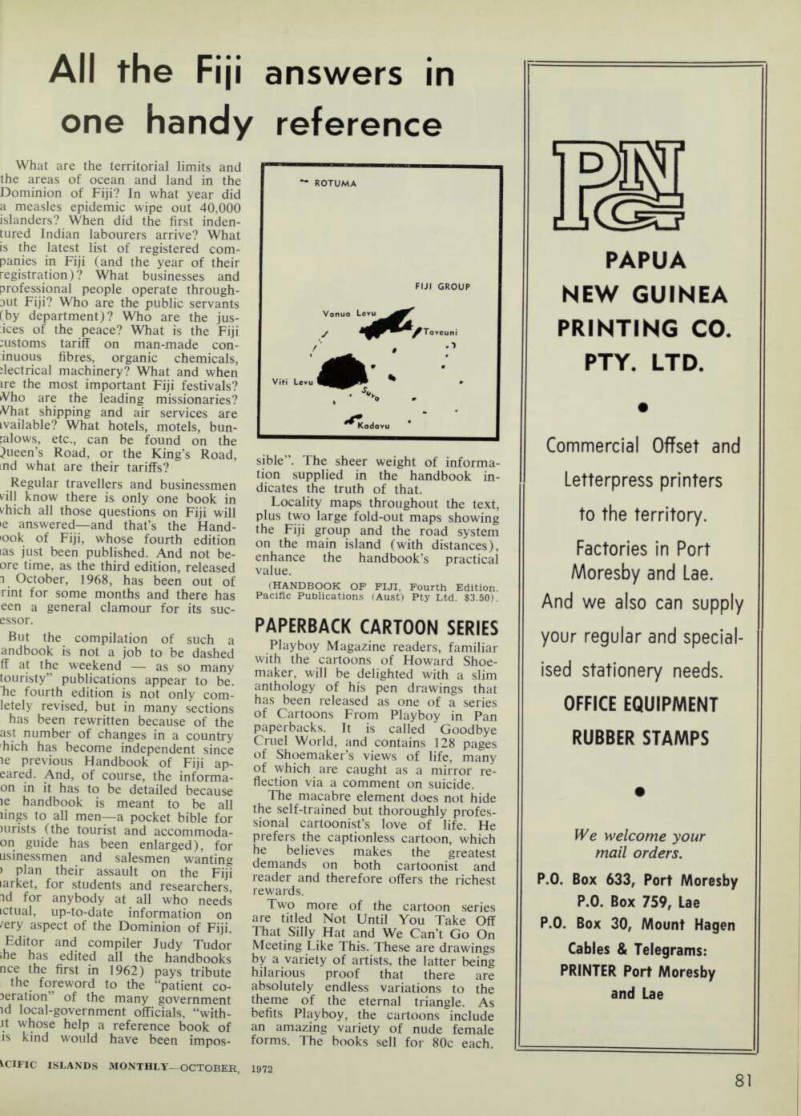
All the Fiji answers in one handy reference
What are the territorial limits and the areas of ocean and land in the Dominion of Fiji? In what year did a measles epidemic wipe out 40,000 islanders? When did the first inden tured Indian labourers arrive? What is the latest list of registered com panies in Fiji (and the year of their registration)? What businesses and professional people operate through out Fiji? Who are the public servants (by department)? Who are the jus ices of the peace? What is the Fiji mstoms tariff on man-made con inuous fibres, organic chemicals, flectrical machinery? What and when ire the most important Fiji festivals?
Yho are the leading missionaries?
Yhat shipping and air services are ivailable? What hotels, motels, bun galows, etc., can be found on the Queen’s Road, or the King’s Road, md what are their tariffs?
Regular travellers and businessmen vill know there is only one book in vhich all those questions on Fiji will ie answered—and that’s the Hand ook of Fiji, whose fourth edition tas just been published. And not be ore time, as the third edition, released i October, 1968, has been out of rint for some months and there has een a general clamour for its suc essor.
But the compilation of such a andbook is not a job to be dashed ff at the weekend as so many touristy” publications appear to be. he fourth edition is not only com letely revised, but in many sections has been rewritten because of the ast number of changes in a country hich has become independent since ie previous Handbook of Fiji ap eared. And, of course, the informa on in it has to be detailed because ie handbook is meant to be all lings to all men—a pocket bible for jurists (the tourist and accommoda on guide has been enlarged), for □sinessmen and salesmen wanting ) plan their assault on the Fiji larket, for students and researchers, id for anybody at all who needs ictual, up-to-date information on aspect of the Dominion of Fiji.
Editor and compiler Judy Tudor •he has edited all the handbooks nee the first in 1962) pays tribute the foreword to the “patient co leration” of the many government id local-government officials, “with it whose help a reference book of is kind would have been impos-
sible”. The sheer weight of informa tion supplied in the handbook in dicates the truth of that.
Locality maps throughout the text, plus two large fold-out maps showing the Fiji group and the road system on the main island (with distances), enhance the handbook’s practical value. (HANDBOOK OF FIJI, Fourth Edition.
Pacific Publications (Ausf) Pty Ltd. $3.50).
Paperback Cartoon Series
Playboy Magazine readers, familiar with the cartoons of Howard Shoe maker, will be delighted with a slim anthology of his pen drawings that has been released as one of a series of Cartoons From Playboy in Pan paperbacks. It is called Goodbye Cruel World, and contains 128 pages of Shoemaker’s views of life, many of which are caught as a mirror re flection via a comment on suicide.
The macabre element does not hide the self-trained but thoroughly profes sional cartoonist’s love of life. He prefers the captionless cartoon, which he believes makes the greatest demands on both cartoonist and reader and therefore offers the richest rewards.
Two more of the cartoon series are titled Not Until You Take Off That Silly Hat and We Can’t Go On Meeting Like This. These are drawings by a variety of artists, the latter being hilarious proof that there are absolutely endless variations to the theme of the eternal triangle. As befits Playboy, the cartoons include an amazing variety of nude female forms. The books sell for 80c each.
Advertisements & other items, pp. 83-84 (2 items)
81
ICIFIC ISLANDS MONTHLY—OCTOBER, 1972
Papua
NEW GUINEA
PRINTING CO.
PTY. LTD.
Commercial Offset and Letterpress printers to the territory.
Factories in Port Moresby and Lae.
And we also can supply your regular and specialised stationery needs.
OFFICE EQUIPMENT
RUBBER STAMPS
We welcome your mail orders .
P.O. Box 633, Port Moresby P.O. Box 759, Lae P.O. Box 30, Mount Hagen Cables & Telegrams: PRINTER Port Moresby and Lae
PIT MOTIRURTIBia
In lour work wlik
vi mmmm §1 m G.M. Bedford Industrial Diesel Engine, Models 330, 330 T.
CLAE make engines. Engines for trucks. For boats. For Industry. Generators, power units and pumping sets.
CLAE are proud of their hard-earned reputation as the most reliable name in the business of precision. They look after you from the moment your enquiry is received. And they keep looking after you—long after the sale is made — by efficient, expert after-sales service and by the very largest spare parts department in the country.
If your equipment is not running as well as it should —if your costs are too high—if you’re too long off the fob through costly delays in finding spare parts—you NEED Claei!
CLAE Parts and Service back-up guarantees down-time being kept to an absolute minimum. Send us details of your application NOW.
It’ll be different from all the rest, and that’s the kind of challenge we like the best.
4 Q.M. Bedford Diesel Generator Sets, Models 220 G and 3300.
CLAE 8D145 Diesel Marine Engine. 145 h.p.
Paragon P4OO Series Hy - GJW. Bedford 6 cyl. 466 cJ. draullc Transmission. fitted with 15 Flood Pump Clae Engine Sales & Service, 31 Hoskins Ave., Bankstown, N.S.W. 2200.
Clae Engine (Old.) Pty. Ltd., Lavarack Ave., Eagle Farm, Queensland 4007.
Please send me details of.
Name Address. jm
the power
f .Date.
DISTRIBUTED BY: Townsville: Nth. Queensland Diesel Services Pty. Ltd. Ph. 79 3688 • Melbourne: Motor Spares Ltd. Ph. n 3 ° Adelaide: Rasch Motors (S.A.) Pty. Ltd. Ph. 51 5371-3 • Launceston: Highline Marine Services. Ph. 31 3082 • Perth: Attwoode Marine Centra.
Ph. 28 3155 • Hobart: Motors Pty. Ltd. Ph. 2 0571
Pacific Shipping
Competition And Parochialism
Threaten Islands' Own Lines
By a PIM staff writer
News of the month in shipping is dominated by problems which em phasise the fiercely competitive nature of Pacific trade. New ships are en gaged, new lines being formed or pro posed and the pressure on Islands owned lines is increasing.
Nauru Pacific is a prime example of the situation that a regional ship ping line may be faced with when it enters the icy waters of commercial competition. On the other hand its successes can be a source of en couragement to the backers of a co operative line between the Islands states.
Late in August, Nauru Pacific was confronted with a demand from Transpac, the shipping company hold ing exclusive franchise for the US Trust Territory, to perform a com plete inventory of all cargo bound for the territory, both at the time of loading the Eigamoiya in Melbourne and at the time of unloading in Majuro.
This was in addition to a surcharge 3f 15 per cent, already levied against Nauru Pacific Line as compensation for Transpac’s loss of trade through he Nauru ship’s operation. The sur ;harge had apparently not been effective in limiting imports via the Nauru line, but the further require ment led the Nauruans to threaten to discharge the cargo then en route for Majuro at Nauru and let the con signees send for it from there.
Intervention by Marshall Islands District Administrator Oscar De 3rum, together with a visit by lonorary Consul-General for Nauru n the US, Carlton Skinner led to a ;uspension of the restrictions to allow hat cargo to be discharged as scheduled. A meeting was hastily irranged between Nauru President Tammer Deßoburt who was in Vlajuro, and Congress of Micronesia >enate President Amata Kabua and Representative Charles Dominick, >oth of whom were engaged in a pecial session of the Congress in s onape. The recently appointed Chief
of TT Transport and Communication, Joseph Beadles, was also summoned to the meeting.
Result was that the surcharge was removed and Nauru will continue to service Majuro only. Possible extension to a western TT port will be discussed in another six months. (See also Business pages).
In a hard-hitting editorial, the Micromtor, which is published in Majuro said that Nauru had proved its capability to provide regular and reliable service to Majuro, and the quality of the merchandise imported
from Australia met local require ments. “If Transpac can’t give freight rates comparable to Nauru, why not give the franchise to Nauru l ?” the paper asked.
Nauru recently offered to buy into Transpac and was rather brusquely warned off. The Micronesian in vestors in Transpac might be glad to see their company declared bankrupt, but selling the Nauruans the Ameri cans’ $210,000 share in Transpac and letting them run it might be better for everybody concerned, the Micro nitor thought.
by taking Islands partners
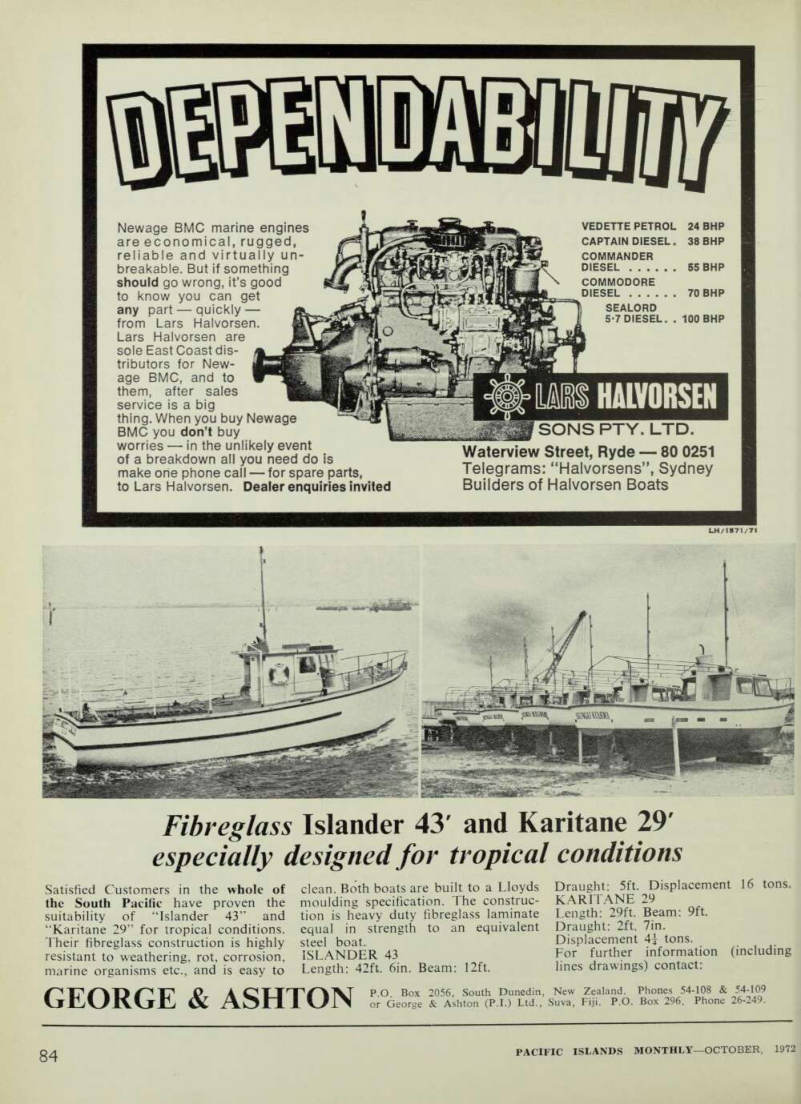
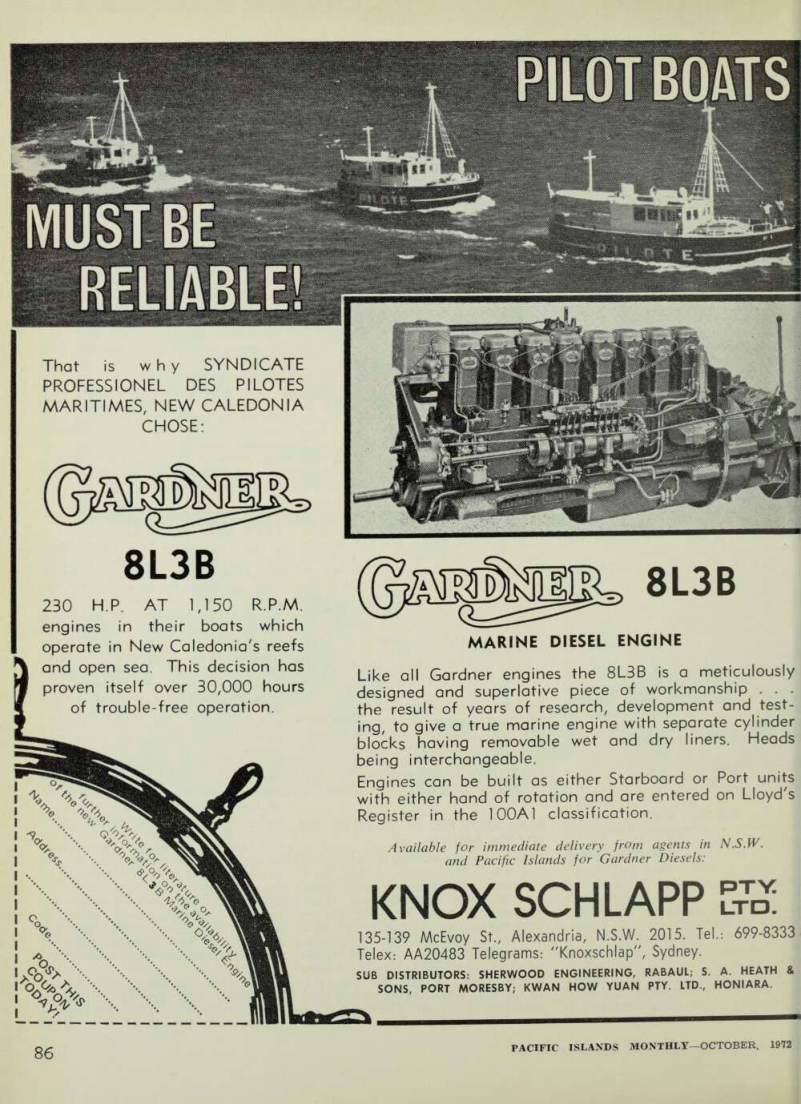
. . . but USS would solve it by taking Islands partners
From Felise Va’a in Apia
The South Pacific seminar on shipping, held in Apia early September, produced a big surprise.
This was an offer from the Union Steam Ship Co. of New Zealand to island governments enabling the island governments to purchase 50 per cent, of shares in the company.
Mr D. C. Jury, assistant general manager of the Union Steam Ship Co., in making the offer to participants at the seminar, said island governments had 12 to 18 months in which to consider the offer.
Mr A. Edwards, assistant secretary of the New Zealand Industries and Commerce Department, as well as Mr William Martin, president of the New Zealand Seamen’s Union both recommended to participants that the offer should be accepted.
Western Samoa’s Minister of Marine, Tupuloa Efi, was not prepared to comment on the proposal shortly after it was made, and like the majority of the other participants indicated that the proposal would have to be considered further by the island governments.
However, it was obvious at the seminar that the proposal received
more than a lukewarm reception though the participants refused to give clear cut answers to specific questions; after all it was not in the power of most of them to make any commitments.
The question whether island parti cipation in the Union Steam Ship Co. would necessarily prevent the establishment of a regional shipping line was settled by Mr Jury who said island participation in the company would not prevent the formation of such a line at a later date.
It is not very clear what has prompted the company’s offer but it could be that a regional shipping line is seen by the company as a threat to its operations in the South Pacific and that a proposal for joining forces would be preferable to any straight-out competition between the company and such a shipping line, Finally, though the island govern ments may profit from their holdings the question of high freight rates and related matters would still remain, • Mr R. Cribb, a director of Thomas Nationwide Transport, told PIM in Sydney that the USS Co. ser
vices to the Pacific Islands from New Zealand and return were “very un profitable”. ‘We are trying to put on two letter class Tarros ships ” he said.
'The Pacific Islands people have r lways wanted their own shipping line md we have told them they can have in equity with us. They are studying his and have not given us their 'ecision yet.”
The seminar was faced with the sual problems of Islands shipping, ke differential rates for exports and nports, and it agreed substantially n the need to develop regional trade.
A recommendation was made that full study be taken of the possible )rmation of a regional shipping line. is believed that the South Pacific ureau for Economic Co-operation ill be involved in this.
Further details of the USS offer ■e that despite the period of 18 lonths given for the Islands govern ients to decide, the service with the jw Tarros class ships could begin 1 soon as facilities were available 1 handle them at the various ports id when the present trial of con iner loading of bananas on conven tual ships proves successful.
The equity offer is to Fiji, Tonga id Western Samoa in the first stance, but it would be open also the Gilbert and Ellice Islands and hers too if they wished.
The Fiji delegation expressed con rn at the high cost of the necessary stallations to handle container ssels at Suva and Lautoka.
The New Zealand seamen’s attitude regional shipping is coloured by desire to retain jobs for unionists, “ile th ey want to help Islanders ise living standards, they want ships runs traditionally NZ-manned to NZ-owned and operated. The Fiji mes in a hard-hitting editorial stigated the union for an “arrogant, g-m-the-manger attitude”.
Jion Steamship Back
The Black
It took less than a full financial ar for Bulkships Ltd and the NZ tisortium of companies which took sr the Union Steam Ship Co. of - L . td ’ to change from a substantial s in *° a more than satisfactory )fit. This is revealed in the annual counts of Thomas Nationwide ansport Ltd, which has a one-third erest in Bulkships.
The acting chairman of TNT, Sir ter Abeles. commenting on the >S Co., said: ’Union Steam Ship will be one of greatest management successes, ticularly as we have succeeded in ng the same management there.
We have changed the philosophy not the management.”
The USS Co. made a net profit of $928,000 in the nine months to June 30, compared with a loss of $841,512 for the whole of the previous year.
TNT has a one-third interest in Bulkships, which owns 50 per cent, of Tasman Union, the holding com pany for the USS Co. The other 50 per cent, is held in NZ.
Karlander Boosts
Aust.-Fiji Service
Karlander is boosting its Australia- Fiji-North America service by adding two chartered ships to the run and cutting the Melbourne-Fiji freight rate to that obtaining on the Sydney- Fiji run.
With the addition of the two ships, the Good Mariner and the Good Navigator, Karlander will double the frequency to twice monthly.
The rate cut operates from Octo ber 1.
Karlander launched this service in February, 1971, with three sideport loaders, the Woolgar, the Slevik and the Wyvern. After calling at Fiji and ports on the west coast of the US and Mexico they returned to Aus tralia, via New Zealand.
The Good Mariner has already made its first voyage, and early in September was back in Australia and loading in Adelaide for the second trip. The Good Navigator, early in September, was loading in Mexico on her way to Australia to enter the service. Both are 11,000-ton, 17-knot ships with flush decks for forklift loading. They can handle containers, pallets and broken cargo. A third similar vessel is projected.
Karlander will keep the Wyvern on the Australia-Fiji service, running about once a month. The Wyvern, with one of the other ships calling at Fiji on the way to America, will give Fiji two Karlander services a month.
The Slevik has been transferred to
the Melbourne-Sydney-Lae-Madang-
Kimbe service, and the Woolgar will be phased out of the Australia-Fiji- North America service.
More Ships For
Islands Routes
Late August and early September saw the introduction of two new services to the Pacific Islands from Australia and New Zealand. There was also a strong possibility that a third service would start from New Zealand to Fiji and New Caledonia.
Messageries Maritimes has regis tered a subsidiary. South Pacific United Lines, at Vila, to operate a service from Melbourne, Sydney and Auckland to Papeete. The first voyage was with the Wah Fung, chartered
in Singapore. This service was scheduled to return direct to Mel bourne from Papeete. However, on future return voyages there will be calls at Vila, Santo and Noumea.
Pacific Island Transport Co. Ltd, inaugurated a service from the NZ West Coast port of Westport to the New Hebrides early in September.
There will be sailings every four to five weeks for Vila and Honiara, and Santo if there is sufficient freight.
Reef Shipping Co. has offered NZ exporters a new service to Fiji, in direct competition with the Union Steam Ship Co., which has had a virtual monopoly on the route for many years. The Reef plan is to link the Fiji service with an existing ser vice to Noumea. Reef intends to onerate a three-weekly service from Onehunga to Suva, Lautoka and Noumea with the freighter, Jean Philippe (914 tons). A second ship may be chartered later.
The USS Co. was reported from Auckland to be considering the pos sibility of chartering two small con tainer ships for the Auckland-Pacific Islands service. The company, in September, was scheduled to run a trial container shipment of bananas, on a conventional freighter.
Training The Men For
Png's Maritime Trade
When the Papua New Guinea Edu cation Department decided to mod ernise its marine training course it did not have to look further for advice than a former territory mariner, who is now head teacher in charge of the School of Navigation at Sydney Technical College. Thus, Captain W. D. Heighway paid a 24 day visit to PNG in July/August to report on training young seamen.
As a young man, Captain Heigh way was with Burns Philp from 1935 to 1941, serving as a cadet and, later, as a second officer, in the “old firm’s” ships. These included the Macdhui (sunk by the Japanese during World War II), the Neptunia and the Muliama, He was second mate in the Muliama, then based at Rabaul.
A nautical training school, con ducted by the Department of Trade and Industry, was set up in Port Moresby in the early 60s. A few years later control was transferred to the Department of Transport. The Education Department has been re sponsible for the school since the start of 1972. The school, which was formerly in two different parts of Port Moresby, is now consolidated at Madang.
The Education Department did not have any experience in running a nautical school. It asked that Captain Heighway be sent to PNG to advise
what should be done to modernise the school and the courses.
Captain Heighway, after discussing the matter with the appropriate authorities and representatives of shipning companies, has suggested a two-block school one block for classrooms and administration, and the other for marine engineering. His report has been sent to the authorities, and is now being considered.
He expects the number of students will be more than 100 each year. The courses will be from three to six nonths. The school will not offer certificates or diplomas. The Trans port Department is the marine licens ng authority. Students who want certificates will sit examinations con lucted by that department.
The school, at present in “quite nadequate” buildings, is under the control of Captain Peter Hester, a veil-known PNG mariner. There is i staff of six teachers.
There are special courses for >fficers, covering navigation, etc., and or marine engineers. The basic level ourses place emphasis on safety :onsiderations, the correct use of fre ighting and life-saving equipment and
;eneral seamanship.
/10Re Lights On
Ui's Shipping Lanes
Four new lighthouses will be built a Fiji under a scheme to improve lavigational facilities. Two of them, ine at Vatoa in southern Lau, and tie other at Totoyo, the most easterly f the Yasayasa Moala cluster, will lark the southern and northern mits of the main track of shipping etween Fiji and Tonga.
A new light at Nanukulevu will lark the northern and western limits f the main shipping track between iji and North America. The fourth dll be on a rocky outcrop to mark le eastern limit of the Vatu-i-Ra assage. This passage is used by igar ships and inter-island shipping.
A loan of $54,480 from the British (verseas Development Administra on will help to finance the scheme, he scheme also covers setting up nd improving minor beacons in mer reef passages, and marking ewly discovered hazards in the main lipping channels of the outer islands, ■ reef blasting programme will im rove existing passages and create sw ones in the outer islands.
Iji Marine Plans
S Biggest Ship
With a new blueprint ready in ace of one which was prepared in ngland and then scrapped as too istly, the Fiji Marine Department id the Maritime Co-operative Ship ng Association are almost ready to
begin building a replacement for the ill-fatecf Tui Lau, wrecked on a Fiji reef in 1968.
Earlier in September only contract legalities remained to be settled be fore work begins in October or November in the government shipyard at Walu Bay, Suva.
With an overall length of 142 ft and capacity for 135 tons of cargo, the ship will be the biggest yet built in the dominion. Fifty-two passengers will be accommodated on airliner type seats in an aft saloon and there will be seven two-berth cabins. Ser vice speed will be about 10 knots.
The association consists of Fijian co-operative societies operating in the Lau Group.
Shipping Briefs
• Austasia Line, which has been conducting a bi-monthly service from Australia via PNG ports to Malaysia has announced the withdrawal of the vessel Malaysia from October and the cessation of the service. The ship is not being replaced. • New Zealand seamen adopted a familiar tactic when the USS Co’s Waimea was at Nukualofa early in August. Eleven of the crew walked off after the master, Captain D.
Coleman, refused to alter a log entry
about one of the seamen. They returned after 36 hours on instruc tions from their union in Auckland.
The strikers, technically, became illegal immigrants, and were escorted away by the police. Later they were released and stayed privately in Nukualofa before returning to their ship. • The Fiji-Australia Line is still looking for a suitable ship to replace the Taiyuan on the Australia-Fiji-New Caledonia run. A spokesman for the company said, “We can’t get a suitable vessel. We are trying to charter one and are still looking”.
The Taiyuan was sold and made her last return voyage to Fiji from Aus tralia in July. • The Boy Roel, which led a protest against French nuclear tests off Mururoa Atoll, was out of sight of land and under sail for five weeks after radio and engine mishaps, when she was about 350 miles south-west of Tonga, 500 miles from Niue and 850 miles from Rarotonga. The crew saw Japanese and Korean fishing ships, but as communications were difficult, and the men did not want to incur heavy salvage expenses, they remained on their own. They made landfall at Manua, American Samoa, on August 7, after having been on water rations since July 7, and restricted food since August 1.
Advertisements & other items, pp. 85-91 (5 items)
83
’ACIFIC ISLANDS MONTHLY—OCTOBER, 1972
especially designed for tropical conditions
« I I
VEDETTE PETROL 24 BMP
CAPTAIN DIESEL. 38 BHP
COMMANDER
DIESEL 55 BHP
COMMODORE
DIESEL 70 BHP
SEALORD
5-7 DIESEL, . 100 BHP
mm Newage BMC marine engines are economical, rugged, reliable and virtually unbreakable. But if something should go wrong, it’s good to know you can get any part quickly from Lars Halvorsen.
Lars Halvorsen are sole East Coast distributors for Newage BMC, and to them, after sales service is a big thing. When you buy Newage BMC you don’t buy worries in the unlikely event of a breakdown all you need do is make one phone call for spare parts, to Lars Halvorsen. Dealer enquiries invited
SONS PTY. LTD.
Waterview Street, Ryde 80 0251
Telegrams: “Halvorsens”, Sydney
Builders of Halvorsen Boats
LH/1871/7I
u u
Fibreglass Islander 43' and Karitane 29'
especially designed for tropical conditions
Satisfied Customers in the whole of the South Pacific have proven the suitability of “Islander 43” and “Karitane 29” for tropical conditions.
Their fibreglass construction is highly resistant to weathering, rot, corrosion, marine organisms etc., and is easy to clean. Both boats are built to a Lloyds moulding specification. The construction is heavy duty fibreglass laminate equal in strength to an equivalent steel boat.
ISLANDER 43
Length: 42ft. 6in. Beam: 12ft. 16 tons.
Draught: sft. Displacement
KARITANE 29
Length: 29ft. Beam: 9ft.
Draught: 2ft. Tin.
Displacement 4j tons.
For further information (including lines drawings) contact:
GEORGE & ASHTON
P O Box 2056, South Dunedin, New Zealand. Phones 54-108 & 54-109 or George & Ashton (P. 1.) Ltd., Suva, Fiji. P.O. Box 296. Phone 26-249.
ii HI ■ ■■■'■ ■ :: ■ • . m Ri El M Bli Im mm »i m .
B IHh
. I and open sea. This decision has proven itself over 30,000 hours of trouble-free operation.
Like all Gardner engines the BL3B is a meticulously designed and superlative piece of workmanship . . . the result of years of research, development and testing, to give a true marine engine with separate cylinder blocks having removable wet and dry liners. Heads being interchangeable.
Engines can be built as either Starboard or Port units with either hand of rotation and are entered on Lloyd's Register in the 100A1 classification.
Available for immediate delivery from agents in N.S.W. and Pacific Islands for Gardner Diesels:
KNOX SCHLAPP
PTY.
LTD.
135-139 McEvoy St., Alexandria, N.S.W. 2015. Tel.: 699-8333 Telex: AA20483 Telegrams: "Knoxschlap", Sydney.
SUB DISTRIBUTORS: SHERWOOD ENGINEERING, RABAUL; S. A. HEATH & SONS, PORT MORESBY; KWAN HOW YUAN PTY. LTD., HONIARA.
MORE PORTS / MORE OFTEN
with
t€£k RLJUVOBR
KARLANDER NEW GUINEA LINE: Serving; Pt. Moresby, Samarai, Lae, Madang, Rabaul, Wewak, Manus Is., Kieta, Honiara, Yandina, Gizo, Vila, Norfolk Is., and Lord Howe Is.
KARLANDER KANGAROO LINE: Serving; Los Angeles, San Francisco,
Auckland, Melbourne, Suva, Lautoka.
AUSTRALIAN TERRITORY LINER SERVICES: Serving,- Melbourne,
Sydney, Newcastle, Brisbane, Weipa, Gove, Thursday Is.
Managing Agents
KARLANDER (AUSTRALIA) PTY. LIMITED
19-31 Pitt Street, Sydney
General Agents
Brisbane: F. H. Stephens Pty. Ltd.
Melbourne: F. H. Stephens (Vic.) Pty. Ltd.
Pt. Moresby: Carpenter Shipping Agencies.
Samarai: Burns Philp (N.G.) Ltd.
San Francisco: Transpacific Transportation Co.
Los Angeles; Transpacific Transportation Co.
Madang: B. J. Back Pty. Ltd.
Yandina: Levers Pacific Plantations Co. Ltd Santo; Burns Philp (N.H.) Ltd Lord Howe Is.: R. Wilson, Leanda Lei, Thursday Is.: Torres Industries Ltd.
Manus Is.: Edgell & Whiteley Ltd.
Rabaul: Rabaul Trading Co. Ltd.
Honiara; E. V. Lawson Pty. Ltd.
Kieta: Breckwoldt & Co. Pty. Ltd.
Lae: N.G.G. Trading Company.
Wewak; Burns Philp (N.G.) Ltd FiM; Burns Philp (S.S.) Ltd.
Gizo: British Solomon Trading Co.
Vila; Burns Philp (N.H.) Ltd.
Norfolk Is.: Burns Philp (S.S.) Ltd.
MILLERS
MARINE AND GENERAL ENGINEERS
♦ /I mm m m . am ■ ■ 11 ■ dr I ■ ■mmmm i I ! fl 11 i is?
SB - I ; ■ -
THE "WAKAYA"
A standard 50 ft tug built far Marine Pacific Ltd to be used for berthing operations and inter-island barge towing. The propulsion unit in this tug is a 12V71M 340 H.P. G.M.
Detroit diesel, nozzle propeller, with a bollard pull of 6 tons.
Work in hand is tt Mission ship for tl Gilbert and Ellii Islands, 86 ft. x ! ft. x 7 ft. 9 in. TH ship is powered i twin 180 H.P. T 6 KO
LIMITED
SHIP BUILDERS TO THE PACIFIC
Sa^Ta*
% t 11
THE MISSION SHIP
'in diesels, 2 x 20 K.V.A. alternators and is capable of a top speed of 10 knots, t has accommodation for 12 crew and 10 passengers and has a cargo capacity 70 tons - Also under construction is a 72 ft. fibreglassed wood hull tourist aunch, two 40 ft. and wo 30 ft. steel work oats and six 250 ton apacity barges. « /z. ii. nuicyiaoocu wuuu HUM IULMII
M!Llers
P-O. BOX 296, SUVA, FIJI. PHONE: 23031.
85
IFIC ISLANDS MONTHLY—OCTOBER, 1972
Cific Islands Monthly—October, 1972
89
ICIFIC ISLANDS MONTHLY—OCTOBER 1972
Cruising
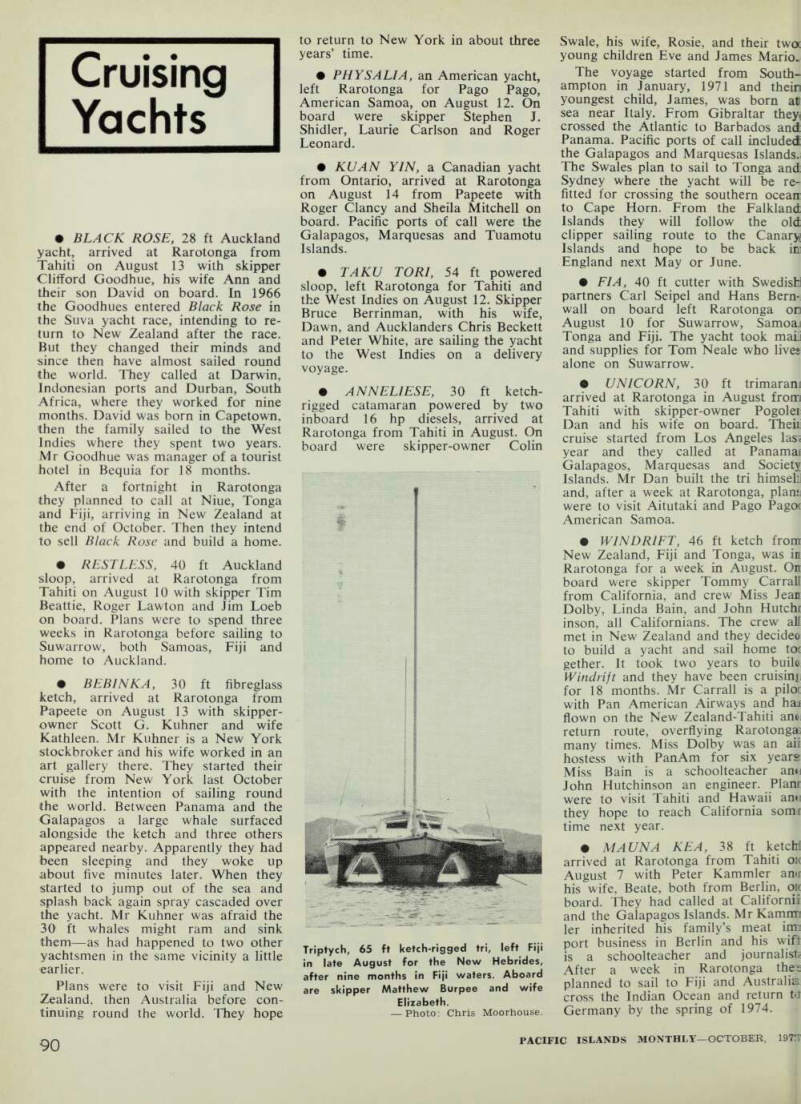
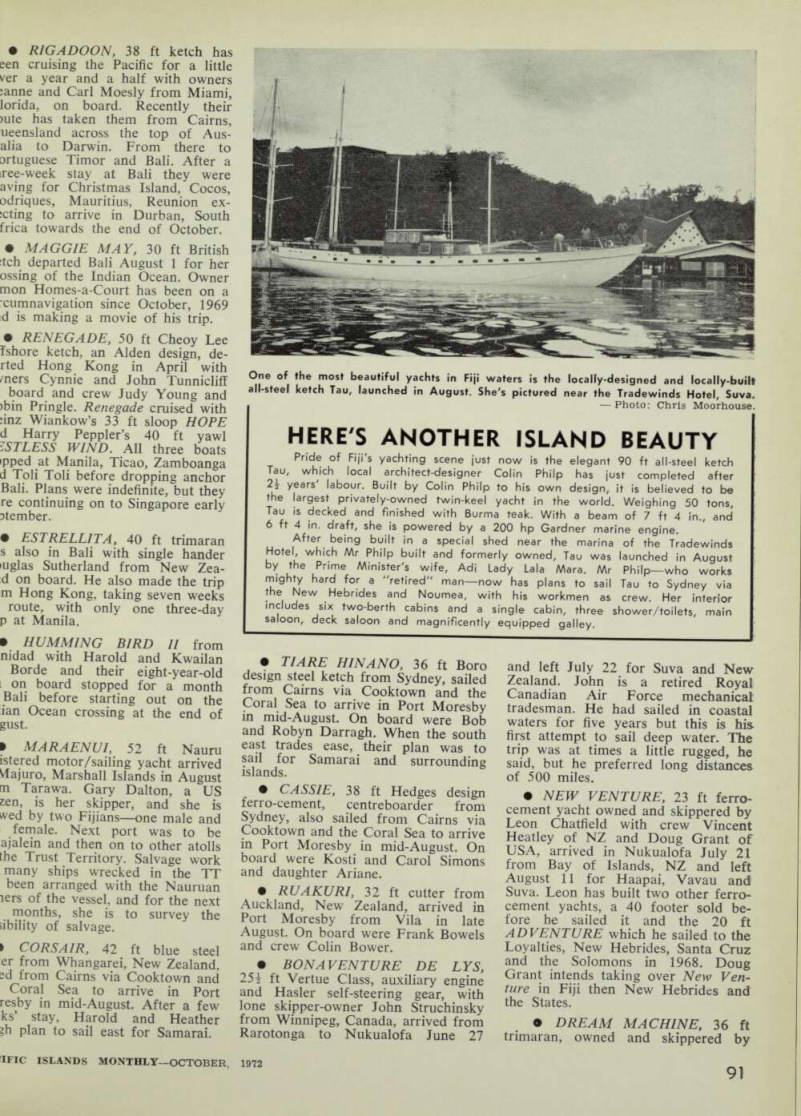
Yachts
• BLACK ROSE, 28 ft Auckland yacht, arrived at Rarotonga from Tahiti on August 13 with skipper Clifford Goodhue, his wife Ann and their son David on board. In 1966 the Goodhues entered Black Rose in the Suva yacht race, intending to re turn to New Zealand after the race.
But they changed their minds and since then have almost sailed round the world. They called at Darwin, Indonesian ports and Durban, South Africa, where they worked for nine months. David was born in Capetown, then the family sailed to the West Indies where they spent two years.
Mr Goodhue was manager of a tourist hotel in Bequia for 18 months.
After a fortnight in Rarotonga they planned to call at Niue, Tonga and Fiji, arriving in New Zealand at the end of October. Then they intend to sell Black Rose and build a home. • RESTLESS, 40 ft Auckland sloop, arrived at Rarotonga from Tahiti on August 10 with skipper Tim Beattie, Roger Lawton and Jim Loeb on board. Plans were to spend three weeks in Rarotonga before sailing to Suwarrow, both Samoas, Fiji and home to Auckland. • BEBINKA, 30 ft fibreglass ketch, arrived at Rarotonga from Papeete on August 13 with skipper owner Scott G. Kuhner and wife Kathleen. Mr Kuhner is a New York stockbroker and his wife worked in an art gallery there. They started their cruise from New York last October with the intention of sailing round the world. Between Panama and the Galapagos a large whale surfaced alongside the ketch and three others appeared nearby. Apparently they had been sleeping and they woke up about five minutes later. When they started to jump out of the sea and splash back again spray cascaded over the yacht. Mr Kuhner was afraid the 30 ft whales might ram and sink them—as had happened to two other yachtsmen in the same vicinity a little earlier.
Plans were to visit Fiji and New Zealand, then Australia before con tinuing round the world. They hope
to return to New York in about three years’ time. • PHYSALIA, an American yacht, left Rarotonga for Pago Pago, American Samoa, on August 12. On board were skipper Stephen J.
Shidler, Laurie Carlson and Roger Leonard. • KUAN YIN, a Canadian yacht from Ontario, arrived at Rarotonga on August 14 from Papeete with Roger Clancy and Sheila Mitchell on board. Pacific ports of call were the Galapagos, Marquesas and Tuamotu Islands. • TAKU TORI, 54 ft powered sloop, left Rarotonga for Tahiti and the West Indies on August 12. Skipper Bruce Berrinman, with his wife, Dawn, and Aucklanders Chris Beckett and Peter White, are sailing the yacht to the West Indies on a delivery voyage. • ANNELIESE, 30 ft ketch rigged catamaran powered by two inboard 16 hp diesels, arrived at Rarotonga from Tahiti in August. On board were skipper-owner Colin
Swale, his wife, Rosie, and their twoc young children Eve and James Mario.
The voyage started from South ampton in January, 1971 and thein youngest child, James, was born at sea near Italy. From Gibraltar crossed the Atlantic to Barbados and Panama. Pacific ports of call included the Galapagos and Marquesas Islands.; The Swales plan to sail to Tonga and Sydney where the yacht will be re fitted for crossing the southern ocean: to Cape Horn. From the Falkland Islands they will follow the old clipper sailing route to the Canary Islands and hope to be back im England next May or June. • FI A, 40 ft cutter with Swedish! partners Carl Seipel and Hans Bern-i wall on board left Rarotonga on August 10 for Suwarrow, Samoaj Tonga and Fiji. The yacht took maiii and supplies for Tom Neale who lives alone on Suwarrow.
O UNICORN, 30 ft trimaram arrived at Rarotonga in August from Tahiti with skipper-owner Pogolei; Dan and his wife on board. Theiii cruise started from Los Angeles las< year and they called at Panamat Galapagos, Marquesas and Society Islands. Mr Dan built the tri himsellJ and, after a week at Rarotonga, plansj were to visit Aitutaki and Pago Pagoc American Samoa. • WINDRIFT, 46 ft ketch from New Zealand, Fiji and Tonga, was in Rarotonga for a week in August. On board were skipper Tommy Car rail from California, and crew Miss Jean Dolby, Linda Bain, and John Hutchi inson, all Californians. The crew all met in New Zealand and they decideo to build a yacht and sail home toe gether. It took two years to builo Windrift and they have been cruisinjj for 18 months. Mr Carrall is a piloc with Pan American Airways and ha* flown on the New Zealand-Tahiti anoj return route, overflying Rarotongas many times. Miss Dolby was an aii hostess with PanAm for six years Miss Bain is a schoolteacher anti John Hutchinson an engineer. Planr were to visit Tahiti and Hawaii ami they hope to reach California somr time next year. • MAUN A KEA, 38 ft ketdri arrived at Rarotonga from Tahiti ok August 7 with Peter Kammler an<r his wife, Beate, both from Berlin, ok board. They had called at Californii and the Galapagos Islands. Mr Kamnn ler inherited his family’s meat inn port business in Berlin and his wifi is a schoolteacher and journalists After a week in Rarotonga thes planned to sail to Fiji and Australia! cross the Indian Ocean and return ttf Germany by the spring of 1974.
Triptych, 65 ft ketch-rigged tri, left Fiji in late August for the New Hebrides, after nine months in Fiji waters. Aboard are skipper Matthew Burpee and wife Elizabeth.
Photo; Chris Moorhouse.
• RIGADOON, 38 ft ketch has een cruising the Pacific for a little ver a year and a half with owners :anne and Carl Moesly from Miami, lorida, on board. Recently their )ute has taken them from Cairns, ueensland across the top of Aus alia to Darwin. From there to ortuguese Timor and Bali. After a ree-week stay at Bali they were aving for Christmas Island, Cocos, odriques, Mauritius, Reunion ex iting to arrive in Durban, South frica towards the end of October. • MAGGIE MAY, 30 ft British :tch departed Bali August 1 for her ossing of the Indian Ocean. Owner mon Homes-a-Court has been on a cumnavigation since October, 1969 d is making a movie of his trip. • RENEGADE, 50 ft Cheoy Lee fshore ketch, an Alden design, de rted Hong Kong in April with mers Cynnie and John Tunnicliff board and crew Judy Young and )bin Pringle. Renegade cruised with ;inz Wiankow’s 33 ft sloop HOPE d Harry Peppler’s 40 ft yawl ZSTLESS WIND. All three boats ipped at Manila, Ticao, Zamboanga d Toli Toli before dropping anchor Bali. Plans were indefinite, but they re continuing on to Singapore early atember. • ESTRELLITA, 40 ft trimaran s also in Bali with single hander •uglas Sutherland from New Zea d on board. He also made the trip m Hong Kong, taking seven weeks route, with only one three-day p at Manila.
• Humming Bird Ii From
nidad with Harold and Kwailan Borde and their eight-year-old • on board stopped for a month Bali before starting out on the ian Ocean crossing at the end of gust. • MARAENUI, 52 ft Nauru istered motor/sailing yacht arrived Majuro, Marshall Islands in August m Tarawa. Gary Dalton, a US zen, is her skipper, and she is wed by two Fijians—one male and female. Next port was to be ajalein and then on to other atolls the Trust Territory. Salvage work many ships wrecked in the TT been arranged with the Nauruan iers of the vessel, and for the next months, she is to survey the ability of salvage. • CORSAIR, 42 ft blue steel er from Whangarei, New Zealand, from Cairns via Cooktown and Coral Sea to arrive in Port resby in mid-August. After a few ks’ stay, Harold and Heather ?h plan to sail east for Samarai.
• Tiare Hinano, 36 Ft Boro
design steel ketch from Sydney, sailed from Cairns via Cooktown and the Coral Sea to arrive in Port Moresby m mid-August. On board were Bob and Robyn Darragh. When the south east trades ease, their plan was to sail for Samarai and surrounding islands. • CASSIE, 38 ft Hedges design ferro-cement, centreboarder from Sydney, also sailed from Cairns via Cooktown and the Coral Sea to arrive in Port Moresby in mid-August. On board were Kosti and Carol Simons and daughter Ariane. • RUAKURI, 32 ft cutter from Auckland, New Zealand, arrived in Port Moresby from Vila in late August. On board were Frank Bowels and crew Colin Bower.
• Bonaventure De Lys,
25i ft Vertue Class, auxiliary engine and Hasler self-steering gear, with lone skipper-owner John Struchinsky from Winnipeg, Canada, arrived from Rarotonga to Nukualofa June 27
and left July 22 for Suva and New Zealand. John is a retired Royal Canadian Air Force mechanical tradesman. He had sailed in coastal waters for five years but this is his first attempt to sail deep water. The trip was at times a little rugged, he said, but he preferred long distances of 500 miles. • NEW VENTURE, 23 ft ferro cement yacht owned and skippered by Leon Chatfield with crew Vincent Heatley of NZ and Doug Grant of USA, arrived in Nukualofa July 21 from Bay of Islands, NZ and left August 11 for Haapai, Vavau and Suva. Leon has built two other ferro cement yachts, a 40 footer sold be fore he sailed it and the 20 ft ADVENTURE which he sailed to the Loyalties, New Hebrides, Santa Cruz and the Solomons in 1968. Doug Grant intends taking over New Ven ture in Fiji then New Hebrides and the States.
• Dream Machine, 36 Ft
trimaran, owned and skippered by
Peter Crowe and wife Joan, left Barrow-in-Furness, England, 1969 and cruised across the North Sea to Scandinavia then down to the Canaries and across the Atlantic to the Barbados, Panama, Galapagos, Marquesas, Rarotonga and Tonga tapu. They left for Fiji and New Zealand on August 19 intending to sell Dream Machine and settle in Christchurch. • GREYBEARD, one of the largest and most modern yachts to visit Tonga, is a 73 ft ketch. She was designed by Hadfield and built in British Columbia, Canada in 1970.
The Canadian owner and skipper Mr Lol Killam entered Greybeard in this year’s Los Angeles-Tahiti yacht race against six other contestants from Canada, the US and France. Grey beard with her 13 member racing crew won the race, covering the 3,700 miles in 20 days. One of the crew, Jeff Allan, said the yacht is one of the easiest 73 footers to sail down wind. Others aboard on this trip are Mr and Mrs Lol Killam, Tom En dersby, Don Soper, Ken Galpin and Allan Blunt.
After their race victory, half the crew returned home while the cruise continued through the Society Islands,
Rarotonga and Tonga. Greybeard left August 19 for Vavau, Fiji and the Sydney-Hobart race. She reached Suva early September.
O lOTA, 30 ft Water witch Lee bord ketch built in Sydney by Simon Simpson, who is also skipper. Crew member Jennifer Ashford brought the yacht from Sydney to Tonga on MV Tauloto where Simon joined her early in August, lota left for Haapai and Vavau August 3, then on to spend a leisurely month exploring the Fiji group. As freelance writers and photographers for yachting and travel magazines, they have covered the Bahamas, Tahiti, the Solomons, PNG and the South China Sea. • CLEAR SKIES. 37 ft ketch arrived at Rarotonga from New Zea land in mid-August with Grahame Murray and his wife, Christina, on board. They planned to spend a month in Rarotonga, sightseeing, be fore deciding whether to continue cruising or to return to New Zealand. © MORIAH, 38 ft ketch, arrived at Rarotonga from Papeete, Huahine.
Raiatea and Bora Bora on August 18 with skipper Charles C. Nunnery, his wife Joyce, and their 14-year-old son Matthew, on board. The family from Florida, US, planned to stay a fortnight in Rarotonga before pro ceeding to Samoa, Fiji and New Zealand. © SALTY, 33 ft cutter, arrived at Rarotonga from Papeete on August 18 with skipper Edward Aderton, John Cherrington and Ted Culley on board. The cruise started from San Diego, California, last November, and the first ports of call were the French Polynesian islands. Salty was stranded on a reef there and the French Navy helped refloat her. Repairs in Tahiti took three and a half months before the yacht was fit for sea again.
• WINDCALL, an Auckland yacht, arrived at Rarotonga from Papeete on August 19 with skipper K. N. Higgins and H. D, Plessis on board. The next port of call was to be in Vavau, Tonga. e SHEBESSA, a yacht registered at Southampton, UK, arrived at Rarotonga on August 19 from Papeete with skipper Norman Martin, Sheila Martin, Max Roedel and Alan Robinson on board. Shebessa was New Zealand bound, and Mr Roedel joined her in Tahiti. © TAMURE, an Auckland nuclear tests protest ketch, arrived at Raro tonga from Tahiti on August 22 with owner-skipper James Rolls Sharp, James Cottier, Hilary Sharp and Barry Kirkwood on board. Tamure was bound for Auckland. Hilary Sharp left the yacht at Rarotonga because of illness. © Planning an indefinite stay in Fiji are Ross and Minine Norgrove, who have obtained a charter licence to operate their 70 ft schooner WHITE SQUALL 11 throughout the group. It isn’t easy to get Fiji Gov ernment approval for charter opera tions, unless it can be proved that business won’t be taken away from local cruise vessels. In applying for permission, the Norgroves offered never to advertise locally for passen gers.
The Norgroves plan to draw their passengers from a clientele previously established during seven years’ cruis ing in the Virgin Islands. People had written to them, said the Norgroves, saying they wanted a change from Caribbean cruising and would follow White Squall wherever she was based. © TYPEE, 36 ft sloop registered at St Thomas in the Virgin Islands, was due to leave Fiji in late Sep tember to spend several months in New Zealand. She arrived in Suva in late August from Pago Pago, with owner-skipper Robert K. Grant, his wife Marie, son Guy, 13 and Danny Choy, of Honolulu as crew. Typee has been based at Honolulu for the past three years. © In Suva in September was Ray Rawls’ 35 ft New York ketch MISS Fancy V; DAY-SPRING (Auckland); PAUL-MARKSON (Auckland);
Wind Song; Rebel; Mu An A
KEA (Berlin); ARGO (Goteborg); and MANY AN A (Australia). Due to depart in mid-September was the 75 ft Auckland-built ketch FINISTERRE, a familiar sight in Fiji waters for the past 12 months. She was due to return to Australia.
Here's Another Island Beauty
Pride of Fiji's yachting scene just now is the elegant 90 ft all-steel ketch Tau, which local architect-designer Colin Philp has just completed after 2* V ears labour. Built by Colin Philp to his own design, it is believed to be the largest privately-owned twin-keel yacht in the world. Weighing 50 tons, Tau is decked and finished with Burma teak. With a beam of 7 ft 4 in., and" 6 ft 4 in. draft, she is powered by a 200 hp Gardner marine engine.
After being built in a special shed near the marina of the Tradewinds Hotel, which Mr Philp built and formerly owned, Tau was launched in August by the Prime Minister's wife, Adi Lady Lala Mara. Mr Philp—who works mighty hard for a "retired" man—now has plans to sail Tau to Sydney via the New Hebrides and Noumea, with his workmen as crew. Her interior includes six two-berth cabins and a single cabin, three shower/toilets, main saloon, deck saloon and magnificently equipped galley.
One of the most beautiful yachts in Fiji waters is the locally-designed and locally-built all-steel ketch Tau, launched in August. She's pictured near the Tradewinds Hotel, Suva.
Photo: Chris Moorhouse.
Advertisements & other items, pp. 93-98 (2 items)
91
IFIC ISLANDS MONTHLY—OCTOBER, 1972
Aitchison Yacht Masts,
h
AITCHISON YACHT MASTS OF
NEW ZEALAND
CONSTRUCT AND SUPPLY FOR YACHTS;
WOODEN MASTS AND SPARS • ALUMINIUM MASTS AND SPARS • ALL SPAR FITTINGS, LIGHTING, ROPES, RIGGING,
WINCHES, STAINLESS STEEL BOAT FITTINGS.
Yachties for quick experienced service contact the specialist firm with the world wide reputation now !!! We air freight and ship all over the islands. Flagpoles also made and supplied.
AITCHISON YACHT MASTS,
ROWANDALE AVE., MANUREWA (P.O. BOX 274, MANUREWA),
AUCKLAND, N.Z. Ph: 6-3500
5* I Of
AGFA-GEVAERT
T 5. w AT AtiS / \ £
Your dm
Agfacolor
-.with the natural colours.
Take no chances. Insist on nati irai mini iro okomnao« i. t a ■
.m- -£ m m Mi h*k- V 4 : Mi 4«» p &VA.V <n w¥ af •/. » &, Mi ’O' ,v> C% #• / V' ! ' S|* ,J s£W/mm »5 IS a *.. jwMiaF <k V ■-
K aKHSSIS^
■ ; s-.sa.; s* . a '%' M*‘h> S :1 S~; -v V : S * .\j IfflpK m%l¥ .:wV-/4 |ik|*p
Ijjjr iMfPlft
SSS'- '*■■■
W-WS
><■ ■• > J®.
ill
■ 1 ■i
iINCE 1868
§»»»!« *■-! *1
'* PRODUCERS OF BRUNTONS
FAMOUS
ROYAL.BAKERS' FLOURS
I CAKE, BISCUIT AW» NOODLE
> FIOURS. SHARPS. ETC.
■ ' ' H S' fc ■ I m m y l > ■ :■' : i Wm y- ■■■
WWM *
1 !» . !203; Si i.k± >*- A*? 1
'BRUNTON".
X Jk -e
We put off today...
what others leave
until tomorrow!
This Is due to side-port, unit-loading—a fast, efficient, safe way to handle cargo. Our 4 ships, “New Guinea Chief,” “Island Chief,” “Coral Chief,” and “Papuan Chief,” are specially designed for side-port unit-loading, and to save ‘turn around’ time in port they carry their own ‘on board’ forklifts to speed the loading and discharge procedure. If you would like to see how side-port unitloading can save you money on our Sydney, Brisbane, Port Moresby, Samarai, Lae, Madang, Rabaul, Kavieng, Kieta and Honiara services let us show you our 20 minute film “Cargo Revolution” ... and you will see how we can “put off today what others leave until tomorrow”.
New Guinea Australia Line Pty.ltd
Member of the Swire Group * General Agents: PORT MORESBY—Steamships Trading Co. Ltd. SYDNEY—Swire & Gilchrist Pty Ltd Agents at: BRISBANE— Wins, Gilchrist & Sanderson Pty. Ltd. PAPUA-NEW GUlNEA—Steamships Trading Co- d (for New Guinea Chief” at Rabaul and “Island Chief” at Kavieng—Burns Philp (N.G.) Ltd.).
HONlARA—British Solomons Trading Co.
r~ f -m r ..._ I i J.
BB X x R K V % ; sms
SHARPS
is?
'' ,»co scorrs
JMfiir jsOPEiSI
sy °mey austraua fl ■
:OTT‘S
MIAN
•*IU
BEST
m . ¥
WtßlFi
Flour that's milled fresh
when called for by your shipping agent Milled fresh —when called for—then packed in clean, strong sacks or drums. That's the reason why Mungo Scott's have the largest output of any mill in Australia.
Mungo Scott's skilled laboratory staff put to practice every modern method to ensure you receive the finest quality entoleted flour.
Since 1894 . . . Mungo Scott "a good firm to do business with". We pride ourselves on documentation.
BAKERS FLOUR • SHARPS • MEALS
CAKE FLOUR • BISCUIT FLOUR • SPONGE FLOUR
MUNGO SCOTT -
FLOUR MILLERS
A DIVISION OF ALLIED MILLS INDUSTRIES PTY. LTD.
Summer Hill, N.S.W., Australia Cable & Telegraphic SUPERB Sydney, Phone: 797-8333
BEECH
News
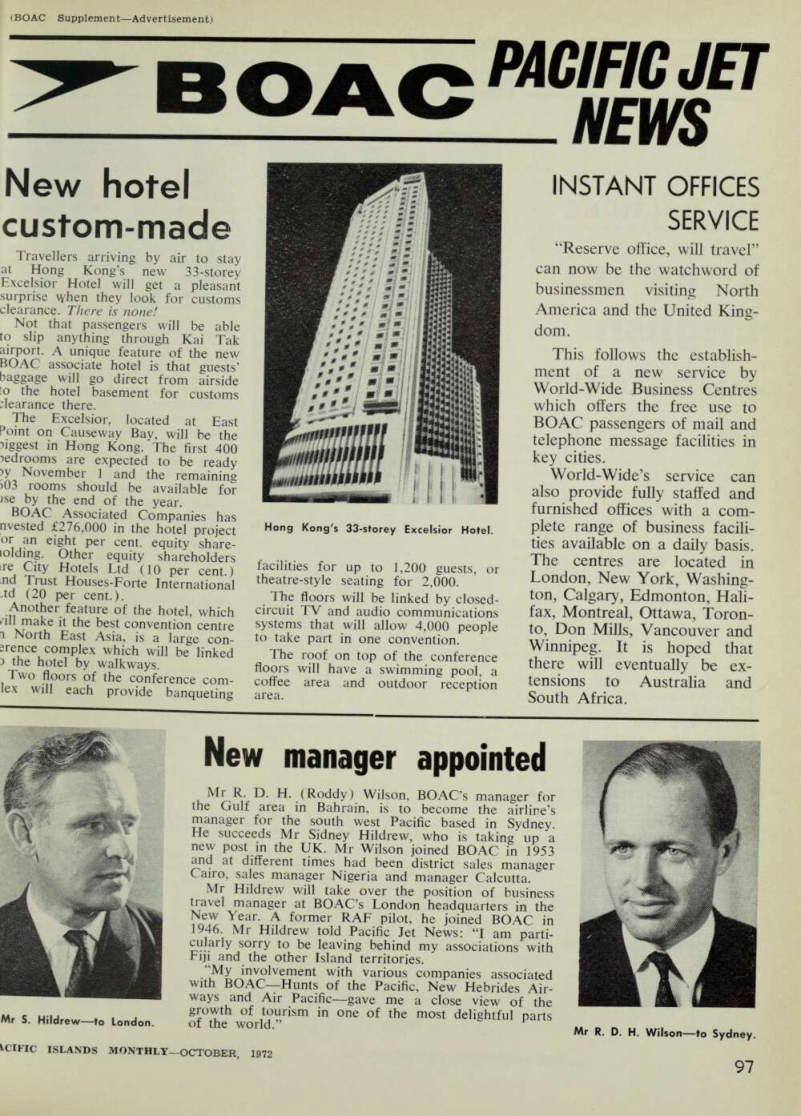
Boac Pacific Jet
(BOAC Supplement—Advertisement)
New hotel
custom-made
Travellers arriving by air to stay at Hong Kong’s new 33-storey Excelsior Hotel will get a pleasant surprise when they look for customs clearance. There is none!
Not that passengers will be able to slip anything through Kai Tak airport. A unique feature of the new BOAC associate hotel is that guests’ baggage will go direct from airside to the hotel basement for customs dearance there.
The Excelsior, located at East Point on Causeway Bay, will be the dggest in Hong Kong. The first 400 bedrooms are expected to be ready ?y November 1 and the remaining >O3 rooms should be available for ise by the end of the year.
BOAC Associated Companies has nvested £276,000 in the hotel project or an eight per cent, equity share loldmg. Other equity shareholders ire City Hotels Ltd (10 per cent.) nd Trust Houses-Forte International Td (20 per cent.).
Another feature of the hotel, which /ill make it the best convention centre i North East Asia, is a large con srence complex which will be linked 3 the hotel by walkways.
Two floors of the conference corn lex will each provide banqueting
facilities for up to 1,200 guests, or theatre-style seating for 2,000.
The floors will be linked by closed circuit TV and audio communications systems that will allow 4,000 people to take part in one convention.
The roof on top of the conference floors will have a swimming pool, a coffee area and outdoor reception area.
Instant Offices
Service
“Reserve office, will travel” can now be the watchword of businessmen visiting North America and the United King dom.
This follows the establish ment of a new service by World-Wide Business Centres which offers the free use to BOAC passengers of mail and telephone message facilities in key cities.
World-Wide’s service can also provide fully staffed and furnished offices with a com plete range of business facili ties available on a daily basis.
The centres are located in London, New York, Washing ton, Calgary, Edmonton, Hali fax, Montreal, Ottawa, Toron to, Don Mills, Vancouver and Winnipeg. It is hoped that there will eventually be ex tensions to Australia and South Africa.
Hong Kong's 33-storey Excelsior Hotel.
New manager appointed
Mr R. D. H. (Roddy) Wilson, BOAC’s manager for the Gulf area in Bahrain, is to become the airline’s manager for the south west Pacific based in Sydney.
He succeeds Mr Sidney Hildrew, who is taking up a new post in the UK. Mr Wilson joined BOAC in 1953 and at different times had been district sales manager Cairo, sales manager Nigeria and manager Calcutta.
Mr Hildrew will take over the position of business travel manager at BOAC’s London headquarters in the New Year. A former RAF pilot, he joined BOAC in 1946. Mr Hildrew told Pacific Jet News: “I am parti cularly sorry to be leaving behind my associations with Fiji and the other Island territories. ‘Aly involvement with various companies associated with BOAC—-Hunts of the Pacific, New Hebrides Air ways and Air Pacific—gave me a close view of the growth of tourism in one of the most delightful parts of the world.”
Mr S. Hildrew—to London.
Mr R. D. H. Wilson—to Sydney.
Advertisements & other items, p. 99 (1 item)
97
LCIFIC ISLANDS MONTHLY—OCTOBER, 1972
English
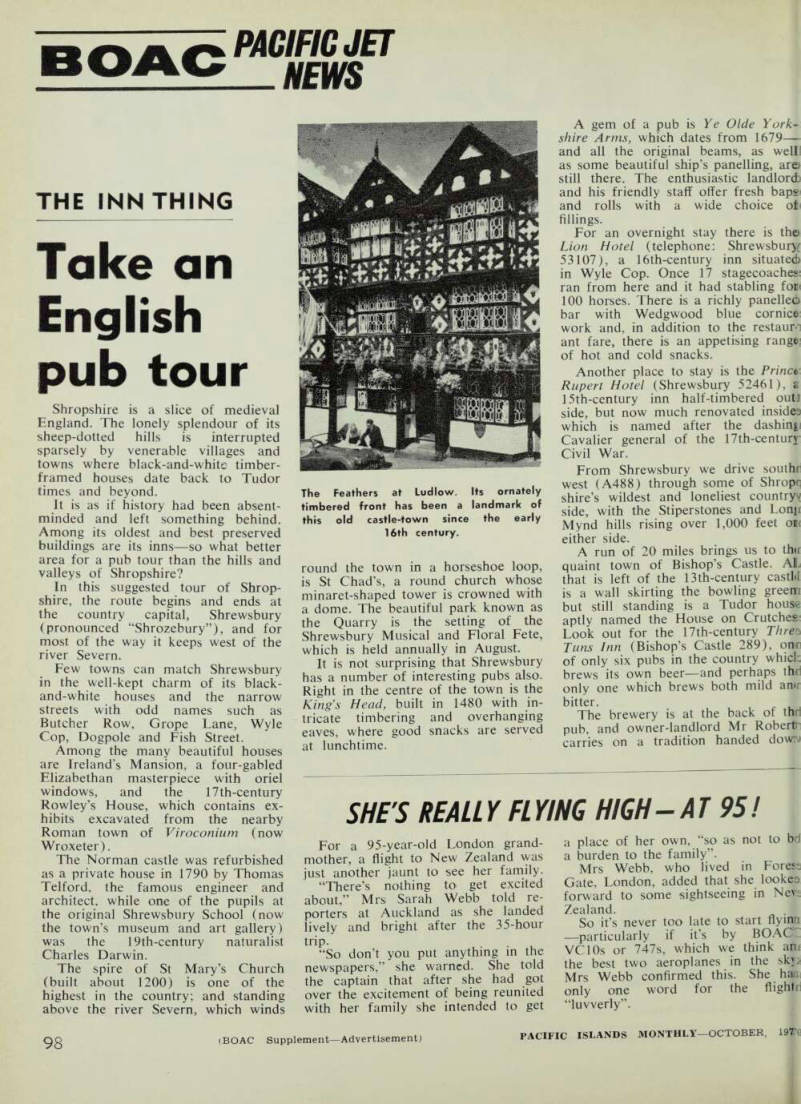
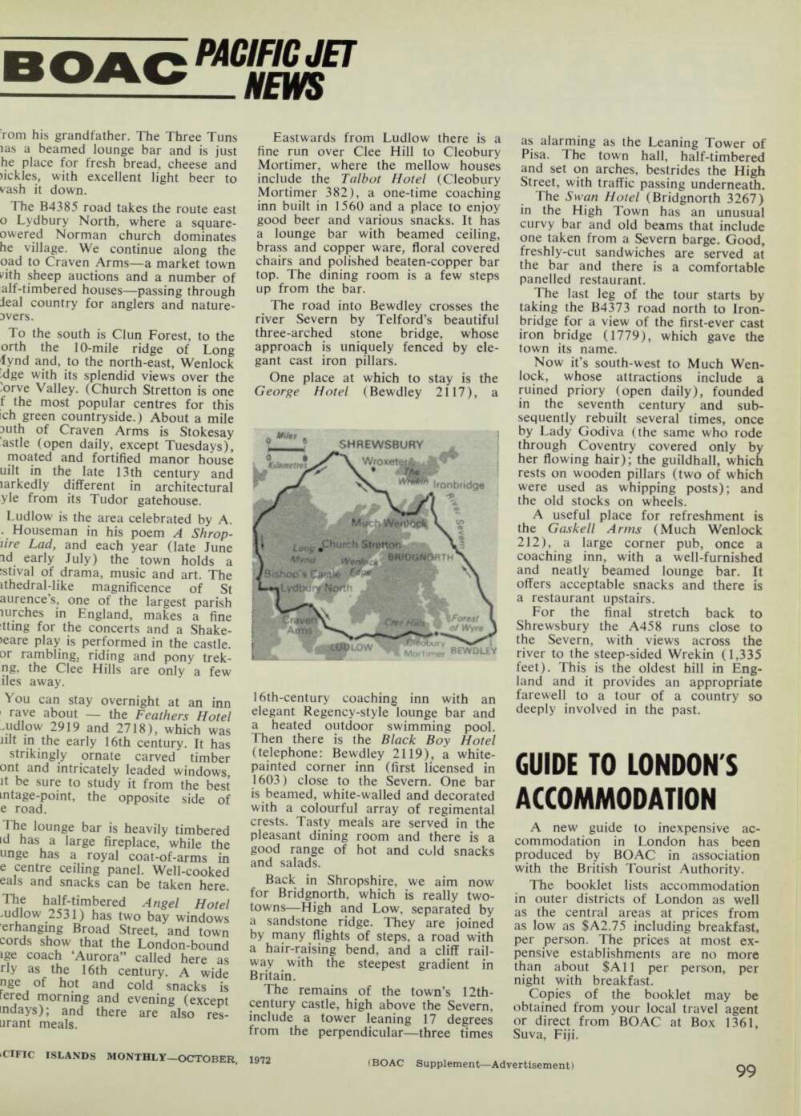
The Inn Thing
Take an English pub tour
Shropshire is a slice of medieval England. The lonely splendour of its sheep-dotted hills is interrupted sparsely by venerable villages and towns where black-and-white timber framed houses date back to Tudor times and beyond.
It is as if history had been absent minded and left something behind.
Among its oldest and best preserved buildings are its inns—so what better area for a pub tour than the hills and valleys of Shropshire?
In this suggested tour of Shrop shire, the route begins and ends at the country capital, Shrewsbury (pronounced “Shrozebury”), and for most of the way it keeps west of the river Severn.
Few towns can match Shrewsbury in the well-kept charm of its black and-white houses and the narrow streets with odd names such as Butcher Row, Grope Lane, Wyle Cop, Dogpole and Fish Street.
Among the many beautiful houses are Ireland’s Mansion, a four-gabled Elizabethan masterpiece with oriel windows, and the 17th-century Rowley’s House, which contains ex hibits excavated from the nearby Roman town of Viroconium (now Wroxeter).
The Norman castle was refurbished as a private house in 1790 by Thomas Telford, the famous engineer and architect, while one of the pupils at the original Shrewsbury School (now the town’s museum and art gallery) was the 19th-century naturalist Charles Darwin.
The spire of St Mary’s Church (built about 1200) is one of the highest in the country; and standing above the river Severn, which winds
round the town in a horseshoe loop, is St Chad’s, a round church whose minaret-shaped tower is crowned with a dome. The beautiful park known as the Quarry is the setting of the Shrewsbury Musical and Floral Fete, which is held annually in August.
It is not surprising that Shrewsbury has a number of interesting pubs also.
Right in the centre of the town is the King’s Head, built in 1480 with in tricate timbering and overhanging eaves, where good snacks are served at lunchtime.
A gem of a pub is Ye Olde York shire Arms, which dates from 1679 and all the original beams, as well! as some beautiful ship’s panelling, ar© still there. The enthusiastic landlord) and his friendly staff offer fresh baps< and rolls with a wide choice ot< fillings.
For an overnight stay there is th©' Lion Hotel (telephone: Shrewsbury 53107), a 16th-century inn situated) in Wyle Cop. Once 17 stagecoaches ran from here and it had stabling fort 100 horses. There is a richly panelle6 bar with Wedgwood blue cornice: work and, in addition to the restaun ant fare, there is an appetising range; of hot and cold snacks.
Another place to stay is the Prince: Rupert Hotel (Shrewsbury 52461), s 15th-century inn half-timbered out! side, but now much renovated insides which is named after the dashing/ Cavalier general of the 17th-century* Civil War.
From Shrewsbury we drive southri west (A 488) through some of Shropq shire’s wildest and loneliest side, with the Stiperstones and Lonjr Mynd hills rising over 1,000 feet one either side.
A run of 20 miles brings us to th/r quaint town of Bishop’s Castle. AL that is left of the 13th-century castlJ: is a wall skirting the bowling greem but still standing is a Tudor house aptly named the House on Crutches: Look out for the 17th-century Thres Tuns Inn (Bishop’s Castle 289), onn of only six pubs in the country which brews its own beer —and perhaps thd only one which brews both mild an»n bitter.
The brewery is at the back of thd pub, and owner-landlord Mr Roberth carries on a tradition handed dowiv
The Feathers at Ludlow. Its ornately timbered front has been a landmark of this old castle-town since the early 16th century.
fom his grandfather. The Three Tuns las a beamed lounge bar and is just he place for fresh bread, cheese and fickles, with excellent light beer to vash it down.
The 84385 road takes the route east o Lydbury North, where a square owered Norman church dominates he village. We continue along the oad to Craven Arms—a market town idth sheep auctions and a number of alf-timbered houses—passing through leal country for anglers and nature- Dvers.
To the south is Clun Forest, to the orth the 10-mile ridge of Long lynd and, to the north-east, Wenlock 'dge with its splendid views over the '°rve Valley. (Church Stretton is one f the most popular centres for this ich green countryside.) About a mile puth of Craven Arms is Stokesay astle (open daily, except Tuesdays), moated and fortified manor house uilt in the late 13 th century and larkedly different in architectural yle from its Tudor gatehouse.
Ludlow is the area celebrated by A. • Houseman in his poem A Shrop ure Lad, and each year (late June id early July) the town holds a :stival of drama, music and art. The ithedral-like magnificence of St aurence’s, one of the largest parish lurches in England, makes a fine ttmg for the concerts and a Shake >eare play is performed in the castle, or rambling, riding and pony trek ng, the Clee Hills are only a few iles away.
You can stay overnight at an inn rave about the Feathers Hotel .udlow 2919 and 2718), which was ult in the early 16th century. It has strikingly ornate carved timber ont and intricately leaded windows, it be sure to study it from the best mtage-point, the opposite side of e road.
The lounge bar is heavily timbered id has a large fireplace, while the unge has a royal coat-of-arms in e centre ceiling panel. Well-cooked eals and snacks can be taken here.
The half-timbered Angel Hotel mdlow 2531) has two bay windows erhangmg Broad Street, and town cords show that the London-bound ige coach ‘Aurora” called here as rly as the 16th century. A wide hot and cold snacks is tered morning and evening (except indays); and there are also res arant meals.
Eastwards from Ludlow there is a fine run over Clee Hill to Cleobury Mortimer, where the mellow houses include the Talbot Hotel (Cleobury Mortimer 382), a one-time coaching inn built in 1560 and a place to enjoy good beer and various snacks. It has a lounge bar with beamed ceiling, brass and copper ware, floral covered chairs and polished beaten-copper bar top. The dining room is a few steps up from the bar.
The road into Bewdley crosses the river Severn by Telford’s beautiful three-arched stone bridge, whose approach is uniquely fenced by ele gant cast iron pillars.
One place at which to stay is the George Hotel (Bewdley 2117), a
16th-century coaching inn with an elegant Regency-style lounge bar and a heated outdoor swimming pool.
Then there is the Black Boy Hotel (telephone: Bewdley 2119), a white painted corner inn (first licensed in 1603) close to the Severn. One bar is beamed, white-walled and decorated with a colourful array of regimental crests. Tasty meals are served in the pleasant dining room and there is a good range of hot and cold snacks and salads.
Back in Shropshire, we aim now for Bridgnorth, which is really two towns —High and Low, separated by a sandstone ridge. They are joined by many flights of steps, a road with a hair-raising bend, and a cliff rail way with the steepest gradient in Britain.
The remains of the town’s 12th century castle, high above the Severn, include a tower leaning 17 degrees from the perpendicular—three times
as alarming as the Leaning Tower of Pisa. The town hall, half-timbered and set on arches, bestrides the High Street, with traffic passing underneath.
The Swan Hotel (Bridgnorth 3267) in the High Town has an unusual curvy bar and old beams that include one taken from a Severn barge. Good, freshly-cut sandwiches are served at the bar and there is a comfortable panelled restaurant.
The last leg of the tour starts by taking the 84373 road north to Iron bridge for a view of the first-ever cast iron bridge (1779), which gave the town its name.
Now it’s south-west to Much Wen lock, whose attractions include a ruined priory (open daily), founded in the seventh century and sub sequently rebuilt several times, once by Lady Godiva (the same who rode through Coventry covered only by her flowing hair); the guildhall, which rests on wooden pillars (two of which were used as whipping posts); and the old stocks on wheels.
A useful place for refreshment is the Gaskell Arms (Much Wenlock 212), a large corner pub, once a coaching inn, with a well-furnished and neatly beamed lounge bar. It offers acceptable snacks and there is a restaurant upstairs.
For the final stretch back to Shrewsbury the A 458 runs close to the Severn, with views across the river to the steep-sided Wrekin (1,335 feet). This is the oldest hill in Eng land and it provides an appropriate farewell to a tour of a country so deeply involved in the past.
Guide To London's
Accommodation
A new guide to inexpensive ac commodation in London has been produced by BO AC in association with the British Tourist Authority.
The booklet lists accommodation in outer districts of London as well as the central areas at prices from as low as $A2.75 including breakfast, per person. The prices at most ex pensive establishments are no more than about SAII per person, per night with breakfast.
Copies of the booklet may be obtained from your local travel agent or direct from BOAC at Box 1361, Suva, Fiji.
She's Really Flying High-At 95!
For a 95-year-old London grand mother, a flight to New Zealand was just another jaunt to see her family.
“There’s nothing to get excited about,” Mrs Sarah Webb told re porters at Auckland as she landed lively and bright after the 35-hour trip. .
“So don’t you put anything m the newspapers,” she warned. She told the captain that after she had got over the excitement of being reunited with her family she intended to get
a place of her own, “so as not to be a burden to the family”.
Mrs Webb, who lived in Fores; Gate, London, added that she looke: forward to some sightseeing in Nev Zealand.
So it’s never too late to start flymr —particularly if it’s by BOAC.
VC 10s or 7475, which we think an the best two aeroplanes in the sky Mrs Webb confirmed this. She has only one word for the flight) “luvverly”.
Advertisements & other items, pp. 100-101 (2 items)
R St • Fc Pacific Jet
98
PACIFIC ISLANDS MONTHLY—OCTOBER. 19T
(BOAC Supplement—Advertisement)
R St • fC PACIFIC JET
BOAC NEWS
Bo Ac Mc Jg&P
99
(BOAC Supplement—Advertisement)
iCIFIC ISLANDS MONTHLY—OCTOBER, 1972
BO AC MC jg&P
Special offer
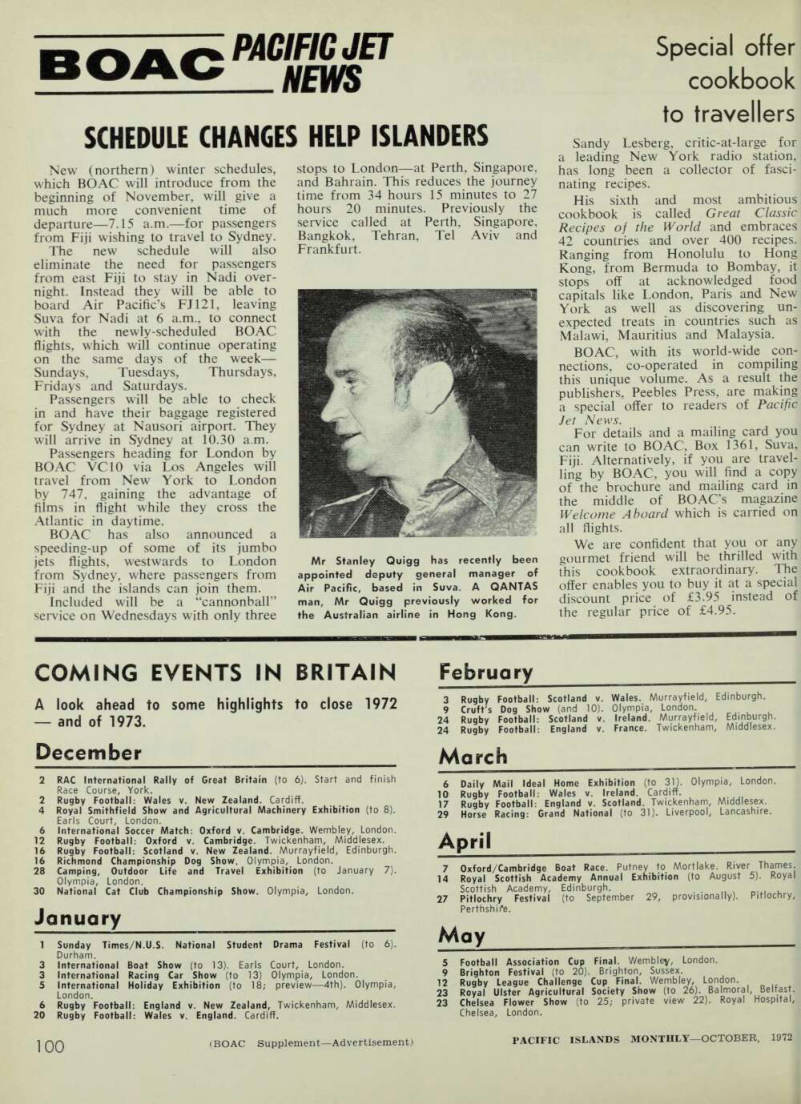
Schedule Changes Help Islanders
New (northern) winter schedules, which BOAC will introduce from the beginning of November, will give a much more convenient time of departure—7.ls a.m.—for passengers from Fiji wishing to travel to Sydney.
The new schedule will also eliminate the need for passengers from east Fiji to stay in Nadi over night. Instead they will be able to board Air Pacific’s FJI2I, leaving Suva for Nadi at 6 a.m., to connect with the newly-scheduled BOAC flights, which will continue operating on the same days of the week— Sundays, Tuesdays, Thursdays, Fridays and Saturdays.
Passengers will be able to check in and have their baggage registered for Sydney at Nausori airport. They will arrive in Sydney at 10.30 a.m.
Passengers heading for London by BOAC VC 10 via Los Angeles will travel from New York to London by 747, gaining the advantage of films in flight while they cross the Atlantic in daytime.
BOAC has also announced a speeding-up of some of its jumbo jets flights, westwards to London from Sydney, where passengers from Fiji and the islands can join them.
Included will be a “cannonball” service on Wednesdays with only three
stops to London—at Perth, Singapore, and Bahrain. This reduces the journey time from 34 hours 15 minutes to 27 hours 20 minutes. Previously the service called at Perth, Singapore, Bangkok, Tehran, Tel Aviv and Frankfurt.
Special offer
cookbook
to travellers
Sandy Lesberg, critic-at-large for a leading New York radio station, has long been a collector of fasci nating recipes.
His sixth and most ambitious cookbook is called Great Classic Recipes of the World and embraces 42 countries and over 400 recipes.
Ranging from Honolulu to Hong Kong, from Bermuda to Bombay, it stops off at acknowledged food capitals like London, Paris and New York as well as discovering un expected treats in countries such as Malawi, Mauritius and Malaysia, BOAC, with its world-wide con nections, co-operated in compiling this unique volume. As a result the publishers, Peebles Press, are making a special offer to readers of Pacific Jet News.
For details and a mailing card you can write to BOAC, Box 1361, Suva, Fiji. Alternatively, if you are travel ling by BOAC, you will find a copy of the brochure and mailing card in the middle of BOACs magazine Welcome Aboard which is carried on all flights.
We are confident that you or any gourmet friend will be thrilled with this cookbook extraordinary. The offer enables you to buy it at a special discount price of £3.95 instead of the regular price of £4.95,
Mr Stanley Quigg has recently been appointed deputy general manager of Air Pacific, based in Suva. A QANTAS man, Mr Quigg previously worked for the Australian airline in Hong Kong.
January
Coming Events In Britain
A look ahead to some highlights to close 1972
and of 1973.
December
2 RAC International Rally of Great Britain (to 6). Start and finish Race Course, York. 2 Rugby Football: Wales v. New Zealand. Cardiff. 4 Royal Smithfield Show and Agricultural Machinery Exhibition (to 8).
Earls Court, London. 6 International Soccer Match: Oxford v. Cambridge. Wembley, London. 12 Rugby Football; Oxford v. Cambridge. Twickenham, Middlesex. 16 Rugby Football; Scotland v. New Zealand. Murrayfield, Edinburgh. 16 Richmond Championship Dog Show. Olympia, London. 28 Camping, Outdoor Life and Travel Exhibition (to January 7).
Olympia, London. 30 National Cat Club Championship Show. Olympia, London.
January
1 Sunday Times/N.U.S. National Student Drama Festival (to 6).
Durham. 3 International Boat Show (to 13). Earls Court, London. 3 International Racing Car Show (to 13) Olympia, London. 5 International Holiday Exhibition (to 18; preview—4th). Olympia, London. 6 Rugby Football: England v. New Zealand, Twickenham, Middlesex. 20 Rugby Football: Wales v. England. Cardiff.
Februory .
3 Rugby Football: Scotland v. Wales. Murrayfield, Edinburgh. 9 Cruft's Dog Show (and 10). Olympia, London 24 Rugby Football: Scotland v. Ireland. Murrayfield, Edinburgh. 24 Rugby Football: England v. France. Twickenham, Middlesex.
Morch
6 Daily Mail Ideal Home Exhibition (to 31). Olympia, London, 10 Rugby Football: Wales v. Ireland. Cardiff. 17 Rugby Football: England v. Scotland. Twickenham, Middlesex. 29 Horse Racing: Grand National (to 31). Liverpool, Lancashire.
April
7 Oxford/Cambridge Boat Race. Putney to Mortlake. River Thames. 14 Royal Scottish Academy Annual Exhibition (to August 5). Royal Scottish Academy, Edinburgh. . . .. . . 27 Pitlochry Festival (to September 29, provisionally). Pitlochry, Perthshire.
May
5 Football Association Cop Final. Wembley, London. 9 Brighton Festival (to 20). Brighton, Sussex. 12 Rugby League Challenge Cup Final. Wembley, London. 23 Royal Ulster Agricultural Society Show (to 26). Balmoral, Belfast. 23 Chelsea Flower Show (to 25; private view 22). Royal Hospital, Chelsea, London.
Advertisements & other items, p. 102 (1 item)
Boac News
100
PACIFIC ISLANDS MONTHLY—OCTOBER, 1972
(BOAC Supplement—Advertisement)
n *v a JET
BOAC NEWS
Business and Development

FIJI HAS THE LION'S SHARE OF THE
Neighbourhood's Business
Prom a Suva correspondent
R. M. Major, in September PIM (p. 101) pointed out the difficulties of developing economic unity in the Pacific Islands, which is one of the tasks of the new Bureau for Economic Co-operation based in Suva. Analysis of Fiji’s latest trade figures (for 1970) point to an interesting pattern of trade between Fiji and its neighbours which is worth noting. In short, can Fiji lend a helping hand to its neighbours?
Both Fiji’s imports and exports continued to increase in 1970. The falue of domestic exports in 1970 vas $49,254,000, an increase of 55.706.000 or 13 per cent, over 1969, vhile Fiji’s re-exports, valued at :i3,053,000 were $3,374,000, or 35 >er cent, higher than in 1969. Taken is a whole, total exports of 162.307.000 were 17 per cent, higher ban in 1969.
Imports have increased very rapidly 'ver the past few years and 1970 was o exception, with imports valued at 90.502.000 being $12,614,000 or 16 er cent, higher than the 1969 level.
The visible trade deficit (the mount by which total imports ex eed total exports) stood at a record 28.195.000 in 1970. This deficit was lore than offset however, by in cases in invisible earnings and by rivate and official capital inflows.
For example, gross earnings from )urism are estimated at $24.3 mil on for 1970. After taking invisible arnings into account the net balance f payments position in 1970 showed n estimated surplus of $3.5 million.
IMPORTS: Fiji’s import pattern as always been heavily biased to ards its neighbours, Australia, New ealand and Japan and its former letropolitan power, the United King am. 1970 saw a continued decline in ie level of imports from the United ingdom. Whereas 10 years ago UK iports represented 28 per cent of *tal imports, in 1970 they had ipped to 17 per cent.
Japan over the same period in eased its share of total imports from per cent, to 15 per cent., and New ealand increased its share from 8 t cent, to 12 per cent. Most of the owth in Japanese imports into Fiji fleets the development of the tourist dustry and the associated growth
of duty-free sales of predominantly Japanese goods.
New Zealand’s imports to Fiji were given a strong boost by New Zealand’s devaluation in late 1967, whereas Australia, which did not devalue, has seen its share of the Fiji market fall from 27 per cent, in 1961 to 24 per cent, in 1970.
EXPORTS: Sugar continued to be Fiji’s major single export in 1970 with 329,129 tons, valued at $31,821,000, being exported. Sugar has made up about two-thirds of domestic exports for a number of years now. With British entry into the European Economic Community imminent, there are fears that the
EEC’s ‘Common Agricultural Policy’ could have unfavourable consequences for the Fiji sugar industry.
Fiji’s sugar quota for the American market has risen in recent years, however, and stood at 45,000 short tons in 1970. Coconut oil was once again the second most important export in 1970, with shipments of 18,704 tons worth $5,130,000.
In 1970 growth in Fiji’s manufac turing industries was encouraging, particularly with respect to biscuits, cigarettes, cement, paint, clothing and galvanised corrugated iron. Most of the exports of Fiji’s manufacturing industries go to neighbouring Pacific countries which do not have similar industries of their own.
In this respect Fiji is slowly be coming the Hong Kong or Singapore of the South-west Pacific and there is concern that in the future it will prove difficult to attract small-scale manufacturing industry to other countries in the region because of the very strong advantages to busi nessmen of locating these in Fiji.
(over)
Regional Trade ;
Fiji’s Trade with South Pacific Countries, 1970 F$ Total Total Exports Imports Cook Islands 249,695 2,177 Gilbert and Ellice Islands 522,473 2,264 Niue 166,558 461 Tonga 1,206,552 12,664 Western Samoa 1,169,792 8,357 American Samoa 866,761 19,013 Wallis and Futuna 412,757 149 New Caledonia 184,325 3,548 New Hebrides 380,170 700 Tahiti 95,419 Others 111,227 3,049
Total 5,365,729
52,382
In 1970 Fiji’s exports to countries in the SW Pacific region were worth $5,255,000 (representing 8.6 per cent, of total exports). By comparison, imports into Fiji from the same coun tries were worth a mere $52,000 (representing only 0.1 per cent, of total imports). Fiji is fortunate therefore in having a favourable trade balance of $5,200,000 with its regional neighbours.
A third of Fiji’s exports to the region ($1,794,000) are domestic ex ports while the other two-thirds ($3,461,000) are re-exports. The two main destinations of the domestic exports are Tonga and Western Samoa.
With Fiji’s exports to the region being a hundred times greater than its imports from the region it seems to be high time that Fiji took steps to encourage imports. Fiji can hardly complain about its adverse balance of trade with Australia while its near neighbours have an even greater ad verse balance of trade with Fiji.
Import duties on handicrafts enter ing Fiji and the harsh enforcement of quarantine regulations do little to encourage imports into Fiji from the region.
Perhaps we might see Fiji starting an aid programme to assist its less developed neighbours? Certainly if its buoyant foreign trade position is any thing to go by, it may well find itself doing this in the future.
Air Nauru to
return to consortium?
While the Pacific leaders were neeting in Suva and then in Apia, )ther —and maybe more important alks—were going on outside the main irena.
Member governments of the Air Pacific consortium were attempting to ure back to the fold their erstwhile jartners Air Nauru, which broke iway in March to fly it alone. The alks. President Hammer Deßoburt et drop, were at “ministerial level” md were aimed at persuading Nauru hat its future lay within a regional irline.
“I have been approached to go »ack and there are possibilities” said he president to PIM, “but the most can say is that I will listen very arefully to what they have to say.
Ve always think there is room for o-operation.”
Then, referring to the heated ex hanges during the February Can erra Forum which led to Nauru reaking away from the regional air rrangement, the president said: “The lash came because, I think, there /as unfriendliness. I think they found s inconvenient; that the existence of
Air Nauru was an inconvenience.”
The break, the president stressed, was not the beginning of a wider division. Any suggestion that Nauru wanted to draw closer to its Micro nesian relations at the expense of its other South Pacific ties (such as the SPC and Forum) was wrong.
“We are not turning away from the South Pacific,” he said. “We must make that quite clear. We feel we are part of both worlds. We have ties with Micronesia which will develop but we also have close ties with the South Pacific. We are part of the South Pacific whereas our relations with Micronesia are not firmly in existence yet.”
Japanese "wont
no control"
In Suva in September, the Japanese Ambassador to Australia, Mr Shizuo Saito, was most emphatic that Fiji need have no fears about foreign control by Japanese investors.
“It is not true that Japanese busi nessmen prefer to have the major shareholding when they invest in a country,” he stressed. “I know Fiji would welcome Japanese investment —and we have no idea of going any further than a 50 per cent, share holding in any venture.”
Mr Saito said so far as Japanese
investment in Fiji was concerned, tourism had first priority. A consor tium of Japanese companies had already bought a major share in the Mana Island resort and the massive real estate company, Nomura Real Estate Cos., of Tokyo, had bought $300,000 worth of sites at the Pacific Harbour resort development, for re sale to Japanese investors. Other areas for Japanese involvement in tourism were being considered.
Mr Saito said it was possible that Japan Air Lines would eventually fly into Fiji—“but there was nothing concrete yet.” He doubted whether the airline had yet approached the Japanese Government on the question.
“My government sent a three-man team to Fiji for a feasibility study on investment opportunities here and areas of possible co-operation. The conclusions will be made known soon,” he said.
Mr Saito mentioned agriculture and fishery as two other areas for co operation. There might be some pos sibility of lessening the trade im balance between the two countries— but he couldn’t be more specific at this stage.
He saw no possibility yet of estab lishing assembly plants in Fiji for Japanese electronic goods—“but this might develop”. The exchange of students and technicians was being considered.
Mr Saito said that in addition to economic and trade co-operation be tween Fiji and Japan, he would like to see closer cultural links, and would be asking Japanese cultural missions to visit Fiji, “in a spirit of enlighten ment”.
Mr Saito said he could not foresee the development of a Pacific free trade area involving Asia and the South Pacific in the immediate future.
Economic development in each coun try was so different that such a bloc could not be maintained. “We have to have this idea as a target but it is too hard a practical problem to solve at present,” he said.
"Unrivalled
Experience"
Mr Ken Piddington, deputy to Mr Make Tupouniua, the new Bureau for Economic Co operation’s first director, will be something more than just a deputy. Mr Tupouniua has an unrivalled experience of the Islands’ economic and trade prob lems as Tonga’s Minister of Finance for the last 12 years.
Allied to that will be Mr Pidding ton s knowledge of the economic workings of the NZ Govern ment’s mind in relation to a wider, international field. He is coming to Suva from his job of head of the Economics Division of the NZ Ministry of Foreign Affairs.
He is an MA—he got it in French—and no stranger to his new boss. They were together at Auckland University in the 19505.
Advertisements & other items, pp. 103-106 (2 items)
101
ISLANDS MONTHLY—OCTOBER, 1972
Brewo Bush Knives No. 625
SUPERIOR
QUALIT.y
INSUPERABLE
mo LION BRAND
exclusively sold by:
Breckwoldt & Co. (N.G.) Pty. Ltd.
P.O. Box 222,
RABAUL
P.O. Box 72,
KIETA.
P.O. Box 1549, Boroko, P.O. Box 185,
PORT MORESBY. MADANG.
P.O. Box 237,
MT. HAGEN.
P.O. Box 1188,
LAE.
P.O. Box 178,
WEWAK.
BRECKWOLDT & CO. BRECKWOLDT S.A.R.L. BRECKWOLDT & CO. (5.1.) LTD.
P.O. Box 47, APIA. B.P, 65, NOUMEA. P.O. Box 140, HONIARA.
AMPLIFIERS for ALL
L A l°a, PA SYSTEMS
Geloso P.A. Amplifiers, well known for performance and reliability, have models rated from 10 watt to 200 watt for all requirements. Horn and column speakers, mikes and stands can be supplied.
Ideal for installations in factories, schools, clubs, hospitals, stores and
sporting complexes.
FULL particulars of all GELOSO P.A. equipment will be forwarded FREE on request. We will be pleased to quote for the particular equipment you may require.
Gl/2030 Amplifier with M 59 and 880 Table Stand NOW Hear This! . . . GELOSO “Amplivoce” Model 2583 Loudhailers The 2583 Loud Mailer, a lightweight, weatherproof "power megaphone", can be heard loud and clear up to 300 yards away. A real boon to construction supervisers, schools, surf clubs, sporting bodies anyone that must get a message over... at a distance.
' Prv. LTD VIC.: 493-499 Victoria St., West Melbourne. Phone: 329-9633.
N.S.W.: Sydney. Phone; 929 8066 W.A.; Perth. Phone: 49 4919.
QLD.: L. E. BOUGHEN & CO.,
Auchenflower. Phone; 70-8097.
TELEX: Melb. 31447, Sydney 21707 GELOSO AMP. & 2583 P-I-M. 10/72 Name Address . ---
MAIL THIS COUPON
PORTABLE OR STANDBY POWER
500 - 50,000 watts When power goes out PINCOR goes on! A complete selection of dependable generators, alternators, transfer panels, and demand control systems. For further information, see your area PINCOR Distributor or write to: Pioneer Gen-E-Motor Corporation 5841 W. Dickens Avenue Chicago, 111. 60639, U.S.A.
Wenger Swiss Army I
unique in precision
Sole Importers:
PETER FISHER
TRADING PTY.LTD.
321 Pitt Street
SYDNEY
Telephone 26 1109 o
Knives,
and efficiency
WENGER
I
U AII over Australia”
MARSON
HP-4 HAND RIVETTING PLIER
t ! w
80 TONS
TEST SPECIFICATIONS
ultimate tensile. 2,000 lbs approx, net effective at pulling jaws
JAW HARDNESS 58-eo Rc.
CAPACITY. . . 3/32", 1/8", 5/32", 3/1-6"
KLIKFAST RIVETS
Weight, 1.25 lbs.; length overall, 9.75"
Craftsmanship—material —performance
COMPLETELY GUARANTEED BY
MARSON PRODUCTS (AUSTRALIA) PTY. LTD.
102 May Street, St Peters, N.S.W. 51-2285
ED IT D/\D¥llVfr Any beach is yours for the taking lliJulj I AnMllU in a 4 seat Lake Buccaneer. i s Tw*-.
LAKE AIRCRAFT SALES PTY. LTD.
154 INGLEBURN ROAD, INGLEBURN, N.S.W. 2565, AUSTRALIA.
Phone Sydney 605-1478. Australasian and South Pacific Distributor.
Tax haven telex
The New Hebrides administra tion is taking urgent steps to establish telex links for its grow ing tax haven business. The move follows pressure from some of the newly-established banks and trust companies who were begin ning to feel like the wolf watching sheep on the far side of the river a lot of offshore business sniffing around the New Hebrides has been put off by the absence of a telex link.
fill lead to stock exchange

[?]vestment Corp. activities fill lead to stock exchange
Not all Island administrations believe that government investment corporations, such as the one not long established in Papua New Guinea, are the answer to investment problems. Do they, for example, really involve local people in participation or are they merely looked on locally as another arm of Treasury? PIM invited Mr. E. S. Owens to explain the aims of, and progress made with, the PNG Investment Corporation.
By E. S. OWENS, Chairman of the Investment Corporation of Papua New Guinea.
fhe Investment Corporation of )ua New Guinea was established 1971 as an independent legal entity h its own board of directors and nagement. The board of directors isists of 10 members, six of whom white, four are black. The deputy tirman is a Tolai, Mr Paulias tane, from the Gazelle Peninsula. 2 others are representatives of the erent districts of Papua New inea. Since the first board meeting February it has accumulated d assets of approximately 56.2 lion and earned a net profit in ess of $lOO,OOO. As well it has an iressive list of companies operating PNG currently seeking participa i. fhe corporation’s role is to acquire lificant interests in profitable or entially profitable overseas com lies operating in PNG and to in ve local people as individual share ders in its investments, fhe corporation has demonstrated that it can put together an •active portfolio of shares in sub itial and profitable companies, pile doubt as to the reaction of sting companies to the placing of lificant holdings in the hands of government agency—the corpora i. A doubt which in the event ved groundless; in fact the con t has been welcomed because a nber of companies have for long hed to admit local people as share ders. fo meet its second commitment the poration is now actively planning the involvement of the local >ple as individual shareholders. It’s hallenging task when it is remem ed that the population of 2.5 lion is spread over a half-million lare miles of difficult country, aks some 700 dialects and approxi tely 40 per cent, are still engaged subsistence agriculture.
Nevertheless, the people have made
it clear to the Administration through their representatives in the House of Assembly that they want rapid de velopment in their standard of living.
The need for investment in roads, hospitals, schools and industries is apparent. But there has been a great basic problem of bridging the gap between the desire for investment on the one hand and their limited capacity to generate savings on the other.
It was in an effort to solve this problem that the Australian Govern ment set up the investment corpora tion.
The House of Assembly has stated that it sees as essential a continuing sizeable flow of private capital into PNG together with technical know how and the managerial skills which follow. Without this capital inflow, it is clear PNG will not be able to develop its social and economic stan dards at the pace which its people want.
Both the first and second Houses of Assembly are on record as wel coming overseas capital and guaran teeing it against expropriation or discriminatory treatment. These decla rations have done much to maintain and strengthen the confidence of overseas investors in PNG.
In assessing propositions put to it, the board of the corporation con siders the following main criteria: • Is it a substantial company? • Is it a viable operation supported by history and/or projections? • Is it a significant or potentially significant employer of local labour? • Will it assist in developing PNG on a sound and balanced basis? • Will it provide employment and training opportunities for local people? • Will it involve maximum pro cessing of products in PNG? • Will it involve the provision of
Investment Trusts
maximum common user facilities such as roads, ports, etc? > Will it assist the country’s balance of payments through development of exports or re placement of imports? ► Is a worthwhile shareholding ranging from, say, 10 per cent, to 50 per cent, available to the corporation? • Can the corporation nominate a member for the board of direc tors?
Based on the foregoing criteria the operation holds shares in the fol ding companies: ANG Holdings Ltd., total assets $5.5 million—2o per cent equity capable of being increased to 26 per cent.
Burns Philp (New Guinea) Ltd., total assets $3O million—l2J per cent, equity capable of being in creased to 26 per cent.
Bougainville Copper Ltd., 1,000,000 shares of $1 each.
Commonwealth New Guinea Timbers, total assets $7 million— -35 per cent, equity.
Watkins Property Investments Ltd., total assets $700,000—45 per cent, of equity.
Money on deposit—ssoo,ooo.
These investments have been lanced by capital funds of $2.2 illion and the balance by borrow gB.
While the corporation will continue add to its investments, the main eoccupation now is the setting up a series of investment trusts. Each ist will be designed to appeal to fferent cross sections of the corn unity. Some will be general in Jure, in that they will hold shares more than one investment, while hers will have appeal because of e local nature of a single invest ;nt.
The first prospectus or invitation to /est in a corporation sponsored ist is expected to be ready in the st quarter of 1973. By that time e corporation must have established sound streamlined administration pable of processing accurately, eedily and at low cost the paper )rk involved in keeping track of ausands of small and inexperienced areholders.
It must have established a market r dealing in scrip of the trusts by pans of a daily advertised buy back ice for each trust and have pro led a network of offices through t PNG where scrip can be ex anged for cash and vice versa.
The current phase of the corpora l’s activities will be most demand
ing because public confidence is at stake. There will be no room for mistakes; planning must be meticu lous and patience and understanding will be at a premium during the introduction of this new form of saving and investment, which will in fact be the first step towards estab lishment of a stock exchange in PNG.
The corporation must succeed in this phase because without the in volvement of people in business enter prises there can be no understanding of the benefits which can flow from the partnership of capital, manage ment and labour.
The corporation is very conscious of the importance of its role in busi ness education and with this in mind is having a shortened form of its annual report printed in Motu and Pidgin. As well, copies of the full report will be sent to the University of Papua and New Guinea and schools so that young people will have the opportunity to know first hand the part played by various companies and industries in the de velopment of the country. This report can be the means of opening up new vistas for education and employment as the wide range of business under takings and opportunities in PNG are brought to the notice of students and others seeking to improve them selves.
In simple terms the corporation has a threefold task: • To be a responsible shareholder; • To encourage and make possible individual shareholding in its investments; and • To be a vehicle for business and management education.
The extent to which it is able to perform these roles will influence the rate of progress and development of PNG itself.
Tourism Looks Bright.—
Pacific Area Travel Association’s executive vice-president F. Marvin Plake anticipates that the 12 months from July will be another excellent year for tourism in the Pacific. In a letter to members he says: “Almost every destination area of the Pacific, and of the world, is up solidly from a year ago. There is no reason to imagine that this trend will diminish.
When reports are received from some area which indicates that tourism there is down, a brief investigation almost always shows that it is because of a temporary over-capacity of facilities. I say “temporary” because it has become obvious that even a severe overbuilding of hotels, for example, will correct itself within two or three years.”
Basic wage rise in
Port Moresby
The PNG Minimum Wages Board nquky (see p. 55) resulted in a lecision handed down September 19 0 raise the minimum pay for urban workers in Port Moresby from $8 to 1 11.50 forthwith, with a further rise »f $2.30 to come one year later. )omestic and agricultural workers re not included in the order, but it > expected that the decision will ventually affect them and all other workers throughout Papua New luinea.
Five trade unions had claimed the 'age should rise $l2 to $2O a week, ut the board apparently felt that a 2 per cent, rise was all the economy ould be called upon to bear at resent.
'tauru consolidates
rade link
The success which President ammer Deßoburt of Nauru had in jptember in gaining a foothold in ie US Trust Territory for the Nauru acific Line will mean more oppor mities for two-way trade between ie North and South Pacific.
Nauru’s active shipping line has len servicing Majuro, in the Mar lalls, from Melbourne and wanted to hend its operations to various ports the Trust Territory besides Majuro.
But at two meetings between the auruans, Micronesian Government presentatives and Transpac officials Majuro in August and September,
Transpac, which holds an exclusive franchise to TT ports, made it clear that “the present economic situation” in the TT precluded Nauru entering any other port than Majuro.
President Deßoburt was able to stress the advantages for Micronesia of a link south, with the result that both sides will meet again in six months to discuss progress generally and to consider extending the agree ment to another port in Western Micronesia.
Said a joint statement made at the September meeting, “It is the con fident hope of the parties to the agreement that the new arrangement will provide the people of Micronesia access to the markets of Australia, New Zealand and the islands of the Pacific for the purchase and sale of commodities, with regular delivery at reasonable rates.”
Toke-over bid
tor PNG brewery
Incorporated in Papua New Guinea on August 1 with an authorised capital of $4,500,000, San Miguel (PNG) Limited is making a take over bid for Territory United Brewery Limited with an offer to TUB share holders of one 50c share in San Miguel for three 50c TUB shares.
The offer is conditional on ac ceptances representing at least 76 per cent, of TUB’s issued capital. If the take-over succeeds, TUB, which has been ailing over the last 12 months, will be managed by Neptunia Corporation Limited, of Hong Kong, itself a subsidiary of the Manila
based San Miguel, and by Swan Brewery, of Melbourne, each of which has agreed to make cash sub scriptions of $312,000 for 625,000 shares in San Miguel.
Neptunia and Swan have also agreed to make available a further $812,000 each as a loan secured by second debentures over San Miguel’s assets. The loans, for five years, can be converted during the loan period into San Miguel shares at par.
Directors of San Miguel (PNG) Ltd include Mr B. C. Goodsell, managing director of Burns Philp (NG) Ltd, Mr Clifford Jackson, a well-known Port Moresby business man and three top executives from Swan Brewery.
San Miguel’s incorporation in PNGi was made with the object of staging: the TUB take-over.
Business briefs
• The Reserve Bank expected! returns from rural production ini PNG for 1971/72 to be down on the; previous year, the June statistical! bulletin revealed. Coffee prices have: been better, but manufacturing was restrained. Building activity was? similar, but improvement in both was? expected. Retail prices increased 8.41 per cent, in the 12 months to March,, 1972. Government spending was upc 7.2 per cent, at $144.6 m. Tax) revenue was up and loan raising had! been highly successful.
O The Solomon Islands Investment!
Company, has been floated in the Solomons by Naviti Investments Ltd of Fiji, and is offering 250,000 shares of $1 for public subscription. The first! venture of the new company is a halt share in Mendana Hotels, purchased from Guadalcanal Plains Ltd fon $200,000. Work has already begun: on a four-stage programme of en larging the hotel to 106 rooms.; Diversification of the company’s port folio, with Solomon Islanders taking a bigger share of economic develop ment, is an aim.
O Two new food factories are planned for the GEIC, a biscuit fac-: tory to be built on Betio by the newly-registered Tarawa Biscuit Com-i pany, and a bakery and shop which! will be opened on Bairiki, opposite the wharfs by the Bairiki Bakery Trading Company. The biscuit conn pany hopes to be able to export to the Marshalls and Nauru and is ex: perimenting with coconut meal to see if it can be used as an ingredient. An oven for the bakery costing $1,500 is being shipped from Australia.
Advertisements & other items, pp. 107-112 (4 items)
Dific Islands Monthly—October, 1972
Nairnflor
The Commercial
and Domestic
Vinyl
Flooring
Nairnflor is a fully flexible vinyl flooring available in 4 thicknesses I.lmm; I.smm; 2.omm; 2.5 mm; Nairnflor is manufactured in accordance with B.S. 3261; 1960 in a range of 19 colours in either 48" wide sheet or 12" x 12" tiles.
Nairnflor is marketed by
Fletcher
International
For further information and name of nearest stockist contact Fletcher International, Private Mail Bag, Auckland, New Zealand
Kerr Bros., the Parker Furniture people
FOR PACIFIC
ISLANDS
Parker Furniture undoubted leader in Australia's domestic furniture industry Manufacturers of modern dining, lounge, occasional and bedroom furniture.
KERR BROTHERS PTY. LTD
Island Merchants,
65 York Street, Sydney.
CABLES: CAREFULNESS, SYDNEY.
Ask for FOUREX—the dear sparkling amber beer...
available in BOTTLES, CANS and STUBBIES
xxxx
The Popular
‘lts Quality Never ’
Wholesale Distributors:
C. SULLIVAN
(NEW GUINEA) PTY. LTD.,
Port Moresby, Lae, Mt. Hagen, Rabaul, Kieta, Lautoka and Suva, Fiji.
AGENCIES :
R. Bensley—Madang. Ping Shee & Co. —Wewak. E. V. Lawson Pty. Ltd. — Honiara, British Solomon Islands.
Brewed from the finest Ingredients by Castlemaine Perkins Limited, Brisbane, Queensland, Australia.
camion
Tarpaulin Material
A Cover for
all seasons
Camion is a double sided P.V.C. coated nylon tarpaulin material for use in any situation where protection from the weather is required. Manufactured in rolls 50” wide Camion can be seam welded to provide a cover of any size or shape.
Camion is marketed by w
Fletcher
International
For further information and name of nearest stockist contact Fletcher International, Private Mail Bag, Auckland, New Zealand
OFFERS A COMPREHENSIVE AND EFFICIENT
BUYING SERVICE TO THE PACIFIC ISLANDS
OFFICES AT:
PORT MORESBY • LAE • RABAUL • KIETA • MOUNT HAGEN • BULUMA • SUVA • LAUTOKA • NOUMEA • HONIARA • PORT VILA
"SULLIVANS for SERVICE '
rs KS.
J t: I Looking for an
INTERIOR
PLYWOOD
that won’t get eaten by insects?
KLINKII
PRUFPLY
Made by Commonwealth New Guinea Timbers Ltd, Bulolo, New Guinea Available from plywood suppliers in the Territory (i Pacific area
PLYCOPYNI
Particle Board
The all-purpose
Joinery Board
Plycopyne particle board is a grainless, knot free, all purpose joinery board which will reduce time and labour costs. Plycopyne is an engineered product made under accurate and precise controls and comes close to perfection in workability.
Plycopyne is marketed by w
cVi
Fletcher
International
For further information and name of nearest stockist contact Fletcher International, Private Mail Bag, Auckland, New Zealand
WANTED
PACIFIC ISLAND TOURIST RESORT
ANY AREA CONSIDERED
A young, widely-travelled and experienced Australian family wishes to establish, purchase or renovate a tourist resort somewhere in the Pacific Islands. A joint venture or partnership would be also considered.
Previous experience includes the complete development from scratch of a tropical island resort in another part of the world.
All of the international travel contracts and affiliations established then, have been maintained.
Our combined expertise includes:— Flying (experienced pilot); Diving (commercial deep sea and experienced instructor); Photography,- Sailing,- Civil Construction Engineering,- Mechanical and Electrical Engineering,- Architecture,- Hotel Management and Nursing.
Please Forward Details of Offers and Proposals to: Family Resort Development, P.O. Box 122, Glen Waverley, Victoria, 3150 Australia. (Photographs would be appreciated)
thrtr
THE
YORKSHIRE INSURANCE
CO. LTD.
(Incorporated in England)
A MEMBER OF THE GENERAL ACCIDENT GROUP OF COMPANIES
ALL CLASSES OF INSURANCE
AUSTRALIAN HEAD OFFICE: 10-12 Spring Street, Sydney.
Group Manager for Australia: R. M. Trotter.
PAPUA AND NEW GUINEA BRANCH: Douglas Street, Port Moresby.
Manager: H. M. Harvey.
CHIEF ISLAND REPRESENTATIVES
'Rabaul, A.S.P. (N.G.) Ltd.; Lae, Radio Cabs (Lae) Pty. Ltd.; Madang, W. Stokes; Manus, Edgell & VVhiteley Ltd.; Honiara, 8.5.1. P., E. V. Lawson Ltd.; Suva, Williams & Gosling Ltd.; Noumea, R. Laubreaux; Norfolk Island, Martin's Agencies; Apia, E. A. Coxon & Co.; Vila, C. Sullivan (INT) Pty. Ltd.
107
CIFIC ISLANDS MONTHLY— OCTOBER 1972
Vcific Islands Monthly—October, 1972
Produce Prices
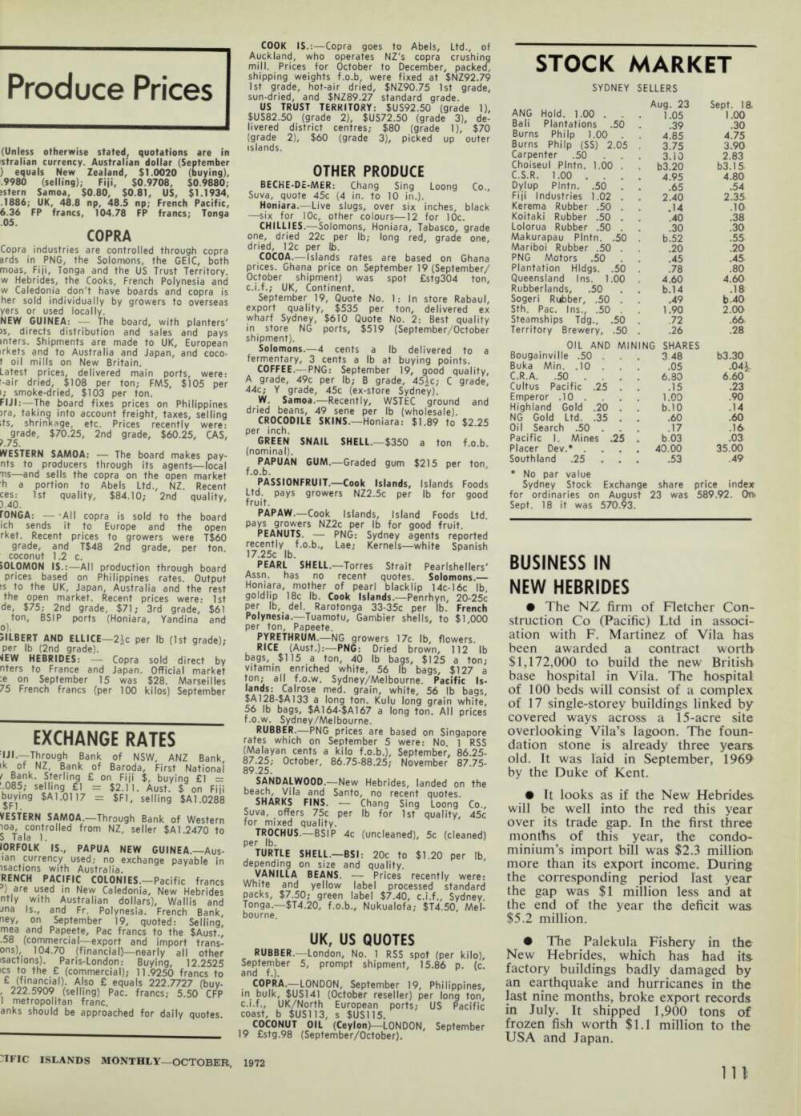
(Unless otherwise stated, quotations are in stralian currency. Australian dollar (September ) equals New Zealand, $1.0020 (buying), .9980 (selling); Fiji, $0.9708, $0.9880; jstern Samoa, $O.BO, $O.Bl, US, $1.1934, .1886; UK, 48.8 np, 48.5 np; French Pacific, 6.36 FP francs, 104.78 FP francs; Tonga .05.
Copra
Copra industries are controlled through copra ards in PNG, the Solomons, the GEIC, both moas, Fiji, Tonga and the US Trust Territory, w Hebrides, the Cooks, French Polynesia and w Caledonia don't have boards and copra is her sold individually by growers to overseas yers or used locally.
NEW GUINEA: The board, with planters' )s, directs distribution and sales and pays inters. Shipments are made to UK, European irkets and to Australia and Japan, and coco t oil mills on New Britain.
Latest prices, delivered main ports, were: f-air dried, $lOB per ton; FMS, $lO5 per i; smoke-dried, $lO3 per ton.
FIJI: —The board fixes prices on Philippines >ra, taking into account freight, taxes, selling its, shrinkage, etc. Prices recently were: 570.25, 2nd grade, $60.25, CAS, WESTERN SAMOA: The board makes pay nts to producers through its agents—local tis —and sells the copra on the open market h a portion to Abels Ltd., NZ. Recent ces: Ist quality, $84.10; 2nd quality, ).40. fONGA; -All copra is sold to the board ich sends it to Europe and the open rket. Recent prices to growers were Ts6o grade, and Ts4B 2nd grade, per ton. coconut 1.2 c.
SOLOMON IS.: —All production through board prices based on Philippines rates. Output 15 to the UK, Japan, Australia and the rest the open market. Recent prices were: Ist de, $75; 2nd grade, $7l; 3rd grade, $6l ton, BSIP ports (Honiara, Yandina and o).
GILBERT AND ELLICE —2£c per lb (Ist grade); per lb (2nd grade). <EW HEBRIDES: Copra sold direct by nters to France and Japan. Official market :e on September 15 was $2B. Marseilles 75 French francs (per 100 kilos) September
Exchange Rates
: IJl.— Through Bank of NSW, ANZ Bank, ik of NZ, Bank of Baroda, First National I Bank. Sterling £ on Fiji $, buying £1 ••085; selling £1 = $2.11. Aust. $ on Fiji buying $A1.0117 = SFI, selling $A1.0288 VESTERN SAMOA. —Through Bank of Western ioa, controlled from NZ, seller $A1.2470 to S Tala 1.
Iorfolk Is., Papua New Gulnea.—Aus
ian currency used; no exchange payable in isactions with Australia.
RENCH PACIFIC COLONIES.— Pacific francs ) are used in New Caledonia, New Hebrides ntly With Australian dollars), Wallis and Jna Is., and Fr. Polynesia. French Bank, "ey, on September 19, quoted: Selling, mea and Papeete, Pac francs to the sAust., .58 (commercial—export and import trans ons), 104.70 (financial) —nearly all other isactions). Paris-London; Buying, 12 2525 ics to the £ (commercial); 11.9250 francs to £ (financial). Also £ equals 222.7727 (buy , 222.5909 (selling) Pac. francs; 5.50 CFP 1 metropolitan franc. anks should be approached for daily quotes.
COOK IS.: —Copra goes to Abels, Ltd., of Auckland, who operates NZ's copra crushing mill. Prices for October to December, packed, shipping weights f.o.b, were fixed at $NZ92.79 Ist grade, hot-air dried, $NZ90.75 Ist grade, sun-dried, and $NZ89.27 standard grade.
Us Trust Territory: $U592.50 (Grade 1),
$U582.50 (grade 2), $U572.50 (grade 3), de livered district centres; $BO (grade 1), $7O (grade 2), $6O (grade 3), picked up outer islands.
Other Produce
BECHE-DE-MER: Chang Sing Loong Co., Suva, quote 45c (4 in. to 10 in.).
Honiara. —Live slugs, over six inches, black —six for 10c, other colours—l2 for 10c.
CHILLIES. —SoIomons, Honiara, Tabasco, grade one, dried 22c per lb; long red, grade one, dried, 12c per lb.
COCOA. —lslands rates are based on Ghana prices. Ghana price on September 19 (September/ October shipment) was spot £stg3o4 ton, c.i.f.; UK, Continent.
September 19, Quote No. 1: In store Rabaul, export quality, $535 per ton, delivered ex wharf Sydney, $6lO Quote No. 2: Best quality in store NG ports, $519 (September/October shipment).
Solomons. —4 cents a lb delivered to a fermentary, 3 cents a lb at buying points.
COFFEE. —PNG: September 19, good quality, A grade, 49c per lb; B grade, 45£c ; C grade, 44c; Y grade, 45c (ex-store Sydney).
W. Samoa. —Recently, WSTEC ground and dried beans, 49 sene per lb (wholesale).
CROCODILE SKlNS.— Honiara: $1.89 to $2.25 per inch.
GREEN SNAIL SHELL.— S3SO a ton f.o.b. (nominal).
PAPUAN GUM. —Graded gum $215 per ton, f.o.b.
PASSIONFRUIT. — Cook Islands, Islands Foods Ltd. pays growers NZ2.5c per lb for good fruit.
PAPAW. —Cook Islands, Island Foods Ltd pays growers NZ2c per lb for good fruit.
PEANUTS. PNG: Sydney agents reported recently f.0.b., Lae; Kernels—white Spanish 17.25 c lb.
PEARL SHELL. —Torres Strait Pearlshellers' Assn, has no recent quotes. Solomons. — Honiara, mother of pearl blacklip 14c-16c lb goldlip 18c lb. Cook Islands.— Penrhyn, 20-25 c per lb, del. Rarotonga 33-35 c per lb. French Polynesia.— Tuamotu, Gambier shells, to $l,OOO per ton, Papeete.
PYRETHRUM. —NG growers 17c lb, flowers.
RICE (Aust.):— PNG: Dried brown, 112 lb bags, $ll5 a ton, 40 lb bags, $125 a ton; vitamin enriched white, 56 lb bags, $127 a ton; all f.o.w. Sydney/Melbourne. Pacific Is lands: Calrose med. grain, white, 56 lb bags, SAI2B-SAI33 a long ton. Kulu long grain white, 56 lb bags, SAI64-SAI67 a long ton. All prices f.o.w. Sydney/Melbourne.
RUBBER. —PNG prices are based on Singapore rates which on September 5 were: No. 1 RSS (Malayan cents a kilo f.0.b.), September, 86.25- 87.25; October, 86.75-88.25; November 87.75- 89.25.
SANDALWOOD. —New Hebrides, landed on the beach, Vila and Santo, no recent quotes.
SHARKS FINS. Chang Sing Loong Co., Suva, offers 75c per lb for Ist quality, 45c for mixed quality.
TROCHUS. —BSIP 4c (uncleaned), 5c (cleaned) per lb.
TURTLE SHELL— BSI: 20c to $1.20 per lb, depending on size and quality.
VANILLA BEANS. Prices recently were: White and yellow label processed standard packs, $7.50; green label $7.40, c.i.f., Sydney.
Tonga.—sT4.2o, f.0.b., Nukualofa; $T4.50, Mel bourne.
Uk, Us Quotes
RUBBER. —London, No. 1 RSS spot (per kilo), September 5, prompt shipment, 15.86 p. (c. and f.).
COPRA.— LONDON, September 19, Philippines, in bulk, SUSI4I (October reseller) per long ton, c.i.f., UK/North European ports; US Pacific coast, b SUSII3, s SUSIIS.
COCONUT OIL (Ceylon)— LONDON, September 19 £stg.9B (September/October).
Business In
New Hebrides
• The NZ firm of Fletcher Con struction Co (Pacific) Ltd in associ ation with F. Martinez of Vila has been awarded a contract worth $1,172,000 to build the new British base hospital in Vila. The hospital of 100 beds will consist of a complex of 17 single-storey buildings linked by covered ways across a 15-acre site overlooking Vila’s lagoon. The foun dation stone is already three years old. It was laid in September, 1969 by the Duke of Kent. • It looks as if the New Hebrides will be well into the red this year over its trade gap. In the first three months of this year, the condo minium’s import bill was 52.3 million, more than its export income. During the corresponding period last year the gap was $1 million less and at the end of the year the deficit was $5.2 million. • The Palekula Fishery in the New Hebrides, which has had its factory buildings badly damaged by an earthquake and hurricanes in the last nine months, broke export records in July. It shipped 1,900 tons of frozen fish worth $l.l million to the USA and Japan.
Stock Market
Sydney Sellers
ANG Hold. 1.00 . .
Aug. 23 1.05 Sept. ia 1.00 Bali Plantations .50 .39 .30 Burns Phi Ip 1.00 . 4.85 4.75 Burns Philp (SS) 2.05 3.75 3.90 Carpenter .50 3.10 2.83 Choiseul Plntn. 1.00 . b3.20 b3.15
C.S.R. 1.00 . . .
4.95 4.80 Dylup Plntn. .50 .65 .54 Fiji Industries 1.02 . 2.40 2.35 Kerema Rubber .50 . .14 .10 Koitaki Rubber .50 . .40 .38 Lolorua Rubber .50 . .30 .30 Makurapau Plntn. .50 b.52 .55 Mariboi Rubber .50 . .20 .20 PNG Motors .50 .45 .45 Plantation Hldgs. .50 .78 .80 Queensland Ins. 1.00 4.60 4.60 Rubberlands, .50 b.14 .18 Sogeri Rubber, .50 . .49 b.40 Sth. Pac. Ins., .50 . 1.90 2.00 Steamships Tdg., .50 .72 .66 Territory Brewery, .50 .26 .28
Oil And Mining Shares
Bougainville .50 . 3 48 b3.30 Buka Min. .10 .05 .04 i-
C.R.A. .50 . . .
6.80 6.60 Cultus Pacific .25 .15 .23 Emperor .10 1.00 .90 Highland Gold .20 b.10 .14 NG Gold Ltd. .35 , .60 .60 Oil Search .50 . .17 .16 Pacific 1. Mines .25 b.03 .03 Placer Dev.* . 40.00 35.00 Southland .25 .53 .49 * No par value Sydney Stock Exchange share price inde* for ordinaries on August 23 was 589.92. On.
Sept. 18 it was 570.93.
Advertisements & other items, pp. 113-114 (2 items)
111
:IFIC ISLANDS MONTHLY—OCTOBER, 1972
Hand
AVAILABLE FROM :
JAMES SANDY PTY. LTD
637 GARDENERS ROAD, MASCOT
N.S.W., 2020, AUSTRALIA.
• GLASS MERCHANTS
• ALUMINIUM STOREFRONTS
9 ALUMINIUM WINDOWS AND DOORS
• SHOWER SCREENS
• MIRRORS
SANDYS
EXTRUDED ALUMINIUM
ADJUSTABLE LOUVRES
FITTED WITH ALUMINIUM OR GLASS BLADES
FOR SUN AND VENTILATION CONTROL
i X * ■
SANDYS EXTRUDED ALUMINIUM GLAZING BAR FOR
ECONOMICAL SIDEWALL GLAZING
J n A ✓ ✓
HAND
faaL&zjr
Pj /
PmPUWpefro/
Australia's best selling non-electric Iron! For reliability, ease of handling, and excellence of quality at a low price, you can't beat the HANOI. It's simplicity itself to operate—NO PUMPING IS REQUIRED. IT'S IMPOSSIBLE TO OVERFILL THE FUEL TANK and ont filling does approximately 2 hours effortless ironing. Attractively finished in nickel plate. Spare parts always available.
THE PORTABLE OUTDOORS COOKER bt a sensible price!
Twin independent burners for fast cooking. Twin tanks for double capacity. Steel case, when opened, acts as triple-wind shield. Rustproof. Noisy or silent burners as required. Small or large porcelala enamel ovens also available separately. HANOI —the lowest priced QUALITY Twin Burner Portabiei I "if. • 1 compo Rd„ Salisbury North, Ph. 47 2121
BRISBANE, QUEENSLAND, AUSTRALIA
Deaths of Islands People

Mr. Kenneth Gedye Goddard tribute from Douglas S. Askew : A very fine old Territorian, Ken -th Gedye Goddard, better known to I his friends throughout Papua New uinea as “Tiger” Goddard, died ;acefully in hospital at the War eterans’ Home, Narrabeen, Sydney, the end of August. It would be true say that he will be remembered a Very Kindly Gentleman, the soul courtesy and honesty.
“Tiger” was about 82 and led a II and active life in many places, hen World War I broke out he en ted in the Australian Light Horse d served on Gallipoli and in the nai Desert. He afterwards spent a mber of years on cattle stations the Northern Territory and was at e time the manager of Wave Hill ition.
On the outbreak of World War II iger” again enlisted and despite position from some of the Colonel imps who offered him a job at ctoria Barracks he served with a icial mounted unit which patrolled tback in the Northern Territory, ese men were a sort of “Inland >astwatcher” unit because at that le it was suspected that Japanese -nts somewhere inland were morn ing radio information and trans iting it to Japan. That was where irst met “Tiger”, in a bush camp the bank of the Ord River.
Dur next meeting was on another 2r far removed from the Ord; on Vailala River, Western Papua, )ut 1948, and as we both roamed und the territory in the ensuing rs we would always be sure to
et again, Rabaul-Lae-Madang
roka, even in the “Concrete igle’’ that is now Sydney. So ger” has gone, and we won’t in hear his special greeting when raised his glass at any gathering: obs of cheers!”. And that was it he whispered to me the last time iw him!
Mr C. Prentice lanager of the Melbourne Hotel iuva for many years, Mr Campbell ntice died in the Colonial War morial Hospital in Suva towards end of August, only weeks after hotel had closed its doors for the time, before being demolished nake way for an office block. . popular Fiji resident for nearly Mr Prentice, known as Cam ill his friends, was 59. He under t a serious operation in February, te was a child when his parents
lert their Scottish home and went to live in Gisborne New Zealand. He joined the NZ Army as a regular soldier and was posted to Fiji m 1942 to tram soldiers of the Fiji Military is?aS S, 9 n^ e a ?t S ° J erved OI ? Fann j n § I and and after the war pioneered a tr^ in f sectl ?J l the c 7j!!iH the a l d u-?!
SS meD ’ started a rehabilitation p \ ' He leaves a widow, formerly Miss
Margaret Wilson, of Levuka and Suva, a daughter, two grandchildren and a sister.
Mrs Mildred Hill A direct descendant of the McCoy and Christian families of Pitcairn Island, Mrs Mildred Hill, formerly Miss McCoy, has died at her home in Vila, New Hebrides, aged 79.
She and her late husband, Mr George Hill, for many years Treasurer in the Condominium Treasury and Customs Department, went to the New Hebrides in 1914 from Norfolk Island where she was born.
She leaves a son, Mr Minto Hill, who is in Papua New Guinea,
Advertisements & other items, pp. 115-116 (2 items)
Ific Islands Monthly—October, 1972
family down
Don't let your
You've worked hard to give them a home, schooling and security. Don't let that hard-won security erode away because you continued to overlook making out a Will. With a properly planned Will, you can be certain in the knowledge that your property will eventually pass to the people you specify, and also that your Estate will be as large as possible after probate and duties. In this regard, we invite you to take advantage of the advisory service we provide, entirely free of obligation. Our specialists in Estate Planning w 'y. ° e delighted to help you plan your Will most efficiently, or to discuss it fully with your solicitor or accountant.
A the
BURNS PHILP TRUSTEE
COMPANY LIMITED
IXECUTOR • ADMINISTRATOR • TRUSTEE • ATTORNEY • AGENT Fiji Office: Mr. A. W. Cooper, Resident Manager, Rodwell Road, Suva. Telephone: 311 777.
Head Office: 51 Pitt Street, Sydney 2000.
Telephone: 241 1021. Telegrams: "BURNSTRUST," Sydney.
Branches and/or Registered Offices: Parramatta (N.S.W.), Canberra, Melbourne, Brisbane, Adelaide, Fremantle (W.A.), Port Moresby (Papua). 8P45
THE BANK LINE
MONTHLY SERVICES
U.K., CONTINENT to PAPUA-NEW GUINEA & SOLOMON ISLANDS PAPUA, NEW GUINEA to NORTH AMERICA & U.K., CONTINENT SOLOMON ISLANDS, FIJI, TONGA, SAMOA AND TARAWA to U.K.,
CONTINENT
☆ US GULF/AUSTRALASIA VESSELS CALL AT FIJI WHEN REQUIRED Ov > JtliT ' .r Mil u
FOR PARTICULARS APPLY:
JHE BANK LINE (AUSTRALASIA) PTY. LTD., SYDNEY, N.S.W
New Guinea Express Lines
FAST NEW SERVICE IN FAST NEW SHIPS Lae M.V.s Lae Express/Moresby Express, tfirect Express Services.
Melbourne • Sydney • Port Moresby Sydney • Brisbane • Lae • Rabaul. 80 ft Hatches 20 ton lifts —20 ton Refrigerated containers, Unitised and Palletised, General Cargo.
Sydney —Refrigerated Express Lines (A'asia) Pty Ltd, 37 Pitt Street, Sydney. Telephone 2411396.
Brisbane —Refrigerated Express Lines (A'asia) Pty Ltd Eagle Street, Brisbane. Telephone 21 9333.
Melbourne —Westralian Farmers Transport Pty Ltd, 459 Collins Street, Melbourne. Telephone 67 8766.
Port Moresby— Breckwoldt Shipping Agencies, P.O. Box 1549, Port Moresby. Telephone 2985.
L ae _Breckwoldt Shipping Agencies, P.O. Box 557, Lae.
Telephone 4 2819.
Rabaul— Breckwoldt Shipping Agencies, P.O. Box 222, Rabaul.
Telephone 92 3381.
Shipping
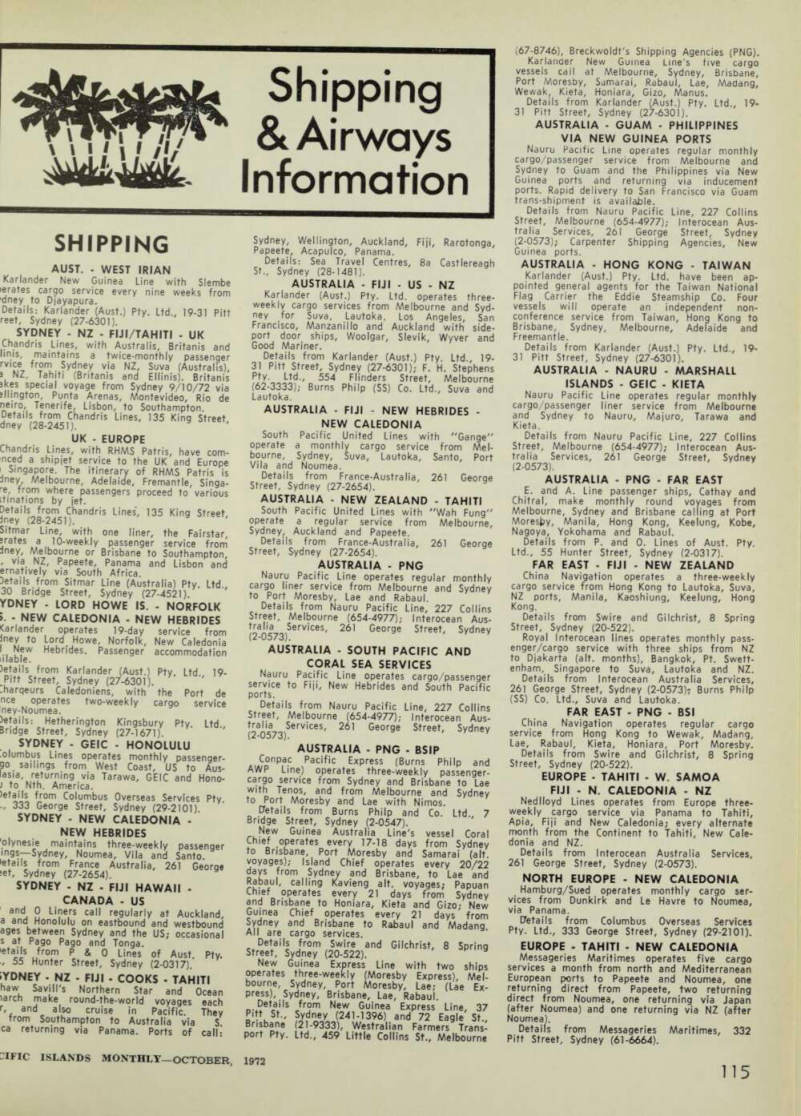
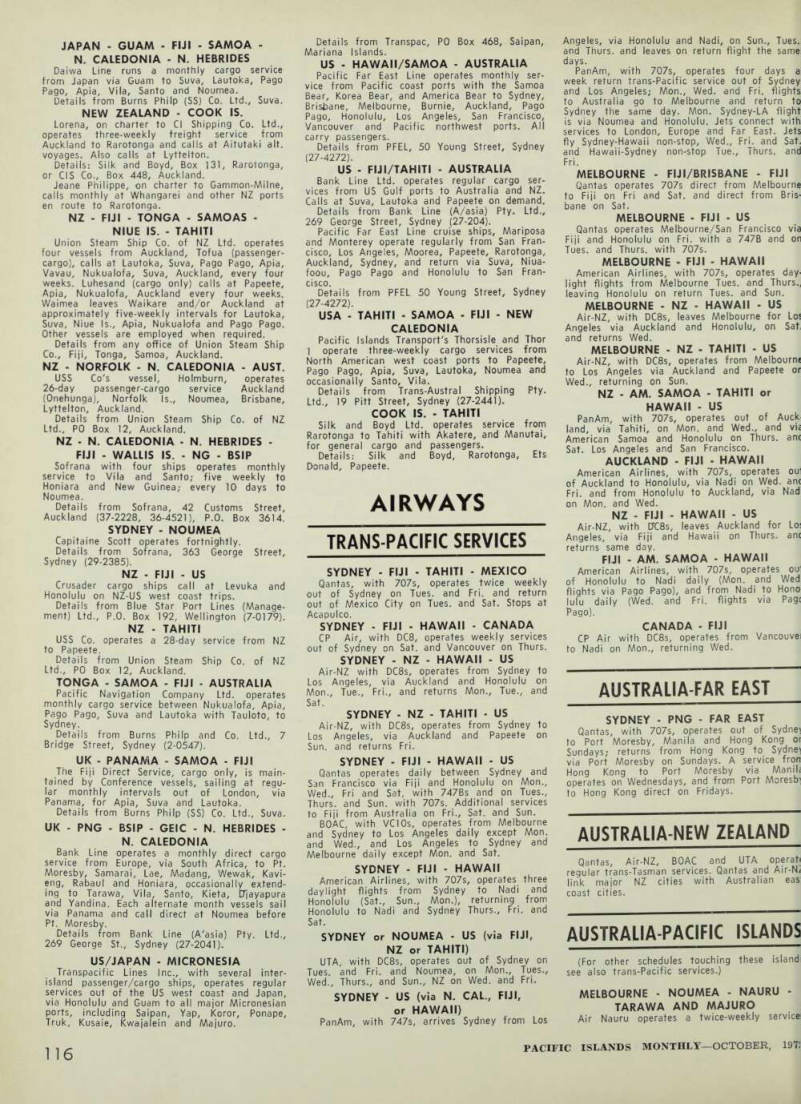
& Airways Information
Aust. - West Irian
Karlander New Guinea Line with Slembe icrates cargo service every nine weeks from dney to Djayapura.
Details: Karlander (Aust.) Pty. Ltd., 19-31 Pitt reet, Sydney (27-6301).
SYDNEY - NZ ■ FIJI/TAHITI - UK Chandris Lines, with Australis, Britanis and lims, maintains a twice-monthly passenger rvice from Sydney via NZ, Suva (Australis), J , NZ - Tahlt i (Britanis and Ellinis). Britanis 3kes special voyage from Sydney 9/10/72 via illmgton, Punta Arenas, Montevideo, Rio de ne |r o, Tenerife, Lisbon, to Southampton.
Details from Chandris Lines, 135 King Street dney (28-2451).
Uk - Europe
Chandris Lines, with RHMS Patris, have com nced a shipjet service to the UK and Europe i Singapore. The itinerary of RHMS Patris is tney, Melbourne, Adelaide, Fremantle, Singa re, from where passengers proceed to various itinations by jet.
Chandris Lines, 135 King Street, Sitmar Line, with one liner, the Fairstar srates a 10-weekly passenger service from tney, Melbourne or Brisbane to Southampton, , via NZ, Papeete, Panama and Lisbon and ernatively via South Africa.
Retails from Sitmar Line (Australia) Pty. Ltd., 30 Bridge Street, Sydney (27-4521).
YDNEY - LORD HOWE IS. - NORFOLK >. ■ NEW CALEDONIA - NEW HEBRIDES Carlander operates 19-day service from ney to Lord Howe, Norfolk, New Caledonia I New Hebrides. Passenger accommodation liable. details from Karlander (Aust.) Pty Ltd 19- Pitt Street, Sydney (27-6301). .hargeurs Caledoniens, with the Port de nee operates two-weekly cargo service ney-Noumea. >etails: Hetherington Kingsbury Pty Ltd Bridge Street, Sydney (27-1671).
Sydney ■ Geic - Honolulu
.olumbus Lines operates monthly passenger go sailings from West Coast, US to Aus las'a returning via Tarawa, GEIC and Hono i to Nth. America. letails from Columbus Overseas Services Pty 333 George Street, Sydney (29-2101)
Sydney - New Caledonia -
New Hebrides
'olynesie maintains three-weekly passenger mgs—Sydney, Noumea, Vila and Santo, ►etails from France Australia, 261 George set, Sydney (27-2654).
SYDNEY - NZ - FIJI HAWAII -
Canada - Us
and 0 Liners call regularly at Auckland, a and Honolulu on eastbound and westbound ages between Sydney and the US; occasional s at Pago Pago and Tonga, letails from P & 0 Lines of Aust. Pty. , 55 Hunter Street, Sydney (2-0317). •YDNEY - NZ • FIJI - COOKS - TAHITI haw Savill's Northern Star and Ocean larch make round-the-world voyages each r, and also cruise in Pacific. They rrom Southampton to Australia via S ca returning via Panama. Ports of call-
Sydney, Wellington, Auckland, Fiji, Rarotonga, Papeete, Acapulco, Panama.
Details: Sea Travel Centres, 8a Castlereagh St., Sydney (28-1481).
AUSTRALIA - FIJI - US - NZ Karlander (Aust.) Pty. Ltd. operates three weekly cargo services trom Melbourne and Syd ney for Suva, Lautoka, Los Angeles, San Francisco, Manzanillo and Auckland with side port door ships, Woolgar, Slevik, Wyver and Good Mariner.
Details from Karlander (Aust.) Pty. Ltd., 19- 31 Pitt Street, Sydney (27-6301); F. H. Stephens Pty. Ltd., 554 Flinders Street, Melbourne (62-3333); Burns Philp (SS) Co. Ltd., Suva and Lautoka.
AUSTRALIA - FIJI - NEW HEBRIDES -
New Caledonia
South Pacific United Lines with "Gange" operate a monthly cargo service from Mel bourne, Sydney, Suva, Lautoka, Santo, Port Vila and Noumea.
Details from France-Australia, 261 George Street, Sydney (27-2654).
Australia - New Zealand - Tahiti
South Pacific United Lines with "Wah Fung" operate a regular service from Melbourne, Sydney, Auckland and Papeete.
Details from France-Australia, 261 George Street, Sydney (27-2654).
Australia - Png
Nauru Pacific Line operates regular monthly cargo liner service from Melbourne and Sydney to Port Moresby, Lae and Rabaul Details from Nauru Pacific Line, 227 Collins Street, Melbourne (654-4977); Interocean Au5(20173 (2ol73) SerViCeS ' 261 George street ' Sydney
Australia - South Pacific And
Coral Sea Services
Nauru Pacific Line operates cargo/passenger service to Fiji, New Hebrides and South Pacific ports.
Details from Nauru Pacific Line, 227 Collins Street, Melbourne (654-4977); Interocean Aus a'ia Services ' 261 Geor ge Street, Sydney (2-0573).
Australia - Png - Bsip
»..£? np . a . c Pacific Express (Burns Philp and AWP Line) operates three-weekly passenger cargo service from Sydney and Brisbane to Lae with Tenos, and from Melbourne and Sydney to Port Moresby and Lae with Nimos.
Details from Burns Philp and Co. Ltd. 7 Bridge Street, Sydney (2-0547).
New Guinea Australia Line's vessel Coral Chief operates every 17-18 days from Sydney to Brisbane, Port Moresby and Samarai (alt. voyages); Island Chief operates every 20/22 days from Sydney and Brisbane, to Lae and Rabaul, calling Kavieng alt. voyages; Papuan Chief operates every 21 days from Sydney and Brisbane to Honiara, Kieta and Gizo,- New Guinea Chief operates every 21 days from Sydney and Brisbane to Rabaul and Madang All are cargo services.
Details from Swire and Gilchrist, 8 Spring Street, Sydney (20-522). 9 New Guinea Express Line with two ships operates three-weekly (Moresby Express), Mel bourne, Sydney, Port Moresby, Lae; (Lae Ex press), Sydney, Brisbane, Lae, Rabaul. , G®tai ls from New Guinea Express Line, 37 Pitt St., Sydney (241-1396) and 72 Eagle St..
Brisbane (21-9333), Westralian Farmers Trans port Pty. Ltd., 459 Little Collins St., Melbourne
(67-8746), Breckwoldt's Shipping Agencies (PNG).
Karlander New Guinea Line's five cargo vessels call at Melbourne, Sydney, Brisbane, Port Moresby, Samarai, Rabaul, Lae, Madang, Wewak, Kieta, Honiara, Gizo, Manus.
Details from Karlander (Aust.) Pty. Ltd., 19- 31 Pitt Street, Sydney (27-6301).
Australia - Guam - Philippines
Via New Guinea Ports
Nauru Pacific Line operates regular monthly cargo/passenger service from Melbourne and Sydney to Guam and the Philippines via New Guinea ports and returning via inducement ports. Rapid delivery to San Francisco via Guam trans-shipment is available.
Details from Nauru Pacific Line, 227 Collins Street, Melbourne (654-4977); Interocean Aus tralia Services, 261 George Street, Sydney (2-0573); Carpenter Shipping Agencies, New Guinea ports.
Australia - Hong Kong - Taiwan
Karlander (Aust.) Pty. Ltd. have been ap pointed general agents for the Taiwan National Flag Carrier the Eddie Steamship Co. Four vessels will operate an independent non conference service from Taiwan, Hong Kong to Brisbane, Sydney, Melbourne, Adelaide and Freemantle.
Details from Karlander (Aust.) Pty. Ltd., 19- 31 Pitt Street, Sydney (27-6301).
Australia - Nauru - Marshall
Islands - Geic - Kieta
Nauru Pacific Line operates regular monthly cargo/passenger liner service from Melbourne and Sydney to Nauru, Majuro, Tarawa and Kieta.
Details from Nauru Pacific Line, 227 Collins Street, Melbourne (654-4977); Interocean Aus tralia Services, 261 George Street, Sydney (2-0573).
Australia - Png - Far East
E. and A. Line passenger ships, Cathay and Chitral, make monthly round voyages from Melbourne, Sydney and Brisbane calling at Port Moresby, Manila, Hong Kong, Keelung, Kobe, Nagoya, Yokohama and Rabaul.
Details from P. and 0. Lines of Aust. Pty.
Ltd., 55 Hunter Street, Sydney (2-0317).
FAR EAST - FIJI - NEW ZEALAND China Navigation operates a three-weekly cargo service from Hong Kong to Lautoka, Suva, NZ ports, Manila, Kaoshiung, Keelung, Hong Kong.
Details from Swire and Gilchrist, 8 Spring Street, Sydney (20-522).
Royal Interocean lines operates monthly pass enger/cargo service with three ships from NZ to Djakarta (alt. months), Bangkok, Pt. Swett enham, Singapore to Suva, Lautoka and NZ.
Details from Interocean Australia Services, 261 George Street, Sydney (2-0573); Burns Philp (SS) Co. Ltd., Suva and Lautoka.
Far East - Png - Bsi
China Navigation operates regular cargo service from Hong Kong to Wewak, Madang, Lae, Rabaul, Kieta, Honiara, Port Moresby.
Details from Swire and Gilchrist, 8 Spring Street, Sydney (20-522).
Europe - Tahiti - W. Samoa
Fiji - N. Caledonia - Nz
Nedlloyd Lines operates from Europe three weekly cargo service via Panama to Tahiti, Apia, Fiji and New Caledonia; every alternate month from the Continent to Tahiti, New Cale donia and NZ.
Details from Interocean Australia Services, 261 George Street, Sydney (2-0573).
North Europe ■ New Caledonia
Hamburg/Sued operates monthly cargo ser vices from Dunkirk and Le Havre to Noumea, via Panama.
Details from Columbus Overseas Services Pty. Ltd., 333 George Street, Sydney (29-2101).
Europe - Tahiti - New Caledonia
Messageries Maritimes operates five cargo services a month from north and Mediterranean European ports to Papeete and Noumea, one returning direct from Papeete, two returning direct from Noumea, one returning via Japan (after Noumea) and one returning via NZ (after Noumea).
Details from Messageries Maritimes, 332 Pitt Street, Sydney (61-6664).
JAPAN - GUAM ■ FIJI - SAMOA -
N. Caledonia - N. Hebrides
Daiwa Line runs a monthly cargo service from Japan via Guam to Suva, Lautoka, Pago Pago, Apia, Vila, Santo and Noumea.
Details from Burns Philp (SS) Co. Ltd., Suva.
New Zealand - Cook Is.
Lorena, on charter to Cl Shipping Co, Ltd., operates three-weekly freight service from Auckland to Rarotonga and calls at Aitutaki alt. voyages. Also calls at Lyttelton.
Details: Silk and Boyd, Box 131, Rarotonga, or CIS Co., Box 448, Auckland.
Jeane Philippe, on charter to Gammon-Milne, calls monthly at Whangarei and other NZ ports en route to Rarotonga.
NZ - FIJI - TONGA - SAMOAS -
Niue Is. - Tahiti
Union Steam Ship Co. of NZ Ltd. operates four vessels from Auckland, Tofua (passenger cargo), calls at Lautoka, Suva, Pago Pago, Apia, Vavau, Nukualofa, Suva, Auckland, every four weeks. Luhesand (cargo only) calls at Papeete, Apia, Nukualofa, Auckland every four weeks.
Waimea leaves Waikare and/or Auckland at approximately five-weekly intervals for Lautoka, Suva, Niue Is., Apia, Nukualofa and Pago Pago.
Other vessels are employed when required.
Details from any office of Union Steam Ship Co., Fiji, Tonga, Samoa, Auckland.
NZ - NORFOLK - N. CALEDONIA - AUST.
USS Co's vessel, Holmburn, operates 26-day passenger-cargo service Auckland (Onehunga), Norfolk Is., Noumea, Brisbane, Lyttelton, Auckland.
Details from Union Steam Ship Co. of NZ Ltd., PO Box 12, Auckland.
NZ • N. CALEDONIA • N. HEBRIDES - FIJI - WALLIS IS. • NG - BSIP Sofrana with four ships operates monthly service to Vila and Santo; five weekly to Honiara and New Guinea; every 10 days to Noumea.
Details from Sofrana, 42 Customs Street, Auckland (37-2228, 36-4521), P.O. Box 3614.
Sydney - Noumea
Capitaine Soott operates fortnightly.
Details from Sofrana, 363 George Street, Sydney (29-2385).
Nz - Fiji ■ Us
Crusader cargo ships call at Levuka and Honolulu on NZ-US west coast trips.
Details from Blue Star Port Lines (Manage ment) Ltd., P.O. Box 192, Wellington (7-0179).
Nz - Tahiti
USS Co. operates a 28-day service from NZ to Papeete.
Details from Union Steam Ship Co. of NZ Ltd., PO Box 12, Auckland.
TONGA - SAMOA - FIJI - AUSTRALIA Pacific Navigation Company Ltd. operates monthly cargo service between Nukualofa, Apia, Pago Pago, Suva and Lautoka with Tauloto, to Sydney.
Details from Burns Philp and Co. Ltd., 7 Bridge Street, Sydney (2-0547).
UK - PANAMA - SAMOA - FIJI The Fiji Direct Service, cargo only, is main tained by Conference vessels, sailing at regu lar monthly intervals out of London, via Panama, for Apia, Suva and Lautoka.
Details from Burns Philp (SS) Co. Ltd., Suva.
UK - PNG - BSIP - GEIC - N. HEBRIDES -
N. Caledonia
Bank Line operates a monthly direct cargo service from Europe, via South Africa, to Pt.
Moresby, Samarai, Lae, Madang, Wewak, Kavi eng, Rabaul and Honiara, occasionally extend ing to Tarawa, Vila, Santo, Kieta, Qjayapura and Yandina. Each alternate month vessels sail via Panama and call direct at Noumea before Pt. Moresby.
Details from Bank Line (A'asia) Pty. Ltd., 269 George St., Sydney (27-2041).
Us/Japan - Micronesia
Transpacific Lines Inc., with several inter island passenger/cargo ships, operates regular services out of the US west coast and Japan, via Honolulu and Guam to all major Micronesian ports, including Saipan, Yap, Koror, Ponape, Truk, Kusaie, Kwajalein and Majuro.
Details from Transpac, PO Box 468, Saipan, Mariana Islands.
Us - Hawaii/Samoa - Australia
Pacific Far East Line operates monthly ser vice from Pacific coast ports with the Samoa Bear, Korea Bear, and America Bear to Sydney, Brisbane, Melbourne, Burnie, Auckland, Pago Pago, Honolulu, Los Angeles, San Francisco, Vancouver and Pacific northwest ports. All carry passengers.
Details from PFEL, 50 Young Street, Sydney (27-4272).
Us - Fiji/Tahiti - Australia
Bank Line Ltd. operates regular cargo ser vices from US Gulf ports to Australia and NZ, Calls at Suva, Lautoka and Papeete on demand.
Details from Bank Line (A/asia) Pty. Ltd., 269 George Street, Sydney (27-204).
Pacific Far East Line cruise ships, Mariposa and Monterey operate regularly from San Fran cisco, Los Angeles, Moorea, Papeete, Rarotonga, Auckland, Sydney, and return via Suva, Niua foou, Pago Pago and Honolulu to San Fran cisco.
Details from PFEL 50 Young Street, Sydney (27-4272).
USA - TAHITI ■ SAMOA - FIJI - NEW
Caledonia
Pacific Islands Transport's Thorsisle and Thor 1 operate three-weekly cargo services from North American west coast ports to Papeete, Pago Pago, Apia, Suva, Lautoka, Noumea and occasionally Santo, Vila.
Details from Trans-Austral Shipping Pty.
Ltd., 19 Pitt Street, Sydney (27-2441).
Cook Is. - Tahiti
Silk and Boyd Ltd. operates service from Rarotonga to Tahiti with Akatere, and Manutai, for general cargo and passengers.
Details: Silk and Boyd, Rarotonga, Ets Donald, Papeete.
Advertisements & other items, p. 117 (1 item)
115
DIFIC ISLANDS MONTHLY—OCTOBER, 1972
Airways
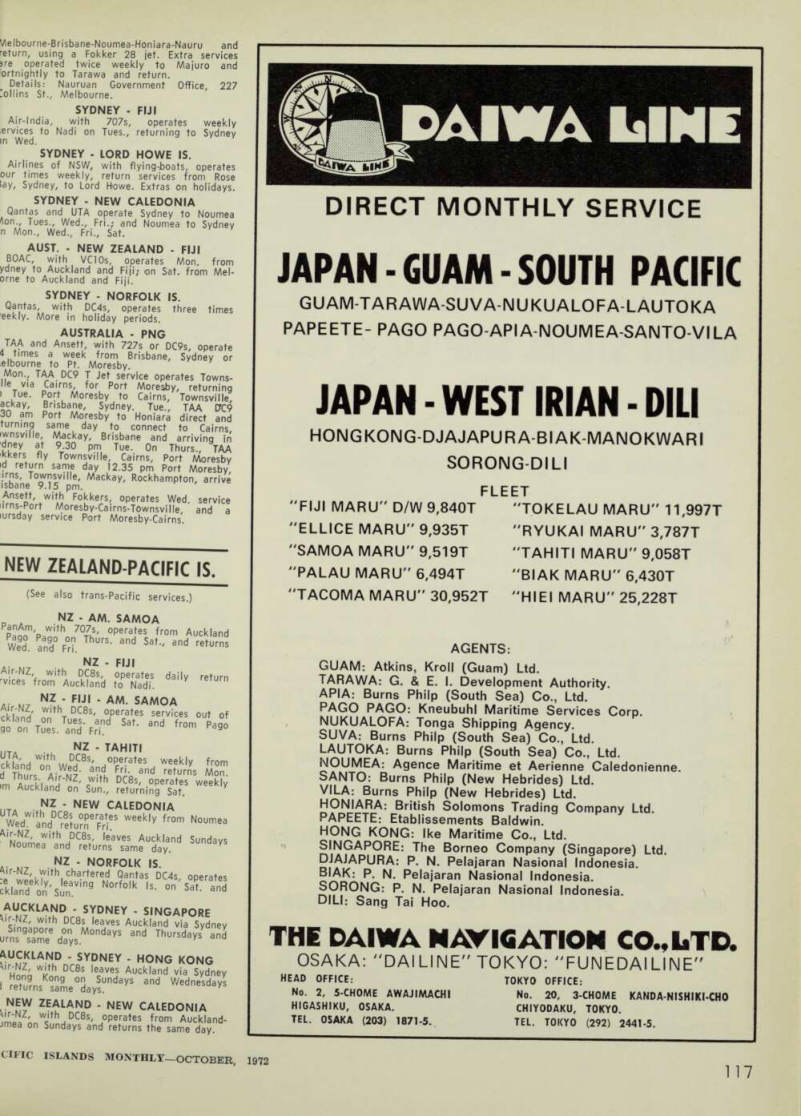
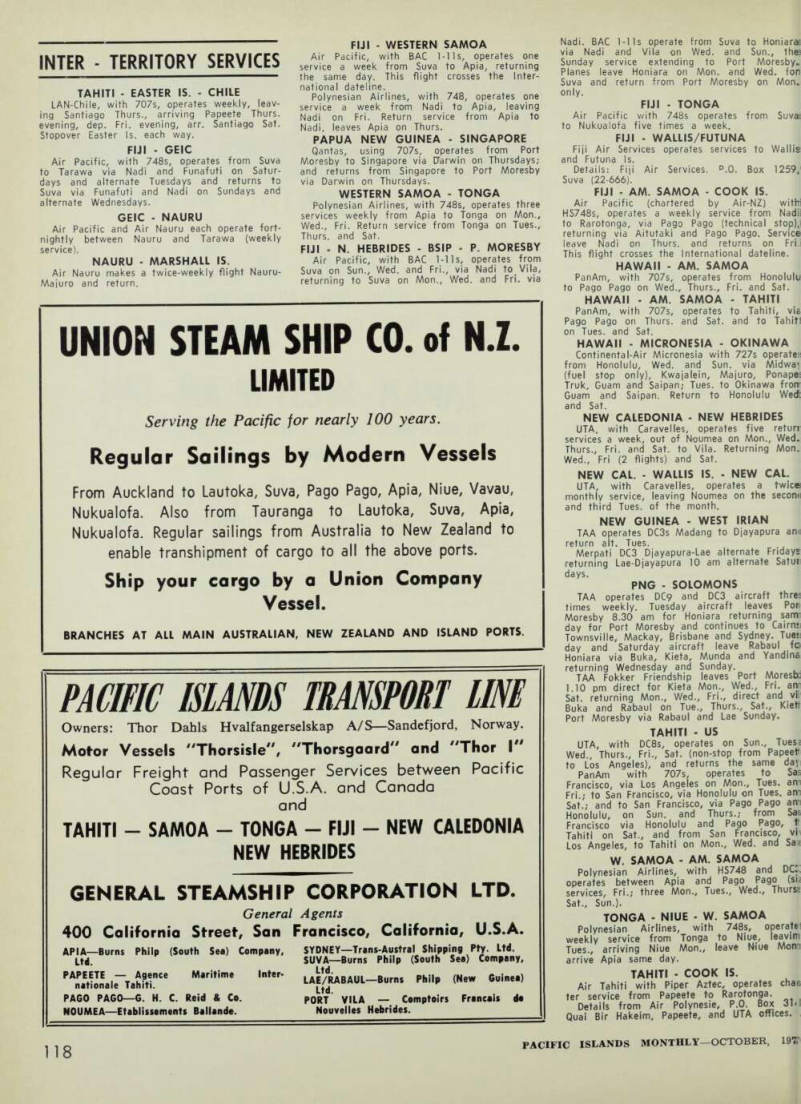
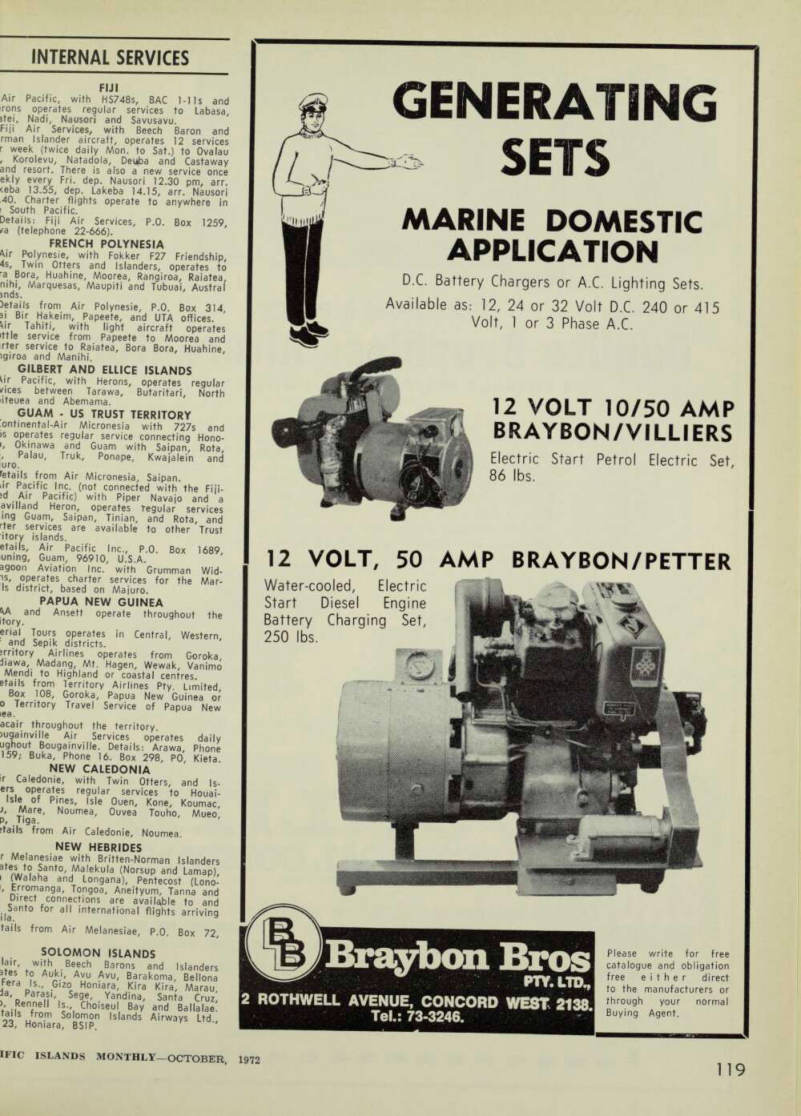
Trans Pacific Services
SYDNEY - FIJI ■ TAHITI - MEXICO Qantas, with 7075, operates twice weekly out of Sydney on Tues. and Fri. and return out of Mexico City on Tues. and Sat. Stops at Acapulco.
SYDNEY - FIJI - HAWAII • CANADA CP Air, with DCS, operates weekly services out of Sydney on Sat. and Vancouver on Thurs.
SYDNEY - NZ - HAWAII - US Air-NZ with DCBs, operates from Sydney to Los Angeles, via Auckland and Honolulu on Mon., Tue., Fri., and returns Mon., Tue., and Sat.
SYDNEY - NZ - TAHITI - US Air-NZ, with DCBs, operates from Sydney to Los Angeles, via Auckland and Papeete on Sun. and returns Fri.
SYDNEY - FIJI - HAWAII ■ US Qantas operates daily between Sydney and San Francisco via Fiji and Honolulu on Mon., Wed., Fri and Sat. with 7478 s and on Tues., Thurs. and Sun. with 7075. Additional services to Fiji from Australia on Fri., Sat. and Sun.
BOAC, with VClOs, operates from Melbourne and Sydney to Los Angeles daily except Mon. and Wed., and Los Angeles to Sydney and Melbourne daily except Mon. and Sat.
Sydney - Fiji - Hawaii
American Airlines, with 7075, operates three daylight flights from Sydney to Nadi and Honolulu (Sat., Sun., Mon.), returning from Honolulu to Nadi and Sydney Thurs., Fri. and Sat.
SYDNEY or NOUMEA - US (via FIJI,
Nz Or Tahiti)
UTA, with DCBs, operates out of Sydney on Tues. and Fri. and Noumea, on Mon., Tues., Wed., Thurs., and Sun., NZ on Wed. and Fri.
SYDNEY ■ US (via N. CAL., FIJI,
Or Hawaii)
PanAm, with 7475, arrives Sydney from Los
Angeles, via Honolulu and Nadi, on Sun,, Tues., and Thurs. and leaves on return flight the same; days.
PanAm, with 7075, operates four days ai week return trans-Pacific service out of Sydney and Los Angeles; Mon., Wed. and Fri, flights; to Australia go to Melbourne and return to Sydney the same day. Mon, Sydney-LA flight! is via Noumea and Honolulu. Jets connect with services to London, Europe and Far East. Jets fly Sydney-Hawaii non-stop. Wed., Fri. and Sat. and Hawaii-Sydney non-stop Tue., Thurs. and Fri.
Melbourne - Fiji/Brisbane - Fiji
Qantas operates 707 s direct from Melbourne to Fiji on Fri and Sat. and direct from Bris bane on Sat.
Melbourne - Fiji - Us
Qantas operates Melbourne/San Francisco via Fiji and Honolulu on Fri. with a 7478 and on Tues. and Thurs. with 7075.
Melbourne • Fiji - Hawaii
American Airlines, with 7075, operates day light flights from Melbourne Tues. and Thurs., leaving Honolulu on return Tues. and Sun.
MELBOURNE ■ NZ - HAWAII - US Air-NZ, with DCBs, leaves Melbourne for Los Angeles via Auckland and Honolulu, on Sat. and returns Wed.
MELBOURNE - NZ - TAHITI - US Air-NZ, with DCBs, operates from Melbourne to Los Angeles via Auckland and Papeete or Wed., returning on Sun.
NZ - AM. SAMOA - TAHITI or
Hawaii - Us
PanAm, with 7075, operates out of Auck land, via Tahiti, on Mon. and Wed., and vie American Samoa and Honolulu on Thurs. anc Sat. Los Angeles and San Francisco.
Auckland - Fiji - Hawaii
American Airlines, with 7075, operates oul of Auckland to Honolulu, via Nadi on Wed. anc Fri. and from Honolulu to Auckland, via Nad on Mon. and Wed.
NZ - FIJI - HAWAII - US Air-NZ, with DCBs, leaves Auckland for Lo< Angeles, via Fiji and Hawaii on Thurs. anc returns same day.
Fiji - Am. Samoa - Hawaii
American Airlines, with 7075, operates oui of Honolulu to Nadi daily (Mon. and Wed flights via Pago Pago), and from Nadi to Hono lulu daily (Wed. and Fri. flights via Page Pago).
Canada - Fiji
CP Air with DCBs, operates from Vancouvei to Nadi on Mon., returning Wed.
Australia-Far East
Sydney - Png - Far East
Qantas, with 7075, operates out of Sydne\ to Port Moresby, Manila and Hong Kong or Sundays; returns from Hong Kong to Sydney via Port Moresby on Sundays. A service frorr Hong Kong to Port Moresby via MamU operates on Wednesdays, and from Port Moresby to Hong Kong direct on Fridays.
Australia-New Zealand
Qantas, Air-NZ, BOAC and UTA operafl regular trans-Tasman services. Qantas and Air-Ni link major NZ cities with Australian eas; coast cities.
Australia-Pacific Islands
(For other schedules touching these islands see also trans-Pacific services.)
Melbourne - Noumea - Nauru -
Tarawa And Majuro
Air Nauru operates a twice-weekly service;
Melbourne-Brisbane-Noumea-Honiara-Nauru and return, using a Fokker 28 jet. Extra services are operated twice weekly to Majuro and ortnightly to Tarawa and return.
Details: Nauruan Government Office, 227 lollins St., Melbourne.
Sydney - Fiji
Air-lndia, with 7075, operates weekly ervices to Nadi on Tues., returning to Sydney m Wed. y
Sydney - Lord Howe Is.
Airlines of NSW, with flying-toats, operates our times weekly, return services from Rose lay, Sydney, to Lord Howe. Extras on holidays.
Sydney - New Caledonia
Qantas and UTA operate Sydney to Noumea *on., Tues., Wed., Fri.; and Noumea to Sydney n Mon., Wed., Fri., Sat.
Aust. - New Zealand - Fiji
BOAC, with VClOs, operates Mon, from ydney to Auckland and Fiji; on Sat. from Mel orne to Auckland and Fiji.
Sydney - Norfolk Is.
Qantas, with DC4s, operates three times eekly. More in holiday periods.
Australia - Png
TAA and Ansett, with 727 s or DC9s, operate 4 times a week from Brisbane, Sydney or elbourne to Pt. Moresby.
Mon., T/W\ DC9 T Jet service operates Towns lle via Cairns, for Port Moresby, returning 1 j ue - v, Moresby to Cairns, Townsville, ackay, Brisbane, Sydney. Tue., TAA DC9 30 am Port Moresby to Honiara direct and turning same day to connect to Cairns •wnsville, Mackay, Brisbane and arriving in dney at 9.30 pm Tue. On Thurs., TAA kkers fly Townsville, Cairns, Port Moresby id return same day 12.35 pm Port Moresby, irns, Townsville, Mackay, Rockhampton, arrive isbane 9.15 pm.
Ansett, with Fokkers, operates Wed. service irns-Port Moresby-Cairns-Townsville, and a lursday service Port Moresby-Cairns
New Zealand-Pacific Is.
(See also trans-Pacific services.)
Nz - Am. Samoa
Pa?o m 'p fl nn h nn 70 r 7 h S ' opera ] es from Auckland Wed. and Fri. and sat " and returns
.. Nz - Fiji
Air-NZ with DCBs, operates daily return rvices from Auckland to Nadi.
A- M, NZ • F,JI ■ AM. SAMOA cManri' DCBs ' operates services out of go oi? Tues. Sat a " d from Pa *>
Nz - Tahiti
W ,! th u/ D .f Bs ' ° perates weekly from rf k Thl?rc a " d Fri> and returns Mon fL T 5 l‘i Al , r ' NZ ' Wlt h DCBs, operates weekly m Auckland on Sun., returning Sat,
Iit. .Nz - New Caledonia
wV Fri" Weekly ,r “ Noumea ''Nou Z mertd^«urlfrsarne U day. n<l Su " davs
Nz - Norfolk Is.
r '« Z, u'( Vlth . cha - rtered Qantas DC4s, operates Ala”d on'sin 3 ''"' 9 N ° r,olk ls ' Sat - a "« i A Vi7 KLAND ‘ SYDNEY - SINGAPORE with DCBs leaves Auckland via Sydney umr^rdrys.^^ 97s and Thu - d ays yd an e d y ? U ff? LAND ■ sy °NEY - HONG KONG X ' r £n W i!- th DCBs leaves Auckland via Sydney I S„s KO sSe 0 d a vs aVS a " d Wednesdays
Nfw Zealand - New Caledonia
INAl N A n W c lth . DCBs ' ° perates from Auckland- J mea on Sundays and returns the same day.
Inter - Territory Services
Tahiti - Easter Is. ■ Chile
LAN-Chile, with 7075, operates weekly, leav ing Santiago Thurs., arriving Papeete Thurs. evening, dep. Fri. evening, arr. Santiago Sat.
Stopover Easter Is. each way.
Fiji • Geic
Air Pacific, with 7485, operates from Suva to Tarawa via Nadi and Funafuti on Satur days and alternate Tuesdays and returns to Suva via Funafuti and Nadi on Sundays and alternate Wednesdays.
Geic - Nauru
Air Pacific and Air Nauru each operate fort nightly between Nauru and Tarawa (weekly service).
Nauru - Marshall Is.
Air Nauru makes a twice-weekly flight Nauru- Majuro and return.
Fiji - Western Samoa
Air Pacific, with BAC 1-1 Is, operates one service a week from Suva to Apia, returning the same day. This flight crosses the Inter national dateline.
Polynesian Airlines, with 748, operates one service a week from Nadi to Apia, leaving Nadi on Fri. Return service from Apia to Nadi, leaves Apia on Thurs.
Papua New Guinea - Singapore
Qantas, using 7075, operates from Port Moresby to Singapore via Darwin on Thursdays; and returns from Singapore to Port Moresby via Darwin on Thursdays.
Western Samoa - Tonga
Polynesian Airlines, with 7485, operates three services weekly from Apia to Tonga on Mon., Wed., Fri. Return service from Tonga on Tues., Thurs. and Sat.
FIJI - N. HEBRIDES - BSIP - P. MORESBY Air Pacific, with BAC 1-lls, operates from Suva on Sun., Wed. and Fri., via Nadi to Vila, returning to Suva on Mon., Wed. and Fri. via
Nadi. BAC 1-1 Is operate from Suva to Honiara via Nadi and Vila on Wed. and Sun., thes Sunday service extending to Port Moresby.
Planes leave Honiara on Mon. and Wed. ton Suva and return from Port Moresby on Mon.i only.
Fiji - Tonga
Air Pacific with 748 s operates from Suvas to Nukualofa five times a week.
Fiji ■ Wallis/Futuna
Fiji Air Services operates services to Wallis and Futuna Is.
Details: Fiji Air Services. D .O. Box 1259,' Suva (22-666).
FIJI - AM. SAMOA - COOK IS.
Air Pacific (chartered by Air-NZ) with!
HS74Bs, operates a weekly service from Nadil to Rarotonga, via Pago Pago (technical stop),! returning via Aitutaki and Pago Pago. Service leave Nadi on Thurs. and returns on Fri.i This flight crosses the International dateline.
Hawaii ■ Am. Samoa
PanAm, with 7075, operates from Honolulu to Pago Pago on Wed., Thurs., Fri. and Sat.
Hawaii - Am. Samoa - Tahiti
PanAm, with 7075, operates to Tahiti, via Pago Pago on Thurs. and Sat. and to Tahiti on Tues. and Sat.
Hawaii - Micronesia - Okinawa
Continental-Air Micronesia with 727 s operate:! from Honolulu, Wed. and Sun. via Midway (fuel stop only), Kwajalein, Majuro, PonapeE Truk, Guam and Saipan; Tues. to Okinawa fronr Guam and Saipan. Return to Honolulu Wedt and Sat.
New Caledonia - New Hebrides
UTA, with Caravelles, operates five returr services a week, out of Noumea on Mon., Wed.
Thurs., Fri. and Sat. to Vila. Returning Mon.
Wed., Fri (2 flights) and Sat.
NEW CAL. • WALLIS IS. - NEW CAL.
UTA, with Caravelles, operates a twice monthly service, leaving Noumea on the second and third Tues. of the month.
New Guinea - West Irian
TAA operates DC3s Madang to Djayapura and return alt. Tues.
Merpati DCS Djayapura-Lae alternate Fridays returning Lae-Djayapura 10 am alternate Saturn days.
Png - Solomons
TAA operates DC9 and DCS aircraft thres times weekly. Tuesday aircraft leaves Pon Moresby 8.30 am for Honiara returning samn day for Port Moresby and continues to Cairnsi Townsville, Mackay, Brisbane and Sydney. Tuet! day and Saturday aircraft leave Rabaul fo Honiara via Buka, Kieta, Munda and Yandins returning Wednesday and Sunday.
TAA Fokker Friendship leaves Port Moresta 1.10 pm direct for Kieta Mon., Wed., Fri. ann Sat. returning Mon., Wed., Fri., direct and w Buka and Rabaul on Tue., Thurs., Sat., Kiett Port Moresby via Rabaul and Lae Sunday.
Tahiti - Us
UTA, with DCBs, operates on Sun., Tuesa Wed., Thurs., Fri., Sat. (non-stop from Papeete to Los Angeles), and returns the same dayi PanAm with 7075, operates to Sas Francisco, via Los Angeles on Mon., Tues. am Fri.; to San Francisco, via Honolulu on Tues. am Sat.; and to San Francisco, via Pago Pago am Honolulu, on Sun. and Thurs.; from Sas Francisco via Honolulu and Pago Pago, tt Tahiti on Sat., and from San Francisco, vr.
Los Angeles, to Tahiti on Mon., Wed. and Sae
W. Samoa - Am. Samoa
Polynesian Airlines, with HS74B and DO. operates between Apia and Pago Pago ( s,! services, Fri.; three Mon., Tues., Wed., Thurss Sat., Sun.).
Tonga - Niue - W. Samoa
Polynesian Airlines, with 7485, operatel weekly service from Tonga to Niue, leavim Tues., arriving Niue Mon., leave Niue Monn arrive Apia same day.
Tahiti - Cook Is.
Air Tahiti with Piper Aztec, operates chas ter service from Papeete to Rarotonga.
Details from Air Polynesie, P.O. Box 31-1 Quai Bir Hakeim, Papeete, and UTA offices.
Internal Services
Fiji
Air Pacific, with HS74Bs, BAC 1-lls and rons operates regular services to Labasa, jtei, Nadi, Nausori and Savusavu.
Fiji Air Services, with Beech Baron and rman Islander aircraft, operates 12 services r week (twice daily Mon. to Sat.) to Ovalau , Korolevu, Natadola, Deuba and Castaway and resort. There is also a new service once ekly every Fri. dep. Nausori 12.30 pm, arr. <eba 13.55, dep. Lakeba 14.15, arr. Nausori 40. Charter flights operate to anywhere in ( South Pacific.
Details: Fiji Air Services, P.O. Box 1259. /a (telephone 22-666).
French Polynesia
*' r Polynesie, with Fokker F 27 Friendship, 4s, Twin Otters and Islanders, operates to 'a Bora, Huahine, Moorea, Rangiroa, Raiatea, mhi, Marquesas, Maupiti and Tubuai, Austral mds.
Details from Air Polynesie, P.O. Box 314 V- Bi l Hakeim, Papeete, and UTA offices. \ir Tahiti, with light aircraft operates ittle service from Papeete to Moorea and rter service to Raiatea, Bora Bora, Huahine, igiroa and Manihi.
Gilbert And Ellice Islands
Pacific, with Herons, operates regular /ices between Tarawa, Butaritari, North iteuea and Abemama.
Guam - Us Trust Territory
ontinental-Air Micronesia with 727 s and
>s operates regular service connecting Hono i, Okinawa and Guam with Saipan, Rota, > Palau, Truk, Ponape, Kwajalein and uro. details from Air Micronesia, Saipan.
Jr Pacific Inc. (not connected with the Fiii- Pacific) w 'fh Piper Navajo and a a viHand Heron, operates regular services mg Guam, Saipan, Tinian, and Rota, and rter services are available to other Trust
itory islands.
etails. Air Pacific Inc., P.O. Box 1689 uning, Guam, 96910, U.S.A. agoon Aviation Inc. with Grumman Wid is, operates charter services for the Mar ls district, based on Majuro.
Papua New Guinea
and Ansett operate throughout the itory. erial Tours operates in Central, Western. and Sepik districts, irritory Airlines operates from Goroka, Jiawa, Madang, Mt. Hagen, Wewak, Vanimo Mendi to Highland or coastal centres, etails from Territory Airlines Pty. Limited, Box 108, Goroka, Papua New Guinea or 0 Territory Travel Service of Papua New ica. acair throughout the territory. )ugainville Air Services operates daily ughout Bougainville. Details: Arawa, Phone 159; Buka, Phone 16. Box 298, PO, Kieta.
New Caledonia
r Caledonie, with Twin Otters, and Is ers operates regular services to Houai- Isle of Pines, Isle Ouen, Kone, Koumac, J. Mare, Noumea, Ouvea Touho, Mueo P, Tiga. stails from Air Caledonie, Noumea.
New Hebrides
r Melanesiae with Britten-Norman Islanders Santo, Malekula (Norsup and Lamap), 1 (Walaha and Longana), Pentecost (Lono , Erromanga, Tongoa, Aneityum, Tanna and Direct connections are available to and for all international flights arriving tails from Air Melanesiae, P.O. Box 72,
Solomon Islands
♦ W A h i- Be . ech . Baro "s ar| d Islanders ates to Auki, Avu Avu, Barakoma, Bellona Fera Is., Gizo Honiara, Kira Kira, Marau a Paras. Sege Yandina, Santa Cruz * I", Choiseul Ba Y and Ballalae. s ,, rom Solomon Islands Airways Ltd 23, Honiara, BSIP.
Advertisements & other items, pp. 119-122 (3 items)
117
CIFIC ISLANDS MONTHLY—OCTOBER, 1972
Daiwa
LINE
DIRECT MONTHLY SERVICE
JAPAN - GUAM - SOUTH PACIFIC
GUAM-TARAWA-SUVA-NUKUALOFALAUTOKA
PAPEETE- PAGO PAGO-APIA-NOUMEA-SANTO-VILA
DAIWA
JAPAN - WEST IRIAN - DILI
HOIMGKONG-DJAJAPURA-BIAK-MANOKWARI
SORONG-DILI
FLEET
"FIJI MARU" D/W 9.840 T
"ELLICE MARU" 9,9351
"SAMOA MARU" 9.519 T
"PALAU MARU" 6.494 T
"TACOMA MARU" 30.952 T
"TOKELAU MARU" 11,997 T
"RYUKAI MARU" 3,787 T
"TAHITI MARU" 9.058 T
"BIAK MARU" 6.430 T
"HIEI MARU" 25.228 T
AGENTS:
GUAM: Atkins, Kroll (Guam) Ltd.
TARAWA: G. & E. I. Development Authority.
APIA: Burns Philp (South Sea) Co., Ltd.
PAGO PAGO: Kneubuhl Maritime Services Corp.
NUKUALOFA: Tonga Shipping Agency.
SUVA: Burns Philp (South Sea) Co., Ltd.
LAUTOKA: Burns Philp (South Sea) Co., Ltd.
NOUMEA; Agence Maritime et Aerienne Caledonienne.
SANTO: Burns Philp (New Hebrides) Ltd.
VILA: Burns Philp (New Hebrides) Ltd.
HONIARA: British Solomons Trading Company Ltd.
PAPEETE: Etablissements Baldwin.
HONG KONG: Ike Maritime Co., Ltd.
SINGAPORE: The Borneo Company (Singapore) Ltd.
DJAJAPURA: P. N. Pelajaran Nasional Indonesia.
BIAK; P. N. Pelajaran Nasional Indonesia.
SORONG: P. N. Pelajaran Nasional Indonesia.
DILI: Sang Tai Hoo.
THE DAIWA NAVIGATION CO.* LTD.
OSAKA; "DAILINE" TOKYO: "FUNEDAILINE"
HEAD OFFICE: TOKYO OFFICE:
No. 2, 5-CHOME AWAJIMACHI No. 20, 3-CHOME KANDA-NISHIKI-CHO
HIGASHIKU, OSAKA. CHIYODAKU, TOKYO.
TEL. OSAKA (203) 1871-5. TEL. TOKYO (292) 2441-5.
UNION STEAM SHIP CO. of N.Z.
LIMITED
Serving the Pacific for nearly 100 years.
Regular Sailings by Modern Vessels
From Auckland to Lautoka, Suva, Pago Pago, Apia, Niue, Vavau, Nukualofa. Also from Tauranga to Lautoka, Suva, Apia, Nukualofa. Regular sailings from Australia to New Zealand to enable transhipment of cargo to all the above ports.
Ship your cargo by a Union Company Vessel.
BRANCHES AT ALL MAIN AUSTRALIAN, NEW ZEALAND AND ISLAND PORTS.
PACIFIC ISLANDS TRANSPORT LINE
Owners: Thor Dahls Hvalfangerselskap A/S—Sandefjord, Norway.
Motor Vessels "Thorsisle", "Thorsgaard" and "Thor I"
Regular Freight and Passenger Services between Pacific Coast Ports of U.S.A. and Canada and TAHITI - SAMOA - TONGA - FIJI - NEW CALEDONIA
NEW HEBRIDES
GENERAL STEAMSHIP CORPORATION LTD.
General Agents 400 California Street, San Francisco, California, U.S.A.
APlA—Burns Philp (South Sea) Company. SYDNEY—Trans-Austral Shipping Pty. Ltd.
Ltd. SUVA—Burns Philp (South Sea) Company.
PA na E t!onairiah?tl nCe Mar ' ,,me ,nter ‘ LAE/RABAUL—Borns Philp (New Guinea) PAGO PAGO —G. H. C. Reid & Co. PORT VILA Cemptoirs Francais do NOUMEA—Etablissements Ballande. Nouvelles Hebrides.
L >/*
GENERATING
SETS
MARINE DOMESTIC
APPLICATION
D C. Battery Chargers or A.C. Lighting Sets.
Available as: 12, 24 or 32 Volt D.C. 240 or 415 Volt, 1 or 3 Phase A.C.
12 VOLT 10/50 AMP
BRAYBON/VILLIERS
Electric Start Petrol Electric Set, 86 lbs.
12 VOLT, 50 AMP BRAYBON/PETTER
Water-cooled, Electric f'.- 4Jk & vWIS Start Diesel Engine a Battery Charging Set, 250 lbs. mmw i m 9
Braybon Bros
PTV.LTO,
2 ROTHWELL AVENUE, CONCORD WEST 2138
Tel.: 73-3246.
Please write for free catalogue and obligation free either direct to the manufacturers or through your normal Buying Agent.
Years ahead in design
Dunlite Brushless Alternators
THE TOTALLY RELIABLE AX- POWER SUPPLY
Powered by water or air cooled diesel engines of world-wide renown, Dunlite brushless alternators supply unvarying power from 6 K.V.A. to 150 K.V.A. With only one rotating assembly, alternator maintenance is reduced to an absolute minimum. The exclusive Dunlite “Diotran” solid state encapsulated regulator has no moving parts, and is completely sealed against dust, moisture and vibration ensuring precise voltage regulation. The excellent power-to-weight ratio is another reason why generating sets equipped with Dunlite brushless alternators are the perfect power supply for communications, fire protection, continuous power supply, rural power supply, process plant, crane magnets, mains failure, refrigeration vehicles, train power units and many other commercial and industrial applications.
DUNLITE 75 K.V.A. BRUSHLESS ALTERNATOR, DUNLITE 6 K.V.A. BRUSHLESS ALTER- POWERED BY ROLLS ROYCE SF6SC RADIATOR NATOR PLANT, POWERED BY LISTER SR2 COOLED DIESEL ENGINE, SKID MOUNTED. DIESEL ENGINE.
DAVEYBDUNUTE
v DUNLITE
ELECTRICAL COMPANY
DIVISION OF PYE INDUSTRIES
See your local Dunlite Dealer or mail the coupon below!
To: DUNLITE ELECTRICAL COMPANY, 37 COLCHESTER ST., SOUTH BRISBANE, OLD., 4101.
I Please post me details of Dunlite Commercial and Industrial generating sets.
I NAME
ADDRESS DP6771/Q
1 I I I B
Ific Islands Monthly—October, 1972
Index to Advertisers
ms Ind. 26, 124 a-Gevaert 68 Pacific 2 ;hison 92 ett Airways 35 ett Hotels 32 ott's cov. ii is Copco 48 f. Nat. Uni. 79 ardi 34 k Line 114 k of Queensland 80 (house 123 A.C. 97-100 'bon 119 kwoldt, Wm. 102 khoff's 58 iton 94 is Philp 46, 113, cov. iii wry 3 meray Marina 92 I ation 221
Carpenter, W. R., 4], cov. iv Castlemaine Perkins 106 Clae Engine 82 Classified 121 Commonwealth N.G.
Timbers 108 Cunningham, R. H. 102 Uaiwa Line 117 Davey Dunlite 120 Ego Lab. 123 Fiat 30, 31 Fisher & Co. 125 Fisher, Peter 8, 103 Fletcher 105, 107, 109 French Knit 7 George & Ashton 84 Gillespie Bros. 62 Grove, W. H. 125 Halvorsen, Lars 84 Handi Works 112 Hellaby 126 Hyster 63
International Harvester 40 Jacksons Corio 121 Karlander Line 87 Kerr Bros. 106 Knox Schlapp 86 Kodak 78 Lake Aircraft 104 Marson 104 Massey-Ferguson 9 Millers Ltd. 88, 89 Mungo Scott 96 Namale 122 N.G. Express Lines 114 Nicholas 49 Nissan 64, 65 Pacific Diesel 128 Pacific Islands Transport Line lIP Parker Pen 56 Pillar Naco 6 Pioneer Chemicals 125 Pioneer Gen-E-Motor 103
PNG Printing 81 Qantas 72 Old. Insurance 39 Rothmans 33 Sandy, J. 112 Sansui Electric 4
Sharp 28
Southern Pacific Insurance 125 Stapleton, J. T. 122 Steamships Trading 110 Sullivan, C. 108 Sunbeam 76 Swire & Gilchrist 66, 95 Tabata 70 Tait, W. S. 10 Tatham, S. E. 44 Toyo Kogyo 68 Toyota 36 Trio Electronics 67 Turners Supply 123 Union S.S. Co. 118 Walker, John 55 Warburton Franki 60 Webster, David 38 Wild 54 Wills, W.D.&H.O. 61 Wunderlich 74 Yorkshire Insurance 110
Advertisements & other items, pp. 123-124 (2 items)
Norfolk Island
'IFIC ISLANDS MONTHLY—OCTOBER, 1972
[Continued from p. 37)
Jack
SONS
GOOD FLAVOUR FOODS
available through our agents:
C. SULLIVAN EXPORT PTY. LTD.
1033
PARK VIEW MOTEL—BRISBANE
Quiet location —opp. Botanic Gardens.
Single, double, family suites, all with refrig., air conditioning, phone, TV, radio, tea making facilities, from $lO. Pool and restaurant.
Phone 31-2695—Telex 40270.
Write for coloured brochure — Park View Motel, 128 Alice St, BRISBANE, Old., 4000.
Line Advertisements
Per line, 950 Aust.; Minimum rate. 4 lines.
FAST CRUISING YACHT 32 ft. 27 in. X 9 ft. 6 in. x 5 ft. 8 in. Larson built, Colin Archer, flush deck cutter, reg. Volvo diesel, new aluminium mast, 6 sails, 2 new jibs, radio, depth sounder, dinghy, outboard. frig., etc. $11,500 0.n.0. Now cruising Barrier Reef. Les Kenny, c/o G.P.0., Townsville, Qld. 4810, Australia.
ALL BOOKS AND JOURNALS ON AUST-
RALASIA AND THE PACIFIC BOUGHI
AND SOLD. Catalogues issued and sent free on application. Correspondence Invited. Berkelouw, 15-19 Boundary St., Rushcutters Bay, Sydney, 2011. Phone: 31-8215.
BODEN’S BOAT DESIGNS PTY. LTD.,
695 George St., Sydney, 2000. Get your Bodens Boat Designs and Boat Building Book from newsagents everywhere. Posted direct 5A2.20 surface mail.
FLEETS 28 ft. carvel sloop, bit. 1965, Dacron sails, 5 berths $6,300.00. 32 ft. workboat bit. 1957. 30 h.p. Lister $7,500.00.
Fleets, Rowe’s Bldg., Edward St., Brisbane.
Cable: “FLEETS BRISBANE”.
NEW ZEALAND exporter of frozen meats offers merchants with refrigerated space facilities regular quotations, personalised service and wide supply access.
Write LEN R. HARLAND LTD., P.O. Box 289, New Plymouth, New Zealand. Cables:
"CANLEN".
C. S. JOHNSON YOUNG CO., Box 422 Hong Kong. Export: Camphorwood chests dress materials, plastic flowers, hardware rattan and porcelain ware. Importt Fungus, sharkfin.
CONCRETE BLOCK MACHINE FOR SALE
Makes blocks, flags, edgings, screen-blocks garden stools —up to 8 at once and an hour. SAI2O c.i.f. main ports. Sen*j for leaflets. Forest Farm Research, Lom donderry, N.S.W., 2753.
PENFRIENDS GALORE. A world of ner friends —a world of new interests. Write Five Continents Company Ltd., P.O. BOX 21219, Henderson, New Zealand.
IN KURANDA, NORTH QUEENSLAND!
furnished 2 bedroom home, on Vi-acre All electric, screened, phone, small orchard) Suit retired couple. Particulars: J. Deam 116 Aumuller St., Cairns, Queensland 4870 Australia.
Stay at —
JOHN OXLEY
MOTEL
491 WICKHAM TERRACE,
BRISBANE.
(750 yards City Hall) Every possible facility.
At very sensible rates.
SEND FOR BROCHURE
fi
WE WILL PAY FOR NEWS
Required: permanent correspondents in
all islands to provide copy for a marine magazine. Full details: W. J. & J. D. KEANE LTD., P.O. Box 1189, Auckland, N.Z.
VISITING BRISBANE?
Stay at TOWER MILL MOTEL. First class air-conditioned accommodation, T.V,, private bathroom and verandah with a delightful view. Two restaurants.
From $lO.OO per day.
Book through your Travel Agent or Airline office or direct to 239, Wickham Terrace, Brisbane. Telephone 31-1421.
SUNCOURT REAL ESTATE
M.R.E.I.N.Z.
TAUPO, NEW ZEALAND
P.O. BOX 22 TEL: 674
For Real Estate Anywhere in N.Z.
ESCAPE
FROM THE ORDINARY
Here is an idyllic paradise where you can enjoy the unspoiled beauty and serenity of a working coconut plantation. This privatelyowned Pacific retreat has been designed for a maximum of 12 people. Gracious surroundings, friendly service, relaxed accommodations with Fijian decor and American conveniences.
Activities available include: Deep sea fishing, reef and shell hunting, skin diving and snorkeling, water skiing, hiking, turf tennis court, badminton, horseback riding, and a beautiful tropical garden to relax in.
Send for free brochure: The Manager,
NAMALE PLANTATION,
SAVUSAVU, FIJI ISLANDS
WANTED
FREEHOLD LAND
Am interested in buying a large tract of freehold land in the South Pacific. Might pay cash.
Please write: "PAM", c/- G.P.O.
Box 3408, Sydney, N.S.W. 2001, Australia.
YOUR NEXT LEAVE
Modern up to the minute homes at Palm Beach, Avalon, Newport. Church Point.
Mona Vale, etc., available to Island Residents for Holidays. Write for information to:
J. T. STAPLETON PTY. LTD.
ESTATE AGENTS,
133 PITT STREET, SYDNEY, 2000. 25-5305, 25-1737 also Box 32, P. 0., Avalon Beach, Sydney 2107. 918-2221.
What the leaders decided

[?]LL TEXT OF THE COMMUNIQUE OF THE SOUTH PACIFIC FORUM'S SUVA MEETING
The President of Nauru, the Prime Ministers New Zealand, Western Samoa and Fiji, the emier of the Cook Islands, the Australian mister for Foreign Affairs and the Minister Lands of Tonga met in Suva from September to 14 for the third meeting of the South cific Forum.
This meeting, the first to be held in the ands, was welcomed by participants as re ctmg the acceptance of the Forum as a per cent regional institution. It was also appro ve th *f the meeting should be held in the pital of one of its Island members where the reau for Economic Co-operation is to be ated. at the first two meetings in Wellington d Canberra, discussion centred on matters of mediate and practical concern. The measures ich were considered were directed towards ! social and economic well-being of the jples of the member countries, with especial phasis on ways and means of developinq itual trade. ¥ 3 r nlcnpT.« H .. PA £ ,FIC BUREAU FOR ECONOMIC ■OPERATION: The Forum decided to conclude soon as possible an agreement for the ablishment of a South Pacific Bureau for momic Co-operation and approved the terms a draft text which they initialled. They lertook to recommend its adoption to their lernments. fhe Forum confirmed the appointment of the i Mahe Tupouniua, Minister of Finance in iga, as Director and appointed Mr K W dmgton formerly Head of the Economic is'on of the New Zealand Ministry of eign Affairs, to be Deputy Director. They “f starting wor k in Suva in November.
Membership Of Forum And Fcureau: While
loldmg the principle that membership of the urn should be restricted to decision-makers m independent or self-governing countries mbers wished to find a way in which a ntry such as Papua New Guinea, which t 0 become self-governing by the end 1973, and which has expressed a genuine :rest in becoming a member of the Forum be associated with it at an earlier date, he Forum considered that it would be in ropnate to establish different types of nbership in either the Forum or the bureau spectiye members could be invited to attend meetings as observers in the period im
mediately prior to achieving self-government.
It noted the request made by Mr Michael Somare, Chief Minister of Papua New Guinea, forwarded to Fiji, the host government, raising the question of attendance at the Forum. The Forum decided to invite Papua New Guinea to attend future Forum meetings as an observer until such time as it met the criterion for full membership at self-government or independence.
Membership of the bureau need not be re stricted to members of the Forum, providing that_ the Forum itself decides to approve an application from a non-member. The services of the bureau should, however, be available to territories in the region who are not members whether or not they contribute financially.
Trade And Economic Co-Operation: The
Forum considered how regional co-operation in trade and economic matters might be strengthened and discussed the possibility of arrangements among Forum members to facili tate trade and economic development.
It is appropriate that the co-operation of the Forum countries should have culminated in the formation of the Bureau of Economic Co operation at a time when the enlargement of the EEC has made changes necessary in the trading patterns of Forum countries.
The options available to certain Island mem bers of the Forum in regard to their future relations with the enlarged EEC were discussed.
Members recognised that it would be necessary to weigh up carefully the respective advantages and disadvantages of those options bearing in mind possible regional arrangements in the longer term.
Ways must be found to strengthen the economies of Island members of the Forum by extending the production and processing industries. In particular, special consideration should be given to: the development of further processing of primary products; the rationalisa tion of import substitution industries, and the establishment of export-oriented manufac turing industries.
The Forum decided that the Bureau for Economic Co-operation should be asked to carry out a commodity by commodity and an industry by industry study to identify where and in what manner development might take place.
This study will examine exports by Island mem bers within the region and look at export possibilities beyond the South Pacific. It will
Forum communique
take into account quarantine and commercial regulations besides tariffs.
The bureau is also asked to report on thti factors which need to be taken into account in deciding whether and on what condition:!
Fiji, Tonga and Western Samoa should seel associate status with the EEC.
Forum members acknowledged the need til make the maximum use of existing opportunities such as those available under the GeneraE Scheme of Preferences for developing countries; Australia and New Zealand expressed theii willingness to work closely with Island menr bers and the bureau in finding solutions to thu many important trade and economic matter which they must now face. This could includl such assistance as: co-operation in assisting faii commercial access to each other's markets foe agreed commodities; facilitation of investment] and encouragement of joint ventures in indus tries using Islands' raw materials; encourage* ment of co-operation in consultancy services, iii design and construction projects including joiir ventures with a maximum practicable use oo Island resources and supporting the negotiation of international agreements to improve thr conditions of trade in primary products.
The Forum discussion highlighted the fao that no single or simple action is likely tl solve trade problems. There must be con tinuing action over a wide range of activities if the Islands are to expand and diversify thei: trade in the region and in wider world market:- NUCLEAR TESTING: The question of nudes weapons tests was extensively discussed in thri light of the series of tests recently conclude: by France.
Members were unanimous in expressing thei: deep concern that the French Government shoull have failed so signally to accord recognitioc to the wishes of the peoples of the Soutl Pacific area despite the views so clearly in dicated by both governments and peoples. ThH fact that radioactive fallout from this year 1series was low because of the nature of tbi test explosions carried out did not lessen thei; opposition, which would remain unaltered untl such time as a firm assurance was given ths the South Pacific would not be used as a sitf for further experimentation of this kind witf its resulting implications for man and his er vironment, and in particular the marine environ ment.
Members exchanged views as to the way and means by which they could pursue thei; common objectives of bringing to an end at nuclear weapons tests in all environments b any country. The Prime Minister of New Zealam and the Minister of Foreign Affairs of Au;» tralia informed the meeting of the steps beim taken by the two governments to invite Pacifr member states of the United Nations sjmilarl concerned about this matter to meet in Nc; York during the early stage of the forthcom ing session of the General Assembly, and out lined the approach which they intended t adopt. The warm support of other Foruu members was voiced for this initiative.
LAW OF THE SEA: The Forum discussed number of issues concerning the law of thi sea including the breadth of the territorial se; the question of resources' jurisdiction over wider area of sea and of the sea-bed, a specie! regime for archipelago states and rights o passage through waters subject to the jurisdm tion of coastal states. They agreed that then; was a large area of common interest amom members of the Forum and that there shoul continue to be close consultation among thei; in relation to the prospective conference on tm Law of the Sea.
Members of the Forum recognised Tongas historical association with the Minerva Reerf welcomed the Tongan Government's contmuim interest in the area and agreed that then; could be no question of recognising other
lims, and specifically that of the Ocean Life search Foundation, to sovereignty over the jfs.
University Of The South Pacific: The
rum agreed that, because they contribute University of the South Pacific finances, lional representation on the 1972 University laries Committee should be increased to four that members can be appointed from Tonga Fiji and Samoa.
TELECOMMUNICATIONS; The Forum noted i the British Solomon Islands in addition it the UNDP has recruited two experts to dy telecommunications improvements and t their reports will be considered at a hmcal meeting in 1972.
Regional Development Bank: The Forum
k the opportunity to discuss the report of UNDP visiting mission which has recom piled the establishment of a regional de opment bank which will be an item on the nda of the forthcoming South Pacific Con duce in Apia. he Forum considered a paper reporting the Jits of a recent seminar on shipping held Western Samoa. Members discussed the sibility of a regional shipping line, inflation increases in freight rates, the need to im ve present services, and a number of *i!j eS i. a * e trade of the region which uld be taken into account in deciding what I of shipping services are required, he Forum commissioned the bureau to y out further studies into the financial and rational structure of a regional shipping An important objective of the study would to determine the extent to which such a would be economically viable and to make mmendations on ways and means of evmg this aim. The Forum noted the sug ion that Australia might be able to assist Ihe study to be made by the bureau It pted with appreciation Australia's offer to whatever it could to assist.
Emographic Problems: The Forum Re
'ed the case and effect of population prob , particularly those arising from education supported an approach to UNESCO to sms not adapted to contemporary needs, mse a conference, in conjunction with the h Pacific Commission, to consider popula problems, urbanisation and resettlement in Pacific region. )URISM: The Forum discussed the effects of ism in the region and supported a proposal, be discussed at the South Pacific Con ice in Apia, that UNESCO might be asked indertake a study of tourism in the South Pic with particular reference to its impact he way of life of the islands. :XT MEETING: Members gratefully accepted invitation of the Prime Minister of Western )a to hold the next meeting of the Forum ,a before the 1973 South Pacific Con ice.
Advertisements & other items, pp. 125-132 (7 items)
Ific Islands Monthly—October, 1972
Tsophyl
PRICKLY
HEAT?
relief is swift with
Tsophyl
(for adults)
EGOZITE
(for infants or young children) ask your family chemist!
EGO LABORATORIES PTY. LTD.
MELBOURNE
Specialists lor Dermatological preparations
OVERHAULED and NEW
MACHINERY
FOR SALE
GENERATOR SETS
New sets 40 KVA to 590 KVA.
Overhauled sets 69 KVA to
1,000 KVA.
MINING and QUARRY
EQUIPMENT
Jaw and Gyratory Stone Crushers.
Ball and Rod Mills. Hammer Mills.
AIR COMPRESSORS
Both electric and diesel engine driven from 80 c.f.m. upwards.
WINCHES
Air, e'ectric and diesel engine powered.
D. H. BERGHOUSE
PTY. LTD.,
Machinery Merchants since 1928. 61-65 Macarthur Street, Ultimo, Sydney, N.S.W. 2007, Australia.
Cables: "Bergmachines", Sydney.
SPECIALIST EXPORTERS
FRESH FRUIT AND VEGETABLES
N.Z. DAIRY BOARD GHEE
GERRARD WIRE TYING EQUIPMENT
GENERAL MERCHANDISE COOLER
FREEZER
Turners Supply Company Limited
POTATOES
GARLIC
ONIONS
BLUEPEAS
Current Quotations from:
P.O. Box 1370, AUCKLAND.
Cables: "TUSCO" Auckland.
PACIFIC EXPORT DIVISION of TURNERS & GROWERS LTD. Wholesale Fruit and Produce A ...I. I I 11 ■* ■ ■ Merchants, Auckland, New Zealand,
harmless to the human system, even in infants. Pea-Beu aerosol insecticide is also guaranteed safe near any warm-blooded domestic animal and near food. Even in the pure state, the odour of pyrethrins is neither overpowering nor unpleasant.
Harmless to spray
freely anywhere
As a powerful space spray, Pea-Beu effectively rids any room of dangerous flies, mosquitoes and other biting insects and plays a major role in family health-protection. In addition it is perfectly safe to spray in kitchen cupboards or on pantry shelves, with no risk of food contamination. The unique strength of the Pea-Beu formula kills the toughest cockroach and colonies of ants rapidly too, yet cannot affect humans or pets in any way.
Pea-Beu aerosol insecticide is so strong it is effective in
killing flies, mosquitoes and
every type of insect pest.
Powerful Pea-Beu kills all insects —yet it’s so pure it’s safe to spray anywhere. fill!
Start precautions against
disease carrying insects with . .
The Insect Spray
that is
Completely Safe,
Completely
Effective
m
Rigid testing selects only
pure, safe ingredients In formulating insect sprays, the aim is maximum effectiveness against many species of pests with maximum safety for humans and pets. A.N.I.
Research Chemists are at work worldwide to ensure that concentrated Pea- Beu aerosol insecticide satisfies in all respects. Its active insecticidal ingredient is pyrethrins . . . proven the most potent insect-killing substance available. All raw materials must conform to rigid specifications of chemical purity. A programme of progress checking then operates at every stage of processing from mixing the insect-killing concentrate and highgrade ‘carrier’ to injecting the propellant which produces Pea-Beu’s highspeed spray. Rigid quality control of every stage of manufacture ensures that Pea-Beu is brought to you in the purest, safest and most effective form.
Because of this Pea-Beu is also really effective against every type of insect pest including flies and mosquitoes.
Pyrethrins: Nature's
pest control
From the small, innocent-looking white Pyrethrum daisy, modern chemistry extracts pure pyrethrins.
This syrupy fluid is so deadly to all insects, even the microscopic quantities carried in droplets of Pea-Beu spray kill instantly on contact. Yet pyrethrins are absolutely
Pea-Beu-the safe, powerful insecticide
Ffic Islands Monthly—October, 1972
Fishoilene
W. H. GROVE & SONS LTD.
ESTABLISHED 1896
ISLAND MERCHANTS
Exporters to the Pacific of Dairy Products and all New Zealand consumer and manufactured goods.
ENTRUST YOUR REQUIREMENTS TO THE
ESTABLISHED FIRM.
P.O. Box 3718, Cables
AUCKLAND GROVE AUCKLAND
The easy way to
FISHOILENE
BRUSH OR SPRAY OVER RUST
Australia’s famous fisholi based preparation—penetrates and bonds rust to form tough protective film. Try U!
Trade enquiries to Pioneer Chemicals Ply. Ltd..
Railway Pde., Rocklea, Brisbane, Australia.
WHAT'S THE MATTER
WITH BABY?
dost probably it's teething troubles and he surest way of soothing baby's sore lums, digestive disturbances and intesinal upsets, is to give baby Fisher's eething Powders. You'll be delighted iow effective they are—and so safe oo, if used as directed. Fisher's Teethng Powders are available from your hemist or store—only 30c for 20 owders. Fisher & Co., Manufacturing hemists (Est. 1876), 17 May St., St. eters, N.S.W. 2044.
PIM 806/72
*'S
SOUTHERN PACIFIC INSURANCE
COMPANY LIMITED
Head Office: Equitable Life Building, 80 Alfred Street, Milsons Point, N.S.W., 2061.
Specialising in Pacific Island Insurance requirements for over 30 years. • FIRE • FIRE AND VOLCANIC ERUPTION • HOUSEHOLD COMPREHENSIVE • MOTOR VEHICLE • COMPULSORY THIRD PARTY • COMPULSORY WORKERS' COMPENSATION
• PUBLIC LIABILITY • MARINE
Enquiries invited for all classes of insurance from special representatives ati 75^^ U^P 0^MO R 6^ ° H X'* GU P°Q. Box
Continually growing
in popularity
HELLABY’S CANNED MEATS
‘CROWN’
‘PACIFIC’ hellaby
‘ARROW’
>1 11! w
DIESELS
POWER INDUSTRY
WITH A RANGE FROM
360 H H TO armriTTß 0 & = % m O ✓ or VI I a o
PACIFIC DIESEL AND TECHNICAL AGENCIES
19 CARRINGTON ROAD, MARRICKVILLE, N.S.W., AUSTRALIA.
(P.O. BOX 7, MARRICKVILLE, N.S.W. 2204.)
Telephone: Sydney 55-3473. Cables: DIESELTECH, SYDNEY.
BURNS PHILP (NEW GUINEA) LIMITED
GENERAL MERCHANTS
SHIPPING AND CUSTOMS AGENTS
Head Office; Champion Parade, Port Moresby.
PHONE: 2202. TELEX: PM 116. CABLE ADDRESS: BURPHIL.
BRANCHES: PAPUA NEW GUINEA
BOROKO KIETA PORT MORESBY
BULOLO KOKOPO RABAUL
DARU LAE SAMARAI
GOROKA MADANG WAU
KAINANTU MT. HAGEN WEWAK
KAVIENG POPONDETTA
Subsidiary Companies otel Moresby Ltd. a Motors Ltd. >cal Laundries Ltd. oresby Hire Services Ltd. jpua Hotel Ltd. )e B.N.G. Trading Co. Ltd. le Port Moresby Freezing Co. Ltd.
Overseas Agents irns, Philp & Co. Ltd. All Aust. States, irns, Philp & Co. Ltd., London. irns-Philp Co. of San Francisco, irns Philp (South Sea) Co. Ltd. irns Philp (New Hebrides) Ltd, Agents for irns Philp Trustee Co. Ltd. jeensland Insurance Co. Ltd. )yds of London.
Jwarts & Lloyds (Australia) Pty. Ltd. ell Company (Pacific Islands) Ltd.
Distributorships include British Paints Buckingham & Carnatic Textiles Byford Products Citizen Watches "CeCoCo" Machinery Conditionaire Air Curtain Doors Hardie's Building Products Heuga Carpet Tiles Jean Patou Partums "John" Valves Johnson Ceramic Tiles Kienzle Clocks Marcel Rochas Parfums Mikimoto Pearls National Radios & Appliances Noritake Chinaware Rolex Watches Ronson Products Rover Power Mowers Sunbeam Appliances, Mowers & Rural Products Exporters of Coffee & Cocoa Beans, Peanuts, Rubber Shipping Agents for Bank Line Ltd.
Campagnie Des Messageries Maritimes Chandris Line Cogedar Line Containers Pacific Express Line Cunard Steamships Co. Ltd.
Eastern & Australian Steamship Co. Ltd P & O Lines of Australia Pty. Ltd.
Nederland Line Royal Dutch Mail Societe Francaise de Navigation The French Line Union Steam Ship Co. of N.Z. Ltd.
N.Y.K. Line Airline Agents for Ansett Airlines Qantas Airways Ltd.
Trans-Australia Airlines International Air Transport Association Representatives Travel Department For World Wide Travel «
URNS PHILP (New Guinea) Ltd.
FOR SERVICE AND REAL VALUE
f/j
WORLD TRADERS
IN THE PACIFIC
NEW '
GUINEA
>: 1 M \v cf \
SUVA •]
* markf 'Jt I £3
SYDNEY
syiM
QCTI972
4
NEW ZEALAND
i<sr
AUCKLAND
The W. R. Carpenter Group has been a major trader between the Pacific Islands and the rest of the world for more than 55 years. As a grower, buyer and processor of island produce such as copra, coffee and cocoa beans, the Group has contributed to the economic progress of the area and of its peoples Associated companies of the Group in the Pacific Islands include:
PAPUA AND NEW GUINEA
W. R. Carpenter (T.P.N.G.) Limited.
Coconut Products Limited.
New Guinea Company Limited.
Boroko Motors Limited.
The Group is also a wholesaler and retailer and holds many
leading agencies, including
• NISSAN/DATSUN • FORD • DEWARS WHISKY
• ELECTROLUX • GORDON'S GIN
• EVINRUDE • VICTA
FIJI
W. R. Carpenter (South Pacific) Limited.
Carpenters (Fiji) Limited.
Morris Hedstrom Limited.
Millers Limited.
Island Industries Limited.
Suva Motors Limited.
W. R. CARPENTER & COMPANY LIMITED
68 PITT STREET CABLES: U K. OFFICE: f //.-a../Mir// on papy ct rpnvnnM roo TMP
Polynesia's By-Passed Paradise
PACIFIC ISLANDS MONTHLY—OCTOBER, 19
(Continued from p. 32)
Uiiti Elections
127
IFIC ISLANDS MONTHLY—OCTOBER, 1972
mtinued from p. 13)