Pacific Islands Monthly
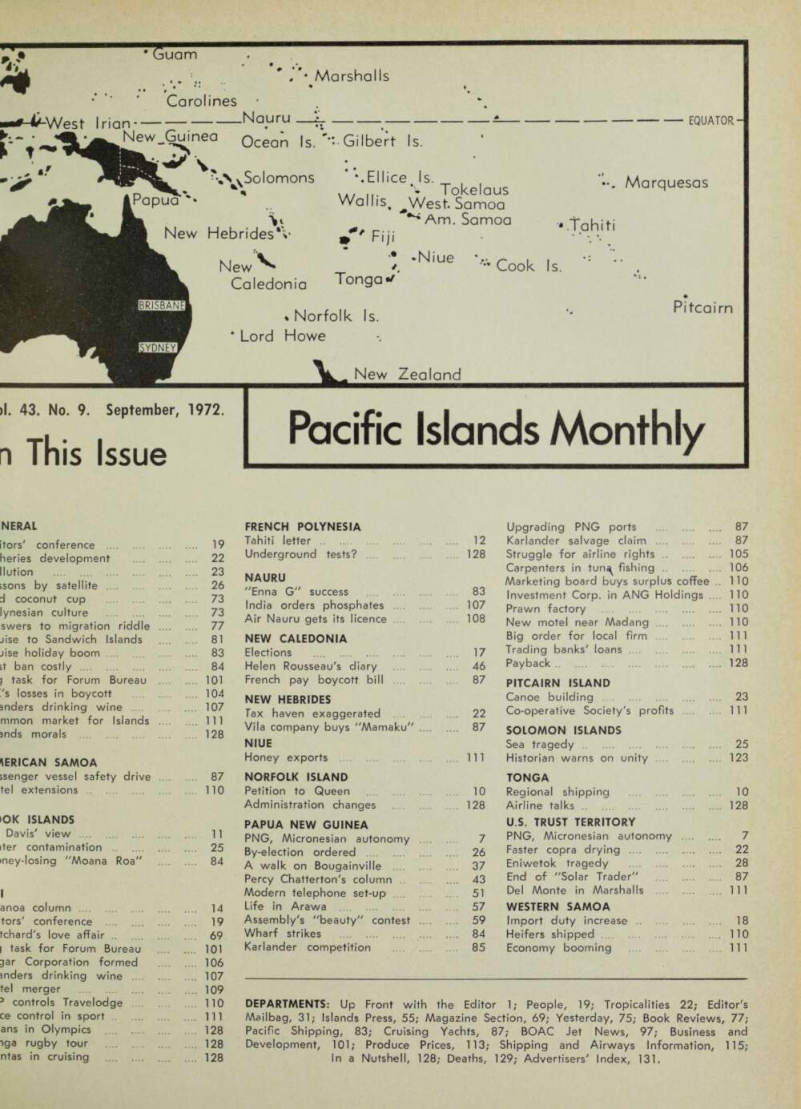
News Magazine Of The South Pacific
September, 1972
Australia, Nz, Geic, Bsip 50C
PNG, FIJI, COOKS, TONGA, W. SAMOA, N. HEBRIDES 45c
Nauru, Norfolk, Niue 45C
American Samoa 70C Hawaii, Micronesia $L.Oo
NEW CALEDONIA 65 CFP FRENCH POLYNESIA 100 CFP
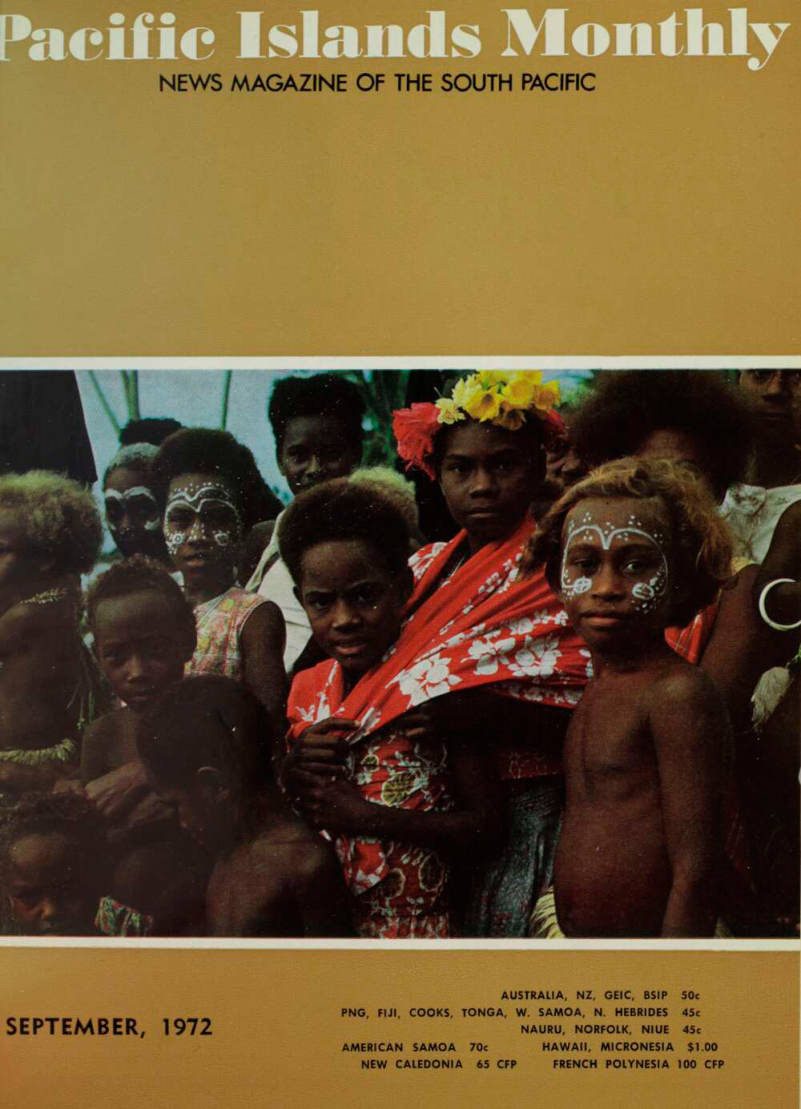
Our Cover
Ted Marriott, ex-govern ment information officer in the Solomons, snapped this colourful group at Savo in the Russell Islands of BSI. When they weren’t looking into the camera they were watching a dancing display.
Advertisements & other items, p. 2 (1 item)
m
i m iiili ■MB :v‘s: * \ % % Spp CD CD Biß| ‘ssiifftEJOqn <q|oQ |O h|ietu epeii t $ 111 *- I >2
This Issue
Neral
itors' conference 19 heries development 22 llution 23 isons by satellite 26 d coconut cup 73 lynesian culture 73 swers to migration riddle 77 jise to Sandwich Islands 81 jise holiday boom ... ... 83 it ban costly 84 j task for Forum Bureau 101 's losses in boycott 104 mders drinking wine 107 mmon market for Islands 11l ands morals 128
Origan Samoa
ssenger vessel safety drive 87 tel extensions 110
•Ok Islands
Davis' view 11 iter contamination 25 mey-losing "Moana Roa" 84 I anoa column 14 tors' conference 19 tchard's love affair 69 I task for Forum Bureau 101 jar Corporation formed 106 mders drinking wine 107 tel merger 109 3 controls Travelodge 110 ce control in sport 11l ans in Olympics ... 128 iga rugby tour 128 ntas in cruising 128
French Polynesia
Tahiti letter 12 Underground tests? 128
Nauru
"Enna G" success .. . 83 India orders phosphates 107 Air Nauru gets its licence 108
New Caledonia
Elections ... 17 Helen Rousseau's diary 46 French pay boycott bill 87
New Hebrides
Tax haven exaggerated 22 Vila company buys "Mamaku" 87
Niue
Honey exports 11l
Norfolk Island
Petition to Queen 10 Administration changes 128
Papua New Guinea
PNG, Micronesian autonomy 7 By-election ordered 26 A walk on Bougainville 37 Percy Chatterton's column 43 Modern telephone set-up 51 Life in Arawa 57
Assembly's "beauty" contest 59
Wharf strikes 84 Karlander competition 85
Upgrading PNG ports 87 Karlander salvage claim 87 Struggle for airline rights 105 Carpenters in fishing 106 Marketing board buys surplus coffee .. HO Investment Corp. in ANG Holdings . .. 110 Prawn factory 110 New motel near Madang 110 Big order for local firm 11l Trading banks' loans 111 Payback 128
Pitcairn Island
Canoe building 23 Co-operative Society's profits 11l
Solomon Islands
Sea tragedy 25 Historian warns on unity ... 123
Tonga
Regional shipping 10 Airline talks 128
U.S. Trust Territory
PNG, Micronesian autonomy 7 Faster copra drying 22 Eniwetok tragedy 28 End of "Solar Trader" 87 Del Monte in Marshalls ... 11l
Western Samoa
Import duty increase 18 Heifers shipped ... 110 Economy booming 111
DEPARTMENTS: Up Front with the Editor 1; People, 19; Tropicalities 22; Editor's Mailbag, 31; Islands Press, 55; Magazine Section, 69; Yesterday, 75; Book Reviews, 77; Pacific Shipping, 83; Cruising Yachts, 87; BOAC Jet News, 97; Business and Development, 101; Produce Prices, 113; Shipping and Airways Information, 115; In a Nutshell, 128; Deaths, 129; Advertisers' Index, 131.
Advertisements & other items, p. 4 (1 item)
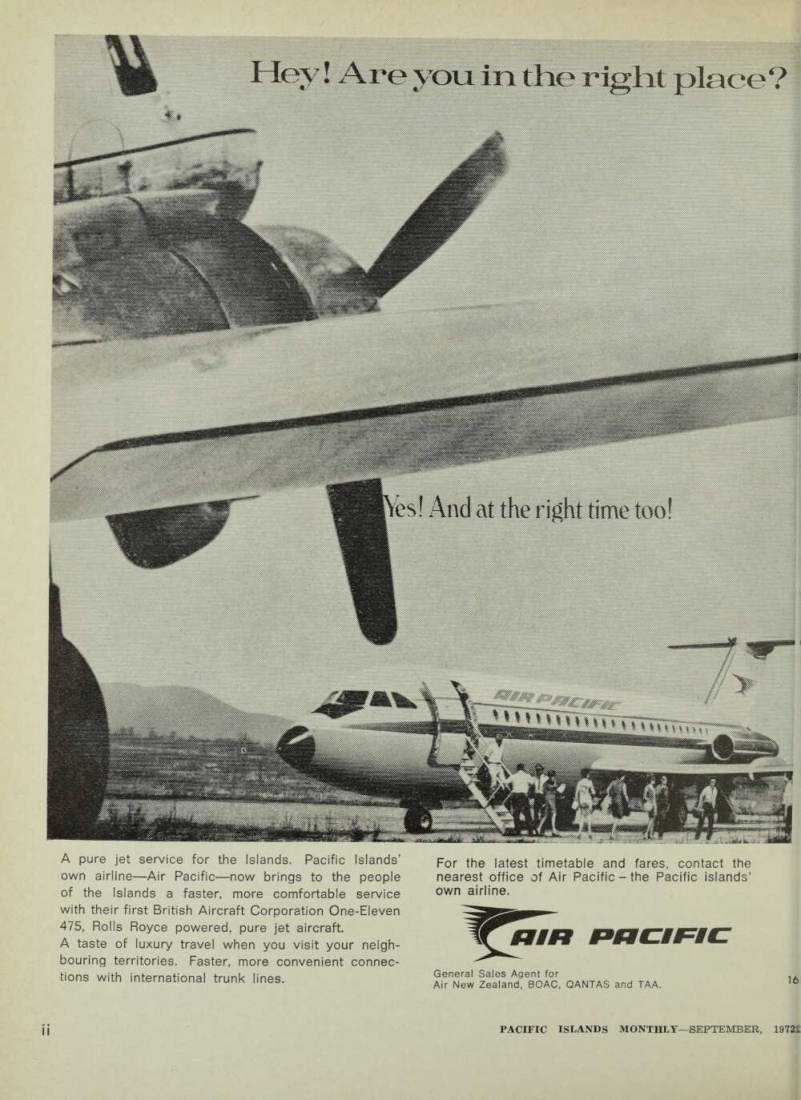
tiey! Are you in the right place?
, ■ es! And at the right time too!
LJjJJ H l|I IH111
A pure jet service for the Islands. Pacific Islands’ own airline—Air Pacific—now brings to the people of the Islands a faster, more comfortable service with their first British Aircraft Corporation One-Eleven 475, Rolls Royce powered, pure jet aircraft.
A taste of luxury travel when you visit your neighbouring territories. Faster, more convenient connections with international trunk lines.
For the latest timetable and fares, contact the nearest office of Air Pacific-the Pacific islands’ own airline.
am pacific
General Sales Agent for Air New Zealand, BOAC, QANTAS and TAA. 16
Pacific Islands

Monthly
FOUNDED BY R. W. ROBSON IN 1930
Owned And Published Monthly By
Pacific Publications (Aust.) Pty. Ltd.,
29 Alberta St., Sydney, N.S.W., 2000.
Postal Address: G.P.O. BOX 3408, SYDNEY,
N.S.W., 2001.
Telegraphic Address: PACPUB, Sydney.
Telephones: 61-9197, 61-7101, 61-4369.
nsulting Directors: R. W. Robson, Judy Tudor.
Chief Executives: General Manager: Selwyn Hughes.
Publisher: Stuart Inder.
Director of Advertising: W. A. Gasnier.
Pacific Islands Monthly
Editor; Stuart Inder.
Assistant Editor: John Carter, Advertising Manager: W. A. Gasnier.
Circulation Manager: Barry Badger.
Subscription Rates:
acific Islands Monthly" is air-freighted to I subscribers and agents in the Pacific Islands; copies to other areas go by surface mail, istralia (including Lord Howe and Thursday ), 8.5.1. P., Gilbert and Ellice Is.: $5.50 Aust.; pua New Guinea, Norfolk Island, Nauru, nga and New Hebrides: $5.00 Aust.; New aland: $5.50 NZ; Fiji, Cook Islands, Niue d Western Samoa; $5.00 (local currency); lerican Samoa: $B.OO US; U.S. Mainland: 4.00 US Micronesia (including Guam): $12.00 Hawaii; New Caledonia: 750 French Pacific mcs; Tahiti and French Polynesia: 850 French cific francs; United Kingdom and elsewhere: £3.25.
Representatives
|i: Pacific Publications (Fiji) Ltd., Fiji Times ilding, 20 Gordon Street, Suva. Tel.; 25601; ji Times Office, Cnr. Vitogo Pde, and Namoli 'e, LAUTOKA. Telex: 1144. Tel.: 60-422. pua New Guinea: LAE, P.O. Box 227; Mr. Steve Simpson, P.O. Box 433 (c/- Rabaul Photographic. Tel.: 2677.) ench Polynesia: Distribution—Hachette Paci iue, 10 Ave Bruat, Papeete. :w Zealand: Pacific Publications, C.P.O. Box 129, Auckland. 379-494. Representative: John edding. Civic House, 291 Queen St., Auckland, Tel.: 379-494. lited Kingdom: I. B. Graham, Park House, ! Park Street, Croydon, CR9 3NP. Tel.: 01-6884177. rerseas Newspapers (Agencies) Ltd., Cromwell >use, Fulwood Place, London, W.C.I. Tel.: -242-0661. Cables: WESNEWS, London, DS4. pan; Advertising—Universal Media Corpora ion, C.P.O. Box 46, Tokyo. Tel.: 666-3036. ctoria: Advertising—Wilke & Co. Ltd., 37 own's Road, Clayton, Vic., 3168. Tel.: 544-8222. jeensland: Advertising—Beale Media Services, !2 St. Paul's Terrace, Fortitude Valley, Qld., 4006. Tel.: 52-5827. iwaii and U.S. Mainland only: Mrs. W. H. cGrath, 225 Queen Street, Apt. 178, Honolulu, 96813. end change of address notices. Form 3579 to the above address.) jplication to mail at second class postage rates pending at Honolulu, Hawaii.
Copyright ©, 1972,
Pacific Publications (Aust.) Pty. Ltd.
September, 1972 Vol. 43, No. 9.
Advertisements & other items, pp. 5-6 (2 items)
Iii
CIFIC ISLANDS MONTHLY—SEPTEMBER, 1972
Drink the vitamins
you don’t eat.
Some of us don’t always get the vitamins we should get because of inadequacies in the diet.
Sometimes we eat a little too much of the wrong foods. Or much too little of the right foods.
In these cases, a vitamin supplement is often required. That’s where ‘Akta-Vite’ comes in.
One serving gives you most of the important vitamins you’re ever likely to need. Vitamins A, 81, C and D. In a delicious chocolate malty milk drink.
So raise your glass of ‘Akta-Vite’. And drink to vour health.
‘AktaVite’.
Made in Australia by Nicholas Pty. Ltd., 699 Warrigal Rd., Chadstone, Vic., 3148.
NPII4B
v S®S£ O', & m m m. rag 7W¥ i*e< 38 ;’*S.v m W. m m
<VJS^
m*.
Give your family
these all-time favourites
from Arnott’s
Everybody likes them! Nourishing Milk Arrowroot...
tasty Nice... delicious Coconut Bar... the egg-and-butter goodness of Scotch Finger... they’re all-time family favourites from the great big Arnott’s range. Taste them!
The triple-wrapped packs keep the biscuits fresh.
Qrnott's/™* Biscuits
There is no Substitute for Quality
Up Front
with the Editor
Freedom of speech is a basic free om, in the Islands as elsewhere. And ou can’t have free speech unless ou also have a free Press, and a ree Press, as Churchill said, “is the nsleeping guardian of every other ight that free men prize; it is the lost dangerous foe of tyranny.”
It’s surprising, when I come to link of it, that the people who pro uce the Press in the South Pacific ave never in their history got igether to discuss their mutual aims nd responsibilities—until last month, md it’s not surprising, when I come ) think of it, that it was an American istitution that initiated the idea and len made the get-together possible.
Americans are good at taking iternational over-views and then cting on them, usually generously, he East-West Communication )enter could not have got any :>ecial advantage from the heavy xpense of arranging the South acific Editors’ Conference in Suva, ut it certainly was a worthwhile xercise for all the participants, who ame from New Guinea, the Solo ions, Fiji, Western and American amoa, Tonga and Tahiti.
Newspapermen the world over ave common attitudes, and there 'as never any doubt of the social access of such a meeting. But South acific editors have something else i common—the special problems of üblishing news and comment in a eveloping area, where governments -ill have a strong influence because f the weakness of free enterprise.
John Fitzgerald, managing editor f the “Papua New Guinea Post courier,” noted: “We must be ritical but where in a more aphisticated society we might be smpted to ‘give ’em hell’, here we lust be constructive rather than ex losive. Undoubtedly we could push ur sales on a scale unprecedented i the Pacific Islands. But it would e short-term only. . . . People taking le first, gingerly steps towards ecision-making can be so easily rightened into ineffectiveness if they re told publicly that what they are oing is wrong. Too often this esults in a lasting bitterness towards he critic, who often uses the Press
as an outlet. The Press in turn suffers, even if it is unfairly.”
King Taufa’ahau of Tonga put it another way, although the king him self wasn’t there. He probably never even heard of the conference at which something he said earlier was quoted at length, and anyway he was well on his way to England in a copra ship.
He said “absolute freedom of the Press is the absolute aim,” but he thought that in Tonga this had to come by stages, “by evolution rather than revolution”. He made these points: “The first aim of a Tongan news paper should be the same as any other newspaper: to disseminate responsibly-gathered and written information. And the first duty of a newspaper is public information.
Because Tonga’s only newspaper (the "Tonga Chronicle”) is financed by the Tonga government, government officials may be nervous of it. . . .
Such nervousness is understandable.
These views are only held because they are not used to newspapers making comments on public affairs.
Had they experience in a country where a free Press is the rule rather than the exception, they’d find govern ments in that country tend to develop a hide about as thick as a rhinoceros, and newspaper, radio and television criticism simply bounces off. This attitude has not yet developed in Tonga. But I think it will come.
“Tonga is a very small country, and the opinions people have about them selves are dependent on the opinions others have of them. I think people in Tonga tend to be over-sensitive to criticism. Instead of examining the substance in criticism and trying to profit from it, if that is possible, they think that criticism is a personal affront. This is quite the wrong attitude. We can all profit from criticism. Where you are dealing with human affairs and things that affect the lives of people, you must expect people to react differently, because they are individuals.”
Henry Raraka, editor of Honiara’s lively little monthly newssheet, the "Kakamora Reporter”, observed that his paper was not worrying the
government because the circulation (700) was so small, but he would be interested to know what would happen as the circulation grew.
Colonial rule, he said, suppressed the Press because the administration was the regulator of all matters and it kept at bay anything that was “contrary to regulations”. Any local with an education was also sure to be a government employee, and thus his mouth was kept shut.
“In such a situation,” said Raraka, “one could hardly be in a position to develop a Press destined to reveal local aspirations as well as to dis seminate views, news, ideas and opinions.”
The lack of trained people to man the Islands newspapers, and worse, the lack of people to train as a result of the government “corner” on the short supply of suitably educated people, is one of those problems that all the editors who met in Suva had in common.
“From the point of view of pro duction,” said John Fitzgerald, “we would be able to produce the [New Guinea] daily newspaper using a completely-native production staff, from compositors right through to distribution. And it would be a paper with few mistakes. But from an editorial viewpoint, if we used all local staff it would be a newspaper that would be unprofessional, probably libellous in many areas, lacking flair—and certainly late!”
When the editors’ conference broke up it resolved to do something to help meet the common problems. It agreed to establish a South Pacific Press Association, and appointed a committee to go into the details. One of its aims will certainly be to find
way to help train South Pacific urnalists, “drawing on all available sources and always with the aim : fostering and preserving a free ress ”
Already the committee thinks it ight be able to organise crash traing courses, with tutors moving from ea to area, putting inexperienced cal journalists through the ropes.
M Ichael Somare, Papua New
Guinea’s Chief Minister since e National Coalition came to power April and quickly began to move e country towards self-government, is been doing a competent job in fficult circumstances.
Those (in the government oppoion) who are critical of what they :lieve to be a panic dash towards dependence, naturally are stirring e pot and this doesn’t make any
easier Mr Somare’s task in vigorously attacking a whole range of problems that just have to be tackled. At the same time, the coalition’s success also attracts the usual share of backslappers, sycophants and riders-on-thebandwagon, and this type of adulation also doesn’t make Mr Somare’s task any easier.
Myself, I wish Mr Somare would curb what appears to be a tendency to sound off in public without choosing his words. His naturally forthright style and easy fluency are very attractive, but when translated from the informality of a Press conference into cold print, some of his comments are better unsaid.
As New Guinea’s national leader, his words are analysed carefully, especially outside the country, and no man with his responsibility can risk international incidents arising from
a chance, or off - the - cuff remark.
I have in mind such international matters as the West Irian refugee problem, and the border with Queensland (which is exciting some of the islanders). But on home front party-political matters, which with out doubt he is fully equipped to comment on, it is nevertheless t hair raising to read of him saying, “It is high time the elected leaders of this country gave some guidance to the people, and if Matt Toliman and his gang are not prepared to give some guidance, that’s bad luck!”
Opposition Leader Toliman and his party represent a substantial oppo sition that almost formed a govern ment, and his choice of words to describe them is not likely to assist the cause of harmony in a country that is going to need it in large
lumps.
Stuart Inder.
Advertisements & other items, pp. 7-12 (4 items)
1
acific ISLANDS MONTHLY—SEPTEMBER, 1972
and complete
dD
MORRIS
HEDSTROM
LIMITED
HEAD OFFICE: SUVA-FIJI
LONDON OFFICE:
MORRIS HEDSTROM LTD.,
Park House,
22 Park Street,
CROYDON, CR9 BNP.
• GENERAL MERCHANTS
• PRODUCE BUYERS
• IMPORTERS & EXPORTERS
• PLANTATION OWNERS
• COMMISSION & INSURANCE
AGENTS
AUSTRALIAN REPRESENTATIVE;
W. R. CARPENTER & CO. LTD.,
(MERCHANDISE DIVISION),
The A. Cr N.Z. Building,
68 Pitt Street,
SYDNEY, 2000.
Registered Cable Addresses:
MORRISHED —SUVA, APIA, NUKUALOFA. • SUVAMARK LONDON. • MORSTROM SYDNEY.
AGENTS AND DISTRIBUTORS FOR:
SHIPPING
GENERAL
LIQUOR
China Navigation Company Lloyd's Lloyd Triestino Mitsui OSK Lines Pacific Australia Direct Line Pacific Far East Line, Inc.
MOTOR
Alfa-Laval A.R.A. Airconditioners Assoc. Battery Makers of Aust. Ltd.
Champion Spark Plug Co.
Chrysler U.K. Ltd.
D. H. Davies & Co. Ltd.
Ferodo Ltd.
Ford Motor Co.
Fram Filters Ltd.
Good-year Tyre & Rubber Co.
Hayter Exports Ltd.
Howard Rotavators Pty. Ltd.
Napier Bros. Ltd.
Norton-Villiers Outboard Marine International W. H, Wylie Addis Limited Benford Ltd.
Crittall-Hope Export Electrolux Ltd.
Imperial Chemical Industries Ltd.
James A. Jobling Ltd.
John Steventon & Sons (Export) Ltd.
H. & R. Johnson Ltd. .
Kelvinator International Inc. (Leonard Refrigerators) Longines SA Marley Floor Tile Co.
Nippon Kogaku (Nikon Cameras) Noritake Co. Ltd.
Olympus Optical Parker/Eversharp Pen Co.
Pilkington Bros. ltd.
Procter & Gamble Ronson Ltd.
Rowntree & Co. Ltd.
Sanyo Electrical Singer Australia Ltd.
Wiltshire File Co. Pty. Ltd.
Winstone Ltd.
Yorkshire Imperial Metals Bacardi International Drambuie Liqueur Co. Ltd.
Guinness Exports Jas. Hennessy & Co.
John Dewar & Sons Ltd.
McWilliams Wines Pty. Ltd.
Tanqueray Gordon & Co. Ltd.
PHARMACEUTICALS & COSMETICS
Astra International Burroughs Wellcome & Co. N.Z. Ltd.
Ciba Laboratories Cynamid CfHA Pty. Ltd.
Elizabeth Arden Faberge Inc, Fisons Pty. Ltd.
G. D. Searle (Aust.) Pty, Ltd.
Glaxo Laboratories Ltd.
Hoechst Aust. Ltd.
Lentheric Perfumes Max Factor Morny Ltd.
Parfum Corday Parfum Christian Dior Parfum Gres Parfum Pucci Parfum Venet Rimmel Ltd.
Sandoz Pharmaceuticals Silten International Smith & Nephew Ltd,
for friendly service
and complete
satisfaction its .. .
MORRIS HEDSTROM
LIMITED
Fiji—Western Samoa-Tonga
CATHOLIC BOARDING COLLEGE FOR BOYS
This college is conducted by the Marist Fathers and special attention is given to boys preparing for School Certificate (4th Form) and Higher School Certificate (sth and 6th Forms).
Vacancies exist in Forms 1-5 and the elective subjects include Woodwork, Technical Drawing, Asian Social Studies and Languages.
TERM FEE: Ist & 2nd Form $230; 3rd & 4th Form $250; sth & 6th Form $270.
EARLY APPLICATION IS ADVISABLE
For all enquiries contact: THE SECRETARY, ST. JOHN'S COLLEGE, P.O. BOX 6, LISMORE, N.S.W. 2480, AUSTRALIA.
ST. JOHN'S COLLEGE
WOODLAWN, LISMORE, N.S.W.
SULLIVANS
MELBOURNE
AUCKLAND
SYDNEY
C. SULLIVAN (EXPORT) PTY. LTD.,
4TH FLOOR, KEMBLA BUILDING,
60 MARGARET STREET. SYDNEY
(G.P.O. BOX 3373).
CABLES AND TELEGRAMS: ~C HASULL, ,.
BRISBANE
LONDON
OFFERS A COMPREHENSIVE AND EFFICIENT
BUYING SERVICE TO THE PACIFIC ISLANDS
OFFICES AT:
PORT MORESBY • LAE • RABAUL • KIETA • MOUNT HAGEN • BULUMA • SUVA • LAUTOKA • NOUMEA • HONIARA • PORT VILA u
SULLIVANS for SERVICE
ff
AVAILABLE FROM ;
JAMES SANDY PTY. LTD
637 GARDENERS ROAD, MASCOT
N.S.W., 2050, AUSTRALIA.
• GLASS MERCHANTS
• ALUMINIUM STOREFRONTS
• ALUMINIUM WINDOWS AND DOORS
• SHOWER SCREENS
• MIRRORS
SANDYS
EXTRUDED ALUMINIUM
ADJUSTABLE LOUVRES
FITTED WITH ALUMINIUM OR GLASS BLADES
FOR SUN AND VENTILATION CONTROL
SANDYS EXTRUDED ALUMINIUM GLAZING BAR FOR
ECONOMICAL SIDEWALL GLAZING
OT" nSWWr T > V’vr" ’ ♦ ** .
HHHHBMp ■ W:
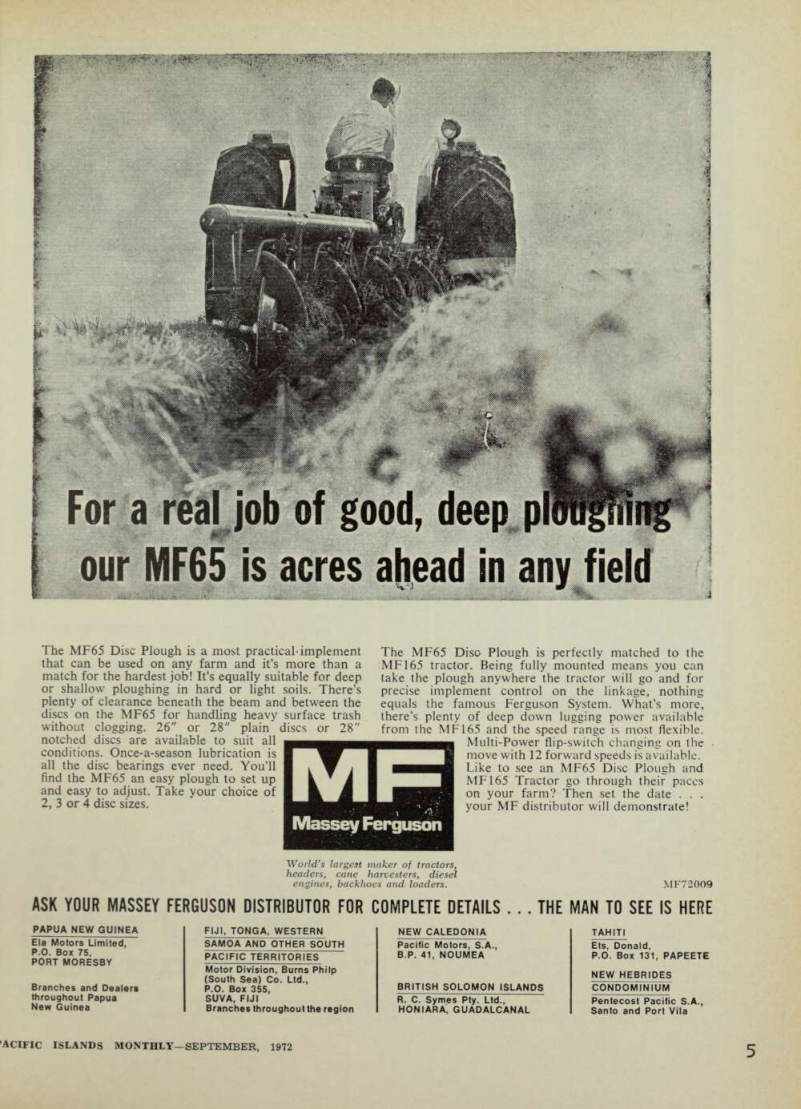
4h, For a real job of good, deep pi our MF6S is acres ahead in any field M The MF6S Disc Plough is a most practical* implement that can be used on any farm and it’s more than a match for the hardest job! It’s equally suitable for deep or shallow ploughing in hard or light soils. There’s plenty of clearance beneath the beam and between the discs on the MF6S for handling heavy surface trash without clogging. 26" or 28" plain discs or 28" notched discs are available to suit all conditions. Once-a-season lubrication is all the disc bearings ever need. You’ll find the MF6S an easy plough to set up and easy to adjust. Take your choice of 2, 3 or 4 disc sizes.
MP The MF6S Disc Plough is perfectly matched to the MFI6S tractor. Being fully mounted means you can take the plough anywhere the tractor will go and for precise implement control on the linkage, nothing equals the famous Ferguson System. What’s more, there’s plenty of deep down lugging power available from the MFI6S and the speed range is most flexible.
Multi-Power flip-switch changing on the move with 12 forward speeds is available.
Like to see an MF6S Disc Plough and MFI6S Tractor go through their paces on your farm? Then set the date . . . your MF distributor will demonstrate!
Massey Ferguson
World’s largest maker of tractors, headers, cane harvesters, diesel engines, backhoes and loaders.
MF72009 ASK YOUR MASSEY FERGUSON DISTRIBUTOR FOR COMPLETE DETAILS ... THE MAN TO SEE IS HERE
PAPUA NEW SUIWEA
Ela Motors Limited, P.O. Box 75,
PORT MORESBY
Branches and Dealers throughout Papua New Guinea
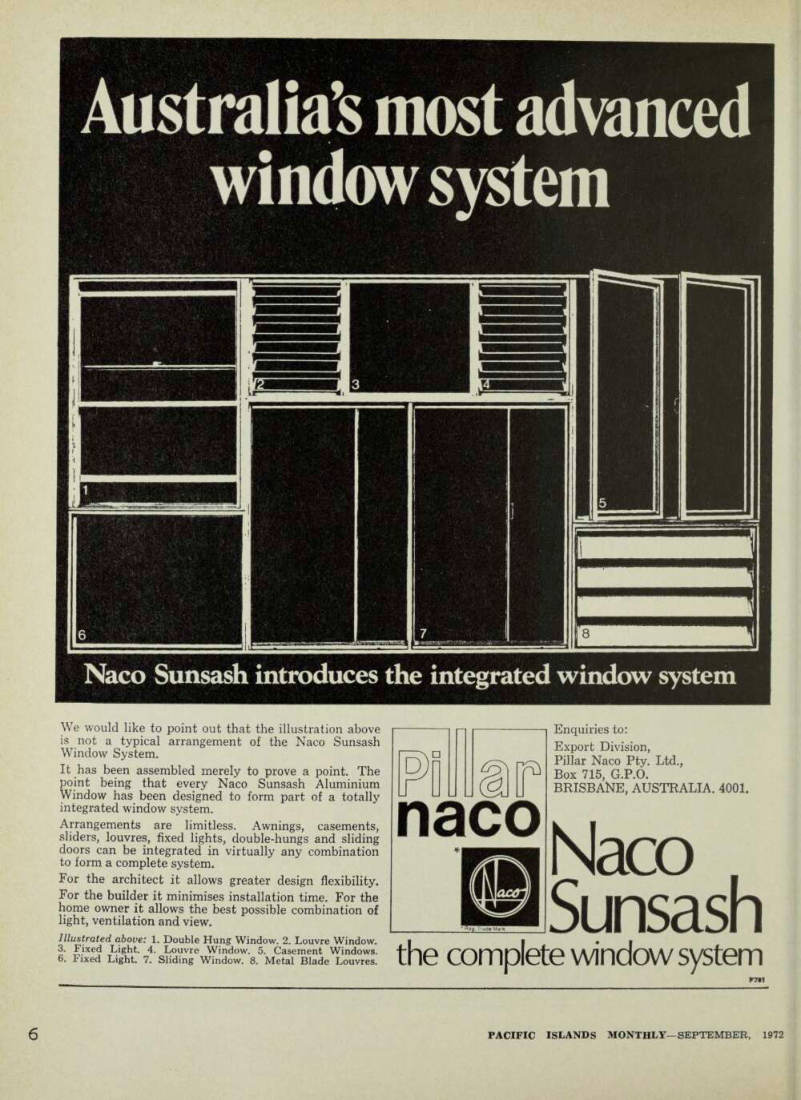
Australia's most advanced
window system
Naco Sunsash introduces the integrated window system We would like to point out that the illustration above is not a typical arrangement of the Naco Sunsash Window System.
It has been assembled merely to prove a point. The point being that every Naco Sunsash Aluminium Window has been designed to form part of a totally integrated window system.
Arrangements are limitless. Awnings, casements, sliders, louvres, fixed lights, double-hungs and sliding doors can be integrated in virtually any combination to form a complete system.
For the architect it allows greater design flexibility.
For the builder it minimises installation time. For the home owner it allows the best possible combination of light, ventilation and view.
Illustrated above: 1. Double Hung Window. 2. Louvre Window. 3. Fixed Light. 4. Louvre Window. 5. Casement Windows. 6. Fixed Light. 7. Sliding Window. 8. Metal Blade Louvres.
Enquiries to: Export Division, Pillar Naco Pty. Ltd., Box 715, G.P.O.
BRISBANE, AUSTRALIA. 4001.
the complete window system
nt\
Naco
Sunsash
naco
im
3
CIFIC ISLANDS MONTHLY—SEPTEMBER, 1972
5
ACIFIC ISLANDS MONTHLY— SEPTEMBER, 1972
Pacific Islands Monthly
Last Two Trust Territories
Chart Their New Course
As Australia’s Minister for Terri fies, Mr Andrew Peacock, said in ort Moresby at the August constitu onal talks with Papua New Guinea, iere is no universally agreed upon efinition of what constitutes self ovemment. But it’s interesting that le world’s remaining two UN trust uritories —Papua New Guinea and le Trust Territory of the Pacific (lands—are at the same time now ying to decide on a suitable formula f self-government, and that they are etting some of the same answers id have still to face some of the ime problems.
The Port Moresby talks were the rst in a series. The decisions there ill have to be approved by the PNG louse of Assembly meeting which egins at the end of August, and irther talks with the Australian Gov mment will take place in October.
The fifth in a series of Micronesian ilks was wound up in Washington n August 1. It will be discussed t a special session of the Congress f Micronesia in Ponape late in oigust, and further talks with the jnerican Government will take place i Hawaii in September.
Both New Guinea and Micronesia ave got down to the nitty-gritty of emulating timetables for self ovemment. The PNG Coalition 'ants it in December, 1973, followed y independence soon after. They ave already got agreement on some latters, but some others, notably ivil aviation, defence and foreign (fairs, will have to wait (see separate ory, p. 8). Financial matters will e discussed at the October meeting, nd a timetable for the transfer of lost of the remaining matters will icn be worked out.
Leader of the Opposition in New iuinea, Matthias Tollman, who took art in the Port Moresby talks only s an observer, and who did not sign le final communique, indicated that ic opposition would try to prevent le assembly from endorsing the greement.
“Our policies are not those of the oalition,” he said. “I speak of and
for the people in the villages whose thoughts may not have been taken into account in these meetings.” But Chief Minister Michael Somare said he was confident that his majority Coalition Government would approve the agreement in the House.
His confidence was well-based, but the Australian Government did say at the talks that Australia wanted to see a decisive expression of support on such an important question.
Australia undoubtedly wants the handover to go smoothly, and quickly, and if there is a serious division in the PNG parliament, Australia will be faced with a problem.
The Micronesians, too, are not agreed among themselves on the details of self-government. One of the six Micronesian districts, the Marianas, are to have separate negotiations to give them a much closer relationship with the US, and nobody knows the extent of other opposition until the draft pact now being worked out is properly debated.
In other words, neither Australia nor the United States as administering powers is now a serious obstacle to autonomy in the last remaining trust territories. Whether or not there will be a smooth passage depends now upon the shoals of New Guinean and Micronesian domestic politics.
The Micronesian timetable calls for the completion of the draft “Compact of Association” which was started at Washington. This will probably be done in September in Hawaii. The next moves are to have the compact approved by the Con gress of Micronesia, the United States Congress and then the people of the trust territory with a referendum, The referendum, next year, will probably be run in conjunction with a constitutional convention to discuss the form of the new State of Micro nesia. Legislation to establish the con vention will be discussed at the August meeting of Micronesian Congress in Ponape. The Ponape meeting, which will continue until early September, will be the final meeting of the Fourth Congress. There will be general elections on November 7, and the Fifth Congress will meet in January —to be faced with the real problem of establishing self-government. This will occur over a transitional period in which details will have to be worked out for the final handover, It has not yet been agreed on how long this transitional period will be.
The Micronesians have suggested five years, the US has suggested 15, and there has to be a compromise, But autonomy is arriving quickly in both New Guinea and Micronesia.
Greater equity in Islands business
A development which ”is arousing considerable interest” in the Solomon Islands is the recent formation of the Solomon Islands Investment Company, the Western Pacific High Commissioner, Sir Michael Gass, told the BSIP Governing Council in Honiara in August.
He said the aim of the company was to give small local investors the chance to take shares in well-established concerns which until now have been wholly owned by expatriates.
And in Port Moresby the same week, PNG Minister for Lands, Mr. Albert Maori Kiki, told an Associated Chambers of Commerce meeting that some foreign companies in PNG were making excessive profits while refusing to promote indigenous staff. The “best insurance” that companies could have in PNG was to give fair and equitable treatment to local people and their government, said Mr. Kiki, in the bluntest warning yet from the new National Coalition government that overseas companies will have to give New Guineans a bigger share of management and profits.
Advertisements & other items, p. 13 (1 item)
7
ACIFIC ISLANDS MONTHLY—SEPTEMBER, 1972
approach to
Realistic approach to PNG power swapping
From Percy Chatterton
During Mr C. E. Barnes’ long occupancy of the post of Minister for External Territories in the Aus tralian Government, we were blandly assured from time to time that we could have self-government when ever we wanted it; but little was done to investigate just what legislative and administrative procedures would be involved in our progress towards it.
A few powers have been handed over by Canberra to Port Moresby during the last few years; but one suspects that they have been selected partly because they were powers which it was procedurally easy to hand over, and partly because their transfer would not materially weaken Canberra’s control, rather than for their significance as steps toward meaningful self-government.
Our new minister, Mr Andrew Peacock, has attacked the problem more realistically, and it may be suspected that that is what he was given his portfolio to do. If this is the case, he must have been greatly encouraged by the goal set by PNG’s ruling National Coalition, December 1, 1973, “or as soon thereafter as may be practicable,” for the attain ment of complete internal self government.
Between July 26 and August 8, an important conference was held in Port Moresby between Mr Peacock and the National Coalition ministry headed by Chief Minister Michael Somare, together with three represen tatives of the opposition United Party.
The object of this exercise was to review the further powers which Canberra must transfer to Port
Moresby so that complete internal self-government may be attained, and to classify them into those which can be transferred without raising any serious procedural problems and those which will involve legislative action either by the Australian Parliament or by the House of Assembly or by both.
The first category is said to include some 25 powers of varying degrees of importance. Those to be transferred immediately, subject to House of Assembly approval, include control of policy on wages and industrial relations, migration, and land settlement and development. Reliable sources do not expect serious differences to arise over these powers, though the National Coalition will have to get approval for the changes from the House of Assembly in September, and the leader of the opposition, Mr Matthias Toliman, has already expressed dissent, complaining of the speed at which progress towards self-government is being pursued.
The second category includes responsibilities that will require some planning. One of the most important in this group is currency. There has been increasing pressure here recently for Papua New Guinea to break away from the Australian dollar. Both the Minister for Internal Finance, Julius Chan, and the newly appointed New Guinean manager of the Reserve Bank here, Henry To Robert, have expressed themselves in favour of such a step. This issue was discussed, it is understood, during the present round of talks, and will be discussed again when they are resumed, probably in October.
But even if a policy decision is; made in favour of a separate cur rency, the implementation of that: policy will involve months of prepara tion and some pretty involved legislation, as Treasurer H. P. Ritchie; pointed out when a rumour went; round town recently that the banks: were about to close down for a long: weekend and open again the follow ing week with the new currency ini operation.
The fact that this rumour sent; many hare-brained expatriates rush ing round to the bank to transfer their savings to Australia could be i regarded as a reflection on the Aus tralian education system.
A third group of powers are those; that require major planning and 1 policy decisions. These include control 1 of the public service, of the police,, of broadcasting and of civil aviation,, and these will probably not be; transferred until the eve of the target; date for self-government. Indeed, the; control of civil aviation is such a j hard nut to crack that it may have; to be relegated to that small group ( of powers, such as control of foreign i relations and defence, which will not; be transferred until independence.
However, the immediate appoint ment of spokesmen for defence and police in the House of Assembly has ; been agreed to, and it has been an nounced that for the present the Chief !
Minister will handle these matters ; himself.
An issue of special interest to me ; is that of broadcasting. Both the ; House of Assembly and the Aus- ■ tralian Government have agreed in i principle to the setting up of a i National Broadcasting Authority to <
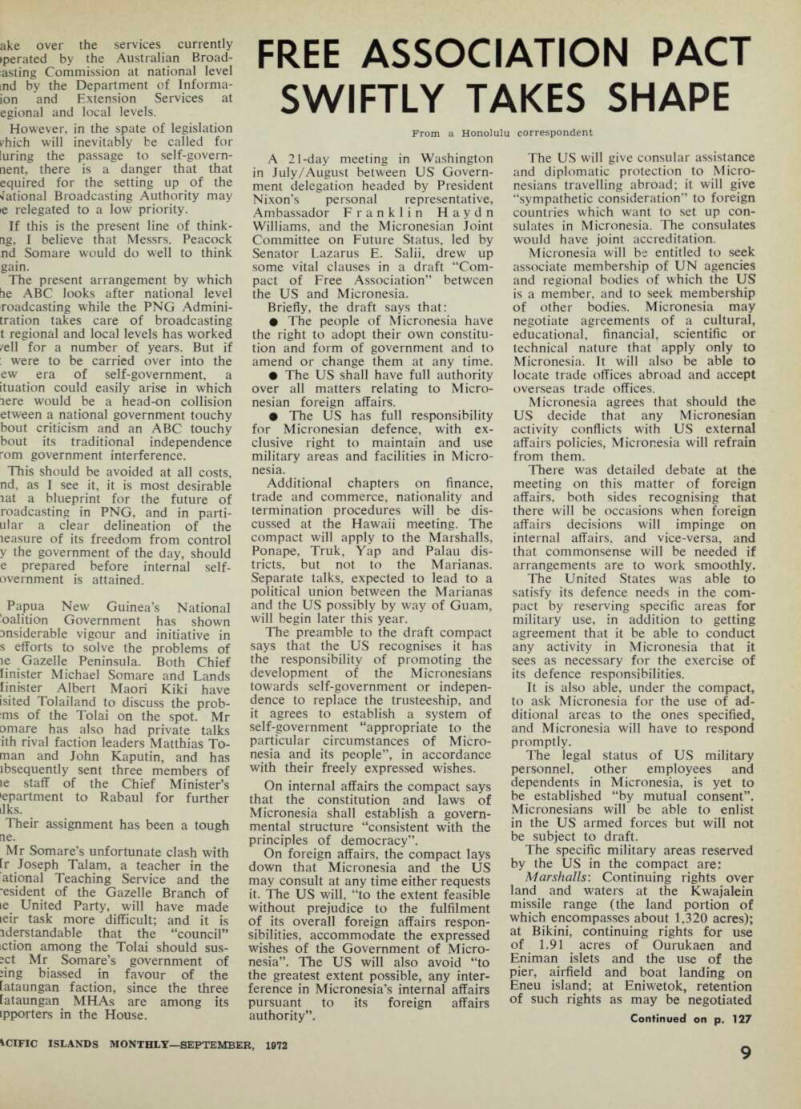
Mr Somare (left) and Mr Peacock during the talks
ake over the services currently ►perated by the Australian Broad asting Commission at national level ind by the Department of Informa ion and Extension Services at egional and local levels.
However, in the spate of legislation /hich will inevitably be called for luring the passage to self-govern nent, there is a danger that that equired for the setting up of the National Broadcasting Authority may ie relegated to a low priority.
If this is the present line of think tig, I believe that Messrs. Peacock nd Somare would do well to think gain.
The present arrangement by which tie ABC looks after national level roadcasting while the PNG Admini tration takes care of broadcasting t regional and local levels has worked /ell for a number of years. But if ; were to be carried over into the ew era of self-government, a ituation could easily arise in which iere would be a head-on collision etween a national government touchy bout criticism and an ABC touchy bout its traditional independence rom government interference.
This should be avoided at all costs, nd, as I see it, it is most desirable lat a blueprint for the future of roadcasting in PNG, and in parti ular a clear delineation of the leasure of its freedom from control y the government of the day, should e prepared before internal self overnment is attained.
Papua New Guinea’s National ’oalition Government has shown Misiderable vigour and initiative in s efforts to solve the problems of le Gazelle Peninsula. Both Chief linister Michael Somare and Lands linister Albert Maori Kiki have isited Tolailand to discuss the prob rns of the Tolai on the spot. Mr omare has also had private talks ith rival faction leaders Matthias To man and John Kaputin, and has ibsequently sent three members of ie staff of the Chief Minister’s department to Rabaul for further ilks.
Their assignment has been a tough ae.
Mr Somare’s unfortunate clash with fr Joseph Talam, a teacher in the ational Teaching Service and the 'esident of the Gazelle Branch of ie United Party, will have made icir task more difficult; and it is iderstandable that the “council” iction among the Tolai should sus ;ct Mr Somare’s government of dng biassed in favour of the fataungan faction, since the three lataungan MHAs are among its ipporters in the House.
Free Association Pact
Swiftly Takes Shape
From a Honolulu correspondent
A 21-day meeting in Washington in July/August between US Govern ment delegation headed by President Nixon’s personal representative, Ambassador Franklin Haydn Williams, and the Micronesian Joint Committee on Future Status, led by Senator Lazarus E. Salii, drew up some vital clauses in a draft “Com pact of Free Association” between the US and Micronesia.
Briefly, the draft says that: • The people of Micronesia have the right to adopt their own constitu tion and form of government and to amend or change them at any time. • The US shall have full authority over all matters relating to Micro nesian foreign affairs. • The US has full responsibility for Micronesian defence, with ex clusive right to maintain and use military areas and facilities in Micro nesia.
Additional chapters on finance, trade and commerce, nationality and termination procedures will be dis cussed at the Hawaii meeting. The compact will apply to the Marshalls, Ponape, Truk, Yap and Palau dis tricts, but not to the Marianas.
Separate talks, expected to lead to a political union between the Marianas and the US possibly by way of Guam, will begin later this year.
The preamble to the draft compact says that the US recognises it has the responsibility of promoting the development of the Micronesians towards self-government or indepen dence to replace the trusteeship, and it agrees to establish a system of self-government “appropriate to the particular circumstances of Micro nesia and its people”, in accordance with their freely expressed wishes.
On internal affairs the compact says that the constitution and laws of Micronesia shall establish a govern mental structure “consistent with the principles of democracy”.
On foreign affairs, the compact lays down that Micronesia and the US may consult at any time either requests it. The US will, “to the extent feasible without prejudice to the fulfilment of its overall foreign affairs respon sibilities, accommodate the expressed wishes of the Government of Micro nesia”. The US will also avoid “to the greatest extent possible, any inter ference in Micronesia’s internal affairs pursuant to its foreign affairs authority”.
The US will give consular assistance and diplomatic protection to Micro nesians travelling abroad; it will give “sympathetic consideration” to foreign countries which want to set up con sulates in Micronesia. The consulates would have joint accreditation.
Micronesia will be entitled to seek associate membership of UN agencies and regional bodies of which the US is a member, and to seek membership of other bodies, Micronesia may negotiate agreements of a cultural, educational, financial, scientific or technical nature that apply only to Micronesia. It will also be able to locate trade offices abroad and accept overseas trade offices.
Micronesia agrees that should the US decide that any Micronesian activity conflicts with US external affairs policies, Micronesia will refrain from them.
There was detailed debate at the meeting on this matter of foreign affairs, both sides recognising that there will be occasions when foreign affairs decisions will impinge on internal affairs, and vice-versa, and that commonsense will be needed if arrangements are to work smoothly.
The United States was able to satisfy its defence needs in the com pact by reserving specific areas for military use, in addition to getting agreement that it be able to conduct any activity in Micronesia that it sees as necessary for the exercise of its defence responsibilities.
It is also able, under the compact, to ask Micronesia for the use of ad ditional areas to the ones specified, and Micronesia will have to respond promptly.
The legal status of US military personnel, other employees and dependents in Micronesia, is yet to be established “by mutual consent”.
Micronesians will be able to enlist in the US armed forces but will not be subject to draft.
The specific military areas reserved by the US in the compact are: Marshalls : Continuing rights over land and waters at the Kwajalein missile range (the land portion of which encompasses about 1,320 acres); at Bikini, continuing rights for use of 1.91 acres of Ourukaen and Eniman islets and the use of the pier, airfield and boat landing on Eneu island; at Eniwetok, retention of such rights as may be negotiated
Continued on p. 127
Advertisements & other items, p. 15 (1 item)
9
*CIFIC ISLANDS MONTHLY—SEPTEMBER, 1972
bounty
Norfolk seeks the Queen's bounty
Alleging unjust, and even illegal interference in their affairs by the Australian Government, the Norfolk Islanders are drafting a petition to Queen Elizabeth which will suggest that, if the Australian Government doesn’t draw in its horns, they will ask to become a separate Crown colony.
A Citizens’ Committee, which claims it has the overwhelming sup port of the islanders, decided on August 23 to make the petition.
Two measures proposed by the Australian Government have created the crisis—legislation to close down the island as a “tax haven”, and the planned establishment of an animal quarantine station. The former, the islanders complain, will rob them of much-needed revenue—they reckon at least 5250 a head, plus hotel and store trade generated by a tax haven.
The latter could bring all sorts of evils. An outbreak of disease among quarantined stock is one bogey, but the biggest fear is that the tourist industry would suffer.
Norfolk Island, they argue, would lose its image and its tourists. Who fancies an island paradise with a quarantine station?
When the business of the abolition of the tax haven blew up many months ago, Norfolk was split in two.
On one side were those who pocketed fees as resident “directors” of the carpet-bagging companies. On the other, those who didn’t. It even caused an election, a new island council. Most of the “Bounty” strain were among those who didn’t.
Then came the quarantine station proposal and an uneasy feeling that, although they’d been told they were being consulted over the station, the government would please itself in the end and the islanders would be landed with it. There was no doubt the majority were “agin” it; letters in the island’s newspaper proved that. The letters also indicated that bad feeling, neighbour against neigh bour, was creeping in: something the island had never had to any great extent.
But the realisation that the govern ment was acting without really con sulting the people and would ignore their wishes and their welfare was the real spark which is being fanned into the flame of polite revolt, but revolt
all the same. Once again the idea of secession, nothing new in Nor folk’s history, is abroad. Many want Britain to take over the island as a Crown colony, arguing that Australia has no legal right to claim its 8,528 acres as part of the mainland; that all Australia had been given was the job of looking after it for the good of the islanders. Even that right, contained in an Order in Council made by George V in 1914, is “meaningless” says Mr Tom Jackson, Norfolk’s just-retired chief magistrate.
Many people are angry. They say the island council has sold the pass after being elected on a promise to protect their rights. At a recent meet ing the councillors accepted the idea of a quarantine station “in principle”.
So a Citizens’ Committee has come into being, and it’s talking about secession.
The companies registration fee was originally $l3 a year. The Federal Government, by ordinance, raised this last year to $250 and away went 60 companies through deregistration, with another 30 going into liquida tion. But there were still 1,550 left at June’s end this year which, the local newspaper, “Norfolk Islander”, estimated, would bring in revenue of $400,000 a year—a nice nest egg in another basket to that of tourism.
This is what Norfolk Island will lose along with its tourists, the islanders fear, if the two measures come into operation.
And one is in operation already, the ordinance closing the tax haven through a ruse which the juris prudence practitioners think is one of the nastiest, most underhand bits of work ever perpetrated by a poli tician, which is saying something.
When Federal Treasurer Mr Snedden announced in July that the island’s tax haven days were over and that the Federal Government would table a bill introducing the requisite ordinance, he put a stopper on the activities of all the companies.
He said the effects of the measure would be retrospective to July 19 this year. What’s the effect of that?
For one thing, the government’s right to make the law will be chal lenged. The legal draftsmen have to draft a measure which will be an extremely complicated piece of work.
All this will take time, at least 12 months, say the legal experts.
Meantime, as the effect of any law which emerges has been made retro spective, that law is already working as a de facto law if not de jure.
What company is going to go on operating with the risk of losing any thing it has gained from July 19?
Continued on p. 127
shipping
Islands' shipping problems
By a special correspondent
Shipping services between the s Islands and Australia and New v Zealand seem to be receiving increas- ing attention from governments in r the region nowadays.
What with a continual round of 5 freight increases allegedly contribut- ing to inflation in the countries and f political forces making shipping a r popular subject for politicians, the £ shipping companies serving the region r are probably hankering after the good £ old days of anonymity, when they \ simply carried the cargo and that was 8 it.
Tonga’s Pacific Navigation Com- pany has also taken a hammering over the past year; first it was operat- ing losses, at first denied and then r admitted; next it was the report com- missioned by PIPA from a Fiji firm r of auditors which concluded that the s Tongan line didn’t have the necessary \ operating accounts to enable it to c complete its report; while finally the s Tongan line was put in the embarrass- ing position of being the first line on r the Australia run to increase its rates. .
So much, said some, for a regional 1 line being able to hold down freight J rates.
In an interesting development J affecting the regional shipping line 3 proposal, the Adelaide-based firm of f consultants, P. G. Pak-Poy and £ Associates, who have been working § on a roads project in Western Samoa, f are understood to have been retained £ by the Western Samoa Government J to report on the country’s overseas z shipping situation.
The terms of reference are said to o include a preliminary study of the 3 prospects for a nationally-owned h Western Samoan shipping line. .; Whether the study sounds the death- knell of the proposed joint regional fj shipping line, which was to have been n based on the Tongan national line, is not at all clear.
The prospect now of Tonga, ,j Western Samoa and other island gov- ernments each running its own ships & in some form of co-operative venture 3 cannot be ruled out, however. .* Whether Western Samoa’s interest in n going it alone in the shipping field b
Continued on p. 127
Of The Political Scene
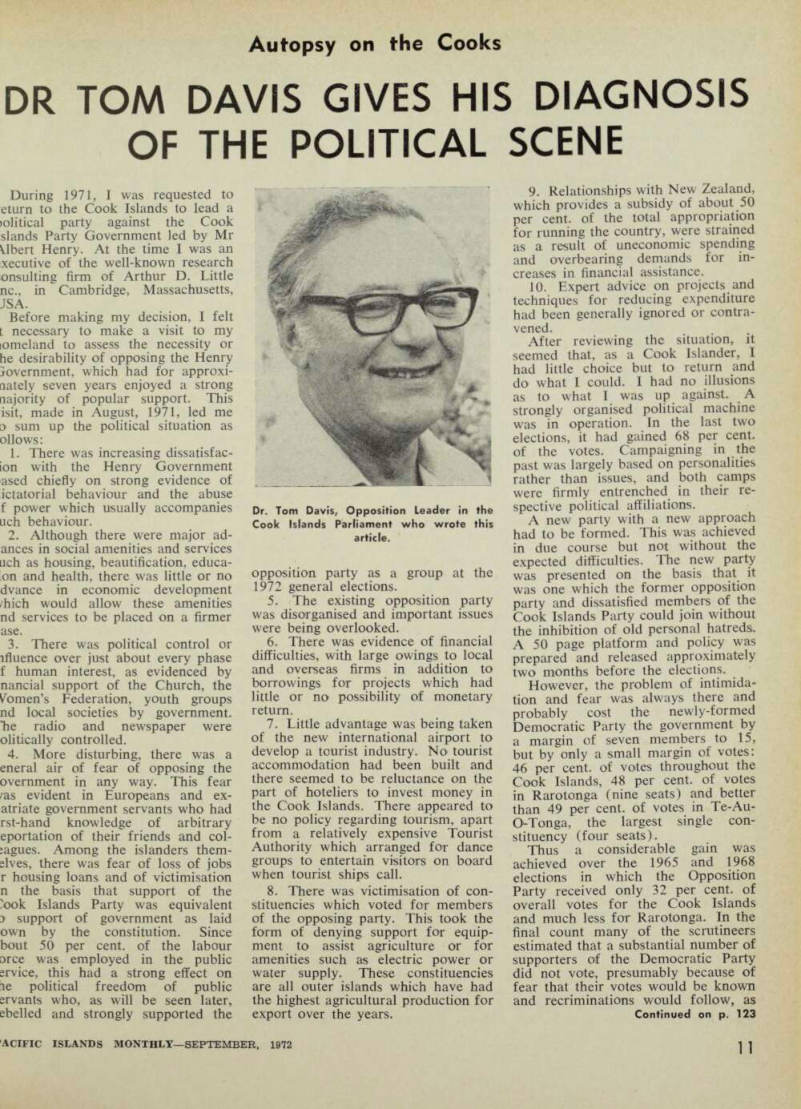
Autopsy on the Cooks
Dr Tom Davis Gives His Diagnosis
During 1971, I was requested to eturn to the Cook Islands to lead a (olitical party against the Cook slands Party Government led by Mr Übert Henry. At the time I was an xecutive of the well-known research onsulting firm of Arthur D. Little nc., in Cambridge, Massachusetts,
Jsa.
Before making my decision, I felt t necessary to make a visit to my lomeland to assess the necessity or he desirability of opposing the Henry jovernment, which had for approxi mately seven years enjoyed a strong majority of popular support. This isit, made in August, 1971, led me o sum up the political situation as ollows: 1. There was increasing dissatisfac ion with the Henry Government ased chiefly on strong evidence of ictatorial behaviour and the abuse f power which usually accompanies uch behaviour. 2. Although there were major ad ances in social amenities and services mch as housing, beautification, educa 'on and health, there was little or no dvance in economic development dmich would allow these amenities nd services to be placed on a firmer ase. 3. There was political control or ifluence over just about every phase f human interest, as evidenced by nancial support of the Church, the Women’s Federation, youth groups nd local societies by government.
Tie radio and newspaper were olitically controlled. 4. More disturbing, there was a eneral air of fear of opposing the ovemment in any way. This fear fas evident in Europeans and ex atriate government servants who had rst-hand knowledge of arbitrary eportation of their friends and col ;agues. Among the islanders them slves, there was fear of loss of jobs r housing loans and of victimisation n the basis that support of the 'ook Islands Party was equivalent y support of government as laid own by the constitution. Since bout 50 per cent, of the labour mrce was employed in the public srvice, this had a strong effect on me political freedom of public ervants who, as will be seen later, ebelled and strongly supported the
opposition party as a group at the 1972 general elections. 5. The existing opposition party was disorganised and important issues were being overlooked. 6. There was evidence of financial difficulties, with large owings to local and overseas firms in addition to borrowings for projects which had little or no possibility of monetary return. 7. Little advantage was being taken of the new international airport to develop a tourist industry. No tourist accommodation had been built and there seemed to be reluctance on the part of hoteliers to invest money in the Cook Islands. There appeared to be no policy regarding tourism, apart from a relatively expensive Tourist Authority which arranged for dance groups to entertain visitors on board when tourist ships call. 8. There was victimisation of con stituencies which voted for members of the opposing party. This took the form of denying support for equip ment to assist agriculture or for amenities such as electric power or water supply. These constituencies are all outer islands which have had the highest agricultural production for export over the years.
9. Relationships with New Zealand, which provides a subsidy of about 50 per cent, of the total appropriation for running the country, were strained as a result of uneconomic spending and overbearing demands for in creases in financial assistance. 10. Expert advice on projects and techniques for reducing expenditure had been generally ignored or contra vened.
After reviewing the situation, it seemed that, as a Cook Islander, I had little choice but to return and do what I could. I had no illusions as to what 1 was up against. A strongly organised political machine was in operation. In the last two elections, it had gained 68 per cent, of the votes. Campaigning in the past was largely based on personalities rather than issues, and both camps were firmly entrenched in their re spective political affiliations.
A new party with a new approach had to be formed. This was achieved in due course but not without the expected difficulties. The new party was presented on the basis that it was one which the former opposition party and dissatisfied members of the Cook Islands Party could join without the inhibition of old personal hatreds, A 50 page platform and policy was prepared and released approximately two months before the elections.
However, the problem of intimida tion and fear was always there and probably cost the newly-formed Democratic Party the government by a margin of seven members to 15, but by only a small margin of votes: 46 per cent, of votes throughout the Cook Islands, 48 per cent, of votes in Rarotonga (nine seats) and better than 49 per cent, of votes in Te-Au- O-Tonga, the largest single con stituency (four seats).
Thus a considerable gain was achieved over the 1965 and 1968 elections in which the Opposition Party received only 32 per cent, of overall votes for the Cook Islands and much less for Rarotonga. In the final count many of the scrutineers estimated that a substantial number of supporters of the Democratic Party did not vote, presumably because of fear that their votes would be known and recriminations would follow, as
Continued on p. 123
Dr. Tom Davis, Opposition Leader in the Cook Islands Parliament who wrote this article.
Advertisements & other items, p. 17 (1 item)
11
’ACIFIC ISLANDS MONTHLY—SEPTEMBER, 1972
Tahiti
Letter
From James Boyack
T'HE blah-blah and self-serving sophistries of the politicians seem to be everywhere in Tahiti these days. Two hundred and forty-eight would-be servants of the people are inundating the political arena with solemn promises accompanied by warnings of the im pending disaster inherent in the policies of all candidates who oppose them. Thirty Territorial Assembly seats will be allotted for five years on September 10, and to hear the various pretenders to a legislative throne, there should be 248.
I sure am lucky to be an American without franchise.
My only concern is to get 3-1 on McGovern (no money yet where the mouths are), and to scream myself hoarse at Fautaua Arena, like I did last night. There my opinion counts because I am a journalist, which means I can get close enough to the ring to make myself heard.
When my man scores, I leap as high as the second cord.
I know my place, however, and down I fall into another short-lived, nervous silence. The ring is for the fighters, political and pugilistic.
A good fight being one of the few honest things left, I prefer boxing to politics. Last night’s was the best fight I have trembled through in my seven years of staying out of the ring in Tahiti. It matched a Fijian gentleman of enormous resistance, one Maitaitini, with the hatcheting speed of a future French middleweight champion. This Gratien Tonna, a 23-year-old bundle of exploding muscle, was a wagering man’s dream made flesh. He sought incontrovertible victory by instan taneous persuasion of the senses. His style was immacu lately slaughter-house. His most engaging tool was an uppercut that swung into place like a windmilling soft ball pitcher’s knee-high striker-motion. He had a radar guided right cross which drove down like a comet onto any exposed facial area. Not to mention, before and after such onslaught, a slashing left hook which was responsible for two of the three knockdowns to em barrass Maitaitini in the second round.
But the Fijian, the middleweight champion of a no less tough nation, weathered this two-round thunderstorm.
What came after was a simple deluge, and Maitai managed to pour on a few himself. Enough to be attributed rounds 5, 6 and 7 by myself and other knowledgeable enthusiasts. Which made the breaking of his nose in the Bth an unacceptable misfortune. Cut short was that very redeeming effort—the turning of the tide, a responsibility to self which frowns at ‘no’ for an answer.
Gratien Tonna, former World Military middleweight champ, now 18-2 as a pro, earned his 17th knockout by the default of the Fijian’s nose. He slipped through the crowd in Maitaitini’s dressing room after the eight round brawl. Under his welted right eye there was a half-moon gash. His right thumb was raised, the rest of his fist shoving at the air. “C’etait bon, mon vieux.
Tres fort, toi.” You’re one strong mother, he was saying in French. What hotel you staying in? Come and have a drink with us . . .
Although the conversation collapsed in translation, Gratien needed no words for his gesture. He bent down to kiss both of the Fijian’s cheeks for the third time in 25 minutes.
Which is another reason I like boxing more than politics. Nobody kisses in politics. The loser cries on television with his dog. The winner buys the loser a drink after the fight. distaste of mine is particularly strong for local •*" politics. The punches are thrown, but not much happens. The winners don’t win much, and the losers don’t lose much. This is a French overseas territory,
a modified colony, and therein lies the problem, as well as the enormous challenge and hope for French Poly nesia’s future.
TTere is a repetitious disaccord among local poli ticians which is wearing my ears out. And good faith does prevail to the edge of political affinity, but what happens when such boundaries collapse before the moderating tide of intelligence, in the shifting of national feeling, in the face of real need? What happens to morrow?
The politics of yesterday are so much scrap paper.
The polemical barriers here are barricades, not de marcation lines. It’s the good guys and the bad guys, and ne’er the twain shall meet, or so it seems. Choose sides. The arguments of each are as appealing, and as
short-sighted, because they conveniently ignore the
virtues of the other guy’s position.
Going into this election on September 10, those who espouse autonomie interne, if not having total control of domestic affairs, firmly hold 16 of the Assembly’s 30 seats. They owned 18 earlier in their majority mandate, but lost two by defection.
The other Territorial Assembly members share in varying degree the belief that Polynesia is inalienably French. They accuse the majority of having wasted the Assembly’s time for the last five years with vapid dis cussion of an autonomy which does not confront the territory’s economic and social priorities.
The autonomists argue that without real power, with out the responsibility of making sink-or-swim decisions, it is impossible for them to influence the major trends of Polynesian life. They maintain that since the liberalising Loi Cadre of 1957, much of the political power inherited by the territory through this constitu tional reform has been side-stepped or co-opted by the central government.
PEOPLE who vote this month will probably do so with not much more understanding of what is possible than an opinion for or against autonomie interne. If only they could step back from the battlefront, to the position by circumstance (as an American) and penchant (I’m a francophile lover of Polynesia) I have chosen for myself (perhaps unfairly, I do not have to vote).
They might share with me in opinion that the only
insistent consideration should be the nourishment of Dody and spirit. This is the bed-rock of all politics.
All eyes and effort then could turn to generating that /iable economy consistent with the Polynesian way of life, which happens to be inextricably linked to French modes of thought, inexorably hooked into certain ielights of French culture, and definitely, at least since 1960 (“Mutiny on the Bounty”), meshed with the dynamics of any consumer society. No nationalism in aggressively political sense will alter this French Polynesian, and now immutable, character. No flag can make a difference. When I hear National Assembly Deputy Francis Sanford say, “We lived without France luring World War 11, we can do it again,” I wonder what he means.
To listen to the politicians, you’d think life was a lot more complicated around here than it is.
Maybe the politicians, if they have to be listened to, should try listening to each other. I refuse to believe :hat I have to be one of the few people far enough iway from the trenches to receive signals from both sides. Those political barriers need not be barricades.
Fhe two sides should stop haranguing their individual supporters and begin shouting at each other. And if ;he sound doesn’t make it over the barricades, then, ike two honest boxers seeking total but sportsmanlike /ictory—that is, without trying to kill each other—the ;wo sides should rush those barricades, overrun them, mix it up in one hearty intellectual skirmish, and then sit down and have a drink. The problems are remark ably the same on both sides of the fence, viewed from my observation post.
For example, I do not believe assembly President lohn Teariki really listened to Governor Pierre Angeli in that vindictively abbreviated inaugural spring session nf the Territorial Assembly. And vice versa.
The governor said his primary concern was the healthy expansion of French Polynesia’s economy over the years.
He said, “This expansion must not be accompanied by grave upheavals for man, his society or the natural mvironment in which he lives.” He went on to analyse jach aspect of that economy. That is the name of the game. Mr Teariki, at that moment, would have done oetter to play it than waste invective on why com munalisation is bad news. rHE assembly President did strike a disturbing note, however, one the other side seems to have under estimated. It was disturbing because it tended to dis count the French and Polynesian unity of national purpose which, in 1972, is this territory’s principal hope 'or the future. Mr Teariki said, “For a long time now, t has been customary to swear, with hand on heart, :o all Metropolitan emissaries, that the Polynesians have neen, and always will remain, ‘indefectibly’ attached to he Mother Country . . .
“Today, it must be admitted that the times are no onger those in which such ritual is entirely honest.
“Human feelings are fragile and need not survive ;hose in whom they were born. Unrequited love easily changes into indifference, and even hate.
“There are, therefore, no ‘indefectible’ attachments, neither between individuals nor collectivities.”
Mr Teariki then outlined what he said was the 15pear effort by the central government to limit rather ban increase Polynesian political liberties. He recalled that on July 5, 1970, a group of autonomist politicians warned visiting French Defence Minister Michel Debre that there was a current of opinion favourable to Poly nesian independence, albeit then small and disorganised.
Fhe political approach of the Fifth Republic to French
Polynesia was blamed for such feelings, Mr Teariki said, and the minister was warned of the consequences of the evolution of these sentiments.
The President’s inaugural speech continued, “The recent developments in Taaa unfortunately confirm the terms of this warning. They prove that certain of our compatriots, having lost hope in France, have come to the conviction that the only way to liberalise the political institutions here is to stop being French.
“The munitions theft at the army base, the prison riot, these were not only the gestures of excited youths.
These are the first violent symptoms of a political sick ness for which the central government is responsible and which only the central government can cure with the appropriate political remedies.”
The governor, who spoke next, was caught some what flat-footed by Mr Teariki’s declarations, and he seemed to commit the same error common on the other side. He did not listen sympathetically to an authorita tive opinion honestly expressed.
Instead, he invoked the spectre of “adventurers’* headed at best back to the 19th Century, and at worst, to their own suicide.
THE answer for French Polynesia, and 120,000 people do deserve an answer, is not rhetoric, but what their Overseas Territories Minister Pierre Messmer said in that same assembly hall one year ago this month.
After reviewing local economic perspectives, the present French Prime Minister said that “a study in common (between the central government and the assembly), in the spirit of mutual comprehension”—dialogue—is the answer.
Should the autonomists retain or increase their majority in September (and even were they to lose this assembly platform), the verbal bridge between Paris and Papeete, and between pro- and anti-autonomist forces here, must never become so cluttered with political charades that simple messages cease to flow.
The autonomists may not be shaping future prosperity by crying over the sour milk of the political statute, but their pleas for understanding must be heard. (And as audible must be the Messmerian concept of political evolution congruent with economic progress.) Robert Cahn, who, two weeks ago, was re-arrested (see the August letter) with an arsenal in his hideout and the demon of destruction in his heart, is a tiny voice in the wilderness, but even his tormented outcry must not be ignored. Encasing him in a French prison, which has been done, is only 99 per cent, of the solution of the problem he represents.
To my knowledge, the French are the most sophisti cated, sharp and empathetic people on earth (Francis Sanford’s rebuff at the United Nations was a local demonstration of the weight such empathy gives French opinion in the developing world).
The Polynesians are the most lovable and loving people I have ever met.
What is this talk of hate?
What the hell is wrong with all the politicians around here?
Why can’t they jump out of their rhetorical straight jackets and together meet head-on the challenging post colonial period at hand? (How will French Polynesia pay its bills when the nuclear test personnel depart in three years?) It is only with France, in the foreseeable future, that Polynesia will have a running jump into the 21st Century.
And by then, the politics of today should be scrap paper.
Advertisements & other items, p. 19 (1 item)
13
'ACIFIC ISLANDS MONTHLY—SEPTEMBER, 1972
Trade winds blow but
fiji talanoa
With Guest Columnist
L. G. Usher, In
Sue Wendt's Absence
In Britain
was a time when Fiji had a clearly-defined tourist season.
This was that part of the year—from March to October—when the trade winds blow and the weather strikes a delightfully balmy balance between sticky heat and freezing cold. In these months, Australian and New Zealand visitors came to Fiji to escape the rigours of their winter.
They still do, but with them now are Americans on summer vacation, and a variety of other international visitors. And the “season” has dis appeared, because the whole lot now happily spread their visits over the hot months too, so that throughout the year hotel occupancy rates stay up, together with the high spirits of duty-free dealers, the rate of build ing of new hotels, and the spiralling cost of living.
TPHE Government’s main weapon against rising living costs is a price control committee, drawn mainly from the civil service. They have not heard of King Canute, who demon strated the limits of his power by showing his courtiers that even a king could not control the tides by decree.
One price control order, for in stance, fixed the price of flour and sharps (the last product of the wheat milling process, before the white flour is reached) at the then ruling rate.
So importers pointed to overseas price rises and said politely that they would not order any more flour or sharps because they would be losing money if they had to sell in Fiji at the prices fixed.
A further order quietly lifted the permitted price and things returned to normal—normal meaning in Fiji these days, as elsewhere, that house holders’ bills continued to go up.
Some sections of the community have been able to do something about this. Reports of wage negotiations between unions and employers in recent weeks have told one after the other of pay increases round the
20-25 per cent, mark, though Fiji’s current Development Plan is based on an annual growth of the national wages bill by about a third of this.
For the coconut producer (meaning in the main the Fijian villager with few other sources of income) there are no employers to bargain with in the knowledge that a bit more on wages can be passed on to the customer (thereby taking away a good deal of the benefit of the higher wages, but who wants to think about
that, Jack?)
Incomes from copra and coconuts have dwindled to vanishing point as the local price has drifted steadily
Trade winds blow but storm clouds gather
downwards with each announcement by the Coconut Board, and on its downward path has passed below the cost of copra production. The board’s predictions of future trends grow gloomier month by month. Fijian growers have been given some pre sent relief at the expense of future advantage.
The compulsory levy of $2O a ton which is credited to growers’ ac counts with the Fiijan Development Fund Board has been reduced to $5.
The board decided not to stop the levy (cess, is the local word) altogether because that would mean that the machinery would run right down and it might be hard to start it up again.
Past cess accumulations in the fund have helped many Fijians to build houses, buy farm equipment, pay school fees and become share holders in public and private com panies. But you can’t put aside savings from a non-existent income.
TI/fR DON AIDNEY, chairman of the Copra Board, is also president 0 f the Fiji Employers’ Consultative Association, and at the association’s annual meeting he talked of the good and the bad in Fiji’s prospects. On the good side he put the “remarkable job’’ done by the politicians, He said they had evolved a gener ally accepted pattern of racial and political balance—a pattern that is working. They had introduced a popu |ar measure of inter-racial govern ment anc j h ac j achieved, through sincerity and tolerance, success that few had really dared to hope for.
But in the economic field Mr
Aidney saw storm signs—the sort of hurricane warnings old-timers used to read in the look of the sea, or the feel of the wind or the colour of the sky, and then hastened to batten up. “It is idle to talk of free and universal education unless that educa tion trains our youth in the skills that will enable them to find decent em ployment,” he said.
“It is naive to think that tourism will be the long-term answer to our economic development. It is mis chievous to propose shorter working hours and extravagant wages for a tenth of our people when the rest have to try to seek a subsistence living from primary crops whose value can barely be maintained. It is shocking to ignore the growing cess pools of crime, vice and degradation that are forming in our cities with the swelling influx of rural people hoping for a better deal.
“We have been lucky. Tourism has given us a boost to sustain our economy while we work out our
jture. It will not in Fiji—nor has anywhere else in the world—remain le basis of our economy. This can ;st only on two factors, the worth f our land and the things it pro uces, and the worth of our people r ho work this land.” kTOT ALL recent trade union activities have been concerned with r age negotiations. At the mining entre at Vatukoula, for instance, ,300 employees of the Emperor Gold lining Company stopped work for ine days in protest against the trans -5r of a watchman from the company’s ort installations at Vatia Point to atukoula itself.
At the end of the nine days, during 'hich the Minister of Labour, Mr )nati Mavoa, took a hand in settle lent negotiations, the man in ques on went back to Vatia Point for a ay, and then settled down quietly t Vatukoula, leaving the rest of Fiji rendering what on earth all the fuss ad been about. The secretary of the iji Dockworkers’ Union, Mr Taniela ’eitata, commented that the strike ad been “for no reason".
But he was basking in a rosy glow f satisfaction, because his union had oncluded an agreement with ship ing companies with what the “Fiji imes” called “unprecedented speed nd amicability”. This was in sharp ontrast to happenings last year, rhen a protracted national docks nd shipping strike brought near isaster to Fiji’s economy.
On industrial relations, in the ddress already quoted from, Mr Don Jdney had some forthright things to ay to employers. They had only lemselves to blame if industrial rela ons deteriorated through lack of iscipline and through disregard of le law, he said.
Most industrial agreements set out a mutually agreed grievance pro cedure. So, to control the industrial situation, “all we have to do,’’ he said “is to observe the conditions of the agreements that we have signed with the various trade unions. All we have to do is to acknowledge that a strike or a walkout without resort to the agreed channels of negotiation is a clear breach of contract and until the terms of that contract have been re stored there can be no negotiation”.
Mr Aidney claimed that many of Fiji’s industrial disputes were “frankly racialist” and directed against ex patriates. But he blamed some over seas firms who were in Fiji for short term contracts for “taking the easy way out of buying peace today and to hell with tomorrow and everyone else”.
Many, he said, were accustomed to the relatively sophisticated in dustrial negotiation procedure and the discipline of labour movements of other countries, and they naively ex pected similar standards in Fiji. “Un derstandably, they are often regarded by our trade unions as disorganised, gutless and easy targets,” Mr Aidney said. \ GROUP, not of employers but protesters, from Australia has been providing some light relief to the Fiji scene. Led by Mr Gordon Mutch, they turned up at Nadi Airport all dressed up as parachutists ready to leap into the waters of Mururoa Atoll to discourage the French Gov ernment from continuing its nuclear tests in the area. But Mururoa is 2,800 miles from Nadi so the group talked lightly of chartering a DCS in Fiji or New Zealand to cover this distance.
They announced that they would parachute into Suva harbour as a preliminary, but this performance was on-again off-again for a couple of weeks because they had left the necessary licences back in Australia.
Eventually, two jumps were made from a light aircraft supplied by Fiji Air Services. But the series came to an end when the company found difficulty in collecting the charter fee for the flights already made.
The same trouble arose over the hire of power boats from Tradewinds Marina. These boats were used to visit reefs near Suva to collect sea weed to put under a Geiger counter to detect radioactivity that might possibly have drifted from Mururoa.
The various moves of the group were filmed by members of the party.
Scenes shot included some of para chutists jumping from aircraft, but with the planes still on the ground.
When the party returned to Aus tralia, having got no closer to Mururoa than Suva, Tradewinds Marina reported that a $20.00 cheque proffered in part-payment of a debt of $53.00 had been returned by the bank.
There is no evidence that any of this had any influence on deterring President Pompidou from continuing nuclear testing in the Pacific.
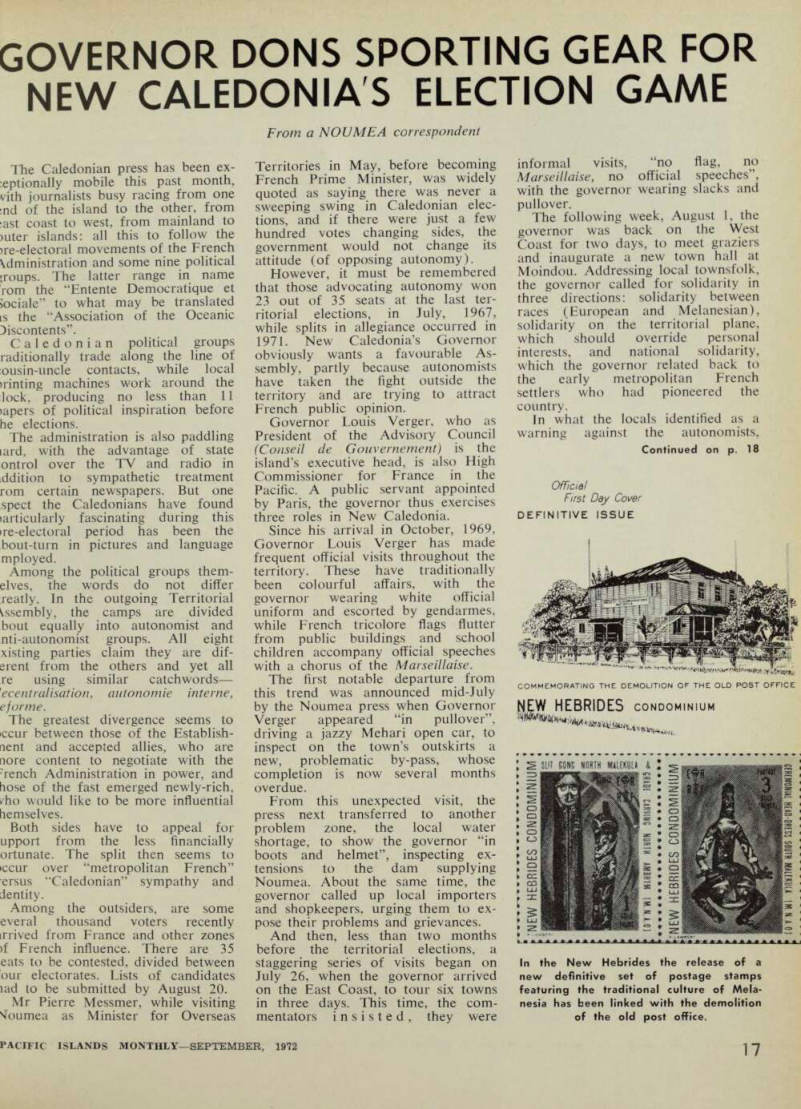
A peace sign from "Greenpeace IV" protester Mr Lindsay Matthews after he para chuted safely into Suva Harbour.
"Greenpeace IV" protester Mr Lindsay Matthews parachutes into Suva Harbour.
Advertisements & other items, pp. 21-22 (2 items)
15
’ACIFIC ISLANDS MONTHLY—SEPTEMBER, 1972
Little things from Holbrooks
r
mean a lot.
© i
IiBIIIJImU
malt vinegar Mmi-mnuK;; i mustard pickles v ift At «r? v /M-. r ® I
I fiOLBHOOKH I
white vinegar 1 * •» .■• ,ai w Swhiteo 1801 \< Spanish o&tf » m p i It’s the little things that really make a meal.
That’s why it’s important that the little
things you buy HOLBROOKS
come with a big name.
Trade Enquiries: Reckitt & Colman Pty. Limited, 44-96 Wharf Road,
WEST RYDE. 2114. N.S.W.
Cables: Reckitts Sydney.
RC6702
Governor Dons Sporting Gear For
New Caledonia's Election Game
From a NOUMEA correspondent
The Caledonian press has been ex ;eptionally mobile this past month, vith journalists busy racing from one :nd of the island to the other, from :ast coast to west, from mainland to >uter islands: all this to follow the >re-electoral movements of the French Administration and some nine political groups. The latter range in name rom the “Entente Democratique et Jociale” to what may be translated is the “Association of the Oceanic discontents”.
Caledonian political groups raditionally trade along the line of ousin-uncle contacts, while local minting machines work around the lock, producing no less than 11 »apers of political inspiration before he elections.
The administration is also paddling lard, with the advantage of state ontrol over the TV and radio in ddition to sympathetic treatment rom certain newspapers. But one spect the Caledonians have found •articularly fascinating during this ire-electoral period has been the bout-turn in pictures and language mployed.
Among the political groups them elves, the words do not differ really. In the outgoing Territorial Assembly, the camps are divided bout equally into autonomist and nti-autonomist groups. All eight xisting parties claim they are dif erent from the others and yet all re using similar catchwords— 'ecentralisation, autonomic interne, eforme.
The greatest divergence seems to ccur between those of the Establish aent and accepted allies, who are aore content to negotiate with the Tench Administration in power, and hose of the fast emerged newly-rich, /ho would like to be more influential hemselves.
Both sides have to appeal for upport from the less financially ortunate. The split then seems to •ccur over “metropolitan French” ersus “Caledonian” sympathy and dentity.
Among the outsiders, are some everal thousand voters recently rrived from France and other zones )f French influence. There are 35 eats to be contested, divided between bur electorates. Lists of candidates lad to be submitted by August 20.
Mr Pierre Messmer, while visiting Noumea as Minister for Overseas
Territories in May, before becoming French Prime Minister, was widely quoted as saying there was never a sweeping swing in Caledonian elec tions, and if there were just a few hundred votes changing sides, the government would not change its attitude (of opposing autonomy).
However, it must be remembered that those advocating autonomy won 23 out of 35 seats at the last ter ritorial elections, in July, 1967, while splits in allegiance occurred in 1971. New Caledonia’s Governor obviously wants a favourable As sembly, partly because autonomists have taken the fight outside the territory and are trying to attract French public opinion.
Governor Louis Verger, who as President of the Advisory Council (Conseil de Gouvernement) is the island’s executive head, is also High Commissioner for France in the Pacific. A public servant appointed by Paris, the governor thus exercises three roles in New Caledonia.
Since his arrival in October, 1969, Governor Louis Verger has made frequent official visits throughout the territory. These have traditionally been colourful affairs, with the governor wearing white official uniform and escorted by gendarmes, while French tricolore flags flutter from public buildings and school children accompany official speeches with a chorus of the Marseillaise.
The first notable departure from this trend was announced mid-July by the Noumea press when Governor Verger appeared “in pullover”, driving a jazzy Mehari open car, to inspect on the town’s outskirts a new, problematic by-pass, whose completion is now several months overdue.
From this unexpected visit, the press next transferred to another problem zone, the local water shortage, to show the governor “in boots and helmet”, inspecting ex tensions to the dam supplying Noumea. About the same time, the governor called up local importers and shopkeepers, urging them to ex pose their problems and grievances.
And then, less than two months before the territorial elections, a staggering series of visits began on July 26, when the governor arrived on the East Coast, to tour six towns in three days. This time, the com mentators insisted, they were
informal visits, “no flag, no Marseillaise, no official speeches”, with the governor wearing slacks and pullover.
The following week, August 1, the governor was back on the West Coast for two days, to meet graziers and inaugurate a new town hall at Moindou. Addressing local townsfolk, the governor called for solidarity in three directions: solidarity between races (European and Melanesian), solidarity on the territorial plane, which should override personal interests, and national solidarity, which the governor related back to the early metropolitan French settlers who had pioneered the country.
In what the locals identified as a warning against the autonomists.
Continued on p. 18
In the New Hebrides the release of a new definitive set of postage stamps featuring the traditional culture of Mela nesia has been linked with the demolition of the old post office.
Governor Verger stated, “We are determined to fight against the eternal sirens with hypocritically reassuring voices but pernicious intentions”.
Emphasising the significance of France for the territory, the governor stated that, “France has brought and will (continue to) bring to the ter ritory all the support of a nation which is strong by her population, by her economy, by her techniques”.
Pointing out that this guaranteed the island’s progress and dynamic expansion, the governor concluded his speech by repeating his call for local unity.
That same week, the governor was back on the East Coast for a bridge inauguration, then on the Saturday he took his heads of government departments to a meeting at Dumbea, to discuss urban prob lems of water, electricity and tele phone facilities for the inhabitants
of this periphery zone of Noumea.
After a break on the Sunday, the governor arrived next day on the upper West Coast for a tour of eight towns in three days. At the end of that week he received all the mayors of New Caledonia at his Residence and promised them a trip to France next March. The same afternoon he officially inaugurated a new Forestry School for 11 pupils, whose classes began last March.
Next trip scheduled was for August 16, a flight to Lifou in the Loyalty Islands. . . .
It was becoming almost a marathon for the administration and the press, while the public was kept hot on the trail with a photo of the governor in sports togs, limbering up on the soccer field, preparing for an en counter, Governor’s Office versus Noumea City Council. The match was scheduled for one week before the September 10 elections.
W. Samoa Govt. Sticks Its Neck Out
From FELISE VA’A in Apia
The Western Samoa Government has set the country by the ears with two new measures—an increase in import duties to offset losses through the abolition of export duties, and a bill to restrict the sale of freehold land to aliens.
The import duty increase has raised public blood pressure as never before and, coming as it does when the country is beginning to ponder over its choice in the coming general elec tion, poses the query: Is the govern ment deliberately committing hara kiri?
It recently granted a 5 per cent, salary increase to its public servants and has now increased import duties on a number of important items, pre sumably to offset any loss in govern ment money. What the government seemed to have forgotten was that the 5 per cent, salary increase did not affect the rest of the population and in no time public anger against the new measures was evident.
Public opposition to the new duties was first of all shown in the letters to the editor, both English and Samoan, which appeared in the editions of the “Samoa Times”. Then during early August, a citizens’ meet ing attended by nearly 500 was held at the Mothers’ Centre, Apia, to dis cuss sending a delegation to parlia ment to petition for removal of the duty increases, which were felt to have been responsible for the latest
rise in living costs. The petition was rejected.
Realising the unpopularity of the new measures, the Minister of Finance, Tofa Siaosi, tabled a paper in parliament explaining that the new duties were needed to offset the loss in government revenues caused by the abolition of export duties; that they were needed to protect local industry.
“Most increases are on products that can be produced locally and are aimed at encouraging local production and industry. Other increases involve tobacco items, radios, motor-cycles and high-priced motor cars,” the minister said.
The new import duties affect items such as biscuits, cabin or ships’ bread, fresh and frozen eggs, fresh and frozen fish, fruits, honey, ice cream, fresh or frozen meat, mutton flaps, fresh and preserved vegetables, cigarettes, cigars, tobacco, clothing, drapery, radios, motor cycles and cars. Increases range from 10 per cent, to 15 per cent.
The biggest increases are on motor cycles, 65 per cent. Commonwealth preferential and 65 per cent, general, and motor vehicles, 65 per cent. CP and 65 per cent. G for the first SWSI,OOO cif, thereafter 100 per cent.
CP and 100 per cent. G.
Concerning the import duties, the “Samoa Times” argued: “We feel . . . that the move to increase import duties does not necessarily mean we
would get cheaper goods that have been produced locally. The other possibility is far more likely: the merchants will take advantage of this loophole to bring the prices of local goods up to the level of imported goods, if for no other good reason than bigger profits”.
The government, however, has frozen the price of mutton flaps and pilchards, abolished the radio licence fee and confined increases in car im port duty mainly to the posh sedan types.
One class which could be counted as pleased with the new measures is the planter who now pays no duty on his fruit exports. And, it’s a con siderable sum, for a small country— s36o,ooo which the government hopes to get back through the larger import duties and more income tax which, theoretically, will flow from the planters’ greater production.
Perhaps with large overseas de velopment companies in mind and the price to which land in Fiji has rocketed creating tempting, affluent visions, landowners and merchants are looking askance at the new Alienation of Freehold Land Bill which was passed by a comfortable majority.
At least one merchant has said he might challenge the bill in court.
Urging control of land sales to prevent ownership passing to out siders, Minister of Lands Polataivao Fosi said that already there was a report that 100 acres had been sold to an alien.
The Bills Committee had actually recommended that the bill be referred back to the government for recon sideration. The chairman of the Bills Committee, Ulugia Suivai, said there was a possibility the bill might be unconstitutional as the constitution guaranteed citizens the rights over their lands.
The committee’s recommendation to return the bill to the government, however, was rejected by 31-8.
Subsequent amendments were also defeated. These included one by Tofilau L. Eti to remove the word “resident” from “resident citizen”, making it possible for all citizens, resi dent or not, to purchase land without any government-imposed restrictions.
Another was to exempt those work ing overseas for the government or privately as well as students from the residency requirement of years before land could be bought. A move by Taulapapa Faimaala to reduce the residency requirement to three months was also beaten.
Advertisements & other items, p. 24 (1 item)
Governor in sports togs
18
PACIFIC ISLANDS MONTHLY—SEPTEMBER. 1972
Continued from p. 17
People
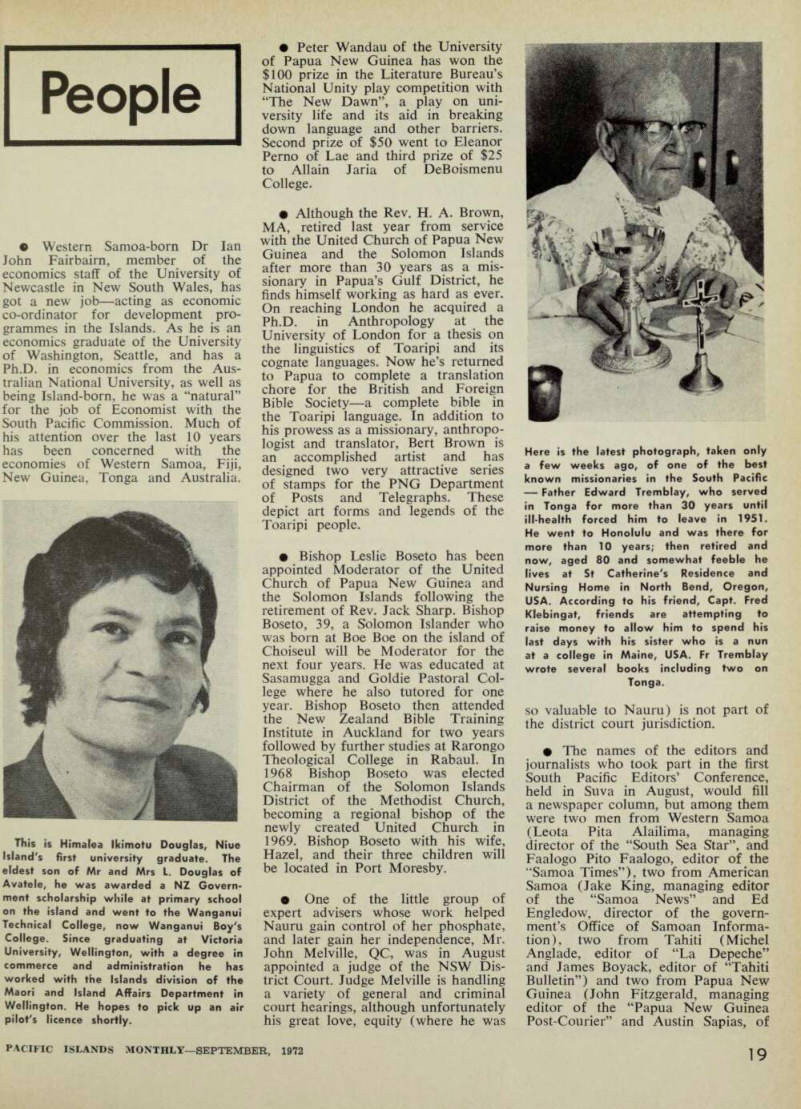

• Western Samoa-born Dr lan John Fairbaira, member of the economics staff of the University of Newcastle in New South Wales, has got a new job—acting as economic co-ordinator for development pro grammes in the Islands. As he is an economics graduate of the University of Washington, Seattle, and has a Ph.D. in economics from the Aus tralian National University, as well as being Island-born, he was a “natural” for the job of Economist with the South Pacific Commission. Much of his attention over the last 10 years has been concerned with the economies of Western Samoa, Fiji, New Guinea, Tonga and Australia.
• Peter Wandau of the University of Papua New Guinea has won the $lOO prize in the Literature Bureau’s National Unity play competition with “The New Dawn”, a play on uni versity life and its aid in breaking down language and other barriers.
Second prize of $5O went to Eleanor Perno of Lae and third prize of $25 to Allain Jaria of Deßoismenu College. • Although the Rev. H. A. Brown, MA, retired last year from service with the United Church of Papua New Guinea and the Solomon Islands after more than 30 years as a mis sionary in Papua’s Gulf District, he finds himself working as hard as ever.
On reaching London he acquired a Ph.D. in Anthropology at the University of London for a thesis on the linguistics of Toaripi and its cognate languages. Now he’s returned to Papua to complete a translation chore for the British and Foreign Bible Society—a complete bible in the Toaripi language. In addition to his prowess as a missionary, anthropo logist and translator, Bert Brown is an accomplished artist and has designed two very attractive series of stamps for the PNG Department of Posts and Telegraphs. These depict art forms and legends of the Toaripi people. • Bishop Leslie Boseto has been appointed Moderator of the United Church of Papua New Guinea and the Solomon Islands following the retirement of Rev. Jack Sharp, Bishop Boseto, 39, a Solomon Islander who was born at Boe Boe on the island of Choiseul will be Moderator for the next four years. He was educated at Sasamugga and Goldie Pastoral Col lege where he also tutored for one year. Bishop Boseto then attended the New Zealand Bible Training Institute in Auckland for two years followed by further studies at Rarongo Theological College in Rabaul. In 1968 Bishop Boseto was elected Chairman of the Solomon Islands District of the Methodist Church, becoming a regional bishop of the newly created United Church in 1969. Bishop Boseto with his wife, Hazel, and their three children will be located in Port Moresby. • One of the little group of expert advisers whose work helped Nauru gain control of her phosphate, and later gain her independence, Mr.
John Melville, QC, was in August appointed a judge of the NSW Dis trict Court. Judge Melville is handling a variety of general and criminal court hearings, although unfortunately his great love, equity (where he was
so valuable to Nauru) is not part of the district court jurisdiction. • The names of the editors and journalists who took part in the first South Pacific Editors’ Conference, held in Suva in August, would fill a newspaper column, but among them were two men from Western Samoa (Leota Pita Alailima, managing director of the “South Sea Star”, and Faalogo Pito Faalogo, editor of the “Samoa Times”), two from American Samoa (Jake King, managing editor of the “Samoa News” and Ed Engledow, director of the govern ment’s Office of Samoan Informa tion), two from Tahiti (Michel Anglade, editor of “La Depeche” and James Boyack, editor of “Tahiti Bulletin”) and two from Papua New Guinea (John Fitzgerald, managing editor of the “Papua New Guinea Post-Courier” and Austin Sapias, of
This is Himalea Ikimotu Douglas, Niue Island's first university graduate. The eldest son of Mr and Mrs L. Douglas of Avatele, he was awarded a NZ Govern ment scholarship while at primary school on the island and went to the Wanganui Technical College, now Wanganui Boy's College. Since graduating at Victoria University, Wellington, with a degree in commerce and administration he has worked with 0the Islands division of the Maori and Island Affairs Department in Wellington. He hopes to pick up an air pilot's licence shortly.
Here is the latest photograph, taken only a few weeks ago, of one of the best known missionaries in the South Pacific Father Edward Tremblay, who served in Tonga for more than 30 years until ill-health forced him to leave in 1951.
He went to Honolulu and was there for more than 10 years; then retired and now, aged 80 and somewhat feeble he lives at St Catherine's Residence and Nursing Home in North Bend, Oregon, USA. According to his friend, Capt. Fred Klebingat, friends are attempting to raise money to allow him to spend his last days with his sister who is a nun at a college in Maine, USA. Fr Tremblay wrote several books including two on Tonga.
the “Post’s” Rabaul bureau). Also there, were Robert McClelland, editor of the “Tonga Chronicle”, Henry Raraka, editor of Honiara’s “Kaka more Reporter”, and Stuart Inder, editor of “Pacific Islands Monthly”.
A big group from Fiji who attended the week-long seminar included Nat Gandhi, president of the Fiji Press Club (which sponsored the con ference with the East-West Center’s Communication Institute), Ten Usher, publisher and editor of the “Fiji Times”, Shirley Barker, direc tor of the South Pacific Area News Service and G. D. Sharma, editor of “Shanti Dut”. James Richstad, Ralph Barney and Paul Grimes were active participants and organisers from the US', supported by Juan Mercado from the Philippines (Press Founda tion of Asia). • Mr Rudolph Fabian, who has managed Intercontinental Hotels in Melbourne and Karachi during his 25 years in the hotel business, has been appointed general manager of the Fijian Hotel on Yanuca island on Fiji’s Coral Coast. He succeeds Mr Paddy Doyle who becomes director of development. His past jobs include the top position at the Park Court Hotel in London. • Twenty - one - year - old Miss Margaret Loko, of Port Moresby, doesn’t like staying in one place for long. She’ll get plenty of travel as new secretary of the Local Govern ment Association of PNG when she takes over next year. She is one of three girls scheduled to graduate from the University of Papua New Guinea with a BA degree in August. • Sister Helen Roberts of St Peter’s Hospital at Wanigela in Papua is wondering how long is temporary? She has just completed her first quarter of a century with the Anglican Mission at Wanigela.
She was sent there in 1947 on a “temporary” posting, since when she has seen the building of a new mis sion station at Sarad to replace the first station, built in 1901 and “invaded” by the sea. One of the instigators of the building of the present Wanigela airstrip, she helped in the Mount Lamington disaster in 1951. • Miss Julia Hecht of the University of Chicago has left Rarotonga for Pukapuka to carry out anthropological research work there, especially with regard to kin ship, Her work will take about a year and will be the first of its kind on Pukapuka since 1935 when Ernest and Pearl Beaglehole spent seven and
half months there, from November, 1934 to June, 1935, later publishing their “Ethnology of Pukapuka”. c i f tt i u • Mr Samuela Mis., of Folaha, Tongatapu, Tonga, who has been living in Hawaii for the past two years, has been appointed US market ing manager for the Tonga Export Company Ltd. His headquarters will be at the company’s head office in Honolulu. • Mr Ernest Alec Startin-Field has been appointed chief magistrate of Norfolk Island’s court of petty sessions with Mr Wilfred Metcalfe
Randall, Mr John Arthur Davidson and Mr Clarence Lindsay Hermes as magistrates. Two magistrates whose appointments have been terminated at their own request are Mr Alfred , d McCo y and Mr Richard Alh f t Rafai n e Albert BataiUe ' o King Taufa’ahau Tupou IV, of Tonga and Queen Mata’aho have been invited by Queen Elizabeth to stay for three days in September as her guests at Balmoral Castle in Scotland. They left Nukualofa on July 3 in the Bank Line copra carrier “Rowanbank” for a private holiday in Britain and the Continent.
Advertisements & other items, pp. 26-27 (1 item)
Kmscus Records
ft >s
SOUTH PACIFIC FESTIVAL OF ARTS ON RECORD Dynamic recordings of top performers and the highlights of their presentations during the Festival are being made in high-fidelity stereo for early release, thus enabling the traditional music of nearly every part of the Pacific to be enjoyed at your leisure. Recordings will cover the exciting and authentic music from the following islands: Fiji, Tonga, Cook Islands, Niue, Gilbert and Ellice Islands, Other LPs include Aboriginal and Maori music, a Festival Sampler, plus Sione Aleki, ukelele virtuoso. v Write now for a copy of the Festival brochure now in preparation: Promotion Department Hibiscus Records Box 6002 Wellington, New Zealand
. HIBISCUS (X
THE MUSIC AND f
SOUNDS Of THE PACIFIC I
TABATA SKIN & SCUBA DIVING EQUIPMENT
m The TABATA line offers the importer a complete range of
RUBBER SKIN & SCUBA DI-
VING EQUIPMENT and ACC-
ESSORIES for both the professional and amateur. Years of specialized manufacturing experience has established our line’s
REPUTATION FOR QUALI-
TY, ATTRACTIVE and PRA-
CTICAL DESIGNS and VERY
COMPETITIVE PRICES. We
also offer a varied line of rubber sundries for golfing, skiing and other popular sports.
For full particulars on our lines, write to: Manufacture rs
TABATA CO., LTD
Yajima 81dg.,2-2 Yoshi-cho, Nihonbashi, Chuoku, Tokyo Cable: EASTABA Tokyo TELEX:2S2-2806
EASTABATA TOK Te1:(663)8651 5
Don't let your
family down
You've worked hard to give them a home, schooling and security. Don't let that hard-won security erode away because you continued to overlook making out a Will. With a properly planned Will, you can be certain in the knowledge that your property will eventually pass to the people you specify, and also that your Estate will be as large as possible after probate and duties. In this regard, we invite you to take advantage of the advisory service we provide, entirely free of obligation. Our specialists in Estate Planning will be delighted to help you plan your Will most efficiently, or to discuss it fully with your solicitor or accountant. the
BURNS PHILP TRUSTEE
COMPANY LIMITED
IXECUTOR o ADMINISTRATOR • TRUSTEE • ATTORNEY • AGENT Fiji Office: Mr. A. W. Cooper, Resident Manager, Rodwell Road, Suva. Telephone: 311 777.
Head Office: 51 Pitt Street, Sydney 2000.
Telephone: 241 1021. Telegrams: "BURNSTRUST," Sydney.
Branches and/or Registered Offices: Parramatta (N.S.W.), Canberra, Melbourne, Brisbane, Adelaide, Fremantle (W.A.), Port Moresby (Papua). 8P45
Tropicalities
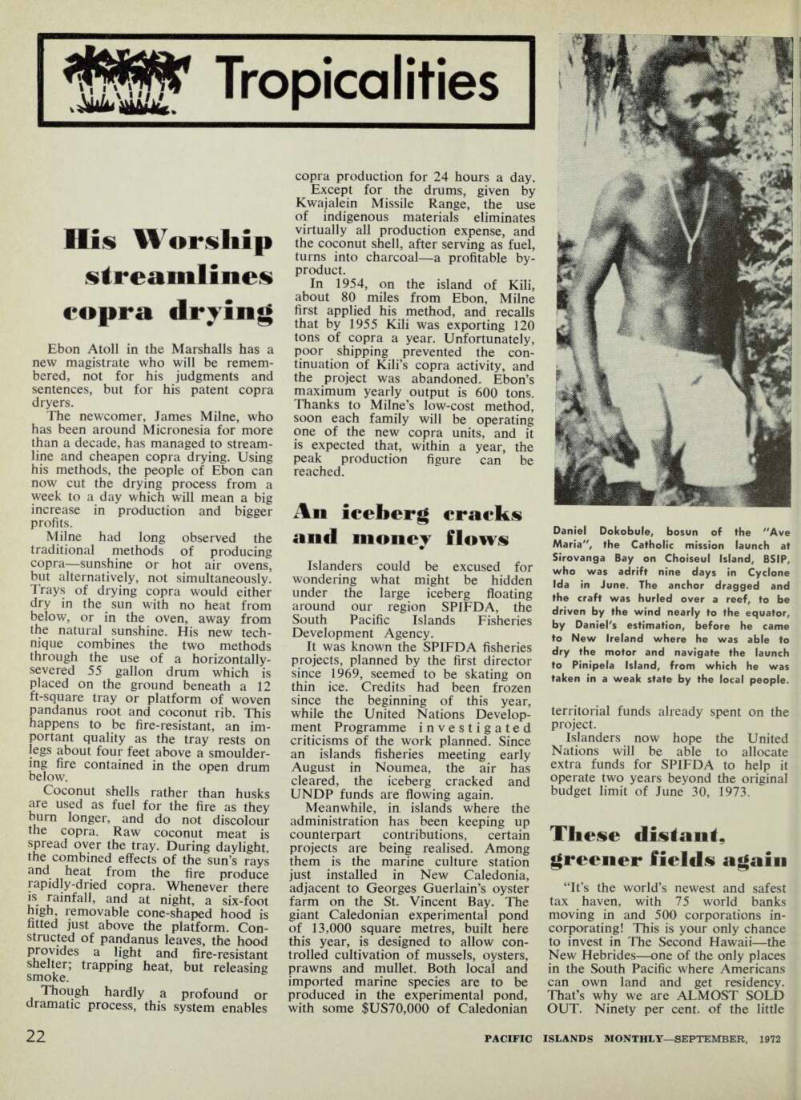
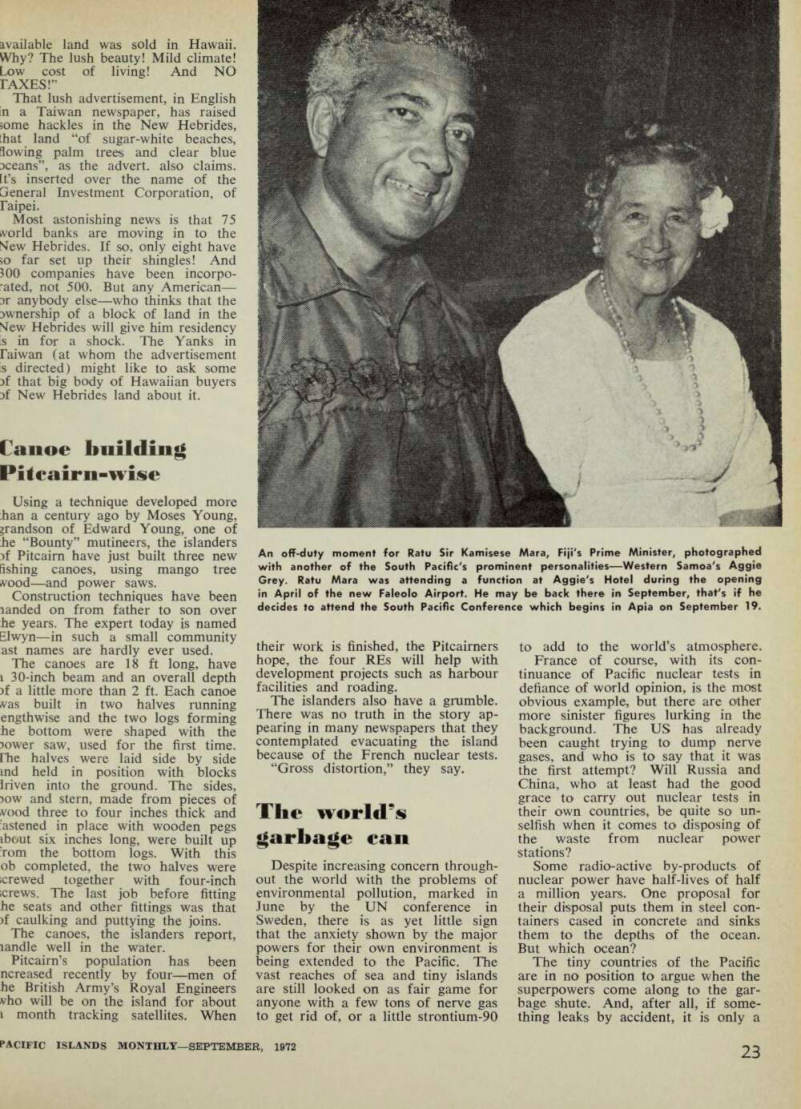

His Worship
streamlines
ropra drying
Ebon Atoll in the Marshalls has a new magistrate who will be remem bered, not for his judgments and sentences, but for his patent copra dryers.
The newcomer, James Milne, who has been around Micronesia for more than a decade, has managed to stream line and cheapen copra drying. Using his methods, the people of Ebon can now cut the drying process from a week to a day which will mean a big increase in production and bigger profits.
Milne had long observed the traditional methods of producing copra—sunshine or hot air ovens, but alternatively, not simultaneously.
Trays of drying copra would either dry in the sun with no heat from below, or in the oven, away from the natural sunshine. His new tech nique combines the two methods through the use of a horizontally severed 55 gallon drum which is placed on the ground beneath a 12 ft-square tray or platform of woven pandanus root and coconut rib. This happens to be fire-resistant, an im portant quality as the tray rests on legs about four feet above a smoulder ing fire contained in the open drum below.
Coconut shells rather than husks are used as fuel for the fire as they burn longer, and do not discolour the copra. Raw coconut meat is spread over the tray. During daylight, the combined effects of the sun’s rays and heat from the fire produce rapidly-dried copra. Whenever there is rainfall, and at night, a six-foot high, removable cone-shaped hood is fitted just above the platform. Con structed of pandanus leaves, the hood provides a light and fire-resistant shelter; trapping heat, but releasing smoke.
Though hardly a profound or dramatic process, this system enables
copra production for 24 hours a day.
Except for the drums, given by Kwajalein Missile Range, the use of indigenous materials eliminates virtually all production expense, and the coconut shell, after serving as fuel, turns into charcoal—a profitable by product.
In 1954, on the island of Kili, about 80 miles from Ebon, Milne first applied his method, and recalls that by 1955 Kili was exporting 120 tons of copra a year. Unfortunately, poor shipping prevented the con tinuation of Kili’s copra activity, and the project was abandoned. Ebon’s maximum yearly output is 600 tons.
Thanks to Milne’s low-cost method, soon each family will be operating one of the new copra units, and it is expected that, within a year, the peak production figure can be reached.
An iceberg cracks
anti money flows
Islanders could be excused for wondering what might be hidden under the large iceberg floating around our region SPIFDA, the South Pacific Islands Fisheries Development Agency.
It was known the SPIFDA fisheries projects, planned by the first director since 1969, seemed to be skating on thin ice. Credits had been frozen since the beginning of this year, while the United Nations Develop ment Programme investigated criticisms of the work planned. Since an islands fisheries meeting early August in Noumea, the air has cleared, the iceberg cracked and UNDP funds are flowing again.
Meanwhile, in islands where the administration has been keeping up counterpart contributions, certain projects are being realised. Among them is the marine culture station just installed in New Caledonia, adjacent to Georges Guerlain’s oyster farm on the St. Vincent Bay. The giant Caledonian experimental pond of 13,000 square metres, built here this year, is designed to allow con trolled cultivation of mussels, oysters, prawns and mullet. Both local and imported marine species are to be produced in the experimental pond, with some SUS7O,OOO of Caledonian
territorial funds already spent on the project.
Islanders now hope the United Nations will be able to allocate extra funds for SPIFDA to help it operate two years beyond the original budget limit of June 30, 1973.
These distant,
greener fields again
“It’s the world’s newest and safest tax haven, with 75 world banks moving in and 500 corporations in corporating! This is your only chance to invest in The Second Hawaii—the New Hebrides—one of the only places in the South Pacific where Americans can own land and get residency.
That’s why we are ALMOST SOLD OUT. Ninety per cent, of the little
Daniel Dokobule, bosun of the "Ave Maria", the Catholic mission launch at Sirovanga Bay on Choiseul Island, BSIP, who was adrift nine days in Cyclone Ida in June. The anchor dragged and the craft was hurled over a reef, to be driven by the wind nearly to the equator, by Daniel's estimation, before he came to New Ireland where he was able to dry the motor and navigate the launch to Pinipela Island, from which he was taken in a weak state by the local people.
available land was sold in Hawaii.
Why? The lush beauty! Mild climate!
Low cost of living! And NO
Paxes!”
That lush advertisement, in English in a Taiwan newspaper, has raised »ome hackles in the New Hebrides, that land “of sugar-white beaches, [lowing palm trees and clear blue Dceans”, as the advert, also claims.
It’s inserted over the name of the General Investment Corporation, of Paipei.
Most astonishing news is that 75 vorld banks are moving in to the Mew Hebrides, If so, only eight have »o far set up their shingles! And 300 companies have been incorpo rated, not 500. But any American— ar anybody else—who thinks that the ownership of a block of land in the Mew Hebrides will give him residency is in for a shock. The Yanks in Paiwan (at whom the advertisement s directed) might like to ask some if that big body of Hawaiian buyers if New Hebrides land about it.
Canoe building
Piteairn-wise
Using a technique developed more ;han a century ago by Moses Young, grandson of Edward Young, one of he “Bounty” mutineers, the islanders if Pitcairn have just built three new Sshing canoes, using mango tree vood —and power saws.
Construction techniques have been landed on from father to son over he years. The expert today is named Elwyn—in such a small community ast names are hardly ever used.
The canoes are 18 ft long, have i 30-inch beam and an overall depth if a little more than 2 ft. Each canoe vas built in two halves running engthwise and the two logs forming he bottom were shaped with the lower saw, used for the first time.
Phe halves were laid side by side ind held in position with blocks iriven into the ground. The sides, iow and stern, made from pieces of vood three to four inches thick and "astened in place with wooden pegs ibout six inches long, were built up Torn the bottom logs. With this ob completed, the two halves were icrewed together with four-inch icrews. The last job before fitting he seats and other fittings was that if caulking and puttying the joins.
The canoes, the islanders report, landle well in the water.
Pitcairn’s population has been ncreased recently by four—men of he British Army’s Royal Engineers vho will be on the island for about i month tracking satellites. When
their work is finished, the Pitcairners hope, the four REs will help with development projects such as harbour facilities and reading.
The islanders also have a grumble.
There was no truth in the story ap pearing in many newspapers that they contemplated evacuating the island because of the French nuclear tests.
“Gross distortion,” they say.
The world’s
garbage ean
Despite increasing concern through out the world with the problems of environmental pollution, marked in June by the UN conference in Sweden, there is as yet little sign that the anxiety shown by the major powers for their own environment is being extended to the Pacific. The vast reaches of sea and tiny islands are still looked on as fair game for anyone with a few tons of nerve gas to get rid of, or a little strontium-90
to add to the world’s atmosphere.
France of course, with its con tinuance of Pacific nuclear tests in defiance of world opinion, is the most obvious example, but there are other more sinister figures lurking in the background. The US has already been caught trying to dump nerve gases, and who is to say that it was the first attempt? Will Russia and China, who at least had the good grace to carry out nuclear tests in their own countries, be quite so un selfish when it comes to disposing of the waste from nuclear power stations?
Some radio-active by-products of nuclear power have half-lives of half a million years. One proposal for their disposal puts them in steel con tainers cased in concrete and sinks them to the depths of the ocean.
But which ocean?
The tiny countries of the Pacific are in no position to argue when the superpowers come along to the gar bage shute. And, after all, if some thing leaks by accident, it is only a
An off-duty moment for Ratu Sir Kamisese Mara, Fiji's Prime Minister, photographed with another of the South Pacific's prominent personalities—Western Samoa's Aggie Grey. Ratu Mara was attending a function at Aggie's Hotel during the opening in April of the new Faleolo Airport. He may be back there in September, that's if he decides to attend the South Pacific Conference which begins in Apia on September 19.
few thousand people on remote islands who are wiped out, not hundreds of thousands in Minneapolis, Kharkov, Marseilles or Chunking.
It is to be hoped that the growing conscience of the world as regards the damage being done to the planet by chemical, biological and physical pollution will expand to include con cern for Pacific Islanders.
Or perhaps it doesn’t matter. The pursuit of nuclear weaponry by countries with chips on their shoul ders seems to indicate that the human race need only worry about the next five years, not the next 500,000.
Sea tragedr
in the Solomons;
Danger is part of the pattern of life for island-hopping public servants, but some officers in the Solomons are wondering if more could not be done to reduce the risk sometimes en countered in the line of duty. This was sparked by the death of a soil scientist, Dr Ken Barnes, aged about 30, in a tricky landing from a small boat at Tinakula Island in June, and the subsequent inquest in July.
The coroner, Mr W. R. M, Low, said that it was not unusual in the
Solomons, for landings to be made from dinghies unequipped with life saving gear, because the gear itself is generally regarded as an en cumbrance. One civil servant, how ever, expressed his view privately, “I’d rather fall into the drink more often and live than be relying on my agility because I was lightly burdened.”
Dr Barnes had been one of a party visiting the normally uninhabited Tinakula, but where the volcanic soil is favoured for gardens, in the course of a complete soil survey of the Solomons. Dr David Wall, in charge of the party, described how their aluminium boat with a com plement of eight Islanders was swamped in the tricky, but only available approach to the shore.
Doctor Toiqi hit
below the belt
Hitler’s tongue talked him into the top job in Germany. Mark Anthony borrowed the Romans’ ears to revenge Julius Caesar’s assassina tion. But no orator has ever been recorded as having sickened his audience at least not until the Cook Islands’ Legislative Assembly debated
in July a bill to improve the Raro tonga water supply.
The orator was Dr Tom Davis (Tom Taote), Democratic Party opposition leader, who attacked Premier Albert Henry’s government over water supplies in the Cooks.
Maybe it was his smooth-tongued oratory or perhaps the fact that he was one of the foremost research physicians in the United States, which gave added weight to his words. He made a few stomachs heave when he alleged that the islanders were drinking dirty water.
The contamination, he said, was caused by human waste and he quoted a 1970 report of tests carried out on the water supplies in which was found repo tangata. Then, in scientific terms, he explained his point.
This “washing of the islands' dirty water” in public didn’t go down well.
Health Minister Inatio Akaruru ac cusing Tom Taote of creating fear among the people. He did more than that with the parliamentarians. Three members left the House and the manner of their leaving was diagnosed as “stomach sickness”.
There was another funny thing in the Cooks about that time. Agri cultural survey teams reported on the number of dogs and said they were an immediate and distressing factor
in the country as they killed poultry and goats. The survey leader said the real purpose of the exercise was to make an attempt to assess the dogs’ impact on food production.
Killing poultry and goats made an impact, no doubt, but there was another impact. “Dogs in the outer districts are more frequently well fed than dogs in town,” he said. “And roast dog baked in the umu remains a great favourite with many families.”
Lessons swap
h\ satellite
Launched little more than 12 months ago, PEACESAT is spread ing so fast that the time must come soon when governments face up to its implications. Will it compete against commercial communications?
PEACESAT means Pan Pacific Education and Communication Ex periments by Satellite. It began its development with a pilot system at the University of Hawaii in April last year, and this year it “went international”.
It is a system of low-cost ground stations which send and receive messages by bouncing their signals off a NASA satellite, ATS-1, above the Pacific. ATS-1 is normally used for weather reporting, but it has some spare time available which is being put to use in this new way.
It’s still in the experimental stage and it’s strictly for use by non-profit organisations only. There are three ground stations in Hawaii (all on university or college campuses), and others at the Wellington Polytechnic Institute, NZ, the University of the South Pacific, Suva, at Nukualofa (operated by the Tonga Government), and the Lae (PNG) Institute of Technology. Testing is now going on for a station in Pago Pago, and by the end of the year there should be stations on Saipan and Truk, in Micronesia.
One of the advantages of PEACESAT is that stations can be built that will hook into the system for as little as SUS 1,500—0 r SUS6,OOO to $7,000 for large stations.
Stations can both send and receive voice messages, facsimiles, still TV pictures and teletype, and can connect with any one or all stations on the network. There can be general dis cussions involving people in Lae, Wellington, Suva and Honolulu, for instance.
The system has so far been used to transmit library materials, and for instructional exchanges on all kinds of university subjects. Doctors in Suva sought information from
doctors in Honolulu about a dengue fever outbreak in Fiji; research information on the starfish plague has been passed on.
The University of Hawaii, which administers the system, is planning to use the system for a student news paper exchange, a non-commercial radio news service and for inter national debates on subjects such as tourism.
More ground stations will obviously join, and in fact the director of the project, Dr John Bystrom, of the University of Hawaii’s Department of Speech Communication, is inviting institutions to join the experiment.
He says, “If an effective system of sharing by long distance telecom munication transmission is developed between the universities, educational institutions and professional services of the nations of the Pacific, it will benefit not only the people living there but will serve as an example to the world.” The demonstration will have implications for India, South America and Africa.
It ’s a re-mateh
For the first time in Papua New Guinea an election result has been challenged in the Court of Disputed Returns, and as a con sequence the election of well-known and highly respected Yule Island businessman Ron Slaughter has been disallowed and a new election ordered.
At the general elections earlier this year Mr Slaughter won the Kairuku- Hiri seat in the House of Assembly with a majority of 60 votes from Mr Charles Maino Auki of Mekeo, Unfortunately, in the course of pol ling, four ballot boxes had been tipped into a fast flowing river. Only two of them were recovered, and the contents of these were undecipherable.
Under these circumstances, it is not surprising that the result of the poll should be challenged.
Oddly enough, both Mr Slaughter and Mr Auki had been runners up in the 1968 elections, though in different electorates. Ron Slaughter lost to Oala Oala Rarua in the Central Regional poll, while Charles Maino Auki lost to Toua Kapena in what was then called the Hiri, now re named Kairuku-Hiri electorate.
The court’s decision leaves Kairuku-Hiri without representation at the September meeting of the House, but Chief Electoral Officer Simon Kaumi hopes to be able to organise a by-election in time for the new member to take his seat at the November meeting.
Advertisements & other items, pp. 29-33 (2 items)
23
ACIFIC ISLANDS MONTHLY—SEPTEMBER, 1972
♦
r Qantas gives you the big, smooth, quiet and beautiful 7478. This is the plane with the biggest First Class Lounge in the skies. The one with movies and stereo*, with wide, wide aisles and wide custombuilt seats. The Qantas 7478 has 15 washrooms. Separate Shaver Bars.
And it’s a quieter plane from nose to tail.
Even the main galley is below, so you’re really away from any noise.
You can fly the Qantas 7478 between Australia, Singapore, Europe and London, and between Australia and San Francisco. Go now.
The service is as big as the plane.
MATA regulations require us to make a charge of US$2.5O for the use of headsets.
L 81.1279
THE BIG FLAVOURS COME TO THE
SOUTH PACIFIC
(Hi LP
RTAN P
The red hibiscus symbol proudly marks the introduction of some of New Zealand's most popular soft drinks by Island Bottlers of Fiji Ltd., from their new modern factory.
In Apia in Western Samoa the same flavourful range is produced by the Apia Bottling Company and people everywhere are asking for these famous names -
LEMON and PAEROA, TARTAN DRY GINGER
ALE and the colourful fruity range of JU'CY
SOFT DRINKS.
They're yours to enjoy . . . time after time.
Manufactured under franchise to Innes Tartan Ltd., Auckland, New Zealand by-
H ISLAND BOTTLERS OF FIJI LTD.
V APIA BOTTLING COMPANY LTD.
FIAT
CONCESSIONAIRES
American Samoa Silver Star Transport.lnc.,
P.O. Box CB-4, PAGO PAGO.
Fiji Motibhai & Co. Ltd., P.O. Box 40, ba.
New Caledonia Agence Automobile S.A.,
P.O. BOX 842, NOUMEA.
New Guinea New Guinea Motors Pty. Ltd.,
P.O. Box 1027, BOROKA.
New Hebrides Societe Bourgeois & Cie.,
P.O. Box 28, PORT VILA.
New Zealand Torino Motors Ltd.,
P.O. BOX 6240, AUCKLAND.
Norfolk Island Red Rental Ltd.,
P.O. Box 147, NORFOLK ISLAND.
Solomon Islands Chan Wing Motors Ltd.,
P.O. BOX 820, HONIARA.
Tahiti Societe Tahitienne, D’Automobile S.A.R.L.,
P.O. BOX 1723, PAPEETE.
Western Samoa E. A. Coxon & Co. Ltd.,
P.O. Box 38, APIA.
Now you can
fallinlpve
all over again.
Rat introduce a new 124 Sport Coupe You know how it is when you’ve been in love a long time. And you hardly notice you’re in love anymore. Then suddenly she changes. Just a little. And all the old magic returns.
Our 124 Sport Coupe has changed too. See the difference? The bonnet has new curving lines. There are four headlights, with quartz iodine bulbs that would light a landing strip.
Larger stop lights a wise precaution with a new twin circuit, four disc, brake system.
And the reversing light has moved under the bumper out of harms way.
Inside, our bucket seats are now trimmed with cloth, which is cooler.
Passengers have individual ventilation, which could be hotter or cooler. And the dash looks even more aeronautical.
When will your Italian Love Affair begin? Again.
Tragedy Of Eniwetok One Good
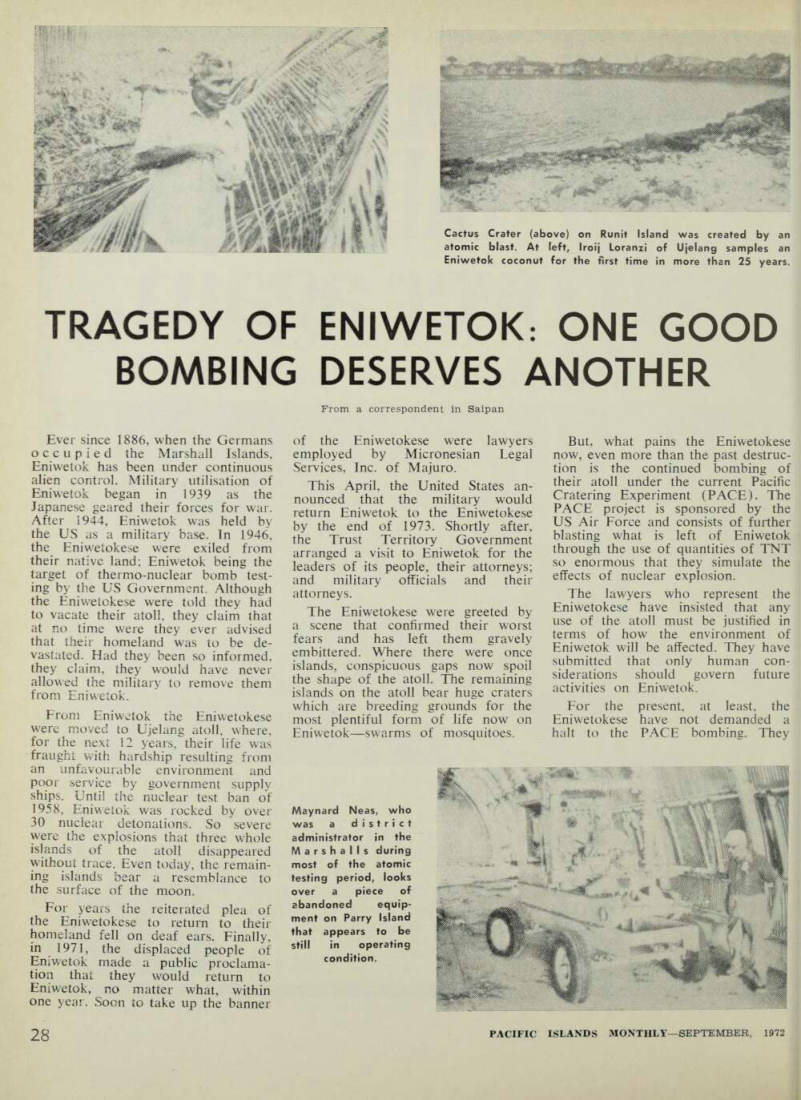
Bombing Deserves Another
From a correspondent in Saipan
Ever since 1886, when the Germans occupied the Marshall Islands, Eniwetok has been under continuous alien control. Military utilisation of Eniwetok began in 1939 as the Japanese geared their forces for war.
After 1944, Eniwetok was held by the US as a military base. In 1946, the Eniwetokese were exiled from their native land; Eniwetok being the target of thermo-nuclear bomb test ing by the US Government. Although the Eniwetokese were told they had to vacate their atoll, they claim that at no time were they ever advised that their homeland was to be de vastated. Had they been so informed, they claim, they would have never allowed the military to remove them from Eniwetok.
From Eniwetok the Eniwetokese were moved to Ujelang atoll, where, for the next 12 years, their life was fraught with hardship resulting from an unfavourable environment and poor service by government supply ships. Until the nuclear test ban of 1958, Eniwetok was rocked by over 30 nuclear detonations. So severe were the explosions that three whole islands of the atoll disappeared without trace. Even today, the remain ing islands bear a resemblance to the surface of the moon.
For years the reiterated plea of the Eniwetokese to return to their homeland fell on deaf ears. Finally, in 1971, the displaced people of Eniwetok made a public proclama tion that they would return to Eniwetok, no matter what, within one year. Soon to take up the banner
of the Eniwetokese were lawyers employed by Micronesian Legal Services, Inc. of Majuro.
This April, the United States an nounced that the military would return Eniwetok to the Eniwetokese by the end of 1973. Shortly after, the Trust Territory Government arranged a visit to Eniwetok for the leaders of its people, their attorneys; and military officials and their attorneys.
The Eniwetokese were greeted by a scene that confirmed their worst fears and has left them gravely embittered. Where there were once islands, conspicuous gaps now spoil the shape of the atoll. The remaining islands on the atoll bear huge craters which are breeding grounds for the most plentiful form of life now on Eniwetok—swarms of mosquitoes.
But, what pains the Eniwetokese now, even more than the past destruc tion is the continued bombing of their atoll under the current Pacific Cratering Experiment (PACE). The PACE project is sponsored by the US Air Force and consists of further blasting what is left of Eniwetok through the use of quantities of TNT so enormous that they simulate the effects of nuclear explosion.
The lawyers who represent the Eniwetokese have insisted that any use of the atoll must be justified in terms of how the environment of Eniwetok will be affected. They have submitted that only human con siderations should govern future activities on Eniwetok.
For the present, at least, the Eniwetokese have not demanded a halt to the PACE bombing. They
Cactus Crater (above) on Runit Island was created by an atomic blast. At left, Iroij Loranzi of Ujelang samples an Eniwetok coconut for the first time in more than 25 years.
Maynard Neas, who was adistrict administrator in the Marshalls during most of the atomic testing period, looks over a piece of abandoned equip ment on Parry Island that appears to be still in operating condition.
are attempting to evaluate an “Environmental Statement” from the US Air Force which ascribes great importance to the PACE bombing tests. The Eniwetokese want time to obtain an independent evaluation of the consequences, but the military think this would create unnecessary delay. Nonetheless, should the Eniwetokese discover that the military’s account falls short of protecting their island-home from further destruction, it is a fair as sumption that they will demand an immediate discontinuance of the bombing.
Obvious haste seems to pervade all aspects of the PACE testing except in keeping the owners of Eniwetok informed. This attitude rather sug gests that the military prefers to keep the Eniwetokese in the dark.
The military chose not to provide the Eniwetokese with a copy of the “environmental statement” until after a request for one was made by their attorneys. As if to add insult to injury, the statement itself contained highly complex scientific language virtually untranslatable into Marshallese.
In their response to the environ
mental statement, the attorneys for the Eniwetokese alleged violations of law by the military in failing to consult the people of Eniwetok.
They said the statement was “not designed to inform. It is designed to persuade. It is almost entirely con clusionary.”
It is now obvious that the decision to run bombing tests on Eniwetok was more a random decision than a calculated one. Although the Eniwetokese were told that Eniwetok
was “most suitable”, what the military really meant was “most convenient”.
Apart from these considerations, the military justifies the new testing by saying that so much damage was caused in the past, a few more bombs will make little difference.
Certainly, bombing on the present large scale must play havoc with reef and marine biology, the fresh water lens and the land itself. Not to mention the impact upon Eniwetokese culture.
Residual Radioactivity On Islands
About 100 people, mostly civilians, are currently living on Eniwetok.
They are involved with a US Coast Guard Loran station and the PACE programme. A recent survey by the Atomic Energy Commission shows that some residual radioactivity exists on some of the islands, but the government has said these will be “cleaned up” before the atoll is returned. Remaining radioactivity is mostly concentrated on pieces of scrap metal, with which some of the islands are littered.
But there are many aluminium buildings on the islands of Eniwetok and Parry that are still in excellent shape, and docks and wharves, and the major airfield, will be of special value for the returning islanders.
There has been some suggestion that bomb craters could be used as small boat harbours, or for fish farming. The islands are more abundant with coconuts and crabs than the islanders’ present home of Ujelang.
Advertisements & other items, pp. 35-36 (1 item)
Huon gulf morei.
If you’re going to Lae, book in at the Huon Gulf Motel, just down the road from Lae Airport.
The Huon Gulf is individually airconditioned in every suite. There’s a swimming pool to cool you down after your trip and attentive service for top standard a la carte meals in the modern restaurant and for liquor service to your table, suite or poolside.
For family groups there are family suites with kitchenettes and interconnecting doors to adjoining suites.
Make the Huon Gulf Motel your base in Lae.
Book direct or through any office of Ansett Airlines of Papua New Guinea.
Huon gulf morei.
Markham Road, Lae. Phone: Lae 3204.
A member company of Ansett Transport Industries Limited.
AH0129
Pull a lever and the job’s
as good as done!
You’ll do a first class job every time with these simple to operate IH ploughs and harrows,.. Just hitch them up to any 3 pt. linkage tractor and away you go! m <S m m
INTERNATIONAL Al-41
Disc & Mouldboard Ploughs
This unit is built around a strong frame comprising a ‘hat section’ main beam rockshaft clamp and headstock, and the one frame suits both mouldboards and discs as required. You can have a number of combinations from 1 furrow mouldboard to 4 furrow mouldboard, or from 2 furrow 26 in. discs to 4 furrow 28 in. discs.
It’s an ‘as-you-want-it’ plough with excellent side draft control.
INTERNATIONAL 3-3
Disc Harrow-offset
You’re looking at the biggest breakthrough in 3 pt. linkage harrow design ever to be released! You get up to twice the offset without a trace of excessive side-draft. You’ll find the 3-3 easier to use, easier to manoeuvre, more convenient to store. Choose the size to suit your job —the 3-3 is available In category 1 and 2 3-pt. hitch In 5Va, 6,6% and 7Vz ft. sizes.
INTERNATIONAL Al-54
Disc & Mouldboard Ploughs
You could call this a more robust version of the Al-41, for it Is ideal for the tough job of opening up land. The Al-54 model also allows you to step up to 5 furrows. The offset headstock gives excellent side-draft control. As the plough tends to move left because of side draft, the top link distance between the headstock and the tractor lengthens, thus pushing the rear plough disc deeper into the soil.
For further details see your local distributor or send this coupon.
TAHITI; Tahiti Produits Shelltex Boite Postale 350,
PAPEETE.
NEW CALEDONIA: Societe d'lmportation Francaise, Boite Postale 806, Noumea, New Caledonia.
FIJI: Niranjan's Auto Port Limited, G.P.O. Box 450, SUVA, NEW HEBRIDES: Kerr Bros. Pty. Limited, G.P.O. Box 3838,
SYDNEY, N.S.W.
SOLOMON ISLANDS: Solomon Motors Limited, P.O. Box Cl 6,
HONIARA.
6708
EXPORT SALES DEPT.
International Harvester Company of Australia Pty. ltd.. 171-205 City Road, South Melbourne, Vic. Aust. 3205 Please send me complete details of the equipment indicated.
Al-41 Disc & Mouldboard Ploughs Al-54 Disc & Mouldboard Ploughs 3-3 Disc. Harrow offset
NAME
ADDRESS
CITY. POSTCODE..
The Editor's Mailbag

Captain J. B. Stevenson
I am writing to seek your assist ance in tracing any records relating to Captain James Barclay Stevenson who was master (and part-owner) of the wooden barque Chevert in 1880.
The Chevert was a wooden barque built at Rochfort, France, in 1863 as a French man-of-war. She later passed into the hands of R. R. S.
Bowker (the coal factor and ship owner of Newcastle, NSW). Later still, in 1875, the Chevert became the property of Sir William Macleay who retained ownership of her until 1877, during which time he made her his headquarters for his famous voyage of discovery from Sydney to New Guinea and return (this chapter of her career is very adequately covered by David Macmillan in his excellent book A Squatter Went to Sea).
In June, 1877, he sold her. She passed through various hands during the following few years. In 1880 her (then) part-owner and master, Captain James Barclay Stevenson of Sydney, reported that she had been dismasted in a hurricane, towed into Havannah Harbour in the New Hebrides, and there condemned. She was (apparently) bought wholly or in part from Stevenson by Captain Donald McLeod (the rather legen dary South Sea Islands’ trader and seaman) who re-rigged her. With this transaction her Sydney registry was cancelled and she disappeared from Australian shipping records. So, as far as I have been able to estab lish, did James Barclay Stevenson.
The Chevert was 105.6 ft in length, 29.0 ft in breadth and 16.7 ft in depth. When registered in Sydney her registered number was 71,799; she had a registered tonnage of 314.
After Donald McLeod purchased the Chevert it seems possible that he retained the services of Captain Stevenson—possibly as her master or as master of one of his other ships.
I have in my possession a letter written from Noumea, by Stevenson, to his son (Willie) in Sydney, in January, 1882. In this letter Steven son gives no Noumea address, but refers to “a cheque (to his wife) for £3O on the Union Bank at Sydney”.
The cheque was from “Morgan” and I wonder who Morgan was.
Captain Stevenson’s son (Willie) was William Henry Webster Stevenson who became the Anglican Bishop
of Grafton in New South Wales in 1938, and who died in Sydney in 1945 at the age of 67 years.
I have read with interest the two references to Captain McLeod in your magazine of September, 1955 (by H.
E. L. Friday), and in November, 1955 (by Donald Hugh Kerr). I have also read Lion of Scotland and Cannibals and Convicts, but neither leads me any closer to James Barclay Stevenson. I also know the two sur viving grandsons of Captain Steven son but neither is able to shed further light on the previous or subsequent career of their ancestor.
My interest in J. R. Stevenson is in connection with some research which I am doing into early Australian shipping.
M. E. Palmer.
129 Mackenzie Street, Hackett, Canberra, A.C.T. 2602.
Does Anybody Know?
Seeing in an article in the October, 1971, PIM on the “Half-forgotten Western Isles” (the Ninigo Group), a photograph of a girl, Mary Handis, I wrote to her on Pihon Island on January 24 but got my letter back.
I assumed she was living there but maybe she has moved. Do you know her present address?
C. Heuboer (Mr).
175 Paul Gabriel Street, Den Haag, Holland.
Indians In Samoa
Mr R. P. Berking, bless his indus trious soul, was a reservoir of Samoan history which he could relate in a most absorbing way. I discovered this to my pleasure during my term as Observer-in-Charge of Apia Observa tory from 1962-65. It was with some sadness therefore that I read of his death in PIM (June, p. 129).
You say it is not clear why, during the German era, Mr Berking ignored the direction of his superiors and turned a group of Indian immigrants away from Western Samoa.
He explained to me that he could envisage an “Indian takeover” in the years ahead if these immigrants had been allowed to even put a foot ashore. As soon as they had come ashore, he said, they would have sought out local chiefs and had them selves accepted as guests. Next, with the support of the chiefs, they would have got around the authorities to
allow them to remain permanently. It was precisely this situation that Mr Berking, with his foresight, had sought to avoid.
Had not the ship (or ships) earlier been turned away from Tonga? Does any reader know why and in what circumstances Indians attempted to migrate beyond Fiji?
John Milne.
Bali, Indonesia.
"Men, Not Natives"
Fred Archer, in his letter “Wuvulu Island” (PIM, June, p. 3) says, “Rep resentations have been made to the MPs in Canberra and to native mem bers of the PNG House of Assembly recently . . .
Why is it necessary to use the word “native”?
As a member of the dying race of arrogant European settlers in South- East Asia and the Pacific, Mr Archer should be reminded that SE Asia was once a land of “boys, boongs and natives”, (in the eyes of people like Mr Archer).
When we freed ourselves from our colonial masters and were able to assert ourselves we became men .
Mr Michael Somare was man enough to remind some white inter lopers at Goroka recently that Papua New Guineans are men, not boys.
Regardless of our educational back ground we are all humans seeking dignity and self-respect. To use the word “people” instead of “natives would have been a nice gesture from highriding Mr Archer. However, he and his ilk will soon have to step off their horses and face reality.
S. Chalid.
c/- Hotel Negara, Singapore.
Impressive Pim!
I wish to advise my change of address. It is now over two years since I started my subscription with you, for PIM. The first time I came upon the magazine was in early December, 1969 at the old overseas terminal at Sydney airport. Wanting something to read on the flight to Tontouta, New Caledonia, I was browsing through the contents of the newsagency when the title, “Pacific Islands Monthly” caught my eye.
Those words and the coverplate promised literature relevant to the area I was about to be travelling in.
I must admit I was a bit set back when, on the aircraft, I opened the magazine and found no glossy travel advertisement-type photographs of sunbathed beaches, palm trees or
damsels in grass skirts and hibiscus blooms.
Much daunted I waded tentatively into the print. I became interested.
In between my activities over the five days spent in Noumea I finished reading the magazine and left it in my room on my departure for Fiji.
On arrival back home I found that I wanted to keep informed on hap penings in the Pacific and it was then that I remembered that impressive PIM I had read two months earlier.
Fortunately I had kept the subscrip tion form that was in that issue— foresight or luck?
In the two years since then I have found that the standard I found in that first issue has been maintained.
In fact I do not even mind that there are no glossy photos.
The articles have been interesting, informative and, at times, amusing.
My interest in the region the magazine covers has been increased by it and, perhaps, it is partly responsible for my coming to Papua New Guinea.
Since being here I have noticed the articles dealing with this country to be informed and accurate. Un fortunately, I feel that a lot of the people here are less informed, in some cases, than your PIM.
Thank you for the last two years.
I look forward to the future, both of your issues and the region.
Noel M. Leach.
Boroko, Port Moresby.
Exclusive Yacht Club
When our overseas yacht was recently moored at the Royal Suva Yacht Club, an Indian friend from Lautoka on the other side of the island visited us there.
An official of the RSYC, not very politely, and in fact, quite nastily asked a crew member, who was ac companying the Indian, what our guest was doing in the club grounds and on our yacht. He said that club rules stated that no locals living within fifteen miles of the club could visit it.
When he was told that our friend was from Lautoka, he said that no “locals” at all could visit either the club or our yacht there and because our Indian friend was visiting us, the official requested that we remove our yacht from the RSYC area.
Both we and our guest were embarrassed and humiliated by the attitude of the official. Many people in Fiji are aware of the colour-bar at the yacht club and we feel that something must be done to eliminate it.
(Miss) Diane Galiardi.
Yacht Tathata , Tradewinds Marina, Suva.
More letters on p. 121
Advertisements & other items, pp. 38-42 (1 item)
key to the safe insect killer
This little flower is your
ONE of the safest and most potent insect-killers known to contemporary science is derived from an innocent-looking small white flower, the African Pyrethrum daisy. Pure pyrethrins, as chemists call this substance, is the active ingredient in Pea-Beu insect spray, and the key to its concentrated killing power. Continuing research by the chemists in the laboratories of A.N.I. Chemical Research and by health and environmental authorities throughout the world, confirms that insects do not become immune to py rethrum. Pea-Beu contains a high concentration of pyrethrins which means that short bursts only are needed to kill flies, mosquitoes and every type of insect pest.
Filthy flies:
universal health menace Entomologists and medical research workers have established the common fly to be a carrier of typhoid, cholera, smallpox, infective hepatitis amoebiasis in epidemic proportions. Every fly you kill lessens the risk to your family, helps keep their food uncontaminated. Pea-Beu is recommended to kill every fly that enters your home because it is guaranteed completely effective yet absolutely safe.
No fears near food Your kitchen and food-cupboards are the favourite places for houseflies, especially when attracted by exposed food as you cook or serve.
Of course you’re reluctant to use pungent insecticides, and fear toxic effects. But never hesitate to use Pea-Beu.
Its active ingredient guarantees it harmless to humans and pets, and thanks to the purity of all its ingredients, it is completely safe to spray anywhere in the home. so pure it’s safe to spray
anywhere
m m
Pea-Beu-the safe, powerful insecticide
* \ Come over to Consulate, enjoy the rich inviting flavour of choice Virginia tobacco enhanced by a touch of refreshing menthol.
People who know the best insist \ on Consulate—the world’s first Virginia menthol cigarette.
COOL CLEAN CONSULATE
For that surprising extra it gives you
N S* W . ■ '
Yesterday
o
Tomorrow
Ever since the day we began making autos 40 years ago Toyota has faced one fact we can never get around. Our home country is only about the size of California, but with almost five times its population. So right from the start we’ve had to meet the consumers’ demand for a good small car.
Our philosophy has remained the same to the present day. Everything we have goes into satisfying the world's need for a safe, reliable, well built small car. And the way we’ve been accepted in over a hundred and twenty countries tells us we’ve been on the right track all along.
In the days to come Toyota plans to concentrate its extensive research and development facilities on solving the problems we are all aware of. Because if we don't use yesterday’s experience to overcome today’s difficulties no one can have a decent tomorrow.
PAPUA NEW GUINEA: ELA MOTORS LIMITED. Scratchley Rd., Badili, Papua U.S. TRUSTTERRITORY: MICROL CORPORATION, P.O. Box 267, Saipan FIJI ISLANDS: AUTOMOTIVE SUPPLIES CO., LTD., P.O.
Box 355, Suva AMERICAN SAMOA: BURNS PHILP (SOUTH SEA) CO.,LTD.,Pago Pago WESTERN SAMOA; BURNS PHILP (SOUTH SEA) LTD.,Apia GUAM:RICKY's AUTO CO.,P.O.Boxl4sB,Agana NEWHEBRIDES: NEW HEBRIDES MOTORS LTD., P.0.80x 18,Vila SOLOMON ISLANDS: ZEPHYR SERVICE STATION PTY LTD., Honiara NEW CALEDONIA: SOCIETE D'IMPORTATION AUTOMOBILE DU PACIFIC, Noumea TAHITI: ETABLISSEMENTS E.A. MARTIN&FILS,B.P.6I Papeete COOK
ISLANDS: COOK ISLANDSTRADING CORPORATION LTD., Rarotonga
TOYOTA
flash
MazdaBoBlffi"
r-
Oil
fi * ■}< » Who says family motoring can’t be fun?
Meet the Mazda 808 sedan.
It is lavish glamour you can afford.
Along with its fine finish, you get high back front bucket seats that lay way back. And women, children and men appreciate the four doors with two stage checkers.
Plus the door locks are child-proof.
You also get a lockable gas door, thick foam dash, padded sun visors, door armrests, beautifully recessed instruments and more.
You even get front disc brakes. And the body is of semimonocoque construction with subframes designed for safe controlled-collapse under impact.
What’s more, the spare fits under the trunk so your luggage fits snugly.
Now load up and go. You hug the road with its wide track. And you take the lumps out of bumps thanks to its coil suspension up front and bias-mounted gas-filled shock absorbers in the rear.
And the center console with its 4-speed floor shift gives you more than crafty craftsmanship.
The thrifty but hefty 1300 cc overhead engine gives you the feeling of power.
There you have it. Power, safety, comfortable ride and all the things that make driving fun . . . because our engineers are family men, too.
And if you are not a family man, you can also get a sporty coupe with all of the above.
But that is another story.
Meet the Mazda 808 sedan first.
mmza4
Toyo Kogyo Co . Ltd . Hiroshima. Japan American Samoa/MAX HALECK, INC. Page Pago. American Samoa 96920 Fiji Islands/NIRANJANS AUTOPORT LTD. G P 0 Box 450, Suva Tel: 22691 New Caledonia/SOCIETE RIVIERE ET BERNANOS 41 Rue de Sebastopol, Noumea New Guinea/PNG MOTORS LTD. P 0. Box 1394, Boroko. Papua Tel: 55788 New Zealand/MAZDA MOTORS OF NEW ZEALAND LIMITED Auckland Western Samoa/H. & J RETZLAFF P.O Box 1 95, Apia Tel 237 "The trade mark MAZDA in this advertisement stands for AUTOMOBILES MAZDA as far as France and her territories are concerned.
Take A 'Chopper' For A Stroll
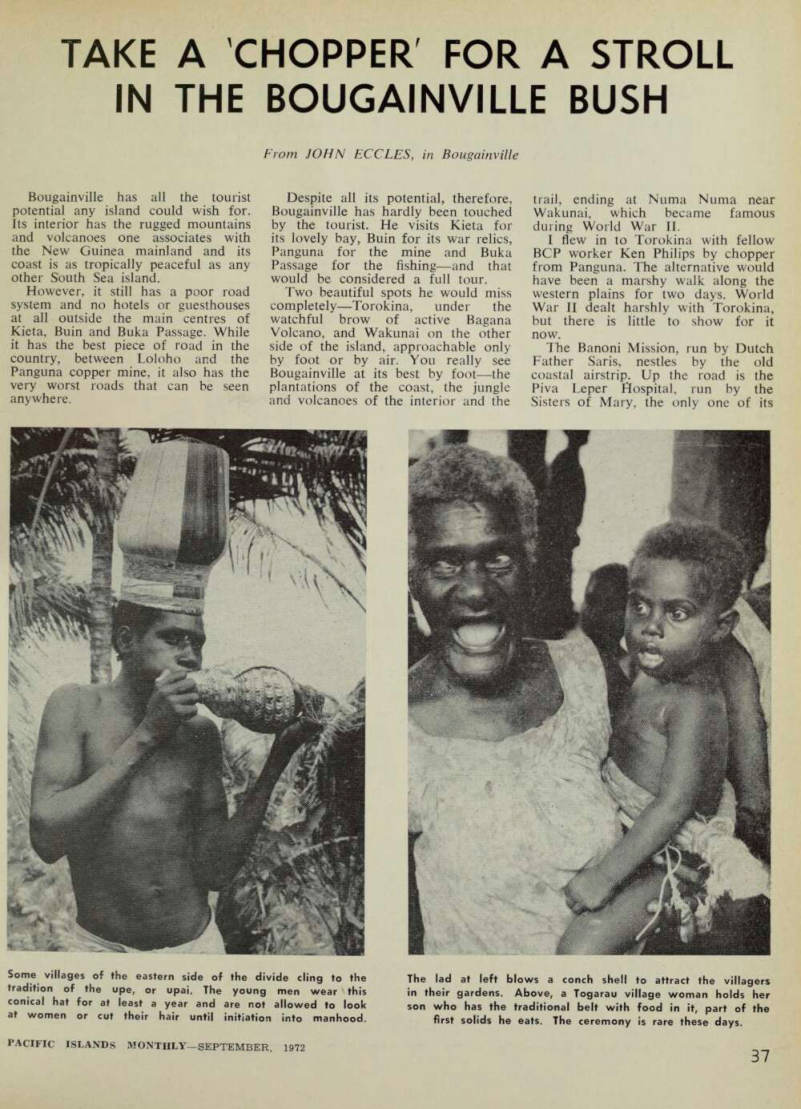

In The Bougainville Bush
From JOHN ECCLES, in Bougainville
Bougainville has all the tourist potential any island could wish for.
Its interior has the rugged mountains and volcanoes one associates with the New Guinea mainland and its coast is as tropically peaceful as any other South Sea island.
However, it still has a poor road system and no hotels or guesthouses at all outside the main centres of Kieta, Buin and Buka Passage. While it has the best piece of road in the country, between Loloho and the Panguna copper mine, it also has the very worst roads that can be seen anywhere.
Despite all its potential, therefore, Bougainville has hardly been touched by the tourist. He visits Kieta for its lovely bay, Buin for its war relics, Panguna for the mine and Buka Passage for the fishing—and that would be considered a full tour.
Two beautiful spots he would miss completely—Torokina, under the watchful brow of active Bagana Volcano, and Wakunai on the other side of the island, approachable only by foot or by air. You really see Bougainville at its best by foot—the plantations of the coast, the jungle and volcanoes of the interior and the
trail, ending at Numa Numa near Wakunai, which became famous during World War 11.
I flew in to Torokina with fellow BCP worker Ken Philips by chopper from Panguna. The alternative would have been a marshy walk along the western plains for two days. World War II dealt harshly with Torokina, but there is little to show for it now.
The Banoni Mission, run by Dutch Father Saris, nestles by the old coastal airstrip. Up the road is the Piva Leper Hospital, run by the Sisters of Mary, the only one of its
Some villages of the eastern side of the divide cling to the tradition of the upe, or upai. The young men wear this conical hat for at least a year and are not allowed to look at women or cut their hair until initiation into manhood.
The lad at left blows a conch shell to attract the villagers in their gardens. Above, a Togarau village woman holds her son who has the traditional belt with food in it, part of the first solids he eats. The ceremony is rare these days.
A little war history uncovered by development
kind on the island. The plains leading up the mountains are dotted with villages and on the coast near the mission is Dokotanama village, the people of which once lived on nearby Puruata island until it was flattened during the war.
Torokina in November, 1943, was the last place the occupying Japanese expected the Americans to attack.
The US Marine landing there was a fairly easy matter. Only 78 Marines were killed and 270 of the enemy.
The Americans sent a Fijian battalion to Ibu on the other side of the range to watch the Japanese at Wakunai. The trail was the same we were about to use. When the Japanese counter-attacked early in 1944, the Fijians retreated to Torokina.
Over 20,000 Japanese attacked the American garrison; 5,000 were killed and 3,000 wounded were carried back to Wakunai over the Numa Numa trail. It was the last Japanese offensive in the Solomons area.
The Australians took over Torokina in October, 1944, and began offensives immediately. When the Japanese surrender came they had control over most of the Numa Numa trail and were ready to strike at Wakunai.
Today there is little left of the war; salvage operators have cleared the wreckage. But one of the air strips has been cleared by a private contractor, Ray “Kiwi” Blanchfield, and DCA permission has been given to open it again.
We followed the road across the Torokina plains to the foot of the dividing range under the shadow of the volcano and there the walk started. The Numa Numa trail follows the Laruma River through a gorge and then straight over the range.
Another branch crosses the range diagonally going very close to the Balbi volcano. We had to take the Balbi route as the Laruma was in flood and we couldn’t cross.
It was a sunny morning when Ken Philips and I set out with the porters.
As we climbed the cloud dropped accordingly until the familiar rain began to come down. Walking the Bougainville ridges in pouring rain, sliding mud and tripping vines, is a lousy way to spend a day. But it’s great afterwards sitting in the warmth of a bush hut with a billy boiling and a tin of corned beef heating over the fire.
I just kept thinking about that boiling billy as we trudged up and down, up and down. For those who fought here during the war, every ridge may hold a memory. To us, every ridge looked the same—
horrible. No war relics, not even a village to drop into and have a coconut.
Ten hours we walked that day, just making it to a deserted bush hut as the light began to fail. We were within two hours of the top of the divide—not a bad effort considering we had to detour round the Laruma River. Crammed into the bush hut watching the fire boil our billy, we asked our guides what to expect tomorrow; “I go, i go, i go,” they said, “i long way liklik”.
Not knowing whether to feel pleased or dejected, I fell asleep.
Next day we were off at dawn, swigging away at mugs of tea as we went. Two hours later we crossed the divide and saw Balbi for the first time. It’s a beautiful volcano made up of a series of craters rather than the classical one. Sisivi, the first village over the divide, is perched on a ridge separated from the volcano.
It seems to float in mid air with Balbi soaring 5,000 ft higher.
No-one is quite sure how high Balbi is. The maps say 8,500 ft but nearer 10,000 would be closer. Quite a few groups from BCP climb the volcano by bush path. There is no
Solid food singsing
thermal activity at the top but there are sulphur pools.
Few people were about when we reached Sisivi as they had gone to a singsing, so we continued on towards Togarau where we hoped to spend the night. The next village, Ruruvu, had fine pomeloes (a sweeter grape fruit, with thicker rind), and we gratefully quenched our thirst on them. On to Togarau, perched up a 500 ft bluff. There we found the singsing being held to celebrate the eating of solid food by some of the village babies.
The babies were wearing large vine belts round their waists with a protuberance at the side. The pro tuberance held morsels of food con nected with the eating rite, spiced with bush herbs to make the babies strong. There was no alcohol at this singsing in the heart of Bougainville, a pleasant change from the more “civilised” parts of the island.
One of the villagers was a friend of Ken’s and invited us to stay the night. We dined on potatoes with a tin of corned beef neatly tipped on top. Togarau has a rich volcanic soil which grows many crops superior to the rest of the island. A road is slowly being built from the eastern side of Bougainville towards the village. When it arrives, the villagers hope to make a good living selling garden produce to the Wakunai area.
From Togarau an easy walk followed the Wakunai River down to the coast near the Marist Mission of Asitavi.
The next day we walked through village gardens for an hour before striking the river. The new road follows the river too and it was a pleasant respite from ridge walking to follow its smooth surface, taking the occasional cooling dip in the river.
By 2 p.m. we were at Asitavi where Fr Kronenberg put us up for the night. The area has numerous plan tations, many of them dating back to German times. Oldest is Numa Numa itself, started in 1912 by Buka Plantations and Trading Company.
It’s also the country’s largest single plantation, at 4,000 acres. In charge since 1934, bar the war years, is Sandy Sandford, well known for his part in guerilla operations against the Japanese. Sandy’s wife runs a trade store and Sandy spends his spare time looking after his beloved orchids.
So there it is, a tough, but rewarding walk across Bougainville.
It shouldn’t be attempted without letting the local administration know, or, in the case of Bougainville Copper people, the village relations officers.
Advertisements & other items, pp. 44-48 (1 item)
I Prouds
GENERAL AGENTS AND WHOLESALERS
IN FIJI, SOLOMON ISLANDS, NEW HEBRIDES, TONGA
WESTERN SAMOA, AMERICAN SAMOA, NIUE
Cigarette Lighters, Pipes, Smokers Accessories Alfred Dunhill Ltd.
Colibri French Perfumes Balenciaga, Nina Ricci, Madeleine De Rauch, Gres, Paco Rabanne, Caron, Yves Saint Laurent, Le Gallon.
Watches & Clocks Patek Philippe, Girard Perregaux, Consul, Looping, Schatz.
Royal Copenhagen Porcelain Lladro Spanish Porcelain Figures (also Guam, Singapore, Kuala Lumpur, Bangkok, Bali) Stockburger and Huger German Barometers Carl Zeiss Binoculars & Sunglasses (Fiji only) Trade enquiries should be directed to; Prouds (Fiji) Limited, G.P.O. Box 180, Suva, Fiji.
Retail outlets available in many countries
I Prouds
(FIJI) LIMITED
THE TRIANGLE SUVA, NADI, LAUTOKA
J. 569
□ STARTS WET MOTORS □ STOPS SQUEAKS □ PREVENTS RUST □ PROTECTS ALL METALS □ PREVENTS WET IGNITION □ LUBRICATES □ PROTECTS ALL ELECTRICAL SYSTEMS
□ FIGHTS SALT SPRAY CORROSION
□ PENETRATES AND LOOSENS TIGHT NUTS
□ PROTECTS RIFLES AND SPORTING EQUIPMENT
□ PREVENTS BATTERY CORROSION
MECHANIC IN A CAN
WD4O is available in handy aerosol cans or gallon and half gallon cans with applicator.
Other chemicals manufactured by Ardrox include degreasers, decarbonisers, detergents, paint removers, rust and scale removers, corrosion removers, safety solvents, marine cleaning solvents, industrial cleaning materials, general cleaning products and steam cleaning additives ... all developed and approved for aircraft, marine, electrical and general engineering industries.
Send for more information.
ARDROX AUSTRALIA PTY. LIMITED acompany
HEAD OFFICE: BIRNIE AVENUE, LIDCOMBE, N.S.W., AUSTRALIA. TEL: 649 0111 Port Moresby: ANG House. Singapore: 193 b Goldhill Centre, Thompson Rd., Singapore 11 $
GAD
VfICTA
TURNS
GRASS
INTO
LAWN!
A MODEL AVAILABLE TO SUIT ALL
CONDITIONS AND EVERY PURPOSE
SUVA MOTORS LTD.
SUVA, LAUTOKA.
CARPENTERS
PORT MORESBY.
NEW GUINEA CO. LTD.
RABAUL, MADANG,
LAE, MOUNT HAGEN,
MINJ, GOROKO.
vrora^j.
Established 1890 offering merchants in the Pacific, buying service giving prompt, careful and expert attention to all requirements.
For that service with a difference, cable "Success", Sydney % & 15 % Representing Manufacturers of: Tilley Lamps, Success Footwear, Del Monte Products, Murray Valley Drinks, etc., Lingman Italian Gas Ranges, Success Petrol Washing Machines, E. W. Pipe Fittings, Sharp Calculators, Success Canned Fish, and other leading Brands. r 3
I TD.*\ N.S.
HIGHEST PRICES OBTAINABLE ON THE WORLD MARKETS
FOR YOUR
SHELL - COCOA - COFFEE - COPRA - ETC. 31 Macquarie Place, Sydney, N.S.W. 2000 Seatrans House, Gore St., Auckland, N.Z.
G.P.O. BOX 5315, SYDNEY, 2001.
CABLES: "TAITCO", SYDNEY.
P.O. BOX 2044, AUCKLAND, N.Z,
CABLES: ''TAITCO'', AUCKLAND.
New
Loveliness
for your
skin
* V THE exquisite beauty of your complexion is essentially your own responsibility.
Only you can give your skin the vital beauty care it needs. Only you can resolve to give it the beauty benefits of a unique tropically moist oil blend that will keep it always young and pretty.
Oil of Ulan, with its tremendous potential for softening against the dryness which causes wrinkles, can do much to ward off those tiny, ageing lines a woman fears most.
Because this unique beauty fluid enjoys an ideal compatibility with the skin’s own natural fluids, it helps to balance those precious “liquid” assets of combined oil and moisture that give the complexion its youthful softness and bloom.
Skin Needs Protection A film of oil of Ulan smoothed over the face and neck is all that your skin needs to protect it from the dryness caused by artificial indoor environments and the elemental consequences of exposure to wind and weather.
The rich moist oil provides a perfect beautifying base for makeup, and at the same time brings out the best in your complexion.
Saturation of the skin with oil of Ulan at night will ensure with even greater certainty that your complexion gains optimum smoothness and loveliness.
Almost every skin has a moisture problem, and the tropically moist oil blend can help to solve this very important aspect of complexion care. It is natural for the water content of the outer dermTc layer to evaporate constantly, but when your skin is subjected to severe winter or hot, drying summer conditions, evaporation takes place too rapidly. Tiny lines, wrinkles and rough, flaky patches will put in a premature appearance unless there is some form of relief for the thirsty, dehydrated skin.
Oil of Ulan nurtures the natural conditions appropriate to maintain the health of the complexion and keeps the skin dew soft, moist and supple.
All your life—this year, next year and every year—your complexion can be the living proof of your daily devotion. Pledge the remarkable beauty benefits of oil of Ulan (which is available from chemists and beauty counters) to your complexion today.
Beauty Skin-Care
Consultants Recommend Beauty-care consultants are now recommending that, to take full advantage of the benefits of tropically moist oil of Ulan, it should be smoothed over the face and neck daily before applying makeup. In this way, tiny lines may be held at bay and the youthful bloom on a beautiful complexion can be carefully cherished.
The rich
and golden
eggs’n’butter
shortbread:
Brockhoff
Edinburgh
Shortbread.
Farm fresh eggs and creamy dairy butter a quarter by weight, make Edinburgh Shortbread melt in your mouth. Traditional Scottish biscuits that serve so deliciously with coffee or tea.
Edinburgh Shortbread is baked oven-crisp with the flavour-fresh goodness that’s unmistakably Brockhoff.
There’s value, variety and quality in
BROCKHOFF
BISCUITS
h
BROCKHOFF
6442/exe
Footnotes
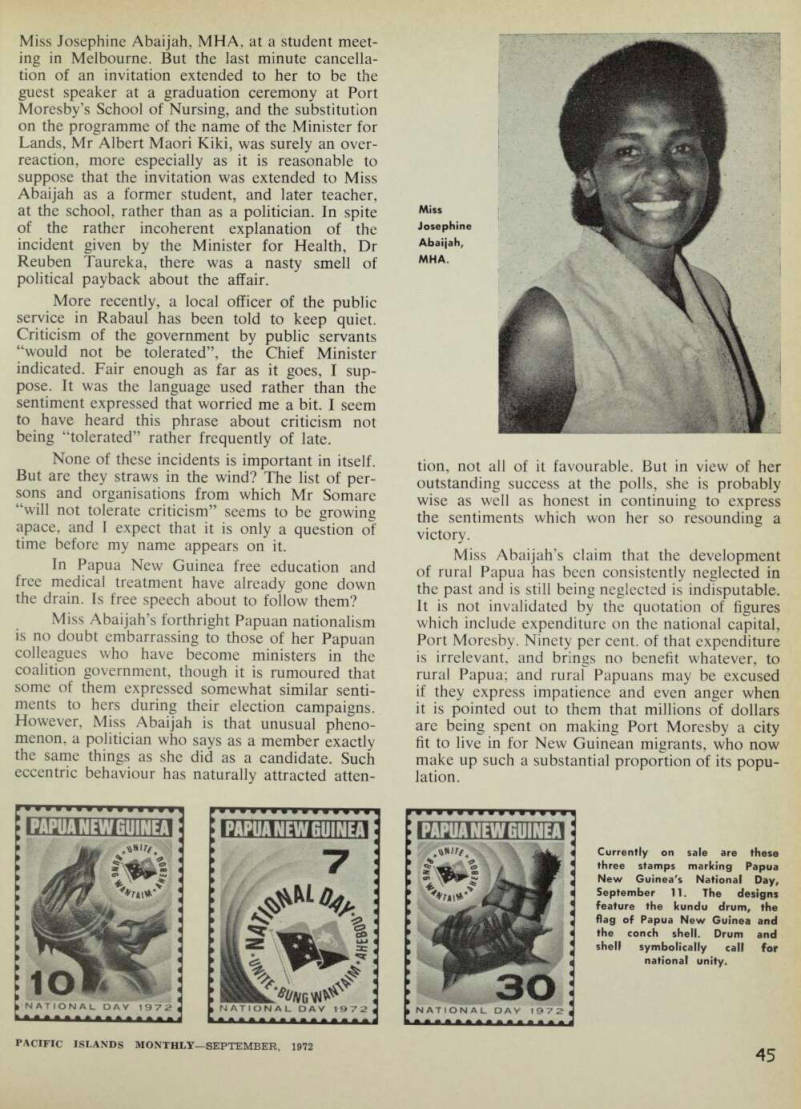
#YN Monday, September 11, Papua New Guinea will observe its third National Day, an occa sion intended to promote a sense of national unity among the diverse people of this ex-colony.
There will be bands, marches, traditional singing and dancing, and a good deal of high sounding waffle on the theme of “bung wantaim”, which seems to be well on its way to being regarded as an “open sesame” to peace and prosperity—a new cargo cult, in fact.
What progress has been made towards national unity since National Day 1971?
At the top level, a good deal. This time last year it seemed impossible to hope that the elec tion of a third House of Assembly could produce a government representative of all parts of the country and at the same time competent to tackle the work of government at ministerial level with out too great dependence on expatriate public servants.
However, the seemingly im possible has happened, and the National Coalition which now controls the affairs of Papua New Guinea is highly representative of all the country’s regions and most of its districts and has an impres sive measure of competence.
But what of the people who inhabit these regions and districts.
Well, if unity, like charity, begins at home, the signs are not en couraging. In the Gazelle Peninsula
of New Britain, the rival Tolai factions are, if anything, growing more rather than less bitter towards each other. And in the Highlands hardly a week passes without some inter-clan dispute, generally about land, leading to fighting, blood shed and death.
It may be true that it is easier to be on good terms with the chap at the other end of the street than with one’s next door neighbour. But even allowing for this the signs are not propitious.
A few weeks ago certain faceless men described as the Chief Minister’s advisers came up with the idea of building up Chief Minister Michael Somare as a National Leader, and of flooding the country with pictures of him. Mr Somare showed no marked enthusiasm for this
New Guinea
Must Keep Free
Speech Free
tactic, his fellow ministers opposed it, and the idea was dropped. And a very good thing too.
Personality cults have generally proved detri mental to the countries upon which they have been inflicted, and we don’t want one here.
But personality cult-inspired “unity” is not the only kind of bogus national unity we are in danger of having inflicted on us. One gets the impression that some members of the National Coalition would not be adverse to a “unity” based
on the silencing of criticism.
Touchiness about and over reaction to adverse criticism has always been a feature of colonial government. Is it to become a feature of national government, as Stuart Inder has suggested in June PlM’s “Up Front”?
It was understandable that the National Coalition should not be pleased with Mr Anton Parao’s performance as one of Papua New Guinea’s delegates to the Trustee
ship Council’s meeting in New York; but its reaction was perhaps a little stronger than the occasion warranted.
It was understandable that the coalition should take a dim view of the tendency of some expatriates to use their influence and affluence in an effort to mould PNG politics, and the new head of the Institute of Technology, Dr Sandover, is no doubt right when he advises expatriates to keep out of the country’s politics at this stage.
But the threats breathed out by the Chief Minister during his highly successful Highlands tour were again perhaps a little stronger than the circum stances warranted.
It was understandable that coalition ministers should take umbrage at certain remarks made by
With Percy Chatterton
in Pori Moresby
Miss Josephine Abaijah, MHA, at a student meet ing in Melbourne. But the last minute cancella tion of an invitation extended to her to be the guest speaker at a graduation ceremony at Port Moresby’s School of Nursing, and the substitution on the programme of the name of the Minister for Lands, Mr Albert Maori Kiki, was surely an over reaction, more especially as it is reasonable to suppose that the invitation was extended to Miss Abaijah as a former student, and later teacher, at the school, rather than as a politician. In spite of the rather incoherent explanation of the incident given by the Minister for Health, Dr Reuben Taureka, there was a nasty smell of political payback about the affair.
More recently, a local officer of the public service in Rabaul has been told to keep quiet.
Criticism of the government by public servants ‘‘would not be tolerated”, the Chief Minister indicated. Fair enough as far as it goes, I sup pose. It was the language used rather than the sentiment expressed that worried me a bit. I seem to have heard this phrase about criticism not being “tolerated” rather frequently of late.
None of these incidents is important in itself.
But are they straws in the wind? The list of per sons and organisations from which Mr Somare “will not tolerate criticism” seems to be growing apace, and I expect that it is only a question of time before my name appears on it.
In Papua New Guinea free education and free medical treatment have already gone down the drain. Is free speech about to follow them?
Miss Abaijah’s forthright Papuan nationalism is no doubt embarrassing to those of her Papuan colleagues who have become ministers in the coalition government, though it is rumoured that some of them expressed somewhat similar senti ments to hers during their election campaigns.
However, Miss Abaijah is that unusual pheno menon, a politician who says as a member exactly the same things as she did as a candidate. Such eccentric behaviour has naturally attracted atten-
tion, not all of it favourable. But in view of her outstanding success at the polls, she is probably wise as well as honest in continuing to express the sentiments which won her so resounding a
victory.
Miss Abaijah’s claim that the development of rural Papua has been consistently neglected in the past and is still being neglected is indisputable.
It is not invalidated by the quotation of figures which include expenditure on the national capital, Port Moresby. Ninety per cent, of that expenditure is irrelevant, and brings no benefit whatever, to rural Papua; and rural Papuans may be excused if they express impatience and even anger when it is pointed out to them that millions of dollars are being spent on making Port Moresby a city fit to live in for New Guinean migrants, who now make up such a substantial proportion of its popu lation.
Miss Josephine Abaijah,
Mha.
Currently on sale are these three stamps marking Papua New Guinea's National Day, September 11. The designs feature the kundu drum, the flag of Papua New Guinea and the conch shell. Drum and shell symbolically call for national unity.
Advertisements & other items, p. 50 (1 item)
Burns Philp
s'.
THE PACIFIC
fUI,SAMOA,TONGA,NIUE Is.
BURNS PHILP
(SOUTH SEA! CO. LTD.
LA
REGISTERED OFFICE: SUVA, FIJI.
TELEPHONE NO: 22661
TELEX NO: FJ1127
Code Address: "BURNSOUTH'
SHIPPING AGENCIES
The New Zealand Shipping Co. Ltd.
Shaw Savill & Albion Co. Ltd.
Blue Star Port Line (Management) Ltd.
Bank Line Ltd.
General Steamship Corporation Ltd.
Compagnie des Messageries Maritimes Royal Interocean Lines Daiwa Navigation Company Ltd.
Sitmar Line Flotta Lauro (Lauro Lines) Australasia Pty. Ltd.
Tonga Shipping Agency.
Karlander Kangaroo Line
EXCLUSIVE
DISTRIBUTORSHIPS
INCLUDE
Akai Taperecorders Sunbeam Appliances Dunlop Products Hitachi Electronics Holden Motor Vehicles Rolex Watches Revlon Cosmetics Pentax Cameras Massey-Ferguson Tractors Olympic Tyres Penfold Wines
AGENTS FOR
Queensland Insurance Co. Ltd.
Shell Company (P. 1.) Ltd.
Bureau Veritas
ASSOCIATED COMPANIES
Burns Philp (New Hebrides) Ltd.
Burns Philp Trustee Co. Ltd.
Automotive Supplies Co. Ltd.
Corrie & Co. Ltd.
Wrought Iron and Steel Construction Co. Ltd.
Bish Ltd.
SPECIALISED SERVICES
Expert advice on Shipping; Forwarding; Customs formalities; Insurance.
COMPLETE TRAVEL
SERVICE
accredited agents for the
INTERNATIONAL AIR
TRANSPORT ASSOCIATION
OVERSEAS AGENTS: SYDNEY • LONDON • SAN FRANCISCO
Tuned In,
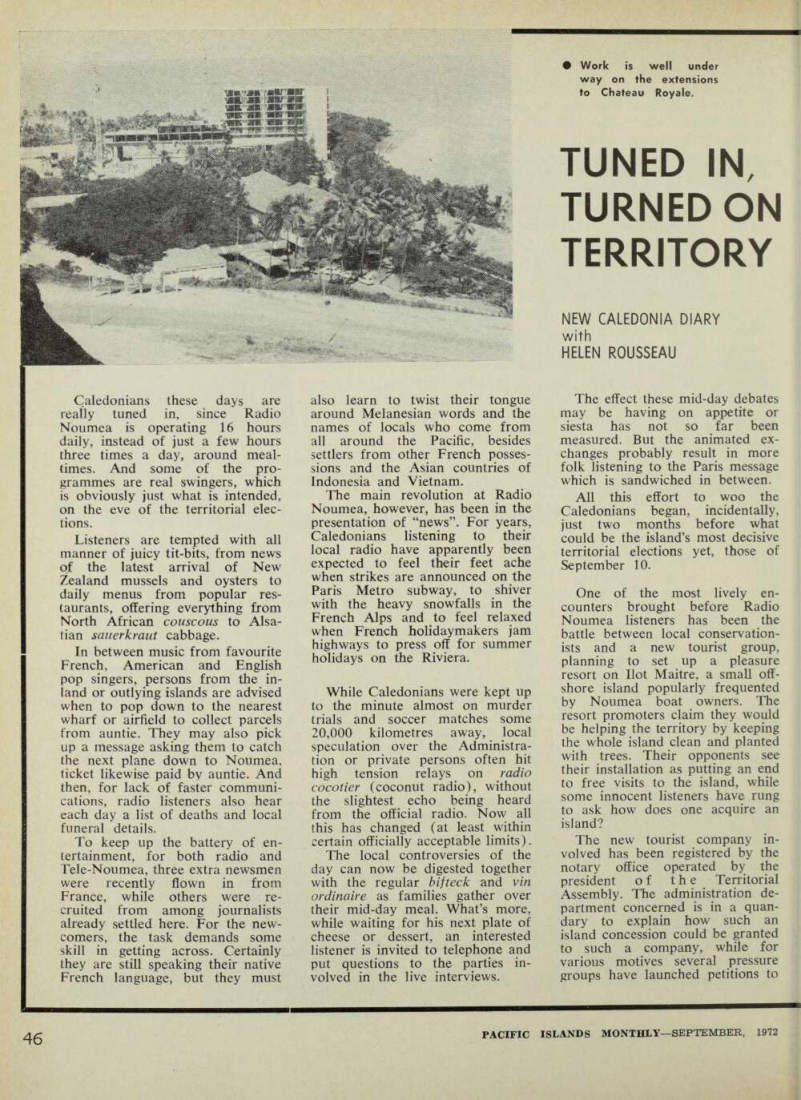
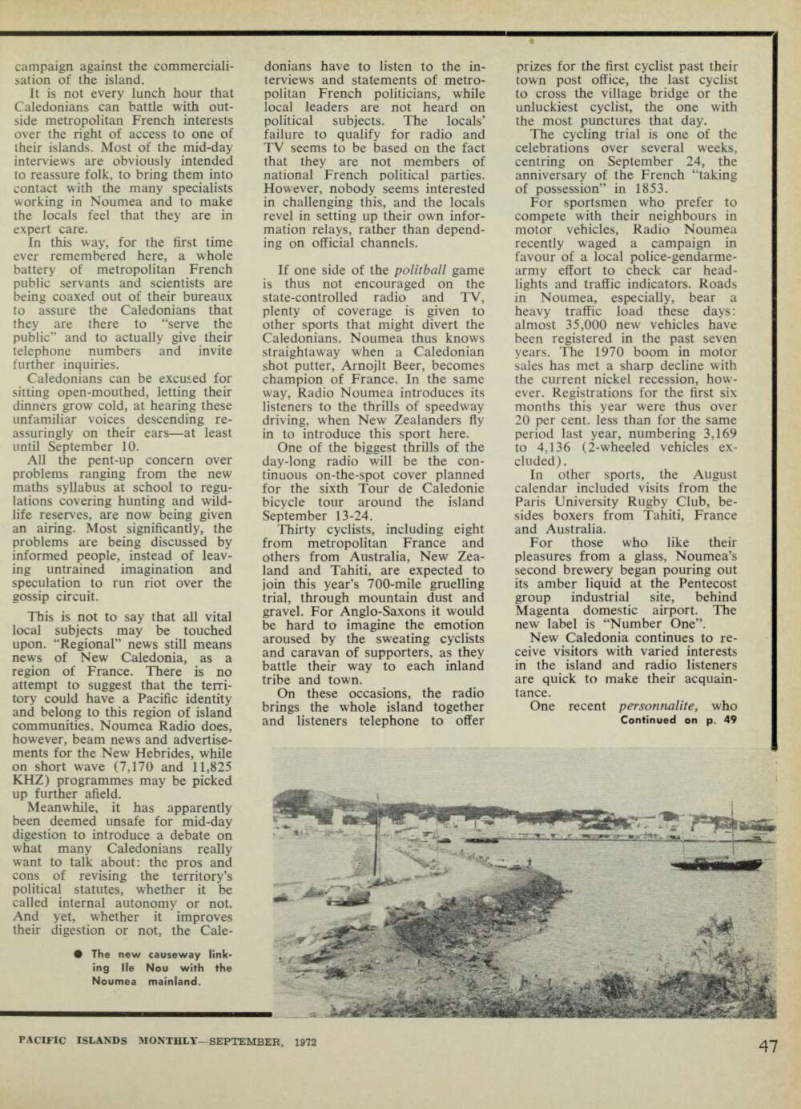

Turned On
Territory
New Caledonia Diary
with
Helen Rousseau
Caledonians these days are really tuned in, since Radio Noumea is operating 16 hours daily, instead of just a few hours three times a day, around mealtimes. And some of the programmes are real swingers, which is obviously just what is intended, on the eve of the territorial elections.
Listeners are tempted with all manner of juicy tit-bits, from news of the latest arrival of New Zealand mussels and oysters to daily menus from popular restaurants, offering everything from North African couscous to Alsatian sauerkraut cabbage.
T , . . c r ..
French^'*American 'and
pop singers, persons from the in land or outlying islands are advised when to pop down to the nearest wharf or airfield to collect parcels from auntie. They may also pick up a message asking them to catch the next plane down to Noumea, ticket likewise paid by auntie. And then, for lack of faster communications, radio listeners also hear each day a list of deaths and local funeral details.
To keep up the battery of entertainment, for both radio and Tele-Noumea, three extra newsmen were recently flown in from France, while others were recruited from among journalists already settled here. For the newcomers, the task demands some skill in getting across. Certainly they are still speaking their native French language, but they must
also learn to twist their tongue around Melanesian words and the names of locals who come from all around the Pacific, besides settlers from other French posses sions and the Asian countries of Indonesia and Vietnam.
The main revolution at Radio Noumea, however, has been in the presentation of “news”. For years, Caledonians listening to their local radio have apparently been expected to feel their feet ache when strikes are announced on the Paris Metro subway, to shiver with the heavy snowfalls in the French Alps and to feel relaxed when French holidaymakers jam highways to press off for summer holidays on the Riviera.
While Caledonians were kept up to the minute almost on murder trials and soccer matches some 20,000 kilometres away, local speculation over the Administra tion or private persons often hit high tension relays on radio cocotier (coconut radio), without the slightest echo being heard from the official radio. Now all this has changed (at least within certain officially acceptable limits).
The local controversies of the day can now be digested together with the regular bifteck and vin ordinaire as families gather over their mid-day meal. What’s more, while waiting for his next plate of cheese or dessert, an interested listener is invited to telephone and put questions to the parties in volved in the live interviews.
The effect these mid-day debates may be having on appetite or siesta has not so far been measured. But the animated ex changes probably result in more folk listening to the Paris message which is sandwiched in between.
All this effort to woo the Caledonians began, incidentally, just two months before what could be the island’s most decisive territorial elections yet, those of September 10.
One of the most lively en counters brought before Radio Noumea listeners has been the battle between local conservation ists and a new tourist group, planning to set up a pleasure resort on Hot Maitre, a small off shore island popularly frequented by Noumea boat owners. The resort promoters claim they would be helping the territory by keeping the whole island clean and planted with trees. Their opponents see their installation as putting an end to free visits to the island, while some innocent listeners have rung to ask how does one acquire an island?
The new tourist company in volved has been registered by the notary office operated by the president of the Territorial Assembly. The administration de partment concerned is in a quan dary to explain how such an island concession could be granted to such a company, while for various motives several pressure groups have launched petitions to
Work is well under way on the extensions to Chateau Royale.
campaign against the commerciali sation of the island.
It is not every lunch hour that Caledonians can battle with out side metropolitan French interests over the right of access to one of their islands. Most of the mid-day interviews are obviously intended to reassure folk, to bring them into contact with the many specialists working in Noumea and to make the locals feel that they are in expert care.
In this way, for the first time ever remembered here, a whole battery of metropolitan French public servants and scientists are being coaxed out of their bureaux to assure the Caledonians that they are there to “serve the public” and to actually give their telephone numbers and invite further inquiries.
Caledonians can be excused for sitting open-mouthed, letting their dinners grow cold, at hearing these unfamiliar voices descending re assuringly on their ears—at least until September 10.
All the pent-up concern over problems ranging from the new maths syllabus at school to regu lations covering hunting and wild life reserves, are now being given an airing. Most significantly, the problems are being discussed by informed people, instead of leav ing untrained imagination and speculation to run riot over the gossip circuit.
This is not to say that all vital local subjects may be touched upon. “Regional” news still means news of New Caledonia, as a region of France. There is no attempt to suggest that the terri tory could have a Pacific identity and belong to this region of island communities. Noumea Radio does, however, beam news and advertise ments for the New Hebrides, while on short wave (7,170 and 11,825 KHZ) programmes may be picked up further afield.
Meanwhile, it has apparently been deemed unsafe for mid-day digestion to introduce a debate on what many Caledonians really want to talk about: the pros and cons of revising the territory’s political statutes, whether it be called internal autonomy or not.
And yet, whether it improves their digestion or not, the Cale
donians have to listen to the in terviews and statements of metro politan French politicians, while local leaders are not heard on political subjects. The locals’ failure to qualify for radio and TV seems to be based on the fact that they are not members of national French political parties.
However, nobody seems interested in challenging this, and the locals revel in setting up their own infor mation relays, rather than depend ing on official channels.
If one side of the politball game is thus not encouraged on the state-controlled radio and TV, plenty of coverage is given to other sports that might divert the Caledonians. Noumea thus knows straightaway when a Caledonian shot putter, Arnojlt Beer, becomes champion of France. In the same way, Radio Noumea introduces its listeners to the thrills of speedway driving, when New Zealanders fly in to introduce this sport here.
One of the biggest thrills of the day-long radio will be the con tinuous on-the-spot cover planned for the sixth Tour de Caledonie bicycle tour around the island September 13-24.
Thirty cyclists, including eight from metropolitan France and others from Australia, New Zea land and Tahiti, are expected to join this year’s 700-mile gruelling trial, through mountain dust and gravel. For Anglo-Saxons it would be hard to imagine the emotion aroused by the sweating cyclists and caravan of supporters, as they battle their way to each inland tribe and town.
On these occasions, the radio brings the whole island together and listeners telephone to offer
prizes for the first cyclist past their town post office, the last cyclist to cross the village bridge or the unluckiest cyclist, the one with the most punctures that day.
The cycling trial is one of the celebrations over several weeks, centring on September 24, the anniversary of the French “taking of possession” in 1853.
For sportsmen who prefer to compete with their neighbours in motor vehicles, Radio Noumea recently waged a campaign in favour of a local police-gendarme army effort to check car head lights and traffic indicators. Roads in Noumea, especially, bear a heavy traffic load these days: almost 35,000 new vehicles have been registered in the past seven years. The 1970 boom in motor sales has met a sharp decline with the current nickel recession, how ever. Registrations for the first six months this year were thus over 20 per cent, less than for the same period last year, numbering 3,169 to 4,136 (2-wheeled vehicles ex cluded).
In other sports, the August calendar included visits from the Paris University Rugby Club, be sides boxers from Tahiti, France and Australia.
For those who like their pleasures from a glass, Noumea’s second brewery began pouring out its amber liquid at the Pentecost group industrial site, behind Magenta domestic airport. The new label is “Number One”.
New Caledonia continues to re ceive visitors with varied interests in the island and radio listeners are quick to make their acquain tance.
One recent personnalite, who
Continued on p. 49
The new causeway link ing lie Nou with the Noumea mainland.
An unusual treat
was not available for interview, but nevertheless was much talked of, was a young sea-lion, found washed up on the south coast. He speedily became a cherished in mate of Dr Catala’s famous aquarium.
Noumea music lovers had an unusual treat in August with the visit of the world-famed bassoon player George Zuckerman from Canada. On the visual plane, Caledonian artist Patrice Nielly exhibited 77 paintings at the Noumea Museum gallery, where the first oil sold at more than $A2,000 before the official open ing.
Finally, those who appreciate the charming contribution of the Indonesian community in Noumea were invited to join the Indonesian Consul and Mrs Paul Samadiono in celebrating the 27th anniver sary of Indonesia’s Independence Day, on August 17.
In the industrial sector, visitors who have been particularly active on election eve came from the Patino subsidiary, COFREMMI, and its partners. Their nickel plans for the north of the island are geared to renew the locals’ con fidence in Paris development plans.
The French company Pechiney- Ugine Kuhlmann, together with Swedish Grangesberg, are asso ciated in the project, which is now making feasibility studies. The new group has been named SOMMENI, with production said to be planned for mid-1975.
While these recent visitors may be raising hopes, they have not been sufficient to raise the statis tics. The number of overseas visitors to the island in July totalled only 556, which was 43 per cent, less than for the same month last year. Reasons given by the Noumea Tourist Office were the attractive cheaper fares now being offered to rival destinations such as Europe and Singapore.
The recent boycott (over French Pacific nuclear tests) also reduced the tourist traffic, particularly with the suspension of triangular flights through Fiji.
French airlines and shipping companies were, mostly, fast back to normal services when the boy cott was over. The Caledonian press made an effort to express the hope that the whole affair would fast become a faded memory.
Advertisements & other items, pp. 54-56 (1 item)
Continually growing
w ) p
SHEET, FIGURED ROLLED & PLATE
GLASS
"ARMOURPLATE" GLASS
ANTI-GLARE & HEAT ABSORBING
GLASS
LAMINATED & TOUGHENED
AUTOMOTIVE GLASS
GLASS LOUVRE BLADES
GLASS BENDING
GLAZING BARS
AUSTRALIA’S FOREMOST
GLASS MERCHANTS AND
MIRROR MANUFACTURERS
"COPPERBAK” MIRROR—
CUT-TO-SIZE & STOCK SIZES
FRAMED & UNFRAMED
DECORATIVE WALL MIRRORS
CHEVAL MIRRORS
VANITY TABLE MIRRORS
ONE-WAY VISION MIRRORS
SHOP FRONTS
METAL MOULDINGS
"KAWNEER" ALUMINIUM SECTIONS
ENTRANCE DOORS & SCREENS
•■ARMOURPLATE" DOORS
"AQUALITE” SHOWER SCREENS
MODULAR PARTITIONING
“U-RECT-IT” STORE EQUIPMENT
GLASS & SHOP FITTING TRADE
TOOLS. HARDWARE & SUPPLIES
"COWDROY" & “LIDCO” SLIDING
GLASS DOORS & WINDOWS
CARD KEY SECURITY SYSTEMS
ORDERS AND ENQUIRIES THROUGH THE GENERAL MERCHANTS IN YOUR AREA Catalogues and Price Lists Available 223 Botany Rd.. Waterloo, N.S.W. 2017-Telegrams: FOBRON, Sydney
TELEPHONE SYDNEY 69 0466
FRANK G. O'BRIEN LTD.
FG21.44
Continually growing
in popularity
HELLABY’S CANNED MEATS
‘CROWN’
‘PACIFIC’ HELLABY
‘ARROW’
m / %
Which insurance
company will cover
you best?
We’ll find out.
We’re Insurance Brokers, the first and most experienced in the Territory.
If you wish to avail yourself of our services, just lift the phone, or drop a note.
We’ll welcome the opportunity to serve.
HARVEY TRINDER
Insurance Brokers Hunter Street, Port Moresby. Tel. 2241-2 Agents:
STEAMSHIPS TRADING COMPANY LIMITED
Port Moresby, Samarai, Popondetta, Goroka, Mount Hagen, Rabaul, Madang and Kieta, Bougainville.
R. W. MANFIELD, Bulolo.
MACDONALD HAMILTON
TRADING COMPANY PTY. LTD., Lae.
D. J. GUBBAY & COMPANY (N.H.) PTY. LTD., Honiara And at Sydney, Melbourne, Brisbane, Adelaide, Perth, Hobart and Launceston.
Personal, commercial, industrial insurances at Lloyd’s and companies
HT.4171R
a % 7a
S. E. TATHAM
& Co. Pty. Ltd.
Melbourne, Australia,
G.P.O. Box 8, Cables "SET",
Telephone 60-1125
SOME OF THE FIRMS
WE REPRESENT ARE:
Frappier (French Brandy) Huvet (French Brandy) Indika (Belgium Dairy Produce) Durobor S.A. (Belgium Glassware) Miroiterie Gen. de Belgique S.A. (Louvre glass and mirrors) City Engineers (U.K. Bicycles) F.H.I. Japan (Subaru Cars) Sunshine Biscuits Sunrise (Confectionery) Flamenco (Instant Coffee & Tea) Quaker Products (Oats, Jets) Merchants (Canned Soft Drinks, Cordials) Hancocks (Spaghetti, Cereals) Melbourne Canning (Jams) Water Wheel (Flour, Sharps, Wheat) A. P. & D. (Twisties, Twirlies) Edward Zorn (Margarine, Cooking Fats) Allens (Confectionery) Red Tulip (Fine Chocolates) Robert Timms (New Guinea Gold Instant Coffees and Teas) Highness (Canned Vegetables, Fruit Juices)
DIRECT ENQUIRIES WELCOMED
ASSOCIATE COMPANY
S. E. TATHAM (FIJI)
LAUTOKA, P. 0., BOX 366.
SUVA, G.P.0., BOX 671.
% 1 1
LTD
S.P.C. (Abalone) Lunchtime (Honey) Wing Lee (See You Sauce) Hardings (Sauces) Magnet (Mattresses) Essteel (Cookware) Warner-Drayton (Fans) Mitchell's (Abrasives) Regent (Swiss watches) Austramax (Pressure Lanterns) Preservene (Soap Products) Lawn Chair; Tubco (Garden Furniture) Sunrise Lustertone (S.S, Sinks, Plumbers Supplies) Electronic Industries (Electrical Household Appliances) Jex (Steelwool) Arnbro (Folding Beds) Elmaco (Plastics —Electrical Fittings) B.X. (Plastics) Franklite (Light Fittings) J.J. Cash (Embroidered Labels) Disston (Saws) Supa-Swift (Motor Mowers, Tractors)
SINCE 1924
Taking the spoken word
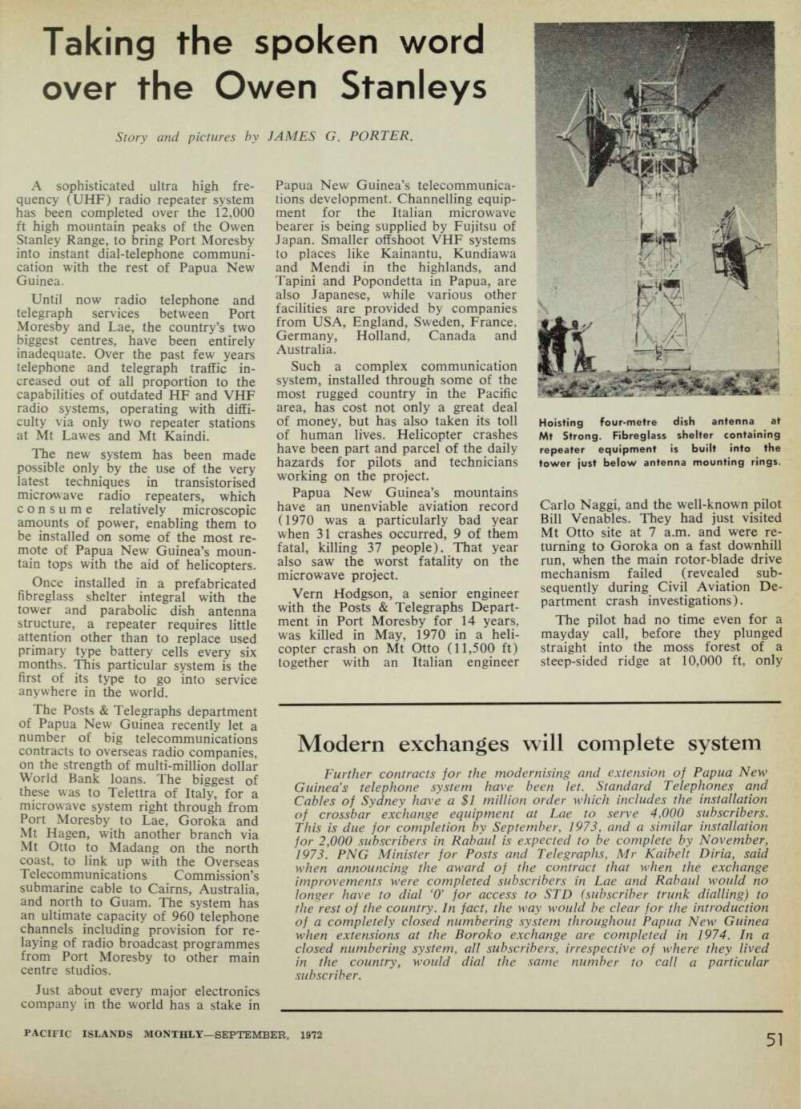

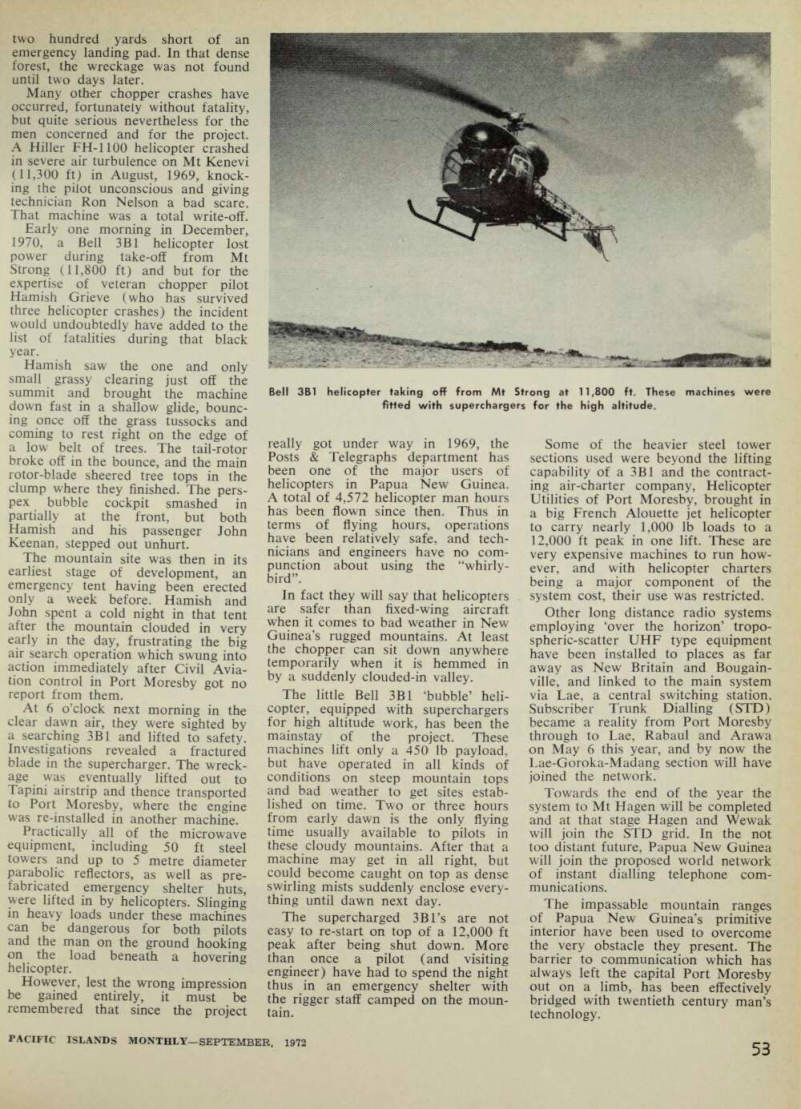
over the Owen Stanleys
Story and pictures by JAMES G. PORTER.
A sophisticated ultra high fre quency (UHF) radio repeater system has been completed over the 12,000 ft high mountain peaks of the Owen Stanley Range, to bring Port Moresby into instant dial-telephone communi cation with the rest of Papua New Guinea.
Until now radio telephone and telegraph services between Port Moresby and Lae, the country’s two biggest centres, have been entirely inadequate. Over the past few years telephone and telegraph traffic in creased out of all proportion to the capabilities of outdated HF and VHF radio systems, operating with diffi culty via only two repeater stations at Mt Lawes and Mt Kaindi.
The new system has been made possible only by the use of the very latest techniques in transistorised microwave radio repeaters, which consume relatively microscopic amounts of power, enabling them to be installed on some of the most re mote of Papua New Guinea’s moun tain tops with the aid of helicopters.
Once installed in a prefabricated fibreglass shelter integral with the tower and parabolic dish antenna structure, a repeater requires little attention other than to replace used primary type battery cells every six months. This particular system is the first of its type to go into service anywhere in the world.
The Posts & Telegraphs department of Papua New Guinea recently let a number of big telecommunications contracts to overseas radio companies, on the strength of multi-million dollar World Bank loans. The biggest of these was to Telettra of Italy, for a microwave system right through from Port Moresby to Lae, Goroka and Mt Hagen, with another branch via Mt Otto to Madang on the north coast, to link up with the Overseas Telecommunications Commission’s submarine cable to Cairns, Australia, and north to Guam. The system has an ultimate capacity of 960 telephone channels including provision for re laying of radio broadcast programmes from Port Moresby to other main centre studios.
Just about every major electronics company in the world has a stake in
Papua New Guinea’s telecommunica tions development. Channelling equip ment for the Italian microwave bearer is being supplied by Fujitsu of Japan, Smaller offshoot VHF systems to places like Kainantu, Kundiawa and Mendi in the highlands, and Tapini and Popondetta in Papua, are also Japanese, while various other facilities are provided by companies from USA, England, Sweden, France, Germany, Holland, Canada and Australia.
Such a complex communication system, installed through some of the most rugged country in the Pacific area, has cost not only a great deal of money, but has also taken its toll of human lives. Helicopter crashes have been part and parcel of the daily hazards for pilots and technicians working on the project.
Papua New Guinea’s mountains have an unenviable aviation record (1970 was a particularly bad year when 31 crashes occurred, 9 of them fatal, killing 37 people). That year also saw the worst fatality on the microwave project.
Vern Hodgson, a senior engineer with the Posts & Telegraphs Depart ment in Port Moresby for 14 years, was killed in May, 1970 in a heli copter crash on Mt Otto (11,500 ft) together with an Italian engineer
Carlo Naggi, and the well-known pilot Bill Venables. They had just visited Mt Otto site at 7 a.m. and were re turning to Goroka on a fast downhill run, when the main rotor-blade drive mechanism failed (revealed sub sequently during Civil Aviation De partment crash investigations).
The pilot had no time even for a mayday call, before they plunged straight into the moss forest of a steep-sided ridge at 10,000 ft, only
Hoisting four-metre dish antenna at Mt Strong. Fibreglass shelter containing repeater equipment is built into the tower just below antenna mounting rings.
two hundred yards short of an emergency landing pad. In that dense forest, the wreckage was not found until two days later.
Many other chopper crashes have occurred, fortunately without fatality, but quite serious nevertheless for the men concerned and for the project.
A Hiller FH-1100 helicopter crashed in severe air turbulence on Mt Kenevi (11,300 ft) in August, 1969, knock ing the pilot unconscious and giving technician Ron Nelson a bad scare.
That machine was a total write-off.
Early one morning in December, 1970, a Bell 381 helicopter lost power during take-off from Mt Strong (11,800 ft) and but for the expertise of veteran chopper pilot Hamish Grieve (who has survived three helicopter crashes) the incident would undoubtedly have added to the list of fatalities during that black year.
Hamish saw the one and only small grassy clearing just off the summit and brought the machine down fast in a shallow glide, bounc ing once off the grass tussocks and coming to rest right on the edge of a low belt of trees. The tail-rotor broke off in the bounce, and the main rotor-blade sheered tree tops in the clump where they finished. The pers pex bubble cockpit smashed in partially at the front, but both Hamish and his passenger John Keenan, stepped out unhurt.
The mountain site was then in its earliest stage of development, an emergency tent having been erected only a week before. Hamish and John spent a cold night in that tent after the mountain clouded in very early in the day, frustrating the big air search operation which swung into action immediately after Civil Avia tion control in Port Moresby got no report from them.
At 6 o’clock next morning in the clear dawn air, they were sighted by a searching 381 and lifted to safety.
Investigations revealed a fractured blade in the supercharger. The wreck age was eventually lifted out to Tapini airstrip and thence transported to Port Moresby, where the engine was re-installed in another machine.
Practically all of the microwave equipment, including 50 ft steel towers and up to 5 metre diameter parabolic reflectors, as well as pre fabricated emergency shelter huts, were lifted in by helicopters. Slinging in heavy loads under these machines can be dangerous for both pilots and the man on the ground hooking on the load beneath a hovering helicopter.
However, lest the wrong impression be gained entirely, it must be remembered that since the project
really got under way in 1969, the Posts & Telegraphs department has been one of the major users of helicopters in Papua New Guinea.
A total of 4,572 helicopter man hours has been flown since then. Thus in terms of flying hours, operations have been relatively safe, and tech nicians and engineers have no com punction about using the “whirly bird”.
In fact they will say that helicopters are safer than fixed-wing aircraft when it comes to bad weather in New Guinea’s rugged mountains. At least the chopper can sit down anywhere temporarily when it is hemmed in by a suddenly clouded-in valley.
The little Bell 381 ‘bubble’ heli copter, equipped with superchargers for high altitude work, has been the mainstay of the project. These machines lift only a 450 lb payload, but have operated in all kinds of conditions on steep mountain tops and bad weather to get sites estab lished on time. Two or three hours from early dawn is the only flying time usually available to pilots in these cloudy mountains. After that a machine may get in all right, but could become caught on top as dense swirling mists suddenly enclose every thing until dawn next day.
The supercharged 3Bl’s are not easy to re-start on top of a 12,000 ft peak after being shut down. More than once a pilot (and visiting engineer) have had to spend the night thus in an emergency shelter with the rigger staff camped on the moun tain.
Some of the heavier steel tower sections used were beyond the lifting capability of a 381 and the contract ing air-charter company, Helicopter Utilities of Port Moresby, brought in a big French Alouette jet helicopter to carry nearly 1,000 lb loads to a 12,000 ft peak in one lift. These are very expensive machines to run how ever, and with helicopter charters being a major component of the system cost, their use was restricted.
Other long distance radio systems employing ‘over the horizon’ tropo spheric-scatter UHF type equipment have been installed to places as far away as New Britain and Bougain ville, and linked to the main system via Lae, a central switching station.
Subscriber Trunk Dialling (STD) became a reality from Port Moresby through to Lae, Rabaul and Arawa on May 6 this year, and by now the Lae-Goroka-Madang section will have joined the network.
Towards the end of the year the system to Mt Hagen will be completed and at that stage Hagen and Wewak will join the STD grid. In the not too distant future, Papua New Guinea will join the proposed world network of instant dialling telephone com munications.
The impassable mountain ranges of Papua New Guinea’s primitive interior have been used to overcome the very obstacle they present. The barrier to communication which has always left the capital Port Moresby out on a limb, has been effectively bridged with twentieth century man’s technology.
Bell 381 helicopter taking off from Mt Strong at 11,800 ft. These machines were fitted with superchargers for the high altitude.
Modern exchanges will complete system
Further contracts for the modernising and extension of Papua New Guinea's telephone system have been let. Standard Telephones and Cables of Sydney have a $1 million order which includes the installation of crossbar exchange equipment at Lae to serve 4,000 subscribers.
This is due for completion by September, 1973, and a similar installation for 2,000 subscribers in Rabaul is expected to be complete by November, 1973. PNG Minister for Posts and Telegraphs, Mr Kaibelt Diria, said when announcing the award of the contract that when the exchange improvements were completed subscribers in Lae and Rabaul would no longer have to dial ‘O' for access to STD (subscriber trunk dialling) to the rest of the country. In fact, the way would be clear for the introduction of a completely closed numbering system throughout Papua New Guinea when extensions at the Boroko exchange are completed in 1974. In a closed numbering system, all subscribers, irrespective of where they lived in the country, would dial the same number to call a particular subscriber.
Advertisements & other items, pp. 58-61 (1 item)
Quadruple your listening pleasure
vith SANSUI 4-channel stereo
7 QS
*OlO U
100 m QS 500 SP 10 w
4-CHANNEL STEREO
ScutsttL
r ith Sansui’s QSP-10 Compact 4-Channel )nsolidator QS-100 4-Channel Rear Amplifier, ' QS-500 4-Channel Rear Amplifier, you can ijoy the incomparable richness and “presence” 4-channel stereo at minimum cost. The secret JS in a 4-channel synthesizer decoder that agically transforms 2-channel sources, such as cords, tapes, and FM broadcasts, into eathtaking “live sound field” concert-hall alism. QSP-10 combines this with a 20-watt ereo power amplifier and a set of highrformance 15-watt speaker systems. Hook it ) with your present hi-fi system and—presto— ►u’ve got a complete, compact 4-channel stereo stem that will quadruple your listening easure. QS-100 combines the 4-channel synthesizer decoder with a 50-watt power amplifier, while the QS-500 combines it with a 120-watt power amplifier. In either case all you need in addition to your present system is a second set of speaker systems.
If you’re building a new system from scratch, Sansui recommends its 210 A solid-state SW/MW tuner with stereo amplifier. It provides sensitive reception in both MW and SW bands, 36 watts of music power, and a wide 30 to 25,000 Hz power bandwidth, while limiting distortion to less than 1%. 3A-rr 5 J 210 A isui products are available through: VEE RADIO LTD. Teerad House 13, Midstone Street, Grey Lynn Auckland 2, New Zealand. Tel; 763064 / PRABHU BROTHERS LTD. P.O. Box 183, Nadi, Fiji islands : 70183 / SERVONNAT Rue des Polius, Tahitiens Pateete, Tahiti. Tel: 03-29 / OCEANIA INDENT AGENCY P.O. Box 5518, Boroko, Port Moresby, Papua & New nea. Tel: 56406 / PAUL MOW & CO. 9th St,, P.O. Box 449, Lae. Tel: 2954 / CHIN H. MEEN & SONS PL Tabari Place, P.O. Box 1106, Boroko. Tel: 56546/Kamarere :et, P.O. Box 224, Rabaul. Tel: 2462 / MICHAEL CHOW & Co. P/L Okari Street, P.O. Box 1106, Boroko. Tel: 56338 / SEETO KONG & SONS P/L Taurama Road, . Box 1218, Boroko. Tel: 56445 / PINGS (MT HAGEN P/L P.O. Box 165, Mt Hagen. Tel; 385 / BOUGAINVILLE COPPER Canteen, Panguna / PHOTOSONIC P.O. 519, Madang. Tel: 2503 / MICHEL MERCIER Angle Des Rues Alma-Sebastopol B.P. 1123 Noumea, Nouveue-Caledonia. Tel: 59-11 et 40-78 / SANSUI ELECTRIC LTD. 14-1, 2-chome, Izumi, Suginami-ku, Tokyo, Japan
t oiiiL* m till
Rowenta:
available in London, Paris,
Newark and Sydney.
And now in New Guinea,
Fiji, Noumea and Honiara.
Rowenta lighters are sold at fine shops throughout the world. They are now available in Australia and the South Pacific.
Craftsmen-styled lighters for men and women.
In silver, gold and leather for the pocket or handbag or for the table.
A Rowenta will cost you less than most quality lighters and you get a 12 months’ guarantee and many years of pleasure. Rowenta lighters are guaranteed and serviced by the Sunbeam Corporation in Australia and by Sunbeam in the South Pacific.
Rowenfa L 83.3203
WORLD TRADERS
IN THE PACIFIC
N • s r c»NEW •» M s H V %
SUVA
t t 'Mb er%o
MARKt:
it m % g)R -A
SYDNEY
j
27 SEP 1972
iA
NEW ZEALAND
AUCKLAND
The W. R. Carpenter Group has been a major trader between the Pacific Islands and the rest of the world for more than 55 years. As a grower, buyer and processor of island produce such as copra, coffee and cocoa beans, the Group has contributed to the economic progress of the area and of its peoples Associated companies of the Group in the Pacific Islands include:
PAPUA AND NEW GUINEA
W. R. Carpenter (T.P.N.G.) Limited.
Coconut Products Limited.
New Guinea Company Limited.
Boroko Motors Limited.
The Group is also a wholesaler and retailer and holds many
leading agencies, including
• NISSAN/DATSUN • FORD • DEWARS WHISKY
• ELECTROLUX • GORDON'S GIN
• EVINRUDE • VICTA
FIJI
W. R. Carpenter (South Pacific) Limited.
Carpenters (Fiji) Limited.
Morris Hedstrom Limited.
Millers Limited.
Island Industries Limited.
Suva Motors Limited.
W. R. CARPENTER & COMPANY LIMITED
68 PITT STREET
SYDNEY
CABLES:
"CAMOHE"
U.K. OFFICE:
22 PARK ST., CROYDON, CR9 3NP