From Battlefield To Ricefield
pp. 54-56 · Read in the full issue

From DENIS FISK in Honiara
Mechanised paddy rice farming is alive and recovering nicely on the Guadalcanal Plain. This unique Pacific project is at last proving itself viable after seven years of trying, despite pests which finally killed off dry-land rice farming last year as a commercial proposition, and the three cyclones which decimated the paddy crops from December last year until September this year. (In August, the Solomons Government lifted the duty of 2i cents/lb on Australia rice because local rice production had fallen so far).
But now parent company Guadal canal Plains Limited, and the rice project company subsidiary, GPL Agriculture Limited, are guardedly delighted at the yield in September of a good two tons to the acre, from land which is allowing 2\ to 3 crops a year with fertilisation. The Sep tember harvest was about 220 tons.
If they could be certain of getting the remainder of the wet weather harvesting equipment they need by injecting new capital into their now slim capital resources, most of that guardedness would disappear, they admit. It could be said that the com pany now resembles a child about to get its second teeth, a relatively pain less process in which mainly care is
needed to ensure they come through as expected.
Guadalcanal Plains Ltd is willing to offer up to 50 per cent of shares to get money for re-equipping, and to repay some of the capital to the parent after such a long period of non-earning. A public issue could be planned well into next year.
GPL had about 750 acres under paddy rice at the end of October. It was confident of increasing this to 1,500 acres by the end of 1973.
It has always been the aim of GPL to satisfy the entire Solomons demand for polished rice—about 3,500 to 4,000 tons yearly—and to leave a small surplus for export to other Pacific countries and Territories.
Small export quantities have already gone to Fiji, and Micronesia has enquired about taking some, Mr Carson said.
“As well as these, there are the other Pacific markets, including those closest to us—the Gilbert and Ellice, Papua New Guinea, and the New Hebrides—which we could send rice to, but we cannot imagine ever being able to produce enough to satisfy any one of the bigger markets such as Papua New Guinea, even if it weren’t already interested in growing its own rice,” he said.
“Mainly we regarded this sort o trading as an example of what tB Pacific countries must do in the own interest—trade among then selves, and not rely on one sourc Australia in this case, for supplies.
“In the Solomons, and in tB closer markets, GPL can beat Am tralian rice on price. This was r cognised by the Chairman of tB Australian Ricegrowers Co-operatr Society, Noel Hogan, who visite us this year. He was surprised at tB advances we had made and hope for his members’ sake we wouldr be too successful.
“Our mechanised methods are st; fairly unusual in the world becam of the scale we’re working on, an there’s a lot of interest in whi we’re doing.” Dr William Golde Jr, head of the Ford and RockefellJ rice project in Ceylon, was makii his second visit to the Solomons the end of November.
The “we” who are “doing” on tl former vegetable garden for Amei can troops during the Guadalcanr campaign are an Australian-!* miniature united nations, of mainr young people.
Keith Carson, general manager ai company secretary of Guadalcanr Plains Limited, is a 29-year-old fra Sydney. General manager of the rii project itself is Geoffrey Mitcha 32, raised on a wheat and shei: property near Gunnedah in Ne South Wales. Carson has a BachelJ of Commerce degree, while Mitchtj has tertiary qualifications in boc farm mechanics and managemei supplemented by an innate practia ability essential where services as often difficult or impossible to obtai; Francisco Gorrez, who contro the technical side of tropical rii growing, is a Filipino aged 40 fra the International Rice Researr Institute in the Philippines, where 1 worked for six years after complete a BSc in agriculture at the Unive sity of the Philippines.
Support comes from Australia David Hall, Irishman Anthony McGI lick, Dutchman Bernardus Vermee; Fijian Vilikesa Saronicava, an Solomon Islanders who are movii
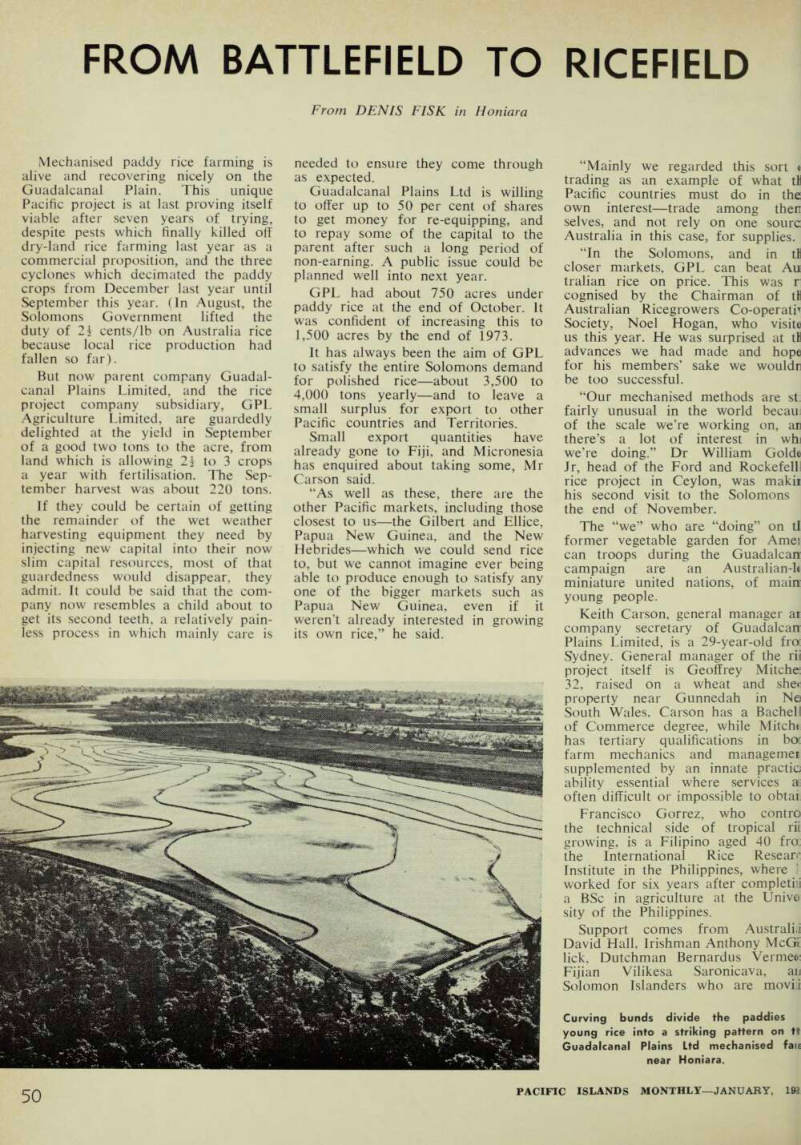
Curving bunds divide the paddies young rice into a striking pattern on to Guadalcanal Plains Ltd mechanised fa[?] near Honiara.
upwards in the work force while handling all harvesting and transport machinery and most of the workshop activity.
The irrigation project was relying on pump-fed water last year. The pump was installed at a cost of $20,000 on the Mbalasuna’s bank, to avoid diversion of the river for a gravity feed system preferred by the company. The government was advised at the time that diversion could cause problems on customary land lower down.
Two crops yielding 2J tons to the acre of rice were harvested amid triumphant cries in October-Nov ember, 1971. The cries were soon stilled by a cyclone which crushed the December crop and others planted to be harvested in months to come. In January, cyclone Carlotta brought flooding and swept away the expensive new pumping station while diverting the river into a course which suited the company’s original plan for gravity feed.
Now the irrigation channel is capable of carrying in excess of 100 cusecs (2,250,000 gallon an hour).
Flooding caused by any future cyclone should be prevented from reaching the paddies by a ready made diversion from the channel into another stream.
And the bonus of the gravity feed is that the weir to control it cost only $2,000 to build, while the former diesel fuel bill no longer exists.
Production is highly mechanised, with the Fletcher agricultural aircraft on permanent hire, three combine harvesters, three bulldozers, a 60 foot land-plane, and tractors, trucks and other equipment.
The company carries out all opera tions from preparation of the land right through to marketing of polished rice to stores, because the Solomons are so isolated from agricultural services.
Weeds are controlled by careful land preparation and good water con trol. Sometimes aerial application of chemicals is necessary. Control of rapid weed growth on the bunds is more of a problem, and a concern because of the harbour they give to pests.
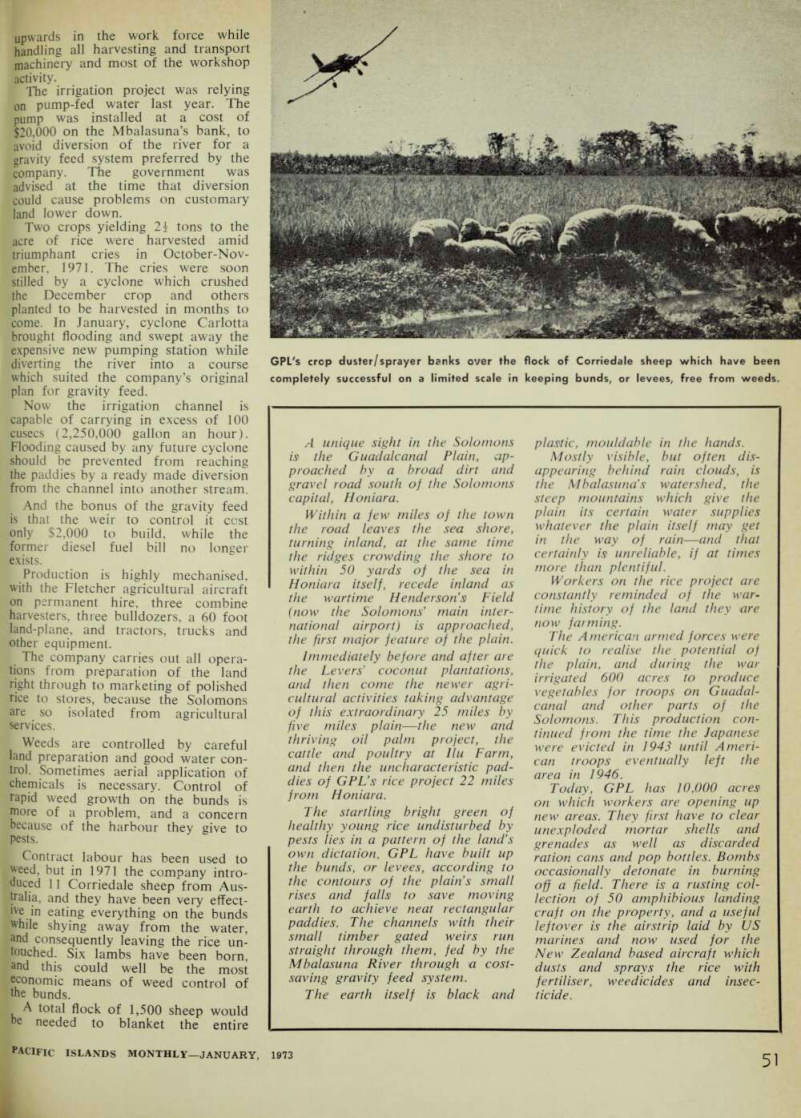
Contract labour has been used to weed, but in 1971 the company intro duced 11 Corriedale sheep from Aus tralia, and they have been very effect ive in eating everything on the bunds while shying away from the water, and consequently leaving the rice un touched. Six lambs have been born, and this could well be the most economic means of weed control of the bunds.
A total flock of 1,500 sheep would he needed to blanket the entire
A unique sight in the Solomons is the Guadalcanal Plain, approached by a broad dirt and gravel road south of the Solomons capital, Honiara.
Within a few miles of the town the road leaves the sea shore, turning inland, at the same time the ridges crowding the shore to within 50 yards of the sea in Honiara itself, recede inland as the wartime Hendersons Field (now the Solomons’ main international airport) is approached, the first major feature of the plain.
Immediately before and after are the Levers' coconut plantations, and then come the newer agricultural activities taking advantage of this extraordinary 25 miles by five miles plain-, he new and thriving oil palm project, the cattle and poultry atl Farm, and then the uncharacteristic paddies of GPL’s rice project 22 miles r . ’
The startling bright green of healthy young rice undisturbed by pests lies in a pattern of the land’s own dictation. GPL have built up the bunds, or levees, according to the contours of the plain’s small rises and falls to save moving earth to achieve neat rectangular paddies. The channels with their small timber gated weirs run straight through them, fed by the Mbalasuna River through a costsaving gravity feed system.
The earth itself is black and
plastic, mouldable in the hands, Mostly visible, but often dis appearing behind rain clouds, is the Mbalasuna’s watershed, the steep mountains which give the plain its certain water supplies whatever the plain itself may get in the way of rain—and that certainly is unreliable, if at times more than plentiful.
Workers on the rice project are constantly reminded of the war time history of the land they are now farming.
The American armed forces were ?«'<* !° realis f of ,he durm * . war 600 acres to produce vegetables for troops on c “'! al T °.'! ier P° r,s r °< " ,e Solomons. This product,on con lu were can • rot jojr: f
are £ K 1 , moon
Today, GPL has 10,000 acres on which workers are opening up new areas They first have to c i ear unex ploded mortar shells and grena des as well as discarded ration ccm s and pop bottles. Bombs occasionally detonate in burning o ff a fi etd There is a rus ting col iection of 50 amphibious landing cra f t on the property, and a useful leftover is the airstrip laid by US marines and now used for the New Zealand based aircraft which dusts and sprays the rice with fertiliser, weedicides and insec ticide.
GPL's crop duster/sprayer banks over the flock of Corriedale sheep which have been completely successful on a limited scale in keeping bunds, or levees, free from weeds.
Market Mutton As A Sideline
acreage planned for the end of 1973, and the company could market mutton as a sideline since sheep are found nowhere else in the Solomons these days, despite several efforts to raise them successfully since the 19205.
Meanwhile, sweet potato is being planted on some bunds as a very effective means of keeping weeds down.
Harvesting in wet weather has been and continues to be a problem, despite the harvesters’ rice tyres.
Whenever there has been plentiful rain, the 10 ton trucks cannot move across the paddies to where the harvesters are operating, and the harvesters have to take time out from their urgent job to trundle across to the transport.
To overcome this bogging problem, Geoff Mitchell said they were trying to get tracked trailers pulled by a tractor, and to convert a 20-ton field bin, used in the original dry-land farming, to tracks. Also being in vestigated were hover trailers, which
obviously would be able to operaU in any conditions.
Three rice varieties are grown— IRS, 1R22, IR66l—all developed a the International Rice Researc Institute in the Philippines.
IRS, the well publicised “miracll rice”, has become a minor variety a GPL because of local tastes whici demand a rice that is sticky when i is cooked. The truly Asian type, 1R22 long grain and sticky if wanted, i the major one produced now.
Coming up is 1R661 which wa developed for GPL by the institut] after samples of Australian rice wer: sent for study, since Australian ric: has been preferred by Solomoi Islanders because of its stickiness whe: cooked. Its introduction was delays by cyclone Carlotta which wiped i out but for 16 bags saved for seed and it was being harvested for thi first time in September.
Another possibility is a new variety E 666, sent to GPL for testing. Ii its test paddy, next to other varieties it had held up as virtually pest free despite the fact that other varietie: have been badly affected right along side it. The only help it has had hat been nitrogen feeding, and it wat showing beautifully even green, afte: 50 days growth. It could break down but it was very promising, if only ex perimental so far, Geoff Mitchel said.
“I think we have proved tha rice growing is practicable in thi Solomons, and the Pacific for tha matter, having survived the wors imaginable year”, Keith Carson said “We’ve still had some reasonable] yields from the paddy rice, despitJ cyclones and lack of the most suit able machinery. We now can’t se< how we can fail with all we know..
Geoff Mitchell is even talking oc possibly returning to dry land rice farming, which had become a dirt;; word at GPL after six years oc trouble. But a pest free variety like E 666 could give the entree back intc it, and a more profitable means a production.
Paddy rice growing always was thi more expensive alternative, although satisfactory if all goes reasonably well. But its need for more specialises machinery in harvesting does maka the prospect of dry land farminr still attractive, even if Keith Carson shrinks visibly from the suggestion of his manager. © Despite a fail in the price cn rice, the retail price index producer by the Government Statistician showed an overall one point rise i;i the BSIP cost of living during the third quarter last year. Local stapll item, sweet potato and imports wen both up.