Yesterday
p. 71 · Read in the full issue
A funny story in PIM, January 1953, which had been in circulation in the Grand Pacific Hotel in Suva said that "Jim" Borron and his wife had just returned from a visit to the US and Britain. In New York he called on a broker, on the 4th floor of a 45 storey building; and he told the American that he had a plantation—a "copra" farm, he called it—on Mago Island, in the Lau Group. The interested broker asked how he kept his stock under control— what kind of fences did he use.
James said he had no fences—Mago was a self-contained island. "Well, that
must be very handy," said the American.
"But, tell me, how do you breed the things?" "What things?" asked James, puzzled. "These cobras," said the American.
"Guess you must have one of the biggest snake farms in the world."
It took some sorting out, but the explanation is simple enough. "Jim"
Borron was of the old school of Pacific planters, who still pronounced the word "copra" as if the p were a b.
PIM received a letter from Rev Father A. McDonald, SM, the only European resident in the Tokelaus—those three small atolls lying north of Samoa — reporting the events of 1952 while waiting in expectation of a ship from Apia in October. He said the Tokelaus had been the "Isles of Isolation" with a vengeance that year. "We've had only one boat and one plane since December, 1951. The last mail was in May—the next in early October—if we're lucky! The reason—a bad year for coconuts due to drought. Thank God, there has been enough for food, but the surplus for export has been very little. Usually we export about 2,400 sacks of copra—this year we've shipped 300. Needless to say, it's been a hard year for the people." The water ration per person per day was about two quarts for all purposes—hardly enough for drinking— and some of that small ration was being used for bathing the babies.
Private Jone Ruwei, 22, of the Fiji Infantry Regiment serving against the terrorists in Malaya was killed in an enemy ambush on December 16, 21 years ago. He was the first battle casualty of the FMF in Malaya.
PIM reported 20 years ago the list of graduates and special prize-winners,
issued at the end of that year by the Central Medical School, Suva, Fiji, were from "the American contingent"— students from the American Trust Territory of Micronesia, which decided, only two years before to support the Suva institution. The other was the issue of diplomas to two of the six young men sent to the school four years before from Papua New Guinea.
One of the successful students was Reuben Taureka, now PNG's Minister for Health. Education in PNG was not then of a high enough standard to provide a wide choice of Papua New Guinea lads for the Suva School, and a system of training selected young men for medical service was being developed within Papua New Guinea itself. It's moved ahead since then.
A hurricane had struck Nissan—a small island about 100 miles east of New Ireland and 80 miles from Buka, in the first week of December, 1952.
The excessive damage was done to houses and gardens but there was no loss of life. Nissan's population was about
1,500, and there was a Catholic Mission Station there. All the roads on the island were blocked by fallen trees, and apart from wind damage many gardens were ruined by salt spray. A government trawler and a mission vessel had set out for Nissan with relief stores and staff.
In Auckland, December 22, 1952, Leonard Alafurai, of the Melanesian Mission, was ordained a deacon of the church. He was a native of Malaita and the first Melanesian to be ordained since 1872, and the second in the history of the Mission. Alafurai went to New Zealand four years before that, going first to Te Aute Maori boys college in Hawke's Bay, and later to St John's College, Auckland. Before retiring to Melanesia he created another precedent by becoming the first Melanesian to serve as a curate in an Anglican Church in New Zealand—St Mark's of Auckland.
The Rt Rev L. Alafurai is now assistant bishop at Auki, BSIP.
Tasman Empire Airways (old name of Air New Zealand), in its first year operating the Coral Route to Tahiti in 1952, carried 250 American passengers who brought SNZ3O,OOO. The company anticipated that the current advertising drive, backed by Tahiti film publicity, would reap more dividends.
On December 14, 1952, the 35 ft workboat Calais, which had been missing since November 9, while en route from Rabaul to New Ireland, was sighted and taken in tow by the coastal ship Morova, which was proceeding from Karkar Island to Madang. Four native women and two native men were on board. Another woman had died and had been buried on a small atoll in the Bismarck Sea. The survivors had kept alive by eating copra, which they were carrying in the vessel, and by catching rain water.
In Madang they were admitted to the Native Hospital suffering from exposure and malnutrition. The native skipper, Medili, had become ill at the Duke of York Islands, and went ashore leaving the vessel in charge of the engine boy.
Later, the ship broke down in the St George Channel, and a native rowed ashore for spare parts; on his return the ship was not in sight. In the ensuing five weeks the Calais drifted 400 miles.
The boat was owned by Mr Martin Chan of Rabaul.
Apakuki Tuitavua, captain of the Fijian Rugby Union team which toured New South Wales and Queensland in July-August, 1952, returned to Fiji in December. When the rest of the team returned to Suva, Apakuki remained in Sydney to study meat inspection methods. Today he holds a major post in the Agriculture Department in Fiji dealing with animal inspection.
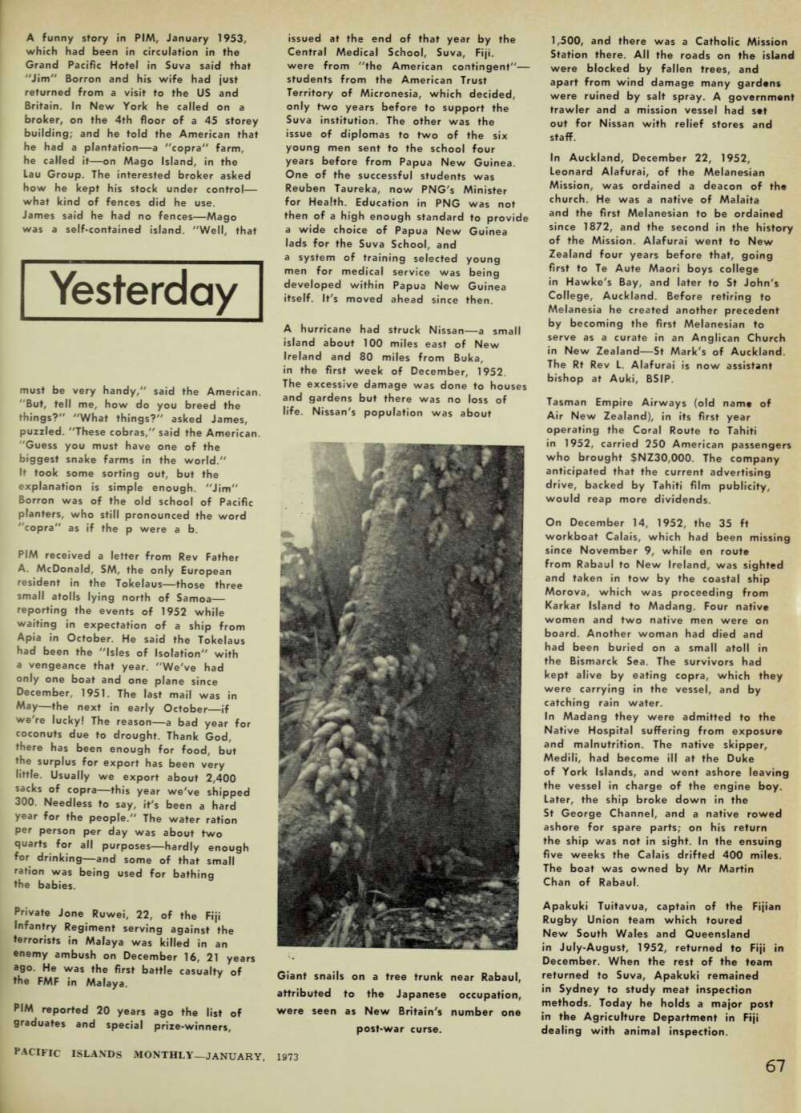
Giant snails on a tree trunk near Rabaul, attributed to the Japanese occupation, were seen as New Britain's number one post-war curse.