"Freedom-Whatever The Cost"
pp. 41-43 · Read in the full issue
Say The Ellis Islanders
From JOHN CARTER in Tarawa
Separation, federation, or as you were. These are the alternatives which have been put to the 7,000 Ellice Islanders who want to go it alone instead of as partners — unequal partners they say—in a self-governing or even an independent state with the 40,000-odd Gilbertese. The Ellice Islanders fear domination in any partnership.
The Gilbert and Ellice Islands have been a colony since 1915 and before that, in 1892, were made a protec torate.
Mr Anthony Kershaw, Parliament ary Under-Secretary for Common wealth and Foreign Affairs, heard all about it from the Islanders’ own mouths when he visited the colony in October (PIM, Nov p 9) and Britain is now studying the position.
He passed no opinions. They had already been told the pros and cons by the Governor, Sir John Field. For instance, as a separate state the Ellice would need $1 million for annual running costs. Sir John based his figures on such places as the Cay man Islands, Turks and Caicos Islands and St Helena of Napoleon Bonaparte fame. Revenue at present rates of taxation would amount to about $200,000 a year, leaving $800,000 to be raised.
“To raise this sum,” the islanders heard, “an Ellice government would have to impose additional taxation amounting to about $230 a year on each adult Ellice man and woman, which is obviously more than the average man and woman could afford to pay.” Again, $700,000 would have to be found at the outset to build housing and office accommodation for the staff and a ship would have to be found to service the islands in the group—another $120,000. Which means a total of at least $800,000 to be found before the state of Ellice can be set up as a going concern.
“The inescapable conclusion is that a separate Ellice government would not be viable and could only be set up, and thereafter continue to exist, with the help of massive aid,” was “ r John’s verdict on the go-it-alone n} an ’ . can t>e no guarantee mat aid on the scale required would
he forthcoming.”
On the debit side, the effect of separation on the Gilbertese, although not as great as on the Ellice people, would be far-reaching and far from
beneficial. They would be a smaller political unit; the recurrent cost of running a government for the Gilberts alone is not likely to be appreciably less than at present and about $lOO,OOO would be lost in revenue— a frightening thought for the not-far off days when phosphate revenue ceases.
Sir John also pointed out that the Gilberts would be short of some serving experienced Ellice civil ser vants and they would also lose the benefit of any fishing industry that might be established in the Ellice.
Small-scale industries might not be viable if a sixth of the internal mar ket was lost to them.
So, there wasn’t anything good to say for separation for either group.
What about federation? That was a possibility, said the Governor, with the Gilberts and the Ellice each form ing a state with its own government and a joint Gilbertese-Ellice govern ment responsible for central affairs previously agreed between the two.
Sir John wouldn’t hazard a guess at the cost of such a federal government but it “would be substantially more expensive than a single government for the whole country since there would be three governments to run instead of one”. For one thing, he pointed out, there would be more civil servants with more office and living accommodation.
“On the other hand,” he said, “a federal form of government might have certain political advantages. The virtue of a federal system is that, where there are differences of interest
and outlook between one part of a country and another, it leaves to local, ie, state, control, those affairs which most closely touch the people in their day-to-day lives, thus permitting variation between one part of the country and another, while broader issues are left to central control thus ensuring uniformity in those matters which affect all the people equally and as a whole. It is a system that enables unity to be maintained while recognising that a certain degree of diversity is necessary.”
Then there was a variation on the theme—a regional system, with dif ferent parts of a country having limited rights to regulate certain local affairs, without creating separate states. The cost would be less than the federal system.
But to go on as at present, with a unitary form of government, was what Sir John really plumped for.
"There may be political advantages in looser ties between the Gilberts and the Ellice than those at present but there can be no real doubt that, at any rate, for the foreseeable future, the greater economic advantage lies in both groups remaining together under a single government. It is eco nomics which, in the last resort, pro vide the people of a country with the things they want—better education, better medical services, better com munications, in fact a better standard of living.”
But the Ellice Islanders weren't plumping for it. After they had heard all the arguments, they stuck to their guns. They were reluctant to remain as part of the GEIC but thought that was better than nothing provided the colony didn’t become self-governing, and that’s a foregone conclusion.
The Ellice representatives had their say to the Governor before Mr Ker shaw arrived. Telavi Fati, of Nanu mea pleaded for help from Britain to launch projects like fishing, tourism the sale of handicrafts and postage stamps, and asked for the transfer to the Ellice of the Phoenix Group or some of the Line islands.
“The steady changes in the gov ernment setup and the policies do not favour the Ellices in the long run, so we have to decide for our own future freedom as a separate colony under Britain at whatever cost,” said Telavi.
Pie Palako, of Nanumanga, com-
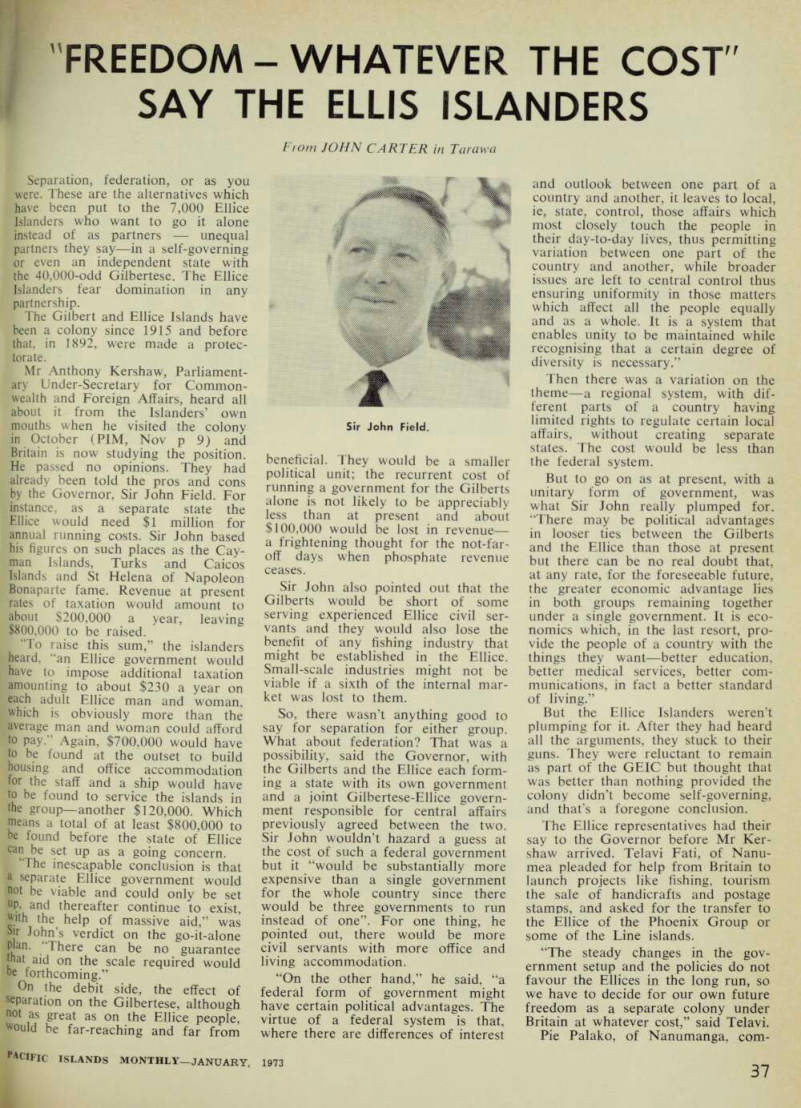
Sir John Field.
A Plate Of Food For Each
plained that the Ellice people never got a chance to work as labourers in the Phoenix or Line Islands and the argument used by Benjamin Kofe, the member for Funafuti, was that they were a separate people, “much different in many ways from the Gil bertese.” He was also not satisfied with the system of sharing out the colony’s representation in the Legis lative Council and the Executive Council and jobs in the civil service, although all these are apportioned according to population—seven Gil bertese to one Ellice Islander. Benja min thought that the job should go to the most reliable man and the best student. He obviously thought one Ellice islander was worth seven Gilbertese.
Language was seen as the obstacle to union by Maheli Naniseni, also of Nanumea. The Ellice language was rarely used, he said, even in schools, churches and on the radio and, if that continued their language would be lost for ever.
Another representative, Tapu, put their case to the Governor this way; “When a father gives a plate of food to his two sons, we do know that the two won’t eat peacefully, for one son would like to have more than the other. From that we can see the difference in behaviour. What must the father do? Each should have a plate of food so that each of them will be pleased and happy,”
At the close of the October meet ing with Mr Kershaw, Telavi Fati summed up the feelings of the Ellice people with a lengthy statement in which he stressed the threat which continued union with the Gilbertese posed for the existence of the Ellice language and culture. Despite their wish to maintain their relationship with Polynesian stock everywhere, they would never forget their much closer ties with the Gilberts. How ever, in the long run they wished for freedom and happiness in accordance with their own customs and culture.
Where do the Gilbertese stand in all this? Reuben Uatioa, Leader of Government Business and, almost certainly, the country’s first Prime Minister, summed up the Gilbertese position to me as, “We would like to continue with the Ellice but under Ibis present system and constitution.
They don’t want to change, so it is either both under the existing type of unitary state, or separation.”
Both sides have bent over back wards to prevent any ill-feeling arising. The actual negotiations, the speeches in the Legislative Council when the Ellice members introduced
a motion calling for separation, and the meeting with Mr Kershaw have received no publicity at all in the colony’s weekly newspaper, the Atoll Pioneer or on the radio.
Both Mr Uatioa and Mr Sione Kleis, one of the Ellice leaders, told me that they had avoided publicity to keep it out of the public arena.
Open discussion in the street or bars could create arguments and bad feel ing and, so far, all that had been
avoided. There is no ill feeling at all between the two peoples and both sides, if separation came, wanted to retain their close ties, The motion which was put to the Legislative Council called for separa tion of the two territories by 1974.
It was pointed out that Britain was responsible for the fusion of the two territories into one when it created the protectorate in 1892. Therefore, it was Britain’s problem and not one for the Legislative Council, so the motion was withdrawn. The decision now rests with Britain.