diary
pp. 35-37 · Read in the full issue

New Caledonia diary
. , . with Helen Rousseau, who after 10 years in the Pacific, from Tokyo and Kyoto to Noumea, has returned with her family to Sydney.
The brisk tempo of an expand ing Noumea is catching up with the Caledonians these days, and rapidly changing their older pat terns of living.
Now that workers drive to Noumea each day from half an hour away in Dumbea, Paita or Mont Dore, there is less chance to return home for a leisurely midday lunch and siesta. So the almost sacred ritual of family eat ing is being sacrificed in favour of la civilisation moderne. This is not to say that Caledonians are reduced to a city milkshake and bite of sandwich for lunch—sand wich bread is even something of a luxury for the French. But snack bars and cafeteria-style eating are becoming more accepted.
This should be a help for over seas visitors to Noumea, since many foreigners are disinclined to spend either the time or the money required for a gastronomical French meal in outer bayside suburbs.
When all the rest of the city closes down from 11 am to 1.30 or 2 pm, visitors may enjoy a variety of midday meals in the growing business community around the new central post office ie in the Quatier Latin-Baie de la Moselle area. Closer to the cruise ship wharves, a snack bar has now opened on the main street, Rue de I’Alma, near the Avenue Foch corner. Here “Le Bearno” serves a hot dish for about 5A1.70.
Visitors should note the large document prominently displayed just inside the front door: this is a lengthy reminder of the French “Law for the Suppression of Public Drunkenness” . . .
One block away, on the Rue Georges Clemenceau, the “Kings Cross” tearoom continues its popular light luncheons, while at the top of the Rue de Verdun,
beyond the Australian Consulate office, the first cafeteria-cum-coffee shop has opened. You can pay almost 80 cents Aust for an ice cream, but with it comes a balcony view of St Joseph’s Roman Catho lic Cathedral, some quaint old colonial houses and the passing parade of all-Noumea, speeding be low in the latest European auto mobiles and “baby-car” buses.
All this, as the neon sign boldly proclaims, at “Le Drop” (no con nection with la bombe).
The more the metropolitan French move out to Noumea, the more English words seem to be come fashionable. So around the corner, Caledonians may buy gifts at “Gentleman”, while fashion goods are offered at “O’Clock”, "Bus-Stop”, “Mylord’ and “New Look”. Out in the bayside suburbs, “Le Sydney Snack” is near the Baie des Citrons beach, while those willing to make the climb can wine and dine high above Orphelinat Bay at the “Town Top”.
None of this is intended to sug gest an Anglo-Saxon takeover of the island; all these English names are pronounced with the best French accents. In fact, anything more Anglo-Saxon than an odd printed word is likely to raise strong suspicions over coming months, as the French steel them selves against the fresh burst of anti-French feeling being aroused in view of this year’s planned nuclear tests in the Pacific.
Despite the outward appearance of defiance and nonchalance, sensi tive French pride is being severely pricked on the bomb protest issue.
Under the present Paris regime, anything critical of the authorities in power is regarded as “anti- French” ie highly subversive, whether the criticism comes from Caledonians or outsiders.
The recent election victories of the Labour parties in the Austra lian and New Zealand national parliaments were noted by the
Noumea press, together with the Australian Labour Party’s threat to break off diplomatic relations with France over the tests. Previously, only a week before the New Zealand elections, the nickel com pany press in Noumea hastened to reassure the Caledonians that they had little reason to fear any unpleasant boycotting action from New Zealand workers this year, since the dominion’s retiring (later defeated) prime minister was to introduce legislation to ban “politi cal” strikes by unionists.
By election day, the same paper obviously had second thoughts, and in a front page editorial dip lomatically recommended the ob servance of “politeness among nations” together with expressing the hope that French embassies in the region would succeed in putting across reassuring propaganda on the tests problem.
Some of the bomb issue even backwashed onto the poor old South Pacific Commission. In a recent assessment of this regional body, the daily “Les Nouvelles”, which frequently reflects official French government thinking, said: . . The work of the SPC results mainly in meetings, con ferences and seminars etc, meet ings which end in “recommenda tions” or “conclusions” lacking in originality . . . and only providing masses of roneoed documents . . .
“Moreover, it must be recog nised that the French territories of the Pacific (Tahiti, New Cale donia) are the most developed.
They are 20 years ahead of the other South Pacific territories, whether they be independent or under mandate. Most of the prob lems they face have already been solved in the French territories long ago, by metropolitan France alone, without the help of SPC.
“Although there is no advantage for France, she continues to con tribute about 5A150,000 (an nually) to the SPC. So on top of that, it is important that this money should not be used against
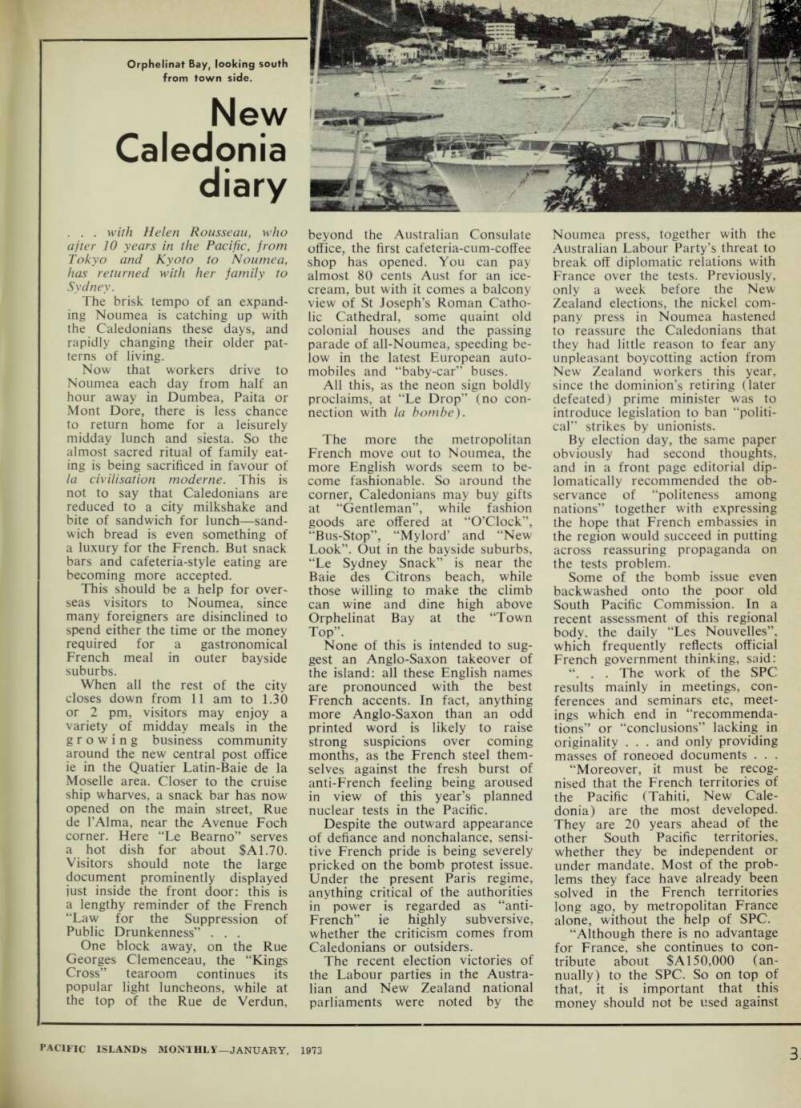
Orphelinat Bay, looking south from town side.
France, to spread the abusive cam- Smith Pacific- oreatlv bothers Fiii bourn Pacmc greatly bothers riji for example, as well as Australia and New Zealand in (their) bid fnr snnremarv in the Sm.th tor supremacy in the ioutn Pacific. Suva, guided by Auckland and Sydney, would like to become the capital of the South Pacific”.
As Caledonians themselves are the first to admit, life is changing fast from the old days. The massive influx of metropolitan French, attracted by promised nickel developments, has brought extensive changes, being superimposed on old Caledonian habits. The culture shock has been felt on both sides, together with greater competition for jobs, during the current recession, between the locals and the metros (“invaders”, “zozos” or simple “strangers” as they are
referred to). Some of the islanders’ hostile reaction is highlighted in an advertisement published regul larly by the oldest bank in Noumea, which now entices local clientele with the reassuring words, “Each day, from north to south, in every branch of the Banque d’lndo Chine, a Caledonian re plies to a Caledonian”. That is, there are Caledonians on both sides of the counter when you do business.
For the Caledonians, despite all their recent prosperity, seem to feel they have lost something, as Paris takes a keener interest in
controlling the island’s develop
ment. Gone is the spirit of the old days, when an island man like the late Edouard Pentecost could carve out a whole business empire for himself in the true pioneering style. Caledonians now seem to feel that their days of unlimited possibilities are ended, that it is the national French Plan which must be respected above all. The
plan calls for the island’s indus trialisation, “and only big French companies can do it”, they have been told.
Some of the local nickel tycoons are facing it philosophically; after all, life has been very generous to them and all good times must come to an end. Others, particu larly younger men, cannot easily bear to be thwarted in their am bition. As the power of Paris public servants and big business increase, these Caledonians are looking to more distant horizons, not only to develop their pocket books, but to secure a more ex pansive atmosphere, a happier ambiance for their children.
Thus, many Caledonians, who are after all children of the Pacific, are developing more business and social interests among their Aus tralian and New Zealand neigh bours, while Noumea’s short-term settlers from France keep their thoughts turned to a more distant home, in Europe.