Footnotes
pp. 31-33 · Read in the full issue
IN November, 1872, the first LMS missionaries 1 arrived in what is now the Papua Region of Papua New Guinea, declaring, it is said, “We have come in peace”.
In November, 1972, the Minister for Agri culture, Stock and Fisheries in PNG’s National Coalition Government, excusing himself in a radio interview for an alleged lapse from minis terial dignity, declared, “Everybody gets drunk”.
In the century which has passed between these two declarations, Papuans and New Guineans have been busily engaged in abandoning the worst of their own bad habits and adopting the worst of ours.
Those first missionaries, however, were not white men from the west but brown men from the east —Melanesians from the Loyalty Islands and Polynesians from the Cook Islands.
In the November and December issues of PIM, Marjorie Crocombe has given us a fascinating
picture of the celebrated Ruatoka, whose portrait appears on a recent PNG stamp, and his Cook Islands colleagues. One suspects that her study has been a labour of love as well as a painstaking piece of research. It is much to be hoped that someone will give us an equally sympathetic study of the Loyalty Islands pioneers in the Torres Strait islands and western Papua.
There is one point, however, at
which Marjorie Crocombe’s interpreters have not served her well. The people of Manumanu are reported to have said of Ruatoka and his col leagues, “They are gods who have come down from Tauru, the spirit world”.
Back-translating into Motu, it is a fairly safe guess that what they actually said was, Idia na dirava, Tauru amo vada e diho.
But Tauru was not “up there”; it was “out there” over the western horizon. In fact, pri marily, the word simply meant the horizon; its secondary meaning was the abode of the spirits of the dead which lay beyond that horizon.
It is true that diho can mean “down”. But it can also mean motion from seaward to landward, and clearly that is the meaning here.
With Percy Chatterton
in Port Moresby
The Worst Of
Then For The
Worst Of Now
Finally dirava, in 1872, meant “the spirits of the dead” (as distinct from lauma, the spirits of the living)—and nothing else. It was W. G.
Lawes, the first white missionary to British New Guinea, who, arriving two years later in 1874, adopted the word Dirava to mean the God of the Christians and their Hebrew forerunners, and dirava to denote the pagan gods who intrude from time to time into the Bible story.
This piece of linguistic hijacking was so suc
cessful that later generations of Motu have tended to keep Dirava for “God”, and to use Lauma to denote the spirits of the dead as well as those of the living—a usage which their ancestors would probably have regarded with horror.
If, therefore, the people of Manumanu did indeed use the phrase I have suggested they used, what they meant by it was, “They are the spirits of the dead,
who have come across the ocean from Tauru, their home beyond the horizon”.
In the same way, the phrase translated “the people of God”, an expression completely ana chronistic for 1872, was probably mase taudia diravadia, that is, “the spirits of dead people”.
Come to think of it, what is more natural than that the people of Manumanu should come to this conclusion. Here were brown skinned people not unlike themselves in appearance who had appeared from the direction of Tauru, and who spoke a strange language which was nevertheless interlarded with occasional Motu words, showing that these dirava had not completely forgotten their mother tongue during their sojourn in Tauru. Who else could they be? (over)
When the Minister for Agriculture, Stock and Fisheries said, “Everybody gets drunk”, his words, of course, were not strictly accurate. I don’t get drunk. Tens of thousands, probably hundreds of thousands, of Mr Okuk’s com patriots can’t afford to get drunk. And at least one of Mr Okuk’s fellow parliamentarians has decided not to get drunk. He is Mr Toni Ila, member for Lae. A non-drinker at the time of his election to the House, he has given it a go, but has now decided to give it away, and has taken a pledge of total abstinence.
It is a pity that an aura of alcohol surrounds our legislature. “I hope he doesn’t win”, said the wife of one candidate to me at election time.
“Why?”, I asked in surprise. “He drinks too much as it is”, she said tersely.
The demand of some MHAs for drinking facilities within the precincts of the House, though resisted so far by the Chief Minister, can only serve to imprint more deeply on the minds of the voters an image of our legislators as a hard-drinking bunch of guys.
It is now a year since the Commission of Inquiry into Alcoholic Drink, the membership of which, apart from its chairman, Mr Justice Clarkson, was entirely indigenous, turned in its report. It made a number of sensible suggestions for dealing with the problem of excessive drink ing. The government’s failure to date to bring down legislation to implement these suggestions re-enforces the impression that our parliament does not regard the promotion of sobriety as having a very high priority.
When, not long ago, a group of young High landers formed the “Highlands Liberation Front” many of us wondered what the Highlanders wanted to be liberated from. It soon became evident that they wanted to be liberated from
domination by the people of the coast. They may rest assured that the feeling is mutual, and that the people of the coast are equally concerned about the possibility that in the long run it is they who will be dominated by the Highlanders.
But now a spokesman for the “Front” has declared that this is not the only kind of libera tion it wants. It also wants liberating from centralism and individualism. It calls for regional autonomy and communalistic development.
Its programme for regional autonomy is far reaching. If it doesn’t want the Public Service structure regionalised, it at least wants public servants to work in their own regions. It wants taxes to be spent in the regions in which they are raised. It even wants the country’s armed forces (and presumably the police, though this force is not specifically mentioned in the statement I have seen) regionalised.
This may seem to be going rather far, and one envisages each region having its own mini-army, poised to resist aggression by other regions. I think that the “Front” will have to think out a better solution to the problem of the Army than that. But at least its proposal is not more devilish than that of those Australian academics who en visage the PIR being used to massacre separatists.
And if the UN can’t make up its mind which are the terrorists and which are the heroes of the re sistance, and apparently it can’t, we can hardly expect our own Highlanders to have the answer.
Leaving the details aside, I can only applaud the “Front’s” programme of regional autonomy and communalistic development. And if the Highlanders can use the weight of their numbers to achieve these aims, I believe that many coastal people will rise up and call them blessed.
Little did I think that I would ever find myself
agreeing with Highlanders!
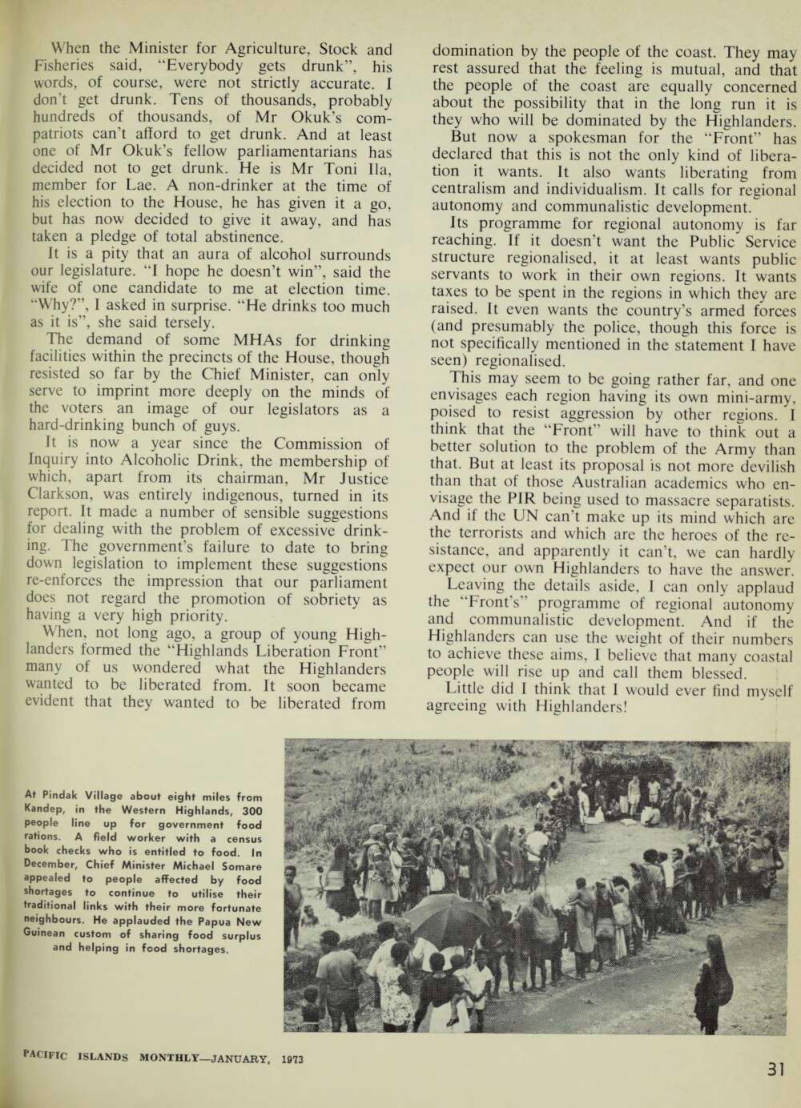
At Pindak Village about eight miles from Kandep, in the Western Highlands, 300 people line up for government food rations. A field worker with a census book checks who is entitled to food. In December, Chief Minister Michael Somare appealed to people affected by food shortages to continue to utilise their traditional links with their more fortunate neighbours. He applauded the Papua New Guinean custom of sharing food surplus and helping in food shortages.