The gentlemanly touch
pp. 27-29 · Read in the full issue
in PNG'S politics
From Percy Chatterton, In
Port Moresby
Last month I suggested that the kind of opposition most likely to commend itself to Paguineans would be an urbane one. This view was confirmed during the November meeting of the House of Assembly when the Opposition moved to cen sure the Minister of Agriculture, Stock and Fisheries, lambakey Okuk, for what it alleged had been his unseemly behaviour in a Port Moresby restaurant.
No one seemed to have his heart in the exercise, and after 40 minutes of desultory debate the government applied the gag. The Opposition did not call a division; the closure was agreed to and the motion defeated on the voices. Evidently this kind of political in-fighting just doesn’t go down in Papua New Guinea.
The result of the Kairuku-Hiri by election could be another straw blown by the same breeze. Ron Slaughter, well-known Kairuku busi nessman, won the seat in the general election, but by such a small margin that his Papuan runner-up was able to challenge the result on the plea that the contents of several ballot boxes lost in a river-crossing mishap could have affected the result.
The Court of Disputed Returns
ordered a new election, which Mr Slaughter has now won with a lead of more than 1,000 votes over the same runner-up he so narrowly de feated last March. 1 think that the most likely explanation of this land slide victory is that the voters were embarrassed by the course of events and felt that they must do the right thing by Mr Slaughter so that he should not suffer loss of face.
Papuans are very polite people.
The meeting was a brief one—lo sitting days spread over 2± weeks.
But in that time some very important business was dealt with.
First, there was Father John Momis’ motion, setting out, in a 13-point policy statement, guidelines for future mineral exploitation in Papua New Guinea. The most con troversial clause in the motion, that concerning re-negotiation of agree ments, was first withdrawn by Fr Momis and then put back in a modi fied form by Mines Minister Paul Lapun. In its final form the motion was passed on the voices, with not more than a handful of dissentients.
The effect of the motion on the eco nomic development of the country remains to be seen.
The Bougainville Agreement is not directly or immediately affected by the Momis motion. But Chief Minister Somare has made it clear that while future mining agreements will be honoured, his government does not regard the colonially-negotiated Bougainville Agreement as sacro sanct.
Opposition Leader Matthias Toli man, in what is possibly his party’s first constructive contribution to gov ernment since it found itself in oppo sition, has suggested that the govern ment should retain the services of overseas consultants tj study and advise on the agreement.
After the Momis declaration, the most important act of this meeting of the House has undoubtedly been the passage of a bill providing for the setting up of village courts, authorised to deal with certain minor offences and disputes. The fact is that village “courts” have been operating outside the official legal system during the greater part of the colonial period.
This move to regularise and control them and to bring them within the official system is long overdue.
An amendment to the Local Gov ernment Ordinance has removed the requirement that council rules (ie by laws) must be passed by a three quarter majority to be valid. This will save some councils, among them the Port Moresby City Council, from the frustration of having revenue-raising plans blocked by a small but deter mined minority.
The Gazelle Peninsula Bill, the gov ernment's attempt to bring peace to Tolailand, has been deferred till next year in the face of determined opposi tion from those members who regard the measure as a sell-out of the law abiding to the lawless.
It is certainly an odd piece of legislation, designed as it is to give official recognition to the unofficial “councils” set up by opposing fac tions, and to give them certain powers, including the power to levy taxes, but only over their registered members. It is difficult to see how such an arrangement could work satisfactorily except as a very tem porary measure.
On the self-government front the transferral of a further substantial block of powers from Canberra to Port Moresby has been approved by the House, though not without some protest from the go-slow brigade.
Finally yet another attempt, the third, to repeal the notorious Gaming (Playing Cards) Ordinance, which makes playing cards an illegal im port, has failed. It was defeated on a division, in a little more than half filled House, by 34 votes to 24.
Nevertheless, a recent court ruling
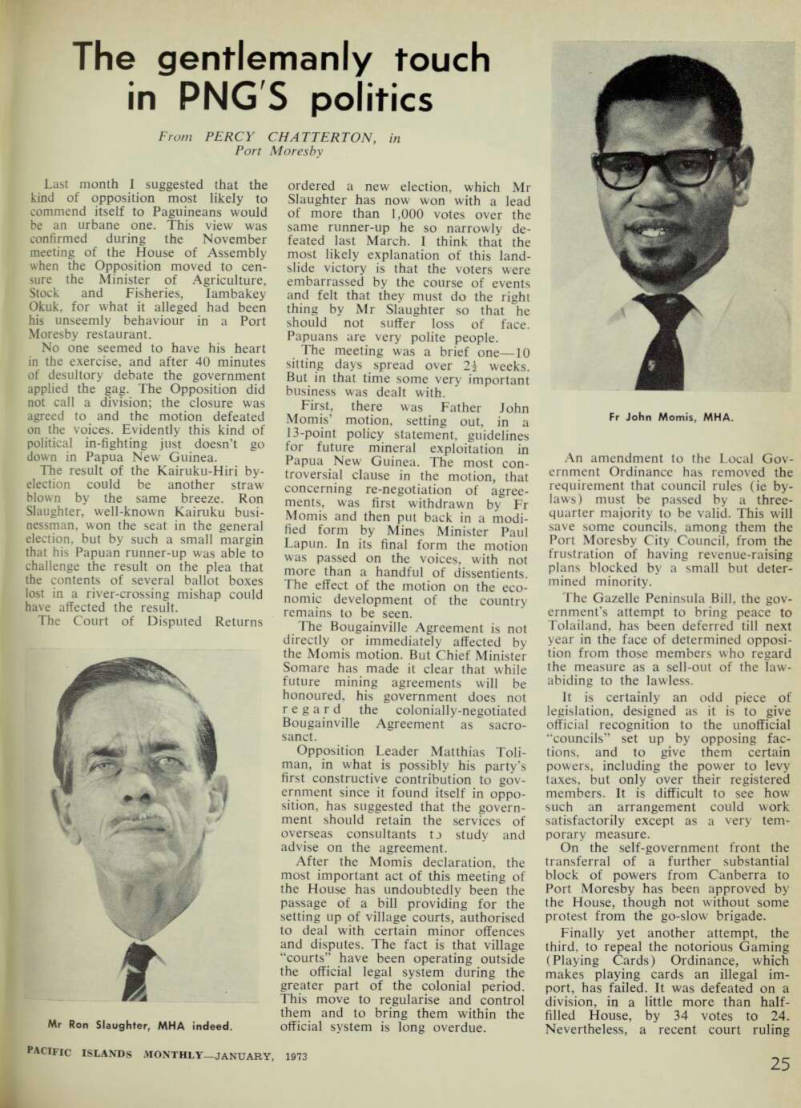
Mr Ron Slaughter, MHA indeed.
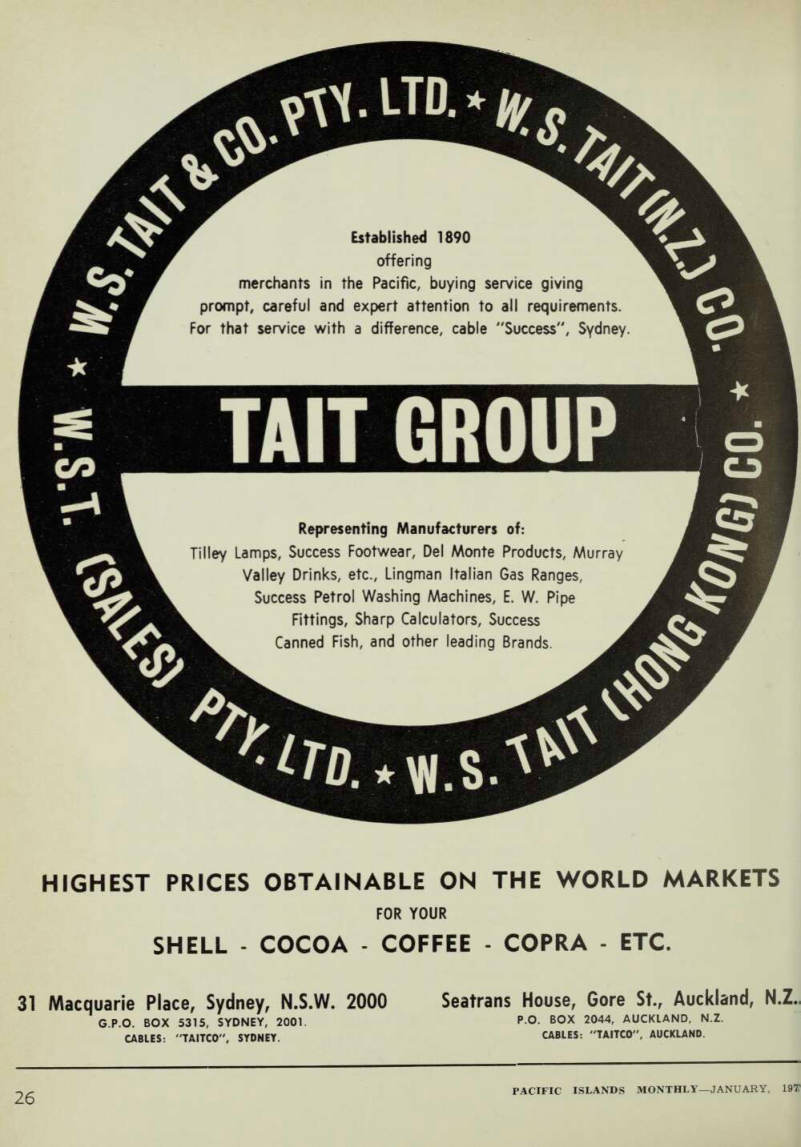
Fr John Momis, MHA.
Major Share Wanted In Mining
has largely drawn the ordinance’s
teeth.
A magistrate has ruled that to be in possession of playing cards is not in itself an offence, and that a prose
cution can therefore only succeed if
it can be proved that the cards in
question were imported subsequently
to the coming into force of the Ordinance in 1965.
On November 29 the House ad
journed to “a date to be fixed” rumoured to be February 23.
The Resolution
There were 13 clauses in Fr Momis’s motion in which he called for major participation by Papua New Guineans in any mining ventures in the territory.
The motion reads: That this House, re cognising the vital role which mining will play in the economy of Papua New Guinea; that control of the economy is essential to national self-determination and real political independence; that in many developing countries the effect of major mining ventures has been more detrimental than beneficial to these countries: and that it is in the best interests of both Papua New Guinea and potential investors that government policy regarding foreign investment be as clear and explicit as possible, calls on the government to formulate and adopt certain investment principles relating to mining ventures, such principles to provide for the following matters: (a l The equity of Papua New Guineans in any major mining venture should be as great as possible and normally should constitute a major holding; •bi Such equity should normally be held by the government or a government
instrumentality;
<c) The terms of any mining venture should provide—(ii for the maximum employment of Papua New Guineans; (ii) that the venture should, as far as possible, be labour-intensive rather than capital-intensive; (iff) for employee participation in decision making, and; (ivl for the develop ment of secondary and tertiary industries in connection with the mining venture, including the maxi mum feasible processing of ore prior to export. (di Any corporation engaged in a mining venture should be obligated to train or arrange for the training of Papua New Guineans to take over managerial and technical positions in accordance with a definite time table established for each venture; (ei In the setting-up and conduct of any mining venture maximum use should be made of goods and services produced from resources within Papua New Guinea and provided by Papua New Guineans; (fi Any ancillary economic activity generated within Papua New Guinea by a mining venture should be con ducted as far as possible by Papua New Guineans; igi The terms of any mining venture should aim to preserve racial harmony in the area of operations and to maintain and repair the physical environment;
(hi In negotiating the terms of any mining venture, the Government would seek to obtain the maximum collateral advantages in terms of trade and assistance for develop ment; (i) An agreement setting up a mining venture should include formulae agreed to by the parties which provide for changing circumstances, such as price fluctuations, variations in profitability and development of new techniques; (j) To the maximum possible extent, government purchases of equity in mining ventures should be paid for out of future earnings of the mine, instead of large initial cash outlays and commercial loans;
(k) Any agreement for a mining venture should provide at least as much revenue for the Papua New Guinea Government—as is provided on the average by similar ventures in other developing countries; (l) Mining agreements should provide that disputes between mining com panies and the government will be settled in accordance with Papua New Guinea’s legal procedures, and not by resort to outside arbitrators; (m) The offering of tax holidays and other Investment incentives should be balanced against the nation’s need for revenue and equitable treatment of all industry, both foreign-owned and Papua New Guinean, and recommends that the government recruit a specialist team to engage in the negotiation and supervision of mining ventures.