Not Much Money But Lots
pp. 24-98 · Read in the full issue
Of Fun In The Solomons
From a Honiara correspondent
The longest sitting in the history of the Solomon Islands legislature (3 weeks, 1 day), dealt with a budget which revealed the awful facts about the Solomons’ financial state (if they were not obvious already), and several associated events —all of them vital to the future of the protectorate.
An obvious highlight was the walk out by the 12 so-called “back benchers” of the Governing Council on Tuesday, Nov 21, the first time Govco has been forced to suspend proceedings for such a reason.
The sudden rising and dispersal of the members through four doors, bags, papers and all, at 3 pm caught the chairman. High Commissioner Sir Michael Gass, and the house leader.
Chief Secretary Mr Tom Russell, by surprise, and somewhat flat-footed as to procedure.
There had been unilateral decision by Internal Affairs Committee chair man, Mr Mariano Kelesi, to allow broadcasting hours on the Solomon Islands Broadcasting Service to be reduced (no lunchtime programmes, evenings cut by an hour or so) without referring to his committee of five.
Seeing Govco was sitting, and all committee members were present, it can only be assumed Mr Kelesi was flexing his muscles in preparation for the new constitution under which he could be a minister if he were to survive the April-May, 1973, general elections. But it was asking for trouble when one of his committee men is the respected and honourable Dr Clement Ofai and the young semi-reformed firebrand, Solomon Mamaloni, is roused.
These two suddenly brought tension to the house. Dr Ofai with quiet anger said there was no use having a committee if the chairman made decisions on his own. Mr Kelesi, tried to bluster his way out in reply with a series of largely incoherent statements about the situation.
When he sat down, another of his four committee members, Alfred Maeke, reiterated more angrily Dr Ofai’s question, and was followed by Mamaloni who spoke with quiet menace briefly about failings of the broadcasting service and the lone decision by Kelesi, then stated, “If we backbenchers are to mean nothing to the government of this country then let us walk out”.
Sir Michael Gass was chairing the Committee of Supply debate on the Budget. After searching Standing Orders, he concluded that the remain ing members —five chairmen of com mittees and two ex-officio—and him self had to sit out 15 minutes of somewhat embarrassing inactivity, then resume the Governing Council itself, find it without a quorum and adjourn until the next day.
The importance of this little drama lay in what had been said the week before by David Kausimae, chairman of the Natural Resources Committee and of the present members probably the most likely choice for the first Chief Minister (in 1974?).
Speaking on the report of the Select Committee on Constitutional Develop ment which recommended a West minster system, he was convinced that only a political party could form a government with staying power.
He picked one or two holes in the report, perceiving that a recom mended Advisory Committee of all backbench members of the new Legislative Assembly could unite easily to defeat their numerically smaller executive of Chief Minister and Council of Ministers—unless there was a party to discipline back benchers.
If nothing else would have revived
the Solomons United National (SUN) Party, this opening seems to have inspired its founder, David Kausimae, to really work for its transformation from steering committee stage to active party.
At least among sophisticates and among those who see meal tickets in commercial fishing, Kausimae has gained considerable prestige by stick ing to his belief in the joint fishing venture with Japan’s Taiyo Fishery Company, in the face of almost total opposition from members and Solomon Islanders at large. To follow this with a party election campaign based on unity for the Solomons to demonstrate his leadership qualities may well swing his own rural, con servative and reputedly still resentful Are Are, Malaita, electorate behind him. Kausimae, the devil who allowed foreigners to fish the Solomons’ deej blue sea, may yet be seen more widely as his country’s financial saviour (with the behind-the-scenes leadership of his chief apostle Financial Secretary, John Smith).
The Solomons Government has ap parently done very nicely out o; its agreement with Taiyo to forn the joint commercial fishing company Solomon Taiyo Limited. Taiyo put; up all the money after paying royaltie: to carry out a survey (admitted!] they also exported $4Jm worth o skipjack while surveying); Taiyo give the Solomons immediately a 25 pe cent share in return for exclusivi foreign fishing rights to skipjack ant other tuna-like fish for the next U years; Taiyo must sell a further 2per cent share to the government a any time the government wants h Taiyo must localise, beginning will 10 per cent of catcher vessels nex year and going to 90 per cent b< 1982, and beginning with 30 per cer Solomon Islanders at sea (86 per cer on shore) next year, and going to 60 per cent at sea (90 per cent o. shore) by 1977; Taiyo must mamtaii shore freezers and cold storage am other on-shore processing, establis; a cannery, provide all expertise am management personnel, pay 10 pe cent export duty on all skipjack ex ported (with a three per cent con cession the first two years, and on per cent the third year) based o f.o.b. value, and pay tax on eventu; dividends as well as 15 per cent ta on interest on overseas borrowings.
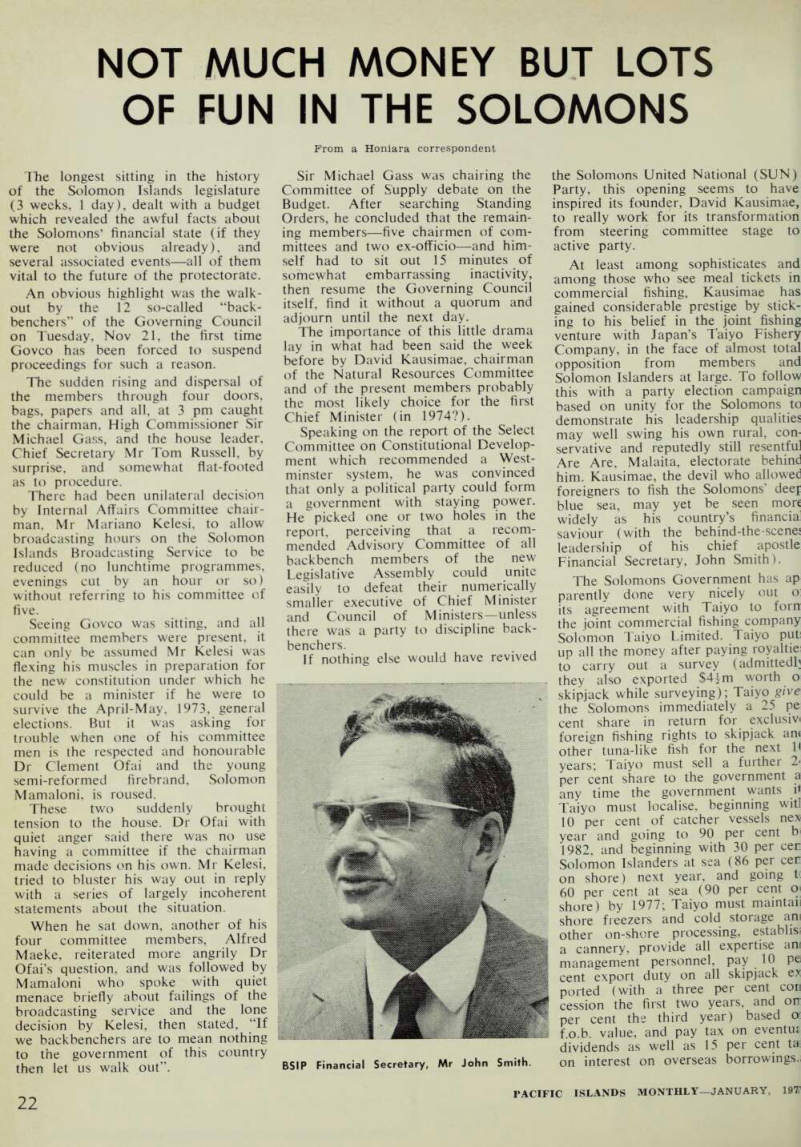
BSIP Financial Secretary, Mr John Smith.
John Smith believes it to be an example to other developing countries, which need not sell their very valuable natural resources cheaply. His negotiating and presentation to the house reportedly earned him the apt nickname of “Sweet-Lip” Smith after the local fish!
Taiyo gets in return the opportunity to catch 30,000 metric tons of skip jack (katsuwonus pelamys ) a year.
The Solomons will earn from duty, probably even in the first year more than $300,000.
One could read recently of how the Bougainville secessionists in PNG have to all appearances cooled after years of intermittently fiery debate.
The Bougainvilleans were said to have become too interested in making money, and coping with Bougainville Copper’s impact on their lush island.
Commentators of this kind lack an understanding of the persistent bloody mindedness of the Melanesian, or perhaps it was wishful thinking* try to suppress a heart-felt Melanesian cause, and it will simmer, gathering force, like a volcano with a stopper in it.
The Governing Council of the Solomons in November unanimously rejected a motion passed in October, i/ 71 ’ b y a combined meeting of Bougainville local government councils, suggesting that the British Solomon Islands' western district break away and join Bougainville.
But it was merely a ploy to record members strong—passionate, among western district members—desire to see Bougamville join the Solomons' the motion came from Remisio Lresi, whose mother was from Bougainville, and who is the member tor Choiseul and the Shortlands the islands adjoining Bougainville. He blamed quite reasonably the colomahsts of Germany and the United Kingdom, for dividing the people of southern Bougainville from their close relations in the Shortlands by erecting a Bougainville-style Berlin wall out of their selfish colonial in i erence. No colonial powers had been able to break these ties of blood, he declared, using his well-practised singing voice and his angry black face to good effect.
The Administrator of Papua New 9 J!" ea , Mr Leslie Johnson, was holidaying in Honiara, and sat poker faced m the Govco chamber to hear members sympathise to varying degrees wiff, Eresi, who said un bashedly that the Bougainville people hated New Guineans (note: not other
New Guineans) and did not want to remain part of Papua New Guinea.
Most countries find they cannot raise enough revenue to do what they want or need to do, but the Solomons next year are in the position of having to spend less than this year in actual dollars, even before inflation has cut into the value of the dollar.
The United Kingdom is choking off grants for recurrent expenditure, with self-government now looming, even if it is continuing the flow of development capital. If it were not for copra being so hard hit on world markets, timber exports devalued because of a recession in the Japanese markets, cyclone damage, bauxite and nickel mining prospects being very indefinite because of current over-pro duction, and there being a civil service which has waited more than four years for a wage increase, nobody would mind too much.
The civil service’s patience finally wore out waiting for a reply from the Secretary of State for Foreign and Commonwealth Affairs in London, or the BSIP Government itself, on an interim cost-of-living award. A wage review is promised for this year, following a review of all civil service posts now being carried out.
Civil servants throughout the pro tectorate did that rare thing in their tradition—they stopped work and marched in protest.
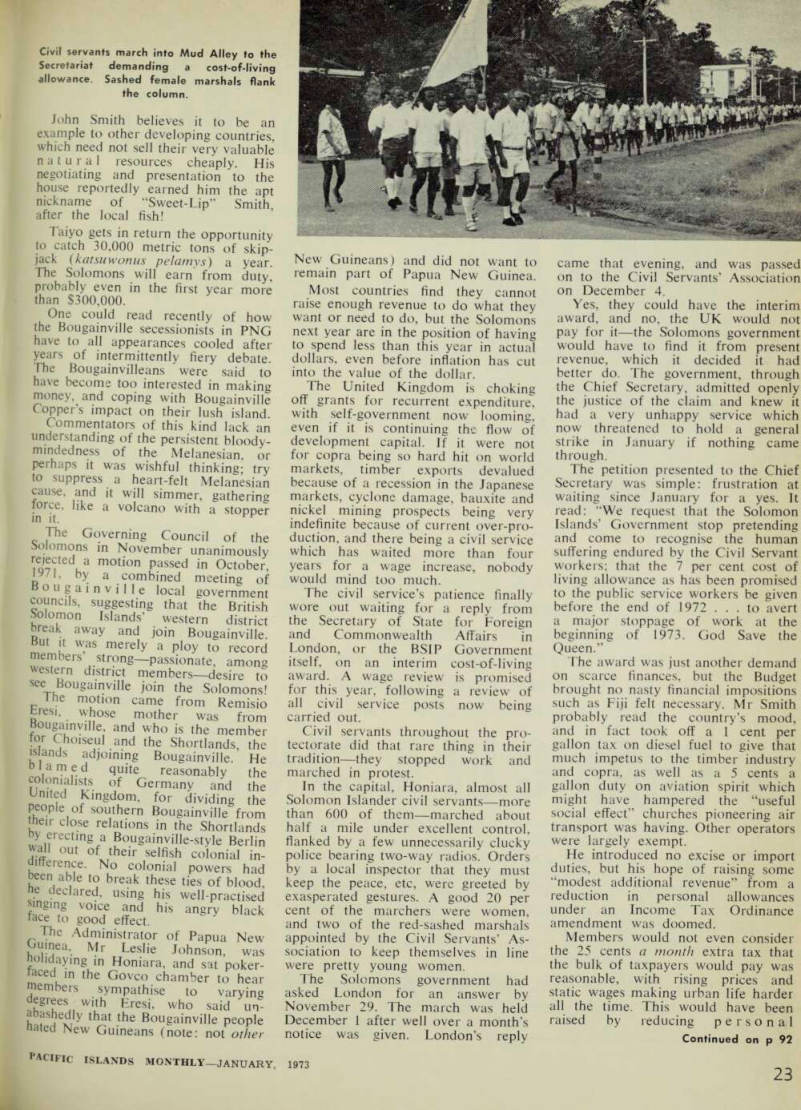
In the capital, Honiara, almost all Solomon Islander civil servants—more than 600 of them—marched about half a mile under excellent control, flanked by a few unnecessarily ducky police bearing two-way radios. Orders by a local inspector that they must keep the peace, etc, were greeted by exasperated gestures. A good 20 per cent of the marchers were women, and two of the red-sashed marshals appointed by the Civil Servants’ As sociation to keep themselves in line were pretty young women.
The Solomons government had asked London for an answer by November 29. The march was held December 1 after well over a month’s notice was given. London’s reply
came that evening, and was passed on to the Civil Servants’ Association on December 4.
Yes, they could have the interim award, and no, the UK would not pay for it—the Solomons government would have to find it from present revenue, which it decided it had better do. The government, through the Chief Secretary, admitted openly the justice of the claim and knew it had a very unhappy service which now threatened to hold a general strike in January if nothing came through.
The petition presented to the Chief Secretary was simple: frustration at waiting since January for a yes. It read: “We request that the Solomon Islands’ Government stop pretending and come to recognise the human suffering endured by the Civil Servant workers; that the 7 per cent cost of living allowance as has been promised to the public service workers be given before the end of 1972 ... to avert a major stoppage of work at the beginning of 1973. God Save the Queen.”
The award was just another demand on scarce finances, but the Budget brought no nasty financial impositions such as Fiji felt necessary. Mr Smith probably read the country’s mood, and in fact took off a 1 cent per gallon tax on diesel fuel to give that much impetus to the timber industry and copra, as well as a 5 cents a gallon duty on aviation spirit which might have hampered the “useful social effect” churches pioneering air transport was having. Other operators were largely exempt.
He introduced no excise or import duties, but his hope of raising some “modest additional revenue” from a reduction in personal allowances under an Income Tax Ordinance amendment was doomed.
Members would not even consider the 25 cents a month extra tax that the bulk of taxpayers would pay was reasonable, with rising prices and static wages making urban life harder all the time. This would have been raised by reducing personal
Continued on p 92
Civil servants march into Mud Alley to the Secretariat demanding a cost-of-living allowance. Sashed female marshals flank the column.
allowances claimed as tax deducts from $4BO to $420. It would b introduced tax to between 2,000 3.000 more people on top of 3.000 taxpayers, and it was “breaking in” of more of the po lation Mr Smith was after as nr as the small amount of revenue.
He did, however, get approval taxing dividends paid from Solomons to foreign shareholcb and for taxing interest repayment! overseas lenders (as in Taiyo’s • mentioned earlier).
The amount to be spent this J by the Solomons is $12,856,783 some $600,000 less than budgij for last year, which ended T a deficit of about $1,900,000. deficit is being met by a grant-inn from the United Kingdom whicl: also providing $4,625,980 in deves ment aid and research funds for • Sixth Development Plan’s prop which continue.
Mr Smith proposes a Solomons • rency, fully backed by reserves?
Australian dollars, be introducedt January 1, 1976. A report made year by an economist from the Um Nations Development Advisory T<l found more in favour of a local rency than against.