Western Samoa Can Expect Many
p. 23 · Read in the full issue
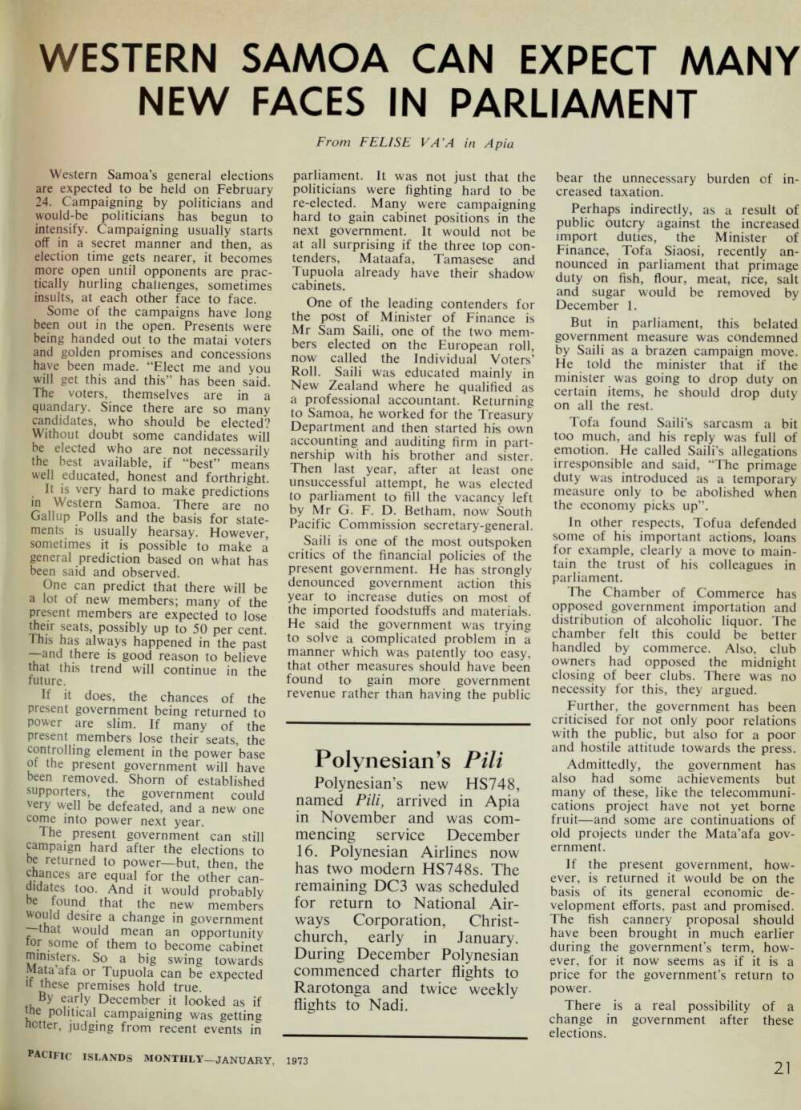
New Faces In Parliament
From FELISE VA’A in Apia
Western Samoa’s general elections are expected to be held on February 24. Campaigning by politicians and would-be politicians has begun to intensify. Campaigning usually starts off in a secret manner and then, as election time gets nearer, it becomes more open until opponents are prac tically hurling challenges, sometimes insults, at each other face to face.
Some of the campaigns have long been out in the open. Presents were being handed out to the matai voters and golden promises and concessions have been made. “Elect me and you will get this and this” has been said.
The voters, themselves are in a quandary. Since there are so many candidates, who should be elected?
Without doubt some candidates will be elected who are not necessarily the best available, if “best” means well educated, honest and forthright.
It is very hard to make predictions in Western Samoa. There are no Gallup Polls and the basis for state ments is usually hearsay. However, sometimes it is possible to make a general prediction based on what has been said and observed.
One can predict that there will be a lot of new members; many of the present members are expected to lose their seats, possibly up to 50 per cent.
This has always happened in the past —and there is good reason to believe that this trend will continue in the future.
If it does, the chances of the present government being returned to power are slim. If many of the present members lose their seats, the controlling element in the power base of the present government will have been removed. Shorn of established supporters, the government could very well be defeated, and a new one come into power next year.
The present government can still campaign hard after the elections to be returned to power—but, then, the chances are equal for the other can didates too. And it would probably be found that the new members would desire a change in government --that would mean an opportunity tor some of them to become cabinet ministers. So a big swing towards Mata afa or Tupuola can be expected it these premises hold true.
By early December it looked as if me political campaigning was getting better, judging from recent events in
parliament. It was not just that the politicians were fighting hard to be re-elected. Many were campaigning hard to gain cabinet positions in the next government. It would not be at all surprising if the three top con tenders, Mataafa, Tamasese and Tupuola already have their shadow cabinets.
One of the leading contenders for the post of Minister of Finance is Mr Sam Saili, one of the two mem bers elected on the European roll, now called the Individual Voters’
Roll. Saili was educated mainly in New Zealand where he qualified as a professional accountant. Returning to Samoa, he worked for the Treasury Department and then started his own accounting and auditing firm in part nership with his brother and sister.
Then last year, after at least one unsuccessful attempt, he was elected to parliament to fill the vacancy left by Mr G. F, D. Betham, now South Pacific Commission secretary-general.
Saili is one of the most outspoken critics of the financial policies of the present government. He has strongly denounced government action this year to increase duties on most of the imported foodstuffs and materials.
He said the government was trying to solve a complicated problem in a manner which was patently too easy, that other measures should have been found to gain more government revenue rather than having the public
bear the unnecessary burden of in creased taxation.
Perhaps indirectly, as a result of public outcry against the increased import duties, the Minister of Finance, Tofa Siaosi, recently an nounced in parliament that primage duty on fish, flour, meat, rice, salt and sugar would be removed by December 1.
But in parliament, this belated government measure was condemned by Saili as a brazen campaign move.
He told the minister that if the minister was going to drop duty on certain items, he should drop duty on all the rest.
Tofa found Saili’s sarcasm a bit too much, and his reply was full of emotion. He called Saili’s allegations irresponsible and said, “The primage duty was introduced as a temporary measure only to be abolished when the economy picks up”.
In other respects, Tofua defended some of his important actions, loans for example, clearly a move to main tain the trust of his colleagues in parliament.
The Chamber of Commerce has opposed government importation and distribution of alcoholic liquor. The chamber felt this could be better handled by commerce. Also, club owners had opposed the midnight closing of beer clubs. There was no necessity for this, they argued.
Further, the government has been criticised for not only poor relations with the public, but also for a poor and hostile attitude towards the press.
Admittedly, the government has also had some achievements but many of these, like the telecommuni cations project have not yet borne fruit—and some are continuations of old projects under the Mata’afa gov ernment.
If the present government, how ever, is returned it would be on the basis of its general economic de velopment efforts, past and promised.
The fish cannery proposal should have been brought in much earlier during the government’s term, how ever, for it now seems as if it is a price for the government’s return to power.
There is a real possibility of a change in government after these elections.