Tropicalities
pp. 13-18 · Read in the full issue

Too close
for comfort
Australia’s new Labour Prime Minister Gough Whitlam, elected in December, is sympathetic to New Guinean opinion in the Papua- Queensland border dispute. And since the Prime Minister is also the Minister for Foreign Affairs (as is Mew Zealand’s new Prime Minister, Mr Kirk) one may expect that New 3uinea will get a favourable ear in Canberra.
PIM last discussed the dispute in letail back in June, when it hadn’t n fact developed into a dispute. r hings have been moving swiftly in ecent weeks.
Briefly, the Australian border with apua New Guinea runs in one place within 200 yards of the Papuan oast, and traditional Papuan fishing rounds are within Australian waters.
Tie strip also contains three islands, aibai, Dauan and Boigu, with a opulation of about 1,000 islanders, ho are Australian citizens, enjoying xial service benefits from Queens md.
After independence, can New ruinea have three islands and their 20ple smack up against its shoreline Lit belonging to somebody else? ew Guinea government feeling is iat it can’t—that Australia should xiraw the border to give the islands ► New Guinea, with or without the Jople.
Queensland’s Premier, Mr Bjelke etersen, doesn’t like the sound of ns and wants to dig his heels in. e may in fact have the legal right 1 do so.
Nobody yet knows how far he is spared to go, how far Mr Whitlam prepared to go, or how far the ipua New Guinea Government is e Pared to go. But clearly it is a r ? point among many New umean ministers, and it’s unlikely at an independent New Guinea )ul( * tolerate the present situation. [ Bjelke-Petersen, we predict, is
mmg a losing battle.
Papua New Guinea’s coalition moment has problems besides
those of the Queensland border. One of them is a decision on its attitude to a takeover in December by a Japanese firm of Commonwealth New Guinea Timbers.
CNGT is 65 per cent owned by Territory Development Ltd, all of whose shares are held by Placer De velopment Ltd. Placer is selling its shareholding to New Guinea registered New Guinea Sobu Pty Ltd —owned by a wealthy Japanese family group—subject to govern mental agreement.
The point of the story is that the other 35 per cent shareholding in CNGT is held by the Investment Corporation of PNG on behalf of the PNG government, which is thus likely to find itself suddenly with a majority Japanese business partner.
The deal between Placer and the Japanese also includes Territory Fisheries Pty Ltd, all of which is owned by Territory Development Ltd.
PNG Chief Minister Michael Somare had hoped to get his state ment on PNG investment guidelines out by January 1, but its been de layed. Meanwhile Mr Somare says that “several rounds of discussions might be necessary” over the Sobu deal.
Chairman of the PNG Investment Corporation, Mr E. S. Owens, is not perturbed. He says that although he is sorry to lose the old association, the new arrangement would offer benefits to the corporation. “It gives us access to the Japanese markets,” he says, adding that the Japanese ob viously saw tremendous opportunities in PNG in the long term. He under stood that the price paid by the Japanese was in excess of the price paid by the corporation, which he sees as another example of the confi dence the Japanese have in PNG.
US Tilts out
SPC ceiling
After 25 years of attempting to impose its own fiscal check on the South Pacific Commission’s budget, the United States Government has removed the legislative ceiling on American contributions to the SPC.
The amendment, which limits the
United States only to its assessed 20 per cent of the budget, has been signed into law. Now, there are no longer any artificial restrictions im posed by the US Congress on the American contribution as was the case at the conference at Apia this year when the United States delegation was tied to a miserly offer of an eight per cent increase.
Until the new legislation, the SPCs formula for contributions meant that, at times, when the American ceiling was about to be reached or breached, contributions from all the participating governments would be limited to the American peg. While this situation rarely developed openly, it did restrain the other governments behind the scenes. This was very evident when Fiji Prime Minister Ratu Sir Kamisese Mara before leaving Suva
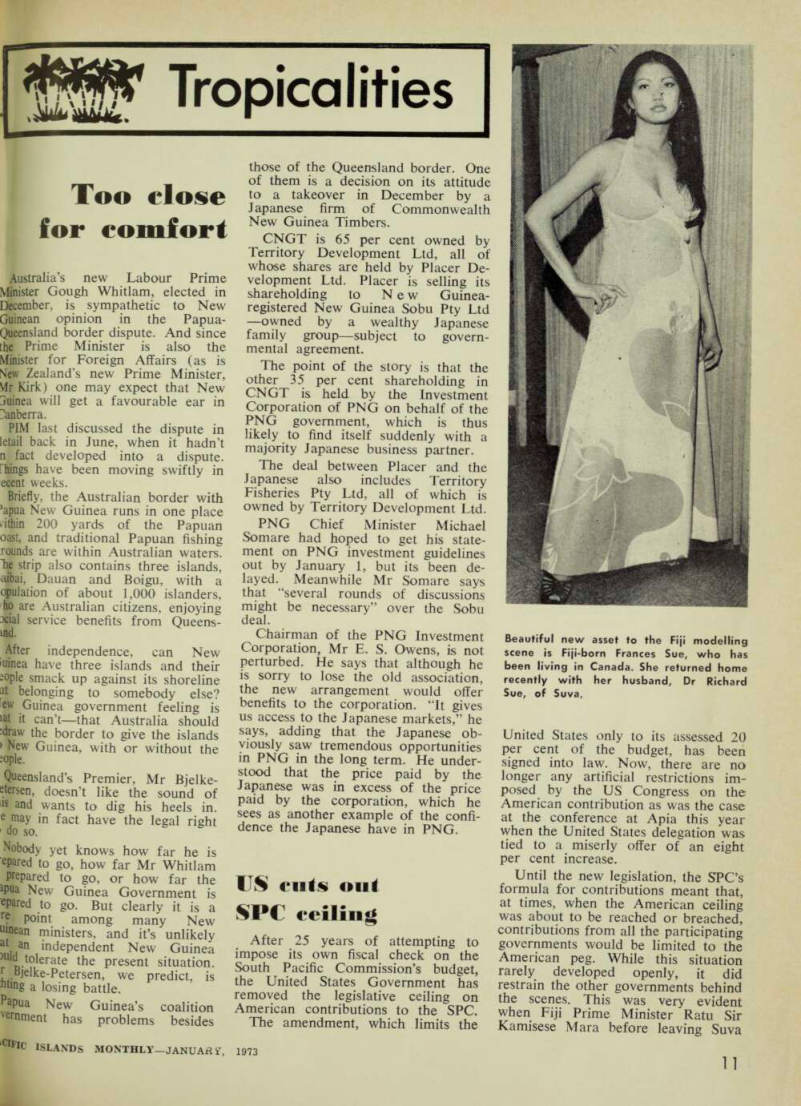
Beautiful new asset to the Fiji modelling scene is Fiji-born Frances Sue, who has been living in Canada. She returned home recently with her husband, Dr Richard Sue, of Suva,
for Apia, severely criticised the US (and France) for its close-fisted ap proach to the SPC.
Now, it seems, the US commis sioners and their State Department advisers may be able to be more generous in their increases. This would help to restore the United States to a more purposeful role in the SPC.
Although the new legislation does not guarantee that the SPC appropriation will be passed by the Congress, it does put the SPC in the same funding category as the United Nations since the American contribution to the SPC will have a continuing authorisation in the future.
In the past, the authorisation has usually caused far more difficulty than the appropriation.
The effect of the change is that whatever the size of the budget, the United States delegation can agree to pay its 20 per cent without re course to Congress for a new authori sation.
Stamp hona idza
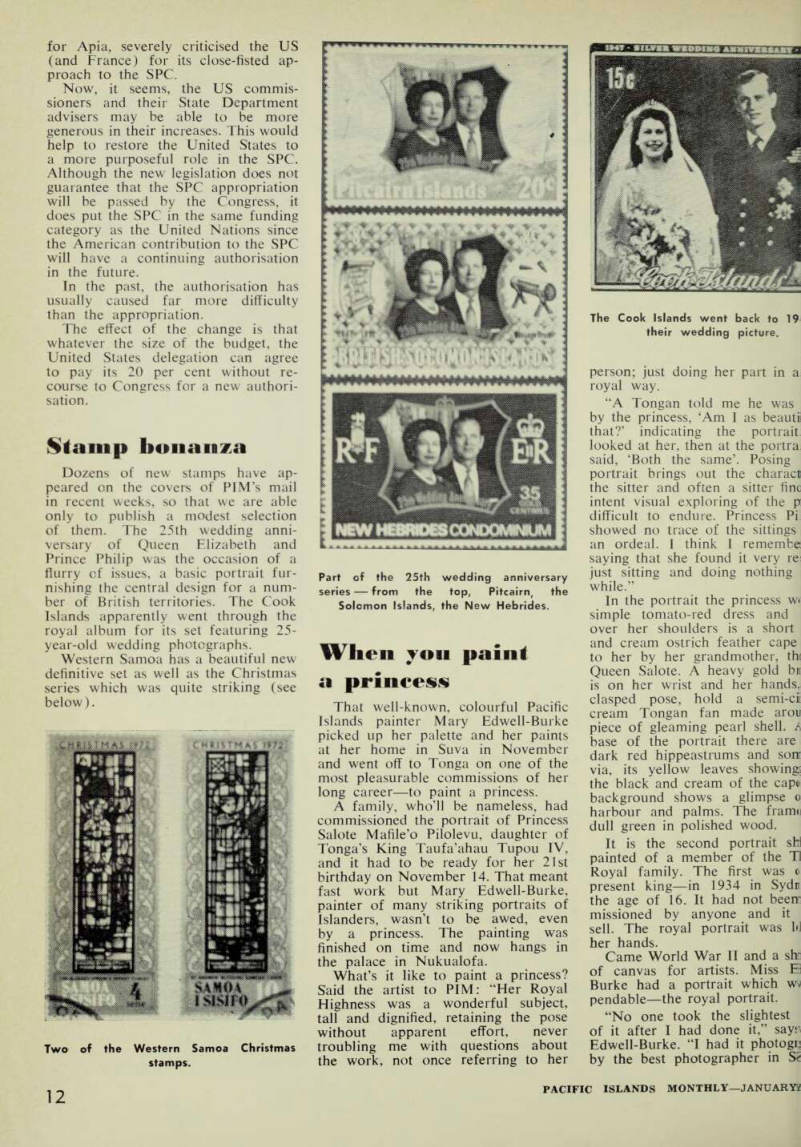
Dozens of new stamps have ap peared on the covers of PI M's mail in recent weeks, so that we are able only to publish a modest selection of them. The 25th wedding anni versary of Queen Elizabeth and Prince Philip was the occasion of a flurry of issues, a basic portrait fur nishing the central design for a num ber of British territories. The Cook Islands apparently went through the royal album for its set featuring 25year-old wedding photographs.
Western Samoa has a beautiful new definitive set as well as the Christmas series which was quite striking (see below).
When you paint
a princess
That well-known, colourful Pacific Islands painter Mary Edwell-Burke picked up her palette and her paints at her home in Suva in November and went off to Tonga on one of the most pleasurable commissions of her long career—to paint a princess.
A family, who’ll be nameless, had commissioned the portrait of Princess Salote Mafile’o Pilolevu, daughter of Tonga’s King Taufa’ahau Tupou IV, and it had to be ready for her 21st birthday on November 14. That meant fast work but Mary Edwell-Burke, painter of many striking portraits of Islanders, wasn’t to be awed, even by a princess. The painting was finished on time and now hangs in the palace in Nukualofa.
What’s it like to paint a princess?
Said the artist to PIM: “Her Royal Highness was a wonderful subject, tall and dignified, retaining the pose without apparent effort, never troubling me with questions about the work, not once referring to her
person; just doing her part in a royal way.
“A Tongan told me he was by the princess, ‘Am I as beautii that?’ indicating the portrait, looked at her, then at the portra. said, ‘Both the same’. Posing portrait brings out the charact) the sitter and often a sitter fine intent visual exploring of the p difficult to endure. Princess Pi showed no trace of the sittings an ordeal. I think I remembe saying that she found it very re; just sitting and doing nothing while.”
In the portrait the princess w» simple tomato-red dress and over her shoulders is a short and cream ostrich feather cape to her by her grandmother, thi Queen Salote. A heavy gold bn is on her wrist and her hands, clasped pose, hold a semi-cii cream Tongan fan made arou piece of gleaming pearl shell. A base of the portrait there are dark red hippeastrums and sonr via, its yellow leaves showing the black and cream of the cape background shows a glimpse o harbour and palms. The frannj dull green in polished wood.
It is the second portrait sH painted of a member of the T 1 Royal family. The first was e present king—in 1934 in Sydn the age of 16. It had not been: missioned by anyone and it sell. The royal portrait was Id her hands.
Came World War II and a sh~ of canvas for artists. Miss B Burke had a portrait which wv pendable—the royal portrait.
“No one took the slightest of it after I had done it,” says\ Edwell-Burke. “I had it photogp by the best photographer in Sc
Two of the Western Samoa Christmas stamps.
Part of the 25th wedding anniversary series from the top, Pitcairn, the Solomon Islands, the New Hebrides.
The Cook Islands went back to 19 their wedding picture.
Monty Luke, but still no one took any notice. It was just as though it didn't exist.”
So, she painted another portrait over that of young Prince Tupouto’a- Tungi, one of a “Spanish-type of girl” ‘ in Sydney who often sat for her. She sold it.
Where it is, she doesn’t know, but someone has a painting of a girl.
Underneath is another painting of a prince who is now a king. In the background is the Tongan Royal coat of arms and in the foreground a table and on it a tray of tropical fruit.
Fiji’s own
strolling players
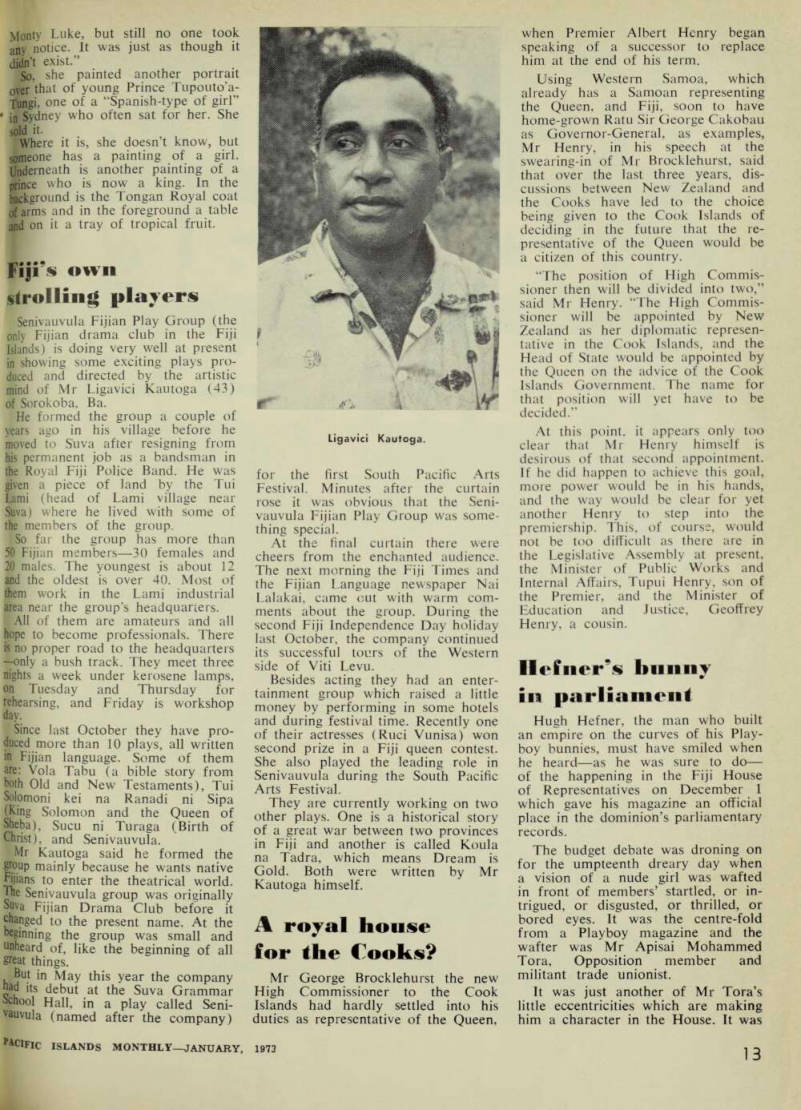
Senivauvula Fijian Play Group (the only Fijian drama club in the Fiji Islands) is doing very well at present in showing some exciting plays pro duced and directed by the artistic mind of Mr Ligavici Kautoga (43) of Sorokoba, Ba.
He formed the group a couple of years ago in his village before he moved to Suva after resigning from his permanent job as a bandsman in the Royal Fiji Police Band. He was given a piece of land by the Tui lami (head of Lami village near Suva) where he lived with some of the members of the group.
So far the group has more than 50 Fijian members—3o females and 20 males. The youngest is about 12 and the oldest is over 40. Most of them work in the Lami industrial area near the group’s headquarters.
All of them are amateurs and all hope to become professionals. There is no proper road to the headquarters a bush track. They meet three nights a week under kerosene lamps, on Tuesday and Thursday for rehearsing, and Friday is workshop day.
Since last October they have pro duced more than 10 plays, all written in Fijian language. Some of them are: Vola Tabu (a bible story from both Old and New Testaments), Tui Solomoni kei na Ranadi ni Sipa (King Solomon and the Queen of Sheba), Sucu ni Turaga (Birth of Christ), and Senivauvula.
Mr Kautoga said he formed the group mainly because he wants native Fijians to enter the theatrical world.
The Senivauvula group was originally Suva Fijian Drama Club before it changed to the present name. At the beginning the group was small and unheard of, like the beginning of all great things.
But in May this year the company had its debut at the Suva Grammar School Hall, in a play called Seni vauvula (named after the company)
for the first South Pacific Arts Festival. Minutes after the curtain rose it was obvious that the Seni vauvula Fijian Play Group was some thing special.
At the final curtain there were cheers from the enchanted audience.
The next morning the Fiji Times and the Fijian Language newspaper Nai Lalakai, came out with warm com ments about the group. During the second Fiji Independence Day holiday last October, the company continued its successful tours of the Western side of Viti Levu.
Besides acting they had an enter tainment group which raised a little money by performing in some hotels and during festival time. Recently one of their actresses (Ruci Vunisa) won second prize in a Fiji queen contest.
She also played the leading role in Senivauvula during the South Pacific Arts Festival.
They are currently working on two other plays. One is a historical story of a great war between two provinces in Fiji and another is called Koula na Tadra, which means Dream is Gold. Both were written by Mr Kautoga himself.
A royal house
for the Cooks?
Mr George Brocklehurst the new High Commissioner to the Cook Islands had hardly settled into his duties as representative of the Queen,
when Premier Albert Henry began speaking of a successor to replace him at the end of his term.
Using Western Samoa, which already has a Samoan representing the Queen, and Fiji, soon to have home-grown Ratu Sir George Cakobau as Governor-General, as examples, Mr Henry, in his speech at the swearing-in of Mr Brocklehurst, said that over the last three years, dis cussions between New Zealand and the Cooks have led to the choice being given to the Cook Islands of deciding in the future that the re presentative of the Queen would be a citizen of this country.
“The position of High Commis sioner then will be divided into two,” said Mr Henry. “The High Commis sioner will be appointed by New Zealand as her diplomatic represen tative in the Cook Islands, and the Head of State would be appointed by the Queen on the advice of the Cook Islands Government. The name for that position will yet have to be decided.”
At this point, it appears only too clear that Mr Henry himself is desirous of that second appointment.
If he did happen to achieve this goal, more power would be in his hands, and the way would be clear for yet another Henry to step into the premiership. This, of course, would not be too difficult as there are in the Legislative Assembly at present, the Minister of Public Works and Internal Affairs, Tupui Henry, son of the Premier, and the Minister of Education and Justice, Geoffrey Henry, a cousin.
Hefner’s bunny
in parliament
Hugh Hefner, the man who built an empire on the curves of his Play boy bunnies, must have smiled when he heard —as he was sure to do— of the happening in the Fiji House of Representatives on December 1 which gave his magazine an official place in the dominion’s parliamentary records.
The budget debate was droning on for the umpteenth dreary day when a vision of a nude girl was wafted in front of members’ startled, or in trigued, or disgusted, or thrilled, or bored eyes. It was the centre-fold from a Playboy magazine and the wafter was Mr Apisai Mohammed Tora, Opposition member and militant trade unionist.
It was just another of Mr Tora’s little eccentricities which are making him a character in the House. It was
Ligavici Kautoga.
his way of protesting against a government member’s attack on the importation of the permissiveness of the outside world. Earlier, Mr Kishor Govind had criticised the wear ing of hotpants and miniskirts, the ex ' hibition and sale of pornographic literature and the showing of indecent films.
Waving the tasty bit over his head, Mr Tora declared: “I see no reason why sexy films demonstrating the art of love and sexual intercourse should not be shown on our screens to adults.” Then he brought the Kama Sutra into the act and, when challenged to show under which head of the budget proposals he was speak s' said, “The Perfumed Garden” (which, surely, wasn’t in the Agri culture Ministry accounts.) ■Deputy Speaker Ratu David Toganivalu warned him he was verg ing on indecency. That might have brought on a recurrence of an in cident which earned Mr Tora head lines a week before. He had called the Minister of Finance, Mr Charles Stinson, a liar and had refused to apologise. Ratu David suspended him and ordered him to leave the House.
His leaving was tardy, so he was helped out by the sergeant-at-arms, apoliceman, and two other policemen. ■Because Mr Tora tabled his Play boy picture, which he called “one of the most beautiful things I have seen,” it will have gone into the official words. Somewhat ambiguously, The Fiji Times headlined the incident “NFP man tables a nude in the House.”
Volunteers 9 place
in Samoa
An Apia correspondent reports: lAre United States Peace Corps wlunteers really needed in Western Slmoa? Opinion is divided. Some say yes, others say no, that the volunteers either do not have a sufficiently high standard of education, or that they help to displace Samoans from many jobs.
The critics do not deny that Peace volunteers are very often graduates and highly qualified by standards, but they contend that these are not up to British sydards and hence do not meet local requirements.
Others are worried that government encouragement of Peace Corps activities will lead to displacement of qualified Samoans from government Pjitions. They say the government taftrying to save money by requesting taore volunteers and that in the long ran Samoans will suffer because they
will not be offered jobs, as tea for example.
The criticism that the Peace volunteers are not highly qualif not based on truth. Many o volunteers are highly qualified in special fields and include PhDs rest are BAs and MAs from v; universities in the US and degrees are certainly not rubbis Most often they are assign teachers to the Departmen Education and they certainly se< be doing a good job as teache maths, science, etc., in seco schools. The Education Depar is requesting a further 30 ( teacher volunteers for 1973.
However, the complaint volunteers may displace Samoa a legitimate one, and one tha government must look into. Cer there is room for volunteers in ern Samoa, especially now h Department of Education reports a shortage of secondary s teachers. But, at the same volunteers must not displace Sar from jobs.
Volunteers will be needed long time as specialised skills a short supply in Samoa.
A new handout
Forty Hereford yearling hi five Hereford bulls and the Zealand High Commissioner- Western Samoa and Tonga, Ni W. Thorp, arrived at Nukualofa) in December. They didn’t all together but there was a conne Mr Thorp had come to talk NZ aid to the kingdom, and the were part of that aid.
Selected Tongan farmers w 1 trained under the aid scheme i basic skills of pasture and beef management.
Mr Thorp, who talked with Prime Minister Tuita and othei eminent leaders, told them New Zealand’s first-ever aid gramme for Tonga would be about $750,000 between now/ March, 1975.
NZ was showing her inter* Tonga because the kingdom was.
Zealand’s closest neighbour anr establishment of diplomatic relt between the two countries was other important factor, as well natural increase of New Zeas global aid under UNDP requires About a third of the total ail be used to establish a livestooi dustry focused mainly on cattle ing. Telecommunications and a:i tation are other probable areas o