is a billion dollar reality
pp. 45-46 · Read in the full issue
Yen for a share in tourism is a billion dollar reality
From SUE WENDT in Suva
The enormously wealthy Japanese consortium, Toyo Ocean Develop ment and Engineering Company of fokyo, will this month launch what it calls a “major propaganda pro gramme”, publicising its latest South Pacific acquisition—sl per cent of Mana Island Resort, Fiji’s newest ourist playground.
With combined assets of SUS6O )illion (according to Sydney stock >roker Graham Ducker, one of the mginal Australian investors and levelopers of Mana), the consortium’s |1 million takeover is a drop in the )cean. But it’s likely to be the thin ;nd of the wedge of Japanese invest nent in Fiji tourism.
Japanese companies have shown nterest in operating major hotels at »oth Pacific Harbour and Denarau esort developments. The Toyo con ortium, consisting of 31 companies, ticluding such giants as Nippon Steel, he Sanwa Bank, the Hitachi ship milding company, Ohbayashi Con traction and the Teijin textile com >any is already looking for a site at for a 400-500 room hotel to eed tourists to offshore Mana. And t has various other Fiji tourism •rejects in mind.
Mana Island, 19 miles from ; autoka and described once by finance Minister Charles Stinson as ! "jewel of an island”, boasts powder lne beaches and a magnificent lagoon ontaining the proverbial crystal-clear vaters and fish-filled reefs. Part of he island is regarded as sacred by he Fijians and will remain unde 'eloped for at least 10 years.
Mana Island Resort (Fiji) Ltd, °rmed in 1970, holds a 99-year lease in 150 acres, about half of the Fijian 'Wned island.
The original investment in the $H
million resort came from Australia after Irishman Jamie Clarke dis covered that the land was available and contacted stockbroker Graham Ducker in Sydney to get the ball rolling. Other Australian directors were Errol Feifer, Stanley Howard and Michael Hershon, of Sydney.
Local directors were Noel McFarlane of Suva and Ratu Jeremiah Matai, representing the Fijian landowners.
Under lease terms, the mataqali Ketenamasi of Yaro village received 5 per cent of the issued capital and the option to buy a further 5 per cent. Annual rental is $17,000. In 1975, this will increase to $30,000 or 1\ per cent of the gross, whichever is greater—up to a maximum of $70,000.
It is anticipated that 250,000 shares —representing 25 per cent—will be offered to the public early this year.
Bridging finance is being provided by Partnership Pacific Ltd, merchant bankers involving the Bank of NSW, Bank of America and Bank of Tokyo.
PPL will acquire per cent share holding.
For the Australian directors, the dream resort was something of a toy, an experiment in a new field of investment. During construction, the company received approaches from both Toyo and a company involving BOAC, Qantas and UTA, which wished to finance an offshore hotel with Club Mediterranee management.
The Australians decided to sell a majority interest to the Japanese con sortium—and in December, when the purchase agreement was being com pleted, they had reason to be pleased with the results of their experiment.
“We’re all amateurs at this game, it was a gamble that seems to have paid of,” said solicitor Stan Howard.
The difficulty with that sort of arrangement, of course, is that with so many directors, all enthusiastic and eager to have a say, running a resort can be a frustrating business for management and staff. It's a situation that has occurred before in Fiji.
The Japanese directors in December were Mr S. Itoh, who heads the Hitachi organisation and is president of Toyo, Mr K. Majima, managing director of Nichimen Co, one of Japan’s largest industrial companies and Mr Y. Tsuji, who is manager of Nichimen branch offices and resident director of Toyo in Fiji.
“Although, contrary to reports, Japan Air Lines is not involved in the consortium, the Sanwa Bank is banker for JAL,” director Ducker told PIM. “Through this connection Mana expects to have a valuable association with JAL in future.
“The company intends to make Mana the premier international off shore resort in Fiji—certainly not a little Japan in the Pacific.
“It’s anticipated that the director ship will change early in the New Year when certain Australian direc tors resign and further Japanese directors are appointed. But 1 think we all agree that our marketing aim is to attract the professional and executive type of visitor,”
Mr Tsuji, who has a three-year residential and work permit for Fiji, says the dominion can’t expect large numbers of Japanese visitors until excursion fares are introduced: “It’s very expensive to get here from Japan—the return fare is about $U52,400. Of course, we will get more Japanese visitors in Fiji when JAL flies here from Guam, but people are aften surprised to learn that some 1,000 Japanese tourists came to Fiji during 1971. The total for 1972 is likely to be about 2,000.”
Mana got off to a bad start when
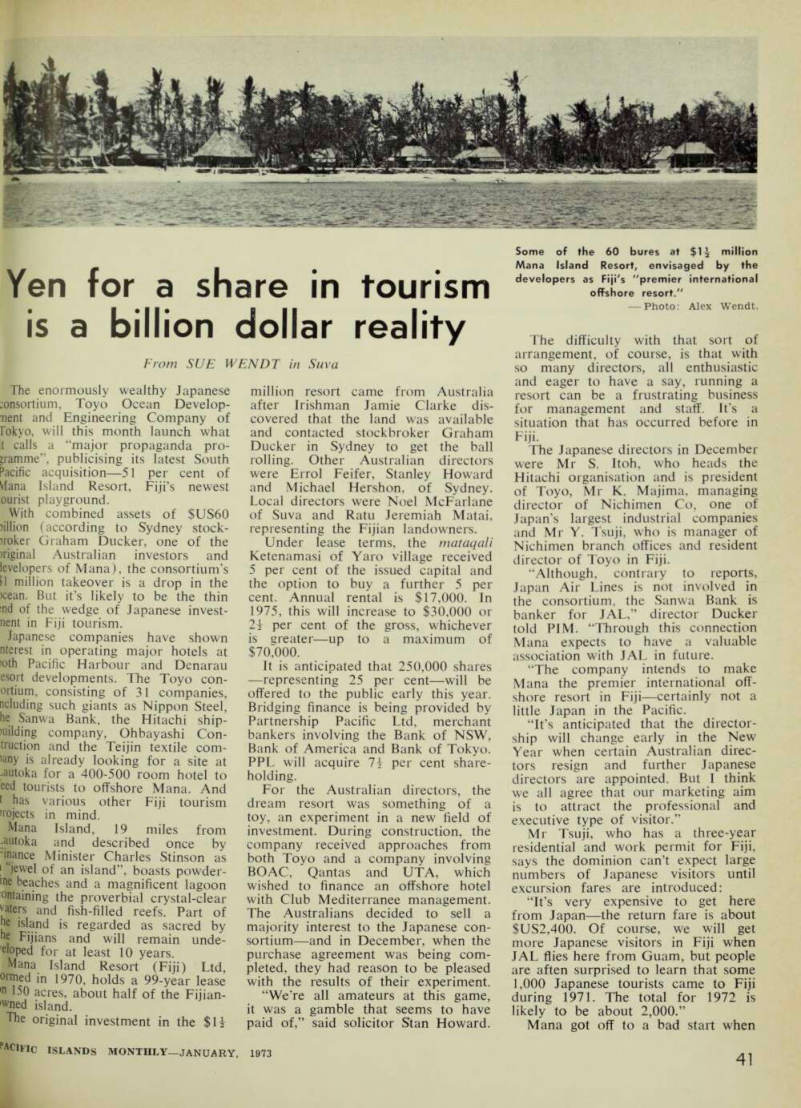
Some of the 60 bures at $1½ million Mana Island Resort, envisaged by the developers as Fiji's "premier international offshore resort." - Photo: Alex Wendt.
Hurricane Bebe roared through Fiji two weeks after it opened in October, playing havoc with the landscaped garden and eroding the beach. But the 60 cottage units were undamaged and by December, new planting was underway.
It is planned to start stage 2 of the development in April or May, adding a further 60 units. The resort already includes facilities for day trippers, who are transported to the island in the 87 ft diesel-powered cruiser South Sea Mana. The vessel also carries fresh water to the island, which has a storage capacity of 108,000 gallons, all of it transported from Lautoka.