Tropicalities
pp. 24-28 · Read in the full issue
Vunivaln will be First in the Land again
Six days before his 60th birthday on November 6, Ratu George Kada vulevu Cakobau, OBE, IP, the Vunivalu (war leader) of Bau and paramount chief of Fiji was named by the Queen as the next Governor General of Fiji. It was no surprise.
It was an open secret.
His appointment to succeed Sir Robert Foster, who will leave Fiji in January, has been pending for some time. After the last election, when he became Minister without Portfolio, he was told he was being “groomed for other things”. Every one knew what those were —an abode in the conventionally colonial pile known as Government House, front seat at all the big shows and royal honours.
The Fijians will see him as the paramount chief as well as the Queen’s First Man in the Land, and history will have come full circle— once more a Cakobau will be first in the land with little chance of being ousted as his great-grandfather Ratu Seru, King Cakobau, feared would happen to him before Victoria could be persuaded to accept Fiji as a gift and a liability.
Perhaps, to complete the circle, Ratu George, who’s sure to become Ratu Sir George, will be ceremonially installed in Levuka, the old capital, on the very spot on which King Cakobau handed over Fiji to Queen Victoria on October 10, 1874.
Such a ceremony, in such a place, would register full marks with the Fijians and bridge the gap in his tory. Ratu George’s appointment is a logical one from any angle but expert observers of the Fiji scene see a little more in it.
It all began half-way through the last century when King Cakobau’s throne was in peril. One of his enemies was Ratu Kamisese Mara, grandson of Tui Nayau, half-brother to Cakobau and great-great-grand father of Ratu Sir Kamisese Mara, Fiji’s first and present prime minister.
In 1853 Mara joined other chiefs in a rebellion against Cakobau. The
war dragged on for two years before peace was made between them.
Then, in 1859, Mara rebelled again but Mara was captured and hanged.
Although no one has spelled it out, the Bauans in recent years have watched the ascent of Ratu Sir Kamisese Mara with mixed feelings, particularly when, on October 10, 1970, Fiji became independent and King Cakobau’s gift of his country to the British Crown was returned.
At such a time, some Bauans thought, should not a Cakobau be first in the land. But the historic position was reversed. A Mara was prime minister.
A Cakobau, great-great-grandson of the king, was a minister.
John Carter in Suva says: ‘There have been rumours, denied as soon as they were current, of a split between Ratu Sir Kamisese and Ratu George. I don’t think there was even the suspicion of one, but so long as the thought remained in some minds it was a menace to the solidarity of Ratu Mara’s government.”
Today, with Ratu George about to become first man in the land and history repeats itself, there can be no such danger.
W ho'll buy the
drinks ?
When the Germans, and then the New Zealanders first came to Western Samoa, a basic aims of their admini strations was to make all forms of alcoholic beverages unavailable to the Samoans. No doubt, they felt the Samoans were incapable of control ling their passions after they had taken a few beers. This attitude, of course, led to sole government control of all importation and sale of alcoholic beverages.
The government decided how much liquor should be imported and pro cessed these orders through the local agents of the liquor manufacturers.
When these arrived, the government was the sole distributor and only those who were given a number of points could obtain any beer or other liquor.
After independence, the rules weie relaxed. The public could buy both beer and spirits from the local taverns and only very recently, the public was given full right to buy from the government bond store without the
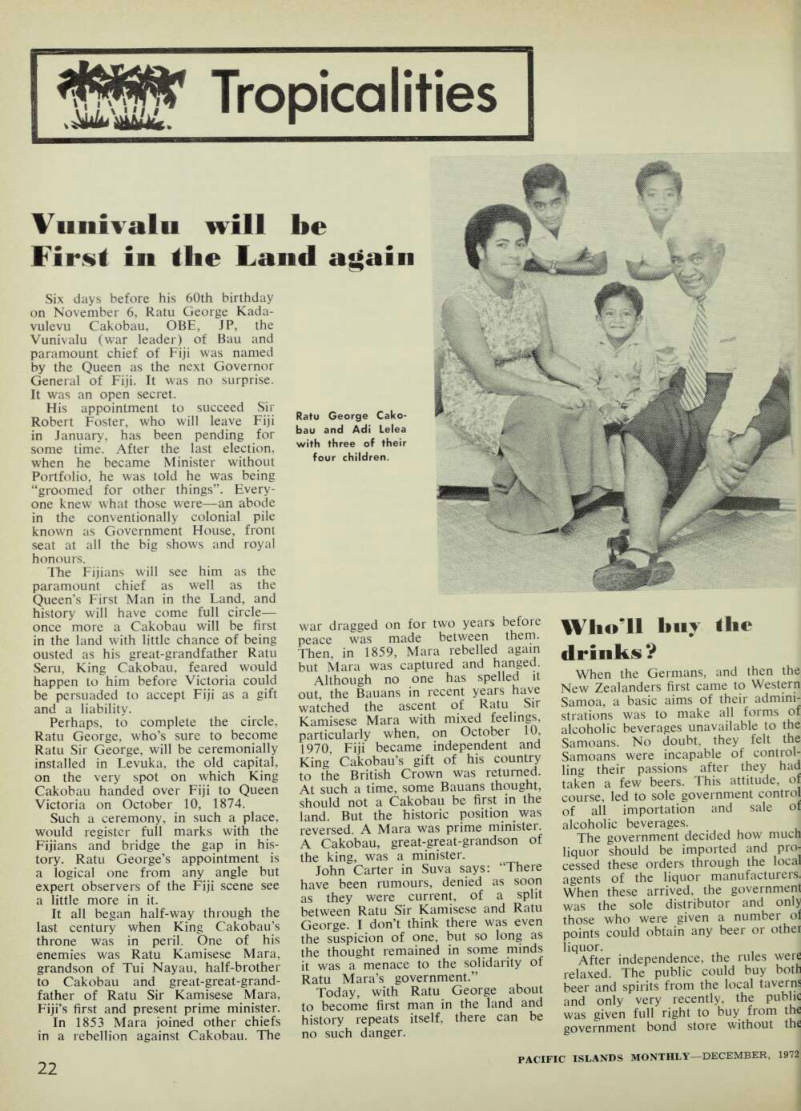
Ratu George Cako bau and Adi Lelea with three of their four children.
need for any points from the Police Department.
So far so good for the public. But some months ago, the government reportedly tried to take away the agencies from the local firms.
A local member of the Chamber of Commerce complained that the government had written direct to the manufacturers requesting that the agencies for liquor coming to Samoa should be transferred to the govern ment. This would have the effect of transferring the commissions now □eing earned by the local agencies to he government—so that the govern ment would not only get the revenue Torn the duty and sales of alcoholic irinks, but also the commissions!
The member, who did not want to me identified for fear of government eprisal, said the government was mgaging in unethical practices. It was rying to take over what should pro )erly be left in the hands of private mterprise. In fact, the government hould get out of the business and eave all the importing and distribut ng to the local firms.
Basically, this is the Chamber of Commerce position. It wants the ;overnment to get out of the business )f importing and distributing alcoholic Irinks, and to leave this to private mterprise, which probably could do t much more efficiently and at much ess cost to the public. The chamber laims the government will gain more evenue by leaving the business to •rivate enterprise.
In spite of this, the Minister of Customs, Tofa Siaosi, rejected the hamber proposal. He instead asked hat a proper written submission be nade, but the chamber fears the esult would be the same, that the ninister is merely trying to gain ime.
The chamber’s outcry has become nore persistent as a result of more requent shortages of certain brands f liquor, especially of beer.
Hang them!
No noose would have been good ews for some people in Fiji at Jovember’s beginning when parlia ment decided to end the five-year moratorium on hanging for murder.
Tmere was a free vote which produced mme strange bedfellows, many of me Alliance side of the house, icluding ministers like Deputy Prime linister Ratu Sir Edward Cakobau nd Finance Minister Charles Stinson, □ting alongside the majority of lational Federation Party members ) restore the death penalty. The lotion to extend the present suspen on of the death penalty for another
five years lost by 23 votes to 18 with one abstention.
But that doesn’t necessarily mean that the rope will come back to Suva Gaol. There is time before the moratorium period ends in January for both the House of Representa tives and the Senate to push a bill through to abolish hanging com pletely.
Emotion played a big part in the debate. The waverers, were pushed over the edge by a recent murder which horrified the whole country.
The fact that murders have not in creased during the last five years weighed little with those who believed in something more than deterrence.
They were out for punitive punish ment.
Some reverted to the Middle Ages and called for castration for sex murderers—which they’ve got in Sweden today—and for torture before execution. They won the day, though it’s safe to say there’ll be no castra tion in Fiji—or torture.
44 C«raI chain"
islands hopeful
Work has recently started on the production of a film on Melanesia.
Filming is being done by the Papua New Guinea Tourist Board's film unit and the film is sponsored by the Melanesian Tourist Federation.
In September Chris Fryman, film director for Pangtour made a survey trip through the British Solomon Islands, New Hebrides and New Caledonia and returned to Port Moresby enthusiastic about the prospects for the Melanesia film. A
survey for the Papua New Guinea content was made some time ago.
The object of the film is to show the world where Melanesia is and the variety of attractions it has to offer. Viewers will also see modern air transport and modern hotels.
Original plans were for the film— which will be in full colour—to have its premiere at next year’s Pacific Area Travel Association conference in Tokyo, late February. It is now doubtful if it will be ready by then and the federation may have to find some other suitable opportunity to launch the production.
Also planned is a comprehensive tour guide on the four countries— the first-ever combined information production from Melanesia. However to fill the need for information the federation is pressing ahead with the immediate production of cyclostyled sheets to assist agents and airlines to sell Melanesia.
Improved air services to and through the Melanesian countries offer a golden opportunity for the build up of tourism, but, says federa tion chairman Don Barrett of Papua New Guinea, accommodation is still a problem in some places.
In Port Moresby in particular there has been an excess of demand for hotel rooms over those available.
Prospects of relief have faded some what with the suspension by Ansett of proposed extensions to the Gateway Hotel following the announcement of plans fo a national airline in PNG.
There is to be a year’s delay in the site becoming available for the Travelodge consortium multi-million dollar project in Port Moresby, and
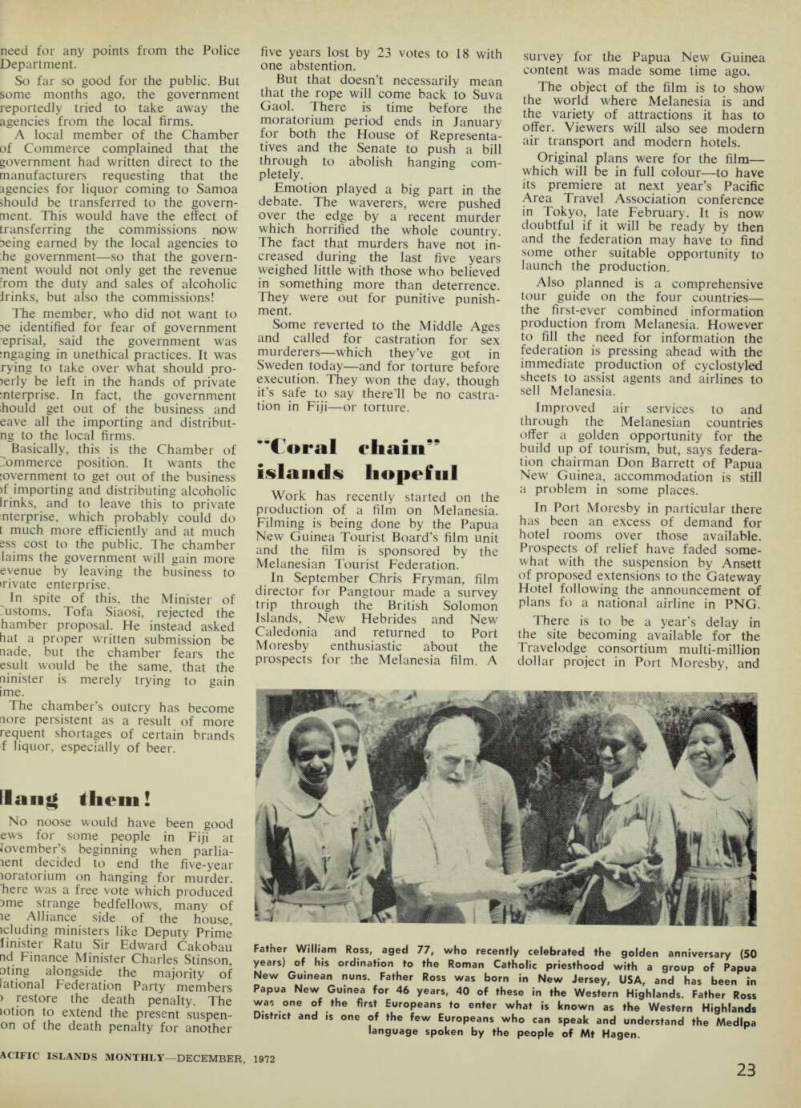
Father William Ross, aged 77, who recently celebrated the golden anniversary (50 years) of his ordination to the Roman Catholic priesthood with a group of Papua New Guinean nuns. Father Ross was born in New Jersey, USA, and has been in Papua New Guinea for 46 years, 40 of these in the Western Highlands. Father Ross was one of the first Europeans to enter what is known as the Western Highlands District and is one of the few Europeans who can speak and understand the Medlpa language spoken by the people of Mt Hagen.
Davara Motel is to remodel its “old wing” before proceeding with a plan ned extension.
The situation is brighter in other PNG towns. Rabaul’s Ascot Hotel has just completed remodelling that includes a new air-conditioned lounge bar and dining room; further plans include the converting of the present bar into a function room. Smugglers’
Motel in Madang is constructing a new block and several hotels in the Highlands have added rooms in the past six months.
Honiara has a doubled capacity.
The Air Pacific jet service from Suva to Port Moresby cut out a night stop over at the BSI capital and this has affected business this year. How ever in the long run Honiara should benefit since travellers can con veniently stop over for two days and go on to Port Vila, Noumea or Fiji.
BSI tourist interests are less happy with the service in the other direction since the Air Pacific jet and TAA’s jet are on Sunday and Tuesday respectively. A wider spacing would suit them they claim, but TAA has explained that operational require ments make it impossible, at least for
the present, to fly the route with a DC9 on any other day.
With the nickel building boom over in New Caledonia that country is really seeking tourists. New hotels, new restaurants and other attractions such as boat cruises are available — and prices are not “out of this world”.
Qantas and UTA are selling cheap packages to both New Caledonia and the New Hebrides. With really de pressed copra prices and not much other source of income (save offshore companies) the condominium has a large welcome sign out for tourists — and the number is increasing steadily, although New Caledonia is still the best customer.
The Melanesian Tourist Federation hopes to encourage more travel by individuals and family groups which do not pose such a strain on ac commodation in places like Port Moresby. It hopes to get more Aus tralian and New Zealand people going through the “coral chain”.
The counter attraction of cheap fares to UK, Europe and Singapore is a big hurdle to overcome but the federation is hopeful that there could be excursion fares through Melanesia in the not too distant future.
She's consumed
with zeal
Anaseini Qionibaravi, Fiji’s only woman senator, is softly-spoken, eminently feminine. Wife of a highly successful Fijian businessman and mother of four children, hers is far from the image of aggressive cam paigner, waver of banners, upholder of the rights of the underprivileged.
As first chairman of Fiji’s Consumer Council however, she’s all of those.
The job, for which she isn’t paid and to which she devotes almost all the normal working day, is one of the most important in inflation (and now hurricane) hit Fiji. It’s also one of the most frustrating.
Because the council still hasn’t any real power, she told PIM in November, shopkeepers won’t re cognise the existence of a pressure group protecting consumer interests.
A Consumer Council staff member, writing down prices recently in a certain store, was told to leave. “We don’t want any of that sort of thing here,” said the shopkeeper.
Mrs Qionibaravi says: “People say the council is doing a marvellous job
in publicising over-priced items and instances of consumers being at the mercy of unscrupulous shopkeepers— but we’re not satisfied with that.
There is much more to be done.
“The only weapon we have is publicity, but at present we can’t name the guilty offenders or take them to court. We need these powers.
We need some real teeth.”
A former teacher of home econo mics and then full-time radio an nouncer (she still has a daily women’s programme), Mrs Qionibaravi says: “When it comes to complaints, those two big octopuses are named again and again.
“It’s useless to point out that a particular brand of face cream is selling for one price in an uniden tified shop and for a much lower price somewhere else. The lower priced one is marked up immediately!
“We need to be able to name the offenders publicly.”
With 11 members, all of them volunteers, the Consumer Council is part of Fiji’s Ministry of Commerce and Industry. Set up in November last year, as part of the government’s efforts to combat inflation, it now has branches in Suva and Ba. More are
planned and two publications—simply
presented, in English, Hindi and Fijian—are to be circulated.
Getting the message across to rural dwellers is the biggest challenge facing the Consumer Council.
Villagers know nothing of budgeting.
They don’t earn a regular income.
And they certainly can’t shop around looking for the best buy.
Mrs Qionibaravi wasn’t in favour of price control on local produce— until the hurricane. “We’ve seen such astronomical increases since the hur ricane that some sort of control is essential,” she said. “Shopkeepers all over the country are taking advantage of the situation. Our council is going to have to become more aggressive.”
Royal visitor?
The coconut radio says there are plans for Queen Elizabeth to visit some of the Islands, notably the New Hebrides, next year. Prince Philip has visited the condominium, and so has a French President, but no British monarch.
Samoan novelist
Mr Albert Wendt, Samoan writer, poet and schoolteacher, has recently announced the acceptance of his latest novel, Sons for the Return Home.
Mr Wendt (principal of Samoa Col lege, Apia) claims his novel is the first by a Samoan writer to be pub lished, and also perhans the first published novel by a Polynesian.
Mr Wendt says of his novel; “It is about 250 pages long and is divided into three parts. The first two parts are set in New Zealand, the last part set in Western Samoa. The novel concerns a Western Samoan family who migrate to New Zealand in the early 19505. It deals with their life there and their eventual return to Western Samoa 20 years later.”
The book is woven around the two main characters—the youngest son of the family and a pakeha girl, and it examines different kinds of love, racial conflict, the conflict between two very different cultures and the conflict between different generations.
“In one way, the book is my small contribution towards racial under standing,” said Mr Wendt. Sons for the Return Home is being published by Longmans by next March.
Mr Wendt has two other books to be published by the same publishers, a collection of poetry and a collec tion of short stories, and he is cur rently trying to finish off aa 800 page novel. Mr Wendt is an MA in history from Victoria University. He has already had many poems and stories published in New Zealand and other Pacific countries.
Hurrying up
the PNC Anglicans
A hard-hitting report on localisa tion in the Papua New Guinea Angli can church says that as things are going the church won’t be able to meet its 1980 target date for com pleting localisation. The report was made by Dr Robin Gill, an English priest and sociologist.
He claims that in responsibility and decision-making, the Anglican church is still basically an expatriate church.
Dr Gill says the Anglicans com pare favourably with the Roman Catholics, but poorly with the Lutheran and United churches. He concludes that . . the Anglican church is in urgent need of a pro gramme of localisation.”
Far more responsibility should be given to local priests, and expatriate priests should be willing to act as assistants to their indigenous col leagues, he believes. More top jobs in the church should be given to Papua New Guineans and all diocesan planning and decision-making com mittees (at present dominated by ex patriates) should have “a clear majority of local members, and, preferably, local chairmen,” says Dr Gill.
He also calls for the appointment of a special commission to look into the pay and conditions of local clergy, many of whom, he says, are very poor. Local clergy are beginning to resent the better salaries and hous ing of the expatriate priests, a feeling which he thinks the white clergy are mostly unaware of.
Dr Gill’s report was presented to the last meeting of the Diocesan Council, which appointed a special committee to consider it. The com mittee is made up largely of local people and is headed by Papuan Bishop George Ambo.
A tour to
remember
Guest houses mean many things in the Fiji capital of Suva—a lot of them not nice. Noise, cheap women and black market beer are among them.
Which may explain the reaction of the management of the Australian Capital Territory soccer team when it arrived in Suva and found its booked into one.
The Australians announced, firmly, that they were having nothing of it.
“If you don’t find us somewhere
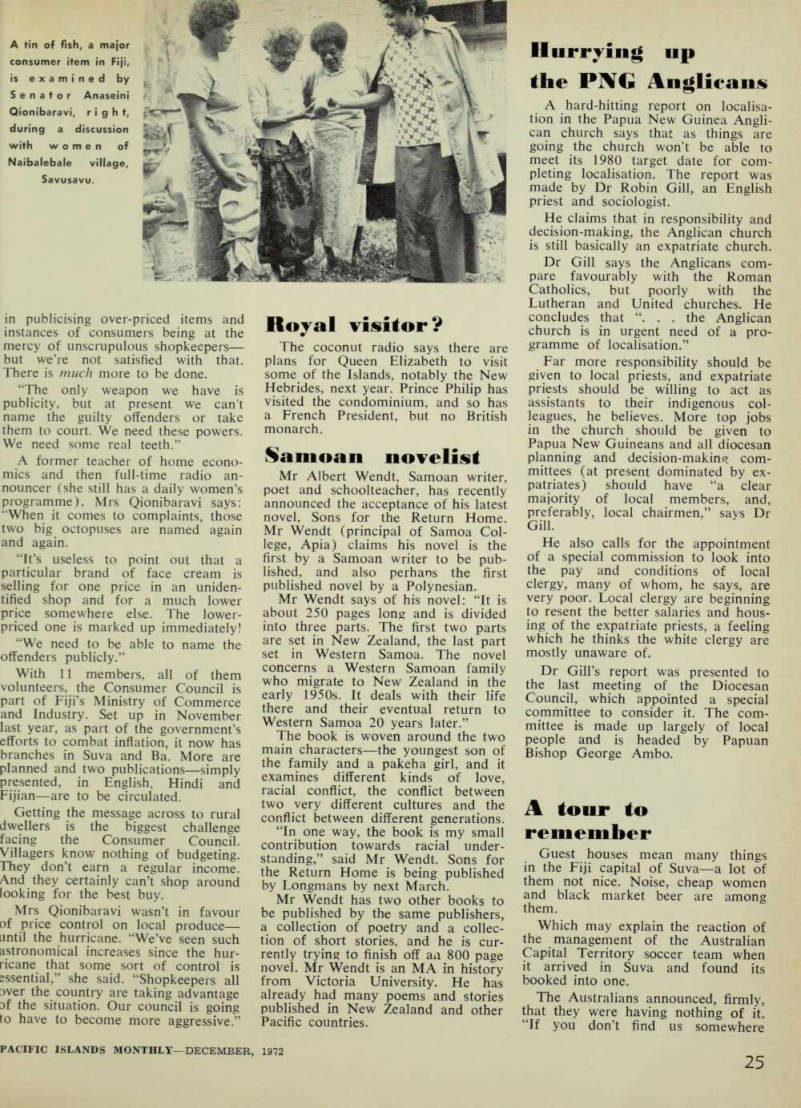
A tin of fish, a major consumer item in Fiji, is examined by Senator Anaseini Qionibaravi, right, during a discussion with women of Naibalebale village, Savusavu.
better to stay we are not playing,” they said.
The ultimatum led to much running around by the Fiji soccer officials.
Eventually the Australians were found alternative accommodation.
It was all very much a storm in a tea cup—the guest house in ques tion was one of Suva’s respectable ones —but typical of this hot-tempered tour.
The Australian side was the first overseas team to meet Fiji in Fiji in seven years. It’s going to take Fiji soccer fans about as long to forget these games.
In the first game of the two-match series, the Australians beat Fiji 2-0 and were hooted by the big crowd for their rough play. The Fiji players came off the field bitter at the maul ing they took at the hands of the Australians.
The second game looked like de veloping into open warfare. It did.
Police came on to the field to break up a wild brawl between the teams shortly before halftime. At least one prominent Fiji official had to be led off the field and referee S. A. Hus sain was pushed and sworn at by the Australian players.
Fighting continued through the second half. Linesman Humphery Chang got into a shouting match with the Australian players and referee Hussain had to step in and restore order. (The match, by the way, was a 2-2 draw).
Trying out the
common roll
Common roll voting, with all the races thrown together into one ballot —after land, Fiji’s most contentious subject—came to Suva and Lautoka on November 5 with the municipal elections fought on party lines.
People voted for party and not the man. The Alliance took over the Suva
City Council with 14 seats against the National Federation Party’s six, and the NFP, in an area where the Indian community predominates, won control of the Lautoka Town Council 8-4.
Suva’s Alliance group chose for mayor, Cr Peter Allan, a long-serving member, who was deputy mayor a few years ago, thereby dashing the hopes of Cr C. P. Bidesi of the NFP, who plaintively complained that a year ago there was a promise that he would be the next mayor.
Last year’s mayor. Dr Macu Salato, who didn’t exactly cover himself with glory in the post, did not stand for the council this year. There are rumours that he will be Fiji’s Number One man in London.
The NFP at Lautoka also steam rollered their man in but they fell out doing it. The caucus was split, one faction wanting popular, moderate Cr Hari Punja, the other Cr Wilfred Sugrim. It was alleged that at the party meeting one member had struck another.
Cr Punja got the nomination and all 12 councillors, both Federation and Alliance voted unanimously in the council meeting for Cr Punja.
Chickens may come home to roost with the election to the council of Cecil Bradnam, who a few months ago was sacked by the council from his job as City Engineer. Cecil would be more than human if, at some time or another, he doesn’t weigh heavily on those who encompassed his dis missal, both councillors and officials.
Crisis in the Cooks
In the interests of nature and human respect, the authorities at Rarotonga are going to have to streamline their Customs and immi gration procedures for seaborne visitors.
At any rate that’s what the crew and passengers of the charter yacht Winston Churchill think after drop ping anchor at Rarotonga in Sep tember. They were met by officials who told them that, in the interests of the campaign against pollution of lagoons, a brand new modern toilet facility had been established on shore and must be used in preference to yachts’ toilets which were not allowed to operate while in port.
So the crew and passengers waited patiently for clearance before going ashore. That took six hours at the end of which a crowd of uncomfort able people dashed for Rarotonga’s newest attraction. They found it locked. But it could be operated by the insertion of a New Zealand 5c piece. They hadn’t one between them.