Christmas high jinks
pp. 22-23 · Read in the full issue
but no rejoicing over nickel
New Caledonia Diary With
HELEN ROUSSEAU in Noumea
“Joyeux Noel” and “Bonne Annee” are the greeting phrases the French exchange as Christmas and New Year festivities approach.
Papa Noel sent his display wares well in advance to Noumea stores this year, so that from the end of October Caledonian mothers had an increasingly embarrassing time each occasion they escorted their infants through the doors of Maison Barrau, Ets. Ballande, Prisunic etc.
As the stocks of champagne expanded on supermarket shelves, adults also thought of the good time ahead, that is, if they could momentarily forget the fact that prices kept rising while incomes were falling with the nickel tide.
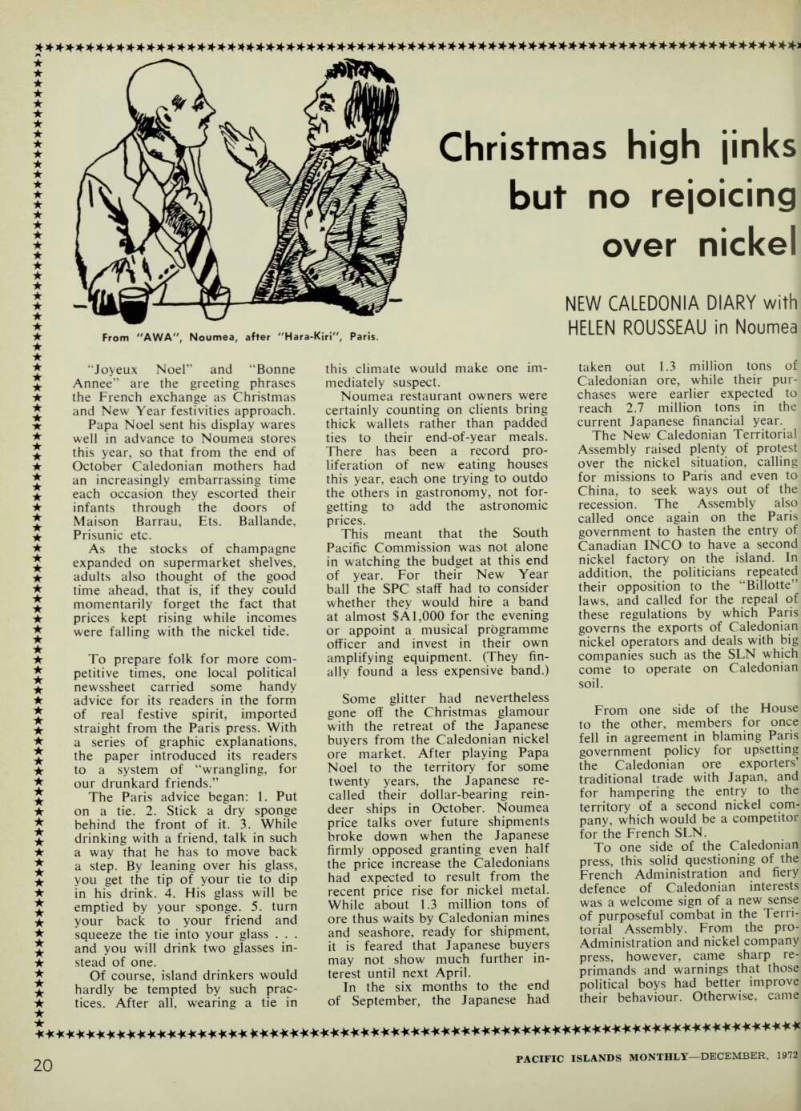
To prepare folk for more com petitive times, one local political newssheet carried some handy advice for its readers in the form of real festive spirit, imported straight from the Paris press. With a series of graphic explanations, the paper introduced its readers to a system of “wrangling, for our drunkard friends.”
The Paris advice began: 1. Put on a tie. 2. Stick a dry sponge behind the front of it. 3. While drinking with a friend, talk in such a way that he has to move back a step. By leaning over his glass, you get the tip of your tie to dip in his drink. 4. His glass will be emptied by your sponge. 5. turn your back to your friend and squeeze the tie into your glass . . . and you will drink two glasses in stead of one.
Of course, island drinkers would hardly be tempted by such prac tices. After all, wearing a tie in
this climate would make one im mediately suspect.
Noumea restaurant owners were certainly counting on clients bring thick wallets rather than padded ties to their end-of-year meals.
There has been a record pro liferation of new eating houses this year, each one trying to outdo the others in gastronomy, not for getting to add the astronomic prices.
This meant that the South Pacific Commission was not alone in watching the budget at this end of year. For their New Year ball the SPC staff had to consider whether they would hire a band at almost SA 1,000 for the evening or appoint a musical programme officer and invest in their own amplifying equipment. (They fin ally found a less expensive band.) Some glitter had nevertheless gone off the Christmas glamour with the retreat of the Japanese buyers from the Caledonian nickel ore market. After playing Papa Noel to the territory for some twenty years, the Japanese re called their dollar-bearing rein deer ships in October. Noumea price talks over future shipments broke down when the Japanese firmly opposed granting even half the price increase the Caledonians had expected to result from the recent price rise for nickel metal.
While about 1.3 million tons of ore thus waits by Caledonian mines and seashore, ready for shipment, it is feared that Japanese buyers may not show much further in terest until next April.
In the six months to the end of September, the Japanese had
taken out 1.3 million tons of Caledonian ore, while their pur chases were earlier expected to reach 2.7 million tons in the current Japanese financial year.
The New Caledonian Territorial Assembly raised plenty of protest over the nickel situation, calling for missions to Paris and even to China, to seek ways out of the recession. The Assembly also called once again on the Paris government to hasten the entry of Canadian INCO to have a second nickel factory on the island. In addition, the politicians repeated their opposition to the “Billotte” laws, and called for the repeal of these regulations by which Paris governs the exports of Caledonian nickel operators and deals with big companies such as the SLN which come to operate on Caledonian soil.
From one side of the House to the other, members for once fell in agreement in blaming Paris government policy for upsetting the Caledonian ore exporters’ traditional trade with Japan, and for hampering the entry to the territory of a second nickel com pany, which would be a competitor for the French SLN.
To one side of the Caledonian press, this solid questioning of the French Administration and fiery defence of Caledonian interests was a welcome sign of a new sense of purposeful combat in the Terri torial Assembly. From the pro- Administration and nickel company press, however, came sharp re primands and warnings that those political boys had better improve their behaviour. Otherwise, came
From "AWA", Noumea, after "Hara-Kiri", Paris.
the stern warning, Paris intentions to allow greater decentralisation might be changed, if such irrespon sible, inquisitive debates continued.
For their part, the Administra tion had to remind the Assembly, on another matter, that they had no right to intervene on an execu tive matter such as the premature recall to Paris of a public service chief, whom Assembly members considered was giving satisfaction.
Back on the nickel front, by this time the SLN was also raising the alarm, crying poor in the current recession and insisting it would not be able to continue operating if the territory’s nickel export tax laws remained unchanged. The company flew its managing direc tor, Mr Bernard de Villemejane, out to Noumea to denounce the Caledonian tax system, which hits the SLN shipments of nickel, re gardless of whether the company’s balance sheet shows a profit or loss.
Meanwhile, as the Japanese smiled and flew back to Tokyo, teams of prospecting geologists from various overseas mining com panies were also closing their dossiers and flying home. Their parting comments indicated that they could look at the situation again in 1974-76, but now exten sive world discoveries have made the nickel market more competi tive.
New Caledonia, with half the world’s known nickel reserves, had a good start in the contest, but in tervening factors such as rising local costs and government con trols are making the Caledonians wonder how they can keep in the race.
Ironically enough, as one Franco- American mining group has moved aut of its choice site on Noumea’s bayside promenade, the vacated building has been converted into a waterfront restaurant. For in the moment of crisis, the magic wand af tourism is being waved over the lormant nickel mines.
Undoubtedly, Noumea, its outer slands and coastal hinterland ;ould provide immense fascination or overseas visitors. But scenic ;pots, as much as local inhabitants, nust become accessible if they eally want to welcome travellers.
The French craving for indivi dual liberte restrains them from bothering” even their suburban leighbours with excessive doses of
friendliness. So visitors must not be daunted by this seeming indif ference. Rather, newcomers could indulge the whims of their own personalite and just enjoy being themselves, imbibing a changed atmosphere. There is certainly plenty to imbibe, through more than the purely oral senses.
The major problem for the visitor, of course, is to do this with out devouring his travellers’ cheques too fast. This may mean abandoning the popular idea that a holiday must be a bargain hunting spree, and instead deciding that a holiday can also include collecting fresh views of people, as seen on a 20 cent bus ride or over a 50 cent cup of coffee on a pave ment terrace.
French tour promoters are cer tainly concerned at the territory’s dwindling tourist traffic, but one of the major problems here still re mains the fact that most visitors are not millionaires, and if they are, they demand service when they pay.
So far the unhappy fact remains that in the first three-quarters of this year, New Caledonia has re ceived only 8,085 visitors staying on the island, a drop of over one third from the peak year of 1968.
As the Chateau Royal hotel ex tensions progress towards the opening scheduled for next July, its French promoters were plan ning to spend up to $A150,000 to advertise it on the Australian market. In addition, UTA French airlines were announcing a special bid to improve service on their flights.
While a Noumea barrister ad vertised in the local press for dis satisfied passengers to contact him with a view to forming an Asso ciation for the Protection of Clients, the French airline in formed Caledonians that extra (free) smiles and courtesy would be dispensed by the company from December 1.
There certainly should be more smiles all around, since the new passenger terminal has been opened at Tontouta, the island’s international airport. The new restaurants, bars and duty-free facilities give visitors an impres sive welcome to the French island.
Various Noumea tour and car operators have offices in the new terminal, while the decor is en hanced by mural pieces, from
locally-established French artists.
Not to be left behind, the Port of Noumea is still planning to build a Welcome Hall for cruise visitors. The building is now planned also to handle bus pas sengers from Tontouta. Credits of about $A200,000 have been aliocated for an imaginative design to feature New Hebridean timber. It is hoped these new tourist facilities can be completed before the end of 1973.
Meanwhile, since visitors usually face a language handicap, they have to be prepared to ask lots of questions if they are going to know all the interesting things that could be going on in Noumea —the location of the current art shows, the programme of star singers who now fly in regularly from France, and the venue of Melanesian women’s cricket.
Among some of these recent “spectacles” have been the shows of singers Rika Zarai then Jacques Dutronc, flown in from Paris; an exhibition of Indonesian art work, sponsored by the Indonesian Consul and Mrs Paul Samadiono; Jamaican, Japanese, Australian and New Zealand boxers, patronised by the SLN nickel company sports club. Caledonian boxing fans pay from SAI4 to $2B to watch what have now become regular monthly boxing evenings organised by the ASLN.
While the nickel company is diverting local aggressive instincts to this rowdy sport, figures from the French Administration indicated a need to cut territorial expenses, as revenue was to be SAI3 million below estimates on a planned 1972 budget of some $BO million.
For 1973, the Administration has proposed a budget reduced to $69 million. At the same time, Governor Verger continues to emphasise the need for Caledonians to seek more loan money from Europe to keep up the territory’s development programmes at a time when nickel earnings are not meeting earlier expectations.
Among the first loan items mentioned by the Administration were over a million dollars required for a rugby field and new indoor sports hall in Noumea.
Obviously, serious thoughts are already turning to the next South Pacific Games in Guam, 1975.