mid-Pacific
pp. 31-34 · Read in the full issue
Devastation comes to mid-Pacific
From JOHN CARTER in Suva
Around 10 a.m. on Tuesday, Oc tober 24, a youngster, in Suva for only a year or two, said to me, “It’s great; I’ve wanted to experience a hurricane.” He was talking about hurricane Bebe which was then about 12 hours away from the Fiji capital.
He’d changed his tune the next morn ing, full of relief that it was a :hastened but still dangerous Bebe which had hit Suva after devastating a large area in north-west Viti Levu.
He was even more relieved when details of the carnage caused by the 150-knot hurricane began to filter hrough. Once again, for the third ;ime in eight years, Suva had been ucky, comparatively lucky that is.
Damage in the city was slight—more if an inconvenience than anything ;lse. For the third time in eight the lovely islands lying to the lorth of Lautoka, the Yasawas, had )een smashed, the people left home ess and their crops gone.
North-west Viti Levu, particularly and Ba, also suffered ;everely. Thousands were made lomeless and without food or cloth ng and the death rate was the leaviest since the 1932 hurricane when nore than 200 were drowned in the 'alley at Ba.
Bebe killed 19 people in Fiji, six )f them at Ba and three at Rakiraki md Tavua, and badly injured 25. fhere were 113 “moderately” in ured and 791 had minor injuries.
Total damage has been assessed at >etween SlO million and $2O million; t will cost much more to feed and muse the victims. Probably 50,000 vere made homeless.
Aid has poured in from overseas.
Suva took the preliminary warning almly and began battening down, fhe news reached Suva on the Sun lay that Funafuti had been blasted, lardly a house stood. A tidal wave tad swept three people away. One, ater officially confirmed as dead, /as Surendra Ariyan (29), a Fiji adio technician on duty at the Funa uti meteorological station when the
tidal wave swept away the building.
Altogether six people died, 90 per cent of the buildings on Funafuti were destroyed and 700 were made homeless. Two deep sea fishing boats were sunk and their mother ship, Van Camp I was aground.
It was one of the big hurricanes all right, all of 150 knots, but would it hit Fiji? Then Rotuma got it; houses down, crops destroyed but no fatalities. It had been raining hard since the Sunday and the wind began to freshen until by Monday night, October 23, it was blowing a gale.
The following morning the Yasawas caught Bebe’s full blast and her future path was sure—some part of Viti Levu would get it. The capi
tal was like a dead city. Only a couple of milk bars were open; the big stores had sent their staffs home to look after their houses.
A few people roamed around, one, a tourist, complaining to me that he wasn’t staying any longer in Fiji and wanted to buy some duty-free goods and the shops were shut. Well, he needn’t have worried. He wouldn’t get out of Fiji for a few days.
By late afternoon gusts of around 80 knots were howling around the buildings. Darkness came ahead of time. Mopping up operations were going on at The Fiji Times printing works and in the newsroom Bebe’s depredations were being recorded. (More pictures pages 30 and 31, text continues on page 32.)
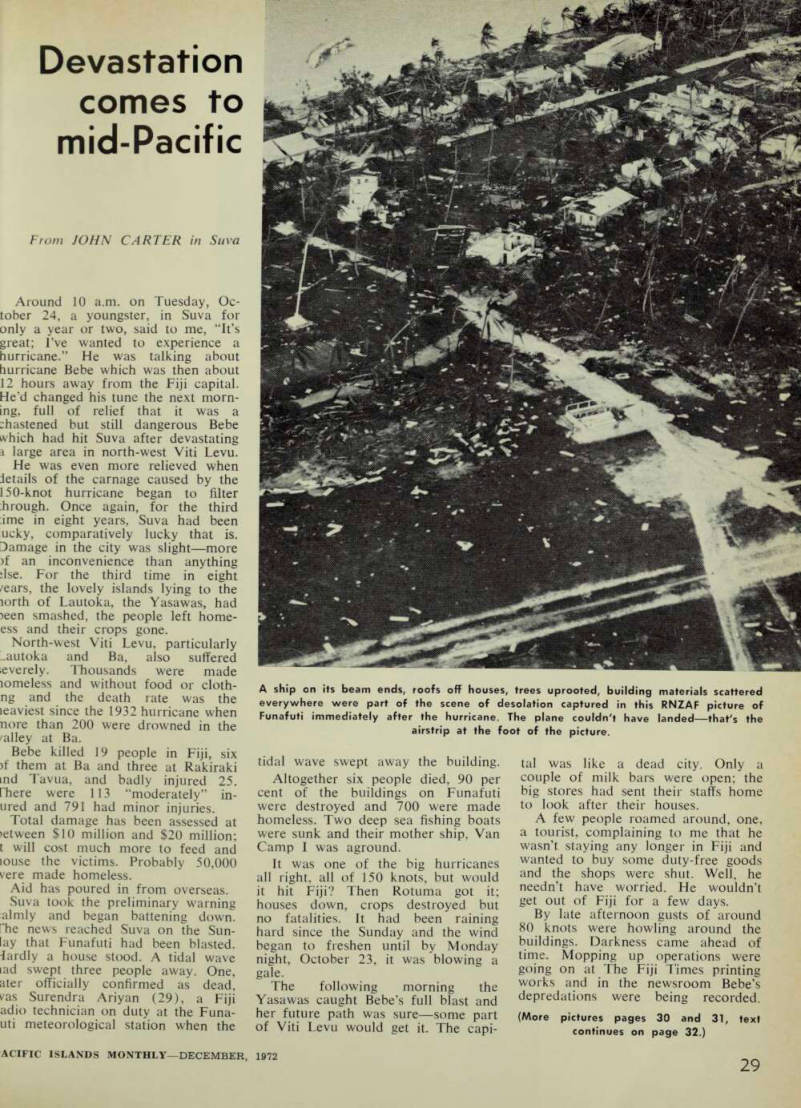
A ship on its beam ends, roofs off houses, trees uprooted, building materials scattered everywhere were part of the scene of desolation captured in this RNZAF picture of Funafuti immediately after the hurricane. The plane couldn't have landed—that's the airstrip at the foot of the picture.
The Navua River had broken its banks. The big bridge had been swept away. The Rewa River was rising dangerously—it drowned 12 in 1965.
Lautoka, Ba and Nadi were getting it badly. Then it would be Suva’s turn, around 10 p.m. Why are the worst hours always at night?
As the hour neared people began wondering. There were 100 mph gusts but at Lautoka they were reckoned at 180 mph. What had happened to Bebe? She came over the mountains and the land of Viti Levu had sapped her energy. For a couple of hours a chastened Bebe blew through the city. Power and telephone lines went in some places.
A few roofs were damaged but Bebe was now more noisy than murderous. Suva had escaped.
Lautoka reporter Vijendra Kumar had a different story to tell. He saw, heard and felt Bebe at her worst.
Below is his story.
Night of feor
From Vijendra Kumar in Lautoka At Lautoka and Ba winds of up to 180 mph roared and howled during a terrifying two-hour spell of carnage. The winds ripped off entire roofs and flattened bures (grass thatched houses). Stout baka trees and even the strong coconut palms danced crazily before being up rooted.
It was a little after 4.30 p.m. and yet in our newspaper office in Lau toka it seemed as if night had fallen.
Vitogo Parade was a watery channel and Namoli Avenue was a roaring torrent with water two to four feet deep in places. As I watched, a length of roofing iron from a stack in the shop-yard across the road, flew up and smashed against a signpost a chain away. Coconut fronds broke off the tree-tops and were carried chains away. Flying debris that hit electric wires which were still live sent sparks flying like dozens of tiny stars falling in the sky.
Frightened and wet, an elderly man tottered to our door and said: “Please tell me where the temple is.
I must shelter somewhere.”
I gave them directions to the Sikh temple which has a dormitory for poor guests. The two said they were ordinary farmers from Ba and had not heard the hurricane notice broad cast half-hourly by Radio Fiji. They were in Lautoka to sell their market produce but had lost everything and were trapped by the storm.
As they waded in the flooded street towards the temple, I decided to walk home five chains away. Falling and slipping in the muddy water, I ducked and weaved to avoid being hit by flying debris. Reaching Nacula Street —the road to my home—l watched out for broken electric wires which would have put a sudden end to my journey. Nacula Street was a mess of broken branches and tree trunks, tins, timber and a maze of wires. How I got through it all is something I wonder about still.
With the help of a flashlight, I saw strange objects floating all around my house. Discarded boxes, car parts, fruit and vegetables, coconuts, cloth ing and even a woman’s brassiere floated past.
My wife had improvised a kerosene lamp from an empty milk can—the only light in the house after our power cut off. Windows and doors shut, we waited while the entire world seemed to be in a mad frenzy out side. At about six, we felt a sudden silence. Opening the window, we found the rain had stopped and the wind had abated.
Bebe had passed over Lautoka.
The next morning, the sun came out shining bright.
On an inspection tour, I saw roads washed away, sugar cane fields under water, hundreds of trees uprooted, dead birds and animals scattered about, and the entire countryside littered with debris from damaged houses. There was despair on almost every face.
At Karavi, an old Land-Rover was carrying a coffin. The driver told us of the tragic deaths of a mother and son who were buried under the roof of their house as it fell. Their bodies were found by neighbours.
At the Ba Methodist Mission Hos pital, 1 met Mr Bal Krishna, a farmer from Koronubu. His wife lay critically ill in the hospital as he waited out side. He could hardly speak. I pieced together a story of the family’s terror as their little house was lifted up by the wind while they were still inside.
“My little nephew, my sister’s one year-old boy, was carried five chains away in the wind. My father and sister were thrown out somewhere and we found them dead. My wife suffered deep cuts on her head,” Mr Krishna said. Incredibly, the little boy was picked up from a bush uninjured.
Amid the destruction, men and women went about picking up pieces of their homes, burying the dead, repairing damage and with painful slowness resuming normal life. Said a Ba farmer who lost his cane crop and home: “Life must go on. We have to start again. It’s all God’s will.”