two are far closer to one another
pp. 57-58 · Read in the full issue
racially than either group is to its political mainland.
Now, their isolation, and the inevi table effect of education on young people’s horizons, is threatening once more to depopulate the atoll.
Malaria has been virtually con trolled after having been hyperendemic until the 19605, and a permanent medical clinic has just been built, along with the atoll’s first regular vater supply. Two open wells, one of :hem at least 100 years old, have been eplaced by concrete wells with 2,000 gallon tanks fed by windmills. At imes, previously, the only source of vater was young coconuts, although ain is usually plentiful.
Tim Bayliss-Smith says in an as yet mpublished study, “European obser vers have always considered atolls o be among the harshest of physical nvironments for human life”. He says hat typical of early reactions was he comment of the Spaniard Mau elle in 1791, describing what he bought were natives of Ontong Java: They returned to their islets, on /hich it appeared to me impossible or human creatures to live. We saw tere were a tolerable number of aim trees, which no doubt bore fruit, nd by this and the help of fishing lose islanders drag on their miserable fe”.
Even general accounts by modern eographers such as W. L. Thomas ill give the impression that atoll fe is a long and bitter struggle gainst a hostile environment; “Coral ;efs with their low sandy islets pro ide the most limited range of re mrces for human existence and the tost tenuous habitats for man in the acific. . . . The soil of reef islets relatively infertile, lacking humus, id fresh ground water is very mited or may be brackish or itirely lacking, . , . Even where rain -11 is abundant, an atoll can support ily meagre land vegetation and umal life. Maintaining a livelihood a considerable task for man”. And at was written in 1965!
Bayliss-Smith, however, has come ) with quite a different view of oil life. After spending a year on ntong Java with his French wife, ancoise, he is quite convinced that lere resources are not stretched by o large a population an atoll can tisfy man’s basic needs with very tie human effort. He found Ontong va to be “a perfectly viable habitat, oviding an adequate and balanced ;t, sufficient resources for a satisfac ry material culture, and even quite asonable levels of monetary income” om copra—coconuts are planted ry extensively on the atoll’s islands).
How many other people would be delighted to settle for an average of only 4.1 hours a day in activities that can be construed as work?
Bayliss-Smith found that the men spent 45 per cent, of this time in money-earning activities, mainly copra production, 36 per cent, in subsistence food production, notably fishing, 7 per cent, in house construction and maintenance, 4 per cent, in canoe making, 6 per cent, in travelling around the atoll, and the other 2 per cent, at various communal tasks such as village cleaning, well digging building schools.
Remembering that an atoll day is daylight only, he says “the other eight hours are free for resting, washing, childminding, eating, drinking and dancing, church attendance, and other social activities, various small village jobs not mentioned, and leisure”.
The women spend only 2.6 hours daily working, although they have the cooking and the children to at tend to on top of their work—copra production and taro gardening, with some housemaking. The pattern of work has been affected but not radi cally altered by imported tools.
This easy way of life has come about partly through the decrease in population, since in the past some 56 hectares of taro swamps were ex cavated by hand to support the earlier larger populations.
Other scientists looking for data on life in remote places have come to Ontong Java, where at least some aspects remain largely as they have been for centuries. A Harvard team visited in August, examining the physical make-up of the inhabitants, apparently to help understand why western man’s blood pressure rises as he gets older while people living traditionally in the Pacific tend to be the opposite.
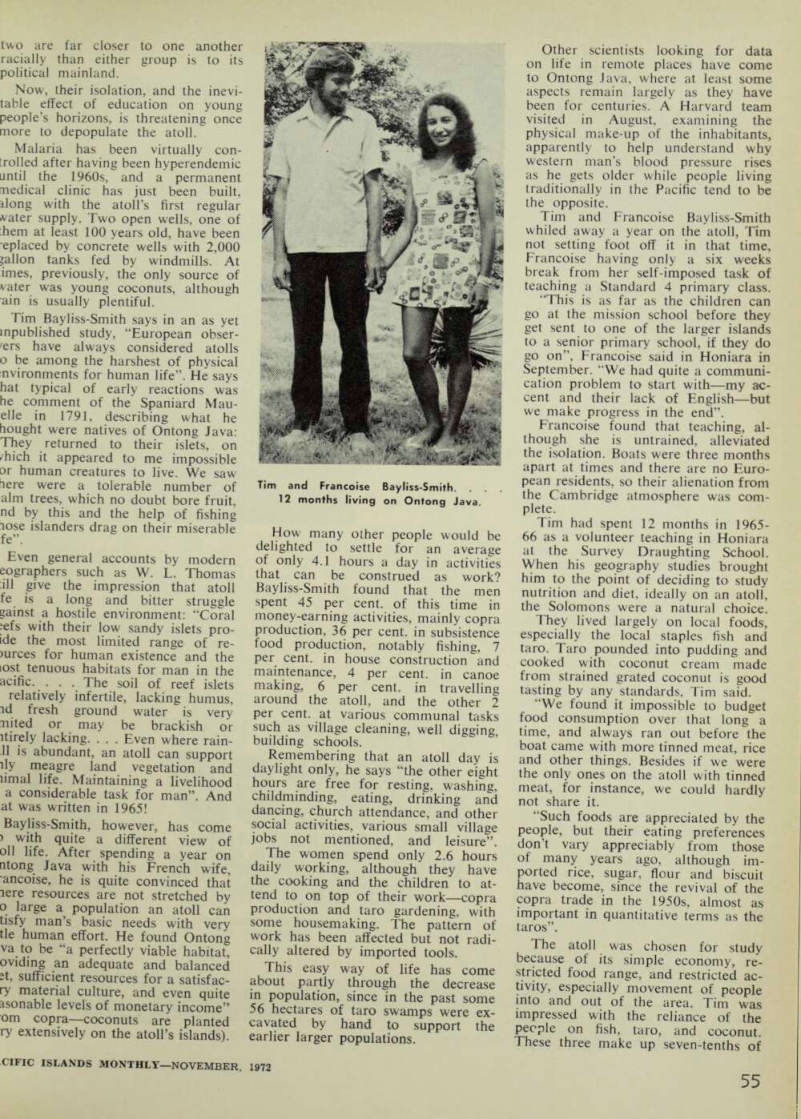
Tim and Francoise Bayliss-Smith whiled away a year on the atoll, Tim not setting foot off it in that time, Francoise having only a six weeks break from her self-imposed task of teaching a Standard 4 primary class.
“This is as far as the children can go at the mission school before they get sent to one of the larger islands to a senior primary school, if they do go on”, Francoise said in Honiara in September. “We had quite a communi cation problem to start with—my ac cent and their lack of English—but we make progress in the end”.
Francoise found that teaching, al though she is untrained, alleviated the isolation. Boats were three months apart at times and there are no Euro pean residents, so their alienation from the Cambridge atmosphere was com plete.
Tim had spent 12 months in 1965- 66 as a volunteer teaching in Honiara at the Survey Draughting School.
When his geography studies brought him to the point of deciding to study nutrition and diet, ideally on an atoll, the Solomons were a natural choice.
They lived largely on local foods, especially the local staples fish and taro. Taro pounded into pudding and cooked with coconut cream made from strained grated coconut is good tasting by any standards, Tim said.
“We found it impossible to budget food consumption over that long a time, and always ran out before the boat came with more tinned meat, rice and other things. Besides if we were the only ones on the atoll with tinned meat, for instance, we could hardly not share it.
“Such foods are appreciated by the people, but their eating preferences don’t vary appreciably from those of many years ago, although im ported rice, sugar, flour and biscuit have become, since the revival of the copra trade in the 19505, almost as important in quantitative terms as the taros”.
The atoll was chosen for study because of its simple economy, re stricted food range, and restricted ac tivity, especially movement of people into and out of the area. Tim was impressed with the reliance of the people on fish, taro, and coconut.
These three make up seven-tenths of
Tim and Francoise Bayliss-Smith. 12 months living on Ontong Java.
the diet, by energy content. However, there does seem the likelihood that the gradual changeover towards im ported starchy foods in place of taro will continue if the income from copra can be maintained. (The continuing low price of copra could help pre serve a traditional way of eating, and, it must be said, self-reliance.) Gardening on Ontong Java is quite a sight, if you can stand the clouds of mosquitoes which also inhabit the swampy garden beds. It is an inten sive system using a coral sand base, mulched with vegetable matter often brought from other islets to the in habited atoll islands. But the rain is frequent and this mulching so suc cessful that two crops of taro are harvested annually.
Sometimes very large pits are dug, down to a couple of feet above water level. Mounds around the gardens can be 25 ft high, and all dug by hand. Taro dominates, but pawpaw and bananas, sweet potatoes, sugar cane, and American taro are culti vated, playing a minor part in diet.
Breadfruit was never apparently very important, and practically all of the bearing trees destroyed by the 1967 cyclone have not been replaced.
Other sea and bird life are eaten, but not in significant proportion.
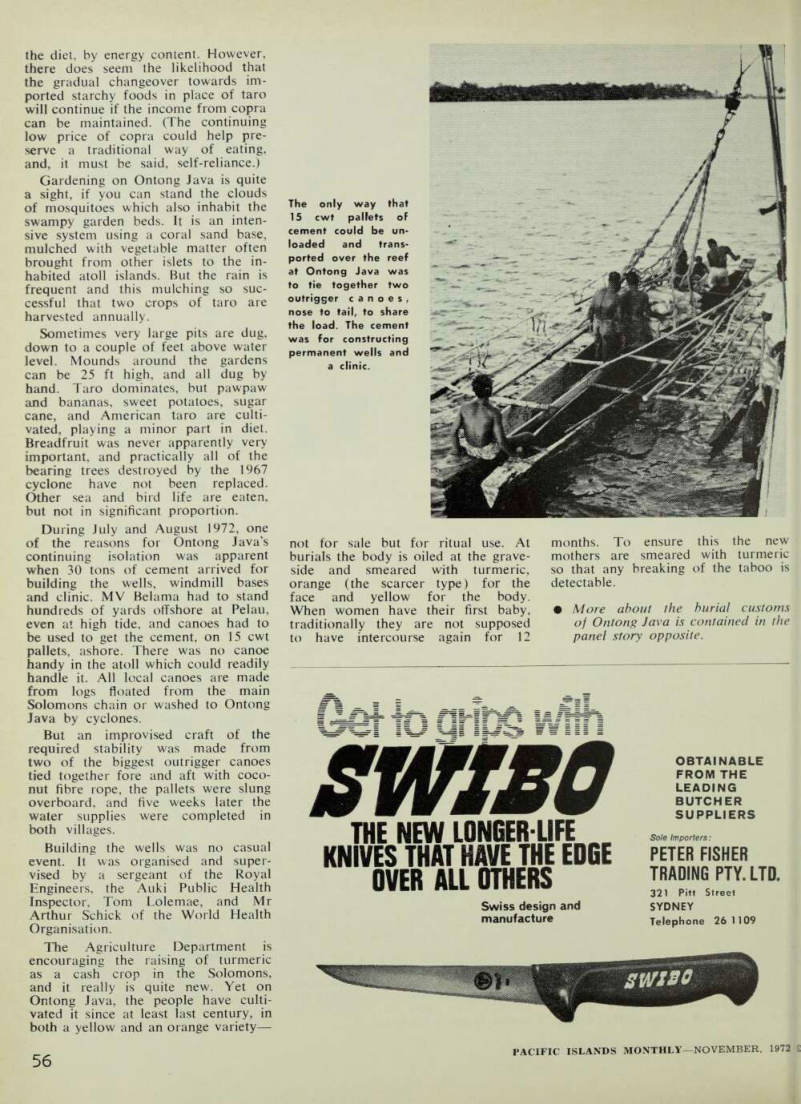
During July and August 1972, one of the reasons for Ontong Java’s continuing isolation was apparent when 30 tons of cement arrived for building the wells, windmill bases and clinic. MV Belama had to stand hundreds of yards offshore at Pelau, even at high tide, and canoes had to be used to get the cement, on 15 cwt pallets, ashore. There was no canoe handy in the atoll which could readily handle it. All local canoes are made from logs floated from the main Solomons chain or washed to Ontong Java by cyclones.
But an improvised craft of the required stability was made from two of the biggest outrigger canoes tied together fore and aft with coco nut fibre rope, the pallets were slung overboard, and five weeks later the water supplies were completed in both villages.
Building the wells was no casual event. It was organised and super vised by a sergeant of the Royal Engineers, the Auki Public Health Inspector. Tom Lolemae, and Mr Arthur Schick of the World Health Organisation.
The Agriculture Department is encouraging the raising of turmeric as a cash crop in the Solomons, and it really is quite new. Yet on Ontong Java, the people have culti vated it since at least last century, in both a yellow and an orange variety—
not for sale but for ritual use. At burials the body is oiled at the graveside and smeared with turmeric, orange (the scarcer type) for the face and yellow for the body.
When women have their first baby, traditionally they are not supposed to have intercourse again for 12
months. To ensure this the new mothers are smeared with turmeric so that any breaking of the taboo is detectable, • More about the burial customs of Ontong Java is contained in the panel story opposite.
The only way that 15 cwt pallets of cement could be un loaded and trans ported over the reef at Ontong Java was to tie together two outrigger canoes, nose to tail, to share the load. The cement was for constructing permanent wells and a clinic.