F "Too-Tranquil" Ontong Java
p. 55 · Read in the full issue
By Denis Fisk
In the early part of this century, the population of Ontong Java, one of the Pacific’s larger atolls, was re duced by at least 80 per cent, through introduced diseases and a breakup of the old political, religious and econo mic structure.
The lovely kidney-shaped atoll, 43 miles long and up to 16 miles wide, sarly last century was the home of a tightly organised community of around 5,000 people, who used every resource available to them on the lecklace of 124 islands around and n the lagoon.
But between 1900 and 1930 their lumbers dwindled to 700, and 10 /ears later to 600, through pre viously unknown diseases such as überculosis, influenza, pneumonia md malaria, as well as what one •esearcher of the 1930 s called “a state of mind which acquiesces in sxtinction”. At that time, it was gene ally held that the Polynesian/Micro lesian descended people on Ontong tava were most likely to die out.
In 1939, the atoll was declared i closed district following a serious nfluenza epidemic, and this was not evoked until two years ago. There las been a gradual revival, so that ast year’s head count by Cambridge esearcher, Tim Bayliss-Smith, in iicated a population of 1,083, inclu ling 211 living or working outside he atoll.
Whereas previously there had been
eight settlements, with four fairly certainly permanent, since 1910 there have been only two villages—Pelau, and the three times larger Luangiua (or Liuaniua as it is sometimes spelled).
Already 20 per cent, of the people have been attracted away permanently
or temporarily from their home which is 149 miles north of Santa Ysabel, the nearest island in the main Solomon islands chain. Their near est neighbours in fact are the people of Nukumanu in the Mort locks, 24 miles north, who are poli tically speaking New Guineans. These
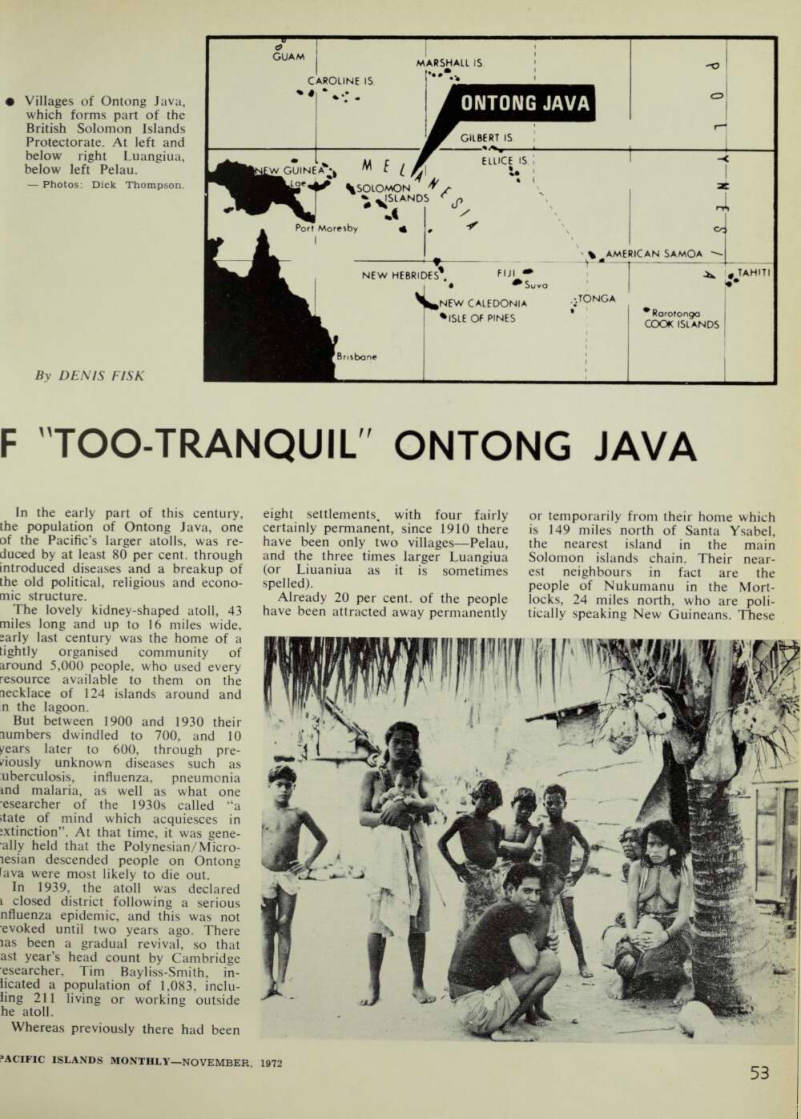
Villages of Ontong Java, which forms part of the British Solomon Islands Protectorate. At left and below right Luangiua, below left Pelau.
Photos; Dick Thompson.