Mixed burial ground reminds of earlier intolerance
p. 59 · Read in the full issue
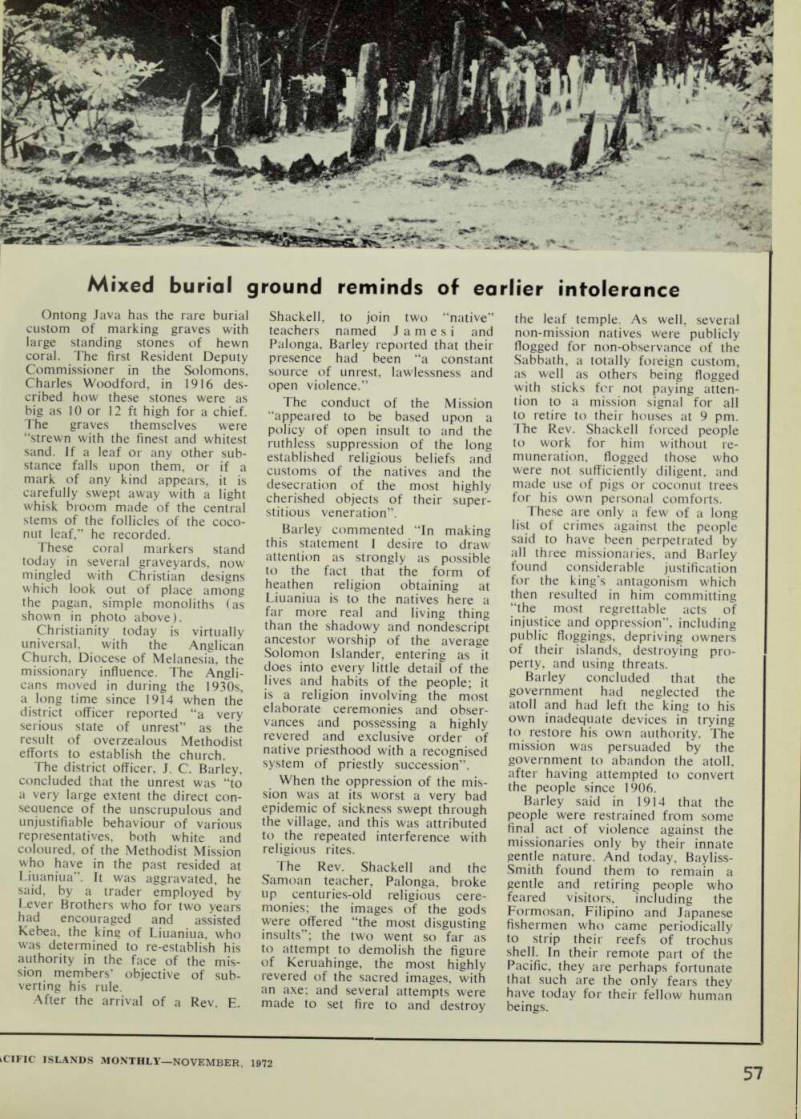
Ontong Java has the rare burial custom of marking graves with large standing stones of hewn coral. The first Resident Deputy Commissioner in the Solomons, Charles Woodford, in 1916 des cribed how these stones were as big as 10 or 12 ft high for a chief.
The graves themselves were “strewn with the finest and whitest sand. If a leaf or any other sub stance falls upon them, or if a mark of any kind appears, it is carefully swept away with a light whisk broom made of the central stems of the follicles of the coco nut leaf,” he recorded.
These coral markers stand today in several graveyards, now mingled with Christian designs which look out of place among the pagan, simple monoliths (as shown in photo above).
Christianity today is virtually universal, with the Anglican Church, Diocese of Melanesia, the missionary influence. The Angli cans moved in during the 19305, a long time since 1914 when the district officer reported “a very serious state of unrest” as the result of overzealous Methodist efforts to establish the church.
The district officer, J. C. Barley, concluded that the unrest was “to a very large extent the direct con sequence of the unscrupulous and unjustifiable behaviour of various representatives, both white and coloured, of the Methodist Mission who have in the past resided at Liuaniua”. It was aggravated, he said, by a trader employed by Lever Brothers who for two years had encouraged and assisted Kebea, the king of Liuaniua, who was determined to re-establish his authority in the face of the mis sion members’ objective of sub verting his rule.
After the arrival of a Rev. E.
Shackell, to join two “native” teachers named J a m e s i and Palonga, Barley reported that their presence had been “a constant source of unrest, lawlessness and open violence.”
The conduct of the Mission “appeared to be based upon a policy of open insult to and the ruthless suppression of the long established religious beliefs and customs of the natives and the desecration of the most highly cherished objects of their super stitious veneration”.
Barley commented “In making this statement I desire to draw attention as strongly as possible to the fact that the form of heathen religion obtaining at Liuaniua is to the natives here a far more real and living thing than the shadowy and nondescript ancestor worship of the average Solomon Islander, entering as it does into every little detail of the lives and habits of the people; it is a religion involving the most elaborate ceremonies and obser vances and possessing a highly revered and exclusive order of native priesthood with a recognised system of priestly succession”.
When the oppression of the mis sion was at its worst a very bad epidemic of sickness swept through the village, and this was attributed to the repeated interference with religious rites.
The Rev. Shackell and the Samoan teacher, Palonga, broke up centuries-old religious cere monies; the images of the gods were offered “the most disgusting insults”; the two went so far as to attempt to demolish the figure of Keruahinge, the most highly revered of the sacred images, with an axe; and several attempts were made to set fire to and destroy
the leaf temple. As well, several non-mission natives were publicly flogged for non-observance of the Sabbath, a totally foreign custom, as well as others being flogged with sticks for not paying atten tion to a mission signal for all to retire to their houses at 9 pm.
The Rev, Shackell forced people to work for him without re muneration, flogged those who were not sufficiently diligent, and made use of pigs or coconut trees for his own personal comforts.
These are only a few of a long list of crimes against the people said to have been perpetrated by all three missionaries, and Barley found considerable justification for the king’s antagonism which then resulted in him committing “the most regrettable acts of injustice and oppression”, including public floggings, depriving owners of their islands, destroying pro perty, and using threats.
Barley concluded that the government had neglected the atoll and had left the king to his own inadequate devices in trying to restore his own authority. The mission was persuaded by the government to abandon the atoll, after having attempted to convert the people since 1906.
Barley said in 1914 that the people were restrained from some final act of violence against the missionaries only by their innate gentle nature. And today, Bayliss- Smith found them to remain a gentle and retiring people who feared visitors, including the Formosan, Filipino and Japanese fishermen who came periodically to strip their reefs of trochus shell. In their remote part of the Pacific, they are perhaps fortunate that such are the only fears they have today for their fellow human beings.