Western
pp. 24-25 · Read in the full issue
Style
All The Wa
New Caledonian Diary
with
Helen Rousseau
The Caledonian press in October jubilantly announced that Noumea was living at the pace of Paris, Rome or New York —with a momentous international boxing evening scheduled for October 7.
However, before Europe’s middleweight champion from Paris could face his Argentine rival flown out from New York, some local gangsters jumped the gun and Noumea unexpectedly burst into the top cosmopolitan tradition when the island’s first armed robbery took place in broad daylight, on Anse Vata beach.
The much-discussed boxing en counter was reduced almost to small town gossip compared to the news of four men making a two million Pacific franc getaway from the construction site of the Chateau Royal hotel extensions.
The career setback of a three centimetre cut on the eyebrow of a European boxing champion then had to compete with an armed holdup under the flowing palms of Noumea’s most fashionable tourist resort.
The robbery took place this sunny Saturday morning when four men surprised a construction company accountant driving up with nearly $A20,000 in cash to pay employees building the 250 new rooms being added to the Chateau Royal. The four men, described as wearing hats, gloves and dark glasses, were believed to be three indigenes and a Euro pean, who held the revolver. Once obtaining their loot, they drove off in the accountant’s white Ford Escort.
Once this wide-publicised vehicle
had been found abandoned and returned to its owner, the Noumea police had to promptly advise all would-be Caledonian Sherlock Holmes that it was now back in the right hands and further advice on the car’s whereabouts was not required.
Three days later the press pub lished complete photos of the recovered loot, hold-up pistol and presumed culprits: four Tahitians.
Meanwhile, the organised combat of the day opposed French man Jean-Claude Bouttier, middle weight champion of Europe and Jose Chirino, second Argentinian of his category, behind the world champion.
After a week’s preparation in Noumea, the two boxers were engaged in their fourth round, and beginning to give the crowd the spectacle they had been waiting for, when Chirino cut open Bouttier’s eyebrow with a tough knock from his head. While doctors and judges conferred, Noumea Radio transmitted the uproar of the crowd, until the referee announced the Argenti nian’s disqualification. Noumea was still living at the pace of Paris, Rome or New York as reporters rushed off to interview Bouttier for the world wire services, which normally do not remain open late at night.
Of course, Noumea doesn’t really have to import professional fighters to provide the locals with some heated combat, at least in the oratory sense.
By October the new Territorial Assembly was stirring up its first brew and beginning to whet local
appetites with spicy exchanges between members and the French Administration.
The 35 members began their meetings at the end of September with the election of House com mittees and office bearers. This was the first sampling of group, loyalties: the three anti-autonomist, pro-decentralisation parties cast their 16 votes together. Aided largely by the void votes of the 5 Melanesians comprising the Union Multiraciale, the anti-auto nomists succeeded in filling all five Assembly posts with their members, leaving the largest single party, the 12-man Union Cale donienne, out in the cold.
But autonomist leader Maurice Lenormand did not remain an idle spectator. From the first day of this budget session, Lenormand demanded the repeal of the “Billotte” laws affecting Cale donian mining and tax laws; called for a halt to the immigration of workers from France and finally invited discussion to reform the territory’s statutes, to give greater —“decentralisation”.
This was the bombshell —at last the reformists had dropped that dirty word “autonomy”, after all the efforts of the Administration and followers had convinced the electorate to adopt the more ac ceptable euphemism of “decen tralisation".
Lenormand also denounced the election statement of the French Overseas Territories Minister Xavier Deniau. The Minister was quoted in the Caledonian press as claiming a new Assembly majority was favourable to the current
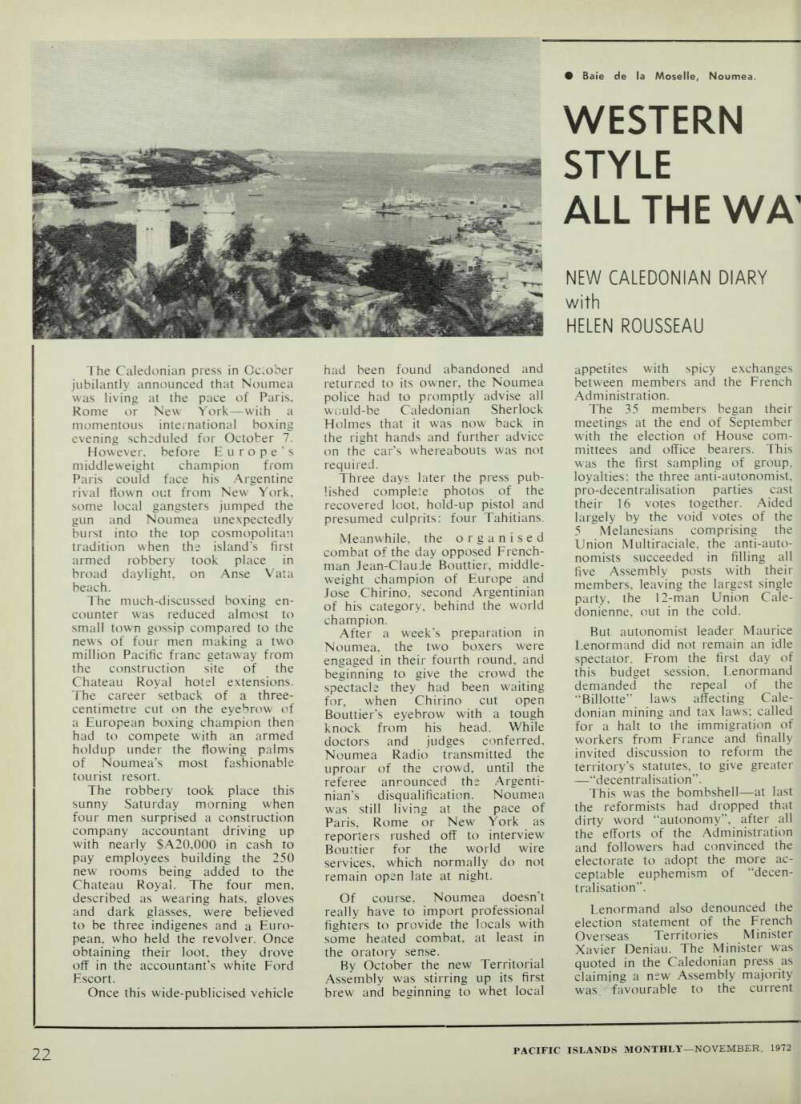
Bale de la Moselle, Noumea.
political statutes and that this esult was due to four reasons— he success of recent municipal eforms, the financial support from -ranee, the anxiety provoked by certain autonomist leaders, and he feeling of French solidarity milt up during the recent boycott mposed on New Caledonia by ome of her Anglo-Saxon neigh murs, during the French Pacific mclear testing.
Lenormand countered that the reformed” inland municipalities lad voted in favour of autonomy; hat French economic policy had ailed and the official picture of he situation was a “bluff”; he epudiated charges against out oing leaders and finally claimed he French nuclear tests had not ontributed to Caledonian pride r dignity among their island eighbours.
These issues were not forgotten nd at the next Assembly session le debate was resumed by Mr lichel L e v a 11 o i s , Secretary- Jeneral and representative of the rench Administration at the assembly.
Lenormand is a keen debator nd tactician. His next move was n open letter to the leader of the fnion Multiraciale, Yann Celene [regei, who was charged, through is party’s void votes for Assembly resident, etc., with being a tacit ipporter of the pro-Administra on bloc. The nickel company ress, in the meantime, had Dyered the Multiraciale vote as sing the action of a young party, lore interested in social reform ian occupying House posts. The nion Multiraciale had been ected on an “autonomist” ticket id their failure to vote with enormand had been the first lock in the new Assembly.
Next vote in the House was for e five members of the Governor’s ouncil (Conseil de Gouverne ent). This gave two seats to the nion Caledonienne and one each 1 the Multiraciale, Liberals and ntente Democratique et Sociale. hree new members were then heduled to move up into the ouse, replacing those joining the ouncil, and this way the first two 'allis islanders joined the New aledonian Territorial Assembly.
The election of the Governor’s ouncil signalled more sparks om Lenormand, who demanded at this executive Council should
play its real role, rather than re main simply consultative with the governor maintaining what he described as “dictatorial powers”.
Meanwhile, the Liberals plugged for a reduction in the monthly fee of the members of the Governor’s Council, proposing that these men, who meet once a week and are provided with secretary and private car, should be paid around SABSO per month instead of the current $1,300.
Early in October, Governor Louis Verger, addressing a group of mainly metropolitan French reporters, had sharply criticised certain overseas press coverage of the Caledonian elections. Pro- Administration papers which took up the Governor’s criticism referred to overseas newspapers which stated “New Caledonia wants relief from French colonial yoke” and which described Governor Louis Verger donning sports togs to play two public soccer matches on the eve of the elections. The press also criticised an Australian national TV team after it had spent six days filming in Noumea without requesting a “working visa”.
Once the elections were over, but before the new Assembly had to face the debate of a difficult 1973 budget, there were differing press reactions to the Caledonian economic situation.
The anti-autonomist Lafleur press instantly grew optimistic over their election results and not only saw immediate signs of a business recovery and greater interest in local investment, but also heralded the disappearance of the nickel recession.
The nickel company press on the other hand, published detailed official figures outlining an “obvious slowing down in numerous sectors (of the Ter ritory’s economy) compared to last year”. The figures showed a 12 per cent, decline in exports and 20 per cent, drop in imports over the first eight months of this year, compared to the same period last year; a 70 per cent, drop in migration, a slowing down in the numbers of new workers registered and a 60 per cent, drop in the number of building permits issued.
All this, of course, is running counter to the ambitious develop ment projects of the French Sixth Plan to increase the island’s nickel production.
At the same time, the nickel press published a report to SLN shareholders from company Presi dent Guy de Rothschild. During the first half of this year, the SLN states that on its nickel operations it has suffered a deficit of about 46 million French francs (approx. 5A7.5 m.) while at the same time paying some $7 million in tax to New Caledonia. While unsold nickel is being stockpiled in France, the SLN pays tax on nickel shipped out of the Ter ritory, regardless of the company’s profit or loss account, a form of territorial revenue which the Baron Rothschild continues to find disastrous for his company.
Meanwhile, at the end of Sep tember, the SLN closed the last of three blast furnaces at its Noumea smelters, leaving eight Elkem and three Demag electric furnaces in operation, with an annual production capacity of 65,000 tons of metal.
On the Caledonian nickel mines, extraction of ore for the first eight months of this year totalled only 3.3 million wet tons, compared with 5.1 million tons for the same period last year.
While world prices of nickel metal rose, Japanese ore buyers were reluctant to pay higher rates for Caledonian nickel ore. As a resumption of nickel price talks was awaited in Noumea, all ship ments of Caledonian ore to Japan were reported to be suspended.
Trucking operators who had been particularly hit by the nickel market recession, found temporary relief when the Noumea city council late September contracted a convoy of heavy vehicles to begin filling in the foreshores of the Baie de la Moselle. This area, in front of the Noumea Museum and new city post office, is to be a parking area for 1,500 cars.
Another recent development in Noumea, on a hill top at Mont Te, has been the opening of the Territory’s first botanical and zoological park. Work on the 60acre site has continued for ten years and is still incomplete.
However, Caledonians have wel comed this first initiative to create a natural reserve for a limited number of local and imported varities of animal and plant life, including the island’s indigenous “barking”, flightless cagou bird.