We Norfolk
pp. 22-23 · Read in the full issue
Islanders need to know who we are
By TOM LLOYD, publisher of The Norfolk Islander.
Many statements have been made over the air and in the mainland press regarding the petition to the Queen, at the moment gathering signatures on Norfolk Island.
Such headlines as “Bounty Crew Mutiny Again”, “Norfolk Petition will fail”, etc., miss the underlying enigma that is Norfolk Island. And unfortunately these “sensational” type headlines give rise to doubts here and abroad, as to the ultimate object of the petition.
The base of this petition is really the same as those which have gone before—one in 1896 and the other in 1955. Although different in context, all three have one common denominator; the preservation of the character of Norfolk Island and its way of life.
Many probably wonder what it is that we have here that is so special. Well, apart from the perennial favourites—we don’t pay income tax, and burial is free—there is some undefinable something—call it a freedom of the soul that we, who were born here, accept naturally. Visitors sample it and want to share it with us; others try, but find that their earlier mainland, more especially suburban upbringing is too much to overcome. As a consequence they try to alter things to suit their own inherited way of living.
While we owe much of our way of life to our Pitcairn forbears, we owe equally as much to those who joined the Norfolk community in early years; American whalers, carpenters and traders from all over the world.
In those early days, as is the case today, people saw (and still see), appreciated (and still appreciate), that here is a community which, given the right guidance, could become a shining example of true democracy unfettered by bureaucratic control.
But these idealistic views, while sounding good, need certain basic requirements and one of these involves the legal status of the residents of Norfolk Island.
Ever since the arrival of the Pitcairn community to Norfolk Island in 1856 doubt as to what exactly Queen Victoria meant when she offered Norfolk Island as a new home to her loyal subjects from Pitcairn Island, has plagued us here.
Personally, I have no doubt that Queen Victoria felt that the first Norfolk Island community should be able to work out its own destiny, and that that is why she created it “a separate and distinct settlement”.
The bureaucratic mind of the late 1800’s was pretty much the same as that of 1972 and one can well imagine Viscount Hampden fwho visited the island in 1896) saying to his confreres, “These poor people don’t know what they are missing, being isolated as they are from the civilised world; we must change this un fortunate state of affairs”.
From then on, there followed a series of Orders in Council, recommendations by various experts,
evictions and public meetings, until on July 1, 1914, King George V proclaimed that Australia should administer Norfolk Island as an external territory.
The king stipulated that this administration was confined to “the peace, order and good government of Norfolk Island”. Unfortunately, nobody sought to ask just how far-reaching this statement was meant to go and what, at that point in time, the fundamental right of Norfolk Island and its council was.
Over the years the island has been fortunate to have men in the community willing to serve on the local council. These councils have ranged in name from the Council of Elders, the Executive Council to an Advisory Council. The present Norfolk Island Council, while having certain powers of raising and spending local revenue is really only an “advisory” body.
It has been the lot of these councils, together with the Administrator, to help guide the island in all its ups and downs. We have experienced that well-known (and trite expression used particularly here) “boom and bust” economy—with a fair share of both.
It would be wrong to attribute all our problems to the Commonwealth, but in many instances the island has been made the ham in the political Australia-New Zealand trans-Tasman sandwich, and we have seen the island’s fortunes climb, only to crash again. Each time we have had to pick ourselves up and start again.
During these times a few more island-born families have had to sell up and return to the mainland to eke out a living.
The unfortunate thing about all these past (and not
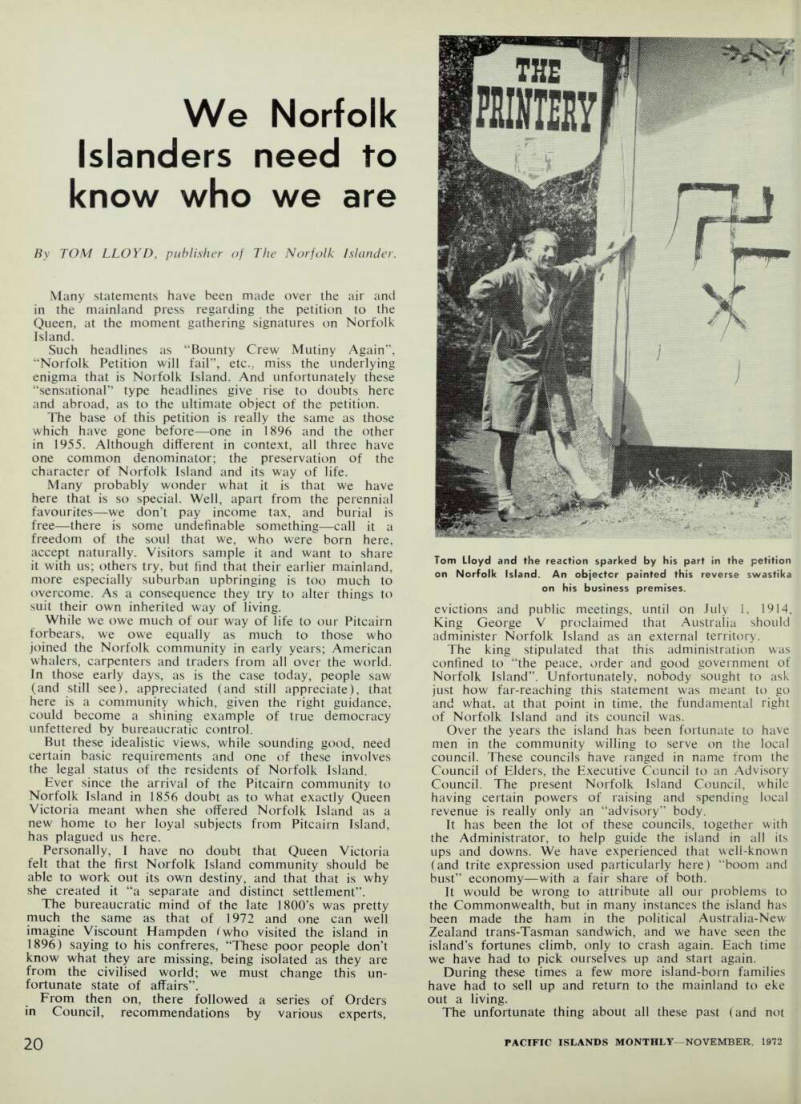
Tom Lloyd and the reaction sparked by his part in the petition on Norfolk Island. An objector painted this reverse swastika on his business premises.
Scant regard to Norfolk view
so distant past) ups and downs, is that the “powers that be” in Canberra appear to have given scant consideration to the wishes of the Norfolk Island Council and the people generally. In fact, the minister reserves the right unto himself to disregard the wishes of council and the people of Norfolk Island and to legislate “if it is in the national interests of the Com monwealth”.
Now, admittedly, this does not happen often, but the dreadful thought forever hangs over the heads of council like the Sword of Damocles. At the moment all the council can do if it disagrees with the minister or his department, is to resign. For what? They are re-elected again and nothing is really proved. In these nstances it would be good to think that the council fand therefore the people of Norfolk) could appeal iirectly to the Queen to mediate in our disagreements.
It might appear that I am anti-Australian. Please et me dispel that idea. The greater part of my educa ion was had in Australia; I served my apprenticeship is a printer in Australia; my wife is Australian and I’m sure that the “give the bloke a fair go” attitude of he average Australian would be extended to us here on Norfolk at the present time.
Norfolk is much too small to be drifting alone in he Pacific. We need a country like Australia to turn o. By the same token, we would like to feel that it s a mutually respectful relationship. We would like o feel that the value of our purchases from the main and are worthy of recognition in the way of our
yearly grant; we would like to feel that the island’s purchases from foreign countries help in some small way to balance the Commonwealth’s trading agree ments; we would like to feel that the Norfolk Island airport, which was built to help protect Australia (and paid for by Norfolk Island) does still have some strategic and economic value to the Commonwealth and is not being kept operative at the taxpayer’s expense so that the island can depend on its thrice-weekly Qantas service.
Let it be known that the tax-haven status of Norfolk Island has been very beneficial to Australia and that it has not been a complete waste of taxpayer’s money.
So, in a nutshell, what I hope the petition will determine is 1. Preservation of the character of Norfolk Island and its way of life, according to the will of its people through the Norfolk Island Council. 2. An end to the uncertainty concerning the fundamental rights of Norfolk Island and its people. 3. Government by law as decided by the Norfolk Island Council consistently with the above principles. 4. Preservation of the right of reference direct to the Crown. 5. Maintainance of, and close, cordial and mutually respectful relationship with Australia subject to the above principles.
Inherent in these five points is the underlying anxiety, expressed by one of the island’s senior residents when he signed the petition. “It’s a pity we nor se find this out 50 years ago. Before we go any further we must know whether we se com a nit-os”.
That’s not a misprint. Those last few words are Norfolkese for “Whether we have become nothing’’.