French Polynesia prefers
pp. 17-21 · Read in the full issue

security to adventure
From JAMES BOY AC K, in Papeete
Drama, bitterness and a sprinkle )f comedy in October transformed he inaugural budgetary session of he newly elected pro-Paris Territorial \ssembly into a standing-room-only heatrical event.
The initial gathering of those who vill legislate in French Polynesia for he next five years permitted auto lomist guru, Senator Pouvanaa A )opa, 77, to strut through his first and probably final) major ap )earance on the political stage since lis return to Tahiti from exile in 968. It also gave French Governor ’ierre Angeli the chance to tear off lis political kid gloves for an un irecedented display of who’s-in harge, and why.
Everyone knew that a majority :oalition contract had been signed he previous day by the 11 members >f the Gaullist Tahitian Union UDR md the five centrist assemblymen if the Te Autahoeraa. Voting late n the session for assembly officers ind commission membership was, as xpected, perfunctory; however, just is a play like King Lear chills the epeat spectator at each performance,
so did the pre-scripted inaugural as sembly session give format to the free reign of all the passions that colour the political spectrum in French Polynesia.
For example, it was newspaper headline knowledge that Pouvanaa, acting as interim president because he is the oldest of the 30 assembly men, would speak only in Tahitian.
And yet, at 9.01 a.m., when the old man initiated proceedings in the language understood by the greatest number of people here, there was aghast silence . . . for the few seconds before Governor Angeli, seated next to Pouvanaa on the podium, loudly interrupted him.
Angeli’s intrusion was as much of a surprise, as part of the rite.
Pouvanaa had not completed one full sentence before the governor was on his feet, gesticulating, blurting to cut Pouvanaa short; “It seems that the doyen of this assembly insists on expressing himself only in the Tahitian language, which leads me to con clude that either he does not speak French, in which case I question the legality of his election because the law requires those elected to express themselves in French, or he is seeking to provoke an incident.
“I warn you right away that I am not willing to play such a game. I will, however, remain here and decide whether his tone does or does not warrant a reply.”
The first act had barely begun, yet there was carnage on the stage.
Pouvanaa continued. (It was his final performance. He resigned his assembly seat ope week later to permit dynamic autonomist Yannick Amaru to return to the assembly).
In spite of his 77 years and failing health, Pouvanaa’s Polynesian rhetorical prowess was undiminished.
The reasons for his reputation as perhaps the most eloquent public figure of the past decades were obvious. The governor’s castigation did not perturb him.
He spoke extemporaneously, in short phrases. He repeated the words with which he had begun (transla tion courtesy of the Journal de Tahiti): “This land is called Tahiti, the language 1 use is the Tahitian language. ... I repeat. We are in
Tahiti. If the governor has something to say, let him say it”. Long pause.
John Martin, the official translator, was busy at a nearby table scribbling the French equivalent of the old man’s remarks. These were im mediately shuttled to the governor on the podium.
“I repeat once again, if he has something to say, let him say it . .
Governor Angeli sat calmly during these pauses. A slight ironic smile wavered on his face. Finally he stood up again, and said, “If he wants me to reply, here I am with my inaugural speech. I can begin immediately”.
Nedo Salmon, a trumpeting Poly nesian orator in his own right, who happens to adhere to the Tahitian Union, began to accept the challenge to debate.
The old man cut him off. “It’s his reply I want,” Pouvanaa said, point ing to the governor. Silence.
“Our language is not considered fit for humans . . . when I was in prison, another governor, his name is
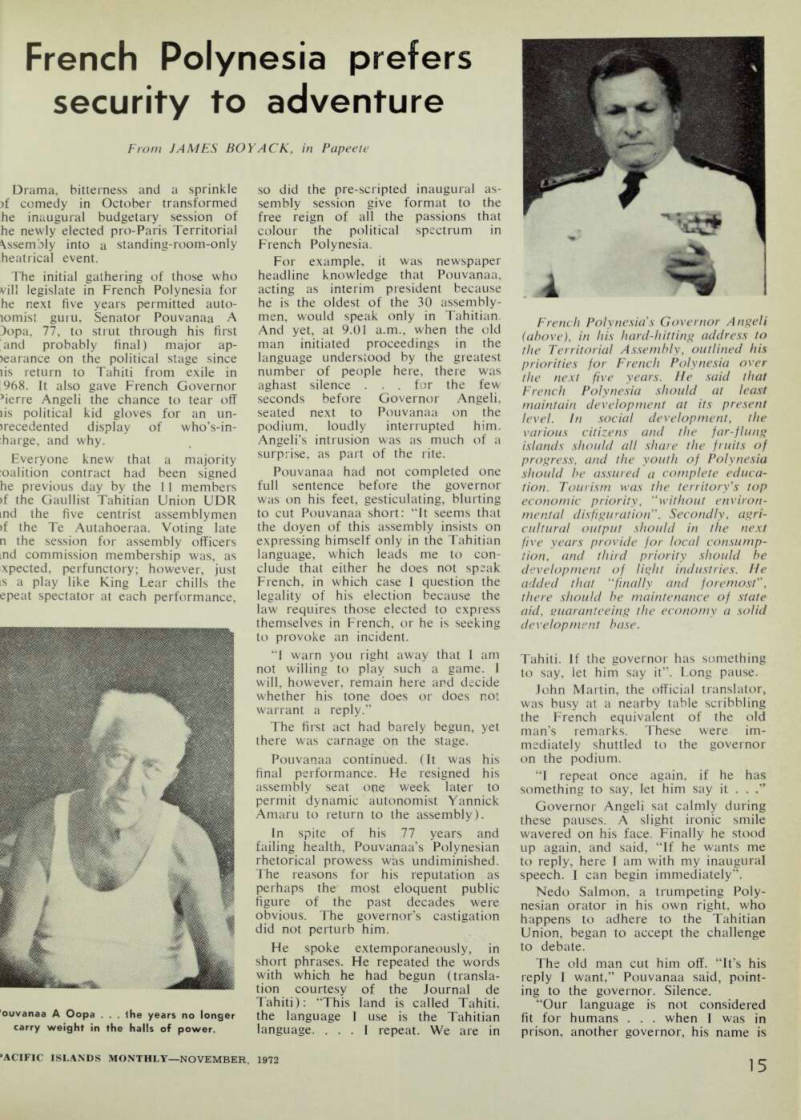
ouvanaa A Oopa . . . the years no longer carry weight in the halls of power.
French Polynesia’s Governor Angeli (above), in his hard-hitting address to the Territorial Assembly, outlined his priorities for French Polynesia over the next five years. He said that French Polynesia should at least maintain development at its present level. In social development, the various citizens and the far-flung islands should all share the fruits of progress, and the youth of Polynesia should be assured a complete educa tion. Tourism was the territory’s top economic priority, “without environ mental disfiguration” . Secondly, agri cultural output should in the next five years provide for local consump tion, and third priority should be development of light industries. He added that “finally and foremost”, there should be maintenance of state aid, guaranteeing the economy a solid development base.
Maestracci, told me Tahitian is animal talk. ... In 1914 when 1 joined the army to defend France, no one told me I spoke an animal language. No one asked me if I spoke French.”
And Pouvanaa began an account Df the long life which had led him ;o that platform. His jowls shook is he made a point and drew gunfire ipplause from the excited autonomist ;ympathisers in the assembly. Puffed >ags hung limply beneath his eyes is he thumped another point on the able in front of him. Four times his ;peech was greeted with applause.
He said, “I cannot hold myself >ack any longer. Today the vase has werflowed”. He said he would defend us people until his eyes closed.
At which remark Nedo Salmon, the JT-UDR assemblyman and school eacher rose to his feet. “If you are true aito, a chief, you should have be courage to let me speak,” he said a Tahitian.
Pouvanaa impassively nodded as ent.
Continuing in Tahitian, Salmon aid that by asking the governor to sply, Pouvanaa was demanding a ialogue of deaf mutes. He noted lat the governor was a guest of the ssembly, and deserved to be treated s such.
He said that whether his own guest Tahitian, French or American etermines whether he will speak ahitian, French or English, It is a latter of simple politeness. The avernor deserves no less. (Applause).
“You hold a position,” he told ouvanaa, “which allows you the full eedom to say everything which is i your heart. Use this freedom. But ;t everyone understand you.”
This plea ignited the loudest and ingest applause of the session.
Pouvanaa, offering something of a apology, said he would not have ioken as he did if the governor had ot interrupted him. Then, he began > ennumerate examples of his long ersecution as a public figure. (He as gaoled and exiled in France in 958 for allegedly plotting to burn own Papeete, a charge whose sub ance he still denies). And he spoke f governors who had wronged him i the past.
Salmon intervened again. He said lat Pouvanaa must stop associating le present governor with the errors f those who had preceded him. \nd if you are an intelligent and X)d man,” Salmon intoned, “you lust permit your guest to understand ou”.
To illustrate his message, the aullist Tahitian told the story of ic fox and the stork. Each invited le other to dinner and each cooked
only what he himself could eat.
“'That’s what you are doing,” Salmon concluded.
The Tahitian word used for fox was uri, which means dog. Pouvanaa asked innocently, “And which one of us is the dog?” The tight-packed assembly hall echoed with laughter as a brimming smile enveloped the old man’s face. Tension in the room subsided.
Finally, Salmon said, “We are two bad actors, enough of playing to the crowd, we are becoming ridicu lous.”
Pouvanaa ended his remarks by noting the absence of Mrs Lenoir, autonomist assemblywoman from the Austral Islands. Mrs Lenoir could
Pa Ying The Price Of Security
not obtain transport to Tahiti from Rimatara. Pouvanaa said that with out her, the inaugural session was illegal and should be postponed.
After a last recollection of priva tions suffered by him and his country, Pouvanaa A Oopa sat down, perhaps never to be heard from in a public forum again.
It was Governor Angeli’s turn to dish out political rabbit punches. The governor traditionally opens each budgetary session with an outline of territorial economic and social horizons. Such a composite picture was eventually traced, but Governor
Angeli chose first to make the most biting political statement of his almost four-year administration. Part of his preamble was devoted to an analysis of why the autonomist majority was overturned in the Sep tember Territorial Assembly election.
“First, let me assure you 1 will not speak in my native Corsican language,” he began, and then he questioned whether Pouvanaa’s speech in Tahitian was not proof that the autonomists, in fact, do not want dialogue with the central government.
In any event, he said since he did not have an advance copy of the doyen’s speech, he would not be able to reply immediately. Instead, he recalled another inflammatory and surprise address, that one given at the opening of the preceding assembly session by then President John Teariki (PIM, Sept., p. 12).
“In view of how things stand today,”
Governor Angeli said, “one can reasonably wonder whether the ex cesses of language which charac terised that speech did not influence the political turnabout we have just witnessed.
“By calling the prison riot a political manifestation, did not the former majority think it had an election issue capable of swaying public opinion? By presenting the “No” vote in the important 1958 referendum as an act of courage (Pouvanaa led those who voted “No” to remaining French in 1958. “Yes” won by a 2-1 margin), while every one knows that had “No” triumphed the territory would have lost every thing, didn’t they think they had tantalising bait for the electorate?
Is it really a surprise that this ter ritory voted in 1972 just as it did in 1958?
“Who really believes that adven turism is preferable to security?
“Where would we be today . . .
Where would the schools be, the hospitals, the dispensaries, the stadiums, the youth centres, the roads, the ports, the airports? What would be the standard of living of our fellow-citizens? What hope would there be for our youth?”
The Governor of French Polynesia said that rabble-rousing language and political maladroiteness, like auto nomist National Assembly Deputy Francis Sanford’s visit to the United Nations (PIM, Aug., p. 15), were contributing factors in the triumph of a Gaullist-oriented majority in this assembly.
And he stressed his major criticism of autonomist politics. “To subordinate all activity in the ter ritory for the satisfaction of a
statutory complaint leads only to paralysis.”
He said there was not an auto nomist and an anti-autonomist way of solving Polynesia’s real problems, because, he emphasised, “the key to these economic and social problems is an active and increased solidarity with metropolitan France. Who can Joubt this?”
Shortly afterwards, when Governor \ngeli criticised the outgoing Govern ■nent Council, autonomist Henri Bouvier tried to speak. “People were ible to interrupt Pouvanaa at will,”
Bouvier exclaimed, “now I will answer hat last comment immediately.”
But the governor did not miss a )eat. His voice even rose another lecibel and his words fell more apidly. Bouvier, drowned out, lumped back into his chair.
Governor Angeli is not a tall man, >ut he seemed very big as he spoke.
Be would remove his glasses and hake them at the congregation to tress a thought. Several times he /ould reach a critical point and, to mphasise it, he would throw his peech down in front of him,.
He blamed the former Government rnuncil for political gamesmanship vhich blocked the machinery of :ovemment, and he urged the new ouncillors to put aside past rivalry ietween elected officials and the ’aris-appointed administration.
As for the political status quo, governor Angeli said, “Let us apply, □yally and in all of its detail, the tatute which governs us. Afterwards, •ut only afterwards, if the wheels of overnment need to be changed, we vill have the well-founded demon tration of why. We must not re aain in the closed universe of sterile irotest.”
Only after reviewing the available nodes of government and expressing •ptimism that the new majority would lave the sense to use them, did the hief executive outline what he con iders priorities for the next five ears.
Before leaving the assembly, the overnor shook hands with a smiling ‘ouvanaa. AFer a short recess, lebate resumed ... in Tahitian. It /as time to elect assembly officers nd commissioners. Nado Salmon nformed the autonomist opposition hat, unlike during their just-expired ive-year reign, the minority would be •ermitted on commissions. The utonomists requested a recess to this offer.
Discussions were resumed shortly fterwards, this time in French. )nly Pouvanaa continued to speak 'ahitian. Spokesmen for the two parties each rejected the naiority offer, calling it a “cheap Boy”. They reminded the pro-Paris
parties of their campaign demand for proportionality in assembly posts.
Unless they received positions in pro portion to the 16-13 assembly break down (the assemblyman from Bora Bora remained aloof, PIM, October, p. 13), the minority preferred to offer “constructive opposition” at a distance.
Charles Taufa’s five “centrist” members of the Te Autahoeraa party, although less than one-third of the majority coalition, played their balance-of-power trump card to oblige the 11 Gaullists to cede 40 per cent of the assembly prestige cake.
Their hard-line attitude, which included a declaration of indepen
dence except on the principle of op position to “autonomic interne”, persisted through a month’s negotia tion of the majority contract. That contract was signed less than 24 hours before the opening session.
Announcement of it was postponed at the last minute one day earlier when the Gaullists stalked out of a meeting, outraged that five people could demand so much from 11.
In any case, Gaullist luminary Gaston Flosse, the Mayor of Pirae and the leader of the Tahitian Union UDR, became the assembly’s first president. He will be succeeded in one year by Charles Taufa. Frantz Vanizette will preside over the key Permanent Commission.