fiji talanoa
pp. 14-15 · Read in the full issue
Building a nation's pride the Pacific way
With Sue Wendt,
in Suva
FFHOSE over-worked words—peace, tolerance, harmony and goodwill —have been spouted so often in Fiji since independence that it sometimes seems as if everyone is protesting just a bit too much. Is Fiji, still the New Boy in the independence stakes, really achieving the ideal that some other emergent countries have so disastrously missed?
The dominion celebrated its second anniversary of independence in October and the ‘‘Pacific way”, that catchy phrase coined by Prime Minister Ratu Sir Kamisese Mara, was very much in evidence. And it rang true.
Fiji has remained stable, both politically and economically, and words like tolerance and harmony aren’t empty cliches after all. People of amazingly, almost irreconcilably, diverse cultures, religions and beliefs are co-existing peacefully and happily, and various ethnic leaders are exhibiting an increasing sense of national responsibility.
Sir Robert Foster, giving his last Dominion Day address as Fiji’s Governor-General (Ratu George Cako bau, Minister Without Portfolio, was being tipped in October as the next, and first Fijian, incumbent) spoke of Fiji’s “solid achievements” during the past two years. These included grow ing co-operation and friendship be tween Fiji, other Pacific islands and Australia and New Zealand, closer links with India and continuing close ties with Britain. “Fiji has added a Pacific voice to the deliberations in the United Nations,” Sir Robert said.
“As the Prime Minister once put it ‘We have sought the friendship of all and enmity of none'.”
But in tackling the problems of inflation, unemployment, poverty, ignorance, inadequate housing and a rising crime rate, Sir Robert declared, Fiji people needed to develop a greater sense of national pride.
“They need to acquire the habit
of putting the country's interest be fore self-interest; they need, above all, to increase productivity; and in seeking to settle industrial and other disputes they need to resort more to discussion and, if necessary, to mediation, than to action which can harm the community as a whole,” he said.
INTOLERANCE still exists in Fiji; it * would be unrealistic to expect otherwise. The Prime Minister ex pressed disappointment in October at opposition from some quarters over Fiji's decision to accept a token number of expelled Uganda Asians, saying he’d hoped to see the prin ciples of ‘‘goodwill” tolerance and
understanding” accepted right down
the line.
The Fijian Association, a constituent organisation of Ratu Sir Kamisese's Alliance Party, had passed a resolu tion opposing Fiji’s acceptance of any of the deported Asians. Ratu Sir Kamisese described such objections as the tip of the iceberg of in tolerance and racialism in Fiji. He announced that the government’s previous decision to take in 10 of the deported Asians had been recon sidered and the figure of 10 would now represent heads of families.
Fiji had received about 20 applica tions, he said.
The Prime Minister added that Fiji people were being accepted as permanent citizens, by Commonwealth countries which had agreed to take in Uganda Asians. If Fiji refused to accept any of the deportees, oppor tunities for Fiji citizens to become permanent residents of those Com
monwealth countries might be preju diced.
Meanwhile, with the deadline for
Fiji citizenship applications having
expired on October 10, the Immigra tion Department was still ploughing!
through a big backlog of paperwork.,
The Minister for Labour, Mr Jonatii Mavoa, assured the public that people who hadn’t applied in time wouldn’t be deported just yet. Hei rejected claims that the citizenshipi issue and deadline date hadn’t beem publicised enough—and added that) the $l5 application fee was beingi waived for those who couldn’t pay it., The Immigration Department couldn’t produce any figures for the number of people who’ve applied for citizen ship during the past two years, but) there were still thought to be numerous long-time residents of Fiji who hadn't come forward, perhaps through confusion about the pro cedure involved or ignorance of the need to ratify their position. Many ofl the old people who came from India or neighbouring Pacific Islands stilll couldn’t comprehend why they needed: to go through all that red tape whenf their children and grandchildren had! been born in Fiji.
Others, though probably only very\ few, were still baulking because they\ wanted to retain sentimental links? with the ‘‘old country” and were loathr to exchange one passport for an other. People who were born in the?
UK, Australia and New Zealand have? been assured that they’d have noc problem getting their old passports? back if they decided to relinquish Fijii citizenship.
There’s still a lot of sorting out to(
10, but in the end people in Fiji will all into three categories—Fiji citizens, xempt people (including civil ser ants, United Nations personnel, and acognised foreign diplomats and taff) and those who hold residential r work permits. Mass deportations re not on the cards. i MONG the busiest men about Fiji’s towns these days is the roverbial “man in the grey flannel jit”. He favours less formal garb nd lacks the slick expense-account resence of his Madison Avenue con imporaries, but he’s raking in the jsiness just the same.
The ad-man has been seducing the ji public for many a long year, nee the last century in fact, when 3 promoted the virtues of all manner : fascinating commodities. Back in 569, the Fiji Times—on page one : its very first issue—carried an jvertisement for Pure Drugs and ruggist's Sundries, including such iracle cure-alls as Mrs Kidder’s id Dr Jacob’s cordial for Diarrhoea id Dysentery; Dr Churchill’s hypo ilphite of lime and soda, for con imption; Mrs Winslow’s soothing rup for children teething, Poor an’s Friend; and Dr Hunter’s eradi tor. Ladies could buy “bone gum igs, nipple shields, breast tubes, ip boats, puff boxes and atmos eric oderators”. Gentlemen could come hirsute again with Fish’s hair storative.
In 1880, H. Raddock and Co, vuka, advertised dinner plates at 3 a dozen, wine glasses at 4/- a zen, decanters at 2/6 each, Turkish /vels at 10d each, white damask Dlecloth at 1/6 a yard. In 1920, alter Horne and Co Ltd advertised m innovation for evening dress jar, introduced by the vice-regal rty of India and worn by His Royal ghness the Prince of Wales”. It is "an evening suit, consisting of 3ss sac coat, evening vest and 'users, all of white drill” and cost ) 63/- a suit.
In 1918, Morris Hedstrom Ltd ad rtised “The universal car, the rd” at £196 for cash. The latest )del Dodge Brothers’ touring car s £395. In 1933. The Morris 10 loon was selling for £240.
Those old advertisements make in going reading, recording as they do : fads and trends of the day. From )se early beginnings, the promotion me has become a multi-million
dollar business in Fiji, supporting not only the Fiji Times and its asso ciated vernacular newspapers and tourism publications, but earning substantial revenue for other Fijian and Hindi newspapers, the Fiji Broad casting Commission, cinemas, Beach Press Ltd (which produces a fort nightly tourist paper for the Fiji Hotel Association), even town councils and transport companies.
Advertising messages adorn parking
metres in Suva streets and garish illustrations on the backs of buses exhort us to sample anything from whisky, breath fresheners and head ache powders to electronic equip ment, cars and air travel. This year, the Fiji Visitors Bureau is spending $13,800 on local promotion and $153,650 on advertising and promo tion overseas.
TV/’HEN it comes, to getting the " message across however, India’s High Commission in Fiji—selling that
intangible product, “goodwill”—
leaves high-powered advertising pro
motions in the shade. Gregarious
High Commissioner Mr Bhagwan
Singh dispenses goodwill with urbane professionalism, so successfully that aside from the Prime Minister, he’s probably leading contender for the award of Fiji’s Most Photographed
Personality.
It’s a rare week when Mr Singh isn’t photographed at some charity function or social occasion, touring the outer islands, opening an exhibi tion or fund-raising festival, welcom ing technical experts from India, entertaining young Fiji people at his home or farewelling Fiji dignitaries
off to India as guests of the Indian government.
India’s “image-building” campaign is making a big impact in Fiji. In August, flourish and festivity accom panied the opening of an Indian Cultural Centre in Suva, timed to co incide with celebrations marking India’s 25th anniversary of indepen dence.
TN October, an India On The Move trade exhibition described by Bhagwan Singh as a “modest dis play”, but presenting a variety of products ranging from arms and ammunition to cosmetics, jewellery and electrical goods—was opened in Suva by Fiji’s Paramount Chief and Minister Without Portfolio, Ratu George Cakobau. Ratu George praised India’s contribution to Fiji’s development, through technical assist ance and the training of personnel, and said he was glad to learn that India would be providing experts to work with the Minister of Fijian Affairs, expressly to train Fijians in industry.
As he opened the exhibition and performed the Indian lamp-lighting ritual, the venerable Fijian leader wore traditional sulu and a glittering mala, or ceremonial Indian garland —sartorial evidence of changing cul tural patterns in the dominion.
“If you noticed me making several false starts to get to the microphone,” said Ratu George jokingly, after rising from his cross-legged position on Indian embroidered cushions,” it’s because I don’t really like sitting on the floor!”
More changing cultural patterns . . .
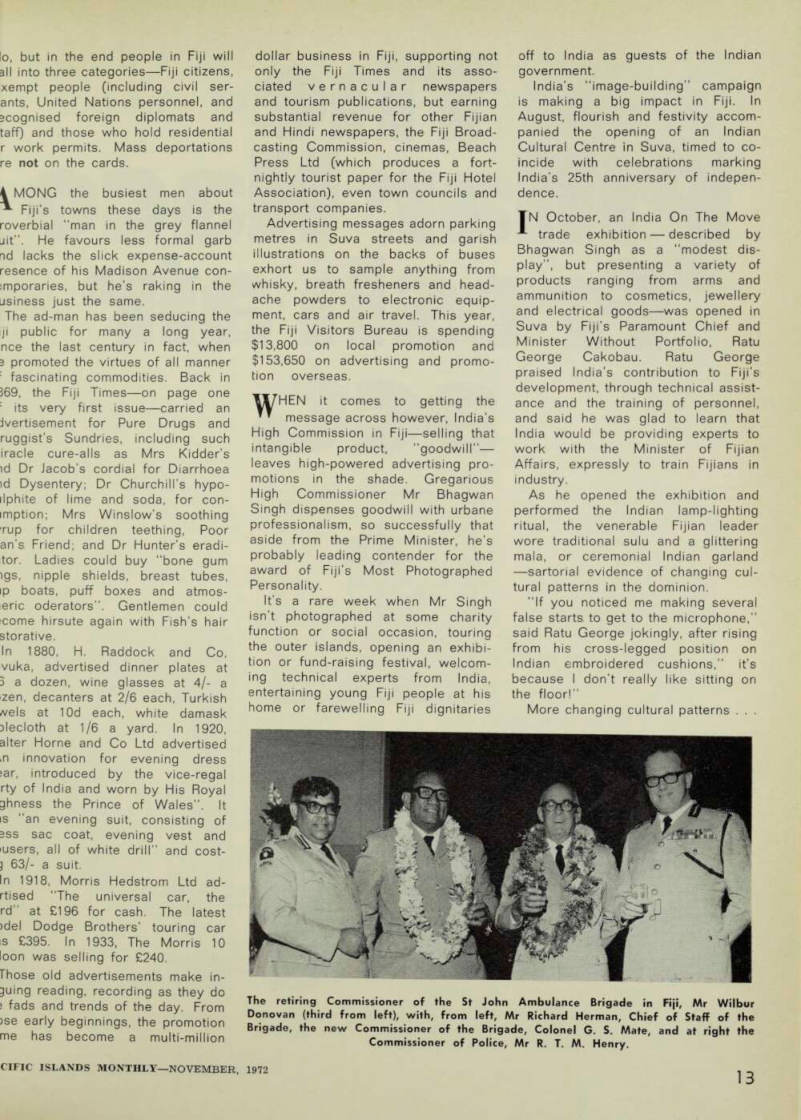
The retiring Commissioner of the St John Ambulance Brigade in Fiji, Mr Wilbur Donovan (third from left), with, from left, Mr Richard Herman, Chief of Staff of the Brigade, the new Commissioner of the Brigade, Colonel G. S. Mate, and at right the Commissioner of Police, Mr R. T. M. Henry.