Well (But Hungry) After 25 Years
pp. 26-113 · Read in the full issue

Sp Commission Is Alive (Just) And
From JOHN CARTER, in Apia
When the history of the second 25 years of the South Pacific Commis sion is written, the Twelfth South Pacific Conference held in Apia, Western Samoa, in late September might well be called the Penurious Palaver. Never has so much been said about so small a budget.
Every year it’s almost the same— so many projects, so little cash. This year, for the 10 days the 18 Island countries, with big brothers USA, UK, France, Australia and NZ breathing down their necks, had to decide what projects to finance for next year with less money—in spend ing power—than they’ve ever had.
And all because of a bit of blackmail by France.
She didn’t like the way the plan ning committee fiddled around with short-term projects, instead of getting down to long-term planning. She also wanted the South Pacific Islands Fisheries Development Agency (SPIFDA) to continue even if the SPC has to go it alone, UNDP having refused to carry on the partnership after next July.
Most of the territories seemed to favour its demise. France, through her veteran senior commissioner Mr
Henri Nettre, was adamant. He told the other commissioners on the first day that, as it didn’t look as if the planning committee would change its ways and there had been “unaccept able delays” in the SPIFDA projects, France would not increase her SPC contribution this year.
All the other participating countries had promised increases, Australia, the biggest contributor, promising 20 per cent, with most of the Islands adding to their voluntary quotas. It meant, with the rule that the “metros” must be unanimous, that the commission would have to limp along on its original budget of $1,263,798. Every thing had gone up in price, including SPC salaries. There was gloomy consternation.
Once again, as in past years, it was France versus the Rest, a position Mr Nettre seems to enjoy.
This looked like the beginning of the end for the commission—and its silver jubilee year too! During tea breaks, which were almost like ban
ouets so generous was Samoan hos pitality, there were sotto-voce sug gestions like, “We should change the whole thing and go it without France”; “This is ridiculous, and we’ve got the Forum now”. This went on all through the next nine days.
I think France was right about the planning committee. There have been too many seminars, too much talking, tons of paper and precious little else.
This sort of thing could wreck the SPC. As Mr Nettre warned, “I fear in the future we will no longer believe in the commission.”
Mr Andrew Peacock, Australian Minister for External Territories, ex pressed “Australia’s regret” and trusted “that the matter will be re thought”.
Duncan Maclntyre, NZ Minister for Maori and Island Affairs, was more direct. “I would appeal to France to rethink what her action will do to this consortium of small developing countries,” he said. “Is there any reason why the metropoli tan countries should push their pro teges back under the water after 25 years of effort teaching them to swim?”
Mr Anthony Kershaw, Parlia-
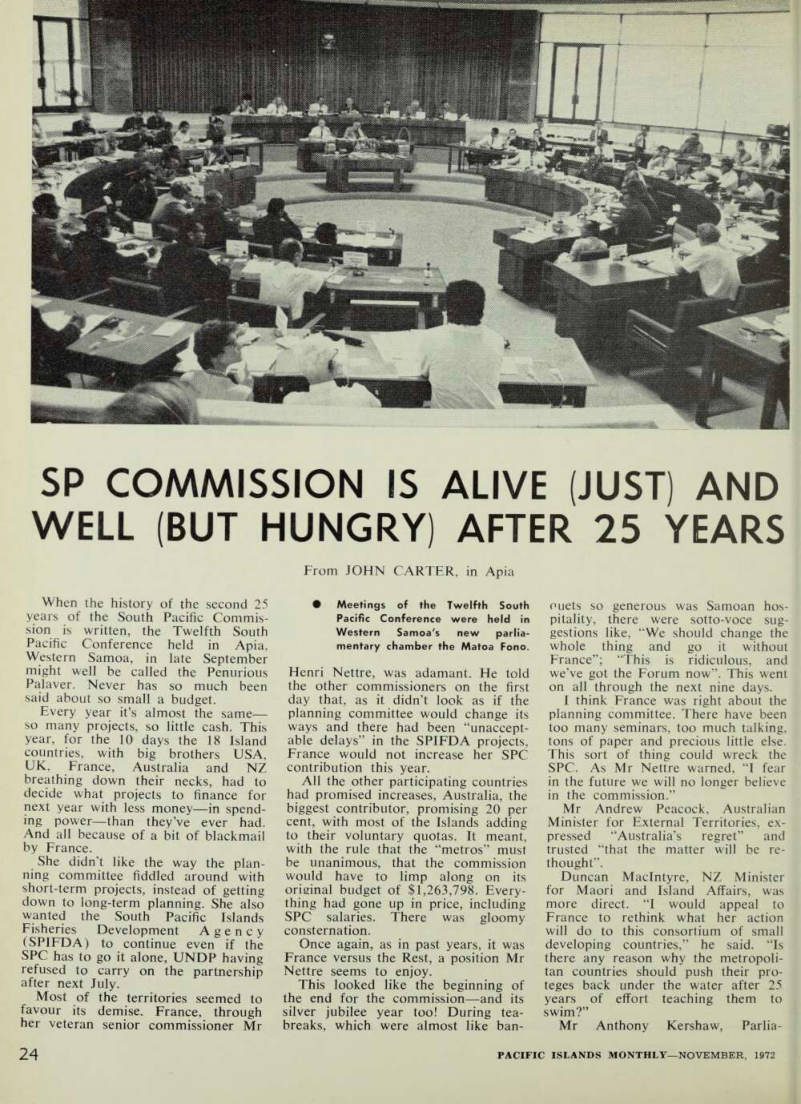
Meetings of the Twelfth South Pacific Conference were held in Western Samoa's new parlia mentary chamber the Matoa Fono.
Move Toward Long-Term Planning
icntary Under-Secretary for Britain’s r oreign and Commonwealth Office, choed Australian and NZ senti icnts.
If France felt herself out in the old, Mr Nettre gave no sign. There ould be no walk-out this year (as Ir Nettre walked out last year) and e contented himself with a reminder ow and again that he would come ) the party if France got what she anted.
And that is how it was. Gradually lere was a shift of opinion by other luntries. Maybe the planning com ittee did want changing; there was lot of sense in having only a few ng-termed projects; what was the ;e of seminars and surveys without ly action, etc.
Then Mr Fred Thorburn of the ooks moved that the planning com ittee should prepare a plan con ntrating on a few long-term prac :al projects of significance for the gion, without being concerned imarily with the financial implica )ns or the commission’s annual ark programme.
Mr C. D. Reseigh, Australia’s nior commissioner, the most ex rienced commissioner there after r Nettre, backed it up after ensur g that small, short-term projects auld survive, and Fiji’s Mr Vijay Singh crystallised the whole thing th a suggestion that the motion ould be used as a basis for draw g up terms of reference for both rig and short-term planning.
This is close to what I have been essing for a long time,” Mr Nettre id, on the seventh day. “You should ways separate long-term plans from e annual budget.”
Quick to seize the opportunity, Mr ne Naisara, Fiji’s Minister for lucation, Youth and Sport, who was “ commission session chairman, lied a meeting of the commissioners at evening. But France still held t. It wasn’t something “near” their sires which would satisfy France, was all or nothing, and nothing >uld, I think, have damaged the ’C irreparably. “There’s always the >rum,” was a thought underlying ents in Apia.
Then senior NZ Commissioner mrles Craw announced that NZ )uld contribute up to 15 per cent, nch meant an extra $20,000 in the ty. Mr, Nettre’s reaction was ini tiate. He said—with the black nlmg touch of course—that if the nference in its wisdom concentrated long-term projects he might be le to recommend his government agree to an increased contribution
of not more than five per cent, but, if more attention was not given to long-term projects, France’s increased contribution would be devoted to French territories only.
The conference’s reaction was almost as swift. In no time at all a resolution went through from a special ad hoc committee which had been struggling to unravel the tangle.
This was a directive to the planning committee to present to next year’s conference a long-term plan concen trating on practical projects of sig nificance to the region.
Moving the motion, Vijay Singh, who had been closest to Mr Nettre all along, commented that it was time to concentrate on projects lasting from one to five years instead of on “things like interminable seminars”.
Everybody agreed.
Not long afterwards, SPIFDA’s future was also assured. That even ing, a smug Mr Nettre, who’s really an engaging fellow when he’s not being a chauvinistic Frenchman, told me he would be adding France’s five
per cent to the budget, the next, and final, day.
He did, but he would not go higher than five per cent. As the unanimity rule prevailed, all other participating governments, seven of them, gave the same. Some, however, said they would add voluntary contributions.
Ever-generous New Zealand said it would add another 10 per cent.
Nauru and the UK gave the same.
Fiji and Western Samoa gave ad ditional amounts on top of their statutory percentages (see panel for these details). The additional cash was promptly allocated.
But there was resentment over the French tactics. Several representatives said afterwards that France wouldn’t get away with it a second time.
Mr Nettre, who is in the top flight of the French Civil Service, is both an expert tactician and a rough in fighter. He’s also down to earth. Over the last few years he has played a large part in turning the conference into a training ground for diplomats and politicians. The whole struggle surrounding the business of increased contributions was an exercise in chicanery, Machiavellianism, brink manship, tactical retreating and the other political sciences so ably prac tised at the United Nations.
France has objected to “politics” several times in the conference in past years but she practises it the most. This year she did it perfectly because, unlike last year and the year before when Mr Nettre had recalci trant French Polynesian autonomists to needle him and cause him to walk out, the Frenchmen were a united team. All their representatives voted as a bloc and talked in the same strain.
One longed for another Henri Bouvier to relieve the tedium of the conference which, for the most part, became very dull after the first two days of drama.
Mr Nettre’s obvious main target was Bill Hussey and his United Nations Development Programme. He attacked UNDP over SPIFDA, charging it with developing “an in creasingly rigid attitude and enforc ing its authoritarian and centralistic ideas” at the prompting of its regional representative, who is Bill Hussey.
Mr Hussey replied several times, or at least spoke on joint UNDP-SPC projects, without really crossing foils with Nettre, or losing his cool.
He explained UNDP’s position and defended it against the accusation of hogging the action in the field to the detriment of the SPC. If it did hog the action, he implied, it was with the idea of letting the SPC get on with its main job of furthering the
economic and social development of the Island territories.
Only once did he take the button off the foil. That was when Mr Nettre attacked UNDP’s decision to end its active role in SPIFDA next July and concentrate its funds on the five T’s, trade expansion, telecommunications, transport (sea and air), tourism and
training.
Mr Nettre complained that the withdrawal of UNDP finance at the present stage would ruin the pilot project which SPIFDA is conducting in New Caledonia. Mr Hussey didn’t think it would because, so far as the UNDP programme was concerned, it was for regional projects as a study for all territories and not the “coun try” type.
The New Caledonia project was a study project no longer, because, as they had learned with consternation, the v were now faced with a project which was making money. Arrange ments had been made to open a bank account in Rome for the profits!
After the money crisis over the planning committee, SPIFDA’s fate engendered the most heat. Three aquaculture projects were at stake, the New Caledonia one, one in Fiji and one in Koror in Micronesia.
Future projects recommended by the consultative committee were a new study of techniques in outer reef fish ing involving work in American Samoa, Cook Islands. Fiji, GEIC, Tonga and Western Samoa; the pro vision of experts for a project in French Polynesia, and the continua tion of the inter-island training pro gramme.
All this, spread over 24 months! from next July, would cost $440,000.
SPC would be expected to chip in i with about $28,500 a year.
It was obvious that most represen- tatives took a dim view of what; SPIFDA had accomplished to date,, several referring scathingly to the fact J that, instead of tackling the problem i of supolying nrotein at the village; level, it had concentrated on oyster— culture.
Mr Vijay Singh brought a smile to< Mr Nettre with a reference to a< fancied famous quote in French his tory when Marie Antoinette sug gested that, if the peasants hadn't J bread, they could eat cake. Mr Singh i complained that the Islands wanted! protein and had been given oysters * and champagne with tourists inr mind.
But it was obvious that everyones knew that SPIFDA must continue..
There was a wide division of opinionr as to whether the agency’s activitiesa should pave the way for large-scales commercial fishing or be confined toe
Continued on p. 108
ensuring adequate supplies and teach- j ing techniques to the various terri-1 tones.
Mr Isaac Qoloni (BSIP), Mr Tom Koraea (PNG), Mr George Kalkoaj (New Hebrides) and Mr Isakala Paeniu (GEIC) all thought there could be joint actions by agency and commercial concerns, but Mr Singh, wanted SPIFDA to die and let terri-| tories deal directly with UNDP.
Dealing direct with UNDP and I other agencies, thus bypassing the| SPC, would condemn the commis4 sion to death, Mr Nettre warned. He: sounded the same warning several) times whenever anyone suggested! cutting out the SPC middleman.
Mr David Kausimae of the BSIP' and Mr Singh used the debates om fisheries as a vehicle to snipe at) France over the nuclear tests, a sub ject banned in the conference because: politics “aren’t allowed”.
Mr Kausimae made only am oblique reference to the tests, com plaining that a certain country had spread fish poisoning throughout the region. Mr Singh, however, pointed at France, declaring, after charging the developed countries with polluting the ocean with industrial waste, “it seems a great pity that one of the nations deeply interested in the wel fare of the South Pacific is currently accused by Island territories of de-; stroying fish in the Pacific by nucleai bombs.”
Urbane Mr Nettre wasn't rising to the bait that contributed to last year’s walk-outs. He even remained silent) though his face flushed, when on anjj other occasion, when he assured the conference France would help to pro-* mote knowledge of her language, Mi Singh exclaimed, “We know French tricks without learning the language”' SPIFDA was spared when the coni ference decided to spend $21,200 on the agency up to next July. If UNDH funds are not forthcoming then, thti commission will prepare a report on the feasibility of continuing the proc ject with its own resources and witH assistance from “such other source;; as might be found”.
What seemed to be a bright ideas a development bank for the SoutH Pacific, got a mixed reception when; the conference discussed a UNDI mission’s study report on the subject!: The mission calculated that thu current net external capital gap foe the whole region, excepting of PNO which had no estimate available, was between SUS3O million and SUS4M
nillion. In other words the region leeded that much more capital for levelopment and a development bank yas the best thing for bridging the :ap.
Cook Islands Premier Mr Albert lenry, who knows all about financial aps, urged further studies when it Doked as if representatives were ikewarm. Several pointed out that ie report was too sketchy.
The metropolitan powers, with the tception of France, said little, be eving, as it was explained by Mr raw on one occasion, that the Island :rritories should do the talking and aiding. Mr Nettre said a regional mk would prove highly expensive id would duplicate existing facilities some countries including the rench territories. Ways should be •und of gaining access to loans from e Asian Development Bank and the odd Bank.
Mr Singh, who knew about the rubles associated with the Fiji De lopment Bank which spent 20 per nt of its paid up capital in annual •crating costs, also suggested a rther study, although he seemed to eard it as a waste of time, “But > not the Pacific way,” he said, “to oot a thing down. We would rather it wither away.”
And wither away it probably will if * territories dwell on the words of
Mr Akira Tsusaka of the Asian De velopment Bank, who did a fine job of “selling” his bank.
He pointed out that there were already four members of the ADB in the region, Fiji, PNG, Tonga and Western Samoa, and they’d never had a loan request turned down. There were other potential members in the region who, if they qualified, could join and take advantage of the bank’s services.
ADB’s assistance to the region in cluded loans of SUS 4.7 million to Fiji for power development besides technical assistance to the Fiji De velopment Bank, a SUS4.S million Joan to the PNG Development Bank and two loans to Western Samoa of a little over SUS 2.7 million for air port and road development and beef cattle projects. Much more was in the offing and moves were being made to help Tonga, the newest member.
“The mere creation of a bank does not create any money, and finding adequate resources for a new regional or sub-regional bank is quite a serious problem,” said Mr Tsusaka.
After that, it was a wonder the conference pursued the idea. But it recommended that UNDP seek poten tial donor countries to see where the capital is coming from and also pro vide more details on the cost of establishing the bank.
Mr Tsusaka is likely to recommend the ADB to find ways of extending membership to all the territories, so that the idea of a South Pacific Regional Development Bank is pretty sure to wither away, the Pacific way.
And the Pacific way of doing things added hours to debates as chairman Mr Tamasese Lealofi, Western Samoa’s Prime Minister, and his deputy, Mr George Kalkoa, gave representatives loads of leeway in making speeches. As, for instance, when they discussed the venue for next year.
The conference turned down Guam’s invitation on the grounds of cost as it would put $60,000 on the bill against only $lB,OOO if it was at home in Noumea. It decided to stay home. The following day Guam’s man, Mr Jose S. Perez, pleaded for another chance, offering not only $25,000 towards expenses but asking for 90 days in which to find ways of cutting expenses to the Noumea level.
All the Island representatives voted for that.
Guam will make a nice change, especially as Mr Perez was sure that the three floors of living space in the now-building, 12-floor World Trade Centre there would be available free, and there would be no charge for secretarial work.
It was a struggle to complete the
agenda in the apportioned 10 days, mainly because of penury. Time and] again, important projects on the works programme were put aside for! a later decision, which meant until!
France’s Oui was heard.
There was one good result. Projects! were scrutinised more carefully and only the really practical ones got
through. Unproductive jaunts and]
seminars for experts and ephemeral!
theory-producing get-togethers, got j
the chopper. Projects such as school syllabuses suitable for the Islands in stead of those exported from metro- 1 politan countries, the rhinoceros beetle project, language teaching pro-* jects, experts for animal production! and new moves for solving nutrition! problems, all survived.
Considerable time was devoted toi the Arts Festival revolving fund sup posed to have been created out of: the Fiji Arts Festival profits, but Mr Singh soon disillusioned the con ference. There was no fund because! there had been no profits, only a loss! of $50,000 which Fiji had paid, mak-| in» the dominion’s contribution to the) festival $150,000.
Dr Fanaafi Larkin, of Western Samoa, was a severe critic of the Fiji festival she said it was more a theatrical spectacle for commercial, interests than a display of the Islands” ancient cultures for the Islanders’ de light—but the festival is destined to< live again, maybe in PNG next; lime. The conference decided to ask; UNESCO for a larger grant than it; gave for the Fiji festival —a niggardly' 16 000 and the secretariat willl sound out the territories on the ideal of another festival in five years.
So now the SPC moves into the second 25 years. What of the future** There will be some radical changes.
All the members want them, buti what form they will take is uncertain.
What is certain is that the commission; will have to have much more moneys if it is to survive. US Trust Terri tories representative Mr Ambilos lehsi gave the secretariat a back hander on the final day when he blamed it for the commission’s poverty, saying it didn’t know how to beg, and that there was plenty of money around if it knew where to look. He suggested approaches to the European countries, Switzerland!
Holland, Denmark and others ano suggested Japan was only waiting to pour out her gold to whoever askeo for it. , ..
A resolution was passed directing the secretariat to study ways of raise ing the wind for more projects.
As in past years, Canada was repc resented at the conference and seemet: eager to contribute, her representative Mr C. V. Svoboda, telling the conn
jrence that “the South Pacific ualifies as a region of eligibility for 'anadian assistance”. He sounded as his country would willingly become partner in the SPC if some way 3uld be found.
It was suggested outside the fono ile that maybe the Cooks would and one of their small islands, awarrow for instance, to Canada so lat she could qualify as a participatg country having a dependency in e region. If the money was right, e Cooks might do a deal!
But whatever way is used, the SPC ust be more effective if it is to last. ie Islands have now a mini-United ations of their own, the Forum. d, being way past weaning age, ey want something more than icken feed from the commission.
L . .
iTrS festival
irector replies
Mr Vic,or Caretl.who directed the I strongly dispute Dr Larkin’s ack on the festival. She alleges immercialism”. All this spate of ticism from her is merely a okescreen to hide the facts.
Nothing could have been less iimercial than this remarkable tival in which all of the countries the South Pacific so warmly )wed their very best traditional s to one another and to the world. all this they stated their respect one another and for human f i Ihe fact that five or six permances were given free for every-
one for which admission was charged, should be strong enough proof that this was a non-com mercial event. Even at the paid performances 50 per cent, of the seats were at the very low price of 50 cents.
All of the countries entered into the spirit of giving with joy and a remarkable sense of co-operation, of togetherness—all except Western Samoa. Dr Larkin kept her group from giving a free scheduled per formance on the stage over Nubu kalau Creek and thereby disap pointed thousands of eager spec tators. She also was the lone person to stop her dancers from being especially filmed for the official film even though she knew that the film was to be given free to all the participating countries and that the profits from the film were to benefit future festivals and thus the culture of the South pacific.
cr £j nanf
Vr they generated a great deal of enthusiasm from this coming together in warm and friendly brotherhood. And the future ad vantages are great. Beside the film record, there are over 30 disc record ings which were made “live” at the festival—a truly significant gift to posterity. All of the other countries agreed to the contractual payment for the recordings except ing Dr Larkin who demanded more, As a result, only one name will be missing from the recording list— Western Samoa!
One wonders who is being com mercial.