fiji talanoa
pp. 26-28 · Read in the full issue
With Sue Wendt,
in Suva
'l/’ISITING Kenya in August, I dined ’ one evening in the plush confines of the Nairobi Intercontinental. Hot topic of conversation was the plight of Uganda’s expelled Asians. “Would Fiji take any of the 60,000 refugees?” my African hosts wanted to know.
“Would other Pacific Islands?”
I got the feeling that my hosts weren’t so much concerned with the fate of the ousted Asians, as with the possible success of the exercise.
Black Kenyans were watching Uganda with an eager eye, I was told, and many believed that President Amin’s actions would accelerate a similar movement in Kenya.
“We can see the signs,” an African lawyer said. “There are more busi nesses and properties for sale in Kenya than before. It’s a quiet move ment—the Asians don't want to create a panic and with investment pouring into Kenya, neither does the Govern ment.
“But President Amin’s actions have started a lot of Kenyans thinking. We Africans are asking what we’ve really achieved since independence. The expatriates, including Asians, have enormous, control. On the question of who really controls Kenya, we are sitting on a volcano.
“The trouble is, even those out siders who’ve taken Kenyan citizen ship don’t think Kenyan and they don’t integrate. I believe the day will come when Kenya expels such people. So what if the economy suffers?”
A questionable philosophy perhaps, undoubtedly anathema to Kenya’s present leadership—but that’s what the gentleman said. It’s the kind of talk that must send ripples of unease through any non-indigenous minority community anywhere and make the multi-racial population of a country like Fiij thankful for a sane and humane regime.
Fiji is, of course, in no position to open its doors to large numbers of homeless refugees. Faced with a
delicate situation, although under no pressure from the British Government to make any magnanimous, gesture, Prime Minister Ratu Sir Kamisese Mara went about as far as he could practic ally go.
The government was already ex tremely concerned about housing Fiji’s own people, the PM said, and about the problems of its destitutes and would-be tenants seeking land on which to settle. However, Fiji would “certainly consider favourably allow ing in professional people whom we need or who come here with money to invest”. They would have to meet the usual requirements before they could be granted citizenship.
Ratu Sir Kamisese said he was dis
turbed by the lack of reaction among Commonwealth countries to President Amin’s decision to expel the Asians.
He commented: “It appears that President Amin is getting away with something that Mr Smith of Rhodesia is not allowed to do—discrimination of race. If this sort of thing is allowed to go on, there will be dis turbances in many other countries in the world with leaders getting out of the wrong side of the bed and de ciding to kick someone out.”
Humanitarian considerations
aside, Fiji has problems a-plenty when it comes to population. Latest news on the “birth boom” is, en couraging however, with Family Planning Association president, Senator Robert Munro, reporting one of the fastest reductions in birth
rates, without demographic assist ance, recorded anywhere.
The birthrate last year was down to 30.2 per 1,000, compared with a rate of 41.78 in 1959. The Indian birthrate was recorded as between 29.6 and 29.3 and the Fijian rate as 30.5 per 1,000. Official target for Fiji is a birthrate of 25 per 1,000 popula tion by 1975.
The dominion had a total population of 535,357 at the end of last year, a net increase (after allowing for migra tion) of 10,900 over the previous, year.
Indians totalled 272,040; Fijians 231,042; Part-Europeans 9,497; other Islanders 6,679; Rotumans 6,643; Chinese 4,725; Europeans 4,600; and “others” 131.
Racist ripples from Uganda felt in Fiji
While the Family Planning Asso ciation is justifiably pleased with the results of its programme (which in cluded distributing 165,000 condoms during the year, for retail by shop keepers at 1c each), it still considers Fiji “grossly over-populated”.
Senator Munro points out in his report that the real picture is seen not so much in the number of people —but in the number of dependents.
Fiji, with 46 per cent, of the popula tion 15 years and under, has 86 de pendents to every 100 workers.
The Roman Catholic Church in Fiji isn’t much pleased with the family-curbing efforts. Outspoken priest Father Dermot Hurley, director of Fiji’s Responsible Parenthood Council, was severely critical in Sep tember of population control methods in the South Pacific, declaring that
such “western exports as the con dom, diaphram, pill and loop” were completely alien to the way of life of Island peoples. Their promotion and acceptance would hasten the accept ance of permissive culture ", . . to the consequent detriment of family and personal happiness”.
Addressing a Roman Catholic Church conference in Suva, Father Hurley claimed that the shortage of medical personnel in developing countries like Fiji meant dispensing with safeguards insisted upon in de veloped countries for the use of the pill or loop. The next step of "doctrinaire contraceptionists”, he said, was the use of prostaglandin (abortive) pills, currently being tested in Africa.
Father Hurley urged the Church to sponsor and finance a family plan ning programme using the ovulation method —“embodying all the positive ✓alues of the old rhythm method, but without any of its limitations”. This method, he felt, was in keeping with :he tradition of many South Pacific peoples, who accepted as normal a neriod of abstinence from marital elations after the birth of a baby, t had been successfully introduced nto Tonga and Fiji, he said.
Senator Munro subsequently hit out it the Church’s “out-moded belief in i last-ditch stand against authoritative nedical and sociological opinion”— nd added that if contraceptive levices were alien to Pacific slanders, the same could be said f penicillin, streptomycin, control of ifection by antibiotics, hospitals and ealth centres, air travel and news apers.
He denied that safeguards concern ig loop insertion or use of the pill ere dispensed with in Fiji and said lat the complication of venous irombosis in pill takers in island opulations was. virtually non-existent, epeated pregnancy was far more angerous. Secretary for Health Dr haram Singh joined the fray, assur ig the public that every care was iken in family planning programmes. pHE Methodist Church was in the news too in September, with its /owed intention of building a school Suva to rehabilitate prostitutes, 'ostitution in Fiji was so prevalent, lid a women’s committee report,
that it seemed almost an accepted way of life. Church women’s groups had been visiting red light establish ments regularly during the past 18 months, taking Bibles with them and holding prayer meetings (one can imagine the astonishment of the clientele!) and they’d found that girls often expressed the desire to go to church and to leave the guest houses.
Money was already being raised for a $20,000 school, where up to 10 girls at a time could be rehabilitated for a happy and useful life.
September saw the unfolding of one of the most spectacular murder trials in Fiji’s history, with two young men charged with the murder in May of Taveuni schoolteacher Miss Evelyn Nair. Intent on learning all the horrifying details, people waited for hours outside Suva’s Supreme Court to get a seat during the hearing, which looked like lasting two or three weeks.
TT was also the month of the contro- A versial wage award for Qantas workers at Nadi Airport. Rejecting union claims for a basic weekly wage of $4O, arbitration tribunal chairman Mr Justice Hardayal Hardy, of New Delhi, gave the workers a new mini mum wage of $2l a week—repre senting an increase of 8c an hour on the former basic rate of 42c.
He rejected claims for reduced hours—remarking that the present 42hour week included 2\ hours for meal breaks, making actual working time
39$ hours—for three weeks’ annual leave for non-salaried workers, a special service bonus and certain weekend overtime. He awarded time and-a-half for Sunday work. The union had asked for double time on Sundays and time-and-a-half on Saturdays.
The award included a transport allowance of 40c for certain cate gories of shift workers and an additional 1c an hour for every five years of service with the company.
Despite earlier threats of further industrial unrest if the union’s claims weren’t met and a statement that he was “the angriest man in Fiji”, Air line Workers’ Union secretary Mr Apisai Tora appeared to accept the new award with good enough grace.
Mr Justice Hardy had at least re jected claims by previous arbitrators and boards of inquiry that all wage increases should be related to Fiji’s economy, said Tora. The union “bowed its head to the judge” for destroying such theories.
The award, which both the union and Qantas had agreed to abide by, was effective from September 5 and binding for 18 months. In the mean time perhaps, Mr Tora and his con freres will have talks with the two un-named international carriers, he claims could replace Qantas if the Australian airline ever withdrew from Fiji.
According to Tora, Qantas had told the union it would pull out of Fiji if so-called “excessive wage demands” (over)
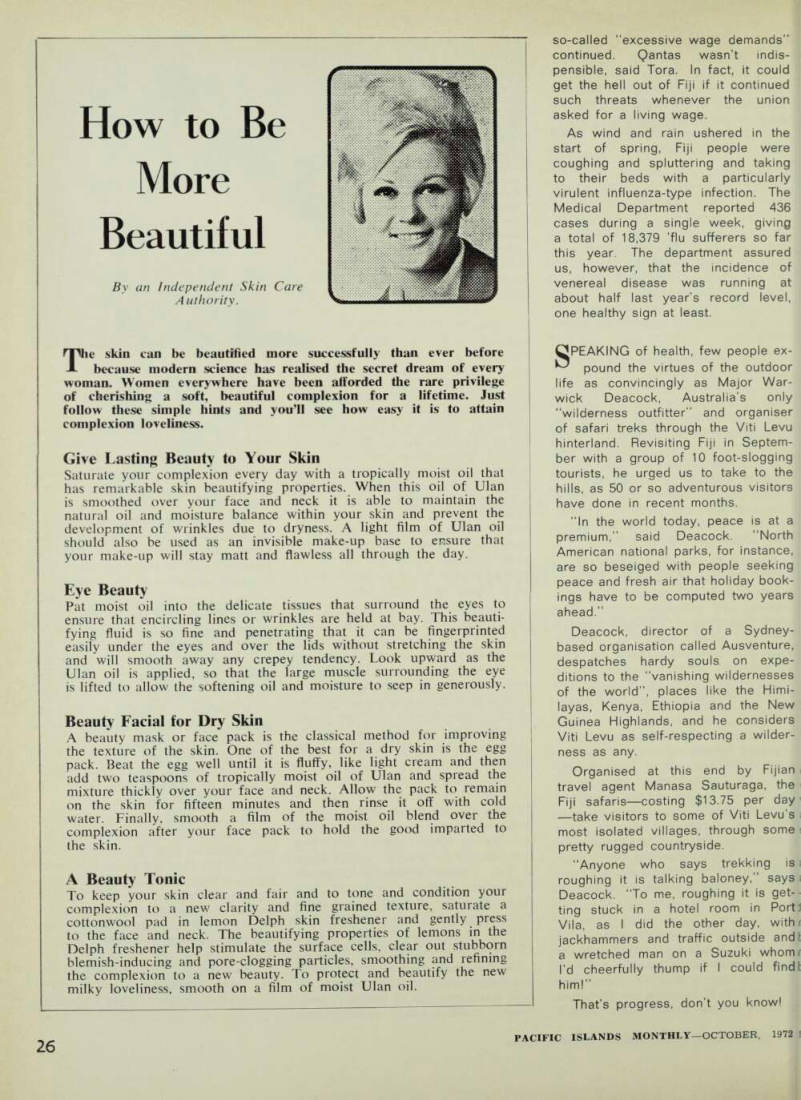
Western Samoa's Prime Minister, Tupou Tamasese in a tete-a tete with Adi Lelea, wife of Ratu George Cakobau, Paramount Chief of Fiji, during the South Pacific Forum in Suva.— Photo: Stan Ritova.
so-called “excessive wage demands” continued. Qantas wasn’t indis pensible, said Tora. In fact, it could get the hell out of Fiji if it continued such threats whenever the union asked for a living wage.
As wind and rain ushered in the start of spring, Fiji people were coughing and spluttering and taking to their beds with a particularly virulent influenza-type infection. The Medical Department reported 436 cases during a single week, giving a total of 18,379 ’flu sufferers so far this year. The department assured us, however, that the incidence of venereal disease was running at about half last year’s record level, one healthy sign at least.
CREAKING of health, few people expound the virtues of the outdoor life as convincingly as Major War wick Deacock, Australia’s only “wilderness outfitter” and organiser of safari treks through the Viti Levu hinterland. Revisiting Fiji in Septem ber with a group of 10 foot-slogging tourists, he urged us to take to the hills, as 50 or so adventurous visitors have done in recent months.
“In the world today, peace is at a premium,” said Deacock. “North American national parks, for instance,
are so beseiged with people seeking
peace and fresh air that holiday book ings have to be computed two years ahead.”
Deacock, director of a Sydney based organisation called Ausventure, despatches hardy souls on expe ditions to the “vanishing wildernesses of the world”, places like the Himi layas, Kenya, Ethiopia and the New Guinea Highlands, and he considers Viti Levu as self-respecting a wilder ness as any.
Organised at this end by Fijian travel agent Manasa Sauturaga, the Fiji safaris —costing $13.75 per day —take visitors to some of Viti Levu’s most isolated villages, through some
pretty rugged countryside.
“Anyone who says trekking is roughing it is talking baloney,” says Deacock. “To me, roughing it is get ting stuck in a hotel room in Port Vila, as I did the other day, with jackhammers and traffic outside and a wretched man on a Suzuki whom I’d cheerfully thump if I could find him!”
That’s progress, don’t you know!