Png Government Gets Practice
pp. 23-25 · Read in the full issue
In The Art Of Governing
From PERCY CHATTERTON, in Port Moresby
The September issue of PIM illustrates the traps for young players, and old ones too, who write com mentaries on current affairs for monthly magazines. My remarks on broadcasting in Papua New Guinea were out of date by the time they appeared in print.
When the third meeting of the Touse of Assembly began on Monday, August 28, the Minister for Informa ion, Paulus Arek, made a statement o the House on this matter. He ieclared that it was the government’s mention to set up a National Broad :asting Authority before the end of lext year. As set up, it would enjoy he same sort of independence as that njoyed by the Australian Broadcast ng Commission. But, added Mr Vrek cautiously, it would remain to •e seen whether it would continue o enjoy that independence. This, he aid, would depend on “the attitude •f the people”.
This latter remark sounds more ban a trifle naive. However, Mr Arek > not a naive man, so perhaps he /as speaking with his tongue in his heek. It is safe to say that when be independence of broadcasting or
the freedom of the Press is restricted, it is not the attitude of the people but the attitude of the politicians in power which brings about the restric tion.
However, it is satisfactory to know that the National Coalition means business in this field, and is at any rate going to start off on the right foot.
On the evening of the second day of the meeting, the 1972-73 budget was brought down, not, as in the past, by the Treasurer, a public servant, but, for the first time in Papua New Guinea’s history, by an elected parliamentarian—Mr. Julius Chan, Minister for Internal Finance in the National Coalition Government, who, incidentally, celebrated his 33rd birthday on Budget Day.
But this was about the only aspect of the budget that was novel. The promised new-look taxation structure, envisaged in a white paper tabled in the second House last year, did not materialise, though perhaps the abolition of the “personal allowance” deduction from taxable income may be regarded as a foretaste of it.
Increase of duty on wines, spirits
and tobacco, and of excise on locally made cigarettes, had a familiar ring, as also had increased import duties on cars, station wagons, panel vans and motor cycles of more than 100 cc capacity. A new note, however, was struck by the abolition of import duty on buses, mini-buses and motor cycles under lOOcc capacity, and a reduction from 15 per cent, to 10 per cent, in the duty on trucks.
The first of these concessions takes account of the importance of these forms of transport to lower income wage-earners; while the second aims at encouraging indigenous participa tion in the road transport industry and in industries dependent on road transport, as well as at keeping down the cost of transporting goods by road.
Mr Chan also announced the intro duction of a dividend with-holding tax of 15 per cent., and explained that this was intended to correct an anomaly under which companies in Australia which receive dividends from Papua New Guinea are not taxed on those dividends either in Papua New Guinea or in Australia.
The minister modestly described
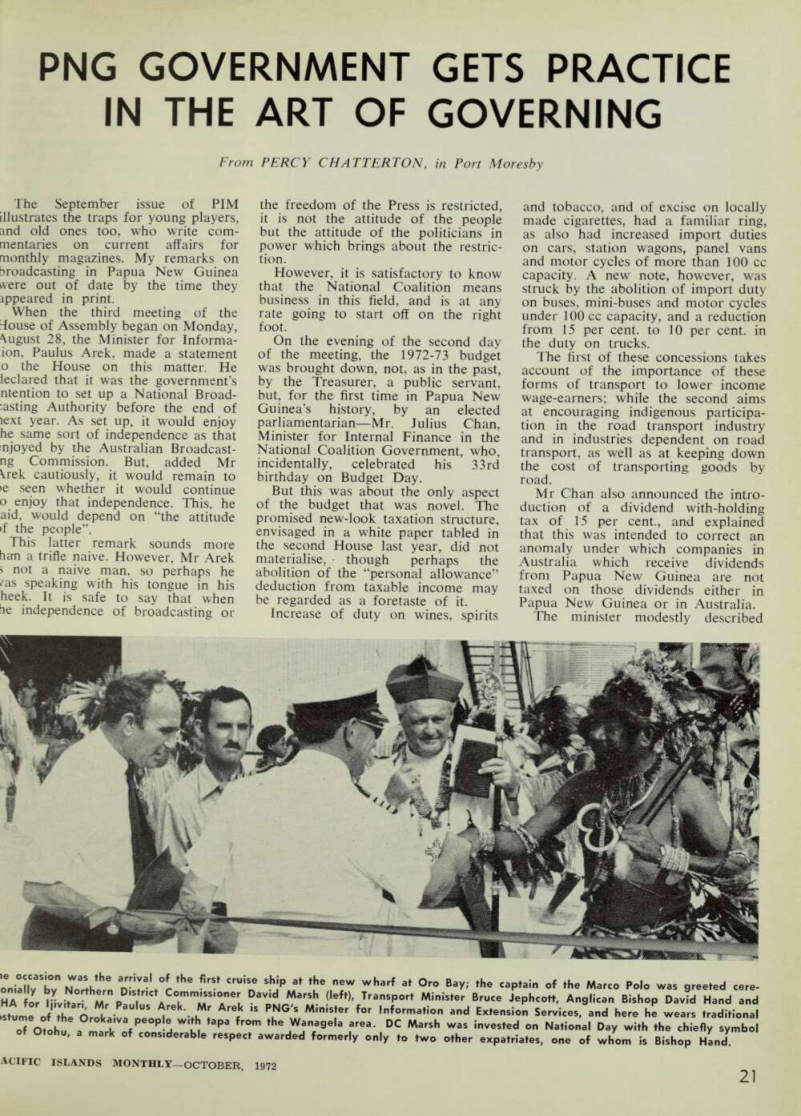
[?]e cocasion was the arival of the first cruse ship at the new whart at Oro Bay: the captain of the Matco Polo was greeted cere onially by Nortern District Commissioner David Marsh (left), Transport Minister Bruce Jephcott, Anglican Bishop David Hand and HA for Ijivitari, Mr Paulus Arek. Mr Arek is PNG's Minister for Information and Extension Services and here he wears traditional [?]stume of the Orokaiva people with the Wanagela area. DC Marsh was invested on National Day with the chiefly symbol of Otohu,a mark of considerable respect awarded formerly only to two other expatriates, one of whom is Bishop Hand
his first budget as a “stocktaking” one, and drew attention to the dif ficulties under which it had been prepared. There was the fact that the prices of many of our exports were falling, while those of our most important imports were rising. There was a need to increase domestic pro duction and so to reduce Papua New Guinea’s dependence on imports, he said.
Then there was the problem of the government’s rising salaries bill, which now stood at $6O million, 27 per cent, of total spending. We must ensure that we do not build up a public service structure which the country cannot afford, said Mr. Chan.
A report tabled at a later sitting from the Papuan chairman of the Public Service Board, Mr Sere Pitoi, seems to foreshadow the possibility that the Public Service may find itself pruned down willy-nilly. Localisation of the Public Service has not gone nearly as well as was envisaged in an earlier white paper tabled in the House last year.
The main reasons for the failure appear to have been, firstly, the inability of the Administration to provide housing of the quality now looked for by the more sophisticated sector of the indigenous work-force and the non-availability of funds to remedy this deficiency; and, secondly, increasing competition for the avail able personnel from a private sector at last awakened to the need for rapid localisation. Mr Pitoi predicts that in 1976, the Chief Minister’s favoured date for independence, the Public Service will still need the services of 7,000 expatriates. Will it be able to get them at a price that Papua New Guinea can afford, and, if not, where do we go from there?
However, back to the budget.
Finally, said Mr Chan, there was the problem created by the fact that final shaping of the budget could not take place until the amount of aid which Australia would provide was known, and it was only known a few weeks before the budget had to be brought down in the House. This meant, explained Mr Chan that the Treasury had to prepare several tentative budgets based on different levels of Australian aid. It was greatly to be desired, he added, that the next Australian Government would be prepared to negotiate an advance agreement on its aid level over a period of years, so that the PNG Government could get on with some advance planning.
On the whole the budget has been well received, and the opposition United Party has conceded that it does not differ greatly from the kind
All Share In National Airline
of budget which it would have intro duced had it been able to form a government.
The withdrawal of the taxpayer’s “personal allowance” concessional deduction has been criticised, notably by the PSA, which fears that it will largely nullify recent salary increases granted to local officers in the Public Service. However, it is difficult to find any intelligible rationale for this allowance; indeed, while as a tax payer I have always been glad to be able to claim it, I have never under stood why I got it.
During the first two weeks of this meeting, the budget itself has been aver-shadowed by other events both nside and outside the House.
The announcement in the first week )f the meeting that the government ntends to press on without delay with he establishment of a National Broadcasting Authority was followed n the second week by a more sensa ional one, namely that of the im pending formation of a national air ine. This decision is in line with a ecommendation of a select com nittee of the second House, chaired >y former member for New Ireland md Manus Regional, Wally Lussick.
Jut few people expected it to bear ruit so soon.
It is intended that the national air ine will be set up within the next 8 months as a consortium in which tie PNG Government, Trans Aus tria Airlines, Ansett and Qantas /ill be equal partners. It will start y taking over and rationalising iternal air services now operated by 'AA and Ansett.
For the present, these two airlines dll continue to operate the services etween Australia and Papua New iuinea, but it is envisaged that after idependence the national airline and )antas will have reciprocal rights to y these routes. Australia’s Depart icnt of Civil Aviation will continue ?r the present to provide technical nd safety services.
Transport Minister Jephcott has irecast that the rationalisation of le internal services may lead to a eduction in fares. Let us hope that e is right.
Outside the House, overshadowing /ery other happening, there has sen the catastrophic crash of an AAF “Caribou” carrying over a :ore of school cadets returning to icir school in Port Moresby, the 'e La Salle College, after a train ig exercise. Only five of the cadets ere rescued, and one of these died iter in hospital. The rest, together
with the crew of the aircraft and two army officers, perished.
In the House, Miss Josephine Abaijah, member for Central Regional, moved that the Australian Government be asked to appoint a Royal Commission to investigate the disaster.
“The country has suffered a great blow,” she said, “in the loss of these fine, educated young men who were at the beginning of a life of service to our country. We need as a parlia ment, we need as a nation, and the parents and relatives need a full, all powerful, independent public inquiry, covering all aspects of this disaster.”
Miss Abaijah has not been very popular with the National Coalition Government of late, but this time they agreed with her, and her motion was carried on the voices. It remains to be seen whether the Australian Government will accede to or reject the request.
Three other motions accepted by the House are of some interest. One, moved by Mr John Matik, member for Wosera-Gaui, calls for local government council “advisers” to be given specific training for their task.
This motion is the latest manifesta tion of continuing dissatisfaction with the performance of district adminstra tion officers appointed as council advisers.
The second, sponsored by Western Regional’s Naipuri Marina, called on the government to state the qualifica tions, experience and training of officers engaged in political education.
This again expresses a continuing dis satisfaction with the present system and a feeling that political education should not be in the hands of public servants.
The third came from Gulf Regional’s Tom Koraea, and amount ed to a criticism of the government of which he is a supporter and in particular of the Minister for Agri culture, Mr lambakey Okuk.
At the June meeting of the House Mr Koraea had expressed his con cern at the lack of development in his electorate, and asked that con sideration should be given to the establishment of an oil-palm industry there. Mr Okuk replied brusquely that conditions in the Gulf District were not suitable for oil-palm cultiva tion.
Outside the House this snub pro voked a retired LMS missionary, Rev Sue Rankin, to retort, in an ABC current affairs programme, that oil palms planted at Veiru, near Kikori, at the time of World War I by Rev
Ben Butcher (still alive at 95 in NSW) had survived and thrived, self sown and untended to the present day. Confronted with Mr Okuk’s statement, Mrs Rankin, a small but wiry Welshwoman, retorted tartly that she and Mr Koraea knew the area while Mr Okuk evidently didn’t.
During the current meeting, Mr Koraea raised the issue again in the form of a motion calling on the government to investigate the potential of the country’s under-developed districts before initiating any more oil-palm projects. (The two estab lished to date are both in New Britain).
Mr Koraea’s blunt speaking on this occasion was all the more significant because although only a back bencher in the National Coalition he is national chairman of the Pangu Party, the Coalition Government’s senior partner.
Party affiliations continue to exhibit a certain fluidity. During the current sittings three members have crossed the floor of the House. Two High lands United Party members have defected to the National Coalition, while the honourable member of Menyamya, who was elected on the UP ticket and later defected to the Coalition, has now re-defected to the United Party.
The reasons given by members for these manoeuvres suggest that many PNG politicians regard party allegiance as a means of securing benefits for their electorates rather than as an instrument for the pro motion of sound national policies.
Moreover, party members are still liable to exercise a free vote on issues they feel strongly about. In one recent division, two government supporters voted with the opposition while two opposition members voted with the government—a novel variant of Westminster’s pairing system.
Then, after an adjournment for National Day, the Coalition won a majority 53-34 vote on a motion set ting the date for self-government as December 1, 1973. The vote, follow ing a 10-hour debate, was short of the 75 per cent, majority. Mr Somare said in June that he wanted—and the Opposition reminded him of it. But Mr Somare said the vote was “sub stantial”, and he was satisfied.
In the meantime the target date debate has produced the piquant story of a meeting at which West Sepik Regional’s Paul Langro tried to explain the meaning of self-govern ment to some of his constituents.
Following the explanation, a member of the audience said he wanted three self-governments, one for himself, one for his wife, and one for his child.