Tuned In,
pp. 52-55 · Read in the full issue

Turned On
Territory
New Caledonia Diary
with
Helen Rousseau
Caledonians these days are really tuned in, since Radio Noumea is operating 16 hours daily, instead of just a few hours three times a day, around mealtimes. And some of the programmes are real swingers, which is obviously just what is intended, on the eve of the territorial elections.
Listeners are tempted with all manner of juicy tit-bits, from news of the latest arrival of New Zealand mussels and oysters to daily menus from popular restaurants, offering everything from North African couscous to Alsatian sauerkraut cabbage.
T , . . c r ..
French^'*American 'and
pop singers, persons from the in land or outlying islands are advised when to pop down to the nearest wharf or airfield to collect parcels from auntie. They may also pick up a message asking them to catch the next plane down to Noumea, ticket likewise paid by auntie. And then, for lack of faster communications, radio listeners also hear each day a list of deaths and local funeral details.
To keep up the battery of entertainment, for both radio and Tele-Noumea, three extra newsmen were recently flown in from France, while others were recruited from among journalists already settled here. For the newcomers, the task demands some skill in getting across. Certainly they are still speaking their native French language, but they must
also learn to twist their tongue around Melanesian words and the names of locals who come from all around the Pacific, besides settlers from other French posses sions and the Asian countries of Indonesia and Vietnam.
The main revolution at Radio Noumea, however, has been in the presentation of “news”. For years, Caledonians listening to their local radio have apparently been expected to feel their feet ache when strikes are announced on the Paris Metro subway, to shiver with the heavy snowfalls in the French Alps and to feel relaxed when French holidaymakers jam highways to press off for summer holidays on the Riviera.
While Caledonians were kept up to the minute almost on murder trials and soccer matches some 20,000 kilometres away, local speculation over the Administra tion or private persons often hit high tension relays on radio cocotier (coconut radio), without the slightest echo being heard from the official radio. Now all this has changed (at least within certain officially acceptable limits).
The local controversies of the day can now be digested together with the regular bifteck and vin ordinaire as families gather over their mid-day meal. What’s more, while waiting for his next plate of cheese or dessert, an interested listener is invited to telephone and put questions to the parties in volved in the live interviews.
The effect these mid-day debates may be having on appetite or siesta has not so far been measured. But the animated ex changes probably result in more folk listening to the Paris message which is sandwiched in between.
All this effort to woo the Caledonians began, incidentally, just two months before what could be the island’s most decisive territorial elections yet, those of September 10.
One of the most lively en counters brought before Radio Noumea listeners has been the battle between local conservation ists and a new tourist group, planning to set up a pleasure resort on Hot Maitre, a small off shore island popularly frequented by Noumea boat owners. The resort promoters claim they would be helping the territory by keeping the whole island clean and planted with trees. Their opponents see their installation as putting an end to free visits to the island, while some innocent listeners have rung to ask how does one acquire an island?
The new tourist company in volved has been registered by the notary office operated by the president of the Territorial Assembly. The administration de partment concerned is in a quan dary to explain how such an island concession could be granted to such a company, while for various motives several pressure groups have launched petitions to
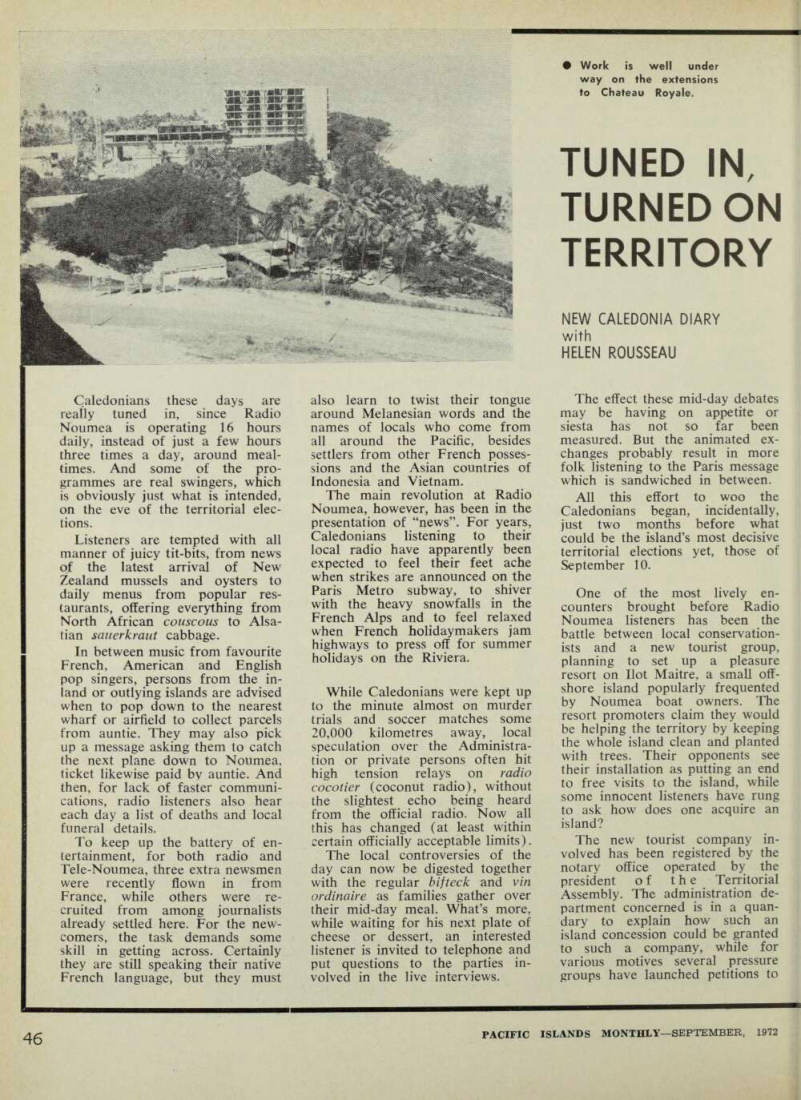
Work is well under way on the extensions to Chateau Royale.
campaign against the commerciali sation of the island.
It is not every lunch hour that Caledonians can battle with out side metropolitan French interests over the right of access to one of their islands. Most of the mid-day interviews are obviously intended to reassure folk, to bring them into contact with the many specialists working in Noumea and to make the locals feel that they are in expert care.
In this way, for the first time ever remembered here, a whole battery of metropolitan French public servants and scientists are being coaxed out of their bureaux to assure the Caledonians that they are there to “serve the public” and to actually give their telephone numbers and invite further inquiries.
Caledonians can be excused for sitting open-mouthed, letting their dinners grow cold, at hearing these unfamiliar voices descending re assuringly on their ears—at least until September 10.
All the pent-up concern over problems ranging from the new maths syllabus at school to regu lations covering hunting and wild life reserves, are now being given an airing. Most significantly, the problems are being discussed by informed people, instead of leav ing untrained imagination and speculation to run riot over the gossip circuit.
This is not to say that all vital local subjects may be touched upon. “Regional” news still means news of New Caledonia, as a region of France. There is no attempt to suggest that the terri tory could have a Pacific identity and belong to this region of island communities. Noumea Radio does, however, beam news and advertise ments for the New Hebrides, while on short wave (7,170 and 11,825 KHZ) programmes may be picked up further afield.
Meanwhile, it has apparently been deemed unsafe for mid-day digestion to introduce a debate on what many Caledonians really want to talk about: the pros and cons of revising the territory’s political statutes, whether it be called internal autonomy or not.
And yet, whether it improves their digestion or not, the Cale
donians have to listen to the in terviews and statements of metro politan French politicians, while local leaders are not heard on political subjects. The locals’ failure to qualify for radio and TV seems to be based on the fact that they are not members of national French political parties.
However, nobody seems interested in challenging this, and the locals revel in setting up their own infor mation relays, rather than depend ing on official channels.
If one side of the politball game is thus not encouraged on the state-controlled radio and TV, plenty of coverage is given to other sports that might divert the Caledonians. Noumea thus knows straightaway when a Caledonian shot putter, Arnojlt Beer, becomes champion of France. In the same way, Radio Noumea introduces its listeners to the thrills of speedway driving, when New Zealanders fly in to introduce this sport here.
One of the biggest thrills of the day-long radio will be the con tinuous on-the-spot cover planned for the sixth Tour de Caledonie bicycle tour around the island September 13-24.
Thirty cyclists, including eight from metropolitan France and others from Australia, New Zea land and Tahiti, are expected to join this year’s 700-mile gruelling trial, through mountain dust and gravel. For Anglo-Saxons it would be hard to imagine the emotion aroused by the sweating cyclists and caravan of supporters, as they battle their way to each inland tribe and town.
On these occasions, the radio brings the whole island together and listeners telephone to offer
prizes for the first cyclist past their town post office, the last cyclist to cross the village bridge or the unluckiest cyclist, the one with the most punctures that day.
The cycling trial is one of the celebrations over several weeks, centring on September 24, the anniversary of the French “taking of possession” in 1853.
For sportsmen who prefer to compete with their neighbours in motor vehicles, Radio Noumea recently waged a campaign in favour of a local police-gendarme army effort to check car head lights and traffic indicators. Roads in Noumea, especially, bear a heavy traffic load these days: almost 35,000 new vehicles have been registered in the past seven years. The 1970 boom in motor sales has met a sharp decline with the current nickel recession, how ever. Registrations for the first six months this year were thus over 20 per cent, less than for the same period last year, numbering 3,169 to 4,136 (2-wheeled vehicles ex cluded).
In other sports, the August calendar included visits from the Paris University Rugby Club, be sides boxers from Tahiti, France and Australia.
For those who like their pleasures from a glass, Noumea’s second brewery began pouring out its amber liquid at the Pentecost group industrial site, behind Magenta domestic airport. The new label is “Number One”.
New Caledonia continues to re ceive visitors with varied interests in the island and radio listeners are quick to make their acquain tance.
One recent personnalite, who
Continued on p. 49
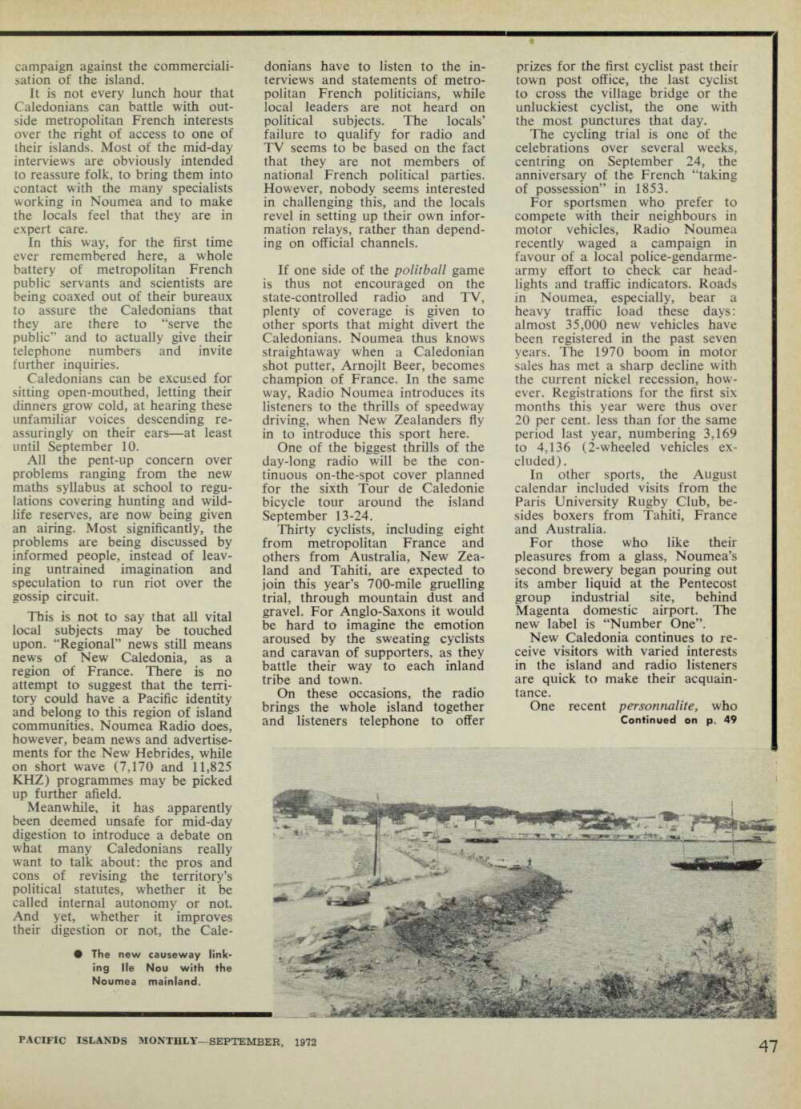
The new causeway link ing lie Nou with the Noumea mainland.
An unusual treat
was not available for interview, but nevertheless was much talked of, was a young sea-lion, found washed up on the south coast. He speedily became a cherished in mate of Dr Catala’s famous aquarium.
Noumea music lovers had an unusual treat in August with the visit of the world-famed bassoon player George Zuckerman from Canada. On the visual plane, Caledonian artist Patrice Nielly exhibited 77 paintings at the Noumea Museum gallery, where the first oil sold at more than $A2,000 before the official open ing.
Finally, those who appreciate the charming contribution of the Indonesian community in Noumea were invited to join the Indonesian Consul and Mrs Paul Samadiono in celebrating the 27th anniver sary of Indonesia’s Independence Day, on August 17.
In the industrial sector, visitors who have been particularly active on election eve came from the Patino subsidiary, COFREMMI, and its partners. Their nickel plans for the north of the island are geared to renew the locals’ con fidence in Paris development plans.
The French company Pechiney- Ugine Kuhlmann, together with Swedish Grangesberg, are asso ciated in the project, which is now making feasibility studies. The new group has been named SOMMENI, with production said to be planned for mid-1975.
While these recent visitors may be raising hopes, they have not been sufficient to raise the statis tics. The number of overseas visitors to the island in July totalled only 556, which was 43 per cent, less than for the same month last year. Reasons given by the Noumea Tourist Office were the attractive cheaper fares now being offered to rival destinations such as Europe and Singapore.
The recent boycott (over French Pacific nuclear tests) also reduced the tourist traffic, particularly with the suspension of triangular flights through Fiji.
French airlines and shipping companies were, mostly, fast back to normal services when the boy cott was over. The Caledonian press made an effort to express the hope that the whole affair would fast become a faded memory.