Taking the spoken word
pp. 57-59 · Read in the full issue

over the Owen Stanleys
Story and pictures by JAMES G. PORTER.
A sophisticated ultra high fre quency (UHF) radio repeater system has been completed over the 12,000 ft high mountain peaks of the Owen Stanley Range, to bring Port Moresby into instant dial-telephone communi cation with the rest of Papua New Guinea.
Until now radio telephone and telegraph services between Port Moresby and Lae, the country’s two biggest centres, have been entirely inadequate. Over the past few years telephone and telegraph traffic in creased out of all proportion to the capabilities of outdated HF and VHF radio systems, operating with diffi culty via only two repeater stations at Mt Lawes and Mt Kaindi.
The new system has been made possible only by the use of the very latest techniques in transistorised microwave radio repeaters, which consume relatively microscopic amounts of power, enabling them to be installed on some of the most re mote of Papua New Guinea’s moun tain tops with the aid of helicopters.
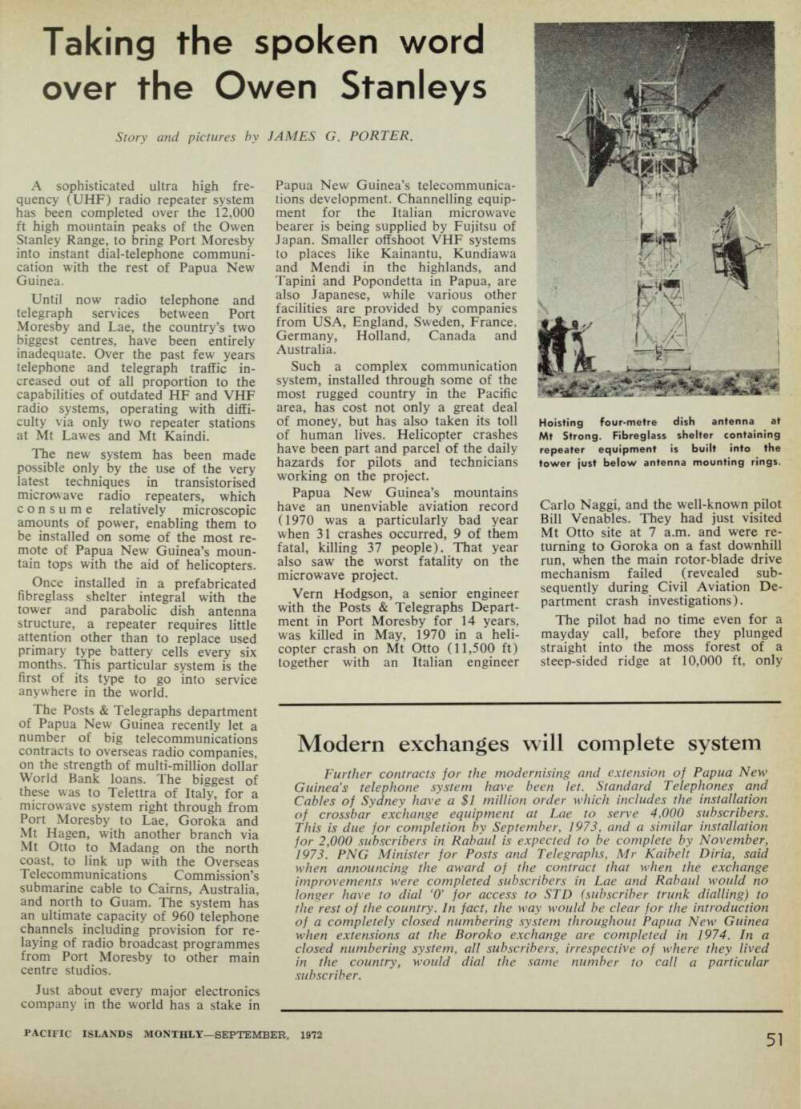
Once installed in a prefabricated fibreglass shelter integral with the tower and parabolic dish antenna structure, a repeater requires little attention other than to replace used primary type battery cells every six months. This particular system is the first of its type to go into service anywhere in the world.
The Posts & Telegraphs department of Papua New Guinea recently let a number of big telecommunications contracts to overseas radio companies, on the strength of multi-million dollar World Bank loans. The biggest of these was to Telettra of Italy, for a microwave system right through from Port Moresby to Lae, Goroka and Mt Hagen, with another branch via Mt Otto to Madang on the north coast, to link up with the Overseas Telecommunications Commission’s submarine cable to Cairns, Australia, and north to Guam. The system has an ultimate capacity of 960 telephone channels including provision for re laying of radio broadcast programmes from Port Moresby to other main centre studios.
Just about every major electronics company in the world has a stake in
Papua New Guinea’s telecommunica tions development. Channelling equip ment for the Italian microwave bearer is being supplied by Fujitsu of Japan, Smaller offshoot VHF systems to places like Kainantu, Kundiawa and Mendi in the highlands, and Tapini and Popondetta in Papua, are also Japanese, while various other facilities are provided by companies from USA, England, Sweden, France, Germany, Holland, Canada and Australia.
Such a complex communication system, installed through some of the most rugged country in the Pacific area, has cost not only a great deal of money, but has also taken its toll of human lives. Helicopter crashes have been part and parcel of the daily hazards for pilots and technicians working on the project.
Papua New Guinea’s mountains have an unenviable aviation record (1970 was a particularly bad year when 31 crashes occurred, 9 of them fatal, killing 37 people). That year also saw the worst fatality on the microwave project.
Vern Hodgson, a senior engineer with the Posts & Telegraphs Depart ment in Port Moresby for 14 years, was killed in May, 1970 in a heli copter crash on Mt Otto (11,500 ft) together with an Italian engineer
Carlo Naggi, and the well-known pilot Bill Venables. They had just visited Mt Otto site at 7 a.m. and were re turning to Goroka on a fast downhill run, when the main rotor-blade drive mechanism failed (revealed sub sequently during Civil Aviation De partment crash investigations).
The pilot had no time even for a mayday call, before they plunged straight into the moss forest of a steep-sided ridge at 10,000 ft, only
Hoisting four-metre dish antenna at Mt Strong. Fibreglass shelter containing repeater equipment is built into the tower just below antenna mounting rings.
two hundred yards short of an emergency landing pad. In that dense forest, the wreckage was not found until two days later.
Many other chopper crashes have occurred, fortunately without fatality, but quite serious nevertheless for the men concerned and for the project.
A Hiller FH-1100 helicopter crashed in severe air turbulence on Mt Kenevi (11,300 ft) in August, 1969, knock ing the pilot unconscious and giving technician Ron Nelson a bad scare.
That machine was a total write-off.
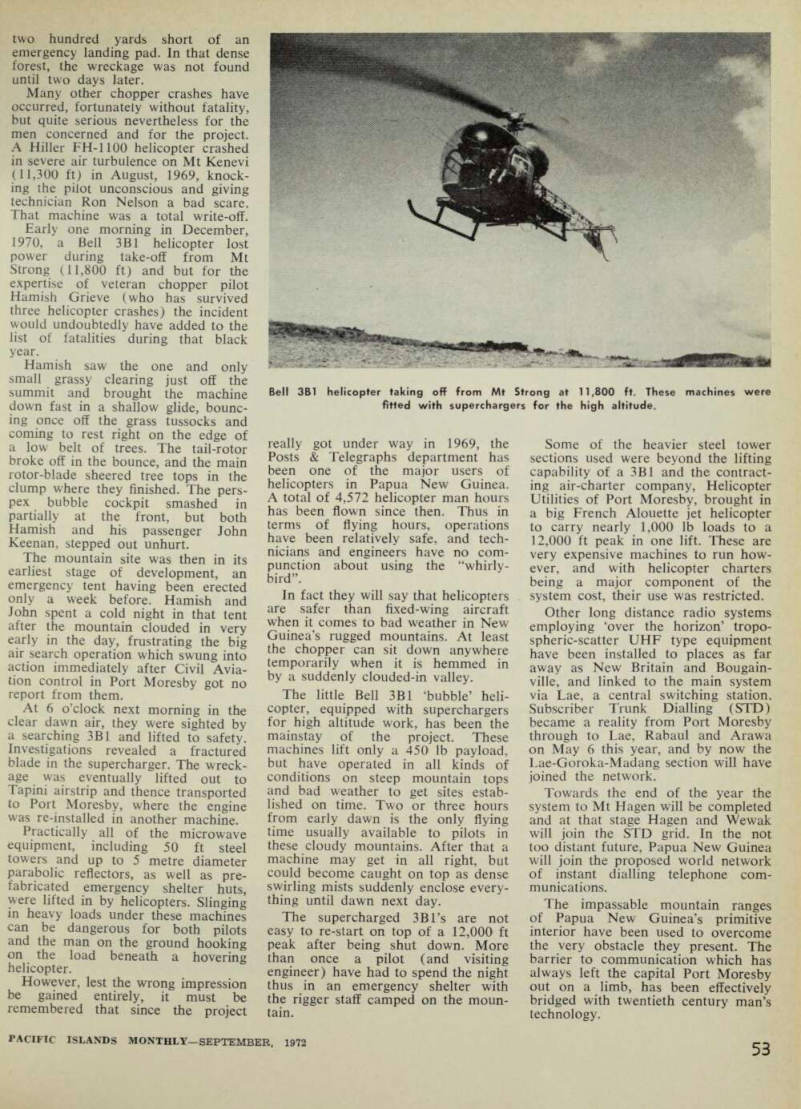
Early one morning in December, 1970, a Bell 381 helicopter lost power during take-off from Mt Strong (11,800 ft) and but for the expertise of veteran chopper pilot Hamish Grieve (who has survived three helicopter crashes) the incident would undoubtedly have added to the list of fatalities during that black year.
Hamish saw the one and only small grassy clearing just off the summit and brought the machine down fast in a shallow glide, bounc ing once off the grass tussocks and coming to rest right on the edge of a low belt of trees. The tail-rotor broke off in the bounce, and the main rotor-blade sheered tree tops in the clump where they finished. The pers pex bubble cockpit smashed in partially at the front, but both Hamish and his passenger John Keenan, stepped out unhurt.
The mountain site was then in its earliest stage of development, an emergency tent having been erected only a week before. Hamish and John spent a cold night in that tent after the mountain clouded in very early in the day, frustrating the big air search operation which swung into action immediately after Civil Avia tion control in Port Moresby got no report from them.
At 6 o’clock next morning in the clear dawn air, they were sighted by a searching 381 and lifted to safety.
Investigations revealed a fractured blade in the supercharger. The wreck age was eventually lifted out to Tapini airstrip and thence transported to Port Moresby, where the engine was re-installed in another machine.
Practically all of the microwave equipment, including 50 ft steel towers and up to 5 metre diameter parabolic reflectors, as well as pre fabricated emergency shelter huts, were lifted in by helicopters. Slinging in heavy loads under these machines can be dangerous for both pilots and the man on the ground hooking on the load beneath a hovering helicopter.
However, lest the wrong impression be gained entirely, it must be remembered that since the project
really got under way in 1969, the Posts & Telegraphs department has been one of the major users of helicopters in Papua New Guinea.
A total of 4,572 helicopter man hours has been flown since then. Thus in terms of flying hours, operations have been relatively safe, and tech nicians and engineers have no com punction about using the “whirly bird”.
In fact they will say that helicopters are safer than fixed-wing aircraft when it comes to bad weather in New Guinea’s rugged mountains. At least the chopper can sit down anywhere temporarily when it is hemmed in by a suddenly clouded-in valley.
The little Bell 381 ‘bubble’ heli copter, equipped with superchargers for high altitude work, has been the mainstay of the project. These machines lift only a 450 lb payload, but have operated in all kinds of conditions on steep mountain tops and bad weather to get sites estab lished on time. Two or three hours from early dawn is the only flying time usually available to pilots in these cloudy mountains. After that a machine may get in all right, but could become caught on top as dense swirling mists suddenly enclose every thing until dawn next day.
The supercharged 3Bl’s are not easy to re-start on top of a 12,000 ft peak after being shut down. More than once a pilot (and visiting engineer) have had to spend the night thus in an emergency shelter with the rigger staff camped on the moun tain.
Some of the heavier steel tower sections used were beyond the lifting capability of a 381 and the contract ing air-charter company, Helicopter Utilities of Port Moresby, brought in a big French Alouette jet helicopter to carry nearly 1,000 lb loads to a 12,000 ft peak in one lift. These are very expensive machines to run how ever, and with helicopter charters being a major component of the system cost, their use was restricted.
Other long distance radio systems employing ‘over the horizon’ tropo spheric-scatter UHF type equipment have been installed to places as far away as New Britain and Bougain ville, and linked to the main system via Lae, a central switching station.
Subscriber Trunk Dialling (STD) became a reality from Port Moresby through to Lae, Rabaul and Arawa on May 6 this year, and by now the Lae-Goroka-Madang section will have joined the network.
Towards the end of the year the system to Mt Hagen will be completed and at that stage Hagen and Wewak will join the STD grid. In the not too distant future, Papua New Guinea will join the proposed world network of instant dialling telephone com munications.
The impassable mountain ranges of Papua New Guinea’s primitive interior have been used to overcome the very obstacle they present. The barrier to communication which has always left the capital Port Moresby out on a limb, has been effectively bridged with twentieth century man’s technology.
Bell 381 helicopter taking off from Mt Strong at 11,800 ft. These machines were fitted with superchargers for the high altitude.