Footnotes
pp. 49-51 · Read in the full issue
#YN Monday, September 11, Papua New Guinea will observe its third National Day, an occa sion intended to promote a sense of national unity among the diverse people of this ex-colony.
There will be bands, marches, traditional singing and dancing, and a good deal of high sounding waffle on the theme of “bung wantaim”, which seems to be well on its way to being regarded as an “open sesame” to peace and prosperity—a new cargo cult, in fact.
What progress has been made towards national unity since National Day 1971?
At the top level, a good deal. This time last year it seemed impossible to hope that the elec tion of a third House of Assembly could produce a government representative of all parts of the country and at the same time competent to tackle the work of government at ministerial level with out too great dependence on expatriate public servants.
However, the seemingly im possible has happened, and the National Coalition which now controls the affairs of Papua New Guinea is highly representative of all the country’s regions and most of its districts and has an impres sive measure of competence.
But what of the people who inhabit these regions and districts.
Well, if unity, like charity, begins at home, the signs are not en couraging. In the Gazelle Peninsula
of New Britain, the rival Tolai factions are, if anything, growing more rather than less bitter towards each other. And in the Highlands hardly a week passes without some inter-clan dispute, generally about land, leading to fighting, blood shed and death.
It may be true that it is easier to be on good terms with the chap at the other end of the street than with one’s next door neighbour. But even allowing for this the signs are not propitious.
A few weeks ago certain faceless men described as the Chief Minister’s advisers came up with the idea of building up Chief Minister Michael Somare as a National Leader, and of flooding the country with pictures of him. Mr Somare showed no marked enthusiasm for this
New Guinea
Must Keep Free
Speech Free
tactic, his fellow ministers opposed it, and the idea was dropped. And a very good thing too.
Personality cults have generally proved detri mental to the countries upon which they have been inflicted, and we don’t want one here.
But personality cult-inspired “unity” is not the only kind of bogus national unity we are in danger of having inflicted on us. One gets the impression that some members of the National Coalition would not be adverse to a “unity” based
on the silencing of criticism.
Touchiness about and over reaction to adverse criticism has always been a feature of colonial government. Is it to become a feature of national government, as Stuart Inder has suggested in June PlM’s “Up Front”?
It was understandable that the National Coalition should not be pleased with Mr Anton Parao’s performance as one of Papua New Guinea’s delegates to the Trustee
ship Council’s meeting in New York; but its reaction was perhaps a little stronger than the occasion warranted.
It was understandable that the coalition should take a dim view of the tendency of some expatriates to use their influence and affluence in an effort to mould PNG politics, and the new head of the Institute of Technology, Dr Sandover, is no doubt right when he advises expatriates to keep out of the country’s politics at this stage.
But the threats breathed out by the Chief Minister during his highly successful Highlands tour were again perhaps a little stronger than the circum stances warranted.
It was understandable that coalition ministers should take umbrage at certain remarks made by
With Percy Chatterton
in Pori Moresby
Miss Josephine Abaijah, MHA, at a student meet ing in Melbourne. But the last minute cancella tion of an invitation extended to her to be the guest speaker at a graduation ceremony at Port Moresby’s School of Nursing, and the substitution on the programme of the name of the Minister for Lands, Mr Albert Maori Kiki, was surely an over reaction, more especially as it is reasonable to suppose that the invitation was extended to Miss Abaijah as a former student, and later teacher, at the school, rather than as a politician. In spite of the rather incoherent explanation of the incident given by the Minister for Health, Dr Reuben Taureka, there was a nasty smell of political payback about the affair.
More recently, a local officer of the public service in Rabaul has been told to keep quiet.
Criticism of the government by public servants ‘‘would not be tolerated”, the Chief Minister indicated. Fair enough as far as it goes, I sup pose. It was the language used rather than the sentiment expressed that worried me a bit. I seem to have heard this phrase about criticism not being “tolerated” rather frequently of late.
None of these incidents is important in itself.
But are they straws in the wind? The list of per sons and organisations from which Mr Somare “will not tolerate criticism” seems to be growing apace, and I expect that it is only a question of time before my name appears on it.
In Papua New Guinea free education and free medical treatment have already gone down the drain. Is free speech about to follow them?
Miss Abaijah’s forthright Papuan nationalism is no doubt embarrassing to those of her Papuan colleagues who have become ministers in the coalition government, though it is rumoured that some of them expressed somewhat similar senti ments to hers during their election campaigns.
However, Miss Abaijah is that unusual pheno menon, a politician who says as a member exactly the same things as she did as a candidate. Such eccentric behaviour has naturally attracted atten-
tion, not all of it favourable. But in view of her outstanding success at the polls, she is probably wise as well as honest in continuing to express the sentiments which won her so resounding a
victory.
Miss Abaijah’s claim that the development of rural Papua has been consistently neglected in the past and is still being neglected is indisputable.
It is not invalidated by the quotation of figures which include expenditure on the national capital, Port Moresby. Ninety per cent, of that expenditure is irrelevant, and brings no benefit whatever, to rural Papua; and rural Papuans may be excused if they express impatience and even anger when it is pointed out to them that millions of dollars are being spent on making Port Moresby a city fit to live in for New Guinean migrants, who now make up such a substantial proportion of its popu lation.
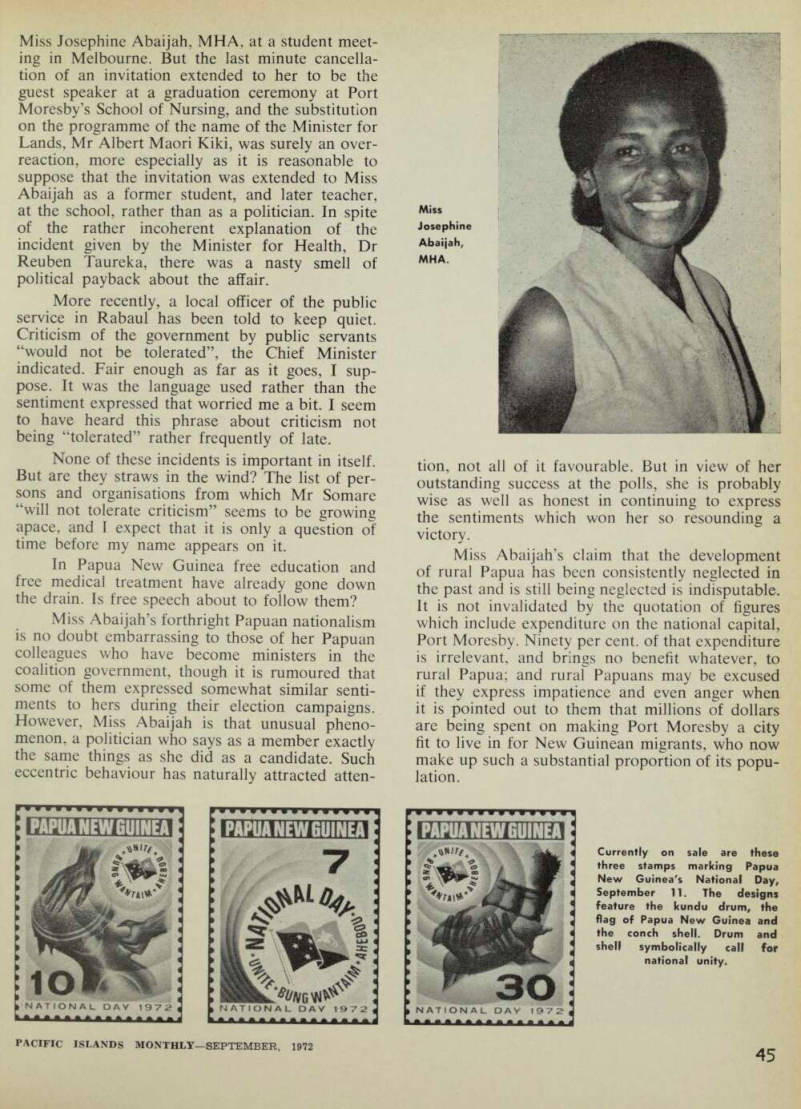
Miss Josephine Abaijah,
Mha.
Currently on sale are these three stamps marking Papua New Guinea's National Day, September 11. The designs feature the kundu drum, the flag of Papua New Guinea and the conch shell. Drum and shell symbolically call for national unity.