Yesterday
p. 81 · Read in the full issue
Twenty years ago in PIM there was a small picture, only 2 inches by 2 inches, which showed a palm-fringed beach and beyond it the sea from which was rising a mushroom-shaped cloud.
Under the picture was the legend: "Not a Bikini atom-blast. This photograph was taken by Mr Edwin Gold of Mangaia, Cook islands when the ship 'Kanieri' was blasting a passage through the reef off that island."
It's a sure bet that the caption writer didn't dream there would be more mushrooms over the South Pacific a couple of decades later and that they'd be the real thing.
And, now that YESTERDAY has recorded for TOMORROW that there were nuclear blasts on PIM'S doorstep in June, 1972, and not just reef blasts, we'll leave the subject. It was just a bit of musing over things happening which, only a few short years ago, no-one dreamed
would happen.
Like copra, f'rinstance. Who'd have thought in July-August, 1952 that the nadir to which the copra industry in the Islands had plunged at that time was only half-way down the hole into which it's fallen today. Look at the prices then— disastrous they were called: At Suva and Levuka, 1952: Plantation grade (60 points and over) EF6S/0/6 a ton; FMS points) EF64/15/-; lower grades £63/10/-. In PNG the Copra Marketing Board's prices began at £7O/5/- for hot air dried.
Now look at 'em. The latest price quoted in Suva in late June was $67 for Fiji first grade—just over half as much as the 1952 figure, much less when the purchasing power of today's dollar is taken into account. No wonder the Tartes on Taveuni are planning to flog some of their plantation land.
But cheer up. In 1932 copra prices were down and plantations were for sale. Would you believe it—one of 2,000 acres in the New Hebrides, complete with homestead, gardens, sheds, permanent water and cattle, was going for £2,500! There was one in Fiji of 500 acres priced at £l,OOO.
The copra industry 20 years ago might have seemed to be dying but Carpenters thought there was plenty of life left in it—as there was—because PIM, August, 1952, reported the imminent opening of a new copra-crushing mill by Carpenters at Toboi, Rabaul, a
3-expeller mill which would process 25,000 tons a year.
This business of copra occupied a lot of PIM space then but running it pretty close was something a long way removed from coconuts —rugby. At that time, Fiji's rugby team was making its first tour of Australia. PIM said the Fijians were getting the film-star treatment and enthused, "In 35 days, a score of young Fijians have done more in Australia for the reputation of Pacific Islands and Islanders than savants and politicians have done in 35 years."
Here's the score card: Fiji 21, Sth.
Harbour 9; Fiji 28 City, 19; Fiji 14, NSW 14; Fiji 30, New England 18; Fiji 24, Queensland 17; Fiji 33, Comb.
Services 14; Australia 15, Fiji 9; Fiji 50, Central NSW 8; Fiji 28, Newcastle 25; Fiji 17, Australia 15.
There was a much smaller item, but also showing the product of Fiji in a good light. This was the rescue of three fishermen in a storm by a 17-year old Fijian girl, Lakalaka Sau, of Lakeba.
She did a Grace Darling act, paddling a heavy canoe for five miles in stormy seas to rescue the men who were clinging to a coral patch after losing their canoe. Wonder where Lakalaka Sau is now? And did she get a medal?
There was another rescue reported by PIM featuring an old PIM friend, who's still going strong, Captain Brett Hilder.
As a matter of fact he wrote to PIM a couple of weeks ago.
The rescue was of Lever's AV "Matoma", a labour recruiting vessel, which ran on a reef in the Russells. She had been on the reef for three weeks before Captain Hilder turned up in the MV "Muliama" and pulled her off at the second attempt. The good captain, who graced PIM with his "profiles" is now with Karlander and on June 20 (this year) was leaving Sydney in the MV "Sariba".
The importance of land in the lives of the people of Papua New Guinea has recently been underlined by events in that country, notable among them being
the tragic death of Jack Emanuel. His murderers, say their apologists, were suffering under a sense of injustice through deprivation of their land rights.
Land also loomed large 20 years ago and the then Minister for Territories, Mr Paul Hasluck took time off from his sparring with ex-PNG Administrator Colonel J. K. Murray to indicate what his policy was in that regard.
PIM quoted him as saying, among other things, "It is also part of the government's policy that the natives should take an increasing part in the development of the territory ...
Considerable encouragement has been and will continue to be given according to the circumstances in each district for the participation by the natives in the development of the country, and to this end enough land will be reserved to them to make this participation in progress effective."
Nobody realised then that 20 years later, the people of PNG would be girding their loins to take over the government of their country. Colonel Murray, whose term as Administrator ended with a shemozzle, was particularly keen over the people's land rights.
A picture of Colonel Murray on his farewell tour appeared in the August PIM. A woman was in the picture, standing at his right hand —Mrs E. J.
Emanuel, of Minj.
Around that time they were tightening their belts in Western Samoa where, PIM said, "The continuing acute food shortage is causing considerable concern to the Samoan Government and native leaders."
Apparently the drift from the villages to Apia the capital, a movement which began with the arrival of American troops during the war, was one of the main causes of the shortage and the high price of imported food.
Linked to the shortage was a crime wave which affected practically all the districts of Upolu and Savaii where Samoan foodstuffs were systematically stolen from breadfruit, taro, banana and yam plantations.
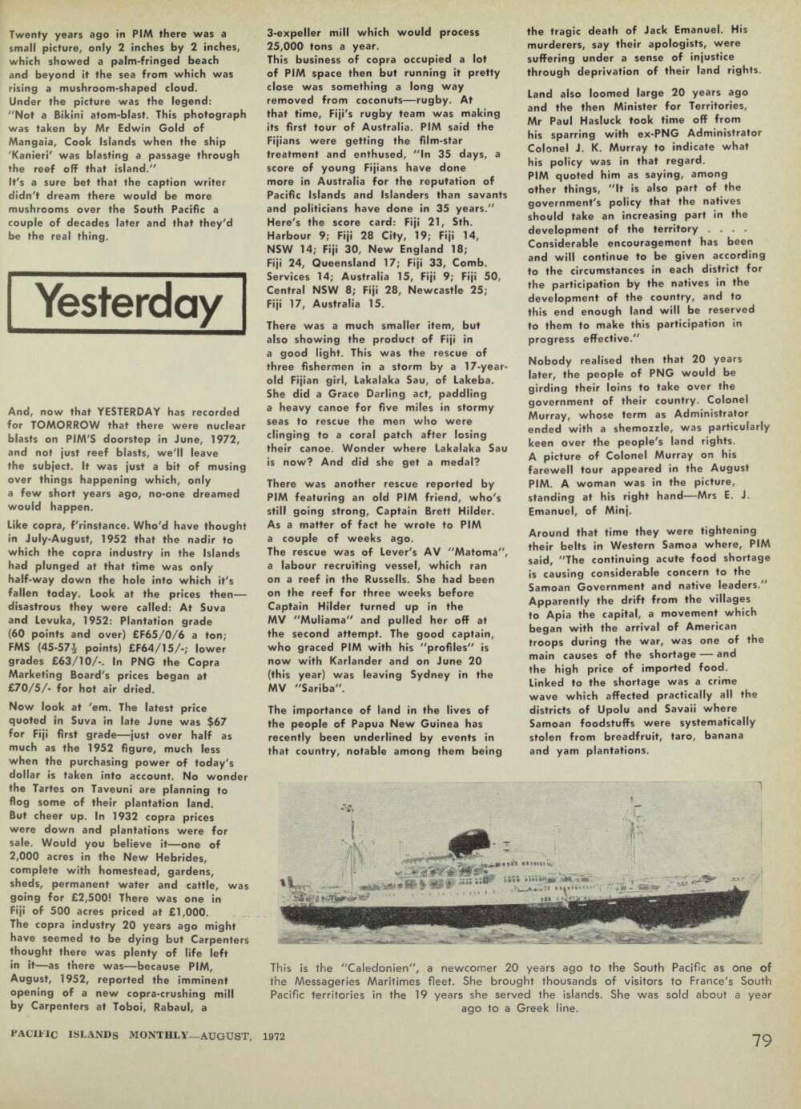
This is the "Caledonien", a newcomer 20 years ago to the South Pacific as one of the Messageries Maritimes fleet. She brought thousands of visitors to France's South Pacific territories in the 19 years she served the islands. She was sold about a year ago to a Greek line.