A reminder of the harshness of war
p. 79 · Read in the full issue
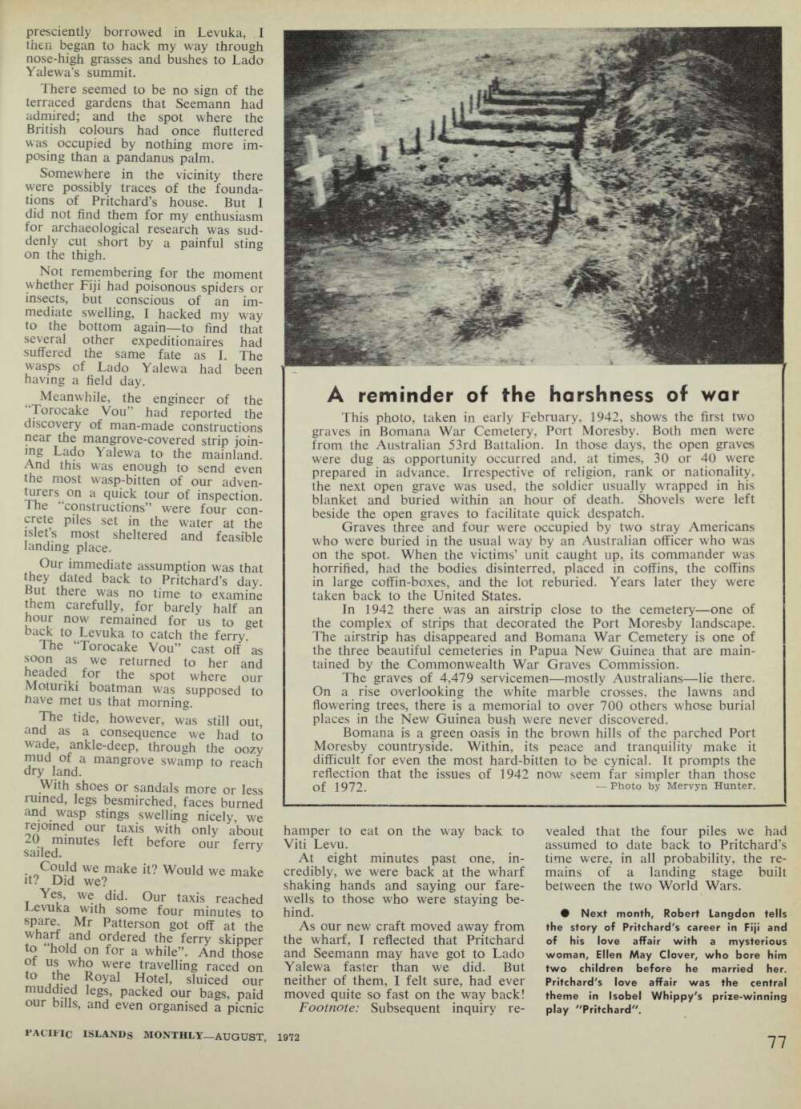
This photo, taken in early February, 1942, shows the first two graves in Bomana War Cemetery, Port Moresby. Both men were from the Australian 53rd Battalion. In those days, the open graves were dug as opportunity occurred and, at times, 30 or 40 were prepared in advance. Irrespective of religion, rank or nationality, the next open grave was used, the soldier usually wrapped in his blanket and buried within an hour of death. Shovels were left beside the open graves to facilitate quick despatch.
Graves three and four were occupied by two stray Americans who were buried in the usual way by an Australian officer who was on the spot. When the victims’ unit caught up, its commander was horrified, had the bodies disinterred, placed in coffins, the coffins in large coffin-boxes, and the lot reburied. Years later they were taken back to the United States.
In 1942 there was an airstrip close to the cemetery—one of the complex of strips that decorated the Port Moresby landscape.
The airstrip has disappeared and Bomana War Cemetery is one of the three beautiful cemeteries in Papua New Guinea that are main tained by the Commonwealth War Graves Commission.
The graves of 4,479 servicemen—mostly Australians—lie there.
On a rise overlooking the white marble crosses, the lawns and flowering trees, there is a memorial to over 700 others whose burial places in the New Guinea bush were never discovered.
Bomana is a green oasis in the brown hills of the parched Port Moresby countryside. Within, its peace and tranquility make it difficult for even the most hard-bitten to be cynical. It prompts the reflection that the issues of 1942 now seem far simpler than those of 1972. Photo by Mervyn Hunter,