Magazine Section
pp. 75-79 · Read in the full issue
Sentimental Journey To A
Fiji Isle With A Past
By Robert Langdon
A dozen people—l among them— made a sentimental journey in late May to Lado Yalewa, site of the home from 1860 to 1862 of Britain’s first consul in Fiji, William Thomas Pritchard, It was a six-hour adven ture by road, river, sea and mangrove swamp that most of us will not soon forget.
And one day, perhaps, its various phases—with a sloshy finale—will be recorded in music as the “Lado Yalewa Suite”, for our party included the Australian composer, John Antill, who was last heard muttering to himself, “mud, mud, mud”.
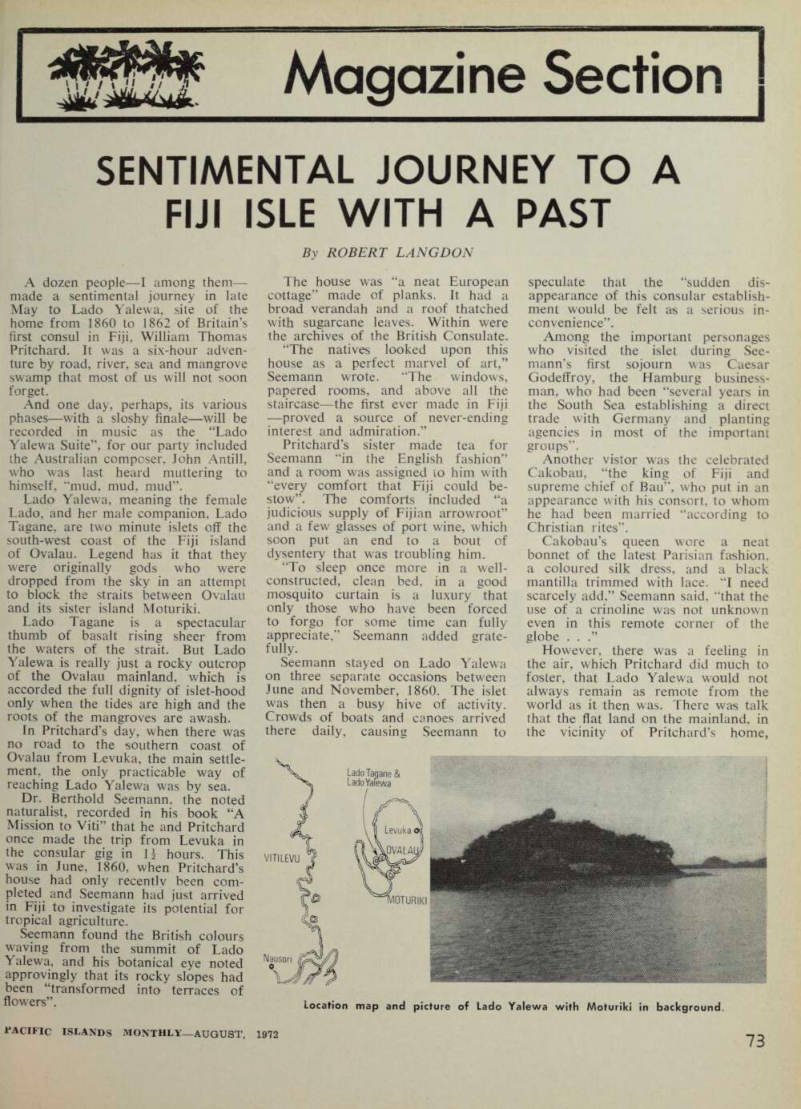
Lado Yalewa, meaning the female Lado, and her male companion, Lado Tagane, are two minute islets off the south-west coast of the Fiji island of Ovalau. Legend has it that they were originally gods who were dropped from the sky in an attempt to block the straits between Ovalau and its sister island Moturiki.
Lado Tagane is a spectacular thumb of basalt rising sheer from the waters of the strait. But Lado Yalewa is really just a rocky outcrop of the Ovalau mainland, which is accorded the full dignity of islet-hood only when the tides are high and the roots of the mangroves are awash.
In Pritchard’s day, when there was no road to the southern coast of Ovalau from Levuka, the main settle ment, the only practicable way of reaching Lado Yalewa was by sea.
Dr. Berthold Seemann, the noted naturalist, recorded in his book “A Mission to Viti” that he and Pritchard once made the trip from Levuka in the consular gig in U hours. This was in June, 1860, when Pritchard’s house had only recently been com pleted and Seemann had just arrived in Fiji to investigate its potential for tropical agriculture.
Seemann found the British colours waving from the summit of Lado Yalewa, and his botanical eye noted approvingly that its rocky slopes had been “transformed into terraces of flowers”.
The house was “a neat European cottage” made of planks. It had a broad verandah and a roof thatched with sugarcane leaves. Within were the archives of the British Consulate.
“The natives looked upon this house as a perfect marvel of art,”
Seemann wrote. “The windows, papered rooms, and above all the staircase—the first ever made in Fiji —proved a source of never-ending interest and admiration.”
Pritchard’s sister made tea for Seemann “in the English fashion” and a room was assigned to him with “every comfort that Fiji could be stow”. The comforts included “a judicious supply of Fijian arrowroot” and a few glasses of port wine, which soon put an end to a bout of dysentery that was troubling him.
“To sleep once more in a well constructed, clean bed, in a good mosquito curtain is a luxury that only those who have been forced to forgo for some time can fully appreciate,” Seemann added grate fully.
Seemann stayed on Lado Yalewa on three separate occasions between June and November, 1860. The islet was then a busy hive of activity.
Crowds of boats and canoes arrived there daily, causing Seemann to
speculate that the “sudden dis appearance of this consular establish ment would be felt as a serious in convenience”.
Among the important personages who visited the islet during See mann’s first sojourn was Caesar Godeffroy, the Hamburg business man, who had been “several years in the South Sea establishing a direct trade with Germany and planting agencies in most of the important groups”.
Another vistor was the celebrated Cakobau, “the king of Fiji and supreme chief of Bau”, who put in an appearance with his consort, to whom he had been married “according to Christian rites”.
Cakobau’s queen wore a neat bonnet of the latest Parisian fashion, a coloured silk dress, and a black mantilla trimmed with lace. “I need scarcely add,” Seemann said, “that the use of a crinoline was not unknown even in this remote corner of the globe . . .”
However, there was a feeling in the air, which Pritchard did much to foster, that Lado Yalewa would not always remain as remote from the world as it then was. There was talk that the flat land on the mainland, in the vicinity of Pritchard’s home,
Location map and picture of Lado Yalewa with Moturiki in background.
When Port Kinnaird was to become a city
would become the site of Fiji’s capital when Britain took over toe governmcnt of the country, as was confidently expected.
Indeed, about 25 European settlers had taken up land on the southern coast of Ovalau—on the shores of the strait that Pritchard had called Port Kinnaird in honour of a British parliamentarian who took a particular interest in Fiji.
Some of these settlers, Seemann noted, had cleared a little land, but most of them “seemed to belong to that class of immigrants who arrive almost penniless and are disappointed on not becoming transformed into capitalists on landing”.
T endeavoured to urge them to begin planting their land with such producS as dimate favours,” Seemann added, “and told them of mv little cotton plantation at Somosomo [But] aU hoSS to make their fortune when Port Kim naird should became the carita] of Fiji and their TanT should P rise to value d ” 1 d should nse m XT , . . . . .
Nowadays, it is difficult to imagine that anyone ever seriously believed that Port Kinnaird might one day become Fiji s capital and a thriving
metropolis. Still less can one readily visualise that anyone ever slept in a mosquito net on Lado Yalewa; that he drank port, climbed a staircase, admired terraced gardens, and hob nobbed with an island queen in a bonnet and crinoline.
Toe boats and canoes that swarmed on Port Kinnaird in Pritchard’s time h ave disappeared; the European settlers have moved from its shores; I™ d anything, now remains of Pntchards estabhshment on Lado Ya lewa. d * s co p si derably more ditticuit t - reacb Yalewa these d f ys tdan ll: . was 110 years ago. Our P an t( ? vis . lt: Yalewa was wi? UVa bet^ een me and IS w bel a day t ? fo 5 Whippy’s prize-wmmng 1 . j Pacitlc Festlva l of Arts.
We decided to go on our expedition on « he Sunday morning after a special P erfo ™. anc f of ’’Pritchard" was pre sen.ted m Levl ka ’ where 1116 P la V' s ac ti°n is set. Anyone interested was to be invited to accompany us; we would take taxis to a point on Port Kinnaird opposite Lado Yalewa; and we would go the remaining 300 or 400 yards by boat.
.ds,^^ a
toy toft phefdMy between Levttof
and Viti Levu. Mr Patterson said he knew just the man who could pro vide the service we wfnjfd P So when, at 7.30 a.m. on Mav 30, the Lado Yalewa expedition assembled outside Levuka’s Roval Hotel, we were all confident that we would set foot on the islet within an hour or so There were nine adults and three children, and as half of us were booked to return to Viti Levu on the 1 p.m. ferry, it was important that everything should run reasonably smoothly. Most of Levuka was not yet astir, as we drove down Beach Road, with its long row of old-world shops, without passing more than two dogs and one small b °y* We passed the Japanese fish- W ° rkS ’ n ° W .backbone ° f Levuka s economy, and then the Cession Stone, where Fiji’s chiefs ceded their country to Great Britain in 1874 and Prince Charles handed •* ba <* 96 years later, After a leisurely drive of about 30 minutes, we reached a settlement for Solomon Islanders whose ancestors were blackbirded to Fiji in the bad old days. Here our two taxis were halted by an earnest Malaitaman,
who announced that the boat that was supposed to take us to Lado Yalewa had not turned up.
We found out why—after much palavering and many recriminations —-at Bureta, a Fijian village about a mile further on. Someone had failed to pass on a message from Mr Patterson to the man who owned the boat, Mr Patterson, who was in our party, was annoyed and upset—the more so as the boatowner in question lived on Moturiki, and it looked as if our expedition would fizzle out before it had really begun.
“But isn’t there some other boat?” we asked.
There was more palavering, with Mr Patterson acting as interpreter.
No one in Bureta owned such a vehicle. However, up in the mountain village of Lovoni, they said, there was such a man—the village chief.
His boat, in fact, was moored in River i ust , outside the a Sf* an Ovaiauan version African Queen —a long, nSwnrthfS- ’ fla i‘ b°ttomed, na “Tnrnl^ 111 V (th ? + Era) inscribed in fading paint and with much unconscious irony on its side It was scarcely a boat to travel in for pleasure. But it was reputed to have an outboard motor, and if we were to go to Lado Yalewa at all, it was plain that it was that or nothing. Moreover, the Bureta people said that if we didn’t act quickly to persuade the Lovoni chief to take us,
the tide in the river would be too low to get the boat to the open sea.
So we jumped into our taxis again, and dashed—as far as this is possible on the winding, rain-soaked roads of Ovalau’s rugged interior—for Lovoni, a distance of two or three miles. At the end of the road, we had to negotiate a rickety suspension bridge on foot to reach the village on the other side of the turbulent Bureta.
Then it was a matter of finding the Tui Lovoni.
As it was Sunday, life in Lovoni was even more lethargic than usual; but we found our man fairly quickly and persuaded him to enter into our desperate scheme. He, in turn, com manded the services of the “Torocake Vcu’s” engineer and look-out man; and within 30 minutes, with our taxis weighed down with three extra passengers, the outboard motor, a drum of petrol and a box of tools, we were hastening back to Bureta.
By this time it was after 11 o’clock, which gave us less than two hours to get to Lado Yalewa— wherever that place might be beyond the Wall ° f j Un g le tha t SUITOUnded US -and return to Levuka in time to catch the one 0 » clock ferry . . „ , The Torocake Vou , although fla ‘:bo«omed rolled ominously as s c h m bed aboard. Indeed, she dld thls whenever we subsequently ™,?\? tha £ a fe ™ from l^e * me- tlR ’ s b e dld go.
However, the water in the river was now too low for the outboard motor to be used with safety. So the
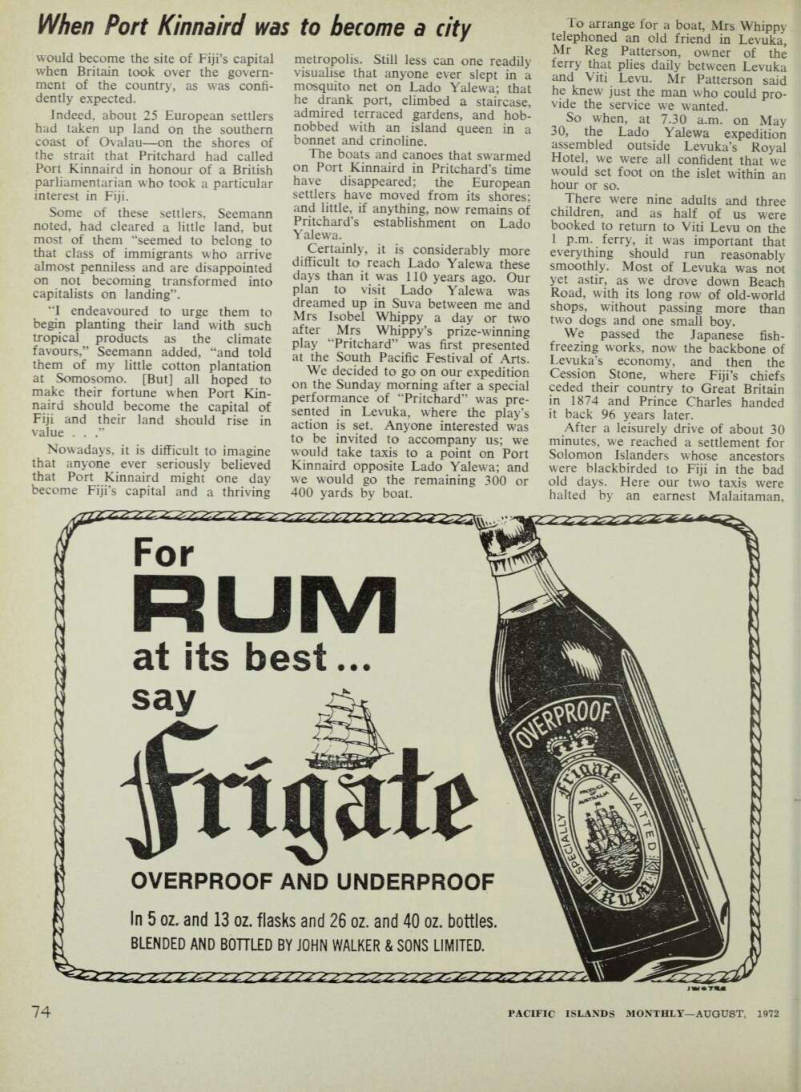
look-out man had to pole us down river with a long bamboo.
It was slow work, and even slower when the “Torocake You” ran aground on a pebbly bank and every one had to jump out and push.
We rounded a number of jungly bends and had several close views of the intestines and bladder of a slaughtered cow that were floating downstream. Then, suddenly, after being poled for a mile or so, we were in the open waters of Port Kinnaird.
After the ship’s engineer had per suaded his engine to splutter anaemically three or four times, it died, and our Fijian “gondolier” had to take up his bamboo again.
Lado Yalewa and Lado Tagane could now be seen about two miles off on the port bow, but our craft kept heading contrarily in the opposite direction.
The water, for the most part, was only three or four feet deep over a coral bottom, and I wondered whether all the ships visiting Pritchard’s pro jected capital would have had to be pontoons.
Meanwhile, the engineer tinkered with his engine and time ticked by.
There seemed little hope of being back in Levuka by one.
But presently the engineer stopped tinkering; gave his engine a few jerks with its cord; and the ‘Torocake You”, now in deep water, began put putting in the right direction at a steady pace.
At 12.09 p.m. the first members of our expedition landed on Lado Yalewa; and at 12.12 p.m., I myself, one of the last to land, slithered “head over turkey” on a slippery rock. Despite this, I completed a circuit of the islet by about 12.16, for its area is not much greater than a couple of tennis courts.
Armed with a spade that I had
Poling down the Bureta River in the "Torocake Vou".
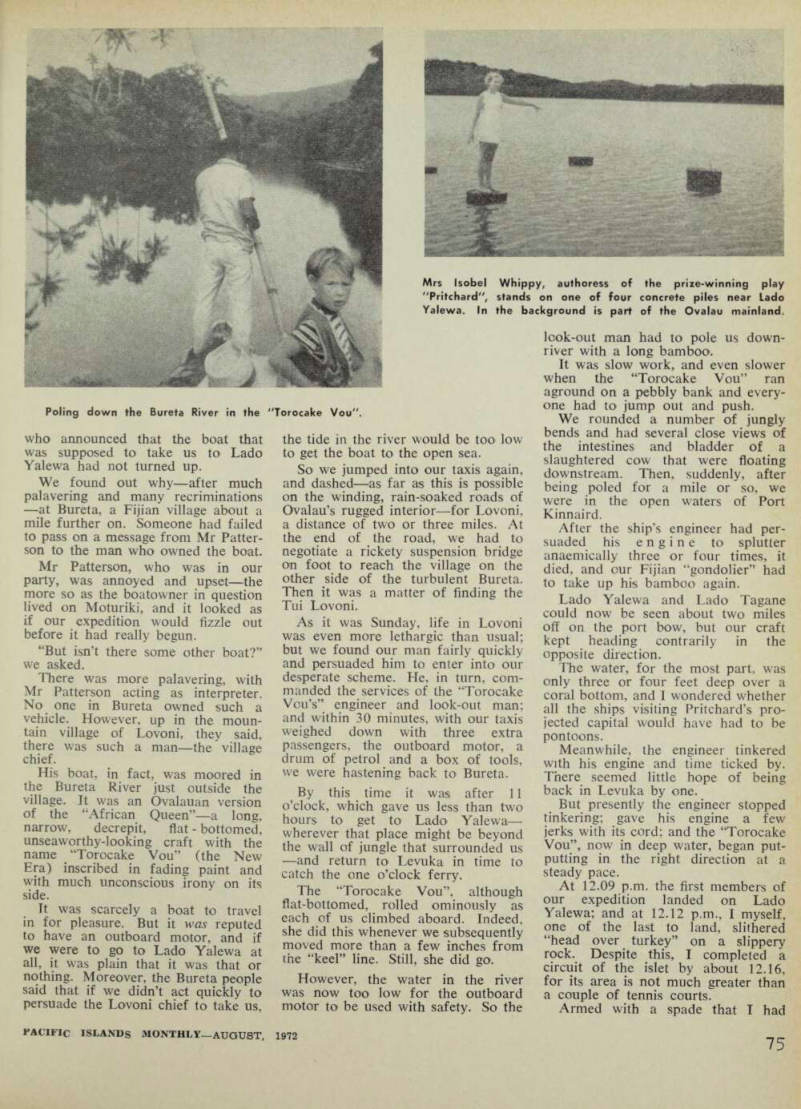
Mrs Isobel Whippy, authoress of the prize-winning play "Pritchard", stands on one of four concrete piles near Lado Yalewa. In the background is part of the Ovalau mainland.
presciently borrowed in Levuka, I then began to hack my way through nose-high grasses and bushes to Lado Yalewa’s summit.
There seemed to be no sign of the terraced gardens that Seemann had admired; and the spot where the British colours had once fluttered was occupied by nothing more im posing than a pandanus palm.
Somewhere in the vicinity there were possibly traces of the founda tions of Pritchard’s house. But I did not find them for my enthusiasm for archaeological research was sud denly cut short by a painful sting on the thigh.
Not remembering for the moment whether Fiji had poisonous spiders or insects, but conscious of an im mediate swelling, I hacked my way to the bottom again—to find that several other expeditionaires had suffered the same fate as I. The wasps of Lado Yalewa had been having a field day.
Meanwhile, the engineer of the “Torocake You” had reported the discovery of man-made constructions near the mangrove-covered strip join ing Lado Yalewa to the mainland.
And this was enough to send even the most wasp-bitten of our adven turers on a quick tour of inspection.
The “constructions” were four con crete piles set in the water at the islet’s most sheltered and feasible landing place.
Our immediate assumption was that they dated back to Pritchard’s day.
But there was no time to examine them carefully, for barely half an hour now remained for us to get back to Levuka to catch the ferry.
The “Torocake You” cast off as soon as we returned to her and headed for the spot where our Motunki boatman was supposed to have met us that morning.
The tide, however, was still out, and as a consequence we had to wade, ankle-deep, through the oozy mud of a mangrove swamp to reach dry land.
With shoes or sandals more or less ruined, legs besmirched, faces burned and wasp stings swelling nicely we rejoined our taxis with only about 20 minutes left before our ferrv sailed. y . Could we make it? Would we make it? Did we?
Yes, we did. Our taxis reached Levuka with some four minutes to SP u F i Mr Patters °n got off at the ♦ , j nd ordered the ferry skipper to hold on for a while”. And those of us who were travelling raced on to the Royal Hotel, sluiced our mUd u-f, d legs ’ P acked our bags, paid our bills, and even organised a picnic
hamper to eat on the way back to Viti Levu.
At eight minutes past one, in credibly, we were back at the wharf shaking hands and saying our fare wells to those who were staying be hind.
As our new craft moved away from the wharf, I reflected that Pritchard and Seemann may have got to Lado Yalewa faster than we did. But neither of them, I felt sure, had ever moved quite so fast on the way back!
Footnote: Subsequent inquiry re
vealed that the four piles we had assumed to date back to Pritchard’s time were, in all probability, the re mains of a landing stage built between the two World Wars. • Next month, Robert Langdon tells the story of Pritchard's career in Fiji and of his love affair with a mysterious woman, Ellen May Clover, who bore him two children before he married her.
Pritchard's love affair was the central theme in Isobel Whippy's prize-winning
play "Pritchard".