Banabans Plan To Untangle
pp. 65-66 · Read in the full issue
The Twists Of History
From a SUVA correspondent
Ever since the Banabans began pressing, several years ago, for a more generous share of the proceeds of the phosphate mining industry on Ocean Island—their homeland—their racial origin seems to have been hotly debated.
The big question has always been: “Are the Banabans really Gilbertese?”
Probably it arose from their as sertion that Ocean Island (or Banaba, as they called it) was not, geographi cally, part of the Gilbert Group; that it was left out of the Gilbert and Ellice Islands Protectorate when Britain formed it in 1892; that Britain was not interested in it until enormous phosphate wealth was discovered there eight years later; and that it was then included in the protectorate purely for administrative convenience and to ward off commercial entre preneurs from other nations.
The Banabans insist that they were never asked whether they wished to become part of the protectorate but were arbitrarily thrust into it because of pressure on the British Colonial Office by the influential London com pany that had found the phosphate deposits. Neither—they say—were they consulted when Britain began moves to turn the protectorate into a colony during World War I.
Even if they had been consulted the chances are that they would not have understood what was happening, any more than did the people of all the other islands in the two groups (who, incidentally, were asked and,
who, according to the memoirs of the official who negotiated the changeover to colony status, had not the foggiest notion of what it meant.) But present-day Banabans have checked up on the difference between a protectorate and a colony and have found legal authorities quoted as ruling that whereas a protectorate remains foreign territory to the pro tecting power a colony becomes an extension of the colonising power’s own territory.
And the British Crown, of course, asserts rights in minerals—such as phosphate—discovered in its territory.
Thus, over the years, more and more royalty on phosphate from Ocean Island went to pay for the upkeep of the Gilbert and Ellice Islands Colony.
“Why?” asked the Banabans. “We are not Gilbertese. The Colony is Britain’s, not ours, so Britain should pay, not us.”
Then the argument started. “The Banabans ARE Gilbertese,” reported the politicians in Tarawa. “Ocean Island is part of the colony. We have a right to the money.”
Mr. Reuben Uatioa, Leader of Government Business in the GEIC, said it again when he was in Suva for the South Pacific Festival of Arts in May. “My administration has the right to extract whatever revenue it wants from phosphate,” he claimed.
And he rejected the Banabans’ as sertion that they are of different racial stock. “They are pure
Gilbertese,” he declared. That irritated the Banabans, as it always does.
So it is interesting to read what Mr. H. E. Maude, of the School of Pacific Studies in the Australian National University, Canberra, has to say about the relationship between the Banabans and the Gilbertese.
Harry Maude is an old Pacific hand and is regarded as an authority on many aspects of life in the region.
He assumed duty on Ocean Island as a Colonial Office cadet in November, 1929, and for more than 40 years was in more or less intimate touch with the Banabans and their affairs.
He became Secretary to the Colony Government in 1933, Lands Commis sioner in 1934 and officer-in-charge of the Phoenix Island settlement scheme in 1938. He also reorganised the constitution, the legal code and governmental system in the GEIC.
Then, with the colony under Japan ese occupation, he served on Pitcairn, in Tonga and with the Western Pacific High Commission, returning to Tarawa as Resident Commissioner in 1946. Two years later he was ap pointed Deputy Secretary General of the South Pacific Commission, and from 1949 to 1957 was executive officer for social development in the SPC’s Research Council. His Canberra career began in 1957 in the Research School of Pacific Studies.
He came to know Banaban custom and tradition probably better than any other European, was responsible for the purchase of Rabi Island in
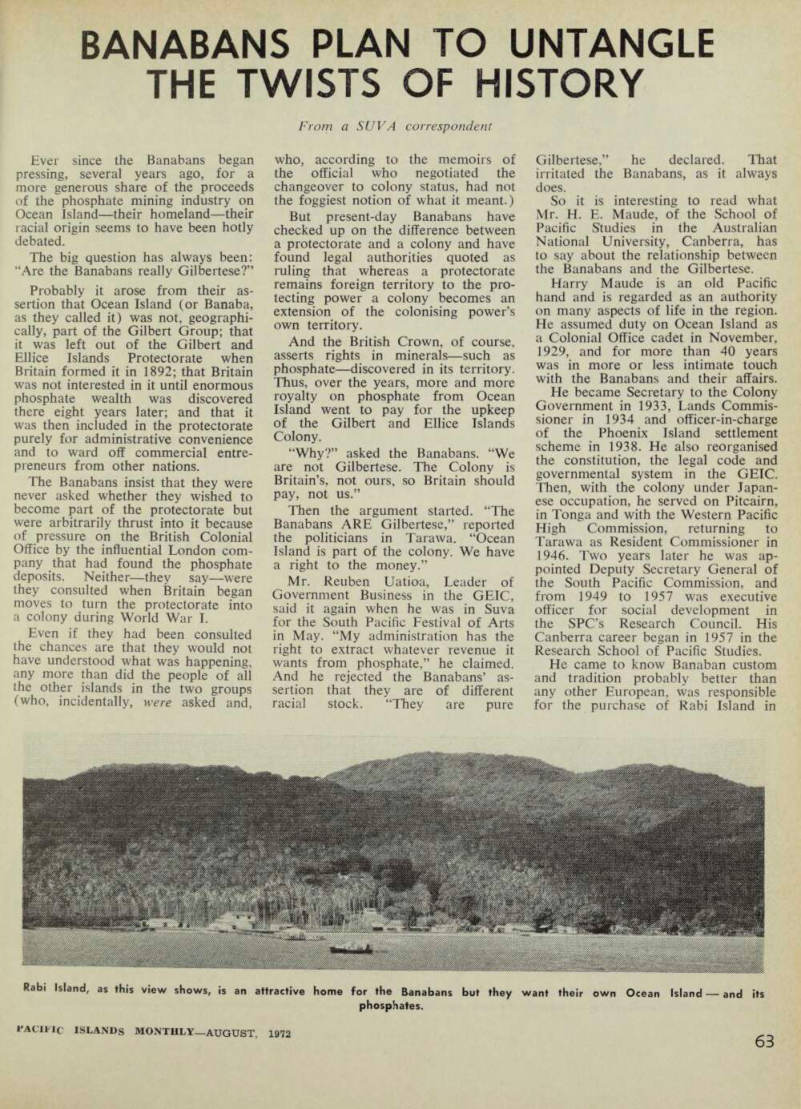
Rabi Island, as this view shows, is an attractive home for the Banabans but they want their own Ocean Island-and its phosphates.
Banabans were kind to accidental migrants
the Fiji Group for the Banabans in 1942 and for their settlement there in 1945.
He holds a Cambridge honours degree in anthropology and is a professional Pacific historian. And this is what he says about whether the Banabans are Gilbertese: “The view that the Banabans were Gilbertese was indeed uncritically accepted by myself during my early years of residence in the Gilbert and Ellice Islands Colony and it was only after detailed study that it became apparent that, like almost every community the world over, they in fact represented a racial mixture, in which the Gilbertese component was a relatively recent overlay on a thaWn 7 hfhe^Banabans had never at anv time formed a nart of
the ni?hert y iJwc wwLf
ttdfSSS
cohesion ” y o t ough social Harry Maude wrote this after a single witness—who, he said, had no professional qualifications or detailed knowledge of the two communities or expert examination of the evidence— testified in London a few years ago
on the relationship between the Banabans and the Gilbertese (and got it wrong, he says.) Evidence shows, he wrote, that the original people of Ocean ’island were not Gilbertese; but because of the dominance of south-east trade winds and the east-west set of the equatorial current there was, over the centuries, a sporadic accidental dri ft of canoes from the Gilbert Islands eastwards, of which a number chanced to make a landfall on Ocean Island.
“It seems that the Banabans invariably were hospitable hosts to these driftaways and readily assimilated them into the local society,”
Harry Maude found.
In addition to accidental driftaways (he says >’ ° cean Island was twice mvaded by larger parties of immigrantS - firSt invaders were nQt Ghbertese, since they were known to have come from the west, and thus from the Carolines if not from farther afield. In all probability they came from Indonesia or Micronesia to the Gilberts and inter-married there. On genealogical evidence, the second group arrived at Ocean Island
about the year 1650 from Bern Island in the Gilberts and were probably refugees from local wars.
They were received peaceably and settled down there, but with the original inhabitants retaining many prerogatives over the whole of Banaba.
“In brief,” Harry Maude sums up, “Banaban tradition is clear on the main point of issue, i.e., that the community is basically composed of a non-Gilbertese stock . .
It is sometimes asserted, he says, that the Banabans must be Gilbertese because they speak Gilbertese. Apart from the fact that linguistic affinity is a shaky foundation on which to base racial relationship, he warns, it was obvious to him when he was living among the Banabans that they had at one time used a different language.
He tells of GEIC Lands Commis sion proceedings in which words and idioms were used that were not Gilbertese at all; and the clerk com piled a significant number of words and expressions recognised to be distinctively Banaban.
That, probably, is the most authoritative voice heard in the “Are the-Banabans-really-Gilbertese?” con troversy. But no doubt the argument will still go on.