News magazine of the South Pacific
pp. 59-63 · Read in the full issue

Pim
American Samoa, seven islands under the Stars and Stripes since 1904, with 25,000 of its 28,000 inhabitants living on one island, Tutuila, has a problem called, in the modern, slick but obscure jargon of the day, environmental control.
How can the Samoans —most of whom have never been more than a few miles from home and know nothing of strontium 90, gamma radiation, DDT and the 1,001 other doubtful blessings of modern living, not to mention plastics, detergents and their disposal difficulties—escape the consequences of world pollution.
As a first step in the job of solving the problem, the American Samoa Government has instituted an Donald F. Graf,
of biodegradable materials for housing, tools, etc., allowed them to live in harmony with nature, properly re cycling all their refuse. However, this was more out of necessity than through any realisation of ecological prin ciples, as non-biodegradable materials were non-existent. Conservation of natural resources was unnecessary.
The relatively small population harvested as much as they required, and the high tropical growth rate re plenished land resources quickly.
It was virtually impossible for the small population to harvest fish faster than they could be replaced. Sanita tion and solid waste problems were non-existent, as high decomposition rates quickly returned everything to the soil or sea. Natural deaths, diseases, and accidents controlled the population to levels that didn’t over-
News magazine of the South Pacific
For more than 40 years Pacific Islands Monthly has been reporting on events in the Pacific Islands. Not the glossy travel brochure version but the significant things. Social and political changes, commercial development, historical background, extracts from the Islands Press, personalities and PlM's correspon dence columns are a noted exchange mart of Pacific Islands opinion.
Take out a subscription and dip yourself each month into the real South Pacific.
USE THE FORM OVERLEAF TO BECOME A REGULAR READER
Big
S
om the Office of nity, a fleet of 24 ft ies is being con to local fishermen, eat step in reducing recently acquired ported food. The 1 sales have been )n of modern illy reduced the the Samoan popu i method of popu :amily planning was y introduced and antastic increase in American Samoa, were about 5,000 ands. Today, there and the territory is aal rate of 3.06 per
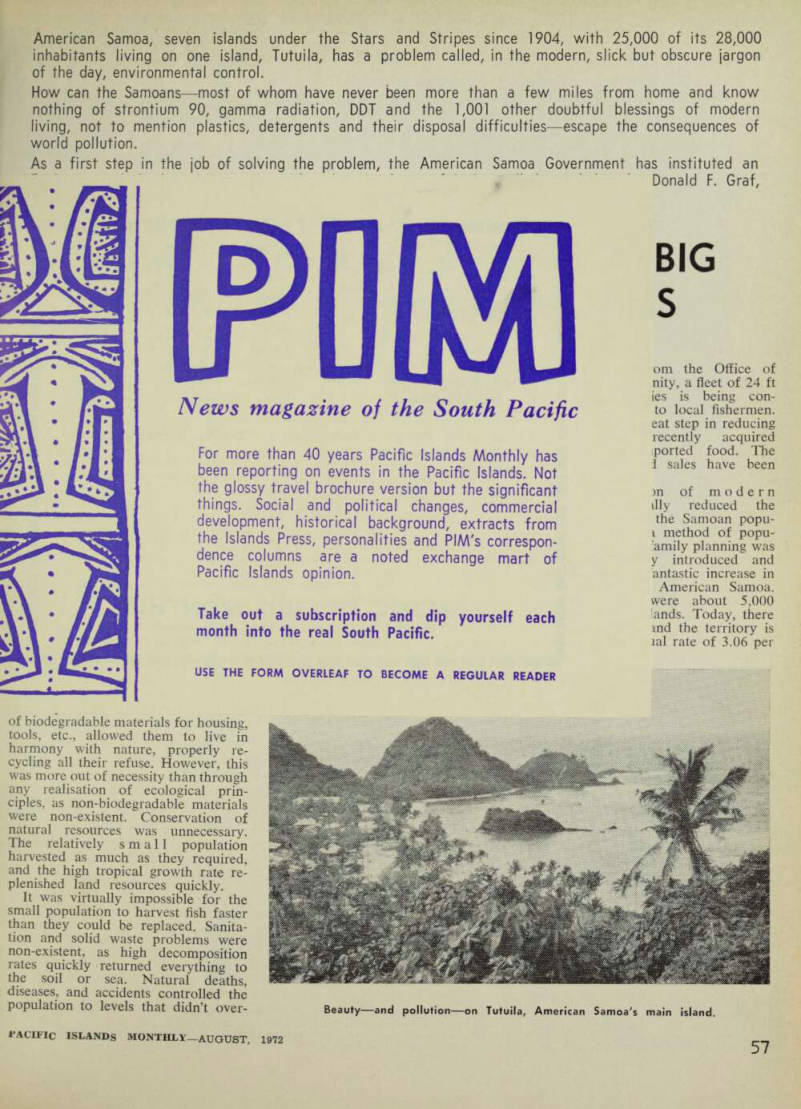
Beauty—and pollution—on Tutuila, American Samoa's main island.
cent,, one of the highest growth rates in the world.
One of the greatest drawbacks to a family planning programme is the typical Samoan “extended” family.
In the past, a large family was the traditional form of life insurance, retirement and support. When one became too old to work, the rest of the family or aiga would see that he received food and the rest of his material comforts. A large family also became a source of pride and prestige in normal village life. In an environ ment where housing was essentially free for the building, and beds con sisted of woven grass mats, the burden of an additional child was minor compared to the benefits of that child’s productivity at later stages in his life. An addition to the family simply meant pulling the mats a little closer together to make room for the new child. And with each additional child, additional prestige was heaped upon the household head!
Traditional arguments for family Manning have, therefore, been in effective in American Samoa. Over erowding could never be demonstrated is Samoans migrate freely to Hawaii md the US mainland. Food shortages vere non-existent as the Samoan diet consists mostly of locally-grown fruits md vegetables such as taro, bananas md coconuts, pigs and fish.
The present family planning pro gramme is making definite progress n increasing the number of Samoan vomen participating in it. The current iffort concentrates on the desirability )f spacing children for healthier :hildren and healthier mothers. In he last 18 months, the number of lew patients on the programme has ncreased 300 per cent. In the same >eriod, the number of returning >atients increased 265 per cent. This las resulted in decreasing the birth ate, but, unless these gains are main lined the population of American lamoa will double within the next 0 years. The figures on new patients re, however, encouraging.
The generation and subsequent [isposal of solid waste is also a ignificant problem in this island erritory. The introduction of a cash conomy has introduced many non iodegradable materials into the amoan way of life. Metals and lastics have replaced banana leaves s food containers, and as more food 5 purchased rather than grown, these mpty containers increase in number nd volume.
The Samoans have also “progres sd” to washing machines, and other ght appliances. The highly-corrosive onditions of the atmosphere limit ie useful life of these products to iree or four years. The scrapped ap-
pliances find their way to many a roadside and beach. The abandoning of unusable construction equipment by the Navy, the government and private contractors has also com pounded the solid waste problem.
To help solve this burgeoning problem the government has applied to the Environmental Protection Agency for a comprehensive solid waste planning grant. This grant will help the government develop plans for handling past accumulations and future solid waste. However, little consideration is being given to re ducing the total volume of incoming solid waste by new packaging methods.
The real fact that the limited market in Samoa cannot demand new packaging has essentially blocked these efforts. Under the cujrent administration’s urging, all municipal garbage on Tutuila is now disposed of in sanitary landfills. However, proper garbage disposal still remains a problem in the Manu’a Islands.
Abandoned vehicles also are con tributing greatly to the solid waste problem. The present law prohibits anyone from having an unlicensable vehicle on their property for more than 30 days. However, proper dis posal is a problem not met by any sector of the Samoan economy.
During 1970 an effort to sell this scrap for recycling (some 12,000 tons) failed when the purchaser did not return for a second ship load.
The government would gladly dis pose of more automobiles if they could get them off the road. Road accidents have become the territory’s number one health problem. With about 2,800 automobiles on the island and only 35 miles of paved road, most of it extremely dangerous, there is one serious accident for every
500 yards of paved road in American Samoa every year.
An annual vehicle inspection, radar traps and a crackdown by the Division of Public Safety has done little to reduce the accident rate.
These programmes have had the effect of changing the nature of accidents from fender benders to automobile pedestrian accidents in the areas of less congestion. The result has been an increase in severe bodily injuries.
The administration is now considering legislation to reduce the importation of automobiles and tighten inspection requirements.
A land-use law was rejected by the legislature, but plans are being made to submit a more comprehensive law in the near future. Proper land management is also a great concern to the administration in American Samoa. Construction, and the clearing of steep hillsides for gardens, remove valuable soil-retaining vegetation necessary to prevent erosion.
Torrential rain running down slopes generally in excess of 30 degrees creates silting problems for the lagoons, thus affecting the coral reefs which surround the islands. This has a direct effect on the marine resources which are looked upon as a major food source for the islands.
Part of the problem of soil erosion stems from the Western practice of completely baring all the soil before planting crops. The Department of Agriculture is operating an ex perimental farm at Taputimu, its main purpose being to demonstrate new agricultural techniques and crops suitable to Samoa. However, the programme has been traditionally under-emphasised.
Past road construction paid little attention to normal land contours and the result was often roads washed
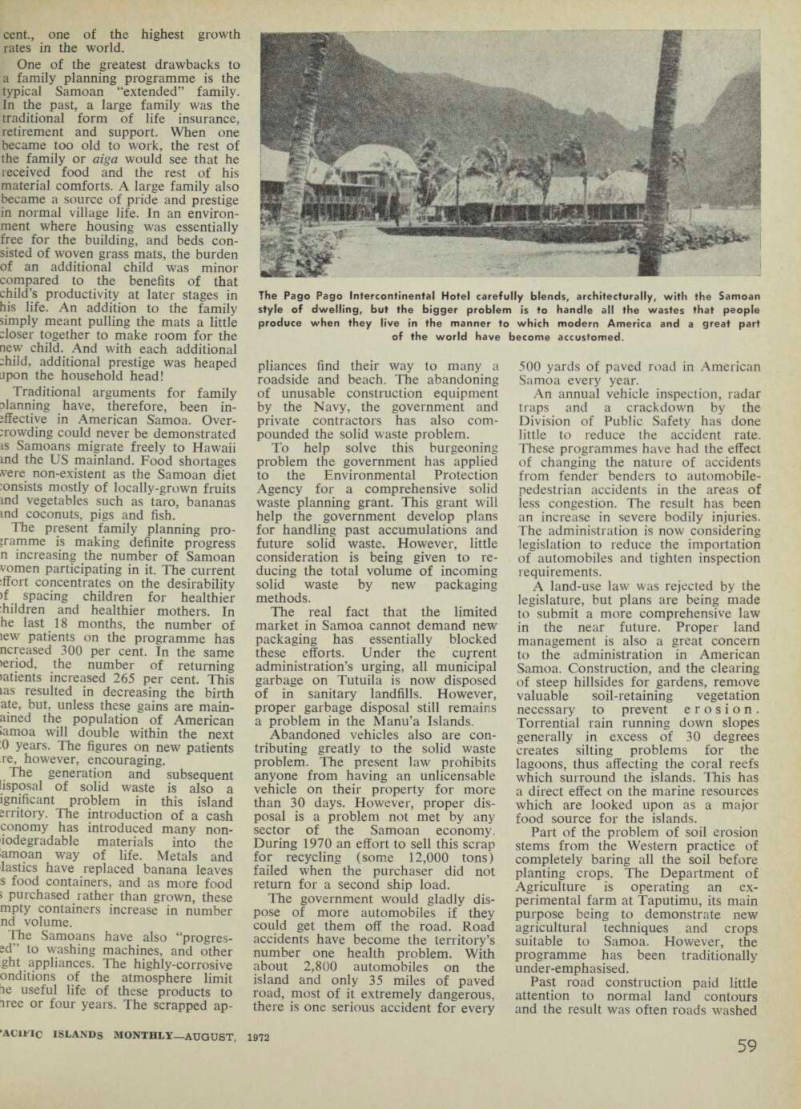
The Pago Pago Intercontinental Hotel carefully blends, architecturally, with the Samoan style of dwelling, but the bigger problem is to handle all the wastes that people produce when they live in the manner to which modern America and a great part of the world have become accustomed.
OH pollution in Pago Harbour
out during torrential rainfalls. And the rain does fall in American Samoa! On Christmas Eve, 1969, 32 in. fell in slightly less than six hours. While normal rainfall is generally not as heavy, its effects are, nonetheless, as devastating over an extended period of time.
With over 200 sampan style tuna boats operating out of Samoa, oil pollution in Pago Pago Harbour is a problem. In 1971, an experimental division of the Public Safety Depart ment was formed to enforce local oil pollution laws. Local laws provide for fines up to $l,OOO for the dump ing of oil or other toxic pollutants into the territorial waters.
In its first year of operation, the experimental harbour division issued 196 citations worth about $16,000 for he dumping of oil into the harbour.
Lhis is in addition to activities carried m by the US Coast Guard and its oil 3ollution patrols. An oil pollution con ingency plan is under constant evision, keeping in mind increases in uaterial and techniques now avail ible.
In a territory with 200 inches of ain a year, it would seem that iuitable drinking water would be no Droblem. In fact, the government ations water through its pipelines on in average of three months a year.
Vluch of the rain water simply runs )ff into the sea for lack of proper :atchment facilities although these ire being expanded. A great deal escapes the system through leaks, aulty faucets and careless use.
With an increase in the con ventional types of sewage collection ystems, water use for sanitation could >e expected to zoom. For this reason, ;round water resources are being ex >lored, as are low water volume ewage facilities. More than SUS2.S nillion was spent in 1972 for water ystems and sewers alone, with a like imount scheduled for 1973.
Proper maintenance of internal ombustion engines and other equip ment does not exist in American lamoa. Relatively low pay scales do lot entice qualified mechanics from lawaii or the mainland United States. )n the contrary, Samoans receiving high degree of training often migrate a Hawaii and the American mainland /here their newly-acquired skills ommand a higher salary. This has erious implications for the main mance of emission control devices n automobiles, the sewage system, nd water system, electrical system, nd other mechanical devices.
Like creating the position for the cologist, many of the environmental
programmes in American Samoa can be directly attributed to the concern of Governor Haydon, probably the only governor in the United States ever to have formed an active Sierra Club, a territorial group consisting of a few highly-concerned citizens, who meet about once a month to discuss the territory’s environmental problems and their role in solving them. The club has taken an active part in drawing Samoans into the environmental movement and spread ing the gospel of ecology. Mostly through the governor’s doing, an Environmental Quality Commission has been formed, and air and water pollution standards have become law.
The traditional Samoan society is being swamped by the flood of American wealth, power and influence, a phenomenon typical of many parts of the world today. The old social structure and value system are giving way to individual independence and materialism, especially among the young. The old ways are associated with poverty, discomfort, and arbitrary constraints on individual action. Traditions, crafts, and his torically significant areas are vanish ing, due to lack of concern. A con tributing factor to this phenomenon is the return of many Samoans who have migrated to the United States.
The return of this westernised group is doing much to dilute past tra ditions. The Arts Council of American Samoa is attempting to retain these traditions and skills. Under a grant from the National Endowment for the Arts, the old Post Office building in Pago Pago is now being converted into a museum. The present museum is on the first floor of Government House. Mrs Haydon has played a major role in the formation of the Arts Council and the development of the museum, as well as actively seeking funds to support their pro grammes.
The local Chamber of Commerce is also taking an active part in seeking solutions to Samoa’s problems and, through a series of weekly seminars, has discussed such topics as aesthetics, traffic safety, com prehensive planning, and harbour pollution.
All this points to encouraging trends in solving American Samoa’s environmental problems. There is great determination not to make the environmental movement American Samoa’s latest fad, but we cannot deny the fact that Western civilisation has arrived. The Americanisation of Samoa had its start with the Navy’s occupation, and is increasing daily.
The airlines bring in tourists by the hundreds. Cruise ships visit the harbour frequently, and American Samoans are returning from their visits to the mainland United States.
All these influences, combined with the tremendous population pressure, are creating serious problems. The American Samoa Government is desperately trying to overcome the problems created; however, it cannot do the entire job. The final solution lies in the Samoans developing an awareness of the environmental problems that are being created and a life-style to deal adequately with them.
The failures of Western society are not as apparent to isolated islanders as they are to the hundreds of thousands of people in Los Angeles, New York, London, Tokyo, ad nauseam. Strides are being made in the educational field, both by the government’s Department of Educa tion and the local Sierra Club.
The teaching of this new awareness, coupled with the beneficial aspects of government programmes may preserve the natural beauty of Samoa for the future.
As Governor John M. Haydon is fond of saying, “We still have time here in American Samoa”. Hopefully, all will use the time wisely. • PlM’s cover girl in June had American Samoa searching for her identity, Colonel Robert Zehring, chief of information in the Pacific for the US Air Force, took the picture during a visit for Flag Day 1971. The American Samoa “News Bulletin” asked “who is the winsome little Samoan girl?”
Governor John M. Haydon . . . takes a leading part in the quest for a way to live with progress and still preserve the values of the past.