Book Reviews
pp. 83-85 · Read in the full issue
Myth And Magic In The Gilberts-
A Return To Arthur Grimble
A well-produced volume of the early writings of Sir Arthur Grimble has been arranged and illustrated with black-and-white drawings by his daughter Rosemary. Migrations, Myth and Magic from the Gilbert Islands offers something for most kinds of reader. Some of the ethnographical texts on life in the Gilberts, canoes, navigation and migrations have been published before by the Polynesian Society and the Royal Anthropo logical Institute.
Edited and supplemented by un published texts on magic and myth, the material gives a representative picture of the Gilbertese people and their beliefs in a period which had almost vanished when Grimble recorded them in the inter-war years.
I say almost vanished because, dur ing and after World War 11, it was still possible to find people who knew something of that way of life which, thankfully, Grimble had the interest and insight to investigate.
The vicarious traveller will have a choice of pleasure but he will have to surmount the sound patterns of written Gilbertese with which the author offers no help— not even that it must make do with thirteen letters and that the vowel sounds more closely resemble those of the Romanic languages than English.
Many a reader will, I fear, trip over the lovely myth Nei Tituabine and her brother-paramour Auriaria but, if one remembers that each vowel is individually sounded and that ti rep resents s, the tussle is half won.
A good deal of the text, especially on the myths and migrations, is known to and this makes review no easier. Gilbertese myths are as difficult to disentangle as Greek and very few people have tried. There are stories that touch one on the other and there are problems of translation.
Grimble claims that truth is some times shrouded in cryptic language.
Possiblv, but I have less doubt that story-tellers sometimes chanted echo ing sounds just for effect.
None of these things really matter unless one is engaged in scholarly study for which purpose the book is only partlv suited. The second chapter on the genesis can be enjoyed as a primitive myth of an oceanic people and it can be compared with the second creation myth of the Skull in the chapter Drip-drip-the-blood. I leave it to the reader to ponder the Grimbles’ interpretations, offering just a word of caution on accepting apparent linguistic affinities among place names.
My wife’s recommendation is the chapter on Birth to Death. It is a small classic, a serious study of a way of life in a bygone age of which but vestiges remain. For example, after grave consultation with Gil bertese mentors, I was able to estab
lish that the phrase “the fourth generation goes free” still represented custom on incest in 1946 and incorporate it into the law. The account gives a fascinating insight into a morality which has often been wildly misinterpreted by casual ob servers—a morality which varies little from island to island and which survived occupation by Japanese and American forces remarkably well.
The chapters on canoes and navi gation deal with a technology and science vital to an oceanic race.
Although the skills are now less practised than they were, Nabetari’s escape from the Japanese on Ocean Island in 1944 and his seven-month voyage to the Admiralty Islands in a light fishing canoe can be called to witness the remarkable
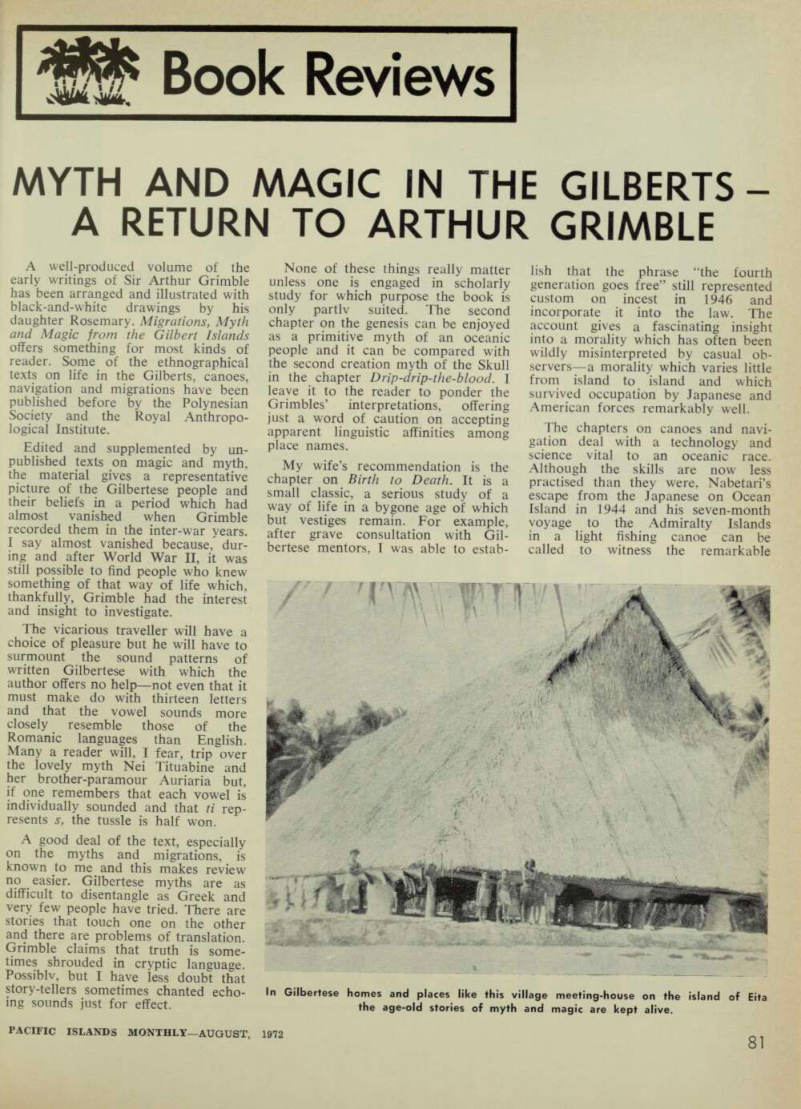
In Gilbertese homes and places like this village meeting-house on the island of Eita the age-old stories of myth and magic are kept alive.
affinity between the Gilbertese, canoe, sea and sky. Recalling this saga, reminds me that there is a fas cinating section on seamarks in be tween the sun and moon legends of Bue and Utonga in chapter 6.
I have left the first chapter on magic to the last. A very old friend of mine, who had clerked for Grimble and who was a devout Roman Catholic, wrote down a few of his tabunea chants for me. They mainly invoked kindness to the traveller as he moved, on land or sea, from one destination to another. He did not find this incompatible with his Christian religion nor, if it comes to that, did he so regard adherence to clan taboos on food either, I have also come across vindictive and love magic and dancing spells.
On one occasion, I recall seeing a girl collapse while dancing and was able to establish that she was under an alarming but benign spell from which, exhausted physically, she in time recovered.
I recommend the book to anyone, scholar or general reader, who has any interest at all in a select region of the South Pacific. There is some thing in it for each—a good com panion to Sir Arthur’s ethnographical
publications but a better one to A Pattern of Islands and its sequel.— Reid Cowell.
(Migrations. Myth And Magic
From The Gilbert Islands. Arr. By
Rosemary Grimble. Routledge and Kegan Paul. £ Stg.6.)
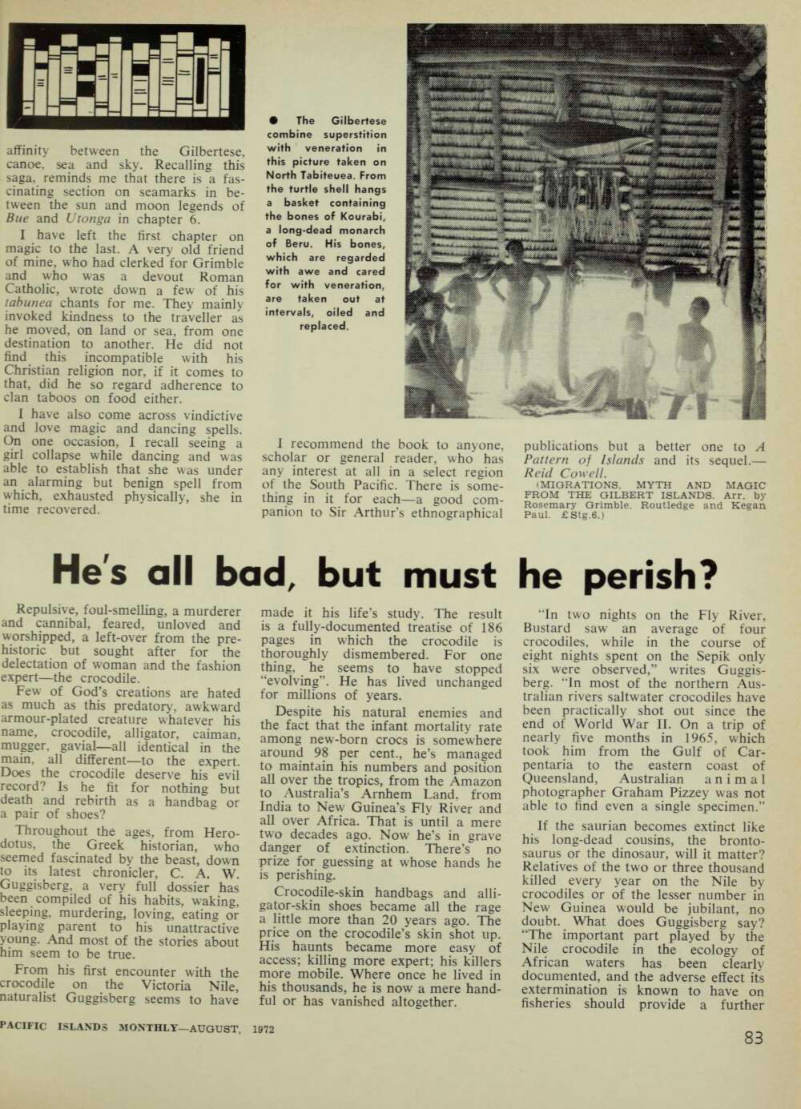
The Gilbertese combine superstition with veneration in this picture taken on North Tabiteuea. From the turtle shell hangs a basket containing the bones of Kourabi, a long-dead monarch of Beru. His bones, which are regarded with awe and cared for with veneration, are taken out at intervals, oiled and replaced.