Seen From The Wings
pp. 47-51 · Read in the full issue


The Festival Of Arts As
By Victor Carell
The South Pacific Festival of Arts held in Suva, May 6 to 20, was a dream come true. For more than 25 years my wife and I have enjoyed, studied and worked in many of the countries of this vast region. I have never had any doubt that, given the opportunity to show their best, the people of the South Pacific would unleash for the world a tremendous wave of joy, of excitement and that their arts would prove to be of out standing entertainment value.
And they did. During the festival almost 4,000 superbly trained and costumed dancers, musicians, artists and artisans kept Suva throbbing with fun, joy and a liveliness such as only the South Pacific knows how to generate.
Although the festival was almost overwhelming in its final success, its birth occurred only after much pain and an enormous volume of work.
Most of the participating countries had to be “sold” on the festival, had to be awakened, enthused and stirred to re-
evaluate the rare beauty of their own potential in world art.
The people had to be convinced of the pristine loveliness of the traditional, both in performance and in costuming; in song, chant, in pottery making, in weaving, in tapa and carving. This was especially true in Fiji. It was necessary to speak out frequently against the scourge now prevalent in much of the Pacific —the use of tawdry crepe paper, cellophane and tin drums in carelessly presented performances—often only a travesty of the real thing.
But the message calling for only the best got through. llie festival demonstrated the nobility of un corrupted ancient arts. The costumes were breathtakingly beautiful in their exactness. The people had returned to their roots, seeking to correct in congruous anachronisms and re establish traditional details.
Drums, spears, clubs and head dresses were magnificent once more, just as they were in times long gone by. Here was history, stylised, yet true, living before us through the dedication and hard work of thousands of eager people, young and old—who at last thrilled to the same, the mutual goal, and expression, a mirror, as close to perfection as possible, showing from each parti cipant group its own cultural achieve ments.
It was wonderful to find that various countries had come forward with extra-curricular items such as the village of traditional houses at the University! Yet there were also disappointments—for example, West ern Samoa, whose aim had been to build the best and biggest fale out side Samoa (a building of dimensions measuring 80 ft x 36 ft) failed at the last moment to produce the house.
The creative works of drama which several overseas countries presented were stimulating. Of particular value were the two original Fijian works especially created within Fiji, as there is very little Fijian literature avail able anywhere and these dramas point towards a fascinating future for indigenous literature.
The Aboriginal dancers from Aus tralia were a unique contribution and a great success. Both the Cook Islands National Arts Theatre and the amazingly professional offering by the Solomon Islands dancers could have had entirely sold out houses for a week. All of the other groups pre sented splendid items that proved immensely popular.
Of outstanding note were the Banabans of Rabi Island and the forthright Niue Island people. The Symphonia of Auckland and the Auckland based Dorian Singers gave Fiji a first taste of top quality music in their own respective fields. Of importance, too, was the Samoan Opera by the Ueta Solomone.
All the exhibitions were of an imposing standard. Possibly the handi crafts at the USP “village” and the South Pacific fine arts exhibit at the Civic Centre were among the most outstanding contributions. Although small in number, the traditional canoes, too, were superb.
The four days of indigenous games were a splendid success. Originally, only two days were allotted for these unique items but there are so many traditional games still extant in the area it was necessary to double the time in order to include as many as possible. Many of these ancient games are exciting; some also proved to be hilariously funny in the manner they were played. With all that extrovert spirit of the South Pacific infusing them, who could resist the fun?
The indigenous games side of Pacific cultures is a facet which should be encouraged and possibly some games which are common to, and are played by, several countries should be included in future South Pacific Games competitions.
My own job as Executive Director in the festival covered anything from “begging” for money from firms and individuals for the support of Pacific arts to the gathering together of the huge oratorio choir for the “Elijah”.
This required me to speak at several churches each Sunday over many weeks. The campaign for rooms for visitors—with the help of some hard working volunteers—resulted in ac commodation being made available,
For Beth Dean (Mrs.
V. Carell) a shared dream.
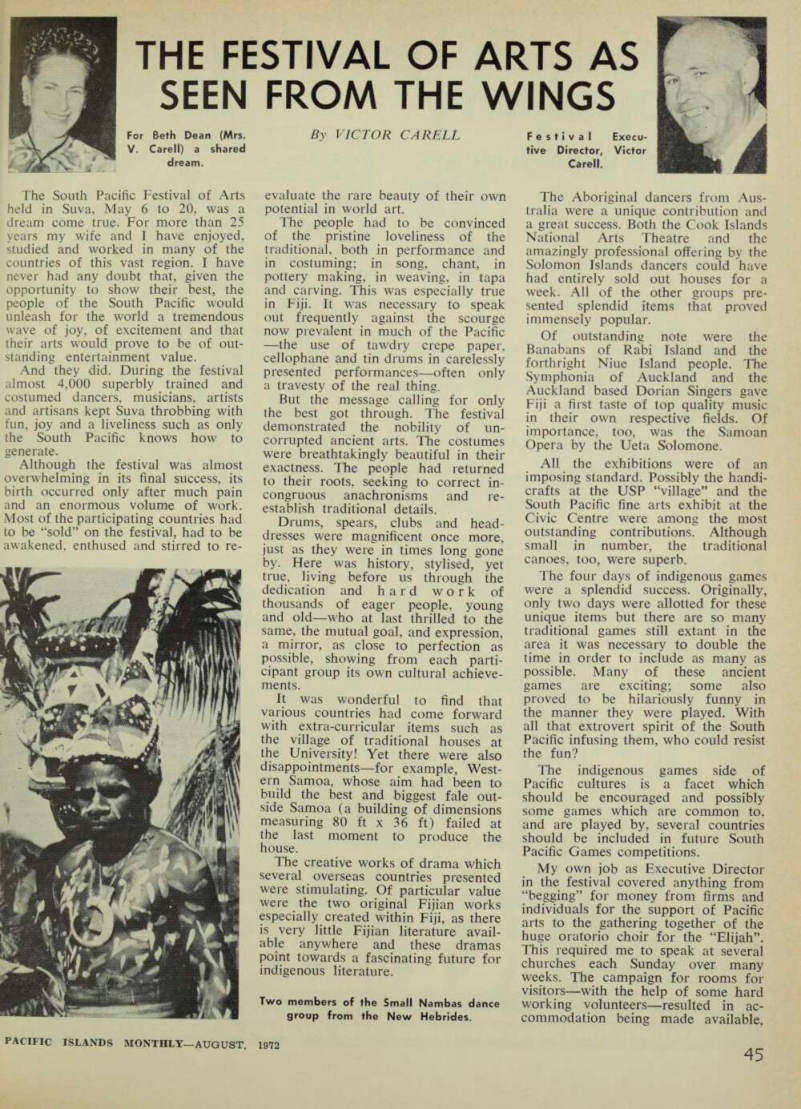
Two members of the Small Nambas dance group from the New Hebrides.
Festival Execu tive Director, Victor Carell.
even in private homes, for all visitors.
Hard work was necessary in the realm of public relations, explaining the tremendous scope of a “world standard” concept for this unique festival. If South Pacific Festivals of Arts are to be successful they have to be on a level equal to standards accepted as the norm for presenta tions throughout the rest of the world —but the South Pacific has certain advantages. As well as being so colourful, the strength of the original cultures still exists.
This strength was especially obvious during the foundation festival. If this historic first had been allowed to flounder the whole dream could have been wiped out for all time. There fore, our problem was one not only of discovering how to excite and stimulate the people and their respective governments throughout the region so that each would provide only the very best material, but we also had to succeed on a budget that could not compare with that required by Festivals of Arts of similar size held elsewhere in the world.
Immense distances were involved in visiting each country to work with the local committees on the con tribution each was planning. The greatest challenge perhaps was the time limit of only thirteen months for all die planning, preparation and production. In Fiji alone my work entailed going to all of the provinces and seeing meke after meke to select, in association with experts from The Government Department of Fijian Affairs, the best of these to come to Suva.
These trips in themselves were ex iting, rewarding and sometimes very wearying. I remember sailing from Suva on one occasion at 1.30 a.m.
Breakfast was at 4.30 a.m. and at 6 a.m., after wading through a quarter Df a mile of mangrove, we entered the tillage, to the sound of the pounding af yaqona roots. We sat all day and all night being greeted ceremonially, drinking the yaqona (kava) and watching the mekes danced, hearing he chanting groups and examining he fine handicrafts.
We continued until 1.30 a.m. when aur hosts invited us to rest. Half an lour later the large room just out side our sleeping accommodation was nvaded by forty people who had :ome to show us yet another meke.
Fhere was no sleep! At 6 a.m. we were wending our way on the return ourney to the ship, past the same nen still pounding yaqona.
It was a blow to know in the last weeks that Guam and Tahiti were not aking part after all. We had held ligh hopes of a 100 per cent, parti
cipation at this first historic festival.
However, the other SPC countries generously sent so much, which was so fantastically good, that those who did not appear were hardly missed in the constant stream of joy that effervesced throughout the festival.
There were, of course, the many smaller problems—such as clearing a huge head-dress from Papua New Guinea; which we did, only an hour before the performance.
The big opening and closing ceremonies held in Albert Park were conceived on a gigantic scale. Follow ing the meticulously drawn plans of the technical director, Nick Dowling (head of the Rank-Strand organisation in Asia and the Pacific) the engineers
and electricians of the Suva City Council erected a large control system to cope with all communica tions and the intricate lighting.
Among the dozens of powerful spotlights imported for the festival there were four special follow spotlights (there are only twenty of these at present in the world) and each was capable of covering an area as large as 60 ft x 60 ft or as small as a person’s face 200 feet away.
The two days and nights of rehearsal prior to the opening night were dogged by constant heavy down pours of rain. By walkie talkie and telephone, each group of performers was marshalled from one control point to the next until the final one
was reached, then into its own dance area.
As one group finished a performance the lights would fade to a complete blackout, then immediately pick up another group performing in a different area. Thus the vast performance moved continuously, dramatically, as if a huge and living movie film were spread out, with successive items offering in the immense darkness of Albert Park.
Hayes Gordon (who acted as stage director for the opening night) re marked after the final dress rehearsal, “That is the only time in my life when I have directed a show ankle deep in frogs!”.
For the opening performance the ground was soaked and muddy after days of rain, and rain was still falling in spiteful little showers. Much to my own relief, all the leaders wanted to go ahead on schedule.
Dancing in mud up to their ankles and sometimes having to kneel, sit or even lie in it, they triumphed over the conditions and the elements to give all who saw them an unforget table experience. They showed by their courage and enthusiasm, their tenacity and, above all, in the joy that flowed from their performances, that the human spirit and sheer ex huberance of the South Pacific Island people can overcome even the worst adversity.
This set the tone of the whole festival. True team spirit prevailed and all those otherwise isolated islands became as one, so much 80 that in an editorial the Fiji Times said: “They had taught, and they had learned. Above all, they had given great pleasure to the thousands they had entertained.
“For those with eyes to see, they had given new insight into the treasure of skills and artistry that is spread through the South Pacific. The South Pacific Festival of Arts can now take its place, in proven worth, with the great art festivals of the world.”
The unleashed force of enthusiasm developed by the performers in the festival enveloped all who saw them with joy. Everybody who came to the festival was left in no doubt that the South Pacific traditional arts, shown in the finest possible way and presented with dignity and with proper preparation, are equal to the finest of entertainment anywhere. The performers, too, were left in no doubt of this—by the eager and responsive audiences who applauded them. They, I feel sure, have taken back with them to their homes the requisite confidence and an abundance of zeal to carry on the arts they have revived so splendidly.
. . . and as Sue Wendt
saw it all in retrospect
One writer predicted that the festival would turn out to be an exercise in nostalgia, a showing of dead traditions with little application to the South Pacific today. He was the first to admit his mistake.
Certainly, many of the songs and dances and chants had been revived, dredged up, if you will, from the memories of the old people and polished up for presentation by anew generation of Islanders. The ancient canoes and weapons of war seen during the festival have no practical function in 1972.
Elaborate indigenous dwellings like those constructed at the University of the South Pacific are becoming rarities in their countries of origin.
The difficulty of securing traditional materials for costumes proves in itself how much conditions giving rise to the old ways have changed.
The festival afforded a magnificent insight into the ancient culture and craft of the Pacific Islands—but more than that, it was a showcase for the living arts of the region. Culture, by its very definition, denotes change, intellectual development, a refine ment of what went before. Island environments have changed and so have Island attitudes. The festival proved that not only is cultural awareness alive and well in the Islands, but that it is growing apace and in new directions.
But how to judge its immediate success? By the fact that nearly 4,000 performers are presently relat ing their impressions to the tens of thousands of Islanders who were in volved during many months of pre paration? By the glee with which Fijians greeted their first sight of barely-clad New Hebridean dancers?
Or the awe of the New Hebrideans as they viewed Suva for the first time? By the remark of a Laulasi villager from the Solomons that “Fiji is one very big place but the people same as us”—or the observation of Australian Aboriginal James Gelarr wuy that although his group could see little in common with other Islanders when they first arrived, “when they began to dance it was a different thing”?
For my money, the real value of this biggest-ever gathering together of Pacific Islanders is the contribution they will make, as individuals, to de veloping regional awareness. It’s an awareness altogether different from that engendered by the competitive spirit of the South Pacific Games or arising from high-level decisions by Island leaders.