Footnotes
pp. 43-45 · Read in the full issue
Can We Create A
Community Now
We Have A City?
T'HE City of Port Moresby! How odd it sounds A when one lets one’s mind wander back across the years. And my memory ranges over slightly more than half of the 99 years which have elapsed since Captain John Moresby sailed through Basilisk Passage and gave the place its name.
Though actually he didn’t. It was the harbour, and only the outer harbour at that, which he named Port Moresby, with Fairfax (another family name) as the name of the inner harbour.
The founders of the town called it Granville, a name which now survives only on the maps of the Lands Department and the title deeds it issues.
One of my vividest memories of Port Moresby in the late 20s is of a hot, still afternoon on which I had to make a call at a government office.
The only buildings in Konedobu’s “happy valley” at that time were Government House, Police Headquarters and a few upper crust homes
in Spring Gardens Road. The government offices were all in what we now call the “old town”, which was then the whole of the town. Most of them consisted of two or three rooms surrounded by a broad, open verandah, differing only in the furniture and function from the private residences.
The office I called at was such a one. The officer I called on was sitting in one of the cool, inner rooms behind a desk devoid of papers of any kind except for a
With Percy Chatterton
in Port Moresby
blotting pad of pristine freshness. A few bound volumes of regulations were piled on it. He pushed away the volume he had been consulting, and we transacted our uncomplicated item of business, after which we chatted on amiably. Eventually ae let me go with apparent reluctance; I imagine hat he was wondering how on earth he was ioing to fill in the time till four o’clock.
The town into which I emerged was not notice ably busier or noisier than the office I had just eft. After calls at BP’s and Steamships’ stores rthe latter still little more than a trade store), [ wandered down to the wharf to return to as I had come, by launch.
In those days the road ended at Konedobu, and there were only about a dozen motor vehicles, ncluding the Model “T” Ford which had been
the first-ever Government House car, in the whole town. The number increased rapidly as we ap proached the thirties, and the road was extended from Konedobu to the cemetery behind Hanua bada. This extension was for the convenience of the dead, and those who bore them to their graves, rather than for that of the living. However, I reaped a side benefit, and about this time I became the owner of a 1916 Buick. When, in what state and why this venerable vehicle was brought to Papua I never learned, but it served me well enough. By this time the purchaser of
the ex-Government House Model “T” found himself obliged, when he came to see us at the Hanua bada Mission, to drive it up the steepish hill to the Mission house backwards in reverse gear, as the poor old thing could no longer make it in the lowest forward gear.
Port Moresby was still, as it had always been, a white man’s town.
Papuan office and store workers walked in each morning from Hanuabada, Vabukori and Kila kila villages and returned to their
village homes in the afternoon. Suau domestics lived discreetly and circumspectly in the humble quarters erected for them in their employer’s back yards. Goaribari wharfies were quartered outside the town in the wilds of Koke, where the jail was located.
It was a white man’s town, and the Papuans did not mind it. In the subsistence world from which they were emerging there were no towns and there was no need for towns. This town was a white man’s thing; let them have it.
It was a white man’s town, and the 400 or so whites, mostly Australians, who made up its popu lation were determined to keep it that way—at one time by means of a fence running from shore to shore across the neck of the promontory on which the town was built, and later by restrictive
regulations, including a curfew, designed to control the movement of Papuans into and out of the town and their behaviour while there.
Until cars became numerous and a road of sorts was opened up to Rouna Falls, few of the whites ventured beyond the boundaries of the town. I knew one estimable Australian who lived in Port Moresby for 30 years and had never been further than to the Mission at Hanuabada and on picnics to Fisherman’s Island and Idlers’ Bay.
Our sole European policeman, Tom Gough, assisted by a dozen or so Papuan police, had no difficulty in maintaining law and order in this cosy little outpost of empire.
And now Port Moresby is a city, with a popula tion of round about 60,000. But not a white man’s city, as it was for so long a white man’s town.
Two thirds or more of its population are indigenes, ranging in colour from lightest brown to deepest black, and drawn hither by bright lights and job opportunities from every corner of Papua New Guinea. How to employ them, and how to keep them law-abiding are among the Government’s major problems, problems it will share, more and more with the newly-estab lished City Council as time goes on.
The council has the additional problem of coping with the divided loyalties of its citizens.
One of Lord Mayor Oala Oala-Rarua and his aldermen’s biggest headaches arises from the transient nature of so much of the. city’s popula tion. A considerable proportion not only of the white but also of the indigenous population is here today and gone tomorrow. Australians on short term contract jobs, public servants, over seas and local, living in Administration houses and liable to be transferred to the other end of the country at any time; disillusioned Dick Whit tingtons trying to raise the price of a ticket home;
unemployed and perhaps unemployable “passen gers”, battening on their one-talks—all these have no stake in the place, and no feeling of loyalty towards it.
Even among those Papuans and New Guineans who have lived here for many years there are not a few who still think of the village from which they came as “home”, and the allegiance of their hearts is to it rather than to Port Moresby.
However, there is a steadily increasing number of Paguineans who have a stake in the place.
Starting as tenants of the Housing Commission they have now become the owners of the homes in which they live, and are busy paying off their mortgages.
Then there are the people of the shanty settle ments and the no-covenant areas, too poor to rent, much less to buy, even the lowest priced Housing Commission houses. The shacks they have built are often unsightly to the eye, but they may be quite comfortable inside, and their builders are proud of them. Many of them have now been town-dwellers for years and are unlikely ever to
return to their villages. They belong.
Most important of all, there is a steadily in creasing number of young people who were born here, often to parents from different parts of the country and different tribal groups. Port Moresby is the only home they have ever known, and probably the. only one they ever will know. They are townsmen true.
Phis is the group which the City Council should be thinking a lot about, because it has the poten tial to be either a great asset or a great liability to the new city.
Given education, jobs and homes they can be a tremendous asset because their loyalty to the city will be undivided. Denied these things, they can and probably will turn Port Moresby into a city of violence and fear.
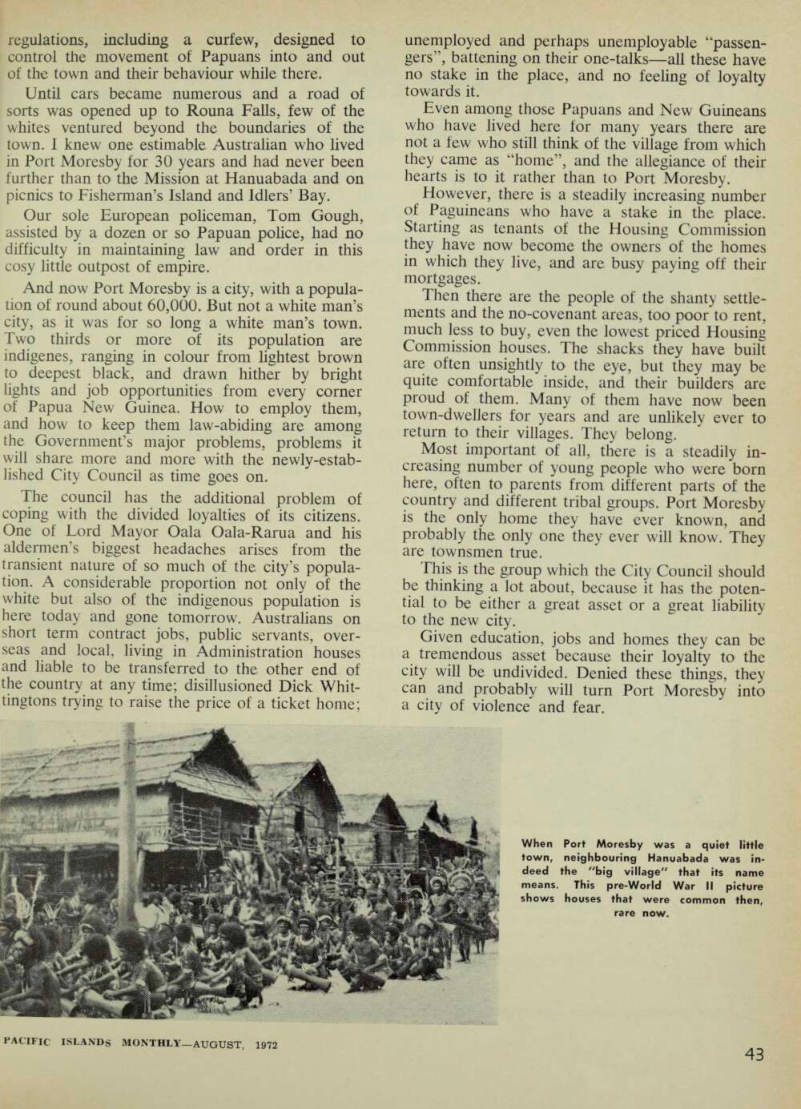
When Port Moresby was a quiet little town, neighbouring Hanuabada was in deed the "big village" that its name means. This pre-World War II picture shows houses that were common then, rare now.