Political Prospects In
pp. 53-55 · Read in the full issue
Western Samoa
From FELISE VA’A, in Apia.
A dose of election fever has already hit Western Samoa, though the general elections are still many months away, probably not being held before February or March of next year.
For many months, the main talk in the villages (especially among the matais, or titleholders), has been on who will run for parliament in the various constituencies and in parti cular who will make the ideal prime minister for the next three years.
Public opinion is generally against the present cabinet being returned to power. But in Western Samoa the public does not decide the politics of the country. Rather it is the power ful, traditional power bloc of the matais, who comprise some 10,000 of the population (out of a total popu lation of about 135,000).
Only the matais have the vote. The rest of the people have no say in their government except indirectly in the sense that they can influence their own matais to vote for a particular candidate. Public opinion does not clearly indicate what will happen.
For that one should consult the matais.
Most of the present cabinet mem bers will probably be returned to parliament, but one or two are in trouble with their constituencies and must be worried about their futures.
What about the rest of the present
members of parliament? In every past election, many changes have occurred, and a 50 per cent, turn over of seats would not surprise.
Samoans are noted for their generosity but they are also quick in replacing the unfruitful or the ungrateful. Of course, sometimes, it is just a case of bad luck.
Who will be the top candidates for the position of prime minister?
Well, of course, the present one, Hon Tupua Tamasese Lealofi IV. And, of course, the previous prime minister, Hon Fiame Mataafa Mulinuu 11.
And then there is Hon Tupuola Efi, the present Minister of Works, who is almost certain to be nominated.
These are the three main contenders.
There may be one or two others.
A few words about the three main candidates: Hon Tupua Tamasese is easy-going, active and a gentleman, but he is frequently criticised for giving the more radical members of his cabinet too much rein. Hence, his critics say, though he has the best of intentions, he is ineffective.
Hon Mataafa is the classic picture of what a prime minister should be like. He has grace, intelligence and rare dignity. He is a political artist, a very effective cabinet leader who commands respect. But his critics say he is too slow in the development of the country. In other words his failing is his extreme conservatism at a time when the country needs change and bold leadership.
Hon Tupuola is perhaps the paradigm of the modern, educated young Samoan. He is extremely intelligent, aggressive, very active, a skilful debater and orator and a good negotiator. But he seems to need the patience of Tamasese and the con servatism of Mataafa.
Hon Tupuola has a good chance of winning the prime ministership if he can win enough members to his cause. But he will have a big fight against the two Tama Aiga, Tamasese and Mataafa. The Tama Aiga are usually favoured, regardless of their ability, because the matais respect their traditional authority. The Tama Aiga (of whom there are four) are the highest chiefs in Samoa.
Before he can be a prime ministerial prospect, Hon Tupuola has first to be re-elected to parliament, and there have been reports of some difficulties
in his constituency. If he gets into parliament but fails to get a majority for the leadership, the voting pattern of the last elections for prime minister is likely to be repeated, with Tupuola supporting his kinsman, the present prime minister, Tamasese.
This should be enough to make Tamasese the winner. Mataafa will find it hard to defeat the Tamasese- Tupuola coalition.
Tamasese thus stands in a good position, strategically, while Mataafa and Tupuola are in weak positions.
Mataafa and Tupuola, therefore have a much harder task than Tamasese and consequently they have to cam paign harder. But a change of opinion by the new members of parliament could be a life saver for one of them.
What the politicians
are doing
Western Samoa’s parliament re cently discussed two important bills on alienation of freehold land and citizenship.
The Alienation of Freehold Land Bill was an attempt by the Minister of Lands, Hon. Polataivao Fosi, to prevent Samoan lands from getting into the hands of aliens.
More and more Samoans are leav ing the villages to find work, especi ally in New Zealand and in Apia.
Reasons for the mass migrations from the villages are many. Some find the “faaSamoa” or Samoan traditional way of life too demanding, some want to be near the better schools where their children can be educated, while some want to earn more money. As a part of this trend more Samoans are coming to live in Apia.
Some are lucky. They can stay
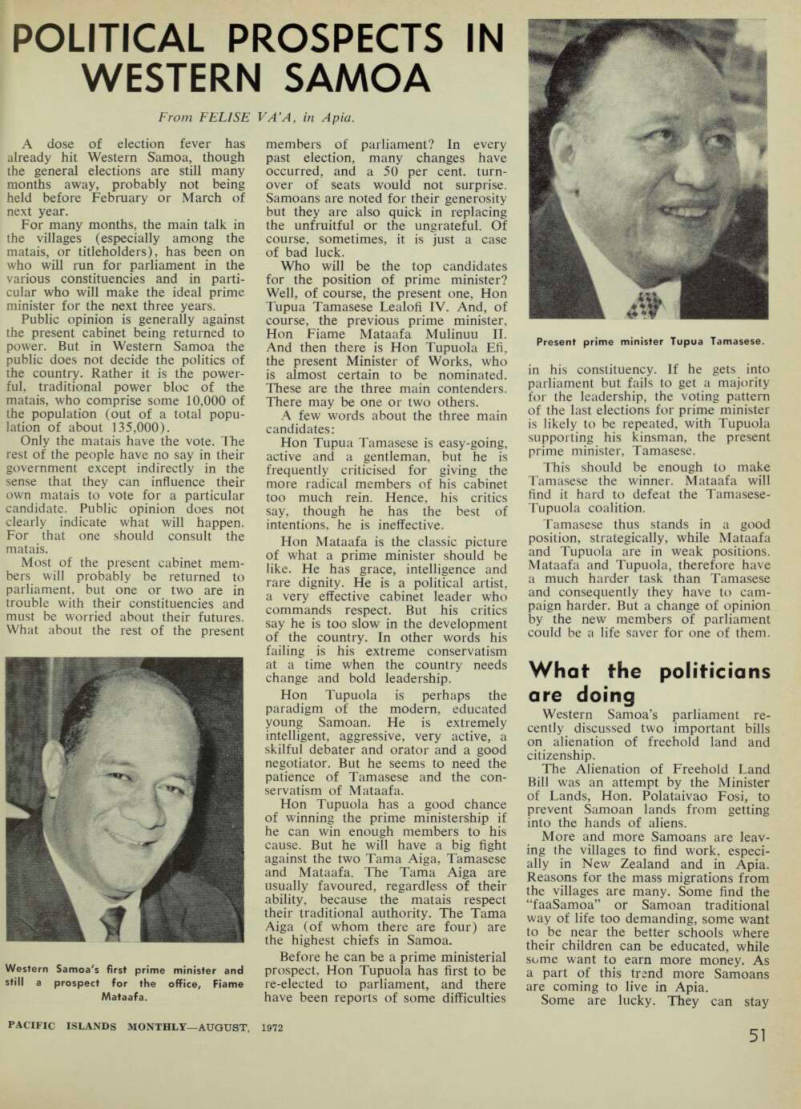
Western Samoa's first prime minister and still a prospect for the office, Fiame Mataafa.
Present prime minister Tupua Tamasese.
with their relatives. Some obtain leases either from the missions or from the government. Some have nowhere to go and just wander from place to place.
The minister has found himself with a problem—how to make gov ernment land available for these Samoans who have left their villages?
The solution would be to limit the sale or lease of Samoan land to aliens.
Land may be sold or leased to resident citizens, but a resident citizen must have resided in Western Samoa for not less than 2i years during the period of three years immediately preceding the date of the land tran saction, and he must intend to con tinue to reside permanently in Western Samoa.
The purpose of the bill is a good one, since it is only fair that most Samoan land should be preserved for Samoans, but critics have found the residency requirement for citizens too tough. Surely, they argue, there should be no residency requirement for citizens. Some citizens, for instance, find it necessary to stay for long periods overseas to work, and want to buy land immediately on their return without having to go back to their aigas in the villages where they are most likely to be out of place, and where soon all their savings will be spent in the “faaSamoa”.
Others want to come back to buy land for cultivation by their relatives.
In short, it would be the Samoan citizens who will suffer. They will find it hard to come back to Samoa (be cause they will have to wait three years before they can buy land) and they will find it hard to leave Samoa (because they must reside in Samoa permanently).
The Citizenship Bill, provides for the minister to revoke the citizenship of any Samoan who is disloyal and/or disaffected. Could this be interpreted as anyone who dared criticise the government, the “faaSamoa” or the country’s political institutions? An un scrupulous politician could use this provision to get rid of any critic of government or a personal enemy.
Already in Western Samoa, there are signs that many politicians regard themselves as the masters rather than the servants of the Samoan people.