Tropicalities
pp. 28-31 · Read in the full issue
Long knives cut some Humble pie
The long knives with which Premier Albert Henry of the Cook Islands made good his threat to cut short the careers of civil servants who worked for his opponents in the general election in April have been sheathed.
The 44 members of the public service who lost their jobs on re dundancy grounds and who, by a coincidence maybe, were all sup porters of the opoosition Democratic Party, have got their jobs back and compensation for loss of earnings.
The Premier has discovered per haps that even he can’t buck the High Court and justice. Of course, it wasn't the Premier against whom the Public Service Association threatened legal action for the sackings. It was the Public Service Commission but the islanders allege that Mr Henry has the commission in his pocket and though the voice of dismissal was the voice of the commission the hand behind it was the hand of the Premier.
The PSA filed suit in the High Court against the commission, seeking the quashing of the dismissal notices.
Now that would have been interest ing. There would’ve been some revelations but the commission did a rapid about-turn, reinstated the 44 m u en ami recalled dismissal notices which had gone out since the knives first flashed.
Some staffmen had resigned in pro test at the dismissals. They also were told they could withdraw their resig nationB. In addition, the commission said it would consider any requests from wage workers for compensation for loss of earnings—and agreed that m any future review of staffing levels it would consult the PSA. In return, the PSA agreed to withdraw legal proceedings.
And it looks as if the PSA is going to put the screws on Mr Henry’s government a little tighter. It’s been discovered that among the lengthy
list of government creditors there’s the PSA. That was really one for the book—the boss owing his workers money.
It worked this way.
Civil servants’ membership sub scriptions to the Public Service Asso ciation are automatically deducted from their pay by the Treasury De partment. The Treasury had deducted a total of 5892.60 and FAILED TO PAY IT TO THE PSA! Which gives an indication of what a heck of a mess the Cooks finances are in.
But, there are moves to clean up the mess and in July experienced accountants were sent to Rarotonga by the NZ Government, another creditor of the Cooks which this year owed the NZ Post Office $146,000 and the NZ Government superannua tion fund $llO,OOO.
New Hebrideans
sound a warning
Economic development must come before political development averred Mr Pierre Messmer, when, as French Minister for Overseas Territories, he put the cat among the pigeons in the New Hebrides just weeks before he slid into the hot seat of Gallic politics and became Prime Minister.
This was his argument when he met a delegation from the New Hebridean National Party and, with the adroitness of a French fencing master, side-stepped their questions.
He had been asked what the French Government’s attitude was to “ulti mate political status” of the condo minium which, the National Party men pointed out was not like New Caledonia or Tahiti where progress towards self-government was not pre sent.
The New Hebrides was unique, Mr Messmer agreed. Tahiti was not pro gressive but New Caledonia was the most developed country in the South Pacific. Why else would New Hebri deans want to go there?
The New Hebrideans tried again.
They were referring to political de velopment, they said, whereas in New Caledonia the development was mostly economic.
Back came the minister with, “You cannot have political progress and stability without a firm economic base”—a statement which the Cale-
donian autonomists might be able to turn against France’s new Prime Minister!
Declaring that the minister handled the situation created by his visit “like a born ventriloquist”, taking no time at all to adjust to each new frequency; that he “came and went with the hurried air of someone who does not belong—the epitome of his country’s concern”, the National Party’s news paper “New Hebridean Viewpoints” sounded a warning. It said this: “The National Party does not advocate violence and does not wish to create a Black Power movement; nor does it want to create underground forces, but wishes to advise the two Metro politan Powers on what people are thinking and saying, and it hopes that Paris and London will negotiate with the people of the New Hebrides and not dictate.”
Popular Tongans
Most popular people in the Hutt Valley in New Zealand’s North Island are 81 men from Tonga who are working at Lower Hutt under a
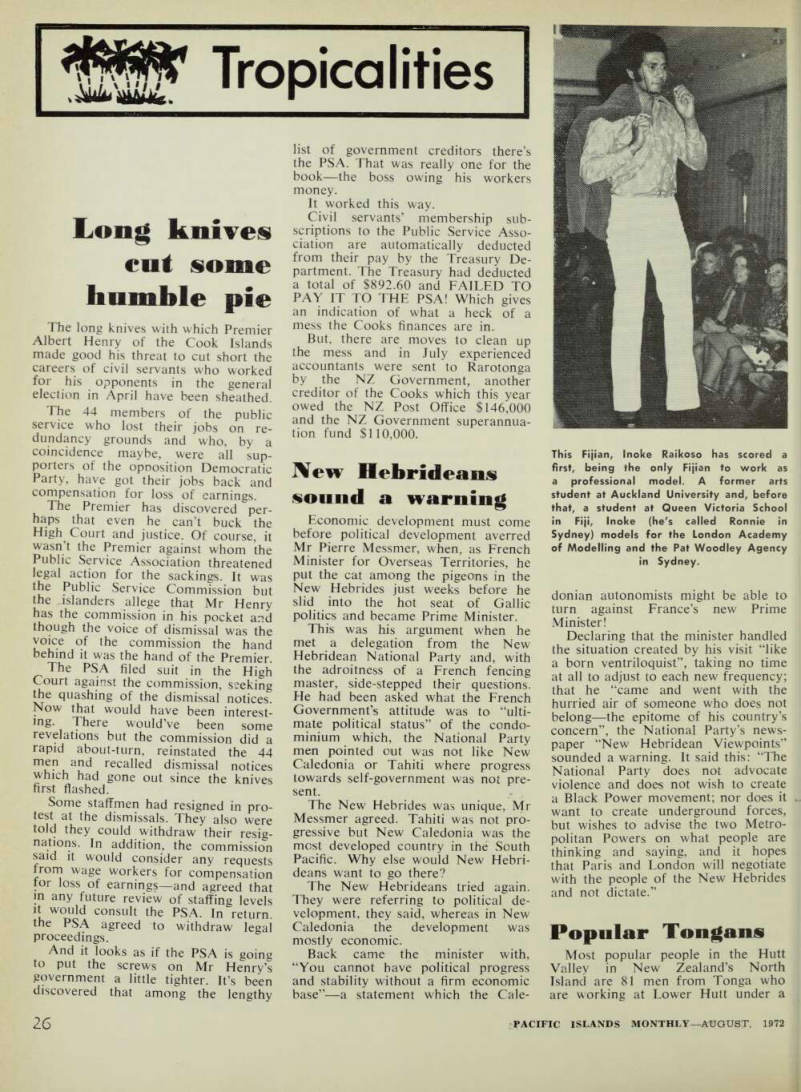
This Fijian, Inoke Raikoso has scored a first, being the only Fijian to work as a professional model. A former arts student at Auckland University and, before that, a student at Queen Victoria School in Fiji, Inoke (he's called Ronnie in Sydney) models for the London Academy of Modelling and the Pat Woodley Agency in Sydney.
scheme approved by the Tonga and New Zealand Government.
The men, brought in specially from Tonga to relieve the labour shortage, are working for 10 em ployers who, it is reported, are “fantastically happy” with the way the Tongans have settled in and learned their jobs since arriving in February. They are working in a variety of industries including the NZ Railways, motor companies and a tobacco company.
According to the employers, their Tongan workers could be relied on to work a full day for a whole week and do any overtime required of them.
This is the second group of Tongans to work in the Hutt Valley.
They replaced a smaller group which went home in February. They were due back in Tonga in July and a third group were to arrive the same month and work until December.
Battlefields wanted
for tourists
“Preserve our war relics and battlefields before it’s too late” was the cry which went out to Island governments at June’s end from the Melanesian Tourist Federation hold ing its annual meeting in Honiara.
Twenty delegates from Papua New Guinea, Fiji, New Caledonia, the New Hebrides and the Solomons, with the air lines well represented, were told by ABC Airways magazine editor Mr John Seekings, who gave the special address, that they were missing out by not promoting their war history.
It was of considerable interest, not only to those who had fought in World War II but also to those want ing to see the places which had figured in the battles.
But, he cried, no efforts were being made to establish war museums or to create access to battlefields, and war relics were not only being de stroyed but were being exported.
Mr R. Hunt, of American Airlines in Suva, reckoned that five million Americans would like to visit the Pacific battle grounds. Mr Seekings backed him up with an example of how many Americans travelled con siderable distances in their own country to see the Civil War battle fields.
The Japanese, it was said, would also be interested, and the delegates were told by Mr J. C. Foster of Air Pacific in Fiji that the Fiji tourist industry was planning a Visit-Fiji campaign in Tokyo.
Delegates were impressed with the idea of battlefields for tourists and unanimously passed a resolution call ing on the governments of member
countries to preserve war relics and prohibit their export.
Mr Seekings had few fears that tourism would damage Island cultures.
There were other and stronger forces such as the progression from a barter to a cash economy, the demands of education and changes from sub sistence farming to paid employment.
Those were likely to bring about more changes in the Islands over the next 20 years than tourism was ever likely to bring.
Hey, they 9 ve got
freedom on Niue!
Heaven knows what weird ideas United Nations delegates entertain about the Pacific Islands and their governments, but one must be that they are all police states. What other construction could be put on the reaction of Mr Salim Ahmed Salim, of Tanzania, leader of a three-man UN mission which visited Niue at the end of June?
The mission, testing the theory, perhaps, that all the Islands are under the wicked thrall of colonial govern ments—in this case New Zealand— spent five days on the island. And
what surprised Mr Salim most? It was, said a wide-eyed Mr Salim, the freedom with which the people spoke to the mission. He maybe expected them to be rounded up and gaoled!
Another thing which struck the mission, he said, was the desire the Niueans had for self-government and coupled with it the desire to “keep their own identity” and, at the same time, maintain their ties with New Zealand. They also found there was a lot of goodwill towards New Zealand.
All members of the Legislative Assembly, except one, wanted self government and only a few people did not think progress to full self government was in Niue’s best interests.
There was some talk of indepen dence but it was very difficult to assess.
Mormons 9 ban
upsets Samoans
Ages - old FaaSamoa (Samoan custom) and the newer Mormon faith have clashed in Hawaii and the reverberations have been felt in Samoa. The clash came when High Chief Lilomaiava Galeai was told by Wayne L. Allison, state president of the Mormon Church on Oahu, that he and the other Samoans living under the aegis of the church in Laie should stop practising the ancient matai system of giving and trading gifts at funerals and wed dings.
“This entire practice . . . is con trary to the teaching of the Gospel,”
Allison wrote, and alleged, “Frankly, this entire business of the matai , i& becoming a nuisance. 1 urge you to stop promoting such activities and to use your energies and talents more constructively in being a good mem ber of the church. I sincerely hope you will do this and not force mo to take action against your brethren who seem to insist on establishing this FaaSamoa system here in the United States.”
High Chief Lilomaiava’s reaction was to protest that the church was “encroaching on the personal freedom of Laie Samoans.
“Our church leaders do not under stand what FaaSamoa is and what it means to us.” He complained, “The problem is that the church leaders want to have complete power. They have even threatened to take away our leases.”
The matai system, Hawaii Church College president Dr Stephen L.
Brower explained, took time and money away from the families and, although it was perfectly workable
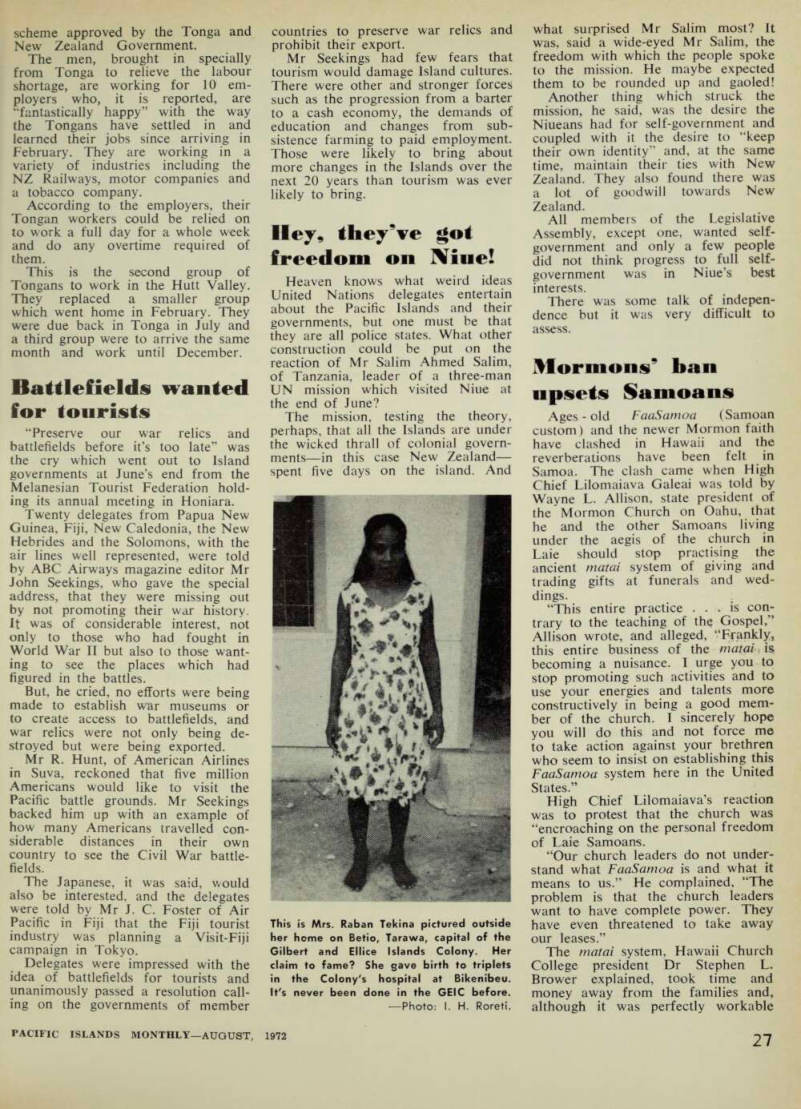
This is Mrs. Raban Tekina pictured outside her home on Betio, Tarawa, capital of the Gilbert and Ellice Islands Colony. Her claim to fame? She gave birth to triplets in the Colony's hospital at Bikenibeu.
It's never been done in the GEIC before.
Photo: I. H. Roreti.
and legal in Samoa, it was basically illegal in church circles in that the matais obtained the time and money in competition with what was due to the church.
He added, “Laie Samoans who persist in practising the matai system are not considered to be members in good standing and they are, therefore, denied access to the temple. After all, when they become members of the Church of Jesus Christ of Latter-Day Saints, they commit themselves to giving first priority of time and money to the church.”
The “Samoa Times” under the heading “Minority Rights” confessed that the Mormons’ ban had left them flabbergasted. “Surely,” said the news paper, “the Samoan people have the right to practise their own culture, which, unlike American culture, goes back many, many centuries.”
The “Samoa Times” comment that the church leaders’ attitude would appear to “stem either from jealousy or ignorance” ruffled the fur of one Samoa resident, Acel Lowe Jr, who advised the newspaper in a letter, “If you are looking for a crusade that will help a minority faction against prejudice and discrimination try look ing on your own doorstep”. He also pointed out that money received by the church in America was spent “in places like Western Samoa where church contributions are incapable of providing even the rudiments of education for the members”.
But the Mormon Church in Western Samoa, obviously wanting to keep out of the conflict, disowned Mr Lowe’s views, its Director of Educa tion, Mark S. Littleford, writing that nothing was official, so far as LDS church schools were concerned, un less he signed it.
And there, for the present, the matter rests.
Noii’s no longer
an island
The Isle of Nou which was featured in a story in June PIM has become far more accessible in recent months because of the causeway that now links it to Noumea, on the mainland.
The causeway, which opened to traffic in April this year, provides the backbone for immense port exten sions currently under construction in Noumea harbour. Work began in January, 1971, proceeding in stages and involving expenditure of over SAIS million.
So far the project involves six new berths, one built on the inner harbour side of the causeway, three deep water berths on the outer harbour
side of the causeway, and facilities for two medium-sized cargo vessels on the foreshores of Anse du Tir bay.
Now that Noumeans can easily cross the causeway to the Isle of Nou, various development schemes are being drawn up for the historic island.
However, an essential step will be an up-grading of the present “mule track” island circuit, to provide adequate streets for cars arriving from the mainland.
French boycotting
English press ?
While overseas news services were announcing recommendations made on the New Hebrides by the UN subcommittee on Decolonialisation, Radio Noumea announced the scheduled visit to New Caledonia of Sir Michael Gass, High Commissioner for the Western Pacific.
The UN subcommittee was reported as stating that the parallel Anglo- French administration of the New Hebrides is an obstacle to the political and economic advancement of the people. The subcommittee thus urged Britain and France to institute a form of government in which the local people could participate. The administrative powers were also urged to allow a UN mission to visit the New Hebrides and obtain first-hand information.
None of this was highlighted in Noumea. The visit of Sir Michael
Gass, it was noted, followed the earlier trip made to the Solomons by French Governor Louis Verger.
When PlM’s correspondent con tacted Governor Louis Verger’s press office for confirmation of Sir Michael’s arrival and details of his whereabouts, the office declined to answer questions or give any informa tion.
Is this a boycott of the English press, in retaliation for the Aus tralian and New Zealand boycott of French ships during the nuclear tests in the Pacific?
Into the Highlands
6 the hard way’
New Guinea pioneer, explorer, farmer Mick Leahy didn’t catch up with PlM’s account of the Akmana explorations of 1929/30, published in April last year, because he was on an overseas tour, receiving a medal for his own explorations from the Explorers’ Club. So when he made a tentative inquiry from his homestead at Zenag, near Wau, recently, we sent him the tearsheets about that goldmining expedition which appears to have been first into the New Guinea Highlands.
Mick now replies: “Many thanks for the Akmana explorations. They sure must have done it the hard way, coming into that area from the Sepik.
The Maramuni River country on the north side of the timbered ranges that literally hem in the Highlands
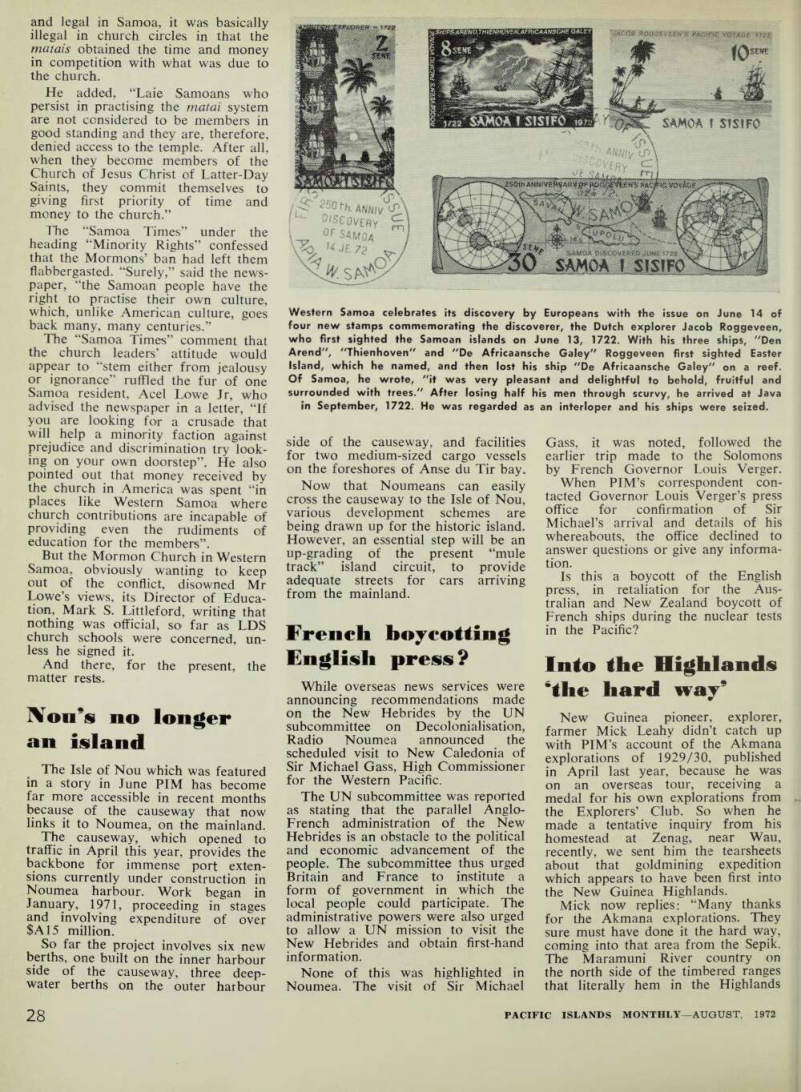
Western Samoa celebrates its discovery by Europeans with the issue on June 14 of four new stamps commemorating the discoverer, the Dutch explorer Jacob Roggeveen, who first sighted the Samoan islands on June 13, 1722. With his three ships, "Den Arend", "Thienhoven" and "De Africaansche Galey" Roggeveen first sighted Easter Island, which he named, and then lost his ship "De Africaansche Galey" on a reef.
Of Samoa, he wrote, "it was very pleasant and delightful to behold, fruitful and surrounded with trees." After losing half his men through scurvy, he arrived at Java in September, 1722. He was regarded as an interloper and his ships were seized.
is as rough as anywhere in New Guinea.
“I feel sure that another few days towards the south or the south-east and they would have sighted the grass country of the Jimmi, the Baiyer and/or the Wabag valley with its thickly populated and (for Dan and me in 1934) very aggressive wigmen.
The Akmana photos in PIM are identical with the Wabag people.
“The work axe in one photo looks like a stone from the Jimmi. Did they see any of the ceremonial axes?
We found in 1933 the ceremonial centre of the sing-sing grounds was around Mt. Hagen. They became less impressive away from that area.
“The good old days and ways have gone. Most of my negatives and diaries are in the National Library, Canberra, and available should any of those old-timers be interested in having a look at them. I knew Bill MacGregor and Sam Freeman well.
Both gone now, of course. Bill managed the Baiyer River cattle station for the administration until his death.”
Fi|i 9 s short of
buying patriotism
During NZ Trade Week in Suva in July, the stylised kiwi emblem, on lapel pins, placards, plastic carry-all bags, men’s ties and various other vantage points exhorted all and sundry to “Buy New Zealand-Made”.
The kiwi motif, selling New Zealand’s message so well, underlined the lack of anything similar in Fiji, which sorely needs to inject some sort of buying patriotism into its shopping public.
In July, it seemed likely that the Fiji Government would make an announcement soon, probably before the end of the month, about an official emblem for Fiji’s manufac turers. The Fiji Manufacturers’ As sociation chose a design last April and submitted it to government for approval. President of the MFA Mr Mark Israel told PIM he ex pected a decision soon, but no “Buy Fiji-Made” campaign could be
effectively launched until government had approved an emblem.
“The emblem will belong to the Manufacturers’ Association and will be granted to local companies whose products come up to recognised inter national standards,” Mr Israel said.
“It will be a hallmark of prestige.”
Few people, either in Fiji or over seas, realise the diversity of Fiji manufactured goods. They range from paper bags, baking powder and brooms to boats and biscuits, from molasses and motor bodies to cigarettes and cloth s pegs. Fiji com panies turn out building and roofing materials, paint, putty, suitcases, soap, tiles, umbrellas, chain link and barbed wire, plastic products, pumps, ply wood, matches, animal feed and detergents.
On the food side, local products include clam chowder and corned beef, tomato sauce and soy sauce, honey, ice-cream, canned fish, curry powder, jelly crystals and ginger in various forms. Not to mention meat products, butter, cream, powdered kava and milk shake flavours.
The list of Fiji goods is very much longer than that, but it’s probably not too wild an exaggeration to say that some householders could go for weeks without spending more than a fraction of the housekeeping budget on home-made items. There’s simply not enough loyalty to local products, say the Fiji manufacturers.
Model houses
for Micronesia
The Foundation for the Peoples of the South Pacific with the aid of Australian Catholic Relief, is demon strating a method of building cheap and durable houses in Micronesia.
The one, two and three bedroom pilot models of houses have been designed at the Ponape Agriculture and Trades School.
Father Hugh F. Costigan, super visor of the project, says that the designs meet these requirements: © The cost of materials per square foot to be less than three dollars.
© The house to be entirely pre fabricated with a minimum of labour. • Prefabrication to be so simple that one teacher can instruct the people of a community to build. • Foundation, floors and walls to be of reinforced concrete to with stand weather demands without costly plywood formwork. • Finally, the house must allow for cultural needs and fit family life patterns in Micronesia.
Father Costigan says that the Ponape Agricultural and Trade School is unable to finance the models for the pilot project but it will contribute all the engineering, supervision and labour.
The Agricultural and Trade School believes the future success of this programme necessitates the actual building of three units as a term project for the students. During the building process, selected students will be taught varying trade skills under supervision and when com pleted, the houses will be used to accommodate one Peace Corps volunteer family and two Catholic lay missionary families who will work at the school.
Father Costigan says Ponape needs a minimum of 1,000 homes but the low-cost housing plan has been accepted for Housing Authority loans. The immediate beneficiaries of other homes, as they are built, will be the students who will con tribute their labour free but ultimately all home owners will pay the full cost.
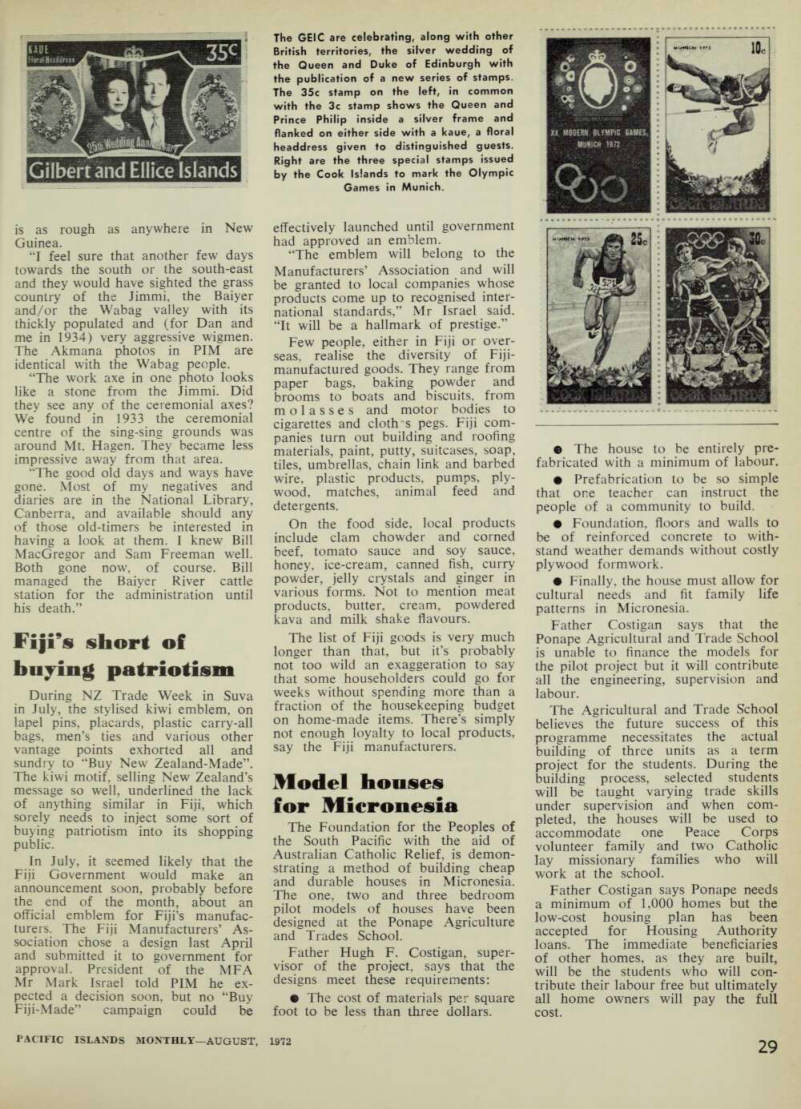
The GEIC are celebrating, along with other British territories, the silver wedding of the Queen and Duke of Edinburgh with the publication of a new series of stamps.
The 35c stamp on the left, in common with the 3c stamp shows the Queen and Prince Philip inside a silver frame and flanked on either side with a kaue, a floral headdress given to distinguished guests.
Right are the three special stamps issued by the Cook Islands to mark the Olympic Games in Munich.