Caledonian Politball:
p. 32 · Read in the full issue
Gearing Up For Final
From a NOUMEA correspondent
Whatever the recent slow-down in nickel demand affecting New Cale donia, there has been no slow-down in the “news” trade, especially in sporting coverage, as “politball” players shape up for the September 10, “territorial championship” event.
The Caledonian Territorial Assem bly is already divided into seven teams preparing for the September renewal of the House. Recently, an eighth group has announced its inten tion to enter the arena—the AICLF, a Melanesian association, originally non political, which has now decided to counter the autonomists. The AICLF have one supporter in the Territorial Assembly.
The five-yearly territorial elections were due in July, but the Paris Government had them postponed to September. In the meantime, the state controlled ORTF office has intro duced continuous radio broadcasts in Noumea, from July 1.
This means Caledonians now have 16 hours of radio daily, from 6 a.m. to 10 p.m., instead of three shorter broadcasts around mealtimes only, as previously.
Of course, radio and Tele Noumea are not the only agencies covering “politball”: there are no less than 10 papers in Noumea reflecting various political viewpoints. One of the latest moves among them has come from the SLN nickel company. Controlling shareholder in “La France Australe” daily, the SLN has now bought out the twice-weekly “Bulletin du Com merce” and has been planning to make this paper an evening daily, either from August 1, or after the elections.
And what sort of play does the press have to report? Beginning with the French administration, they have recently learned that already half way through this year the territory looks like facing an almost SAIO million budget deficit. Since the Cale donian budget must balance, spending has to be cut back.
The deficit has arisen through over optimistic forecasts of revenue, since tax money derived from imported goods and exports (nickel) has been down on the estimates. Governor Louis Verger’s administration has thus proposed a five per cent, cut in public service spending and other economies, as first steps to make up the deficit.
On the electoral scene, the July municipal by-election at Voh, on the island’s west coast, gave the greatest number of seats to the predominantly Melanesian, autonomist Union Multi racial party (currently four seats out of 35 in the Territorial Assembly).
In the Paris National Assembly, New Caledonia’s Deputy, Melanesian Roch Pidjot, like Tahitian Deputy Francis Sanford, has announced his resignation from the PDM group, within the majority coalition. The Caledonian deputy is now holding talks with the Reformateurs centre party. Home in New Caledonia, Pidjot is a leader of the autonomist Union Caledonienne (12 seats).
A fourth Caledonian group, the Entente Democratique et Sociale (EDS —four seats) held its constitutive congress in July, after its break-away earlier this year from the Union Demo cratique, led by Georges Chatenay (five seats). The EDS claim the split was over personalities rather than policies and have elected Noumea Mayor Roger Laroque as leader. The EDS have pledged their opposition to the autonomists. Major charges are that internal autonomy would only lead to upheavals, racial discord and, ultimately, independence.
The Liberals (seven seats), mostly break-aways from the Union Cale donienne, are also taking an anti autonomist stand, although seeking certain minor reforms in the local power structure.
The Mouvement Populaire Cale donien of Alain Bernut (one seat) is anti-autonomist and continues to have a strong voice through its popular weekly paper.
Finally, the Union Civique (one seat) has just published a detailed booklet proposing revised statutes to give the territory greater internal self-govern ment. Main demand is for the transfer of certain local executive functions away from a Paris-appointed public servant (as governor), into the hands of locally-elected people. This would be a step towards decentralisation away from Paris, leading to New Cale donia having similar status to that of Hawaii within the USA or Tasmania within the Commonwealth of Aust ralia.
Meanwhile, as background to the local autonomy debate, French Gover nor Louis Verger, executive head of
the island, has summoned the Cale donians to “unity, comprehension and through that, to efficiency and pro gress”. The governor made this exhortation during one of his most recent public statements, at Hieng hene, in June.
The governor noted that during his island visits, local people expressed “their uncertainty, their fear for the future”. This fear and uncertainty has no valid basis, however, he claimed since Mr Pierre Messmer (Minister for territories, recently became Prime Minister), has assured the Caledonians of their political and economic future.
This was that New Caledonia “will remain forever French”, while at the same time promises were made over the new long-discussed nickel projects at Poum in the north and for INCO Canadian mining company, in the south.
The Governor thus repeated his popular appeal to the Caledonians: “Let us face with determination, with clearsightedness the passing worries of a still uncertain nickel situation; the temporary inconvenience of still largely insufficient insinuations in the public, industrial, agricultural and commercial sectors; (as well as) the occasional unpleasantness of unavoid able but finally advantageous changes”.
Just how far the Caledonians have faith in the French Government to let the Paris authorities alone manipu late all these changes for the island’s future, will be seen by how the game is played up until September 10.
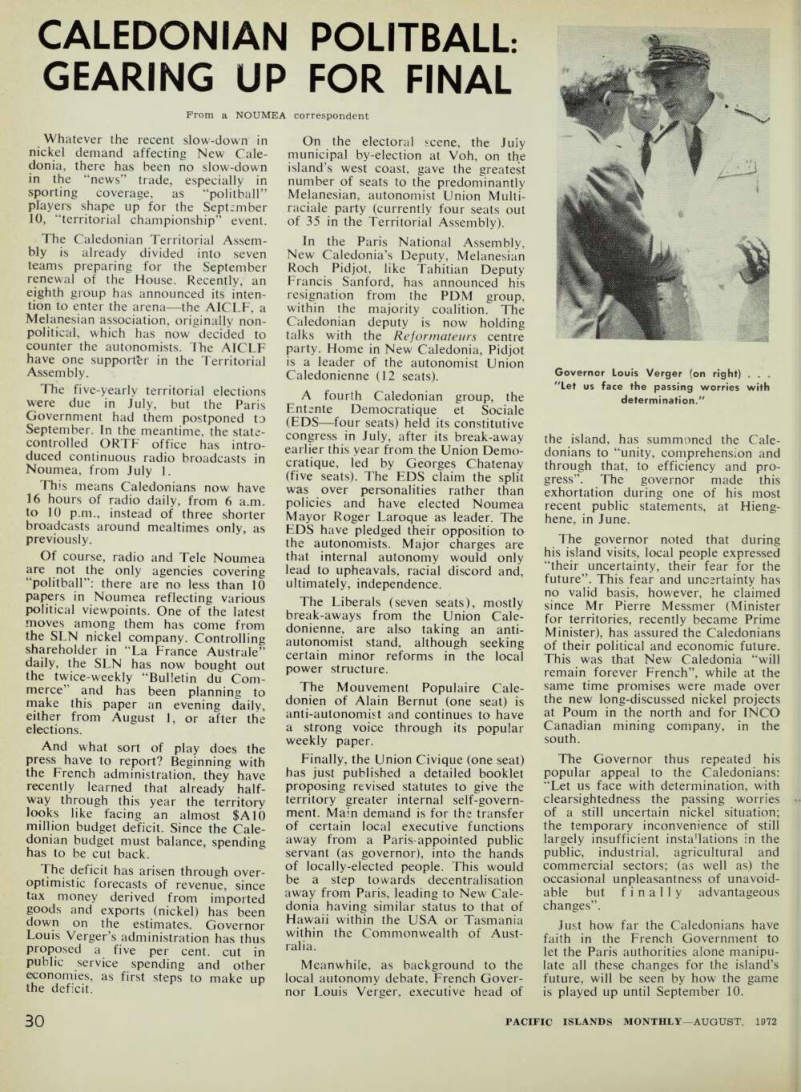
Governor Louis Verger (on right) . . .
"Let us face the passing worries with determination."