liji talanoa
pp. 26-27 · Read in the full issue
Money or the lack of it was the story of July
With Sue Wendt, In Suva
F|THE “floating pound” and subse quent devaluation of the Fiji dollar sent food costs soaring again in July, but for some sections of the community, news on the financial scene wasn’t all bad.
Civil servants were granted pay rises worth $1.5 million a year (fol lowing a 1970 agreement to increase civil service salaries when Fiji’s consumer price index reached 113.6 points); canefarmers were assured that they would be paid more than the guaranteed minimum per ton of cane for the 1971 season; and New Zealand announced that aid to Fiji during the next three years would be increased to about $2 million.
TN a speedy clamp-down on specu lative outflow of precious Fiji dollars following Britain's decision to float the pound, the government an nounced new exchange controls on currency movements to both sterling and non-sterling countries. Finance Ministry approval will now be needed before anyone can invest outside the dominion—whether it is direct capital investment or investment in equities or other securities.
Investment of purchase of shares by overseas residents in locally registered companies is also subject to control and the amount of money Fiji residents can send overseas as gifts is limited to $5OO a year. To ensure the return to Fiji of export earnings, the government has ruled that companies will require a licence to export goods valued at $l,OOO or more and export earnings will have to be paid into a bank in Fiji.
Although consumer goods imported from Australia and New Zealand were now costing householders an extra 6c in the dollar following the Fiji devaluation, Finance Minister Mr Charles Stinson pointed out that so far as exports were concerned, ex change rates were in Fiji’s favour.
The dominion would be worse off if it tied its currency to the US dollar, as
some other Commonwealth countries had hastened to do. Fiji’s safest step at present, said Mr Stinson, was to stick with the pound.
In early July, with exchange rates fluctuating from day to day, Aus tralian and New Zealand visitors were confused about how much they’d get in exchange for their own money.
On July 6, the Fiji dollar had dropped 5.1 per cent, on its previous level.
Banks were selling the Fiji dollar for 97.11 c Australian, compared with 95.91 c the day before. It was selling for 96.85 c NZ (95.66 c the previous day) and $U51.1554 (SUSI.I4II on July 5).
The business community in general welcomed the new measures as being in Fiji’s economic interests, but banks were wondering whether the Ministry of Finance was geared to meet the flood of applications for permission to transact various exchange deal ings. A pile-up of paper work seemed inevitable, but in the early stages, people who took their applications in person to the ministry were being processed with surprising speed.
ZITHER financial moves during the month included the news that Barclays, Bank—Britain’s largest and the world’s fourth largest commercial trading bank—would start operating in the dominion in September or October, giving Fiji a total of six com mercial banks. According to Mr John Martin, the bank’s Sydney-based director for Australia-New Zealand and the Pacific Islands, Barclay’s presence in Fiji could encourage more British investment here. It would also provide several new services in the ‘‘fairly rigid” banking scene.
New arrival in July was financial
expert Mr lan Craik, on two years’ secondment from the Bank of England to advise the government on convert ing the present simple currency board system into a central monetary system and eventually, a central bank. Finance Minister Stinson said that whatever the controls introduced by the authority, the government would keep ‘‘firmly in mind the need for free transfer and for free action in the field of finance”. It would be a negative action to put a brake on the flow of overseas investment into Fiji, he said.
To most Fiji people, however, all that “high finance” was just so much talk. They were far more preoccupied with the fact that Japanese canned fish was up to 24c a can at local stores, that a pint of milk was up to 11c in Suva and 12c in country dis tricts and that butter was now 47c a pound. Even staple foods like flour and sharps had gone up in price.
Taxi drivers were pressing for higher rates (though they decided not to introduce meters for another three years) and bank officers announced that they were after pay increases of up to 45 per cent, and equal pay for women.
The tourist industry was concerned about an apparent falling-off in the growth rate of visitors and looked like developing ulcers over the effect on Fiji’s duty-free earnings of new moves to allow Australian air travel lers to buy duty-free liquor and cigarettes on their home ground.
TSUI’S strike - happy workers were still on the rampage in July, with members of the Airline Workers’
Union continuing their boycott of UTA aircraft at Nadi Airport and their ban
on any communications between Fiji and French Pacific territories. A wild cat strike involving 600 workers brought work on the $8 million new Lautoka Hospital and the $5 million Nadi Airport extension project to a temporary standstill. Other “stop work” exercises affected canecutting operations at Labasa and had 140 Lautoka Town Council workers downing tools over what was de scribed as a "difference in the inter pretation of job evaluation”.
The antics of the pound were of little concern to 15 squatter families in Suva, who were told to get off land many of them had occupied for up to 30 years —and Minister for Social Welfare, Mr Vijay R. Singh was clearly on the ball when he de clared that in his opinion, housing had replaced employment as Fiji’s No. 1 problem.
The plight of the squatter was high lighted in the annual report of the Fellowship of St Francis and St Clare, with social worker Mrs Joy Lawlor seeking community support for the Fellowship’s efforts to clothe and feed more than 70 needy families.
She drew a horrifying picture of the sufferings of families living in poverty near Suva —"malnutrition, children coughing up handfulls of worms . . . and practically every type of illness suffered by people who, either through ignorance or inability to travel, have not been seeking medical assistance”.
As examples, she cited the case of the aged rheumatic living in "almost unbelievable squalor” and the 16-year-old polio victim who has spent most of his life lying on his stomach in a bure in a Suva suburb.
When visitors ask her whether Fiji's tourism boom has improved con ditions for all Fiji’s people, said Mrs Lawlor, her answer is always an em phatic "no”.
Nobody with honesty could answer otherwise—though a visitor perusing recent promotional material put out by the Fiji Visitors Bureau might be forgiven for thinking this the land of milk and honey.
“The past still lives, unspoiled,” sings the FVB brochure. “The pre sent is peace and leisurely comfort.
The future—a soft breeze on a distant horizon.”
The visitor is promised "golden days filled with fun, laughter and singing”, assured of a welcome from
"outrageously hospitable people” and
told that Fijians spend their evenings around the yaqona bowl, "with a guitar, an old polished coconut shell, a ukelele and an unending supply of
lilting Fijian love songs”.
Today’s Fiji, says the lavishly illustrated brochure, is a land of fasci nation, friendliness, excitement and contrasts. The 15,000 shack dwellers in and around Suva would agree with the last word at least . . .
It’s not fair, of course, to poke fun at the adman’s flights of fancy when eulogising Fiji for the purpose of promotion. It's the FVB’s job after all to lure visitors and the tourist dollar does filter through a great many sectors of the community, some of them surprisingly dissociated from the industry itself. \ S mentioned earlier, developments on the Australian travel scene have the local tourist plant worried.
Reduced fares from Australia to Singapore and Malaysia, to be im plemented later this year, threaten to lure Australians away from Fiji. New Zealand too has stepped up its con sumer advertising in an attempt to woo the free-spending Aussie.
Of the estimated $33 million earned by Fiji from tourism last year, almost half was of Australian origin. Fiji just can't afford to lose that kind of business.
Unfortunately, because several staff members have been on extended leave, Fiji’s Department of Statistics hasn’t published its monthly analysis of visitor statistics since February this year. But according to FVB general manager Jo Cokanasiga, who has been compiling his own figures based on information from carriers serving Fiij, the growth rate is falling.
"According to my figures, Fiji re ceived 45,912 staying visitors be tween January and May, compared with 57,000 for the same period last year,” Mr. Cokanaiga said. "There’s some doubt whether the 1972 visitor total will reach last year’s peak.”
Last year’s 39 per cent, visitor in crease was extraordinary and the in dustry isn’t expecting the growth rate to continue at that pace. But it is taking steps—including allocation of an extra $32,000 for Australian pro motion in the next five months and a restructuring of FVB management in Australasia —to prevent the cold of falling numbers from becoming an icy gale.
Most beneficial move, says the industry, would be for airlines to agree to a year-round Australia-Fiji fare of less than $lOO. At the moment, that too seems like just another flight of fancy.
A VISITOR’S mode of travel within the dominion frequently colours his lasting impressions of the place.
If he takes to the sky or even the sea, well and good. A visiting US journalist took to the road—and he wrote recently: "The 150-mile ‘high way’ between Nadi and Suva is a sweaty, tortuous, death-defying, tooth rattling horror . . .”
Fiij people were heartened by the Prime Minister’s announcement in July that a $lO million contract to upgrade the 50-odd miles between Nadi and Korotogo had been awarded to Dill ingham, Wilkins, and Greene, of Sydney and work would start in September.
It was welcome news for Nadi siders and Coral Coast hotel con cerns, but not so pleasing to the developers of the $32 million Pacific Harbour resort development, who had hoped to see the Suva-Deuba section tackled first. The Prime Minister said up-grading of this section would cost around $9 million and government was negotiating with the World Bank for finance.
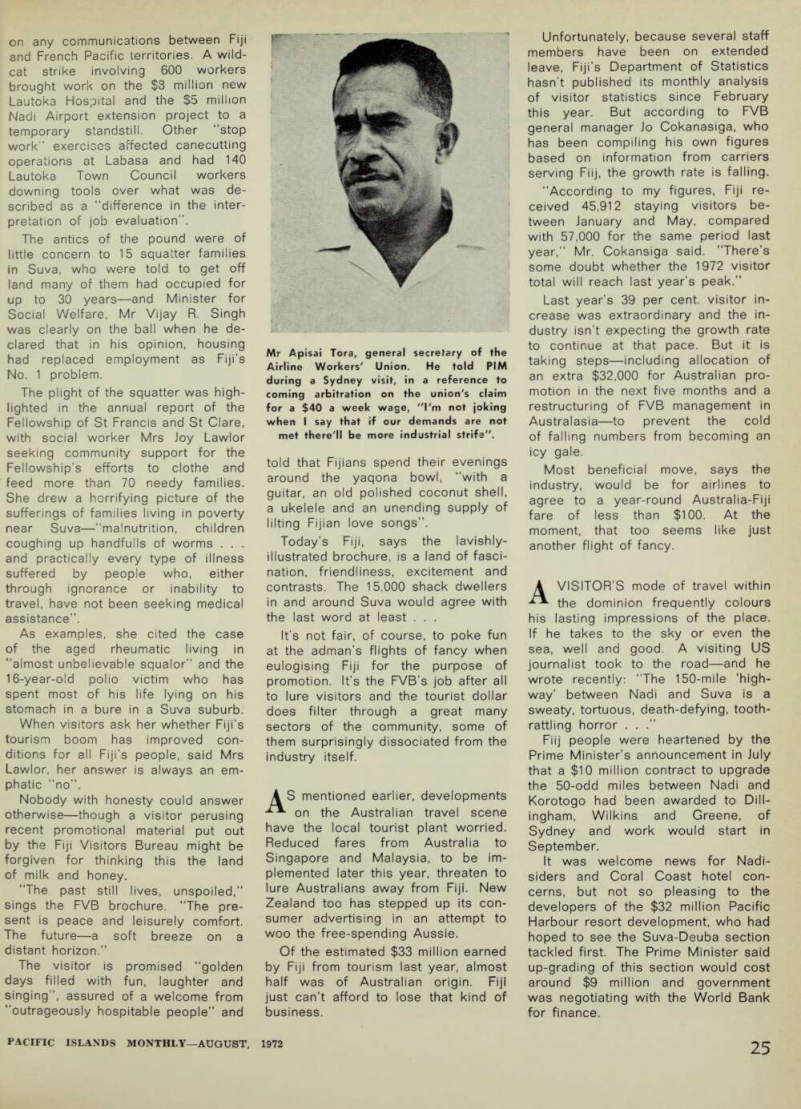
Mr Apisai Tora, general secrefary of the Airline Workers' Union. He told PIM during a Sydney visit, in a reference to coming arbitration on the union's claim for a $4O a week wage, "I'm not joking when I say that if our demands are not met there'll be more industrial strife".