Living
pp. 24-25 · Read in the full issue
Under A
Boycott
New Caledonia Diary
with
Helen Rousseau
Dockers and seamen, ships’ captains and harbourmasters were key spokesmen on the Noumea scene over recent weeks.
The boycott imposed on French ships and aircraft by Australian, New Zealand and Fiji unionists brought most Noumea-centred ships to a standstill and in their place a whole fleet of non-French vessels began arriving. Som local newspapers reacted to the scene with threats of suspending foreign import licences and blocking the pass to this foreign armada, while there was talk of a new Battle of Trafalgar.
But to look at what really did happen; on the new Quai FED wharf, the Greek “Santa Vassiliki” was double-berthed alongside the French “Gange”. For what reason?
The Greek vessel was chartered by a French line to bring Aus tralian goods which dockers were refusing to load aboard the “Gange” and “Polynesie”. So in Noumea the trans-shipment took place, and the “Gange” proceeded with the Australian cargo to the New Hebrides.
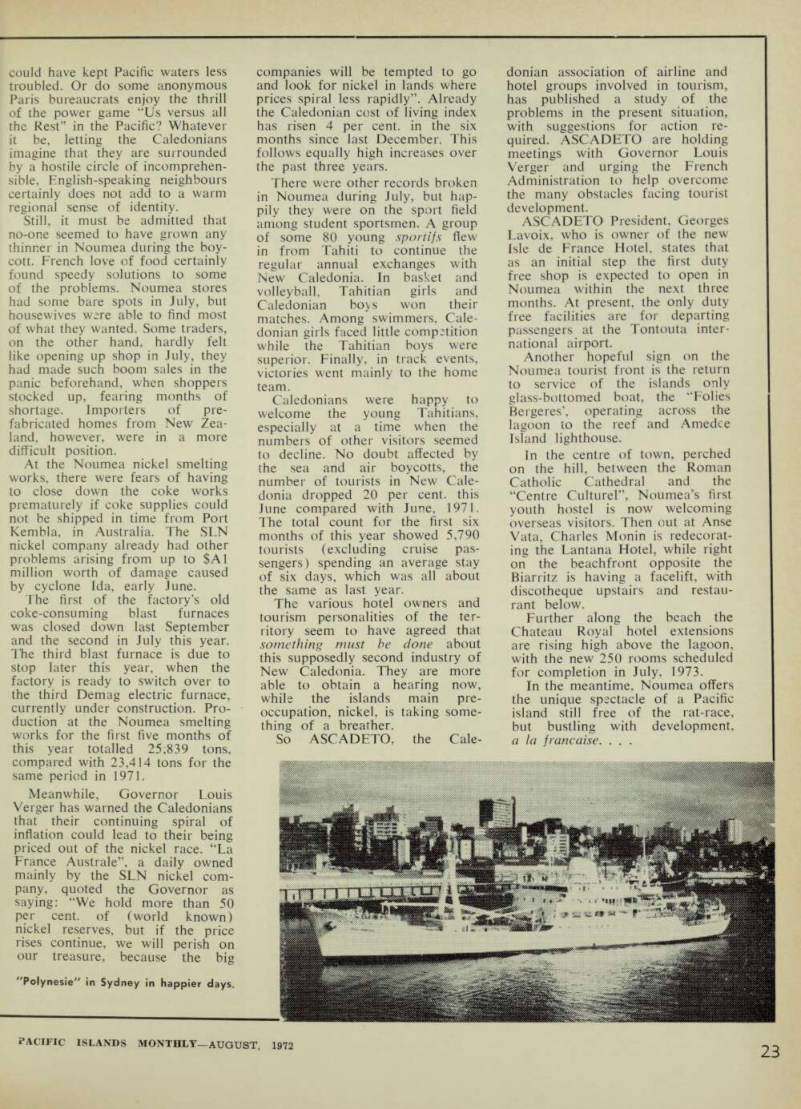
In the meantime, at the new wharf built for regional traders, two other vessels were lying idle —the “Erakor” belonging to the Cie. Hebridaise de Navigation of Port Vila and the “Polynesie” which was being taken over by the regrouping of French interests forming the new South Pacific United Lines.
On the wharf of what is now the “old port”, the Chargeurs Caledoniens Company’s “Port de France” was also lying idle, her master, Captain Michel Tostin, just back from Sydney where he had been unable to change the
attitude of Australian and Fiji unionists.
By early July, two other French ships had raised anchor and left Noumea—the “Capitaine Wallis” headed for the French Wallis Islands, while the “Capitaine Scott”, its crew reduced, made for the New Hebrides, to load meat for Noumea. These two vessels belong to the SOFRANA line which, at that time, still had its other two ships, the “Capitaine Cook” and “Capitaine Tasman”, blocked in New Zealand ports.
The crews were due to be dis missed once the vessels could regain Noumea.
Owners of the six ships most keenly affected had sought an indemnity of almost SA 180,000 from the Paris Government to cover costs of the vessels’ idleness in June. But Paris also had its problems, for at that stage the government of Prime Minister Chaban-Delmas was crumbling.
The distress signals sent out by Caledonian seamen and anxious shipowners were left unanswered.
One company spokesman said the men felt they had been abandoned by the Paris Government, while his group faced bankruptcy if no aid arrived. Yet crewmen dis missed on June 30, including Hebrideans and Fijians, were re maining aboard their vessels, to defend their trade and also because they had no home in Noumea.
Meanwhile, non-French ships continued to be handled normally in Noumea: incoming supplies were vital and new faces were treated with interest by old port hands. There were Danish ships, the “Jette Bue” and “Lisbeth Bue”, each able to carry some 800 ton
of merchandise, chartered from Sydney by Caledonian shippers.
Another chartered vessel was the British “Jean Philippe” from New Zealand, but this operation was unpopular among local ship pers as the Caledonian Pantaloni group actually set up a rival ship ping company during the boycott to charter this vessel and such timing caused protests all around.
Meanwhile, boycotted shippers pointed out the indemnity requested from Paris was so insignificant against the cost of the nuclear operations at Mururoa. The men turned desperate over their enforced idleness and threatened to block the Port of Noumea against com petitors—a threat which obviously was not to be carried out, but which sought to attract the atten tion of the Paris authorities. . . .
This gesture of the Caledonian seamen seems to highlight the whole drama of the Pacific nuclear protests and shipping boycott— the lack of dialogue between Paris and the Pacific. It also highlights the difference between the old world of Europe and the new world of the Pacific; the difference that exists over who has the right to question authority and be answered.
Already in France there is much call for dialogue and participation; the strain becomes even greater when the distance is stretched to 20,000 kilometres, as between Noumea and Paris. And by the time the scene involves Tahiti and non-French Pacific neighbours, the whole affair just seems to mush room overnight.
One can’t help thinking that more dialogue at the beginning and less authoritarian posturing from Paris
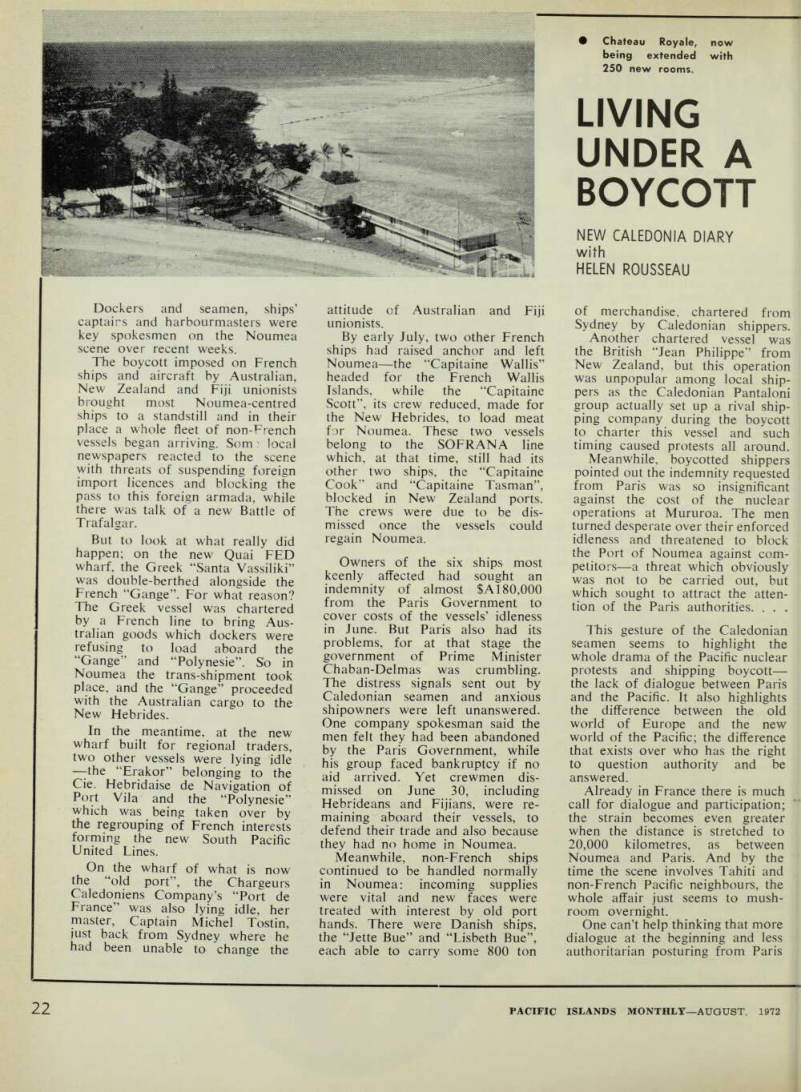
Chateau Royale, now being extended with 250 new rooms.
could have kept Pacific waters less troubled. Or do some anonymous Paris bureaucrats enjoy the thrill of the power game “Us versus all the Rest” in the Pacific? Whatever it be, letting the Caledonians imagine that they are surrounded by a hostile circle of incomprehen sible, English-speaking neighbours certainly does not add to a warm regional sense of identity.
Still, it must be admitted that no-one seemed to have grown any thinner in Noumea during the boy cott. French love of food certainly found speedy solutions to some of the problems. Noumea stores had some bare spots in July, but housewives were able to find most of what they wanted. Some traders, on the other hand, hardly felt like opening up shop in July, they had made such boom sales in the panic beforehand, when shoppers stocked up, fearing months of shortage. Importers of pre fabricated homes from New Zea land, however, were in a more difficult position.
At the Noumea nickel smelting works, there were fears of having to close down the coke works prematurely if coke supplies could not be shipped in time from Port Kembla, in Australia. The SEN nickel company already had other problems arising from up to SAI million worth of damage caused by cyclone Ida, early June.
The first of the factory’s old coke-consuming blast furnaces was closed down last September and the second in July this year.
The third blast furnace is due to stop later this year, when the factory is ready to switch over to the third Demag electric furnace, currently under construction. Pro duction at the Noumea smelting works for the first five months of this year totalled 25;839 tons, compared with 23,414 tons for the same period in 1971.
Meanwhile, Governor Louis Verger has warned the Caledonians that their continuing spiral of inflation could lead to their being priced out of the nickel race. “La France Australe”, a daily owned mainly by the SLN nickel com pany, quoted the Governor as saying: “We hold more than 50 per cent, of (world known) nickel reserves, but if the price rises continue, we will perish on our treasure, because the big
companies will be tempted to go and look for nickel in lands where prices spiral less rapidly”. Already the Caledonian cost of living index has risen 4 per cent, in the six months since last December. This follows equally high increases over the past three years.
There were other records broken in Noumea during July, but hap pily they were on the sport field among student sportsmen. A group of some 80 young sportifs flew in from Tahiti to continue the regular annual exchanges with New Caledonia. In basket and volleyball, Tahitian girls and Caledonian boys won their matches. Among swimmers, Cale donian girls faced little competition while the Tahitian boys were superior. Finally, in track events, victories went mainly to the home team.
Caledonians were happy to welcome the young Tahitians, especially at a time when the numbers of other visitors seemed to decline. No doubt affected by the sea and air boycotts, the number of tourists in New Cale donia dropped 20 per cent, this June compared with June, 1971.
The total count for the first six months of this year showed 5,790 tourists (excluding cruise pas sengers) spending an average stay of six days, which was all about the same as last year.
The various hotel owners and tourism personalities of the ter ritory seem to have agreed that something must be done about this supposedly second industry of New Caledonia. They are more able to obtain a hearing now, while the islands main pre occupation, nickel, is taking some thing of a breather.
So ASCADETO, the Cale
donian association of airline and hotel groups involved in tourism, has published a study of the problems in the present situation, with suggestions for action re quired. ASCADETO are holding meetings with Governor Louis Verger and urging the French Administration to help overcome the many obstacles facing tourist development.
ASCADETO President, Georges Lavoix, who is owner of the new Isle de France Hotel, states that as an initial step the first duty free shop is expected to open in Noumea within the next three months. At present, the only duty free facilities are for departing passengers at the Tontouta inter national airport.
Another hopeful sign on the Noumea tourist front is the return to service of the islands only glass-bottomed boat, the “Folies Bergeres’, operating across the lagoon to the reef and Amedee Island lighthouse.
In the centre of town, perched on the hill, between the Roman Catholic Cathedral and the “Centre Culturel”, Noumea’s first youth hostel is now welcoming overseas visitors. Then out at Anse Vata, Charles Monin is redecorat ing the Lantana Hotel, while right on the beachfront opposite the Biarritz is having a facelift, with discotheque upstairs and restau rant below.
Further along the beach the Chateau Royal hotel extensions are rising high above the lagoon, with the new 250 rooms scheduled for completion in July, 1973.
In the meantime. Noumea offers the unique spectacle of a Pacific island still free of the rat-race, but bustling with development, a la francaise. . . .
"Polynesia" in Sydney in happier days.