Australian soccer fade-out ?
p. 57 · Read in the full issue
What's behind the scenes in Australian soccer fade-out ?
By Mike Hohensee
Australia, which was instrumental in forming the Oceania Soccer Con federation six years ago, is to with draw its membership. In May, Australian Soccer Federation sec retary, Mr. Brian Le Fevre, an nounced that Australia would officially withdraw at the next meeting of Oceania in Sydney on June 24.
The decision will not come as a complete surprise to the other mem bers which include New Zealand, Papua New Guinea, Tahiti, New Caledonia, Fiji and the New Hebrides.
Australia made itself unpopular last year following a last-minute with drawal from the first Oceania soccer tournament planned for Noumea in October. It got involved in a dispute with hosts New Caledonia over the payment of air fares. The dispute was never resolved and the tourna ment was cancelled.
The Australian Soccer Federation was criticised for its action. The criticism, perhaps, was not fully justified. Later, the ASF explained that although all members had initially agreed to pay their own return fares to Noumea the over heads for staging the tournament had, to a great extent, been absorbed by local authorities in Noumea.
Therefore, the ASF maintained, the savings should have been allocated as part-payment for fares of visiting teams. It put its case to New Cale donia but there was no response.
Thoroughly dispirited, Australia went for all or nothing; it demanded that New Caledonia pay the entire cost of the Australian team’s fares. Nothing
was forthcoming.
The ASF said some months ago that if Australia was asked to leave the Oceania Confederation because of the tournament dispute it would still be prepared to play the “odd match” in the South Pacific. It looks very doubtful if it will stick to that promise.
Little has happened within Oceania since October last year and the furore which followed the cancellation of the tournament. However, Australia has not stood still. A few months ago the ASF made no secret of the fact it would join the 32-nation Asian Soccer Federation if invited to do so.
It even went as far as to inform Oceania members of this by letter.
Mr. Le Fevre admitted that he and ASF president, Mr. Arthur George, would be lobbying Asian members during the recent World Cup grouping
talks in Bangkok. Presumably their efforts were not in vain for, in ad dition to the Oceania announcement, Mr. Le Fevre said Australia’s ap plication to join the Asian Federation would be discussed at a meeting in Kuala Lumpur in July.
To align itself with Asia it seems obvious Australia must first sever its ties with the South Pacific; the Asian Federation probably wouldn’t have it any other way. It is ironical that New Zealand gave Australia the necessary support in Bangkok to bring the World Cup group elimina tion matches to Australia. One match, of course, will be played in New Zealand.
New Zealand called for the June meeting to discuss the future of Oceania. If New Zealand, like Aus tralia, feels it is wasting its time competing in the South Pacific, it too may decide to out. Any member has the right to break away to im prove its soccer standards, says Mr.
Le Fevre.
However, he knows his observation can only truly apply to Australia and New Zealand. Players from the French territories are registered with the French Football Association and are therefore only eligible to play for France in full international matches. The likes of Papua New Guinea and Fiji haven’t the reputa tion or the cash to go trotting around Asia.
So, we could see Oceania left solely in the hands of its South Pacific members, a state of affairs readily acceptable to Australia.
Administration, especially that regard ing the abortive tournament, was found to be lacking and Australia will no doubt use this as a lever to ease itself out.
The news that Australia is pre paring its World Cup squad for a tour of Asian countries in October, a month well-suited to the playing of soccer in the South Pacific, will only rub salt into the wound.
Australia is a developing nation as far as soccer is concerned and, ac cording to Mr. Le Fevre, if it can qualify for the World Cup final 16 in 1974, the game in Australia will progress 10-15 years. But where does that leave the South Pacific territories?
What can they do? Very little, apart from holding Oceania together and promoting more inter-island matches as well as inviting European teams to play in the area. The suggestion that the Islands join the larger group ings, like Asia, is not worth consider ing at this stage.
The Asians are said to be “fanatical” about their soccer. So are they in Fiji and the French territories where many games attract bigger crowds than in Australia. But Aus tralia will be the team scoring in Asia and it doesn’t intend to drag its feet with the South Pacific in tow.
Brian Le Fevre.
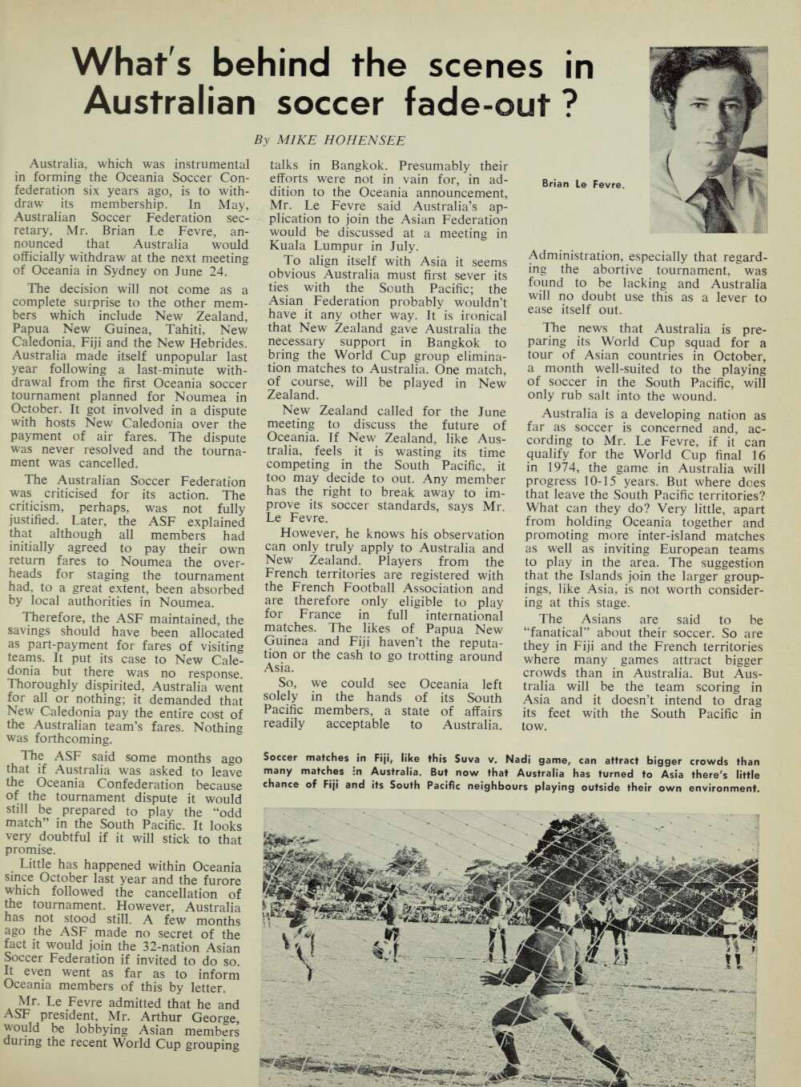
Soccer matches In Fiji, like this Suva v. Nadi game, can attract bigger crowds than many matches in Australia. But now that Australia has turned to Asia there's little chance of Fiji and its South Pacific neighbours playing outside their own environment.