Pacilic Islands Monthly

July, 1972
Australia, Nz, Geic, Bsip 50C
PNG, FIJI, COOKS, TONGA, W. SAMOA, N. HEBRIDES 45c
Nauru, Norfolk, Niue 45C
AMERICAN SAMOA 70c HAWAII 80c MICRONESIA 90c NEW CALEDONIA 65 CFP FRENCH POLYNESIA 100 CFP
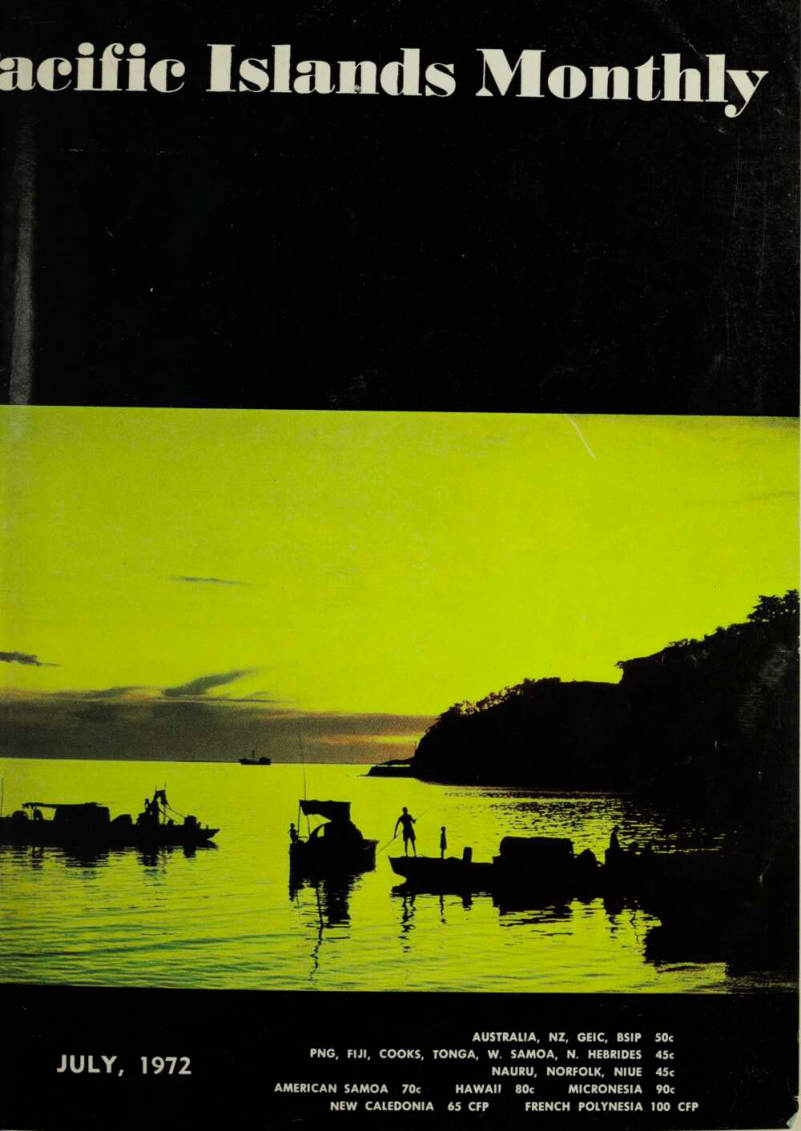
Our Cover
This striking sunset scene was taken by roving English camera man Steve Vidler who pointed his camera from Koki market over towards Port Moresby in Papua.
To obtain the delicate effect Steve used two filters, one yellow, the other blue.
Advertisements & other items, p. 2 (1 item)
ke
<3O CD I % % £ s \ \!W * y *?S, a&aii 1 KM 3T033 it . .
sJjggßß|
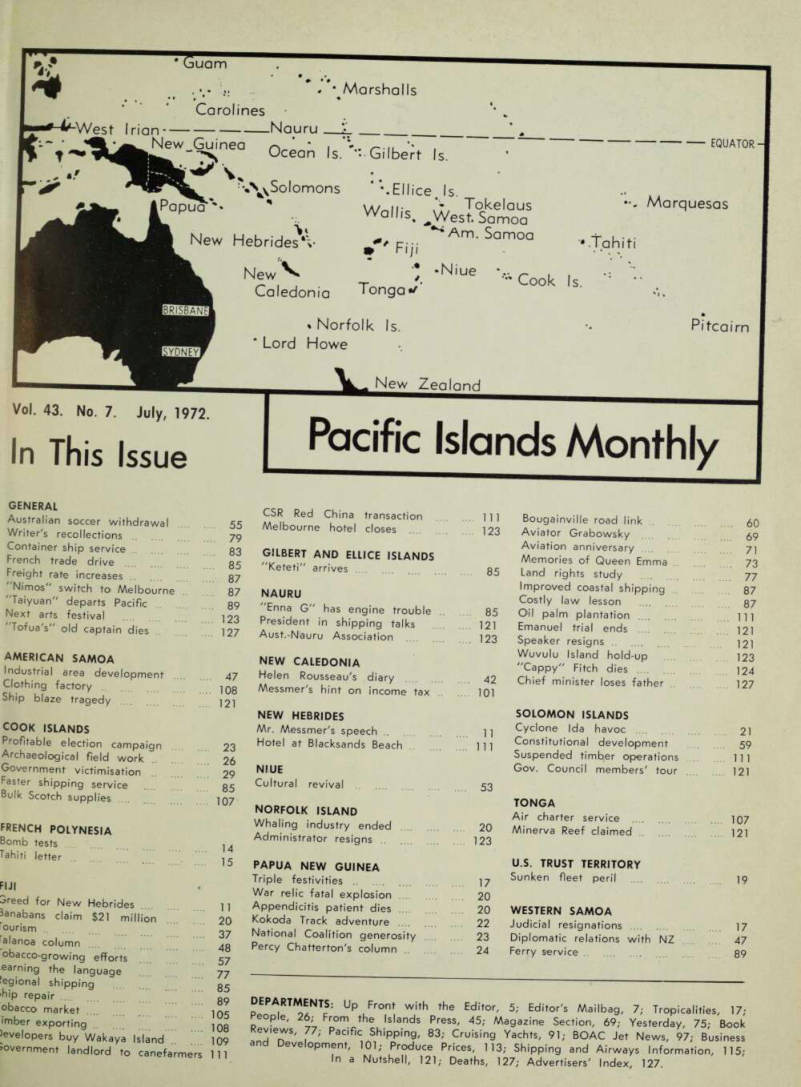
In This Issue
General
Australian soccer withdrawal 55 Writer's recollections 79 Container ship service 83 French trade drive 85 Freight rate increases 87 Nimos" switch to Melbourne 87 "Taiyuan" departs Pacific .. 89 Next arts festival 123 Tofua s" old captain dies . 127
American Samoa
Industrial area development 47
Clothing factory .. 108
Ship blaze tragedy 121
Cook Islands
Profitable election campaign 23 Archaeological field work 26 Government victimisation 29 Faster shipping service 85 Bulk Scotch supplies ... 107
French Polynesia
Bomb tests 14 Tahiti letter 15
Fiji
3reed for New Hebrides ... H Janabans claim $2l million 20 ourism 27 alanoa column ... 4 8 obacco-growing efforts 57 earning the language 77
Regional shipping 85
’hip repair ... 89 obacco market ... 105 imber exporting 108 developers buy Wakaya Island 109 government landlord to canefarmers 111
CSR Red China transaction ill Melbourne hotel closes 123
Gilbert And Ellice Islands
"Keteti" arrives QS
Nauru
"Enna G" has engine trouble 85 President in shipping talks 121 Aust.-Nauru Association 123
New Caledonia
Helen Rousseau's diary 42 Messmer's hint on income tax 101
New Hebrides
Mr. Messmer's speech 11 Hotel at Blacksands Beach 111
Niue
Cultural revival 53
Norfolk Island
Whaling industry ended 20 Administrator resigns 123
Papua New Guinea
Triple festivities 17 War relic fatal explosion 20 Appendicitis patient dies ... 20 Kokoda Track adventure 22 National Coalition generosity 23 Percy Chatterton's column 24
Bougainville road link 60 Aviator Grabowsky 69 Aviation anniversary 7] Memories of Queen Emma 73 Land rights study ... 77 Improved coastal shipping 87 Costly law lesson g 7 Oil palm plantation 1] ] Emanuel trial ends 121 Speaker resigns 121 Wuvulu Island hold-up 123 "Cappy" Fitch dies 124 Chief minister loses father 127
Solomon Islands
Cyclone Ida havoc ... 21 Constitutional development 59 Suspended timber operations 111 Gov. Council members' tour 121
Tonga
Air charter service IQ7 Minerva Reef claimed 121
U.S. Trust Territory
Sunken fleet peril 19
Western Samoa
Judicial resignations 17 Diplomatic relations with NZ 47 Ferry service 89
p1 P ?™o! NT c S: Up L Fron ! with the Editor ' 5; Editor's Mailbag, 7; Tropicalities, 17; pie, 26; the Islands Press, 45; Magazine Section, 69; Yesterday, 75; Book cv'ews, 77; Pacific Shipping, 83; Cruising Yachts, 91; BOAC Jet News, 97; Business and Development, 101; Produce Prices, 113; Shipping and Airways Information, 115; In a Nutshell, 121; Deaths, 127; Advertisers' Index, 127.
Advertisements & other items, p. 4 (1 item)
Qrnott's/ Biscuits
m m 'CtrJi n m
TSSi
m sSa li^si
Give your family
these all-time favourites
from Arnott’s
Everybody likes them! Nourishing Milk Arrowroot... tasty Nice ... delicious Coconut Bar... the egg-and-butter goodness of Scotch Finger... they’re all-time family favourites from the great big Arnott’s range. Taste them!
The triple-wrapped packs keep the biscuits fresh.
Qrnott's/ Biscuits
There is no Substitute for Quality
Pacific Islands
Monthly
FOUNDED BY R. W. ROBSON IN 1930
Owned And Published Monthly By
Pacific Publications (Aust.) Pty Ltd
29 Alberta St., Sydney, N.S.W., 2000'
Postal Address: G.P.O. BOX 3408, SYDNEY
N.S.W., 2001.
Telegraphic Address.- PACPUB, Sydney.
Telephones: 61-9197, 61-7101, 61-4369
Consulting Directors.- R. W. Robson, Judy Tudor.
Chief Executives: General Manager: Selwyn Hughes.
Publisher: Stuart Inder.
Director of Advertising: W. A. Gasnier.
Pacific Islands Monthly
Editor: Stuart Inder.
Assistant Editor: John Carter.
Advertising Manager: W. A. Gasnier.
Circulation Manager: Barry Badger.
„ N . X Subscription Rates:
Pacific Islands Monthly" is air-freighted to all subscribers and agents in the Pacific Islands- Anctr P Jf- S °f h 5 r areas 90 by surfa ce mail.
IO R s 3 ! p (inC r-i d u ms i L ° rd „ Howe and Thursday Is.), B.S.I.P., Gilbert and Ellice Is.; $5.50 Aust • Papua New Guinea, Norfolk Island, Nauru' Tonga and New Hebrides: $5.00 Aust.; New fnH a wi NZ; Fi J i ' Cook Islands, Niue d Western Samoa: $5.00 (local currency)- American Samoa: $8.00 US; U.S. Mainland Micronesia (including Guam); $10 00 US-' Hawan: $9.00 US; New Caledonia: 750 French 850 lfl F C r P nrh n D S; • J ah / fi and French Polynesia: 850 French Pacific francs; United Kingdom and elsewhere: £3.25.
... Representatives
SV. T AST Bfc » oli
RABAUl NC M G r Ca: C - LAE ' P -°- Box 227; KABAUL, Mr. Steve Simpson, P.0. Box 433 (c/~ Rabaul Photographic. Tel.: 2677.) f F im?p Ch 1 n°A ynesi o a: Distribution—Hachette Paci tique, 10 Ave Bruat, Papeete.
Z A ala u. d: J Pacific Publications, C.P.O. Box S, Auc . la . nd - u 379-494. Representative: John Speddmg, Civic House, 291 Queen St., Auckland Tel.: 379-494.
United KiHsdom, S. R. Warman, Park House, Hark Street, Croydon, CR9 3NP Tel • 01-6884177.
HnfiRo eaS c FJ ews Papers (Agencies) Ltd., Cromwell &n! W0 °P d k, Place ' London, W.C.l Tel 01-242-0661. Cables: WESNEWS, London, DS4. t. P o a n n: Cp d 0 er E 9^ Un i V r Sal M . edia Corpora on l.p.u. Box 46, Tokyo. Te • 666-3CHA victoria; Advertising—Wilke S Co Ud 37 Brown-s Road, Clayton, Vic , 3 68 Tel 544-8222. ' 5 3 u * en s slar L d: Advertising— B ea |e Media Services, PaUl jJ arraca ' Fortitude Valley, Qld. 4006. Tel.; 51-5827.
S.r ai L and US Mainland only Mrs W H cGrath, 225 Queen Street, Apt. 17B, Honolulu,' (Send change of address' notices. Form 3579 a i- . to the above address ) App I (cation to mail at second class postage rates pending at Honolulu, Hawaii. 9
Copyright ©, 1972,
Pacific Publications (Aust.) Pty. Ltd.
July, 1972 Vol. 43, No. 7.
Advertisements & other items, pp. 5-6 (1 item)
Completely Safe,
Start precautions against disease carrying insects with . . ,
The Insect Spray
that is
Completely Safe,
Completely
Effective
Rigid testing selects only
pure, safe ingredients.
In formulating insect sprays, the aim is maximum effectiveness against many species of pests with maximum safety for humans and pets. A.N.I.
Research Chemists are at work worldwide to ensure that concentrated Pea- Beu aerosol insecticide satisfies in all respects. Its active insecticidal ingredient is pyrethrins . . . proven the most potent insect-killing substance available. All raw materials must conform to rigid specifications of chemical purity. A programme of progress checking then operates at every stage of processing from mixing the insect-killing concentrate and highgrade ‘carrier’ to injecting the propellant which produces Pea-Beu’s highspeed spray. Rigid quality control of every stage of manufacture ensures that Pea-Beu is brought to you in the purest, safest and most effective form.
Because of this Pea-Beu is also really effective against every type of insect pest including flies and mosquitoes.
Pyrethrins: Nature’s
pest control From the small, innocent-looking white Pyrethrum daisy, modem chemistry extracts pure pyrethrins.
This syrupy fluid is so deadly to all insects, even the microscopic quantities carried in droplets of Pea-Beu spray kill instantly on contact. Yet pyrethrins are absolutely
<4 harmless to the human system, even in infants. Pea-Beu aerosol insecticide is also guaranteed safe near any warm-blooded domestic animal and near food. Even in the pure state, the odour of pyrethrins is neither overpowering nor unpleasant.
Harmless to spray
freely anywhere
As a powerful space spray, Pea-Beu effectively rids any room of dangerous flies, mosquitoes and other biting insects and plays a major role in family health-protection. In addition it is perfectly safe to spray in kitchen cupboards or on pantry shelves, with no risk of food contamination. The unique strength of the Pea-Beu formula kills the toughest cockroach and colonies of ants rapidly too, yet cannot affect humans or pets in any way.
Pea-Beu aerosol insecticide is so strong it is effective in
killing flies, mosquitoes and
every type of insect pest.
Powerful Pea-Beu kills all insects—yet it’s so pure it’s safe to spray anywhere.
S3ZE2
£ ft *
Pea-Beu-the safe, powerful insecticide
*' ! ;'' c r • mi - ■
+tf*§ »: I
x ,■■£", ■■■'. ■ :; ■’ X'" •'
TATRA
ENQUIRIES:
Tatra Leather Goods Ltd. 96 Tory St., Wellington New Zealand.
...just a few
of the many ways
TATRA leather
makes life more
exciting!
V-/ N7W.
Up Front
with the Editor
The massive union boycott in Aus tralia and New Zealand in June of French ships, aircraft and mail destined to and from France and the French Pacific territories certainly helped make the point to Paris that its Pacific nuclear testing programme is roundly condemned by the people who live here. As Tahiti’s Deputy Francis Sanford, pointed out, “How would the French people like it if they did the tests in Corsica?”
But, in another way, the exercise was a failure.
Most of the people getting hurt had httle or nothing to do with the bomb. The territory that has suffered most, the New Hebrides, certainly had nothing to do with the bomb, but its shipping links were severed by the boycott at a time when its people were attempting to pick themselves up after four devastating hurricanes that wiped out food gardens and destroyed schools, hospitals, houses.
Building supplies and food have been needed badly. There are only a couple of thousand Europeans in the New Hebrides’ population of 85,000, and the New Hebrideans themselves are neither British nor French. The boycott brought anger in the New Hebrides, as well it might.
In New Caledonia and French Polynesm, where the populace is indeed French, they were perplexed and irritated. They aren’t responsible tor the bomb either—the French Pacific territories are mere colonies ot Pans, where the important decisions on anything at all continue to be made, despite the entreaties of the autonomists for greater local control But France’s Pacific Islanders are certainly not anti-French; although there is real pressure in these ter ow°n rieS ff r th - e u right to run their own affairs, neither New Caledonians nor brench Polynesians have seriously suggested they do this outside the aegis of France, and they are not unhappy to be in the republic. t j °, as , Frenchmen as well as islanders they have naturally resented nk m ° V 5 S x^ hiC u h they believe Aus tralia and NZ have directed against ar^ m T ui 6 as against France. They TO not able t 0 accept that the ground c7v f P S est 1S m fac * a heartfelt cry ot public condemnation of the
Communist plot, ? meant to weaken Fr . ance ’ s ho,d in the Pacific and allow explanation is an indication of the u Xtent of th . e communications gap between English and French-speaking peoples m the Pacific.
It’s a lamentable gap and there are num £ers of reasons for it, but that’s another story The noint I’m maWno is that the boycott has not mad^thf French Pacific Islanders feel in any Way ashamed of themselves, which is hardly surprising. They nrobablv now feel more French P y another topic . when Dr c Pa P- New « in Suva that PNG should be al '™ ed membership of the South Pa . clfic Forum - But the issue suddenl y got more prominence when PNG’s neW - Chie Minister, Michael Somare!
P a ? sm g through Fiji in June after a ' independence 7 aS keepmg out of the forum Wte, Ratu Sir Kam . ,sese Ma ™> retorted that the r f^ uireme nts for membership were c ear — had to be an independent country with the power to make your °" n ***”-■ S °™ re repli ed
that PNG was capable of making its own decisions—it was “no stooge” of Australia.
The debate is not yet resolved, and in fact both sides have a point.
Ratu Mara’s criteria have been agreed on by the present forum members Fiji, Western Samoa, Tonga, Nauru, Australia and NZ (all independent), and the Cooks, which are self-governing. Ratu Mara is entitled to defend the position.
Constitutionally PNG cannot be compared with the Cook Islands, even though the Cooks are not independent m the same sense as the other mem bers. But the Cooks have full internal self-government, with authority vested in the cabinet. The cabinet includes no “official” members, as has PNG’s cabinet (its “executive advisory council ). The Cooks have the power of amending their own constitution, which PNG has not. What Ratu Mara probably has not clearly realised is that there is a de facto position of full self-government in PNG now.
The PNG cabinet really does have very great powers and has taken to using them with extraordinary con fidence. There is an understanding that Somare and not the Administrator is in control, even though Somare’s title of “Chief Minister” is a courtesy one. The fact is that Australia would not now dare object to any decision that the PNG cabinet made if it was determined to make it, and Somare is right when he says that PNG is not Australia’s stooge.
The de facto position is to be made legal very soon—constitutional talks have already begun, to set a time table for both self-government and independence. Whether the present Australian Liberal-Country Party Government gets back at this year’s general elections has nothing to do with it.
Forum membership for PNG meanwhile is surely a question of compromise. But if present forum members don’t want to compromise, then the PNG Government should take a rein on its super-sensitive feel ings and pipe down until the con stitutional changes go through.
Otherwise its boorish behaviour will irritate its Island friends and
neighbours.-
Stuart Inder.
Advertisements & other items, pp. 8-12 (1 item)
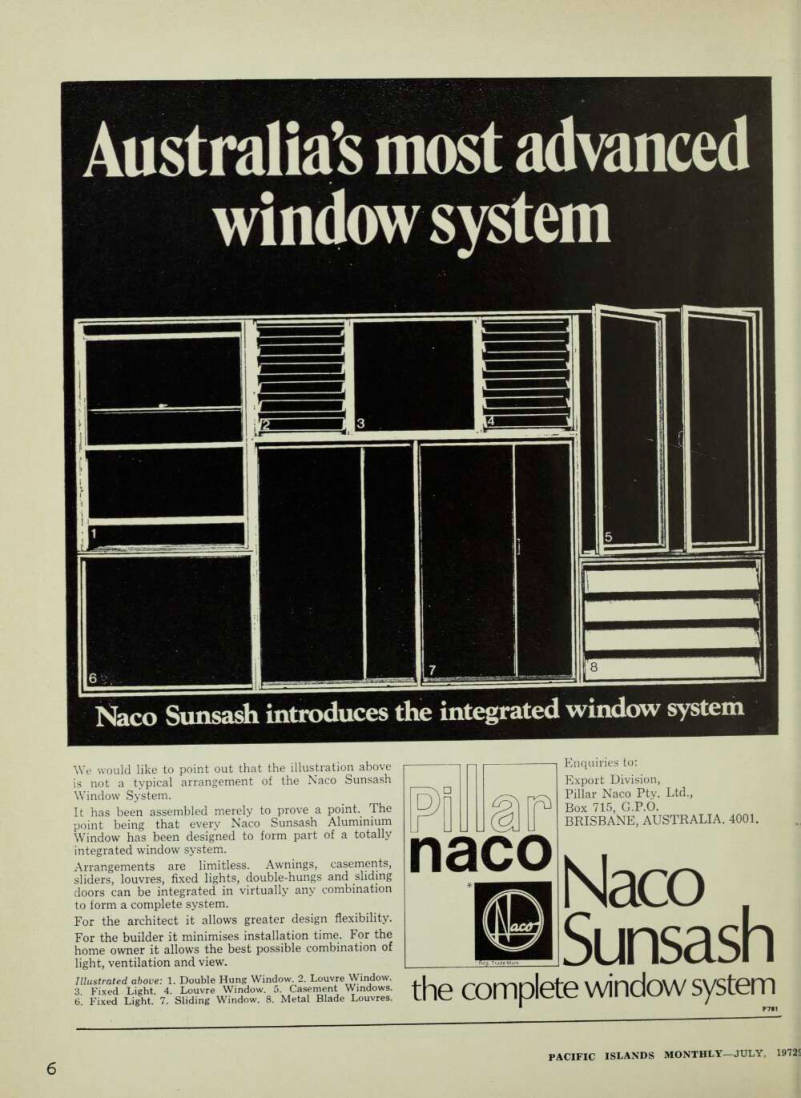
window system
Australia's most advanced
Naco Sunsash introduces the integrated window system We would like to point out that the illustration above is not a typical arrangement of the Naco Sunsash Window System.
It has been assembled merely to prove a point. The point being that every Naco Sunsash Aluminium Window has been designed to form part of a totally integrated window system.
Arrangements are limitless. Awnings, casements, sliders, louvres, fixed lights, double-hungs and sliding doors can be integrated in virtually any combination to form a complete system.
For the architect it allows greater design flexibility.
For the builder it minimises installation time. For the home owner it allows the best possible combination of light, ventilation and view.
Illustrated above: 1. Double Hung Window. 2. Louvre Window. 3 Fixed Light. 4. Louvre Window. 5. Casement Windows. 6 Fixed Light. 7. Sliding Window. 8. Metal Blade Louvres.
Enquiries to: Export Division, Pillar Naco Pty. Ltd., Box 715, G.P.O.
BRISBANE, AUSTRALIA. 4001.
naco
K
Naco
Sunsash
the complete window system
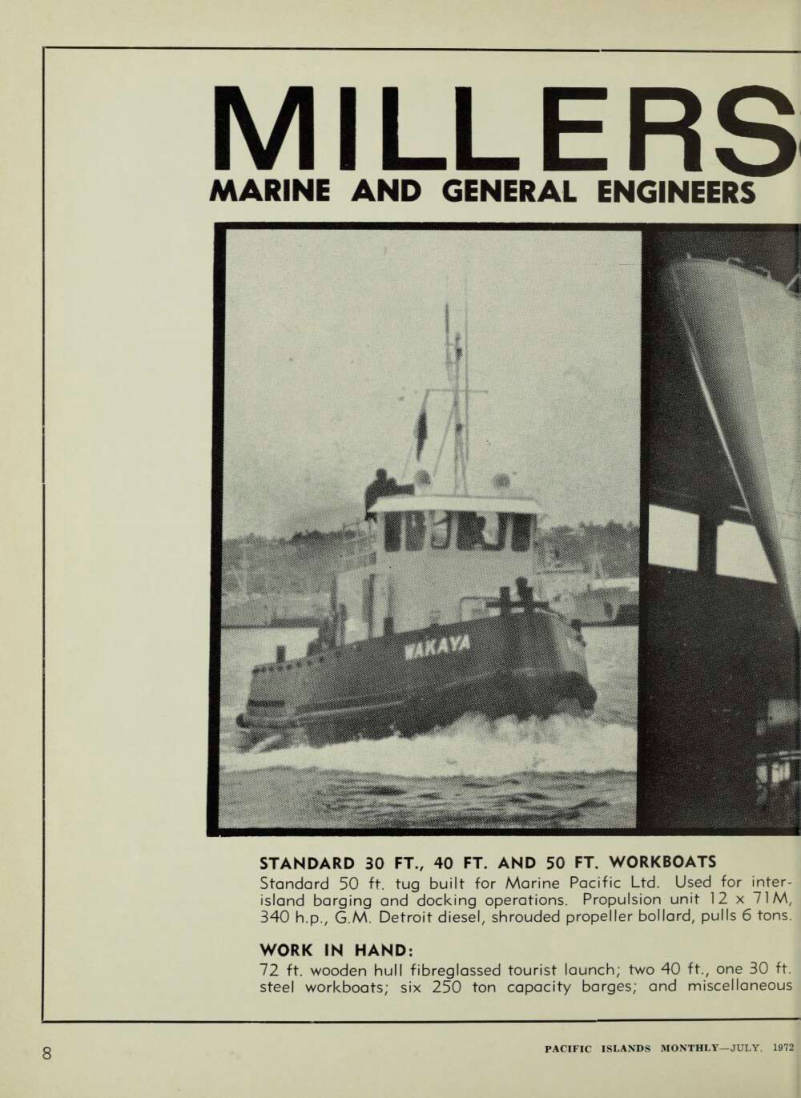
MILLERS
MARINE AND GENERAL ENGINEERS
STANDARD 30 FT., 40 FT. AND 50 FT. WORKBOATS Standard 50 ft. tug built for Marine Pacific Ltd. Used for interisland barging and docking operations. Propulsion unit 12 x 71M, 340 h.p., G.M. Detroit diesel, shrouded propeller bollard, pulls 6 tons.
WORK IN HAND:
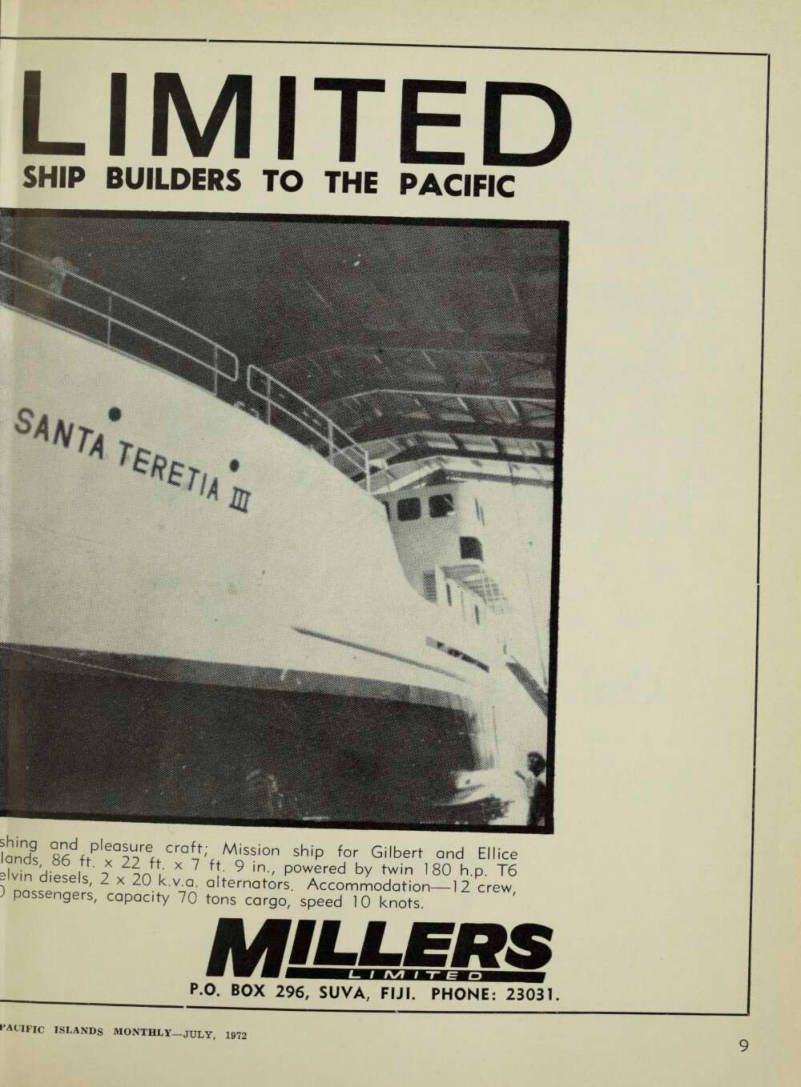
72 ft. wooden hull fibreglassed tourist launch; two 40 ft., one 30 ft. steel workboats; six 250 ton capacity barges; and miscellaneous
LIMITED
SHIP BUILDERS TO THE PACIFIC
m m m. ■ i M «i . u • m I
s *Hr
4 £ ru £ 1* and, o^ d ,. plea = l i r ® craf f; Mission ship for Gilbert and Ellice dietkS Hr!*C X 7 f |- 9 in - Peered by twin 180 h.p. T 6 1 nnJl ' 2 X 20 . k v - a - alternators. Accommodation—l 2 crew passengers, capacity 70 tons cargo, speed 10 knots.
MILLERS
P.O. BOX 296, SUVA, FIJI. PHONE: 23031.
if# of*jl / 0^ •• ••
Only die best from Australia
Edgell know the secret of freezing tender fresh vegetables. It’s a matter of knowing exactly when to pick them the exact moment when they’re perfect. Then quickly freeze their freshness. Try Edgell Frozen vegetables soon. • IS
Fresh from an Edgell Country Garden
The Editor's Mailbag
Nauru's German Gaol
An item included in the segment In a Nutshell (PIM, May, p. 125) made passing reference to skeletal remains uncovered recently under the heading “Uncovering Nauruan History”.
We have found this item to be of interest to our family, as my father, Mr, J. Tracey first moved to Nauru in 1933, aged 15 years, as an employee of the company mining the island. He was evacuated off the island after the beginning of hos tilities in the area (approx, eight months after) by the Free French vessel commissioned by the company.
Immediately after the end of the war he returned to Nauru (approx.
October, 1945) and remained there until 1956. Family associations with the island go back further than 1933.
The family home on Nauru was destroyed by the Japanese and the area used as the airfield for the duration of the War in the Pacific.
I have mentioned these facts as we would like to get further information on the above-mentioned article, as we are having some difficulty in re calling the German gaol mentioned.
There were a number of German installations on the island, but the gaol is not among the buildings we can recall. Nor does it appear on the numerous pre-war photos in our possession.
M. Johnson (Mrs.)
94 Royal Parade, Ashgrove, Queensland 4060.
Linguistic Clues
While in Tonga, I read your May magazine section about “Com puterised clues unlock a door to Polynesia’s past” by W. W. Howells with great interest. In that article on page 68, a few lines underneath the picture, the author states that linguists can virtually speak proto- Polynesian”. In the Tonga Chronicle Of May 25, 1972, page 11, I read mat at the Arts Festival in Suva, the Tongans had a performance with an ancient chant—so old that only a tew words could still be understood according to the Hon. Ve’ehala.
If the linguists are as good as stated m the article, couldn’t they have a crack at those ancient chants, maybe through tape, records or other media and the results published in your magazine?
Also with regard to the great “flu
epidemic”, PIM April, pages 15 and 16, isn’t it improper that the re quested diaries, letters, etc., go to a private collector instead of to a public library, by help of PIM. Those diaries, etc., should be collected and retained by libraries in each country concerned, as museum pieces.
E. Lindy.
Nukualofa, Tonga.
That Bomb
As Papua New Guinea is a member of the South Pacific countries, we citizens of it are very much against the idea of the bomb test in the Pacific by France. How do you feel about this? We hope you are in favour with our ideas. We would like you to argue strongly, against the bomb tests.
Will Akus And
Gomang Yalon
(Kar Kar High School Political Club).
Kar Kar Island, Madang District, PNG.
Qantas Query
I would like to contact any ex QANTAS staff, agents, etc., that helped run the New Guinea services and QANTAS services to the Solomons, New Hebrides, Nauru, Gilbert and Ellice Islands and Dutch New Guinea.
The purpose of this contact is to complete a book I am compiling on activities of QANTAS during its period in the Territory.
P.O. Box 1401,
Al. Bovelt.
Lae, P.N.G.
Queen Emma's Land
Your article on Queen Emma’s land (PIM, April, p. 69) was ex tremely interesting, the footnote by Judy Tudor even more so.
My partner Rod Hancock and I own Rabaul Excursions (tour opera tors of the Gazelle Peninsula) and we were rather surprised that Judy Tudor was unable to find “someone who runs this sort of service” while she was visiting Rabaul in early February.
We are not the only tour operators in Rabaul, but we are the only ones who provide a printed brochure and these are supplied to all hotels and motels and are readily available at the reception desks. We are listed in the telephone directory, and are even in the Pink Pages!!
Both of us have lived in Rabaul in excess of 15 years and are personally known by the accommoda tion houses. It is true that reception staff changes all the time and this may have accounted for the lack of ability to locate us. The kiosk at the airport is also operated by us and either one would have been in at tendance when Mrs. Tudor arrived.
Also PlM’s Rabaul representative, Steve Simpson, a friend of long standing, knows where we can be contacted.
It would have been our pleasure to take Mrs. Tudor on a jaunt around the Gazelle, and we might add—with our compliments. We are sorry that her friend’s efforts in contacting us were in vain.
With regard to Queen Emma’s mat-mat we agree that it is a crying shame to see it fall into disrepair (on one occasion we ourselves had the grass cut).
This and other slices of history should be preserved and maintained, the land deemed a historic place and put in the hands of either the Rabaul Historical Society or entrusted to the New Britain Tourist Association.
B. A. Connelly.
Rabaul Excursions, Rabaul. • Judy Tudor comments: Maybe the fact that I arrived in Rabaul at 7 a.m. on a Sunday had something to do with the apparent non-existence of tour operators. Nonetheless, it is a fact that my friend Mrs. Dorothy Stewart, of the Hotel Ascot, who has been longer in New Guinea than all of us put together, could not raise anyone, including Mr. Steve Simpson, on that particular day.
But no matter, so long as someone gets cracking and preserves what's left of New Britain’s historical sites.
Even the Tolais might be grateful some day.
Western Samoans, who have some pre-World War I history in common with NG, have been amazed in recent years at the interest shown by tourists in their few remaining German relics. Though long neglected and ignored, some citizens are now making an honest tala showing them off to visitors.
Meanwhile, and stemming out of that April story on Emma’s old plantations, someone might produce some information on the exact fate of the Parkinson mat-mat; and what happened to the original German headstones in the mat-mat at Kenabot which, according to Mr. Maurice Wilson, was reorganised by the German ambassador to Australia in 1965. If anyone knows, PIM would be grateful to be let into the secret.
Pacific Islands Monthly
A Big French "Non" Upsets The
Entente In The New Hebrides
From correspondents in VILA and SYDNEY
Have the French said “never” to condominium hopes for autonomy?
Or have they said “when it comes, it’s going to come our way”?
This is the question being asked in the condominium after a startling policy speech by French Minister Pierre Messmer in Vila at the end of May. Made during a three-day visit to the New Hebrides, following his visit to New Caledonia (see p. 101 for story on his impact there), the speech shook the people who heard it as much by the way it was said as by what was said. Not only did the French Minister for Overseas Territories say non to any form of political progress in the immediate future, but he succeeded in trans gressing all the unwritten rules of political speechifying in the condo minium by making unilateral policy statements about which the British had not been approached beforehand.
His speech did something else. It made it clear for the first time publicly that British and French atti tudes on the political future of the condominium are widely divergent.
It was made at a large reception at the French Residency on the first day of his visit. Several hundred people, representing all sectors of the condominium’s varied community, listened as he read, with the same delivery and about as much emotion as a machine gun, a 30-minute state ment of France’s policy towards the territory which in essence said “Who pays the piper calls the tune. We, the French, have made the money here and this is the way things are going to happen (or not happen)”.
Unfortunately for the people who drafted the speech, a lot of the reasoning employed was based on some dubious premises.
Mr, Messmer said the condominium system that has operated since 1906 should still be the basis for “harmonious evolution” of the country, and it should not be thrust aside without a great deal of thought.
France considered that to trans
form the advisory council into a legislative council would be pre mature. Although the protocol was not immutable it “would be vain to think of hastily applying to the New Hebrides a facade of institutions destined above all else to appease international opinion”.
He said France’s ambition was “to make of the New Hebrideans of all origins, during the course of a pro gressive but complete development, a community which would be original, fully aware and responsible, better equipped than are certain of their neighbours in the Pacific to face the uncertainties of the modern world.
France is prepared to pursue, as long as necessary, the substantial effort she has already made in the interests of the New Hebrides”.
Mr. Messmer made it clear that France wanted no quick political development in the New Hebrides by any elite, but she aimed at a policy of political gradualism.
Although Britain has made no clear policy statement on what it thinks is the future of the New Hebrides, the British attitude seems to be that political development cannot be held back to the slower pace of economic
development, nor can political development be held at the pace of the lowest common denominator. The more politically conscious in the community will always push for progress ahead of the masses.
Mr. Messmer’s frank statement will probably force the British to lay their own cards on the table as squarely as the French have. Many people in the New Hebrides are certainly ex pecting a British reply.
Earlier this year the 24-man New Hebrides Advisory Council moved, almost unanimously, that a legislative council be phased in. The present advisory council is comprised of 12 New Hebridean members, four British, four French and four con dominium officials.
Some members are already angered because Mr. Messsmer referred to “some people here, Europeans and Melanesians” as wanting a speedy transformation of the advisory council. Mr. Bob Paul, a member, said the advisory council could hardly be regarded as “some people”, especially as the vote was almost unanimous. Nor did the council ask for a speedy transformation, but
COPRA PLAN A 'BIT BELOW THE BELT'
suggested that a legislative council be phased in.
Mr. Messmer’s answer to that was that France did not think that the general level of education in the condominium was sufficient to sup port such institutions. Local thinking on that was that it is one thing to tell a teenager that he can’t have a bicycle, but it doesn’t help your popu larity to tell him you think he is too stupid to ride it as well.
Mr. Messmer’s long statement traced the political and economic history of the condominium. He said France and Britain had agreed that the condominium was not a colony but a zone of communal influence, and the protocol of 1914 was devised to establish the security of the people, particularly to fight against the early excesses of the sandalwood collectors and labour recruiters. It “thus appears as an instrument for protection and not domination,” he said.
This was a shining example of the dubious reasoning employed by the minister. He should have been aware
that sandalwooding and blackbirding
had been suppressed more than 30 years before the protocol, largely through Australian action. To pre tend that the protocol was anything more than straight colonialism is hardly realistic.
Between the wars, said Mr.
Messmer, the two governments had limited themselves to maintaining the convention, of keeping the peace and rendering justice. But for the last 25 years “they have considerably exceeded their original engagements by making a considerable equipment effort. This task is far from being achieved”. It was “natural and desirable,” said Mr. Messmer, that the New Hebrideans should wonder about their future.
There had been great social and economic improvements, although currently the state of the economy was causing concern because of the crisis through the slump in oils. But the copra industry was still valuable to development, and France wanted to introduce a price stabilisation system for tropical products, and a system of guaranteed prices for copra.
This was presumably intended as a sop to the copra producers who have been hit so badly by the present low prices in France. He said, “such action would need to be bilateral and would need the British Government’s agreement”. This one was really a bit below the belt. The onus for accepting, or refusing, such a pro posal was placed publicly upon the
British, yet how do you establish a viable, guaranteed price scheme when the present New Hebrides price is $3O and the economic price needed by planters is more like $80?
There was not much hope for extension of the timber industry, but the most promising future was in cattle production. With the increase in world population and the rise of living standards in New Caledonia, the demand for meat must increase.
There was also no reason why the New Hebrides could not share in the growing increase in tourism, although its hotel facilities were still insufficient.
He added: “But whatever the reasons for hopefulness, one cannot ignore the fragility of the economy, which is indicated by the deficit in the balance of trade, strong depen dence on the franc zone for exports and on the sterling zone for imports, by the small amount of private and condominium budget investment, and by the inescapable recourse to financial assistance from the admini strative powers. Under these con ditions, while it is not forbidden to think of the archipelago’s political
future, it is advisable to do this in the light of experience, and guarding against easy and hasty solutions which would only mean resignation, and with concern to build the structure from the base and not from the top.”
Mr. Messmer declared that “the appearance of Melanesian movements based on local custom or led by educated indigenes, and the activities of certain European associations, mark the awakening of new aspira tions, but the only thing these move ments have in common is a question ing of the status of the condomi nium.”
He continued: “It is generally realised that this status has guaranteed security and allowed considerable development, but it is claimed that this status no longer answers the contemporary world demands of efficiency and participation. It is certainly easy to criticise an inter national convention which is now half a century old, but if France has proved that she did not hold the agreement immutable, she still today considers it to be the basis for the harmonious evolution of the country.
In spite of certain archaic provisions which could perhaps be remedied, the 1914 protocol offers the unique advantage of doubled financial, tech nical and cultural assistance, which the more impatient people should not thrust aside without a great deal of thought.”
In France’s opinion a legislative assembly could “only be based upon a wide, popular foundation of educated and well-informed citizens.
At this moment, such a foundation is still embryonic and practically con fined to the two town areas [Vila and Santo].”
Mr. Messmer said France, with Britain, had now agreed to create the first communes, with full powers, the members directly elected. He did not, however, give any further details of this system (which would pre sumably be similar to systems designed for French Polynesia and New Caledonia).
The minister said he did not agree that a fusion of the two national services in the New Hebrides would be wise and economic. The real economy would be doubtful and the efficiency illusory because the national services, especially on health and education, were designed to ful fil different needs and were organised according to the techniques and practices peculiar to each nation. Con sequently, they “provided guarantees of equality, maintained by com petition, and the possibility of choice would disappear if they were to fuse.”
Perhaps the major failing in Mr.
Messmer’s speech was the omission of any recognition of human spiritual needs and ambitions. Economics, profits, investment, financial aid, do not cover the whole of the field of human ambition.
The people of the New Hebrides, sleepy as they have been in the past, are awakening and are feeling the same needs as their fellow islanders in other parts of the Pacific. “We look upon our neighbours with envy,” said one New Hebridean member at the last Advisory Council meeting, and he wasn’t talking about economics. If the French continue to ignore rising New Hebridean nationalism, which exists in Euro peans in the condominium as well as in New Hebrideans, it could make for trouble in the future. “He who sticks head in sand, gets kick up backside,” says the proverb.
On one subject Mr. Messmer was entirely constructive—land. “France has often been reproached for keep ing possession of land which she does not use and for condoning what is called the monopolising of land by companies which are unable or un willing to make full use of it . . . the French Government has adopted the principle of handing over a large part of its land to indigenous com munities, and has decided to finance the return to these same communities of SFNH land, the development of which cannot be envisaged in the near future.” (SFNH =: Societe Francaise des Nouvelles Hebrides, largest landowner in the New Hebrides, with the majority of shares owned by French Government.) This was cheering news indeed for the islanders, but, on the whole, the feel ing seems to be that Mr. Messmer’s chauvinistic speech has done the French cause in the New Hebrides more harm than good.
After outlining the financial help France would give to the New Hebrides in its sixth (1971-75) development plan, including extra money to repair the serious damage caused by four successive cyclones, the minister said the teaching of French would be intensified, and the operating expenses of private schools would be accepted by the state from 1973. “Thus,” he said, “France will participate more extensively still in the education of the Melanesian, and will facilitate their inclusion in the bi-lingual world of the Pacific.”
Mr. Messmer concluded that as history had decided that France should share the responsibility of New Hebrides’ future with Britain, a partner “who had become even more staunch with the treaty of entry to the Common Market”, so France with her long experience in
overseas affairs intended to assume that responsibility “with all the prudence dictated here by an economy facing crisis and change, a civic and technical enlightenment which is just beginning, and with the strong hope of achieving in this archipelago an original happy synthesis of the different cultures which meet here”.
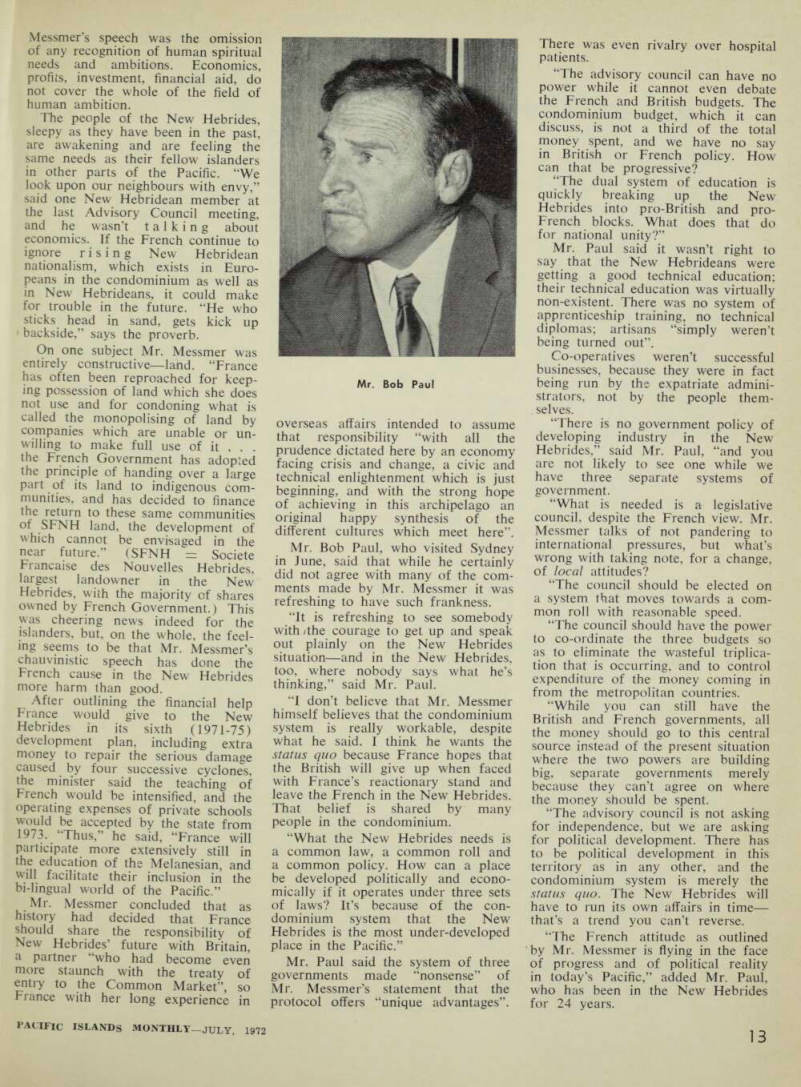
Mr. Bob Paul, who visited Sydney in June, said that while he certainly did not agree with many of the com ments made by Mr. Messmer it was refreshing to have such frankness.
“It is refreshing to see somebody with The courage to get up and speak out plainly on the New Hebrides situation—and in the New Hebrides, too, where nobody says what he’s thinking,” said Mr. Paul.
“I don’t believe that Mr. Messmer himself believes that the condominium system is really workable, despite what he said. I think he wants the status quo because France hopes that the British will give up when faced with France’s reactionary stand and leave the French in the New Hebrides.
That belief is shared by many people in the condominium.
“What the New Hebrides needs is a common law, a common roll and a common policy. How can a place be developed politically and econo mically if it operates under three sets of laws? It’s because of the con dominium system that the New Hebrides is the most under-developed place in the Pacific.”
Mr. Paul said the system of three governments made “nonsense” of Mr. Messmer’s statement that the protocol offers “unique advantages”.
There was even rivalry over hospital patients.
“The advisory council can have no power while it cannot even debate the French and British budgets. The condominium budget, which it can discuss, is not a third of the total money spent, and we have no say in British or French policy. How can that be progressive?
“The dual system of education is quickly breaking up the New Hebrides into pro-British and pro- French blocks. What does that do for national unity?”
Mr. Paul said it wasn’t right to say that the New Hebrideans were getting a good technical education; their technical education was virtually non-existent. There was no system of apprenticeship training, no technical diplomas; artisans “simply weren’t being turned out”.
Co-operatives weren’t successful businesses, because they were in fact being run by the expatriate admini strators, not by the people them selves.
“There is no government policy of developing industry in the New Hebrides,” said Mr. Paul, “and you are not likely to see one while we have three separate systems of government.
“What is needed is a legislative council, despite the French view. Mr.
Messmer talks of not pandering to international pressures, but what’s wrong with taking note, for a change, of local attitudes?
“The council should be elected on a system that moves towards a com mon roll with reasonable speed.
“The council should have the power to co-ordinate the three budgets so as to eliminate the wasteful triplica tion that is occurring, and to control expenditure of the money coming in from the metropolitan countries.
“While you can still have the British and French governments, all the money should go to this central source instead of the present situation where the two powers are building big, separate governments merely because they can’t agree on where the money should be spent.
“The advisory council is not asking for independence, but we are asking for political development. There has to be political development in this territory as in any other, and the condominium system is merely the status quo. The New Hebrides will have to run its own affairs in time— that’s a trend you can’t reverse.
“The French attitude as outlined by Mr. Messmer is flying in the face of progress and of political reality in today’s Pacific,” added Mr. Paul, who has been in the New Hebrides for 24 years.
Mr. Bob Paul
Neighbourly 'interest' in New Caledonia
Highlighting Mr. Messmer's comments on the New Hebrides while visiting Noumea, the New Caledonia paper, “Les Nouvelles”, strong supporter of Governor Louis Verger’s administration and thus a likely reflection of official French thinking, said: “A British policy of withdrawal, even if it is not officially admitted, would virtually mean abandoning the New Hebrideans. And it is certain that their independence would quickly be subject to certain very greedy neighbours. We refer to the Fijians, for example, who barely disguise their desire for a confederation grouping, under their crook, the ‘oppressed’ people of the New Hebrides and New Caledonia.
“The New Hebrides, however pleasant they may be, are not marked by any great economic wealth: manganese is not nickel and tourism is only just beginning. But it is nevertheless obvious that this archipelago, rather well placed in the Pacific, could arouse the greed of certain governments which are more interested in the future of our region and its domination than are distant European nations like France and England.
To abandon the New Hebrides now would be giving them up to foreign hands.’’
word in
Fiji gets a word in
Calling for “a more practi cal form of government” in the New Hebrides, Fiji’s spokes man at the United Nations, Mr. Satya Nandan, told the UN’s Special Committee on Colonialism during a discus sion on the New Hebrides’ future, that Fiji hoped the three separate administrations responsible for governing the condominium would soon be reduced to one. “Such a constitutional structure is not only cumbersome, but is an impediment to the political and economic development of the territory,” he said. He hoped the indigenous people would be given the “fullest opportunity to participate in the running of their own country with a view to their
attaining independence.”
French bomb tests raise
the ire of the Islanders
Short of the Vietnam war issue at its height, there has never been a spate of protests and demonstrations such as those in Australia in June over France’s decision to commence a new series of nuclear explosions at Mururoa atoll. Television, radio and press for weeks were filled with letters, editorials and news stories reporting on the latest protests throughout the country, and in NZ and the Pacific Islands, The Aus tralian Government was fiercely con demned for not having made stronger protests (stung. Prime Minister McMahon finally made a personal protest to the French President and a joint approach with NZ to the UN Committee on Disarmament asking that the tests be stopped.) Meanwhile the Australian Council of Trade Unions—the body which controls unions—authorised bans and boycotts on French shipping and air craft, whatever their contents, and mail. One leading Australian company cancelled a large French contract, a French consular agent resigned, an Australian sportsman sent back a French trophy, there were calls for the severing of diplomatic relations; but more seriously, French offices such as those occupied by UTA in several Australian capital cities were attacked and damaged, and required police protection.
UTA aircraft began over-flying Fiji because of union attitudes there (and the Fiji Government banned all French military or naval aircraft and shipping from using her ports).
In Sydney and Tontouta (New Caledonia) there were tight security precautions on UTA passengers and aircraft for fear that somebody might attempt to hijack a plane in protest.
Australian scientists were split as to the dangers of French atomic fallout, but the weight of opinion was that as nobody knew the facts without doubt, the Pacific was at risk if the tests continued.
The cargo boycotts in Australia and New Zealand looked like causing serious losses to Island agents as goods ordered for French territories piled up on the wharves. In late June the ACTU agreed to allow Australian interests to charter vessels for New Caledonian and New Hebrides trade so long as they didn’t fly the French flag and that 80 per cent, of their cargoes was food.
Among those who helped bring the special plight of the New Hebrides to the attention of the unions in Aus tralia was Mr. Bob Paul, New Hebrides businessman and Advisory Council member, who went on Aus tralian TV and radio to explain that the New Hebrides was suffering as a result of the boycott.
Mr. Joe Bada, of Australia-New Caledonia Exports Pty. Ltd., also told the unions that there was a growing shortage of stockfeed in New Caledonia and one poultry farmer had been forced to kill off 10,000 head of poultry because he was unable to feed them.
In Peru, Premier and Defence Minister General Ernesto Sanchez reaffirmed that Peru would break off diplomatic relations with France if France went ahead with the tests.
Peru made the same threat last year and as a result the test programme was prematurely ended.
As June’s end drew near and with out a nuclear explosion, unsuitable weather was given as the official ex planation for the delay, but critics had
Two sides to a TV story
In Sydney in June as a guest of the militant Waterside Workers Federation and the equally militant metal trades unions, Fiji’s equally militant trade unionist Mr. Apisai Tora, general secretary of the Fiji Airline Workers Union and a National Federation Party member of the House of Representatives, appeared on television on June 20, Facing the cameras in Channel 7’s “Today” programme, Mr. Tora talked about his union’s brush with Qantas and a few other matters including the appointment of Mr. Justice Nimmo as Fiji’s Chief Justice. Maybe he was dazzled by the bright lights, or just nervous, but there was a big gap in his story about the Chief Justice and the gaoling of Suva lawyer and politician Mr. Vijay Parmanandam for con tempt of the Fiji Supreme Court and the Chief Justice. This was Mr.
Tora’s version of the trial: “Now in the recent general elections, one of our blokes—one of our candidates— criticised Nimmo and he was brought before Mr. Justice Nimmo, none other than Justice Nimmo himself,
Listening in on the Coconut Radio PIM heard that a well known Islands personality is likely to be appointed as first Director of the South Pacific Forum’s Bureau for Economic Co-operation. The man strongly tipped for the fob is Mahe T upouniua, Tonga’s Minister of Finance.
other hopes. The tide of protest con tinued to rise, with volunteers in Syd ney threatening to parachute into the test area and New Zealanders raising money to charter ships to “invade” the scene. Canada’s Greenpeace Founda tion announced that its yacht Green peace 111 was provisioned for a three months’ sit-in and other vessels were available to replace her.
One rumour was that the device had been tried and was a fizzer. Scien tists were busy trying to find the elu sive key to a miniature H-bomb, but perhaps there was the prospect that after 12i years of searching for what the other nuclear powers had found in four years at most, France might save face by yielding to world pres sure and give up the search for humanity’s sake.
on a charge of a contempt of court.
And Justice Nimmo acted as a prosecutor, a jury and judge at the same time and sentenced this man to six months imprisonment. And he’s still there.”
Now Mr. Tora neglected to ex plain that two other judges, Mr.
Justice William Goudie and Mr.
Justice Clifford Grant, sat with Sir John Nimmo, and that part of the charge dealt with a statement in an election speech by Mr. Parmanandam who promised, “If you vote the National Federation Party into power, justice will be cleaned up once and for all.” He also accused the Chief Justice of “acting under the Alliance Government.”
The judgment, said the Chief Justice, was the unanimous expression of the Supreme Court. Which put’s a different complexion upon Mr.
Tora’s story.
Incidentally, Mr. Tora told a PIM man in Sydney that he is likely to be named as the NFP’s shadow Minister for Labour in the parlia mentary opposition.
other side
The bomb: from the other side
From James Boyack
FRANCE probably will have conducted its first nuclear test by the time this reaches print. The only obstacle to a late June start of the 1972 series would be persistently unfavourable weather conditions.
Test preparations have been curtained by un precedented secrecy in recent months due to the equally unprecedented barrage of Pacific Basin protests. French authorities, military and civilian, are saying absolutely nothing about what’s happening.
The only reason tests are now certain is because France began to warn air and sea navigators to remain outside the nuclear danger zone. Radio Mahina, Tahiti's radio link with the sea lanes, on June 17 began 11 daily urgent warnings to boatsmen that nuclear experiments could take place as of the following Monday afternoon, Tahiti time. The AVURNAV, broadcast by radio and teletype, defined the danger zone this year to be a circle with a radius of 120 nautical miles. Mururoa, the blast atoll, is at its centre. Additionally, for 200 miles due east of the island, a champagne cork-shaped 55degree angle was also declared off limits.
The 200-mile perimeter was the first official con firmation that explosions this year would be weak in strength. Hydrogen tests in 1968, 1970 and 1971 required a 500-mile taboo to the east.
THe zone is dangerous for a greater distance to the east because the mushroom cloud immediately begins to drift in that direction, away from the inhabited western Pacific. Radioactive particles quickly rise to the uppermost atmosphere and start a slow ride east around the Southern Hemisphere. Most of these die out before they reach the South American coast. Some continue in a belt around the globe, with more particles dying all the time. Those which remain create the relatively mild fallout registered by each country in their path.
Test substances reach the upper atmosphere winds quickly because devices are exploded high in the air.
They are suspended at blast time from a 14,000 cubic metre balloon.
France claims to be the first country to use this “balloon” system and therefore the first nuclear power to have conducted “safe” tests.
The reason they are safe is that when the fire-ball is
created, it does not touch a land or water surface. No foreign substances are swept up into the mushroom stem and therefore no radioactive debris is showered from the atomic cloud in the vicinity of the test.
I saw this system work in July, 1970. A group of journalists had been invited to witness a blast from a French navy vessel cruising 19 miles away. Less than five hours after a one-megaton hydrogen explosion, we were directly under the point of detonation. Many of the journalists (I begged off) swam in the Mururoa lagoon with the French Defence Minister about 45 minutes later. The French tests, whether those protesting them like it or not, are a different animal from the Bikini atoll or any other Pacific island experiments.
Speaking of protests, the massive boycott of French goods and services in the Pacific is taking its toll locally.
Tahiti receives most of its meat from New Zealand by air freight. Shipments ceased on June 1. Sea freight is also not being loaded, and local importers have established emergency trading links with the United States.
Aside from the presently minor repercussions of the various boycotts, one observes relatively little here indicative of French tests 750 miles to the southeast.
There has probably been less public furore over the tests in Tahiti than anywhere else in the Pacific. The autonomist Territorial Assembly majority remains op posed in principle to the nuclear activity, but public manifestations of its stance have been lethargic and infrequent. There are no slogans on the walls, and, since the first blast six years ago, no one has taken to the streets with placards of dipleasure. Frankly, I don’t think the Tahitians give much of a damn about the tests. At most there is a superstitious suspicion of them.
The tests are blamed for diseases like leukaemia, for fish poisoning and even for a scarcity of fish. Only two politicians, John Teariki and Henri Bouvier, have spoken out against the nuclear programme since its introduc tion.
NATIONAL Assembly Deputy Francis Sanford took his first adamant public stand against the blasts a few weeks ago in New Zealand. He shot off a salvo at the French Government in an interview with the New
Zealand Herald. His remarks were widely reproduced by the local press.
Something he did not tell the Herald was that he witnessed a test sometime back, and upon returning from the test site to Tahiti, he told local newspapermen that he was confident that thorough and adequate security measures had been adhered to. His headlined declarations, along with similar eye-witness reports over the past six years from a dozen local politicians and personalities, have neutralised whatever anti-test senti ment might exist in Tahiti.
Another reason for local indifference has been French Government efforts to make sure the French Polynesians felt safe despite the nuclear fireworks in their backyard.
It has been often repeated here that there have been no detailed scientific demonstrations that the tests to date present a significant menace to human, animal, vegetable or sea life. Radiological control stations, financed by France but operated in co-operation with host country scientists, ring the globe and have reported their findings since 1966. A UN radiological surveillance commission, using data thus acquired, has consistently judged the French tests essentially innocuous. A Radiological Control Laboratory here (visited by PlM’s Judy Tudor last year) constantly takes the radiological pulse of everything in French Polynesia susceptible to contamina tion. I agree with Judy that these fellows seem to know what they re doing. jPRENCH public relations men have not done their * j°J? properly in the Pacific outside Tahiti. At the risk of being taken for a pimp or a fool, I must admit that unless the French are complete liars, their view of their own tests is as credible as any other.
Maybe if this view were given a proper hearing in the current debate, people at least would not be so smug as to feel justified in bombing French holdings in New Zealand and Australia, and otherwise harassing people and private companies who couldn’t change matters even if they wanted to.
For the record, it should be known once and for all that France did not provoke a Tahitian boycott of the South Pacific Arts Festival last May in Suva. The anti test, pro-autonomy assembly majority vetoed a French Government proposal to spend about $50,000 to send a Tahitian delegation to the festival. at the ranch, those seven munitions thieves have really outdone themselves this time.
Three of them, in the company of the two most celebrated escape artists of the last penal decade, staged their second gaol break in three months. And this one was a beauty. It is worthy of Papillion and Houdini combined. As I write this, 30 hours after the dramatic event in late June, the escape has cost the prison director his job and has put in gaol the gendarme supposedly guarding Tahiti’s seven most dangerous “criminals”.
But let me pick up this story where I left off in my June letter.
The seven, after all, turned out to be an incipient revolutionary guerilla group nipped in the bud. This was revealed during their trial last month. The judge told a jam-packed courtroom the seven planned to use their stolen munitions to bomb petrol storage tanks in eastern Papeete (which would have probably resulted in the incineration of the whole town) and other key build ings, bridges and installations. The group, which called itself “Teraupoo” (a famous ancient Tahitian warrior), was also charged with plotting to kidnap Governor
Angeli and the admiral responsible for the atomic tests centre (CEP).
The prosecutor’s vision of their conspiracy was very generous. He chose not to oblige a jury trial on charges more incriminating than simple robbery. Lucky for them. They refused to hire or accept counsel, and probably could not have side-stepped a death sentence were such to have been demanded, a fact the prosecutor emphasised.
The state chose to regard the seven as “a puerile band of children, who, if they were 14-year-olds, would be spanked and sent back to their families”. The court pointed them as screwy, excited, impressionable youths.
It suggested motives of individual bitterness and frustration with society rather than political reasons for their activity.
The prosecutor argued, however, that by breaking into a military camp and stealing munitions, and then escaping from gaol and afterwards sparking a destructive prison riot, the group had three times flirted with social catastrophe. They showed determination and the state would be as firm. The accusing attorney asked for a maximum sentence—five years imprisonment, a fine of 400,000 CFP and an additional 10-year exile from Tahiti.
Judgment was rendered in 20 minutes. Five got the maximum penalty. The other two, with lesser roles in the plot, received three-year sentences, 200,000 CFP fines, plus the 10-year banishment.
The courtroom was tense during the two-hour trial, but super-tight gendarme security inside and out proved unnecessary. A single disturbance occurred, and this at the end of proceedings.
CHARLIE Ching. 36, one of the seven, had brought a bag of Tahitian soil to court. Pointing to it, he said. “This is no French soil. We don’t accept French law!”
When sentences were announced, Ching was once again on his feet shouting, “It’s a crying shame. You. you can steal. Get the hell out of here, you dirty bastards. This is our home. You are foreigners. You destroyed our plantations. Pimps! We’re not through yet. We’re going all the way to independence!”
And as he entered the prison bus, with gendarmes on either side of him, Ching screamed, Vive Vindependence.
This was almost a month ago. In the meantime, a special gaol was built just for the five with the heaviest sentences, and two other petty thieves with multiple escapes to their credit. Four cells were constructed inside an abandoned building in the Papeete police station courtyard. Each cell had three thick concrete walls, and extra-thick bars. Bars were also placed above the prisoners, encaging them like animals. A narrow passage way separated the pairs of cells. At one end, 12 feet from this mini-cellblock, sat a prison guard 24 hours a day.
At the other end, about 20 feet away behind an iron gate, sat a gendarme. Between 11 p.m. and 2.25 a.m. on Monday morning, June 19, the seven screamed and yelled and sang. Then there was quiet. The gendarme guard changed at 4 a.m. The retiring guard told his replacement not to make any noise because the prisoners had finally gone to sleep. Breakfast was served at 7.30 a.m. Only two of the seven were in their cells. In each of three cells, one of the bars above the prisoners had been cut with a saw (found) and bent down. A false ceiling had been penetrated easily, and it was a few steps to freedom, where the five remained for the moment.
Whoever said the Tahitians were stupid?
Tropicalities
On being
just to
the justices
From FELISE VA’A, in Apia What is happening to the judiciary of Western Samoa? The question will perhaps never be fully answered, in volving as it does a number of persons, from clerks to ministers. And with government red tape, plus the non co-operative attitude by the present government towards the press it is unlikely that the public will ever come to know the reasons behind mass resignations on the part of officials of the judiciary.
Still, it is possible to get nearer to the real reasons for the mass exodus of judges. The rumblings which were audible became a roar when the Puisne Judge, Mr. G. J. Donne, resigned in 1970. Informed sources said Mr. Donne’s resignation was the result of internal politics in the Justice Department. They hinted that Mr. Donne, an ex-New Zealand stipendiary magistrate was probably fed up with interference and con flicting orders from his superiors.
Then, several months ago, the news leaked out that Cabinet has decided not to extend the term of the Chief Justice, Mr. Barrie Spring. Mr.
Spring’s term had already been ex tended for six months three times, and Mr. Spring was worried at this state of affairs.
He wrote to Cabinet saying that he wanted a ten year term as well as provision for a pension. But Cabinet would not accept these conditions.
Mr. Spring, therefore, will finish his present term about the middle of June.
A later event was another resigna tion, this time of the magistrate, Mr.
Raymond Patrick McAleer. This will be effective, also about the middle of June. Reasons for his resignation were compassionate, Secretary of Justice Su’a Leituposa Thomsen said A member of Mr. McAleer’s family was seriously ill in New Zealand.
With two judiciary officials due to leave soon, there was still no word or replacements at the time of going
to press, and the only judge certain to be in Western Samoa will be the Puisne Judge, Mr. Eric Francis Rothwell. But even he is not a per manent appointment.
Mr. Rothwell, an ex-stipendiary magistrate in New Zealand and relieving judge both in New Zealand and other Pacific territories, has been appointed for a three month term, after which he will return to his post as a member of a tribunal in New Zealand.
What is the story behind this state of affairs? Where are the replace ments going to come from? Reliable sources said the New Zealand authorities are already disgusted because Western Samoan authorities had turned down a person recom mended for the local Supreme Court, and this after the local authorities had already committed themselves to the recommendation. The person recom mended had already sold his house for an appointment that never came.
Stability and length of tenure are important elements in a free judiciary, and it would appear that they are being neglected in Western Samoa.
A Triple Bill in
Port Moresby
Papua New Guinea’s brand new city, Port Moresby, turned on a triple bill for the Queen’s Birthday weekend.
There was the Papuan Agricultural Society’s annual show. There was its younger sister, the Hiri Festival. And finally there was the investiture of the Port Moresby City Council. Percy Chatterton reports:— The show has a distinguished his tory behind it, but the Hiri Festival was celebrating its first birthday, having been inaugurated just twelve months ago.
“Hiri” is the Motu word for the great trading expeditions which the people of the Motu villages of the central Papuan coast used to mount every year, and in the course of which they sailed westward across the Gulf of Papua to trade their earthen ware pots for sago and canoe logs.
The custom in its traditional form died out in the 19305, but the name has become a kind of rallying cry for Motu cultural traditions, and the Hiri Festival aims at keeping these traditions alive and arousing the
interest of others, including tourists, in them.
This year’s festival began with a display of traditional dancing by pupils of a number of primary schools in and around Port Moresby. Under a hot sun beating down on the play ground of the Hagara (Hanuabada) Primary School, youngsters ranging in age from six to 16 displayed their finery and went through their paces with gusto, urged on by enthusiastic parents. It is an endearing charac teristic of coastal Papuans that on occasions such as this parents often put more energy into, and take more pride in, their children’s performances than their own.
In the evening, students from the Sogeri Senior High School, which caters for the fifth and sixth years of secondary schooling, put on a similar exhibition at Port Moresby’s Cultural Centre, which adjoins the Sir Hubert Murray Stadium at Konedobu, on the shores of Port Moresby harbour. This display was accompanied by an amudo, a Papuan style feast with food cooked on hot stones in an earth oven. In passing, I was glad to note that on this Papuan occasion the Motu word for this style of cooking was used instead of the more com monly heard Pidgin word mumu.
Perhaps the most remarkable feature of this display consisted in the fact that it took place at all. A few years ago young Papuans at this level of education were contemptuous of the ways of their forebears and aspired to become brown Australians.
It was good to see these “letting their hair down” (actually in most cases frizzing it up), and taking pride in the old ways.
It was also satisfying to note that these young people, brought together from many parts of Papua New Guinea, had been learning one
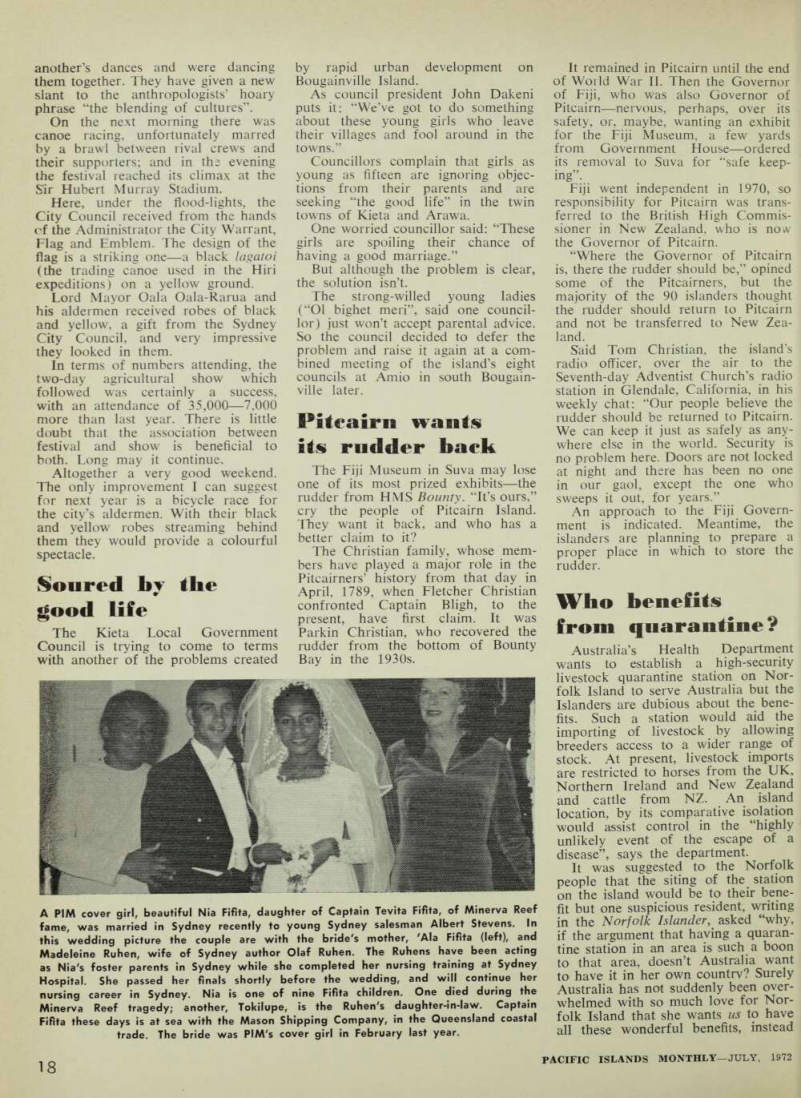
The flag of the new city of Port Moresby, received in June by Lord Mayor Oala Oala-Rarua.
another’s dances and were dancing them together. They have given a new slant to the anthropologists’ hoary phrase “the blending of cultures”.
On the next morning there was canoe racing, unfortunately marred by a brawl between rival crews and their supporters; and in the evening the festival reached its climax at the Sir Hubert Murray Stadium.
Here, under the flood-lights, the City Council received from the hands cf the Administrator the City Warrant, Flag and Emblem. The design of the flag is a striking one—a black lagatoi (the trading canoe used in the Hiri expeditions) on a yellow ground.
Lord Mayor Oala Oala-Rarua and his aldermen received robes of black and yellow, a gift from the Sydney City Council, and very impressive they looked in them.
In terms of numbers attending, the two-day agricultural show which followed was certainly a success, with an attendance of 35,000—7.000 more than last year. There is little doubt that the association between festival and show is beneficial to both. Long may it continue.
Altogether a very good weekend.
The only improvement I can suggest for next year is a bicycle race for the city’s aldermen. With their black and yellow robes streaming behind them they would provide a colourful spectacle.
Kw tflwi IfT ij nnfl ] Ilf** r- The Kieta Local Government Council is trying to come to terms with another of the problems created
by rapid urban development on Bougainville Island, As council president John Dakeni puts it: “We’ve got to do something about these young girls who leave their villages and fool around in the towns.”
Councillors complain that girls as young as fifteen are ignoring objec tions from their parents and are seeking “the good life” in the twin towns of Kieta and Arawa.
One worried councillor said: “These girls are spoiling their chance of having a good marriage.”
But although the problem is clear, the solution isn’t.
The strong-willed young ladies (“Ol bighet meri”, said one council lor) just won’t accept parental advice.
So the council decided to defer the problem and raise it again at a com bined meeting of the island’s eight councils at Amio in south Bougain ville later,
WclllflS
I*ll(Bd(*I* IliK'k
The Fiji Museum in Suva may lose one °f i ts rnost prized exhibits—the rudder from HMS Bounty. ‘ It s ours, cry the people of Pitcairn Island, They want it back, and who has a better claim to it?
The Christian family, whose mem bers have played a major role in the Pitcairners’ history from that day in April, 1789, when Fletcher Christian confronted Captain Bligh, to the present, have first claim. It was Parkin Christian, who recovered the rudder from the bottom of Bounty Bay in the 19305.
It remained in Pitcairn until the end of World War 11. Then the Governor of Fiji, who was also Governor of Pitcairn—nervous, perhaps, over its safety, or, maybe, wanting an exhibit for the Fiji Museum, a few yards from Government House—ordered its removal to Suva for “safe keep ing”.
Fiji went independent in 1970, so responsibility for Pitcairn was trans ferred to the British High Commis sioner in New Zealand, who is now the Governor of Pitcairn.
“Where the Governor of Pitcairn is, there the rudder should be,” opined some of the Pitcairners, but the majority of the 90 islanders thought the rudder should return to Pitcairn and not be transferred to New Zea land.
Said Tom Christian, the island’s radio officer, over the air to the Seventh-day Adventist Church’s radio station in Glendale, California, in his weekly chat: “Our people believe the rudder should be returned to Pitcairn.
We can keep it just as safely as any where else in the world. Security is no problem here. Doors are not locked at night and there has been no one in our gaol, except the one who sweeps it out, for years.”
An approach to the Fiji Govern ment is indicated. Meantime, the islanders are planning to prepare a proper place in which to store the rudder.
Who benefits
from quarantine?
Australia’s Health Department wants to establish a high-security livestock quarantine station on Nor folk Island to serve Australia but the Islanders are dubious about the bene fits. Such a station would aid the importing of livestock by allowing breeders access to a wider range of stock. At present, livestock imports are restricted to horses from the UK, Northern Ireland and New Zealand and cattle from NZ. An island location, by its comparative isolation would assist control in the “highly unlikely event of the escape of a disease”, says the department.
It was suggested to the Norfolk people that the siting of the station on the island would be to their bene fit but one suspicious resident, writing in the Norfolk Islander, asked “why, if the argument that having a quaran tine station in an area is such a boon to that area, doesn’t Australia want to have it in her own country? Surely Australia has not suddenly been over whelmed with so much love for Nor folk Island that she wants us to have all these wonderful benefits, instead
A PIM cover girl, beautiful Nia Fifita, daughter of Captain Tevita Fiflta, of Minerva Reef fame, was married in Sydney recently to young Sydney salesman Albert Stevens. In this wedding picture the couple are with the bride's mother, 'Ala Fifita (left), and Madeleine Ruhen, wife of Sydney author Olaf Ruhen. The Ruhens have been acting as Nia's foster parents in Sydney while she completed her nursing training at Sydney Hospital. She passed her finals shortly before the wedding, and will continue her nursing career in Sydney. Nia is one of nine Fifita children. One died during the Minerva Reef tragedy; another, Tokilupe, is the Ruhen's daughter-in-law. Captain Fifita these days is at sea with the Mason Shipping Company, in the Queensland coastal trade. The bride was PIM's cover girl in February last year.
of having them herself! The truth of the matter is that having a quarantine station in the area is a risk and a danger to the community and Aus tralia wants us to take that risk for her.”
Anyone want
a starfish?
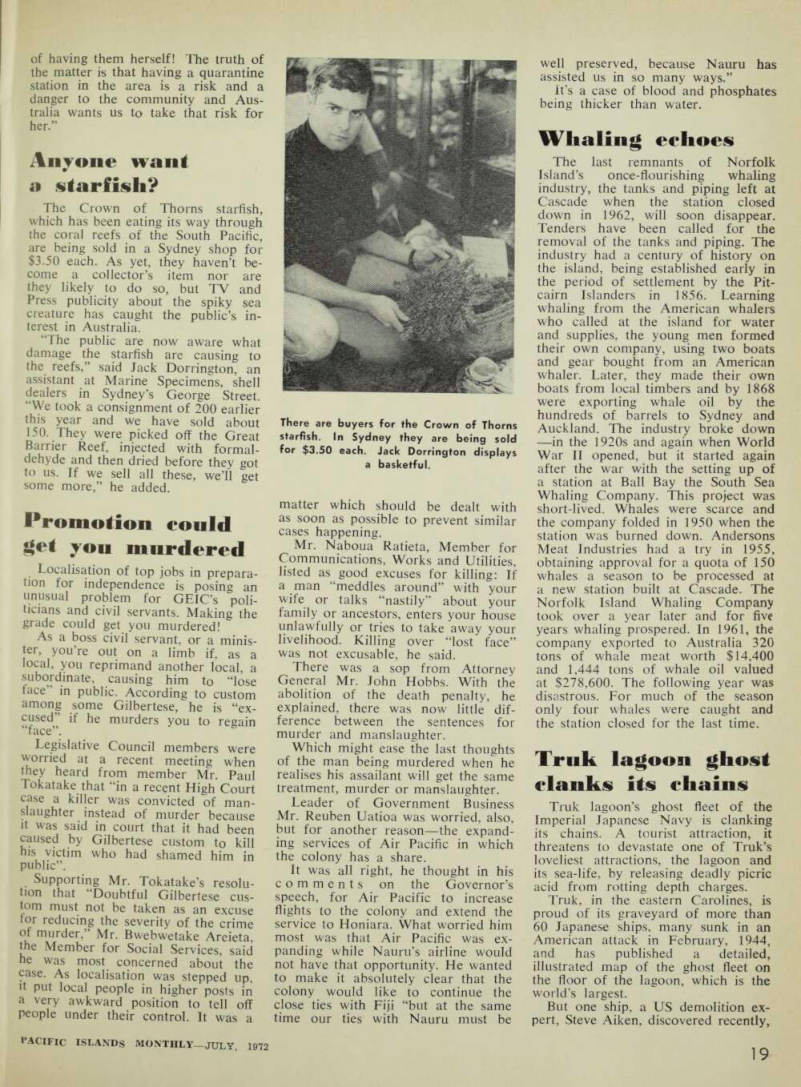
The Crown of Thorns starfish, which has been eating its way through the coral reefs of the South Pacific, are being sold in a Sydney shop for $3.50 each. As yet, they haven’t be come a collector’s item nor are they likely to do so, but TV and Press publicity about the spiky sea creature has caught the public’s in terest in Australia.
“The public are now aware what damage the starfish are causing to the reefs,” said Jack Dorrington, an assistant at Marine Specimens, shell dealers in Sydney’s George Street.
“We took a consignment of 200 earlier this year and we have sold about 150. They were picked off the Great Barrier Reef, injected with formal dehyde and then dried before they got to us. If we sell all these, we’ll get some more,” he added.
Promotion eon Id
get you murdered
Localisation of top jobs in prepara tion for independence is posing an unusual problem for GEIC’s poli ticians and civil servants. Making the grade could get you murdered!
As a boss civil servant, or a minis ter, you’re out on a limb if, as a local, you reprimand another local, a subordinate, causing him to “lose face” in public. According to custom among some Gilbertese, he is “ex cused” if he murders you to regain face”.
Legislative Council members were worried at a recent meeting when they heard from member Mr. Paul Tokatake that “in a recent High Court case a killer was convicted of man slaughter instead of murder because it was said in court that it had been caused by Gilbertese custom to kill his victim who had shamed him in public”.
Supporting Mr. Tokatake’s resolu tion that Doubtful Gilbertese cus tom must not be taken as an excuse for reducing the severity of the crime of murder,” Mr. Bwebwetake Areieta, the Member for Social Services, said he was most concerned about the case. As localisation was stepped up. it put local people in higher posts in a very awkward position to tell off people under their control. It was a
matter which should be dealt with as soon as possible to prevent similar cases happening.
Mr. Naboua Ratieta, Member for Communications, Works and Utilities, listed as good excuses for killing: If a man “meddles around” with your wife or talks “nastily” about your family or ancestors, enters your house unlawfully or tries to take away your livelihood. Killing over “lost face” was not excusable, he said.
There was a sop from Attorney General Mr. John Hobbs. With the abolition of the death penalty, he explained, there was now little dif ference between the sentences for murder and manslaughter.
Which might ease the last thoughts of the man being murdered when he realises his assailant will get the same treatment, murder or manslaughter.
Leader of Government Business Mr. Reuben Uatioa was worried, also, but for another reason—the expand ing services of Air Pacific in which the colony has a share.
It was all right, he thought in his comments on the Governor’s speech, for Air Pacific to increase flights to the colony and extend the service to Honiara. What worried him most was that Air Pacific was ex panding while Nauru’s airline would not have that opportunity. He wanted to make it absolutely clear that the colony would like to continue the close ties with Fiji “but at the same time our ties with Nauru must be
well preserved, because Nauru has assisted us in so many ways.”
It’s a case of blood and phosphates being thicker than water.
Whaling echoes
The last remnants of Norfolk Island’s once-flourishing whaling industry, the tanks and piping left at Cascade when the station closed down in 1962, will soon disappear.
Tenders have been called for the removal of the tanks and piping. The industry had a century of history on the island, being established early in the period of settlement by the Pit cairn Islanders in 1856. Learning whaling from the American whalers who called at the island for water and supplies, the young men formed their own company, using two boats and gear bought from an American whaler. Later, they made their own boats from local timbers and by 1868 were exporting whale oil by the hundreds of barrels to Sydney and Auckland. The industry broke down —in the 1920 s and again when World War II opened, but it started again after the war with the setting up of a station at Ball Bay the South Sea Whaling Company. This project was short-lived. Whales were scarce and the company folded in 1950 when the station was burned down. Andersens Meat Industries had a try in 1955, obtaining approval for a quota of 150 whales a season to be processed at a new station built at Cascade. The Norfolk Island Whaling Company took over a year later and for five years whaling prospered. In 1961, the company exported to Australia 320 tons of whale meat worth $14,400 and 1,444 tons of whale oil valued at $278,600. The following year was disastrous. For much of the season only four whales were caught and the station closed for the last time.
Truk lagoon ghost
Hank* its rhains
Truk lagoon’s ghost fleet of the Imperial Japanese Navy is clanking its chains. A tourist attraction, it threatens to devastate one of Truk’s loveliest attractions, the lagoon and its sea-life, by releasing deadly picric acid from rotting depth charges.
Truk, in the eastern Carolines, is proud of its graveyard of more than 60 Japanese ships, many sunk in an American attack in February, 1944, and has published a detailed, illustrated map of the ghost fleet on the floor of the lagoon, which is the world’s largest.
But one ship, a US demolition ex pert, Steve Aiken, discovered recently.
There are buyers for the Crown of Thorns starfish. In Sydney they are being sold for $3.50 each. Jack Dorrington displays a basketful.
contains 300 depth charges, rotten with rust and liable to burst open at any time. When they do, 60 tons of water-soluble picric acid, killer of fish, coral and other marine life, will be released into the lagoon.
According to Aiken, there are two ways of laying this ghost for good— either blowing up the ship and with it the acid, which would be neutra lised, or removing the depth charges one by one and exploding them in some remote area. Either way, no one’s happy about the probable result. The ship is about 1,000 yards from Uman Island. Blowing up the ship might damage the island and its people as a rain of metal was bound to fall on it, and all marine life within a radius of 2,500 yards would perish.
Salvaging the depth charges piece meal could end in disaster for the salvage ship and crew. The explosives are in a highly-volatile state.
“Whatever the decision, it had better be made fast,” says Aiken.
“Sixty tons of picric acid could cause overwhelming damage.”
The blurb accompanying the tourist map refers to the ships resting on the lagoon floor “as if preserved in a time capsule for more than a quarter of a century”.
For “time capsule” now read “time bomb”.
PNG’s time bombs
Relics of a war thirty years past continue to claim lives in Papua New Guinea. Raphael Lovinau, aged 18, and his friends Osina, John and Julian, decided the village meeting discussing road work and a new school house was rather tiresome. They strolled down to the swamp not far from their village—Rorovana No. 2, in Bougainville.
One of them found the 75mm cannon shell lying at the edge of the swamp and it was dumped into a sack and carried back to the village. Eager to obtain the powder for “bombing” fish, Raphael began to saw the shell in half. The resultant explosion killed him outright and badly injured his three friends.
You can 9 !
always wiu
The drama of a RAN patrol boat which made an emergency dash to pick up a dangerously ill man from the remote Mortlock Islands received headlines in Papua New Guinea late in May. However, the curious sequel to the incident went unreported.
The patrol boat, Madang, was midway between Buka Island and Rabaul when it received the call to make full speed for the low coral atoll, 120 miles east of Bougainville Island. A Mortlock Islander was very ill with appendicitis. The only Euro pean on the islands, a school teacher, feared for the man’s life.
Eleven hours later the Madang reached the islands and the boat’s commander, Lieutenant J. Ryan, went ashore with a party to get the sick man. The man, aged about 28, was sitting propped up in a house surrounded by his relatives. He looked pale and ill.
There was an uneasy silence before a village leader stepped forward and announced that it had been decided that the man would not be allowed to leave the islands. The Madang
returned to Kieta to refuel, without the patient.
The man died three days later.
Cash and sympathy
Although no date has been fixed for London High Court hearing of their claim for $2l million damages from the British Phosphate Commis sioners, the Banabans of Rabi Island are confident of winning world sup port in their fight for compensation.
In Suva in June, Mr. Bertram Jones, secretary of the Rabi Island Council, told PIM that when “all the dirt came out”, world opinion and sympathy was bound to come down heavily on the side of the Banabans.
“When the mouse from Rabi is heard in London, its roars will shatter the complacency of Whitehall,” he said.
The Banabans’ claim for $2l mil lion damages is part of a law suit to be heard in London relating to their long-standing dispute with the British Government and the British Phosphate Commissioners over the mining of phosphates on Ocean Island, the Banabans’ former home.
A writ issued from the London High Court against the BPC seeks the enforcing of a 1913 agreement for worked-out areas of Ocean Island to be replanted with coconut palms and other food trees.
Failing this, the writ seeks more than $2l million in damages, a figure based on a calculation of the cost of replanting the acreage mined by the commissioners and private companies which preceded them. The remainder of the Banabans’ claim relates to their demands for a larger share of phosphate royalties. Mr. Jones expects the case will be heard in October.
“A good deal of information relating to early mining agreements and shabby treatment of the Banabans will be heard for the first time at the hearing,” he said. “There is strong legal opinion that the Gilbert and Ellice Colony (of which Ocean I. is a part) has extracted revenue from phosphate to which it had no right.”
He said arguments about whether the Banabans were of Gilbertese origin were not relevant to the royalty issue. Racial origin was not part of the Banabans’ case.
Since being resettled at Rabi in the Fiji Group in 1945, the Banabans have formed close ties with Fiji.
Many of the 2,100 Banabans now living on Rabi were born there—and 500 of the “resettlers” have now applied for Fiji citizenship. In June, an Immigration Department team was due to visit Rabi to supervise com pletion of citizenship forms.
Artist's sketch of the latest Nauru govern ment investment project in Melbourne, an octagonal 47-storey tower which will be the city's tallest building. The land at the top of Collins Street cost £5 million and the total outlay will exceed £20 million.
Designers hope to use some of Nauru's coral pinnacles to decorate the spacious plaza and incorporate traditional Nauruan string figures in a mural in the foyer.
Nauru government offices will occupy several floors.
Sneak cyclone
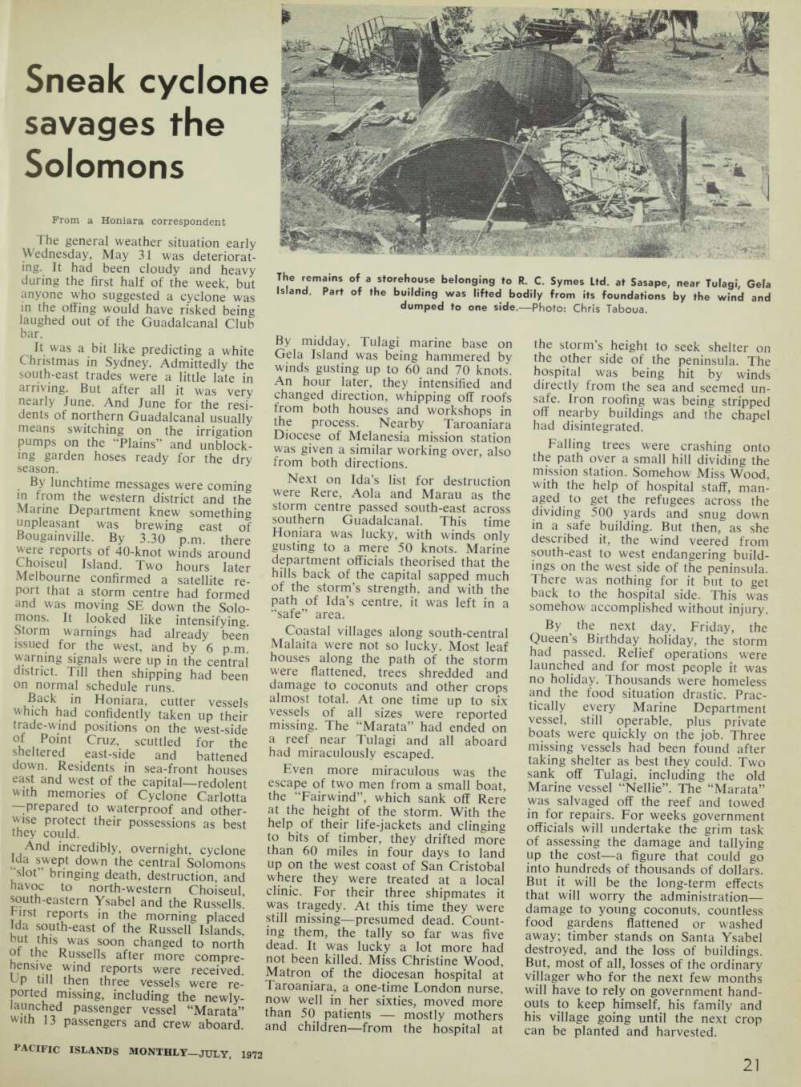
savages the Solomons
From a Honiara correspondent The general weather situation early Wednesday, May 31 was deteriorat ing. It had been cloudy and heavy during the first half of the week, but anyone who suggested a cyclone was m the offing would have risked being laughed out of the Guadalcanal Club bar.
It was a bit like predicting a white Christmas in Sydney. Admittedly the south-east trades were a little late in arriving. But after all it was very nearly June. And June for the resi dents of northern Guadalcanal usually means switching on the irrigation pumps on the “Plains” and unblock ing garden hoses ready for the dry season.
By lunchtime messages were coming in from the western district and the Marine Department knew something unpleasant was brewing east of Bougainville. By 3.30 p.m. there were reports of 40-knot winds around Choiseul Island, Two hours later Melbourne confirmed a satellite re port that a storm centre had formed and was moving SE down the Solo mons. It looked like intensifying.
Storm warnings had already been issued for the west, and by 6 p.m. warning signals were up in the central district. Till then shipping had been on normal schedule runs.
Back in Honiara, cutter vessels which had confidently taken up their trade-wind positions on the west-side of Point Cruz, scuttled for the sheltered east-side and battened down. Residents in sea-front houses east and west of the capital—redolent with memories of Cyclone Carlotta —prepared to waterproof and other wise protect their possessions as best they could.
And incredibly, overnight, cyclone Ida swept down the central Solomons slot” bringing death, destruction, and havoc to north-western Choiseul, south-eastern Ysabel and the Russells. rirst reports in the morning placed Ida south-east of the Russell Islands, but this was soon changed to north of the Russells after more compre hensive wind reports were received.
Up till then three vessels were re ported missing, including the newly launched passenger vessel “Marata” with 13 passengers and crew aboard.
By midday, Tulagi marine base on Gela Island was being hammered by winds gusting up to 60 and 70 knots.
An hour later, they intensified and changed direction, whipping off roofs from both houses and workshops in the process. Nearby Taroaniara Diocese of Melanesia mission station was given a similar working over, also from both directions.
Next on Ida’s list for destruction were Rere, Aola and Marau as the storm centre passed south-east across southern Guadalcanal. This time Honiara was lucky, with winds only gusting to a mere 50 knots. Marine department officials theorised that the hills back of the capital sapped much of the storm’s strength, and with the path of Ida’s centre, it was left in a “safe” area.
Coastal villages along south-central Malaita were not so lucky. Most leaf houses along the path of the storm were flattened, trees shredded and damage to coconuts and other crops almost total. At one time up to six vessels of all sizes were reported missing. The “Marata” had ended on a reef near Tulagi and all aboard had miraculously escaped.
Even more miraculous was the escape of two men from a small boat, the “Fairwind”, which sank off Rere at the height of the storm. With the help of their life-jackets and clinging to bits of timber, they drifted more than 60 miles in four days to land up on the west coast of San Cristobal where they were treated at a local clinic. For their three shipmates it was tragedy. At this time they were still missing—presumed dead. Count ing them, the tally so far was five dead. It was lucky a lot more had not been killed. Miss Christine Wood, Matron of the diocesan hospital at Taroaniara, a one-time London nurse, now well in her sixties, moved more than 50 patients mostly mothers and children—from the hospital at
the storm’s height to seek shelter on the other side of the peninsula. The hospital was being hit by winds directly from the sea and seemed un safe. Iron roofing was being stripped off nearby buildings and the chapel had disintegrated.
Falling trees were crashing onto the path over a small hill dividing the mission station. Somehow Miss Wood, with the help of hospital staff, man aged to get the refugees across the dividing 500 yards and snug down in a safe building. But then, as she described it, the wind veered from south-east to west endangering build ings on the west side of the peninsula.
There was nothing for it but to get back to the hospital side. This was somehow accomplished without injury.
By the next day, Friday, the Queen’s Birthday holiday, the storm had passed. Relief operations were launched and for most people it was no holiday. Thousands were homeless and the food situation drastic. Prac tically every Marine Department vessel, still operable, plus private boats were quickly on the job. Three missing vessels had been found after taking shelter as best they could. Two sank off Tulagi, including the old Marine vessel “Nellie”. The “Marata” was salvaged off the reef and towed in for repairs. For weeks government officials will undertake the grim task of assessing the damage and tallying up the cost—a figure that could go into hundreds of thousands of dollars.
But it will be the long-term effects that will worry the administration— damage to young coconuts, countless food gardens flattened or washed away; timber stands on Santa Ysabel destroyed, and the loss of buildings.
But, most of all, losses of the ordinary villager who for the next few months will have to rely on government hand outs to keep himself, his family and his village going until the next crop can be planted and harvested.
The remaims of a storehouse belonging to R. C. Symes Ltd. at Sasape, near Tulagi, Gela Island. Part of the building was lifted bodily from its foundations by the wind and dumped to one side. Photo: Chris Taboua.
Kokoda Track
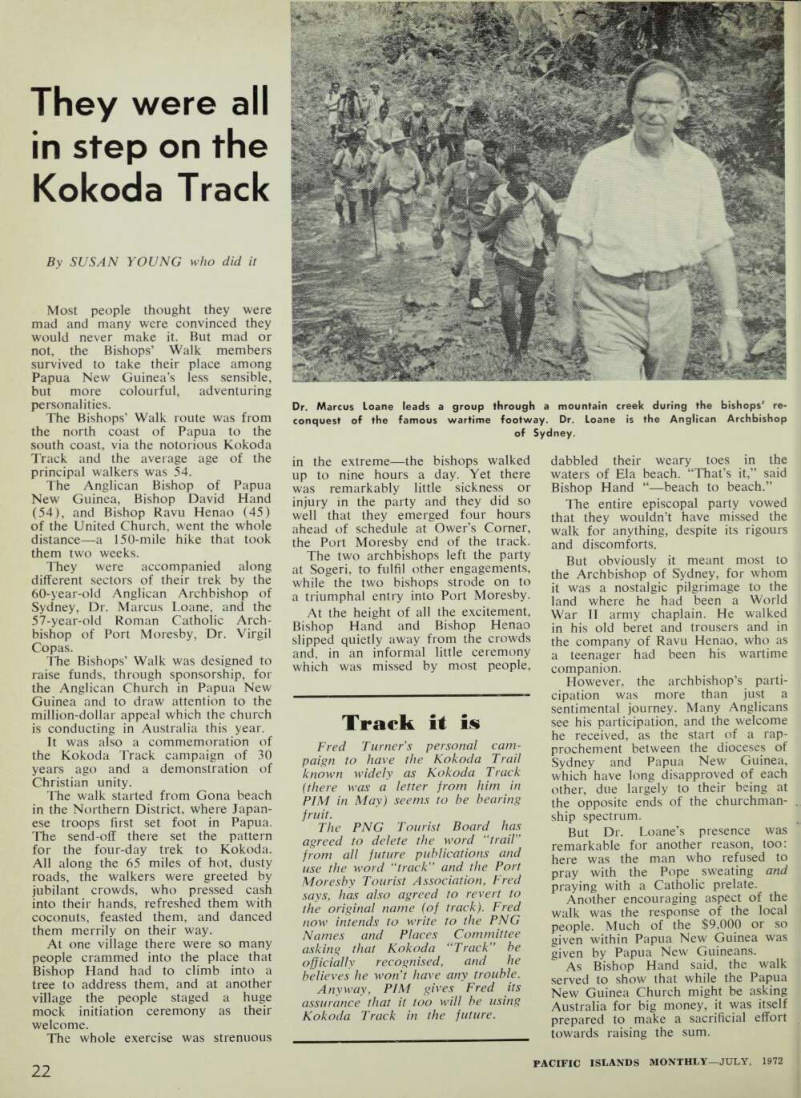
They were all in step on the Kokoda Track
By SUSAN YOUNG who did it
Most people thought they were mad and many were convinced they would never make it. But mad or not, the Bishops’ Walk members survived to take their place among Papua New Guinea’s less sensible, but more colourful, adventuring personalities.
The Bishops’ Walk route was from the north coast of Papua to the south coast, via the notorious Kokoda Track and the average age of the principal walkers was 54.
The Anglican Bishop of Papua New Guinea, Bishop David Hand (54), and Bishop Ravu Henao (45) of the United Church, went the whole distance—a 150-mile hike that took them two weeks.
They were accompanied along different sectors of their trek by the 60-year-old Anglican Archbishop of Sydney, Dr. Marcus Loane, and the 57-year-old Roman Catholic Arch bishop of Port Moresby, Dr. Virgil Copas.
The Bishops’ Walk was designed to raise funds, through sponsorship, for the Anglican Church in Papua New Guinea and to draw attention to the million-dollar appeal which the church is conducting in Australia this year.
It was also a commemoration of the Kokoda Track campaign of 30 years ago and a demonstration of Christian unity.
The walk started from Gona beach in the Northern District, where Japan ese troops first set foot in Papua.
The send-off there set the pattern for the four-day trek to Kokoda.
All along the 65 miles of hot, dusty roads, the walkers were greeted by jubilant crowds, who pressed cash into their hands, refreshed them with coconuts, feasted them, and danced them merrily on their way.
At one village there were so many people crammed into the place that Bishop Hand had to climb into a tree to address them, and at another village the people staged a huge mock initiation ceremony as their welcome.
The whole exercise was strenuous
in the extreme —the bishops walked up to nine hours a day. Yet there was remarkably little sickness or injury in the party and they did so well that they emerged four hours ahead of schedule at Ower’s Corner, the Port Moresby end of the track.
The two archbishops left the party at Sogeri, to fulfil other engagements, while the two bishops strode on to a triumphal entry into Port Moresby.
At the height of all the excitement, Bishop Hand and Bishop Henao slipped quietly away from the crowds and, in an informal little ceremony which was missed by most people,
dabbled their weary toes in the waters of Ela beach. “That’s it,” said Bishop Hand “ —beach to beach.”
The entire episcopal party vowed that they wouldn’t have missed the walk for anything, despite its rigours and discomforts.
But obviously it meant most to the Archbishop of Sydney, for whom it was a nostalgic pilgrimage to the land where he had been a World War II army chaplain. He walked in his old beret and trousers and in the company of Ravu Henao, who as a teenager had been his wartime companion.
However, the archbishop’s parti cipation was more than just a sentimental journey. Many Anglicans see his participation, and the welcome he received, as the start of a rap prochement between the dioceses of Sydney and Papua New Guinea, which have long disapproved of each other, due largely to their being at the opposite ends of the churchman ship spectrum.
But Dr. Loane’s presence was remarkable for another reason, too: here was the man who refused to pray with the Pope sweating and praying with a Catholic prelate.
Another encouraging aspect of the walk was the response of the local people. Much of the $9,000 or so given within Papua New Guinea was given by Papua New Guineans.
As Bishop Hand said, the walk served to show that while the Papua New Guinea Church might be asking Australia for big money, it was itself prepared to make a sacrificial effort towards raising the sum.
Dr. Marcus Loane leads a group through a mountain creek during the bishops' re conquest of the famous wartime footway. Dr. Loane is the Anglican Archbishop
of Sydney.
Track it is
Fred Turner’s personal cam paign to have the Kokoda Trail known widely as Kokoda Track (there was a letter from him in PIM in May) seems to be bearing fruit.
The PNG Tourist Board has agreed to delete the word “trail” from all future publications and use the word “track” and the Port Moresby Tourist Association, Fred says, has also agreed to revert to the original name (of track). Fred now intends to write to the PNG Names and Places Committee asking that Kokoda “Track” be officially recognised, and he believes he won't have any trouble.
Anyway, PIM gives Fred its assurance that it too will be using Kokoda Track in the future.
An Exercise In Magnanimity
In Png's House Of Assembly
From PERCY CHATTERTON, in Port Moresby
Looking back at the first meeting of Papua New Guinea’s third House of Assembly in April, and its after math, one is impressed by the generosity displayed by the Pangu-led National Coalition towards its United Party opponents.
This attitude is all the more notable in view of the fact that when the boot was on the other foot it was used for kicking, and for kicking hard. The majority group in the second House, first as the so-called Independent Group, then as the Compass Party, and finally as the United Party, lost no opportunity of humiliating the small Pangu Party opposition.
Perhaps its crowning feat of in tolerance was to prevent Thomas Kavali, now Minister for Works but then the sole representative in parliament of the New Guinea National Party, from joining the parliamentary delegation to Indonesia led by Dr. John Guise.
It would not have been a matter for surprise if a triumphant Pangu Party had been eager for revenge.
In fact it showed itself magnanimous.
Not only did it support a proposal from its ally, the Peoples’ Progress Party, to give status and perquisites to the leader of the Opposition, but it secured the inclusion of the United Party’s controversial secretary, Anton Parao, in the delegation to the UN Trusteeship Council meeting in New York.
The United Party’s response to these generous gestures has in the main been less than gracious. Anton Parao used the occasion of this ap pearance before the council to engage in a bit of political tub thumping on behalf of his party, or more correctly perhaps on behalf of the Highlands, thus arousing the anger of the leaders of the National Coalition.
As a matter of fact, the three-man PNG delegation gave the UN a very good cross-section of local opinion.
With Anton Parao were Pangu’s Gavera Rea, trade union leader and Minister for Labour in the coalition, and Simon Kaumi, Chief Electoral Officer and cautious public servant.
Members of the Trusteeship Council were able to watch the political traffic lights switch from red to amber to green and back again.
There have been angry reactions to the formation of the coalition in some parts of the country, notably in the
Gazelle Peninsula and in the High lands.
In the Gazelle the reaction has no doubt arisen from the local political situation. The Mataungan MHAs being members of the coalition, anti- Mataungans are in honour bound to oppose it with the virulence which seems to be endemic among the Tolai.
In the Highlands, however, the opposition may be suspected of being a demonstration of Highlands nationalism, of which Anton Parao is such an outspoken apostle. Fair enough, if acknowledged as such.
Personally I prefer Anton Parao, who makes no bones about his High lands regionalism, to those High landers who prate of national unity and urge us to love one another and hun g wantaim, when what they are really after is Highlands domination of the whole country.
The National Coalition has had one notable victory in the Highlands, however. lambakey Okuk, Minister for Agriculture and member for Chimbu Regional, returned home to face what had been billed as a hostile demonstration, and converted it into a demonstration of support for the coalition and himself. In a hard-hitting speech he nailed home responsibility for a previous anti-coalition demon stration at Kainantu to defeated candidates in the recent elections and to the interference in Chimbu affairs of an Eastern Highlands MHA. He named them, one by one.
Proceedings during the 2\ sitting days which made up the first week of the June meeting of the House of Assembly were in low key. Perhaps the most important topic dealt with was that of what is commonly called “free education”.
Actually, of course, there is no such thing as free education. Education is expensive and is getting more and more expensive. The real question is: Who pays for it?
During the last few years parents in Papua New Guinea have been called on to make a contribution to the cost of their children’s education, though the fees charged represent little more than a token payment in relation to the total cost.
Southern Highlands MHA Matiabe Yuwi wants education to be “free” in undeveloped areas. He points out that areas which have had schools for a long time had enjoyed the advantages of free education until fees were introduced a few years back, and it seems to him only fair that in areas where schools are only now being established there should be a period of free education prior to the introduction of fees. He sug gested a period of five years.
Education Minister Ebia Olewale was quick to point out that if fees were remitted in this way there would be less money available and con sequently fewer new schools estab lished.
The member for Central Regional, Miss Josephine Abaijah, suggested that the kind of education currently being given often created more problems than it solved. What was needed, she said, was more adapta tion of schooling to local conditions and requirements rather than more and more schools turning out more and more misfits.
The government compromised by fixing a ceiling for fees chargeable by primary schools, and by agreeing that in cases of hardship fees might be paid in kind instead of in cash.
So if Mary’s little pig follows her to school one day he may find himself impounded as an instalment of Mary’s school fees.
For the rest, a bill was agreed to regularising the nomenclature to be used to prevent confusion between Papua New Guinea ministers and Australian Commonwealth ministers, and creating and defining a position of “leader of the opposition”.
Advertisements & other items, p. 25 (1 item)
Profit From
AN ELECTION!
The victorious Cook Islands Party, which won the general election in April, made a profit out of its election campaign.
The balance sheet, issued in May, showed a profit of $953.11 . Income totalled $3,141.68 and expenditure amounted to $2,188.57. Raffles brought in $1,509.13 and dances $1,154.82. Biggest bill was $687.53 for transport and campaign expenses were $439.02.
Footnotes
Education? It's
Been Here
For Centuries
gOME years ago 1 heard the guest speaker at a college graduation ceremony say that “before 1946 there was no education in Papua New Guinea”.
He was a senior public servant, and many officers in the PNG Public Service seem to be under the impression that nothing happened in Papua New Guinea before 1946, when civil administration was re-established in Konedobu, PNG’s mini-Canberra. Indeed, I am surprised that the suggestion has never been put forward that that year should be regarded as the beginning of a new era, and that the years thereafter should be re-numbered, making the present year A.K. (After Konedobu) 26.
In fact the distinguished guest speaker was doubly wrong. There was not only education in pre-war colonial Papua New Guinea, but there was also education in pre-contact Papua New Guinea.
If we regard education as being preparation for adult life, then I think that it may be said that education in Papua New Guinea before the arrival of the white man was more effective in attaining its objective than much of our edu cational effort is now in A.K. 26.
Admittedly, the problem was simpler then, since adult life was substantially the same for all, and it was known with some certainty beforehand what it would be like.
Education in pre-contact Papua New Guinea was in the main on-the-job training.
Children watched their parents in their activities, helped and imitated them, and so acquired the skills they would need in adult life; they also absorbed from them their tribal traditions and beliefs.
But there was perhaps more to it than that.
I believe that parents sometimes deliberately placed their children in situations from which they would learn. They also gave them what we would nowadays call “assignments”. In other words, situational and project methods are not, as some suppose, a 20th century innovation.
They were invented in the Stone Age.
ITie first Protestant missionaries to arrive in Papua came from an England just in process of
establishing a system of universal elementary education based on the “three Rs”, and they probably thought that this was “a good thing”.
But in establishing schools in Papua, as they did at a very early stage (in the Port Moresby area well before the proclamation of the British Pro tectorate in 1884), they had, I think, a more definite aim. Their own Christian belief was firmly based on a study of the Bible, and they believed that if their converts were to become Christians in any real sense of the word they must be able to read the Bible for themselves.
Much of these missionaries’ time was therefore given over to trans lating the Bible, or portions thereof, into the languages of the people among whom they had settled, and also to teaching both adults and children to read what they had translated for them. In the Port Moresby area, the whole of the New Testament had been translated into Motu by the 1890 s, and the children of the first literates were learning to read it.
They were, of course, putting
their literacy to other uses too. Passionate little notes passed to and fro between the girls’ desks and those of the boys; and, although the onward march of civilisation had not yet reached the point at which the provision of public con veniences was deemed necessary, suitable surfaces for the inscription of graffiti were not lacking.
Indeed, there were moments in the 1920 s and 1930 s when I found myself wondering whether I was doing the right thing by teaching my young pupils to read and write at all. This was par ticularly the case when one or other of my former pupils landed in jail due to his ability to sign not only his own name but that of his employer as well.
Be that as it may, up till the time of World
With Percy Chatterton
in Port Moresby
War I mission school curricula were confined mainly to vernacular literacy, simple arithmetic, and what was then called “general knowledge”’ later to be rehabilitated under the more glamorous title of “social studies”.
Various practical skills were taught at what might be described as a “handy-man” level, and village crafts were encouraged. In the boarding schools which were maintained on mission district head-stations, pupils spent part of their time growing their own food, building and maintaining their own houses, and otherwise “learning bv doing”. 5 y In the 1920 s a start was made on the teaching of English in those few mission schools in which teachers were available who could teach it. The extent and quality of this effort increased slowly during the 19305, in spite of the handicaps of
inadequate teaching techniques, an almost com
plete absence of suitable reading material, and limited opportunities for the pupils to put their English to use outside the classroom.
In the immediate post-war years it looked as if, under the enlightened leadership of PNG’s first Director of Education, W. C. Groves, the foundations laid before the war might be built upon Then the linguistic cargo cultists took over, and the acquisition of the cargo language, English became the be-all and end-all of primary school ing to such an extent that at one stage over do 118 Papuan teachers were punishing Papuan children for speaking to one another in their own language in their own village street. The school became almost completely divorced from the community.
At long last the tide has turned, and we are getting back to the ideals of Bill Groves and the practice of the best of the pre-war mission schools. Head teachers are being encouraged to re-establish the links between community and school to invite members of the adult community into the schools to teach traditional arts and crafts and to tell stories in the until recently despised vernacular. Who knows, if we go on like this we may eventually get back to encourag ing Pagumean children to read and write their
own language.
In fairness to the linguistic cargo cultists it must be said that they provided what the cus tomers (that i S , pup ii s and parents ) of the late lUs?1 Us ? 508 early 60s were demanding. But during the last few years disenchantment has set in with this cargo cult, as it does eventually with all cargo cults.
Perhaps the chief characteristic of traditional ragumean life was its discontinuity. Such activities as clearing land for new gardens and planting,
tending and harvesting food crops had their times and seasons. Certain kinds of fishing, especially the catching of crayfish, turtles and dugong, were also seasonal. Life was a series of starts and stops; and since traditional education was geared to these activities it also proceeded by starts and stops.
This element of discontinuity was present in traditional religion too. The great feast-dances in honour of the spirits of the dead began with a few tentative, seductive drum taps in the still heat of the early afternoon, and worked slowly up to a climax of non-stop dancing in which dancers sometimes dropped in their tracks from exhaustion and had to be dragged away and revived. Then, following the distribution of the food collected on the sacred platform, the ceremony abruptly ended. The head-dresses and ornaments were stored away for some future celebration and the participants went back to more mundane occu pations.
In place of this start-stop life style we have substituted school attendance five days a week and mattins and evensong on Sundays, year in year out.
We probably can’t admit Melanesian discon tinuity into our offices and factories, but we could perhaps find a place for it in our educational system. One envisages start-stop style courses, each one designed to teach a particular skill (using the word in its broadest sense) at a par ticular level. The length of the course might vary from a few days to a few years, according to the nature and level of the skill taught, but it would have a starting point and a climax. Once the climax was reached it would stop, and the educand would wander off either to chase some further skill or to earn a living with those already acquired. Self-service schooling, in fact. This kind of thing is already being done in some of our vocational centres. It could be extended over a much wider field both subject-wise and age-wise.
Such a system could be operated in the first place alongside the present system of western style schooling. There should be no lack of customers among the 60 per cent, of Papua New Guinea’s juvenile population at present shut out from mainstream schooling.
“This here Progress,” said H. G. Wells’ Tom Smallways, “it keeps on.” So does our present educational system. Perhaps an injection of Melanesian discontinuity would do it good.
People
• Mr. Peter Bellwood, lecturer in Prehistory at Auckland University, is back in the Cook Islands with a small archaeological team comprising his wife. Teremoana, and Miss Debbie Cluff. They intend to carry out field work on Penrhyn. This will be the first time archaelogical work has been carried out in the northern Cook Islands. While waiting at Rarotonga for transport north, Mr. Bellwood and his team carried out excavation work on a site at Tutakimoa. Previous work was done on this site by Peter Bellwood and the Auckland Univer sity expedition in 1968-69, when ancient house sites were uncovered.
The earliest carbon date obtained from this site was about AD 1290, and adzes of a Samoan type were dis covered. The carbon date and the type of adzes seem to confirm the authenticity of the Karika-Tangiia legend, Mr. Bellwood said. • Mr. J. R. Williams, British High Commissioner left Fiji on May 22 for leave in the UK and is expected to return in mid-September. Mr. L. S.
Price is acting high commissioner. • Mr. L. J. Davis, New Zealand’s High Commissioner to the Cook Islands, who was taken seriously ill in April and flown to New Zealand for treatment, returned to Rarotonga on May 30 looking very healthy. He was met at the airport by his wife June, Premier Albert Henry and members of his cabinet. • Mr. Peter Hodgkinson, an Aus tralian Government statistical expert, has been appointed statistician with the South Pacific Commission. Pos sessor of a bachelor’s degree in eco nomics, Mr. Hodgkinson has had extensive experience in statistical work with the Bureau of Census and Statistics in Adelaide. He has more than a nodding acquaintance with Papua New Guinea as he was closely associated with an exhaustive study of problems arising from population pressures and food shortages in PNG. • Miss Moia Ituaso, acting pro ducer, of Gilbertese and Ellice pro grammes on the colony’s Radio Tarawa, has left Tarawa by air for
London. She is on a three-month radio production course which is being held in the BBC’s London studios.
She is the first woman member of Radio Tarawa’s staff to go on such a course. • Mr. M. R. Stanton, formerly Air New Zealand’s assistant commer mercial planning manager, has been appointed general manager of Poly nesian Airlines. The appointment was made at the request of the Western Samoa Government through the air line’s board of directors. Initially ap pointed to the Western Samoa-based airline for two years, Mr. Stanton replaces Mr. E. Hughan, previously seconded by Air Pacific who has now returned to a position with the airline in Fiji. Mr. Stanton joined Air New Zealand 21 years ago and was appointed head of tariffs in 1960. In 1965 he became scheduling superin tendent and the following year com mercial planning controller. e The Rev. William McKenzie, who lives in retirement in Melbourne, was at Erakor in the New Hebrides in May. He attended a ceremony marking the centenary of the arrival of his father, Dr. John McKenzie, the first European missionary. A new building named McKenzie Hall was dedicated. At Erakor are the graves of Dr. McKenzie’s first wife and three of their children. A child of the second marriage, William McKenzie was himself a missionary, spending 40 years in charge of Arakun mission in North Queensland. 9 Dr. Alan Growcott has been ap pointed Secretary for Island Develop ment in Nauru, succeeding Mr. Athol Carter, who is now Shipping Manager in Melbourne for the Nauru Pacific Line. Dr. Growcott, 33, is a PhD. in mathematics and B.Eng. of the University of NSW, and was formerly with management consultants W. D.
Scott and Co. as a senior consultant in management science working in the Philippines and Australia. He is accompanied to Nauru by his wife.
They have no children. • Mr. Raymond Patrick McAleer, a magistrate in Western Samoa, resigned his post in June, because of family illness, and returned with his family to New Zealand. • Mr. Wulf Weilinger, catering instructor and chief steward at the GEIC’s marine training school, has left Tarawa on completion of his service. Seconded to the colony in 1967 from the Columbus Line, Mr.
Weilinger established the catering section of the school and also wrote a manual on shipboard catering
Mr. Boitabu Smith, ex-training school student who has been serving with the Columbus Line and has been in the UK on a study fellowship in catering instruction, takes over from Mr.
Weilinger, 9> One of the third generation of his family to follow the sea. Frank Gorohu, of Elevala village, Port Moresby, is studying for his second mate’s certificate at the Sydney Tech nical College’s School of Navigation.
He will sit for the certificate at the year end. Frank, who is the first man from PNG to attend the school, is on a four-year apprenticeship with the Karlander New Guinea Line.
His father was skipper of the MV Laumbada, a Papuan coastal trading vessel, and his grandfather was also master of coastal vessels owned by Steamships Trading Co. • In Sydney and Suva in June was Mr. Brian Riordan, director of training and technical assistance for the Foundation for the Peoples of the South Pacific, which has its headquarters in New York. Mr.
Riordan, London-born, who migrated to the USA from the UK in 1965 and who now lives with his Welsh born wife and three children in Honolulu, had talks with the Banaban people of Rabi Island, Fiji, about technical help the foundation might be able to provide to assist them achieve economic independence. Mr.
Judge William J. McKnight (above), of Brookvale, Pennsylvania, legal officer in the State's Department of Justice, who has been appointed Chief Justice of American Samoa in succession to Judge Donald H.
Crothers. Aged 51, he is a member of the Bar of the US Supreme Court and of the Supreme Court of Pennsylvania.
Married, with three children, Judge McKnight has been active in Boy Scout leadership.
Riordan between 1968 and 1969 was in charge of a Trust Territory training and technical aid scheme in Micronesia and has close interests in Micronesia. The foundation cur rently has six separate community action agencies in the TT, and also helps in pre - school programmes there. • Mr. Richard Young, Canberra based and 37, has a desk in the Australian Department of Trade and a job to do in Papua New Guinea, making periodic visits there in the interests of Australian exporters. He has just been appointed to this job after working in Santiago, Chile, as Assistant Trade Commissioner. In PNG he will do the work normally done by a trade commissioner but without the title. “Something in the Department of Trade” is the nearest you can get to it. His appointment foreshadows the day when PNG will be a foreign country to Australian exporters. • Russ Gribble, popular boss of the Fiji Visitors Bureau in Sydney and devilishly clever exponent of the soft sell on Fiji tourism’s behalf, was forced to ease up in June when he was taken to Sydney Hospital for an operation. He’s currently recuperat ing, but wearing his usual wide smile.
Pastor Andrew G. Stewart, a Seventh-day Adventist missionary in the Islands for more than 60 years who celebrated his 90th birthday towards the end of last year. An Australian now living at Wahroonga in New South Wales, Pastor Stewart served in Fiji for nine years and then in the New Hebrides. He was re sponsible for much of the success of the Seventh-day Adventist mission in New Guinea and the first plane bought in 1964 by the church for mission work in New Guinea, a Cessna 180, was named the Andrew Stewart.
Advertisements & other items, pp. 29-30 (1 item)
m new mim mm
Import
MR NEW. UAIM'D
MB MW/miA
Export
AIR NEW ZEALAND
AIR CARGO
KEEPS ITS COOL
With unique temperature-controlled cargo holds, AIR NEW ZEALAND air-freights cargo faster, fresher, better.
AIR NEW ZEALAND air cargo can handle practically anything: fish or meat or strawberries or flowers or medical vaccines. Each and every one at exactly the right transport temperatures - cool or cold, chilled or frozen. So take a fresh look at your import/export needs.
Talk to your Freight Forwarder today about air cargo by
AIR NEW ZEALAND.
m new mim mm
The moving part of your marketing arm Regularand frequentaircargoservices,toandfrom New Zealand...
FIJI, SAMOA, TAHITI, NEW CALEDONIA, USA, AUSTRALIA,
HONG KONG, SINGAPORE.
NEW ZEALAND’S
GOT 1T...
AND
YOU WANT 1T...
MARAC
INTERNATIONAL
CAN BUY IT
FOR YOU...
F m s / V/1 /p, * LJ
INTERNATIONAL
Name 5725 We can't supply the dancer but we can buy the Maori pois*; plus a wide range of other New Zealand produced goods, ranging from canned foods to factory machinery. We also offer a complete range of financial services as well e.g. medium term finance for the importing of capital equipment from New Zealand. And our executives call frequently to your territory.
Want to know more? Just post the coupon and we’ll reply post haste.
out in the Cooks

It looks as if the knives are out in the Cooks
Heads have begun to roll in the Cook Islands following the success of Premier Albert Henry’s Cook Islands Party at the polls, and the “Night of the Long Knives” seems to be here. But, it’s all a question of how you look at it.
If you support the CIP you view the dismissal of 44 Public Works Department wage workers and 15 salaried workers in the PWD as a legitimate exercise to cut expenses— surely a praiseworthy act when you have to correct overspending! If you support the Democratic Party of Dr.
Tom Davis and remember that the Premier had already hinted that civil servants who had worked against the return to power of the CIP would live to regret it, then you see the sackings as an official act of revenge. And that’s the way the Public Servants’ Association sees it.
The PSA has decided to challenge the legality of the sackings in the High Court. It accuses the Public Service Commission of not acting independently and impartially, and says that the usual procedure, when there are dismissals on redundancy grounds, of “last on first off”, was not followed. All those dismissed, PSA members point out, were Democratic Party supporters.
The government denies the impli cation and recalls that 12 months ago 70 wage workers were put off by the Housing Authority. There had been no election then and no threats of reprisals.
But Dr. Davis doesn’t see it that way. He accuses the government of victimisation, not only of in dividuals, but also of islands, those islands which stood four-square for the Democratic Party.
“Such victimisation has already started, as of this date by the firing of 44 workers from the Public Works, all of whom were Democratic Party supporters,” he accuses. “Lists of individuals from other departments have already been made out for further wholesale firing of Demo cratic supporters.”
Premier Henry, somewhat timidly, has preferred something which re motely resembles an olive branch, complaining that Dr. Davis hasn’t been around for a chat since the CIP won the elections.
“This attitude leads to a feeling
of separatism,” the Premier points out. Dr. Davis isn’t unbending.
“This feeling of separatism exists and will continue to grow,” he replies. . A™ thats not the only worry tor Mr. Henry. His banana exports to New Zealand are nil, thanks to
the hurricanes, and he has to cut his administrative expenditure more than drastically. His budget spending, he told the Legislative Assembly, will be the highest on record, coming to $5,573,572 for ordinary administra tive purposes. The capital works budget is $898,000 of which New Zealand will contribute $500,000.
The Cook , s wants a loan badly but 80 * ar there’s been little sign of one.
Increased taxes seems to be the only answer, which is something Premier Henry has promised he’ll never sup port.
Advertisements & other items, pp. 31-38 (1 item)
family down
Don't let your
You've worked hard to give them a home, schooling and security. Don't let that hard-won security erode away because you continued to overlook making out a Will. With a properly planned Will, you can be certain in the knowledge that your property will eventually pass to the people you specify, and also that your Estate will be as large as possible after probate and duties. In this regard, we invite you to take advantage of the adyisory service we provide, entirely free of obligation. Our specialists in Estate Planning will be delighted to help you plan your Will most efficiently, or to discuss it fully with your solicitor or accountant.
c, ’ XH * T A
mi s the
BURNS PHILP TRUSTEE
COMPANY LIMITED
IXECUTOR o ADMINISTRATOR • TRUSTEE • ATTORNEY • AGENT Fiji Office: Mr. A. W. Cooper, Resident Manager, Rodwell Road, Suva. Telephone: 311 777.
Head Office: 51 Pitt Street, Sydney 2000.
Telephone: 241 1021. Telegrams: "BURNSTRUST," Sydney.
Branches and/or Registered Offices: Parramatta (N.S.W.), Canberra, Melbourne, Brisbane, Adelaide, Fremantle (W.A.), Port Moresby (Papua). 8P45
Sky van/ Skyline
"1 V* ✓ - H
safe
Shorts Skyvan unique STOL transport is equally at home on an unprepared three hundred yard strip of sand or on ten thousand feet of concrete runway. Skyvan is the only light British transport 'aircraft fully approved by the British Airworthiness Board to operate at temperatures up to ISA + 35°C (122°F).
Able to carry up to 2 tons of bulky freight, or 18 passengers, or a vehicle, to fly up to 500 miles between stops and half a million between engine servicing, SKYVAN gives short-haul operators unlimited versatility, scheduling flexibility and reaH profit.
Skyliner, the all-passenger variant, can seat up toe 19 in Jumbo-jet style comfort with new levels oft luxury. Full walk-about headroom throughout thes entire cabin, de luxe seating, and washroom andt galley facilities ensure that the passengers enjoyy the commuter sectors as much as the long haulsa when they fly in the world’s first really wide-bodiedt commuter airliner.
SKYLINEF\ is also available equipped as a VIP dee luxe transport seating up to 9 persons.
I
country
An island beach, a jungle clearing, a hilltop in the Himalayas, or New York, Djakarta, Buenos Aires • t m i u * made by Belfast and London m % -3 ,9;. 'W'*-.
:# ■a* Qantas gives you the big, smooth, quiet and beautiful 7478. This is the plane with the biggest First Class Lounge in the skies. The one with movies and stereo*, with wide, wide aisles and wide custombuilt seats. The Qantas 7478 has 15 washrooms. Separate Shaver Bars.
And it’s a quieter plane from nose to tail.
Even the main galley is below, so you’re really away from any noise.
You can fly the Qantas 7478 between Australia, Singapore, Europe and London, and between Australia and San Francisco. Go now,
tXaNTHB
7478 The service is as big as the plane. *IATA regulations require us to make a charge of USS2.SO for the use of headsets.
L 51.1279
m g
LATE
\ Come over to Consulate, enjoy the rich inviting flavour of choice Virginia tobaccos enhanced by a touch of refreshing menthol.
People who know the best insist on Consulate—the world’s first Virginia menthol cigarette.
COOL CLEAN CONSULATE
For that surprising extra it gives you
PILTKH TIPPED CIGARETTES
I -
Yesterday
day
Tomorrow
Ever since the day we began making autos 40 years ago Toyota has faced one fact we can never get around. Our home country is only about the size of California, but with almost five times its population. So right from the start we've had to meet the consumers' demand for a good small car.
Our philosophy has remained the same to the present day. Everything we have goes into satisfying the world's need for a safe, reliable, well built small car. And the way we've been accepted in over a hundred and twenty countries tells us we've been on the right track all along.
In the days to come Toyota plans to concentrate its extensive research and development facilities on solving the problems we are all aware of. Because if we don't use yesterday's experience to overcome today's difficulties no one can have a decent tomorrow.
PAPUA NEW GUINEA: ELA MOTORS LIMITED. Scratchley Rd. f Badili, Papua U.S. TRUST TERRITORY: MICROL CORPORATION, P.O. Box 267, Saipan FIJI ISLANDS: AUTOMOTIVE SUPPLIES CO., LTD.,P.O. A Box 355,Suva AMERICAN SAMOA: BURNS PHILP (SOUTH SEA) CO.,LTD.,Pago Pago WESTERN SAMOA: BURNS PHILP (SOUTH SEA) LTD.,Apia GUAM:RICKY's AUTO CO..P.O.Boxl4sB,Agana NEW HEBRIDES: NEW HEBRIDES MOTORS LTD., P.0.80x 18,Vila SOLOMON ISLANDS: ZEPHYR SERVICE STATION PTY LTD.,Honiara NEW CALEDONIA: SOCIETED'IMPORTATION AUTOMOBILE DU PACIFIC, Noumea TAHITI: ETABLISSEMENTS E.A. MARTIN & F1L5,8.P.61 Papeete COOK
ISLANDS: COOK ISLANDSTRADING CORPORATION LTD., Rarotonga
Anything eoes.
With Bacamirum
The worids great rum:
With Bacardi rum do your own thing, tonic ... soda ... dry ... Coke; One jigger of Bacardi and they all become something else. asgpiptp- "Coca-Cola'' and "Coke" are registered trade marks ot The Coca-Cola Company Limited Bacardi and Bat device are registered trade marks of Bacardi & Company Limited.
Signposts
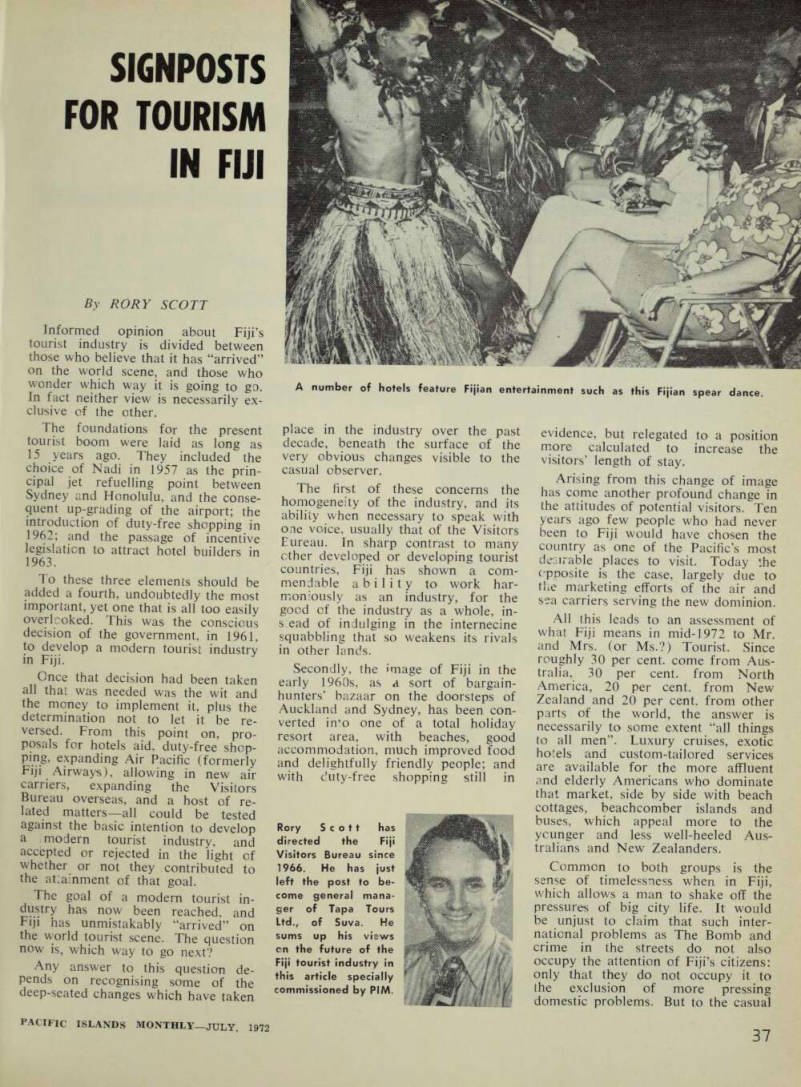


For Tourism
In Fiji
By Rory Scott
Informed opinion about Fiji’s tourist industry is divided between those who believe that it has “arrived” on the world scene, and those who wonder which way it is going to go.
In fact neither view is necessarily ex clusive of the other.
The foundations for the present tourist boom were laid as long as 15 years ago. They included the choice of Nadi in 1957 as the prin cipal jet refuelling point between Sydney and Honolulu, and the conse quent up-grading of the airport; the introduction of duty-free shopping in 1962; and the passage of incentive legislation to attract hotel builders in 1963.
To these three elements should be added a fourth, undoubtedly the most important, yet one that is all too easily overlooked. This was the conscious decision of the government, in 1961, to develop a modern tourist industry in Fiji.
Once that decision had been taken all that was needed was the wit and the money to implement it, plus the determination not to let it be re versed. From this point on, pro posals for hotels aid, duty-free shop ping, expanding Air Pacific (formerly Fiji Airways), allowing in new air carriers, expanding the Visitors Bureau overseas, and a host of re lated matters—all could be tested against the basic intention to develop a modern tourist industry, and accepted or rejected in the light of whether or not they contributed to the atlamment of that goal.
The goal of a modem tourist in dustry has now been reached, and Fiji has unmistakably “arrived” on the world tourist scene. The question now is, which way to go next?
Any answer to this question de pends on recognising some of the deep-seated changes which have taken
place in the industry over the past decade, beneath the surface of the very obvious changes visible to the casual observer.
The first of these concerns the homogeneity of the industry, and its ability when necessary to speak with one voice, usually that of the Visitors Bureau. In sharp contrast to many other developed or developing tourist countries, Fiji has shown a com mendable ability to work har moniously as an industry, for the good of the industry as a whole, in stead of indulging in the internecine squabbling that so weakens its rivals in other lands.
Secondly, the image of Fiji in the early 19605, as a sort of bargain hunters’ bazaar on the doorsteps of Auckland and Sydney, has been con verted in + o one of a total holiday resort area, with beaches, good accommodation, much improved food and delightfully friendly people; and with duty-free shopping still in
evidence, but relegated to a position more calculated to increase the visitors’ length of stay.
Arising from this change of image has come another profound change in the attitudes of potential visitors. Ten years ago few people who had never been to Fiji would have chosen the country as one of the Pacific’s most desirable places to visit. Today the opposite is the case, largely due to the marketing efforts of the air and sea carriers serving the new dominion.
All this leads to an assessment of what Fiji means in mid-1972 to Mr. and Mrs. (or Ms.?) Tourist. Since roughly 30 per cent, come from Aus tralia, 30 per cent, from North America, 20 per cent, from New Zealand and 20 per cent, from other parts of the world, the answer is necessarily to some extent “all things to all men”. Luxury cruises, exotic hotels and custom-tailored services are available for the more affluent and elderly Americans who dominate that market, side by side with beach cottages, beachcomber islands and buses, which appeal more to the younger and less well-heeled Aus tralians and New Zealanders.
Common to both groups is the sense of timelessness when in Fiji, which allows a man to shake off the pressures of big city life. It would be unjust to claim that such inter national problems as The Bomb and crime in the streets do not also occupy the attention of Fiji’s citizens: only that they do not occupy it to the exclusion of more pressing domestic problems. But to the casual
Rory Scott has directed the Fiji Visitors Bureau since 1966. He has just left the post to be come general mana ger of Tapa Tours Ltd., of Suva. He sums up his views on the future of the Fiji tourist industry in this article specially commissioned by PIM.
A number of hotels feature Fijian entertainment such as this Fijian spear dance
How many, how fast, how free?
observer they appear to be matters of no moment, and so the jaded city-dweller on holiday in Fiji is charmed.
So, whither Fiji tourism now?
There are all sorts of possible answers. It could become another Waikiki, catering to numberless, face less hordes only marginally more welcome than the soldiers of an army of occupation. Or another Bermuda, with stringent limitations on num bers, full house signs everywhere, and the certainty that the fat cats of the industry will get ever fatter.
Or a second Singapore, with liberal ised air landing rights and the tourists concentrated where the duty-free shops are, to the joy of the Japanese manufacturers.
It seems to me that the first step must be another conscious decision by the government, such as the one made in 1961. What does the govern ment want the tourism industry, now that it has “arrived”, to do for the social and economic life of Fiji?
TTie best opportunity to make this decision will come about February, 1973, when the report of the con sultants engaged by the World Bank to prepare a master plan for the de velopment of Fiji tourism will be delivered to the cabinet. The fact that this document is being prepared m close consultation with the Ministry for Communications, Works and Tourism—a senior official of the ministry has been seconded to work with the consultants—suggests that its final conclusions and recom mendations are likely to reflect the attitudes of the ministry to the future of the industry, and that it may well towar<^s answering the question Whither Fiji tourism now?’
Even before the report is published it is possible to predict a few of the directions that tourism is most likely to take. The first concerns the future role of Fiji citizens and Fiji capital.
In recent months the feeling has grown among Fiji’s civic, political and religious leaders, that the industry is getting to the stage where it is in danger of becoming the master, nither than the servant, of the people.
Central to this concern is the belief that Fiji, if it ever had full control of its tourism destiny i n the first place, is in danger of losing it now, it indeed it has not already done so. ♦u * , seer P s to me that the airlines, the hotels, the tour operators and the car rental companies must now recognise that the people of Fiji are demanding, and indeed are entitled to, a greater say than hitherto in the
control of the future of tourism.
Already the Native Lands Trust Board has given a lead in meeting this demand, through its new policy of bringing landowners increasingly into the ownership and managerial side of the business. This is being done by leasing Fijian land in con sideration of equity participation by, and a share of the annual income for, the landowners; as well as em ployment opportunities, training in higher skills, and similar fringe bene fits.
Following the NLTB lead, one cruise operator has instituted a profit
sharing scheme for his employees and others may follow suit. If the idea catches on I believe that it may go a long way towards meeting the natural aspirations of the citizens of Fiji for a greater share in the control and direction of tourism development, as well as having the benefit of reducing the chance of labour troubles in the future, and avoiding the bitterness that threatens to submerge the Caribbean tourist industry today.
A third new direction concerns the quality of the tourism product. If Fiji is to be attractive to a million visitors in 1980 as it was to 110,000 in 1971 then something has got to be done to remove the barriers that effectively prevent visitors from
mixing with, and getting to know, the citizens of the country.
At present, almost the only ones they meet are engaged in selling or providing goods or services to the visitors. They rarely, if ever, meet the farmers, teachers and villagers who contribute most of the image of “friendly Fiji”. This situation, if allowed to continue unchecked, must lead to increasing resentments and frustrations instead of to the mutual understanding and goodwill that ought to be the social goal of any tourist industry.
The chances of Fiji avoiding the pitfalls into which other countries have allowed their tourist industries to slide seem to me most promising.
Fiji has a great deal going for her.
To start with, the government is fully aware of the problems inherent in allowing unchecked growth, and the Tourism portfolio is now held by a minister, Ratu Penaia Ganilau, who is very much in touch with the think ing of ordinary people throughout the dominion. Secondly, the industry leaders are a homogenous group, and they include several imaginative men with a deep affection for the country of their birth or adoption.
Perhaps most important of all, there is tremendous goodwill through out the international tourist world for Fiji, and a desire on the part of air line, hotel, shipping and other com pany presidents to ensure that Fiji retains the attractions that have made it “the success story of post war Pacific tourism”, as PlM’s Judy Tudor puts it. When taken together with the local determination that these attractions shall never be thoughtlessly exploited, though it may not be possible to say exactly whither Fiji tourism is going next, at least the future can be faced with confidence.
Fiji's Minister for Tourism, Ratu Penaia Ganilau.
Advertisements & other items, pp. 40-43 (1 item)
Braybon
Guide Bar Saw Type CL Ripping Saw Type S 150/200 C
DOLMAR
Hamburg/Germany
Felling, cutting,
parting, carpentering
DOLMAR
solves your problems Distributors:
BRECKWOLDT & CO. (N.G.) PTY. LTD.
P.O. Box 222, RmBAUL
P.O. Box 1549, Boroko, PORT MORESBY.
P.O. Box 185, MADANG.
P.O. Box 1188, LAE.
P.O. Box 72, KIETA.
P.O. Box 237, MT. HAGEN
P.O. Box 178, WEWAK.
BRECKWOLDT & CO.,
P.O. Box 47, APIA.
BRECKWOLDT & CO. (5.1.) LTD.,
P.O. Box 140, HONIARA.
BRECKWOLDT S.A.R.L., B.P. 65, NOUMEA.
For big trunks of tropical hard wood with diameter up to SO"
Braybon
Diesel electric
set—For site
illumination, AC
appliances,
power tools, etc.
Braybon Bros
PTY. LTD.,
2 ROTHWELL AVENUE, CONCORD WEST 2138.
Tel.: 73-3246.
/portable/
Powered by Lister, Fetter or Honda air-cooled Diesel Engines, 2 kVA to 5 kVA, 240 volt, 50 cycle AC output.
Available Ex-Stock:— Kayco Electrics, P.O. Box 5447, Boroko, Port Moresby.
Export Sales Development Associates, P.O. Box 10159, Auckland, N.Z. 887374/172
<s>
UiCTA
TURNS
GRASS
INTO
LAWN!
A MODEL AVAILABLE TO SUIT ALL
CONDITIONS AND EVERY PURPOSE
SUVA MOTORS LTD.
SUVA, LAUTOKA.
CARPENTERS
PORT MORESBY.
NEW GUINEA CO. LTD.
RABAUL, MADANG,
LAE, MOUNT HAGEN,
MINJ, GOROKO.
Proved best by test
on one of the world’s
toughest truck
testing courses!
It I -1. f *» * m \ j C
I; 'ta
Proved best of all by thousands of owners!
INTERNATIONAL TRUCKS
EXPORT SALES DEPT.
International Harvester Company of Australia Pty. Ltd. 171-205 City Road, South Melbourne, Vic. Aust. 3205.
Please send me complete details of the ACCO Series Trucks
NAME
ACCO Series trucks (with GVW ratings from 15,000 lb. to 35,000 lb.) have been testedand proved-underthe worst conditions you could ever imagine ... conditions far worse than any you are likely to meet!
A top seller in Australia, the top truck in the carrying field, ACCO Series trucks are the ones to buy if you want the best!
Get full details today from your local distributor or send coupon.
ADDRESS
POSTCODE
TAHITI: Tahiti Produits Shelltex Boite Posfale 350, PAPEETE, NEW CALEDONIA: Societe d' Importation Francaise, Boite Postale 806, Noumea, New Caledonia.
FIJI: Niranjan's Auto Port Limited, G.P.O. Box 450, SUVA.
FIJI ISLANDS "NIRANJAN"
NEW HEBRIDES: Kerr Bros. Pty. Limited, G.P.O. Box 3838,
SYDNEY, N.S.W.
SOLOMON ISLANDS: Solomon Motors Limited, P.O. Box Cl 6,
HONIARA. GUADALCANAL BSIP. "SOLMOT"
6710/E/FP
Import
aim Hvn/mm
AIR NEVAJfAI
Export
AIR NEW ZEALAND
AIR CARGO
KEEPS ITS COOL
With unique temperature-controlled cargo holds, AIR NEW ZEALAND air-freights cargo faster, fresher, better.
AIR NEW ZEALAND air cargo can handle practically anything: fish or meat or strawberries or flowers or medical vaccines. Each and every one at exactly the right transport temperatures - cool or cold, chilled or frozen. So take a fresh look at your import/export needs.
Talk to your Freight Forwarder today about air cargo by
AIR NEW ZEALAND.
m new lEAtama mm
The moving part of your marketing arm Regularand frequentaircargoservices,toandfrom New Zealand...
FIJI, SAMOA, TAHITI, NEW CALEDONIA, USA, AUSTRALIA,
HONG KONG, SINGAPORE.
ANZ.GE.B3
drop that
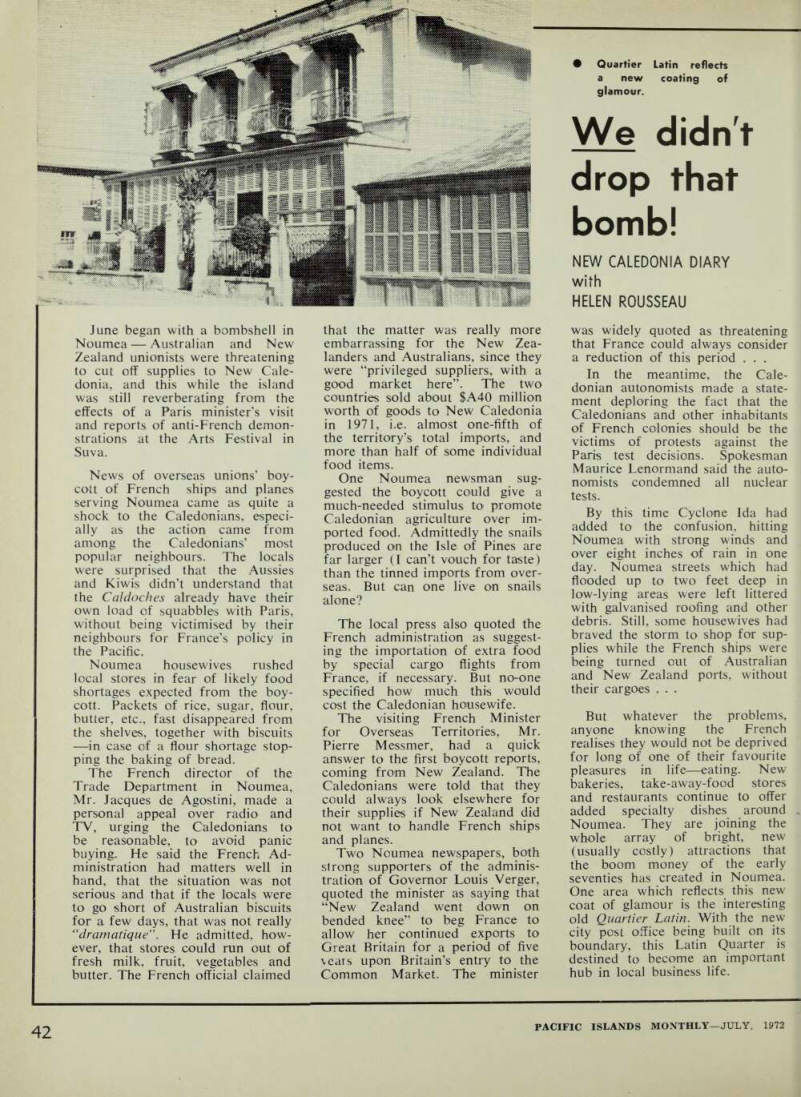
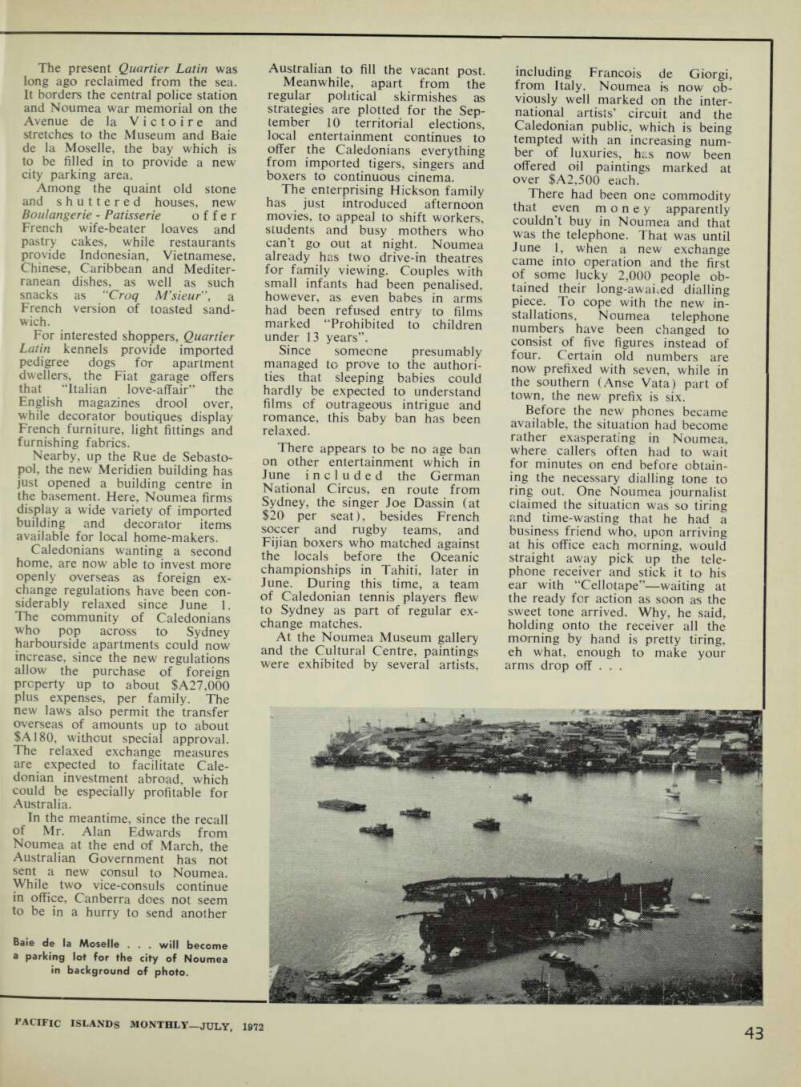
We didn't drop that bomb!
June began with a bombshell in Noumea Australian and New Zealand unionists were threatening to cut off supplies to New Cale donia, and this while the island was still reverberating from the effects of a Paris minister’s visit and reports of anti-French demon strations at the Arts Festival in Suva.
News of overseas unions’ boy cott of French ships and planes serving Noumea came as quite a shock to the Caledonians, especi ally as the action came from among the Caledonians’ most popular neighbours. The locals were surprised that the Aussies and Kiwis didn’t understand that the Caldoches already have their own load of squabbles with Paris, without being victimised by their neighbours for France’s policy in the Pacific.
Noumea housewives rushed local stores in fear of likely food shortages expected from the boy cott. Packets of rice, sugar, flour, butter, etc., fast disappeared from the shelves, together with biscuits —-in case of a flour shortage stop ping the baking of bread.
The French director of the Trade Department in Noumea, Mr. Jacques de Agostini, made a personal appeal over radio and TV, urging the Caledonians to be reasonable, to avoid panic buying. He said the French Ad ministration had matters well in hand, that the situation was not serious and that if the locals were to go short of Australian biscuits for a few days, that was not really “dramatique” . He admitted, how ever, that stores could run out of fresh milk, fruit, vegetables and butter. The French official claimed
that the matter was really more embarrassing for the New Zea landers and Australians, since they were “privileged suppliers, with a good market here”. The two countries sold about SA4O million worth of goods to New Caledonia in 1971, i.e. almost one-fifth of the territory’s total imports, and more than half of some individual food items.
One Noumea newsman sug gested the boycott could give a much-needed stimulus to promote Caledonian agriculture over im ported food. Admittedly the snails produced on the Isle of Pines are far larger (I can’t vouch for taste) than the tinned imports from over seas. But can one live on snails alone?
The local press also quoted the French administration as suggest ing the importation of extra food by special cargo flights from France, if necessary. But no-one specified how much this would cost the Caledonian housewife.
The visiting French Minister for Overseas Territories, Mr.
Pierre Messmer, had a quick answer to the first boycott reports, coming from New Zealand. The Caledonians were told that they could always look elsewhere for their supplies if New Zealand did not want to handle French ships and planes.
Two Noumea newspapers, both strong supporters of the adminis tration of Governor Louis Verger, quoted the minister as saying that “New Zealand went down on bended knee” to beg France to allow her continued exports to Great Britain for a period of five vears upon Britain’s entry to the Common Market. The minister
New Caledonia Diary
with
Helen Rousseau
was widely quoted as threatening that France could always consider a reduction of this period . . .
In the meantime, the Cale donian autonomists made a state ment deploring the fact that the Caledonians and other inhabitants of French colonies should be the victims of protests against the Paris test decisions. Spokesman Maurice Lenormand said the auto nomists condemned all nuclear tests.
By this time Cyclone Ida had added to the confusion, hitting Noumea with strong winds and over eight inches of rain in one day. Noumea streets which had flooded up to two feet deep in low-lying areas were left littered with galvanised roofing and other debris. Still, some housewives had braved the storm to shop for sup plies while the French ships were being turned out of Australian and New Zealand ports, without their cargoes . . .
But whatever the problems, anyone knowing the French realises they would not be deprived for long of one of their favourite pleasures in life—eating. New bakeries, take-away-food stores and restaurants continue to offer added specialty dishes around Noumea. They are joining the whole array of bright, new (usually costly) attractions that the boom money of the early seventies has created in Noumea, One area which reflects this new coat of glamour is the interesting old Quartier Latin. With the new city post office being built on its boundary, this Latin Quarter is destined to become an important hub in local business life.
• Quartier Latin reflects a new coating of glamour.
The present Quartier Latin was long ago reclaimed from the sea.
It borders the central police station and Noumea war memorial on the Avenue de la Vict o i r e and stretches to the Museum and Baie de la Moselle, the bay which is to be filled in to provide a new city parking area.
Among the quaint old stone and shuttered houses, new Boulangerie - Patisserie offer French wife-beater loaves and pastry cakes, while restaurants provide Indonesian, Vietnamese, Chinese, Caribbean and Mediter ranean dishes, as well as such snacks as “Croq M’sieur”, a French version of toasted sand wich.
For interested shoppers, Quartier Latin kennels provide imported pedigree dogs for apartment dwellers, the Fiat garage offers that “Italian love-affair” the English magazines drool over, while decorator boutiques display French furniture, light fittings and furnishing fabrics.
Nearby, up the Rue de Sebasto pol, the new Meridien building has just opened a building centre in the basement. Here, Noumea firms display a wide variety of imported building and decorator items available for local home-makers.
Caledonians wanting a second home, are now able to invest more openly overseas as foreign ex change regulations have been con siderably relaxed since June 1.
The community of Caledonians who pop across to Sydney harbourside apartments could now increase, since the new regulations allow the purchase of foreign property up to about $A27,000 plus expenses, per family. The new laws also permit the transfer overseas of amounts up to about SAIBO, without special approval.
The relaxed exchange measures are expected to facilitate Cale donian investment abroad, which could be especially profitable for Australia.
In the meantime, since the recall of Mr. Alan Edwards from Noumea at the end of March, the Australian Government has not sent a new consul to Noumea.
While two vice-consuls continue in office, Canberra does not seem to be in a hurry to send another
Australian to fill the vacant post.
Meanwhile, apart from the regular political skirmishes as strategies are plotted for the Sep tember 10 territorial elections, local entertainment continues to offer the Caledonians everything from imported tigers, singers and boxers to continuous cinema.
The enterprising Hickson family has just introduced afternoon movies, to appeal to shift workers, students and busy mothers who can’t go out at night. Noumea already has two drive-in theatres for family viewing. Couples with small infants had been penalised, however, as even babes in arms had been refused entry to films marked “Prohibited to children under 13 years”.
Since someone presumably managed to prove to the authori ties that sleeping babies could hardly be expected to understand films of outrageous intrigue and romance, this baby ban has been relaxed.
There appears to be no age ban on other entertainment which in June included the German National Circus, en route from Sydney, the singer Joe Dassin (at $2O per seat), besides French soccer and rugby teams, and Fijian boxers who matched against the locals before the Oceanic championships in Tahiti, later in June. During this time, a team of Caledonian tennis players flew to Sydney as part of regular ex change matches.
At the Noumea Museum gallery and the Cultural Centre, paintings were exhibited by several artists,
including Francois de Giorgi, from Italy. Noumea is now ob viously well marked on the inter national artists’ circuit and the Caledonian public, which is being tempted with an increasing num ber of luxuries, has now been offered oil paintings marked at over $A2,500 each.
There had been one commodity that even money apparently couldn’t buy in Noumea and that was the telephone. That was until June 1, when a new exchange came into operation and the first of some lucky 2,000 people ob tained their long-awaked dialling piece. To cope with the new in stallations, Noumea telephone numbers have been changed to consist of five figures instead of four. Certain old numbers are now prefixed with seven, while in the southern (Anse Vata) part of town, the new prefix is six.
Before the new phones became available, the situation had become rather exasperating in Noumea, where callers often had to wait for minutes on end before obtain ing the necessary dialling tone to ring out. One Noumea journalist claimed the situation was so tiring and time-wasting that he had a business friend who, upon arriving at his office each morning, would straight away pick up the tele phone receiver and stick it to his ear with “Cellotape”—waiting at the ready for action as soon as the sweet tone arrived. Why, he said, holding onto the receiver all the morning by hand is pretty tiring, eh what, enough to make your arms drop off . . .
Bale de la Moselle . . . will become a parking lot for the city of Noumea in background of photo.
Advertisements & other items, pp. 46-48 (3 items)
Continually growing
AUSTRALIA’S FOREMOST
GLASS MERCHANTS ANO
MIRROR MANUFACTURERS
• SHEET, FIGURED ROLLED & PLATE •
GLASS
• "ARMOURPLATE” GLASS •
• ANTI-GLARE & HEAT ABSORBING
GLASS •
• LAMINATED & TOUGHENED •
AUTOMOTIVE GLASS •
• GLASS LOUVRE BLADES •
• GLASS BENDING •
• GLAZING BARS •
••COPPERBAK" MIRROR—
CUT-TO-SIZE & STOCK SIZES
FRAMED & UNFRAMED
DECORATIVE WALL MIRRORS
CHEVAL MIRRORS
VANITY TABLE MIRRORS
ONE-WAY VISION MIRRORS
SHOP FRONTS
METAL MOULDINGS
"KAWNEER” ALUMINIUM SECTIONS
• ENTRANCE DOORS & SCREENS
• "ARMOURPLATE” DOORS
• "AQUALITE" SHOWER SCREENS
• MODULAR PARTITIONING
• "U-RECT-IT” STORE EQUIPMENT
• GLASS & SHOP FITTING TRADE
TOOLS. HARDWARE & SUPPLIES
• "COWDROY” & "LIDCO” SLIDING
GLASS DOORS & WINDOWS
• CARD KEY SECURITY SYSTEMS
ORDERS AND ENQUIRIES THROUGH THE GENERAL MERCHANTS IN YOUR AREA Catalogues and Price Lists Available
FRANK G. O’BRIEN LTD.
223 Botany Rd„ Waterloo. N.S.W. 2017—Telegrams, FOBRON, Sydney
TELEPHONE SYDNEY 69 0466
Continually growing
in popularity
HELLABYS CANNED MEATS
‘CROWN’
‘PACIFIC’ HELLABY
‘ARROW’
&> c V 1 * il cT'Z 9f* \Y
From the
Islands Press
From an editorial in the 'Samoa Times': During the controversy over the cost of bread, it was suggested that duty on flour be removed.
“An alternative source for the ‘lost’ had to be first found” was the reply. The same answer was given when the Samoa Times suggested that the export duty was a penalty on the producers and should be abolished. In fact, this standard answer has echoed and re-echoed across the peeling, rotting ceiling of the old Fale Fono whenever requests were made for water and electricity supplies, health and educational requirements, roads and plantation improvements.
The new expensive Fale Fono will, without doubt, hear the same refrain. Not one word has been said about the source for the amount of more than $i million now required for the public servants’ salary increases and NPF subsidy, deserved though they may be.
"Definition" from the US Trust
Territory 'Micronitor':
DEVELOP, v.t. to irreversibly destroy the life-supporting capacity of land in the name of progress (fr. old American, "develop the West", in which the original American Indian inhabitants were dispossessed of their lands).
DEVELOPMENT, n. act of subversively undermining a people's means of livelihood. Mic. si. the entrance of large American firms into the islands, syn. getting screwed.
Extract from a report in the 'Norfolk Islander' on a survey by CSIRO entomologists on the prospects of introducing the Dung Beetle to the island: I don’t have to tell any of you that there is plenty of scope for the beetle on Norfolk Island.
It is quite evident that there is a large quantity of cow dung everywhere—all along the
roads—and clearly nothing is
clearing this away.
From 'This and That' in the 'Tonga Chronicle': A friend following a bus on the way to the airport last Saturday noticed many of the passengers sitting with their rear ends out of the windows. The reason was obvious when the bus reached its destination. A 40-seater bus disgorged 73 passengers plus the driver.
From the American Samoa 'News Bulletin': Shortly before noon Saturday, a misunderstanding between two bay area villages resulted in a serious fight during which several persons were injured. There was a gun involved
and at least one shot was fired in the air—but the injuries resulted from an exchange of stones. Police officials and chiefs of the villages involved went to work immediately to settle the dispute and prevent further violence.
By Sunday, reports were circulating that two persons had been shot to death and 10 others suffered gunshot wounds.
The Police Department said reports of gunshot wounds were absolutely untrue. The incident was unfortunate, but the spreading of false rumours is additionally embarrassing to the villages involved and the people of those villages.
From a letter by Tebano Tekabaro, crewman in Hapag Lloyd's ship "Roland Bremen", in the GEIC's 'lnformation Notes': We once had a match with a Spanish team, trying to represent our Colony in soccer on the field dose to our port, Middlesbrough in the north-east of England.
We played so rough against those people but we lost the game by 4-2. When the game was over we could hear the whispers of the spectators saying, “Where are these people from?” And we pretended we were from Papua New Guinea! From that day on, nobody would compete with us in a soccer match as we had been found to be rough players. So my warning goes to team captains in the Colony: obey the rules and play fair. Nobody will challenge a rough team anywhere in the world.
Extract from article by Jo Mathieson in the Arawa 'Bulletin' on the effects of constitutional changes in Papua New Guinea: The black elite will soon be taking over the reins of government. Whites have been rejected and European influence is being undermined. Everywhere the local people are demanding more and no longer can we stand in their way as paternalistic white superiors . . . Without total European awareness and acceptance of local rule, predictions of violence and unrest, overthrow of white businesses and banishment of Europeans may well be feared It is just necessary for whites to learn to remember that they will no longer be the predominantly influential minority in a black country, and act accordingly —for the usual peace, stability and prosperity that has for so long been accepted as normal is about to undergo enormous strains of tension.
Extract from a letter by Sheik H. Basha of the University of the South Pacific in 'The Fiji Times': I consider that a lot of schools in Fiji are concerned too much with external examinations. The fewer the exams, the better it would be for our future generation.
It would be better to look at our own problems such as the need for better and healthier crops than have teachers simply telling children what to put on the paper to get better marks in the exams . . . More thought should be given to improving the standard of education in Fiji than to giving children "free" education . . . free education can come later when the country can afford it.
From Agriculture News in the GEIC's 'lnformation Notes':
The department cannot accept any responsibility
for operations on cats, whether Euthanasia or just Emasculation. Any activities in this field are done as personal favours by certain members of staff and not in an official capacity.
Burns Philp
L/\
THE PACIFIC
FIJI,SAMOA,TONGA,NIUE Is.
BURNS PHILP
(SOUTH SEA]
REGISTERED OFFICE: SUVA, FIJI.
TELEPHONE NO: 22661
TELEX NO: FJ1127
Code Address: "BURNSOUTH";
SHIPPING AGENCIES
The New Zealand Shipping Co. Ltd.
Shaw Savill & Albion Co. Ltd.
Blue Star Port Line (Management) Ltd.
Bank Line Ltd.
General Steamship Corporation Ltd.
Compagnie des Messageries Maritimes Royal Interocean Lines Daiwa Navigation Company Ltd.
Sitmar Line Flotta Lauro (Lauro Lines) Australasia Pty. Ltd.
Tonga Shipping Agency.
Karlander Kangaroo Line
EXCLUSIVE
DISTRIBUTORSHIPS
INCLUDE
Akai Taperecorders Sunbeam Appliances Dunlop Products Hitachi Electronics Holden Motor Vehicles Rolex Watches Revlon Cosmetics Pentax Cameras Massey-Ferguson Tractors Olympic Tyres Penfold Wines
AGENTS FOR
Queensland Insurance Co. Ltd.
Shell Company (P.l.) Ltd.
Bureau Veritas
ASSOCIATED COMPANIES
Burns Philp (New Hebrides) Ltd.
Burns Philp Trustee Co. Ltd.
Automotive Supplies Co. Ltd.
Corrie & Co. Ltd.
Wrought Iron and Steel Construction Co. Ltd.
Bish Ltd.
SPECIALISED SERVICES
Expert advice on Shipping; Forwarding; Customs formalities; Insurance.
COMPLETE TRAVEL
SERVICE
accredited agents for the
INTERNATIONAL AIR
TRANSPORT ASSOCIATION
OVERSEAS AGENTS: SYDNEY • LONDON • SAN FRANCISCO
the cost of diplomacy
Western Samoa looks at the cost of diplomacy
From FELISE VA’A in Apia
Western Samoa’s Government has decided to establish formal diplomatic relations with New Zealand and ap point a high commissioner who will be installed in a suitable residence in Wellington, as PIM reported in June.
And it’s that phrase “suitable resi dence” and all that goes with it which is causing more than a little heart burning in Western Samoa. “It’s a waste of time and money,” grumble the critics.
The decision to set up the diplo matic mission was made a long time ago but was kept secret because the cabinet feared premature announce ment would bring in a flood of appli cations. The flood materialised and gave the cabinet a headache. Who should get the job?
The second, and bigger headache is the grumbles of critics. Apparently, the government intends to do the thing in proper style with an elegant residence, a staff and all the frills which go with such a post. The critics moan that a high commission would be a waste of time and money.
The New Zealand Government, they felt, was already doing a fine job representing Western Samoa in the international capitals of the world.
Besides, they said, the money to go into the salaries for a high commis sioner and expenses would be better put to use in improving the standard of living in Samoa. (Samoa is one of the poorest countries in the world according to a recent United Nations survey.) On the other hand, proponents of the scheme argue the establishment of a high commission in New Zealand would better serve the in terests of the Western Samoan Gove n ? en *' As one top government official put it, “Western Samoa has many dealings with New Zealand: in trade, and in immigration for example. But above all, in matters to do with New Zealand aid to Western Samoa. Western Samoa,
• The US Department of Com merce has made a grant of SUS9BO,OOO to American Samoa.
The money will be used to develop an 80-acre industrial area at Tafuna, close to Pago Pago’s international airport. The development will create 300 new jobs.
therefore, needs a full time repre sentative in New Zealand”.
But these are not the only con siderations which compelled the cabinet to go ahead with the pro ject. Several years ago, Mac Fonoti, the president of the Samoan Pro gressive Movement in New Zealand, visited Samoa to persuade the cabinet to appoint a high commissioner to
New Zealand. Fonoti himself told me he had seen many cabinet ministers and had discussed this matter with them.
Fonoti said it was ridiculous that Western Samoa should appoint a consul in the United States and not appoint a representative to handle the interests of Samoans living in New Zealand. But he appeared to empha sise the need for the representative in New Zealand to be of diplomatic status.
It is quite possible cabinet was in fluenced by Fonoti. It is very prob able its members saw the time was ripe for such diplomatic representa tion. Perhaps it was time to break New Zealand’s spell.
Advertisements & other items, p. 49 (1 item)
Queensland
BENEFIT FROM 86 YEARS
OF INSURANCE EXPERIENCE
INSURANCE
Company Limited
(IN corporat E d 1886 IN AUSTRALIA) HEAD OFFICE: 82 Pitt Street, Sydney Fl J* —Branch Office, Suva, Manager for Fiji: K. Galloway.
LAUTOKA, BA, LEVUKA, LABASA—Burns Philp (South Sea) Co. Limited. District Manager at Lautoka: U. Sineh.
PAPUA-NEW GUlNEA—Branch Office, Port Moresby: Manager for Papua & New Guinea: D. J. Granter
SAMARA!, LAE, MADANG, RABAUL, KAVIENG,
MT. HAGEN—Bums Philp (New Guinea) Limited.
District Manager at Rabaul: C. D. Dickings. Acting District Manager at Lae: B. Wain. District Manager at Mt. Hagen* G. F. Donnelly.
HONIARA (b.s.i.p.) —Breckwoldt & Company (s I ) Pty. Limited.
NOUMEA—-W. Johnston.
VlLA—Burns Philp (New Hebrides) Limited.
SANTO—Bums Philp (New Hebrides) Limited.
NORFOLK ISLAND—Bums Philp (South Sea) Co. Limited.
TAHlTl—Arthur Chung; Immeuble B. 1., Front deMer, Papeete OTHER SOUTH SEA ISLANDS—Bums Philp (South Sea) Co. Limited.
Assets exceed 5A65,000,000
fiji talanoa
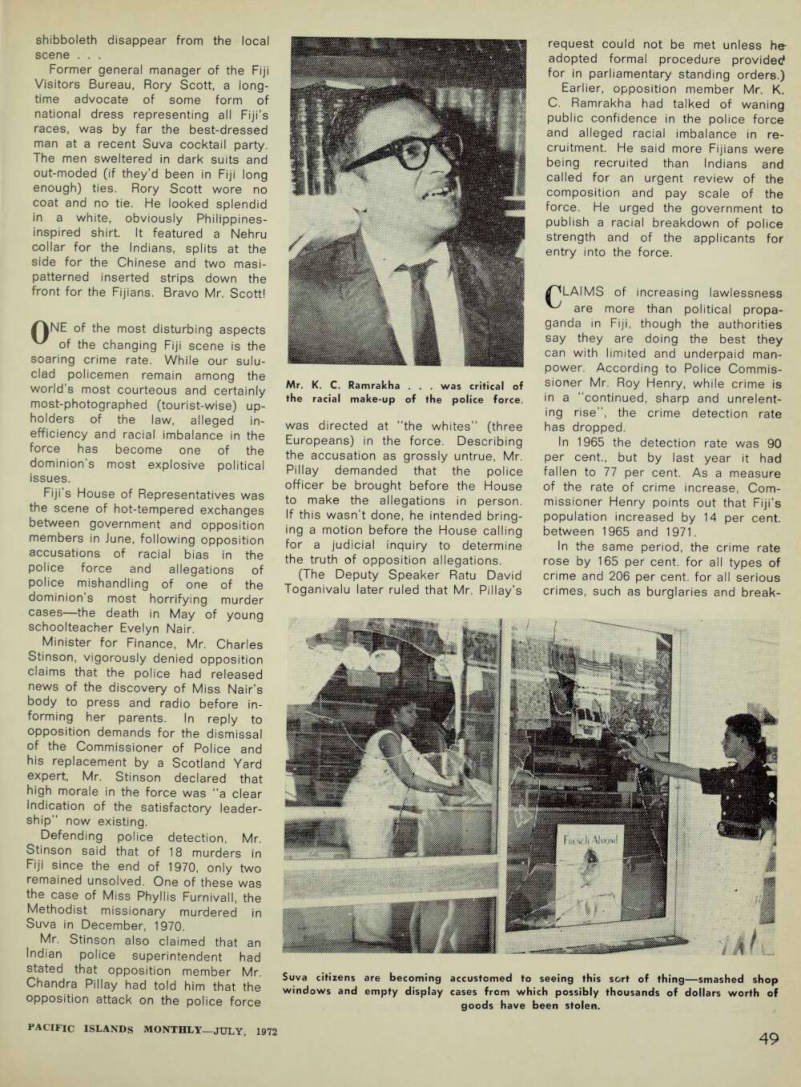

With Sue Wendt, In Suva
Progress provides a problem for policemen and others
NOBODY could accuse Fiji of mark ing time since independence.
The boom-time is upon us —and Fiji is paying the price, with inflation, militant trade unionism, soaring crime and all the other unpleasant side effects of hell-bent development.
Plenty of people would like to see things move a lot faster. A US busi nessman remarked to me recently that Fiji’s big stumbling block was that it still "thinks in hundreds and thous ands of dollars when it talks about overseas investment here. When you start talking millions, some people in government seem to switch right off.
They just don’t want to know,” he
grumbled.
That’s one side of the story, and he’s not the only one to claim that
the machinery facilitating really big
investment, particularly finance from outside the sterling bloc, needs a major overhaul in Fiji. But let's not gainsay the need for caution. Nasty terms like exploitation and foreign control and "incredible profits” are anathema to developing countries.
Playing it cool doesn’t seem such a bad idea, when you’re busy sorting out priorities.
OOME pretty fair sense was espoused in Fiji recently by visiting lecturer from Trinidad, economist Dr.
Lloyd Best (who'd also been to New Guinea). 1 don’t know how popular his ideas are in the West Indies, where he is a founder of a group of young social scientists proposing radical reforms in West Indian society, but when he talked about
Fiji’s own potential, he gave good
advice. The gist of it was that Fiji people had every reason for confi dence in their own ability to cope with the country's problems in their own way. They should be wary of "importing the shibboleths of other countries”, making them think they couldn’t do things themselves.
Not all of what Dr. Best had to say bore much relevance to the Fiji
situation. He was pretty unpopular in some quarters with his talk about the "blinds created by colonial thought and colonial education" and his claim that "colonial mentality” was preventing Fiji from fully utilis ing its wit, resources and intelligence.
And when he urged Fiji to disavow the idea that it is "too poor, too back ward or too black” to manage its own affairs he was obviously quite out of touch with the spirit which moved Fiji to independence.
But there’s something to be said for questioning what Dr. Best called "all the deadly orthodoxy about de velopment, aid and so on”. "Why this mad rush to be like New York?” he asked. Fiji’s problem, as he saw it, was to find a way of "unleashing the native genius and breaking out of development rhetoric”. He called tourism “invitation industrialisation" and said it was a dangerous course to embrace it on a large scale. A slower but safer road for Fiji was to rely on its own resources. The type of tourism that would develop then could be coped with and be part of the natural, organic growth.
ICAN hear the hoots of derision and the shouts of “bunkum” and "bosh” from developers currently pouring millions into Fiji. You can’t halt progress! Of course not, but you can control its direction. The idea that "more and faster is better” isn’t necessarily true for these islands.
Has anyone taken a really serious look at the long-term environmental effect of the new estate for heavy industrial development, just three miles from Suva, for instance? You only have to talk with one of the
social workers from Suva’s rabbit warren Raiwaqa Housing Estate to realise the immense adjustment prob lems facing thousands of young Fijians transplanted into a wholly un familiar environment in the aftermath
of "progress”.
DEOPLE are beginning to question the quality of life in Fiji, though perhaps not the right people and perhaps not loudly enough. In urban areas, the very thing the tourism entrepreneurs are selling so success fully—the life-style of the Fijians—is going the way of the dodo. Fijian leaders are seriously concerned by the Fijian community’s lack of busi ness initiative. The faster Fiji de velops, the faster Fijians have to run to catch up, though what they're running from and what they’re chas ing after begins in the end to repre sent much the same thing.
Perhaps there’s a touch of that "native genius” Lloyd Best talked about in not running too fast. An educationist who visited Viti Levu recently (Viti Levu isn’t Fiji, but it’s an indication of what Fiji can become) was disturbed about various trends, including the number of cars. He suggested that bicycles might be more appropriate if Fiji wanted to avoid the insane pace of some other places. It’s not such a stupid sug gestion. Even New York has its growing army of enlightened souls, pedalling happily and healthily to work each day!
There are various ways of bucking what Lloyd Best termed the "colonial mentality”. I guess he wasn’t think ing of such trivialities as dress —but there’s at least one Fiji citizen who’d like to see the old collar-and-tie
shibboleth disappear from the local scene . . .
Former general manager of the Fiji Visitors Bureau, Rory Scott, a long time advocate of some form of national dress representing all Fiji’s races, was by far the best-dressed man at a recent Suva cocktail party.
The men sweltered in dark suits and out-moded (if they’d been in Fiji long enough) ties. Rory Scott wore no coat and no tie. He looked splendid in a white, obviously Philippines inspired shirt. It featured a Nehru collar for the Indians, splits at the side for the Chinese and two masi patterned inserted strips down the front for the Fijians. Bravo Mr. Scott! /"\NE of the most disturbing aspects of the changing Fiji scene is the soaring crime rate. While our sulu clad policemen remain among the world’s most courteous and certainly most-photographed (tourist-wise) up holders of the law, alleged in efficiency and racial imbalance in the force has become one of the dominion’s most explosive political issues.
Fiji’s House of Representatives was the scene of hot-tempered exchanges between government and opposition members in June, following opposition accusations, of racial bias in the police force and allegations of police mishandling of one of the dominion’s most horrifying murder cases—the death in May of young schoolteacher Evelyn Nair.
Minister for Finance, Mr. Charles Stinson, vigorously denied opposition claims that the police had released news of the discovery of Miss Nair’s body to press and radio before in forming her parents. In reply to opposition demands for the dismissal of the Commissioner of Police and his replacement by a Scotland Yard expert, Mr. Stinson declared that high morale in the force was "a clear indication of the satisfactory leader ship” now existing.
Defending police detection, Mr.
Stinson said that of 18 murders in Fiji since the end of 1970, only two remained unsolved. One of these was the case of Miss Phyllis Furnivall, the Methodist missionary murdered in Suva in December, 1970.
Mr. Stinson also claimed that an Indian police superintendent had stated that opposition member Mr.
Chandra Pillay had told him that the opposition attack on the police force
was directed at "the whites” (three Europeans) in the force. Describing the accusation as grossly untrue, Mr.
Pillay demanded that the police officer be brought before the House to make the allegations in person.
If this wasn’t done, he intended bring ing a motion before the House calling for a judicial inquiry to determine the truth of opposition allegations. (The Deputy Speaker Ratu David Toganivalu later ruled that Mr. Pillay’s
request could not be met unless he adopted formal procedure provided
for in parliamentary standing orders.)
Earlier, opposition member Mr. K.
C. Ramrakha had talked of waning public confidence in the police force and alleged racial imbalance in re cruitment. He said more Fijians were being recruited than Indians and called for an urgent review of the composition and pay scale of the force. He urged the government to publish a racial breakdown of police strength and of the applicants for entry into the force. of increasing lawlessness are more than political propa ganda in Fiji, though the authorities say they are doing the best they can with limited and underpaid man power. According to Police Commis sioner Mr. Roy Henry, while crime is in a "continued, sharp and unrelent ing rise", the crime detection rate
has dropped.
In 1965 the detection rate was 90 per cent., but by last year it had fallen to 77 per cent. As a measure of the rate of crime increase, Com missioner Henry points out that Fiji’s population increased by 14 per cent, between 1965 and 1971.
In the same period, the crime rate rose by 165 per cent, for all types of crime and 206 per cent, for all serious crimes, such as burglaries and break
Suva citizens are becoming accustomed to seeing this sort of thing—smashed shop windows and empty display cases from which possibly thousands of dollars worth of goods have been stolen.
Mr. K. C. Ramrakha . . . was critical of the racial make-up of the police force.
ins, assaults and malicious damage.
Commissioner Henry blamed the drop in the detection rate on limited police manpower for preventive and detection duties, but said this was being countered by expansion of the force. Traffic accidents had also increased last year. In the 2,382 re ported accidents, 57 people were killed and 98 seriously injured.
Theft has become almost a way of life in Fiji's urban areas, with break in experts making increasingly large hauls. During a three-week period in May, for instance, it was reported that thieves had stolen $4,000-worth of goods from a Suva store, wrist watches and cameras worth $5,000 from a Lautoka shop (the third raid on the same shop this year), $585 in cash from a Nausori shop and car penters’ tools worth $3OO at Ba.
Two big payroll robberies, one in volving $1,200 snatched from a build ing company employee at Sigatoka and another $1,500 stolen from a lumber company employee at Lautoka, were reported in the same period.
AS a result of the payroll rob beries, a Fiji security company was planning to introduce a new service in June—a payroll pickup-and deliver service, complete with armed security guards and van. “We don’t need a bullet-proof van of course but the guards will be armed,” said Mr. Ray Dunstan, director of General Security Services (Fiji) Ltd.
The company is planning to import a new German breed of guard dog, a cross between a Staghound and a Doberman.
It already offers a night-patrol service for Suva residents willing to pay a few dollars a week for the protection. “We currently service about 20 homes in the Suva area," said Mr. Dunstan. “A man and a dog patrol on foot and we guarantee that they’ll visit each home at least three times a night, at irregular inter vals.”
The home patrol service was estab lished six months ago, after a spate of robberies in the Suva suburb of Lami. So concerned were residents that some actually moved to other suburbs. “The Lami situation has im proved in recent months, I’d say as a direct result of our security ser vice, said Mr. Dunstan. “Even homes which aren't actually on our books benefit from the fact that a security guard patrols the area.”
Advertisements & other items, pp. 52-54 (1 item)
We Represent Are
SOME OF THE FIRMS
Frappier (French Brandy) Huvet (French Brandy) Indika (Belgium Dairy Produce) Durobor S.A. (Belgium Glassware) AAiroiterie Gen. de Belgique S.A. (Louvre glass and mirrors) City Engineers (U.K. Bicycles) F.H.I. Japan (Subaru Cars) Sunshine Biscuits Sunrise (Confectionery) Flamenco (Instant Coffee & Tea) Quaker Products (Oats, Jets) Merchants (Canned Soft Drinks, Cordials) Hancocks (Spaghetti, Cereals) Melbourne Canning (Jams) Water Wheel (Flour, Sharps, Wheat) A. P. & D. (Twisties, Twirlies) Edward Zorn (Margarine, Cooking Fats) Allens (Confectionery) Red Tulip (Fine Chocolates) Robert Timms (New Guinea Gold Instant Coffees and Teas) Highness (Canned Vegetables, Fruit Juices) S.P.C. (Abalone) Lunchtime (Honey) Wing Lee (See You Sauce) Hardings (Sauces) Magnet (Mattresses) Essteel (Cookware) Warner-Drayton (Fans) Mitchell's (Abrasives) Regent (Swiss watches) Austramax (Pressure Lanterns) Preservene (Soap Products) Lawn Chair; Tubco (Garden Furniture) Sunrise Lustertone (S.S. Sinks, Plumbers Supplies) Electronic Industries (Electrical Household Appliances) Jex (Steelwool) Arnbro (Folding Beds) Elmaco (Plastics —Electrical Fittings) B.X. (Plastics) Franklite (Light Fittings) JJ. Cash (Embroidered Labels) Disston (Saws) Supa-Swift (Motor Mowers, Tractors)
DIRECT ENQUIRIES WELCOMED
ASSOCIATE COMPANY
S. E. TATHAM (FIJI) LTD.,
LAUTOKA, P. 0., BOX 366.
SUVA, G.P.0., BOX 671.
SINCE 1924
.•.v.v. •.*.*. v.v. •.v.v.v.v.v XvlyXvX
For all classes
o£
Personal
Industrial
Commercial
Insurance
Our advice is at
Your service
ARVE Y TRI N I
Insurance Brokers Insurances at Lloyd's and Companies $ Hunter Street, Port Moresby. Tel. 2241-2 X Agents:
X STEAMSHIPS TRADING COMPANY LIMITED
•;I Port Moresby, Samarai, Popondetta, Goroka, Mount X Hagen, Rabaul, Madang and Kieta, Bougainville. £ R. W. MANFIELD, Bulolo.
*£ MACDONALD HAMILTON
X TRADING COMPANY PTY. LTD., Lae.
X D. J. GUBBAY & COMPANY (N.H.) PTY. LTD.
X Honiara.
HT.4169R
ith SANSUI 4-channel stereo
~,, 48
QSP-10
Australia (including Lord Howe and Thursday Is.), 8.5.1. P., Gilbert and Ellice Is Papua-New Guinea, Norfolk Island, Nauru, Tonga and New Hebrides ..
New Zealand Fiji, Cook Islands, Niue and Western Samoa American Samoa U.S. Mainland, Micronesia (including Guam) Hawaii New Caledonia Tahiti and French Polynesia United Kingdom and Elsewhere ..
Please enrol me as a subscriber to “Pacific Islands Attached find payment of for
subscription.
□ NEW □ RENEWAL
(CAPITAL LETTERS)
Monthly”.
. . . years
NAME
ADDRESS
COUNTRY
With Sansui’s QSP Consolidator QS-KX or QS-500 4-Channe enjoy the incompar of 4-channel stereo lies in a 4-channel f magically transforms 2-channel sources, such as records, tapes, and FM broadcasts, into breathtaking “live sound field” concert-hall realism. QSP-10 combines this with a 20-watt stereo power amplifier and a set of highperformance 15-watt speaker systems. Hook it up with your present hi-fi system and —presto — you’ve got a complete, compact 4-channel stereo system that will quadruple your listening pleasure. QS-100 combines the 4-channel
PACIFIC ISLANDS MONTHLY
Box 3408, G.P.0., Sydney, N.S.W. 2001, Australia. 29 Alberta Street, Sydney, N.S.W. 2000.
JULY, 1972—PACIFIC ISLANDS MONTHLY
Sansui recommends its 210 A solid-state SW/MW tuner with stereo amplifier. It provides sensitive reception in both MW and SW bands, 36 watts of music power, and a wide 30 to 25,000 Hz power bandwidth, while limiting distortion to less than 1%. 210 A j Sansui products are available through: VE r f.. R ADIO ltd. Teerad House 13, Midstone Street, Grey Lynn Auckland 2, New Zealand. Tel: 76 3064/PRABHU BROTHERS LTD. P.O. Box 183, Nad! Fui Islands. Tel: 7 0183/SERVONNAT Rue de Polius, Papeete, Tahiti. Tel: 03-29/OCEANIA INDENT AGENCY P.O. Box 5518, Boroko, Port Moresby, Papua New Guinea. Tel: 5 6406/MICHEL MERCIER Angle Des Rues Alma-Sebastopol B.P. 1123 Noumea, Nouvelle-Caledonie. Tel: 59-11 et 40-78/SANSUI ELECTRIC CO., LTD. 14-1, 2-chome, Izumi, Suginami-ku, Tokyo, Japan.
Cultural Revival
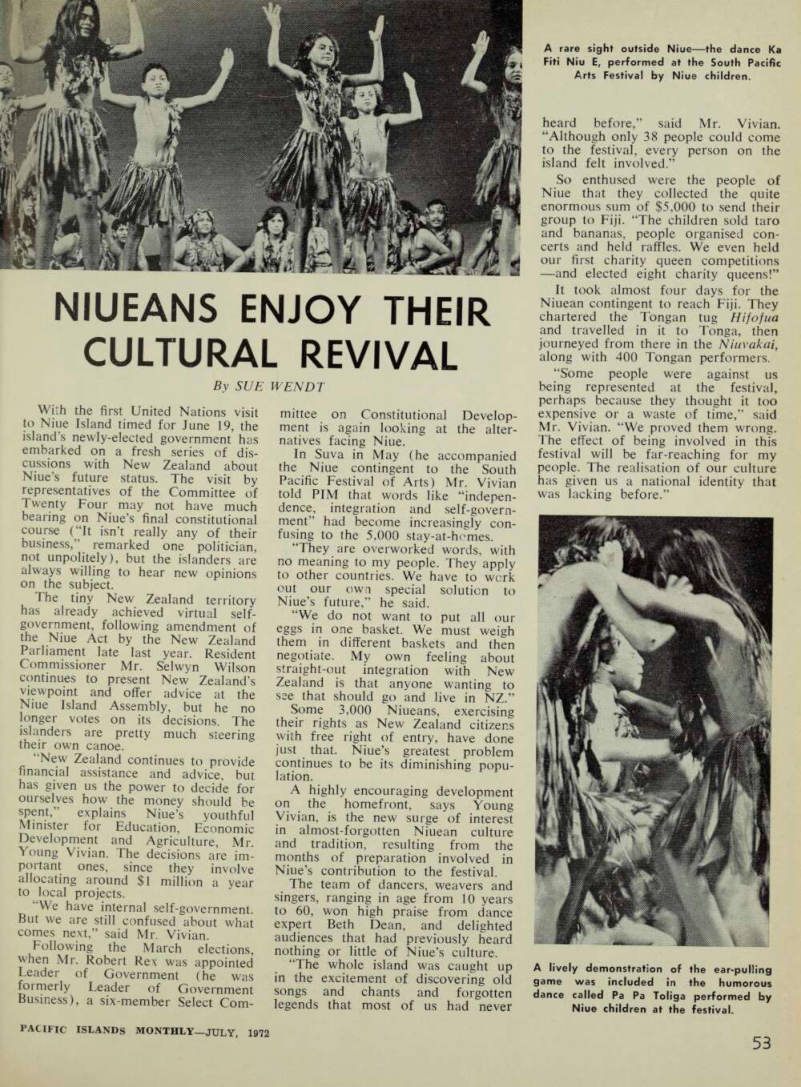
Niueans Enjoy Their
By Sue Wendt
With the first United Nations visit to Niue Island timed for June 19, the island s newly-elected government has embarked on a fresh series of discussions with New Zealand about Niue s future status. The visit by representatives of the Committee of Iwenty Four may not have much bearmg on Niue s final constitutional course ( It isn’t really any of their business, remarked one politician, not unpolitely), but the islanders are always willing to hear new opinions on J he s y b J ec t- Ihe tiny New Zealand territory has already achieved virtual selfgovernment following amendment of the Niue Act by the New Zealand Parliament late last year. Resident Commissioner Mr. Selwyn Wilson continues to present New Zealand’s viewpoint and offer advice at the Niue Island Assembly, but he no longer votes on its decisions. The is anders are pretty much steering ,■ • New Zealand continues to provide hnancial assistance and advice, but has given us the power to decide for ourselves how the money should be pent, explains Niue’s youthful Minister tor Education, Economic Development and Agriculture, Mr.
Young Vivian. The decisions are important ones, since they involve a ocating around $ 1 million a year t 0 “w Ca h P ro lf cts - We have internal self-government.
But we are stm confused about what comes next, said Mr. Vivian. „/ oll ?r n I J he „ March elections, T e ? . Robert Rex was appointed Leader of Government (he was formerly Leader of Government usmess), a six-member Select Com-
mittee on Constitutional Develop ment is again looking at the alter natives facing Niue In Suva in May’(he accompanied the Niue contingent to the South Pacific Festival of Arts) Mr. Vivian told PIM that words like “indepen dence, integration and self-govern ment” had become increasingly con fusing to the 5,000 stay-at-homes, “They are overworked words, with no meaning to my people. They apply to other countries. We have to work out our own special solution to Niue’s future,” he said, “We do not want to put all our eggs in one basket. We must weigh them in different baskets and then negotiate. My own feeling about straight-out integration with New Zealand is that anyone wanting to see that should go and live in NZ.”
Some 3,000 Niueans, exercising their rights as New Zealand citizens with free right of entry, have done ’ ust that - Niue ’ s greatest problem continues to be its diminishing popu lation.
A highly encouraging development on the homefront, says Young Vivian, is the new surge of interest in almost-forgotten Niuean culture and tradition, resulting from the months of preparation involved in Niue’s contribution to the festival, The team of dancers, weavers and singers, ranging in age from 10 years to 60, won high praise from dance expert Beth Dean, and delighted audiences that had previously heard nothing or little of Niue’s culture.
“The whole island was caught up in the excitement of discovering old songs and chants and forgotten legends that most of us had never
heard before,” said Mr. Vivian.
“Although only 38 people could come to the festival, every person on the island felt involved.”
So enthused were the people of Niue that they collected the quite enormous sum of $5,000 to send their group to Fiji. “The children sold taro and bananas, people organised con certs and held raffles. We even held our first charity queen competitions —and elected eight charity queens!”
It took almost four days for the Niuean contingent to reach Fiji. They chartered the T’ongan tug Hifofua and travelled in it to Tonga, then journeyed from there in the Niuvakai, along with 400 Tongan performers.
“Some people were against us being represented at the festival, perhaps because they thought it too expensive or a waste of time,” said Mr. Vivian. “We proved them wrong.
The effect of being involved in this festival will be far-reaching for my people. The realisation of our culture has given us a national identity that was lacking before.”
A rare sight outside Niue—the dance Ka Fiti Niu E, performed at the South Pacific Arts Festival by Niue children.
A lively demonstration of the ear-pulling game was included in the humorous dance called Pa Pa Toliga performed by Niue children at the festival.
Advertisements & other items, pp. 56-58 (1 item)
Cargo advisers
Rod Russell-Stone m- Jj Glenys Neale I Brian Edwards ilJik Peter Kvam John Carey Carson Taukum
to the Territory.
If you have a problem cargo or a cargo problem then the best way to solve it is to talk to the expert "Cargo Advisory Service" team at Conpac. There are two separate teams.
One at Port Moresby and the other at Lae. These teams were specially trained by Conpac to assist you in finding the fastest, most efficient, most economical way of shipping urgently needed or problem cargoes to and from the Territory. If you want expert advice . . . the best advice.
You'll get the right answers at Conpac. Conpac also serves you better with: Direct services to Port Moresby and Lae.
When you ship with Conpac your goods arrive the fast way. Conpac specialises with separate direct services from Sydney/Brisbane to Port Moresby and to Lae.
MV ''Nimos'' offersa 17 day turnabout to Port Moresby.
MV "Tenos" has a 19 day turnabout to Lae, All cargo service.
Our ships are designed to serve. So we'll carry any cargo you name from a king-sized bulldozer to a radio active cobalt unit. It's no problem for Conpac.
Our ships are versatile and are designed to carry containers, pallets, flats, refrigerated cargo and any heavy lifts you like to name.
Exclusive. Simple cargo documentation.
Only Conpac offers simplified standard import/export documentation. Large shippers will find it saves valuable time and money-. Small to large shippers can still use the highly suitable existing documentation. Only Conpac offers you a choice.
Ship your cargo the fast, efficient way through Conpac. Offices are located at Musgrave St. Port Moresby.
Phone: 2369. And at Macdhui St. Lae. Phone: 2269.
CONPHC
CONTRINERS PRCIFIC EXPRESS LINE
SYDNEY: 7 Bridge Street. Phone; 2 0547. BRISBANE: 133 Mary Street. Phone; 31 0391. 25835 ' C0N27.87
r 3 r m /> v 7 sfes n K w%-. rv f * /•:
This many shaves
from one blade:
Gii letfe And more. In fact you’ll probably give up counting. It's the miracle polymer coating on the edge that gives you unbelievably long lasting comfort, more smooth close shaves any other blade, every one as easy as the first... shave after shave after shave after shave after shave after shave after shave...
Z)upet
SHUNLESS STEEL
BLADE
V-Is„ Gi e
Staml
Gillette
Australian soccer fade-out ?
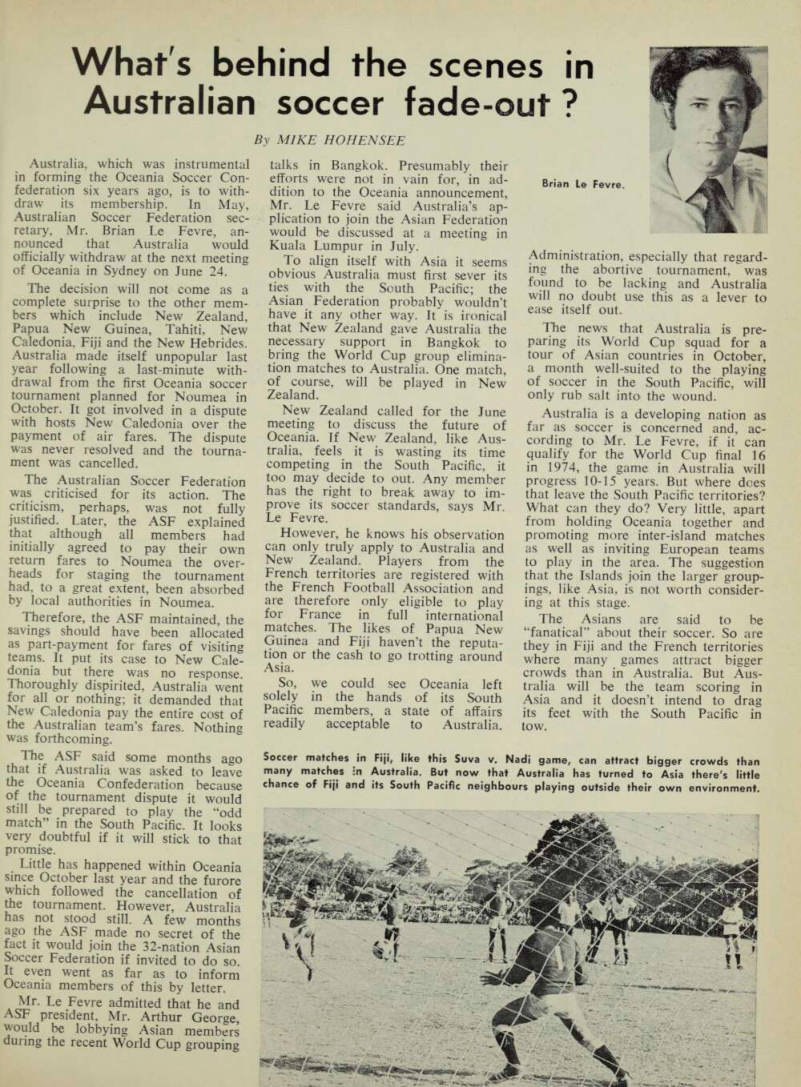
What's behind the scenes in Australian soccer fade-out ?
By Mike Hohensee
Australia, which was instrumental in forming the Oceania Soccer Con federation six years ago, is to with draw its membership. In May, Australian Soccer Federation sec retary, Mr. Brian Le Fevre, an nounced that Australia would officially withdraw at the next meeting of Oceania in Sydney on June 24.
The decision will not come as a complete surprise to the other mem bers which include New Zealand, Papua New Guinea, Tahiti, New Caledonia, Fiji and the New Hebrides.
Australia made itself unpopular last year following a last-minute with drawal from the first Oceania soccer tournament planned for Noumea in October. It got involved in a dispute with hosts New Caledonia over the payment of air fares. The dispute was never resolved and the tourna ment was cancelled.
The Australian Soccer Federation was criticised for its action. The criticism, perhaps, was not fully justified. Later, the ASF explained that although all members had initially agreed to pay their own return fares to Noumea the over heads for staging the tournament had, to a great extent, been absorbed by local authorities in Noumea.
Therefore, the ASF maintained, the savings should have been allocated as part-payment for fares of visiting teams. It put its case to New Cale donia but there was no response.
Thoroughly dispirited, Australia went for all or nothing; it demanded that New Caledonia pay the entire cost of the Australian team’s fares. Nothing
was forthcoming.
The ASF said some months ago that if Australia was asked to leave the Oceania Confederation because of the tournament dispute it would still be prepared to play the “odd match” in the South Pacific. It looks very doubtful if it will stick to that promise.
Little has happened within Oceania since October last year and the furore which followed the cancellation of the tournament. However, Australia has not stood still. A few months ago the ASF made no secret of the fact it would join the 32-nation Asian Soccer Federation if invited to do so.
It even went as far as to inform Oceania members of this by letter.
Mr. Le Fevre admitted that he and ASF president, Mr. Arthur George, would be lobbying Asian members during the recent World Cup grouping
talks in Bangkok. Presumably their efforts were not in vain for, in ad dition to the Oceania announcement, Mr. Le Fevre said Australia’s ap plication to join the Asian Federation would be discussed at a meeting in Kuala Lumpur in July.
To align itself with Asia it seems obvious Australia must first sever its ties with the South Pacific; the Asian Federation probably wouldn’t have it any other way. It is ironical that New Zealand gave Australia the necessary support in Bangkok to bring the World Cup group elimina tion matches to Australia. One match, of course, will be played in New Zealand.
New Zealand called for the June meeting to discuss the future of Oceania. If New Zealand, like Aus tralia, feels it is wasting its time competing in the South Pacific, it too may decide to out. Any member has the right to break away to im prove its soccer standards, says Mr.
Le Fevre.
However, he knows his observation can only truly apply to Australia and New Zealand. Players from the French territories are registered with the French Football Association and are therefore only eligible to play for France in full international matches. The likes of Papua New Guinea and Fiji haven’t the reputa tion or the cash to go trotting around Asia.
So, we could see Oceania left solely in the hands of its South Pacific members, a state of affairs readily acceptable to Australia.
Administration, especially that regard ing the abortive tournament, was found to be lacking and Australia will no doubt use this as a lever to ease itself out.
The news that Australia is pre paring its World Cup squad for a tour of Asian countries in October, a month well-suited to the playing of soccer in the South Pacific, will only rub salt into the wound.
Australia is a developing nation as far as soccer is concerned and, ac cording to Mr. Le Fevre, if it can qualify for the World Cup final 16 in 1974, the game in Australia will progress 10-15 years. But where does that leave the South Pacific territories?
What can they do? Very little, apart from holding Oceania together and promoting more inter-island matches as well as inviting European teams to play in the area. The suggestion that the Islands join the larger group ings, like Asia, is not worth consider ing at this stage.
The Asians are said to be “fanatical” about their soccer. So are they in Fiji and the French territories where many games attract bigger crowds than in Australia. But Aus tralia will be the team scoring in Asia and it doesn’t intend to drag its feet with the South Pacific in tow.
Brian Le Fevre.
Soccer matches In Fiji, like this Suva v. Nadi game, can attract bigger crowds than many matches in Australia. But now that Australia has turned to Asia there's little chance of Fiji and its South Pacific neighbours playing outside their own environment.
tobacco in Fiji
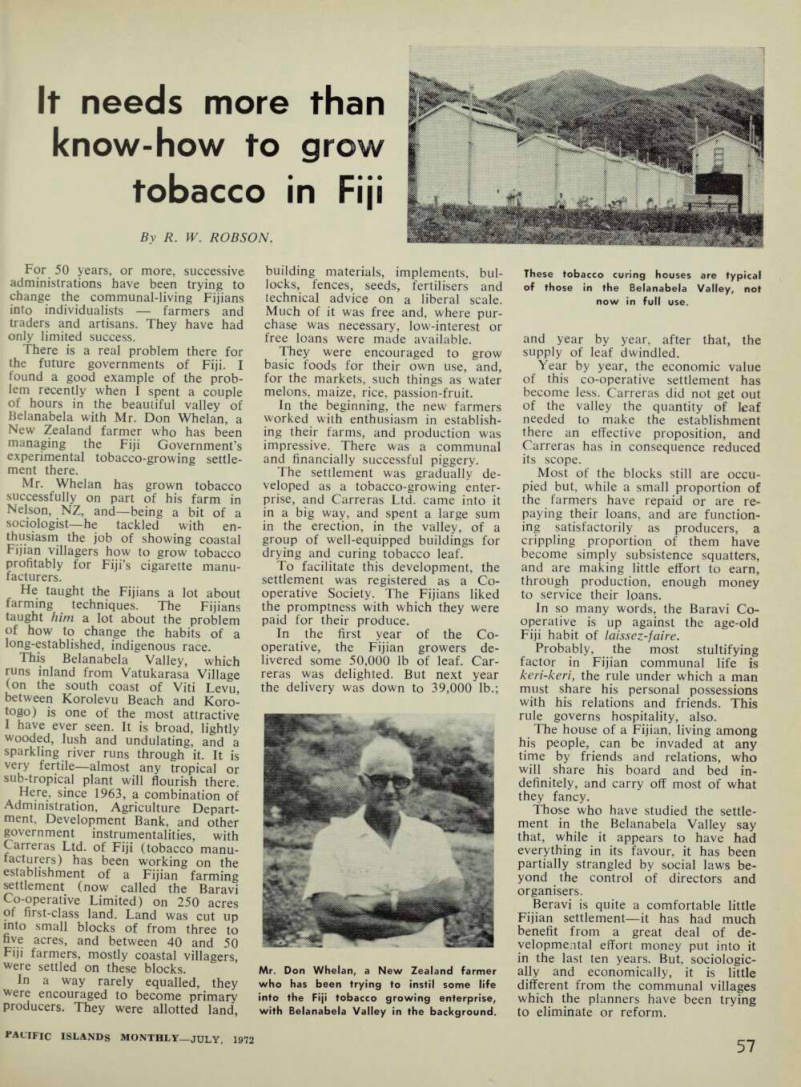
It needs more than know-how to grow tobacco in Fiji
By R. W. Robson.
For 50 years, or more, successive administrations have been trying to change the communal-living Fijians into individualists farmers and traders and artisans. They have had only limited success.
There is a real problem there for the future governments of Fiji. I found a good example of the prob lem recently when I spent a couple of hours in the beautiful valley of Belanabela with Mr. Don Whelan, a New Zealand farmer who has been managing the Fiji Government’s experimental tobacco-growing settle ment there.
Mr. Whelan has grown tobacco successfully on part of his farm in Nelson, NZ, and—being a bit of a sociologist—he tackled with en thusiasm the job of showing coastal Fijian villagers how to grow tobacco profitably for Fiji’s cigarette manu facturers.
He taught the Fijians a lot about farming techniques. The Fijians taught him a lot about the problem of how to change the habits of a long-established, indigenous race.
This Belanabela Valley, which runs inland from Vatukarasa Village (on the south coast of Viti Levu, between Korolevu Beach and Koro togo) is one of the most attractive I have ever seen. It is broad, lightly wooded, lush and undulating, and a sparkling river runs through it. It is very fertile—almost any tropical or sub-tropical plant will flourish there.
Here, since 1963, a combination of Administration, Agriculture Depart ment, Development Bank, and other government instrumentalities, with Carreras Ltd. of Fiji (tobacco manu facturers) has been working on the establishment of a Fijian farming settlement (now called the Baravi Co-operative Limited) on 250 acres of first-class land. Land was cut up into small blocks of from three to five acres, and between 40 and 50 Fiji farmers, mostly coastal villagers, were settled on these blocks.
In a way rarely equalled, they were encouraged to become primary producers. They were allotted land,
building materials, implements, bul locks, fences, seeds, fertilisers and technical advice on a liberal scale.
Much of it was free and, where pur chase was necessary, low-interest or free loans were made available.
They were encouraged to grow basic foods for their own use, and, for the markets, such things as water melons, maize, rice, passion-fruit.
In the beginning, the new farmers worked with enthusiasm in establish ing their farms, and production was impressive. There was a communal and financially successful piggery.
The settlement was gradually de veloped as a tobacco-growing enter prise, and Carreras Ltd. came into it in a big way, and spent a large sum in the erection, in the valley, of a group of well-equipped buildings for drying and curing tobacco leaf.
To facilitate this development, the settlement was registered as a Co operative Society. The Fijians liked the promptness with which they were paid for their produce.
In the first year of the Co operative, the Fijian growers de livered some 50,000 lb of leaf. Car reras was delighted. But next year the delivery was down to 39,000 lb.;
and year by year, after that, the supply of leaf dwindled.
Year by year, the economic value of this co-operative settlement has become less. Carreras did not get out of the valley the quantity of leaf needed to make the establishment there an effective proposition, and Carreras has in consequence reduced its scope.
Most of the blocks still are occu pied but, while a small proportion of the farmers have repaid or are re paying their loans, and are function ing satisfactorily as producers, a crippling proportion of them have become simply subsistence squatters, and are making little effort to earn, through production, enough money to service their loans.
In so many words, the Baravi Co operative is up against the age-old Fiji habit of laissez-faire.
Probably, the most stultifying factor in Fijian communal life is keri-keri, the rule under which a man must share his personal possessions with his relations and friends. This rule governs hospitality, also.
The house of a Fijian, living among his people, can be invaded at any time by friends and relations, who will share his board and bed in definitely, and carry off most of what they fancy.
Those who have studied the settle ment in the Belanabela Valley say that, while it appears to have had everything in its favour, it has been partially strangled by social laws be yond the control of directors and organisers.
Beravi is quite a comfortable little Fijian settlement—it has had much benefit from a great deal of de velopmental effort money put into it in the last ten years. But, sociologic ally and economically, it is little different from the communal villages which the planners have been trying to eliminate or reform.
Mr. Don Whelan, a New Zealand farmer who has been trying to instil some life into the Fiji tobacco growing enterprise, with Belanabela Valley in the background.
These tobacco curing houses are typical of those in the Belanabela Valley, not now in full use.
Advertisements & other items, p. 60 (1 item)
Koror^BLYapJf
Bank of Hawaii is the bank of the Pacific. \bu can hank on it...in Guam£&
Roi Namur JJtWiJke 3S?
JL Kwajalein JltPonape
fyhdwayJl? Tahiti*-2£*-
2* American Samoa.
All in all, we have over 65 branches throughout Hawaii and the Pacific offering full banking services. May we help you?
Bank of Hawaii the bank of the Pacific * affiliate of Banque de Tahiti
On New Solomons Constitution
Politicians Do A Soft Shoe Shuffle
From a Honiara correspondent
Armed with something like 23 representations—both written and oral —the Solomon Islands Government’s special select committee on con stitutional development has gone to the people in the districts to see what they feel about the whole business.
To many people not au fait with the inner workings of government this would seem like putting the cart before the horse. Twenty-three opinions from a population of 163,000 does not provide a wide platform on which to build the Solomons future constitution.
Yet this is apparently what is hap pening. To an outsider the interim report on the committee’s findings (broadcast on radio earlier in May) seems innocuous enough.
It basically provides for the up grading of chairmen of government committees to ministerial level, the selection of a chief minister, the down grading of the High Commissioner to governor level, an increase in - the number of constituencies (a possibility already being looked into by a special boundaries committee) and an overall upgrading of political responsibility by elected representatives in the running of the country’s internal affairs.
There is also some talk of an upper house, or house of elders, or senate, or collection of chiefs to try and sort out some of the muddle between custom and European style law.
Whether this would be included in the constitution or something tacked on afterwards is not generally known, but plenty of people in the villages and out in the districts are certain there should be something in this vein.
One thing is certain: whatever the style of the constitution which comes before Governing Council members in November, it will carry a provision for voting in self-government when ever all members of a future council so feel inclined.
So far, so good. So what’s all the secrecy regarding the interim report.
Except for a single radio broadcast which let slip the above points there has not been a squeak since—either written or verbal.
Government insiders are not saying much, but it is strongly suspected that high level government officials are petrified that the people may think a cut and dried co~stitution is being
forced down their collective neck, resulting in unpredictable reactions.
On the face of it, it is highly unlikely that a general populace which at the best is hazy on how the current con stitution works, would make a big song and dance about a small step up in the government of the country.
Two sub-committees made the first sorties into the districts to test feelings and gauge reactions. The full com mittee consists of all Governing Council members chaired by the Chief Secretary. It split into parties of three or four to “go to the people”.
The feelings and reactions in both cases were mild. The main revelation was the extreme difference in thinking between the rural people and the main centres, particularly Honiara. If the rural people have it their way, there
will be no break from Britain for a long, long time to come. And if any thing is to be changed they wanted to make good and sure that they are consulted first. It perhaps brought out the disparity in development between the districts and main centres.
The areas toured first were Guadal canal and the Eastern District, where in most cases sub-committees had to spend much time explaining how the present constitution worked before unfolding the interim report. In nearly all areas where the sub-committees stopped to talk it was reported to be well appreciated by the people. This is understandable as this is perhaps the first time in recent years when the central government has bothered to go to the people themselves for their opinions.
But the big question was—why didn’t they go sooner, and with full publicity to help put the population in the picture as well as to promote some form of political education so that everyone, north and south, east and west, would have some idea of what was being talked about?
It’s great for the people who managed to make it to the meetings, but by the time the story gets around third hand to the people who didn’t, there is some confusion.
The other question is: what hap pens when all the sub-committees have toured and reported their find ings? Are we going to be offered some other type of constitution so there will be two or maybe three forms of government to choose from?
Somehow this is doubtful. It is a safe guess that the interim report, or summary of conclusions, will stand fast with maybe a small change here and there.
When the country goes to the polls next year Govco will have 24 or 25 elected members, and it won’t be called Govco any more but will be known as the Legislature, and there will be five or six ministers who will hold cabinet meetings in private instead of the present full council meetings. The High Commissioner will relinquish some of his powers over a period of time and eventually become governor, and the chief minister will gradually take over more and more responsibility.
Onward to self-government and on to independence—whenever that may be. The bets are on.
getting them in
Chain letters are getting them in
Prom a Honiara correspondent Efforts by the BSIP Government to outlaw chain letters has run into a brick wall of indignation created by the islanders, of whom many hun dreds have already invested in what the administration considers a rather shady deal.
A public notice issued on May 2 said chain letters entitled “Australian Bonanza” and “Money Tree” were circulating in the Protectorate. These involved participants paying sums of S 6 to $l2 to the organisers in Aus tralia and if their circulation were allowed to continue would inevitably involve large numbers of Solomon Islanders in loss of money.
The legal position was being examined and legislation considered.
In the meantime, members of the public were warned that they would be liable to prosecution under the Post Office Ordinance 1971 if they attempted to send any chain letters by post.
The islanders feel that the govern ment should a'tend to more serious matters instead of playing “daddy” to the masses on this type of issue.
It is their money, and although grate ful for the warning, would like to do as they like with it.
Mining Spins Off
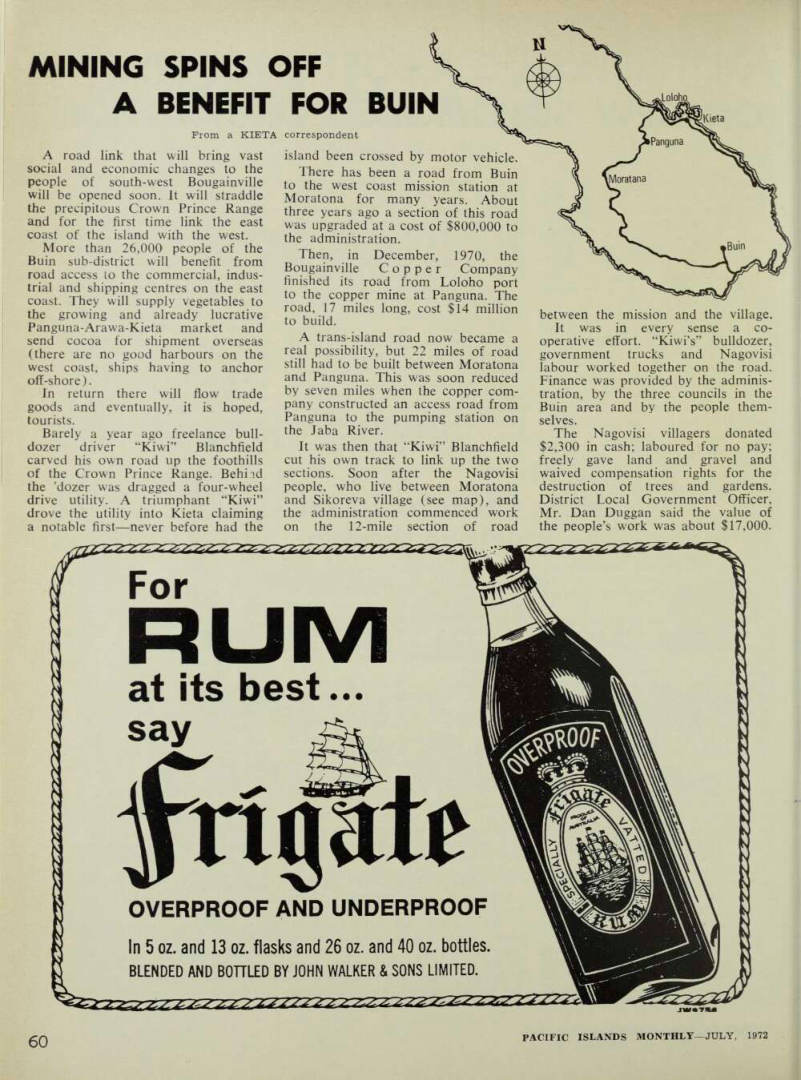
A Benefit For Buin
Prom a KIETA correspondent
A road link that will bring vast social and economic changes to the people of south-west Bougainville will be opened soon. It will straddle the precipitous Crown Prince Range and for the first time link the east coast of the island with the west.
More than 26,000 people of the Buin sub-district will benefit from road access to the commercial, indus trial and shipping centres on the east coast. They will supply vegetables to the growing and already lucrative Panguna-Arawa-Kieta market and send cocoa for shipment overseas (there are no good harbours on the west coast, ships having to anchor off-shore).
In return there will flow trade goods and eventually, it is hoped, tourists.
Barely a year ago freelance bull dozer driver “Kiwi” Blanchfield carved his own road up the foothills of the Crown Prince Range. Behind the ’dozer was dragged a four-wheel drive utility. A triumphant “Kiwi” drove the utility into Kieta claiming a notable first—never before had the
island been crossed by motor vehicle.
There has been a road from Buin to the west coast mission station at Moratona for many years. About three years ago a section of this road was upgraded at a cost of $BOO,OOO to the administration.
Then, in December, 1970, the Bougainville Copper Company finished its road from Loloho port to the copper mine at Panguna, The road, 17 miles long, cost $l4 million to build.
A trans-island road now became a real possibility, but 22 miles of road still had to be built between Moratona and Panguna. This was soon reduced by seven miles when the copper com pany constructed an access road from Panguna to the pumping station on the Jaba River.
It was then that “Kiwi” Blanchfield cut his own track to link up the two sections. Soon after the Nagovisi people, who live between Moratona and Sikoreva village (see map), and the administration commenced work on the 12-mile section of road
between the mission and the village.
It was in every sense a co operative effort. “Kiwi’s” bulldozer, government trucks and Nagovisi labour worked together on the road.
Finance was provided by the adminis tration, by the three councils in the Buin area and by the people them selves.
The Nagovisi villagers donated 52,300 in cash; laboured for no pay; freely gave land and gravel and waived compensation rights for the destruction of trees and gardens.
District Local Government Officer, Mr. Dan Duggan said the value of the people’s work was about $17,000.
Advertisements & other items, pp. 62-70 (1 item)
frigate
For
RUM
at its best... say
frigate
OVERPROOF AND UNDERPROOF
In 5 oz. and 13 oz. flasks and 26 oz. and 40 oz. bottles.
BLENDED AND BOTTLED BY JOHN WALKER & SONS LIMITED.
she stopped
being a
problem
child
M ='^ v ' s4 ¥ * « Until we started buying PAULS Longlife Milk I couldn’t be sure she was getting all the protein and minerals she needed.
That’s just one advantage of having high quality germ-free milk that’s perfect for infants and young ones With the wholesome, real milk taste that we all like in our drinks and on cereals. Plus the big convenience PAULS Longlife Milk can be safely stored without refrigeration. and here it is
THE VERY NEW
TETRABRIK
for high quality milk. • new half litre size • new shape better to handle and easier to store
rtf 2
t
U|fT Ml
I* P r ** s'
Longlife
Liquid Milk
Dolby & SFH
M SUPER FERRITE HEAD
ill °Oo r w f~ / w/ fe,., , Head-Phone Jack for monitoring.
L/R Microphone Jacks for stereo recordings.
Recording Volume Control: Longstroke slide system simplifies delicate level adjustment.
Play-back Volume Control: Perfect * level adjustment assures maximum hifi enjoyment.
Piano-touch Control: Includes convenient PAUSE control aside from regular RECORD, PLAY,
STOP, REVERSE, F.F., EJECT.
the sound approach to quality ★ For minute information, write to: P-SECTION, TRIO ELECTRONICS, INC. 6-5, 1-chome, Shibuya, Shibuya-ku, Tokyo. Japariß
Sounds Like
omebody’s Having
A Good Tim
JP-S.
The sounds of a good time are happy sounds, and you can always add to fun with music.
Take music with you everywhere with one of these Toshiba "happy-machines."
Go on. Have some fun!
RT-296R
Radio/Cassette Recorder Check these features on the Toshiba fun trio: KT-215C Cassette Recorder; Built-in microphone, 1C head, automatic shut-off, push-button operation, tape counter, AC/DC.
RP-212S MW/SW 2-band Radio: Shortwave and medium wave reception, pulls-in distant stations, extra large speaker built-in and exterior antennas, AC operation, too.
RT-296R Radio/Cassette Recorder: Remarkable tonal richness, medium wave and three shortwave bands, simultaneous recording while listening, tuning meter, automatic level control, tape counter, automatic shut-off, dynamic mike, light weight.
RP-212S
MW/SW
2-band Radio - **
KT-215C
Cassette Recorder
TOSHIBA
...In Touch with Tomorrow
9 m K M ■ >*« - - . - *' ,-;■ r' 'J „r -w -* :■“■ m 3. m Sc
fog
DATSUN zoomed through the 3,700 kilometer rally over icy blinding blizzards and Alpine peaks to capture third place over-all! This year’s event was so demanding that only 52 of the 264 entries were able to finish. But Nissan technology propelled DATSUN >/ you’ve got to be good! IjA securely to second place in its engine class. t Engineering and technology is what a motorcar about. With satellite launching experiences behincHt, Nissan offers the most integrated design in a motorcar you can buy today.
Rigid quality control. Extensive ive production tests. Original res' And ingenious styling—distinc and functional. These are only a few of the many reasons why motorists in oyer 120 nations are more than satisfied with DATSUN year aftet year.
Get on the winning side. Get yourself inside a DATSUN soon!
DATSUN
of NISSAN ,
Find out
where to test-drive your rally winner at the
DATSUN distributor nearest you!
Full line of DATSUN’s from pickups to luxury sedans.
New DATSUN Pickup
New DATSUN 1808
Hardtop i
DATSUN
DATSUN
Product of NISSAN
fffii
MORRIS
HEDSTROM
LIMITED
HEAD OFFICE: SUVA-FIJI
• GENERAL MERCHANTS
• PRODUCE BUYERS
• IMPORTERS & EXPORTERS
• PLANTATION OWNERS
• COMMISSION & INSURANCE
AGENTS
LONDON OFFICE:
MORRIS HEDSTROM LTD.,
Park House,
22 Park Street,
CROYDON, CR9 BNP.
AUSTRALIAN REPRESENTATIVE:
W. R. CARPENTER & CO. LTD.,
(MERCHANDISE DIVISION),
The A. Gr N.Z. Building,
68 Pitt Street,
SYDNEY, 2000.
Registered
MORRISHED -SUVA, APIA, NUKUALOFA. •
Cable Addresses:
SUVAMARK - LONDON.
AGENTS AND DISTRIBUTORS FOR:
MORSTROM SYDNEY.
SHIPPING
GENERAL
LIQUOR
China Navigation Company Lloyd's Lloyd Triestino Mitsui OSK Lines Pacific Australia Direct Line Pacific Far East Line, Inc.
MOTOR
Alfa-Laval A.R.A. Airconditioners Assoc. Battery Makers of Aust. Ltd.
Champion Spark Plug Co.
Chrysler U.K. Ltd.
D. H. Davies & Co. Ltd.
Ferodo Ltd.
Ford Motor Co.
Fram Filters Ltd.
Good-year Tyre & Rubber Co.
Hayter Exports Ltd.
Howard Rotavators Pty. Ltd, Napier Bros. Ltd.
Norton-Villiers Outboard Marine International W. H. Wylie Addis Limited Benford Ltd.
Crittall-Hope Export Electrolux Ltd.
Imperial Chemical Industries Ltd.
James A. Jobling Ltd.
John Steventon & Sons (Export) Ltd.
H. & R. Johnson Ltd.
Kelvinator International Inc. (Leonard Refrigerators) Longines SA Marley Floor Tile Co.
Nippon Kogaku (Nikon Cameras) Noritake Co. Ltd.
Olympus Optical Parker/Eversharp Pen Co.
Pilkington Bros. ltd.
Procter & Gamble Ronson Ltd.
Rowntree & Co. Ltd.
Sanyo Electrical Singer Australia Ltd.
Wiltshire File Co. Pty. Ltd.
Winstone Ltd.
Yorkshire Imperial Metals Bacardi International Drambuie Liqueur Co. Ltd.
Guinness Exports Jas. Hennessy & Co.
John Dewar & Sons Ltd.
McWilliams Wines Pty. Ltd.
Tanqueray Gordon & Co. Ltd.
PHARMACEUTICALS & COSMETICS
stra International urroughs Wellcome & Co. N.Z. Ltd. ba Laboratories /namid DHA Pty. Ltd.
I izabeth Arden aberge Inc. sons Pty. Ltd. . D. Searle (Aust.) Pty. Ltd. laxo Laboratories Ltd. oechst Aust. Ltd. antheric Perfumes iax Factor iorny Ltd. arfum Corday arfum Christian Dior arfum Gres arfum Pucci arfum Venet immel Ltd. andoz Pharmaceuticals ilten International mith & Nephew Ltd.
for friendly service
and complete
satisfaction its ...
MORRIS HEDSTROM
LIMITED
Fiji-Western Samoa-Tonga
HHH i
The
China Navigation Company
was launched on theYangtse
ninety nine years ago
In 1873 the China Navigation Company commenced operations with two paddle steamers, the “Glengyle” and the “Tunsin,” serving the Yangtse River trade.
Today, the China Navigation Company provides
the most extensive network of cargo routes within the area bordered by Japan, Tahiti, New Zealand, Australia and the Malay Peninsula.
The two paddle steamers have been replaced by twenty-six cargo ships.
The Company’s early dependence on the Yangtse and the China coast for its living is marked nowadays only by the names of some of its ships . . . traditionally of those towns and provinces in China where the Company grew to its present high standing.
The China Navigation Company—the name that has become synonymous with experience reliability . . . speed . . . service.
For further details and all enquiries there are Agents at the following ports: Melbourne: P. & 0. Lines of Australia Pty. Ltd.
Brisbane: Wills, Gilchrist & Sanderson Pty. Ltd.
Papua and New Guinea: Steamships Trading Co. Ltd., Port Moresby, Samarai, Lae, Madang, Rabaul, Kieta.
New Caledonia; Etablissements Ballande, Noumea. 8.5.1. P.: British Solomons Trading Co. Ltd., Honiara.
New Hebrides: Les Comptoirs Francais des Nouvelles-Hebrides Vila and Santo.
Hong Kong.
CN CO
SWIRE & GILCHRIST PTY. LTD.,
General Agents in Australia, 8 Spring Street, Sydney. Phone: 2 0522
THE CHINA NAVIGATION CO LTD
Member of the Swire Group
This is the famous Ship Clock, made in gold by Hans Schotthein.
Heralds appear on the hour, and parade before the unhappy Rudolf 11, ruler of the Holy Roman Empire from 1576-1612. The clock is now in the British Museum.
Benson aU Hedges
The gold pack tells its own story. 016.P.162.7.71 016. P. 1628. 7.71
Magazine Section
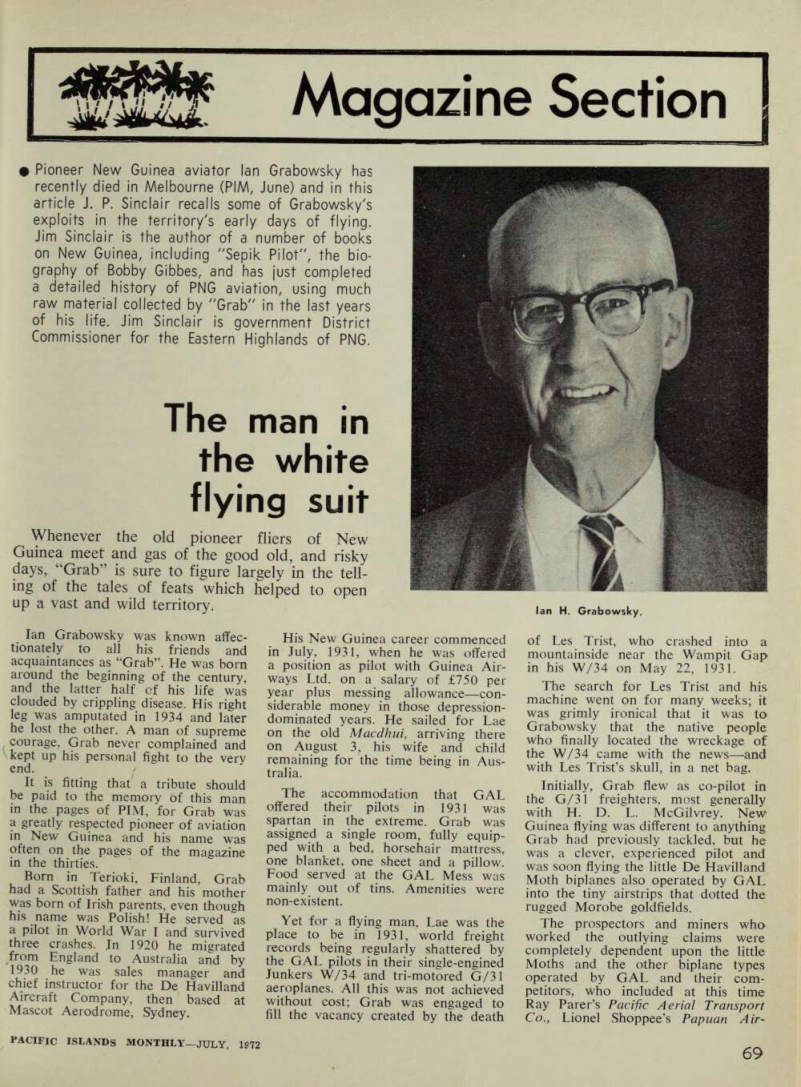
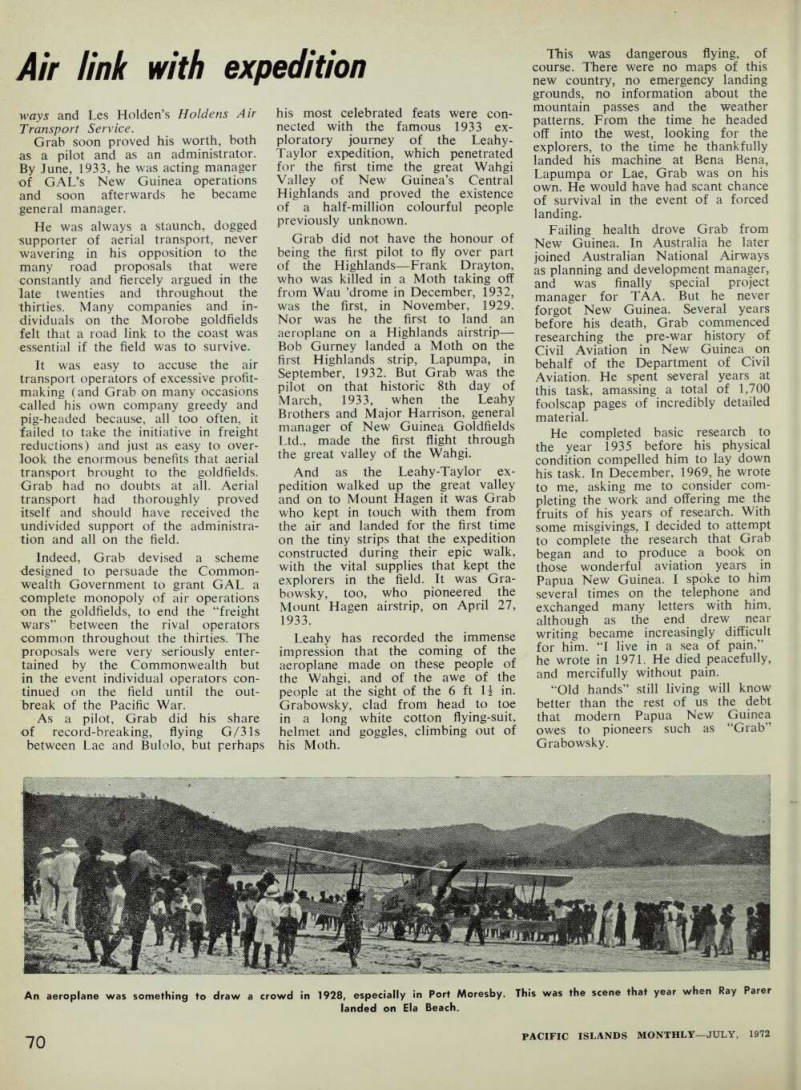
The man in the white flying suit
• Pioneer New Guinea aviator lan Grabowsky has recently died in Melbourne (PIM, June) and in this article J. P. Sinclair recalls some of Grabowsky's exploits in the territory's early days of flying.
Jim Sinclair is the author of a number of books on New Guinea, including "Sepik Pilot", the bio graphy of Bobby Gibbes, and has just completed a detailed history of PNG aviation, using much raw material collected by "Grab" in the last years of his life. Jim Sinclair is government District Commissioner for the Eastern Highlands of PNG.
Whenever the old pioneer fliers of New Guinea meet and gas of the good old, and risky days, “Grab” is sure to figure largely in the tell ing of the tales of feats which helped to open up a vast and wild territory.
lan Grabowsky was known affec tionately to all his friends and acquaintances as “Grab”. He was born around the beginning of the century, and the latter half of his life was clouded by crippling disease. His right leg was amputated in 1934 and later he lost the other. A man of supreme courage, Grab never complained and kept up his personal fight to the very end.
It is fitting that a tribute should be paid to the memory of this man in the pages of PIM, for Grab was a greatly respected pioneer of aviation in New Guinea and his name was often on the pages of the magazine in the thirties.
Born in Terioki, Finland, Grab had a Scottish father and his mother was bom of Irish parents, even though his name was Polish! He served as a pilot in World War I and survived three crashes. In 1920 he migrated from England to Australia and by 1930 he was sales manager and chief instructor for the De Havilland Aircraft Company, then based at Mascot Aerodrome, Sydney.
His New Guinea career commenced in July, 1931, when he was offered a position as pilot with Guinea Air ways Ltd. on a salary of £750 per year plus messing allowance—con siderable money in those depression dominated years. He sailed for Lae on the old Macdhui, arriving there on August 3, his wife and child remaining for the time being in Aus tralia.
The accommodation that GAL offered their pilots in 1931 was spartan in the extreme. Grab was assigned a single room, fully equip ped with a bed, horsehair mattress, one blanket, one sheet and a pillow.
Food served at the GAL Mess was mainly out of tins. Amenities were non-existent.
Yet for a flying man, Lae was the place to be in 1931, world freight records being regularly shattered by the GAL pilots in their single-engined Junkers W/34 and tri-motored G/31 aeroplanes. All this was not achieved without cost; Grab was engaged to fill the vacancy created by the death
of Les Trist, who crashed into a mountainside near the Wampit Gap in his W/34 on May 22, 1931.
The search for Les Trist and his machine went on for many weeks; it was grimly ironical that it was to Grabowsky that the native people who finally located the wreckage of the W/34 came with the news—and with Les Trist’s skull, in a net bag.
Initially, Grab flew as co-pilot in the G/31 freighters, most generally with H. D. L. McGilvrey. New Guinea flying was different to anything Grab had previously tackled, but he was a clever, experienced pilot and was soon flying the little De Havilland Moth biplanes also operated by GAL into the tiny airstrips that dotted the rugged Morobe goldfields.
The prospectors and miners who worked the outlying claims were completely dependent upon the little Moths and the other biplane types operated by GAL and their com petitors, who included at this time Ray Parer’s Pacific Aerial Transport Co., Lionel Shoppee’s Papuan Air-
lan H. Grabowsky.
Air link with expedition
ways and Les Holden’s Holdens Air Transport Service.
Grab soon proved his worth, both as a pilot and as an administrator.
By June, 1933, he was acting manager of GAL’s New Guinea operations and soon afterwards he became general manager.
He was always a staunch, dogged supporter of aerial transport, never wavering in his opposition to the many road proposals that were constantly and fiercely argued in the late twenties and throughout the thirties. Many companies and in dividuals on the Morobe goldfields felt that a road link to the coast was essential if the field was to survive.
It was easy to accuse the air transport operators of excessive profit making (and Grab on many occasions called his own company greedy and pig-headed because, all too often, it failed to take the initiative in freight reductions) and just as easy to over look the enormous benefits that aerial transport brought to the goldfields.
Grab had no doubts at all. Aerial transport had thoroughly proved itself and should have received the undivided support of the administra tion and all on the field.
Indeed, Grab devised a scheme designed to persuade the Common wealth Government to grant GAL a complete monopoly of air operations on the goldfields, to end the “freight wars” between the rival operators common throughout the thirties. The proposals were very seriously enter tained by the Commonwealth but in the event individual operators con tinued on the field until the out break of the Pacific War.
As a pilot, Grab did his share of record-breaking, flying G/31s between Lae and Bulolo, but perhaps
his most celebrated feats were con nected with the famous 1933 ex ploratory journey of the Leahy- Taylor expedition, which penetrated for the first time the great Wahgi Valley of New Guinea’s Central Highlands and proved the existence of a half-million colourful people previously unknown.
Grab did not have the honour of being the first pilot to fly over part of the Highlands—Frank Drayton, who was killed in a Moth taking off from Wau ’drome in December, 1932, was the first, in November, 1929.
Nor was he the first to land an aeroplane on a Highlands airstrip— Bob Gurney landed a Moth on the first Highlands strip, Lapumpa, in September, 1932. But Grab was the pilot on that historic Bth day of March, 1933, when the Leahy Brothers and Major Harrison, general manager of New Guinea Goldfields Ltd., made the first flight through the great valley of the Wahgi.
And as the Leahy-Taylor ex pedition walked up the great valley and on to Mount Hagen it was Grab who kept in touch with them from the air and landed for the first time on the tiny strips that the expedition constructed during their epic walk, with the vital supplies that kept the explorers in the field. It was Gra bowsky, too, who pioneered the Mount Hagen airstrip, on April 27, 1933.
Leahy has recorded the immense impression that the coming of the aeroplane made on these people of the Wahgi, and of the awe of the people at the sight of the 6 ft H in.
Grabowsky, clad from head to toe in a long white cotton flying-suit, helmet and goggles, climbing out of his Moth.
This was dangerous flying, of course. There were no maps of this new country, no emergency landing grounds, no information about the mountain passes and the weather patterns. From the time he headed off into the west, looking for the explorers, to the time he thankfully landed his machine at Bena Bena, Lapumpa or Lae, Grab was on his own. He would have had scant chance of survival in the event of a forced landing.
Failing health drove Grab from New Guinea. In Australia he later joined Australian National Airways as planning and development manager, and was finally special project manager for TAA. But he never forgot New Guinea. Several years before his death, Grab commenced researching the pre-war history of Civil Aviation in New Guinea on behalf of the Department of Civil Aviation. He spent several years at this task, amassing a total of 1,700 foolscap pages of incredibly detailed material.
He completed basic research to the year 1935 before his physical condition compelled him to lay down his task. In December, 1969, he wrote to me, asking me to consider com pleting the work and offering me the fruits of his years of research. With some misgivings, I decided to attempt to complete the research that Grab began and to produce a book on those wonderful aviation years in Papua New Guinea. I spoke to him several times on the telephone and exchanged many letters with him, although as the end drew near writing became increasingly difficult for him. “I live in a sea of pain,” he wrote in 1971. He died peacefully, and mercifully without pain.
“Old hands” still living will know better than the rest of us the debt that modern Papua New Guinea owes to pioneers such as “Grab”
Grabowsky.
An aeroplane was something to draw a crowd in 1928, especially in Port Moresby. This was the scene that year when Ray Parer landed on Ela Beach.
of flying
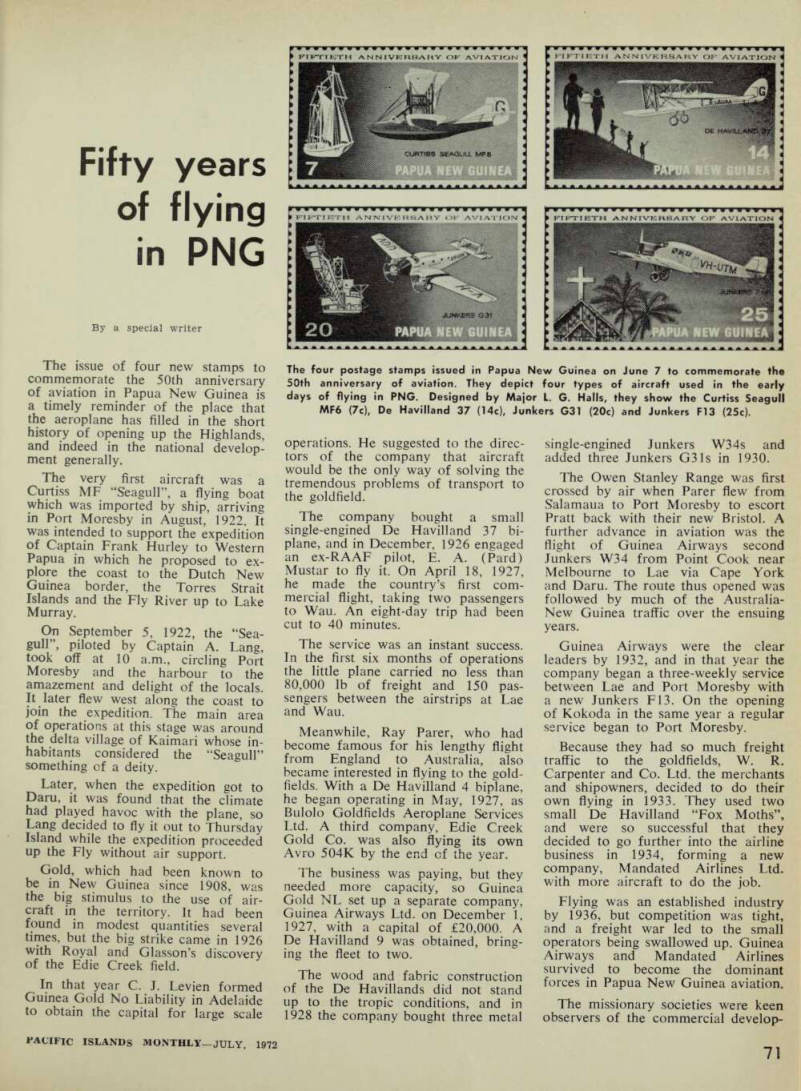
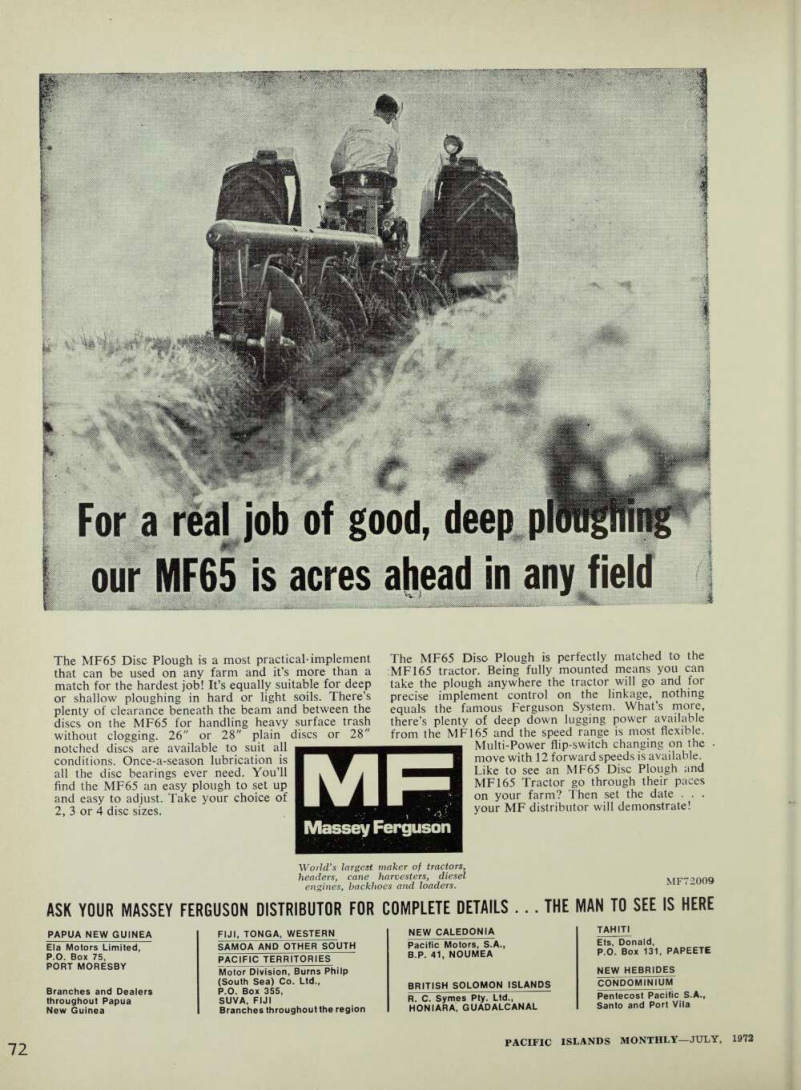
Fifty years of flying in PNG
By a special writer
The issue of four new stamps to commemorate the 50th anniversary of aviation in Papua New Guinea is a timely reminder of the place that the aeroplane has filled in the short history of opening up the Highlands, and indeed in the national develop ment generally.
The very first aircraft was a Curtiss ME “Seagull”, a flying boat which was imported by ship, arriving in Port Moresby in August, 1922. It was intended to support the expedition of Captain Frank Hurley to Western Papua in which he proposed to ex plore the coast to the Dutch New Guinea border, the Torres Strait Islands and the Fly River up to Lake Murray, On September 5, 1922, the “Sea gull”, piloted by Captain A, Lang, took off at 10 a.m., circling Port Moresby and the harbour to the amazement and delight of the locals.
It later flew west along the coast to join the expedition. The main area of operations at this stage was around the delta village of Kaimari whose in habitants considered the “Seagull” something of a deity.
Later, when the expedition got to Daru, it was found that the climate had played havoc with the plane, so Lang decided to fly it out to Thursday Island while the expedition proceeded up the Fly without air support.
Gold, which had been known to be in New Guinea since 1908, was the big stimulus to the use of air craft in the territory. It had been found in modest quantities several times, but the big strike came in 1926 with Royal and Glasson’s discovery of the Edie Creek field.
In that year C. J. Levien formed Guinea Gold No Liability in Adelaide to obtain the capital for large scale
operations. He suggested to the direc tors of the company that aircraft would be the only way of solving the tremendous problems of transport to the goldfield.
The company bought a small single-engined De Havilland 37 bi plane, and in December, 1926 engaged an ex-RAAF pilot, E. A. (Pard) Mustar to fly it. On April 18, 1927, he made the country’s first com mercial flight, taking two passengers to Wau. An eight-day trip had been cut to 40 minutes.
The service was an instant success.
In the first six months of operations the little plane carried no less than 80,000 lb of freight and 150 pas sengers between the airstrips at Lae and Wau.
Meanwhile, Ray Parer, who had become famous for his lengthy flight from England to Australia, also became interested in flying to the gold fields. With a De Havilland 4 biplane, he began operating in May, 1927, as Bulolo Goldfields Aeroplane Services Ltd. A third company, Edie Creek Gold Co. was also flying its own Avro 504 K by the end of the year.
The business was paying, but they needed more capacity, so Guinea Gold NL set up a separate company, Guinea Airways Ltd. on December 1, 1927, with a capital of £20,000. A De Havilland 9 was obtained, bring ing the fleet to two.
The wood and fabric construction of the De Havillands did not stand up to the tropic conditions, and in 1928 the company bought three metal
single-engined Junkers W34s and added three Junkers G3ls in 1930.
The Owen Stanley Range was first crossed by air when Parer flew from Salamaua to Port Moresby to escort Pratt back with their new Bristol. A further advance in aviation was the flight of Guinea Airways second Junkers W 34 from Point Cook near Melbourne to Lae via Cape York and Daru. The route thus opened was followed by much of the Australia- New Guinea traffic over the ensuing years.
Guinea Airways were the clear leaders by 1932, and in that year the company began a three-weekly service between Lae and Port Moresby with a new Junkers FI3. On the opening of Kokoda in the same year a regular service began to Port Moresby.
Because they had so much freight traffic to the goldfields, W. R.
Carpenter and Co. Ltd. the merchants and shipowners, decided to do their own flying in 1933. They used two small De Havilland “Fox Moths”, and were so successful that they decided to go further into the airline business in 1934, forming a new company, Mandated Airlines Ltd. with more aircraft to do the job.
Flying was an established industry by 1936, but competition was tight, and a freight war led to the small operators being swallowed up. Guinea Airways and Mandated Airlines survived to become the dominant forces in Papua New Guinea aviation.
The missionary societies were keen observers of the commercial develop
The four postage stamps issued in Papua New Guinea on June 7 to commemorate the 50th anniversary of aviation. They depict four types of aircraft used in the early days of flying in PNG. Designed by Major L. G. Halls, they show the Curtiss Seagull MF6 (7c), De Havilland 37 (14c), Junkers G3l (20c) and Junkers Fl3 (25c).
ment of aircraft. The Lutherans felt that an aeroplane could make it much easier to supply their outstations in remote localities like the Markham Valley, Gavinazung and Kaiapit.
When further stations were opened at Kambaidam and Mount Hagen, air support became indispensable.
The Neuendettelsau Mission Society, at home in Germany, raised the money to buy a second-hand Junkers FI3. It arrived in Lae on February 19, 1935 and nine days later the pilot, Captain Loose, made the first flight to Kaiapit.
The Catholic Eastern New Guinea Mission, controlled by the German based Society of the Divine Word, followed the Lutheran lead and had two planes in service by the end of 1935. By 1939 they had a fleet of two Klemm monoplanes, a Fokker FVII (which crashed on August 6, 1939, killing three priests) and one Junkers with which they serviced 17 central stations and 181 outstations.
On the outbreak of the Pacific war all this activity ceased abruptly.
A number of aircraft were destroyed by enemy action. The remainder were used in evacuating civilians, and many of the surviving aircraft were impressed by the RAAF for the duration.
Advertisements & other items, pp. 73-74 (2 items)
71
FAC’IFIC ISLANDS MONTHLY— JULY, 1972
For a real job of good, deep pi
,-V ♦ I For a real job of good, deep pi > '• |H|r our MF6S is acres ahead in any fieli . ■ . ■ -v - sv <c •■■■• The MF6S Disc Plough is a most practical-implement that can be used on any farm and it’s more than a match for the hardest job! It’s equally suitable for deep or shallow ploughing in hard or light soils. There’s plenty of clearance beneath the beam and between the discs on the MF6S for handling heavy surface trash without clogging. 26" or 28" plain discs or 28" notched discs are available to suit all conditions. Once-a-season lubrication is all the disc bearings ever need. You’ll find the MF6S an easy plough to set up and easy to adjust. Take your choice of 2, 3 or 4 disc sizes.
MF The MF6S Disc Plough is perfectly matched to the MFI6S tractor. Being fully mounted means you can take the plough anywhere the tractor will go and for precise implement control on the linkage, nothing equals the famous Ferguson System. What’s more, there’s plenty of deep down lugging power available from the MFI6S and the speed range is most flexible.
Multi-Power flip-switch changing on the move with 12 forward speeds is available.
Like to see an MF6S Disc Plough and MFI6S Tractor go through their paces on your farm? Then set the date . . . your MF distributor will demonstrate!
Massey Ferguson
World’s largest maker of tractors, headers, cane harvesters, diesel engines, backhoes and loaders.
MF72009 ASK YOUR MASSEY FERGUSON DISTRIBUTOR FOR COMPLETE DETAILS ... THE MAN TO SEE IS HERE
PAPUA NEW GUINEA
Ela Motors Limited, P.O. Box 75,
PORT MORESBY
Branches and Dealers throughout Papua New Guinea
FIJI, TONGA, WESTERN
SAMOA AND OTHER SOUTH
PACIFIC TERRITORIES
Motor Division, Burns Philp (South Sea) Co. Ltd., P.O. Box 355,
SUVA, FIJI
Branches throughout the region
NEW CALEDONIA
Pacific Motors, S.A.,
B.P. 41, NOUMEA
BRITISH SOLOMON ISLANDS
R. C. Symes Pfy. Ltd.,
HONIARA, GUADALCANAL
TAHITI
Ets, Donald,
P.O. Box 131, PAPEETE
NEW HEBRIDES
CONDOMINIUM
Pentecost Pacific S.A., Santo and Port Vila
Memories of Queen Emma
Queen Emma
The recent release of a new edition of R. W. Robson’s Queen Emma (Pacific Publications, $4) has prompted letters about her from two long-time readers. Mr, V. T.
Saunders of Port Moresby writes about an altar which Emma had re modelled as a cocktail bar in her residence, Gunantambu, at Ralum about 1884. Although Emma was held in some esteem by the Catholics —she made liberal donations to their newly-established mission station near Kokopo—they never forgave her for the way in which she treated the altar. It was part of the equipment sent out to New Britain with the ill fated Marquis de Ray’s expedition and abandoned there, nearly a century ago, later to be salvaged by the Ralum people.
“I picked up a funny old story in the bar of the Popondetta Club last week. It is to the effect that the altar, presumably after Emma ceased to reside at her famous bungalow at Ralum, was removed from the house to the Vunapope mission, at the end of World War I.”
Is it still there?
Former well - known supercargo Neville Chatfield (87) thinks he must be one of a very few people living who actually spoke to Emma in her heyday. He writes the following:— Whenever she came to Sydney she called at the Burns Philp offices— then at No. 10 Bridge Street. 1 well remember that, about 1902, when she was under treatment in St. Vin cents Hospital, she decided that she wanted her diamonds.
I was called into the office of my chief, Mr. Nosworthy, and handed a letter, addressed to the manager (Mr. Bryant) of the Union Bank, at the corner of Hunter and Pitt Streets.
I was told to take a cab, and not to let that letter out of my hand until I saw Mr. Bryant.
Mr. Bryant sent off and got a tin box, and instructed me, as Mr. Nos worthy had done, that—on pain of death—l was to continue in the cab to St. Vincents Hospital, and deliver the box personally into no hands other than those of Mrs. Emma Kolbe.
Which mission I successfully car ried out. I was only 17 at the time and you can imagine the impression the incident made upon me. [Queen Emma sold most of her New Guinea interests about 1910, and died in Monte Carlo in 1913.]
Advertisements & other items, pp. 75-76 (1 item)
Tabata Skin & Scuba Diving Equipment
The TABATA line offers the importer a complete range of
RUBBER SKIN & SCUBA DI-
VING EQUIPMENT and ACC-
ESSORIES for both the professional and amateur. Years of specialized manufacturing experience has established our c * m line’s
REPUTATION FOR QUALI-
TY, ATTRACTIVE and PRA-
CTICAL DESIGNS and VERY
COMPETITIVE PRICES. We
also offer a varied line of rubber sundries for golfing, skiing and other popular sports.
For full particulars on our lines, write to: Manufacture rs O
TABATA CO., LTD.
Yajima 81dg,,2-2 Yoshi-cho, Nihonbashi, Chuo-ku, Tokyo Cable: EASTABA Tokyo TELEX;2S2-2806
EASTABATA TOK Tel:C663lB6'i 1 R
PARAMOUNT
Australia's leading fashion shirts
for men and women
a We send you our best.
Our brilliantly casual Body Shirts . . . our elegantly distinctive Business Shirts for younger, smarter people like yourself who know what they like. We think you II like what you see in the great new Paramount Shirt range now at leading menswear stores throughout Papua,New Guinea, New Britain and the Pacific.
Trade Enquiries: Paramount Shirt Co. Pty. Ltd., 52 Commonwealth Street, Darlinghurst N.S.W. 2010, Australia P 5669
Yesterday
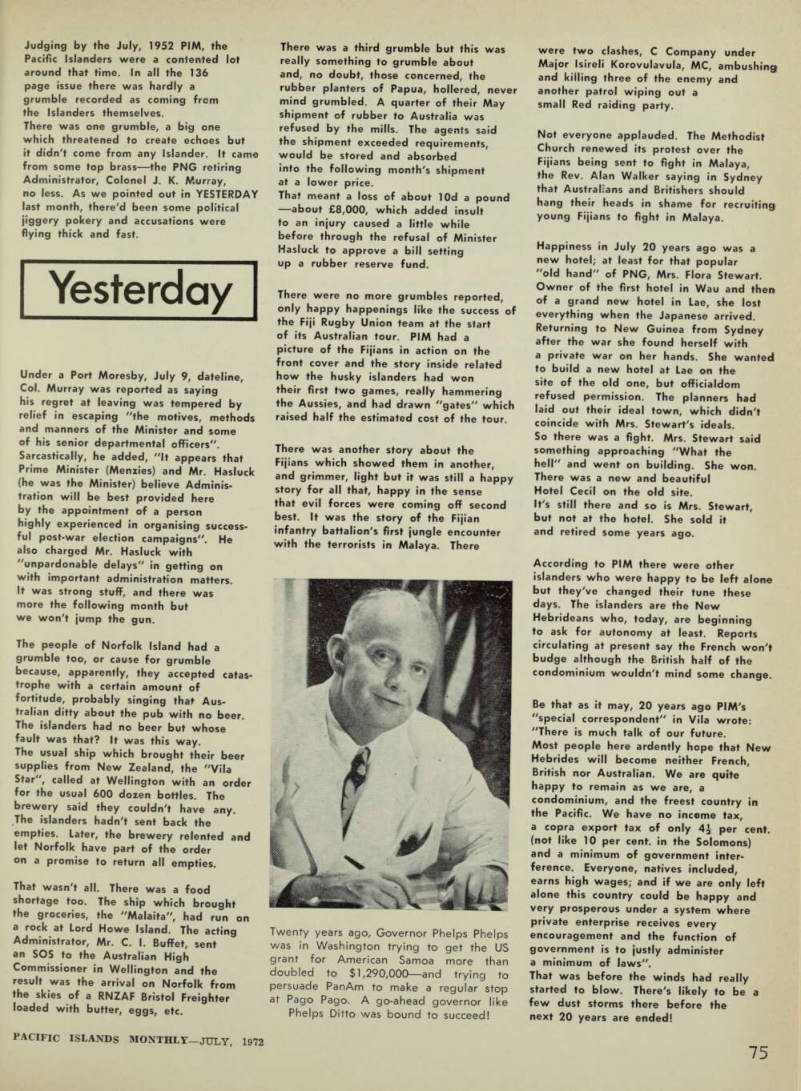
Judging by the July, 1952 PIM, the Pacific Islanders were a contented lot around that time. In all the 136 page issue there was hardly a grumble recorded as coming from the Islanders themselves.
There was one grumble, a big one which threatened to create echoes but it didn't come from any Islander. It came from some top brass —the PNG retiring Administrator, Colonel J. K. Murray, no less. As we pointed out in YESTERDAY last month, there'd been some political jiggery pokery and accusations were flying thick and fast.
Under a Port Moresby, July 9, dateline, Col. Murray was reported as saying his regret at leaving was tempered by relief in escaping "the motives, methods and manners of the Minister and some of his senior departmental officers".
Sarcastically, he added, "It appears that Prime Minister (Menzies) and Mr. Hasluck (he was the Minister) believe Adminis tration will be best provided here by the appointment of a person highly experienced in organising success ful post-war election campaigns". He also charged Mr. Hasluck with "unpardonable delays" in getting on with important administration matters.
It was strong stuff, and there was more the following month but we won't jump the gun.
The people of Norfolk Island had a grumble too, or cause for grumble because, apparently, they accepted catas trophe with a certain amount of fortitude, probably singing that Aus tralian ditty about the pub with no beer.
The islanders had no beer but whose fault was that? It was this way.
The usual ship which brought their beer supplies from New Zealand, the "Vila Star", called at Wellington with an order for the usual 600 dozen bottles. The brewery said they couldn't have any.
The islanders hadn't sent back the empties. Later, the brewery relented and let Norfolk have part of the order on a promise to return all empties.
That wasn't all. There was a food shortage too. The ship which brought the groceries, the "Malaita", had run on a rock at Lord Howe Island. The acting Administrator, Mr. C. I. Buffet, sent an SOS to the Australian High Commissioner in Wellington and the result was the arrival on Norfolk from the skies of a RNZAF Bristol Freighter loaded with butter, eggs, etc.
There was a third grumble but this was really something to grumble about and, no doubt, those concerned, the rubber planters of Papua, hollered, never mind grumbled. A quarter of their May shipment of rubber to Australia was refused by the mills. The agents said the shipment exceeded requirements, would be stored and absorbed into the following month's shipment at a lower price.
That meant a loss of about lOd a pound —about £B,OOO, which added insult to an injury caused a little while before through the refusal of Minister Hasluck to approve a bill setting up a rubber reserve fund.
There were no more grumbles reported, only happy happenings like the success of the Fiji Rugby Union team at the start of its Australian tour. PIM had a picture of the Fijians in action on the front cover and the story inside related how the husky islanders had won their first two games, really hammering the Aussies, and had drawn "gates" which raised half the estimated cost of the tour.
There was another story about the Fijians which showed them in another, and grimmer, light but it was still a happy story for all that, happy in the sense that evil forces were coming off second best. It was the story of the Fijian infantry battalion's first jungle encounter with the terrorists in Malaya. There
were two clashes, C Company under Major Isireli Korovulavula, MC, ambushing and killing three of the enemy and another patrol wiping out a small Red raiding party.
Not everyone applauded. The Methodist Church renewed its protest over the Fijians being sent to fight in Malaya, the Rev. Alan Walker saying in Sydney that Australians and Britishers should hang their heads in shame for recruiting young Fijians to fight in Malaya.
Happiness in July 20 years ago was a new hotel; at least for that popular "old hand" of PNG, Mrs. Flora Stewart.
Owner of the first hotel in Wau and then of a grand new hotel in Lae, she lost everything when the Japanese arrived.
Returning to New Guinea from Sydney after the war she found herself with a private war on her hands. She wanted to build a new hotel at Lae on the site of the old one, but officialdom refused permission. The planners had laid out their ideal town, which didn't coincide with Mrs. Stewart's ideals.
So there was a fight. Mrs. Stewart said something approaching "What the hell" and went on building. She won.
There was a new and beautiful Hotel Cecil on the old site.
It's still there and so is Mrs. Stewart, but not at the hotel. She sold it and retired some years ago.
According to PIM there were other islanders who were happy to be left alone but they've changed their tune these days. The islanders are the New Hebrideans who, today, are beginning to ask for autonomy at least. Reports circulating at present say the French won't budge although the British half of the condominium wouldn't mind some change.
Be that as it may, 20 years ago PlM's "special correspondent" in Vila wrote: "There is much talk of our future.
Most people here ardently hope that New Hebrides will become neither French, British nor Australian. We are quite happy to remain as we are, a condominium, and the freest country in the Pacific. We have no income tax, a copra export tax of only per cent, (not like 10 per cent, in the Solomons) and a minimum of government inter ference. Everyone, natives included, earns high wages; and if we are only left alone this country could be happy and very prosperous under a system where private enterprise receives every encouragement and the function of government is to justly administer a minimum of laws".
That was before the winds had really started to blow. There's likely to be a few dust storms there before the next 20 years are ended!
Twenty years ago, Governor Phelps Phelps was in Washington trying to get the US grant for American Samoa more than doubled to $1,290,000—and trying to persuade PanAm to make a regular stop at Pago Pago. A go-ahead governor like Phelps Ditto was bound to succeed!
Advertisements & other items, p. 78 (1 item)
How to catch a Pan Am 747
NORTHBOUND 747 FLIGHTS
SUNDAY, TUESDAY, THURSDAY
Depart NADI 11.00 p.m.
Arrive HONOLULU 7.00 a.m.
Arrive LOS ANGELES 5.05 p.m.
Pan Am 747 s are also fly.ng around the world daily in both directions from New York and Los Angeles.
SOUTHBOUND 747 FLIGHTS
SUNDAY, TUESDAY, THURSDAY
Depart NADI 6.55 a.m.
Arrive SYDNEY 9.15 a.m.
Nadi: Nadi Airport, 72-100 Suva: 38 Thomson Street, 25-657 You can catch Pan Am’s 747 here in Fiji. The plane with all the room in the world flies three times a week to Australia, and three times a week to Honolulu and the U.S.A. If you feel you need a change of plane, call your Pan Am travel agent right now.
I) Pan Am
9* \ I. r % t 065.P.17281
Book Reviews
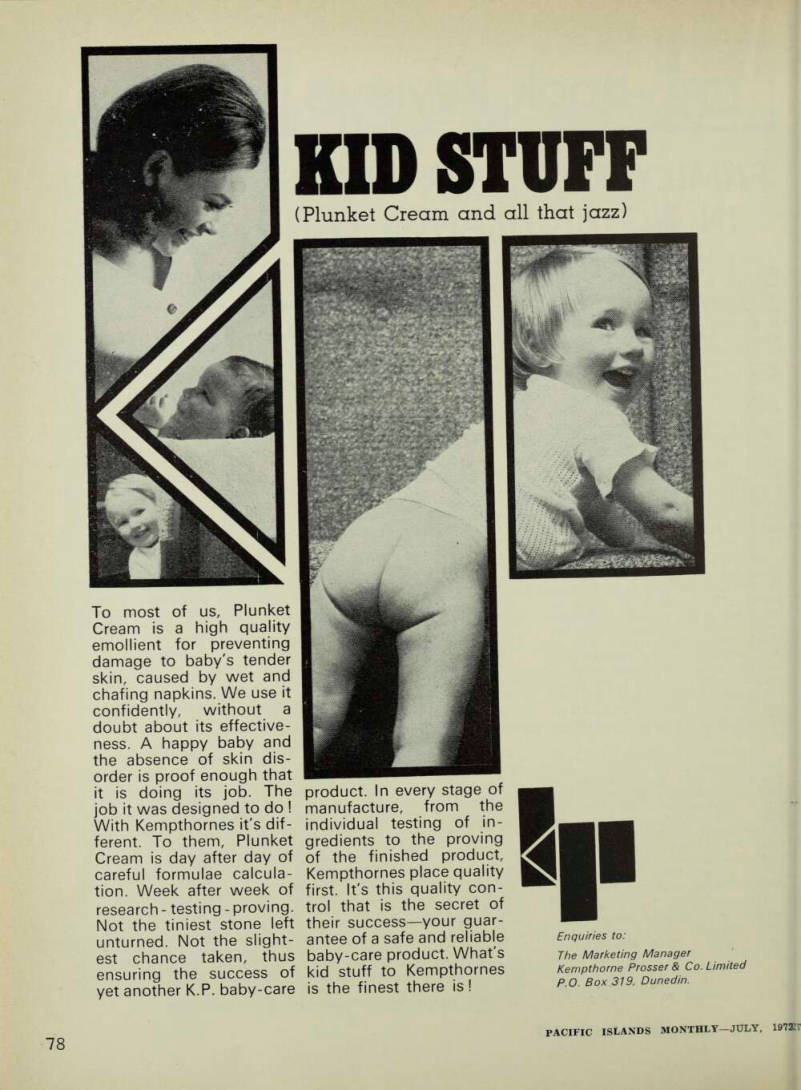
Family Feuds Or Peaceful Reform
In Ng Highlands Land System?
One Father, One Blood, a scholarly and objective book by Andrew Strathern, will find its real importance in the literature of anthropological investigation in Papua New Guinea.
It describes the descent rules which people in the Mount Hagen area had to maintain so that their descent groups could survive the turmoil of tribal warfare.
That the rules were often bent by ambitious fight leaders is not surpri sing. Recruitment and affiliation with other groups were part of this tough world of competition for land and status. Allegiance to these dynamic rules has survived pacification. As population pressures lead to land subsistence pressures, new leaders may be thrust up to take back the law into the hands of those seeking violent solutions.
A study of descent, inheritance and succession customs is built up (as Dr. Strathern so generously acknow ledges) by the work of many in vestigators in the same field. His own patient communication with the people required preparatory study of their language and the understanding co-operation of informants, which is evident in this book. He had to weigh conflicting evidence and test the importance of mythical explanations, sometimes from sources suffering emotional bias.
The author’s conclusions are care fully documented. Thankfully, he does not harvest from his informants the kind of conforming statements that are so often sown in discussion. He links the behaviour and adaptability of the people to their own empirical rules and the way in which forceful personalities—the “big-men” of the Mount Hagen area—both use and bend the rules to their needs.
The role of the people and their big-men in the original Mount Hagen world was built around the need for fight leaders to have followers and affiliates so they could promote the needs, and defend the rights, of their group. It followed that big-men also took a leading part in influencing
marriage patterns, land use and ceremonial exchange.
Those sharing common descent within an exogamous group find their marriage partners outside their own clan. The women they marry are held to a contract to provide their husband’s clan with children. Wives do not become members of their husband’s clan and if he dies before they do, they may revert by returning home. Young children may accom pany them, but these children will have an inviolate right to rejoin the clan of their dead father if they are not persuaded to affiliate with their mother’s group. The frequent New Guinea habit of widows marrying their brothers-in-law (usually the oldest brother of the dead man) is not so much an act of compassion as a practical means of making sure children are not lost to the clan.
Within the clan, the significance of polygamy is that segments and sub clans derive descent from a parti cular female ancestress. There is an important emphasis on brotherhood both from descent and by association.
In a community which is totally
without any central authority or hereditary chieftainship system, there is considerable competition between individuals seeking the status of big men. Refugees from the continual fragmentations of warfare, or from family quarrels, migrate to affiliate.
Great importance was once attached to the ability of famous fight leaders to attract men (from outside accepted descent lines from a common father) to join up as de facto members of the fight leader’s group. People were im portant and closely united by group objectives.
Land Commissioners charged with the difficult duty of peacefully main taining rigid boundaries of land-use or ownership frozen by pacification will not find fixed formulas in this book. Traditional custom became flexible under the pragmatic pressures of living.
Patrilineal descent from a real or mythical owner ancestor is not always the only evidence of a modern land right. Indigenous rights to a land area may justify access by more than one group. Administration officers familiar
(Continued on p. 79)
Land use and ownership can be separate
with that apparent contradiction: “The gardens belong to them but the land is ours”, will be encouraged by this book not to seek quick, obvious solutions. The right to use land can in fact be separate from parallel ownership. The reader will also better understand the reluctance of New Guinea politicians to disturb land tenure systems of this kind and will doubt the capacity of any government to enforce radical change.
Meanwhile, population increase in some places exceeds four per cent, and nearly everywhere the land pres sures are growing. Australian pacifica tion created an occupational vacuum for the former followers of fight leaders. This was met by the govern ments Highlands labour scheme, pro viding up to three years’ work in a distant district with the advantage that on repatriation those returning had monetary wealth to purchase community status.
The huge road programmes and the development of the coffee industry also provided occupational therapy for people who had a subsistence economy to protect them from hunger hardship. Other government and expatriate initiatives created com mercial opportunities for a new kind of “big-man” who no longer would need a group of followers. But group allegiance and individual leadership have continued to be expressed through syndicates operating trucks or purchasing cattle.
We are now in a more difficult phase in the Highlands, influenced by a decline in government leader ship and a feeling that administration control has been relaxed. At the same time, lack of self-discipline has made it impossible to prevent serious over production in the coffee industry upon which so much of the central Highlands depends for the injection of capital to maintain a developing [ullage economy. The duration of labour contracts on distant planta tions has gradually declined and the pattern of recruiting has responded o resistance in both the. Eastern and Western Highlands, to concentrate uore on the Southern Highland dis rict.
The diversions and excitement that -uropean settlement once provided is ’iving way to resentment, particularly imong mobs of partly educated foung men who wish to participate n a future of peasant farming com- •
lined with seasonal coffee-harvesting
abour.
Among the young there is mis placed nostalgia for the turmoil of :lan and tribal competition. When
subsistence hardship due to popula tion increase is compounded by un employment, there will be a danger to public order because traditional followers may force new fight leaders to take violent solutions justified by duty to a descent group.
The obvious solution by migra tion has emotional resistance. The authorities should confer with the people to organise further massive swamp reclamation schemes, more intensive agriculture and subsidise works that will attract secondary industry.
The manpower of Papua New Guinea has never been properly
organised and in all developing countries there is both need and precedent within established Inter national Labour Conventions for forced labour at nominal wages to be used in their own as well as in the national interest. —lan Downs.
(One Father, One Blood, By
Andrew Strathern. Australian National University Press. $7.50).
fascinating Fijian
How you can. say in fascinating Fijian
THAKOMBAU” is spelt Cakobau, and “Nandi” is spelt Nadi, etc.
But why? The question has been asked by every visitor to Fiji over the last century. But the early mis sionaries, who were largely re sponsible for what appears to be the intricacies of Fijian spelling, did not construct the alphabet by drawing letters out of a hat; or because the printers ran out of some letters when the language was put into the hands of the missionary presses. There were reasons for their choice, and the result is a very good writing system, says Dr. A. J. Schutz, Associate Professor of Linguistics at the Uni versity of Hawaii, who explains it
all, simply and entertainingly, in a new booklet Say it in Fijian (Pacific Publications, Sydney, 51.20 plus 7c posted). Dr. Schutz designed the book for visitors who want to enjoy their stay more by participating in Fiji culture, and most Fijian words can be pronounced accurately, he says, by learning a few simple pat terns. “Fijian is a living language, a language to be used, to be perpetu ated, and to be enjoyed,” says Dr.
Schutz, who proceeds to tell us how it works, and supplies well-selected word lists. Both the visitor, and the expatriate living in the dominion, will find Say it in Fijian as practical as it is entertaining.
Advertisements & other items, pp. 80-84 (1 item)
Kid Stuff
(Plunket Cream and all that jazz) To most of us, Plunket Cream is a high quality emollient for preventing damage to baby's tender skin, caused by wet and chafing napkins. We use it confidently, without a doubt about its effectiveness. A happy baby and the absence of skin disorder is proof enough that it is doing its job. The job it was designed to do !
With Kempthornes it's different. To them, Plunket Cream is day after day of careful formulae calculation. Week after week of research - testing - proving.
Not the tiniest stone left unturned. Not the slightest chance taken, thus ensuring the success of yet another K.P. baby-care 4* » product. In every stage of manufacture, from the individual testing of ingredients to the proving of the finished product, Kempthornes place quality first. It's this quality control that is the secret of their success —your guarantee of a safe and reliable baby-care product. What's kid stuff to Kempthornes is the finest there is!
Enquiries to: The Marketing Manager Kempthorne Prosser & Co. Limited P.O. Box 319, Dunedin.
A must for those interested
in South Pacific cultural
art and dance.
In this book, two skilled guides lead the reader on an exciting Pacific Ocean voyage voyage is backward in time, but great art takes no account of age Bruce Palmer and Beth Dean show that there is true greatness m th « Pacific art, whether its form be a carved figure, the pattern stencilled on bark c'oth or woven into the fabric of a building, or the superbly controlled movement of a massed or The* V contents 0 of the book contain 104 glossy pages with 64 beautiful colour plates and 56 black-and-white pictures. .., ith It covers artifacts, cultures and cultural dances from 17 Pacific Island wunjnes with the inclusion of the Australian aboriginal whose origins date back more than 30,000 PRICE; Australia and P-N.G., $2.75 Aust., plus 24c posted; Pacific Islands and overseas countries, $2.75 Aust., plus 25c posted; USA, $3.50 U.S. posted.
Available from:
Pacific Publications (Aust.) Pty. Ltd.
29 ALBERTA STREET, SYDNEY, N.S.W. 2000.
(Postal Address: Box 3408, G.P.O. Sydney, N.S.W. 2001.)
PIT MOTHUHTIQM
in |our work with
fee
G.M. Bedford Industrial Diesel Engine, Models 330, 330 T.
CLAE make engines. Engines for trucks. For boats. For industry. Generators, power units and pumping sets.
CLAE are proud of their hard-earned reputation as the most reliable name in the business of precision. They look after you from the moment your enquiry is received. And they keep looking after you—long after the sale is made — by efficient, expert after-sales service and by the very largest spare parts department in the country.
If your equipment is not running as well as it should —if your costs are too high—if you’re too long off the fob through costly delays in finding spare parts—you NEED Clael!
CLAE Parts and Service back-up guarantees down-time being kept to an absolute minimum. Send us details of your application NOW.
It’ll be different from all the rest, and that’s the kind of challenge we like the best.
T 3 m G.M. Bedford Diesel Generator Sets, Models 220 G and 330 G.
CLAE 8D145 Diesel Marine Engine, 145 h.p.
Paragon P4OO Series Hydraulic Transmission.
G.M. Bedford 6 cyl. 466 c.l. fitted with 15" Flood Pump Clae Engine Sales & Service, 31 Hoskins Ave., Bankstown, N.S.W. 2200.
Clae Engine (Old.) Pty. Ltd., Lavarack Ave., Eagle Farm, Queensland 4007.
Please send me details of Name Address
ihe power
.Date.
DISTRIBUTED BY: Townsville: Nth. Queensland Diesel Services Pty. Ltd. Ph. 79 3688 • Melbourne: Motor Spares Ltd. Ph. 30 0271 Adelaide: Rasch Motors (S.A.) Pty. Ltd. Ph. 51 5371-3 • Launceston: Hlghllne Marine Services. Ph. 31 3082 • Perth: Attwooda Marine centra.
Ph. 28 3155 • Hobart: Motors Pty. Ltd. Ph. 2 0571
Nostalgic recollections
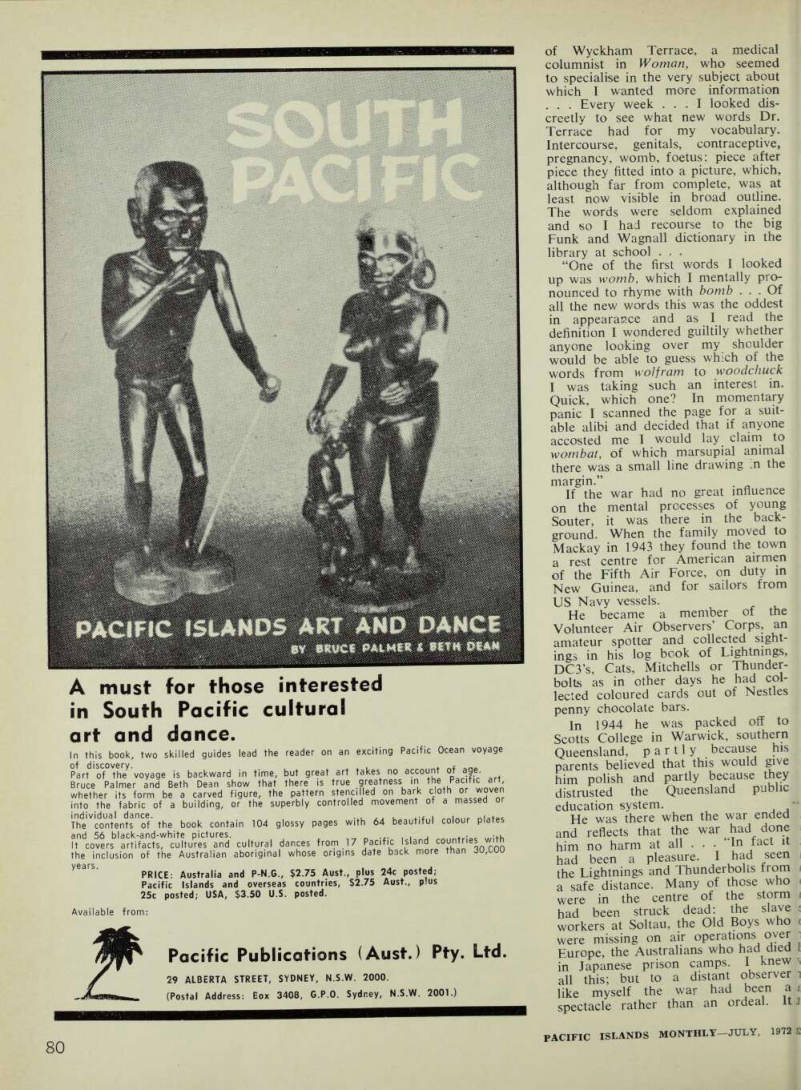
of The Kempsey Lad
Growing up produces similar natural phenomena, no matter who is doing it. Or when. This seems to be the verdict after I tried out Gavin Souter’s The Idle Hill of Summer on people of three different generations.
All could identify with this account of Australian childhood and adolescence to some extent, and to laugh at the same funny bits.
Gavin Souter (above) is known to Pacific readers as the author of the exhaustive history of New Guinea discovery and exploration, New guinea: The Last Unknown; to oydneysiders as a feature writer in the Sydney Morning Herald, and for his serious bock, A Peculiar People, about the 19th century Utopian expenment of Australian socialists who tned to set up a colony in Paraguay.
But as a writer he can also produce the very different, evocative mood of byaney and Sydney Observed, two the latter’s ca/e*o~ pouter papa was a bank manager and as a result the family moved trom one country town to another every few years although they occupied the same relative social position in each—one which, in the Australian country town tradition, included other bank managers, the doctor, the solicitor, a store manager or two and perhaps the chemist.
The story covers the years 1939 to
1945—age 10 to 16 for young Gavin —the family moved from outer Sydney to Kempsey on the NSW North Coast, and to Mackay in North Queensland, They were also the years of World War II but they did not impede the essential business of antipodean growing-up. There was sitting with friends in the branches of the wisteria vine, or on the flat roof of the wood shed; of reading comic books (allegedly “tawdry, time-wasting and a bad influence”) about Rockfist Rogan, Buck Rogers and Ginger Meggs; with Sunbeams, conducted by “Aunt Marie”, in the Sunday Sun and in which 11-year-old Souter made his literary debut with a drawing of a galleon copied from a book— a fact that filled him with mingled elation and fear that the drawing would be recognised and he un masked for the plagiarist that he was. w£ going on around him that he did not understand, except that it had to do with the opposite sex. He felt that, compared to some of his contem poraries, he was slow on the up take. Therefore, although desperately curious, whenever the mysterious sub ject was hinted at, he either ignored it or pretended to know all “My key to understanding,” he says, “was the accidental discovery
of Wyckham Terrace, a medical columnist in Woman, who seemed to specialise in the very subject about which I wanted more information . . . Every week ... I looked dis creetly to see what new words Dr.
Terrace had for my vocabulary.
Intercourse, genitals, contraceptive, pregnancy, womb, foetus: piece after piece they fitted into a picture, which, although far from complete, was at least now visible in broad outline.
The words were seldom explained and so I had recourse to the big Funk and Wagnall dictionary in the
library at school . . .
“One of the first words I looked up was womb, which I mentally pro nounced to rhyme with bomb ... Of all the new words this was the oddest in appearance and as 1 read the definition I wondered guiltily whether anyone looking over my shoulder would be able to guess which of the words from wolfram to woodchuck I was taking such an interest in.
Quick, which one? In momentary panic I scanned the page for a suit able alibi and decided that if anyone accosted me 1 would lay claim to wombat, of which marsupial animal there was a small line drawing !n the margin.”
If the war had no great influence on the mental processes of young Souter, it was there in the back ground. When the family moved to Mackay in 1943 they found the town a rest centre for American airmen of the Fifth Air Force, on duty in New Guinea, and for sailors from US Navy vessels.
He became a member of the Volunteer Air Observers’ Corps, an amateur spotter and collected sight ings in his log book of Lightnings, DC3’s, Cats, Mitchells or Thunder bolts as in other days he had col lected coloured cards out of Nestles penny chocolate bars.
In 1944 he was packed off to Scotts College in Warwick, southern
Queensland, partly because his
parents believed that this would give him polish and partly because they distrusted the Queensland public education system. ■ He was there when the war ended and reflects that the war had done him no harm at all . . . “In fact it had been a pleasure. I had seen the Lightnings and Thunderbolts from a safe distance. Many of those who were in the centre of the storm had been struck dead: the slave workers at Soltau, the Old Boys who were missing on air operations oyer Europe, the Australians who had died in Japanese prison camps. 1 knew all this; but to a distant observer like myself the war had been a spectacle rather than an ordeal. It
had been a long and exciting serial like ‘First Light Fraser’ on 2GB and to be perfectly honest I was sorry it had to end.”
The Idle Hill of Summer takes its title from A. E. Housman’s The Shropshire Lad: On the idle hill of summer, Sleepy with the flow of streams, Far I hear the steady drummer Drumming like a noise in dreams.
This is no story of mis-spent youth; of wicked parades of schoolmasters whose psychological ineptness pro duces trauma in the tender young.
There is absolutely nothing in it about genera ion gaps, revolt against moral values or the Establishment.
The author actually appears to have had a happy childhood and youth, with normal, satisfactory parents, and to have survived the formative years without waning to demolish existing society. It is a nostalgic piece, like a warmly recollected sunny, summer afternoon, cicadas in the gum trees, surf on the beach.
It is deceptively simple, covering considerable insight and was prob ably the hardest of the Sourer books to write. He accomnlishes the inh
splendidly.
Judy Tudor.
(The Idle Hill Of Summer.
$3 y 95? aVin Souter ’ Aun & us & Robertson.
I>AN Paperbacks has come out with * a varied collection of cookery books for everyone, from the beginner to the highly adventurous and ex perienced. Learning to Cook ($1.10) is the most comprehensive —an encyclopaedia for inexperienced would-be cooks. It even includes a small section on what to do if things go wrong. Is author, Marguerite Patten, has also wriLen World Cookery ($1.25) covering dishes from all over the world. Then there’s Mrs. Beeton’s All About Cookery ($1.25), an up-to-date version of this old-time favourite, particularly help ful for those on a budget. But of special interest to Islands’ people is Deep Freeze Cookery ($1.40) with many practical bin's. I would have been glad of it myself when I lived in New Guinea. It is written by Marika Hanbury Tenison. For the specialist, Pan has provided The Cordon Bleu Book of Jams, Pre serves and Pickles by R. Hume and M. Downes (95c). —Marie Shannon.
Book notes and news
|TERE are three books reporting Papua New Guinea research, under the general head of anthro pology: Fighting with Food, by Michael W.
Young (Cambridge University Press, UK price £5,80), is a perceptive and detailed study of the coercive gift giving among the Massim society of Goodenough Island which operates to subdue violence by the organised forms of competitive food exchange and ceremonial festivals. It has an important political message. Those not in the mainstream of European inspired development can go on suc cessfully being themselves by retain ing the dynamic quality of their own Melanesian society.
Place and People, by William C.
Clarke (Australian National Uni versity Press, 57.95), uses a remote minor group on the headwaters of the Simbai River on the northern fall of the Bismarck Range to carry out a very valuable ecological study of how isolated pre-literates managed to cope with their environment and how habitat both proscribes and de velops behaviour. Th s microstudy, undertaken before the clash with white man’s culture has had time to obscure its own initial impact, allows the reader to join the author in considering the consequences.
Some may feel that the shocking health deficiencies, now being made good, are enough to justify our alien interference.
Business and Cargo, by E. Ogan, New Guinea Research Bulletin No. 44 (ANU Press, $1.50), is another valuable contribution to our under standing of people, on this occasion the Nasioi groups living near Kieta, on Bougainville Island, who are con siderably involved in copying and adapting themselves to the European material culture thrust upon them.
The area is of special interest because much of the study was undertaken before the Bougainville Copper com pany decided to operate. At this stage, all conclusions are premature.
Like many investigations, the author’s work suffers because of understand able compassion for the people in
volved.
lan Downs.
A LTHOUGH it all happened long f*- ago, there is a growing interest in World War I aviation, and new and old material finds an avid market. Men and Machines of the Australian Flying Corps 1914-19, by Charles Schaedel, is the most recent
of the new publications, and an ex cellent outline it is of Australia’s infant air force. It is aviation history presented in its best form—accurately, and with few frills.
Chapter one covers the formation of the AFC and the little known Mesopotamian Half-Flight. Very brief mention is made of the AFC’s un eventful expedition as a support unit in New Guinea.
Other chapters cover the activities of Squadrons 1,2, 3 and 4 from the time of their formation.
Illustrations in the book are first class; 10 colour pages and 125 black and white pho os, many coming from private collections and never before published—something that is very re freshing to those of us who hear publishers make this claim with every new book released, and find it is not always justified.
My only real criticism is on the lack of an index. And I would like to have seen more details on Training Squadrons 5,6, 7 and 8. Our copy is from the publishers, Kookaburra Technical Pub. Pty. Ltd., Victoria.
Price $4.95.-
Bill Toohey.
Kangaroo Island, South Aus
tralia, has had a history of ship wrecks—if you include fishing cutters among the big stuff—such as the 5,865ton Portland Maru, wrecked there in 1935, and the 2,284-ton Montebello, wrecked in 1906. Now an amateur historian Gifford Chapman, has col lected the histories (with photographs where possible) of 51 wrecks around that coast since 1847, and published them in the Roebuck series of Australian history, at $4.50, called Kangaroo Island Shipwrecks.
Roebuck’s publisher is Dr. I. S.
Cumpston, 24 Holmes Cres., Camp bell, Canberra, whose aim is to give an outlet to books of merit on Aus tralian historical subjects not other wise published.
PAUL MATANE, a Tolai who holds a senior Papua New Guinea Government post, is the latest New Guinean to get his story into book form. Oxford University Press is shortly publishing Matane’s My Child hood in Papua, about his develop ment from early childhood to maturity. It’s part of an Oxford series for secondary schoolchildren.
As well as aspects of his life it covers more general matters concerned with the rapidly changing context of New Guinea politics and social develop ment.
Advertisements & other items, p. 81 (1 item)
79
'ACIFIC ISLANDS MONTHLY—JULY, 1972
Pacific Shipping
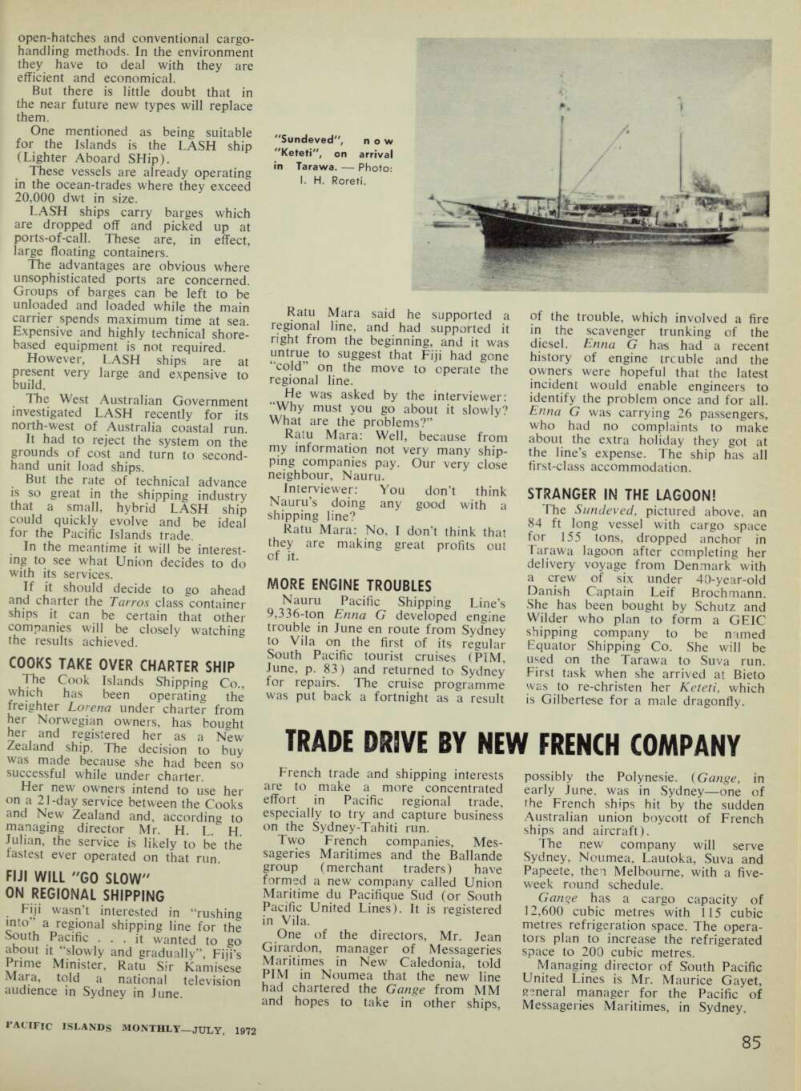
Two Charter Ships As Pioneers
Of Islands Container Service
By William Olson
A container shipping service employing two unusual vessels could be operating from New Zealand to the Pacific Islands by the end of the year.
A decision on whether to go ahead with the service is expected from the Union SS Co. by mid-August.
Indications are that transport ex perts examining the plan for Union and its parent, Thomas Nationwide Transport of Sydney, will strongly recommend the plan to the Union board in New Zealand.
But there are problems, particularly in port facilities, to be overcome.
In Sydney the deputy chairman and managing director of TNT, Sir Peter Abeles, told PIM that plans were to run two chartered stern-loaders.
“If we can resolve several prob which include labour and port facilities, then we feel we could give a much better service with these vessels,” Sir Peter said.
The scheduled run has not been spelt out, but the obvious service would be the one now served by con ventional vessels running out of Auck land to Fiji, Tonga, Western and American Samoa.
Three ships now service these ports with two others running to Norfolk and Noumea, Papeete and Western Samoa.
The container ships being looked at for charter are of the Scandinavian Tarros class.
Small by container ship standards (1,600 tons) they nevertheless can carry 120 standard 20 ft containers and have good sea speeds. Loading is through a stern ramp with containers being lifted off trucks by an overhead crane carried in the ship.
It is understood the Union board will consider chartering two ships of the class, the first to be in service by Christmas, the second by next March.
Chartering of these ships would enable Union to assess their per formance over two to three years before ordering its own vessels.
Such an operation would provide
valuable experience to balance against investigations of ship types for a permanent service.
TNT has already said it is looking at new shipping systems for its Island services and these include contamerships of the cellular type, vehicle-deckers, open hatch unitloaders and hybrids which combine the best features of all these types.
All can carry the standard container, with the vehicle-deckers providing more versatility by loading flats, unitised cargo, vehicles and standard containers.
There is still considerable debate in the shipping world as to the efficiency of the various ship types servicing the new systems of through transport which provide the shipper with door-to-door transport.
A trade such as that servicing the Pacific Islands poses special problems because of unsophisticated port
facilities. However, the benefits to be realised from a container service are such that a thorough investigation is well worth while.
Hovercraft (air-cushion vehicles) have been suggested in some quarters as sea carriers.
But these craft still have bugs to be ironed out for open-sea routes, and their economics have yet to be proved in circumstances which could involve maintenance problems.
The economics of the displacement hull allied with the savings of un manned engine-rooms and low deck manning scales is a combination which the “skimmers” (air-cushion and hydrofoils) have not yet been able to challenge in open-sea freight.
At the moment the New Guinea and Islands runs are serviced by ships which employ side-loading.
Continued on p. 85
open-hatches and conventional cargo handling methods. In the environment they have to deal with they are efficient and economical.
But there is little doubt that in the near future new types will replace them.
One mentioned as being suitable for the Islands is the LASH ship (Lighter Aboard SHip).
These vessels are already operating in the ocean-trades where they exceed 20,000 dwt in size.
LASH ships carry barges which are dropped off and picked up at ports-of-call. These are, in effect, large floating containers.
The advantages are obvious where unsophisticated ports are concerned.
Groups of barges can be left to be unloaded and loaded while the main carrier spends maximum time at sea.
Expensive and highly technical shore based equipment is not required.
However, LASH ships are at present very large and expensive to build.
The West Australian Government investigated LASH recently for its north-west of Australia coastal run.
It had to reject the system on the grounds of cost and turn to second hand unit load ships.
But the rate of technical advance is so great in the shipping industry that a small, hybrid LASH ship could quickly evolve and be ideal for the Pacific Islands trade.
In the meantime it will be interest ing to see what Union decides to do with its services.
If it should decide to go ahead and charter the Tarros class container ships it can be certain that other companies will be closely watching the results achieved.
Cooks Take Over Charter Ship
pie Cook Islands Shipping Co., which has been operating the freighter Lorena under charter from her Norwegian owners, has bought her and registered her as a New Zealand ship. The decision to buy was made because she had been so successful while under charter.
Her new owners intend to use her on a 21-day service between the Cooks and New Zealand and, according to managing director Mr. H. L. H.
Julian, the service is likely to be the fastest ever operated on that run.
Fiji Will "Go Slow"
On Regional Shipping
. phi wasn’t interested in “rushing into’’ a regional shipping line for the South Pacific ... it wanted to go about it “slowly and gradually”, Fiji’s Prime Minister, Ratu Sir Kamisese Mara, told a national television audience in Sydney in June.
Ratu Mara said he supported a regional line, and had supported it right trom the beginning, and it was untrue to suggest that Fiji had gone cold on the move to operate the regional line.
Was asked by the interv »ewer: Why must you go about it slowly?
W R a niii are M the P ™ bl fi mS r * Kalu Mara; Well, because from my information not very many shipping companies pay. Our very close neighbour, Nauru.
You do “’‘ think shipping line?® B °° W " h 3 Ratu Mara: No, I don’t think that they are makine great nmfitc rmt mey are making great profits out
More Engine Troiirifc
K.nrn P n °eu LES .
Nauru Pacific Shipping Lines y, 3 36-ton Enna G developed engine trouble m June en route from Sydney c° X 1 d 01 ? c the fil^ st of . lts re B ular South Pacific tourist cruises (PIM, June, p. 83) and returned to Sydney tor repairs. The cruise programme was put back a fortnight as a result
of the trouble, which involved a fire in the scavenger trunking of the diesel. Enna G has had a recent history of engine trouble and the owners were hopeful that the latest incident would enable engineers to identify the problem once and for all Enna G was carrying 26 passengers, who had no complaints to make about the extra holiday they got at the line’s expense. The ship has all first-class accommodation,
Stranger In The Lagoon!
„ Tj? e pictured above, an it ~? ng . vesse ! Wlth . car 8° u s P a 9 e tons, dropped anchor in Tarawa lagoon after completing her delivery voyage from Denmark with a c . rew of six under 40-year-old Danish Captain Leif Brochmann.
She has been bought by Schutz and Wilder who plan to form a GEIC shipping company to be named Equator Shipping Co. She will be used on the Tarawa to Suva run.
First task when she arrived at Bieto was to re-christen her Keteti, which is Gilbertese for a male dragonfly.
"Sundeved", now "Keteti", on arrival in Tarawa. Photo: I. H. Roreti.
Here's how they will work
The Tarros class container ship combines the qualities of the RO-RO ship (stern loader) and the lift on-lift off cellular vessel. It is essentially a feeder class carrier designed for low-cost operation, independent of sophisticated shore-based cargo handling equipment.
Sea Containers Inc. of New York and its British branch, Sea Containers Ltd. of London have done much pioneering work with the class. The company has 13 small container ships in its fleet and nine more on order. Sea Containers first saw the Tarros class operating on short sea hauls between Genoa and Sardina. They saw its potential and placed orders for their own ship.
There are now six Tarros class in the company fleet and another eight on order from Dutch builders. It is claimed that the Tarros class can discharge and load a cargo of 111 20 ft containers in one eight hour working shift. Sea speed is given as 15.5 knots.
The on-ship cargo handling is particularly interesting. Trucks drive on via a stern ramp to an open vehicle deck. Containers are off-loaded from them by the ship’s overhead gantry crane and stowed in a manner similar to that used in deck loads carried by large cellular vessels.
Clearly the Tarros is a well-tested container carrier of unique design particularly suited to short-haul sea trades such as those in the Pacific Islands.
Advertisements & other items, p. 86 (1 item)
Small Boat Echo Sounder!
You can now own a low cost, high performance Echo Sounder for your small boat.
Furuno models FG-11 Mark 3 and FG-200 Mark 3 are portable, simple to operate and easy to read even in bright sunlight. Graphic and flasher read-outs can be done together or separately to indicate depths of fish and seabed down to 320 Fathoms (FG-11 B).
"White line" operation gives expensive sounder performance to these economical, portable sounders. /Tf ♦ The future today with FUR UNO's electronic teabnologiL
lU FURUNO ELECTRIC CO.. LTD.
9-52, Ashihara-cho, Nishinomiya-city, Japan
CABLE : FURUNG NISHINOMIYA,
. TELEX ; 5644-498
I Newage BMC marine engines are economical, rugged, reliable and virtually unbreakable. But if something should go wrong, it’s good to know you can get any part quickly from Lars Halvorsen.
Lars Halvorsen are sole East Coast distributors for Newage BMC, and to them, after sales service is a big thing. When you buy Newage BMC you don’t buy worries in the unlikely event of a breakdown all you need do is make one phone call for spare parts, to Lars Halvorsen. Dealer enquiries invited
VEDETTE PETROL 24 BHP
CAPTAIN DIESEL. 38 BHP
COMMANDER
DIESEL 55 BHP
COMMODORE
DIESEL 70 BHP
SEALORD
5-7 DIESEL. . 100 BHP
Hi
SONS PTY. LTD.
Waterview Street, Ryde 80 0251
Telegrams: “Halvorsens”, Sydney
Builders of Halvorsen Boats
Trade Drive By New French Company
French trade and shipping interests are to make a more concentrated effort in Pacific regional trade, especially to try and capture business on the Sydney-Tahiti run.
Two French companies, Mes sageries Maritimes and the Ballande group (merchant traders) have formed a new company called Union Maritime du Pacifique Sud (or South Pacific United Lines). It is registered in Vila.
One of the directors, Mr. Jean Girardon, manager of Messageries Maritimes in New Caledonia, told PIM in Noumea that the new line had chartered the Gange from MM and hopes to take in other ships,
possibly the Polynesie. ( Gange, in early June, was in Sydney—one of the French ships hit by the sudden Australian union boycott of French ships and aircraft).
The new company will serve Sydney, Noumea, Lautoka, Suva and Papeete, then Melbourne, with a five week round schedule.
Gange has a cargo capacity of 12,600 cubic metres with 115 cubic metres refrigeration space. The opera tors plan to increase the refrigerated space to 200 cubic metres.
Managing director of South Pacific United Lines is Mr. Maurice Gayet, general manager for the Pacific of Messageries Maritimes, in Sydney.
Advertisements & other items, p. 88 (1 item)
The Popular
tropic or temperate climate —Fibreglass Refrigerated
units by George & Ashton exceed all requirements George and Ashton moulded fibreglass refrigerated units are unaffected by rust, rot, fatigue, weathering or corrosion. No joints to harbour vermin, so cleaning is easy. Used for any type of vehicle or as static storage units. Any size units can be supplied assembled or in prefabricated sections for easy shipping and erection on site.
Approved by N.Z. Depts of Health and Agriculture.
GEORGE &
ASHTON
P.O. Box 2056, South Dunedin, New Zealand.
Phones 54-108, 54-109 George & Ashton (P. 1.) Ltd.
Box 296, Suva, Fiji.
Phone 26-249.
HUM mm
The Fiji Meats unit illustrated is the second supplied to this Company
Ask for FOUREX—the clear sparkling amber beer
available in BOTTLES, CANS and STUBBIES
9 © •
The Popular
‘lts Quality Never Varies
Wholesale Distributors:
C. SULLIVAN
(NEW GUINEA) PTY. LTD.,
Port Moresby, Lae, Mt. Hagen, Rabaul, Kieta, Lautoka and Suva, Fiji.
AGENCIES:
R. Bensley—Madang. Ping Shee & Co. —Wewak. E. V. Lawson Pty. Ltd. — Honiara, British Solomon Islands.
IHMIHi
tISTUNAIf
xxxx
castum»irctMiNi
Fitter
BIPLCMAMf fftO* »C
Brewed from the finest Ingredients by Castlemaine Perkins Lim
Another Round Of Increases
In Shipping Freight Rates
Chickens hatched out by steve dores’ successful demands for more pay are coming home to roost freight rates to pay the increased wages are going up.
By the middle of June, four ship ping lines—Pacific Navigation Co., Tonga’s national line, the French company Sofrana, Fiji Australia Line and the Cook Islands Shipping Co. had announced freight increases on their runs to the Pacific Islands. All gave as the main reason for the hike the increase in dockers’ and seamen’s wages.
More companies are expected to announce increases within the next month.
The decision by Tonga’s Pacific Navigation Co. is bound to rock the Islands’ governments. Fiji, Tonga, Samoa have all dreamed of the day when the Islands could have their own regional shipping line. This was a topic the South Pacific Forum has discussed at length and one which found immediate favour when the Pacific Islands Producers’ Association was first formed. With their own line, the Islands would be able to keep freight rates at a realistic level and would not be influenced by wharfies’ demands and industrial unrest in the metropolitan countries. So they thought.
How wrong they were! To keep in business, Pacific Navigation has found it has to respond to outside influences.
It has raised its freight rates by about nine per cent. Burns Philp, its agents in Sydney, said the rise will just cover the increases in the cost of cargo handling at the wharves.
The rises, per ton of cargo, are: Sydney and Melbourne to Fiji $3; Sydney and Melbourne to Pago Pago $4; Sydney to Apia and Nukualofa $4; Melbourne to Apia and Nukua lofa $5.
The special rate for flour to all Island ports has been increased to $2B a ton, which is a rise of between $3 and $4.
Sofrana’s increase, which had not been announced at the time of writ ing, is expected to be about 10 per cent, on its general cargo to all ports.
Sofrana’s four ships operate be tween New Zealand, New Caledonia New Hebrides, Fiji, Wallis and Futuna, New Guinea, and the Solo mons. It’s obvious, therefore, that living costs are going to rise again in all those territories.
And that goes for the Cook Islands
too. The Cook Islands Shipping Co. which owns the Lorena, has slapped on the biggest increase so far 14 per cent. The reason given is the wharfies’ and seamen’s wages lift. So far, however, there has been no announcement from the NZ Maori and Island Affairs Department which runs the Moana Roa, beyond a state ment that it was waiting for a cabinet decision. Whichever way it goes, it will be heartache for Premier Henry because the Moana Roa’s losses are debited against NZ’s handouts to the Cooks.
The Cook Islands Government has approved the increase on Lorena borne. freight.
Fiji Australia has put S 3 a ton on Fiji-bound cargo. Karlander raised its Australia-Fiji rate by the same amount from July 1. NEL said, “We won’t complete an evaluation of the water-borne increases for another five weeks. At the moment, everything stands as it is.”
Meanwhile, Papua New Guinea’s Harbours Board has increased port, wharf and berth charges, and, as it’s hardly likely that the shipping lines servicing PNG have taken these in creases into account, it looks as if there’ll be another lift for PNG-bound freight.
The new PNG Transport Minister, Mr. Bruce Jephcott, explained that the Harbours Board had to be self sufficient and the increases were necessary to meet commitments over the next few years. Previous rates were artificially low compared with those of other countries. The increases would be from about 70c to 80c a ton.
Conpac Switches
To Melbourne
The over-tonnaged port of Brisbane is to lose one of its regular ships, Container Pacific Express Line’s unit load ship Nimos, a familiar caller at Port Moresby. Faced with decreasing cargoes from the Queensland capital and with demand for more shipping space from exporters in Melbourne, CONPAC has switched Nimos from Brisbane to Melbourne for the regular run to Port Moresby.
This is the second switch this year to benefit the Melbourne exporters.
The first was by the new Japanese financed New Guinea Express Lines.
With the appearance on the Austra lian-PNG scene of Refrigerated Ex press Lines with Moresby Express and Lae Express with the Kieta Ex
press promised for August, CONPAC felt the area was getting overcrowded and decided on the change.
Melbourne needed the additional link with Port Moresby because of expanding trade but the change was not made without thought to Brisbane’s requirements. CONPAC made sure there would be no short shipments through an understanding with the Swire Group’s New Guinea Australia Line which had indicated that their Coral Chief would be able to handle all that was offered in Brisbane.
NGAL will be pleased with the departure of a rival from an over crowded port.
Minister Hopeful On
Png Coastal Trade
Launched on June 2 at Rabaul by the PNG Minister for Transport, Mr.
Bruce Jephcott, a new 82 ft all-steel coastal ship built solely by Papuans and New Guineans was named Dangit as a tribute to the late Dangit, for 20 years a skipper with the Coastal Shipping Co. Member’s of Dangit’s family and councillors from his home on Lambom Island in New Ireland were at the ceremony.
Dangit, of 190 tons gross, is owned by the St. George Shipping Co. An optimistic minister told the audience at the launching, “There are already signs of a slow upturn from the depressed state that existed last year in the shipping industry.”
Learning The Hard Way
The Stern Law Of The Sea
There could be an international storm blowing up over a neat salvage job performed in New Guinea waters in March on the PNG Federation of Co-operative Association’s coastal trader Papua which broke down on her way to Port Moresby from Madang and was towed home by Karlander’s 1,900-ton cargo carrier Slembe.
Papua’s skipper, Milton Cottrell, asked Lae Radio to call up the nearest ship for a tow. The Slembe, whose master knew something about salvage agreements, agreed to do the tow provided Cottrell signed the Lloyds form of salvage agreement which was news to Cottrell. He signed when he was told it was standard procedure and, anyway, no other ships were around. No fee was men tioned but Cottrell was asked Papua’s value. He guessed about $60,000.
Papua made it home on the end of Slembe’s cable, and in next to no time the federation got a demand from Lloyds for £stg3 0,000 to be lodged as security in London against the salvors’ claim.
Consternation at the federation!
According to local custom and that’s
the only thing the locals know about salvage claims—the standard fee for towage in PNG waters is a token pay ment, usually the cost of fuel and compensation for lost time. Kar lander’s head office in Oslo was told this and after some sparring by letter the company offered to settle for $16,000.
“The native people are disgusted and annoyed at the lack of principle displayed by your company in trying to extort such a huge sum of money from our village people, who are try ing to rise above a subsistence economy,” wrote Mr. Mahuru Rarua Rarua, the federation’s secretary.
The underwriters, Co-operative Insurance Co. Pty. Ltd. (Australia), have lodged a protest with Lloyds court of appeal. As the federation and other native co-ops are the share holders in ClC’s PNG branch they would lose out if salvage had to be paid.
Karlander (Australia) Pty. Ltd.’s managing director, Mr. H. Costello, said his board was very sympathetic to the problem but it was outside their hands as, under international salvage law, the Slembe’s crew had a stake in the matter.
The Slembe has white officers and a crew of New Guineans. The latter might be “persuaded” to forego their claims, particularly if, as seems likely, PNG’s new nationalist government takes a hand in the game.
Popular Cruise Ship
Leaves South Pacific
Firmly established on the South Pacific cruise scene in the last two years, the Fiji-Australia Line’s popular cargo passenger ship Taiyuan of 3,500 tons gross, will leave the scene in July. She has been sold and must be in Hong Kong at the beginning of August. She will be missed on the run which she has graced since September, 1970, and which took her and 86 passengers from Sydney to Brisbane, Fiji, Noumea and return.
Loading dates for the last voyage were Brisbane June 17, and Sydney lune 22.
Mid-June, Fiji Australia Line was negotiating for a replacement cargo /essel with the object of continuing ;o operate a regular three-weekly icheduled cargo service from Bris >ane and Sydney to Suva and Lautoka.
The 21-day cruise has been very popular among people wanting a juiet holiday cruise—mainly for the )ver-30s —and bookings have always )een high, usually between 80 per :ent. and 90 per cent, capacity.
Nauru’s Enna G, which has just itarted in the same business, might ind that Taiyuan’s departure is lefinitely to her gain.
Fiji Ship Repair Firm
Undercuts Nz Yard
A Fiji ship repair firm, Bish Ltd., of Suva, is carrying out extensive repairs to a Japanese fishing boat at a third of the cost quoted by a New Zealand shipyard Japanese fish catcher, the Mam 33. of 260 tons, one of the latest types of backline trawlers, ran aground on the New Zealand coast several months ago. After refloating, she was taken to the NZ shipyard for repairs which the shipyard estimated would cost about $ 110,000. The yard started the job but was unable to continue after replating about a third of the starboard side. Fuji Mam 33 was brought to Suva Bish Ltd. is now engaged on replating most of the bottom of the fish ment-and the bill will be aU The Fuji Mam 33 is fully automated and is designed to stay at sea for as long as six months. rrndv rrnmrr rft n n>
Ferry Service For W. Samoa
A ferry service linking Western Samoa’s islands of Upolu and Savaii will be created at a cost of $W5620,000 with the New Zealand
Government contributing $440,000, leaving the Samoans only $lBO,OOO to *? nd ‘. ... , Terminal buildings will be con structed and negotiations are being carned ° ut »n Denmark for the pur chase of a feri T craft whlc h has Fuji a, . r ,‘; ady b « n J oca ' ed . The ferry boat wl " ' be ca P able ? f car ,T, n * ° r . buses and about 300 passengers, • lsb ° ped have , th f service operat ,ng befo A re . >he end of this year, The Asian Development Bank was ? sk , ed for a loan *° fi^" ce ' he P ro ‘ J ect . on Ihe grounds that the ferry semce * aS par ‘ of a scheme already ? ppro . ved and financed by the bank f° r , "proving communications in Western Samoa. This was turned down ’ but New Zealand came IO th <=
rescue
* ™f. Ba “" Rabi S L on cargo ship, the New Zealand ’ f ° r inter -‘ sland tradln 8- The Royal Navy survey ship HMS Hydra has completed a hydro graphic survey of Solomons coastal waters between Guadalcanal and the Bougainville Strait. Her survey will update the charts of dangerous, reef strewn waters off east Bougainville.
Advertisements & other items, pp. 90-92 (1 item)
31 Macquarie Place, Sydney, N.S.W. 2000
Established 1890 offering merchants in the Pacific, buying service giving prompt, careful and expert attention to all requirements.
For that service with a difference, cable "Success", Sydney. & Representing Manufacturers of: Tilley Lamps, Success Footwear, Del Monte Products, Murray Valley Drinks, etc., Lingman Italian Gas Ranges, Success Petrol Washing Machines, E. W. Pipe Fittings, Sharp Calculators, Success Canned Fish, and other leading Brands.
S.' - HIGHEST PRICES OBTAINABLE ON THE WORLD MARKETS
FOR YOUR
SHELL - COCOA - COFFEE - COPRA - ETC.
31 Macquarie Place, Sydney, N.S.W. 2000
G.P.O. BOX 5315, SYDNEY, 2001.
Seatrans House, Gore St., Auckland, N.Z.
P.O. BOX 2044, AUCKLAND, N.Z.
CABLES: "TAITCO", SYDNEY.
MORE PORTS /MORE OFTEN
with
B€£\ RLJUVDER
KARLANDER NEW GUINEA LINE: Serving; Pt. Moresby, Samarai, Lae, Madang, Rabaul, Wewak, Manus Is., Kieta, Honiara, Yandina, Gizo, Vila, Norfolk Is., and Lord Howe Is.
KARLANDER KANGAROO LINE: Serving; Los Angeles, San Francisco,
Auckland, Melbourne, Suva, Lautoka.
AUSTRALIAN TERRITORY LINER SERVICES: Serving; Melbourne,
Sydney, Newcastle, Brisbane, Weipa, Gove, Thursday Is.
Managing Agents
KARLANDER (AUSTRALIA) PTY. LIMITED
19-31 Pitt Street, Sydney
„ , General Agents Brisbane: F. H. Stephens Pty. Ltd.
Melbourne; F. H. Stephens (Vic.) Pty. Ltd.
Pt. Moresby: Carpenter Shipping Agencies.
Samarai: Burns Philp (N.G.) Ltd.
San Francisco: Transpacific Transportation Co Los Angeles: Transpacific Transportation Co.
Madang: B. J. Back Pty. Ltd.
Yandina: Levers Pacific Plantations Co. Ltd.
Santo: Burns Philp (N.H.) Ltd.
Lord Howe Is.: R. Wilson, Leanda Lei.
Thursday Is.; Torres Industries Ltd.
Manus Is.: Edged & Whiteley Ltd.
Rabaul: Rabaul Trading Co. Ltd.
Honiara; E. V. Lawson Pty. Ltd.
Kieta: Breckwoldt & Co. Pty. Ltd.
Lae: N.G.G. Trading Company.
Wewak: Burns Philp (N.G.) Ltd.
Fiji: Burns Philp (S.S.) Ltd.
Gizo: British Solomon Trading Co.
Vila: Burns Philp (N.H.) Ltd.
Norfolk Is.: Burns Philp (S.S.) Ltd.
SULLIVANS
MELBOURNE SYDNEY
C. SULLIVAN (EXPORT) PTY. LTD.,
4TH FLOOR, KEMBLA BUILDING,
60 MARGARET STREET. SYDNEY
(G.P.O. BOX 3373).
AUCKLAND CABLES AND TELEGRAMS: “CHASULL”.
BRISBANE
LONDON
OFFERS A COMPREHENSIVE AND EFFICIENT
BUYING SERVICE TO THE PACIFIC ISLANDS
OFFICES AT:
PORT MORESBY • LAE • RABAUL • KIETA • MOUNT HAGEN • BULUMA • SUVA • LAUTOKA • NOUMEA • HONIARA • PORT VILA
"SULLIVANS for SERVICE"
Save hundreds of dollars
on Australians most efficient
WALK IN, ALUMINIUM
COOLROOMS AND
FREEZE ROOMS
Hundreds already installed! The most economical supplementary coolrooms for bottles and food, providing the largest storage capacity of any comparable coolrooms of the same exterior dimensions. Five sizes —from 90-360 cu. ft. capacity; 16 models offering normal temp., two temp., deep freeze, or for pastry and ice storage applications. White vinyl interior, embossed rustproof aluminium exterior. • SUPPLIED IN EASY-TO-ERECT, DO-IT-YOURSELF KIT FORM • PETROL AND PETROL-ELECTRIC MODELS ARE AVAILABLE FOR AREAS WHERE POWER IS LIMITED OR NON-EXISTENT m m Available from: AUSTRALIAN NEW CALEDONIA EXPORTS, (SILVER AND BARDA), 363 George St, 2000 and Branches.
BRECKWOLDT AND CO., 276 Pitt St, Sydney 2000 and Branches.
HAGEMEYER (AUST.), 59 Anzac Parade, Kensington 2033 and Branches.
MILLERS LIMITED, Thompson St, Suva, Fiji.
Manufactured by:
NELSON AND ROBERTSON PTY. LTD., 197 Clarence St, Sydney, 2000 RABAUL TRADING CO., and Branches. u . . . c ROY GALLIMORE AND ASSOCIATES, POB 179 Vila New Hebrides.
S AND E. TATHAM, 364 Lonsdale St, Melbourne, 3000 and Branches SULLIVAN (EXPORT) PTY. LTD., Kembla Bldg., 60 Margaret St, Sydney 2000 and Branches. . , W. S. TAIT, 31 Macquarie St, Sydney 2000 and Branches. 199 Parramatta Road., Cnr. Skarratt Street, Auburn, N.S.W. 2144, Australia. Phone: 648-1711.
Powered by Kelvinatoi Five-year warranty o compressor. Early de livery.
Cruising
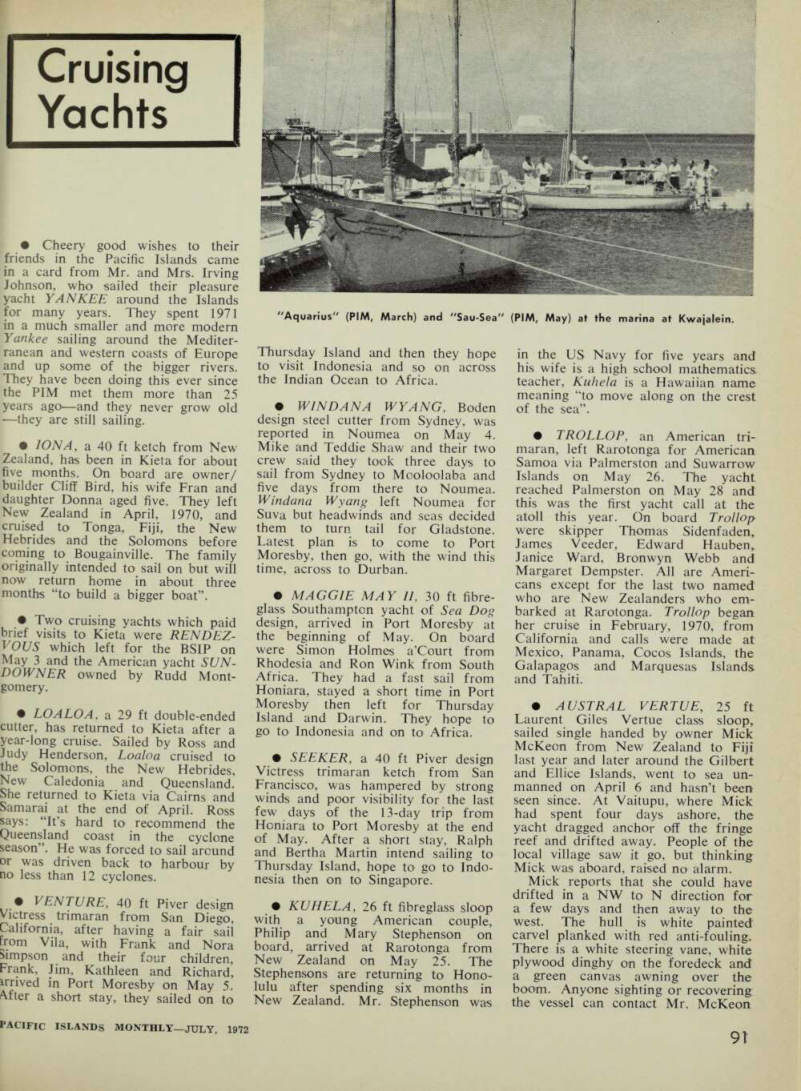
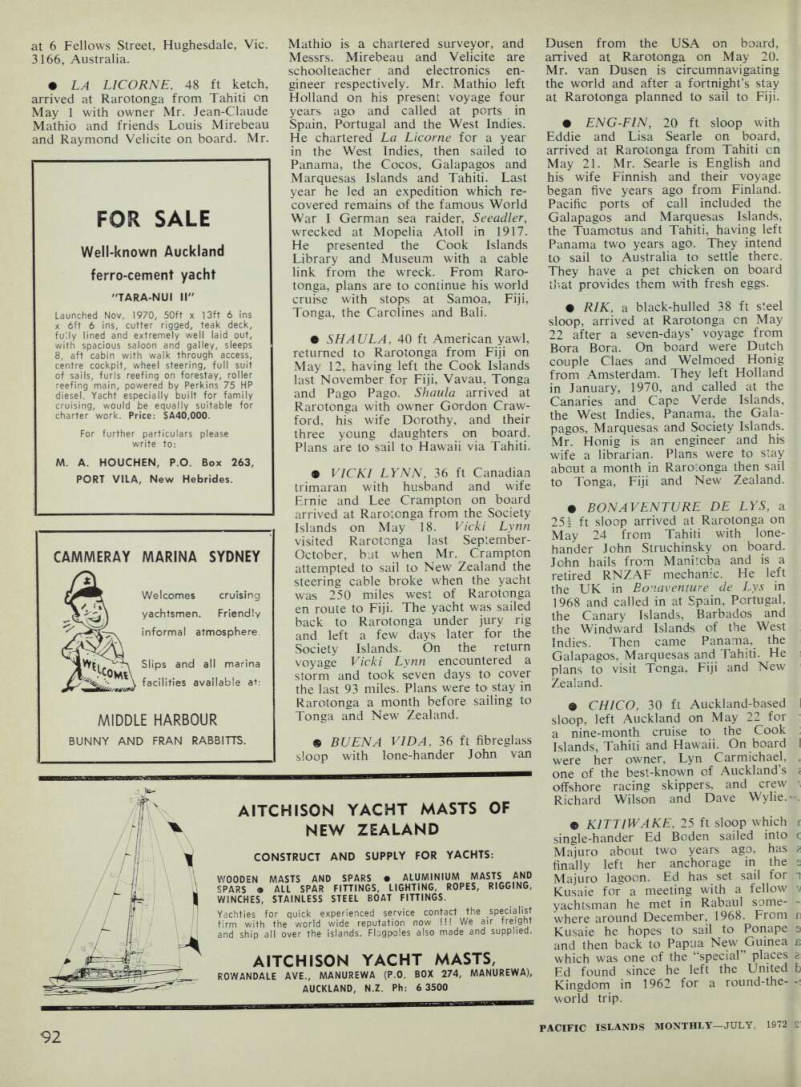
Yachts
• Cheery good wishes to their friends in the Pacific Islands came in a card from Mr. and Mrs. Irving Johnson, who sailed their pleasure yacht YANKEE around the Islands for many years. They spent 1971 in a much smaller and more modern Yankee sailing around the Mediter ranean and western coasts of Europe and up some of the bigger rivers.
They have been doing this ever since the PIM met them more than 25 years ago—and they never grow old —they are still sailing. • lONA, a 40 ft ketch from New Zealand, has been in Kieta for about five months. On board are owner/ builder Cliff Bird, his wife Fran and daughter Donna aged five. They left New Zealand in April, 1970, and cruised to Tonga, Fiji, the New Hebrides and the Solomons before coming to Bougainville. The family originally intended to sail on but will now return home in about three months “to build a bigger boat”. • Two cruising yachts which paid brief visits to Kieta were RENDEZ VOUS which left for the BSIP on May 3 and the American yacht SUN DOWNER owned by Rudd Mont gomery. • LOALOA, a 29 ft double-ended cutter, has returned to Kieta after a year-long cruise. Sailed by Ross and Judy Henderson, Loaloa cruised to the Solomons, the New Hebrides, New Caledonia and Queensland.
She returned to Kieta via Cairns and Samarai at the end of April, Ross says: “It’s hard to recommend the Queensland coast in the cyclone season”. He was forced to sail around or was driven back to harbour by no less than 12 cyclones. • VENTURE, 40 ft Piver design Victress trimaran from San Diego, California, after having a fair sail From Vila, with Frank and Nora Simpson and their four children, Frank, Jim, Kathleen and Richard, irrived in Port Moresby on May 5. a short stay, they sailed on to
Thursday Island and then they hope to visit Indonesia and so on across the Indian Ocean to Africa.
• Win Dan A Wyang, Boden
design steel cutter from Sydney, was reported in Noumea on May 4.
Mike and Teddie Shaw and their two crew said they took three days to sail from Sydney to Mooloolaba and five days from there to Noumea.
Windana Wyang left Noumea for Suva but headwinds and seas decided them to turn tail for Gladstone.
Latest plan is to come to Port Moresby, then go, with the wind this time, across to Durban. • MAGGIE MAY 11, 30 ft fibre glass Southampton yacht of Sea Dog design, arrived in Port Moresby at the beginning of May. On board were Simon Holmes a’Court from Rhodesia and Ron Wink from South Africa. They had a fast sail from Honiara, stayed a short time in Port Moresby then left for Thursday Island and Darwin. They hope to go to Indonesia and on to Africa. • SEEKER, a 40 ft Piver design Victress trimaran ketch from San Francisco, was hampered by strong winds and poor visibility for the last few days of the 13-day trip from Honiara to Port Moresby at the end of May. After a short stay, Ralph and Bertha Martin intend sailing to Thursday Island, hope to go to Indo nesia then on to Singapore. • KUHELA, 26 ft fibreglass sloop with a young American couple, Philip and Mary Stephenson on board, arrived at Rarotonga from New Zealand on May 25. The Stephensons are returning to Hono lulu after spending six months in New Zealand. Mr. Stephenson was
in the US Navy for five years and his wife is a high school mathematics, teacher, Kuhela is a Hawaiian name meaning “to move along on the crest of the sea”. • TROLLOP, an American tri maran, left Rarotonga for American Samoa via Palmerston and Suwarrow Islands on May 26. The yacht reached Palmerston on May 28 and this was the first yacht call at the atoll this year. On board Trollop were skipper Thomas Sidenfaden, James Veeder, Edward Hauben* Janice Ward, Bronwyn Webb and Margaret Dempster. All are Ameri cans except for the last two named who are New Zealanders who em barked at Rarotonga. Trollop began her cruise in February, 1970, from California and calls were made at Mexico, Panama, Cocos Islands, the Galapagos and Marquesas Islands and Tahiti.
• Austral Vertue, 25 Ft
Laurent Giles Vertue class sloop, sailed single handed by owner Mick McKeon from New Zealand to Fiji last year and later around the Gilbert and Ellice Islands, went to sea un manned on April 6 and hasn’t been seen since. At Vaitupu, where Mick had spent four days ashore, the yacht dragged anchor off the fringe reef and drifted away. People of the local village saw it go, but thinking Mick was aboard, raised no alarm.
Mick reports that she could have drifted in a NW to N direction for a few days and then away to the west. The hull is white painted carvel planked with red anti-fouling.
There is a white steering vane, white plywood dinghy on the foredeck and a green canvas awning over the boom. Anyone sighting or recovering the vessel can contact Mr. McKeon
"Aquarius" (PIM, March) and "Sau-Sea" (PIM, May) at the marina at Kwajalein.
at 6 Fellows Street, Hughesdale, Vic. 3166, Australia. • LA LICORNE, 48 ft ketch, arrived at Rarotonga from Tahiti on May 1 with owner Mr. Jean-Claude Mathio and friends Louis Mirebeau and Raymond Velicite on board. Mr.
Mathio is a chartered surveyor, and Messrs. Mirebeau and Velicite are schoolteacher and electronics en gineer respectively. Mr. Mathio left Holland on his present voyage four years ago and called at ports in Spain, Portugal and the West Indies.
He chartered La Licorne for a year in the West Indies, then sailed to Panama, the Cocos, Galapagos and Marquesas Islands and Tahiti. Last year he led an expedition which re covered remains of the famous World War I German sea raider, Seeadler, wrecked at Mopelia Atoll in 1917.
He presented the Cook Islands Library and Museum with a cable link from the wreck. From Raro tonga, plans are to continue his world cruise with stops at Samoa, Fiji, Tonga, the Carolines and Bali. 9 SHAULA, 40 ft American yawl, returned to Rarotonga from Fiji on May 12, having left the Cook Islands last November for Fiji, Vavau, Tonga and Pago Pago. Shaula arrived at Rarotonga with owner Gordon Craw ford, his wife Dorothy, and their three young daughters on board.
Plans are to sail to Hawaii via Tahiti. • VICKI LYNN, 36 ft Canadian trimaran with husband and wife Ernie and Lee Crampton on board arrived at Rarotonga from the Society Islands on May 18. Vicki Lynn visited Rarotonga last September- October, but when Mr. Crampton attempted to sail to New Zealand the steering cable broke when the yacht was 250 miles west of Rarotonga en route to Fiji. The yacht was sailed back to Rarotonga under jury rig and left a few days later for the Society Islands. On the return voyage Vicki Lynn encountered a storm and took seven days to cover the last 93 miles. Plans were to stay in Rarotonga a month before sailing to Tonga and New Zealand. 9 BUENA VIDA, 36 ft fibreglass sloop with lone-hander John van
Dusen from the USA on board, arrived at Rarotonga on May 20.
Mr. van Dusen is circumnavigating the world and after a fortnight’s stay at Rarotonga planned to sail to Fiji. • ENG-FIN, 20 ft sloop with Eddie and Lisa Searle on board, arrived at Rarotonga from Tahiti cn May 21. Mr. Searle is English and his wife Finnish and their voyage began five years ago from Finland.
Pacific ports of call included the Galapagos and Marquesas Islands, the Tuamotus and Tahiti, having left Panama two years ago. They intend to sail to Australia to settle there.
They have a pet chicken on board that provides them with fresh eggs. • RIK, a black-hulled 38 ft steel sloop, arrived at Rarotonga cn May 22 after a seven-days’ voyage from Bora Bora. On board were Dutch couple Claes and Welmoed Honig from Amsterdam. They left Holland in January, 1970, and called at the Canaries and Cape Verde Islands, the West Indies, Panama, the Gala pagos, Marquesas and Society Islands.
Mr. Honig is an engineer and his wife a librarian. Plans were to stay about a month in Rarotonga then sail to Tonga, Fiji and New Zealand.
• Bona Venture De Lys, A
25i ft sloop arrived at Rarotonga on May 24 from Tahiti with lone hander John Struchinsky on board.
John hails from Manitoba and is a retired RNZAF mechanic. He left the UK in Bonaventure de Lys in 1968 and called in at Spain, Portugal, the Canary Islands, Barbados and the Windward Islands of the West Indies. Then came Panama, the Galapagos, Marquesas and Tahiti. He plans to visit Tonga, Fiji and New Zealand. 9 CHICO, 30 ft Auckland-based sloop, left Auckland on May 22 for a nine-month cruise to the Cook Islands, Tahiti and Hawaii. On board were her owner, Lyn Carmichael, one of the best-known of Auckland s offshore racing skippers, and crew Richard Wilson and Dave Wylie. 9 KITTIWAKE, 25 ft sloop which single-hander Ed Boden sailed into Majuro about two years ago, has finally left her anchorage in the Majuro lagoon. Ed has set sail for Kusaie for a meeting with a fellow yachtsman he met in Rabaul some where around December, 1968. From Kusaie he hopes to sail to Ponape and then back to Papua New Guinea which was one of the “special” places Ed found since he left the United Kingdom in 1962 for a round-the world trip.
Advertisements & other items, pp. 94-98 (1 item)
For Sale
Well-known Auckland
ferro-cement yacht
"TARA-NUI II"
Launched Nov. 1970, 50ft x 13ft 6 ins x 6ft 6 ins, cutter rigged, teak deck, fully lined and extremely well laid out, with spacious saloon and galley, sleeps 8, aft cabin with walk through access, centre cockpit, wheel steering, full suit of sails, furls reefing on forestay, roller reefing main, powered by Perkins 75 HP diesel. Yacht especially built for family cruising, would be equally suitable for charter work. Price: $A40,000.
For further particulars please write to:
M. A. HOUCHEN, P.O. Box 263,
PORT VILA, New Hebrides.
CAMMERAY MARINA SYDNEY
c OMI
Welcomes cruising yachtsmen. Friendly informal atmosphere.
Slips and all marina facilities available at;
MIDDLE HARBOUR
BUNNY AND FRAN RABBITTS.
1
AITCHISON YACHT MASTS OF
NEW ZEALAND
CONSTRUCT AND SUPPLY FOR YACHTS:
WOODEN MASTS AND SPARS • ALUMINIUM MASTS AND SPARS 9 ALL SPAR FITTINGS, LIGHTING, ROPES, RIGGING,
WINCHES. STAINLESS STEEL BOAT FITTINGS.
Yachties for quick experienced service contact the specialist firm with the world wide reputation now !!! We air freight and ship all over the islands. Flagpoles also made and supplied.
AITCHISON YACHT MASTS,
ROWANDALE AVE., MANUREWA (P.O. BOX 274, MANUREWA),
AUCKLAND, N.Z. Ph: 6 3500
; v Y,‘v.s***vk~ t'V w$L’M • :•■ •• ■• ■* r . V^.i “W*!® fflßSr <sk\' m y. ■*}
wMm s :v & S '’:
Ry 4qJ #*V *v» i vV '- ,<: w ¥?m 14v v >,<■-•*'
I F#:. > % e-fS:v >
f L * w«* jMvt£T f sSr* r • '■>
Ppf I .
wi&W 4tfe|P :
Mf § mm.
•■* rAiviuUj olr
I^Wgw» pt - proi
SINCE 1868
B) Mm&L
%fHv
-: ? V? ;> ' fliii r j 'll m ,r
PRODUCERS OF BRUNTONS . Y
;<>. FAMOUS
ROYAI.BAKERS' FIdURS
CAKE, .BISCUIT-A*» »ft)ODK
• • FLOURS, .SHARPS, ETC.
i M AZ&- .
■I liPiti a* ,'u« r: r# V|w- I ■'w ■ > -
It costs a little more
when it carries this trademark
U R R H »» «? m 4 a? •yi U i & 9 I Lv 20 years from now you’ll understand why!
In this age of planned redundancy, too few products are built to last. Exceptions, however, do exist. Over the past 50 years, Wild Heerbrugg has developed a range of optical and mechanical instruments whose superior precision and absolute accuracy have withstood the test of time under the most arduous conditions . . . from the frozen wastes of Antarctica to deep in space. This unique degree of precision and reliability is backed in Australia by fully equipped service centres staffed by Swisstrained specialists—together with all necessary parts and accessories to maintain a lifetime of unimpaired accuracy.
The range of Wild instruments includes microscopes, theodolites, tachometers, levelling instruments, distance measuring equipment, photogrammetric equipment and stainless steel drawing instruments —all covered by long term manufacturer’s guarantees.
WILD (AUSTRALIA) PTY. LTD.
45 Epping Road, North Ryde, N.S.W. 11 Buchanan Street, West End, Brisbane, Qld. 5 Errol Street, East Prahran, Victoria.
RDIAKI rpi I A- CO PTY. LTD.. BOROKO, T.P.N.G.
H Y S m E R * * *
siin
If you drove a lift truck,
yoird choose Hyster
Hyster lift trucks are people’s trucks. We build them easy to handle, easy to live with. Comfortable seats.
Full circle visibility. Plenty of leg and foot room. Humanengineered features. Naturally positioned controls.
We also consider managing directors, company secretaries and maintenance men. Find out now how Hyster trucks will reduce your materials handling costs. Ask your Hyster dealer for a demonstration. He’s listed in the Pink Pages. Or write to Hyster Australia Pty. Ltd., Ashford Avenue, Milperra, N.S.W. 2214.
HYSTER AUSTRALIA PTY. LTD.
‘Hyster’ and the Company symbol are trademarks.
HR29.FP2
50
y ea^
UST £ °.
fo lc° lo s Vl ßU S H tH£
the *
fl OH R
RAH D
Clf ,C
|Sl*
M pS-
(jilleApie J
m
HOR
ANCHOR
FLOUR
MAINTOP HIGH PROTEIN
BISCUIT FLOURS AND WHEATMEALS
Gillespie flours are milled from selected high quality Australian wheats and are entoleted for purity. Their consistent high quality has made them the best-known, most asked-for, brands of flour in the Islands. (Entoletion is a special purification process which reduces the risk of insect infection.)
GILLESPIE BROS. PTY. LTD
HEAD OFFICE:
12 UNION ST., PYRMONT, SYDNEY, N.S.W.
(G.P.O. BOX 2518, SYDNEY, 2001).
PHONE: 660-4933
CABLE ADDRESS;
"GILLESPIE",
SYDNEY AND BRISBANE
BRISBANE OFFICE:
ALBION, BRISBANE, QUEENSLAND.
(P.O. BOX 8, ALBION, BRISBANE, 4010).
PHONE: 62-1122
News
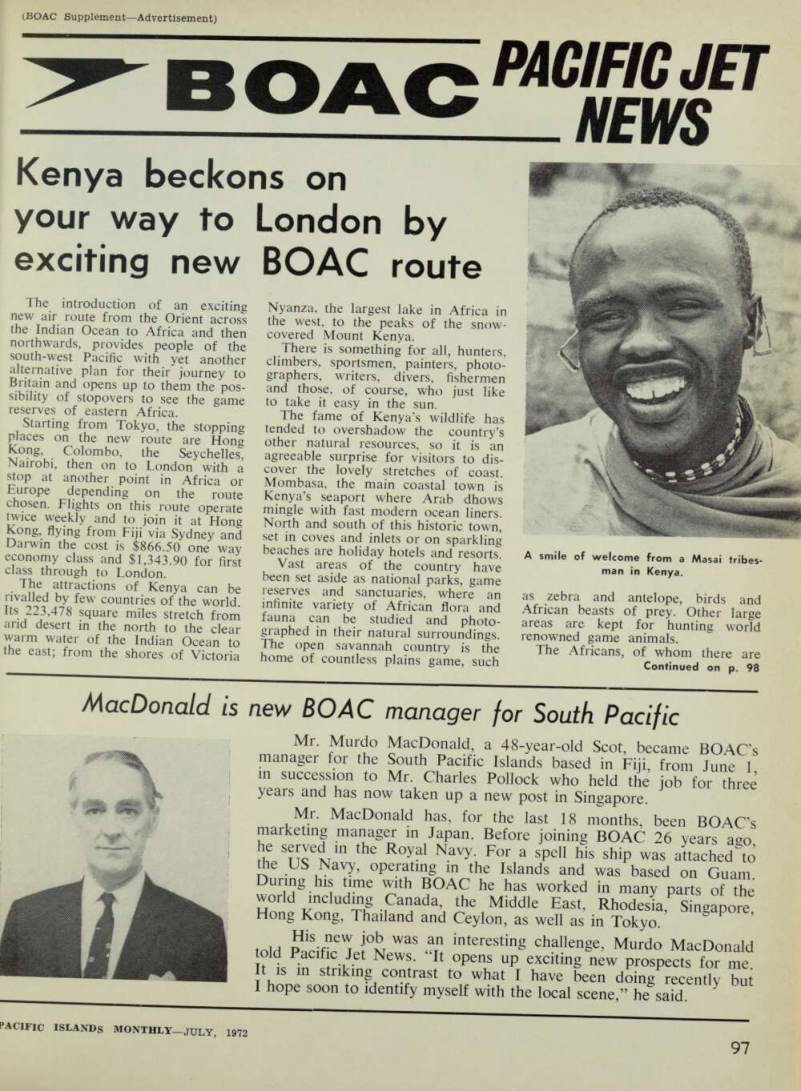
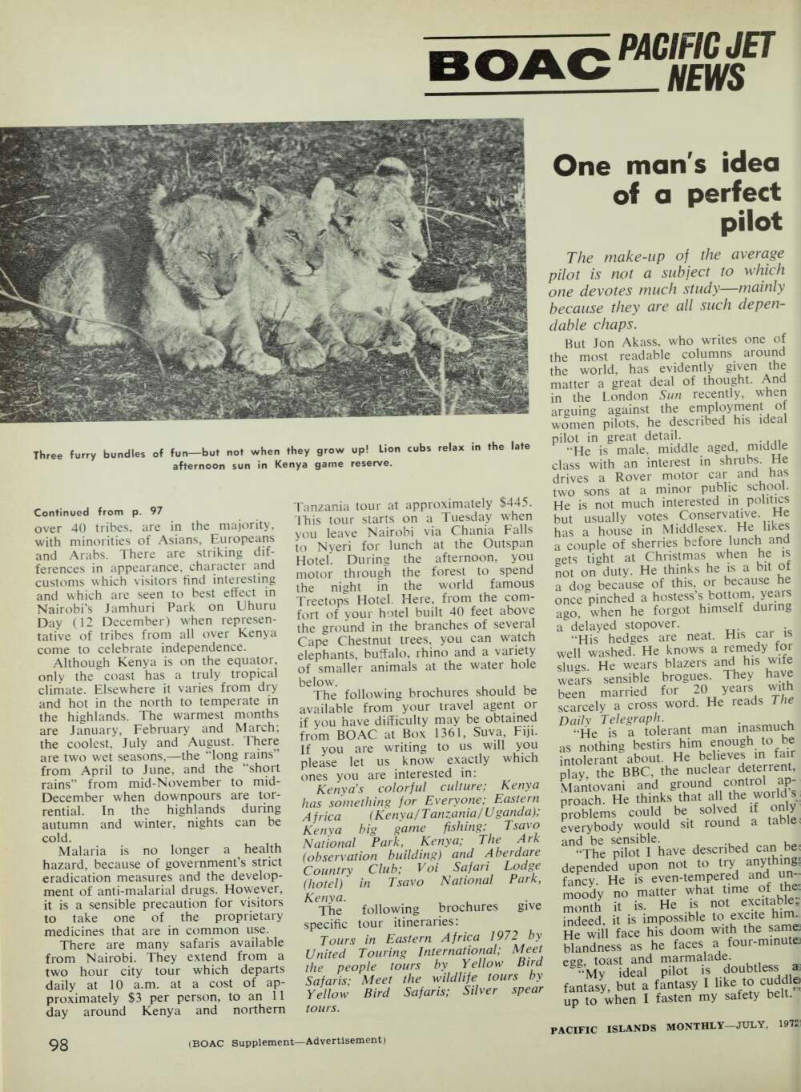
R Oa C Pacific Jet
Kenya beckons on your way to London by exciting new BOAC route
(BOAC Supplement—Advertisement)
The introduction of an exciting new air route from the Orient across the Indian Ocean to Africa and then northwards, provides people of the south-west Pacific with yet another alternative plan for their journey to Britain and opens up to them the pos sibility of stopovers to see the game reserves of eastern Africa.
Starting from Tokyo, the stopping places on the new route are Hong Kong, Colombo, the Seychelles, Nairobi, then on to London with a stop at another point in Africa or Europe depending on the route chosen. Flights on this route operate twice weekly and to join it at Hong Kong, flying from Fiji via Sydney and Darwin the cost is $866.50 one way economy class and $1,343.90 for first class through to London.
The attractions of Kenya can be rivalled by few countries of the world.
Its 223,478 square miles stretch from and desert in the north to the clear warm water of the Indian Ocean to the east; from the shores of Victoria
Nyanza, the largest lake in Africa in the west, to the peaks of the snow covered Mount Kenya.
There is something for all, hunters, climbers, sportsmen, painters, photo graphers, writers, divers, fishermen and those, of course, who just like to take it easy in the sun.
The fame of Kenya’s wildlife has tended to overshadow the country’s other natural resources, so it is an agreeable surprise for visitors to dis cover the lovely stretches of coast.
Mombasa, the main coastal town is Kenya’s seaport where Arab dhows mingle with fast modern ocean liners.
North and south of this historic town, set in coves and inlets or on sparkling beaches are holiday hotels and resorts.
Vast areas of the country have been set aside as national parks, game reserves and sanctuaries, where an infinite variety of African flora and fauna can be studied and photo graphed in their natural surroundings.
The open savannah country is the home of countless plains game, such
as zebra and antelope, birds and African beasts of prey. Other large areas are kept for hunting world renowned game animals.
The Africans, of whom there are
Continued on p. 98
A smile of welcome from a Masai tribes man in Kenya.
Continued from p. 97 over 40 tribes, are in the majority, with minorities of Asians, Europeans and Arabs. There are striking dif ferences in appearance, character and customs which visitors find interesting and which are seen to best effect in Nairobi’s Jamhuri Park on Uhuru Day (12 December) when represen tative of tribes from all over Kenya come to celebrate independence.
Although Kenya is on the equator, only the coast has a truly tropical climate. Elsewhere it varies from dry and hot in the north to temperate in the highlands. The warmest months are January, February and March; the coolest, July and August. There are two wet seasons, —the “long rains” from April to June, and the “short rains” from mid-November to mid- December when downpours are tor rential. In the highlands during autumn and winter, nights can be cold.
Malaria is no longer a health hazard, because of government’s strict eradication measures and the develop ment of anti-malarial drugs. However, it is a sensible precaution for visitors to take one of the proprietary medicines that are in common use.
There are many safaris available from Nairobi. They extend from a two hour city tour which departs daily at 10 a.m. at a cost of ap proximately $3 per person, to an 11 day around Kenya and northern
Tanzania tour at approximately $445. tour starts Q n a Tuesday when you leave Nairobi via Chania Falls for lunch at the Qutspan Hote ]' Dimrig the afternoon, you mQtor through the fores t to spend . h world famous Hotel H ere, from the com -1 o f P yo ur hotel built 40 feet above tortoty™ branches of several 8 Chestnut trees, you can watch elephants buffalo, rhino and a variety P sma ller animals at the water hole following brochures should be f ro m your travel agent or jf you a ve difficulty may be obtained BQAC at Box 1361> Suva , Fiji . are writing to us will you J' let us know exactly which you are interested in: Ke L a ’s colorful culture; Kenya something for Everyone; Eastern Africa (Kenya/Tanzanial Uganda); K J enya big game fishing; Tsavo National °Park, Kenya; The Ark ( observation building) and Aberdare [ Country C lub; Voi Safari Lodge (hote n in Tsavo National Park, inotei) > • fol i ow j ng brochures give spec j^ c tour itineraries: P ~. iqji bv Tours in Eastern A f Touring International Meet people lours to Yellow Bird Safaris; Meet the wildlife tour y Bird Safaris; Silver spear tours.
Three furry bundles of fun—but not when they grow up! Lion cubs relax in the late afternoon sun in Kenya game reserve.
MacDonald is new BOAC manager for South Pacific
Mr. Murdo MacDonald, a 48-year-old Scot, became BOAC’s manager for the South Pacific Islands based in Fiji, from June 1 m succession to Mr. Charles Pollock who held the job for three years and has now taken up a new post in Singapore.
Mr. MacDonald has, for the last 18 months, been BOAC’s marketing manager in Japan. Before joining BOAC 26 years ago m S nc e M m the R ° yal N . avy ' For a s P el > his shi P was attached to US Navy, operating in the Islands and was based on Guam Durmg his time with BOAC he has worked in many parts of the world including Canada, the Middle East, Rhodesia, Singapore Hong Kong, Thailand and Ceylon, as well as in Tokyo. 8 P ’ told WaS -n ‘ ntereSting ch . allen ge, Murdo MacDonald Pa f , . J t News - 11 °P ens U P exciting new prospects for me It is in striking contrast to what I have been doing recently but I hope soon to identify myself with the local scene,” he said
pilot
One man's idea of a perfect pilot
The make-up of the average pilot is not a subject to which one devotes much study—mainly because they are all such depen
dable chaps.
But Jon Akass, who writes one of the most readable columns around the world, has evidently given the matter a great deal of thought. And in the London Sun recently, when arguing against the employment of women pilots, he described his ideal pilot in great detail.
“He is male, middle aged, middle class with an interest in shrubs. He drives a Rover motor car and has two sons at a minor public school.
He is not much interested in politics but usually votes Conservative. He has a house in Middlesex He likes a couple of sherries before lunch and gets tight at Christmas when he is not on duty. He thinks he is a bit of a dog because of this, or because he once pinched a hostess’s bottom years ago, when he forgot himself during a delayed stopover.
“His hedges are neat. His car is well washed. He knows a remedy for slugs He wears blazers and his wife wears sensible brogues. They have been married for 20 years with scarcely a cross word. He reads The Daily Telegraph. .
“He is a tolerant man inasmuch as nothing bestirs him enough to be intolerant® about. He believes in fair play the BBC, the nuclear deterrent, Mantovani and ground control ap proach. He thinks that all the world s problems could be solved if only everybody would sit round a table and be sensible.
“The pilot I have described can be depended upon not to try anything fancy. He is even-tempered and un moody no matter what time of the month it is. He is not excitable, indeed it is impossible to excite him.
He will face his doom with the same blandness as he faces a four-minute egg toast and marmalade. e8 “My ideal pilot is doubtless s fantasy, but a fantasy I hketocuddle up to when I fasten my safety belt.
Advertisements & other items, p. 100 (1 item)
Pacific Jet
98
PACIFIC ISLANDS MONTHLY-JULY, 1972
B OAC NEWS
(BOAC Supplement—Advertisement)
Help for planning your tour of Britain
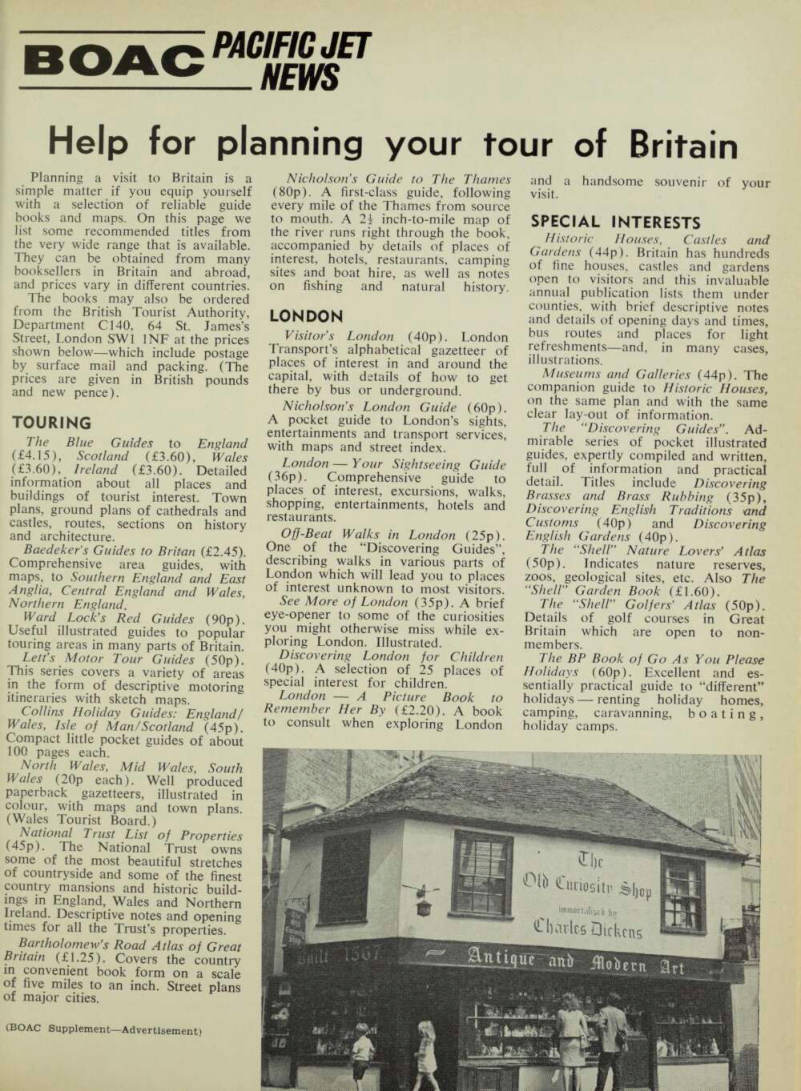
Planning a visit to Britain is a simple matter if you equip yourself with a selection of reliable guide books and maps. On this page we list some recommended titles from the very wide range that is available.
They can be obtained from many booksellers in Britain and abroad, and prices vary in different countries.
The books may also be ordered from the British Tourist Authority, Department Cl4O, 64 St. James’s Street, London SWI INF at the prices shown below—which include postage by surface mail and packing. (The prices are given in British pounds and new pence).
Touring
The Blue Guides to England (£4.15), Scotland (£3.60), Wales (£3.60), Ireland (£3.60). Detailed information about all places and buildings of tourist interest. Town plans, ground plans of cathedrals and castles, routes, sections on history and architecture.
Baedeker’s Guides to Britan (£2.45).
Comprehensive area guides, with maps, to Southern England and East Anglia, Central England and Wales, Northern England.
Ward Lock’s Red Guides (90p).
Useful illustrated guides to popular touring areas in many parts of Britain.
Lett’s Motor Tour Guides (50p).
This series covers a variety of areas in the form of descriptive motoring itineraries with sketch maps.
Collins Holiday Guides: England / Wales, Isle of Man/Scotland (45p).
Compact little pocket guides of about 100 pages each.
North Wales, Mid Wales, South Wales (20p each). Well produced paperback gazetteers, illustrated in colour, with maps and town plans. (Wales Tourist Board.) National Trust List of Properties (45p). The National Trust owns some of the most beautiful stretches of countryside and some of the finest country mansions and historic build ings in England, Wales and Northern Ireland. Descriptive notes and opening times for all the Trust’s properties.
Bartholomew’s Road Atlas of Great Britain (£1.25). Covers the country in convenient book form on a scale of five miles to an inch. Street plans of major cities.
(BOAC Supplement—Advertisement)
Nicholson’s Guide to The Thames (80p). A first-class guide, following every mile of the Thames from source to mouth. A 2i inch-to-mile map of the river runs right through the book, accompanied by details of places of interest, hotels, restaurants, camping sites and boat hire, as well as notes on fishing and natural history.
London
Visitor’s London (40p). London Transport’s alphabetical gazetteer of places of interest in and around the capital, with details of how to get there by bus or underground.
Nicholson’s London Guide (60p).
A pocket guide to London’s sights, entertainments and transport services, with maps and street index.
London Your Sightseeing Guide (36p). Comprehensive guide to places of interest, excursions, walks, shopping, entertainments, hotels and restaurants, Off-Beat Walks in London (25p).
One of the “Discovering Guides”, describing walks in various parts of London which will lead you to places of interest unknown to most visitors.
See More of London (35p). A brief eye-opener to some of the curiosities you might otherwise miss while ex ploring London. Illustrated.
Discovering London for Children (40p), A selection of 25 places of special interest for children.
London A Picture Book to Remember Her By (£2.20). A book to consult when exploring London
and a handsome souvenir of your visit.
Special Interests
Historic Houses, Castles and Gardens (44p). Britain has hundreds of fine houses, castles and gardens open to visitors and this invaluable annual publication lists them under counties, with brief descriptive notes and details of opening days and times, bus routes and places for light refreshments—and, in many cases, illustrations.
Museums and Galleries (44p). The companion guide to Historic Houses, on the same plan and with the same clear lay-out of information.
The “Discovering Guides’’. Ad mirable series of pocket illustrated guides, expertly compiled and written, full of information and practical detail. Titles include Discovering Brasses and Brass Rubbing (35p), Discovering English Traditions and Customs (40p) and Discovering English Gardens (40p).
The “Shell" Nature Lovers’ Atlas (50p). Indicates nature reserves, zoos, geological sites, etc. Also The “Shell” Garden Book (£1.60).
The “Shell" Golfers’ Atlas (50p).
Details of golf courses in Great Britain which are open to non members.
The BP Book of Go As You Please Holidays (60p). Excellent and es sentially practical guide to “different” holidays renting holiday homes, camping, caravanning, boating, holiday camps.
Advertisements & other items, p. 101 (1 item)
R Rmr* Pacific Jet
°V AC NEWS
Pubs Are In Fashion
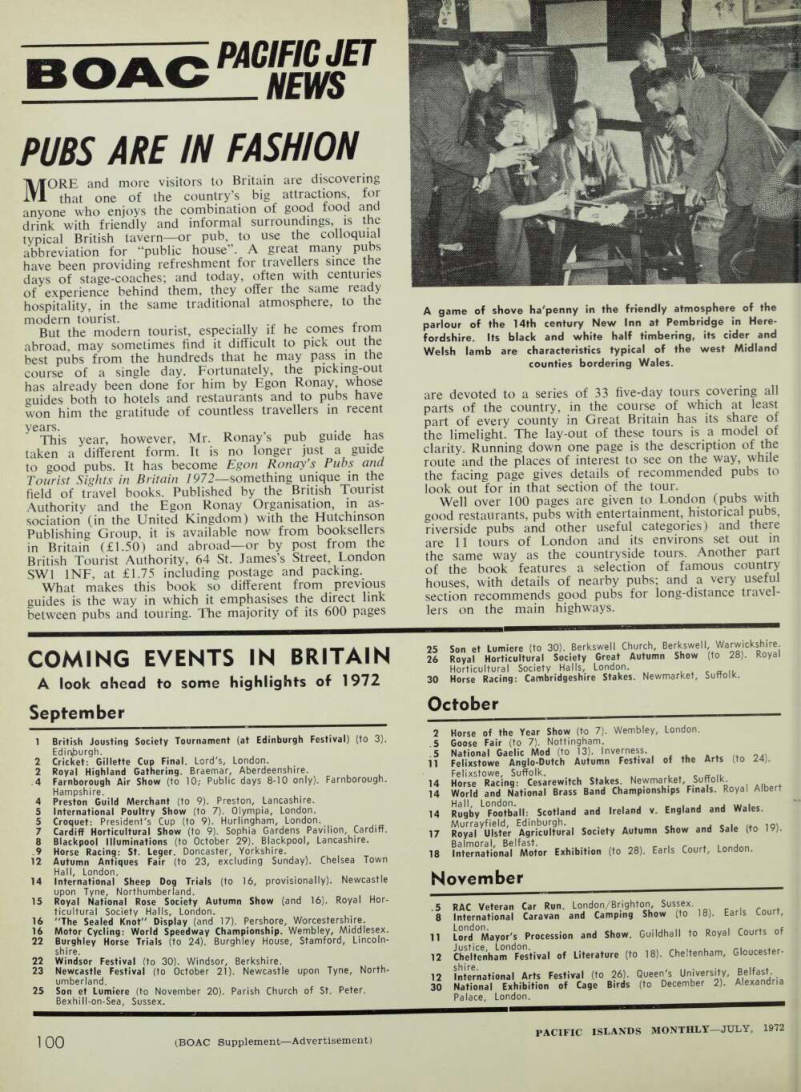
MORE and more visitors to Britain are discovering that one of the country’s big attractions for anyone who enjoys the combination of good food and drink with friendly and informal surroundings, is the typical British tavern —or pub, to use the colloquial abbreviation for “public house”. A great many pubs have been providing refreshment for travellers since the days of stage-coaches; and today, often with centuries of experience behind them, they offer the same ready hospitality, in the same traditional atmosphere, to the modern tourist. , r But the modern tourist, especially if he comes from abroad, may sometimes find it difficult to pick out the best pubs from the hundreds that he may pass in the course of a single day. Fortunately, the pickmg-out has already been done for him by Egon Ronay, whose guides both to hotels and restaurants and to pubs have won him the gratitude of countless travellers m recent years. , , , This year, however, Mr. Ronay’s pub guide has taken a different form. It is no longer just a guide to good pubs. It has become Egon Ronay’s Pubs and Tourist Sights in Britain 1972 —something unique in the field of travel books. Published by the British Tourist Authority and the Egon Ronay Organisation, in as sociation (in the United Kingdom) with the Hutchinson Publishing Group, it is available now from booksellers in Britain (£1.50) and abroad—or by post from the British Tourist Authority, 64 St. James’s Street, London SWI INF, at £1.75 including postage and packing.
What makes this book so different from previous guides is the way in which it emphasises the direct link between pubs and touring. The majority of its 600 pages
are devoted to a series of 33 five-day tours covering all parts of the country, in the course of which at least part of every county in Great Britain has its share of the limelight. The lay-out of these tours is a model of clarity. Running down one page is the description of the route and the places of interest to see on the way, while the facing page gives details of recommended pubs to look out for in that section of the tour.
Well over 100 pages are given to London (pubs with good restaurants, pubs with entertainment, historical pubs, riverside pubs and other useful categories) and there are 11 tours of London and its environs set out in the same way as the countryside tours. Another part of the book features a selection of famous country houses, with details of nearby pubs; and a very useful section recommends good pubs for long-distance travel lers on the main highways.
A game of shove ha'penny in the friendly atmosphere of the parlour of the 14th century New Inn at Pembridge in Here fordshire. Its black and white half timbering, its cider and Welsh lamb are characteristics typical of the west Midland counties bordering Wales.
Coming Events In Britain
A look ahead to some highlights of 1972
September
1 British Jousting Society Tournament (at Edinburgh Festival) (to 3).
Edinburgh. 2 Cricket: Gillette Cup Final. Lord's, London. 2 Royal Highland Gathering. Braemar, Aberdeenshire. 4 Farnborough Air Show (to 10; Public days 8-10 only). Farnborough.
Hampshire. 4 Preston Guild Merchant (to 9). Preston, Lancashire. 5 International Poultry Show (to 7). Olympia, London. 5 Croquet: President's Cup (to 9). Hurlingham, London. 7 Cardiff Horticultural Show (to 9). Sophia Gardens Pavilion Cardiff. 8 Blackpool Illuminations (to October 29). Blackpool, Lancashire. .9 Horse Racing; St. Leger. Doncaster, Yorkshire. 12 Autumn Antiques Fair (to 23, excluding Sunday). Chelsea Town Hall, London. 14 international Sheep Dog Trials (to 16, provisionally). Newcastle upon Tyne, Northumberland. 15 Royal National Rose Society Autumn Show (and 16). Royal Hor ticultural Society Halls, London. 16 "The Sealed Knot" Display (and 17). Pershore, Worcestershire. 16 Motor Cycling: World Speedway Championship. Wembley, Middlesex. 22 Burghley Horse Trials (to 24). Burghley House, Stamford, Lincoln shire. 22 Windsor Festival (to 30). Windsor, Berkshire. 23 Newcastle Festival (to October 21). Newcastle upon Tyne, North umberland. 25 Son et Lumiere (to November 20). Parish Church of St. Peter.
Bexhill-on-Sea, Sussex.
25 Son et Lumiere (to 30). Berkswell Church, Berkswell, Warwickshire. 26 Royal Horticultural Society Great Autumn Show (to 28). Royal Horticultural Society Halls, London. 30 Horse Racing: Cambridgeshire Stakes. Newmarket, Suffolk.
October
2 Horse of the Year Show (to 7). Wembley, London. .5 Goose Fair (to 7). Nottingham. .5 National Gaelic Mod (to 13). Inverness 11 Felixstowe Anglo-Dutch Autumn Festival of the Arts (to 24).
Felixstowe, Suffolk. . . c a „ 14 Horse Racing: Cesarewitch Stakes. Newmarket, Suffolk. 14 World and National Brass Band Championships Finals. Royal Albert 14 Rugby L< Football: Scotland and Ireland v. England and Wales.
Murrayfield, Edinburgh. , e . 1Q \ 17 Royal Ulster Agricultural Society Autumn Show and Sale (to 19). 18 international Motor Exhibition (to 28). Earls Court, London.
November
.5 RAC Veteran Car Run. London/Brighton, Sussex. 8 International Caravan and Camping Show (to 18). Earls Court, 11 Lord Mayor's Procession and Show. Guildhall to Royal Courts of 12 CheVteliham n< Festival of Literature (to 18). Cheltenham, Gloucester -12 International Arts Festival (to 26). Queen's University, Belfast. 30 National Exhibition of Cage Birds (to December 2). Alexandria Palace, London.
Business and Development
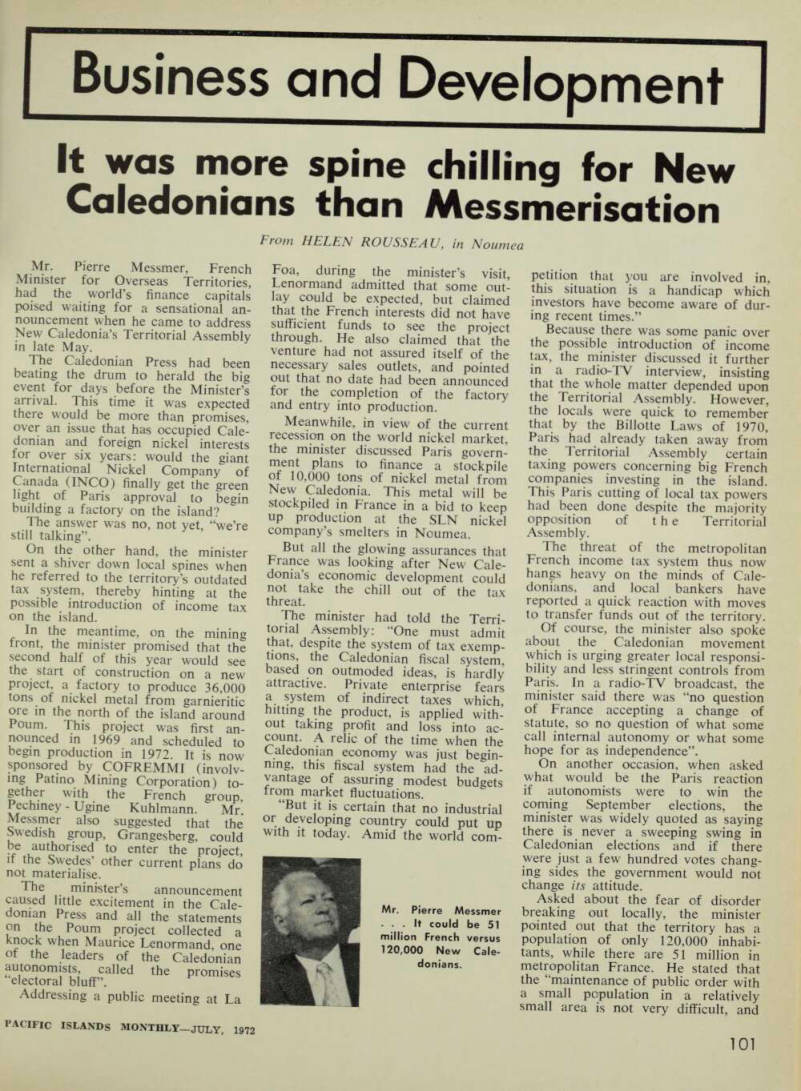
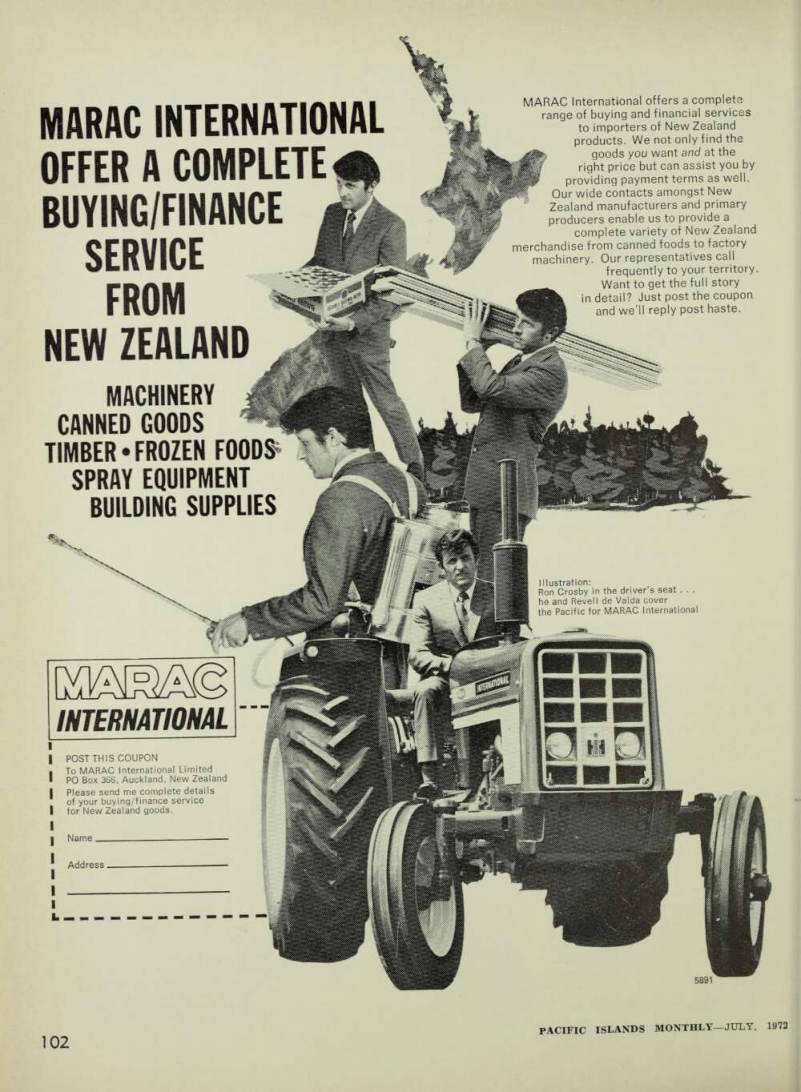
It was more spine chilling for New Caledonians than Messmerisation
From HELEN ROUSSEAU, in Noumea
Mr. Pierre Messmer, French Minister for Overseas Territories, had the world’s finance capitals poised waiting for a sensational an nouncement when he came to address New Caledonia’s Territorial Assembly in late May.
The Caledonian Press had been beating the drum to herald the big event for days before the Minister’s arrival. This time it was expected there would be more than promises, over an issue that has occupied Cale donian and foreign nickel interests for over six years: would the giant International Nickel Company of Canada (INCO) finally get the green light of Paris approval to begin building a factory on the island?
The answer was no, not yet, “we’re still talking”.
On the other hand, the minister sent a shiver down local spines when he referred to the territory’s outdated tax system, thereby hinting at the possible introduction of income tax on the island.
In the meantime, on the mining front, the minister promised that the second half of this year would see the start of construction on a new project, a factory to produce 36,000 tons of nickel metal from garnieritic ore in the north of the island around Poum. This project was first an nounced in 1969 and scheduled to begin production in 1972. It is now sponsored by COFREMMI (involv ing Patino Mining Corporation) to gether with the French group, Pechmey - Ugine Kuhlmann. Mr.
Messmer also suggested that the Swedish group, Grangesberg, could be authorised to enter the project, if the Swedes’ other current plans do not materialise.
The minister’s announcement caused little excitement in the Cale donian Press and all the statements on the Poum project collected a knock when Maurice Lenormand, one of the leaders of the Caledonian autonomists, called the promises electoral bluff”.
Addressing a public meeting at La
Foa, during the minister’s visit, Lenormand admitted that some out lay could be expected, but claimed that the French interests did not have sufficient funds to see the project through. He also claimed that the venture had not assured itself of the necessary sales outlets, and pointed out that no date had been announced for the completion of the factory and entry into production.
Meanwhile, in view of the current recession on the world nickel market, the minister discussed Paris govern ment plans to finance a stockpile of 10,000 tons of nickel metal from New Caledonia. This metal will be stockpiled in France in a bid to keep up production at the SLN nickel company’s smelters in Noumea.
But all the glowing assurances that France was looking after New Cale donia’s economic development could not take the chill out of the tax threat.
The minister had told the Terri torial Assembly: “One must admit that, despite the system of tax exemp tions, the Caledonian fiscal system, based on outmoded ideas, is hardly attractive. Private enterprise fears a system of indirect taxes which, hitting the product, is applied with out taking profit and loss into ac count. A relic of the time when the Caledonian economy was just begin ning, this fiscal system had the ad vantage of assuring modest budgets from market fluctuations.
“But it is certain that no industrial or developing country could put up with it today. Amid the world com-
petition that you are involved in, this situation is a handicap which investors have become aware of dur ing recent times.”
Because there was some panic over the possible introduction of income tax, the minister discussed it further in a radio-TV interview, insisting that the whole matter depended upon the Territorial Assembly. However, the locals were quick to remember that by the Billotte Laws of 1970, Paris had already taken away from the Territorial Assembly certain taxing powers concerning big French companies investing in the island.
This Paris cutting of local tax powers had been done despite the majority opposition of the Territorial Assembly.
The threat of the metropolitan French income tax system thus now hangs heavy on the minds of Cale donians, and local bankers have reported a quick reaction with moves to transfer funds out of the territory.
Of course, the minister also spoke about the Caledonian movement which is urging greater local responsi bility and less stringent controls from Paris. In a radio-TV broadcast, the minister said there was “no question of France accepting a change of statute, so no question of what some call internal autonomy or what some hope for as independence”.
On another occasion, when asked what would be the Paris reaction if autonomists were to win the coming September elections, the minister was widely quoted as saying there is never a sweeping swing in Caledonian elections and if there were just a few hundred votes chang ing sides the government would not change its attitude.
Asked about the fear of disorder breaking out locally, the minister pointed out that the territory has a population of only 120,000 inhabi tants, while there are 51 million in metropolitan France. He stated that the “maintenance of public order with a small population in a relatively small area is not very difficult, and
Mr. Pierre Messmer It could be 51 million French versus 120,000 New Cale donians.
certainly within the means we have at our disposal”.
In addition, the minister did not hold out much hope for the success of an Amnesty Bill that has been tabled in the French Parliament, to clear certain young Caledonians suf fering political charges. The Amnesty Bill has been tabled in Paris by Roch Pidjot, deputy for New Cale donia, Francis Sanford, deputy for French Polynesia and E. Claudius- Petit, vice-president of the French National Assembly.
The amnesty bid concerns young European students convicted for the April, 1969, painting of such wall slogans as “Free Caledonia” (“Cale donie Libre”—remember de Gaulle’s “Vive le Quebec fibre”). The Amnesty Bill also covers the tract distribution and arrests of September, 1969, and, more recently, the current six-month gaoling of young Mela nesian notable, Nidoishe Naisseline, for having insulted a French official.
The bill calls for the amnesty of those associated with these offences and the re-instatement in the public service of personnel having lost jobs over such incidents.
Mr. Messmer gave little hope of an amnesty for these young people con victed of political offences. At the same time, the minister did not fail to emphasise the importance of the French presence in New Caledonia to protect the island from a “foreign takeover”.
The Noumea Press saw little to re joice over in the minister’s state ments.
One daily reacted with front page headlines referring to the “Dis appointed Caledonians”, while the other daily had a front page editorial headed “Gloom”, describing the locals’ “grumbling, dissatisfaction and ill-temper”. This paper, while traditionally close to the French ad ministration, pointed out that “Mr.
Messmer can assert that New Cale donia could not be other than French; he can announce the launching of a (new, nickel) company in the north . . . and he is greeted only with scepticism”.
What both papers did not headline, however, was that the minister, in his official session with the Territorial Assembly, had been boycotted by 19 out of the 35 territorial councillors.
Only 16 elected men attended the minister’s official speech and while Mr. Messmer had informal talks with representatives of most political groups, the autonomist members of the assembly abstained from attend ing all official functions in Noumea during the ministerial visit. These facts were not published in the Press at all.
There was another point that the local pro-French administration Press did not mention during Mr. Mess mer’s visit, and that was the circula tion of an open letter addressed to the minister by the Caledonian Front for Autonomy. The six-page letter of grievances was signed by four leaders of the front, representing 13 territorial councillors. When the first 6,200 copies had been distributed throughout the island, a second edition was necessary.
The letter’s primary theme, which the minister later subtly introduced into one of his speeches, showing that he anyway had read the letter, was that France could not make a
success of New Caledonia unless it had the co-operation of the locals and was prepared to open a realistic dialogue. Another assertion, a reference to which was also carefully woven into the same ministerial speech, was that “one is never better looked after than by oneself”, The letter traced the failure of the graindiose nickel developments Paris had planned for the island, plans which, the letter said, had resulted in upsetting the Caledonian economy with excessive inflation, housing shortages and the elimination of certain Caledonian industries. The letter sought to enlighten the minister about certain activities of local
French administration and claimed, that the failure of the French plans pointed to the need to allow internal autonomy.
The letter named certain young Caledonians (both European and Melanesian) and wondered what had happened to them when, after suc cessful studies in France, they came back to the island only to be im prisoned or to have their careers shattered because of political charges against them.
The letter expressed admiration for the remote control of operations in outer space but urged that for the “satellite Nouvelle-Caledonie” such remote manoeuvring from Paris should be replaced by more local control. Among the distant Paris manoeuvres, it outlined the Billotte Laws and nickel export quotas, all affecting the territory’s main industry —mining.
The writers reflected no great en thusiasm for certain metropolitan French public servants and in regard to the relatively new laws on inland communes (municipalities) they claimed that “in exchange for the control of our mineral heritage you have given dummy communes, which only serve as training grounds in command exercises for the public servants in charge”.
Having heard that the minister would not be prepared to discuss any modification of the territory’s statutes, the autonomists suggested that maybe the minister would use “the carrot and the big stick”. The writers noted that paratroopers, mobile forces, gendarmes and various reinforcements were already, at least partially, in place as a “big stick”. As for the “carrot”, the autonomy leaders said the locals could hardly be expected to be interested any more in the flood of promises for new factories, capital inflow, etc.
Having entertained its readers with various other aspects of local history, the letter made five demands: • An end to the elimination of Caledonians from responsible positions; • A halt to the immigration of workers from overseas; • Abolition of the Billotte Laws; • Formation of true communes; • Internal autonomy.
The letter finally called for the opening of discussions with France to ensure that this Caledonian in ternal autonomy should be achieved within the framework of the French Republic. The printed letter was signed by four leaders of the Union Civique and Union Caledonienne parties.
Advertisements & other items, pp. 104-106 (1 item)
Buying/Finance
MARAC INTERNATIONAL
OFFER A COMPLETE A
SERVICE
FROM
NEW ZEALAND
MACHINERV
CANNED GOODS
TIMBER'FROZEN FOODS'
SPRAY EQUIPMENT
BUILDING SUPPLIES
MARAC International offers a complete range of buying and financial services to importers of New Zealand products. We not only find the i goods you want and at the right price but can assist you by providing payment terms as well.
Our wide contacts amongst New Zealand manufacturers and primary producers enable us to provide a complete variety of New Zealand merchandise from canned foods to factory machinery. Our representatives call frequently to your territory.
Want to get the full story in detail? Just post the coupon and we’ll reply post haste.
INTERHATIOHAL
POST THIS COUPON
To MARAC International Limited PO Box 366, Auckland, New Zealand Please send me complete details of your buying/finance service for New Zealand goods.
Name.
Address.
II 5891
THE GILBERT AND ELLICE ISLANDS
DEVELOPMENT AUTHORITY
WESTERN PACIFIC
Require a
MANAGER
for the
CO-OPERATIVE WHOLESALE SOCIETY
IN TARAWA
SALARY: Up to $A13,195 per annum
BENEFITS INCLUDE;
• Generous terminal leave. • Return air fares for self and family.
TERM:
The appointment is initially for two years and the person appointed will ideally be in post by November. There are prospects for renewal once the initial engagement is complete.
QUALIFICATIONS:
The Society is the largest wholesaling organisation in the Gilbert and Ellice Islands. Its sales to local Co-operative Societies exceed $2 million per annum and the successful candidate for this post will have managerial experience in wholesaling or retailing, buying, importing/exporting and financial and budgetary control. Experience in co-operative trading desirable but not essential.
For further information write, giving brief details of experience, to: The Crown Agents, 10th Floor,
I.A.C. Building,
54-62 Carrington Street,
SYDNEY, N.S.W. 2000
quoting Reference No. M3T/720598/B.
9 fi V. > a
AUSTRALIA’S
TOP SELLING
CAPILLARY FITTINGS
Ask your supplier tor Yorkshire Imperial fittings:g|
YORKSHIRE
IMPERIAL
YORKSHIRE IMPERIAL AUSTRALIA PTY. LTD.
N.S.W. 77 0561. Vit. 569 0859. Old. 36 0155. W.A. 24 1017, S.A. 57 4445.
YL/4C
¥?D D i\D¥llWr Any beach is yours for the taking IliMj 1 illilvlilll in a 4 seat Lake Buccaneer. .
LAKE AIRCRAFT SALES PTY. LTD.
154 INGLEBURN ROAD, INGLEBURN, N.S.W. 2565, AUSTRALIA.
Phone Sydney 605-1478. Australasian and South Pacific Distributor.
Smoking chums
have an eye on all the Pacific
From SUE WENDT, in Suva With Fiji’s “smokers” market sewn up—following their merger in May of manufacturing resources—Carreras of Fiji Ltd. and Fiji Tobacco are casting an interested eye towards other South Pacific markets.
A joint production unit for both companies has been established at Nabua, near Suva, to manufacture all Fiji’s cigarette and tobacco re quirements.
“This should decrease overhead costs for the two companies and allow us to sit down and look closely at the very competitive South Pacific market,” Mr. Alex Finnic told PIM.
Formerly general manager of Carreras, he now heads the new manufacturing operation, Central Manufacturing Company Ltd.
“The export potential is con siderable. New Caledonia, the New Hebrides, the Gilbert and Ellice Islands, the Cooks, Samoa and Tonga import their requirements from Aus tralia, New Zealand, the U.K., France and America.
“The Fiji Government is looking at the usefulness of incentive schemes and should they come up with the kind of scheme that many countries give manufacturers, export from Fiji to neighbouring countries will be a feasible proposition.”
Mr. Finnic stressed that the new manufacturing operation doesn’t re present a takeover of Fiji Tobacco by Carreras, which previously held 85 per cent, of the Fiji market. “It is simply a merging of resources in the interests of both companies and for the good of Fiji,” he said.
“Improved efficiency of the industry will create greater security of employ ment. We hope to contribute to the balance of payments by producing cigarette filters in Fiji. Both com panies are now importing $60,000 worth of filters annually.”
While the Central Manufacturing Company was responsible for pro ducing and distributing both com pany’s requirements Carreras and Fiji Tobacco would continue to operate as distinctly separate and competitive marketing companies, promoting and servicing their existing brands (which include Rothmans, Benson and Hedges and Dunhill).
Carreras Ltd. of London holds 70 per cent, of the equity in C.M.C. and
the British American Tobacco Com pany and British Tobacco Company (Australia) each hold 15 per cent. According to Mr. Finnic, the Fiji market just wasn’t big enough for two companies to be commercially viable.
“The total market is less than 30 million cigarettes a month,” he said.
“If one company had the lion’s share, the other would lose money. If both had 50 per cent, of the market, it still wasn’t a viable proposition.
It’s evident that British American Tobacco and British Tobacco (Aus tralia) were absorbing Fiji Tobacco losses before the merger, but to what extent Mr. Finnic wouldn’t say.
Combined turnover of Carreras and Fiji Tobacco is $4 million a year.
Total capital investment of the new manufacturing company, including expansion of the Nabua factory and improvement of staff facilities, will be about $2 million.
Last year, the Fiji Government in creased excise duty on imported tobacco, which meant an increase or 6 cents on packets of 20 cigarettes— a shot in the arm for the local tobacco growing industry. The new company aims to incorporate more local leaf, building up to about 55-60 oer cent, local content, which will also assist Fiji’s balance of payments P °“As n the quality of local leaf im proves, the thinking on this may alter,” said Mr. Finme. ‘ Fiji leaf is generally of good quality, particularly the two top grades.”
About 800 farmers, with 475 acres devoted to tobacco, are indirectly employed by the Southern Develop ment Co. Ltd., the leaf-producing subsidiary of C.M.C. Plans are to increase the acreage to 500 acres next ye The return to farmers per acre of tobacco is approximately double that of cane—but it requires a lot more work. Future increases m acreage will depend on how fast the tour grades of local leaf can be improved.
The industry in Fiji is almost com pletely localised. Of the 230 staff members employed by the various companies, only four are expatriates and two of these are leaf-growing specialists, difficult to replace. The post of production manager is to be localised next year.
“As an industry, we re of reason able importance to Fiji’s economy, contributing 6 per cent in the way of excise duty,” Mr. Finme said.
“Over 1,000 people are . direct v ‘V employed or associated with the industry and an additional MOO retail outlets derive profits from cigarette and tobacco sales.
In Fiji, cigarette smoking is in creasing by about 4 per cent, a year,
slightly higher than the UK and US rate.
While Fiji hasn’t seen fit to estab lish the strict advertising controls existing elsewhere, “by voluntary agreement with the government” the cigarette companies stopped adver tising in cinemas from June 1.
From January next year all locally produced cigarettes will carry a health warning—but the experience of other countries indicates that this isn’t likely to make much difference to local cigarette consumption.
Latest news from the tobacco industry was that a $250,000 contract for building extensions to the Central Manufacturing Company’s manufac turing plant at Nabua had been awarded to a local firm, Reddy Con struction Co. Ltd.
When completed early next year, the factory will be one of Fiji’s largest manufacturing units with assets of more than $2 million.
Cooks bottle
the Scotch
The price of Scotch selling in the Cook Islands has dropped by 40c a bottle because the Cook Islands Liquor Supply is obtaining bulk sup plies from New Zealand and doing its own bottling.
According to the Supply manager, Mr. Michael Benns, a price reduction was possible because the shipping of the whisky in 50-gallon casks pre vented the large-scale pilfering of bottles on the docks at Auckland. It is planned to import bulk supplies of other spirits.
There would also be a saving on empty bottles because the members of the Boys’ Brigade had agreed to collect empty bottles for the liquor store.
First to sample the home-bottled whisky was Premier Albert Henry.
Air charter service
for Vavau hotel
Tonga Tourist and Development Co. Ltd., which will operate the Port of Refuge Hotel on Vavau, has formed an association with Airfast of Australia to run an air charter service between Nukualofa and Vavau.
Directors of TTD and Airfast representatives met in Fiji in June to discuss programming of the services and the type of aircraft required.
Airfast operates helicopters in Fiji.
TTD’s general manager, Mr. lan Mclntyre, told PIM that Airfast would provide the aircraft and staff for the service, due to start in August to coincide with the opening of the
hotel. “We’re planning on a Twin Otter type of aircraft,” he said.
Clearing of a 3,000 ft airstrip on Vavau began in May. The company has Tongan Government rights to operate a charter service, but is hoping to get approval for scheduled flights.
“We’re seeking to complement the services operated in and out of Tonga by Air Pacific and Polynesian,” Mr.
Mclntyre said. “The charter opera tion will definitely begin in August.”
The hotel, featuring fale-style units, will open with accommodation for 90 people. The air service will facilitate transport of visitors to the island, which currently depends on a twice-weekly passenger service by the Pacific Navigation Company vessel Olovaha.
The company has released two hotel tariffs —one operating from August to December and the other from next January.
Existing rates are ST 15 single; $T 17.50 double or twin and ST2S for luxury suites. From next January rates will be 5T17.50, ST2I and ST3O.
Samoans to
clothe Americans
When a new factory planned for American Samoa gets under way, Samoan-made suits will be exported duty free to the United States under an unlimited quota.
The factory, scheduled for a June opening by the American clothing firm of Peter J. Brennan, will be installed temporarily in the B. F. Kneubuhl warehouse at Satala until the company builds its own premises in the industrial park area at Tafuna.
About 40 workers will be trained and employed at the outset and this will increase to about 100 within a year and to about 500 when the factory is in full production.
All material will be flown in from Taiwan and work at the factory will include sewing, pressing and packing.
The company already has advance orders for the clothing in 16 states.
Timber, Fiji's
new money spinner
The Fiji Government is giving priority to an extensive pine-planting programme which United Nations experts predict will give Fiji a new export industry rivalling sugar by the 1980 s.
A three-year UNDP and FAO survey revealed that at least 78 square miles of pines would have to be planted by 1978 for Fiji to avoid being beaten to the Japanese market.
The target set is 210 square miles.
Advertisements & other items, pp. 107-110 (1 item)
More
How to Be
Beautiful
By an Independent Skin Care Authority. rphe skin can be beautified more successfully than ever before A because modern science has realised the secret dream of every woman. Women everywhere have been afforded the rare privilege of cherishing a soft, beautiful complexion for a lifetime. Just follow these simple hints and you’ll see how easy it is to attain complexion loveliness.
Give Lasting Beauty to Your Skin Saturate your complexion every day with a tropically moist oil that has remarkable skin beautifying properties. When this oil of Ulan is smoothed over your face and neck it is able to maintain the natural oil and moisture balance within your skin and prevent the development of wrinkles due to dryness. A light film of Ulan oil should also be used as an invisible make-up base to ensure that your make-up will stay matt and flawless all through the day.
Eye Beauty
Pat moist oil into the delicate tissues that surround the eyes to ensure that encircling lines or wrinkles are held at bay. This beautifying fluid is so fine and penetrating that it can be fingerprinted easily under the eyes and over the lids without stretching the skin and will smooth away any crepey tendency. Look upward as the Ulan oil is applied, so that the large muscle surrounding the eye is lifted to allow the softening oil and moisture to seep in generously.
Beauty Facial for Dry Skin A beauty mask or face pack is the classical method for improving the texture of the skin. One of the best for a dry skin is the egg pack. Beat the egg well until it is fluffy, like light cream and then add two teaspoons of tropically moist oil of Ulan and spread the mixture thickly over your face and neck. Allow the pack to remain on the skm for fifteen minutes and then rinse it off with cold water. Finally, smooth a film of the moist oil blend over the complexmn after your face pack to hold the good imparted to A Beauty Tonic lo keep your skin clear and fair and to tone and condition your complexion to a new clarity and fine grained texture, saturate a cottonwool pad in lemon Delphskin freshener and gently press to the face and neck. The beautifying properties of lemons in the Delph freshener help stimulate the surface cells, clear out stubborn blemish-inducing and pore-clogging particles, smoothing and refining the compiexion to a new beauty.To protect and beautify the new . —o v„/ 56 i Ugl pat uvits, amuuiuiiig ana rei the complexion to a new beauty. To protect and beautify the milky loveliness, smooth on a film of moist Ulan oil.
LAWRENCE CLUTCHES
AUTOMATIC CENTRIFUGAL
WITH 1,001 APPLICATIONS IN . . .
Industry, agriculture, refrigeration and marine. Manufactured in a wide range with ratings from 1 to 100 hp. Depending on the application, they can be supplied with sintered bronze bearings, or in the case of excessive idling, a permanently sealed ball-bearing race. The clutches are designed for various minimum engaging speeds ranging from 300 to 1,100 rpm.
LAWRENCE AND BRASH AUTOMATIC CLUTCHES PTY. LTD.
P.O. BOX 42, PEAKHURST, N.S.W. 2210. PHONE 533-4967.
137 BOUNDARY ROAD, PEAKHURST.
The easy way to
STOP RUST on
CARS
FISHOILENE
BRUSH OR SPRAY OVER RUST
Australia’s famous fishoil based preparation—penetrates and bonds rust to form tough protective film. Try ft!
Trade enquiries to Pioneer Chemicals Pty. Ltd..
Railway Pde., Rocklea, Brisbane, Australia.
THE
YORKSHIRE INSURANCE
CO. LTD.
(Incorporated in England)
A MEMBER OF THE GENERAL ACCIDENT GROUP OF COMPANIES
ALL CLASSES OF INSURANCE
AUSTRALIAN HEAD OFFICE: 10-12 Spring Street, Sydney.
Group Manager for Australia: R. M. Trotter.
PAPUA AND NEW GUINEA BRANCH: Douglas Street, Port Moresby.
Manager: H. M. Harvey.
CHIEF ISLAND REPRESENTATIVES .
Rabaul, A.S.P. (N.G.) Ltd.; Lae, Radio Cabs (Lae) Pty. Ltd.; Madang, W. Stokes; Manus, EdgeH & Whiteley Ltd.; Honiara, 8.5.1. P., E. V. Lawson Ltd.; Suva, Williams & Gosl mg Ltd.; Noumea, R. Laubreaux; Norfolk Island, Martin's Agencies; Apia, E. A. Coxon & Co.; Vila, C. Sullivan (INI) Pty. Ltd.
o %
CADBURY
DAIRY MILK
CHOCOLATE...
ONE OF TODAYS
GREAT TASTES
Cadbury’s Dairy Milk Chocolate. There’s a glass and a half of pure, fresh, full-cream milk in every half-pound. Nothing else has the same great taste.
Smooth, creamy, delicious. Look for the famous purple wrapper... and say “I want Cadbury’s”.
The biggest selling block chocolate in Australia and New Zealand. a m * rsn
76 Years' Experience
Selling
"SERVICE"
to the Pacific Islands
NELSON & ROBERTSON
PTY. LIMITED
(Established 1895)
PLANTATION HOUSE, 197 CLARENCE STREET, SYDNEY
CABLES: "IVAN", SYDNEY, BRISBANE. TELEX; AA22381, SYDNEY.
ISLAND MERCHANTS
SHIPPING AGENTS
TRAVEL AGENTS
INSURANCE AGENTS
REAL ESTATE AGENTS
Branch Office: Nelson & Robertson Pty. Ltd., 303 Adelaide St., Brisbane, Old.
New Guinea Representatives: Rabaul Trading Co. Pty. Ltd., Rabaul Lae Madang Kieta.
SOUTHERN PACIFIC INSURANCE
COMPANY LIMITED
Head Office: Equitable Life Building, 80 Alfred Street, AAilsons Point, N.S.W., 2061.
Specialising in Pacific island insurance requirements for over 30 years. • FIRE • FIRE AND VOLCANIC ERUPTION • HOUSEHOLD COMPREHENSIVE • MOTOR VEHICLE • COMPULSORY THIRD PARTY • COMPULSORY WORKERS' COMPENSATION
• PUBLIC LIABILITY • MARINE
Enquiries invited for all classes of insurance from special representatives at: RABAUL: Jack T. Ray—Manager for Papua & New Guinea, Mango Avenue. P.O. Box 123.
LAE; R, H. Meyer—Manager at Lae, Kam Hong's Building, Central Avenue. P.O. Box 758. PORT MORESBY; H. A. K. McKee—Manager at Port Moresby, Maloney's Building, Cuthbertson Street. P.O. Box 136. SUVA-FIJI: L. M. Rolls—Manager for Fiji, McGowans Building, Margaret Street. P.O. Box 521.
Wakaya Island
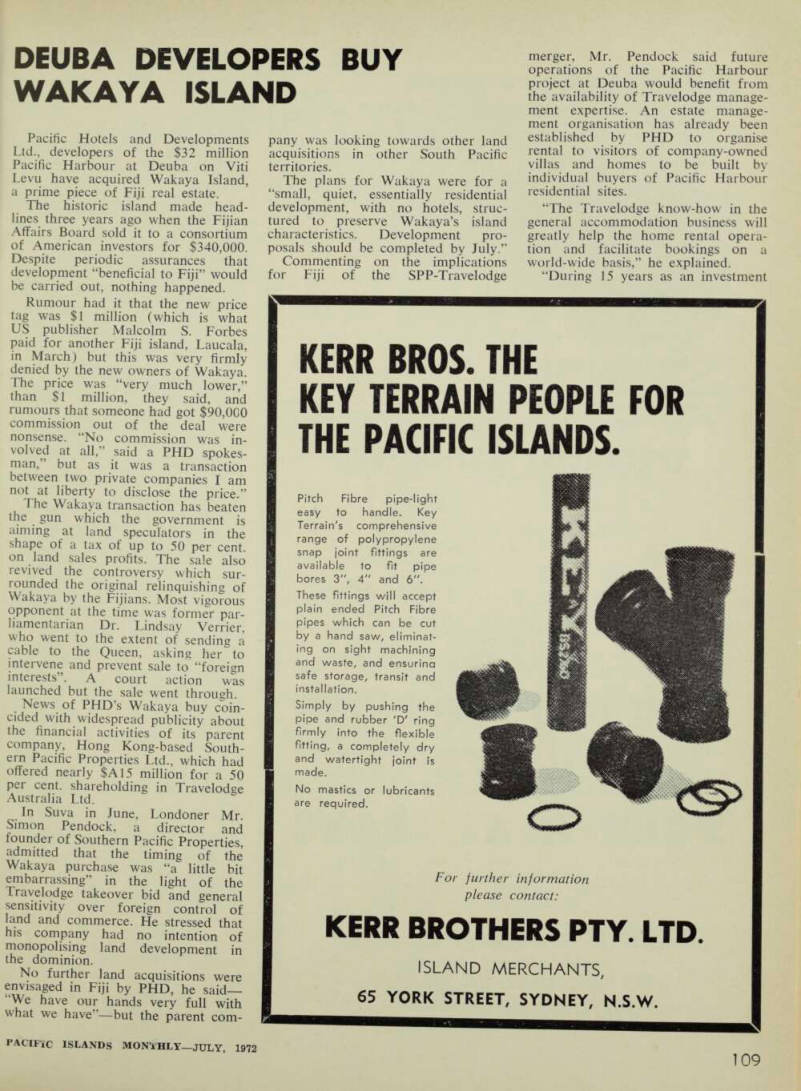
Deuba Developers Buy
Pacific Hotels and Developments Ltd., developers of the $32 million Pacific Harbour at Deuba on Viti Levu have acquired Wakaya Island, a prime piece of Fiji real estate.
The historic island made head lines three years ago when the Fijian Affairs Board sold it to a consortium of American investors for $340,000.
Despite periodic assurances that development “beneficial to Fiji” would be carried out, nothing happened.
Rumour had it that the new price tag was $1 million (which is what US publisher Malcolm S. Forbes paid for another Fiji island, Laucala, in March) but this was very firmly denied by the new owners of Wakaya.
The price was “very much lower,” than $1 million, they said, and rumours that someone had got $90,000 commission out of the deal were nonsense. “No commission was in volved at all,” said a PHD spokes man,” but as it was a transaction between two private companies I am not at liberty to disclose the price.”
The Wakaya transaction has beaten the gun which the government is aiming at land speculators in the shape of a tax of up to 50 per cent, on land sales profits. The sale also revived the controversy which sur rounded the original relinquishing of Wakaya by the Fijians. Most vigorous opponent at the time was former par liamentarian Dr. Lindsay Verrier who went to the extent of sending a cable to the Queen, asking her to intervene and prevent sale to “foreign interests”. A court action was launched but the sale went through.
News of PHD’s Wakaya buy coin cided with widespread publicity about the financial activities of its parent company, Hong Kong-based South ern Pacific Properties Ltd., which had offered nearly SAIS million for a 50 per cent, shareholding in Travelodge Australia Ltd.
In Suva in June, Londoner Mr.
Simon Pendock, a director and founder of Southern Pacific Properties, admitted that the timing of the Wakaya purchase was “a little bit embarrassing” in the light of the Travelodge takeover bid and general sensitivity over foreign control of land and commerce. He stressed that his company had no intention of monopolising land development in the dominion.
No further land acquisitions were envisaged in Fiji by PHD, he said— “We have our hands very full with what we have”—but the parent corn
pany was looking towards other land acquisitions in other South Pacific territories.
The plans for Wakaya were for a “small, quiet, essentially residential development, with no hotels, struc tured to preserve Wakaya’s island characteristics. Development pro posals should be completed by July.”
Commenting on the implications for Fiji of the SPP-Travelodge
merger, Mr. Pendock said future operations of the Pacific Harbour project at Deuba would benefit from the availability of Travelodge manage ment expertise. An estate manage ment organisation has already been established by PHD to organise rental to visitors of company-owned villas and homes to be built by individual buyers of Pacific Harbour residential sites.
“The Travelodge know-how in the general accommodation business will greatly help the home rental opera tion and facilitate bookings on a world-wide basis,” he explained.
“During 15 years as an investment
banker involved in all manner of acquisitions, mergers and takeovers, I have seldom seen a deal that made more sense to both parties in all fundamentals,” was how Mr. Pendock summed up the merger. (The com pany prefers to call it that, although 50 per cent, will give SPP effective financial control. Travelodge manage ment will not change).
Access to sources of international finance through SPP and its eminent shareholders (the P&O shipping group, Slater Walker Securities Ltd., Jardine Matheson and Co. Ltd. of Hong Kong and I. G. Boswell Co. of California) would allow Travelodge to further consolidate its extensive accommodation plant in the South Pacific and give the hotel chain the opportunity of entering major resort complex developments, a field it has been eyeing for some time.
Later news was that SPP had acquired Trust Houses Forte’s 12.3 per cent, shareholding in Travelodge.
Supplying much of the drive for SPP’s activities is its chairman, Mr.
Peter Munk, who is also chairman of Pacific Hotels and Development.
The impending merger with Trave lodge has brought him into the Aus tralian limelight.
One Sydney Sunday newspaper referred to him as a “mystery man”.
PIM was able to give Mr. Munk’s background as long ago as June, 1970, when it reported, in connection with the Deuba development: “Mr. Peter Munk, Southern’s head, was founder of Clairtone Sound Corporation of Canada, which after making colour television sets for the competitive US market, ran into financial difficulties involving some SC2O million.”
PIM continued; “Canada’s Financial Post has quoted Mr. Munk as describing the Deuba projects as ‘the biggest single development of this kind proposed in the South Pacific’.
“Mr. Hopkins (head of a Canadian firm) said Mr. Munk had ‘had a thing’ about Fiji for about seven years. His firm was convinced Mr.
Munk would be more successful in real estate in Fiji than he had been with TV in Canada. The backing of a respected multi-million dollar cor poration such as Slater Walker proved there was ‘great faith’ in Mr.
Munk’s leadership, he said.” 9 The Hong Kong-based Pacific Mail Order System Ltd. has an nounced it intends in three months to start building a hotel, beginning with 40 bures, at Blacksands Beach, near Vila, in the New Hebrides.
Clearing work has begun.
Business briefs
• A long-awaited decision on a Norfolk Island taxation test case was handed down by Mr. Justice Gibbs, of the Australian High Court, in June, but the decision wasn’t the one that supporters of the present system hoped for. There is to be an appeal against the judgement to the Full Bench of the High Court. The case was one where Esquire Nominees Ltd. sought to test the present technique of Aus tralian firms using the Australian ter ritory of Norfolk Island as a tax haven, by paying dividends to Norfolk Island-registered dummy companies and then borrowing the money back, thus avoiding undistributed profits tax. The money in fact goes round in circles. Mr. Justice Gibbs held that the source of the money on the merry-go-round was Australia and that this remained a fact despite the procedure of passing it through various companies.
There are still other tax-saving procedures possible as a result of Norfolk Island company registration but these are not yet in legal dispute.
However, the Australian Government has made it clear that it intends to close down Norfolk Island as a tax haven, and in the last 12 months there has been a flight of Australian and overseas investment to the New Hebrides, which appears to investors to be safer. • More than 6,000 sugar cane farmers, tenants for years of the CSR, will have the Fiji Government as landlord when the government takes over 95,000 acres of CSR land next April at a cost of $3,750,000.
This is part of the deal included in the government’s takeover of the sugar industry. A cattle ranch run by the CSR will be maintained as a model ranch. Abnormally wet weather is expected to cut this year’s sugar crop by thousands of tons. • A new trust company, Pacific International Trust Co. Ltd., has been registered at Vila and opened for business on June 20.
Foundation partners are the Bank of New South Wales and Perpetual Trustees Australia and the Montreal Trust Company of Canada. Affiliated with the partners will be an inter national group of banks and trust companies. • The Shortland Development Company has suspended its timber operations in the Shortlands of the BSIP, hoping to resume next year when the Japanese market improves.
But it’s transferring its milling equip
ment to a sister company on New Britain, and some BSIP government officials are not so optimistic that, having closed down in the Solomons, it will be able to get itself going again.
Which would be bad news for the BSIP because the company has been accounting for about 10 per cent, of the protectorate’s timber exports. • South Pacific Oil Palm Development Pty. Ltd. looks like getting the go-ahead for the establishment of a 5,000-acre oil palm plantation and mill on government land in Bialla, West New Britain. It has offered to spend $5 million over the next four
years, and to give the government 20 per cent, equity and a further option of five per cent, for New Guinean shareholders. The government wants to put New Guinean smallholders on 10,000 acres of land near the pro posed mill. Although the PNG executive council has approved the scheme, it still has to be okayed by the PNG House of Assembly, « Air Micronesia made a profit in 1971 of SUSS,446 compared with $5,856 in 1970. Total receipts were up by 13.1 per cent, over the previous year but operating expenses rose by 13.8 per cent.
Advertisements & other items, pp. 111-114 (2 items)
109
PACIFiC ISLANDS MON'iHLY—JULY, 1972
Key Terrain People For
KERR BROS. THE
THE PACIFIC ISLANDS.
Pitch Fibre pipe-light easy to handle. Key Terrain's comprehensive range of polypropylene snap joint fittings are available to fit pipe bores 3", 4" and 6".
These fittings will accept plain ended Pitch Fibre pipes which can be cut by a hand saw, eliminating on sight machining and waste, and ensurina safe storage, transit and installation.
Simply by pushing the pipe and rubber 'D' ring firmly into the flexible fitting, a completely dry and watertight joint is made.
No mastics or lubricants are required.
For further information please contact:
KERR BROTHERS PTY. LTD.
ISLAND MERCHANTS,
65 YORK STREET, SYDNEY, N.S.W.
Driclcad
Manufacturers of-
AUSTRALIA'S LEADING RANGE OF ABOVE GROUND POOLS AND ACCESSORIES. Pool sizes, in a variety of shapes and sizes, from 5 ft. dia. x 12 in. deep to 38 ft. x 15 ft. x 48 in. deep. Illustrated: 30 ft x 15 ft x 48 in. FAMILY POOL.
Sizes. Circular: 15 ft x 48 in. deep. 18 ft x 48 in, deep. 21 ft x 48 in. deep.
Ovals: Mt 24 ft x 12 ft x 48 in. 30 ft x 15 ft x 48 in. „.„_3B ft x 15 ft x 48 in
\| Olympic:
33 ft long x 18 ft x 12 ft x 48 in.
I •, \f Please send me complete details of the NAME Driclad range.
EXPORT SALES DIVISION, DRICLAD ADDRESS
PTY. LTD., 20-22 Sussex Street, Cabramatta, 2166, N.S.W., Aust.
SPECIALIST EXPORTERS
POTATOES ONIONS
GARLIC BLUEPEAS
FRESH FRUIT AND VEGETABLES
N.Z. DAIRY BOARD GHEE
GERRARD WIRE TYING EQUIPMENT
GENERAL MERCHANDISE COOLER
FREEZER
Current Quotations from:
Turners Supply Company Limited
P.O. Box 1370, AUCKLAND. Cables: "TUSCO" Auckland.
PACIFIC EXPORT DIVISION of TURNERS & GROWERS LTD. Wholesale Fruit and Produce Merchants, Auckland, New Zealand.
YOUR NEXT LEAVE
Modern up to the minute homes at Palm Beach, Avalon, Newport, Church Point, Mona Vale, etc., available to Island Residents for Holidays. Write for information
J. T. STAPLETON PTY. LTD.
ESTATE AGENTS,
133 PITT STREET, SYDNEY, 2000. 25-5305, 25-1737 also Box 32, P. 0., Avalon Beach, Sydney 2107. 918-2221.
W. H. GROVE & SONS LTD.
ESTABLISHED 1896
ISLAND MERCHANTS
Exporters to the Pacific of Dairy Products and all New Zealand consumer and manufactured goods.
ENTRUST YOUR REQUIREMENTS TO THE
ESTABLISHED FIRM.
P.O. Box 3718, Cables
AUCKLAND GROVE AUCKLAND
Australia's top record retailer
offers mail order service!
For over 30 years, Edels have been renowned for customer service and supply of all types of recordings.
Now you can select from the largest stock of local and imported records in Australia— ever* type—country and western, popular, rhythm and blues, etc., etc.
You are invited to add your name to our mailing list (we already have many customers in the Pacific Islands) and receive listings of the latest release recordings available through our C.O.D. mail order system. *>K To Edels Pty. Ltd. 437-439 George Street, Sydney. N.S.W. 2000 Please send me by post, pamphlets on (Name type of music you are interested in) (Name items of interest, records, tapes, etc.) Name Address.
I understand that this places me under no obligation of any kind.
PIM 7/69
I K i Looking for an exterior plywood that resists
WEATHER &
INSECTS?
KLINKII
DURABLY
Made by Commonwealth New Guinea Timbers Ltd, Bulolo, New Guinea Available from plywood suppliers in the Territory U Pacific area
%] i a /r I I y
OTHER HANOI PRODUCTS!
'Handi' range of quality products also includes: a portable Twin-Burner Stovette and 'Handi' Pumpless Petrol iron.
Keep a
HAND! handy!
No need to fumble and fume! Throw light on the subject with a 'Handi'. It's twice as bright as electric light. Completely stormproof. Simple and safe to use. mm
PRESSURE OPERATED
One filling gives 12 hours of brilliant 300 candle-power lighting. Built to last, with chromed, rust-proofed finish. Petrol or Kerosene models.
Ask for Handi! Everywhere!
HANOI WORKS PTY. LTD.
Compo Rd., Salisbury North -
BRISBANE, QUEENSLAND I _AUSTRAUA
Produce Prices
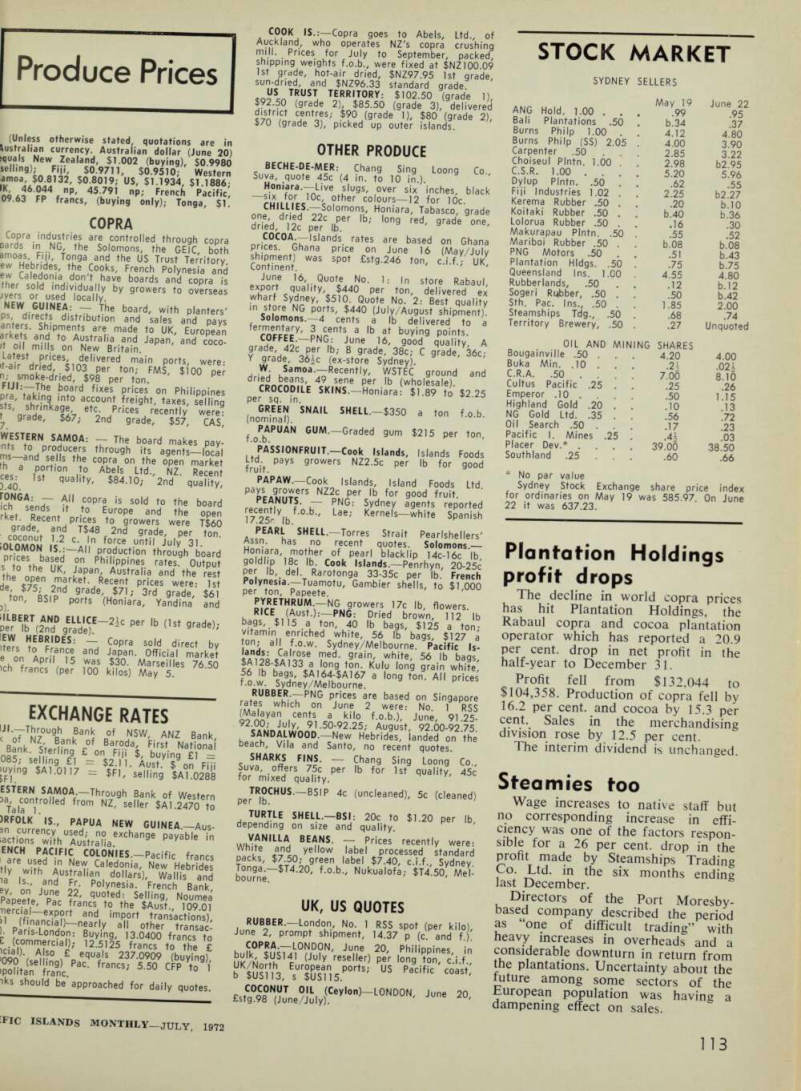
(Unless otherwise stated, quotations are in Australian currency. Australian dollar (June 20) ■quals New /eafand, $1,002 (buying), $0.9980 pclling); F'|. $0.9711, $0.9510; Western 50.8019; US, $1.1934, $1.1886 * S ?D 4 r" P ' 45 /. 791 . "P; Pencil Pacific, 09.63 FP francs, (buying only); Tonga, $l.
Copra
Copra industries are controlled through copra oards in NG, the Solomons, the GEIC, both amoas, Fiji, Tonga and the US Trust Territory ew Hebrides, the Cooks, French Polynesia and ew Caledonia don t have boards and copra is JVers or ufed V Stl by 9roWerS overseas he board ' with Planters' dlstnbut ‘on and sales and pays anters. Shipments are made to UK, European foil mil ° Australia and Japan, and coco it oil mills on New Britain. ita!r t rirS 3 pH CeS tin d '3 eliVered main ports ' were: 't-air dried, $lO3 per ton; FMS, $lOO per c'i .i Sm °Tu' dr / ed/ $9B P er ton. ' Pe nr. : rJ he oard fixes P rices on Philippines etc' f u kl - n i mto account freight, taxes, selling sts shrinkage etc Prices recently were 9 * 7 9 rade ' $67; 2nd grade, $57, CAS, WESTERN SAMOA: - The board makes pay msUnd^llffh 5 thr ° U9h if u a 9ents —local ms— and sells the copra on the open market a portion to Abels Ltd. NZ Recent lst quality, $84.10; '2nd' qSaTy! ic°h NG sendT ft" £ pr £ iS So,d 1° the board icn sends it to Europe and the open P to growers were Ts6o grade, and Ts4B 2nd grade, ner ton iOLOMON K 2 C Ah n f °L Ce Until Jul V 31 • iOLOMON IS.:— All production through board T Phi, i ppines rates. 9 Output s to the UK, Japan, Australia and the rest s7? n 9nH rket ‘w Rec l^ f prices were; Ist ° 75 ic. 2 n nd grade ' s7l '" 3rd grade, $6l BSIP ports (Honiara, Yandina and '™TZ D Z'£~ 2i ‘ per lb ■"*»» !wc t J EBP,DES: Copra sold direct by e on Anri?"?! and {T n - official ma rket , , April 15 was $3O. Marseilles 76.50 ch francs (per 100 kilos) May 5.
COOK IS.;—Copra goes to Abels, Ltd., of Auckland, who operates NZ's copra crushing mill. Prices for July to September, packed, shipping weights f.0.b., were fixed at SNZIOO 09 Ist grade, hot-air dried, $NZ97.95 Ist grade, sun-dried, and $NZ96.33 standard grade
Us Trust Territory; $102.50 (Grade 11
$92.50 (grade 2), $85.50 (grade 3), delivered district centres; $9O (grade 1), $BO (grade 2), $7O (grade 3), picked up outer islands.
Other Produce
BECHE-DE-MER. Chang Sing Loong Co., Suva, quote 45c (4 in. to 10 in.).
Honiara.—Live slugs, over six inches, black run mec ° C c ? ther colours — l2 for 10c. ™ CH a- I ™ Solomon . s ' Hon 'ara, Tabasco, grade dried 12? pe? uT ' b; '° n 9 red - 9rade nr;^? COA rr lslands . rates are based on Ghana prices. Ghana price on June 16 (May/July shipment) was spot £stg.246 ton, c.i.f; UK Continent. ' June 16, Quote No. 1= n store Rabaul, export quality, $440 per ton, delivered ex wharf Sydney, $5lO. Quote No. 2: Best quality in store NG ports, $440 (July/August shipment).
Solomons.—4 cents a lb delivered to a cents a lb at buying points.
PNG C J „ une 16/ 9°°d quality, A grade 42c per lb; B grade, 38c ; C grade, 36c; Y grade, 36£c (ex-store Sydney).
W Samoa.— Recently, WSTEC ground and dried beans, 49 sene per lb (wholesale) CROCODILE SKINS.-Honiara! $1.89 to $2 25 per sq. m.
Green Snail Shell.—S3So A Ton F.O.B.
(nominal). fo P b APUAN GUM.—Graded gum $215 per ton, PASSIONFRUIT.—Cook Islands, Islands Foods fruit PayS growers NZ2 ‘ sc P er lb for good PAPAW.—Cook Islands, Island Foods Ltd Pa p S FANTItc erS NZ2 DMr Per c lb i for 900 d fruit rpr«nti NUT f' PNG: s V dne y agents reported 17 25r y |b f '°’ b ‘' LaC; Kernels — white Spanish PEARL SHELL.—Torres Strait Pearlshellers' hBS ,u no r . ecent g uotes - Solomons.— 5 n ° l n )®Ira'l 1 ra ' lo motber , of l P earl blacklip 14c-16c lb, goldlip 18c lb. Cook Islands.—Penrhyn, 20-25 c per lb,_ del Rarotonga 33-35 c per lb. French Polynesia.—Tuamotu, Gambier shells, to $1 000 per ton, Papeete. ' piti: FTl /a N bu 9 rowers 17c lb, flowers. . R,CE (Aust.):—PNG: Dried brown, 112 lb bags, $ll5 a ton, 40 lb bags, $125 a ton vitamin enriched white, 56 lb bags, $127 a on r a| l f-o.w. Sydney/Melbourne. Pacific Is
« > Jag ;
f o.w b Sy 3 * '° n 9 '° n ' A " PriCeS RUBBER.— PNC prices are based on Singapore rates which on June 2 were.- No 1 RSS (Malayan cents a kilo f.o.b) June 9125 92 00; Ju| y , 91.50-92.25; August, 92 00-92:75 be?r A h ND SM W °°w , 'l NeW Hebr 'des, landed on the beach, Vila and Santo, no recent quotes.
SHARKS FINS. Chang Sing Loong Co., Suva, offers 75c per lb for Ist quality, 45c for mixed quality. per TR |b CHUS '~ BSIP 4 ° (uncleaned )' 5c (cleaned) TURTLE SHELL.—BSI: 20c to $1.20 per lb depending on size and quality. \A/h^ BE A, NS - Prices recently were: rvariy c yellow ,'abel processed standard P ack s, $7 50; green label $7.40, c.i.f., Sydney Tonga.—sT4.2o, f.0.b., Nukualofa; $T4.50 Mel bourne. '
Uk, Us Quotes
RUBBER.—London No. 1 RSS spot (per kilo), June 2, prompt shipment, 14.37 p (c. and f.). bufk° P SMVM l i 0 M D ? N ' JU n e 20, Philippines, in iiK/Kin?f U h S 4 c (Ju y reseller ) P er long ton, c.i.f., “‘‘SSm, E s Ur |s e s a , n 7 s P ° rtS; US PaCi,ic coast £stg°l| ,N (jJne/J , tly) <CeV,on> - LONDON ' June 2 °'
Advertisements & other items, p. 115 (1 item)
.are use^i^New^ledoni^^ew^
EXCHANGE RATES
IJI, T T^ ough Bank of NSW, ANZ Bank ‘Ba° k NZ S,J?n nk t .° f Bd ' oda i First National Bank. Sterling £ on Fiji $, buying £1 085; selling £1 = $2.11. Aust s 9 nn fm: mymg $A1.0117 = SFI, selling $A1.0288 3 E fl STE ront| M i >A f‘~ Thr ° U9h Bank ° f Western Tala 7 0d fr ° m NZ/ Seller SAI - 247 0 to
)RFOLK IS., PAPUA NEW GUINEA— Aus
:a n cti C o U n r s ren w C i y th US A e u^ra n Sa eXChan9e Payab,e in
.are use^i^New^ledoni^^ew^
i V ls W h anH US J ralia D n . dollars) ' Wallis and is., and Fr. Polynesia. French Bank Pa'nAot Jt D ne X 2, 9Uoted; Selling, Noumea' Papeete, Pac francs to the sAust., 109 01 3 ff n 7n eXP n rt and , import transactions), pi! ci « 7 n n arl - y all other transac- P f! a m m L n d0 n : ?o ymg ' 13.0400 francs to iciasl AUn ia r ; 12 - 5 , 125 francs to the £ ’o9o ‘^Nnn^ £ D eqUa x ls 237 -0909 (buying), ■Sltin franc. fra " CS; 550 CFP ,0 ’ iks should be approached for daily quotes.
Stock Market
Sydney Sellers
ANG Hold. 1.00 . . .
May 19 June 22 .99 .95 Bali Plantations .50 . b.34 .37 Burns Philp 1.00 4.12 4.80 Burns Philp (SS) 2.05 . 4.00 3.90 Carpenter .50 2.85 3.22 Choiseul Plntn. 1.00 , 2.98 b2.95
C.S.R. 1.00 . . . .
5.20 5.96 Dylup Plntn. .50 . ! .62 .55 Fiji Industries 1.02 . 2.25 b2.27 Kerema Rubber .50 . .20 b.10 Koitaki Rubber .50 . b.40 b.36 Lolorua Rubber .50 . .16 .30 Makurapau Plntn. .50 ! .55 .52 Mariboi Rubber .50 b.08 b.08 PNG Motors .50 .51 b.43 Plantation Hldgs. .50 .75 b.75 Queensland Ins. 1.00 4.55 4.80 Rubberlands, .50 .12 b. 12
Sogeri Rubber, .50 . ,
.50 b.42 Sth. Pac. Ins., .50 . 1.85 2.00 Steamships Tdg., .50 .68 .74
Territory Brewery, .50 .
.27 Unquoted
Oil And Mining
Shares
Bougainville .50 . 4.20 4.00 Buka Min. .10 . .2k .02 £
C.R.A. .50 . . .
7.00 8.10 Cultus Pacific .25 . . ,25 .26 Emperor .10 . .50 1.15 Highland Gold .20 . .10 .13 NG Gold Ltd. .35 . . .56 .72 Oil Search .50 .17 .23 Pacific 1. Mines .25 .
A\ .03 Placer Dev.* ... 39.00 38.50 Southland .25 .60 .66 * No par value Sydney Stock Exchange share price index tor ordinaries on May 19 was 585 97 22 it was 637.23.
On June
Plantation Holdings
profit drops
The decline in world copra prices has hit Plantation Holdings, the Rabaul copra and cocoa plantation operator which has reported a 20.9 per cent, drop in net profit in the half-year to December 31.
Profit fell from $132,044 to $104,358. Production of copra fell by 16.2 per cent, and cocoa by 15.3 per cent. Sales in the merchandising division rose by 12.5 per cent.
The interim dividend is unchanged.
Sfeamies too
Wage increases to native staff but no corresponding increase in effi ciency was one of the factors respon sible for a 26 per cent, drop in the profit made by Steamships Trading Co. Ltd. in the six months ending last December.
Directors of the Port Moresby based company described the period as one of difficult trading” with heavy increases in overheads and a considerable downturn in return from the plantations. Uncertainty about the future among some sectors of the European population was having a dampening effect on sales
Advertisements & other items, pp. 115-116 (2 items)
113
FIC ISLANDS MONTHLY—JULY, 1972
The Bank Line
monthly services U K CONTINENT to PAPUA-NEW GUINEA & SOLOMON ISLANDS PAPUA, NEW GUINEA to NORTH AMERICA & U.K., CONTINENT SOLOMON ISLANDS, FIJI, TONGA, SAMOA AND TARAWA to U.K.,
CONTINENT
☆ U.S GULF/AUSTRALASIA VESSELS CALL AT FIJI WHEN REQUIRED & ia®-
FOR PARTICULARS APPLY:
THE BANK LINE (AUSTRALASIA) PTV. LID., SYDNEY. N.S.W,
nedlloyd Koninklijke Nedlloyd nv
REGULAR SAILINGS BY FAST, MODERN, CARGO VESSELS
from CONTINENTAL PORTS via PANAMA to
PAPEETE, APIA, SUVA, LAUTOKA, NOUMEA and
NEW ZEALAND
other ports called at subject to sufficient inducement
heavy-lift facilities— refrigerated space—cargo deeptanks
For further particulars apply to agents
Ets. Donald Tahiti, Russell & Sommers (Wellington) Papeete. Ltd., Wellington, N.Z.
Morris Hedstrom & Co. Ltd., O. F. Nelson & Co. Ltd., Lautoka. A P' a - Carpenter's Fiji Ltd., Suva.
Interocean Australia Servict Pty. Ltd., Sydney.
Agence Maritime Pentecost, Noumea.
Shipping
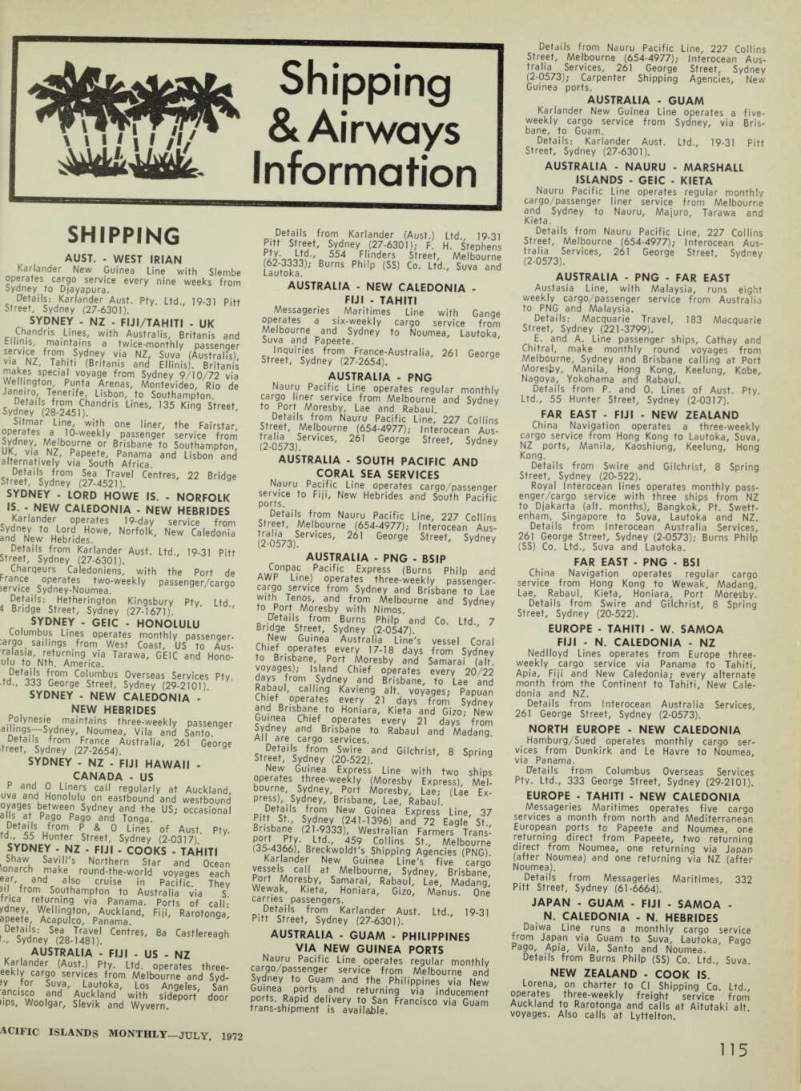
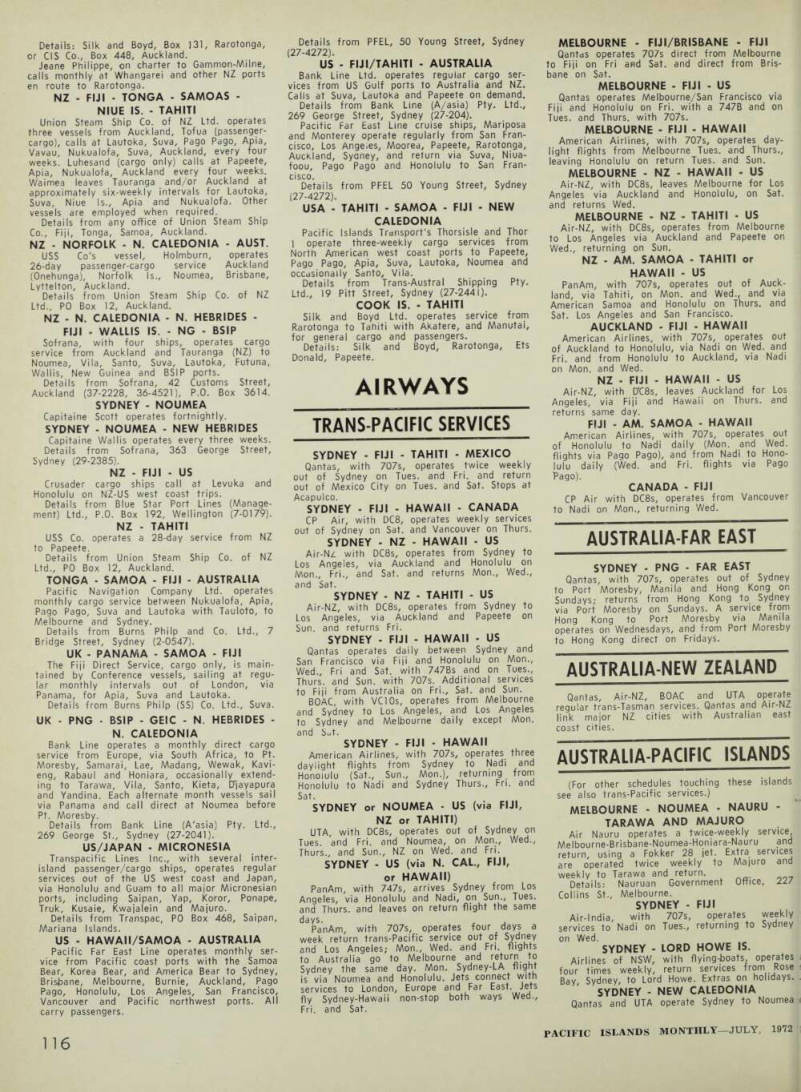
& Airways Information
Aust. - West Irian
Karlander New Guinea Line with Slembe operates cargo service every nine weeks from Sydney to Djayapura.
D'etails: Karlander Aust. Pty. Ltd., 19-31 Pitt Street, Sydney (27-6301).
SYDNEY - NZ ■ FIJI/TAHITI - UK Chandns Lines, with Australis, Britanis and bl li ms, maintains a twice-monthly passenqer servce from Sydney via NZ, Suva (Australis), va NZ, Tahiti (Britanis and Ellinis). Britanis makes special voyage from Sydney 9/10/72 via Wellington, Punta Arenas, Montevideo, Rio de Janeiro, Tenerife, Lisbon, to Southampton.
Sydney (2M«l) driS Li " eS ' 135 Ki " 9 S,ree '' Sitmar Line, with one liner, the Fairstar operates a 10-weekly passenger service from Sydney, Melbourne or Brisbane to Southampton, = i+; V '+- N . Z/ Pape „ ete ', Panama and Lisbon and alternatively via South Africa.
Deta'ls from Sea Travel Centres, 22 Bridge Street, Sydney (27-4521). 9 SYDNEY - LORD HOWE IS. - NORFOLK IS. - NEW CALEDONIA - NEW HEBRIDES .Karlander operates 19-day service from S y dney to Lord Howe, Norfolk, New Caledonia and New Hebrides.
Detaiis from Karlander Aust. Ltd., 19-31 Pitt Street, Sydney (27-6301).
Charqeurs Caledoniens, with the Port de -Ir. n - Ce c°5 erat ?? two-weekly passenger/cargo service Sydney-Noumea.
Details; Hetherington Kingsbury Ptv Ltd i Bridge Street, Sydney (27-1671).
Sydney - Geic - Honolulu
Columbus Lines operates monthly passenger :argo sailings from West Coast, US to Aus ,r.ilaVa,K.r.euturAnm9-via Tarawa ' GEIC and Hono ulu to Nth. America. *P et ooo t rom Golumbus Overseas Services Pty ■td., 333 George Street, Sydney (29-2101).
Sydney ■ New Caledonia -
New Hebrides
Polynesie maintains three-weekly passenger ai fl ir l 9^^ —Sydney, Noumea, Vila and Santo.
Det a|| s from France Australia, 261 George treet, Sydney (27-2654). 9 SYDNEY - NZ - FIJI HAWAII -
Canada - Us
„ P a " d . 2 Li ? e , rs ca!l regularly at Auckland, uva and Honolulu on eastbound and westbound oyages between Sydney and the US; occasional alls at Pago Pago and Tonga. & eta 'l s M f rom P & 0 Lines of Aust. Pty. td., 55 Hunter Street, Sydney (2-0317).
SYDNEY - NZ - FIJI - COOKS - TAHITI Shaw Savill s Northern Star and Ocean lonarch make round-the-world voyages each ear and also cruise in Pacific. They Hi from Southampton to Australia via S f j ica returning via Panama. Ports of calh SSft. Pa A n U S nd ' Fiii ' Raro,o " 9a ' L De Sydney S “B-l4 a B T,', Ce " ,reS ' 88 CaS, ' eraa9h AUSTRALIA - FIJI - US - NZ Karlander (Aust.) Pty. Ltd. operates three eekly cargo services from Melbourne and Syd- : a y n • “[’ Su '' a ' Lautoka, Los Angeles, San m? C S S? i and Auckland with sideport door ups, Woolgar, Slevik and Wyvern.
Details from Karlander (Aust.) Ltd. 19-31 D+ ft S ! r A et ' |y dne y (27-6301); F. H. Stephens ESVvU?-' D 554 m, F , md fc rs c Street ' Melbourne 62-3333); Burns Philp (SS) Co. Ltd., Suva and Lautoka.
Australia - New Caledonia -
Fiji - Tahiti
Messageries Maritimes Line with Gange operates a six-weekly cargo service from Melbourne and Sydney to Noumea, Lautoka Suva and Papeete.
Inquiries from France-Australia, 261 George Street, Sydney (27-2654).
Australia - Png
Nauru Pacific Line operates regular monthly cargo liner service from Melbourne and Sydney to Port Moresby, Lae and Rabaul D et a|| s from Nauru Pacific Line, 227 Collins Street, Melbourne (654-4977); Interocean Aus (2-0573) SerVlCeS ' 261 George street ' Sydney
Australia - South Pacific And
Coral Sea Services
Nauru Pacific Line operates cargo/passenger service to Fiji, New Hebrides and South Pacific ports.
Details from Nauru Pacific Line, 227 Collins Street, Melbourne (654-4977); Interocean Aus (2-0573)SemCeS/ 261 Ge ° rge Street ' Sydney
Australia - Png - Bsip
A>.m np . ac Pacific Express (Burns Philp and AWP Line) operates three-weekly passenger cargo service from Sydney and Brisbane to Lae with Tenos, and from Melbourne and Sydney to Port Moresby with Nimos.
Details from Burns Philp and Co. Ltd 7 Bridge Street, Sydney (2-0547).
New Guinea Australia Line's vessel Coral Chief operates every 17-18 days from Sydney to Brisbane, Port Moresby and Samarai (alt. voyages); Island Chief operates every 20/22 days from Sydney and Brisbane, to Lae and Rabaul, calling Kavieng alt. voyages; Papuan Ghjef operates every 21 days from Sydney and Brisbane to Honiara, Kieta and Gizo; New Guinea Chief operates every 21 days from Sydney and Brisbane to Rabaul and Madang All are cargo services.
Details from Swire and Gilchrist, 8 Spring Street, Sydney (20-522). 9 New Guinea Express Line with two ships operates three-weekly (Moresby Express), Mel bourne, Sydney, Port Moresby, Lae; (Lae Ex press), Sydney, Brisbane, Lae, Rabaul.
Details from New Guinea Express Line, 37 Pitt St., Sydney (241-1396) and 72 Eagle St., Brisbane (21-9333), Westralian Farmers Trans nLtd,/ f* 5 ? EoHins St., Melbourne (35-4366), Breckwoldt's Shipping Agencies (PNG).
Karlander New Guinea Line's five cargo vessels call at Melbourne, Sydney, Brisbane, Port Moresby, Samarai, Rabaul, Lae, Madang, Wewak, Kieta, Honiara, Gizo, Manus. One carries passengers.
Details from Karlander Aust. Ltd 19-31 Pitt Street, Sydney (27-6301).
Australia - Guam - Philippines
Via New Guinea Ports
Nauru Pacific Line operates regular monthly cargo/passenger service from Melbourne and Sydney to Guam and the Philippines via New Guinea ports and returning via inducement ports. Rapid delivery to San Francisco via Guam trans-shipment is available.
Details from Nauru Pacific Line, 227 Collins Street, Melbourne (654-4977); Interocean Aus tralia Services, 261 George Street, Sydney (2-0573); Carpenter Shipping Agencies, New Guinea ports.
Australia - Guam
Karlander New Guinea Line operates a five weekly cargo service from Sydney, via Bris bane, to Guam.
Details.- Karlander Aust. Ltd., 19-31 Pitt Street, Sydney (27-6301).
Australia - Nauru - Marshall
Islands - Geic - Kieta
Nauru Pacific Line operates regular monthly cargo/passenger liner service from Melbourne and Sydney to Nauru, Majuro, Tarawa and Kieta.
Details from Nauru Pacific Line, 227 Collins Street, Melbourne (654-4977); Interocean Aus tralia Services, 261 George Street, Sydney (2-0573).
Australia - Png - Far East
Austasia Line, with Malaysia, runs eight weekly cargo/passenger service from Australia to PNG and Malaysia.
Details: Macquarie Travel, 183 Macquarie Street, Sydney (221-3799).
E. and A. Line passenger ships, Cathay and Chitral, make monthly round voyages from Melbourne, Sydney and Brisbane calling at Port Moresby, Manila, Hong Kong, Keelung, Kobe, Nagoya, Yokohama and Rabaul.
Details from P. and 0. Lines of Aust. Pty.
Ltd., 55 Hunter Street, Sydney (2-0317).
FAR EAST - FIJI - NEW ZEALAND China Navigation operates a three-weekly cargo service from Hong Kong to Lautoka, Suva, NZ ports, Manila, Kaoshiung, Keelung, Hong Kong.
Details from Swire and Gilchrist, 8 Spring Street, Sydney (20-522), Royal Interocean lines operates monthly pass enger/cargo service with three ships from NZ to Djakarta (alt. months), Bangkok, Pt. Swett enham, Singapore to Suva, Lautoka and NZ.
Details from Interocean Australia Services, 261 George Street, Sydney (2-0573); Burns Philp (SS) Co. Ltd., Suva and Lautoka.
Far East - Png ■ Bsi
China Navigation operates regular cargo service from Hong Kong to Wewak, Madang, Lae, Rabaul, Kieta, Honiara, Port Moresby.
Details from Swire and Gilchrist, 8 Spring Street, Sydney (20-522).
Europe - Tahiti - W. Samoa
Fiji - N. Caledonia - Nz
Nedlloyd Lines operates from Europe three weekly cargo service via Panama to Tahiti, Apia, Fiji and New Caledonia; every alternate month from the Continent to Tahiti, New Cale donia and NZ.
Details from Interocean Australia Services, 261 George Street, Sydney (2-0573).
North Europe - New Caledonia
Hamburg/Sued operates monthly cargo ser vices from Dunkirk and Le Havre to Noumea, via Panama.
D'etails from Columbus Overseas Services Pty. Ltd., 333 George Street, Sydney (29-2101).
Europe - Tahiti - New Caledonia
Messageries Maritimes operates five cargo services a month from north and Mediterranean European ports to Papeete and Noumea, one returning direct from Papeete, two returning direct from Noumea, one returning via Japan (after Noumea) and one returning via NZ (after Noumea).
Details from Messageries Maritimes, 332 Pitt Street, Sydney (61-6664).
JAPAN - GUAM - FIJI - SAMOA -
N. Caledonia - N. Hebrides
Daiwa Line_ runs a monthly cargo service from Japan via Guam to Suva, Lautoka, Pago Pago, Apia, Vila, Santo and Noumea.
Details from Burns Philp (SS) Co. Ltd., Suva.
New Zealand - Cook Is.
Lorena, on charter to Cl Shipping Co. Ltd., operates three-weekly freight service from Auckland to Rarotonga and calls at Aitutaki alt voyages. Also calls at Lyttelton.
Details: Silk and Boyd, Box 131, Rarotonga, or CIS Co., Box 448, Auckland.
Jeane Philippe, on charter to Gammon-Milne, calls monthly at Whangarei and other NZ ports en route to Rarotonga.
NZ - FIJI ■ TONGA - SAMOAS -
Niue Is. - Tahiti
Union Steam Ship Co. of NZ Ltd. operates three vessels from Auckland, Tofua (passenger cargo), calls at Lautoka, Suva, Pago Pago, Apia, Vavau, Nukualofa, Suva, Auckland, every four weeks. Luhesand (cargo only) calls at Papeete, Apia, Nukualofa, Auckland every four weeks.
Waimea leaves Tauranga and/or Auckland at approximately six-weekly intervals for Lautoka, Suva, Niue Is., Apia and Nukualofa. Other vessels are employed when required.
Details from any office of Union Steam Ship Co., Fiji, Tonga, Samoa, Auckland.
NZ - NORFOLK - N. CALEDONIA - AUST.
USS Co's vessel, Holmburn, operates 26-day passenger-cargo service Auckland (Onehunga), Norfolk Is., Noumea, Brisbane, Lyttelton, Auckland.
Details from Union Steam Ship Co. of NZ Ltd., PO Box 12, Auckland, NZ - N. CALEDONIA - N. HEBRIDES - FIJI - WALLIS IS. - NG - BSIP Sofrana, with four ships, operates cargo service from Auckland and Tauranga (NZ) to Noumea, Vila, Santo, Suva, Lautoka, Futuna, Wallis, New Guinea and BSIP ports.
Details from Sofrana, 42 Customs Street, Auckland (37-2228, 36-4521), P.O, Box 3614.
Sydney - Noumea
Capitaine Soott operates fortnightly.
Sydney - Noumea - New Hebrides
Capitaine Wallis operates every three weeks.
Details from Sofrana, 363 George Street, Sydney (29-2385).
Nz - Fiji - Us
Crusader cargo ships call at Levuka and Honolulu on NZ-US west coast trips.
Details from Blue Star Port Lines (Manage ment) Ltd., P.O. Box 192, Wellington (7-0179).
Nz - Tahiti
USS Co. operates a 28-day service from NZ to Papeete.
Details from Union Steam Ship Co. of NZ Ltd., PO Box 12, Auckland.
TONGA - SAMOA - FIJI - AUSTRALIA Pacific Navigation Company Ltd. operates monthly cargo service between Nukualofa, Apia, Pago Pago, Suva and Lautoka with Tauloto, to Melbourne and Sydney.
Details from Burns Philp and Co. Ltd., 7 Bridge Street, Sydney (2-0547).
UK - PANAMA - SAMOA - FIJI The Fiji Direct Service, cargo only, is main tained by Conference vessels, sailing at regu lar monthly intervals out of London, via Panama, for Apia, Suva and Lautoka.
Details from Burns Philp (SS) Co. Ltd., Suva.
UK - PNG - BSIP - GEIC - N. HEBRIDES -
N. Caledonia
Bank Line operates a monthly direct cargo service from Europe, via South Africa, to Pt.
Moresby, Samarai, Lae, Madang, Wewak, Kavi eng, Rabaul and Honiara, occasionally extend ing to Tarawa, Vila, Santo, Kieta, ITjayapura and Yandina. Each alternate month vessels sail via Panama and call direct at Noumea before
Pt. Moresby.
Details from Bank Line (A'asia) Pty. Ltd., 269 George St., Sydney (27-2041).
Us/Japan - Micronesia
Transpacific Lines Inc., with several inter island passenger/cargo ships, operates regular services out of the US west coast and Japan, via Honolulu and Guam to all major Micronesian ports, including Saipan, Yap, Koror, Ponape, Truk, Kusaie, Kwajalein and Majuro.
Details from Transpac, PO Box 468, Saipan, Mariana Islands.
Us - Hawaii/Samoa - Australia
Pacific Far East Line operates monthly ser vice from Pacific coast ports with the Samoa Bear, Korea Bear, and America Bear to Sydney, Brisbane, Melbourne, Burnie, Auckland, Pago Pago, Honolulu, Los Angeles, San Francisco, Vancouver and Pacific northwest ports. All carry passengers.
Details from PFEL, 50 Young Street, Sydney (27-4272).
Us - Fiji/Tahiti - Australia
Bank Line Ltd. operates regular cargo ser vices from US Gulf ports to Australia and NZ.
Calls at Suva, Lautoka and Papeete on demand.
Details from Bank Line (A/asia) Pty. Ltd., 269 George Street, Sydney (27-204).
Pacific Far East Line cruise ships, Mariposa and Monterey operate regularly from San Fran cisco, Los Ange.es, Moorea, Papeete, Rarotonga, Auckland, Sydney, and return via Suva, Niua foou, Pago Pago and Honolulu to San Fran cisco.
Details from PFEL 50 Young Street, Sydney (27-4272).
USA - TAHITI - SAMOA - FIJI - NEW
Caledonia
Pacific Islands Transport's Thorsisle and Thor 1 operate three-weekly cargo services from North American west coast ports to Papeete, Pago Pago, Apia, Suva, Lautoka, Noumea and occasionally Santo, Vila.
Details from Trans-Austral Shipping Pty.
Ltd., 19 Pitt Street, Sydney (27-2441).
Cook Is. - Tahiti
Silk and Boyd Ltd. operates service from Rarotonga to Tahiti with Akatere, and Manutai, for general cargo and passengers.
Details: Silk and Boyd, Rarotonga, Ets Donald, Papeete.
Advertisements & other items, p. 117 (1 item)
115
ACIFIC ISLANDS MONTHLY—JULY, 1972
Airways
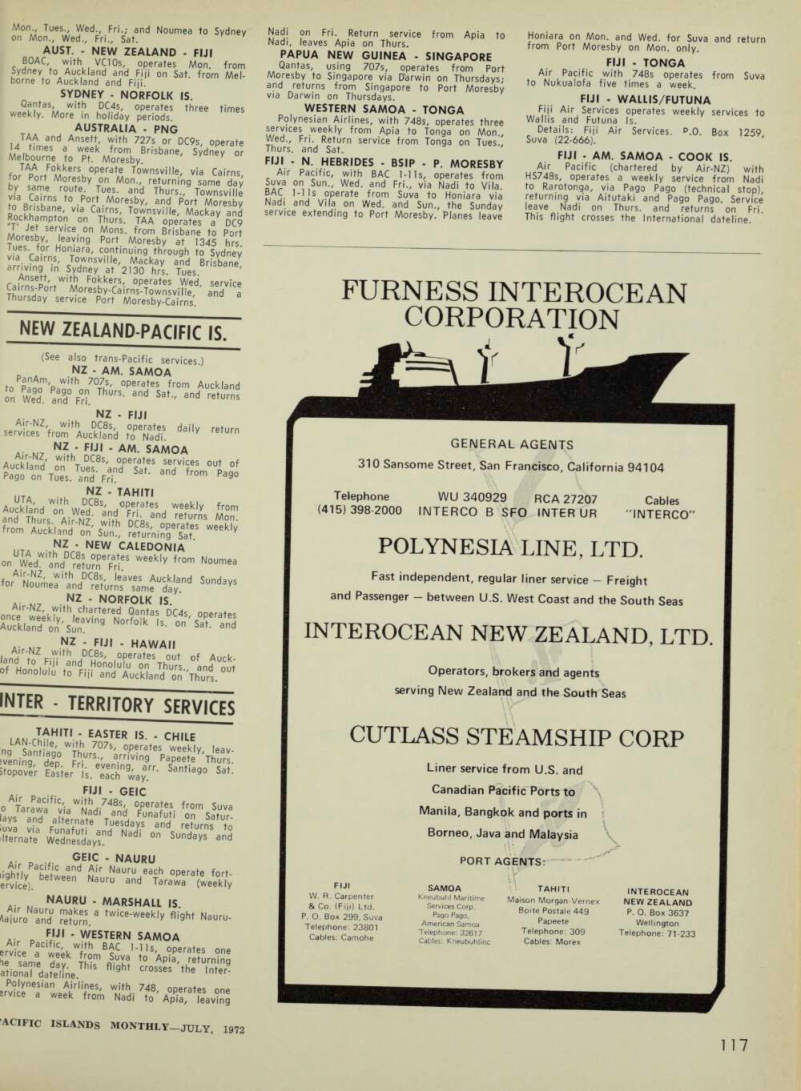
Trans Pacific Services
SYDNEY - FIJI - TAHITI - MEXICO Qantas, with 7075, operates twice weekly out of Sydney on Tues. and Fri. and return out of Mexico City on Tues. and Sat. Stops at Acapulco.
SYDNEY - FIJI ■ HAWAII - CANADA CP Air, with DCS, operates weekly services out of Sydney on Sat. and Vancouver on Thurs.
SYDNEY ■ NZ ■ HAWAII ■ US Air-Nz with DCBs, operates from Sydney to Los Angeles, via Auckland and Honolulu on Mon., Fri., and Sat. and returns Mon., Wed., and Sat.
SYDNEY - NZ - TAHITI • US Air-NZ, with DCBs, operates from Sydney to Los Angeles, via Auckland and Papeete on Sun. and returns Fri.
SYDNEY - FIJI - HAWAII - US Qantas operates daily between Sydney and San Francisco via Fiji and Honolulu on Mon., Wed., Fri and Sat. with 7478 s and on Tues., Thurs. and Sun. with 7075. Additional services to Fiji from Australia on Fri., Sat. and Sun.
BOAC, with VClOs, operates from Melbourne and Sydney to Los Angeles, and Los Angeles to Sydney and Melbourne daily except Mon. and Sot.
Sydney - Fiji - Hawaii
American Airlines, with 7075, operates three daylight flights from Sydney to Nadi and Honolulu (Sat., Sun., Mon.), returning from Honolulu to Nadi and Sydney Thurs., Fri. and Sat.
SYDNEY or NOUMEA - US (via FIJI,
Nz Or Tahiti)
UTA, with DCBs, operates out of Sydney on Tues. and Fri. and Noumea, on Mon., Wed., Thurs., and Sun., NZ on Wed. and Fri.
SYDNEY - US (via N. CAL., FIJI,
Or Hawaii)
PanAm, with 7475, arrives Sydney from Los Angeles, via Honolulu and Nadi, on Sun., Tues. and Thurs. and leaves on return flight the same days.
PanAm, with 7075, operates four days a week return trans-Pacific service out of Sydney and Los Angeles; Mon., Wed. and Fri. flights to Australia go to Melbourne and return to Sydney the same day. Mon. Sydney-LA flight is via Noumea and Honolulu. Jets connect with services to London, Europe and Far East. Jets fly Sydney-Hawaii non-stop both ways Wed., Fri. and Sat.
Melbourne - Fiji/Brisbane - Fiji
Qantas operates 707 s direct from Melbourne to Fiji on Fri and Sat. and direct from Bris bane on Sat.
Melbourne - Fiji - Us
Qantas operates Melbourne/San Francisco via Fiji and Honolulu on Fri. with a 7478 and on Tues. and Thurs. with 7075.
Melbourne - Fiji - Hawaii
American Airlines, with 7075, operates day light flights from Melbourne Tues. and Thurs., leaving Honolulu on return Tues. and Sun.
MELBOURNE - NZ - HAWAII - US Air-NZ, with DCBs, leaves Melbourne for Los Angeles via Auckland and Honolulu, on Sat. and returns Wed.
MELBOURNE - NZ - TAHITI ■ US Air-NZ, with DCBs, operates from Melbourne to Los Angeles via Auckland and Papeete on Wed., returning on Sun.
NZ ■ AM. SAMOA - TAHITI or
Hawaii - Us
PanAm, with 7075, operates out of Auck land, via Tahiti, on Mon. and Wed., and via American Samoa and Honolulu on Thurs. and Sat. Los Angeles and San Francisco.
Auckland - Fiji - Hawaii
American Airlines, with 7075, operates out of Auckland to Honolulu, via Nadi on Wed. and Fri. and from Honolulu to Auckland, via Nadi on Mon. and Wed.
NZ ■ FIJI - HAWAII ■ US Air-NZ, with DCSs, leaves Auckland for Los Angeles, via Fiji and Hawaii on Thurs. and returns same day.
Fiji - Am. Samoa - Hawaii
American Airlines, with 7075, operates out of Honolulu to Nadi daily (Mon. and Wed. flights via Pago Pago), and from Nadi to Hono lulu daily (Wed. and Fri. flights via Pago Pago).
Canada - Fiji
CP Air with DCBs, operates from Vancouver to Nadi on Mon., returning Wed.
Australia-Far East
Sydney - Png - Far East
Qantas, with 7075, operates out of Sydney to Port Moresby, Manila and Hong Kong on Sundays; returns from Hong Kong to Sydney via Port Moresby on Sundays. A service from Hong Kong to Port Moresby via Manila operates on Wednesdays, and from Port Moresby to Hong Kong direct on Fridays.
Australia-New Zealand
Qantas, Air-NZ, BOAC and UTA operate regular trans-Tasman services. Qantas and Air-NZ link major NZ cities with Australian east coast cities.
Australia-Pacific Islands
(For other schedules touching these islands see also trans-Pacific services.)
Melbourne ■ Noumea - Nauru -
Tarawa And Majuro
Air Nauru operates a twice-weekly service,
Melbourne-Brisbane-Noumea-Hqniara-Nauru and
return, using a Fokker 28 jet. Extra services are operated twice weekly to Maiuro and weekly to Tarawa and return.
Details: Nauruan Government Office, 227 Collins St., Melbourne.
Sydney - Fiji
Air-1 ndia, with 7075, operates weekly services to Nadi on Tues., returning to Sydney on Wed.
Sydney - Lord Howe Is.
Airlines of NSW, with operates four times weekly, return services from Rose Bay, Sydney, to Lord Howe. Extras on holidays.
Sydney - New Caledonia
Qantas and UTA operate Sydney to Noumea
Mon., Tues., Wed., Fri.; and Noumea to Sydney on Mon., Wed., Fri., Sat.
Aust. - New Zealand - Fiji
BOAC, with VC 10s, operates Mon. from Sydney to Auckland and Fiji on Sat. from Mel borne to Auckland and Fiji.
Sydney - Norfolk Is.
Qant3s with DC4s, operates three times weekly. More in holiday periods.
Australia - Png
i/ A tf m f nd Anset !' T' h 7275 or DC9s ' operate 14 times a week from Brisbane, Sydney or Melbourne to Pt. Moresby y y for T^rt F °AA kerS u operat . e Townsville, via Cairns, for Port Moresby on Mon., returning same day by same route. Tues. and Thurs., Townsville tn a ßr ai h nS t 0 . p °rf. Moresby, and Port Moresby ° l an t e ' via Ca J, rns ' Townsville, Mackay and Rockhampton on Thurs. TAA operates a DC9 J ser . vice . on Mons. from Brisbane to Port Moresby, leaving Port Moresby at 1345 hrs Tues. for Honiara, continuing through to Sydney via Cairns, Townsville, Mackay and Brisbane 7 arriving ,n Sydney at 2130 hrs. Tues ' Ansett, with Fokkers, operates Wed service Thl. r r nS ri' P ° rt Moresby-Cairns-Townsville, and a Thursday service Port Moresby-Cairns.
New Zealand-Pacific Is.
(See also trans-Pacific services)
Nz - Am. Samoa
operates from Auckland on Wed. a„ 9 d° F°ri. ThUrS ' and Sat -
A A., Nz ■ Fiji
Air-NZ with DCBs, operates daily return services from Auckland to Nadi. a M 7 NZ ' F,JI ' AM - SAMOA Aurkl'Z' r„ lth r DCBs ' operates services out of X on d TSes. T a U „ e d- f r a i" d and f ">™ Pa 9°
Nz - Tahiti
AuckSnH weekly from o n^V^d W 'an^retu^% a /^^^ m Noumea for A,^er, a h nd DC r B e ! t ’„r!, e s aVa a S^ U 5 k al, and
Nz - Norfolk Is.
nn , ir^Z '. W'th chartered Qantas DC4s ooerafpc ZlXs^" 9 N ° r,o,k * s - on 7 Satf r a*nd of Auck .
Inter ■ Territory Services
TAHITI - EASTER IS - run c
Sbss>Ss
tt iffess
Geic - Nauru
Nauru - Marshall Is.
teliro and ,wicc ' weekl V «'9M Nauru-
Fiji . Western Samoa
alio S „ a ar e da t d e a ,(na™ S Polynesian Airlines, with 748 operates nn* irvlce = weak from Nadi to' leaving
Nadi on Fri. Return service from Apia to Nadi, leaves Apia on Thurs.
Papua New Guinea - Singapore
Qantas, using 7075, operates from Port Moresby to Singapore via Darwin on Thursdays; and returns from Singapore to Port Moresby via Darwin on Thursdays.
Western Samoa - Tonga
Polynesian Airlines, with 7485, operates three semces weekly from Apia to Tonga on Mon., Wed., Fri. Return service from Tonga on Tues., Thurs. and Sat.
FIJI - N. HEBRIDES - BSIP - P. MORESBY Air Pacific, with BAG 1-1 Is, operates from Suva on Sun., Wed. and Fri., via Nadi to Vila.
BAG 1-1 Is operate from Suva to Honiara via Nadi and Vila on Wed. and Sun., the Sunday service extending to Port Moresby. Planes leave
Honiara on Mon. and Wed. for Suva and return from Port Moresby on Mon. only.
Fiji - Tonga
Air Pacific with 748 s operates from Suva to Nukualofa five times a week.
Fiji - Wallis/Futuna
f })} r Services operates weekly services to Wallis and Futuna Is.
Details: Fiji Air Services. p .O. Box 1259 Suva (22-666).
FIJI - AM. SAMOA - COOK IS.
Air Pacific (chartered by Air-NZ) with HS74Bs, operates a weekly service from Nadi to Rarotonga, via Pago Pago (technical stop), returning via Aitutaki and Pago Pago. Service leave Nadi on Thurs. and returns on Fri This flight crosses the International dateline.
Li a \a/ aii AM qamoa
Hawaii - Am. Samoa
PanAm, with 7075, operates from Honolulu to Pago Pago on Wed., Thurs., Fri. and Sat.
Hawaii - Am. Samoa - Tahiti
PanAm, with 7075, operates to Tahiti, via Pago Pago on Thurs. and Sat. and to Tahiti on Tues. and Sat.
Hawaii - Micronesia - Okinawa
Continental-Air Micronesia with 727 s operates from Honolulu, Wed. and Sun. via Midway (fuel stop only), Kwajalein, Majuro, Ponape, Truk Guam and Saipan; Tues. to Okinawa from Guam and Saipan. Return to Honolulu Wed. and Sat
New Caledonia ■ New Hebrides
UTA, with Caravelles, operates five return services a week, out of Noumea on Mon., Wed., Thurs., Fri. and Sat. to Vila. Returning Mon., Wed., Fri. (2 flights) and Sat.
NEW CAL. - WALLIS IS. - NEW CAL.
UTA, with Caravelles, operates a twice-
monthly service, leaving Noumea on the second and third Tues . of the month.
New Guinea - West Irian
TAA operates DC3s Madang to Djayapura and return alt. Tues.
Png . Solomons
TAA operat es DC9 and DC3 aircraft three times weekly. Tuesday aircraft leaves Port Moresby for Honiara returning same day tor port Moresby and continues to Cairns, Towns ville, Mackay, Brisbane and Sydney. Tuesday and Saturday aircraft leave Rabaul for Honiara via Buka, Kieta and Yandma, returning Wed nesday and Saturday.
Moresby direct Fri.
and sat returning Mon. Kieta to Port Moresby, Tues Kjeta Buka/ R a baul, Port Moresby. Wed Kieta Port Moresby. Thurs. Kieta, Buka, Rabaul, Port 'Moresby. Fri. Kieta, Port Moresby. Sat.
Kieta Buka, Rabaul Port Moresby. Sun. Kieta, Rabaul, Port Moresby.
Tahiti ■ Us
UTA, with DCBs, operates on Sun., Tues., Wed., Thurs., Fri., Sat. (non-stop from Papeete to Los Angeles), and returns the same day.
PanAm with 7075, operates to San Francisco, via Los Angeles on Mon., Tues. and Fri.; to San Francisco, via Honolulu on Tues. and Sat.; and to San Francisco, via Pago Pago and Honolulu, on Sun. and Thurs.; from San Francisco via Honolulu and Pago Pago, to Tahiti on Sat., and from San Francisco, via Los Angeles, to Tahiti on Mon., Wed. and Sat.
W. Samoa - Am. Samoa
Polynesian Airlines, with HS74B and DC3, operates between Apia and Pago Pago (six services, Fri.; three Mon., Tues., Wed., Thurs., Sat., Sun.).
Tonga - Niue - W. Samoa
Polynesian Airlines, with 7485, operates weekly service from Tonga to Niue, leaving Tues., arriving Niue Mon., leave Niue Mon., arrive Apia same day.
Tahiti - Cook Is.
Air Tahiti with Piper Aztec, operates char ter service from Papeete to Rarotonga.
Details from Air Polynesie, P.O. Box 314, Quai Bir Hakeim, Papeete, and UTA offices.
Internal Services
Fiji
Air Pacific, with HS74Bs, BAC l-11s and Herons operates regular services to Labasa, Matei, Nadi, Nausori and Savusavu.
Fiji Air Services, with Beech Baron and Nor man Islander aircraft, operates to Ovalau Is., Korolevu, Natadola, Deuba and Castaway Island roS Details; Fiji Air Services, P.O. Box 1259, Suva (telephone 22-666).
French Polynesia
Air Polynesie, with Fokker F 27 Friendship, DC4s, Twin Otters and Islanders, operates to Bora Bora, Huahine, Moorea, Rangiroa, Raiatea, Manihi, Marquesas, Maupiti and Tubuai, Austral Islands. „ „ ...
Details from Air Polynesie, P.O. Box 314, Quai Bir Hakeim, Papeete, and UTA offices.
Air Tahiti, with light aircraft operates shuttle service from Papeete to Moorea and charter service to Raiatea, Bora Bora, Huahine, Rangiroa and Manihi.
Gilbert And Ellice Islands
Air Pacific, with Herons, operates regular services between Tarawa, Butaritari, North Tabiteuea and Abemama.
Guam - Us Trust Territory
Continental-Air Micronesia with 727 s and
DC6s operates regular service connecting Hono lulu, Okinawa and Guam with Saipan, Rota, Yap, Palau, Truk, Ponape, Kwaialem and Majuro. . „ . details from Air Micronesia, Saipan.
Air Pacific Inc. (not connected with the Fi|i based Air Pacific) with Piper Navajos and a deHavi Hand Heron, operates regular services linking Guam, Saipan, Tinian, and Rota, and charter services are available to other Trust Territory islands. , ... . r Details, Air Pacific Inc., c/- Micro! Corp., (P.O. Box 267, Saipan, Mariana Islands 96V6U (telephone 6462). ...
Lagoon Aviation Inc. with Grumman Wid geons, operates charter services for the Mar shalls district, based on Majuro.
Papua New Guinea
TAA operates scheduled services throughout the territory, and has Fokker, DCS and Twin Otter aircraft available for charter.
Ansett operates throughout the territory Aerial Tours operates in Central, Western, Gulf and Sepik districts. ■ i Territory Airlines, a charter and third level airline, operates Twin Otter, Beechcraft and Cessna light single and twin engine *} rcT ™ from Goroka, Kundiawa, Ma ? an 9'. Me nd ', JJJ; Hagen and Port Moresby to Highland and C °Details' 6 from Territory Airlines Pty. Limited, P.O. Box 108, Goroka, Papua New Guinea or
Talco Territory Travel Service of Papua New Guinea.
AAacair operates throughout the territory.
Bougainville Air Services operates charter and fare services daily throughout Bougain ville, in Cessna and Britten-Norman Islander aircraft. Details: Arawa, Phone 956-159; Buka, Phone 16. Box 298, PO, Kieta.
New Caledonia
Air Caledonie, with Twin Otters, and Is landers operates regular services to Houai lou. Isle of Pines, Isle Ouen, Kone, Koumac, Lifou, Mare, Noumea, Ouvea Touho, Mueo, Belep, Tiga.
Details from Air Caledonie, Noumea.
New Hebrides
Air Melanesia with Britten-Norman Islanders operates to Santo, Malekula (Norsup and Lamap), Aoba {Walaha and Longana), Pentecost (Lono rore), Erromanga, Tongoa, Aneityum, Tanna and Vila. Direct connections are available to and from Santo for all international flights arriving in Vila with the exception of UTA's Caravelle Service from Noumea on Monday afternoons.
Details from Air Melanesia, P.O. Box 72, Vila.
Solomon Islands
Solair, with Beech Barons and Islanders operates to Auki, Avu Avu, Barakoma, Bellona Is., Fera Is., Gizo Honiara, Kira Kira, Marau, Munda, Parasi, Sege, Yandina, Santa Cruz, Mono, Rennell Is., Choiseul Bay and Ballalae.
Details from Solomon Islands Airways Ltd., Box 23, Honiara, BSIP.
PNG buys shares
in Burns Philp
The Investment Corporation of Papua New Guinea, acting for the people of PNG, have agreed to buy from Burns Philp & Co. Ltd. 1,500,000 fully paid shares of Si each at par in the capital of Burns Philp (New Guinea) Ltd. The shares rep resent 12i per cent, of the capital.
Two corporation directors will sit on the board. A full report will appear in the August PIM.
Japanese Plan
Island Cruises
Japanese shipping lines in the cruise business are turning their eyes towards the Islands. Several thousand Japanese tourists are expected to visit the Pacific Islands later this year when circular cruises begin in a few months time.
The Tojo Yusen shipping line has bought two 23,000-ton liners from Cunard White Star. They have arrived in Japan and are being refitted for Islands cruising, and another line plans the purchase of two 30,000-ton ships for pleasure cruising.
The Mitsui OSK Line opens a cruise programme with cruises to the Philippines and Guam in May.
Guam Cargo Surcharge
“Steep increases in port expenses and stevedoring” are blamed by Kar lander (Australia) for a surcharge of 5A5.89 a freight ton which the line has levied on all cargo loaded in Aus tralia for Guam. The levy operated from June 16.
Advertisements & other items, pp. 119-126 (2 items)
117
ACIFIC ISLANDS MONTHLY—JULY, 1972
Corporation
FURNESS INTEROCEAN
GENERAL AGENTS
310 Sansome Street, San Francisco, California 94104 Telephone WU 340929 RCA 27207
(415)398-2000 INTERCO B SFO INTER UR
Cables
"INTERCO'
POLYNESIA LINE, LTD.
Fast independent, regular liner service - Freight and Passenger - between U.S. West Coast and the South Seas
INTEROCEAN NEW ZEALAND, LTD.
Operators, brokers and agents serving New Zealand and the South Seas
CUTLASS STEAMSHIP CORP
FIJI
W. R. Carpenter & Co. (Fiji) Ltd.
P. O. Box 299, Suva Telephone: 23801 Cables: Camohe Liner service from U.S. and Canadian Pacific Ports to Manila, Bangkok and ports in
Borneo, Java and Malaysia
PORT AGENTS:
; v V
SAMOA
Kneubuhl Maritime Services Corp.
Pago Pago, American Samoa Telephone: 32617 Cables: Kneubuhlinc
TAHITI
Maison Morgan-Vernex Boite Postale 449 Papeete Telephone: 309 Cables: Morex
INTEROCEAN
NEW ZEALAND
P. O. Box 3637 Wellington Telephone: 71-233
UNION STEAM SHIP CO. of N.Z.
LIMITED
Serving the Pacific for nearly 100 years.
Regular Sailings by Modern Vessels
From Auckland to Lautoka, Suva, Pago Pago, Apia, Niue, Vavau, Nukualofa. Also from Tauranga to Lautoka, Suva, Apia, Nukualofa. Regular sailings from Australia to New Zealand to enable transhipment of cargo to all the above ports.
Ship your cargo by a Union Company Vessel.
BRANCHES AT ALL MAIN AUSTRALIAN, NEW ZEALAND AND ISLAND PORTS.
PACIFIC ISIMS TRANSPORT UNE
Owners: Thor Dahls Hvalfangerselskap A/S— Sandefjord, Norway.
Motor Vessels "Thorsisle", "Thorsgoord" and "Thor Regular Freight and Passenger Services between Pacific Coast Ports of U.S.A. and Canada and
TAHITI SAMOA TONGA FIJI NEW CALEDONIA
NEW HEBRIDES
GENERAL STEAMSHIP CORPORATION LTD.
General Agents 400 California Street, San Francisco, California, U.S.A.
APIA-Burns Phl.p -South Sen, Company, LTQ * Ltd PAPEETE Agence Maritime Inter- lae/ rabAUL—Burns Philp (New Guinea) Rationale Tahiti. Lid PAGO PAGO—G. H. C. Reid & Co. PORT VILA Comptoirs Francais de NOUMEA—Etablissements Ballande. Nouvelles Hebrides.
fclHf
DAIWA LINE
DIRECT MONTHLY SERVICE
JAPAN - GUAM - SOUTH PACIFIC
GUAM-TARAWA-SUVA-NUKUALOFA-LAUTOKA
PAPEETE- PAGO PAGO-APIA-NOUMEA-SANTO-VILA
JAPAN-WEST IRIAN-DILI
HONGKONG-DJAJAPURA-BIAK-MANOKWARI
SORONG-DI LI
FLEET
'FIJI MARU" D/W 9,840 T
'ELLICE MARU" 9,935 T
'SAMOA MARU" 9,519 T
'PALAU MARU" 6,494 T
'TACOMA MARU" 30,952 T
'TOKELAU MARU" 11,997 T
'RYUKAI MARU" 3,787 T
TAHITI MARU" 9,058 T
'BIAK MARU" 6,430 T
'HIEI MARU" 25,228 T
AGENTS:
GUAM: Atkins, Kroll (Guam) Ltd.
TARAWA: G. & E. I. Development Authority APIA: Burns Philp (South Sea) Company Ltd.
PAGO PAGO; Kneubuhl Maritime Services Corp.
NUKUALOFA: Tonga Shipping Agency.
SUVA; Burns Philp (South Sea) Co., Ltd.
LAUTOKA: Burns Philp (South Sea) Co., Ltd.
NOUMEA: Agence Maritime et Serienne Caledonienne SANTO: Burns Philp (New Hebrides) Ltd.
VILA: Burns Philp (New Hebrides) Ltd.
HONIARA: British Solomons Trading Company Ltd.
PAPEETE: Establissements Baldwin.
HONG KONG: Ike Maritime Co., Ltd.
SINGAPORE: The Borneo Company (Singapore) SDN BHD.
DJAJAPURA: P.N. Pelajaran Nasional Indonesia.
BIAK: P.N. Pelajaran Nasional Indonesia.
SORONG: P.N. Pelajaran Nasional Indonesia.
Dl LI; Sang Tai Hoo.
THE DAIWA NAVIGATION CO.*LTD.
OSAKA:
HEAD OFFICE:
No. 2, 5-CHOME AWAJIMACHI
HIGASHIKU, OSAKA.
TEL. OSAKA (203) 1871-5.
DAI LINE" TOKYO: "FUNEDAILINE"
TOKYO OFFICE:
No. 20, 3-CHOME KANDA-NISHIKI-CHO
CHIYODAKU, TOKYO.
TEL. TOKYO (292) 2441-5.
33E2m.1£5L15
WORKING MANAGER. Young man, lifetime experience in all station work and able to accept responsibility and use initiative. Experienced in cattle, stud management, farming and property maintenance including welding and mechanical knowledge. Ability and character references available. Apply: Mr. E. Evans, “Craddock”, Graman, N.S.W., 2360.
VISITING BRISBANE?
Stay at TOWER MILL MOTEL. First class air-conditioned accommodation, T.V., private bathroom and verandah with a delightful view. Two restaurants.
From $lO.OO per day.
Book through your Travel Agent or Airline office or direct to 239, Wickham Terrace, Brisbane. Telephone 31-1421.
PARK VIEW MOTEL—BRISBANE
Quiet location —opp. Botanic Gardens.
Single, double, family suites, all with refrig., air conditioning, phone, TV, radio, tea making facilities, from $lO. Pool and restaurant. , Phone 31-2695—Telex 40270.
Write for coloured brochure— Park View Motel, 128 Alice St, BRISBANE, Old., 4000.
WE BUY AND SELL
Secondhand
FLOUR AND FEED MILLING
GRAIN CLEANING
AND ALL TYPES OF
GRINDING AND
PULVERISING MACHINERY
SPARE ROLLS (New
and Used) SUIT ALL TYPES
OF ROLLERMILLS
ILKESTON PTY. LTD.,
MILSONS°PO?NT X N.S ? W. 2061,
AUSTRALIA.
NEW ZEALAND exporter of frozen meats offers merchants with refrigerated space facilities regular quotations, personalised service and wide supply access.
Write LEN R. HARLAND LTD., P.O. Box 289, New Plymouth, New Zealand. Cables:
"CANLEN".
GOLD COAST—BURLEIGH HEADS
PARK TOWERS
• Luxurious s.c. prestige 2 b.r. apartments • 50 yds from ocean —seen from all units Brochure available write — Keith Hatcher, Mgr., Goodwin Tee., Burleigh Heads, Queensland. 4220 or Phone 35 2354
Line Advertisements
Per line, 950 Anst.; Minimum rate. 4 lines.
Stay at —
JOHN OXLEY
MOTEL
491 WICKHAM TERRACE,
BRISBANE.
(750 yards City Hall) Every possible facility.
At very sensible rates.
SEND FOR BROCHURE
FLEETS. For sale. 52 ft x 17 ft' x 6 ft 6 in. steel cargo boat bit. 1971 to M.S.B. survey, 205 h.p. diesel installed new, 3:1 red., 1 500 gals, fuel, 400 gals, water, radio, sounder, etc. $45,000. Fleets, Rowe’s Bldg., Edward St., Brisbane, Cable: Fleets, Brisbane.
CONCRETE BLOCK MACHINE FOR SALE,
Makes blocks, flags, edgings, screen-blocks, garden stools—up to Bat once and 96 an hour. SAI2O c.i.f. main ports. Send for leaflets. Forest Farm Research, Londonderry, N.S.W., 2753.
C. S. JOHNSON YOUNG CO., Box 423, Hong Kong. Export: Camphorwood chests, dress materials, plastic flowers, hardware, rattan and porcelain ware. Import: Fungus, sharkfin.
FOR RENT: f.f. 3-bedroom modern home new area Southport, close Southport school and golf club; all equipment TV and electricity included; also reliable Peugeot 404 car; for 7 months from mid- November, 1972 whilst owner abroad.
Inclusive rental $250 per month. Telephone available. Would take two shorter term rentals but sorry, no children under eight.
Write: Holsheimer, 12 Cooper Parade, Southport, 4215. References required.
BOAT HAND. I can type, write shorthand ind have a year’s nursing experience but [ want to go to sea working on a tourist type vessel. Anyone want a boat hand?
Write to Miss Linda McMillan, 36 White Street, Balgowlah 2093, NSW, Australia.
FOR SALE 55 FT. KETCH, “Fearless”, John Alden design, fast, proven cruiser. $A14,000. For details write: Allan Brown, yacht “Fearless”, P. 0., Port Vila, New Hebrides.
ALL BOOKS AND JOURNALS ON AUST-
RALASIA AND THE PACIFIC BOUGHT
AND SOLD. Catalogues issued and sent free on application. Correspondence mvited. Berkelouw, 15-19 Boundary St..
Rushcutters Bay, Sydney, 2011. Phone: 31-8215.
[ODEN’S BOAT DESIGNS PTY. LTD.,
95 George St., Sydney, 2000. Get your lodens Boat Designs and Boat Building look from newsagents everywhere. Posted irect $A2.20 surface mail.
ESCAPE
FROM THE ORDINARY
Here is an idyllic paradise where you can enjoy the unspoiled beauty and serenity of a working coconut plantation. This privatelyowned Pacific retreat has been designed for a maximum of 12 people. Gracious surroundings, friendly service, relaxed accommodations with Fijian decor and American conveniences.
Activities available include: Deep sea fishing, reef and shell hunting, skin diving and snorkeling, water skiing, hiking, turf tennis court, badminton, horseback riding, and a beautiful tropical garden to relax in.
Send for free brochure: The Manager,
NAMALE PLANTATION,
SAVUSAVU, FIJI ISLANDS
GENERATING SETS
New and used sets up to 600 kVA.
STONE CRUSHERS
Jaw and Gyratory types.
MINING EQUIPMENT
Ball Mills. Hammer Mills.
Disintegrators.
WINCHES
Air, electric and diesel engine powered.
AIR COMPRESSORS
Both electric and diesel engine driven from 80 cfm upwards.
D. H. BERGHOUSE
PTY. LTD.,
61-65 MACARTHUR STREET, ULTIMO,
SYDNEY, N.S.W. 2007, AUSTRALIA.
Cables: "Bergmachines", Sydney.
*ir * & & #3
tWIHW
JACK
SONS
GOOD FLAVOUR FOODS
available through our agents:
C. SULLIVAN EXPORT PTY. LTD.
ANTENNAS
for Radio Com
Point to Point Mobile Services Ground to Air Land or Sea
Broadcasting
M.F. to U.H.E
Navalds
Planning, Installation
Maintenance of
Complete Systems.
icatlons
Auxiliary Equipment
Support Strut Antenna C »upl
Filter Systems
Multico|iple|s
Dlplexers Baiuns & Widebaj Terminations Feeder Systems rdware
Id |fr^s£ormers
ANTENNA ENGINEERING AUSTRALIA PTY. LTD.
Garden Street, Kilsyth: P.0.80x 191. Croydon.Vic.3l36.
Telephone 728-1777 Telex 32274
(Advertisement)
I need rest—
baby's exhausted,
too—
What would
you do?
I've tried to be an attentive mother but so many times I've felt at a loss to know just how to comfort my little one.
Baby, having arrived so much later than Tim and Jen, I'd really forgotten the distressing symptoms that come with teething troubles.
Then, in desperation I remembered Fisher's Teething Powder.
You'd be amazed what an effective and soothing aid they are to baby's sore gums, digestive disturbances and intestinal upsets which are natural teething disorders.
Another great virtue of Fisher's Teething Powders is their safety They do not contain Calomel, Opiates, Bromides or any harmful substances. Even if the baby by mischance should eat several, they could do no harm.
By giving your baby a Fisher's Teething Powder as needed, you not only keep the little one happy and well, but save yourself all those upsets and nervous tensions that beset a mother when her baby suffers distress. Be sure to get a supply of Fisher's Teething Powders from your chemist or store. Only 30 cents for 20 powders, write direct to Fisher & Co., Manufacturing Chemists, 17 May St., St. Peters, N.S.W. Postcode 2044.
WILUAM LAND & (0.
are pleased to advise they
SUPPLY PRIME EXPORT QUALITY MEATS—
available as fully prepared pre-packaged meats for domestic use, and bulk meats for institutions Prices available on application to:
WILLI AAA LAND & CO.
56 SYLVAN RD„ TOOWONG, BRISBANE, Q. 4066
PAPUA
NEW GUINEA
PRINTING CO.
PTY. LTD.
Commercial Offset and Letterpress printers to the territory.
Factories in Port Moresby and Lae.
And we also can supply your regular and specialised stationery needs.
OFFICE EQUIPMENT
RUBBER STAMPS
We welcome your mail orders .
P.O. Box 633, Port Moresby P.O. Box 759, Lae P.O. Box 30, Mount Hagen Cables & Telegrams: PRINTER Port Moresby and Lae
Nutshell
In a Nutshell
NO FORUM QUORUM.—lsland leaders in Western Samoa in June for that country’s 10th independence anniversary celebrations were hoping to use the occasion for an unofficial meeting of the South Pacific Forum but there was no quorum. The Cook Islands Premier, Mr. Albert Henry, regarded as one of the forum’s lead ing lights was absent. The formal meeting will be in Suva in September as arranged. The celebrations went off as planned in the presence of two visiting prime ministers and one deputy prime minister,
Emanuel Trial Ends.—The
trial of the Tolai men for the murder, by stabbing with a rusty Japanese bayonet, of East New Britain District Commissioner Jack Emanuel ended on June 20 with the gaoling of five men. The Chief Justice, Mr. Justice Mmogue, sentenced William Taupa, the murder planner, to 14 years im prisonment; Alton Towaliria, who stabbed Mr. Emanuel, to 11 years; Joseph Tomarum and Likius Topait to two years and Topait’s father, Otto Kaliop to 18 months. Charges against five others were withdrawn.
Extenuating circumstances precluded the passing of the death sentence, the Chief Justice said. The men had been aggrieved because of the loss of their land and the Kabaira people realised their community was in danger of extinction through the loss of land.
Record For Speaker?—“I May
break world records as having served the shortest term in office,” said Mr.
Perry Kwan, Speaker of the PNG House of Assembly. Mr. Kwan an nounced his resignation on June 22 because he felt he was not experienced enough for the job. A European planter and coffee buyer, Mr. Barry Holloway, has been elected Speaker in his place.
Search For Knowledge.—
Four members of the BSIP Governing Council’s select committee on consti tutional development, Mr. W. Betu, Chairman of the Social Services Com mittee, Mr. S. Kuku (New Georgia member), Mr. S. Mamaloni (Makira/ Ulawa) and Dr. Ofai (North Malaita) are visiting Mauritius and the Sey chelles to study constitutional, educa
tional and rural planning and localisa tion methods in these countries. The team which is accompanied by Mr. A.
Manakato, a Solomons establishment officer, visited PlM’s offices in Syd ney. They return home on July 10.
Ship Blaze Tragedy.—An
American Samoan high chief was drowned and six crew members and four passengers were rescued when the Samoan interisland ship Lady Elizabeth caught fire and sank off Aunu’u near Pago Pago on June 4.
The dead man was Tialigo Siliaivao, of Ta’u, An inquiry board was told the ship was turned into a blazing inferno in a few minutes.
BARRIERS.—Nauru President Ham mer Deßoburt met with US Trust Territory Chief of Transportation, Mr.
Wayne Thiessen, early in June to dis cuss the 15 per cent, tariff imposed on Nauru Pacific Line’s trade with Micro nesia. The impost is an arbitrary pro tection device for the TT’s own Trans pac Lines, but Nauru claims they are not in competition and the sur charge merely raises prices to consu mers in the Marshalls. President De- Roburt also offered to invest $250,000 in Transpac, but the offer was declined, along with any change in the tariff.
“The Nauruans are foreigners and cannot buy shares,” Thiessen said later.
PIPA SURVIVES. The Pacific Islands Producers Association (PIPA), which everyone thought would be asked to commit suicide at the seventh conference in Rarotonga to make way for the South Pacific Forum’s Bureau for Economic Co operation, has had a reprieve. PIPA delegates decided that it should con tinue for another three years and then have its future role reviewed.
PIM learns that Tonga’s ambition to have the much-desired regional ship ping line based on the kingdom’s own Pacific Navigation Company was somewhat jolted by criticism aimed by delegates at the company’s opera ting methods.
Republic Of Minerva.—The
Tongans don’t like the idea of the republic and King Taufa’ahau, after a mystery trip at the end of May, declared the kingdom’s sovereignty over Minerva Reef. Ninety Tongan prisoners were taken to the reef to build an artificial island conforming with international law which says only permanent structures above the sea at high tide can be claimed as “country”. The King told his people South Minerva will become Teleki Tonga and North Minerva Tokelau.
The new portion of his kingdom had a tragic birth. One of the working party of prisoners killed another
during an argument. Meanwhile, the originators of the idea, Ocean Life Research Foundation, have published a report which says the Republic of Minerva is now a fact. Its progress from now on should be interesting.
¥C Xtpvt R .. Tx1V ..,,
\'H ER E I* N EX T FESTIVAL?- Although a Noumea work planning conference for the SPC earlier this year proposed that the next South Pacific Festival of Arts be held in Tahiti in 1974, it s not by any means a foregone conclusion. There is a strong movement to keep the festival in Suva, where the first successful programme was staged in May and to have it in 1975 and every three years thereafter A decision won t be made before the next South Pacific Conference in Apia in September.
M r - Vl «° r e^ eC vl lv f °®‘ c ® r of the May festival, is likely to be approached soon to advise on the next festival.
Dalkin Departing—Air-Corn-
modore R. N. Dalkin, Norfolk Island’s Administrator ends his term of office and will leave the island in mid-August, he has told the islanders.
“It is felt that the term of office of approximately four years, bearing in mind the increasing complexities of the post and other factors, is appropriate to the 19705,” he said. His successor had not been named at the time of writing.
LAST DRlNKS.—Drinks were free at the oldest of Suva’s old-timers, the 91-year-old Melbourne Hotel, in June, but many a throat had a lump in it as the beer went down. The patrons were saying farewell to the hotel, latest victim of progress in
Fiji. It is being demolished to make way for a multi-storey office block.
It was built in 1881 by Mr. John Reading.
Development Hitch.—The
swift movement of Papua New Guinea towards self-government to haV e put in jeopardy a „ million sche^e b F Aus ' tr alian syndicate to develop Wuvulu Island 112 miles off the n £ rth coast of New Guin as a get-away-from it.al, retreat for some the ' world . s wel |. hee led. The scheme (for full de tai, PIM Feb 36) was appro ved b the PNG administration last De cember in an agree ment signed by the Administrator, Mr. L. W. John son xhe deve lbpers, Wuvulu Hold jngs Pty Ltd earlier this year be . gan semng the first of 181 o ne-acre blocks on the 3,600-acre island at $30,000 each. The company owns freehold most of the island, Following criticism that there is in sufficient land for the development ? eeds o{ . th 6 'slanders PNG Mincer ? or Mr. Albert Maon Kiki, has ! m P° unded ( on the pro and sto PP ed tEe sale of blocks. move f? as J a ‘ sed , qu l sd ° n security of freehold in PNG. , and , 1S 1,61118 watched w,th close m ' eres * EAGLES’ FLIGHT.—The Matupit Eagles, a Tolai team beat Maltech a West New Britain team, in an Aus tralian Rules football match in Rabaul on June 18 and then wished they hadn’t. After the game Maltech supporters chased the Tolais through the streets for two miles. Riot squads were called out and police made 25 arrests. Two people received treat ment in hospital. The Tolais rounded
off the day by sacking a West New Britain village near Rabaul Airport and, said the police “committed utter carnage”. The Tolais later offered to pay compensation for the damage they caused to village houses.
Australia-Nauru Associa
TION.—At the second annual general meeting of the Australia-Nauru Asso ciation held in Melbourne in April, Mr. J. K. Proudfoot was elected chair man. Committee for 1972-73 are Messrs. T. W. Star, A. E. Holmes, I.
Dedogi, and B. Hamilton. Honorary secretary, F. J. Thistlewaite, and honorary treasurer, G. F. Harris were re-elected.
'Gappy' Fitch's
colourful life ends at 91
By R. W. Robson
“Cappy” Fitch, of Papua, is dead.
He lived 91 years and all—except those of his early boyhood—were packed with incident and adventure.
Christened Algernon Sydney (names he hated) he was successively a student in England; a sailing-ship cadet; an officer and commander of sailing ships including a hospital ship during the Boer War; for nine years a government pilot on the Hoogli River, taking ships through the Ganges Delta to Calcutta; a trader on the coast of Papua and head of Steam ships Trading Co. Ltd. for 27 years.
For the last 25 years he had his luxurious home in Kirribilli Point, Sydney, and travelled far and wide.
He was a keen and usually a cynical observer of men and affairs, and had a sense of the dramatic. I tried to persuade him to write a book —it would have been a best-seller if it got past the censor—but he would have none of it.
It has been my fortune to know most of the men who established or guided the big trading enterprises in the South Pacific Islands—Maynard Hedstrom, of Fiji; Joe Mitchell, of Burns Philp; Tibby Hagen, of Noumea; Bob McKegg, of Raro tonga; Walter Carpenter, of New Guinea; Oscar Nelson, of Samoa; Ivan Nelson, of Nelson and Robert son; Willie Watson, of Rarotonga; Heinrich Rudolph Wahlen, who took over the Queen Emma empire in German New Guinea; and Cappy Fitch, of Papua. Although all were singularly different in character, each had three things in common; they were remarkably bold in founding speculative enterprises; they had the faculty of getting the loyalty of out standing men in running the big cor poration they created; and their very salty reminiscences were made agree able by a sense of humour.
In my memories of these pioneers, Captain Fitch stands out.
He had lived half his colourful life when, soon after World War I, he arrived in Australian waters with a rather battered old steamer named “Queenscliffe”. With the ship, he tried some enterprise—l’ve forgotten what —in Tasmanian waters.
But it was not successful, so he took the steamer to Papua, and traded along that inhospitable coast, between
Samarai and the Fly River. He ex changed his goods for the local pro duce, which he then sold in Moresby.
They were tough traders in those primitive river-mouth ports, but Fitch was tough, too, and he slowly built up a profitable business.
He established a small store in Moresby, which was supplied mainly by the busy “Queenscliffe”. Officially, the enterprise was Steamships Trading Company Ltd. and presently “Steamies” was offering a modest challenge to the big and powerful Burns Philp organisation. But in the early days, the STC men were known as the “Queenies”, after the old steamer.
In the twenties, “Cappy” had the good fortune to meet Eric Vivian Crisp; and “Viv” helped him greatly when he opened a branch at Samarai, and extended his activities in a big way into rubber-planting.
During the thirties, the booming gold industry had enlivened Papua’s rather pallid economy, and Steam ships grew with it. By 1939, when World War II came along, STC had become BP’s liveliest rival in the territory. But its rapid growth had over-strained its capital structure, and life wasn’t easy for the very enter prising Fitch-Crisp organisation.
The Japanese invasion in 1941-1942
changed everything. Except on the north coast, the enemy did not actually land troops in Papua, but his bombers were all over Papua, and early in 1942 all civilians, including the traders, were evacuated to Australia. Bomb damage and looting wrecked Port Moresby. It looked like Steampships’ end.
For a year or two, “Cappy” grumped miserably around Sydney.
Then, as the enemy’s grip on New Guinea weakened, he disappeared.
Long afterwards, I learned that he had put the Hoogli River sign, or something, on the military czars who ruled Papua at that time, and had been allowed back into Moresby. He made for himself a little residential cubby-hole in his big store; and there he lived for a couple of years, and kept a critical eye on events, while meticulously compiling lists of the losses his extensive properties had suffered.
The war ended in 1945, and sud denly Australia found itself with a War Damage Compensation Fund, built up over the years as an insurance against invasion; and there had been no invasion of Australia.
But there was devastation in the Australian territories and it was proper that the fund be diverted there. There was £l4 million, for
distribution to the war sufferers— and there was “Cappy”, with formal evidence to support his claim for a huge sum as war-damage compensa tion.
The rest is history. Steamships Trading Co. came back into PNG trading in a blaze of glory and optimism, with former stock-sheets turned into hard cash, with new plant and equipment, and with more mature plantations.
Before the decade ended, “Cappy” had retired with a snug personal fortune, the highly competent Vivian Crisp had taken charge of the whole lively organisation, and STC shares were eagerly bought on the Sydney stock exchange.
I lunched with “Cappy” and his wife occasionally at the Royal Sydney Yacht Club and the RAC, and heard their stories of frequent world tours.
But they did not have the flavour of his tales of the old days, when he went bucketing around the Horn in Antarctic weather, or dodged pirates off the Chinese coasts, or dealt sum marily with thieves among Indians he encountered when surveying the up per Ganges River.
In another decade “Cappy” Fitch, like other notable pioneers, will be but a memory there; but he surely left his mark on non-official Papua.
Advertisements & other items, pp. 126-128 (1 item)
Engineer Representatives/
ENTREPRENEURS
(all areas) Opportunities to collaborate with major world-wide engineering services and consulting organisation.
Replies are invited from
QUALIFIED FREELANCING ENGINEERS
and/or
ESTABLISHED CONSULTING FIRMS
in all engineering/industrial disciplines who are interested in participation as local
CORRESPONDENTS/OPERATIVES
in all major centres of Australasia (including Papua New Guinea, New Zealand and Pacific Islands) and Oceania.
Experience in engineering/industrial project appraisals, design and commissionings, project expediting and logistical programmes and site supervisions coupled to an in-depth background of mechanical inspection and metrology is required.
Experience of general procurement and infrastructure appraisals in support of projects in developing countries is also considered important to our needs as much of our involvement is likely to relate to overseas appraisals and engagements. We are also interested in speaking with people with a background of N'.D.T. associated with pressure vessels, heavy constructions and pipelines. For engineers applying from urban industrial centres, associations with industrial psychologists or personnel consultants would be an important asset.
Please address replies to
"ENGINEER REPRESENTATIVES/ENTREPRENEURS"
BOX 2422, G.P.0., SYDNEY, 2001.
AVAILABLE FROM :
JAMES SANDY PTY. LTD.
637 GARDENERS ROAD, MASCOT,
N.S.W., 2020, AUSTRALIA.
• GLASS MERCHANTS
• ALUMINIUM STOREFRONTS
• ALUMINIUM WINDOWS AND DOORS
• SHOWER SCREENS
• MIRRORS
SANDYS
EXTRUDED ALUMINIUM
ADJUSTABLE LOUVRES
FITTED WITH ALUMINIUM OR GLASS BLADES
FOR SUN AND VENTILATION CONTROL
t- ■
SANDYS EXTRUDED ALUMINIUM GLAZING BAR FOR
ECONOMICAL SIDEWALL GLAZING
Gift
Crackers
taste as rt
lhau’rp.
thev’re
buttered«
Rrockhoff CHX are crisp,
lICI LK.U ■
Brockhoff Clix are crisp.
*>Wen C ,^art re^>S"
-SSS"
ciAacEftS:
gazter Tender qolden crackers they taste as if already theyare buttered There’s value, variety and quality in
BROCKHOFF BISCUITS
6441/8 X 6V4
Deaths of Islands People
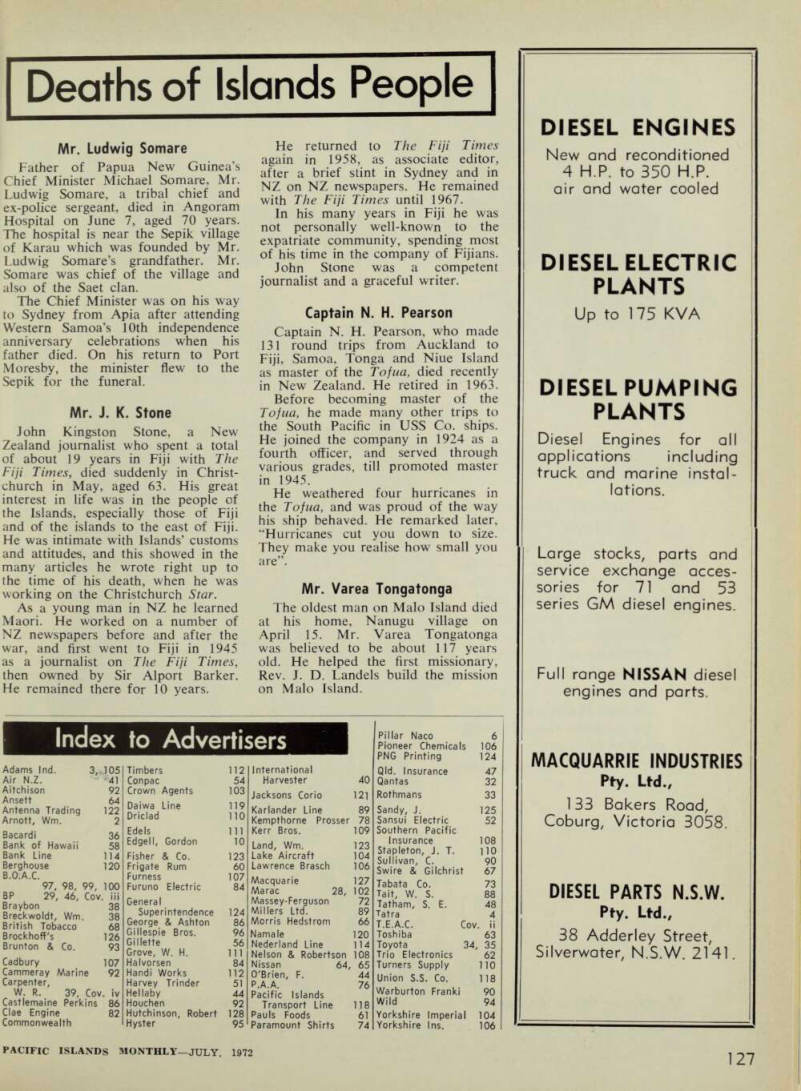
Mr. Ludwig Somare Father of Papua New Guinea’s Chief Minister Michael Somare, Mr.
Ludwig Somare, a tribal chief and ex-police sergeant, died in Angoram Hospital on June 7, aged 70 years.
The hospital is near the Sepik village of Karau which was founded by Mr.
Ludwig Somare’s grandfather. Mr.
Somare was chief of the village and also of the Saet clan.
The Chief Minister was on his way to Sydney from Apia after attending Western Samoa’s 10th independence anniversary celebrations when his father died. On his return to Port Moresby, the minister flew to the Sepik for the funeral.
Mr. J. K. Stone John Kingston Stone, a New Zealand journalist who spent a total of about 19 years in Fiji with The Fiji Times, died suddenly in Christ church in May, aged 63. His great interest in life was in the people of the Islands, especially those of Fiji and of the islands to the east of Fiji.
He was intimate with Islands’ customs and attitudes, and this showed in the many articles he wrote right up to the time of his death, when he was working on the Christchurch Star.
As a young man in NZ he learned Maori. He worked on a number of NZ newspapers before and after the war, and first went to Fiji in 1945 as a journalist on The Fiji Times, then owned by Sir Alport Barker.
He remained there for 10 years.
He returned to The Fiji Times again in 1958, as associate editor, after a brief stint in Sydney and in NZ on NZ newspapers. He remained with The Fiji Times until 1967.
In his many years in Fiji he was not personally well-known to the expatriate community, spending most of his time in the company of Fijians.
John Stone was a competent journalist and a graceful writer.
Captain N. H. Pearson Captain N. H. Pearson, who made 131 round trips from Auckland to Fiji, Samoa, Tonga and Niue Island as master of the Tofua, died recently in New Zealand. He retired in 1963.
Before becoming master of the Tofua, he made many other trips to the South Pacific in USS Co. ships.
He joined the company in 1924 as a fourth officer, and served through various grades, till promoted master in 1945.
He weathered four hurricanes in the Tofua, and was proud of the way his ship behaved. He remarked later, “Hurricanes cut you down to size.
They make you realise how small you are”.
Mr. Varea Tongatonga The oldest man on Malo Island died at his home, Nanugu village on April 15. Mr. Varea Tongatonga was believed to be about 117 years old. He helped the first missionary, Rev, J. D. Landels build the mission on Malo Island.
Index to Advertisers
Adams Ind. 3,. JO5 Air N.Z. ’ *4l Aitchison 92 Ansett 64 Antenna Trading 122 Arnott, Wm. 2 Bacardi 36 Bank of Hawaii 58 Bank Line 114 Berghouse 120 8.0.A.C. 97, 98, 99, 100 BP 29, 46, Cov. iii Braybon 38 Breckwoldt, Wm. 38 British Tobacco 68 BrockhofF's 126 Brunton & Co. 93 Cadbury 107 Cammeray Marine 92 Carpenter, W. R. 39, Cov. iv Castlemaine Perkins 86 Clae Engine 82 Commonwealth
Timbers 112 Conpac 54 Crown Agents 103 Daiwa Line 119 Driclad 110 Edels 111 Edgell, Gordon 10 Fisher & Co. 123 Frigate Rum 60 Furness 107 Furuno Electric 84 General Superintendence 124 George & Ashton 86 Gillespie Bros. 96 Gillette 56 Grove, W. H. 11l Halvorsen 84 Handi Works 112 Harvey Trinder 51 Hellaby 44 Houchen 92 Hutchinson, Robert 128 Hyster 95
International Harvester 40 Jacksons Corio 12l Karlander Line 89 Kempthorne Prosser 78 Kerr Bros. 109 Land, Wm. 123 Lake Aircraft 104 Lawrence Brasch 106
Macquarie 127
Marac 28, 102 Massey-Ferguson 72 Millers Ltd. 89 Morris Hedstrom 66 Namale 120 Nederland Line 114 Nelson & Robertson 108 Nissan 64, 65 O'Brien, F. 44
P.A.A. 76
Pacific Islands Transport Line 118 Pauls Foods 61 Paramount Shirts 74
Pillar Naco 6 Pioneer Chemicals 106 PNG Printing 124 Qld. Insurance 47 Qantas 32 Rothmans 33 Sandy, J. 125 Sansui Electric 52 Southern Pacific Insurance 108 Stapleton, J. T. 110 Sullivan, C. 90 Swire & Gilchrist 67 Tabata Co. 73 Tait, W. S. 88 Tatham, S. E. 48 Tatra 4 T.E.A.C. Cov. ii Toshiba 63 Toyota 34, 35 Trio Electronics 62 Turners Supply 110 Union S.S. Co. 118 Warburton Franki 90 Wild 94 Yorkshire Imperial 104 Yorkshire Ins. 106
Advertisements & other items, pp. 129-132 (2 items)
Diesel Engines
New and reconditioned 4 H.P. to 350 H.P. air and water cooled
DIESEL ELECTRIC
PLANTS
Up to 175 KVA
DIESEL PUMPING
PLANTS
Diesel Engines for all applications including truck and marine installations.
Large stocks, parts and service exchange accessories for 71 and 53 series GM diesel engines.
Full range NISSAN diesel engines and parts.
MACQUARRIE INDUSTRIES
Pty. Ltd., 133 Bakers Road, Coburg, Victoria 3058.
DIESEL PARTS N.S.W.
Pty. Ltd., 38 Adderley Street, Silverwater, N.S.W. 2141.
A
great bunch
of flours.
Robert Hutchinson makes the greatest bunch of flours in the Pacific. Bakers’ flour.
Superlite cake and sponge flours.
Biscuit flour and cracker flour.
Wheafen sharps and wheaten meal.
We’re particularly proud of our bunch of flours. So we have a technical advisory service to help you use them properly.
So next time you see a Robert Hutchinson flour (or even one of our Hutmill stock feeds), remember it’s just one of the bunch mm % {k*m m 5®
ROBERT
HUTCHINSON
LIMITED
the flour people
Harrington Street, Glenroy, Victoria, Australia. 3046. Telephone Melbourne 306 7261 nmot
BURKS PHILP (NEW GUINEA) LIMITED
GENERAL MERCHANTS
SHIPPING AND CUSTOMS AGENTS
Head Office; Champion Parade, Port Moresby
PHONE: 2202. TELEX: PMII6. CABLE ADDRESS: BURPHIL.
PAPUA NEW GUINEA
BRANCHES
BOROKO
BULOLO
DARU
GOROKA
KAINANTU
KAVIENG
Subsidiary Companies Hotel Moresby Ltd.
Ela Motors Ltd.
Local Laundries Ltd.
Moresby Hire Services Ltd.
Papua Hotel Ltd.
The B.N.G. Trading Co. Ltd.
The Port Moresby Freezing Co. Ltd.
Overseas Agents Burns, Philp & Co. Ltd. All Aust. States.
Burns, Philp & Co. Ltd., London.
Burns-Philp Co. of San Francisco.
Burns Philp (South Sea) Co. Ltd.
Burns Philp (New Hebrides) Ltd.
Agents for Burns Philp Trustee Co. Ltd.
Queensland Insurance Co. Ltd.
Lloyds of London.
Stewarts & Lloyds (Australia) Pty. Ltd.
Shell Company (Pacific Islands) Ltd.
Distributorships include British Paints Buckingham & Carnatic Textiles Byford Products Citizen Watches "CeCoCo" Machinery Conditionaire Air Curtain Doors Hardie's Building Products Heuga Tile Floor Coverings Jean Patou Parfums "John" Valves Johnson Ceramic Tiles Kienzle Clocks Marcel Rochas Parfums Mikimoto Pearls National Radios & Appliances Noritake Chinaware Rolex Watches Ronson Products Rover Power Mowers Sunbeam Appliances, Mowers & Rural Products Exporters of Coffee & Cocoa Beans, Peanuts, Rubber Shipping Agents for Bank Line Ltd.
Campagnie Des Messageries Marifimes Chandris Line Cogedar Line Containers Pacific Express Line Cunard Steamships Co. Ltd.
Eastern & Australian Steamship Co. Ltd.
P & O Lines of Australia Pty. Ltd.
Nederland Line Royal Dutch Mail Societe Francaise de Navigation The French Line Union Steam Ship Co. of N.Z. Ltd.
Airline Agents for Ansett Airlines Qantas Airways Ltd.
Trans-Australia Airlines International Air Transport Association Representatives Travel Department For World Wide Travel P
URNS PHILP (New Guinea) Ltd.
FOR SERVICE AND REAL VALUE
cor FEE, tea ° vL
WORLD MABK-tfS
WORLD TRADERS
IN THE PACIFIC
r, MBER-&OL-0 “
markets • i s&r f f M fit
SUVA
jo A (9adJjic
V \ & I % /
SYDNEY
« \B^arv Of Ml V «Jv
AUCKLAND
NEW ZEALAND
The W. R. Carpenter Group has been a major trader between the Pacific Islands and the rest of the world for more than 55 years. As a grower, buyer and processor of island produce such as copra, coffee and cocoa beans, the Group has contributed to the economic progress of the area and of its peoples Associated companies of the Group in the Pacific Islands include:
PAPUA AND NEW GUINEA
W. R. Carpenter (T.P.N.G.) Limited.
Coconut Products Limited.
New Guinea Company Limited.
Boroko Motors Limited.
The Group is also a wholesaler and retailer and holds many
leading agencies, including
• NISSAN/DATSUN • FORD • DEWARS WHISKY
• ELECTROLUX • GORDON'S GIN
• EVINRUDE • VICTA
FIJI
W. R. Carpenter (South Pacific) Limited.
Carpenters (Fiji) Limited.
Morris Hedstrom Limited.
Millers Limited.
Island Industries Limited.
Suva Motors Limited.
W R. CARPENTER & COMPANY LIMITED
68 PITT STREET CABLES; U.K. OFFICE:
SYDNEY "fAMDHF" 22 PARK ST.. CROYDON. CR9 3NP
Published by PACIFIC PUBLICATIONS (AUST.) PTY. LTD., 29 Alberta Street, Sydney, 2000. (Telephone: 61-9107). Wholly set up
and printed In Australia by The Sydney and Melbourne Publishing Co. Pty. Ltd., 29 Alberta Street, Sydney, 2000.
REGISTERED AT THE GPO SYDNEY FOR TRANSMISSION BY POST AS A NEWSPAPER CATEGORY B.
Australian price given on the front cover is recommended Australian retail price only.