Cultural Revival
p. 55 · Read in the full issue
Niueans Enjoy Their
By Sue Wendt
With the first United Nations visit to Niue Island timed for June 19, the island s newly-elected government has embarked on a fresh series of discussions with New Zealand about Niue s future status. The visit by representatives of the Committee of Iwenty Four may not have much bearmg on Niue s final constitutional course ( It isn’t really any of their business, remarked one politician, not unpolitely), but the islanders are always willing to hear new opinions on J he s y b J ec t- Ihe tiny New Zealand territory has already achieved virtual selfgovernment following amendment of the Niue Act by the New Zealand Parliament late last year. Resident Commissioner Mr. Selwyn Wilson continues to present New Zealand’s viewpoint and offer advice at the Niue Island Assembly, but he no longer votes on its decisions. The is anders are pretty much steering ,■ • New Zealand continues to provide hnancial assistance and advice, but has given us the power to decide for ourselves how the money should be pent, explains Niue’s youthful Minister tor Education, Economic Development and Agriculture, Mr.
Young Vivian. The decisions are important ones, since they involve a ocating around $ 1 million a year t 0 “w Ca h P ro lf cts - We have internal self-government.
But we are stm confused about what comes next, said Mr. Vivian. „/ oll ?r n I J he „ March elections, T e ? . Robert Rex was appointed Leader of Government (he was formerly Leader of Government usmess), a six-member Select Com-
mittee on Constitutional Develop ment is again looking at the alter natives facing Niue In Suva in May’(he accompanied the Niue contingent to the South Pacific Festival of Arts) Mr. Vivian told PIM that words like “indepen dence, integration and self-govern ment” had become increasingly con fusing to the 5,000 stay-at-homes, “They are overworked words, with no meaning to my people. They apply to other countries. We have to work out our own special solution to Niue’s future,” he said, “We do not want to put all our eggs in one basket. We must weigh them in different baskets and then negotiate. My own feeling about straight-out integration with New Zealand is that anyone wanting to see that should go and live in NZ.”
Some 3,000 Niueans, exercising their rights as New Zealand citizens with free right of entry, have done ’ ust that - Niue ’ s greatest problem continues to be its diminishing popu lation.
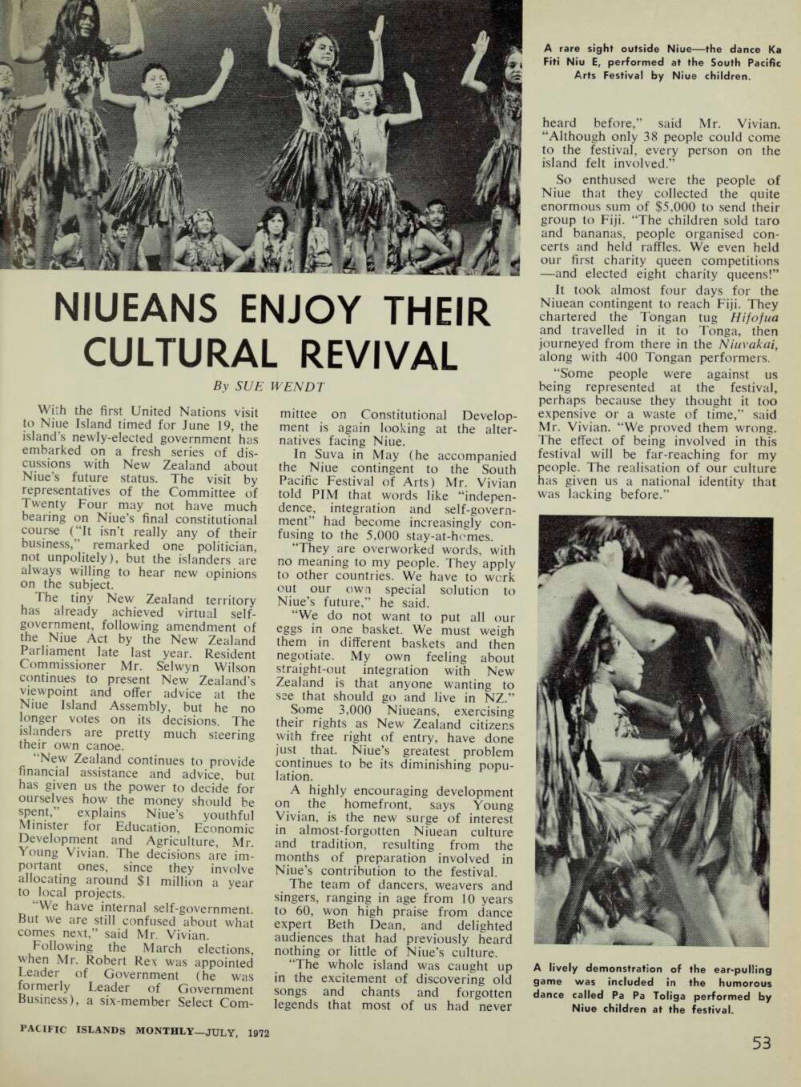
A highly encouraging development on the homefront, says Young Vivian, is the new surge of interest in almost-forgotten Niuean culture and tradition, resulting from the months of preparation involved in Niue’s contribution to the festival, The team of dancers, weavers and singers, ranging in age from 10 years to 60, won high praise from dance expert Beth Dean, and delighted audiences that had previously heard nothing or little of Niue’s culture.
“The whole island was caught up in the excitement of discovering old songs and chants and forgotten legends that most of us had never
heard before,” said Mr. Vivian.
“Although only 38 people could come to the festival, every person on the island felt involved.”
So enthused were the people of Niue that they collected the quite enormous sum of $5,000 to send their group to Fiji. “The children sold taro and bananas, people organised con certs and held raffles. We even held our first charity queen competitions —and elected eight charity queens!”
It took almost four days for the Niuean contingent to reach Fiji. They chartered the T’ongan tug Hifofua and travelled in it to Tonga, then journeyed from there in the Niuvakai, along with 400 Tongan performers.
“Some people were against us being represented at the festival, perhaps because they thought it too expensive or a waste of time,” said Mr. Vivian. “We proved them wrong.
The effect of being involved in this festival will be far-reaching for my people. The realisation of our culture has given us a national identity that was lacking before.”
A rare sight outside Niue—the dance Ka Fiti Niu E, performed at the South Pacific Arts Festival by Niue children.
A lively demonstration of the ear-pulling game was included in the humorous dance called Pa Pa Toliga performed by Niue children at the festival.