fiji talanoa
pp. 50-53 · Read in the full issue

With Sue Wendt, In Suva
Progress provides a problem for policemen and others
NOBODY could accuse Fiji of mark ing time since independence.
The boom-time is upon us —and Fiji is paying the price, with inflation, militant trade unionism, soaring crime and all the other unpleasant side effects of hell-bent development.
Plenty of people would like to see things move a lot faster. A US busi nessman remarked to me recently that Fiji’s big stumbling block was that it still "thinks in hundreds and thous ands of dollars when it talks about overseas investment here. When you start talking millions, some people in government seem to switch right off.
They just don’t want to know,” he
grumbled.
That’s one side of the story, and he’s not the only one to claim that
the machinery facilitating really big
investment, particularly finance from outside the sterling bloc, needs a major overhaul in Fiji. But let's not gainsay the need for caution. Nasty terms like exploitation and foreign control and "incredible profits” are anathema to developing countries.
Playing it cool doesn’t seem such a bad idea, when you’re busy sorting out priorities.
OOME pretty fair sense was espoused in Fiji recently by visiting lecturer from Trinidad, economist Dr.
Lloyd Best (who'd also been to New Guinea). 1 don’t know how popular his ideas are in the West Indies, where he is a founder of a group of young social scientists proposing radical reforms in West Indian society, but when he talked about
Fiji’s own potential, he gave good
advice. The gist of it was that Fiji people had every reason for confi dence in their own ability to cope with the country's problems in their own way. They should be wary of "importing the shibboleths of other countries”, making them think they couldn’t do things themselves.
Not all of what Dr. Best had to say bore much relevance to the Fiji
situation. He was pretty unpopular in some quarters with his talk about the "blinds created by colonial thought and colonial education" and his claim that "colonial mentality” was preventing Fiji from fully utilis ing its wit, resources and intelligence.
And when he urged Fiji to disavow the idea that it is "too poor, too back ward or too black” to manage its own affairs he was obviously quite out of touch with the spirit which moved Fiji to independence.
But there’s something to be said for questioning what Dr. Best called "all the deadly orthodoxy about de velopment, aid and so on”. "Why this mad rush to be like New York?” he asked. Fiji’s problem, as he saw it, was to find a way of "unleashing the native genius and breaking out of development rhetoric”. He called tourism “invitation industrialisation" and said it was a dangerous course to embrace it on a large scale. A slower but safer road for Fiji was to rely on its own resources. The type of tourism that would develop then could be coped with and be part of the natural, organic growth.
ICAN hear the hoots of derision and the shouts of “bunkum” and "bosh” from developers currently pouring millions into Fiji. You can’t halt progress! Of course not, but you can control its direction. The idea that "more and faster is better” isn’t necessarily true for these islands.
Has anyone taken a really serious look at the long-term environmental effect of the new estate for heavy industrial development, just three miles from Suva, for instance? You only have to talk with one of the
social workers from Suva’s rabbit warren Raiwaqa Housing Estate to realise the immense adjustment prob lems facing thousands of young Fijians transplanted into a wholly un familiar environment in the aftermath
of "progress”.
DEOPLE are beginning to question the quality of life in Fiji, though perhaps not the right people and perhaps not loudly enough. In urban areas, the very thing the tourism entrepreneurs are selling so success fully—the life-style of the Fijians—is going the way of the dodo. Fijian leaders are seriously concerned by the Fijian community’s lack of busi ness initiative. The faster Fiji de velops, the faster Fijians have to run to catch up, though what they're running from and what they’re chas ing after begins in the end to repre sent much the same thing.
Perhaps there’s a touch of that "native genius” Lloyd Best talked about in not running too fast. An educationist who visited Viti Levu recently (Viti Levu isn’t Fiji, but it’s an indication of what Fiji can become) was disturbed about various trends, including the number of cars. He suggested that bicycles might be more appropriate if Fiji wanted to avoid the insane pace of some other places. It’s not such a stupid sug gestion. Even New York has its growing army of enlightened souls, pedalling happily and healthily to work each day!
There are various ways of bucking what Lloyd Best termed the "colonial mentality”. I guess he wasn’t think ing of such trivialities as dress —but there’s at least one Fiji citizen who’d like to see the old collar-and-tie
shibboleth disappear from the local scene . . .
Former general manager of the Fiji Visitors Bureau, Rory Scott, a long time advocate of some form of national dress representing all Fiji’s races, was by far the best-dressed man at a recent Suva cocktail party.
The men sweltered in dark suits and out-moded (if they’d been in Fiji long enough) ties. Rory Scott wore no coat and no tie. He looked splendid in a white, obviously Philippines inspired shirt. It featured a Nehru collar for the Indians, splits at the side for the Chinese and two masi patterned inserted strips down the front for the Fijians. Bravo Mr. Scott! /"\NE of the most disturbing aspects of the changing Fiji scene is the soaring crime rate. While our sulu clad policemen remain among the world’s most courteous and certainly most-photographed (tourist-wise) up holders of the law, alleged in efficiency and racial imbalance in the force has become one of the dominion’s most explosive political issues.
Fiji’s House of Representatives was the scene of hot-tempered exchanges between government and opposition members in June, following opposition accusations, of racial bias in the police force and allegations of police mishandling of one of the dominion’s most horrifying murder cases—the death in May of young schoolteacher Evelyn Nair.
Minister for Finance, Mr. Charles Stinson, vigorously denied opposition claims that the police had released news of the discovery of Miss Nair’s body to press and radio before in forming her parents. In reply to opposition demands for the dismissal of the Commissioner of Police and his replacement by a Scotland Yard expert, Mr. Stinson declared that high morale in the force was "a clear indication of the satisfactory leader ship” now existing.
Defending police detection, Mr.
Stinson said that of 18 murders in Fiji since the end of 1970, only two remained unsolved. One of these was the case of Miss Phyllis Furnivall, the Methodist missionary murdered in Suva in December, 1970.
Mr. Stinson also claimed that an Indian police superintendent had stated that opposition member Mr.
Chandra Pillay had told him that the opposition attack on the police force
was directed at "the whites” (three Europeans) in the force. Describing the accusation as grossly untrue, Mr.
Pillay demanded that the police officer be brought before the House to make the allegations in person.
If this wasn’t done, he intended bring ing a motion before the House calling for a judicial inquiry to determine the truth of opposition allegations. (The Deputy Speaker Ratu David Toganivalu later ruled that Mr. Pillay’s
request could not be met unless he adopted formal procedure provided
for in parliamentary standing orders.)
Earlier, opposition member Mr. K.
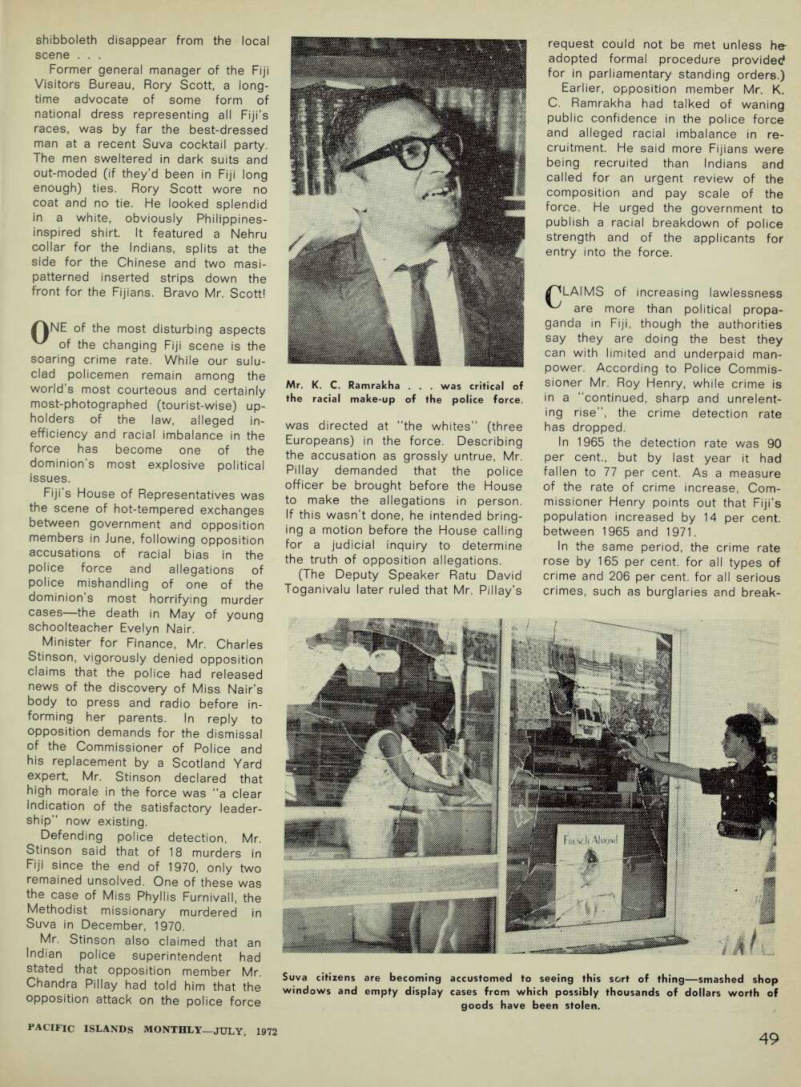
C. Ramrakha had talked of waning public confidence in the police force and alleged racial imbalance in re cruitment. He said more Fijians were being recruited than Indians and called for an urgent review of the composition and pay scale of the force. He urged the government to publish a racial breakdown of police strength and of the applicants for entry into the force. of increasing lawlessness are more than political propa ganda in Fiji, though the authorities say they are doing the best they can with limited and underpaid man power. According to Police Commis sioner Mr. Roy Henry, while crime is in a "continued, sharp and unrelent ing rise", the crime detection rate
has dropped.
In 1965 the detection rate was 90 per cent., but by last year it had fallen to 77 per cent. As a measure of the rate of crime increase, Com missioner Henry points out that Fiji’s population increased by 14 per cent, between 1965 and 1971.
In the same period, the crime rate rose by 165 per cent, for all types of crime and 206 per cent, for all serious crimes, such as burglaries and break
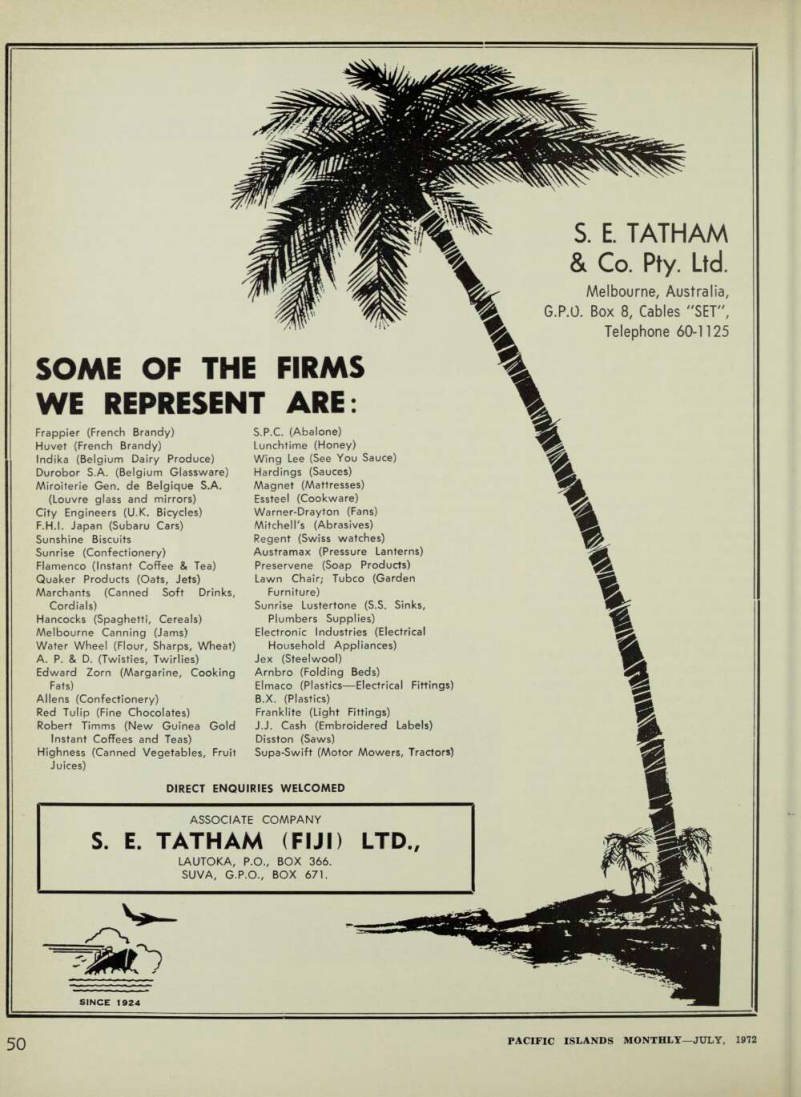
Suva citizens are becoming accustomed to seeing this sort of thing—smashed shop windows and empty display cases from which possibly thousands of dollars worth of goods have been stolen.
Mr. K. C. Ramrakha . . . was critical of the racial make-up of the police force.
ins, assaults and malicious damage.
Commissioner Henry blamed the drop in the detection rate on limited police manpower for preventive and detection duties, but said this was being countered by expansion of the force. Traffic accidents had also increased last year. In the 2,382 re ported accidents, 57 people were killed and 98 seriously injured.
Theft has become almost a way of life in Fiji's urban areas, with break in experts making increasingly large hauls. During a three-week period in May, for instance, it was reported that thieves had stolen $4,000-worth of goods from a Suva store, wrist watches and cameras worth $5,000 from a Lautoka shop (the third raid on the same shop this year), $585 in cash from a Nausori shop and car penters’ tools worth $3OO at Ba.
Two big payroll robberies, one in volving $1,200 snatched from a build ing company employee at Sigatoka and another $1,500 stolen from a lumber company employee at Lautoka, were reported in the same period.
AS a result of the payroll rob beries, a Fiji security company was planning to introduce a new service in June—a payroll pickup-and deliver service, complete with armed security guards and van. “We don’t need a bullet-proof van of course but the guards will be armed,” said Mr. Ray Dunstan, director of General Security Services (Fiji) Ltd.
The company is planning to import a new German breed of guard dog, a cross between a Staghound and a Doberman.
It already offers a night-patrol service for Suva residents willing to pay a few dollars a week for the protection. “We currently service about 20 homes in the Suva area," said Mr. Dunstan. “A man and a dog patrol on foot and we guarantee that they’ll visit each home at least three times a night, at irregular inter vals.”
The home patrol service was estab lished six months ago, after a spate of robberies in the Suva suburb of Lami. So concerned were residents that some actually moved to other suburbs. “The Lami situation has im proved in recent months, I’d say as a direct result of our security ser vice, said Mr. Dunstan. “Even homes which aren't actually on our books benefit from the fact that a security guard patrols the area.”