tobacco in Fiji
p. 59 · Read in the full issue
It needs more than know-how to grow tobacco in Fiji
By R. W. Robson.
For 50 years, or more, successive administrations have been trying to change the communal-living Fijians into individualists farmers and traders and artisans. They have had only limited success.
There is a real problem there for the future governments of Fiji. I found a good example of the prob lem recently when I spent a couple of hours in the beautiful valley of Belanabela with Mr. Don Whelan, a New Zealand farmer who has been managing the Fiji Government’s experimental tobacco-growing settle ment there.
Mr. Whelan has grown tobacco successfully on part of his farm in Nelson, NZ, and—being a bit of a sociologist—he tackled with en thusiasm the job of showing coastal Fijian villagers how to grow tobacco profitably for Fiji’s cigarette manu facturers.
He taught the Fijians a lot about farming techniques. The Fijians taught him a lot about the problem of how to change the habits of a long-established, indigenous race.
This Belanabela Valley, which runs inland from Vatukarasa Village (on the south coast of Viti Levu, between Korolevu Beach and Koro togo) is one of the most attractive I have ever seen. It is broad, lightly wooded, lush and undulating, and a sparkling river runs through it. It is very fertile—almost any tropical or sub-tropical plant will flourish there.
Here, since 1963, a combination of Administration, Agriculture Depart ment, Development Bank, and other government instrumentalities, with Carreras Ltd. of Fiji (tobacco manu facturers) has been working on the establishment of a Fijian farming settlement (now called the Baravi Co-operative Limited) on 250 acres of first-class land. Land was cut up into small blocks of from three to five acres, and between 40 and 50 Fiji farmers, mostly coastal villagers, were settled on these blocks.
In a way rarely equalled, they were encouraged to become primary producers. They were allotted land,
building materials, implements, bul locks, fences, seeds, fertilisers and technical advice on a liberal scale.
Much of it was free and, where pur chase was necessary, low-interest or free loans were made available.
They were encouraged to grow basic foods for their own use, and, for the markets, such things as water melons, maize, rice, passion-fruit.
In the beginning, the new farmers worked with enthusiasm in establish ing their farms, and production was impressive. There was a communal and financially successful piggery.
The settlement was gradually de veloped as a tobacco-growing enter prise, and Carreras Ltd. came into it in a big way, and spent a large sum in the erection, in the valley, of a group of well-equipped buildings for drying and curing tobacco leaf.
To facilitate this development, the settlement was registered as a Co operative Society. The Fijians liked the promptness with which they were paid for their produce.
In the first year of the Co operative, the Fijian growers de livered some 50,000 lb of leaf. Car reras was delighted. But next year the delivery was down to 39,000 lb.;
and year by year, after that, the supply of leaf dwindled.
Year by year, the economic value of this co-operative settlement has become less. Carreras did not get out of the valley the quantity of leaf needed to make the establishment there an effective proposition, and Carreras has in consequence reduced its scope.
Most of the blocks still are occu pied but, while a small proportion of the farmers have repaid or are re paying their loans, and are function ing satisfactorily as producers, a crippling proportion of them have become simply subsistence squatters, and are making little effort to earn, through production, enough money to service their loans.
In so many words, the Baravi Co operative is up against the age-old Fiji habit of laissez-faire.
Probably, the most stultifying factor in Fijian communal life is keri-keri, the rule under which a man must share his personal possessions with his relations and friends. This rule governs hospitality, also.
The house of a Fijian, living among his people, can be invaded at any time by friends and relations, who will share his board and bed in definitely, and carry off most of what they fancy.
Those who have studied the settle ment in the Belanabela Valley say that, while it appears to have had everything in its favour, it has been partially strangled by social laws be yond the control of directors and organisers.
Beravi is quite a comfortable little Fijian settlement—it has had much benefit from a great deal of de velopmental effort money put into it in the last ten years. But, sociologic ally and economically, it is little different from the communal villages which the planners have been trying to eliminate or reform.
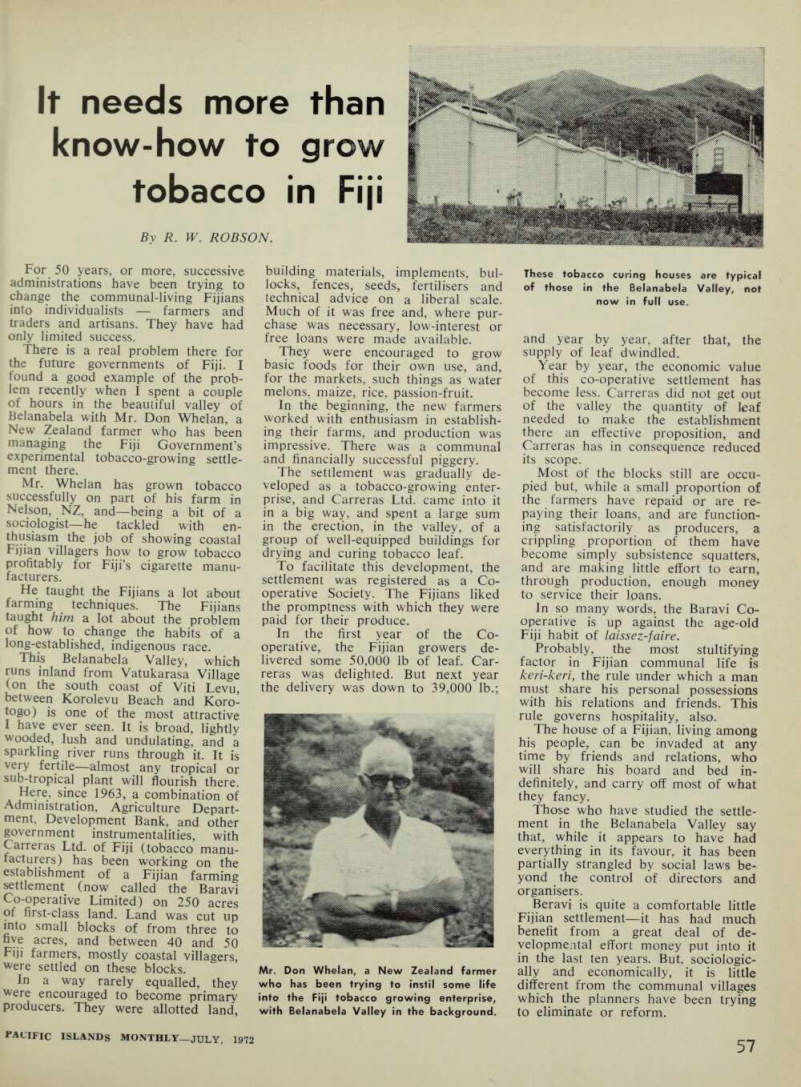
Mr. Don Whelan, a New Zealand farmer who has been trying to instil some life into the Fiji tobacco growing enterprise, with Belanabela Valley in the background.
These tobacco curing houses are typical of those in the Belanabela Valley, not now in full use.